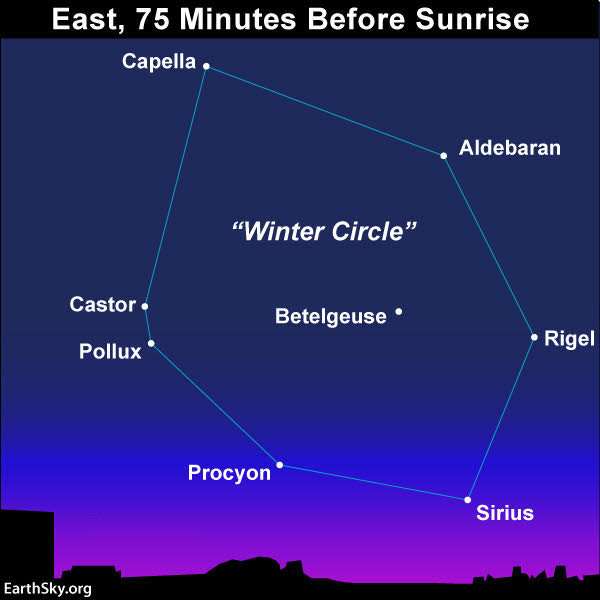
Summer will soon be ending for us in the Northern Hemisphere. Although it’s still hot outside across much of northern Earth, our days are rapidly shortening now and our nights are getting longer. Meanwhile, a classic sign of winter looms large now in the predawn sky, as it does every year at this time.
The Winter Circle – also called the Winter Hexagon – is not a constellation. Instead, it’s an asterism, or recognizable pattern of stars. It consists of six stars in six different constellations. They are all associated with the winter sky for those in the Northern Hemisphere (summer sky for the Southern Hemisphere).
Winter Circle’s 6 (or 7) bright stars
Beloved constellation Orion the Hunter is in the southwest portion of the Winter Circle (lower right on our chart above). If you’ve never seen the Winter Circle but are acquainted with Orion, this constellation presents a great jumping off place for identifying these stars. And it presents a great size comparison too. Orion is big, but the Winter Circle is much bigger!
So look at our chart above and notice the star Rigel in Orion. Then start moving around the Circle clockwise. You’ll encounter Sirius in the constellation Canis Major the Greater Dog, Procyon in the constellation Canis Minor the Smaller Dog, Pollux (and Castor) in the constellation Gemini the Twins, Capella in the constellation Auriga the charioteer and Aldebaran in the constellation Taurus the Bull. Nearly all of the Winter Circle stars are 1st-magnitude stars. And that means they’re bright and easy to see.
The exception is the star Castor in Gemini. It’s not a 1st-magnitude star and not as bright as the other stars in the Winter Circle. But it’s pretty bright! In fact, it’s the sky’s brightest 2nd-magnitude star. If you include Castor as a Winter Circle star, then there are seven stars in the Circle.
When to see the Winter Circle
We don’t see the Winter Circle in June and July because it’s lost in the glare of the sun. However, in late August, the Winter Circle returns to the morning sky. And months from now, when we’re into the Northern Hemisphere’s winter, we’ll see the Winter Circle in the evening sky.
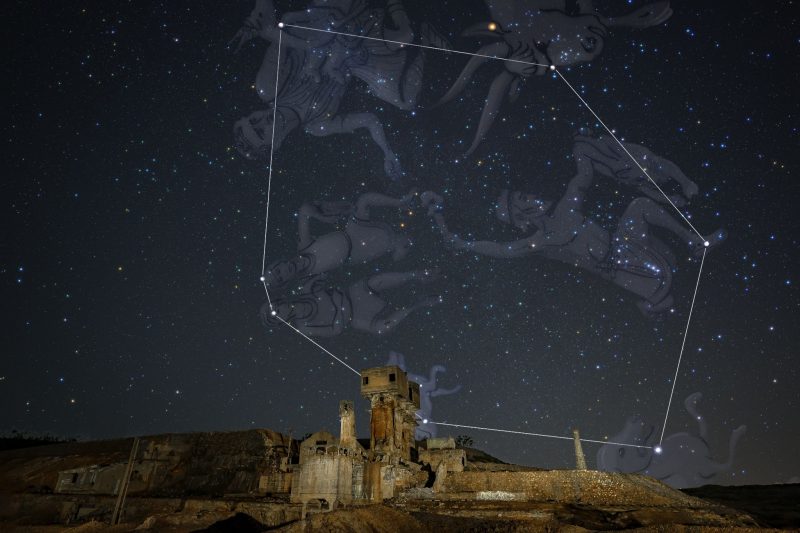
Bottom line: The Winter Circle – or Winter Hexagon – is back in the morning sky. Check it out before dawn. It’s made up of some of our brightest stars from several constellations.
Read more: The return of Sirius in the morning signals seasonal change
Like what you read?
Subscribe and receive daily news delivered to your inbox.
More from
Editors of EarthSky


Comet Halley is parent of 2 meteor showers

Inferior conjunction — Venus! October 23-24, 2026
Mercury after sunset and great for Southern Hemisphere!
Meteor shower guide 2026: Up next … the Orionids