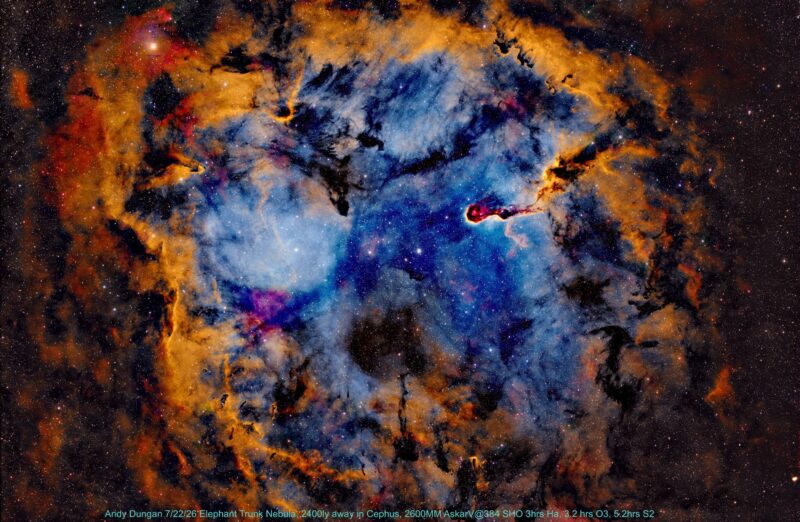
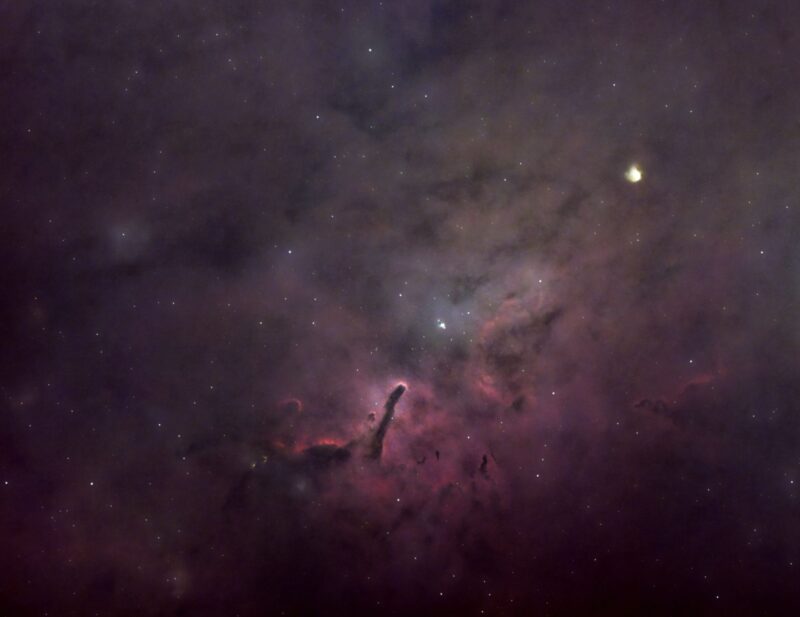
View at EarthSky Community Photos. | Andy Dungan near Cotopaxi, Colorado, captured this telescopic view of the Elephant’s Trunk Nebula, in the constellation Cepheus, on July 22, 2026. Andy wrote: “IC1396 consists of the entire region in this pic. IC1396A is just the Elephant’s Trunk (can you find it, look for the red thing that looks like a club or the end of an elephant trunk).” Thank you, Andy! See more deep-sky photos from July 2026 below.
The EarthSky community has many talented astrophotographers who capture stunning images of the deep sky. We gathered some of our favorite deep-sky photos from July 2026 for you to enjoy. Do you have images of your own to share? You can submit them to EarthSky here. We’d love to see them and share them!
Deep-sky photos of diffuse nebulae
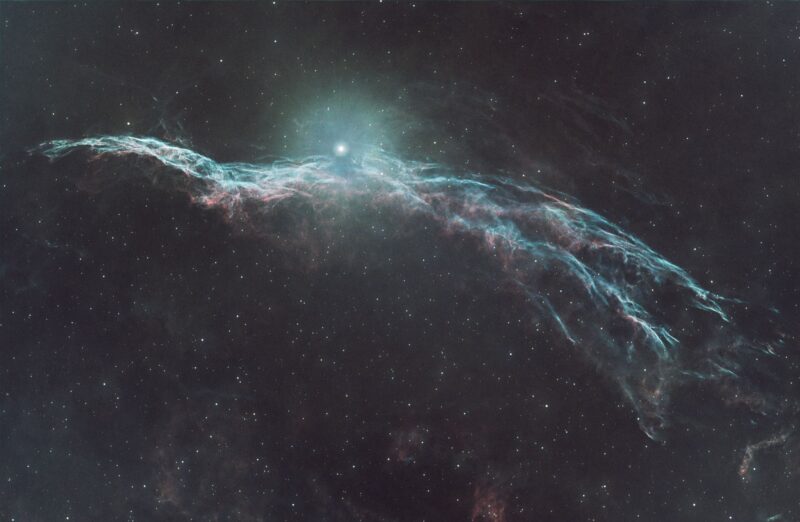
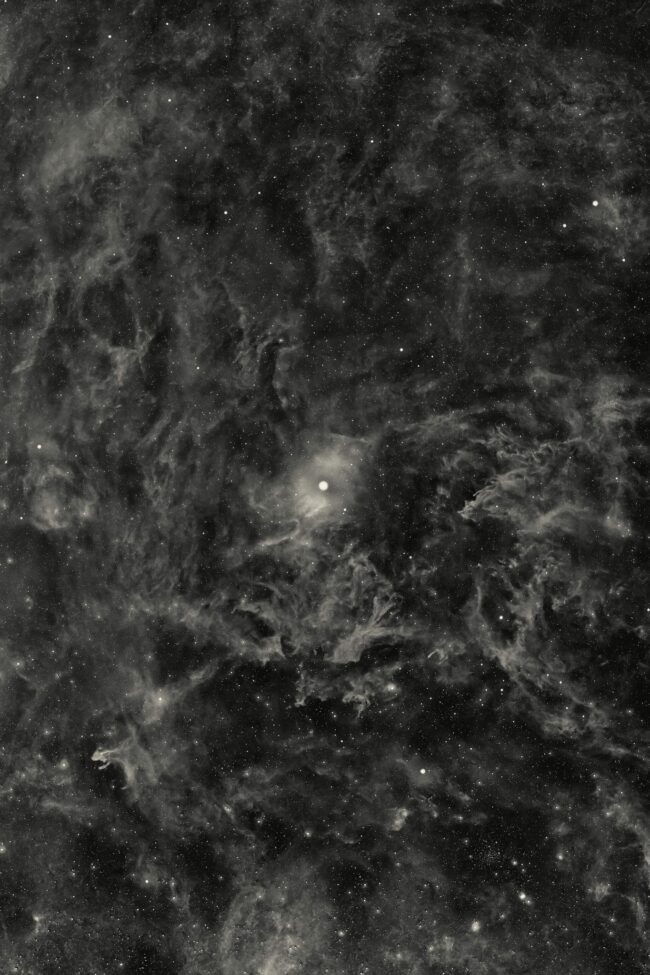
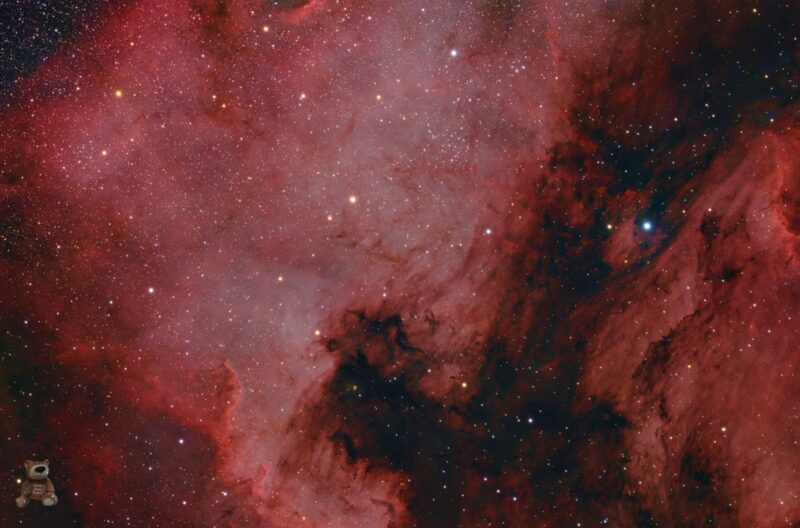
View at EarthSky Community Photos. | Catherine Hyde in Cambria, California, captured a part of the Veil Nebula, in the constellation Cygnus, on July 24, 2026. Catherine wrote: “NGC 6960, the Western Veil Nebula. It’s a supernova remnant in the constellation Cygnus. The very bright star is 52 Cygni. This is about 8 hours of 180-second images, stacked.” Thank you, Catherine!View at EarthSky Community Photos. | Steven Bellavia in Smithfield, Virginia, captured this telescopic view of the sky near the star Polaris, in the constellation Ursa Minor, on July 14, 2026. Steven wrote: “Almost all astrophotographers start with their scope pointing at or near Polaris, the North Star. So I decided to stick around this part of the sky for a while, and capture the integrated flux nebula (IFN) around it, along with some other nice deep space objects.” Thank you, Steven!View at EarthSky Community Photos. | EarthSky’s own Marcy Curran in Cheyenne, Wyoming, captured this telescopic view of a wide nebular complex in the constellation Cygnus on July 16, 2026. Marcy wrote: “I always look for the North America Nebula in my binoculars when I’m out stargazing. It’s easy to spot and covers a large area of the sky. It’s too large to get all of it in my telescope so I decided to get as much of it as I could and include part of the Pelican Nebula too. Summer nebulae are so fun to photograph.” Thank you, Marcy!
More deep-sky photos of diffuse nebulae
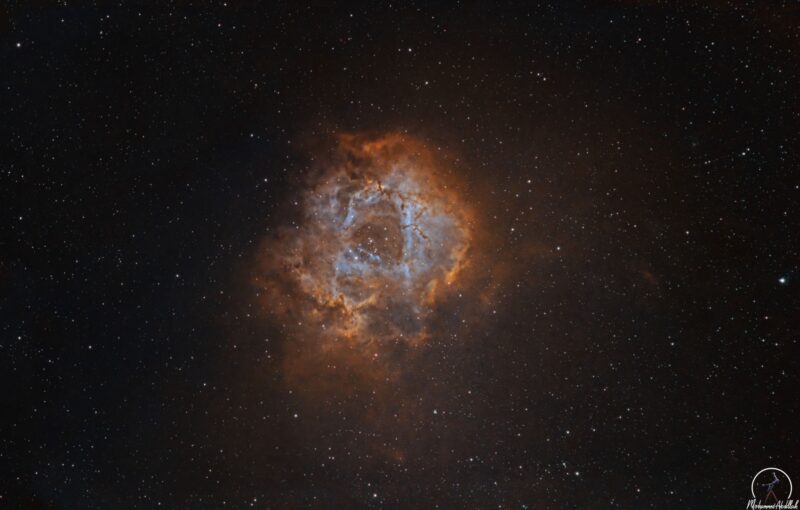
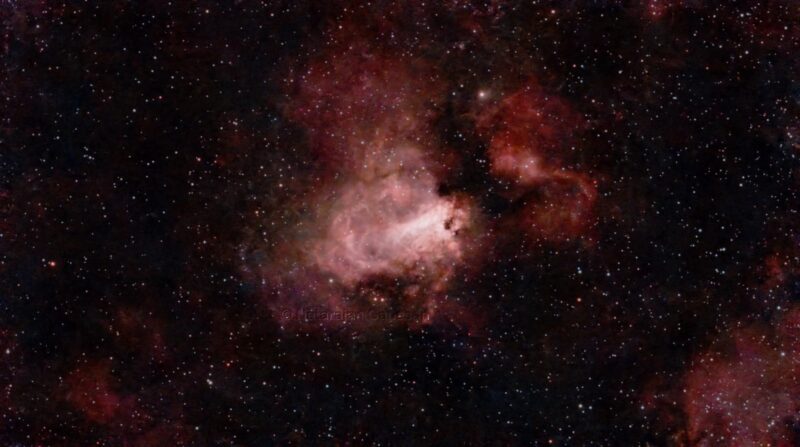
View at EarthSky Community Photos. | Mohammed Abdallah in Suez, Egypt, sent us this reprocessed composite of the Rosette Nebula on July 5, 2026, using data acquired previously. Mohammed wrote: “I want to talk about colors in space. The eyes mostly see the red (hydrogen alpha) since it’s the dominant color in emission nebulae, and the other colors have to be assigned false colors. That’s why we use Hubble palette and the other well-known palettes to be able to assign other gases we can’t see.” Thank you, Mohammed!View at EarthSky Community Photos. | Natarajan Ganesan in Jonesboro, Arkansas, captured this telescopic view of the Swan Nebula, in the constellation Sagittarius, on July 11, 2026. Natarajan wrote: “Capturing the details of the Swan Nebula (M17) turned into a tense game of peek-a-boo with fickle summer clouds, but managed to pull this off from 58 minutes of data.” Thank you, Natarajan!
And more diffuse nebulae
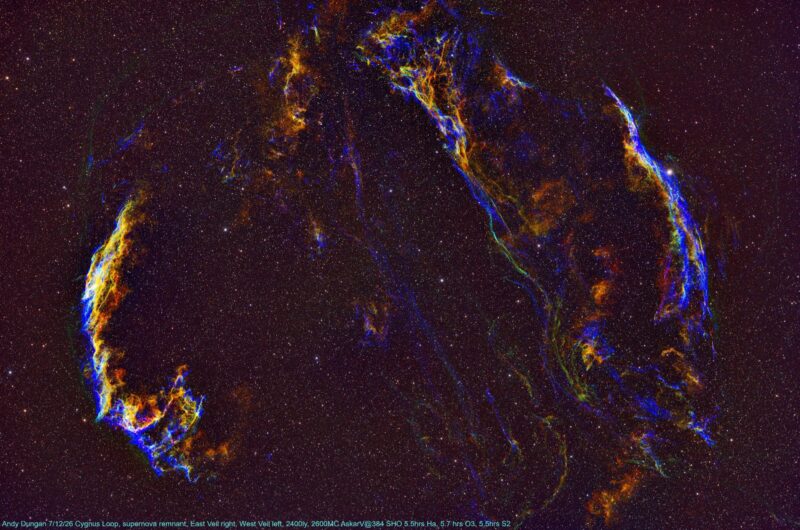
View at EarthSky Community Photos. | Andy Dungan near Cotopaxi, Colorado, captured this telescopic view of the Veil Nebula and its surroundings on July 12, 2026. Andy wrote: “The Veil Nebula is an exciting part of what is found in Cygnus. It is a supernova remnant (meaning a star that exploded). I took a wide view (384 mm) so what is called the Cygnus loop could be seen. The right hand side is the East Veil Nebula and the left hand side is the West Veil Nebula. These are often photographed individually.” Thank you, Andy!View at EarthSky Community Photos. | Catherine Hyde in Cambria, California, captured this telescopic view of emission nebula NGC 6820 on July 15, 2026. Catherine wrote: “This is NGC 6820 in the constellation Vulpecula. It’s one of my favorites with its very distinctive single pillar. I took this over 2 nights, gathering about 6.5 hours of data per night.” Thank you, Catherine!
Bottom line: Enjoy this gallery of deep-sky photos from July 2026 by our EarthSky community. If you have a great photo to share, we’d love to see it!
Armando is known primarily as an astronomy educator, after 30+ years of extensive public outreach and 10 years teaching in colleges. As one of only a handful of science communicators in Puerto Rico during Comet Halley's last visit, he assumed a pioneering role starting in 1985 when science was just beginning to enter the collective mindset. Over the years, his work as a teacher, speaker and writer, inspired people to pursue interests in science and brought enduring change to Puerto Rican culture. After being accepted into the 2014–2015 Antarctic season of PolarTREC, Armando was assigned to the Amundsen-Scott South Pole Station, where in 2015 he successfully conducted 10 days of work at the IceCube Neutrino Observatory. His affiliations include Ana G. Méndez University, Cupey campus (2014 to 2021), the University of Puerto Rico, Aguadilla campus (2015 to 2017), NASA JPL's Solar System Ambassadors (2004 to 2006), and NASA Space Grant (2017 to 2019) where he served as an affiliate representative.
Like what you read? Subscribe and receive daily news delivered to your inbox.
Thank you! Your submission has been received!
Oops! Something went wrong while submitting the form.