Sun news September 30: Near-M flare! Sun waking up?
Our star surprised us again over the past day. This time the sun’s activity lull was broken by a near-M flare from sunspot region AR4535. The blast, a fiery C8.6, peaked at 2:46 UTC on September 30. We can clearly see a huge chunk of solar stuff was sent to space by this eruption. Modeling and analysis is underway to see if this blast could be heading to Earth. We have been observing this sunspot region, AR4535, since it developed a gamma magnetic complexity, and it’s now showing an even-more-promising beta-gamma configuration. A spark like this is what we have all have been expecting from this region. Is this AR4535 — and the sun — waking up?Past 24 hours on the sun
(11 UTC September 29 – 11 UTC September 30)
Flare activity: Solar activity continued at low levels during the past 24 hours, but the near-M flare increased flare activity almost to moderate levels. We have not seen an actual M flare since September 5. Observers registered 5 flares in total: 3 C-class (common) and 2 B-class (weak).- Strongest flare: A C8.6 from AR4535, peaking at 2:46 UTC on September 30.
- Lead flare producer: There is a newcomer in the northeast that dominated, firing three of the five flares: two Cs and one B flare.
- AR4535 (beta-gamma magnetic complexity): This region surprised with an almost-M flare during the period.
- AR4544 (beta): Newcomer numbered during this period. Remained inactive.
Past 24 hours in space weather
Solar wind: Solar wind speeds held at low at background levels as the coronal hole high-speed stream waned. Bt, Bz and magnetic coupling: The total interplanetary magnetic field stayed weak but we saw some moderate peaks during the period. Meanwhile, once again, the north-south component (Bz) pointed mostly southward for the entire period. Earth’s magnetic field: Geomagnetic activity continued at very quiet levels during this period. Kp index ranged from 0 to 1. At the time of this report, the Kp index sits at level 1.
Sun news September 29: Huge eruption sends blob to Earth!


Yesterday, amid a period of solar calm, the sun took us by surprise. A huge eruption blasted from a filament in the northwest. The filament began lifting plasma at around 13 UTC and ended in a powerful eruption. That fiery blast hurled plasma into space as a chunk of solar stuff, known as a coronal mass ejection (CME). Early analysis suggests part of it may head straight for Earth, with arrival estimated by October 2. If it does, it could disturb Earth’s magnetic field up to G1 (minor) geomagnetic storm levels. That could trigger auroras at northerly latitudes.Past 24 hours on the sun
(11 UTC September 28 – 11 UTC September 29)
Flare activity: Solar activity stayed low during the past 24 hours. Observers recorded 8 faint flares in total: 3 C-class (common) and 5 B-class (weak).- Strongest flare: A C2.5 from AR4536, peaking at 15:19 UTC on September 28.
- Lead flare producer: AR4536 dominated, firing seven of the eight flares: 3 Cs and 4 Bs. In fact, it would have produced every flare of the period, if not for a single faint B flare from an as-yet-unnumbered newcomer.
- AR4535 (beta-gamma): This region grew during the period and developed a gamma magnetic complexity. Even so, it produced no flares.
- AR4536 (beta): This region produced nearly every flare of the period. However, by the time of this writing, the sun’s rotation has carried it out of view over the west limb.
Past 24 hours in space weather
Solar wind: Solar wind speeds held at low, background levels as the coronal hole high-speed stream waned. Bt, Bz and magnetic coupling: The total interplanetary magnetic field (Bt) stayed weak. Meanwhile, the north-south component (Bz) pointed mostly southward for the entire period, with only a couple of weak northward peaks. At the time of this writing, it still points south. Earth’s magnetic field: Geomagnetic activity stayed quiet (Kp 0 to 2) during the period. At the time of this report, the Kp index sits slightly above level 0.Sun news September 28: Fast solar wind fades, quiet sun returns
The sun is taking a breather. Solar activity dropped to low levels over the past 24 hours, with only small C-class (common) flares popping off from a handful of modest sunspot regions. And conditions are quiet around Earth too, with fast solar wind from a coronal hole finally ceasing to disturb our planet’s magnetic field. Forecasters expect this tranquil stretch to continue for the next few days.Past 24 hours on the sun
(11 UTC September 27 – 11 UTC September 28)
Flare activity: Solar activity stayed low. Observers recorded several small C-class flares during the period.- Strongest flares: We saw only C1-level flares, from AR4534, AR4535 and AR4536.
- Lead flare producer: AR4535 and AR4536 shared the low-level flaring. AR4534, sitting at the west limb, also contributed as it rotated out of view.
- AR4534: This region fired the strongest recent flare, a C3.1. However, it now sits at or behind the west limb. So its Earth-facing influence is effectively over.
- AR4535 (beta): This is the most notable region left near the center of the disk. Forecasters noted additional spot development during the period. Still, its simple beta configuration limits its flare potential.
- AR4536 (beta): This region is approaching the west limb. It produced small C-class flares but will soon rotate out of view.
Past 24 hours in space weather
Solar wind: Solar wind speeds gradually decreased to background conditions as the coronal hole high-speed stream waned. Bt, Bz and magnetic coupling: The total interplanetary magnetic field (Bt) stayed weak. Meanwhile, the north-south component (Bz) fluctuated between northward and southward. Earth’s magnetic field: Geomagnetic activity reached unsettled to active levels (Kp 3 to 4) early on, driven by the tail end of the coronal hole stream. Conditions then calmed to mostly quiet (Kp 0 to 2). No geomagnetic storms occurred.Sun news September 27: Fast solar wind might brush Earth
A small coronal hole high-speed stream could brush Earth early today. Forecasters at both NOAA and the UK Met Office give a slight chance of G1 (minor) geomagnetic storm conditions if the connection materializes. That would put aurora on the table for observers at high latitudes, including northern Scotland and similar geomagnetic latitudes. Meanwhile, the sun itself is running quiet. Solar activity stayed at low levels over the past day, with only C-class and B-class flares. The most active region, AR4534, has now rotated behind the west limb. Observers detected no Earth-directed coronal mass ejections (CMEs). So today’s geomagnetic activity will come from the wind, not a blast from the sun. Looking ahead, activity should dip further in the coming days. Still, forecasters keep a slight chance for an isolated M-class flare through September 28. Stay tuned!Past 24 hours on the sun
(11 UTC September 26 – 11 UTC September 27)
Flare activity: Solar activity stayed low. Observers recorded 15 flares during the period: 7 C-class and 8 B-class.- Strongest flare: A C3.1 from AR4534 (N08W89), peaking at 16:55 UTC on September 26. The region sat right on the west limb at the time. The flare produced no radio blackout, since C-class events are too weak to cause disruption.
- Other notable flares: A C1.9 from AR4536 peaked at 04:37 UTC on September 27. AR4534 also fired a C1.6 at 13:27 UTC and a C1.4 at 21:09 UTC, both on September 26, among others.
- Lead flare producer: AR4534 fired 9 of the 15 flares (4 C-class, 5 B-class). AR4536 contributed the remaining 6 (3 C-class, 3 B-class).
- AR4534 (beta): Located at N10W90, this region was the period’s most prolific flare producer. It fired the strongest flare, the C3.1, along with multiple C- and B-class events. However, it has now rotated out of view over the west limb.
- AR4536 (beta): This region ranked as the second most active, producing six flares, including the C1.9. It sits in the southern hemisphere and warrants monitoring. Notably, it regained a beta configuration after dropping to alpha yesterday.
- The remaining active regions kept simple alpha or beta configurations. They remained stable or decayed and produced no notable flaring.
Past 24 hours in space weather
Solar wind: Solar wind speeds gradually declined from a peak of about 500 to 550 km/s down to around 450 km/s by the end of the period. That decline reflects the waning influence of a coronal hole high-speed stream. Bt, Bz and magnetic coupling: The total interplanetary magnetic field (Bt) remained low. Meanwhile, the Bz component fluctuated between between northward and southward directions. Several southward intervals drove brief unsettled conditions. Earth’s magnetic field: Geomagnetic activity ranged from quiet to active levels, with Kp at 1 to 4, as the coronal hole stream’s influence diminished. No geomagnetic storms occurred.What’s ahead? Sun–Earth forecast
Flare activity forecast: Forecasters expect low to very low solar activity. C-class flares are likely. A slight chance (10%) exists for an M-class flare, with R1-R2 (minor to moderate) radio blackouts, on September 27 and 28. Activity should then decrease to very low levels by September 29. Geomagnetic activity forecast:- September 27: Expect quiet to unsettled conditions. A slight chance exists for a G1 (minor) storm early in the day, if Earth connects with fast solar wind from a negative-polarity coronal hole. Aurora could then briefly appear over northern Scotland, northern Scandinavia, or similar high geomagnetic latitudes. The greater than 2 MeV electron flux should stay at high levels.
- September 28: Mostly quiet conditions should prevail as coronal hole stream effects subside. Solar wind should return to near-background levels.
- September 29: Expect quiet geomagnetic conditions. Solar activity may drop to very low levels. No solar radiation storms are anticipated.
Sun news September 26: Fast solar wind still stirring Earth’s magnetic field
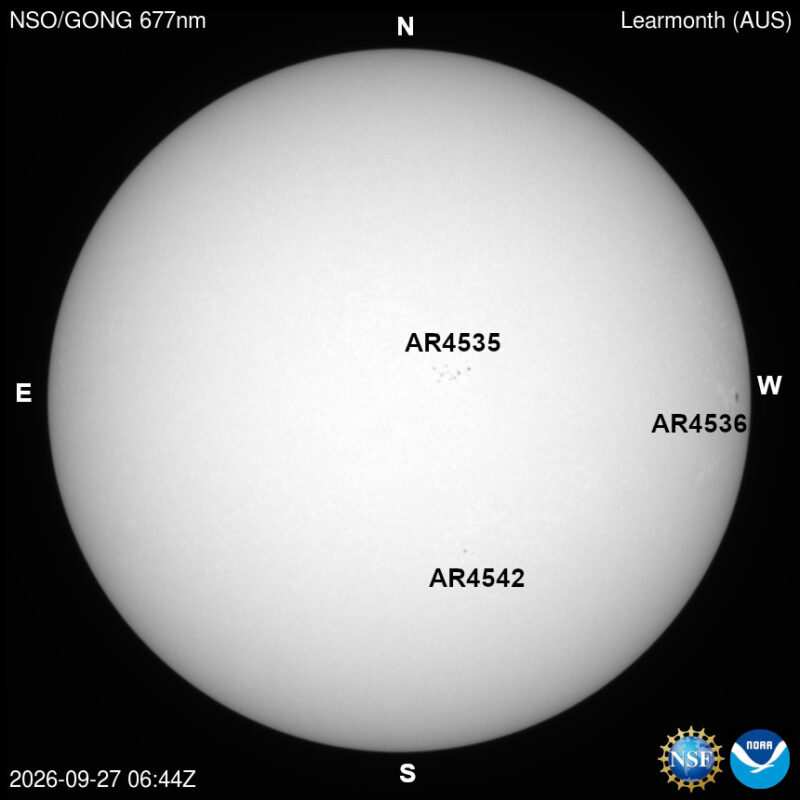
The fast solar wind from a coronal hole that arrived yesterday is still going. It held conditions at Kp 4 for most of the past day, meaning Earth’s magnetic field has been experiencing active, unsettled conditions, sitting just below the geomagnetic storm threshold. Still, there were auroral displays at high latitudes last night. And we hear from many people who say that this sort of activity from the sun causes headaches, mood swings, and sleep disturbances. Is it true? What does the science say? EarthSky’s Deborah Byrd and heliophysicist C. Alex Young had a fascinating discussion about this subject in this video.Past 24 hours on the sun
(11 UTC September 25 – 11 UTC September 26)
Flare activity: It’s been a quiet week on the sun. Solar activity stayed at very low levels over the past day, with mostly B flares and just one C flare. The tally from the past day was one C-class and four B-class (weak).- Strongest flare: A C1.2 from AR4534, peaking at 18:30 UTC on September 25.
- Lead flare producer: AR4536 topped the list again, this time with two B flares.
- AR4533 (beta): This region held its beta configuration and produced no flares.
- AR4535 (beta): This region produced one faint B flare.
- AR4536 (alpha): This region lost its delta completely. In fact, its configuration dropped from beta to a simpler alpha. It still produced two B flares.
- AR4537 (beta): This region produced one B flare.
- AR4542 (alpha): This region produced no flares.
Past 24 hours in space weather
Solar wind: Solar wind speeds kept climbing from moderate to moderate-high levels through the period. Continued effects from the coronal hole high-speed stream drove this environment. By the end of the period, though, speeds began to decline as the stream waned. Bt, Bz and magnetic coupling: The total interplanetary magnetic field (IMF) started at strong levels. It then slowly eased to weak strength by the end of the period. Meanwhile, the north-south component (Bz) showed a few northward peaks. For most of the period, however, it pointed south. Those long southward stretches helped magnetic coupling with Earth’s field, which is why auroras appeared at high latitudes. Earth’s magnetic field: Geomagnetic activity ranged from quiet-to-active levels, with the Kp index at 2 to 4. Kp 4 dominated, holding for nearly four three-hour synoptic periods. Conditions reached that threshold several times, starting at 11 UTC on September 25. At the time of this writing, the Kp index sits right at level 4.
Sun news September 25: Fast wind arrives, auroras up north
The anticipated stream of fast solar wind from a coronal hole arrived over the past day. However, it only stirred Earth’s magnetic field to active levels, just shy of the expected G1 (minor) geomagnetic storm. However, far-northerly latitudes still saw auroras, as you can see above. That was likely helped by the Russell-McPherron effect, which explains why we see more auroras around the equinoxes.Past 24 hours on the sun
(11 UTC September 24 – 11 UTC September 25)
Flare activity: Solar activity continued at low levels over the past day. Notably, flare production dropped to just three flares, compared to six yesterday. This period’s tally: one C-class and two B-class (weak).- Strongest flare: A C1.2 from AR4536, peaking at 2:44 UTC on September 25.
- Lead flare producer: AR4536 topped the list with two flares: the period’s only C flare plus one B flare.
- AR4533 (beta): This region showed some growth. Its complexity also increased, from alpha yesterday to beta today.
- AR4535 (beta): This region gained some strength during the period. It produced one faint B flare.
- AR4536 (beta-delta): This region kept growing and developed a delta magnetic complexity. It also produced the period’s only C flare. That delta makes it a candidate for stronger flares. This guy is worth watching.
- AR4537 (beta): This region showed growth but stayed stable, with no flares.
- AR4538 (beta): This region stayed stable and produced no flares.
- AR4539 (alpha): This region stayed stable and produced no flares.
- AR4542 (alpha): This region emerged from nowhere in the middle of the southeast quadrant. It looks stable so far, with no flares.
Past 24 hours in space weather
Solar wind: Solar wind speeds increased from low to moderate, then moderate-high levels through the period. The arrival of a coronal hole high-speed stream drove this rise. Bt, Bz and magnetic coupling: The total interplanetary magnetic field (IMF) increased to moderate and then strong levels. At the time of this writing, it sits at moderate strength. Meanwhile, the north-south component (Bz) pointed southward for the entire period. As always, long southward stretches like this help magnetic coupling with Earth’s field. So auroras could follow under these conditions. Earth’s magnetic field: Geomagnetic activity ranged from very quiet to active levels, with the Kp index at 0 to 4. At the time of this writing, the Kp index sits just below level 4.
Sun news September 24: Fast solar wind has started to arrive
A stream of fast solar wind from a coronal hole has started to reach Earth’s magnetic field. Solar wind speeds have already climbed to moderate-low levels, and the trend points higher. As a result, we could see G1 (minor) geomagnetic storms today. The source is the large coronal hole we’ve been watching. It launched this fast wind straight toward Earth a couple of days ago, and that wind is only now reaching us. So Earth’s magnetic field should stay disturbed at active levels through tomorrow, September 25. That means auroral displays are possible. Clear skies!Past 24 hours on the sun
(11 UTC September 23 – 11 UTC September 24)
Flare activity: Solar activity stayed at low levels. Over the past day, the sun produced six flares: three C-class and three B-class (weak).- Strongest flare: A C1.7 from AR4537, peaking at 11:31 UTC on September 23.
- Other notable flares: A C1.1 from AR4538 at 15:32 UTC on September 23. Then a C1.0 from AR4536 at 21:25 UTC the same day. The rest were faint B flares.
- Lead flare producer: AR4537 and AR4538 ended tied at the top of the list, with two flares each.
- AR4533 (alpha magnetic complexity): This region sits in the southeast quadrant. It showed minor activity.
- AR4534 (beta): This region showed signs of decay. It produced no flares.
- AR4535 (beta): This region gained some strength during the period. It produced one faint B flare.
- AR4536 (beta): This region kept growing. It also produced one C flare.
- AR4537 (beta): This region fired the strongest flare of the period, the C1.7.
- AR4538 (beta): This region grew as well. It ranked among the period’s C flare producers.
- AR4539 (beta): This region stayed stable and produced no flares.
Past 24 hours in space weather
Solar wind: Solar wind speeds increased from low to moderate-low levels through the reporting period. The trend suggests they may keep climbing. The arrival of a coronal hole high-speed stream is driving the rise. Bt, Bz and magnetic coupling: The total interplanetary magnetic field increased to moderate strength. Meanwhile, the north-south component (Bz) pointed completely northward during the first half of the period. Then, around 0 UTC this morning, it turned south. It has stayed south through the time of this writing. As always, a southward Bz helps magnetic coupling with Earth’s field. So auroras could follow under these conditions. Earth’s magnetic field: Geomagnetic activity ranged from very quiet to unsettled levels, with the Kp index at 0 to 3. At the time of this writing, the Kp index sits at level 2.
Sun news September 23: Solar wind gust could spark auroras
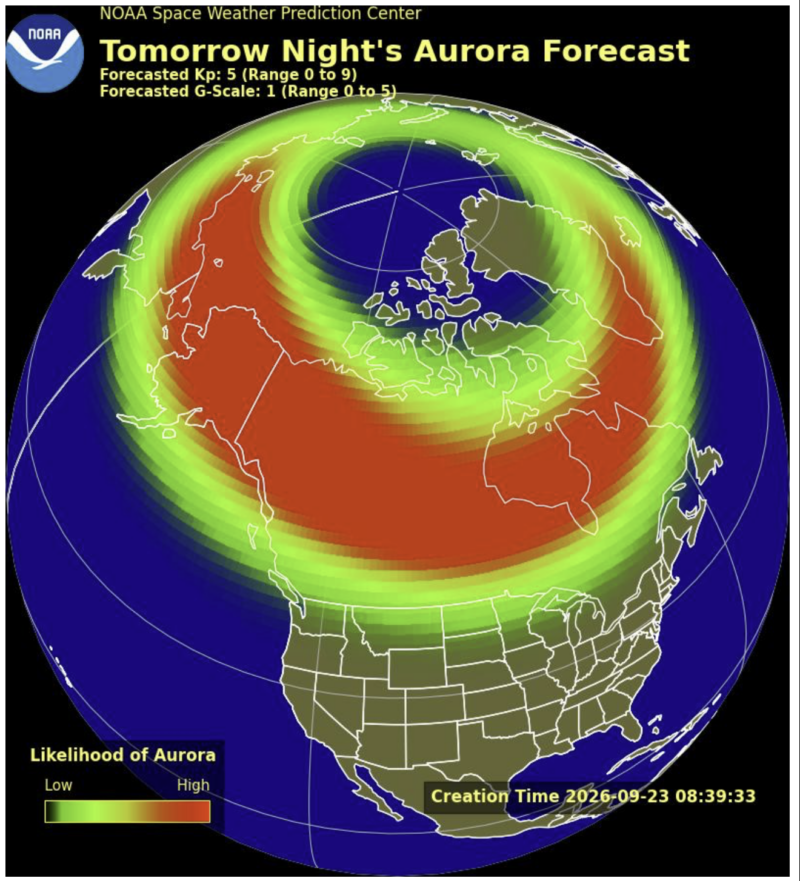
NOAA’s Space Weather Prediction Center has issued a G1 (minor) geomagnetic storm alert today due to a stream of fast solar wind from a coronal hole reaching Earth. The first signs of that high-speed solar wind should show up later today, and effects might extend through September 24 and 25. Could this trigger auroras? Well, auroras are more likely around equinoxes, and the September equinox arrived just yesterday evening … so possibly! Read about aurora seasons here.Past 24 hours on the sun
(11 UTC September 22 – 11 UTC September 23)
Flare activity: Solar activity stayed at low levels over the past day. However, flare production increased compared to the previous day. The sun produced nine flares, versus four yesterday. This period’s tally: three C-class and six B-class (weak).- Strongest flare: A C2.4 from AR4534, peaking at 17:20 UTC on September 22.
- Other notable flares: A C1.1 from AR4536 at 17:58 UTC on September 22. Then a C1.4 from AR4535 at 6:21 UTC on September 23. The rest were faint B flares.
- Lead flare producer: AR4535 led the list with four flares during this period: one C flare plus three B flares.
- AR4533 (alpha magnetic configuration): This region sits in the southeast quadrant. It showed minor activity.
- AR4534 (beta): This region remains a flare producer. It sparked one of the period’s C flares plus a B flare. However, it appears to have lost the delta magnetic configuration it developed earlier this week.
- AR4535 (beta): This region stayed active throughout the period. It produced one of the three C flares.
- AR4536 (beta): This region has continued growing since it appeared yesterday. Today it produced one C flare.
- AR4537 (beta): This region showed an increase in magnetic complexity. It produced one B flare.
- AR4538 (beta), AR4539 (beta), and AR4540 (alpha): These regions received their numbers this period but stayed stable. Only AR4539 produced a B flare.
Past 24 hours in space weather
Solar wind: Solar wind speeds averaged low levels through the reporting period, under the waning influence of a previous coronal hole high-speed stream. For now, there’s no significant space weather to report. But that may change in the next few hours, with the arrival of fast solar wind from a newer coronal hole. Bt, Bz and magnetic coupling: The total interplanetary magnetic field stayed weak. Meanwhile, the north-south component (Bz) kept shifting between southward and northward in short intervals for most of the period. Then, at around 2:30 UTC this morning, it turned north and has held there until the time of this writing. Short-lived southward Bz doesn’t help magnetic coupling with Earth’s field, so auroras may not occur under these conditions. All of that may change in the coming hours. Earth’s magnetic field: Geomagnetic activity remained at very quiet levels. The Kp index held at 0 for most of the period.
Sun news September 22: 3 events to notice on today’s sun
It’s almost the equinox; the sun crosses the celestial equator at 7:05 p.m. CDT today (00:05 UTC on September 23). And today three sun events join the equinox party. They are: the return of sunspot regions to the Earth-facing side of our star, the return of C-class (common) flares and a coronal hole reaching geoeffective position. Read about these events below. All three could participate in producing auroras in the coming days, which, by the way, have a their own favorable season of activity, twice a year, at the spring and fall equinoxes. Why an aurora season? It’s due to magnetism, geometry and something called the Russell-McPherron effect. Read about aurora seasons here. Happy equinox!Past 24 hours on the sun
(11 UTC September 21 – 11 UTC September 22)
Flare activity: Solar activity continued at low levels over the past day. But we did have a C flare! The sun produced 4 flares during the period: 1 C-class and 3 B-class (weak).- Strongest flare: A C2.0 from AR4536, peaking at 4:51 UTC on September 22.
- Other notable flares: A B6.8 at 11:17 UTC on September 21 from AR4535. Active region AR4534 produced the other two B flares of the period, a B6.5 at 23:57 UTC on September 21 and a B6.6 at 3:09 UTC on September 22.
- Lead flare producer: AR4534 continues to dominate, producing 2 of the 4 flares of the period. AR4535 and AR4536 contributed the rest.
- AR4533 (alpha) sits in the southeast quadrant. It showed minor activity.
- AR4534 (beta) lost its delta during the period and now shows a simpler beta configuration. It remains lead flare producer.
- AR4535 (alpha), a newcomer, produced a B flare today.
- Two additional regions sit on the disk. Newcomer AR4536 (beta) in the center of the solar disk, showed rapid growth and produced the strongest flare. AR4537 (beta) in the northwest stayed small, simple and stable throughout the period.
Past 24 hours in space weather
Solar wind: The solar wind speeds gradually decreased to moderate-low and low levels through the reporting period. This decline fits the waning influence of a previous coronal hole high-speed stream. Bt, Bz and magnetic coupling: The total interplanetary magnetic field was weak. Meanwhile, the north-south component (Bz) showed southward directions for most of the period. At around 4 UTC this morning, the Bz component turned north to stay there until the time of this writing. A continued south Bz contributes to magnetic coupling with Earth’s field and therefore auroras. Earth’s magnetic field: Geomagnetic activity remained at quiet levels. Kp index 0 – 2. At the time of this writing the Kp index sits just above 0 level.Sun news September 21: Promising sunspot group AR4534 is growing
The sun is keeping a low profile right now. Solar activity stayed at low levels over the past 24 hours, with only C-class flares popping off from a couple of active regions. But one region near the solar disk’s center is getting more interesting by the day. The region, AR4534, has been developing rapidly. Observers note a proliferation of sunspots and a complex delta magnetic configuration forming. The greater a sunspot group’s magnetic complexity, the greater the chance that it will fire off some big flares. We’ll keep watching this region.Past 24 hours on the sun
(11 UTC September 20 – 11 UTC September 21)
Flare activity: Solar activity stayed low. The sun produced 11 flares during the period: 3 C-class and 8 B-class.- Strongest flare: A C3.7 from AR4534, peaking at 22:34 UTC on September 20.
- Other notable flares: Two more C-class flares occurred, both from AR4534: a C1.1 peaking at 1:13 UTC and a C1.2 peaking at 6:29 UTC on September 21.
- Lead flare producer: AR4534 dominated, producing 9 of the 11 flares. AR4532 and AR4533 contributed the rest, all B-class.
- AR4532 (beta): This region sits in the southwest quadrant. It showed minor growth during the period. It also produced one B7.8 flare, peaking at 21:43 UTC on September 20.
- AR4533: This region produced two B-class flares during the period, a B8.0 and a B5.0. Otherwise, it stayed stable.
- AR4534 (beta-delta): The star of the show sits near the disk’s center. It showed minor growth and a rapidly developing, increasingly complex magnetic structure. Forecasters note a proliferation of spots throughout the region. Moreover, a delta configuration has formed within its northern intermediate portion. AR4534 produced 9 of the period’s 11 flares, including the strongest, the C3.7.
- AR4535 (alpha): A newcomer! This region rotated into view in the northeast quadrant. Its alpha classification means it has a simple magnetic structure for now.
- Two additional regions sit on the disk. They stayed small, simple, and stable throughout the period.
Past 24 hours in space weather
Solar wind: The solar wind environment remains undisturbed. Speeds gradually decreased to normal through the reporting period. This decline fits the waning influence of a previous coronal hole high-speed stream. Bt, Bz and magnetic coupling: The total interplanetary magnetic field (Bt) was weak. Meanwhile, the north-south component (Bz) varied between northward and southward directions. That weak, fluctuating Bz offered minimal magnetic coupling with Earth’s field. Earth’s magnetic field: Geomagnetic activity stayed quiet to unsettled. The Kp index reached up to 3.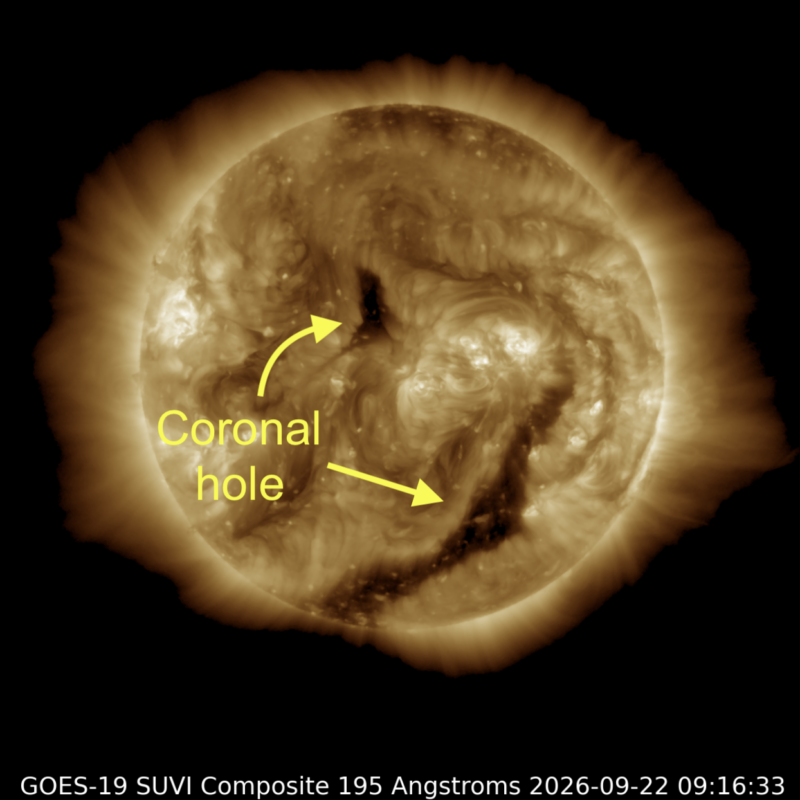
Sun news September 20: Quiet sun with a stormy outlook later this week
The sun is taking a breather. Solar activity stayed low over the past 24 hours, with only B-class and low C-class flares popping off. The strongest was a C3.3 from a source near the sun’s northeast limb. Observers detected no coronal mass ejections (CMEs) headed toward Earth. But forecasters are watching later this week. A coronal hole fast wind stream should arrive around September 23. That could push geomagnetic activity to G1 (minor) geomagnetic storm levels. So it’s quiet now, but stay tuned! In the meantime, forecasters expect very low to low solar activity for the next three days. The visible disk hosts only a few small sunspot regions, and none look threatening.Past 24 hours on the sun
(11 UTC September 19 – 11 UTC September 20)
Flare activity: Solar activity stayed low. Observers recorded 10 flares during the period: 2 C-class and 8 B-class.- Strongest flare: A C3.3 peaking at 18:17 UTC on September 19, from a source at N12E88, near the northeast limb. As a C-class event, it produced no radio blackout.
- Other notable flares: A C1.1 peaked at 05:18 UTC on September 20. The remaining 8 flares were B-class, all below B9.2.
- Lead flare producer: The available data couldn’t confirm the source region for most flares. The C3.3 came from a location at or beyond the northeast limb. Meanwhile, an unnumbered region rotating into view on the southeast limb contributed early B-class activity.
- AR4532 (alpha): This new region emerged at S06W39. It has a rudimentary single spot, which SWPC classified as alpha. It stayed quiet and unremarkable during the period.
- Unnumbered region (southeast limb): A small region is rotating into view on the southeast limb. Observers noted early B-class flaring from this area. They describe it as moderately sized and mature.
- Unnumbered region (north, near central meridian): A small bipolar region is approaching the central meridian in the northern hemisphere. It showed no significant flaring.
- A slow CME (about 321 km/s) appeared in coronagraph imagery starting at 18:48 UTC on September 19. It was accompanied by the C3.3 flare near the northeast limb. Model runs show no Earth-directed component.
- A faster CME (about 729 km/s) first appeared at 16:38 UTC on September 19. Its source is unknown. Model runs predict no Earth impact.
Past 24 hours in space weather
Solar wind: Solar wind speeds ranged from about 400 to 450 km/s. That’s slightly elevated, consistent with waning coronal hole fast wind influence. Otherwise, conditions stayed undisturbed. Bt, Bz and magnetic coupling: The total interplanetary magnetic field (IMF) (Bt) was weak. Meanwhile, the Bz component varied between north and south directions. Earth’s magnetic field: Geomagnetic conditions stayed quiet to unsettled. The Kp index reached up to 3. No geomagnetic storming occurred. Aurora sightings were unlikely at these levels.What’s ahead? Sun–Earth forecast
Flare activity forecast: Forecasters expect very low to low solar activity from September 20 through 22. C-class flares remain possible from the regions rotating into view on the east limb. Geomagnetic activity forecast:- September 20: Expect mostly quiet conditions (Kp 0-2) under ambient solar wind. Aurora sightings are unlikely.
- September 21: Quiet conditions should continue. Solar wind speeds should decline to slow, ambient levels. No storming is expected.
- September 22: Quiet-to-unsettled levels, with background solar wind continuing.
- September 23: Active intervals are likely (Kp 4), with a chance of G1 (minor) geomagnetic storming (Kp 5), especially later in the day. A coronal hole high-speed stream should arrive. Aurora may then appear across northern Scotland and southern New Zealand where skies stay clear.
Sun news September 19: It’s official! First spotless day since February
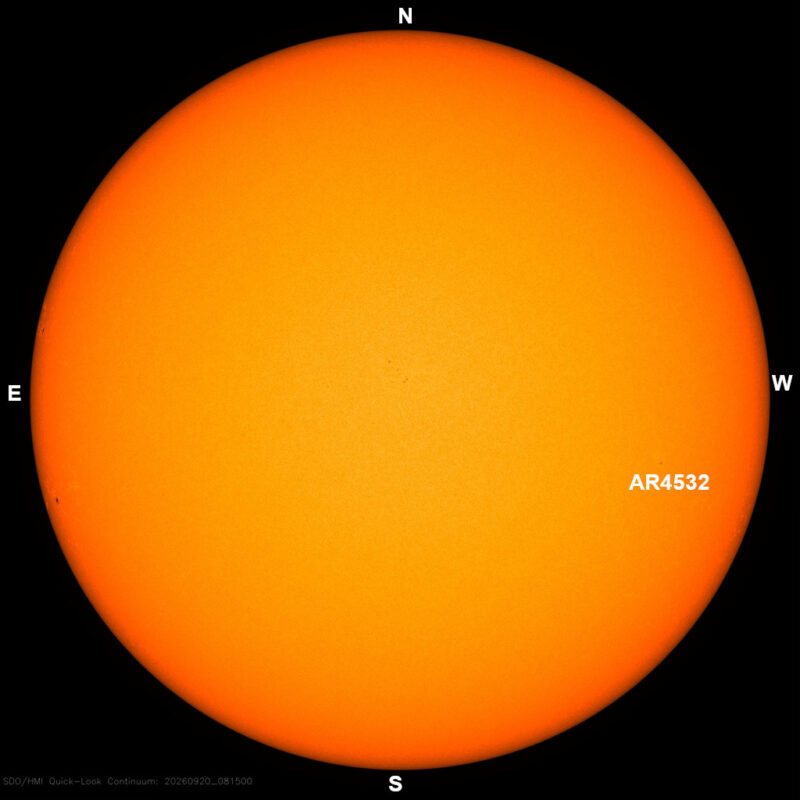
Yesterday — September 18 — was the first spotless day on the Earth-facing sun since February 24. And it’s the 2nd spotless day in a row for our star. In the image above, captured by the Solar Dynamics Observatory at 6:15 UTC this morning, we see no numbered active regions on the visible sun’s face. A couple of regions on the solar southeast and northeast horizons have been blasting B flares. But they haven’t received official numbers and are considered, for now, as plage regions. And we know the sun’s far side does currently have sunspot regions. We just saw four active regions rotate out of view to the far side. So there are sunspot regions that might be carried into view, by the sun’s rotation, in the coming day. But today — no spots! Oh, how the mighty have fallen. The day with the greatest single-day sunspot count recorded during Solar Cycle 25 was August 8, 2024. There were an estimated 337 sunspots that day, marking SWPC’s highest single-day estimate since March 2001.Past 24 hours on the sun
(11 UTC September 18 – 11 UTC September 19)
Flare activity: Solar activity continued at very low levels over the past 24 hours, with only faint B (weak) flares. But flare production notably increased. Observers counted 10 B flares.- Strongest flare: A B9.9 flare, almost a C flare, peaking at 1:35 UTC on September 19. The flare came from an area in the northeast, which hasn’t yet been numbered.
- Lead flare producer is an area in the sun’s southeast, not yet numbered, reaching the top of the list by producing seven B flares over the past day.
- The two unnumbered regions on the northeast and the southeast, that have been producing B flares, haven’t yet received an official number and are now considered as only a plage regions.
Past 24 hours in space weather
Solar wind: Solar wind speeds continued at moderate levels during the past day. Fast solar wind from a coronal hole keeps the solar wind above background levels. Other than that, no significant space weather to report. Bt, Bz and magnetic coupling: The total interplanetary magnetic field (IMF) remained at weak levels for most of the past day with a slight increase to moderate strength at the time of this writing this morning. Meanwhile, the north-south component (Bz) kept shifting from north to south but mostly they were north oriented. At the time of this writing, the Bz points northward. Earth’s magnetic field: The geomagnetic field ranged from quiet to unsettled levels, with the Kp index 0 – 3 (unsettled). At the time of this report, the Kp index sits just above level 3.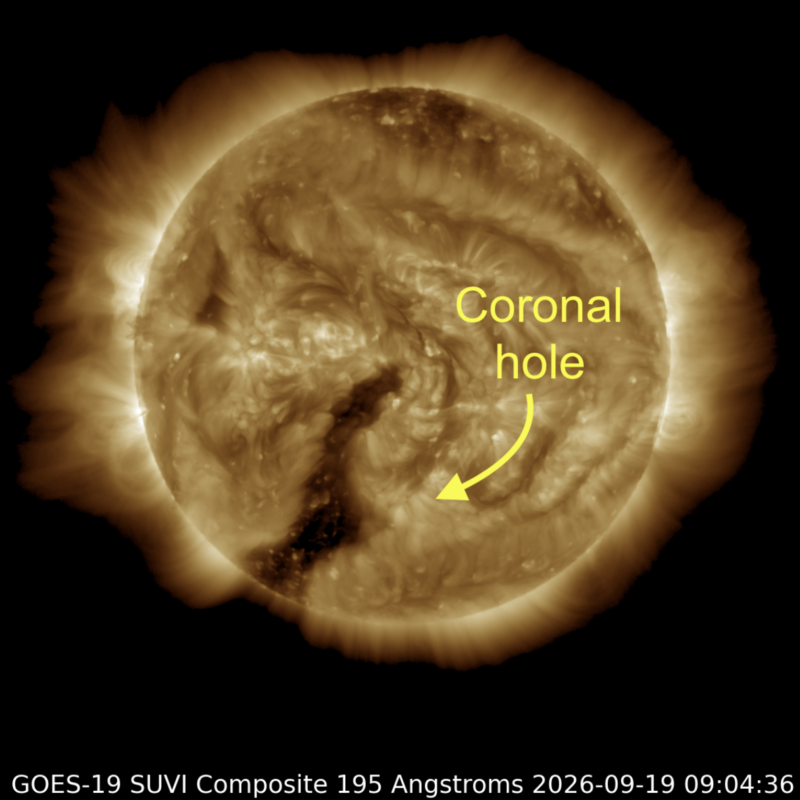
Sun news September 18: A spotless day today?
Are we looking at the first spotless day since February 24, 2026? In the image above, captured by the Solar Dynamics Observatory at 8:30 UTC this morning, we can see no numbered active regions on the solar face as we see it from Earth. We’re awaiting official confirmation, but for practical purposes — at least momentarily — we are now looking at a spotless sun. And if no newcomer region is numbered today, the sun will be officially spotless. Spotless days are a sign that we’re moving away from the peak of the 11-year solar cycle, which arrived in late 2024.Past 24 hours on the sun
(11 UTC September 17 – 11 UTC September 18)
Flare activity: Solar activity continued at very low levels over the past 24 hours, with only 1 faint B-class flares observed.- Strongest flare: The only flare produced during the period, a B3.2 peaking at 12:16 UTC on September 17. The flare came from AR4521, which has rotated to the far side.
- Lead flare producer: The only flare producer of the period was the now-departed AR4521.
- AR4528 (alpha magnetic configuration): Visible earlier in the day (see below), this region appears to have now rotated out of view.
- The unnumbered spot on the northeast limb that has been producing B flares is now considered as only a plage region and has not been assigned an official number.
Past 24 hours in space weather
Solar wind: Solar wind speeds averaged moderate levels during this period. Moderate speeds are expected to continue, driven by fast solar wind from a coronal hole. Bt, Bz and magnetic coupling: The total interplanetary magnetic field remained at weak levels for the period. Meanwhile, the north-south component (Bz) kept shifting from north to south, limiting geomagnetic coupling. At the time of this writing, the Bz points northward. Earth’s magnetic field: The geomagnetic field ranged from quiet to unsettled levels, with the Kp index reaching 3 (unsettled) at 12 UTC on September 17. At the time of this report, the Kp index sits just above level 2.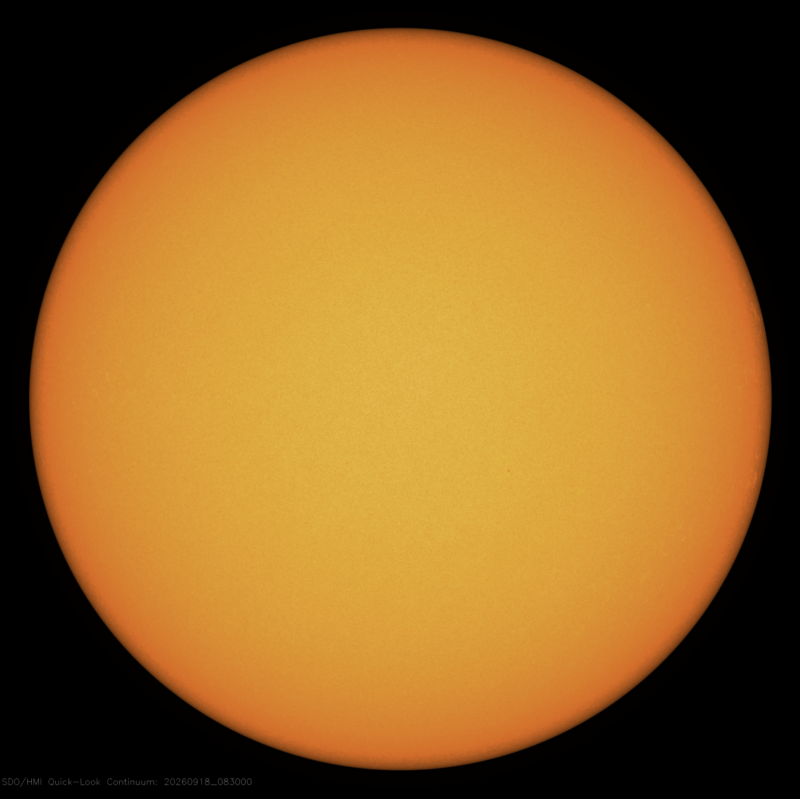
Sun news September 17: A near-spotless day on our star
We’re about to see a spotless sun! Today, the Earth-viewed side of our star shows only one numbered active region: AR4528. And that lone sunspot group will rotate out of view within the next 24 hours. If no newcomer emerges, the sun will be spotless for the 1st time since February 24, 2026. Spotless days are a sign that we’re moving away from the peak of the 11-year solar cycle, which arrived in late 2024. Will tomorrow be the next one? We’ll keep watching.Past 24 hours on the sun
(11 UTC September 16 – 11 UTC September 17)
Flare activity: Solar activity stayed at very low levels over the past 24 hours, with only 3 faint B-class flares observed.- Strongest flare: A B7.9 peaking at 23:45 UTC on September 16. This faint eruption came from an unnumbered region on the northeast limb.
- Other notable flares: That same unnumbered region produced two more B flares: a B3.9 peaking at 11:02 UTC and a B3.4 peaking at 11:32 UTC, both on September 16.
- Lead flare producer: The unnumbered northeast region ended as the lead and only flare producer of the period. It fired all three B flares.
- AR4528 (alpha magnetic configuration): This is now the only active region on the Earth-facing disk, since AR4527 rotated to the far side. AR4528 is about to follow it out of view. It remains magnetically simple, with no relevant activity and no flares.
- No new numbered regions rotated onto the disk during this period. However, the unnumbered spot on the northeast limb has been producing B flares. It’s worth watching as it comes into view.
Past 24 hours in space weather
Solar wind: Solar wind speeds decreased from high to moderate levels during this period. Moderate speeds should persist for the rest of the day, driven by fast solar wind from a coronal hole. Bt, Bz and magnetic coupling: The total interplanetary magnetic field held at weak levels for most of the period, with just a momentary moderate peak at 2 UTC this morning. Meanwhile, the north-south component (Bz) pointed mostly northward, limiting geomagnetic coupling. Observers noted only a few weak south-oriented peaks. At the time of this writing, the Bz points northward. Earth’s magnetic field: The geomagnetic field ranged from quiet to unsettled levels, with the Kp index reaching 3 (unsettled) at 0 UTC on September 17. The anticipated G1 storm either didn’t arrive or is running late. So NOAA canceled its G1 geomagnetic storm watch. At the time of this report, the Kp index sits just above level 1.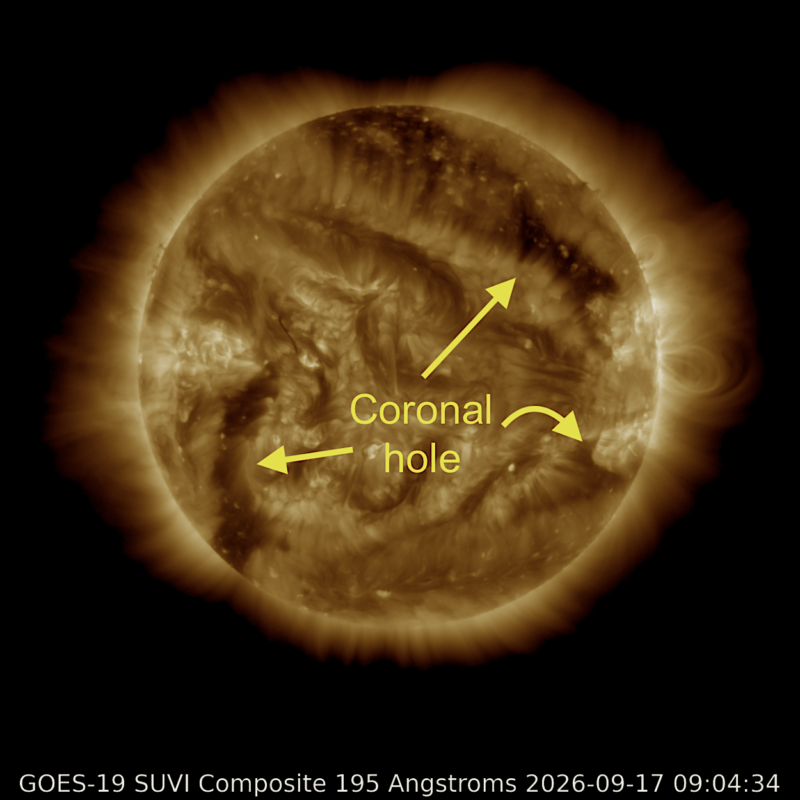
Sun news September 16: Beautiful prominence, auroras tonight?
Wisps of plasma twirled over the sun’s horizon over the past day, following an eruption on our star’s far side. Meanwhile, we on Earth could see the effect of some previous eruptions later today. Forecasters expect up to two bursts of solar material to reach our magnetic field by this evening, fired by the sun on Sunday and Monday. Combined with an ongoing stream of fast solar wind from a coronal hole, these glancing coronal mass ejections (CMEs) could push geomagnetic conditions to G1 (minor) storm levels, with a chance of G2 (moderate) and even a slight chance of G3 (strong) storms. So aurora watchers around the latitudes of Scotland and possibly northern England should keep an eye on the skies tonight!Past 24 hours on the sun
(11 UTC September 15 – 11 UTC September 16)
Flare activity: Solar activity continued at very low levels, with only faint B-class flares. Observers counted just two flares, both B-class (weak).- Strongest flare: A B5.5 peaking at 15:16 UTC on September 15. It came from an unnumbered region on the northeast limb.
- Other notable flares: A B3.6 peaked at 8:14 UTC on September 16 from AR4521.
- Lead flare producer: AR4521 and the unnumbered northeast region ended tied, with one B flare each.
- AR4527 (alpha) and AR4528 (alpha): Both numbered regions are magnetically simple, with no relevant activity. They pose little threat of strong flaring.
- No new regions rotated onto the disk during this period. However, the unnumbered spot on the northeast limb that produced the B 5.5 bears watching as it comes into view.
Past 24 hours in space weather
Solar wind: Solar wind conditions were enhanced, likely from the edge of a coronal hole high-speed stream. Speeds showed two sharp, short-lived spikes. Bt, Bz and magnetic coupling: The total interplanetary magnetic field held strong through most of the period, then dropped to weak strength around 9 UTC this morning. Meanwhile, the north-south component (Bz) pointed mostly northward for much of the period, limiting geomagnetic coupling. Then, around 18:52 UTC on September 15, it swung sharply southward. It stayed south until roughly 0 UTC, then began shifting between south and north in short stretches. At the time of this writing, the Bz points northward. Earth’s magnetic field: The geomagnetic field ranged from quiet to active levels, with the Kp index reaching 4 (active) at times. Conditions hit the Kp 4 threshold at 0:30 UTC on September 16. Despite the southward Bz swing late in the period, conditions did not reach G1 storm thresholds during this window. Auroras were not widely reported. At the time of this report, the Kp index sits at level 2.
Sun news September 15: Chunk of sun-stuff on its way to Earth
It’s now confirmed: a chunk of sun-stuff fired into space during yesterday’s filament eruption is on its way to Earth. Forecasters anticipate an arrival by September 17, which could trigger G1 (minor) geomagnetic storming and auroras at far-northern latitudes. Meanwhile, the filament that fired the burst continued its fiery activity throughout the past day. Observers have spotted no other coronal mass ejections (CMEs) yet, but this region could send more plasma into space at any moment. Stay tuned.Past 24 hours on the sun
(11 UTC September 14 – 11 UTC September 15)
Flare activity: Solar activity stayed very low. Observers counted 5 flares: 1 C-class (common) and 4 B-class (weak).- Strongest flare: A C1.0 peaking at 14:33 UTC on September 14 from active region AR4530.
- Lead flare producer: AR4530 reached the top of the list with three flares: the only C flare of the period plus two B-class flares.
- AR4527 (alpha) and AR4528 (alpha): Both numbered regions are magnetically simple, with no relevant activity.
Past 24 hours in space weather
Solar wind: Solar wind speeds increased from low to moderate levels through the period. A combined effect may explain the rise: a chunk of solar stuff the sun hurled out on September 9, plus fast solar wind from a coronal hole. Bt, Bz and magnetic coupling: The total interplanetary magnetic field started the period weak. It then climbed, ending the period at strong levels. Meanwhile, the north-south component (Bz) held a mostly northward orientation throughout. Only a couple of faint peaks shifted southward. At the time of this writing, the Bz points north at moderate levels. Earth’s magnetic field: The geomagnetic field ranged from quiet to active levels, with the Kp at 0-4. Kp reached level 4 at 17:43 UTC on September 14. At the time of this report, the Kp index sits at level 2.

Sun news September 14: Violent filament eruption last night
The solar southwest was lit up last night by a violent filament eruption. The eruption came from the vicinity of sunspot region AR4528, and has been associated with a C1.4 (common) flare at 19:45 UTC. The blast sent a chunk of sun-stuff into space, which could give Earth a glancing blow by early Thursday.
Past 24 hours on the sun
(11 UTC September 13 – 11 UTC September 14)
Flare activity: Very low. Observers counted 2 flares: 1 C-class and 1 B-class (weak).- Strongest flare: C1.4, peaking at 19:45 UTC on September 13 from an as-yet-unnumbered active region now located in southwest solar quadrant.
- Lead flare producer: The southwestern region and AR4529 were tied for the lead with just one flare each.
- AR4524 (alpha), AR4527 (alpha), AR4428 (alpha), AR4529 (beta): All regions are magnetically simple and are either stable or slowly decaying.
Past 24 hours in space weather
Solar wind: Solar wind speeds reached moderate levels through the 1st half of the period. At around 21 UTC on September 13, conditions started to decrease to background levels. Bt, Bz and magnetic coupling: The total interplanetary magnetic field was weak. The north-south component (Bz) kept a moderately southward orientation throughout most of the period. Earth’s magnetic field: The geomagnetic field kept quiet, with the Kp at 0-2.Sun news September 13: Huge coronal holes take center stage
Two large coronal holes are poised to ramp up geomagnetic activity over the coming days. These holes are large, temporary regions on the sun’s outer atmosphere (the corona) where the solar plasma is cooler, less dense, and has a weaker magnetic field that’s open to space. High-speed streams of solar wind pour from them, and forecasters expect this “wind” to begin influencing Earth late today, September 13. A second solar wind stream should follow around September 15. Together, they could push geomagnetic conditions to active levels, with isolated Kp 5 (G1 minor storm) intervals possible between September 14 and 15. Meanwhile, the sun itself remained relatively quiet over the past day. Solar activity reached low levels, driven by a single C5.8 flare from AR4521 near the western limb.
Past 24 hours on the sun
(11 UTC September 12 – 11 UTC September 13)
Flare activity: Low. Observers counted 13 flares: 1 C-class and 12 B-class.- Strongest flare: C5.8, peaking at 17:20 UTC on September 12 from AR4521 (N09W80).
- Other notable flares: A B9.7 from AR4530 peaked at 23:23 UTC on September 12. Several B8-class events also came from both AR4521 and AR4530.
- Lead flare producer: AR4521 generated 7 of the 13 flares, including the sole C-class event. AR4530 produced the remaining 6 flares.
- AR4521 (alpha): Located at N09W93, this region sat right at the western limb and was the most active producer during the period. It generated the C5.8 flare and multiple B-class events. Despite its activity, it carried a simple Hsx/alpha magnetic configuration and showed slight decay. It will rotate out of view shortly.
- AR4524 (alpha): Positioned at N12W54, this region had an Hrx/alpha configuration. It produced a few B-level enhancements but remained stable overall as it tracked toward the west limb.
- AR4430 (beta): Situated at N19W49 with a Dao/beta configuration. It also contributed minor B-level brightenings. The region showed slight decay through the period.
- AR4530 (alpha/beta): This region was the second most active producer, generating 6 B-class flares including the B9.7 at 23:23 UTC. It remained relatively stable.
- Remaining regions: Three additional numbered sunspot regions were present on the disk. All were magnetically simple and either stable or slowly decaying. None produced notable flaring.
Past 24 hours in space weather
Solar wind: Solar wind speeds averaged close to 400 km/s through the period. Conditions remained near background levels. Bt, Bz and magnetic coupling: The total interplanetary magnetic field (IMF) / (Bt) varied between 1 and 8 nT. The north-south component (Bz) fluctuated between +4 and -6 nT. Earth’s magnetic field: The geomagnetic field was quiet to unsettled, with Kp reaching 3. No geomagnetic storm thresholds were met. Aurora remained confined to typical high-latitude ovals.What’s ahead? Sun–Earth forecast
Flare activity forecast: Forecasters expect very low to low activity through September 15. C-class flares are likely. There is a slight chance (10%) of isolated M-class (R1 minor) flares. AR4521 is rotating off the disk, so its contribution will soon end. The remaining regions are magnetically simple with limited flare potential. Geomagnetic activity forecast:- September 13: Quiet to unsettled, with an isolated active period possible. A coronal hole high-speed stream effects continue. The low-confidence CME from September 9 may also arrive late. Aurora watchers at high latitudes should stay alert after dark.
- September 14: Unsettled to active conditions expected as the coronal hole stream ramps up. Isolated Kp 5 (G1 minor storm) intervals are reasonably possible. Enhanced aurora may be visible as far south as northern Scotland and similar latitudes.
- September 15: A second coronal hole high-speed stream is expected to arrive, maintaining unsettled to active conditions. Again, isolated G1 intervals are possible. Aurora visibility could extend slightly further south than usual at high latitudes.
- September 16: Quiet to active levels as the high-speed stream influence gradually wanes. The likelihood of elevated geomagnetic activity decreases over the course of the day.
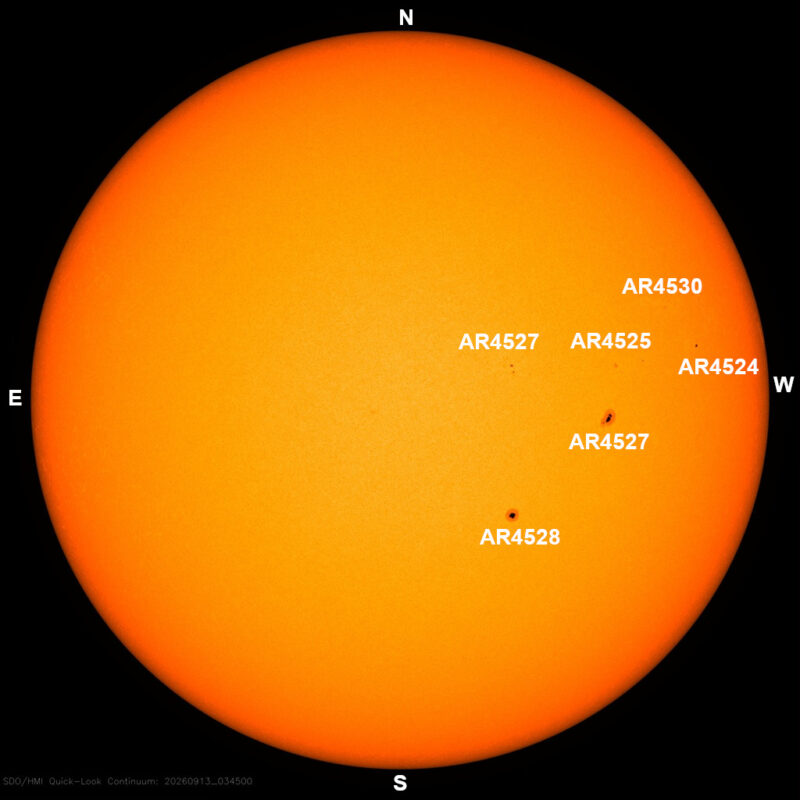
Sun news September 12: Massive eruption in the sun’s northwest
The massive eruptions we’ve been watching in the northwest, with their huge prominences – great ropes of solar materials and magnetic fields, arcing up above the sun’s surface – have turned into one long-lasting fiery prominence dancing on the solar edge. It now appears to drift toward the solar north pole, an effect of perspective as the sun rotates. Meanwhile, sunspot region AR4521, about to disappear over the northwest limb, kept producing faint B-class flares all day long, along with constant jets and small prominences. The plasma these events hurl into space, known as coronal mass ejections or CMEs, is not coming our way. AR4521 sits far out of Earth’s direction. There’s also news closer to the center of the disk. Two huge coronal holes have developed on the Earth-viewed side. One of them, in the southern hemisphere, has now rotated into a geoeffective position. That means it faces Earth head-on, so the fast solar wind it produces will start heading our way. Forecasters anticipate the first arrival by September 14. All of this unfolded during a calm solar day, with very low activity and only faint B-class flares.Past 24 hours on the sun
(11 UTC September 11 – 11 UTC September 12)
Flare activity: Solar activity continued at very low levels, with only B-class flares. Flare production held at nine events, matching yesterday. This time, though, every one of them was a B-class (weak) flare.- Strongest flare: A B8.5 from AR4521 at 23:14 UTC on September 11.
- Lead flare producer: AR4521 reached the top of the list with six flares, all B-class. AR4524 followed with two B flares.
- AR4521 (alpha): This region continued blasting faint flares and hurling plasma into space. Sitting right at the northwest shoulder of our sun, it will disappear any minute now.
- AR4525 (beta): This region showed slight decay.
- AR4530 (beta): This region grew somewhat in area. It produced only one B5.5 flare this period.
- AR4524 (alpha), AR4527 (alpha), AR4528 (alpha), and AR4529 (alpha): These regions showed no significant changes or activity.
Past 24 hours in space weather
Solar wind: Solar wind speeds continued averaging moderate levels during this period. Fast solar wind from a coronal hole drove these conditions. Speeds may increase in the coming days, now that a new coronal hole has moved into a geoeffective position. Bt, Bz and magnetic coupling: The interplanetary magnetic field (IMF) total strength (Bt) was weak to moderate during the period. Meanwhile, the Bz component stayed well balanced, shifting evenly between north and south orientations. The peaks pointed south about as often as north. Even so, prolonged southward periods may have triggered auroral displays near the Arctic Circle. Earth’s magnetic field: Earth’s magnetic field ranged from quiet to unsettled levels over the past 24 hours. Kp values stayed much like the day before, from 1 to just below 3. At the time of this writing, the Kp index sits slightly above level 2.

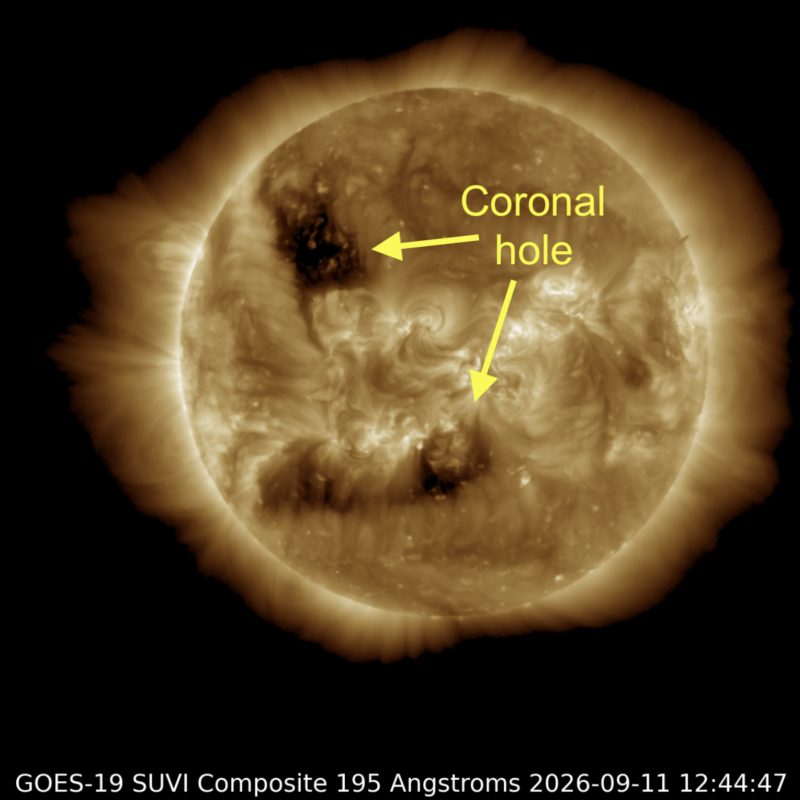
Sun news September 11: Another massive eruption in the sun’s northwest
Yesterday we reported two huge prominences that erupted almost in sync from opposite corners of the solar horizon. Well, the same northern area erupted once again over the past day. This time it produced an even bigger prominence than yesterday’s. Clearly, big action is stirring in a sunspot region that has just passed to the far side of our sun. GOES-19, SOHO’s LASCO C2 and C3 coronagraphs, and SDO all captured the impressive blast. The plasma hurled into space, known as a coronal mass ejection or CME, is not coming our way. That’s because the powerful eruption happened on our star’s far side. Even so, the event is well worth a look. Just watch our top image and the ones below. Stay tuned!Past 24 hours on the sun
(11 UTC September 10 – 11 UTC September 11)
Flare activity: Solar activity decreased to very low levels, with mostly B-class flares. Flare production dropped to nine events. The count over the past 24 hours: only one C-class (common) flare and eight B-class (weak) flares.- Strongest flare: A C1.6 from AR4530 at 17:12 UTC on September 10.
- Lead flare producer: This time AR4530 topped the list with four flares, including the period’s only C flare. AR4521 followed close behind with three flares.
- AR4521 (alpha): This region is about to depart to the far side in the solar northwest. It continued blasting faint flares and hurling plasma into space. It ranked among the flare producers this period.
- AR4525 (beta): This region continued to grow.
- AR4530 (beta): This region produced the only C flare of the period.
- AR4524 (alpha), AR4527 (alpha), and AR4529 (alpha): These regions stayed stable, with no significant activity.
Past 24 hours in space weather
Solar wind: Solar wind speeds averaged moderate levels during the period. Conditions tended to ease as effects from the passing CMEs and the coronal hole high-speed stream continued to wane. Bt, Bz and magnetic coupling: The interplanetary magnetic field (IMF) total strength (Bt) showed weak strength the whole period. Meanwhile, the Bz component kept shifting between north and south orientations. The strongest, most prolonged peaks pointed south. Those conditions may have triggered auroral displays in areas close to the Arctic Circle. Earth’s magnetic field: Earth’s magnetic field ranged from quiet to unsettled levels over the past day, with Kp values from 1 to 3. At the time of this writing, the Kp index sits at level 3.


Sun news September 10: Two huge prominences erupt in sync
Two huge prominences erupted almost in sync from opposite corners of the solar horizon over the past day, one in the southeast and one in the northwest. Both eruptions came from the sun’s far side. However, the long-lasting southeast prominence hints at action that may rotate onto the Earth-facing side in the coming days. By the way, forecasters called off the G1 (minor) geomagnetic storm watch we mentioned yesterday. The 3rd and 4th blasts of sun-stuff (coronal mass ejections, or CMEs) that were forecast never delivered the punch models suggested. The sun-stuff was either too weak to disturb Earth’s magnetic field, or passed ahead of our planet.Past 24 hours on the sun
(11 UTC September 9 – 11 UTC September 10)
Flare activity: Solar activity stayed at low levels. Flare production dropped notably compared to the previous day. Our sun produced a total of four flares, versus 15 the day before. The tally over the past 24 hours: two C-class (common) and two B-class (weak) flares.- Strongest flare: A C3.2 from AR4521 at 10:32 UTC on September 9.
- Lead flare producer: This time AR4521 and AR4524 ended tied at the top with two flares each.
- AR4521 (alpha): This region continued blasting faint flares and hurling plasma into space. It is now approaching the northwest horizon.
- AR4525 (beta): This region showed some growth.
- AR4530 (beta): This region has potential, but produced no flares during the period.
- AR4524 (alpha): Observers noted minor instability in this region. It was one of the two flare producers of the period.
- AR4527 (alpha), AR4528 (alpha), and AR4529 (alpha): These regions stayed stable, with no significant activity.
Past 24 hours in space weather
Solar wind: Solar wind speeds ranged from moderate to moderate-high levels during the period. These conditions may relate to the passing CMEs from September 5 and 6, plus the ongoing coronal hole high-speed stream. Together they should keep speeds elevated through the rest of today. Bt, Bz and magnetic coupling: The interplanetary magnetic field total strength (Bt) started the period at moderate-low strength and ended up weak. Meanwhile, the Bz component behaved much like yesterday, staying mostly southward for most of the period with just a few faint northward peaks. Earth’s magnetic field: Earth’s magnetic field ranged from quiet to unsettled levels over the past 24 hours, with Kp values from 2 to 3. At the time of this writing, the Kp index sits just below level 3.

Sun news September 9: Strike two! Sun-blasts keep arriving
Strike two! The convoy of sun-stuff currently arriving at our planet delivered a 2nd blow yesterday evening, triggering a G1 (minor) geomagnetic storm just 10 hours after the first strike. This was the 2nd of at least four coronal mass ejections (CMEs) that sunspot region AR4524 fired toward Earth over the past weekend. So forecasters expect more impacts today and tomorrow, which may trigger G1 (minor) and even G2 (moderate) storming. As a result, auroral displays may reach as far south as the northern United States, the U.K., and northern France. Clear skies and good luck, aurora chasers. Share those beautiful photos with us!Past 24 hours on the sun
(11 UTC September 8 – 11 UTC September 9)
Flare activity: Solar activity continued at low levels. However, flare production increased notably. Our sun produced a total of 15 flares, compared to yesterday’s two events. The tally over the past 24 hours: nine C-class (common) and six B-class (weak) flares.- Strongest flare: A C3.4 from AR4528 at 23:39 UTC on September 8.
- Lead flare producer: AR4521 and AR4528 ended tied at the top, with six flares each.
- AR4521 (alpha): This region continued to develop. It shared top flare producer honors, blasting six flares during the period.
- AR4528 (alpha): Once again, this region sparked the strongest flare of the period, a C3.4. It also tied for lead producer with six flares.
- AR4523 (alpha), AR4524 (alpha), AR4525 (alpha), AR4527 (alpha), and AR4529 (alpha): These regions stayed stable, with no signs of flare production.
- AR4530 (beta): Numbered just yesterday, this region is the only one showing a beta configuration. It developed an asymmetric penumbra, which is an early sign of potential. It produced one C flare during the period.
Past 24 hours in space weather
Solar wind: Solar wind speeds started easing from moderate-high levels early in the period to moderate levels at the time of this writing. Even so, the remaining CMEs from September 5 and 6, plus the ongoing coronal hole high-speed stream, should keep speeds elevated through the rest of today. Bt, Bz and magnetic coupling: The interplanetary magnetic field total strength (Bt) held at moderate-low strength. However, it spiked to strong levels at 4:30 UTC this morning. Meanwhile, the Bz component stayed mostly southward for most of the period, with just a few faint northward peaks. The stronger peaks pointed south. That opened the door for the geomagnetic storm. At the time of this writing, the Bz shows a weak northward peak. Earth’s magnetic field: Earth’s magnetic field ranged from quiet to active levels in this period, with Kp values from 1 to 5. Conditions reached the Kp 5 threshold at 17:44 UTC on September 8, provoking a G1 (minor) geomagnetic storm. The Kp 5 level held for one three-hour period before declining. At the time of this writing, the Kp index sits at level 1.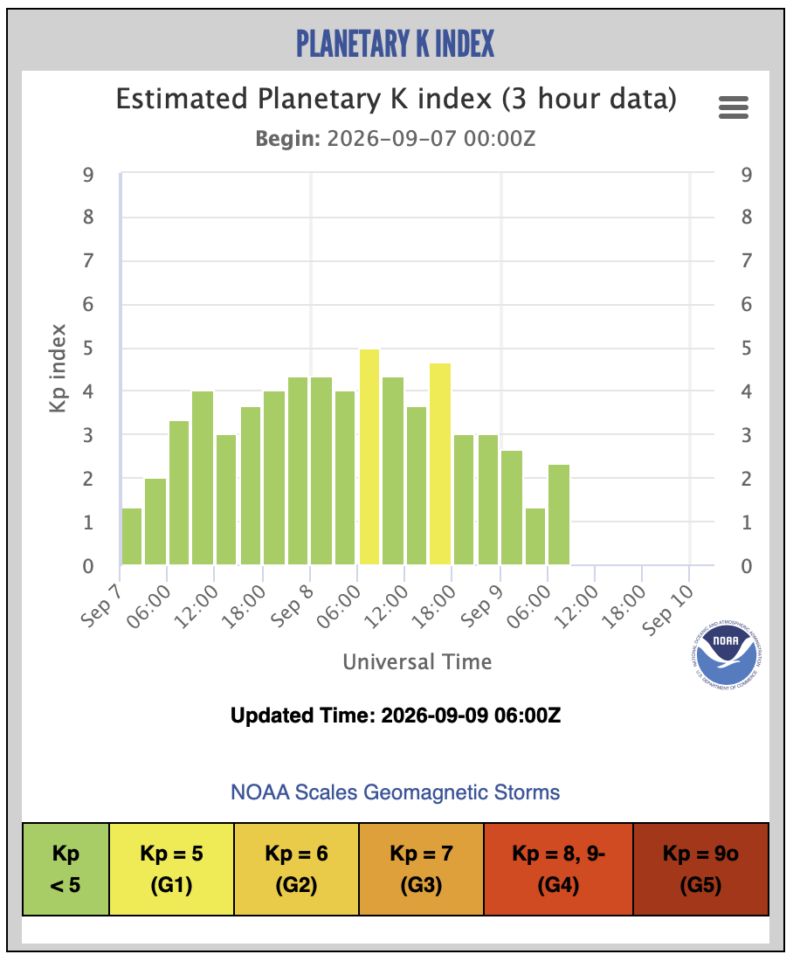


Sun news September 8: Series of sun-blasts arriving, auroras to come
A convoy of sun-stuff blasts has started arriving at our planet. We saw at least four coronal mass ejections (CMEs) fired from sunspot region AR4524 toward Earth over the weekend. The first arrived this morning, triggering a G1 (minor) geomagnetic storm. And this is likely just the beginning. As more impacts arrive today and tomorrow, forecasters have called for G2 (moderate) or even G3 (strong) storming. What does that mean for skywatchers? Auroral displays may reach as far south as New York, London, and northern France tonight and, more likely, tomorrow night. And if two or three of these structures combine, auroras could push even farther south! We’ll keep you updated.Past 24 hours on the sun
(11 UTC September 7 – 11 UTC September 8)
Flare activity: Solar activity continued at low levels. Observers registered just two events over the past 24 hours: one C-class (common) and one B-class (weak) flare.- Strongest flare: A C1.0 from AR4528 at 19:35 UTC on September 7.
- Lead flare producer: AR4526 and AR4528 tied, with one flare each. However, AR4528’s C1.0 outranked AR4526’s B7.8.
- AR4524 (beta): This region continued to show weak decay. It lost its gamma and now shows a simpler beta configuration. It produced no flares during this period.
- AR4528 (alpha): This region was one of only two flare producers. It sparked the strongest flare of the period, a C1.0.
- AR4521 (alpha), AR4523 (alpha), AR4527 (alpha), and AR4529 (alpha): These regions stayed stable, with no signs of flare production.
- AR4530 (beta): This region emerged from nowhere in the middle of the northeast quadrant. It now shows a beta configuration. It’s stable for now, but it shows early signs of potential.
Past 24 hours in space weather
Solar wind: Solar wind speeds averaged at moderate levels early in the period. Then, starting at 0 UTC this morning, speeds increased to moderate-high levels. The arrival of multiple CMEs from September 5 and 6, plus the onset of a coronal hole high-speed stream, should keep solar wind speeds elevated through September 9. Bt, Bz and magnetic coupling: The interplanetary magnetic field total strength (Bt) started the period strong. It then slowly eased to weak strength by the time of this writing. Meanwhile, the Bz component fluctuated between south and north, with the stronger peaks pointing southward. That opened the door for the geomagnetic storm. At the time of this writing, a Kp 5 is ongoing, and the Bz points southward. Earth’s magnetic field: Earth’s magnetic field showed unsettled to active levels throughout the period, with Kp values in the 3 to 5 range. The Kp 5 threshold was reached at 7:30 UTC this morning, provoking a G1 (minor) geomagnetic storm.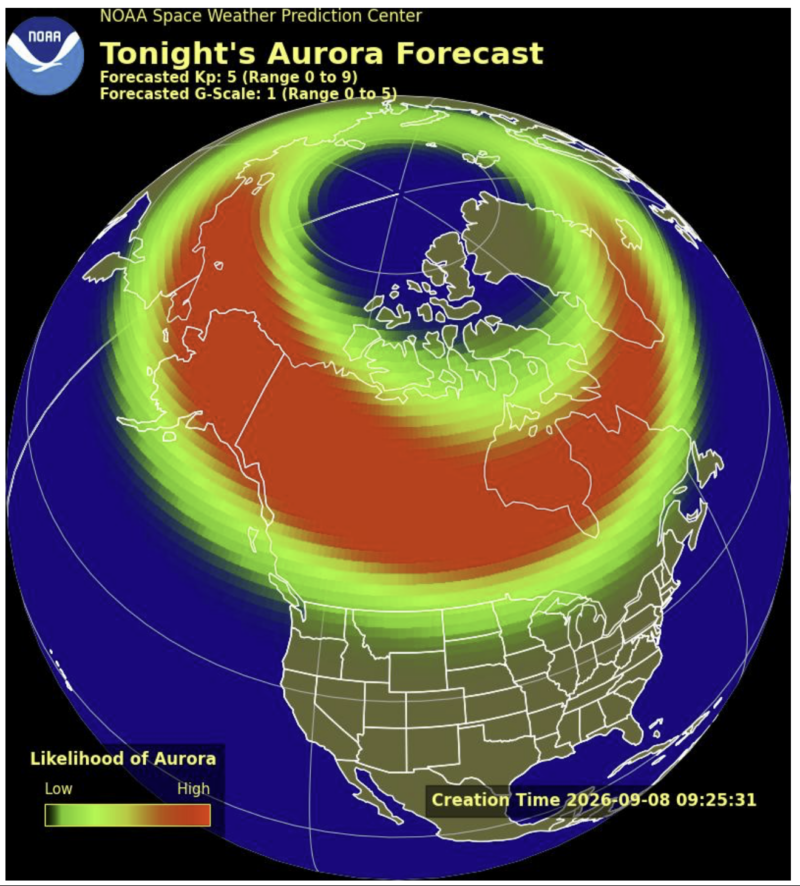
Sun news September 7: Sun-stuff bursts could trigger strong auroras
A convoy of coronal mass ejections (CMEs) is bearing down on our planet, with the first arrivals expected from later today. Solar observers saw at least four CMEs launch from sunspot region AR4524 over September 5 and 6. These are now racing through interplanetary space and could merge into a combined punch. What might that mean for us? Such a combined structure could drive G1 (minor) to G2 (moderate) geomagnetic storms, with a slight chance of G3 (strong) conditions later this week. In turn, that could bring aurora as far south as New York, London and northern France. The peak of auroral activity is currently looking like Wednesday, but stay tuned as the story unfolds!Past 24 hours on the sun
(11 UTC September 6 – 11 UTC September 7)
Flare activity: Solar activity stayed at low levels. Observers logged 6 flares: 2 C-class (common) and 4 B-class (weak) events.- Strongest flare: A C5.0 from AR4524 at 10:31 UTC on September 6. Notably, this C-class flare came with a halo CME, first visible in LASCO C2 imagery at 11:12 UTC. That’s an unusually energetic eruption for such a modest flare classification.
- Lead flare producer: AR4524 dominated, firing 4 of the 6 flares during the period: the C5.0 plus three B-class events.
- For context: An M1.0 flare from decayed AR4520 near the west limb erupted on September 5, just before this reporting period. It came with a fast halo CME and triggered an S1 (minor) proton event.
- AR4524 (beta-gamma): This region continued to show weak decay. Even so, it remained the most active on the disk. Its beta-gamma configuration sustained C-class flare production, and it produced multiple CMEs over the past two days. It warrants continued monitoring as it rotates toward the disk center.
- AR4528 (alpha): This region received its number during the period. Despite its simple magnetic configuration, it produced a C1.1 flare. Located near the east limb, it will rotate into a more Earth-directed position over the coming days.
- AR4520 (near the west limb): This region had decayed, yet it was the source of the significant M1.0 flare and fast halo CME on September 5. It continues rotating toward the far side.
- The remaining active regions on the disk stayed quiet and stable, producing no significant flaring.
Past 24 hours in space weather
Solar wind: Solar wind speeds remained at nominal background levels through most of the period. The arrival of a slow filament CME from September 2 and the onset of a coronal hole high-speed stream should boost solar wind speeds to elevated levels through September 7. Bt, Bz and magnetic coupling: The interplanetary magnetic field total strength (Bt) was average. However, a coherent magnetic structure began rotating through the near-Earth environment starting around 20:40 UTC on September 6. Bt climbed by the end of the reporting period. Meanwhile, the Bz component fluctuated with no strongly sustained southward orientation. That limited geomagnetic coupling and kept aurora at bay. Earth’s magnetic field: Earth’s magnetic field stayed quiet throughout the period, with Kp values remaining in the 0 to 2 range. The lack of sustained southward Bz and the slow solar wind regime kept activity subdued, even though the energetic particle environment stayed slightly elevated after the S1 (minor) proton event on September 5.
Sun news September 06 (UTC): Blast sends radiation storm and more our way
Solar activity climbed to moderate levels over the past day, and from an unlikely source. Plage Region 4520. That region is a once-prominent sunspot group that had decayed to a featureless plage—a hot, bright region near a sunspot (or in this case a former sunspot). This one is near the sun’s southwest limb. It fired off an M1.0 flare at 15:04 UTC on September 5. And it launched energetic protons toward Earth, briefly crossing the S1 (minor) solar radiation storm threshold. The proton flux above 100 MeV also spiked. That’s relatively uncommon, and it highlights the event’s eruptive power despite its modest flare class. A coronal mass ejection (CME) accompanied the flare. Modeling indicates it won’t strike us, but instead will sweep ahead of Earth in orbit. No direct hit is expected. AR4524 unleashed a fast C8.5 flare and an associated CME with an estimated speed of 1,110 km/s. That eruption, combined with a slower CME from earlier in the day, should reach Earth around September 7 and 8. Together they could drive geomagnetic storms and enhance auroral displays. G1-G3 storms are possible! Meanwhile, a coronal hole high-speed stream and a solar sector boundary crossing are converging on the same timeframe. In short, the stage is set for a busy auroral period ahead.Past 24 hours on the sun
(11 UTC September 05 – 11 UTC September 06)
Flare activity: Solar activity increased to moderate levels. Observers recorded one M-class and four C-class flares during the reporting period.- Strongest flare: An M1.0 from Plage Region 4520 (S12W68) at 15:04 UTC on September 5. It triggered an R1 (minor) radio blackout affecting high-frequency communications across the northeastern part of South America. The flare also produced S1 (minor) solar radiation storm proton enhancements at both the 10 MeV and 100 MeV thresholds.
- Other notable flares: A C8.5 from AR4524 at 17:32 UTC on September 5. A C6.5 from AR4524 at 10:24 UTC on September 5. A C4.0 from AR4525 at 15:31 UTC on September 5. And a C1.5 from AR4525 at 11:56 UTC on September 5.
- Lead flare producer: AR4524 topped the list, firing the two strongest C-class events (C8.5 and C6.5). It also produced Type II and Type IV radio emissions with the earlier C6.7 event on September 4.
Past 24 hours in space weather
Solar wind: Solar wind parameters stayed at nominal, slow-wind levels throughout the reporting period. Speeds averaged around 350 km/s, with a brief peak to 372 km/s at 16:18 UTC on September 5. A high-speed stream from the equatorial coronal hole should soon influence conditions. Bt, Bz and magnetic coupling: The interplanetary magnetic field (IMF) total strength was low. Meanwhile, the Bz component made weak southward dips but spent much of the period oscillating. It favored a northward orientation during the first half and leaned southward during the second half. Earth’s magnetic field: Earth’s magnetic field held at quiet to isolated unsettled levels, with the Kp index remaining at 0 to 2 for most of the period. Conditions crossed no G-scale geomagnetic storm thresholds. They reflected the benign, slow solar wind environment, since the weak and variable Bz proved insufficient to drive significant geomagnetic coupling. The estimated Ap index for September 4 was just 3, firmly in quiet territory. Energetic particles: The greater than 10 MeV proton flux began rising at 15:30 UTC on September 5. It exceeded the S1 (minor) solar radiation storm threshold at 16:45 UTC. Levels stayed elevated near the threshold by the end of the reporting period. Meanwhile, the greater than 100 MeV proton flux briefly exceeded its threshold at 15:50 UTC and decayed below the threshold by 16:16 UTC.What’s ahead? Sun–Earth forecast
Flare activity forecast: Forecasters expect solar activity to remain at low levels, with occasional C-class flares through September 8. A slight chance (20%) remains for M-class flares (R1–R2), primarily from AR4524, which stays the most magnetically complex region on the disk despite losing some trailing spots. There is a slight chance (1%) of an isolated X-class flare, most likely from the new regions emerging on the east limb if they develop further complexity. Meanwhile, the greater than 10 MeV proton flux should stay near or above the S1 threshold through early September 6, then slowly decay to background through September 7 and 8. Geomagnetic activity forecast:- September 6: Expect mostly quiet conditions (Kp 0-2) through most of the day. A very weak, slow CME from September 2 may deliver a glancing blow around 16:00 UTC. However, confidence is low, and any impact would be minimal (Kp 2 to 3). Isolated unsettled conditions (Kp 3) are likely by late in the day as a solar sector boundary crossing begins and the leading edge of the coronal hole high-speed stream approaches. Aurora is unlikely for mid-latitude observers.
- September 7: Expect unsettled to periodic active conditions (Kp 3-4) as the SSBC and coronal hole stream strengthen. Then, by late September 7, the faster CME from the C8.5 flare (1,110 km/s) may arrive around 23:21 UTC. If the impact geometry proves favorable, Kp could reach 5 to 7. That would produce G1 (minor) to G2 (moderate) geomagnetic storm conditions, with a chance of isolated G3 (strong) intervals. At Kp 5 to 6, aurora may appear over Seattle, Minneapolis, Edinburgh, Toronto, and northern England. At Kp 7, displays could reach as far south as New York, London, and northern France.
- September 8: The second CME, from the C6.5 flare (873 km/s), should arrive around 02:52 UTC. It may combine with lingering effects from the first. Kp estimates of 4 to 6 suggest continued G1 to G2 storm potential, particularly during the first half of the day. The filament eruption CME may also add to the disturbance. Conditions should gradually wane through the second half of September 8 as the combined influences subside. Aurora watchers across northern Europe, Canada, and the northern United States should stay alert. If conditions align, this could be a multi-night event.

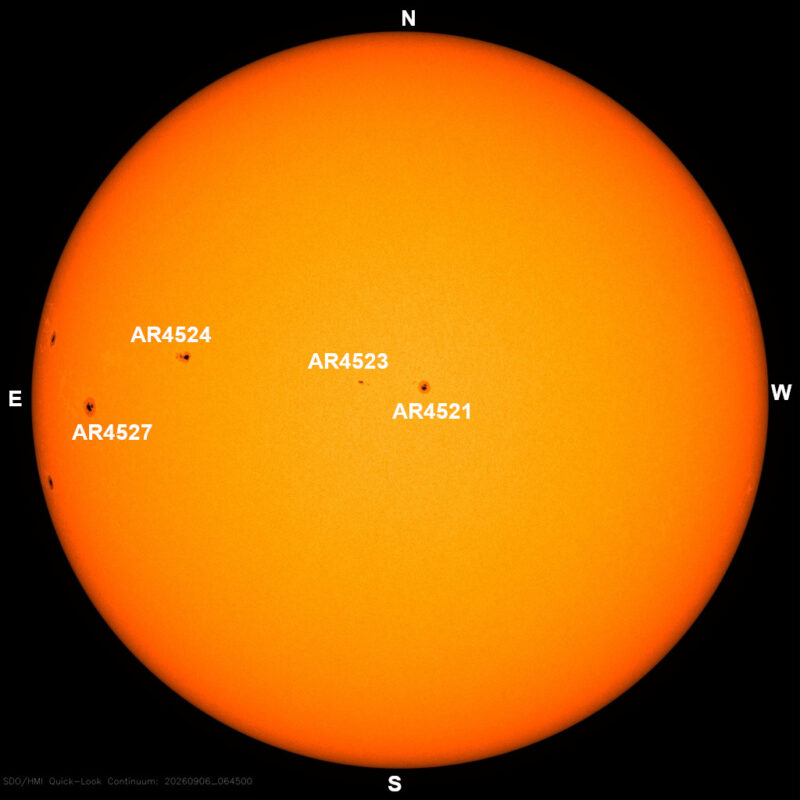
Sun news September 5: Bam bam! The sun issues a 1-2 punch
The sun surprised us with two blasts in sequence, like a 1-2 punch, with one blast from the sun’s northeast horizon and one from the southeast. The first erupted near sunspot region AR4524. It started at around 19 UTC on September 4, and it came with a C6.7 flare. The second blast, in the southeast, started at around 20:56 UTC on September 4, almost right on the heels of the first. No visible flare accompanied this one, meaning it must have erupted just behind the sun’s limb, or edge, from an active region whose arrival on the Earth-facing disk is imminent. Both prominences hurled solar plasma into space. But initial analyses suggest the resulting coronal mass ejections (CMEs) are not Earth-directed. Stay tuned!Past 24 hours on the sun
(11 UTC September 4 – 11 UTC September 5)
Flare activity: Solar activity returned to low levels, with only C-class and B-class events. Over the past day, our star sparked a total of seven flares: 5 C flares and 2 B flares.- Strongest flare: A C7.1 from AR4525 at 11:29 UTC on September 4.
- Other notable C flares: A C6.7 at 19:30 UTC on September 4 from AR4524. A C2.1 at 13:05 UTC on September 4 from AR4527. And a C1.3 at 15:27 UTC on September 4 from AR4518.
- Lead flare producer: Two sunspot regions ended tied at the top of the list, firing two flares each: AR4525 and AR4526.
- AR4521 (alpha): This region stayed stable and quiet throughout the period. It produced no notable flares.
- AR4523 (alpha): This region showed some growth over the past 24 hours. However, it produced no flares this time.
- AR4524 (beta): This region showed some growth. It also produced a C flare during this period.
- AR4527 (alpha): This newcomer received its number during the period. It needs to rotate further into view for a better analysis. Even so, it has already produced a C flare.
Past 24 hours in space weather
Solar wind: Solar wind parameters reflected mostly normal, slow-wind conditions throughout the period. Meanwhile, an equatorial coronal hole has reached a geoeffective position at the center of the Earth-viewed solar disk. Its high-speed stream may begin impacting our magnetic field in the coming days. Bt, Bz and magnetic coupling: The interplanetary magnetic field (IMF) total strength (Bt) ran slightly elevated, at moderate levels. Meanwhile, the Bz pointed north early in the period. Then, at 22:30 UTC on September 4, it shifted southward and held that direction for the rest of the period. That kept conditions favorable for aurora production. At the time of this writing, the Bz still points south. Earth’s magnetic field: Earth’s magnetic field stayed quiet-to-unsettled throughout the period, with the Kp index at 0 to 3. No geomagnetic storm conditions occurred. As of this writing, the Kp index sits just below level 3.
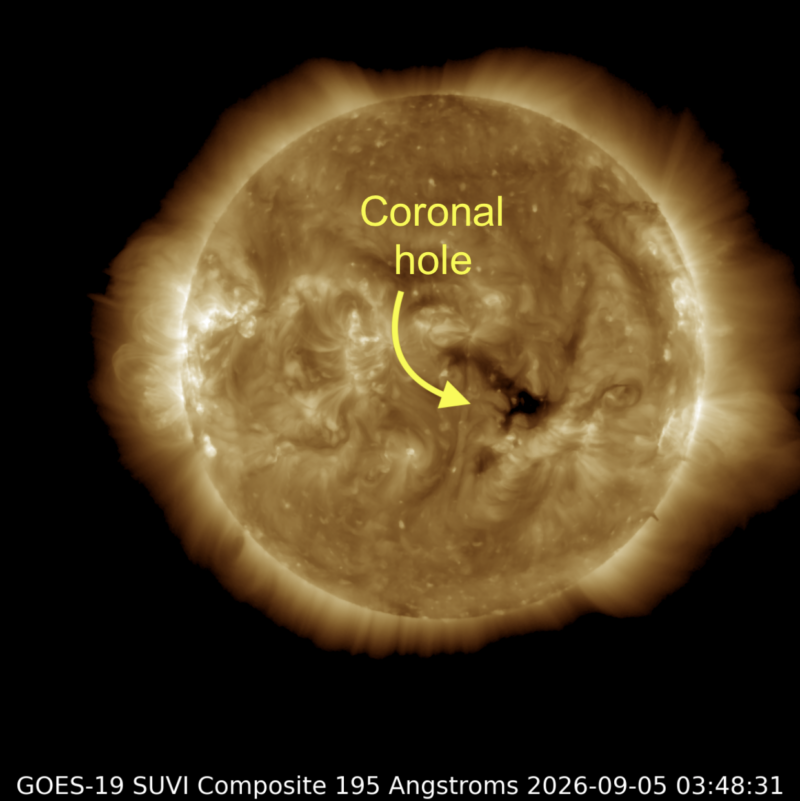
Sun news September 4: More action from returning sunspot region
An exciting sunspot region emerging from the sun’s northeast horizon continued making its presence felt over the past day. Numbered AR4524, this region fired off an M1.2 flare at 7:45 UTC this morning, the strongest event of the 24-hour period. This same region had earlier produced a C7.9 flare with a powerful eruption of sun-stuff, which is heading well away from Earth. This sunspot group appears to have already passed across the face of the sun in mid-August, before rotating around our star’s far side. Now, it’s returning over the eastern horizon. On its last passage, it had an impressive magnetic complexity. As it rotates back into full view within the next day, we’ll be able to see how much potential it’s held on to.Past 24 hours on the sun
(11 UTC September 3 – 11 UTC September 4)
Flare activity: Solar activity reached moderate levels. Observers logged 11 flares: 1 M-class and 10 C-class events.- Strongest flare: An M1.2 from AR4524 at 7:45 UTC on September 4. It triggered an R1 (minor) radio blackout, briefly affecting high-frequency communications over the Arabian Sea.
- Other notable flares from AR4524: C7.9 at 16:13 UTC on September 3, C2.0 at 17:00 UTC on September 3, C1.3 at 06:08 UTC on September 4.
- Lead flare producer: AR4523 topped the list, firing 6 C-class flares.
- AR4521 (alpha): This region stayed stable and quiet throughout the period. It produced no notable flares.
- AR4523 (beta): This region grew over the past 24 hours. It was also the most prolific flare producer, generating multiple C-class events up to C6.9. So it bears watching as it continues to develop.
- AR4524 (alpha): This returning region currently sits near the east limb. It produced the period’s strongest flare, the M1.2, plus the notable C7.9 event. It was magnetically complex during its previous disk transit in mid-August. So it may regain that complexity as it rotates further into view, raising the prospect of stronger flaring.
- In addition, bursts of sun-stuff from beyond the eastern limb during the period confirms that a significant active region is about to rotate onto the visible disk, likely within the next 24 hours.
Past 24 hours in space weather
Solar wind: Solar wind parameters reflected mostly normal, slow-wind conditions throughout the period. Meanwhile, an equatorial coronal hole has reached the center of the Earth-viewed sun. Its high-speed stream may begin impacting our magnetic field in the coming days. Bt, Bz and magnetic coupling: The interplanetary magnetic field (IMF) total strength (Bt) was slightly elevated. Meanwhile, the Bz component fluctuated between north and south. That kept Earth’s magnetic shield largely intact and conditions unfavorable for aurora production. Earth’s magnetic field: Earth’s magnetic field stayed quiet throughout the period, with the Kp index remaining at 1 to 2. No geomagnetic storm conditions occurred.


Sun news September 3: Big flare from newcomer sunspot
Bam! A newcomer sunspot region sparked an impressive M3.0 flare around 19:20 UTC last night. This region is just showing its nose on the northeast solar horizon. It was unnumbered at the moment of the flare, but it’s now been labeled AR4524. This region started showing off its potential with a fiery prominence we reported a couple of days ago. Now, it’s the region to watch. The M3 flare did hurl plasma into space, but this coronal mass ejection (CME) doesn’t appear to be coming our way. But once AR4524 rotates toward the center of the solar disk, a flare like this could sent material toward Earth. Stay tuned.Past 24 hours on the sun
(11 UTC September 2 – 11 UTC September 3)
Flare activity: Solar activity jumped to moderate levels, thanks to the M-class flare. Over the past day, our sun produced a total of 12 flares: the M3, four C-class (common) flares, and seven B-class (weak) flares.- Strongest flare: An M3.0 from the incoming northeast region, now numbered AR4524, at 19:20 UTC on September 2.
- Lead flare producer: That same newcomer, AR4524, reached the top of the list with eight flares this period: the M flare, all four C flares of the period, plus three B flares.
- AR4520 (beta): This region’s magnetic configuration stayed stable. It produced only one B flare during the period.
- AR4521 (alpha): This region kept relatively stable and produced no flares.
- AR4523 (beta): This region produced three B flares during the period.
- AR4524 (alpha): This region sits close to the northeast horizon. It rapidly became the lead flare producer and sparked a strong M3.0 flare. This is the guy to keep watching in the coming days.
Past 24 hours in space weather
Solar wind: Solar wind speeds continued at low levels. The influence of the coronal hole high-speed stream has vanished. No significant space weather to report this time. Bt, Bz and magnetic coupling: The interplanetary magnetic field started our observation period at weak levels. Then, at 7 UTC this morning, it spiked briefly to moderate levels before dropping back to weak. Meanwhile, the Bz component kept fluctuating between south and north orientations throughout the period, with north dominating. As always, prolonged southward Bz periods favor auroras by letting solar wind energy couple more efficiently with Earth’s magnetosphere. At the time of this writing, the Bz still points northward. Earth’s magnetic field: Earth’s magnetic field showed quiet levels during the period, with the Kp index at 1 to 2. At the time of this writing, the Kp index sits just at level 1.


Sun news September 2: New update for Solar cycle 25
The NOAA Space Weather Prediction Center just released its solar cycle progression results for August 2026. The monthly sunspot number slipped slightly to 76, compared to 78.1 in July 2026. Meanwhile, August 2024 still stands as the peak of Solar Cycle 25. Since then, the cycle has been in its declining phase. Even so, as the past two weeks showed, a declining sun can still deliver plenty of action.Past 24 hours on the sun
(11 UTC September 1 – 11 UTC September 2)
Flare activity: Solar activity stayed at low levels, with only faint C-class and B-class flares. Over the past day, our sun produced a total of seven flares: three C-class (common) flares plus another four B-class (weak) flares.- Strongest flare: A C5.7 from an incoming, as-yet-unnumbered region in the northeast at 21:10 UTC on September 1.
- Lead flare producer: That same northeast newcomer, still awaiting its number, topped today’s list. It produced four flares (two Cs and two Bs) including the strongest of the period.
- AR4518 (alpha): This region has decayed to a simple alpha magnetic configuration. Just yesterday it was the only region showing growth. Now it produced no flares.
- AR4520 (beta): This region stayed stable, though it showed signs of decay. It produced only one B flare during this period.
- AR4521 (alpha): This region kept relatively stable.
- AR4522 (beta): This region is in decay and produced no flares.
- AR4523 (alpha): This region stayed stable with no flare production.
Past 24 hours in space weather
Solar wind: Solar wind speeds continued slowly decreasing, from moderate-low to low levels. The influence of the coronal hole high-speed stream has almost vanished, as space weather conditions drop back to background levels. Bt, Bz and magnetic coupling: The interplanetary magnetic field continued at weak levels. Meanwhile, the Bz component fluctuated between south and north orientations throughout the period. Neither direction dominated, since the Bz held each orientation only briefly. As always, prolonged southward Bz periods favor auroras by letting solar wind energy couple more efficiently with Earth’s magnetosphere. At the time of this writing, the Bz has shifted southward. Earth’s magnetic field: Earth’s magnetic field held at quiet-to-unsettled levels during the period, with the Kp index at 1 to 3. Any visible aurora displays would have stayed confined to high latitudes such as northern Scandinavia, Iceland, and northern Canada. At the time of this writing, the Kp index sits just at level 2.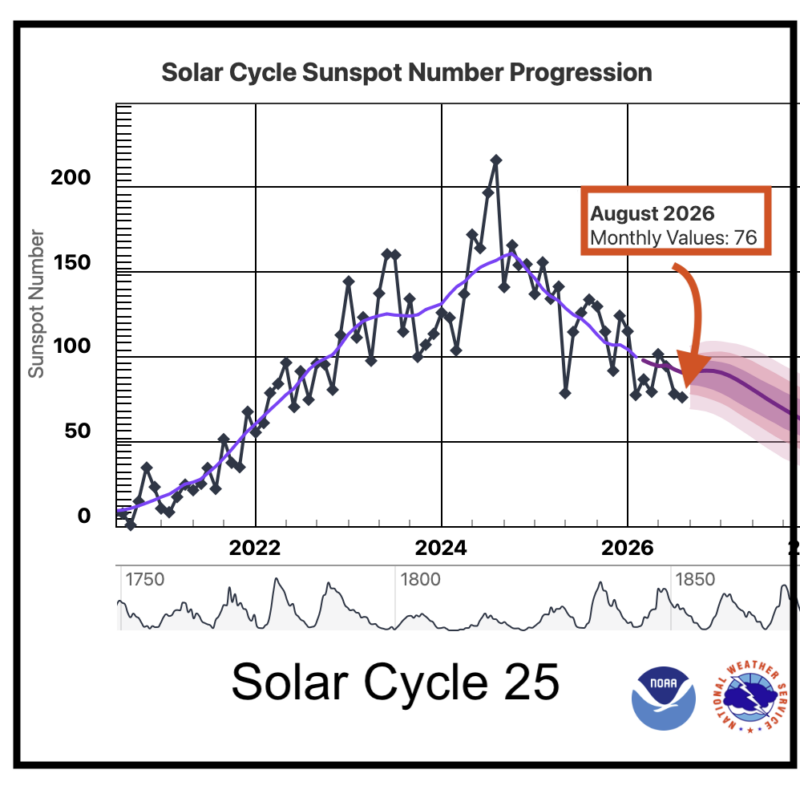
Sun news September 1: Sun-observing spacecraft sees a solar eclipse
The solar observations from NOAA’s GOES-19 spacecraft were interrupted over the past day. That’s because Earth passed in front of our star from the satellite’s perspective. It’s our planet you can see taking a bite out of the solar disk! These eclipses occur twice a year, around the equinoxes.Past 24 hours on the sun
(11 UTC August 31 – 11 UTC September 1)
Flare activity: Solar activity continued at low levels, though flare production increased sharply. During the past day, our sun produced a total of 15 flares, compared to just 2 yesterday. This period’s tally: 5 C-class (common) flares plus another 10 B-class (weak) flares.- Strongest flare: A C2.6 from AR4520 at 15:16 UTC on August 31.
- Lead flare producer: A tie at the top of the list. AR4517 and AR4520 each produced 5 flares, sharing the honor.
- AR4518 (beta): Stable, no flares produced during this period.
- AR4513 (beta): This region is now out of view, having rotated to the far side of our sun.
- AR4520 (beta): This region gained additional spots. It also produced the strongest flare of the period, a C2.6.
- AR4521 (alpha), AR4522 (beta), and AR4523 (alpha): These regions gained spots during the period but otherwise remained stable. Only AR4523 produced flares, contributing 2 C flares.
Past 24 hours in space weather
Solar wind: Solar wind speeds slowly decreased from moderate to moderate-low levels, as the influence of a coronal hole high-speed stream began to wane. Bt, Bz and magnetic coupling: The interplanetary magnetic field averaged at weak levels. Meanwhile, the Bz component fluctuated between south and north orientations. Even so, several sustained southward intervals dominated. A southward Bz favors auroras by letting solar wind energy couple more efficiently with Earth’s magnetosphere. Earth’s magnetic field: Earth’s magnetic field showed quiet levels during the period, with the Kp index at 1 to 2. No significant aurora enhancements were expected at middle latitudes. Any visible displays would have stayed confined to high latitudes such as northern Scandinavia, Iceland, and northern Canada.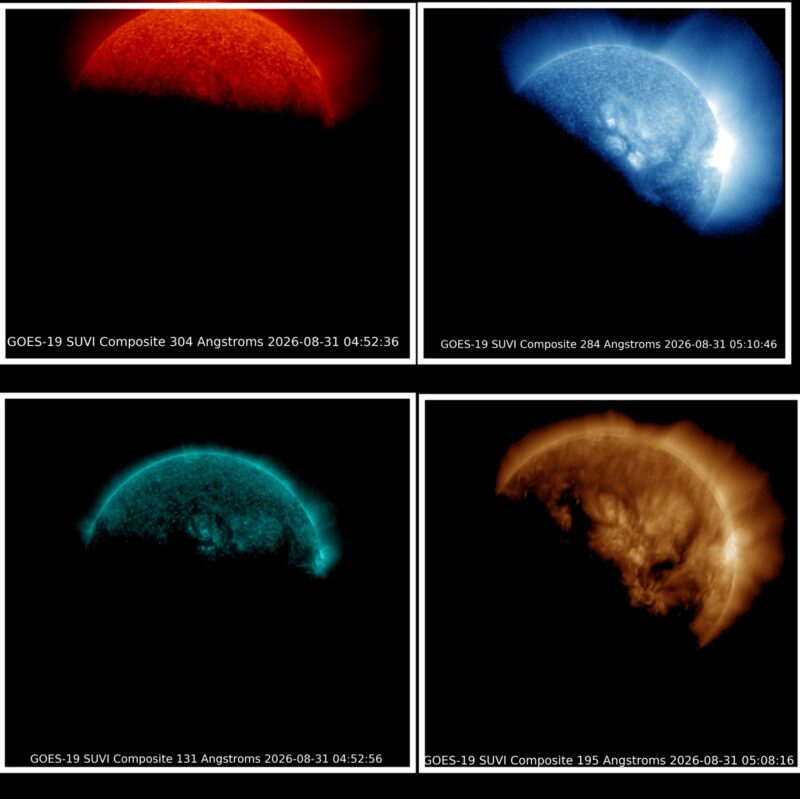

Like what you read?
Subscribe and receive daily news delivered to your inbox.
More from
C. Alex Young


Sun news: Sun-stuff and solar wind on the way

Yes, there’s an aurora season, and it’s here
Sun activity archive for August 2026
Sun activity archive for July 2026