Solar filaments, aka prominences
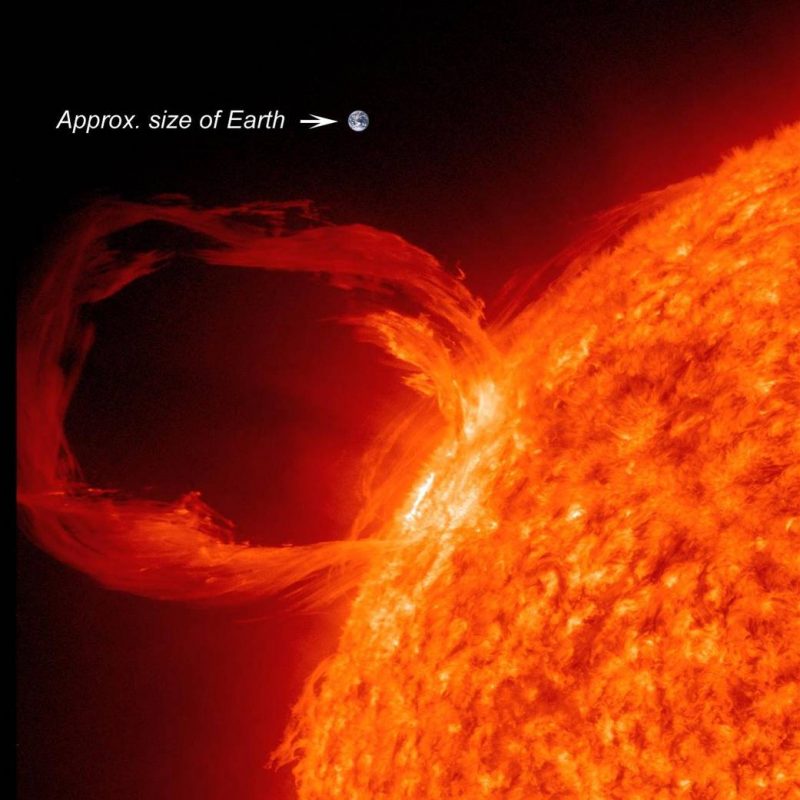
Filaments are ropes of solar material and magnetic fields, arcing up from the visible surface of the sun. When they erupt, they can produce solar flares and CMEs.
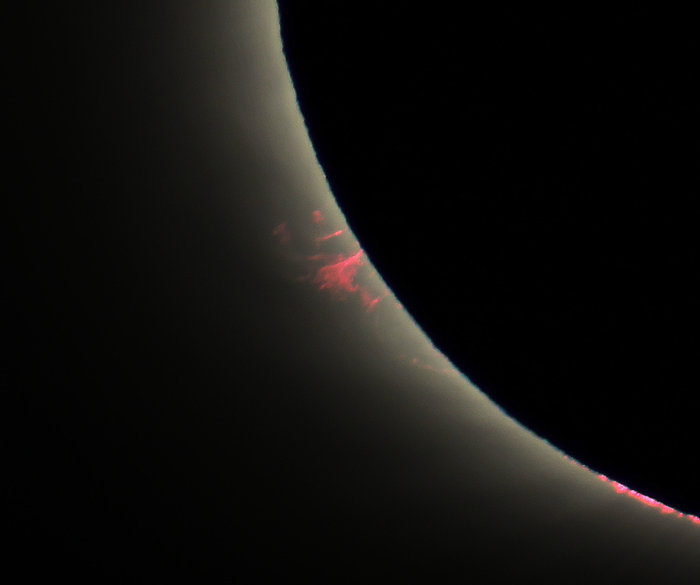
When a solar filament is viewed on the limb of the sun, it’s called a prominence. The largest prominences can extend from the sun’s visible surface to hundreds of times Earth’s diameter.
Prominences (filaments) are anchored to the sun’s surface in its photosphere. They extend outward into the sun’s hot outer atmosphere, called the corona.
A filament or prominence forms over timescales of about a day. Stable prominences may persist in the corona for several months, looping hundreds of thousands of miles into space.
These structures can often be seen as red or pink features during a total solar eclipse.
Why do prominences detach?
Solar filaments are held in place by very strong, loopy magnetic fields. You can think of these as being like invisible “rubber bands” holding the plasma against the sun.
When these magnetic loops become unstable or “snap” (a process called magnetic reconnection), the plasma is no longer anchored.
And once it’s detached, this plasma is hurled into space. If the event is large enough, it becomes a coronal mass ejection (CME). A CME is a much-larger event than a prominence. CMEs are massive bubble of plasma and magnetic fields that – like smaller prominences – can erupt into space. When a prominence detaches and erupts, it often becomes the bright core of a CME.
In fact, in studies by sun scientists, it’s been found that approximately 70% of all CMEs are associated with eruptive prominences.
Bottom line: Solar filaments (aka prominences, when viewed on the limb of the sun) are large, bright arcs of solar material and magnetic fields.
Like what you read?
Subscribe and receive daily news delivered to your inbox.
More from
C. Alex Young


Sun news: M flare erupts as solar wind heads to Earth

Yes, there’s an aurora season, and it’s here
Sun activity archive for September 2026
Sun activity archive for August 2026