Science matters. Wonder matters. You matter. Join our 2026 Donation Campaign today.
The constellation of Ursa Minor, the Little Bear, is often referred to as the Little Dipper. In truth, the Little Dipper is an asterism – or familiar star pattern – within Ursa Minor. But, as the Little Dipper shape contains all of Ursa Minor’s brightest stars, the names are often conflated.
Ursa Minor has helped sailors and navigators for thousands of years. That’s because it contains Polaris, or the North Star, which a traveler can follow to head northwards.
You’re probably more familiar with Ursa Major – home to the Big Dipper – than Ursa Minor. In mythology, there are many versions of the story of these Greater and Lesser Bears. In general, the story follows the woman Callisto, who is turned into a bear by one of the gods. When her son Arcas meets her as a bear in a forest and is about to shoot her, Zeus turns him into a bear too to prevent the killing. Zeus then placed them close together in the northern sky.
How to find Ursa Minor
In the Northern Hemisphere, Ursa Minor is circumpolar, which means it is up all night, every night.
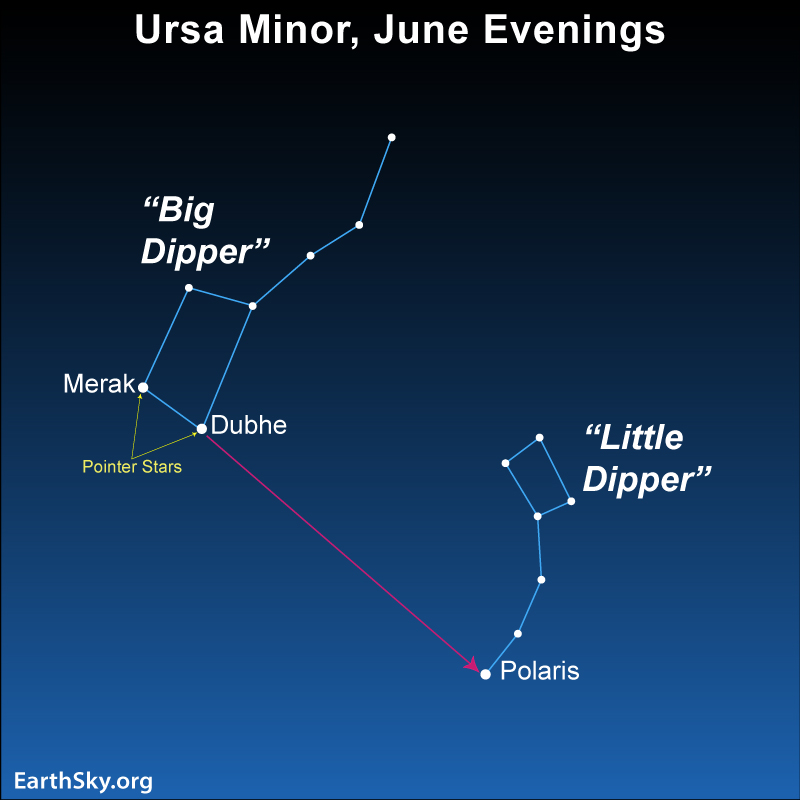
First, find the more easily recognizable Big Dipper. Then, use its pointer stars to get to the Little Dipper. The pointer stars are the last two stars in the bowl of the Big Dipper, named Merak and Dubhe. Draw a line through them and extend it north until you hit the next bright star. This is Polaris, or the North Star. This star-hop is illustrated at the top of this article.
Polaris is the brightest star in Ursa Minor. Earth’s north pole points almost directly at this star. So as Earth spins on its axis, it all the other stars in the sky appear to pivot around stationary Polaris.
For travelers heading north, you can simply aim in the direction of the North Star. Likewise, travelers heading west can keep the Polaris off to their right side, and so forth.
The stars of the Lesser Bear
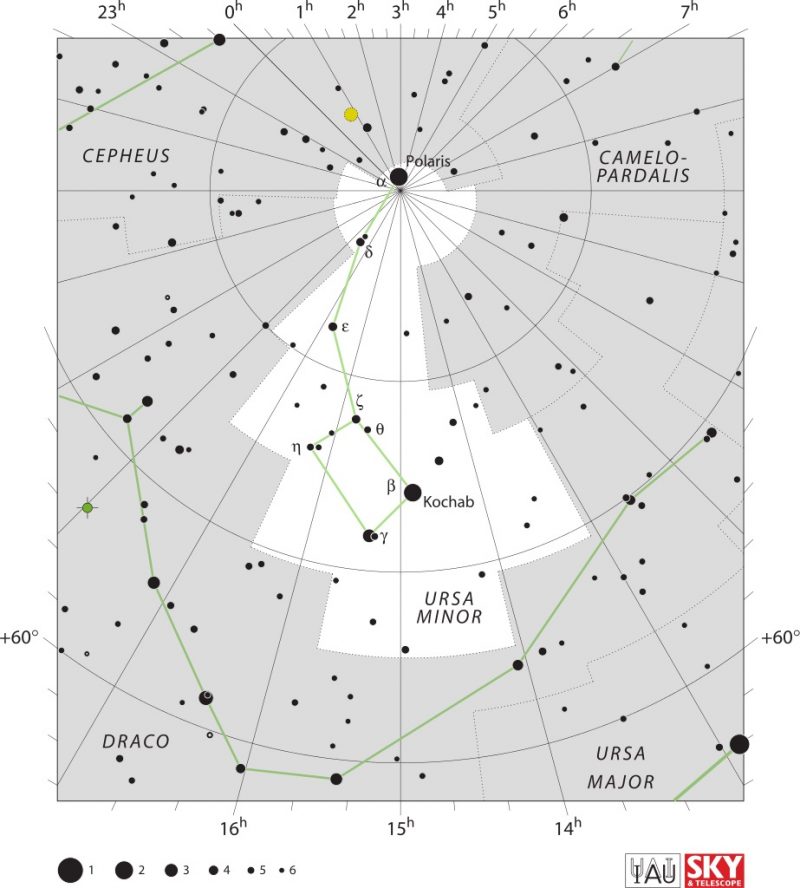
Polaris – the North Star – is the end star in the handle of the Little Dipper. Polaris is a magnitude 1.98 star and the brightest star in the constellation. The North Star lies 433 light-years from Earth.
There are two other bright stars in Ursa Minor. If you live in a light-polluted area, these three stars may be all you ever see of the Little Dipper, making it hard to correctly identify. The other two bright stars are the stars at the end of the bowl of the Little Dipper. Kochab is a 2.08 magnitude star 130 light-years away. Pherkad is a slightly dimmer 3.05 magnitude star lying 487 light-years away.
You can check how light-polluted your location is by seeing if you can trace the shape of the Little Dipper by spotting the rest of the stars between Polaris and Kochab and Pherkad. The remaining stars range in magnitude from 4.2 to 4.9. To find a dark-sky location, check out EarthSky’s Best Places to Stargaze.
Deep-sky objects in Ursa Minor
There is one deep-sky object of note in the Little Dipper, and you’ll need a large telescope and a dark-sky site in order to spot it. Polarissima Borealis, or NGC 3172, is a 14.9 magnitude galaxy about 1 1/2 degrees southeast of Polaris. This round fuzzball is the “most northern” deep-sky object.
Bottom line: Ursa Minor is the Lesser Bear, but you might know it as the Little Dipper. Its brightest star is Polaris, the North Star.
Read more: Ursa Major the Great Bear, home to the Big Dipper
Like what you read?
Subscribe and receive daily news delivered to your inbox.
More from
Kelly Kizer Whitt


Euclid was mapping the universe. Then it found a comet

Visible planets and night sky guide for October
Auriga the Charioteer and bright Capella on October evenings
It’s official! Chiricahua is now the 64th US national park