



EarthSky’s 2026 lunar calendar is available now. Get yours today! Makes a great gift.
When should you begin observing the heavens with binoculars? Now! It’s a great way to get a closer look at the beauties of the universe, without the expense and steep learning curve of a telescope. And, binoculars have other advantages over telescopes. They’re easier to store, and easier to transport to dark sky locations.
Plus, a good pair of binoculars can give you a new perspective on some wonderful objects in the night sky. The fact is, the moon, planets, double stars, star clusters, nebulae and even galaxies are great binocular objects. So, if you’ve never considered stargazing with binoculars, become acquainted with our top tips for binocular stargazing here.
And if you’ve got your binoculars in hand and a clear sky tonight, read on for a list of easy targets to observe.
Submit your own Earth or night sky photos at EarthSky Community Photos.
Best targets for binoculars? Start with the moon
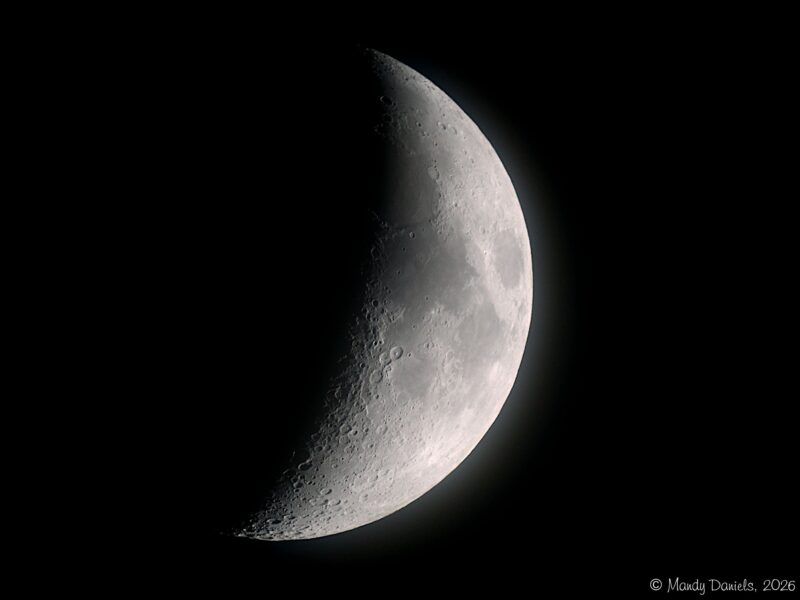
The moon is the best target to start with because it’s easy to find and never disappoints. As our closest neighbor in the solar system, you can see details on the moon that you could only dream of seeing on other worlds.
Start at the moon’s terminator, the dividing line between light and shadow, or day and night. This is the line of sunrise or sunset on the moon. And just as the shadows on Earth are longest around earthly sunrise or sunset, so it is with lunar shadows. The terminator slices across lunar valleys and mountains. Indeed, their long shadows allow them to stand out in stark relief. Look for rilles; the huge, dark maria (dry lava beds); and craters where brighter debris has splashed across the moon’s surface.
The planets with binoculars
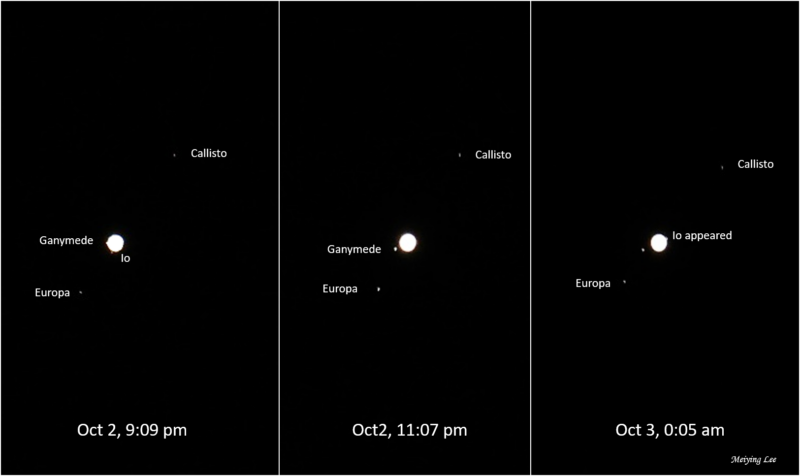
After the moon, visit Earth’s solar system neighbors next. Jupiter – our largest planet – is one of your best binocular targets. It should appear as a disk instead of a point. And you can track this world’s four largest moons as they disappear and reappear from behind Jupiter in their waltzing orbits. And right now, Jupiter is shining brightly high overhead in the evening sky. You can’t miss it!
Did you know you can see Jupiter’s 4 large moons with binoculars? You’ll see them much as Galileo did more than 400 years ago. In this livestream, EarthSky’s Deborah Byrd shows you how and when to spot Jupiter and how to use binoculars to see Jupiter’s 4 Galilean moons.
What about Saturn? Unfortunately, you won’t see Saturn’s rings with binoculars; you need a telescope for that. But you might be able to perceive Saturn’s rings as bulges that give the planet an elongated look.
Likewise, it takes a telescope to see the phases of Venus. But – when it’s near Earth and in a thin crescent phase – binoculars will show you that Venus isn’t perfectly round.
And Mars? Your binoculars will intensify its red-orange color.
They’ll also let you easily spot Uranus – the most distant planet visible to the eye alone – even in a less than optimum sky.
Finally, your binoculars will let you go deep in search of Neptune, the only major planet that requires at least binoculars (or a small telescope) to be seen.
Visit EarthSky’s planet guide. Updated daily!
Comets
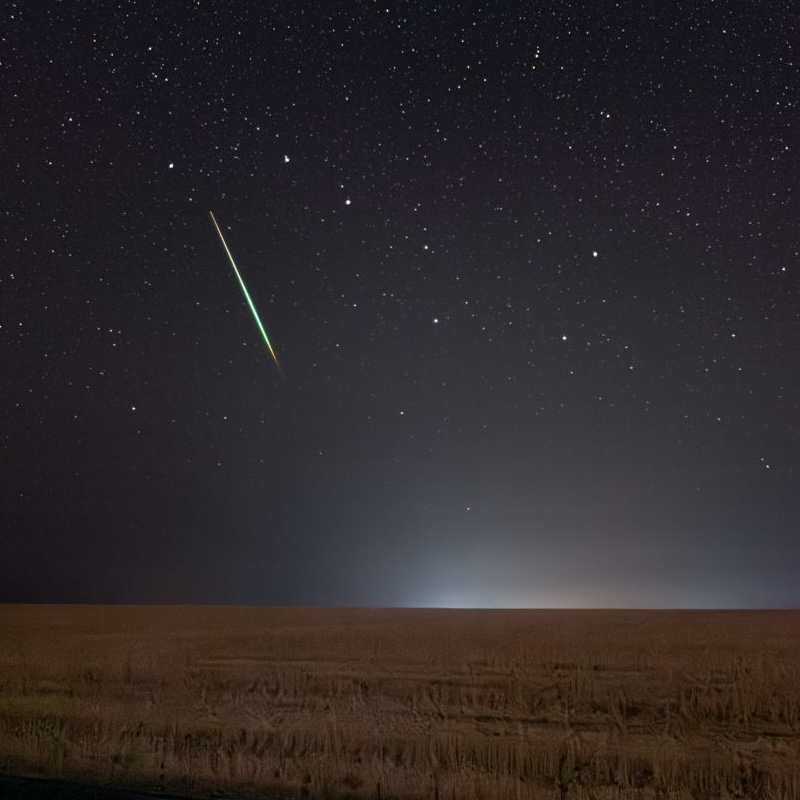
Occasionally a comet graces our nighttime skies. They are often only bright enough to be binocular objects. Since most comets are small, dim and diffuse, they are easier to locate in binoculars before catching them with the unaided eye. And remember that comets may only appear as a smudge even in binoculars. But they are always worth a try if we have a comet visiting the inner solar system.

Best targets for binoculars in the Milky Way
Beyond our solar system, the Milky Way glitters with excellent observing targets, from double stars to star clusters to nebulae. And even distant galaxies are visible in binoculars!
Double stars
Start with an easy double star – Mizar and Alcor – located at the bend of the handle in the Big Dipper. If you have decent eyesight you can separate these two stars without binoculars. But with binoculars you can see what differences there are between the stars in brightness, size and color. These two stars appear 12 arcminutes apart from our point of view.
If that was too easy, try Theta Tauri. At 5.5 arcminutes apart, the two components of Theta Tauri are accessible to some with the eye alone, but binoculars will make the separation obvious. View Theta Tauri, at magnitude 3.8, in the V-shape of Taurus’ head, just down from the bright, reddish Aldebaran. Can you use your binoculars to spot a yellowish color in Theta 1 and a bluish hue in Theta 2?
Open star clusters
Open star clusters are groups of young stars born together out of the same cloud of gas. The Pleiades Cluster in Taurus the Bull, is a fuzzy patch of six to seven stars seen with the unaided eye. It’s one of the best open clusters in the sky. The Pleiades, aka M45, is a 1.6-magnitude grouping that looks best in binoculars because a telescope cannot contain its wide expanse. Through binoculars those six stars suddenly become 30 to 70 stars.

Another favorite star cluster is the Beehive Cluster at the center of Cancer the Crab. The Beehive Cluster, or M44, is a 3.4-magnitude arrangement that you can see with the unaided eye, but it becomes more profuse in binoculars. Through his primitive telescope, Galileo could see more than 40 stars.
In the Southern Hemisphere, the Jewel Box Cluster in the constellation Crux is one of the youngest known clusters at 14 million years old. Can you spot a pyramidal shape to the cluster through binoculars?
Globular star clusters
Globular star clusters look very different from open star clusters. Each one is a huge conglomeration of ancient stars at the edges of our Milky Way. They look like a fuzzy sphere of light through binoculars.
In the Northern Hemisphere, target the Great Cluster in Hercules, aka M13. The globular cluster is on the western edge of a noticeable star pattern – the Keystone asterism – within Hercules. At magnitude 5.9, you can begin to glimpse some of the hundreds of thousands of stars that swarm tightly within the globular star cluster M13.
Another globular cluster is M22 in the constellation Sagittarius the Archer. Sagittarius contains another asterism, called the Teapot, and the whole Teapot region is rich with binocular treasures. M22 is a stunning magnitude 5.1 cluster, just above and to the left of the Teapot’s lid.
In the Southern Hemisphere, look for Omega Centauri. It’s the largest known globular star cluster of the Milky Way, which contains about 10 million stars. This behemoth, also known as NGC 5139, has a diameter of about 150 light-years. And, it’s 10 times more massive than a typical globular cluster.
Nebulae
Nebulae, or clouds in space, come in both light and dark. The best-known nebula is probably the glittering Orion Nebula, M42, a hazy 4th-magnitude patch on Orion’s Sword that can be glimpsed with the unaided eye. Binoculars enhance this view, as several stars cast their light onto the gas cloud, making it glow.

Another nebula for binoculars is the Lagoon Nebula, M8, in Sagittarius, not far from our earlier star cluster target M22. Above the spout of the Teapot asterism of Sagittarius, imagine steam flowing upward. This stretch of the Milky Way, filled with beautiful targets, contains M8, which, at magnitude 5.8, is more of a challenge than M42. Another even more difficult nebula lies right next to M8. You can recognize M20, the Trifid Nebula, by the darker dust lanes dividing this nebula into three parts. Make sure you are observing from a dark-sky location to have a chance at this magnitude 6.3 gas cloud.
Best targets for binoculars beyond the Milky Way
Finally, galaxies are the building blocks of our universe, and they’re our last stop as we head deeper into the greater universe. First, use your binoculars to start with the obvious – the galaxy next door to ours – the Andromeda Galaxy, aka M31. Spot this 3.5 magnitude spiral below the W-shape of Cassiopeia as an elongated fuzzy blob. Then look for two 8th-magnitude companions that lie along the disk of Andromeda. Although they’re a real challenge to glimpse in binoculars, it’s possible to find the companion galaxies.

Also, another option for binocular observing is the pair of galaxies M81 and M82 in Ursa Major, at magnitude 6.9 and 8.4 respectively, which will be a decent challenge. Additionally, these north circumpolar galaxies are up every night of the year for those in the Northern Hemisphere. M81 should be easier to catch, because it’s close to face-on, the dimmer M82 is less obvious in binoculars.
So what are your favorite objects to target in binoculars? Share with us in the comments below.
Bottom line: Binoculars open up new territory for stargazers, letting us view details on the moon, swirling satellites around Jupiter, colorful double stars, billowing clouds of gas and dust plus distant galaxies.
Read more: Top tips for binocular stargazing
Read more: Double stars: How to find, observe and enjoy them
Like what you read?
Subscribe and receive daily news delivered to your inbox.
More from
Kelly Kizer Whitt


Visible planets and night sky guide for October

No more leap seconds! Timekeeping is officially changing
Space is getting crowded. Here’s the latest satellite report
Planetary systems fall into 2 distinct families, astronomers say



