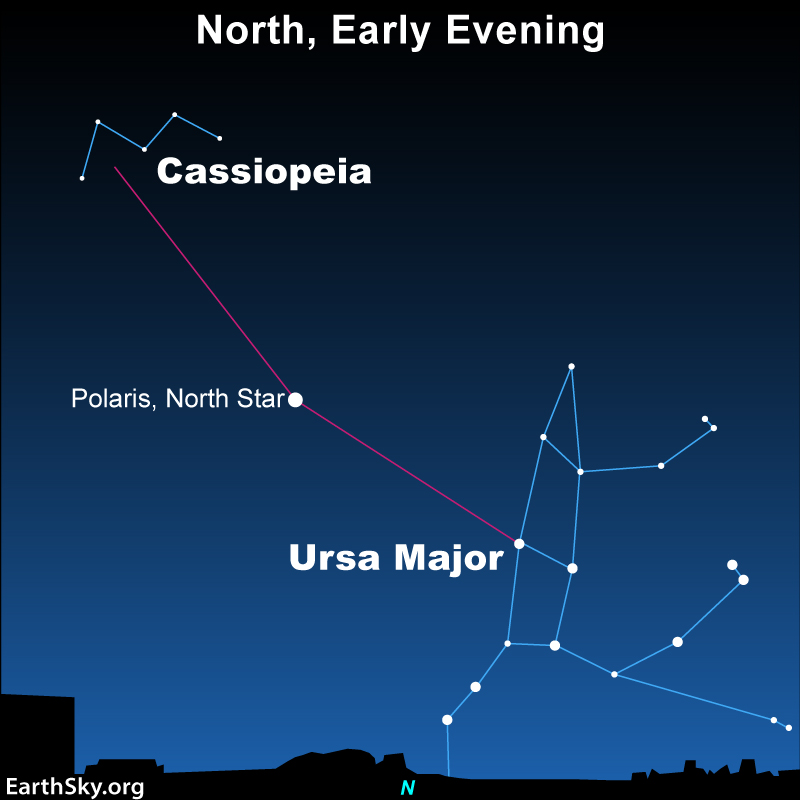
Cassiopeia and the Big Dipper in the night sky
Tonight, look for the northern sky’s two most prominent sky patterns – the constellation Cassiopeia the Queen and the Big Dipper, an asterism in the constellation Ursa Major. Cassiopeia and the Big Dipper circle around Polaris, the North Star, once a day, every day. What’s more, they are opposite each other, one on either side of the North Star.
Cassiopeia
At nightfall, the constellation Cassiopeia the Queen is easy to recognize in the northern sky. This constellation looks like a W or M and contains five moderately bright stars. Plus, the distinctive shape of Cassiopeia makes it very noticeable among the stars of the northern sky.
The Big Dipper
And, of course, Ursa Major the Greater Bear – which contains the Big Dipper asterism – is one of the most famous star patterns. At nightfall this month, Cassiopeia shines high in the north while the Dipper lurks low. In fact, they are always on opposite sides of the North Star. From the southern half of the U.S., the Big Dipper is partly or totally beneath the horizon this month in the evening hours. North of about 40 degrees north latitude (the latitude of Denver, Colorado, and Beijing, China), the Big Dipper always stays above the horizon (if your horizon is level). To see a precise view from your location, try Stellarium Online.
They circle around Polaris all night
Remember that their positions change as the night passes, as the great carousel of stars wheels westward (counterclockwise) around Polaris. You’ll notice Polaris resides halfway between Cassiopeia and the Big Dipper. As a result, they are like riders on opposite sides of a Ferris wheel. Thus, around midnight, Cassiopeia lies west (left) of Polaris, while the Big Dipper lies east (right). By dawn, Cassiopeia will have moved toward the north and the Big Dipper toward the south, remaining on opposite sides of Polaris.

Thus, around midnight tonight, Cassiopeia circles directly west (left) of Polaris, whereas the Big Dipper sweeps to Polaris’ east (right). And then, before dawn tomorrow the Big Dipper climbs right above the North Star, while Cassiopeia swings directly below.
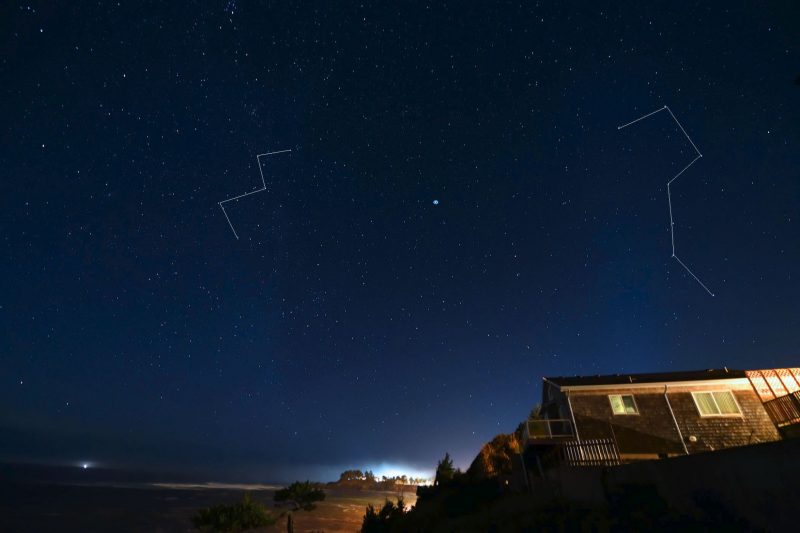
Bottom line: Watch the celestial clock and its two great big hour hands – Cassiopeia and the Big Dipper – as they swing around the North Star each and every night!
Read more: Circumpolar stars stay up all night long
Easily locate stars and constellations during any day and time with EarthSky’s Planisphere.
Like what you read?
Subscribe and receive daily news delivered to your inbox.
More from
Editors of EarthSky


Mercury after sunset and great for Southern Hemisphere!

Meteor shower guide 2026: Up next … the Orionids
We fly between the sun and Saturn. At opposition today
October birthstone: Colorful opal and tourmaline