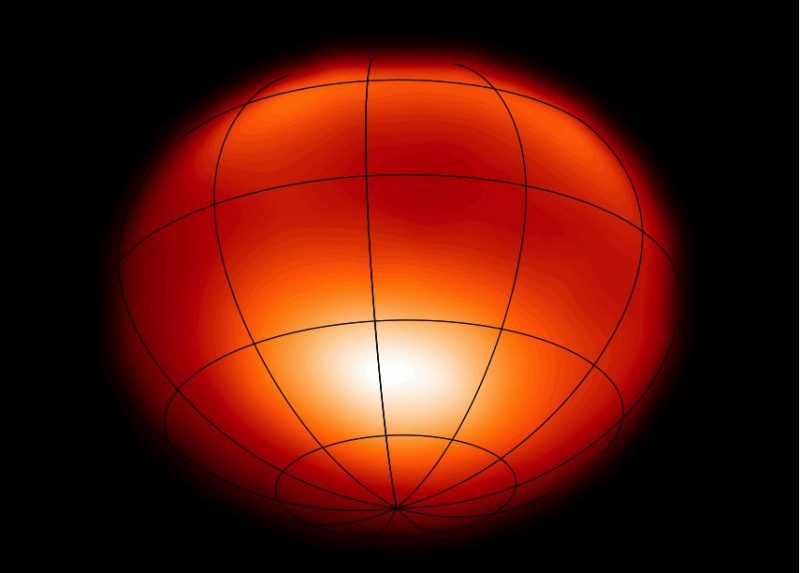
Alpha Cephei, also known as Alderamin, is the brightest star in the constellation Cepheus the King. Astronomers are intrigued by this star because it spins at such a fast rate. Unlike our almost-round sun, Alderamin is distorted by its rapid spin into an oblate form, like a partly deflated beach ball.
This star isn’t the brightest one around, but it’s pretty bright. It shines at about magnitude 2.5.
Its faint constellation, Cepheus, is surprisingly easy to spot in a dark sky because the stars of Cepheus trace out the shape of a child’s stick house.
Science of Alpha Cephei
Alderamin, 49 light-years away, is a white star that is twice the mass of the sun and about 17 times its luminosity. It is considered a Class A star, which is now evolving off the main sequence into a subgiant. It’s thought that this star is now on its way to becoming a red giant as its internal supply of hydrogen fuel runs low.
Alpha Cephei rotates rapidly; observations suggest it could be as fast as 152 miles a second (246 km/s). In comparison, the sun’s rotation speed at the equator is not quite 1.2 miles a second (2 km/s). As a result of its rapid rotation, Alpha Cephei appears oblate. That’s because the star’s surface rotation speed gets progressively faster as you move away from its rotation axis towards its equator. And, as surface rotation speed increases, the star’s surface is increasingly pushed out. As a result, Alpha Cephei bulges along the equator.
A closer look at Alpha Cephei
The image below is a model of Alpha Cephei based on data from the CHARA telescope array. It shows Alpha Cephei’s oblate shape. It also shows a darker equatorial region, shaded to indicate that these are cooler regions of the star. Meanwhile, a section near the pole appears brighter. That’s because the surface gravity is higher around the “flattened” poles compared to the bulging equator, and as a result, higher temperatures and pressure are needed to maintain an equilibrium. These differences in brightness across rapidly rotating stars result in a phenomenon scientists call gravity darkening.
Astronomer Jim Kaler wrote about this rapidly spinning star:
The spin may also be related to the star’s activity. [Our] sun is magnetically active in broad part because its outer third is churning up and down in huge convective currents, the movement helping to generate a magnetic field. Such outer zones are supposed to disappear in class A stars like Alderamin. Yet Alderamin emits about the same amount of X-ray radiation as does the sun and has other features that together suggest considerable magnetic activity. No one really knows why. Such anomalies, of course, drive the science. Understanding Alderamin will someday help us understand our own star, on which we depend for life.
How to find Alpha Cephei
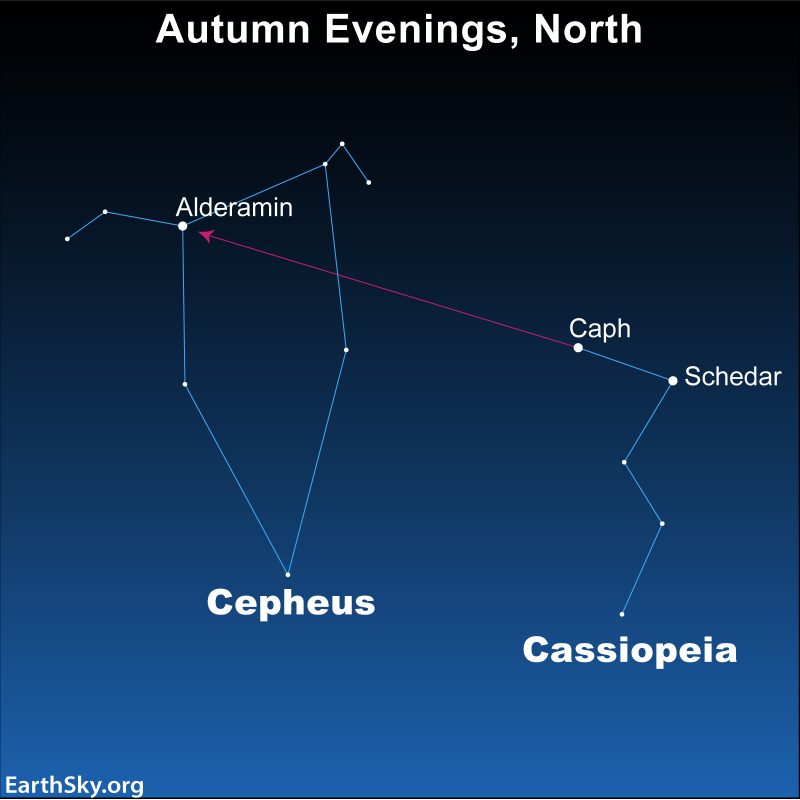
On a dark night, Alpha Cephei is easily visible and relatively easy to find. Look northward for this star. It is circumpolar throughout all of Europe, northern Asia, Canada and American cities as far south as San Diego, California. Its constellation, Cepheus, has the shape of the stick house we all drew as children. Or you might prefer to see the shape of Cepheus as a point on the King’s crown. Cepheus is a rather faint constellation, but Alpha Cephei is by far its brightest star and is easily observable to the unaided eye, even in cities.
If you know the W or M-shaped constellation Cassiopeia the Queen, you can use the Cassiopeia stars Schedar and Caph to star-hop to Alderamin.
A once and future pole star
Alpha Cephei has been a pole star in the past, that is, a star close to the sky’s north pole. The last time was in 18,000 BCE. It will again be a pole star some 5,500 years from now. No matter what is going on then on Earth, the heavens will pursue their long and predictable cycles. And Alpha Cephei will lie some 3 degrees from the sky’s north pole around the year 7500 CE. That means it won’t be as good a pole star as our present-day Polaris, which will be 0.4525 degrees from the north celestial pole on March 24, 2100. But it’ll be pretty good.
This star’s proper name, Alderamin, is from Arabic and means “the right arm,” presumably of Cepheus the King, who played a role in Greek mythology.
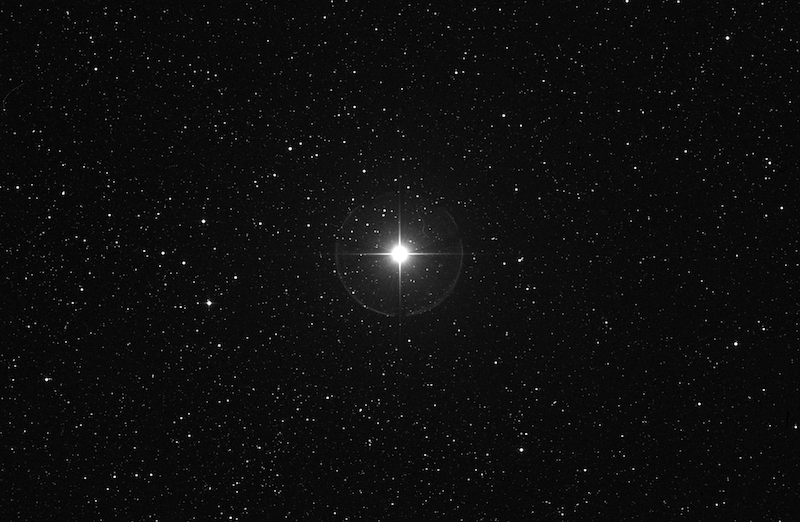
Bottom line: Alpha Cephei, or Alderamin, is the brightest star in the faint constellation Cepheus the King. It’s spinning so fast that it appears like a slightly flattened beach ball.
Like what you read?
Subscribe and receive daily news delivered to your inbox.
More from
Bruce McClure


Cor Caroli, named for the heart of a king

1st eclipse season of 2024 starts March 24-25
On the equinox, are day and night equal?
Equinox fun: Track sun’s shift between now and the solstice