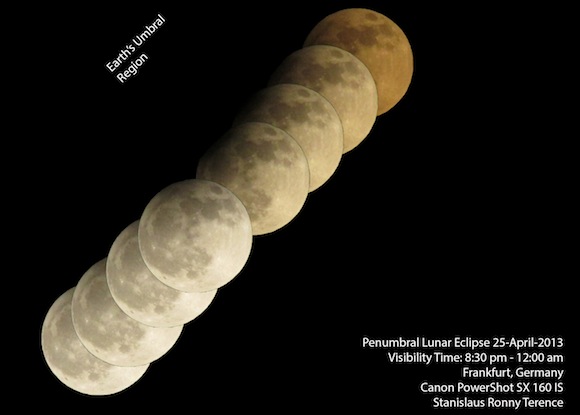
The eclipse of April 25-26, 2013 featured a very brief partial eclipse of the moon, as shown on the photo above. See how the top part of the moon appears darkened for part of the eclipse? As seen from parts of Earth (but not North or South America), Earth’s dark umbral shadow barely clipped the full moon for 27 minutes, causing this third-shortest partial lunar eclipse in the 21st century. Before and after the partial eclipse, there was a deep penumbral eclipse of the moon.
There are two more lunar eclipses later this year, but both are penumbral only. During the April 25-26 eclipse, Earth’s dark umbral shadow was located mostly to one side of the moon, as shown in the photo above. That was the last time Earth’s umbral shadow will touch the moon’s face until the total lunar eclipse of April 15, 2014.
See it! More photos of April 25-26 penumbral lunar eclipse
Next eclipse: Ring of fire annular eclipse of sun May 9-10, 2013
Are lunar eclipses more common than solar eclipses?
Want to see your photo here? Send us your photos via EarthSky on Facebook, EarthSky’s photo community on Google+, and/or e-mail: images@earthsky.org.
Like what you read?
Subscribe and receive daily news delivered to your inbox.
More from
Chris Comfort


Rock towers and Milky Way

Conjuring an orb of light on the rim of Black Canyon
Lenticular clouds in the water and sky
Milky Way over Joshua Tree National Park