Watch this video of some of our editors’ picks for the best deep-sky photos of August 2025, and then see more below!
Stunning deep-sky photos from our community
The EarthSky community has many talented astrophotographers who capture stunning images of the deep sky. We gathered some of our favorite deep-sky photos we received in August 2025 for you to enjoy. Do you have some of your own images to share? You can submit them to us here. We love to see them!
Deep-sky photos of diffuse nebulae
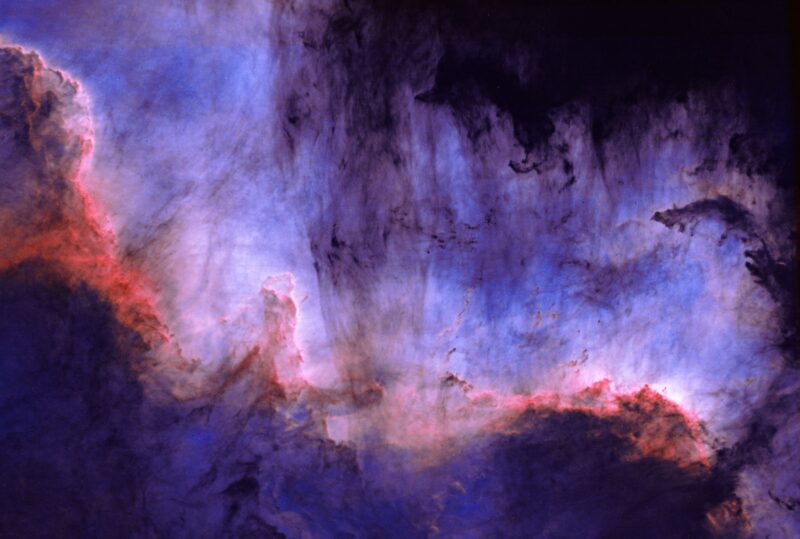
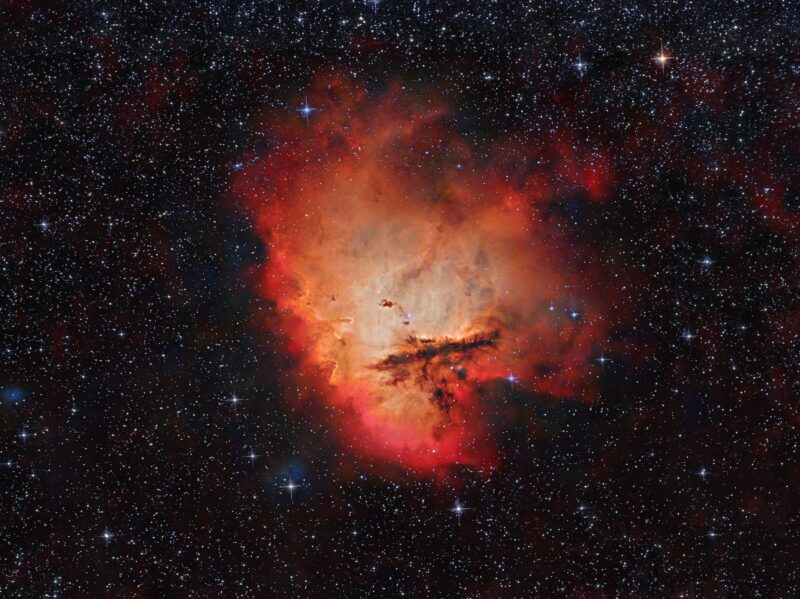
View at EarthSky Community Photos. | Adam Kline in Cherry Sprigs State Park, Pennsylvania, captured this on August 22, 2025. Adam wrote: “The Cygnus Wall is a striking region within the North America nebula (NGC 7000). It’s a vast emission nebula located in the constellation Cygnus. It’s shaped like a towering ridge of glowing gas and dust. The Wall stretches approximately 20 light-years across.” Thank you, Adam!View at EarthSky Community Photos. | Egidio Vergani in Campo Cecina, Carrara, Italy, captured this telescopic view on August 7, 2025. Egidio wrote: “The nebula NGC 281, also known as the Pacman nebula. It’s a typical emission nebula in which the matter, mostly hydrogen, is excited by one or more very hot stars. It is located approximately 9,500 light-years away. It has the multiple star HD 5005 at its center. About a quarter of the nebula is covered by a layer of dust, which is why it has a distinctive shape. It reminded observers of a famous video game character.” Thank you, Egidio!
More photos of nebulae
View at EarthSky Community Photos. | Tameem Altameemi in the United Arab Emirates (UAE) captured this on August 23, 2025. Tameem wrote: “The Elephant’s Trunk nebula (IC 1396) is a dense region of interstellar gas and dust located about 2,400 light-years away in the constellation Cepheus. It is an active star-forming region. That’s where young massive stars sculpt the surrounding clouds with their powerful radiation and stellar winds. The dark, elongated structure resembling an elephant’s trunk is a collapsing cloud of material, giving birth to new stars within.” Thank you, Tameem!View at EarthSky Community Photos. | Andy Dungan near Cotopaxi, Colorado, sent us this reprocessing of Messier 16, the Eagle nebula. It’s in the constellation Serpens. Andy wrote: “The Eagle Nebula is a classic and as part of the Milky Way Core is always fun to take pics of it.” Thank you, Andy!View at EarthSky Community Photos. | Steven Bellavia in Smithfield, Virginia, captured this telescopic view of LBN468 on August 27, 2025. It’s an ionized gas region which he calls the ‘Lasso nebula’. Steven wrote: “Lynds Bright nebula, LBN 468, is an HII region that straddles the constellations Cepheus and Draco. It’s located approximately 1,600 light-years from Earth. LBN 468 is a large complex of both bright and dark nebulosity. It contains regions of dusty interstellar matter where star formation is occurring. A notable feature within LBN 468 is Gyulbudaghian’s nebula (HH 215). It’s a small reflection nebula at the tip of an arrow-shaped formation. It’s illuminated by the variable protostar PV Cephei and changes brightness and shape over time.” Thank you, Steven!
The Crescent nebula with the Soap Bubble
View at EarthSky Community Photos. | Irwin Seidman in Ayton, Ontario, Canada, captured this telescopic view of the Crescent nebula on August 21, 2025. Irwin wrote: “This image of the Crescent and Soap Bubble nebulae were captured on August 21, 2025 at Starfest. That is Canada’s largest annual astronomy conference and star party.” Thank you, Irwin!View at EarthSky Community Photos. | Scott Davis in Florence, Kentucky, captured this telescopic view of the Crescent nebula, in the constellation Cygnus, on August 2, 2025. Scott wrote: “This is only an hour of hydrogen-alpha and 4 hours of oxygen III.” Thank you, Scott!View at EarthSky Community Photos. | Tom Cofer in Lakewood Ranch, Florida, captured this telescopic view of the Crescent nebula on August 21, 2025. Tom wrote: “Behold the galaxy’s most dramatic brain scan. This is the Crescent nebula, also known as NGC 6888. And yes, it really does look like a neuron firing in space. It’s formed by a dying Wolf-Rayet star shedding its outer layers. This cosmic brain cloud is laced with glowing filaments of hydrogen and oxygen. I combined broadband and narrow-band data to highlight the complex textures and those eerie synapse-like structures. Who knew interstellar gas could look so … cerebral?” Thank you, Tom!
Deep-sky photos of far-away galaxies
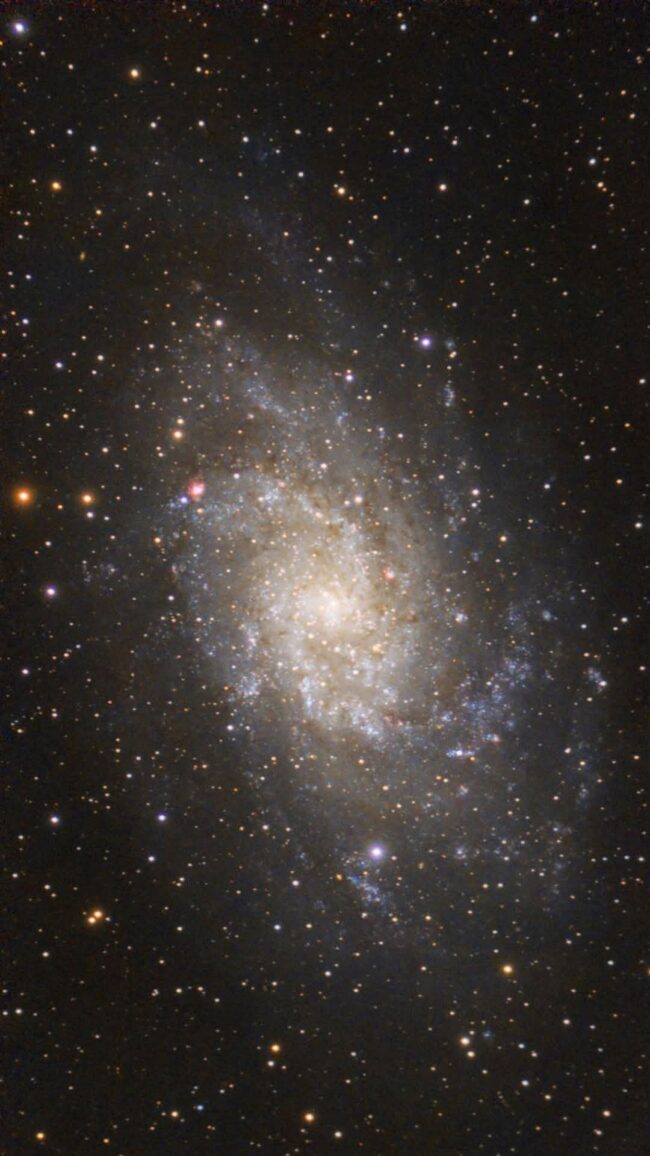
View at EarthSky Community Photos. | Robert R. Gaudet in Fundy National Park, Herring Cove, New Brunswick, Canada, captured this view of Messier 33, the Triangulum galaxy, on August 24, 2025. Robert wrote: “I attended the Fundy star party at Fundy National Park, Herring Cove, New Brunswick, Canada, on August 22 to 24, 2025. The Triangulum galaxy was one of my acquisitions for the weekend.” Thank you, Robert!View at EarthSky Community Photos. | Gwen Forrester in DeKalb County, Tennessee, captured this view of the heart of Messier 31, the Andromeda galaxy, on August 29, 2025. Gwen wrote: “A close-up view of the Andromeda galaxy, showing delicate tendrils of dust and gas swirling around its bright core, 2.5 million light-years away.” Thank you, Gwen!
And a supernova in a distant galaxy
View at EarthSky Community Photos. | Amateur astronomer Filipp Romanov of Russia made this image of supernova SN 2025umq (discovered by him) in galaxy SDSS J004819.14+075856.8, on August 24, 2025. Filipp sent us an interesting story of his discovery, and we have excerpted the following. “On August 17, 2025, on the 16th anniversary of the start of my study of astronomy by self-education, I requested imaging using remote telescopes. I checked 5 x 300 sec. photographs taken using 0.51-m f/6.8 reflector T59 of iTelescope.Net. Only 12 arcseconds from the edges of the frames, I saw a +20 mag star, which was absent from the archival photographs. On August 20, according to my calculations and request, the spectrum of this star was obtained at the Liverpool Telescope. As a result of its analysis, this star was classified as a fading Type Ia supernova at redshift of 0.159 (more than 2 billion light years away).” Read the whole story here. Thank you, Filipp!
Bottom line: Enjoy this gallery of deep-sky photos for August 2025 from our EarthSky community. If you have a great photo to share, send it in, too. We love to see them!
Armando is known primarily as an astronomy educator, after 30+ years of extensive public outreach and 10 years teaching in colleges. As one of only a handful of science communicators in Puerto Rico during Comet Halley's last visit, he assumed a pioneering role starting in 1985 when science was just beginning to enter the collective mindset. Over the years, his work as a teacher, speaker and writer, inspired people to pursue interests in science and brought enduring change to Puerto Rican culture. After being accepted into the 2014–2015 Antarctic season of PolarTREC, Armando was assigned to the Amundsen-Scott South Pole Station, where in 2015 he successfully conducted 10 days of work at the IceCube Neutrino Observatory. His affiliations include Ana G. Méndez University, Cupey campus (2014 to 2021), the University of Puerto Rico, Aguadilla campus (2015 to 2017), NASA JPL's Solar System Ambassadors (2004 to 2006), and NASA Space Grant (2017 to 2019) where he served as an affiliate representative.
Like what you read? Subscribe and receive daily news delivered to your inbox.
Thank you! Your submission has been received!
Oops! Something went wrong while submitting the form.