Sun news September 30: G3 geomagnetic storm and 4 M flares!
(11 UTC Sept 29 – 11 UTC Sept 30)
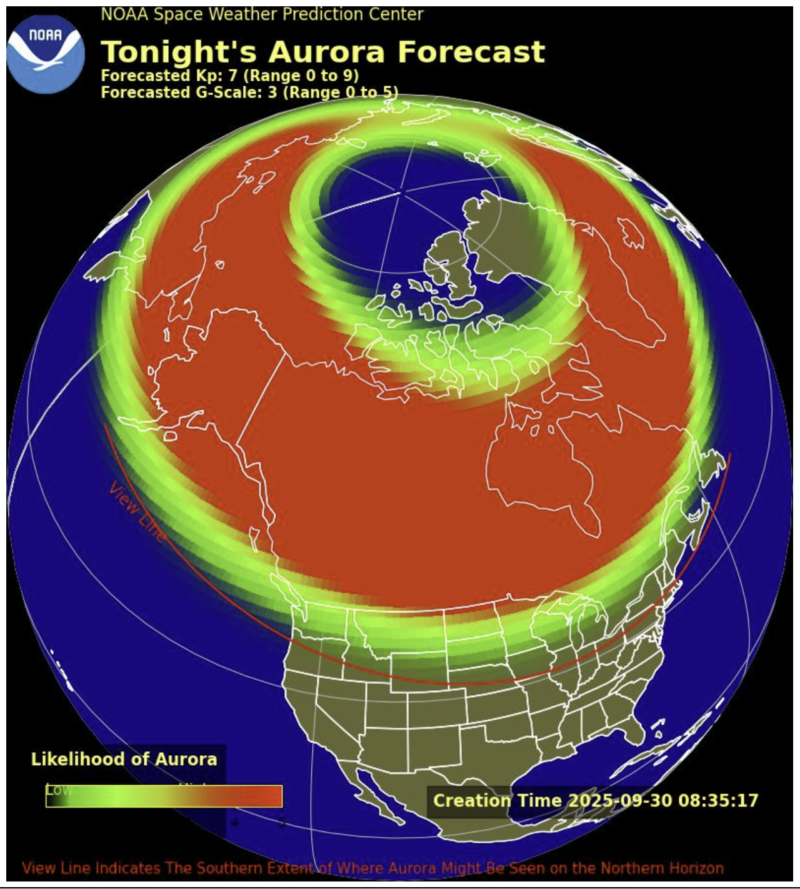

Earth’s magnetic field reached G3 (strong) geomagnetic storm levels early this morning, powered by lingering high-speed solar wind from a coronal hole. More disturbance is possible this evening. It’s also been a busy day on the sun itself, with our star unleashing four M-class (moderate) flares in the past 24 hours. Plus, we observed a spectacular filament eruption this morning; take a look at the imagery below.
- Flare activity: Moderate to high, with 20 flares total: 4 M-class flares and 16 Cs (common).
- Strongest: M1.0 from AR4232 at 0:56 UTC on Sept 30. It caused an R1 (minor) radio blackout over the Pacific Ocean east of Papua New Guinea.
- Other notable flares: M1.1 (AR4232 at 11:15 UTC), M1.1 (AR4236 at 11:43 UTC), M1.1 (AR4233 at 11:59 UTC), C8.4 (AR4230 at 12:18 UTC), C5.8 (AR4227 at 2:14 UTC), and C4.3 (AR4232 at 14:25 UTC).
- AR4236 dominated with seven flares (one M and six Cs), while AR4232 produced two Ms and three mid-Cs.
- Sunspot regions: Nine numbered active regions are currently visible on the Earth-facing disk.
- AR4230 (southwest, beta-gamma) grew into a cluster of spots and split into three different numbered regions: AR4230, AR4238 and AR4239.
- AR4232 (southeast, beta-gamma) decayed slightly but still produced the largest flare of the period.
- AR4236 (emerging, northeast, beta) developed a ring-shaped structure and produced one of today’s M flares.
- AR4233 (northeast, beta) remained relatively simple but still managed an M-class flare.
- Other regions remained small, simple, or in decay with alpha or beta configurations.
- Blasts from the sun? The M flares produced during the period, the coronal mass ejections (CMEs) produced are not Earth-oriented.
- Solar wind: Solar wind speeds increased from 366 km/s to near 440 km/s at 4:40 UTC, reflecting weak influence from a coronal hole’s high-speed stream (CH HSS). By 11 UTC it was holding at 403 km/s increasing to 724 km/s. The IMF peaked at moderately high levels, while Bz stayed strongly southward during most of the period.
- Earth’s magnetic field: Geomagnetic activity ranged from unsettled to active (Kp = 4–7). It began at Kp = 4 at 12 UTC on September 29, held steady, then jumped to Kp = 7 (G3 storm) at 3 UTC on September 30. By 11 UTC, activity eased slightly to Kp = 6, the equivalent of a G2 (moderate) geomagnetic storm.
Sun news September 29: Flaring frenzy keeps the sun crackling
(11 UTC to 11 UTC)
The sun has delivered another busy day, producing 22 flares in the past 24 hours. Two of these were M-class (moderate) events: an M1.0 from AR4233 and a stronger M3.6 from AR4232. We also observed several near-M flares, including C9.1, C9.9, and C9.6 bursts from AR4233. Despite the fireworks, no Earth-directed coronal mass ejections (CMEs) were spotted, though AR4232’s activity remains under close watch.
- Flare activity: Moderate to high, with 22 flares total: 2 M-class flares and 20 Cs (common).
- Strongest: M3.6 from AR4232 at 1:37 UTC on Sept 29. It created an R1 (minor) radio blackout over the Pacific Ocean east of Asia.
- Other notable flares: M1.0 (AR4233 at 13:26 UTC), C9.9 (AR4233 at 13:31 UTC), C9.6 (AR4233 at 20:34 UTC), C9.1 (AR4233 at 13:24 UTC), C7.4 (AR4232 at 19:37 UTC), and C6.5 (AR4232 at 4:11 UTC).
- AR4232 and AR4233 dominated production, while AR4236 added multiple mid-C flares.
- Sunspot regions: Ten numbered active regions are currently visible on the Earth-facing disk.
- AR4232 (northeast, beta-gamma) grew more complex and produced the M3.6 flare, as well as several strong C-class events.
- AR4233 (northeast, beta) unleashed a near-M trio (C9.9, C9.6, C9.1), and the M1.0 flare.
- AR4236 (emerging, northeast, beta) contributed steady C-class flares, showing rapid development.
- AR4230 (southwest, beta-gamma) and AR4235 (northeast, beta) showed minor growth but stayed mostly quiet.
- Other regions remained small, simple, or in decay.
- Blasts from the Sun? No Earth-directed CMEs appeared in coronagraph imagery. A fast CME linked to earlier flaring from AR4232 was modeled as a miss, passing behind Earth.
- Solar wind: Solar wind reflected weak influence from a negative polarity coronal hole high-speed stream (CH HSS). Speeds ranged from 375–450 km/s. The IMF peaked near 14 nT, and Bz dipped southward to -7 nT at times.
- Earth’s magnetic field: Earth’s geomagnetic field stayed quiet to unsettled (Kp = 2–3).
Sun news September 28: Blammo! Big jump to high sun activity!
(11 UTC to 11 UTC)

The sun vaulted to high activity after AR4232 unleashed an M6.5 flare at 08:40 UTC this morning (September 28, 2025). The eruption caused an R2 (moderate) radio blackout over the Indian Ocean just east of Africa. Earlier in the period, multiple regions kept C-class flares coming. Then AR4232 turned up the heat!
- Flare activity: From 11:00 UTC yesterday to 11:00 UTC today, we saw an escalation to high sun activity, with one strong M-class flare (M6.5) and a flurry of C-class events.
- Strongest flare was the M6.5 from AR4232 at 08:40 UTC on September 28.
- Other notable events (from the current list): C7.6 (AR4233 at 12:59 UTC September 27), C7.6 (AR4232 at 17:56 UTC September 27), C6.8 (AR4232 at 17:39 UTC September 27).
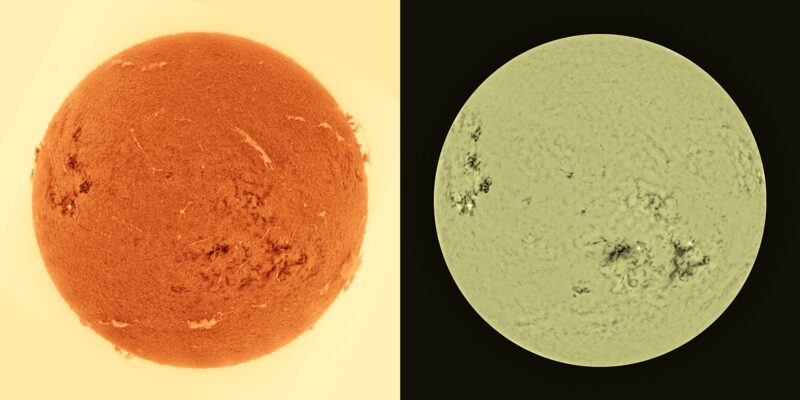
- Sunspot regions: Eight active regions dot the disk, with several newly arrived on the east limb.
- AR4232 (northeast, beta) — today’s star performer with the M6.5; also produced multiple strong C-class flares.
- AR4233 (northeast, beta) — prolific C-class producer as it rotates further into view.
- AR4235 (northeast, beta) — added mid-C activity (peak C5.4).
- AR4226 / AR4227 — smaller, generally simple groups; occasional low C-class events.
- Newcomers: AR4234 (south, beta) and AR4235 (north, beta) numbered late in the prior period.
- Blasts from the sun? Coronagraph imagery shows several coronal mass ejections (CMEs) near or just beyond the sun’s east/northeast limb. Current analysis finds no clear Earth-directed components. The M6.5 from AR4232 remains under modeling for any faint, glancing signature, but an Earth-directed hit looks unlikely so far.
- Solar wind: Parameters stayed near nominal early, then trended upward, a classic sign that a coronal hole high-speed stream (CH HSS) is rotating into a geoeffective position.
- The total (Bt) interplanetary magnetic field (IMF) increased slightly; Bz dipped south, density rose and the speed hovered near ~350 km/s.
- Earth’s magnetic field: Geomagnetic conditions ran quiet to unsettled. As the CH HSS strengthens, expect intervals of active levels and a chance of isolated G1 (minor) storming today.
What’s ahead? Sun–Earth forecast
- Flare activity forecast: With AR4232 hot, M-class flares (R1–R2) remain likely through September 30. A low, non-zero chance for an isolated X-class exists while AR4232 continues to evolve, though no strong X-class signal is evident yet.
- Geomagnetic activity forecast:
- September 28: Unsettled to active with a chance of isolated G1 (minor) geomagnetic storm as the coronal-hole stream builds.
- September 29–30: Quiet to unsettled trending late on the 29th into the 30th as CH HSS effects begin to wane.
Sun news September 27: Sun wakes up and fires off 4 M flares!
(10 UTC to 10 UTC)


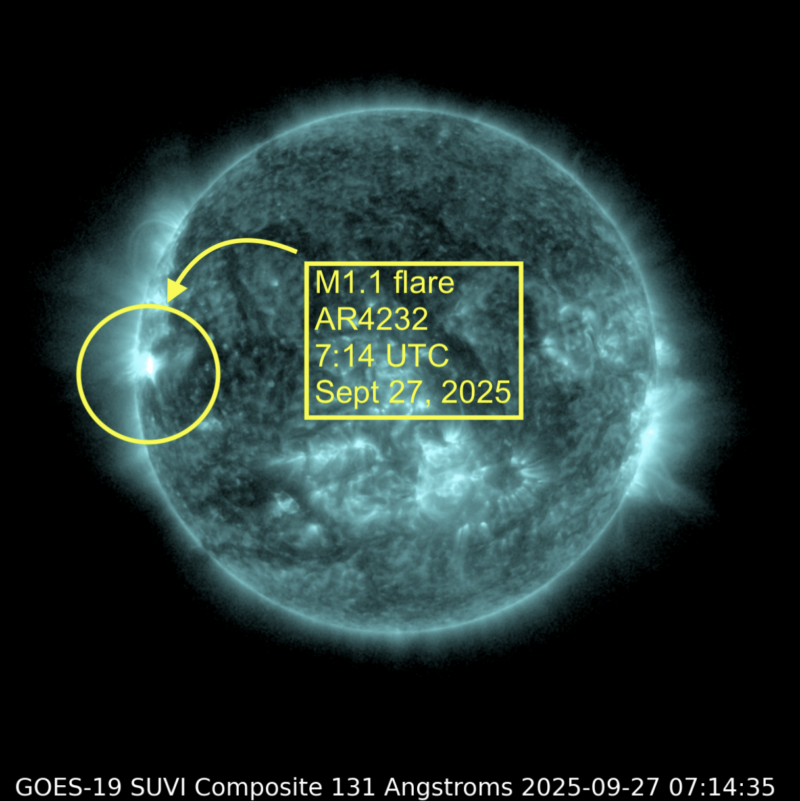
Over the past day, we had four M-class flares and a huge blast in the solar southeast! We said yesterday we might be in a lull before the storm. And here it is. The sun delivered a flurry of 16 flares over the past day, including the four Ms plus 12 C-class flares. Three different active regions fired off the M flares. See details below. Will we see an X flare during this rise in solar activity?
- Flare activity: rose to a moderate level, with four M-class flares and 12 C-class flares during the past day.
- Strongest flare was an M1.6 from a still-unnumbered incoming active region in the sun’s northeast. It happened at 20:01 UTC on September 26. The blast triggered an R1 (minor) radio blackout over the Pacific Ocean.
- Other notable events: M1.1 (northeast region at 4:23 UTC), M1.1 (AR4232 at 7:14 UTC), and M1.0 (AR4226 at 3:59 UTC). The newcomer in the northeast led the count with six flares—two M and four C—while AR4226 followed with four flares, including one M and three C.
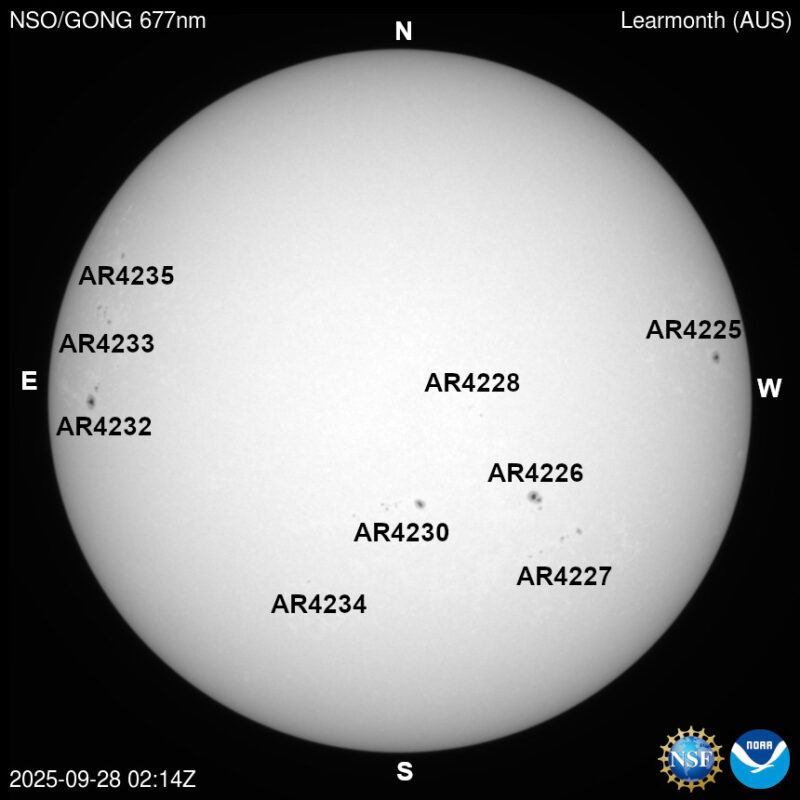
- Sunspot regions: Eight numbered active regions covered the Earth-facing solar disk.
- All visible active regions showed simple alpha or beta magnetic configurations.
- AR4217 (southwest), a major player earlier this week, rotated out of view on the southwest horizon. Fresh solar activity is arriving from just beyond the east limb, where two M flares already erupted on the far side.
- Most regions on the solar disk remained small, stable, or in slow decay.
- A newcomer appeared in the northeast and was numbered AR4232.
- Blasts from the sun? Coronagraph imagery showed no Earth-directed CMEs.
- Solar wind: Solar wind speeds stayed moderate, dropping from 462 km/s to 381 km/s. The IMF stayed weak, while the Bz fluctuated between northward and southward before ending northward at 11 UTC on September 27. A southward Bz favors auroras.
- Earth’s magnetic field: The geomagnetic field stayed quiet (Kp = 1–2). The period ended quietly at Kp = 2.
Sun news September 26: Is the low sun activity the calm before the storm?
(10 UTC to 10 UTC)
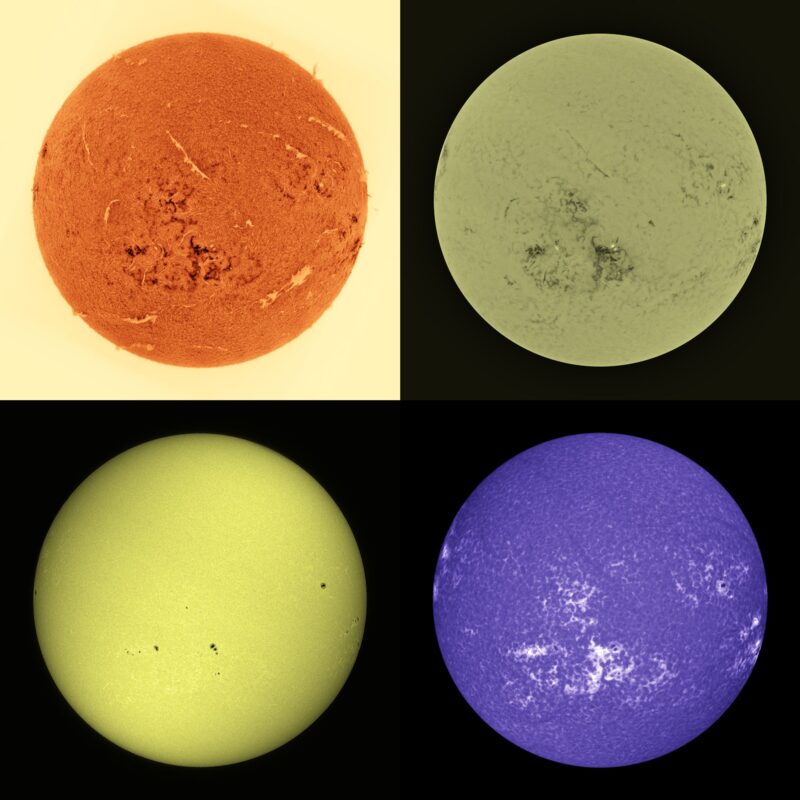

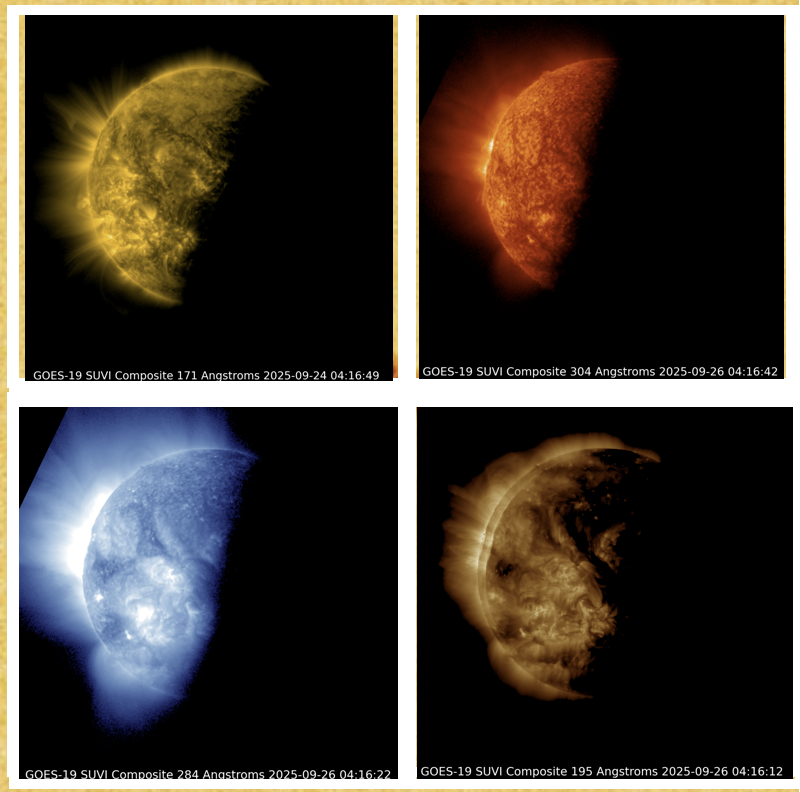
Sun flare activity dropped back to low over the past day, with only faint C-class flares. But the past day’s flare count rose in contrast to recent days. We saw 15 flares in this period versus as few as six earlier in the week. Are we seeing the calm before the storm? We observed fiery activity on the northeast limb through repeated, slow, arching prominences. This action may rotate into Earth’s view in the coming days. Could it bring a surge in solar activity? Stay tuned.
- Flare activity: Solar activity stayed at a low level, producing only C-class flares. The sun fired off 15 C-class flares during the period.
- Strongest: C3.4 from AR4217 at 14:01 UTC on September 25.
- Other notable events: C2.4 (AR4226 at 19:21 UTC), C2.4 (from an incoming unnumbered region in the northeast at 6:28 UTC), and C2.3 (AR4220 at 18:53 UTC). The newcomer in the northeast led the count with seven C flares, closely followed by AR4217 with five.
- Sunspot regions: Ten numbered active regions covered the Earth-facing solar disk.
- The four regions — AR4230 (southeast), AR4217 (southwest), AR4226 (southeast), and AR4229 (southwest) — that showed gamma magnetic complexity yesterday, all simplified to beta configurations today.
- The rest of the regions remained small, stable, or in slow decay.
- A newcomer appeared in the southwest and was numbered AR4231.
- Blasts from the sun? No Earth-directed CMEs appeared in coronagraph imagery.
- Solar wind: Solar wind speeds remained moderate, slowly decreasing from 504 km/s to 462 km/s. The IMF stayed weak, while the Bz remained mostly northward throughout the period. A southward Bz favors auroras.
- Earth’s magnetic field: As the fast solar wind from a coronal hole weakened, conditions ranged from quiet to unsettled (Kp = 1–3). The period ended quietly with Kp = 2.
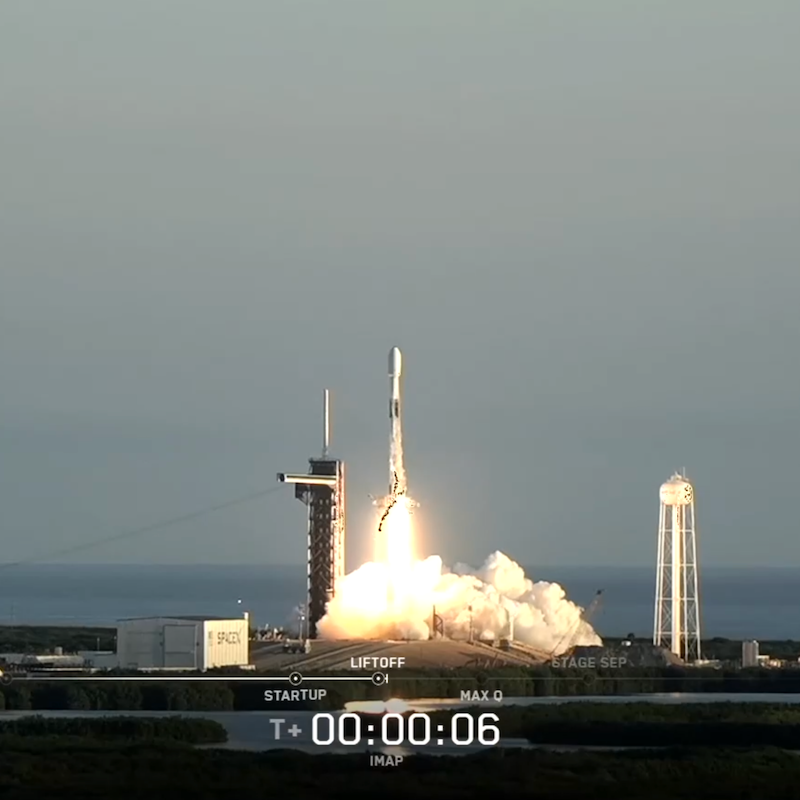
Sun news September 25: Triple launch triumph yesterday
(10 UTC to 10 UTC)
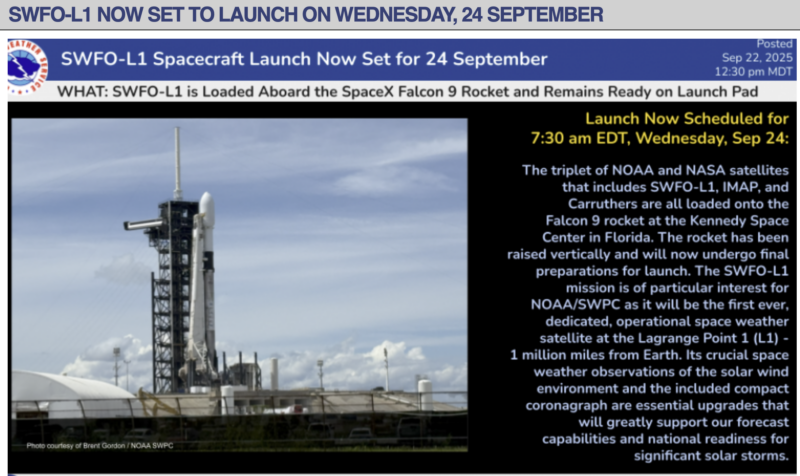
Yesterday morning, a SpaceX Falcon 9 rocket successfully launched three major space weather missions: NASA’s Interstellar Mapping and Acceleration Probe (IMAP), the Carruthers Geocorona Observatory, and NOAA’s Space Weather Follow-On L1 (SWFO-L1). All three spacecraft deployed smoothly, connected with ground stations, and are now on their way to orbit around the L1 point, where they will monitor the sun, solar wind, and Earth’s space environment.
- Flare activity: Solar activity stayed at a moderate level, with 13 flares in the past 24 hours: one M-class and 12 C-class flares.
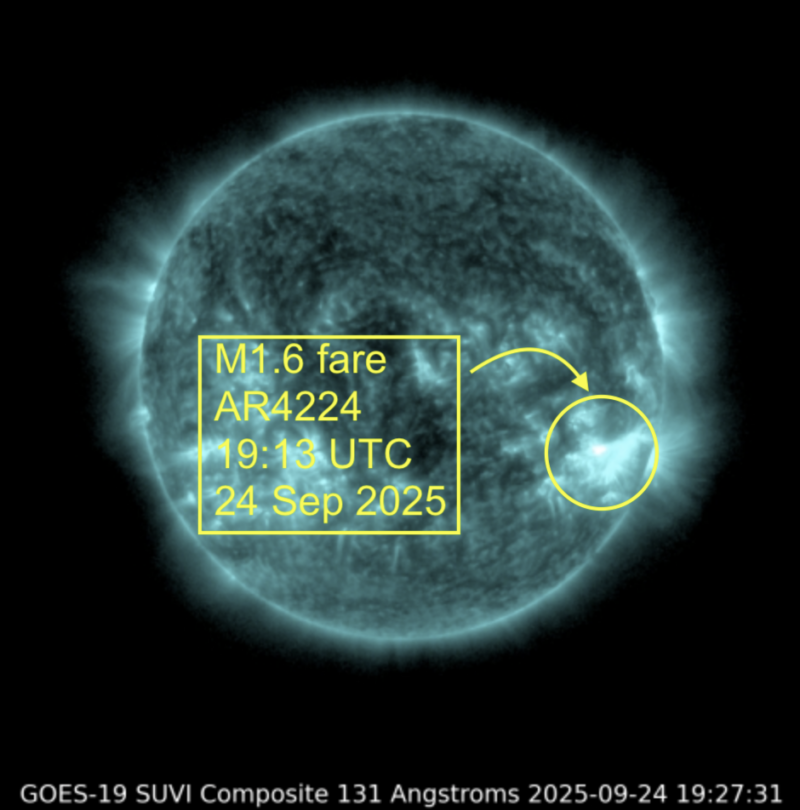
- Strongest: M1.6 from AR4224 at 19:13 UTC on September 24. This flare triggered an R1 (minor) radio blackout over the Pacific Ocean west of the Galápagos Islands.
- Other notable events: C5.3 (AR4226 at 12:50 UTC), C4.6 (AR4226 at 23:22 UTC), and C3.6 (AR4217 at 4:09 UTC). AR4217 led the period with three C-class flares.
- Sunspot regions: The Earth-facing disk shows nine numbered active regions.
- Four regions — AR4230 (southeast), AR4217 (southwest), AR4226 (southeast), and AR4229 (southwest) — developed gamma magnetic complexities.
- The other regions remained small and stable, or slowly decayed.
- Blasts from the Sun? No Earth-directed CMEs appeared in coronagraph imagery. Analysts are modeling the M flare from AR4224 to check for any Earth-directed component.
- Solar wind: Solar wind speeds stayed moderate, ranging from 500–540 km/s and ending near 504 km/s. The IMF remained weak, while the Bz flipped between north and south, ending southward. A southward Bz is favorable for auroras.
- Earth’s magnetic field: As fast solar wind from a coronal hole weakened, conditions ranged from quiet to unsettled (Kp = 1–3). The period ended at quiet levels, Kp = 1.
Sun news September 24: M flare raises activity to moderate
(10 UTC to 10 UTC)
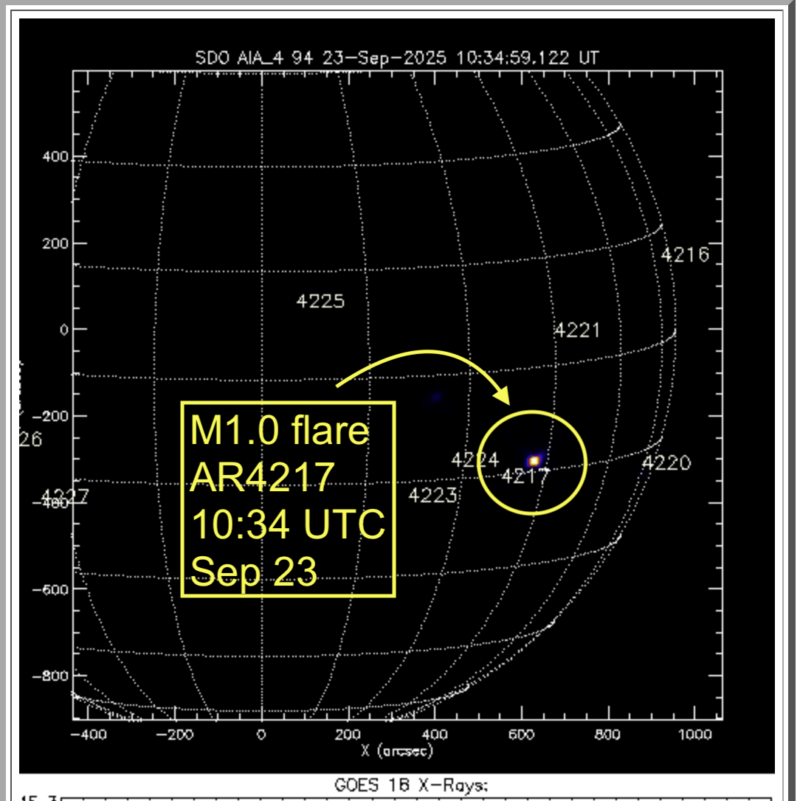
Sun activity jumped up to moderate with the production of an M1.0 flare from active region AR4217 in the southwest. The blast occurred at 10:34 UTC on September 23. Along with the M flare, a type II radio emission was registered at 10:43 UTC along with an R1 (minor) radio blackout observed over Africa. Total flare production also doubled compared to the previous day, with 14 flares blasted out during the past 24 hours.
- Flare activity: Solar activity jumped to moderate levels with the production of an isolated M-class (moderate) flare over the past day. The sun blasted out 14 flares in total: one M and 13 C-class flares.
- Strongest: M1.0 from AR4217 at 10:34 UTC on September 23. Shortly after the blast, an R1 (minor) radio blackout was registered, affecting an area over Africa.
- Other notable flares: C6.7 (AR4224 at 2:29 UTC), C5.5 (AR4226 at 6:31 UTC), and C2.9 (AR4230 at 1:41 UTC). AR4226 was the most productive region during the period with seven C flares.
- Sunspot regions: The Earth-facing side of the sun currently shows nine numbered active regions.
- Three active regions on the solar disk developed gamma magnetic complexities. They are: AR4217 (southwest), AR4226 (southeast) and AR4229 (southwest).
- The rest of the regions remained small and stable, or slowly decayed.
- There are two newcomers on the solar disk: AR4229 in the southwest and AR4230 in the southeast.
- Blasts from the sun? No Earth-directed coronal mass ejections (CMEs) appeared in coronagraph imagery.
- Solar wind: The solar wind stayed at moderately high levels, ranging from 669 km/s down to 540 km/s at the end of this period. The IMF rose to moderate levels, and the Bz flipped between north and south, but the strongest part was northward and it remains northward at the time of this writing. A southward Bz is favorable for auroras.
- Earth’s magnetic field: Conditions ranged from quiet to active (Kp = 2–4). The Kp = 4 threshold was reached at around 12 UTC on September 2, and the observation period ended at Kp = 2.
Sun news September 23: Triplet of space weather missions launch tomorrow
(11 UTC to 11 UTC)
NASA and NOAA will launch a triplet of missions tomorrow to study the sun and its solar wind. The SpaceX Falcon 9 rocket will carry NASA’s Interstellar Mapping and Acceleration Probe (IMAP), the Carruthers Geocorona Observatory, and NOAA’s Space Weather Follow-On L1 (SWFO-L1). Together, these spacecraft will expand our ability to monitor the sun, measure the solar wind, and forecast space weather. Liftoff is set for 7:30 a.m. EDT (11:30 UTC) from Kennedy Space Center, with a 90% chance of favorable weather.
- Flare activity: The sun stayed at low levels, producing 7 C-class (common) flares over the past day.
- Strongest: C4.2 from an unnumbered southeast region at 16:09 UTC on September 22.
- Other notable flares: C3.8 (AR4227 at 17:26 UTC), C2.6 (AR4227 at 16:47 UTC), and C2.2 (unnumbered northeast region at 0:12 UTC). AR4227 was the most productive region with three C flares.
- Sunspot regions: The Earth-facing side of the sun shows 10 numbered active regions.
- AR4217 (southwest, beta-gamma) gained a gamma configuration.
- AR4226 (south-central, alpha) showed modest growth.
- The rest of the regions remained small, stable, or slowly decayed.


- Blasts from the sun? No Earth-directed coronal mass ejections (CMEs) appeared in coronagraph imagery. A striking prominence, which you can see below, erupted on the sun’s far side and is not Earth-directed.
- Solar wind: The solar wind surged. Speeds climbed from 300 km/s at the start of the period to 669 km/s, peaking at 812 km/s at 21 UTC on September 22. The IMF rose to moderate levels, and the Bz flipped between north and south before ending northward. A southward Bz is favorable for auroras.
- Earth’s magnetic field: Conditions ranged from quiet to unsettled (Kp = 2–3). The Kp index was just below 3 at the end of the period.
Sun news September 22: Solar wind set to rise; auroras possible
(11 UTC to 11 UTC)

Happy September equinox, a day of balance between night and day and enhanced chances for auroras. And sure enough, auroras are forecast today! Earth is bracing for the arrival of a fast solar wind stream and a complex knot of solar wind known as a corotating interaction region (CIR), both expected to reach us today. This could push geomagnetic activity to G1 (minor) levels, with a slight chance of G2 (moderate) conditions when the CIR first hits. Aurora watchers, stay alert.
- Flare activity: Solar activity stayed at low levels with 12 flares in the past 24 hours, all in the C (common) range.
- Strongest: C6.6 from AR4223 at 21:16 UTC on September 21.
- Other notable events: C3.3 (AR4224 at 17:43 UTC), C2.3 (AR4220 at 17:01 UTC), and C2.7 (AR4217 at 21:31 UTC). AR4217 kept busy with multiple smaller C flares, including three during the early hours of September 22.
- Sunspot regions: Ten numbered regions are currently on the solar disk.
- AR4220 (southwest, beta-gamma) stayed the most active and complex, though its trailing spots showed some decay.
- AR4223 (south-central, alpha) decayed to a simpler form but still managed the strongest flare of the day.
- AR4217 (southwest, beta) added intermediate spots and stayed moderately active.
- AR4224 (south-central, beta-gamma) continued to grow and produced one of the larger C flares.
- Other regions remained small, stable, or in slow decay.
- Blasts from the sun? No Earth-directed coronal mass eejections CMEs appeared in coronagraph imagery. Several prominence eruptions were spotted on September 21, but none are Earth-directed.
- Solar wind: The solar wind stayed slow, below 300 km/s. The interplanetary magnetic field (IMF) was weak and the Bz flipped gently between north and south. A rise in speed and density is expected later today as the fast solar wind arrives.
- Earth’s magnetic field: Earth’s magnetic field stayed quiet yesterday (Kp = 0–2). Forecasts call for unsettled-to-active conditions, with isolated G1 (minor) storms possible today as the fast solar wind arrives. A slight chance exists for G2 (moderate) conditions when the corotating interaction region hits. Conditions should ease back to quiet-to-unsettled by September 23–24.
Sun news September 21: Fast solar wind on the way and a partial eclipse
(11 UTC to 11 UTC)
The sun has remained quiet over the past day, producing only faint C-class flares. And, for now, Earth’s magnetic field remains calm, but that’ll likely change soon: a coronal hole high-speed stream (CH HSS) is on its way to Earth. It’ll likely spark geomagnetic storms and auroras late today and tomorrow. And a sky treat today: the moon takes a big bite out of the sun in a deep partial solar eclipse, visible from parts of the far Southern Hemisphere. Even though most of the world won’t see this eclipse directly, we can watch online thanks to TimeandDate.com, starting at 18 UTC (2 p.m. EDT). Eclipses remind us of the dramatic alignments possible in our Earth–moon–sun system: a moment of celestial balance on this eve of the September equinox.
- Flare activity: Solar activity remained at low levels with four C-class flares recorded.
- Strongest: C3.4 from AR4220 at 19:11 UTC on September 20.
- Other notable events: C2.4 from AR4220 at 5:07 UTC on September 21, C2.8 from AR4217 at 5:33 UTC on September 21.
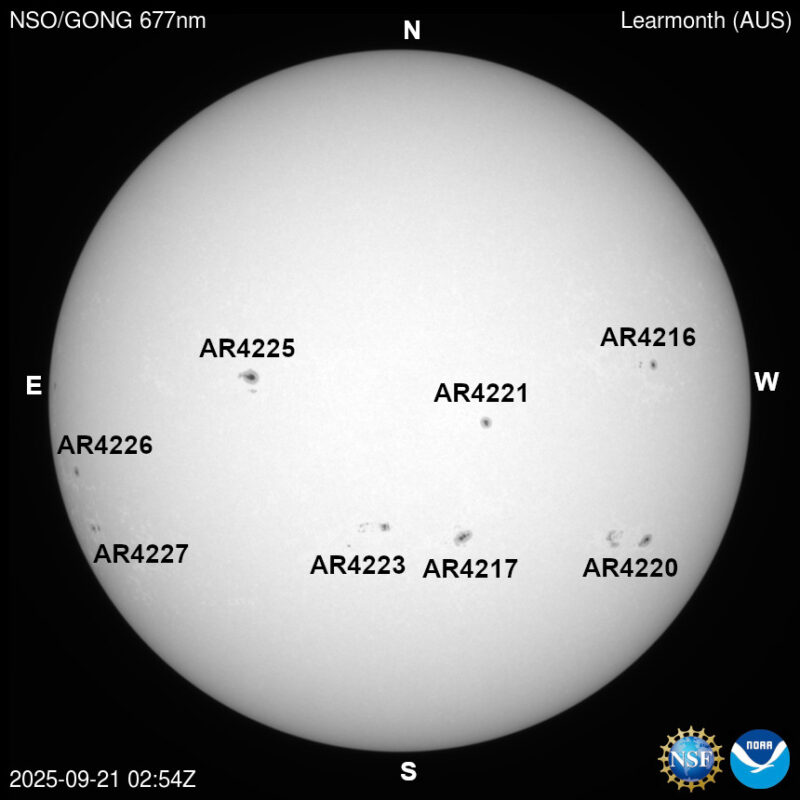
- Sunspot regions: Ten active regions dotted the solar disk.
- AR4220 (southwest, beta-gamma) stayed the most active, producing the day’s largest flare but showing little structural change.
- AR4216 (northwest, beta-gamma) produced a couple of small flares and held steady.
- AR4224, AR4226, and AR4227 showed minor growth with added spots but remained mostly inactive.
- Other regions stayed stable or in decay, showing simple magnetic setups.
- Blasts from the sun? No Earth-directed coronal mass ejections (CMEs) appeared in coronagraph imagery.
- Solar wind: Conditions calmed, with speeds falling below 350 km/s. The total interplanetary magnetic field (IMF/Bt) stayed weak, and the Bz shifted slightly north and south without major impact.
- Earth’s magnetic field: Conditions stayed quiet (Kp = 0–2) throughout the period.
What’s ahead? Sun–Earth forecast
- Flare activity forecast: Expect low activity to continue, with a slight chance of an isolated M-class (R1–R2) flare through September 23, most likely from AR4220 or AR4216.
- Geomagnetic activity forecast:
- September 21: Quiet for most of the day, but unsettled to active conditions are likely late today as the CH HSS arrives, with a chance of G1 (minor) storms. A brief G2 (moderate) storm is possible if a CIR arrives strongly, though confidence is low.
- September 22: Unsettled to active conditions with G1 storming possible as fast solar wind persists.
- September 23: Conditions should ease back to quiet to unsettled as solar wind effects fade.
Sun news September 20: As expected, the sun fires an M flare!
(11 UTC to 11 UTC)
The sun delivered as expected — an M-class flare! Solar activity rose to moderate late yesterday when AR4216 unleashed an M1.5 flare. The flare happened at 21:41 UTC on September 19. The blast triggered an R1 (minor) radio blackout over the Pacific Ocean west of Mexico. Although the sun only produced seven flares in total over the past day, AR4216 and AR4220 both developed more complex beta-gamma magnetic fields, boosting the chance for more M flares this weekend. Meanwhile at Earth, we’re awaiting a corotating interaction region (CIR) combined with a stream of fast solar wind from the large coronal hole. This duo could stir up geomagnetic activity — and auroras — by late this weekend. Stay tuned.
- Flare activity has reached moderate levels with one M-class flare and six C-class flares.
- Strongest flare: M1.5 from AR4216 at 21:41 UTC on September 19, causing an R1 radio blackout over the Pacific Ocean west of Mexico.
- Other notable flares: C5.8 from AR4222 (21:12 UTC), C2.7 from AR4219 (04:57 UTC), C1.9 from AR4219 (12:58 UTC), and C1.9 from AR4223 (16:44 UTC). AR4216 and AR4210 each produced two flares, leading the day’s activity.
- Sunspot regions: Eight active regions dot the Earth-facing disk.
- AR4216 (northwest, beta-gamma) and AR4220 (southwest, beta-gamma) kept their gamma magnetic configuration. AR4220 shrank in size but remained complex. AR4223 (southeast, beta) continued to grow, while AR4224 and AR4225 added new spots.
- The other regions remained stable or showed signs of decay, staying magnetically simple.
- Blasts from the sun? No Earth-directed coronal mass ejections (CMEs) appeared in coronagraph imagery.
- Solar wind:
- Speeds fell from 410 km/s at the start of the period to 341 km/s by the end.
- The total interplanetary magnetic field (IMF/Bt) stayed weak. The Bz remained strongly southward for most of the day and continued southward at 11 UTC on September 20. A southward Bz favors auroras.
- Earth’s magnetic field: Conditions stayed quiet (Kp = 1–2) through the day, with Kp = 2 at the time of this report.
Sun news September 19: Low flaring but active surface
(11 UTC to 11 UTC)

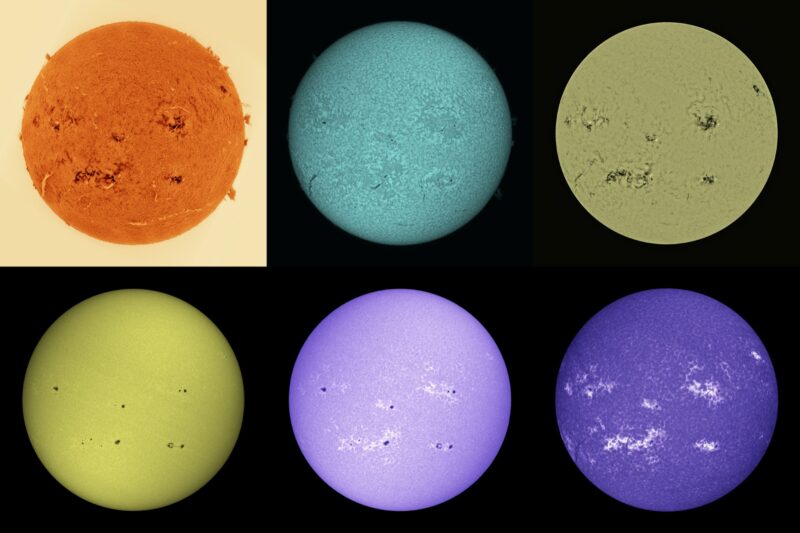
Flare production has been low over the past day, but the sun’s surface has been active, as we saw by action on the periphery. We saw gorgeous long-lasting prominences in the sun’s southeast and southwest. But an increase in flare activity is anticipated, as two active regions, AR4220 and AR4216, have now developed a gamma in their magnetic configurations. Meanwhile at Earth this weekend, we should start receiving the fast solar wind produced by the large coronal hole we reported yesterday. Accompanied by the arrival of a co-rotating interaction region (CIR), this may bring interesting geomagnetic activity – and auroras – at Earth. Stay tuned for the latest solar news.
- Flare activity: We saw only C-class flares over the past day. There was slight increase in flare production from the day before, from 10 to 12 C flares.
- Strongest: A C3.6 from AR4220 at 15:41 UTC on September 18.
- Other notable flares: C3.0 from AR4223 at 22.41 UTC, C2.9 from AR4220 at 7:05 UTC, and C2.3 from AR4225 at 16:22 UTC, C2.3 from AR4219 at 23:17 UTC. AR4220 was leader, producing nine out of the 12 flares of the period.
- Sunspot regions: Seven numbered active regions can be seen on the sun’s Earth-facing disk.
- AR4216 (northwest, beta-gamma) kept its gamma while AR4220 (southwest, beta-gamma) showed growth and developed a gamma configuration and AR4223 (southeast, beta) also showed some growth.
- The remaining regions showed stable or in decay and magnetically simple.


- Blasts from the sun? A filament erupted in the southwest at 18:06 on September 18. The coronal mass ejection (CME) produced during this event is under modeling and analysis.
- Solar wind: The corotating interaction region (CIR) and coronal hole high-speed stream (CH HSS) that triggered last weekend’s geomagnetic storms continued to weaken.
- Solar wind speeds continued decline from 544 km/s initially in the period down to 431 km/s by the end of the period.
- The total interplanetary magnetic field (IMF/Bt) was weak. The Bz mostly northward for most of the period and kept north oriented at the time of this writing 11 UTC on September 19.
- Earth’s magnetic field: Conditions stayed at quiet levels (Kp = 1–2) over the past day. At the time of writing (11 UTC on September 19), the Kp continues at 1.
Sun news September 18: A new coronal hole rotates into view
(11 UTC to 11 UTC)
As one large coronal hole rotates out of view, another has rotated in. The departing coronal hole supplied the fast solar wind that fueled powerful geomagnetic storms and resulting auroras over the weekend. Now, a new large coronal hole has appeared on the Earth-facing disk and is moving into a geoeffective (Earth-affecting) position. Will this coronal hole bring the same excitement its predecessor provided? Let’s wait and see.
- Flare activity: Solar activity stayed at low levels. The sun produced ten C-class flares over the past day.
- Strongest: A C2.8 from AR4223 at 0:04 UTC on September 18.
- Other notable flares: C2.4 from AR4216 at 15:41 UTC, C1.8 from AR4216 at 12:19 UTC, and C1.7 from AR4220 at 01:38 UTC. AR4220 dominated, producing six of the ten flares.
- Sunspot regions: Six numbered active regions occupy the Earth-facing disk.
- AR4216 (northwest, beta-gamma) developed a gamma configuration. AR4221 (southeast, beta) and AR4220 (southeast, beta) both showed modest growth. AR4217 exhibited separation in its leading spots.
- The remaining regions stayed small and magnetically simple.
- Blasts from the sun? Coronagraph imagery showed no Earth-directed coronal mass ejections (CMEs) during this period.
- Solar wind: The corotating interaction region (CIR) and coronal hole high-speed stream (CH HSS) that triggered last weekend’s geomagnetic storms continued to weaken.
- Solar wind speeds fell from 679 km/s to 544 km/s by the end of the period.
- The total interplanetary magnetic field (IMF/Bt) weakened. The Bz flipped between northward and southward, ending the period southward.
- Earth’s magnetic field: Conditions ranged from quiet to unsettled (Kp = 1–3). At the time of writing (11 UTC on September 18), the Kp is at 2.

Sun news September 17: Storming eases after beautiful auroral displays
(11 UTC to 11 UTC)
Earth’s magnetic field has calmed to active levels after the G3 (strong) storming at the weekend, but isolated G1 (minor) geomagnetic storms remain possible thanks to waning effects of fast solar wind from a coronal hole. Meanwhile, three new active regions rotated onto the solar disk. Plus, a long-lived prominence in the northeast continues to surge, hinting that stronger activity could rotate into view in the coming days. Stay tuned.
- Flare activity: Solar activity stayed at low levels, with ten C-class flares recorded over the past day.
- Strongest: AR4220 and AR4223 shared the honors for most powerful flare, each producing a C3.8. AR4220 fired its C3.8 at 13:14 UTC on September 16, while AR4223 flared at 14:42 UTC the same day.
- Other notable flares: C3.5 from AR4223 at 14:03 UTC, C3.6 from AR4220 at 11:58 UTC, and C3.2 from AR4223 at 12:42 UTC. AR4223 dominated, producing six of the ten flares in this period.
- Sunspot regions: The Earth-facing side of the sun now hosts eight numbered regions.
- AR4220 (northeast, beta), AR4221 (southeast, beta), and AR4224 (southeast, beta) showed modest growth with new intermediate spots.
- Three newcomers rotated into view: AR4223, AR4224, and AR4225.
- The rest of the regions remained small and magnetically simple.
- Blasts from the sun? Coronagraph imagery revealed no Earth-directed coronal mass ejections (CMEs) during this period.
- Solar wind: The corotating interaction region (CIR) and coronal hole high-speed stream (CH HSS) that triggered this weekend’s storms continued to drive elevated conditions.
- Solar wind speeds dropped from 760 km/s to 642 km/s by the end of the period.
- The total interplanetary magnetic field (IMF/Bt) weakened, while the Bz stayed strongly northward for much of the day before flipping sharply south at the close of the period.
- Earth’s magnetic field: Conditions ranged from unsettled to active (Kp = 2–4), with Kp = 3 in place at the time of writing (11 UTC on September 17).
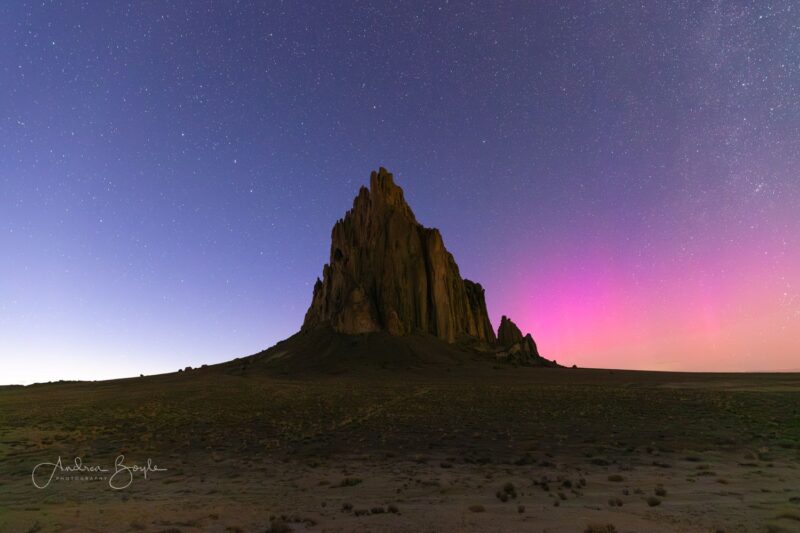
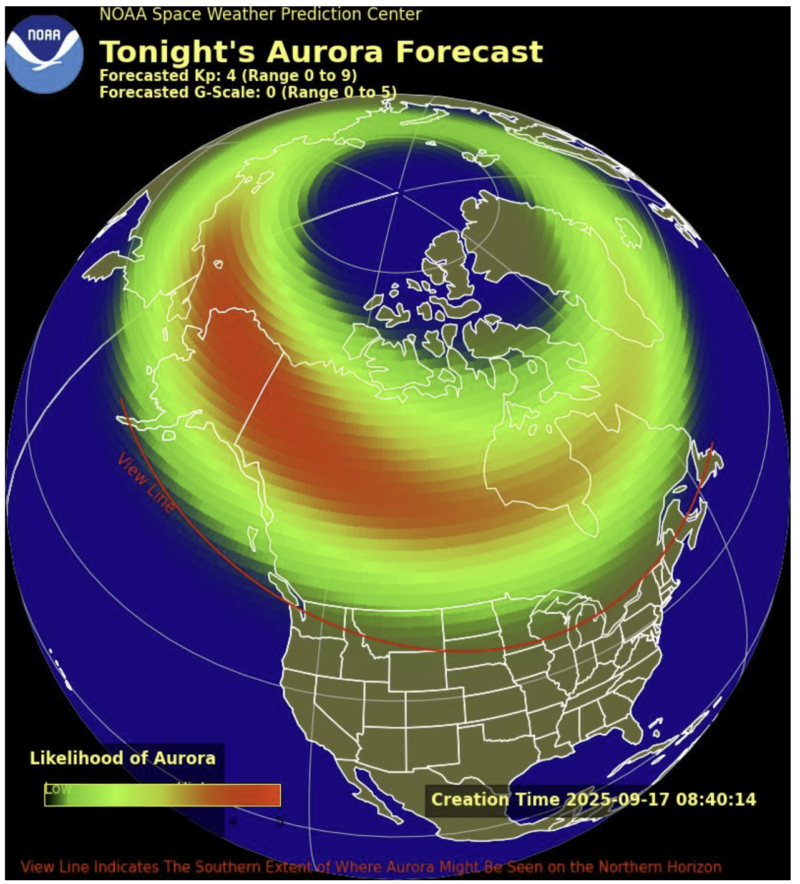

Sun news September 16: Vivid auroras at the weekend, disturbance remains
(11 UTC to 11 UTC)
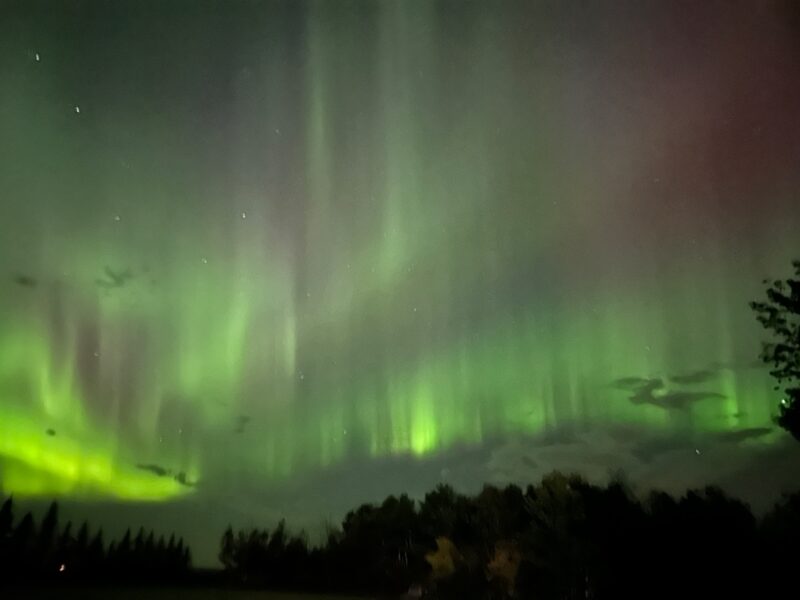
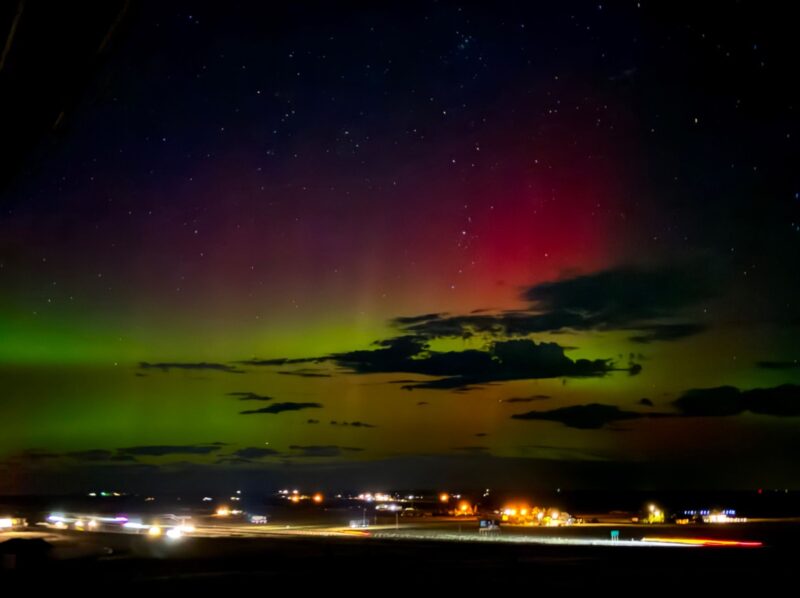
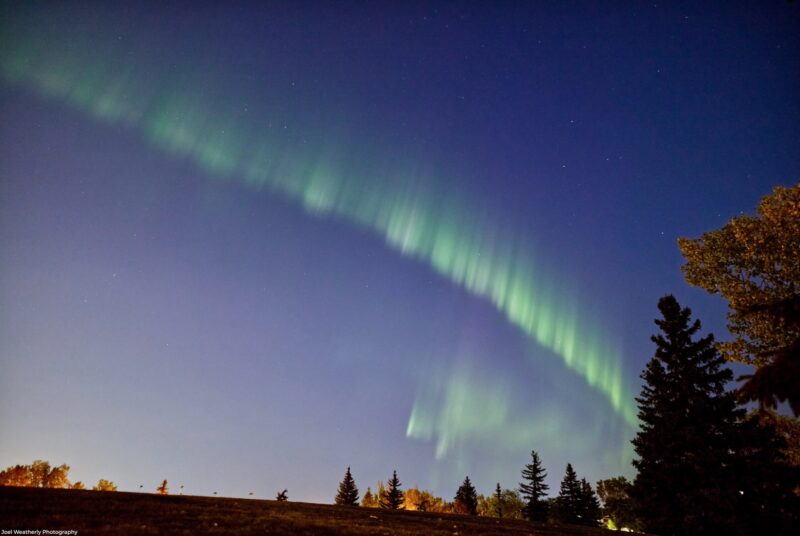
Earth’s magnetic field lit up with a surprise G3 (strong) geomagnetic storm overnight on September 14-15, triggering vivid auroras even down to mid-northern latitudes. The disturbance was the result of a knot of solar winds known as a corotating interaction region (CIR) reaching Earth, as well as a fast solar wind stream from a coronal hole (CH HSS). And, although the intense storming has subsided, G1 (minor) storms continued into early this morning. Plus, the solar wind’s magnetic orientation (Bz) is currently southward, which helps power auroral displays. So more light shows are possible at high latitudes tonight.
- Flare activity: Solar activity stayed at low levels with several small C-class flares.
- Strongest: C3.5 from AR4213 just over the southwest limb at 18:31 UTC on September 15.
- Other events: C2.5 from AR4217 at 4:58 UTC on September 16; C1.8 from AR4217 at 3:04 UTC on September 16. Flaring came mostly from AR4216 and AR4217 on the east, and AR4213 beyond the limb.
- Sunspot regions: Six active regions are visible.
- AR4216 (northeast, beta) showed slight growth with new intermediate spots.
- AR4217 (southeast, beta) rotated further into view and produced several small flares.
- AR4213 (just beyond the southwest limb) still flared strongly despite being out of sight.
- Other regions stayed small and magnetically simple.
- Blasts from the sun? No Earth-directed coronal mass ejections (CMEs) were detected in coronagraph imagery during this period.
- Solar wind: Conditions spiked as the corotating interaction region (CIR) and coronal hole high speed stream (CH HSS) arrived.
- Solar wind speeds surged to near 760 km/s before gradually dropping to the 600–700 km/s range.
- The total interplanetary magnetic field (IMF/Bt) peaked at moderately high levels northward, while the Bz had a prolonged southward stretch from late September 15 into early September 16.
- Earth’s magnetic field: Geomagnetic activity hit G3 (strong) storm levels overnight on Sunday, then eased to unsettled and active conditions, with G1 (minor) storming this morning.

Sun news September 15: Big night for auroras last night!
(11 UTC to 11 UTC)
We had a one–two punch that sparked a surprise G3 (strong) geomagnetic storm overnight last night. The storm stemmed from what’s called a corotating interaction region (CIR), which compressed the solar wind just ahead of a negative-polarity coronal-hole high-speed stream (CH HSS). And this combo caused solar wind speeds to jump to ~650 km/second. Read more about the solar wind last night below. High-latitude sky watchers reported intense displays! And even mid-latitudes were seeing periods of auroral activity as the storm peaked.
- Flare activity: Solar flaring stayed low with small C-class events dominating.
- Strongest: C3.8 from AR4217 at 15:23 UTC on September 14.
- Other C flares (selection): C2.6 at 15:14 UTC (AR4217) and C2.1 at 11:56 UTC (AR4217). AR4217 produced most of the day’s activity as it rotated into view.
- Sunspot regions: We now see four active regions on the sun’s Earth-facing disk.
- AR4217 (southeast limb, emerging) — lead producer with multiple C flares as it rotated into view.
- AR4216 (northeast, beta) — added small intermediate/trailer spots and produced low-level C flares early.
- AR4218 (northwest, beta) — newly numbered; simple structure so far.
- A small unnumbered area near N04E78 is rotating in.
- Blasts from the sun? Multiple coronal mass ejections (CMEs) lifted off the east limb following C flares in AR4217 and a filament eruption near S23E68. Analyses indicate no Earth-directed components. Learn more: What is a CME?
- Solar wind: A classic CIR-then-HSS arrival drove the storm.
- Earth’s magnetic field: Conditions jumped from quiet–unsettled to a G3 (strong) storm during the CIR/CH HSS transition. Expect lingering geomagnetic activity as fast wind persists. Check the real-time Kp index for updates.
Sun news September 14: Fast solar wind incoming, auroras possible
(11 UTC to 11 UTC)
Flaring remained at low levels over the past day, with the sun producing only small C-class and B-class flares. But changes are brewing: a fast solar wind stream from a coronal hole is heading toward Earth. Combined with possible weak influence from a CME launched on September 11, these conditions could bring G1 (minor) geomagnetic storms later today and tomorrow. Sky watchers at high latitudes should be on aurora alert.
- Flare activity: Solar activity stayed at low levels with nine flares recorded in the past 24 hours: six C-class and three B-class.
- Strongest: C2.2 from AR4216 at 06:50 UTC on September 14.
- Other notable events: C1.7 (S16E87 at 06:11 UTC), C1.4 (S14E87 at 08:04 UTC). AR4216 produced several of these faint flares after rotating further into view.
- Sunspot regions: Four active regions are visible on the Earth-facing disk.
- AR4213 (southwest, beta) developed intermediate spots but showed decay in its trailing portion.
- AR4216 (northeast limb, beta) emerged with a simple bipolar structure and became the most active flare producer of the day.
- AR4211 (southwest, alpha) remained stable and magnetically simple.
- Other small regions decayed or stayed quiet with little magnetic complexity.
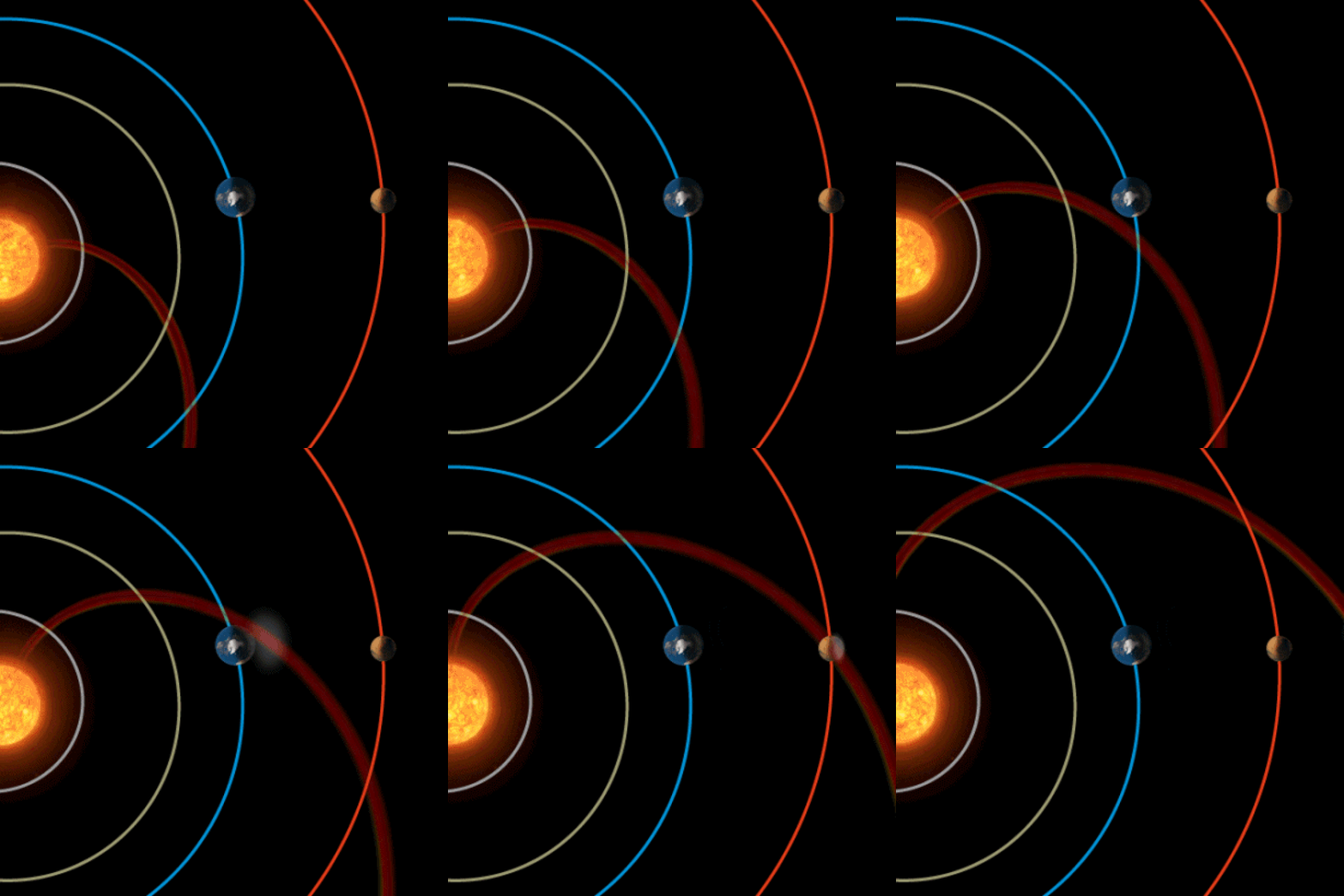
- Blasts from the sun? No Earth-directed coronal mass ejections (CMEs) appeared in coronagraph imagery. A faint filament eruption lifted off the southeast quadrant early on September 13, but models suggest it will miss Earth, passing just south and east on September 16.
- Solar wind: Solar wind conditions weakened, with speeds dropping from 375 km/s to 350 km/s and the interplanetary magnetic field (IMF) strength is low. The Bz component varied weakly between north and south.
- Earth’s magnetic field: Earth’s field was quiet to unsettled yesterday. Forecasts call for G1 (minor) storms today as the fast wind stream reaches Earth, with unsettled-to-active conditions likely through September 16. There’s also a chance for weak effects from the September 11 CME as it passes nearby.
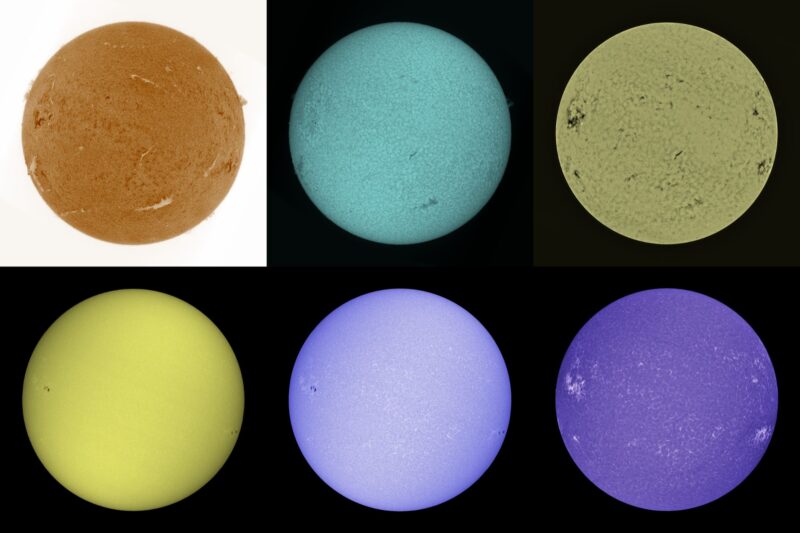
Sun news September 13: Eruptions in sun’s southwest and northwest
(11 UTC to 11 UTC)
The sun has entered a lull in flaring, with only faint C and B flares over the past day. But it still put on a show. At 14:45 UTC on September 12, a huge filament erupted from the southwest quadrant, captured by SDO and SOHO’s LASCO C2. Analysis shows the CME will miss Earth. Then, at 01:00 UTC on September 13, the northwest horizon produced a striking jet-like prominence. At first, scientists suspected AR4207, recently rotated out of view, caused the blast, but it appears another far-side region produced the prominence. Stay tuned for updates.
- Flare activity: The Sun produced six flares in the past day, three C-class and three B-class.
- Strongest: C1.4 from AR4207 at 23:00 UTC on September 12.
- Other notable events: Two C1.1 flares—one from AR4213 at 23:44 UTC and another from AR4207 at 05:09 UTC. Even from behind the horizon, AR4207 led with four flares during the period.
- Sunspot regions: Three numbered sunspot regions sit on the Earth-facing disk.
- AR4207 (northwest, just out of sight) still produced flares strong enough for GOES to register them.
- The remaining regions stayed small and magnetically simple, with little change over the past day.
- Blasts from the Sun? The southwest filament eruption at 14:45 UTC on September 12 hurled plasma into space. Analysis confirms it will not strike Earth.
- Solar wind:
- Speeds dropped from 380 km/s to ~350 km/s by the end of the period.
- The interplanetary magnetic field (Bt) held at moderate levels. The Bz pointed southward through most of the period, a configuration that favors auroras.
- Earth’s magnetic field: Conditions ranged from quiet to unsettled (Kp = 1–3), with Kp = 3 at 11 UTC on September 13.
Read: Why more auroras at the equinoxes?



Sun news September 12: Beautiful filaments lift off sun’s disk
(11 UTC to 11 UTC)
The sun was quiet over the past day, with only C and B flares. But it put on a dramatic show of filament eruptions. At 11:00 UTC on September 11, a large filament in the sun’s southeast quadrant lifted off, hurling plasma into space. Models suggest part of this coronal mass ejection (CME) could deliver a glancing blow to Earth on September 14, possibly bringing us a good auroral display. A second filament eruption in the sun’s northeast happened at 13:38 UTC on September 11. It launched another mass of solar material, now under analysis.
- Flare activity: The sun produced six C-class flares and three B-class flares.
- Strongest: C7.6 from AR4207 at 15:21 UTC on September 11.
- Other notable events: C1.9 (AR4207 at 19:07 UTC), C1.8 (AR4207 at 19:48 UTC), and C1.2 (AR4207 at 19:03 UTC). AR4207 led with four flares during the period.
- Sunspot regions: Four active regions populate the solar disk.
- AR4207 (northwest, beta) remained the week’s top flare producer before rotating off the west limb with dynamic jet-like activity.
- AR4211 (southwest, alpha) shrank from 12 spots to a single spot, but is now the largest region on the disk.
- The other numbered regions stayed small and magnetically simple.
- AR4216 (northeast) emerged as a newcomer with a few small sunspots.
- Blasts from the sun? The southeast filament eruption at 11 UTC September 11 launched plasma that may graze Earth on September 14. A second eruption at 14 UTC in the northeast produced another CME, now under modeling.
- Solar wind:
- Speeds dropped from 445 km/s to ~378 km/s by the end of the period.
- The interplanetary magnetic field (Bt) held at moderate levels. The Bz flipped north and south before turning strongly southward at 02 UTC September 12, where it stayed. A southward Bz favors auroras.
- Earth’s magnetic field: Conditions ranged from quiet to unsettled (Kp = 1–3), with Kp = 3 at 11 UTC September 12.


Sun News September 11: Butterfly-shaped coronal hole takes the stage
(11 UTC to 11 UTC)
The sun stayed quiet with only C flares and B flares. But a large coronal hole has rotated into a geoeffective position, where it’s capable of affecting Earth. And it should now be sending its fast solar wind our way. The hole’s dark shape stretches across the sun’s, looking like a butterfly’s wings. With the equinox just around the corner, sky watchers should stay tuned.
Read: Why more auroras at the equinoxes?
- Flare activity: Solar activity remained at low levels, with nine flares in the past 24 hours—six C-class and three B-class.
- Strongest: C1.5 from AR4207 at 06:26 UTC on Sep 11.
- Other notable events: C1.3 (AR4207 at 05:33 UTC), C1.2 (AR4207 at 06:54 UTC), and C1.0 (AR4207 at 04:09 UTC). AR4207 led production with six flares during the period.
- Sunspot regions: Six active regions dot the Earth-facing disk.
- AR4207 (northwest, beta) fired the most flares and showed dynamic jet-like activity.
- AR4211 (southwest, alpha) shows 12 sunspots, while AR4207 (northwest, beta) remains among the largest regions on the disk.
- Most numbered sunspot regions stayed small and magnetically simple, with little change over the past day.
- Two newcomers appeared: AR4214 in the southwest and AR4215 in the northwest.
- Blasts from the sun? No Earth-directed CMEs appeared in coronagraph imagery over the past day.
- Solar wind: Conditions stayed enhanced under the lingering influence of the September 4 CME and ongoing high-speed wind from a coronal hole.
- Speeds dropped from 558 km/s and settled near 445 km/s at the time of this writing.
- The total interplanetary magnetic field (Bt) held at moderate levels. The Bz was northward early in the period, but turned south at 19 UTC on Sep 10 and stayed southward through the end of the window. A southward Bz favors auroras.
- Earth’s magnetic field: Conditions ranged from quiet to active (Kp = 2–4). A Kp = 4 was observed at 02:44 UTC on Sep 11, then eased to Kp = 2 by the end of the observation period.


Sun news September 10: Geomagnetic storms last night, more to come?
(11 UTC to 11 UTC)
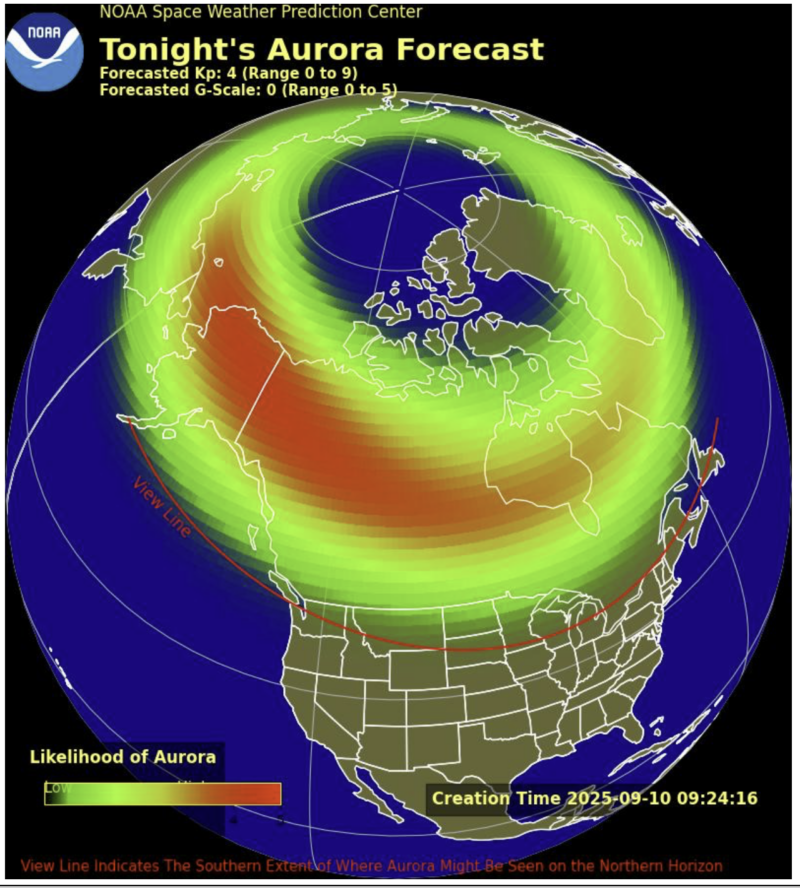
Earth’s magnetic field was disturbed to G2 (moderate) storm levels last night by a stream of solar wind billowing from a coronal hole (an area of lower density in the sun’s atmosphere). More disturbance is possible tonight, which could mean auroras at high latitudes. Stay tuned.
- Flare activity: Solar activity stayed at low levels during the last 24 hours. The sun produced just one C-class flare and five B-class flares, for a total of six flares.
- Strongest: C1.6 from AR4210 at 13:55 UTC on Sep 9.
- Other notable events in this observation window (11 UTC Sep 9 – 11 UTC Sep 10): B9.7 (AR4213 at 12:20 UTC), B9.2 (AR4213 at 20:01 UTC), and B9.1 (AR4211 at 12:12 UTC). AR4213 led flare production with three flares during the period.
- Sunspot regions: Six active regions are visible on the Earth-facing disk.
- AR4213 (southeast, beta) lost its gamma configuration but remained the most active flare producer of the period.
- AR4211 (southwest, alpha) and AR4207 (northwest, beta) remain the largest regions on the disk.
- All numbered sunspot regions stayed small, magnetically simple, and showed little change over the past day.
- Blasts from the Sun? A strong eruption occurred on the sun’s far side near the northwest limb around 12 UTC on Sep 9. Because it came from the far side, it is not Earth-directed. No Earth-directed CMEs appeared in coronagraph imagery.
- Solar wind: Conditions stayed enhanced under the combined influence of the Sep 4 CME and ongoing high-speed wind from a coronal hole.
- Speeds climbed from 433 km/s to 583 km/s, then settled near 504 km/s at the time of this writing.
- The total interplanetary magnetic field (Bt) held at moderate levels. The Bz remained mostly southward, briefly turned northward, and ended the period oriented south. A southward Bz is favorable for auroras.
- Earth’s magnetic field: Geomagnetic conditions ranged from quiet to storm levels (Kp = 2–6) over the past day. A G2 (moderate) storm interval was observed, with the threshold reached at 23:16 UTC on Sep 9.
Sun news September 9: See the solar cycle’s decline in new data
(11 UTC to 11 UTC)

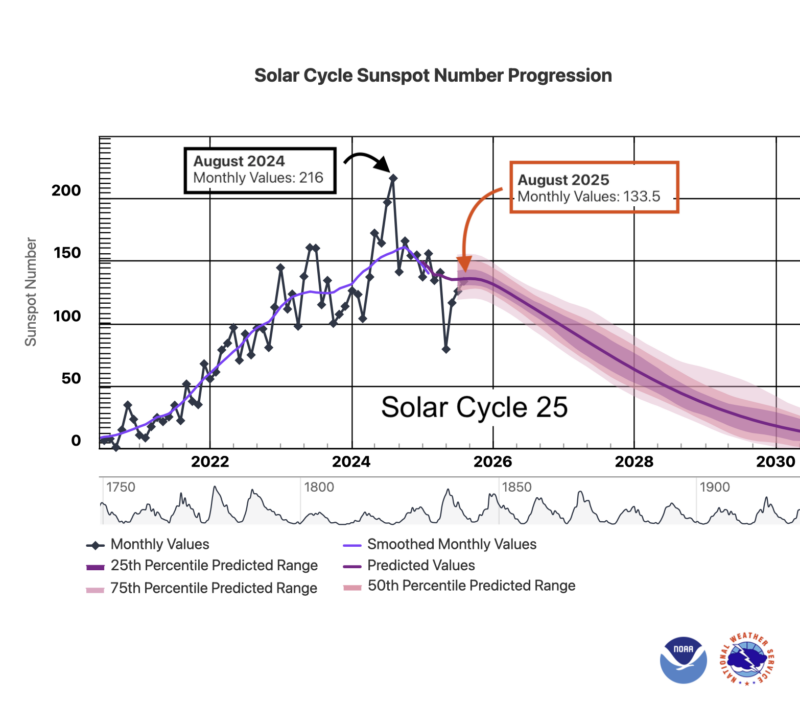
NOAA has just released August 2025’s sunspot number data, which are used to monitor overall activity on the sun. And the sunspot count is significantly lower than August 2024, a clear sign activity is decreasing after the peak of Solar Cycle 25 last year. However, August 2025’s sunspot number actually increased a little compared to the last few months, which saw a dip in activity. While the general trend is downward, the sun can always surprise us from month to month, and it should still have plenty of activity to offer in this cycle.
- Flare activity: Solar activity continued at low levels over the past day. During the last 24 hours, the sun produced a total of eight flares: six C (common) flares and two B (basic) flares.
- Strongest: C1.5 from AR4207 at 3:23 UTC on Sep 9.
- Other events in our observation window (11 UTC September 8 – 11 UTC September 9): C1.3 (AR4213 at 16:30 UTC on September 8), C1.1 (AR4213 at 13:01 UTC on September 8), C1.1 (AR4207 at 19:21 UTC on September 8). The lead flare producer was AR4213 with five flares during the period.
- Sunspot regions: Today, the sun has six active regions on its Earth-facing side.
- AR4213 (southeast, beta-gamma) was the most active flare producer of the period and developed a beta-gamma magnetic complexity.
- AR4211 (southwest, alpha) and AR4207 (northwest, beta) are the largest regions on the solar disk.
- The rest of the numbered sunspots on the solar disk are small and magnetically simple with little change over the past day.
- Blasts from the sun? No Earth-directed coronal mass ejections (CMEs) were detected in coronagraph imagery.
- Solar wind: Conditions remained slightly enhanced following the Sep 4 CME and ongoing high-speed solar wind from a coronal hole.
- Speeds peaked to 730 km/s at 15:12 UTC on September 8 then dropped down to 433 km/s. At the time of this writing the solar wind speed is 502 km/s.
- The total interplanetary magnetic field (IMF/Bt) continued at low levels. The Bz was predominantly southward, but fluctuated weakly northward before ending the observation period oriented south. A southward Bz is favorable for auroras.
- Earth’s magnetic field: Geomagnetic activity has been quiet to unsettled (Kp = 1-3). The Kp index is slightly above Kp = 2 at the time of this writing.
Sun news September 8: 2 regions to watch as activity lulls
(11 UTC to 11 UTC)

Activity has slowed on the sun, with only eight C-class (common) flares fired in the last 24 hours (11–11 UTC). No Earth-directed bursts of sun-stuff (coronal mass ejections or CMEs) were detected. But a pair of sunspot regions could soon kick activity up a notch; AR4207 in the northwest and AR4213 in the southeast both have promising beta magnetic configurations, with AR4213 in particular showing growth over the past day. Stay tuned.
- Flare activity: Solar activity remains low. Over the past day the sun produced 8 C-class flares and no M (moderate) flares.
- Strongest: C4.0 from AR4213 at 17:56 UTC on Sep 7.
- Other events in observation window (11 UTC Sep 7 – 11 UTC Sep 8): C3.6 (AR4207, 12:33), C1.4 (AR4212, 14:28), C2.5 (AR4202, 15:38), C1.2 (AR4207, 20:43). Then, after 00 UTC on Sep 8: C1.2 (AR4212, 2:16), C1.2 (AR4212, 3:27), C1.0 (AR4211, 4:33).
- Sunspot regions: Six active regions are currently on the Earth-facing disk.
- AR4207 (northwest, beta) is the most prominent overall. It has a compact leading spot with mixed smaller trailing spots.
- AR4213 (southeast, beta) is growing and produced the day’s strongest flare (C4.0).
- The others are small and magnetically simple with little change over the past day.
- Blasts from the sun? No Earth-directed CMEs were detected in coronagraph imagery.
- Solar wind: Conditions remained slightly enhanced following the Sep 4 CME and ongoing high-speed solar wind from a coronal hole.
- Earth’s magnetic field: Geomagnetic activity was quiet to unsettled, below G1 storm thresholds.
Sun news September 7: A blood-red moon eclipse and an active sun
(11 UTC to 11 UTC)
Earth’s sky takes center stage! For more than an hour on September 7, the full moon will pass through Earth’s shadow, turning deep red during a total lunar eclipse. Maximum eclipse occurs at 18:11 UTC. While the Americas miss out this time, sky watchers across Asia, Australia, Africa, and most of Europe are in luck — look up! Meanwhile, the sun continues to keep space weather forecasters busy with moderate activity, multiple C-class flares, and one M-class flare, plus ongoing geomagnetic effects from recent solar eruptions.
Read about the total lunar eclipse
- Flare activity: Solar activity rose to moderate levels. Over the past day, the sun produced 19 flares: 18 C-class and 1 M-class.
- M1.2 from AR4207 (N28W16) at 22:15 UTC September 6 – the strongest flare of the period.
- Other notable flares: C9.6 (AR4207 at 00:47 UTC September 7), C6.5 (AR4207 at 18:54 UTC September 6), C6.4 (AR4207 at 05:20 UTC September 7).
- AR4207 dominated with 11 flares, including the M1.2 and several strong C-class events.
- AR4199 (west limb) produced a C5.4 and C5.1 before rotating out of view.
- New AR4213 (S15E26) contributed two smaller C-class flares shortly after appearing.
- Sunspot regions: Seven active regions are visible.
- AR4207 (northwest, beta-gamma) – the most complex and productive, driving the bulk of flaring activity.
- AR4199 (west limb) – now rotating out of view, but produced strong C flares during the period.
- AR4210 (near disk center, beta) – showed trailing spot decay, fewer flares.
- AR4213 (southeast, beta) – newly numbered, already producing C-class events.
- Other regions remain stable and magnetically simple.
- Blasts from the sun? Several eruptions were observed on the west limb after September 6, but none appear Earth-directed. No new Earth-directed CMEs were detected in coronagraph imagery.
- Solar wind: Solar wind intensified after 13:50 UTC September 6 as CME effects overtook coronal hole influences. Speeds surged from ~400 km/s to a peak of ~700 km/s, while total interplanetary magnetic field (Bt) reached 22 nT. The Bz briefly dipped to -15 nT, enhancing geomagnetic activity.
- Earth’s magnetic field: Geomagnetic activity reached G1 (minor) storm levels during the CME arrival. Forecasts call for more G1 intervals today as CME effects wane and coronal hole influences persist. Conditions should ease to active on September 8 and quiet-to-unsettled by September 9.
What’s ahead? Sun–Earth forecast
- Flare activity forecast: Isolated M-class flares remain possible (R1–R2), with AR4207 the most likely source. Overall activity should stay at low-to-moderate levels through September 9.
- Geomagnetic activity forecast:
- September 7: G1 storming remains likely under waning CME and ongoing CH HSS influences.
- September 8: Mostly unsettled-to-active conditions.
- September 9: Quiet-to-unsettled as solar wind slowly declines.
- Radiation forecast: High-energy protons remain at background levels and should stay there, with only a slight chance of an S1 event if a significant flare erupts from AR4207.
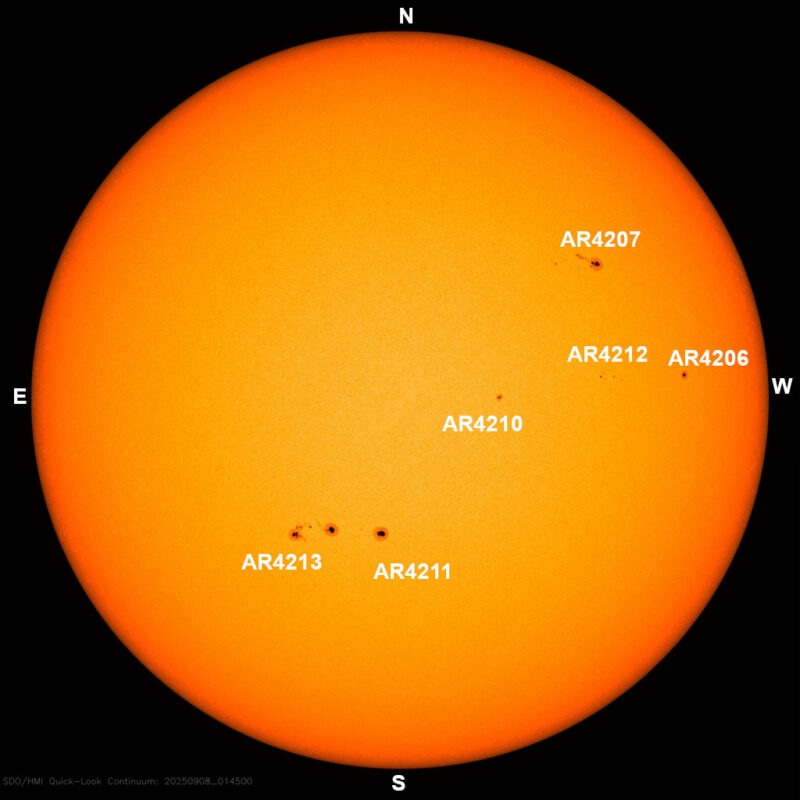
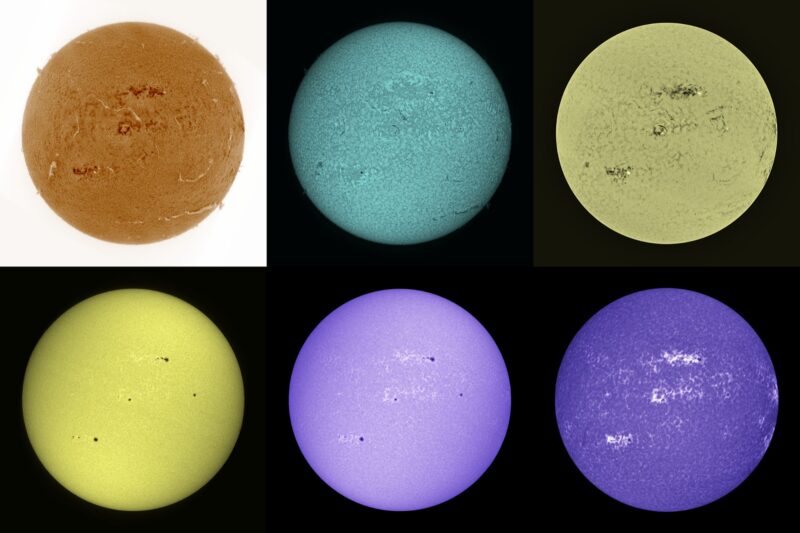
Sun news September 6: Auroras likely tonight while sun keeps blasting CMEs
(11 UTC to 11 UTC)
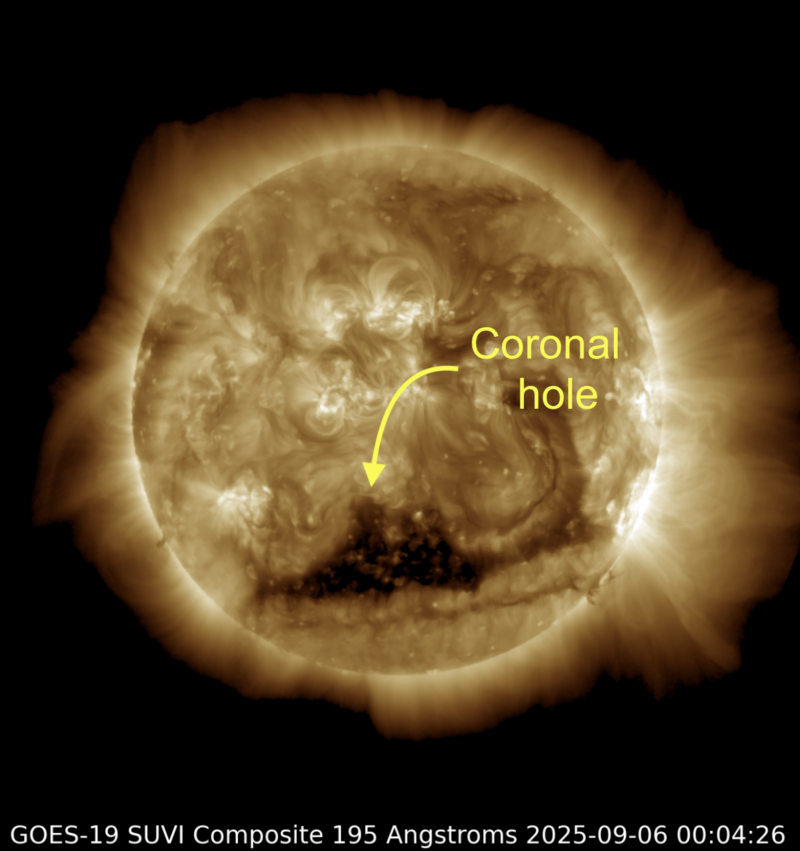
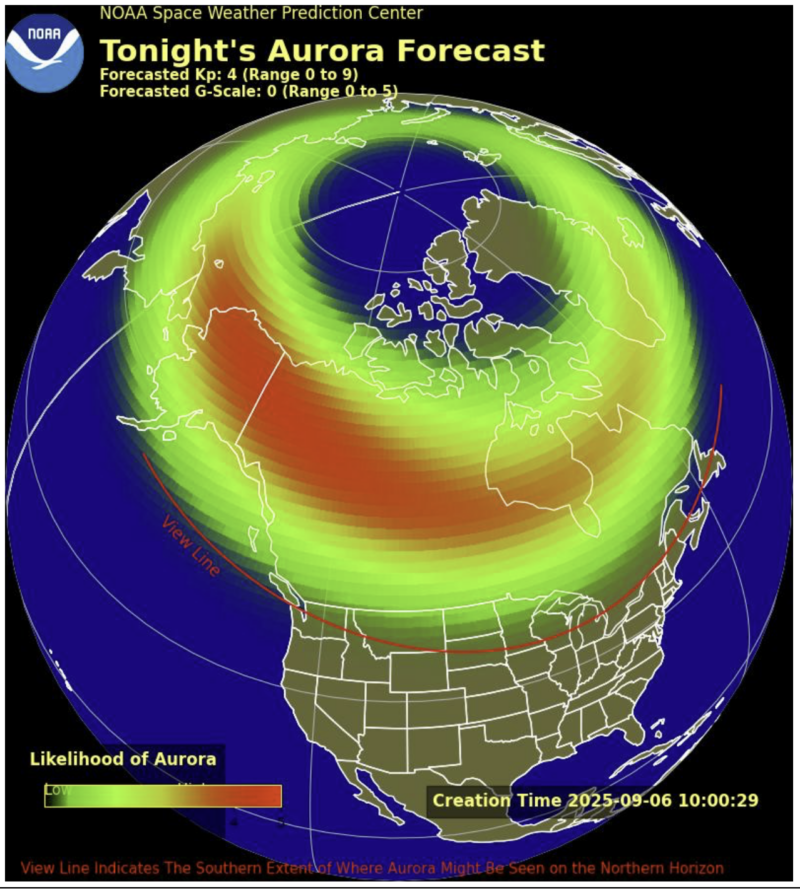
Auroral displays may light up the skies tonight and tomorrow. A large coronal hole we’ve been tracking has rotated into a geoeffective position, where it’s capable of affecting Earth. And so the fast solar wind the hole produces is now streaming toward Earth. Combined with the bursts of solar material we reported on yesterday, these effects are expected to disturb Earth’s geomagnetic field, driving a G1 (minor) geomagnetic storm with chances of reaching G2 (moderate). Meanwhile, back at the sun, overall activity stayed low with only C-class flares. But the sun continued to hurl multiple CMEs into space. So this past day was an active one on the sun! Check out the animation below, and stay tuned!
- Flare activity dropped to low, with 12 C-class flares over the past 24 hours.
- The largest was a C4.5 flare at 04:52 UTC on September 6 from AR4207.
- Other notable flares included a C3.5 at 04:14 UTC Sep 6 (AR4197), a C2.7 at 17:59 UTC Sep 5 (AR4207), and a C2.4 at 00:04 UTC Sep 6 (AR4197).
- AR4197 led flare production with four C flares during the period.
- Sunspot regions: We counted eight numbered sunspot regions on the Earth-facing side of the sun this morning.
- AR4197 has now rotated off the west limb of the sun.
- AR4207 showed slight growth and is now the largest region on the disk.
- All visible active regions currently show simple alpha or beta magnetic configurations.
- Blasts from the sun? The two M flares and two narrow eruptions reported yesterday launched coronal mass ejections (CMEs) that are expected to arrive at Earth early on September 7. Filament eruptions observed during this period are still under analysis to determine whether they have Earth-directed components.
- Solar wind: Solar wind speeds jumped from 392 km/s to 522 km/s at the time of this writing. The total interplanetary magnetic field (Bt) stayed at moderate levels. The Bz swung between southward and northward, with the strongest intervals oriented south. It is northward at the time of this report.
- Earth’s magnetic field: Earth’s magnetic field fluctuated between quiet and active (Kp = 1–4). Kp reached 4 at 02:40 UTC September 6 and again at the time of this report.

Sun News September 5: Sun turns up the heat with 2 M flares
(11 UTC to 11 UTC)
Solar activity rose to moderate, with two M flares over the past day. Both came from active region AR4207 in the sun’s northeast (N28E00). The strongest, an M1.4 flare, erupted earlier today (1:16 UTC on September 5). And we had an M1.0 yesterday (13:44 UTC on September 4).
- Flare activity: Solar activity was considered moderate over the past day, with two M flares. Over the last 24 hours, the sun produced 11 total flares, the two Ms and nine C (common) flares.
- Other notable events included two C3.4 flares—one at 19:46 UTC from AR4206 and another at 23:36 UTC from AR4210, both on September 4—and a C2.9 from AR4201 at 21:44 UTC on September 4.
- AR4197 and AR4201 shared the lead as flare producers, each generating three C flares.
- Sunspot regions: The sun is currently showing 10 numbered sunspot regions on its Earth-facing side.
- AR4197, on the southwest edge, is rotating out of view to the far side of the sun.
- AR4207 in the northeast developed a gamma complexity and now shows a beta-gamma configuration. With AR4197 departing, AR4207 is the largest region in extent.
- The remaining regions stayed quiet with little magnetic complexity.
- A newcomer, AR4212, appeared in the northeast quadrant.
- Blasts from the sun? The two M flares, and two additional narrow eruptions – along with the eruptive filament near AR4206 that generated a CME at 19:30 UTC on Sep 4 (observed by GOES-19 CCOR-1) – remain under modeling and analysis to determine if any Earth-directed components exist.
- Solar wind: The solar wind slowed from 478 km/s to 392 km/s by the end of the period, with three peaks reaching 550 km/s. The total interplanetary magnetic field (Bt) reached moderate levels. The Bz pointed southward during the first half of the period, turned northward early on September 5, then shifted south again at the time of this writing. Conditions may intensify, and a G1 geomagnetic storm “watch” is in effect (it’s predicted but hasn’t happened yet).
- Earth’s magnetic field: Earth’s magnetic field remained at quiet-unsettled (Kp = 1–3). At the time of this writing, Kp = 1.
Sun News September 4: Almost-M flare fires out sun-stuff
(11 UTC to 11 UTC)


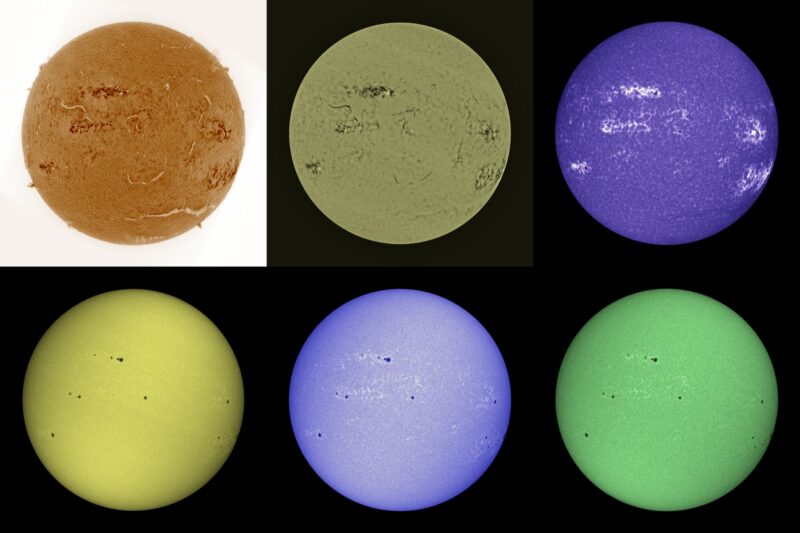

Solar activity came within a hair of reaching moderate levels when active region AR4207 in the northeast fired an almost-M flare this morning. The eruption registered as a C9.2 flares at 5:32 UTC. The GOES-19 satellite’s SUVI 131 angstrom imager, mainly used to detect M and X flares, captured the spark. Satellite imagery also detected a burst of solar material hurled into space during this event. While we await final analysis and modeling, early observations suggest this coronal mass ejection (CME) was too far north to be on its way to Earth.
- Flare activity: Solar activity remained at a low level, with C-class flares dominating over the last 24 hours. The sun produced 14 C-class flares during the period.
- The strongest flare was the C9.2 from AR4207 in the northeast (N28E11) at 5:32 UTC on Sep 4.
- Other notable events: C3.7 (AR4211 at 15:23 UTC Sep 3), C3.4 (AR4211 at 0:01 UTC Sep 4), and C2.9 (AR4207 at 19:21 UTC Sep 3).
- AR4207 was the lead flare producer of the period with five C-class flares, closely followed by AR4211 with four C-class flares.
- Sunspot regions: The Earth-facing solar disk currently holds nine active regions.
- AR4197, on the southwest edge and about to rotate out of view, has become difficult to analyze. It appears to have lost its gamma complexity, now showing a beta magnetic configuration, while remaining the largest region on the disk.
- AR4199 (northwest, beta) grew in sunspots.
- AR4210 developed penumbrae (lighter regions surrounding dark sunspots) on both poles.
- The remaining regions stayed quiet with little magnetic complexity.
- Blasts from the sun? Ejecta observed during the C9.2 event from AR4207 appears not to be on its way to Earth, according to initial analysis. We await the final modeling results. No additional CMEs appeared in available coronagraph imagery.
- Solar wind: The solar wind averaged around 450 km/s during the period, rising to 478 km/s at the time of this writing. The total interplanetary magnetic field (Bt) reached moderate levels. The Bz pointed northward during the first half of the period, then turned southward early September 4. Conditions continued to decline.
- Earth’s magnetic field: Earth’s magnetic field stayed quiet (Kp = 1–2). At the time of this writing, Kp = 2.
Sun news September 3: More geomagnetic activity and auroras last night
(11 UTC to 11 UTC)


The disturbance of Earth’s magnetic field continued last night, with more G1 (minor) geomagnetic storming and auroras. This activity was caused by the coronal mass ejection (CME) impact on Monday. Conditions have calmed now, and although experts forecast up to G2 (moderate) storms today, conditions may be starting to wane.
- Flare activity: Solar activity remains low, with a total of 14 C-class flares produced over the past day.
- The strongest flare of the period was a C6.1 from AR4199 (N05W25) at 14:52 UTC Sep 2.
- Other notable events: C4.2 (AR4197 at 21:03 UTC Sep 2), C4.9 (AR4197 at 23:50 UTC Sep 2).
- AR4197 was the leading flare producer of the period with 10 C flares.
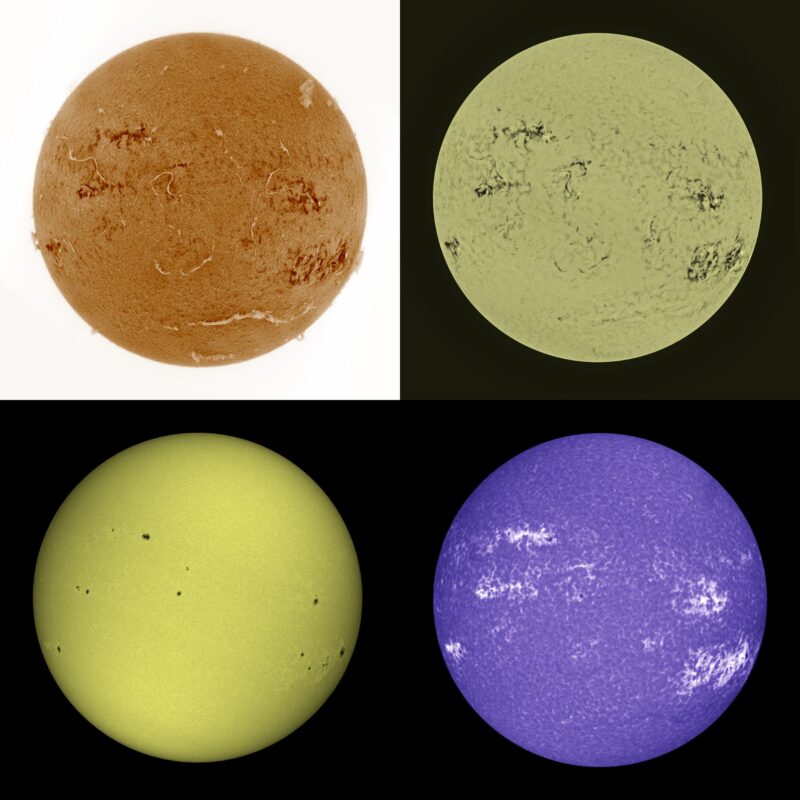
- Sunspot regions: Ten active regions currently dot the solar disk.
- AR4197 in the southwest retains its beta-gamma magnetic configuration and is the largest region on the solar disk. It’s nearing the west limb (edge).
- AR4199 (northwest, beta) started to show some decay.
- The rest of the regions remained quiet, with little magnetic complexity.
- Two newcomers were numbered during the period: AR4210 and AR4211.
- Blasts from the sun? No Earth-bound coronal mass ejections (CMEs) were observed in available coronagraph imagery.
- Solar wind: The solar wind dropped down from 600 km/s to 490 km/s at the time of this writing. The total interplanetary magnetic field (Bt) reached moderate levels, with the Bz mostly southward during the period, but moving northward at 9 UTC today. Conditions started to wane.
- Earth’s magnetic field: Earth’s magnetic field saw G1 (minor) storm conditions during two three-hour periods from 18 UTC and 21 UTC yesterday. At the time of this writing the geomagnetic field is at Kp = 2.

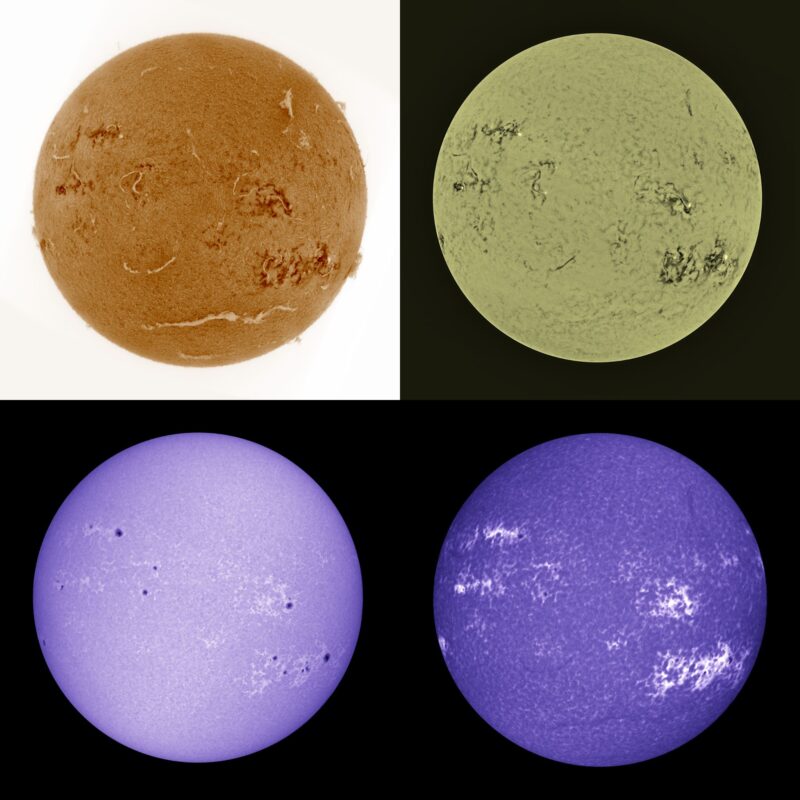
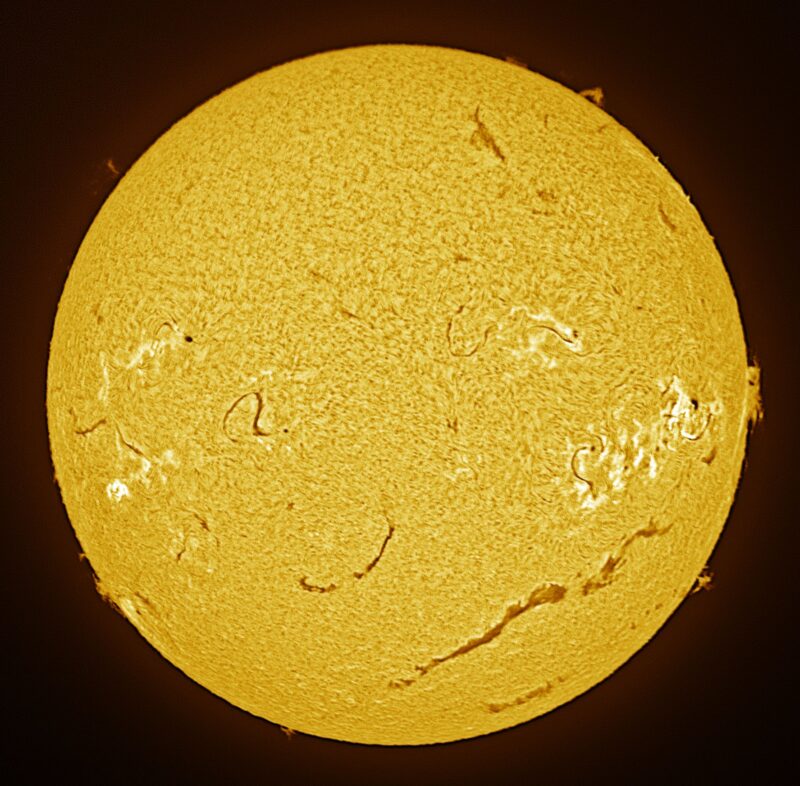
Sun news September 2: Auroras last night, and more to come!
(11 UTC to 11 UTC)
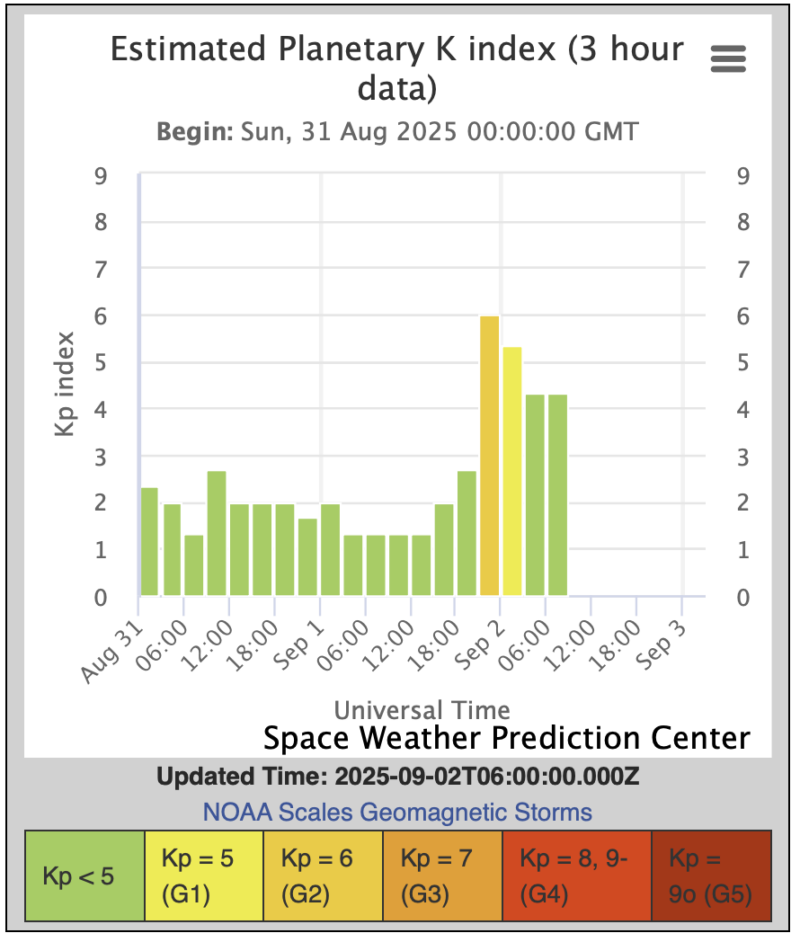
A coronal mass ejection (CME) that erupted from the sun on Saturday slammed into Earth’s magnetic field late last night, triggering a G2 (moderate) geomagnetic storm. And forecasters expect geomagnetic activity to intensify tonight, with potential G3 (strong) storms and even a slight chance of G4 (severe) conditions. Sky watchers at high latitudes, stay alert! Auroras could be widespread if skies are dark and clear, although the bright waxing gibbous moon may interfere with viewing.
- Flare activity: Solar activity remained low with only C-class flares. A total of 13 C flares were fired in the past day.
- The strongest was a C3.9 from AR4196 (S11W36) at 19:14 UTC Sep 1.
- Other notable events: C3.1 (AR4201 at 17:43 UTC on September 1), C3.0 (AR4207 at 18:12 UTC on September 1), C3.0 (AR4207 at 11:51 UTC on September 1), C2.8 (AR4199 at 00:49 UTC on September 2).
- Flaring regions: AR4207 produced four C flares, AR4196 produced three, AR4197 produced two, and we saw additional activity from AR4201, AR4191, and AR4199.
- Sunspot regions: Ten active regions currently dot the solar disk.
- AR4197 (southwest, beta-gamma) produced the two strongest flares of the period and remains the most flare-capable region.
- AR4199 (northwest, beta) gained sunspots but produced only small C-class events.
- AR4207 (northeast limb, beta) rotated into view with trailing spots visible and produced several C-class flares.
- AR4191 (northwest, beta) was stable, with a few small C flares.
- Other regions remained quiet, with little magnetic complexity.
- Blasts from the sun? The coronal mass ejection (CME) from August 30 reached Earth around 21:00 UTC Sep 1, producing the ongoing geomagnetic storm. No new Earth-directed CMEs were observed in coronagraph imagery.
- Solar wind: The solar wind jumped sharply with the CME impact, climbing from ~400 km/s to peaks of 600–675 km/s. The total interplanetary magnetic field (Bt) reached moderate levels, with the Bz mostly northward but occasionally dipping southward. Conditions remain strongly enhanced.
- Earth’s magnetic field: Earth’s magnetic field reached G2 (moderate) storm conditions. Forecasts call for possible G3 (strong) levels during the first half of Sep 2, before easing to G1–G2 (minor to moderate) later in the day. Activity should drop back to unsettled to active on Sep 3, and quiet with isolated unsettled periods by Sep 4.
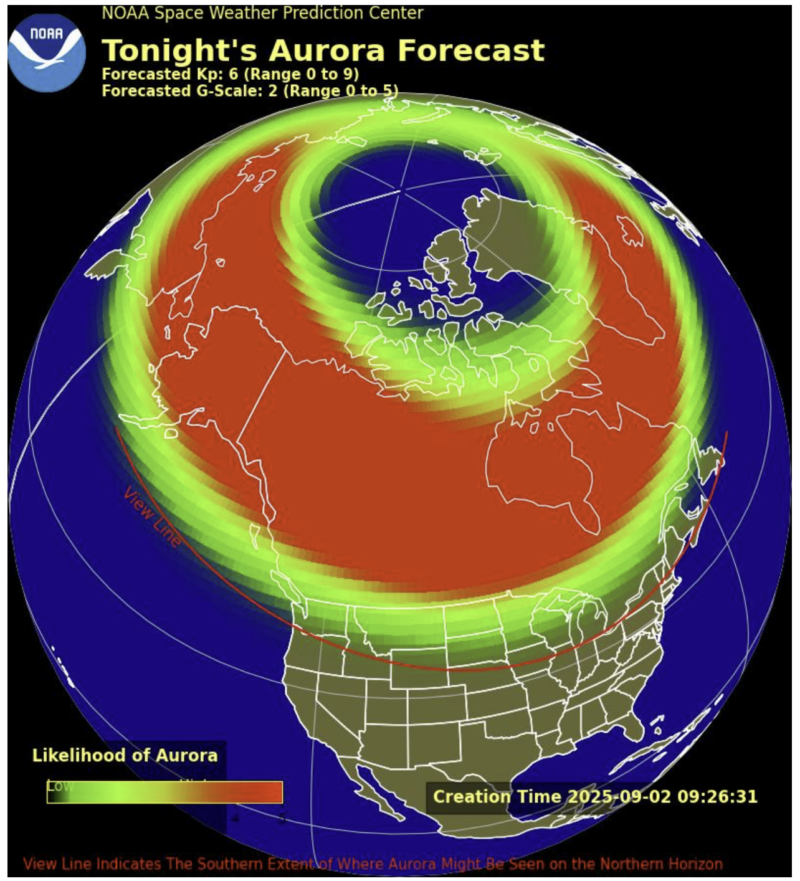
Sun news September 1: Auroras incoming! Severe storming possible tonight
(11:00 UTC Aug 31 – 11:00 UTC Sep 1)

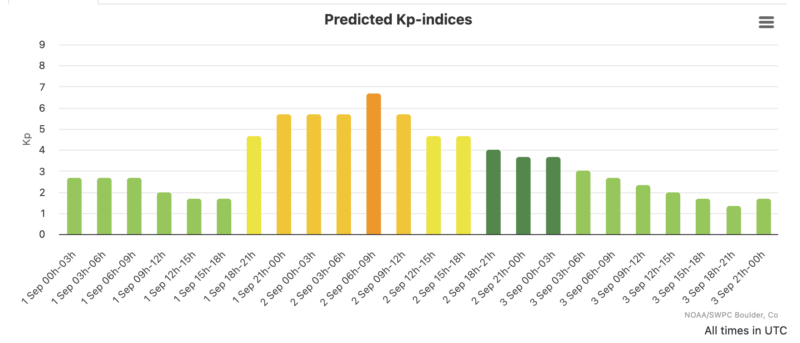
The impressive full-halo coronal mass ejection (CME) that was blasted from the sun on Saturday is expected to impact Earth’s magnetic field later today. This huge burst of sun-stuff could trigger G2–G3 (moderate-strong) geomagnetic storming, with a chance of G4 (severe) storms depending on the CME’s magnetic orientation. That means it could be a brilliant night to see auroras! Clear skies, everyone.
- Flare activity: Solar activity decreased to low levels, with only C-class (common) flares recorded over the past day. Highlights include:
- C6.8 — AR4202 (S15E01) at 18:26 UTC on Aug 31.
- C4.9 — AR4197 (S20W29) at 03:25 UTC on Sep 1.
- Multiple smaller C flares from AR4197 (beta–gamma, now losing its delta complexity) and AR4207 (emerging in the northeast limb region).
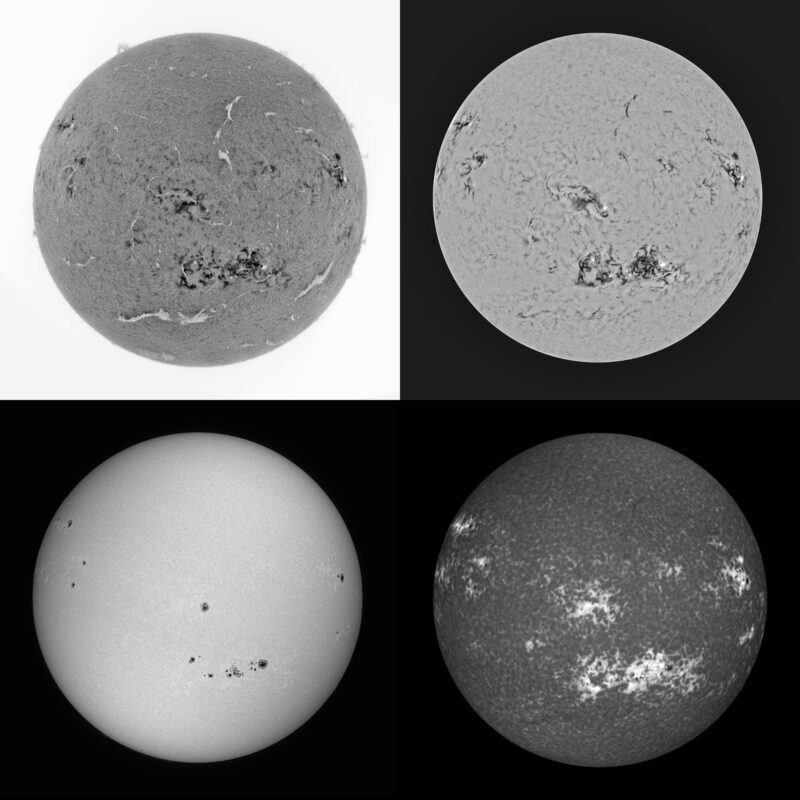
- Sunspot regions: Ten numbered regions are on the Earth-facing disk.
- AR4197 (S18W24): Still the largest and most complex sunspot region, but now showing minor decay and loss of delta spots. This region continues to produce frequent C flares.
- AR4202 (S15E01): Produced the largest flare of the period (C6.8).
- AR4207 (N30E58): Developing additional trailing sunspots, but its proximity to the horizon makes classification tricky.
- AR4208 (N18W68): Newly numbered, simple beta region.
- AR4191 (N11W68): Beta configuration, stable with minor C-class flares.
- Blasts from the sun? The full-halo coronal mass ejection (CME) tied to the M2.8 flare on August 30 remains Earth-directed. Arrival is expected late Sep 1 into Sep 2. No new Earth-directed CMEs were detected during the past 24 hours.
- Solar wind: Solar wind remained normal, rising from ~375 km/s to ~500 km/s late on Aug 31 under weak coronal hole influence. The interplanetary magnetic field (IMF) peaked at normal levels, and the Bz varied between northward and southward. Forecasters expect mildly enhanced conditions early Sep 1, then a significant boost late Sep 1–Sep 2 as the CME arrives.
- Earth’s magnetic field: Conditions stayed quiet (Kp 1–2), with one unsettled period between 9 and 12 UTC yesterday. Storm levels should rise late today into tomorrow, likely reaching G2–G3, with a chance of G4 conditions.
- Energetic particles: The level of energetic particles remains slightly elevated, but below the S1 (minor) radiation storm threshold. A minor storm remains possible through September 3 if additional eruptive flares occur.
Like what you read?
Subscribe and receive daily news delivered to your inbox.
More from
C. Alex Young


Sun news: See a huge solar eruption

Yes, there’s an aurora season, and it’s here
Sun activity archive for September 2026
Sun activity archive for August 2026