Sun news April 30: Solar wind could disturb Earth’s magnetic field

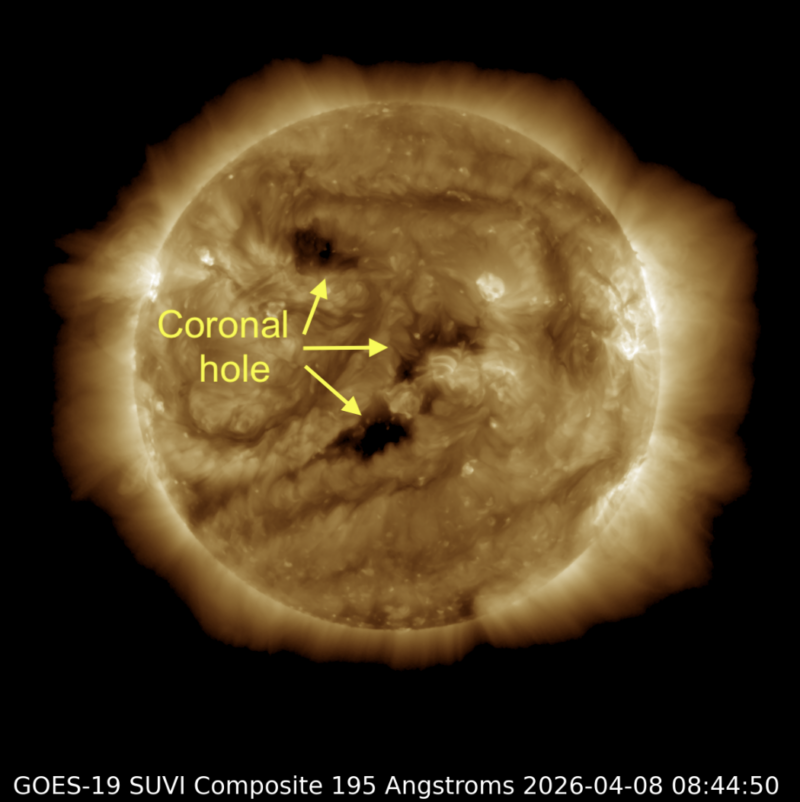
A large coronal hole – a cooler, less dense region in the sun’s outer atmosphere – is now positioned just above the center of the Earth-viewed sun. It’s located too far north for the fast solar wind it produces to head directly to Earth, but some might reach us over the coming days. Meanwhile, fast solar wind from a smaller coronal hole that was facing Earth a couple of days ago is set to reach Earth later today. This should disturb our magnetic field, possibly triggering G1 (minor) geomagnetic storming and even sparking auroras at northerly latitudes.
Past 24 hours of sun news
(11 UTC April 29 – 11 UTC April 30)
Flare activity
Solar activity returned to low levels with the production of C-class (common) flares only. Over the past day the sun fired 15 C flares, compared to yesterday’s tally of 20 C flares and 3 M flares.
- Strongest flare: C5.1 from active region AR4424 in the solar northwest, peaking at 0:31 UTC on April 29.
- Lead flare producer: AR4420 remains the top flare producer. This sunspot region blasted 8 C flares out of the 15.
Sunspot regions: key players
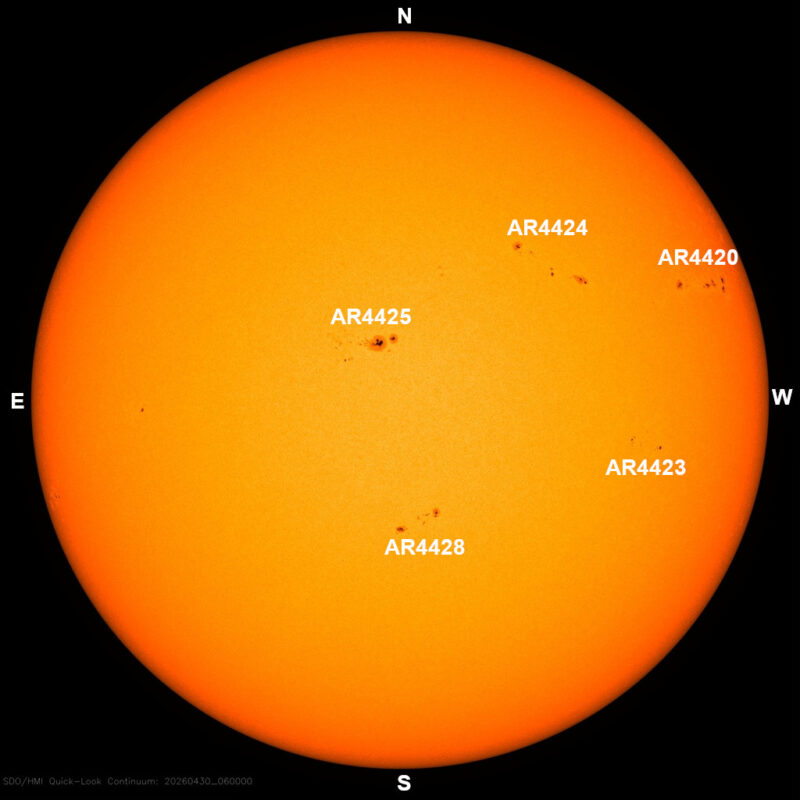
Currently the side of our sun we see from Earth shows 5 numbered active regions. Two continue to dominate:
AR4420 (beta-gamma-delta) retained its overall magnetic complexity, but showed some signs of decay.
AR4425 (beta) lost its delta configuration. That means it’s lost some flare potential.
Blasts from the sun?
No Earth-directed coronal mass ejections (CMEs) were observed during the period.
Past 24 hours in space weather
Solar wind
Solar wind speeds averaged at mostly normal levels during our observation period. The total interplanetary magnetic field (IMF) stayed weak overall.
Bz and magnetic coupling
The Bz component kept shifting from south to north over the past day. This morning, the Bz component turned southward. A southward Bz is favorable for auroras.
Earth’s magnetic field
Earth’s magnetic field was quiet over the past day (Kp 0–2). At the time of this writing the Kp index sits slightly above level 1.
What’s ahead? Sun–Earth forecast
Flare activity forecast
Forecasters expect low-to-moderate levels through April 30. Chances for C-Class flares stay high at 99%. A slight reduction of chances for M flares was noted from 70% yesterday to 65% today. X-class flares dropped to 10% from 20% chance yesterday. All this reflects AR4425 losing its delta and AR4420 showing signs of decay.
Geomagnetic activity forecast
- April 30 (Thursday): Quiet-to-unsettled levels may continue early today, but late during the day an increase to active levels is anticipated (Kp 5). That’s because a stream of high-speed solar wind from a coronal hole should start to arrive. G1 (minor) geomagnetic storm are possible.
- May 1 (Friday): Unsettled-to-quiet conditions may return as fast solar wind from a coronal hole starts to wane.
- May 2 (Saturday): Mostly quiet conditions anticipated.
Sun news April 29: Activity surges with 3 M flares!
Sun activity has picked up over the past day, with an impressive 23 flares fired in 24 hours. And three of those were M flares! These came within just 2 hours, and all from the same sunspot region: AR4420. This region has a complex beta-gamma-delta magnetic setup, meaning it has the potential to unleash strong M or even X (strong) flares. This is certainly the region to watch. Stay tuned!
Past 24 hours of sun news
(11 UTC April 28 – 11 UTC April 29)
Flare activity
Solar activity jumped back up to moderate, thanks to a trio of M flares. Overall flare production also increased; we saw 23 flares (3 Ms plus 20 C-class flares) compared to just 15 C-class flares the day before.
- Strongest flare: M1.6 from AR4420, peaking at 13:53 UTC on April 28. R1 (minor) radio blackout was observed affecting an area over the west coast of Africa.
- Other M flares: Also from AR4420: M1.0 at 12.23 on April 28, causing an R1 (minor) radio blackout over Mauritania. M1.1 flare at 14:07 UTC on April 28, causing an R1 (minor) radio blackout over the Atlantic Ocean west of Africa.
- Lead flare producer: AR4420 continued to lead flare production. It fired 18 of the 23 flares of this period, including the three strongest. Meanwhile, AR4425 contributed 4 flares.
Sunspot regions: key players
The Earth-facing solar disk showed 7 numbered active regions. Two continue to dominate:
AR4420 (beta-gamma-delta) retained its magnetic complexity.
AR4425 (beta-delta) lost its gamma configuration but keeps its delta. That means it’s lost some potential, but could still stir interesting activity.
Blasts from the sun?
No Earth-directed coronal mass ejections (CMEs) were observed during the period.
Past 24 hours in space weather
Solar wind
Solar wind speeds averaged near normal levels. The total interplanetary magnetic field (IMF) stayed weak overall.
Bz and magnetic coupling
The Bz component was mostly oriented north over the past day. But at 3:30 UTC this morning it turned southward and stayed there up to the time of this writing. A southward Bz is favorable for auroras.
Earth’s magnetic field
Over the past day, Earth’s magnetic field was very quiet (Kp 0–1). The Kp index sits slightly above level 0 at the time of this writing.
Sun news April 28: Activity dips, but sunspot regions look potent
The sun dialed its activity back a notch over the past 24 hours. Sunspot regions AR4420 and AR4425 traded volleys of C-class (common) blasts, but no flare made it over the M-flare (moderate) threshold. But don’t let this lull fool you! Both AR4420 and AR4425 still carry complex beta-gamma-delta magnetic setups, meaning they have the potential to unleash strong M or even X (strong) flares. Stay tuned.
Past 24 hours of sun news
(11 UTC April 27 – 11 UTC April 28)
Flare activity
Over the past day, solar activity dropped to low levels. In total, the sun fired 15 C-class flares.
- Strongest flare: C9.0 from AR4420, peaking at 9:23 UTC on April 28.
- Lead flare producer: AR4420 dominated the period. It fired 9 of the 15 flares, including the two strongest. Meanwhile, AR4425 contributed 5 flares.
Sunspot regions: key players
The Earth-facing solar disk showed 7 numbered active regions. Two continue to dominate:
AR4420 (beta-gamma-delta) remained the top flare producer. Slight decay appeared in its middle spots. Its delta setup has weakened somewhat. Even so, significant complexity persists. Two delta spots remain, keeping this region capable of strong eruptions as it moves through the northwest quadrant.
AR4425 (beta-gamma-delta) was the second most active region. It showed moderate growth and consolidation. The region features at least two delta spots. Notably, its position in the northeast means any sun-stuff it sends into space will likely come our way.
Blasts from the sun?
No clearly Earth-directed coronal mass ejections (CMEs) were confirmed during the period.
Past 24 hours in space weather
Solar wind
Solar wind speeds held near normal levels. The total interplanetary magnetic field (IMF) stayed weak overall.
Bz and magnetic coupling
The Bz component fluctuated between north and south, but pointed mostly northward. As a result, Earth’s magnetic shield stayed closed and aurora activity remained subdued.
Earth’s magnetic field
Over the past day, Earth’s magnetic field ranged from quiet to unsettled (Kp 1–3).
Sun news April 27: Powerful M6 flare caps day of high activity

The sun fired off a powerful M6 flare late yesterday, capping a busy 24-hour stretch that pushed activity to high levels. In total, our star fired 4 M-class (moderate) and 17 C-class (common) flares over the past day. That is a relentless barrage, driven primarily by two complex sunspot regions: AR4425 and AR4420. AR4420 was responsible for the M6 eruption, which peaked at 22:51 UTC. Forecasters are determining whether this blast fired any sun-stuff into space. If so, the solar material would have a decent chance of reaching Earth, since AR4420 fired the flare from near the center of the solar disk. Stay tuned!
Past 24 hours of sun activity
(11 UTC April 26 – 11 UTC April 27)
Flare activity
Over the past day, solar activity reached high levels. In total, the sun fired 21 flares: 4 M-class and 17 C-class.
- Strongest flare: M6.0 from AR4420 at 22:51 UTC on April 26. It triggered an R2 (moderate) radio blackout, degrading high-frequency radio over the sunlit Pacific and East Asia.
- Other M-class flares: M2.2 from AR4425 at 19:54 UTC on April 26. M1.7 from AR4420 at 19:18 UTC on April 26. M1.0 from AR4425 at 6:39 UTC on April 27.
- Lead flare producer: AR4420 dominated the period. It fired 14 of the 21 flares, including the M6.0 and one additional M-class event. Meanwhile, AR4425 contributed 6 flares, including two M-class blasts.
Sunspot regions
The Earth-facing solar disk currently shows 7 numbered active regions. Two stand out:
AR4420 (beta-gamma-delta) is the dominant region. Its complex delta setup and ongoing evolution keep it firmly in the spotlight.
AR4425 (beta-gamma-delta) continued to grow. It appears to have developed multiple delta setups. However, its position on the eastern edge of the solar disk makes a full assessment difficult.
Blasts from the sun?
No Earth-directed coronal mass ejections (CMEs) were confirmed during the period.
Past 24 hours in space weather
Solar wind
Solar wind speeds were slightly elevated, thanks to a waning coronal hole high-speed solar wind stream. The total interplanetary magnetic field peaked at moderately strong levels but averaged at normal levels.
Bz and magnetic coupling
The Bz component was highly variable, swinging between deep northward and southward peaks. Each southward dip opened the door for solar particles to flow into Earth’s atmosphere, bringing enhanced geomagnetic activity.
Earth’s magnetic field
Over the past day, Earth’s magnetic field ranged from quiet to active levels. The active intervals were enough to produce minor aurora enhancements at high latitudes.

The sun in recent days
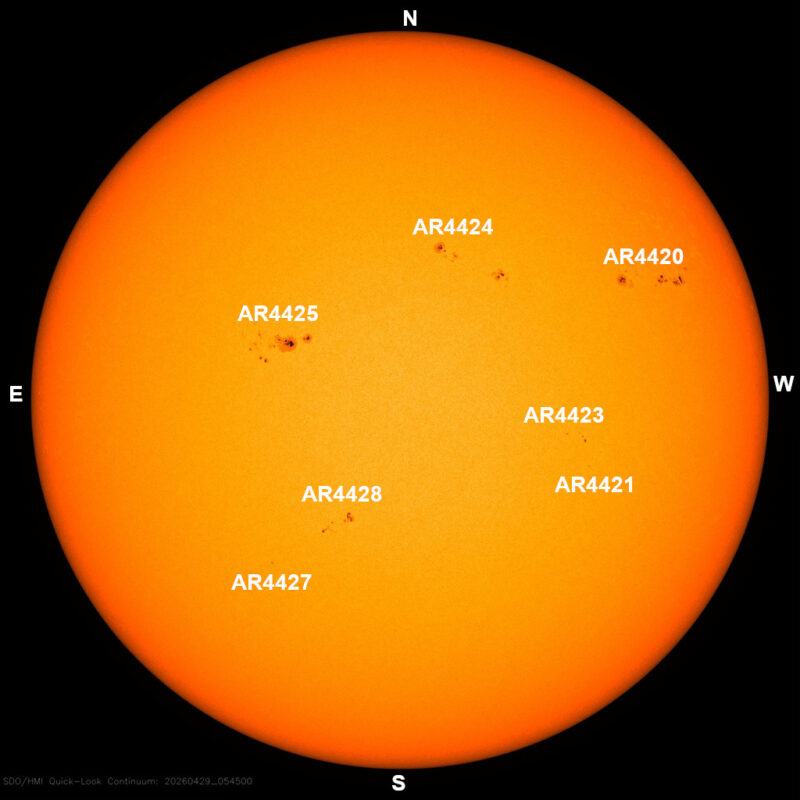
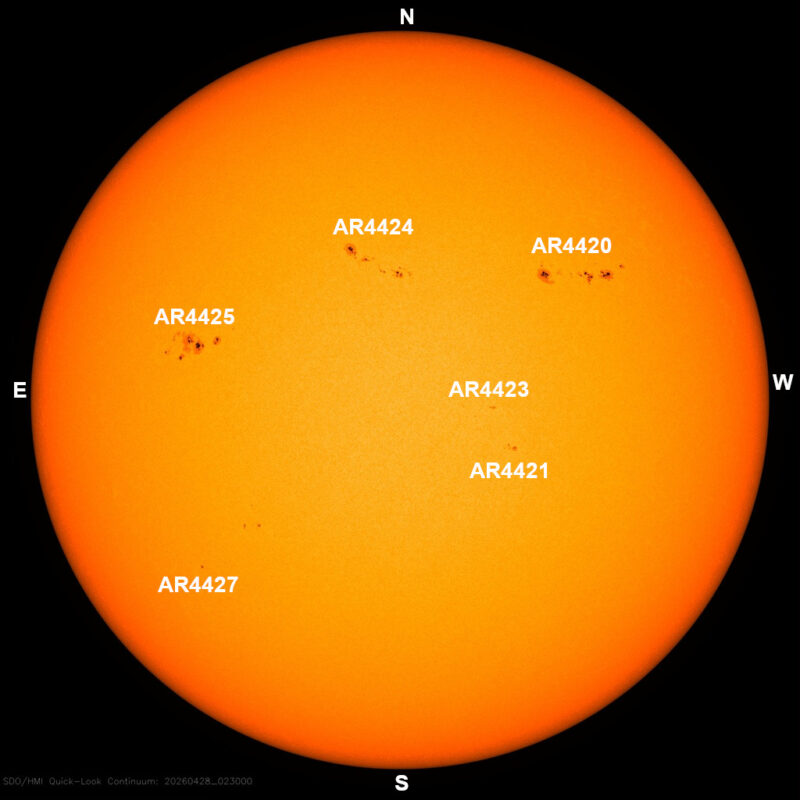
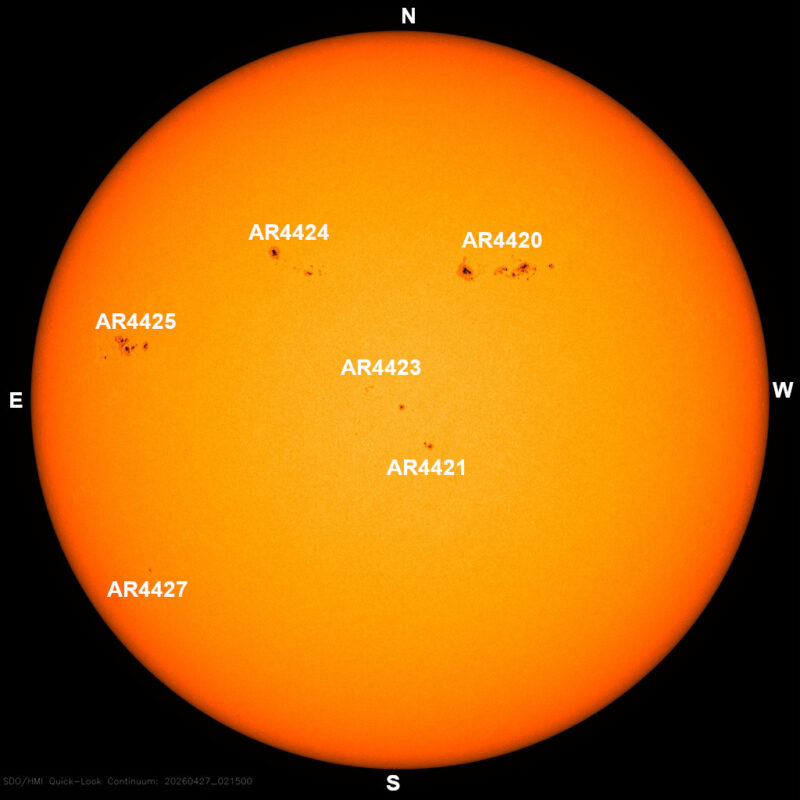
Earlier sun images
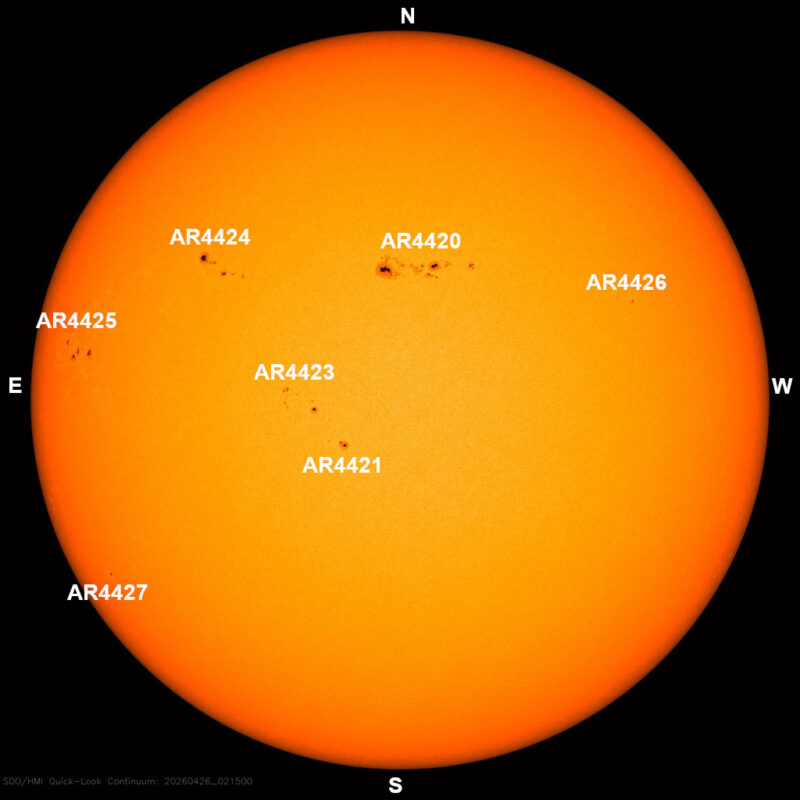
Sun news April 26: M flares persist, CMEs nudge Earth
Earth’s magnetic field stirred overnight. Specifically, the faint breath of a coronal mass ejection (CME) from April 23 swept past our planet. As a result, solar wind speeds jumped, as the interplanetary magnetic field (IMF) spiked. The Bz dipped favorably southward. That briefly opened the door for charged particles to energize the upper atmosphere.
Consequently, geomagnetic conditions climbed to active levels (Kp 4). However, aurora displays stayed confined to high latitudes such as northern Scotland. In addition, glancing CME influences from April 23 and 24 could keep conditions unsettled through April 27. Isolated G1 (minor) geomagnetic storm conditions remain possible later today.
On the solar front, the sun kept busy. Activity held at moderate to high levels. Notably, AR4425 fired an M1.3 flare at 00:08 UTC on April 26. It triggered a minor radio blackout. In total, 2 M-class and 12 C-class flares kept forecasters on alert.
Three complex regions remain capable of more M-class and possibly X-class eruptions. These are AR4420 (beta-gamma-delta), AR4423 (beta-gamma-delta), and the still-emerging AR4425 (beta-gamma). Stay tuned!
Past 24 hours of sun news
(11 UTC April 25 – 11 UTC April 26)
Flare activity
Over the past day, solar activity held at moderate to high levels. In total, the sun fired 14 flares: 2 M-class and 12 C-class.
- Strongest flare: M1.3 from AR4425 (N06E64). It peaked at 00:08 UTC on April 26. The blast triggered an R1 (minor) radio blackout. It briefly affected HF communications over the nightside Pacific and eastern Asia. In addition, an impulsive M1.1 erupted from AR4425 at 14:22 UTC on April 25. That also triggered an R1 blackout.
- Lead flare producer: AR4425 topped the list. It fired at least 5 flares. These included both M-class events and multiple C-class blasts. Meanwhile, AR4419, AR4420, AR4421, and AR4424 each added isolated C-class activity.
Sunspot regions
The Earth-facing solar disk showed 8 numbered active regions. One departed over the western limb. One newcomer received an official number.
Blasts from the sun?
No new Earth-directed coronal mass ejections (CMEs) appeared in coronagraph imagery.
Past 24 hours in space weather
Solar wind
Solar wind conditions grew active through the period. Initially, speeds sat near 450 km/s. Then they dipped toward 350 km/s mid-period. Later, they climbed back to roughly 450 km/s. A transient structure, likely the glancing April 23 CME, caused the rebound. Meanwhile, the total IMF averaged near 8 nT. It peaked at 12 nT near day’s end.
Bz and magnetic coupling
The Bz component spent most of the period pointing north. That is unfavorable for aurora. However, it turned sharply south to -9 nT when the total field peaked. As a result, Earth’s magnetic defenses opened. Solar wind energy poured into the magnetosphere. In
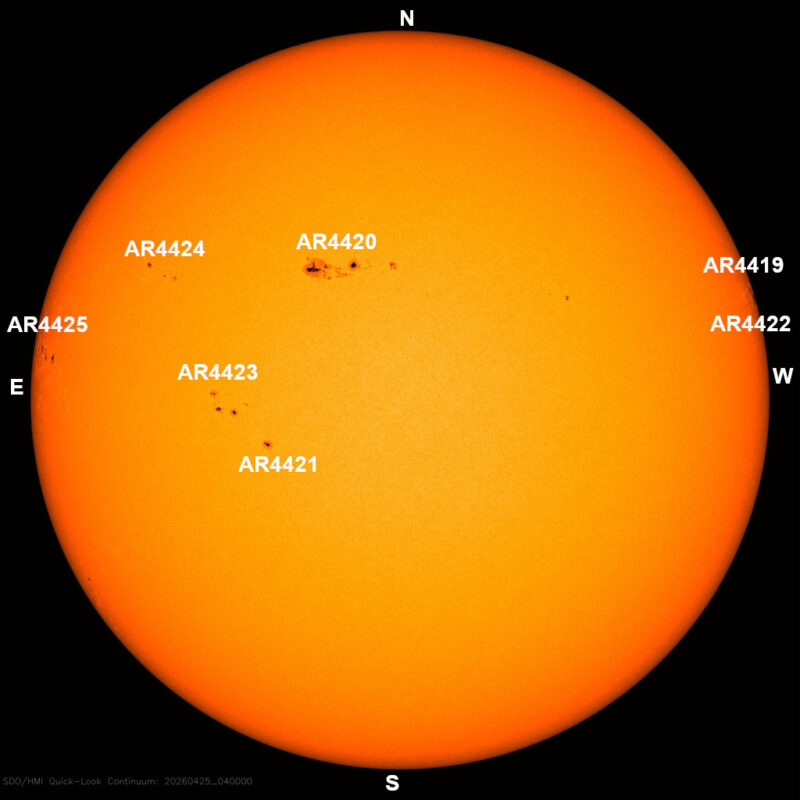
Sun news April 25: M6.4 flare, sun-stuff heads our way
Another three M-class flares rocked the sun over the past 24 hours! The strongest was an M6.4, s solar activity remain at high levels following the previous day’s two X flares. Sunspot region AR4419, now preparing to depart over the sun’s northwest horizon, produced the strongest flare of the day. Newcomer AR4423 in the sun’s southeast produced the other two.
So it seems the sun’s magnetic landscape is heating up! Currently, four active regions carry interesting magnetic setups. AR4420 keeps its beta-gamma-delta configuration. AR4419, already an X-flare producer, lost its delta component but retains beta-gamma. Notably, AR4419 now sits right at the northwest horizon. That is a prime position where any fiery eruption can funnel material directly toward Earth along the Parker Spiral. In addition, newcomer AR4423 shows a beta-delta setup. AR4425 carries a beta-gamma configuration.
Multiple eruptions with CMEs
The multiple eruptions from M flares hurled blobs of solar stuff into space. Several coronal mass ejections CMEs are more or less poised to deliver glancing blows at Earth in the coming days. Specifically, enhancements from these arrivals might start arriving late today, April 25, and extend through April 26. As a result, G1 to G2 (minor to moderate) geomagnetic storms are anticipated. Auroral displays are possible this weekend. Aurora hunters, stay alert!
Past 24 hours of sun news
(11 UTC April 24 – 11 UTC April 25)
Flare activity
Over the past day, solar activity continued at high levels. In total, the sun fired 11 flares: 3 M-class (moderate) and 8 C-class (common).
- Strongest flare: M6.4 from AR4419 in the northwest, peaking at 18:15 UTC on April 24. The eruption triggered an R2 (moderate) radio blackout, affecting an area over Mexico.
- Other notable flares: An M1.7 from newcomer AR4423 in the southeast at 13:01 UTC on April 24. It triggered an R1 (minor) radio blackout over the west coast of Africa. Then, AR4423 fired again with an M1.3 at 7:59 UTC on April 25. That blast triggered an R1 (minor) blackout over the Arabian Sea, west of India.
- Lead flare producer: Newcomer AR4423 topped the list, firing 7 of the period’s 11 flares. These included 2 M-class and 5 C-class events.
Sunspot regions
Our sun shows 7 active regions on its visible face today. Notably, three newcomers received official numbers during the period: AR4423, AR4424, and AR4425. The disk is filling up.
Blasts from the sun?
Several eruptions produced coronal mass ejections (CMEs) during the period. As noted above, some of this material is heading toward Earth. Forecasters expect glancing blows that might arrive starting late today.
Past 24 hours in space weather
Solar wind
Solar wind speeds climbed to moderate levels during this period. Transient influences passing Earth likely caused the increase.
Bz and magnetic coupling
The Bz component pointed southward during late April 24. However, starting at 23:40 UTC on April 24, it shifted north. It held that northward orientation for the rest of the period. As of 11 UTC on April 25, the Bz still points north. As always, southward dips let solar wind energy pour into Earth’s magnetic shield and fuel auroras.
Earth’s magnetic field
Over the past day, Earth’s magnetic field ranged from quiet to unsettled (Kp 1–3). Conditions stayed well below geomagnetic storm levels. Currently, the Kp index sits slightly above level 3. However, that could change quickly once the CME material arrives.
Sun news April 24: Surprise! The sun blasts 2 X flares!


The sun had been pretty quiet. Then yesterday we reported on three M-class flares! And, over the past day, the sun blasted two X flares plus another three M flares! The big blasts came from active region AR4419, now almost over the sun’s northwestern horizon, the side about to depart to the far side of our sun. That’s how we can see the outstanding prominences this sunspot region produced at the moment of the X blasts. AR4419 gained a delta magnetic complexity, giving it a promising beta-gamma-delta configuration. And so did AR4420. So have now two regions on the solar disk with the potential for more M and even X fares. Stay tuned.
Past 24 hours of sun news
(11 UTC April 23 – 11 UTC April 24)
Flare activity
climbed to high over the past day, with the production of 2 X flares. Total solar flare production over the past day consisted of 15 flares: 2 X (strong), 3 M (moderate) and 10 C (common).
- Strongest flare was the X2.5 flare produced by active region AR4419 in the northwest. It peaked at 8:13 UTC today (April 24). The eruption triggered an R3 (strong) radio blackout, affecting an area in the Indian Ocean over Socotra Island.
- Other relevant flares: The second X flare of the period was an X2.4 from same dynamic flare produce AR4419. It was blasted at 1:07 UTC today (April 24). The event provoked a registered R3 (strong) radio blackout that affected an area over Philippine Sea, south of Japan. The two M flares sparked during this period were: M1.7 from AR4419 at 14:11 UTC on April 23. The event was accompanied by an R1 (minor) radio blackout that affected an area over the Atlantic Ocean off the African west coast. The second M flare was an M4.9 at 17:08 UTC on April 23. It provoked an R1 (minor) radio blackout over the Caribbean. The third of the day was an M2.5 flare from AR4421 at 9:07 UTC on April 24. Correspondent R1 (minor) radio blackout registered over the Red Sea.
- Lead flare producer: AR4419 top flare producer of the period with 5 flares, 2 X, 2 Ms and one C flare. This active region was closely followed by AR4420 and AR4421 that produced 4 C flares each.
Sunspot regions
Our sun shows today 4 active regions on its visible face. Both AR4419 and AR4420 gained a delta complexity, and today these two guys show a beta-gamma-delta, the largest configuration there is, capable of producing M and X flares. And they proved it! Note that both AR4419 and AR4422 will soon depart to the far side of our star.
Blasts from the sun?

Yesterday’s M flare from AR4419 hurled plasma into space. After modeling and analysis a component was found heading our way at Earth. It should provide a glancing blow on April 26. The X and M flares produced during this period are under modeling and analysis by specialists to determine if they find if any coronal mass ejection (CMEs) are headed toward Earth.
Past 24 hours in space weather
Solar wind
Solar wind speeds continued decreasing down to moderate-low levels. This decline occurred as the coronal hole’s fast stream continued to wane.
Bz and magnetic coupling
The Bz component kept shifting between south and north during the whole period. However, the strongest peaks pointed south. At the end of this period the Bz component points south. Southward dips let solar wind energy pour into Earth’s magnetic shield to fuel auroras.
Earth’s magnetic field
Over the past day, Earth’s magnetic field ranged from quiet to unsettled (Kp 1–3). Conditions stayed well below geomagnetic storm levels. Currently, the Kp index sits just above level 2.
Sun news April 23: Activity jumps with 3 M flares!


The sun surprised us this morning with three M-class flares! For days, we watched the sun go through a stretch of only faint flares. Recently, flare counts picked up. But the two promising beta-gamma regions, AR4419 and AR4420, held back from anything larger … until this morning.

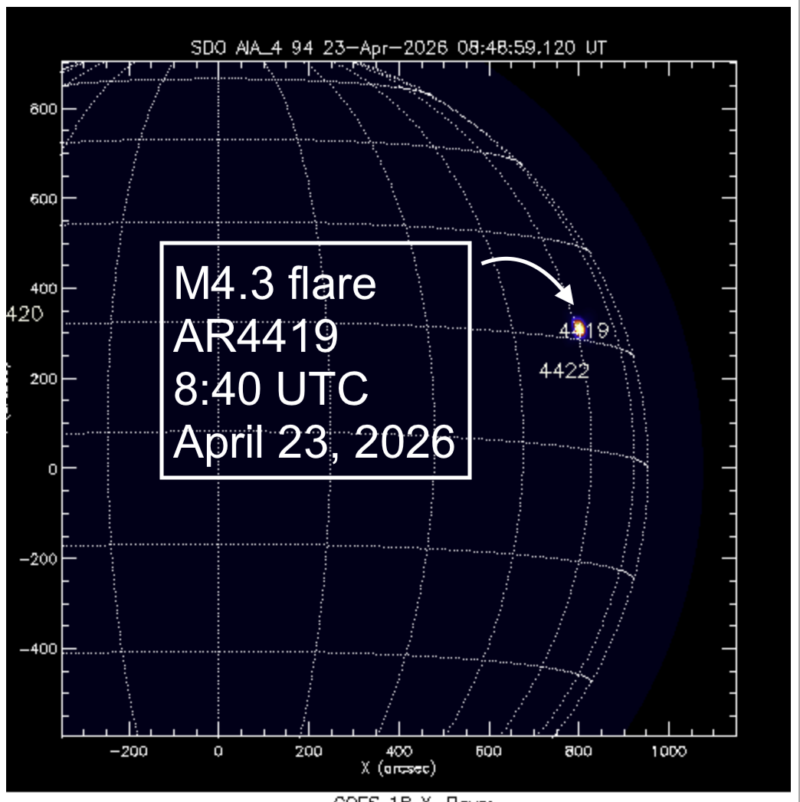
The 3 M flares came in rapid sequence. First, AR4419 fired an M1.7 at 4:35 UTC. Then, AR4420 launched an M1.2 at 4:59 UTC. Finally, AR4419 produced the strongest blast: an M4.3 at 8:48 UTC. These flares all sent bursts of sun-stuff into space, and forecasters are currently determining whether these coronal mass ejections (CMEs) could be heading to Earth.
Past 24 hours of sun news
(11 UTC April 22 – 11 UTC April 23)
Flare activity
Over the past day, solar activity jumped to moderate levels thanks to the 3 M-class flares. In total, the sun fired 14 flares: 3 M-class (moderate), 10 C-class (common), and 1 B-class (weak).
- Strongest flare: M4.3 from AR4419 in the northwest. It peaked at 8:48 UTC on April 23. All three of the day’s M flares triggered R1 (minor) radio blackouts.
- Lead flare producer: AR4420 was again the leading producer, firing 9 of the 14 flares. These included one M, seven Cs, and one B event. Meanwhile, AR4419 added the other five flares, including the two strongest M blasts.
Sunspot regions
Currently, the Earth-facing side of our sun shows 4 active regions. AR4420 keeps its beta-gamma complexity. However, AR4419 lost its gamma part, so now carries a simpler beta setup. Despite the downgrade, AR4419 still fired the two strongest M flares. AR4421 and AR4422 both show beta setups.
Blasts from the sun?
Forecasters are modeling today’s M flares. They want to find if any of the CMEs are headed toward Earth. Besides these events, no other Earth-directed CMEs appeared in coronagraph imagery.
Past 24 hours in space weather
Solar wind
Solar wind speeds dropped from moderately high to moderate levels. This decline occurred as the coronal hole’s fast stream continued to wane.
Bz and magnetic coupling
The Bz component shifted between south and north. However, the strongest peaks pointed north late on April 22. Southward dips let solar wind energy pour into Earth’s magnetic shield to fuel auroras.
Earth’s magnetic field
Over the past day, Earth’s magnetic field ranged from quiet to unsettled (Kp 1–3). Conditions stayed well below geomagnetic storm levels. Currently, the Kp index sits at level 2.
Sun news April 22: Sun-stuff could reach Earth this week

Yesterday we reported two fiery prominences erupting at almost the same time in opposite directions. Now we know that this double eruption sent a blast of solar material – a coronal mass ejection (CME) – in the direction of Earth. This might deliver a glancing blow around April 24. Combined with fast solar wind from a coronal hole, this could provide auroral activity. Stay tuned!
Past 24 hours of sun news
(11 UTC April 21 – 11 UTC April 22)
Flare activity
Over the past day, solar activity stayed at low levels. Only C- and B-class flares occurred. However, flare counts jumped sharply. In total, the sun fired 19 flares: 13 C-class (common) and 6 B-class (weak). That is a clear pickup compared to the 11 flares the day before.
- Strongest flare: C4.0 from newcomer AR4420 in the northeast. It peaked at 11:50 UTC on April 21.
- Lead flare producer: AR4420 dominated almost entirely, firing 18 of the 19 flares. These included the strongest C-class event. The only other flare came from yesterday’s lead producer, now officially numbered AR4421.
Sunspot regions
The Earth-facing side of our sun shows 4 active regions today. Notably, three of them are newcomers: AR4420 in the northeast, AR4421 in the southeast, and AR4422 in the northwest just south of AR4419.
AR4419 keeps its beta-gamma magnetic complexity. However, it now has company. AR4420 also carries a beta-gamma setup. As a result, both regions hold potential for more C-class and even M-class flares.
Blasts from the sun?
Besides the partial halo event in our top story, available coronagraph imagery showed no other Earth-directed coronal mass ejections (CMEs).
Past 24 hours in space weather
Solar wind
Solar wind speeds eased to moderately high levels. Even so, the coronal hole’s fast solar wind stream kept driving active conditions around Earth.
Bz and magnetic coupling
The Bz component pointed south late on April 21. Then, at 21:30 UTC, it swung north, and stayed that way for the rest of the period. Southward dips let solar wind energy pour into Earth’s magnetic shield and fuel auroras.
Earth’s magnetic field
After yesterday’s G1 (minor) geomagnetic storm, Earth’s field calmed down. Conditions ranged from quiet to active (Kp 1–4). Specifically, one Kp 4 (active) three-hour period occurred around 15 UTC on April 21. Since then, conditions have eased. Currently, the Kp index sits at level 1.
Sun news April 21: More geomagnetic storms last night

Earth’s magnetic field remained disturbed for a third night in a row last night. The lingering effects of fast solar wind from a coronal hole rattled our planet’s magnetic shield to cause another round of G1 (minor) geomagnetic storming, bringing auroras to far northern latitudes. Did you catch a glimpse? Share your photos with us!
Past 24 hours of sun news
(11 UTC April 20 – 11 UTC April 21)
Flare activity
Over the past day, solar activity stayed at low levels. In total, the sun fired 11 flares: 5 C-class (common) and 6 B-class (weak). Notably, flare counts picked up compared to recent days.
- Strongest flare: C5.3 from an incoming region in the southeast, not yet named. It peaked at 6:02 UTC on April 21.
- Lead flare producer: This as-yet-unnumbered southeastern region fired at least 5 of the 11 flares. These included the strongest C-class event. Meanwhile, a second incoming region in the northeast, also unnamed, added 4 flares: 3 C-class and 1 B-class.
Sunspot regions
Currently, the Earth-facing sun shows a sparse sunspot count. Only one region has an official number. The estimated sunspot number sits around 40. That is well below the Solar Cycle 25 average for this phase.
AR4419 remains the most complex (beta-gamma) region on the disk. However, it only fired B-class flares this period. Two incoming regions may soon provide some action.
Blasts from the sun?
Available coronagraph imagery showed no Earth-directed coronal mass ejections (CMEs) during the period.
Past 24 hours in space weather
Solar wind
Solar wind speeds stayed elevated throughout the period. The coronal hole’s fast solar wind stream kept driving active conditions around Earth. Speeds held at moderate-to-high levels.
The Bz component pointed mostly south through the period. Each southward dip let solar wind energy pour into Earth’s magnetic shield and fuel auroras. However, at the time of this writing, the Bz has swung back north.
Earth’s magnetic field
Over the past 24 hours, Earth’s magnetic field ranged from unsettled to active, with bursts of geomagnetic storming. G1 (minor) storm intervals (Kp 5) ran from 15:00 UTC on April 20 to 3:00 UTC on April 21. Since then, Earth’s field has eased to Kp 4 levels. At the time of this writing, the Kp index sits at level 4.

Sun news April 20: G2 storm eases, aurora fades

Earth’s magnetic field remained restless over the past 24 hours. Our planet is still under the influence of a coronal hole high-speed stream that has been sweeping past us for days.
As a result, geomagnetic conditions reached G1 (minor) and even briefly G2 (moderate) geomagnetic storm levels. Specifically, Kp reached as high as 6 early in the period. That opened the door for aurora displays from places like Seattle, Minneapolis, Edinburgh, and possibly Toronto and northern England.
What drove the action? Solar wind speeds ranged from roughly 440–570 km/s. Meanwhile, the interplanetary magnetic field (IMF) ranged between 3 and 12 nT. In addition, the Bz component swung between +9 and ?7 nT. Each southward dip helped energize Earth’s upper atmosphere and fuel auroral activity.
The good news for aurora watchers: unsettled-to-active conditions should linger through Monday and Tuesday before gradually fading.
On the solar front, the sun took a breather. Activity dropped to very low levels, with only B-class background flares and a single C-class flare recorded. In addition, a filament eruption in the southeast launched a narrow coronal mass ejection (CME). However, it appears unlikely to hit Earth.
Past 24 hours of sun news
(11 UTC April 19 – 11 UTC April 20)
Flare activity
Over the past day, solar activity held at low levels. In total, the sun produced 10 flares: 1 C-class (common) and 9 B-class (weak).
- Strongest flare: C1.0 from AR4419, peaking at 8:33 UTC on April 20.
- Lead flare producer: AR4419 fired at least 5 of the 10 tracked flares, including the only C-class event. Meanwhile, AR4416 contributed 3 B-class flares. Some B-class events came from unidentified sources, likely tied to filament activity near the equator in the east.
Sunspot regions
Currently, the Earth-facing solar disk shows a sparse sunspot population. The estimated international sunspot number – a measure of long-term solar activity – sits around 40. That is well below the Solar Cycle 25 average for this phase.
AR4419 (beta-gamma) remains the most complex region on the disk. Despite its beta-gamma setup, it showed little overall change during the period. Even so, this region remains the most likely candidate for any jump in activity over the coming days.
Blasts from the sun?
A filament eruption occurred in the southeast around 16 UTC on April 19. Shortly after, a narrow coronal mass ejection (CME) appeared in coronagraph imagery. Forecasters are currently analyzing this CME for any Earth-directed component. However, the bulk of the material will most likely miss Earth. Available coronagraph imagery showed no other Earth-directed CMEs during the period.
Past 24 hours in space weather
Solar wind
Solar wind conditions remained elevated throughout the period. The coronal hole high-speed stream continued to dominate conditions around Earth. The Bz component swung between north and south, with each southward dip opening the door for solar wind energy to pour into Earth’s magnetic shield and fuel auroras.
Earth’s magnetic field
Over the past 24 hours, Earth’s magnetic field held mostly at unsettled-to-active levels. However, G1 (minor) storm intervals (Kp 5) were recorded between 6:00–9:00 UTC on April 19. Currently, conditions are easing back toward unsettled-to-active levels as the coronal hole stream gradually wanes.

Sun news April 19: Auroras light up skies as G2 storm continues
Auroras danced across northern skies last night, as Earth remained under the influence of a powerful coronal hole high-speed stream. These charged solar particles had started sweeping in late on April 17. The geomagnetic storm intensified over the past day, climbing from G1 (minor) to G2 (moderate) levels.
What fueled the display? Solar wind speeds surged past 600 km/s, and the interplanetary magnetic field (IMF) swung strongly southward to -14 nT. Those factors opened the door for charged particles to pour in and energize Earth’s upper atmosphere. As a result, colorful displays were visible from locations as far south as Toronto, Chicago, and northern England, keeping aurora-watchers busy overnight.
Looking ahead, the fast stream should peak near 700 km/s on April 19. That means another round of G1-to-G2 storming is possible before conditions gradually ease. Share your beautiful aurora photos with us!
Past 24 hours of sun news
(11 UTC April 18 – 11 UTC April 19)
Flare activity: Over the past day, solar activity held at low levels, with no C-class or stronger flares recorded during the reporting window. Only 4 B-class flares were detected.
- Strongest flare: B4.4 from AR4416 (N20W87) at 23:13 UTC on April 18. This was a minor event, well below the threshold for any radio blackout. Notably, the period’s largest event in the broader NOAA summary was a C1.6 flare from AR4416 peaking at 7:04 UTC on April 18, just before our EarthSky reporting window opened.
- Lead flare producer: AR4416 fired 3 of the 4 B-class events, though it is now rotating beyond the western limb. Meanwhile, AR4419 produced only a single B4.9 flare.
Sunspot regions: Currently, the Earth-facing solar disk shows 3 numbered active regions, though the disk remains notably quiet with an estimated international sunspot number around 47. AR4416 (alpha) continued rotating around the western limb during the period. Its geoeffective influence is now waning as it moves out of view. AR4419 (beta-gamma) is the most magnetically complex region on the disk and is approaching the central meridian, a geoeffective position. Despite the beta-gamma classification, it produced only a single B-class flare during the period. Even so, this region remains the primary candidate for any M-class activity in the coming days. AR4415 (alpha) remained unchanged and magnetically simple throughout the period.
Blasts from the sun? Available coronagraph imagery showed no Earth-directed coronal mass ejections (CMEs) during the period. However, an approximately 30-degree-long eruptive filament lifted off the solar disk between 7:30 and 8:23 UTC on April 18, visible in GONG H-alpha and GOES-19 SUVI imagery. The associated CME erupted off the southeast limb, but modeling confirmed it will not impact Earth. In addition, a small chance remains for a glancing blow early on April 19 from a CME that left the sun on April 15. Forecasters expect this CME to pass south and east of Earth’s orbit, though a weak interaction cannot be entirely ruled out.
Past 24 hours in space weather
Solar wind: Solar wind conditions were significantly enhanced throughout the past day as the negative-polarity coronal hole high-speed stream continued to drive elevated conditions. Speeds rose from approximately 370–400 km/s early in the period to a maximum of around 600 km/s. The interplanetary magnetic field (CME) total field peaked at a strong 17 nT. The Bz component pointed mostly southward early in the period, reaching a maximum southward deflection of -14 nT, highly favorable for aurora production. It then gradually swung weakly northward by the end of the period.
Notably, this is a large coronal hole that has increased in size since the previous solar rotation. As a result, speeds should continue climbing toward 700 km/s.
Earth’s magnetic field: Over the period, Earth’s magnetic field was significantly disturbed, reaching G2 (moderate) geomagnetic storm levels. The Kp index reached 6 (G2) during the 6:00–9:00 UTC window on April 18. In addition, G1 (minor) storm intervals (Kp = 5) were recorded at 3:00–6:00 UTC and 9:00–12:00 UTC on April 18. The UK Met Office issued a Kp Alert for G1 conditions between 6:00 and 9:00 UTC on April 19, indicating storm-level activity persisted into the current day. Aurora was visible across northern latitudes, including Scotland, northern England, and similar geomagnetic latitudes.

Sun news April 18: G2 storm hits, more auroras possible
As anticipated, the geomagnetic storm arrived, and it arrived strong! At around 21 UTC last night, the Kp index started to climb.
And conditions escalated quickly. At 2:41 a.m. CDT (7:41 UTC) this morning (April 18), conditions crossed the G1 (minor) geomagnetic storm threshold. Remarkably, it didn’t stay there for long. By 8:25 UTC, a G2 (moderate) storm was registered.
So what is driving all of this? Essentially, the fast solar wind streaming from the huge coronal hole we’ve been tracking combined with the arrival of a co-rotating interaction region (CIR). In short, a CIR forms in the space between us and the sun where slower solar wind gets overtaken by faster solar wind from the coronal hole. Together, this combination pushed Earth’s magnetic field to geomagnetic storming levels. Furthermore, periods of more G1 and G2 activity might extend through April 19. Aurora hunters, good luck and clear skies! And please share your beautiful photos of the auroras with us!
Past 24 hours of sun news
(11 UTC April 17 – 11 UTC April 18)
Flare activity: Over the past day, solar flare activity continued at low levels, thanks to an isolated C-class flare. In total, the sun produced 7 flares: 1 C-class and 6 B-class (weak).
- Strongest flare: C1.6 from AR4416 in the northwest, sparking at 7:04 UTC on April 18.
- Lead flare producer: AR4416 claimed lead flare producer honors, firing 6 of the period’s 7 flares. Meanwhile, our previous hero AR4419 produced only a single B-class flare this time around.
Sunspot regions: Currently, the Earth-facing side of the sun continues showing 3 numbered active regions. Notably, AR4419 retains its beta-gamma magnetic configuration and remains the largest in extent. Meanwhile, the remaining two numbered active regions show simpler alpha or beta configurations.
Blasts from the sun? Over the past day, available coronagraph imagery showed no Earth-directed coronal mass ejections (CMEs).
Past 24 hours in space weather
Solar wind: Over the past day, solar wind speeds initially held at low levels. However, starting at 21 UTC on April 17, speeds began climbing and eventually reached moderate-high levels. Accordingly, the interplanetary magnetic field (IMF) peaked at moderate levels. Interestingly, the Bz component started out weak, shifting between north and south. Then, starting around 21 UTC on April 17, it strengthened and swung firmly southward for the rest of the period.
Currently, at the time of this writing, the Bz component points southward. As always, a southward orientation favors auroral activity.
Earth’s magnetic field: Over the period, Earth’s magnetic field swung dramatically from very quiet levels to active levels. Early on, Kp values ranged from 0 to 1. However, starting around 21 UTC on April 17, Earth’s magnetic field began to stir. First, it rose to Kp 2. Then it climbed to Kp 3. Finally, it reached Kp 5, crossing the G1 (minor) geomagnetic storm threshold at 7:41 UTC on April 18. Shortly after, a Kp 6 or G2 (moderate) geomagnetic storm was registered, with the threshold reached at 8:25 UTC on April 18.

Sun news April 17: Huge coronal hole now faces Earth
The huge coronal hole we’ve been tracking – since it emerged on the sun’s northeast earlier this week – is now in a geoeffective position. In other words, it faces Earth directly, so that its fast solar wind is streaming our way. We should soon notice its arrival through disturbances in Earth’s magnetic field.
Forecasters anticipate the arrival of a co-rotating interaction region (CIR), a place between us and the sun where slower solar wind is overtaken by the fast solar wind from this coronal hole. This combination might push Earth’s magnetic field to unsettled-to-active levels, with periods of G1 (minor) geomagnetic storming. And we can’t rule out the possibility of G2 (moderate) activity. These conditions might extend through April 18.
So aurora chasers, take note! Auroral display sightings are possible this weekend. Clear skies!
Past 24 hours of sun news
(11 UTC April 16 – 11 UTC April 17)
Flare activity: Over the past day, solar flare activity jumped to low levels, with a notable increase in flare production. In total, the sun produced 16 flares: 5 C-class and 11 B-class (weak).
- Strongest flare: A C4.2 from AR4419 in the northeast sparked at 4:42 UTC on April 17.
- Lead flare producer: For a second day in a row, AR4419 stood as the sole flare producer during the period, firing all 16 events.
Sunspot regions: Currently, the Earth-facing side of the sun shows 3 numbered active regions. Notably, newcomer AR4419 retains its beta-gamma magnetic configuration and continues dominating flare production. Meanwhile, the remaining two numbered active regions show simpler alpha or beta configurations.
Blasts from the sun? Over the past day, available coronagraph imagery showed no Earth-directed coronal mass ejections (CMEs).
Past 24 hours in space weather
Solar wind: Over the past day, solar wind speeds averaged low levels. Meanwhile, the interplanetary magnetic field (IMF) stayed weak. Interestingly, the Bz component followed a very similar pattern to yesterday, a true space weather déjà vu. Specifically, it pointed southward late yesterday.
However, it turned northward around 20 UTC on April 16 and remained that way for 9 hours before swinging south again. Currently, at the time of this writing, the Bz component points southward. As always, a southward orientation favors auroral activity.
Earth’s magnetic field: Throughout the past day, Earth’s magnetic field continued at very quiet levels, even quieter than yesterday. Kp values ranged from 0 to 1. As of this morning at 11 UTC on April 17, the Kp index sits slightly above level 0.

Sun news April 16: Wow! A 3rd far-side blast this week
The sun is putting on quite a show from the far side! At around 11:45 UTC yesterday, we saw a big blast coming over the horizon for the third time in as many days. This time it appeared over the sun’s northwest edge. The absence of any flare on the Earth-facing side of the sun confirms that this event came from the side of our star we cannot see from Earth. As with the previous far-side eruptions this week, NASA’s SOHO spacecraft observed a huge blob of sun stuff – a coronal mass ejection (CME) – launch into space, heading far away from Earth.
Past 24 hours of sun news
(11 UTC April 15 – 11 UTC April 16)
Flare activity: Solar activity edged up slightly from very low to low levels over the past day, thanks to a pair of C-class flares. In total, the sun produced 13 flares: 2 C-class (common) and 11 B-class (weak).
- Strongest flare: C1.2 from AR4419 in the northeast, sparking at 0:53 UTC on April 16.
- Lead flare producer: AR4419 was the only flare producer during the period.
Sunspot regions: Currently, the Earth-facing side of the sun shows 3 numbered active regions. Newcomer AR4419 retains its beta-gamma magnetic configuration. Meanwhile, the remaining two numbered active regions show simpler alpha or beta configurations.
Blasts from the sun? During the period, two coronal mass ejections (CMEs) occurred on the Earth-facing side of the sun. First, one CME accompanied a B7.9 long-duration flare from AR4419 in the northeast at 7:30 UTC on April 15. Second, a filament eruption in the southeast occurred at 9:40 UTC on April 15. Currently, analysis and modeling are ongoing for both events. But initial results suggest no Earth-bound solar stuff.
Past 24 hours in space weather
Solar wind: During the period, solar wind speeds continued at low levels. Meanwhile, the interplanetary magnetic field (IMF) stayed weak, with a brief peak at moderate levels early this morning. The Bz component pointed southward late yesterday. However, it turned northward around 20 UTC on April 15 and remained that way for 6 hours before turning south. Currently, at the time of this writing, the Bz component points southward.
Earth’s magnetic field: Throughout the period, Earth’s magnetic field continued at very quiet levels. Kp values ranged from 0 to 2. This morning at 11 UTC on April 16, the Kp index sits at level 1.


Sun news April 15: Another big far-side solar blast
Another big blast from the far side! Yesterday, we reported a huge eruption over the southwestern solar horizon. And today, the sun delivered a second, very similar event. This time, the eruption looked more like a large lifting filament (a long rope of solar materials and magnetic fields). Indeed, it rose dramatically before erupting and hurling plasma into space, although most of the ejecta fell back to the sun. Meanwhile, with the Earth-facing sun still in a lull, our planetary neighbors facing the sun’s far side are watching a very different show than we are!
Past 24 hours of sun news
(11 UTC April 14 – 11 UTC April 15)
Flare activity: Over the past day, solar activity held at very low levels, with only faint B-class flares. In total, the sun produced 10 flares, all of them B-class (weak).
- Strongest flare: B9.5 from AR4416 in the northwest, sparking at 5:15 UTC on April 15.
- Lead flare producer: AR4416 and AR4419 both fired 5 B-class flares during the period.
Sunspot regions: Currently, the Earth-facing side of the sun shows 3 numbered active regions. Notably, newcomer AR4419 developed a gamma component and now carries a beta-gamma configuration. So far, this energetic region has produced only faint B-class flares. However, it has potential for more. Meanwhile, the remaining two numbered active regions show simpler beta configurations.
Blasts from the sun? Notably, the coronal mass ejections (CMEs) registered during the period are not heading toward Earth.
Past 24 hours in space weather
Solar wind: During our observation period, solar wind speeds held at low levels. Meanwhile, the interplanetary magnetic field (IMF) stayed weak throughout. In addition, the Bz component pointed mostly northward, with only a few weak southward peaks. Overall, no significant space weather activity occurred.
Earth’s magnetic field: Throughout the period, Earth’s magnetic field stayed very quiet. Kp values ranged from 0 to 1. Currently, at the time of this writing (11 UTC on April 15), the Kp index sits slightly above level 1.


Sun news April 14: Huge far-side blast rocks the sun
The Earth-facing sun is taking a breather, but the far side tells a different story. Specifically, a huge blast erupted over the southwestern solar horizon yesterday evening. Notably, no corresponding flare activity appeared on the solar disk as seen from Earth, confirming that the event originated on the far side. As a result, the resulting coronal mass ejection (CME) is not heading our way. However, it may reach our neighbor Mars by April 18!
Past 24 hours of sun news
(11 UTC April 13 – 11 UTC April 14)
Flare activity: Over the past day, solar activity continued at low levels. In total, the sun produced 8 flares: 1 C-class (common) and 7 B-class (weak).
- Strongest flare: C1.2 from AR4414 in the northeast, fired at 11:37 UTC on April 13.
- Lead flare producer: AR4414 topped the list, firing 4 B-class flares during the period.
Sunspot regions: Currently, the Earth-facing side of the sun shows 4 numbered active regions. Notably, all of them carry either alpha or beta magnetic configurations. In addition, two newcomers received official numbers during the period: AR4418, located almost exactly at the center of the Earth-viewed sun, and AR4419 on the northeast limb (edge).
Blasts from the sun? The huge blast observed around 18 UTC on April 13 on the southwest originated from the far side. As a result, the resulting coronal mass ejection (CME) is not Earth-bound. Meanwhile, available coronagraph imagery showed no other Earth-directed CMEs over the past 24 hours.
Past 24 hours in space weather
Solar wind: During the period, solar wind speeds slowly decreased, dropping from moderate to low levels. Meanwhile, the interplanetary magnetic field (IMF) stayed weak throughout. In addition, the Bz component remained weak and mostly northward-oriented, with only a few weak southward peaks. Overall, no significant space weather activity occurred.
Earth’s magnetic field: Throughout the period, Earth’s magnetic field stayed quiet. Kp values ranged from 0 to 2. Currently, at the time of this writing (11 UTC on April 14), the Kp index sits slightly above level 0.


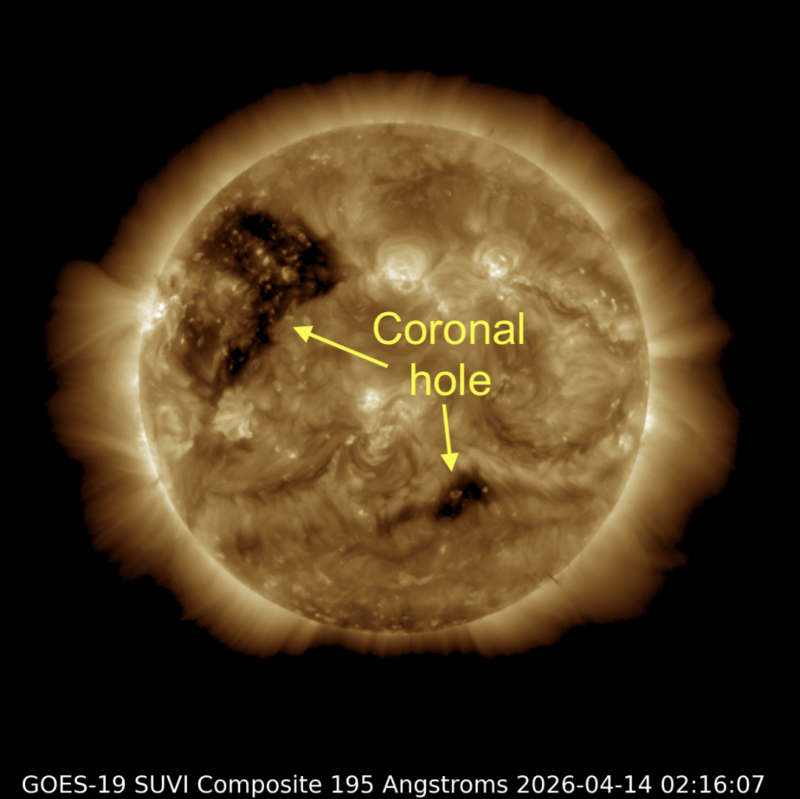
Sun news April 13: Sun quiets down as solar wind eases
Over the past 24 hours, the sun took a breather. Specifically, flare production dropped to very low, with only B-class background flares recorded. Meanwhile, the strength of the solar wind reaching Earth’s magnetic field waned. However, a coronal hole crossing the center of the Earth-facing sun could deliver a fresh blast of fast solar wind our way by April 15, potentially lifting geomagnetic activity to active levels and giving high-latitude skywatchers the chance to spot auroras.
Past 24 hours of sun news
(11 UTC April 12 – 11 UTC April 13)
Flare activity: Solar activity stayed very low, with only B-class flares recorded. In total, the sun produced 12 B-class flares during the reporting window.
- Strongest flare: B7.2 from AR4417 at 14:48 UTC on April 12.
- Lead flare producer: AR4417 topped the list, firing 5 of the 12 tracked flares. In addition, AR4416 contributed 3 flares, with the remaining 4 originating from unnumbered background regions. Notably, all flares during this period were sub-C-class, reflecting a notable quieting of the solar disk as AR4417 approached the west limb.
Sunspot regions: Currently, the Earth-facing solar disk shows 3 numbered active regions, though activity stayed subdued across all of them. Notably, AR4417 (beta), the most prolific flare producer of recent days, is rotating near the western limb and nearing departure from the Earth-facing disk.
Blasts from the sun? Over the past 24 hours, forecasters detected three coronal mass ejections (CMEs) in coronagraph imagery. However, none should impact Earth.
Past 24 hours in space weather
Solar wind: Over the past 24 hours, solar wind speeds steadily declined, reflecting the waning influence of a coronal hole high-speed stream. Meanwhile, the interplanetary magnetic field (IMF) stayed weak. In addition, the Bz component fluctuated between north and south, too modest to drive significant geomagnetic activity. Overall, forecasters expect a gradual return toward background solar wind conditions over the next day or two.
Earth’s magnetic field: Throughout most of the period, Earth’s magnetic field stayed quiet, with Kp values ranging from 1 to 2. However, a single unsettled interval of Kp 3 occurred between 12:00–15:00 UTC on April 12.

Sun news April 12: Quiet sun as solar winds strike Earth
Earth’s magnetic field stayed restless overnight as fast solar wind from a coronal hole continued to wash over our planet. Speeds held between roughly 550–650 km/s, and the interplanetary magnetic field (IMF) occasionally tipped southward. That opened the door for charged particles to energize the upper atmosphere and push geomagnetic activity to active levels (Kp = 4). Solar wind speeds should remain elevated in the 500–600 km/s range. Auroral displays possible from high-latitude locations including Fairbanks, Tromsø, and Reykjavík. Aurora displays should fade over the coming days as the high-speed stream wanes. Good luck, aurora chasers!
Past 24 hours of sun news
(11 UTC April 11 – 11 UTC April 12)
Flare activity: Solar activity stayed at low to moderate levels, with only B- and C-class flares recorded. The sun produced 17 flares: 8 C-class and 9 B-class. It was a steady stream of modest activity, but nothing dramatic.
- Strongest flare: C2.4 from an unnumbered source near S07W80 at 7:31 UTC on April 12. A second C2.4 fired earlier at 4:55 UTC on April 12, also from an unassigned source. Neither flare triggered a radio blackout.
- Lead flare producer: AR4416 dominated the period, firing multiple B- and C-class flares. Plage area 4411 (now beyond the west limb) contributed a late-period C1.9 flare. Several flares originated from sources near the west limb or from newly emerging flux that have not yet been assigned active region numbers.
Sunspot regions: The Earth-facing solar disk currently shows three numbered active regions, a modest count consistent with the current quiet phase. AR4416 (beta) stands out as the only region that grew over the past 24 hours.
Blasts from the sun? Available coronagraph imagery showed no Earth-directed coronal mass ejections (CMEs) during the period. Given the absence of strong flaring or filament eruptions, this is no surprise.
Past 24 hours in space weather
Solar wind: Solar wind conditions reflected the continued influence of a positive-polarity coronal hole high-speed stream (CH HSS). Speeds varied between approximately 500–700 km/s, peaking near 700 km/s before gradually declining back toward 500 km/s. The total interplanetary magnetic field (IMF) ranged from 5–12 nT, moderate to moderately strong. The Bz component varied, dipping south but spending significant periods in a northward orientation. A southward Bz favors auroras, and the intermittent southward excursions during the period were enough to drive active geomagnetic conditions at times.
Earth’s magnetic field: Earth’s magnetic field reached active levels during the period, driven by the ongoing CHHSS influence. The Kp index reached 4 and briefly 4+, corresponding to active conditions but staying below G1 (minor) geomagnetic storm thresholds. Activity stayed predominantly quiet to unsettled (Kp 1–3), with active intervals (Kp 4) occurring when the Bz component turned southward. Aurora visibility during the active intervals remained limited to high-latitude regions, including northern Scandinavia, Iceland, northern Canada, and Alaska.
What’s ahead? Sun–Earth forecast
Flare activity forecast: Forecasters expect solar activity to continue at low levels through April 14, with C-class flares expected. Even so, our star remains restless. A slight chance for M-class flares lingers over the next few days as active regions – primarily AR4416 – continue to evolve. That region continues to grow and sits near the central meridian in a geoeffective position, that is, a position capable of affecting Earth. Its beta magnetic configuration currently limits the probability of strong flaring, though further growth or magnetic complexity could increase the threat. X-class flares are unlikely given current disk conditions.
Geomagnetic activity forecast:
- April 12: Active conditions likely (Kp 4) as the positive-polarity coronal hole high-speed stream continues to influence Earth. Solar wind speeds should remain elevated in the 500–600 km/s range. Aurora possible from high-latitude locations including Fairbanks, Tromsø, and Reykjavík.
- April 13: Expect quiet-to-unsettled conditions (Kp 1–3) as CH HSS effects wane. Solar wind speeds should decline to slightly elevated levels (~400–500 km/s). Aurora visibility retreats to the auroral zone (northern Alaska, northern Canada, northern Scandinavia).
- April 14: NOAA forecasts a return to active levels (Kp 4), possibly from a recurrent or secondary coronal hole influence or residual stream effects. No CME arrivals are expected. Aurora watchers at high latitudes may see renewed activity if Kp reaches 4.
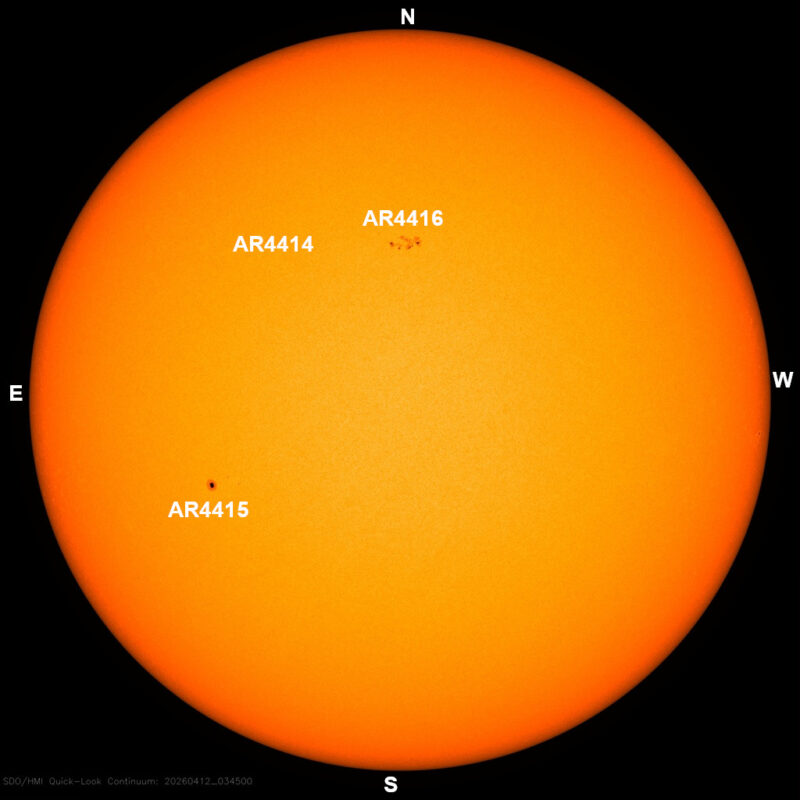
Sun news April 11: G1 storm fell short, more chances ahead
Forecasters expected G1 (minor) geomagnetic storming overnight. But activity fell just short. Earth’s magnetic field climbed only to Kp = 4 (active) instead of reaching the Kp = 5 storm threshold. But those active levels held steady for three three-hour synoptic periods, starting around 12 UTC on April 10.
Forecasters expect G1 storm levels to remain possible today and into tomorrow. After that, Earth’s geomagnetic conditions should start declining to unsettled levels as effects from a co-rotating interaction region (CIR) combined with fast solar wind from a coronal hole begin to wane. Good luck this weekend, aurora chasers!
Past 24 hours of sun news
(11 UTC April 10 – 11 UTC April 11)
Flare activity: Solar activity continued at very low levels during our observation period, with only faint B-class (weak) flares. The sun produced a total of 7 B-class flares.
- Strongest flare: B7.4 from AR4414, firing at 12:47 UTC on April 10.
- Lead flare producer: AR4409 continued firing flares from behind the western horizon, blasting out 4 B-class events. AR4414 closely followed with 3 B-class flares.
Sunspot regions: The Earth-facing side of the solar disk currently shows three numbered active regions. AR4409 lost its delta component and now carries a simpler beta configuration. The remaining sunspot regions on the Earth-viewed disk also show alpha or beta configurations.
Blasts from the sun? Available coronagraph imagery showed no Earth-directed coronal mass ejections (CMEs) during the period.
Past 24 hours in space weather
Solar wind: Solar wind speeds climbed to moderate-high levels over the past day. The interplanetary magnetic field (IMF) held at strong levels during the period. The Bz component showed strong southward peaks late on April 10, which favored geomagnetic coupling. However, from late yesterday into early today (up to 3 UTC), it shifted strongly northward with only occasional dips south. As of 10 UTC this morning on April 11, the Bz component points south again. A southward orientation favors auroral activity.
Earth’s magnetic field: Earth’s magnetic field ranged from quiet to active levels over the past day (Kp = 2-4). Conditions crossed the Kp = 4 threshold at 12 UTC on April 10 and held there for three consecutive three-hour synoptic periods. At the time of this writing, the Kp index sits at level 4.

Sun news April 10: Eclipse season for GOES satellites
Solar eclipse season for GOES satellites is here! Twice a year, the imaging instruments aboard NOAA’s GOES spacecraft capture partial or total solar eclipses. This happens as Earth drifts between the satellites and the sun, thanks to the spacecraft’s geostationary orbit. The result: outstanding views of eclipses from a vantage point far above our heads.
Meanwhile, on the space weather front, a co-rotating interaction region (CIR) combined with fast solar wind from a coronal hole may bring conditions for G1 (minor) geomagnetic storming. That means auroral displays are possible tonight.
Don’t put those cameras away just yet! Instead, clean and polish your lenses and get ready for any aurora this weekend. Clear skies!
Past 24 hours of sun news
(11 UTC April 9 – 11 UTC April 10)
Flare activity: Solar activity plunged to very low levels during our observation period. The sun produced only 3 faint B-class (weak) flares.
- Strongest flare: B6.1 from AR4409 near the western limb, firing at 4:25 UTC on April 10.
- Lead flare producer: AR4409 fired all 3 B-class flares of the period.
Sunspot regions: The Earth-facing solar disk currently shows three numbered active regions. AR4409 has left the building, carrying its beta-delta configuration with it. That complex region still holds potential for M-class and even X-class flares. Any big flare AR4409 produces from just behind the western horizon could still funnel toward Earth along the Parker Spiral. The remaining sunspot regions on the Earth-viewed disk carry simpler alpha or beta configurations.
Blasts from the sun? Available coronagraph imagery showed no Earth-directed coronal mass ejections (CMEs) during the period.
Past 24 hours in space weather
Solar wind: Solar wind speeds continued at moderate-low to moderate levels over the past day. The interplanetary magnetic field (IMF) peaked at strong levels early this morning on April 10. The Bz component showed strong southward peaks during the period. However, early this morning, it started shifting strongly northward. As of 10 UTC this morning, the Bz component points strongly north. A southward orientation favors auroral activity.
Earth’s magnetic field: Earth’s magnetic field held at quiet-to-active levels over the past day (Kp = 2-4). Conditions crossed the Kp = 4 threshold at 2:05 UTC on April 10 and stayed there for one three-hour synoptic period. At the time of this writing, the Kp index sits slightly below level 3.
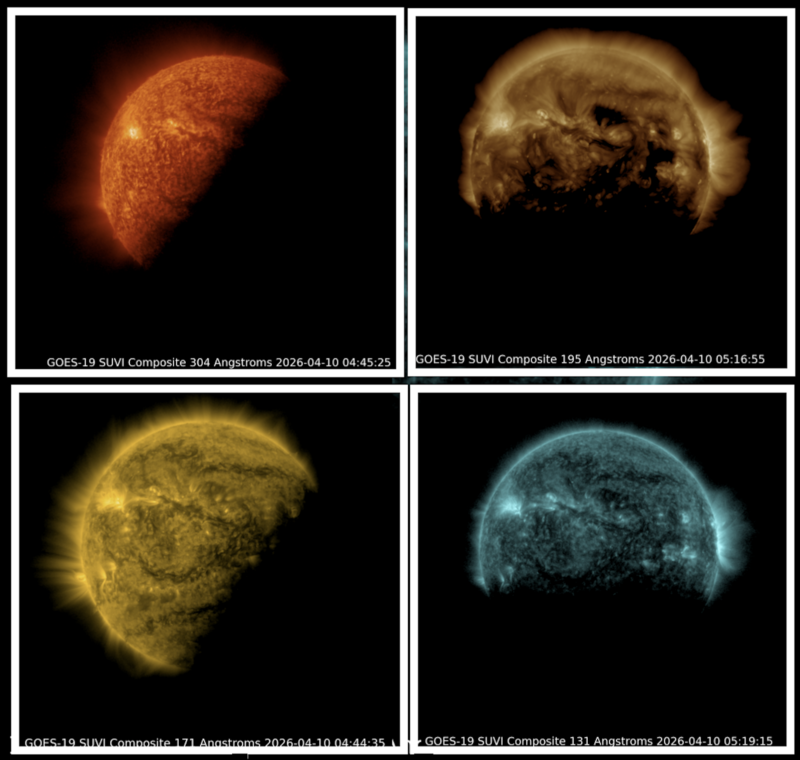
Sun news April 9: Newcomer sunspot region fires an almost-M flare
How the mighty have fallen. Solar Cycle 25 reached the official peak of its 11-year cycle in late 2024. And the sun’s activity has remained active since then. But, as of late, we’re noticing a true decline. And so today we’re celebrating newcomer sunspot region AR4414, which blasted an almost-M flare, a C8.9 flare at 15:43 UTC on April 8. M flares are moderate flares. Eighteen months ago, we wouldn’t have noticed this strong C (common) flare. We would have been waiting for X (strong) flares! But now we watched as AR4414 sent up a powerful jet, while turning into view on the northeast horizon. So AR4414 is rotating into fuller view. Fiery activity is heading our way! Stay tuned.
Meanwhile, the sun’s western limb (the side about to rotate out of view) told its own story over the past day. AR4409 gained a beta-delta configuration, and AR4413 is still carrying a beta-gamma complexity. So both are preparing to depart to the sun’s far side. But AR4409 isn’t done yet. It fired an M1.0 flare at the very end of our observation period. This region could still deliver a surprise before it disappears. Worth noting: if AR4409 blasts a strong flare while sitting on the west horizon, any ejecta hurled into space could funnel directly toward Earth, due to the Parker Spiral.
Past 24 hours of sun news
(11 UTC April 8 – 11 UTC April 9)
Flare activity: Solar activity held at low levels for most of the past 24 hours, climbing to moderate levels at the end with an M1.0 from AR4409. The sun produced a total of 13 flares: 1 M-class (moderate), 8 C-class (common), and 4 B-class (weak).
- Strongest flare: M1.0 from AR4409 near the western limb, fired at 8:43 UTC on April 9. It produced an R1 (minor) radio blackout over the Arabian Sea, northeast of Somalia.The next strongest was the C8.9 from newcomer AR4414, peaking at 15:43 UTC on April 8.
- Lead flare producer: AR4409 fired 8 of the period’s 13 flares, including the M1.0 and 4 C-class events.
Sunspot regions: The Earth-facing side of our sun shows five numbered active regions today, including newcomer AR4415 in the southeast. AR4409 escalated its magnetic complexity, gaining a delta component to now carry a beta-delta configuration. That means potential for M-class and even X-class flares. Although AR4409 is nearing the west horizon, it just proved it can still pack a punch. AR4413 shows a beta-gamma configuration. The remaining sunspot regions carry simpler alpha or beta configurations.
Blasts from the sun? The blast associated with the C8.9 flare from AR4414 launched a coronal mass ejection (CME) into space. Forecasters are currently modeling and analyzing the event to determine if any Earth-directed component exists.
Past 24 hours in space weather
Solar wind: Solar wind speeds stayed at moderate-low levels over the past day, with no significant space weather activity. The interplanetary magnetic field (IMF) held at weak levels throughout. The Bz component pointed mostly southward during the period, similar to yesterday, with minor northward peaks. As of 10 UTC this morning, the Bz component shifted slightly north. A southward orientation favors auroral activity.
Earth’s magnetic field: Earth’s magnetic field stayed at quiet levels over the past day (Kp = 1-2). At the time of this writing, the Kp index sits at level 1.


Sun news April 8: Intense activity coming from the east

Fiery activity is rotating our way! Over the past day, long-lasting prominences and jets appeared over the eastern horizon, including the powerful eruption you can see above. That one came from newly labeled sunspot region AR4414. And in the coming days, more active regions responsible for the past days’ activity could rotate onto the Earth-facing solar disk. Stay tuned.
Past 24 hours of sun news
(11 UTC April 7 – 11 UTC April 8)
Flare activity: Solar activity climbed from very low to low levels over the past 24 hours. The sun produced a total of 11 flares: 8 C-class (common) and 3 B-class (weak).
- Strongest flare: C5.7 from AR4409, peaking at 18:32 UTC on April 7.
- Lead flare producer: AR4409 fired 7 of the period’s 11 flares.
Sunspot regions: Five numbered active regions currently populate the Earth-facing solar disk, including newcomer AR4414 in the northeast. AR4409 regained a gamma component in its magnetic configuration, meaning it now has a promising beta-gamma complexity. The remaining sunspot regions show simpler alpha or beta configurations.
Blasts from the sun? Available coronagraph imagery showed no Earth-directed coronal mass ejections (CMEs) during the period.
Past 24 hours in space weather
Solar wind: Solar wind speeds decreased to moderate-low levels during our observation period as the influence of a coronal hole’s high-speed stream continued to wane. The interplanetary magnetic field (IMF) held at weak throughout. The Bz component pointed mostly southward during the period, with minor northward peaks. As of 10 UTC this morning, the Bz component points south. A southward orientation favors auroral activity.
Earth’s magnetic field: Earth’s magnetic field held at quiet-to-unsettled levels (Kp = 1-3). At the time of this writing, the Kp index sits at level 2.

Sun news April 7: Uptick in activity for Solar Cycle 25
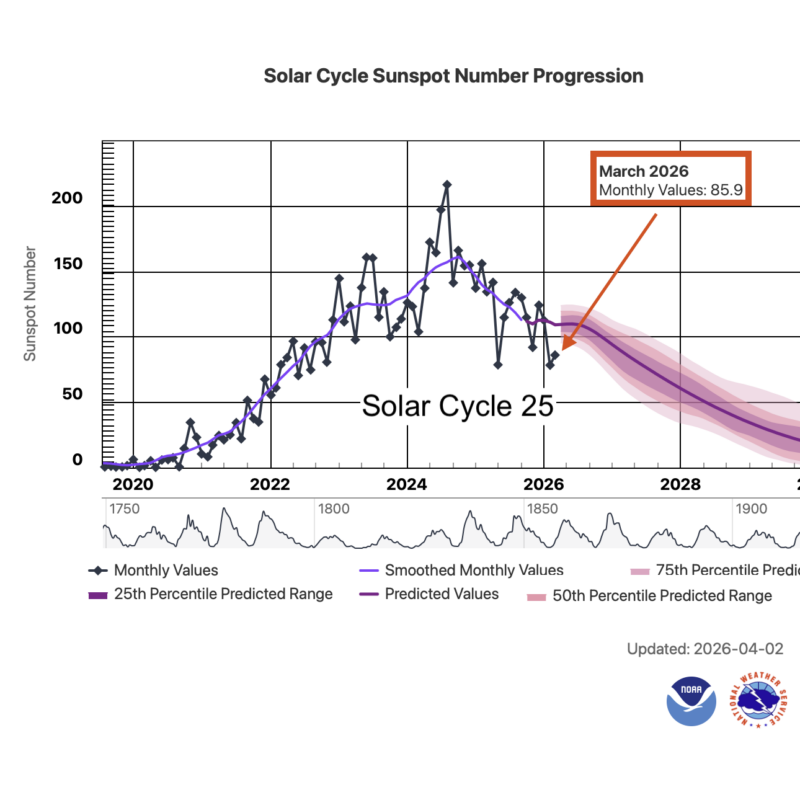
With the sun seemingly taking a breather, it’s a good time to review the latest sunspot number – a measure of long-term solar activity – for Solar Cycle 25.
March brought fireworks. We saw an increase in numbered sunspot regions on the Earth-facing solar disk, fiery M-class (moderate) flare activity, and even an X-class (strong) flare. NOAA just released the results, and they reflect that excitement. The sunspot number for March 2026 came in at 85.9, a welcome uptick after the significant drop to February’s 78.2. The peak sunspot number for Solar Cycle 25 remains August 2024 at 216.
Past 24 hours of sun news
(11 UTC April 6 – 11 UTC April 7)
Flare activity: Solar activity dropped back to very low levels. The sun produced only 7 B-class (weak) flares.
- Strongest flare: B9.4 from AR4409, peaking at 11:23 UTC on April 6.
- Lead flare producer: AR4409 fired 5 of the period’s B-class events.
Sunspot regions: The Earth-facing solar disk currently displays six numbered active regions. All six carry either an alpha or a beta magnetic configuration.
Blasts from the sun? Available coronagraph imagery showed no Earth-directed coronal mass ejections (CMEs) during the period.
Past 24 hours in space weather
Solar wind: Solar wind speeds averaged at moderate levels over the period as the influence of a coronal hole’s high-speed stream continued to wane. The interplanetary magnetic field (IMF) remained weak throughout. The Bz component pointed mostly southward during the period and shifted slightly to the north at the end.
Earth’s magnetic field: Earth’s magnetic field held at quiet-to-unsettled levels (Kp = 2-3). At the time of this writing, the Kp index sits at level 2.
Sun news April 6: quiets down, but stay alert
After exciting flaring over the weekend, the sun appears to have quieted down. Although AR4409 continued to flicker with small flares, we saw none of the M-class (moderate) fireworks that lit up recent days. However, signs suggest the lull could be broken at any moment. AR4409 still carries a potent beta-gamma magnetic configuration, keeping the chance of moderate-to-strong flares alive through the coming days. New sunspots poised to enter the fray over the eastern horizon could add more excitement. And a new fast solar wind stream from a coronal hole could disturb our magnetic field around April 9, giving aurora watchers at high latitudes a reason to keep an eye on the sky. Stay tuned.
Past 24 hours of sun news
(11 UTC April 5 – 11 UTC April 6)
Flare activity: Solar activity remained at low levels. The sun produced 11 flares over the past 24 hours: 4 C-class (common) flares and 7 B-class (weak) flares.
- Strongest flare: C2.8 from AR4409, peaking at 23:39 UTC on April 5.
- Lead flare producer: AR4409 fired all 11 events of the period.
Sunspot regions: The Earth-facing solar disk currently displays seven numbered active regions.
Blasts from the sun? Available coronagraph imagery showed no Earth-directed coronal mass ejections (CMEs) during the period.
Past 24 hours in space weather
Solar wind: Solar wind speeds gradually declined over the period, reflecting the waning influence of a coronal hole’s high-speed solar wind stream. The interplanetary magnetic field (IMF) remained weak throughout. No sustained southward Bz conditions developed, meaning aurora activity remained limited.
Earth’s magnetic field: Earth’s magnetic field remained mildly unsettled as the last wisps of a coronal hole high-speed stream continued washing over our planet. Conditions ranged from quiet to active (Kp = 4).
Sun news April 5: We watched a comet get destroyed by the sun

We just watched a comet die. Comet MAPS (C/2026 A1) plunged through the sun’s atmosphere only 160,000 km above the solar surface. It went in as a comet. What came out the other side was a cloud of dust.
SOHO’s C2 coronagraph caught the whole thing. So the comet’s demise was invisible from Earth, but not from space. In the video below, watch for the sudden brightening between 6:00 UTC 8:00 UTC. That flash is almost certainly the nucleus shattering under thermal stress. The wider C3 view shows it even more clearly.
By the time MAPS passed behind the coronagraph’s occulting disk, the fragments had vaporized. Only a faint stream of debris emerged on the other side. SOHO data are still coming in, and we should see more of this debris trail over the next few hours.
Discovered last January, MAPS held the record as the farthest-out sungrazer ever recorded at the time of discovery. There was real hope it was big enough to survive perihelion, maybe even become visible in broad daylight. But the sun had other plans.
Meanwhile, the sun itself stayed restless. Flare activity held at moderate to high levels over the past 24 hours. AR4409 fired off a steady barrage of flares, including an M1.3 at 11:58 UTC on April 4 and an M1.0 at 22:54 UTC. Nineteen C-class flares accompanied the M-class events, underscoring just how restless this complex region remains.
On the geomagnetic front, Earth’s magnetic field settled into quiet-to-active conditions following a G1 (minor) geomagnetic storm early on April 4. The combined effects of a coronal mass ejection (CME) that left the sun on April 1 and a coronal hole high-speed stream drove the disturbance. Solar wind speeds gradually eased but remained above background.
Looking ahead, a second CME launched on April 2 from AR4404 may deliver a glancing blow later today or early April 6. That keeps aurora watchers on alert for possible displays. Share your beautiful photos with us and get ready for more! Clear skies!
Past 24 hours of sun news
(11 UTC April 4 – 11 UTC April 5)
Flare activity: Solar activity remained at moderate levels. The sun produced 2 M-class and 19 C-class flares during the period. All significant activity originated from AR4409.
- Strongest flare: M1.3 from AR4409 (N02W09), peaking at 11:58 UTC on April 4. It triggered an R1 (minor) radio blackout, briefly affecting HF communications over sunlit portions of Europe and Africa. A second M1.0 flare erupted from AR4409 at 22:54 UTC on April 4, producing another R1 radio blackout affecting the Americas and eastern Pacific.
- Lead flare producer: AR4409 dominated the period, producing nearly all recorded flares, including both M-class events and the majority of C-class activity. All flares were impulsive in nature, with no appreciable radio signatures or coronagraph imagery suggesting associated CMEs.
Sunspot regions: The Earth-facing solar disk displayed seven numbered active regions. AR4409 retains its beta-gamma magnetic complexity and remained the most complex and active region on the disk. Despite minor decay and separation among its leader spots, as noted by NOAA, the region maintained substantial flare potential and produced all significant flares during the period. The remaining sunspot regions carry either alpha or beta configurations. A newcomer on the east has now received the designation AR4411.
Blasts from the sun? One coronal mass ejection (CME) remains in the forecast with potential Earth impact. Additionally, a new CME appeared beginning around 02:15 UTC on April 5. No Earth impact prediction is currently available, and forecasters have not yet confirmed the source region. Analysis should come in subsequent model runs. Beyond these events, available coronagraph imagery showed no other new Earth-directed CMEs.
Past 24 hours in space weather
Solar wind: Solar wind speeds gradually declined by the end of the period. This decline reflects the waning influence of a negative-polarity coronal hole high-speed stream that had been driving enhanced conditions since late March. The interplanetary magnetic field (IMF) total strength held steady, relatively weak. The Bz component showed no significant southward intervals, which limited geomagnetic coupling and kept aurora activity subdued.
Earth’s magnetic field: Earth’s magnetic field ranged from quiet to G1 (minor) geomagnetic storm levels. The G1 storm struck early in the UT day on April 4, during the transition from CME influence (from the April 1 eruption) to the coronal hole stream.


Sun news April 4: Wow … 23 flares with 3 M flares!
Sun activity jumped to moderate over the past day, with 24 total flares! Three of them were M, or moderate flares, and one was edging up toward being an X flare. It was the strongest flare of the past day, an M7.5, at 1:17 UTC this morning (April 4). Sunspot region AR4409 produced it. Read all about it below. Meanwhile, here at Earth, the geomagnetic storming fiesta continued. During the past day, we saw G1 (minor), G2 (moderate) and up to a three-hour synoptic period reaching G3 (strong) geomagnetic storming. It seems effects from Monday’s X flare – and the coronal mass ejection, or CME, it produced – combined with the arrival of a later CME to bring these disturbances to Earth’s magnetic field. The disturbances started around 15 UTC on April 3. They lasted all during the North American night. More G1 disturbances are anticipated for later on today. Stay alert for the auroras at high latitudes.
Share your beautiful photos with us and get ready for more! Clear skies!
In other news, Comet MAPS is now appearing in the field of view of both coronagraphs of the SOHO spacecraft. It just entered the LASCO C2 field of view today. We saw it in the C3 coronagraph yesterday; C2 has a narrower field of view. Perihelion for this sungrazing comet – its closest approach to the sun – will fall at 10:22 a.m. EDT (14:22 UTC) today, April 4, 2026. Keep an eye on coronagraph imagery over the coming days as the comet makes its hairpin turn around the sun. Afterwards, will it become visible in Earth’s sky? Maybe, if it survives. EarthSky’s Deborah Byrd – and veteran comet-watcher Bob King – discuss the odds and provide observing tips in this video.
Past 24 hours of sun news
(11 UTC April 3 – 11 UTC April 4)
Flare activity: Flare productivity increased to 24 total flares over the past day. Three were M (moderate) flares so activity is now considered moderate moderate. Active region AR4409 produced the three M flares.
- Strongest flare: The strongest was the second M flare of the period, an M7.5 at 1:17 UTC on April 4 from active region AR4409 in the northwest. The blast provoked an R2 (moderate) radio blackout affecting an area north of Fiji Island. The other two M flares from AR4409 were: an M1.3 at 12:50 UTC on April 3 (R1, or minor, radio blackout over Africa) and M1.7 at 7:58 UTC on April 4 (R1, or minor, radio blackout over the Indian Ocean).
- Lead flare producer: AR4409 was the day’s top producer. It fired 23 of the day’s 24 flares, including all three M-class events.
Sunspot regions: The Earth-facing solar disk currently shows 7 numbered active regions. AR4409 retains its beta-gamma magnetic complexity. The remaining sunspot regions carry either alpha or beta configurations. There is a newcomer on the east now numbered AR4411.
Blasts from the sun? Experts didn’t observe any new coronal mass ejections (CMEs) in available coronagraph imagery.
Past 24 hours in space weather
Solar wind: Solar wind speeds, similar to yesterday, climbed to moderately high levels (starting around 15 UTC on April 3), then slowly decreased to moderate levels at the end of this period (11 UTC April 4). The transition from the X-flare CME effects to fast solar wind from a coronal hole continued. The interplanetary magnetic field (IMF) initially went to strong levels, then dropped to weak levels at around 11 UTC on April 4. Meanwhile, the Bz component pointed mostly southward through the whole period with the strongest peak at 15 UTC April 3. At the time of this writing, the Bz component points southward. These conditions favored auroral displays over the past day.
Earth’s magnetic field: Earth’s magnetic field ranged from active to strong geomagnetic storm levels during most of the past day (Kp 4-7). We saw G1 (minor), G2 (moderate) and up to G3 (strong) geomagnetic storm conditions from 15 UTC on April 3 through 3 UTC on April 4. At the time of this writing (11 UTC on April 4), the Kp index sits slightly below level 4.
What’s ahead? Sun–Earth forecast
Flare activity forecast: The sun flare production doesn’t disappoint with three M flares, forecasters expect solar activity to continue at low-to-moderate levels. The chance for M-class (moderate) flares holds at 55% today. The chance for X-class (strong) flares continues at 20%. Active regions AR4404, AR4405, and AR4409 are the main influencers.
Geomagnetic activity forecast:
- On April 4, expect lingering effects from Monday’s X1.5 flare and CME, combined with the arrival of a CME that left the sun on April 1. So we might get more G1-G2 (minor-moderate) geomagnetic storms today.
- By April 5, the CME passage and solar wind stream effects might still be going, possibly with more G1 enhancements.
- Then on April 6, expect unsettled-to-active conditions as effects from the solar wind stream and CME start to subside.



Sun news April 3: X-flare CME hits Earth with G2 storm
The X flare blast from the sun – a coronal mass ejection, or CME – did arrive last night. And it arrived stronger than initially expected. Earth’s magnetic field climbed to G2 (moderate) geomagnetic storm levels during the U.S. overnight hours. But G1 (minor) storming dominated most of the period. More G1 enhancement intervals might extend through the rest of today and into April 4.
Share your beautiful photos with us and get ready for more! Clear skies!
The Artemis 2 mission to the moon has left Earth’s orbit, moving beyond the protection of Earth’s magnetic field. The spacecraft can still find shelter within Earth’s magnetotail. Space weather forecasters are closely monitoring conditions from the X-flare CME and solar energetic particles (SEPs). These high-energy, charged particles, primarily protons, electrons, and heavy ions, can be accelerated by solar flares. They travel at a significant fraction of the speed of light, arriving at Earth only about 20 minutes after we observe an X flare on the sun.
The good news: Monday’s X flare and last night’s CME event did not feature those particles heavily. Conditions remained nowhere near the point of concern for Artemis 2.
In other news, Comet MAPS has started appearing in the field of view of SOHO’s LASCO coronagraph, entering from the southeast at 23:06 UTC on April 2. Keep an eye on coronagraph imagery over the coming days as the comet zooms closer to the sun.
Past 24 hours of sun news
(11 UTC April 2 – 11 UTC April 3)
Flare activity: The sun stayed fiery, jumping to moderate flare levels with two M-class flares and 14 C-class flares during the past day. Notably, the first M flare, an M3.5 at 18:15 UTC on April 2, hurled plasma into space. First observations indicate a possible glancing blow at Earth in late April 4 to early April 5.
- Strongest flare: M3.5 at 18:15 UTC on April 2 from active region AR4404 in the northwest. The period’s 2nd M flare came from AR4409 at 7:56 UTC on April 3. Both M-class flares triggered corresponding R1 (minor) radio blackouts affecting sunlit areas. Other notable eruptions included a C7.0 at 1:07 UTC and a C6.1 at 5:42 UTC, both from AR4409.
- Lead flare producer: AR4409 continued topping the list, firing 11 of the period’s flares, including one M-class event.
Sunspot regions: The Earth-facing solar disk currently shows 7 numbered active regions. AR4409 retains its beta-gamma magnetic complexity and remains the period’s top flare producer, including an M-class flare. The remaining sunspot regions carry either alpha or beta configurations.
Blasts from the sun? Multiple filament eruptions launched coronal mass ejections (CMEs) over the past day, though none are headed toward Earth. Additionally, a filament eruption at 17:54 UTC and the C8.1 flare at 19:58 UTC, both on April 1, remain under modeling and analysis. Forecasters are working to determine if either event carries an Earth-directed component.
Past 24 hours in space weather
Solar wind: Solar wind speeds climbed to moderately high levels starting around 15 UTC on April 2. Conditions showed a transition from the X-flare CME effects to fast solar wind from a coronal hole. The interplanetary magnetic field (IMF) initially sat at strong levels, then dropped to weak levels starting around 18 UTC on April 2. Meanwhile, the Bz component pointed mostly southward with some northward variations, though the strongest peaks held a south orientation. At the time of this writing, the Bz component points southward. These conditions favored auroral displays throughout the period.
Earth’s magnetic field: Earth’s magnetic field ranged from active to geomagnetic storm levels during most of the period (Kp 4-6). G1 (minor) geomagnetic storm conditions dominated from around 11 UTC on April 2 through 0:00 UTC on April 3. During one three-hour synoptic period, conditions climbed to G2 (moderate) at 15 UTC on April 2. At the time of this writing, the Kp index has reached level 5.
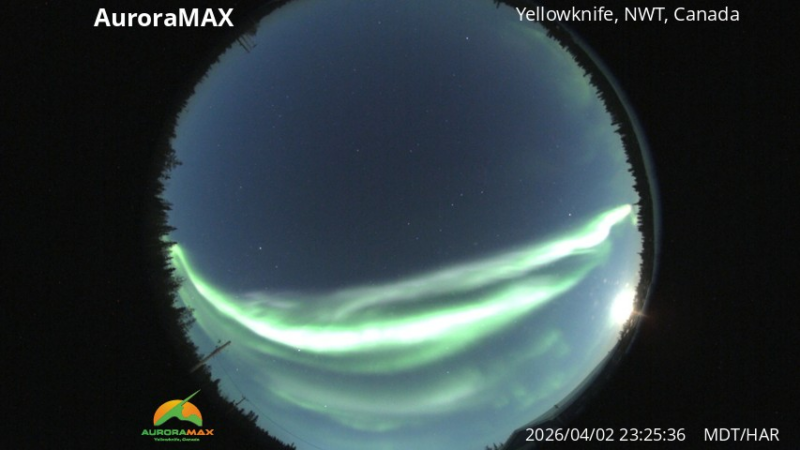


Sun news April 2: X-flare CME arrives with G1 geomagnetic storm
The anticipated blob of sun-stuff from Monday’s X flare finally reached Earth last night. It brought a G1 (minor) geomagnetic storm during the U.S. overnight. But the impact fell short of the G2-G3 (moderate-to-strong) storming we expected. The delay in arrival reduced its intensity to Kp=5 levels. Still, these conditions might continue through today and into tomorrow, April 3. So isolated G1 geomagnetic storms might still occur. Did you see the auroras last night? Share your beautiful photos with us and get ready for more… probably. Clear skies!
By the way, are you wondering if the incoming coronal mass ejection (CME) affected last night’s Artemis 2 launch to the moon? Space weather forecasters were certainly aware of the CME and geomagnetic storm potential, as the launch was taking place. The biggest concern in spaceflight isn’t a CME. It’s the solar energetic particles – high-energy, charged particles, primarily protons, electrons, and heavy ions – that can be accelerated by solar flares. These particles travel at a significant fraction of the speed of light. They arrive at Earth only about 20 minutes after we observe an X flare on the sun. Plus, Monday’s X flare and last night’s CME event didn’t feature those particles heavily; it was nowhere near reaching the point of concern for Artemis 2.
Past 24 hours of sun news
(11 UTC April 1 – 11 UTC April 2)
Flare activity: Solar activity held at low levels during the past day. The sun produced a total of 11 C-class (common) flares.
- Strongest flare: C8.1 at 19:58 UTC on April 1 from active region AR4409 in the northeast. Other notable eruptions included: C6.1 at 23:28 UTC from AR4403, C5.3 at 13:48 UTC from AR4409, C5.2 at 23:00 UTC from AR4409, and C4.7 at 21:51 UTC from AR4409.
- Lead flare producer: AR4409 topped the list, firing 7 of the period’s C-class flares.
Sunspot regions: The Earth-facing solar disk currently hosts 9 numbered active regions. AR4405 shed its gamma magnetic complexity and now shows a simpler beta configuration. Meanwhile, AR4409 gained a gamma component and now carries a beta-gamma complexity, making it the producer of the period’s largest flares. The remaining sunspot regions show either alpha or beta configurations.
Blasts from the sun? Multiple filament eruptions produced coronal mass ejections (CMEs) during the period, but none headed toward Earth. A filament eruption at 17:54 UTC and the C8.1 flare at 19:58 UTC, both on April 1, are currently under modeling and analysis. Forecasters are working to determine if either event carries an Earth-directed component.
Past 24 hours in space weather
Solar wind: Solar wind speeds averaged low levels late on April 1 but started climbing to moderately high levels early this morning. The interplanetary magnetic field (IMF) strengthened to strong levels. The Bz component shifted between southward and northward orientations, but the strongest peaks pointed south. At the time of this writing, the Bz component points southward, which favors auroral displays.
Earth’s magnetic field: Earth’s magnetic field ranged from quiet-to-active levels during the period (Kp 2-5), reaching a G1 (minor) geomagnetic storm. Conditions crossed the Kp = 5 threshold at 0:00 UTC on April 2. At the time of this writing, the Kp index sits slightly above level 4.



Sun news April 1: What happened to last night’s auroras?
Skywatchers hoping for auroras last night were disappointed. The hotly anticipated blast of sun-stuff from Monday’s X flare didn’t reach Earth … and still hasn’t, at the time of this writing (11 UTC, April 1). Is it slower than expected, or did it miss our planet completely? Only time will tell. If it does still arrive, forecasters expect its intensity will be diminished, although G2 (moderate) geomagnetic storms could still be on the cards. Stay tuned.
Past 24 hours of sun news
(11 UTC March 31 – 11 UTC April 1)
Flare activity: Solar activity continued at low levels over the past 24 hours. Over the past day the sun produced 10 flares: eight C-class (common) and two B-class (weak) flares.
- Strongest flare: There were two C1.2 flares. The 1st came at 2:51 UTC this morning from active region AR4405. The 2nd was fired off at 6:51 UTC by active region AR4409.
- Lead flare producer: AR4405 once again topped the list as lead flare producer, this time firing nine of the 10 flares of the period.
Sunspot regions: 10 numbered active regions continue to populate the Earth-viewed side of our sun. AR4405 remains the largest and most complex, with a beta-gamma magnetic configuration. The remaining sunspot regions show either alpha or beta configurations.
Blasts from the sun? No Earth-directed coronal mass ejections (CMEs) were observed in available coronagraph imagery.
Past 24 hours in space weather
Solar wind: Solar wind speeds slowly decreased from moderate to low levels throughout the period. The interplanetary magnetic field (IMF) remained weak. The Bz component shifted from southward to northward, and ended the period southward.
Earth’s magnetic field: Earth’s magnetic field kept at quiet to unsettled levels during the period (Kp 2-3). At the time of this writing, the Kp index sits slightly above level 1.

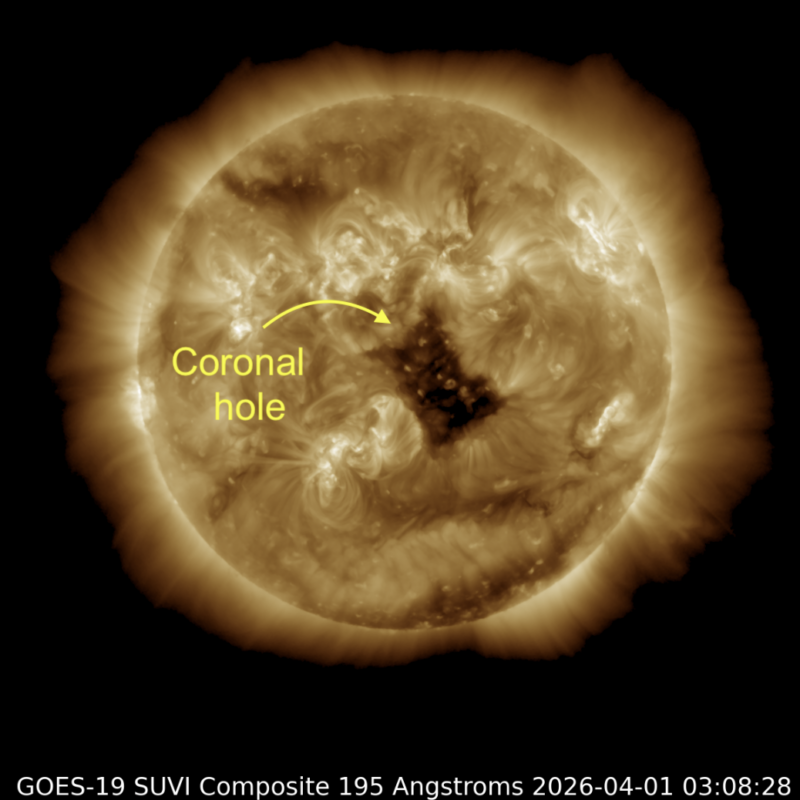
Like what you read?
Subscribe and receive daily news delivered to your inbox.
More from
C. Alex Young


Sun news: See a huge solar eruption

Yes, there’s an aurora season, and it’s here
Sun activity archive for September 2026
Sun activity archive for August 2026