Orionid meteor shower 2026: All you need to know

In 2025, the Orionid meteor shower should rain down its greatest number of meteors on the morning of October 21. Join EarthSky’s Deborah Byrd as she presents observing details on the Orionids. Learn about the meteor shower in this video! Watch in the player above or on YouTube.
The Orionid meteor shower
Predicted peak: The peak is predicted** for 6:54 UTC on October 23, 2026.
When to watch: Watch for Orionid meteors on the morning of October 23, starting after midnight through the wee hours before dawn.
Overall duration of shower: September 26 to November 22. This time period is when we’re passing through the meteor stream in space!
Radiant: The radiant rises before midnight and is highest in the sky around 2 a.m. See chart below.
Nearest moon phase: The full moon falls at 4:12 UTC on October 26. So, during the Orionids’ peak, there’ll be a bright waxing gibbous moon visible after midnight. However, the moon will set several hours before dawn giving you some dark skies for viewing then.
Expected meteors at peak, under ideal conditions: Under a dark sky with no moon, the Orionids exhibit a maximum of about 10 to 20 meteors per hour. Expect reduced rates this year because of moonlight.
Note: These fast-moving meteors occasionally leave persistent trains. The Orionids sometimes produce bright fireballs.
Report a fireball (very bright meteor) to the American Meteor Society: it’s fun and easy!
Orionid meteor shower peaks near a full moon
As for most meteor showers, the hours between midnight and dawn are best for the Orionids. A bright waxing gibbous moon will result in moonlit skies during the peak times of the Orionids in 2026. Luckily, the moon will set a few hours before dawn. If you watch before the moon sets, the best bet to catch the most meteors is to place yourself in the moon’s shadow while watching for meteors.
The term meteor shower might give you the idea of a rain shower. But few meteor showers resemble showers of rain. And the Orionids aren’t the year’s strongest shower, anyway. Plus they’re not particularly known for storming (producing unexpected, very rich displays). From a dark location you might see 10 to 20 Orionids per hour at their peak. There’s always the element of uncertainty and possible surprise when it comes to meteor showers, though.
Orionids zip through the sky
If you do see any Orionids in 2025, note that they’re known to be extremely fast meteors, plummeting into Earth’s atmosphere at about 41 miles per second (66 km/s or 91 mph). But they leave trains, or ionized gas trails, that last for a few seconds after the meteor itself has gone. Maybe half of the Orionid meteors leave persistent trains. Also, sometimes, an Orionid meteor can be exceptionally bright and break up into fragments.
Generally speaking, the Orionids aren’t especially colorful compared to some other showers (like the Perseids or Geminids). They tend to appear white or faintly yellow, since their particles are very small and moving extremely fast. That speed produces bright, sharp flashes, but not a wide range of colors.
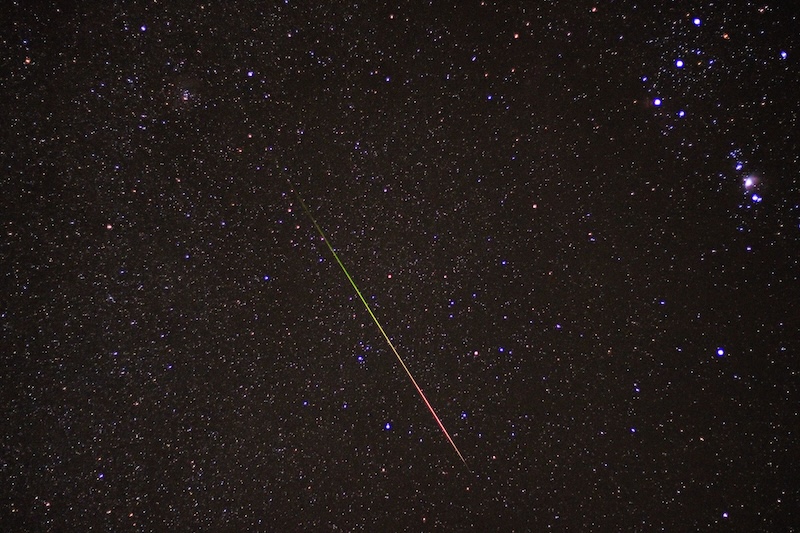
That said, occasional Orionids can show a green or orange tint, depending on their composition and how deeply they penetrate the atmosphere. Green hints at nickel or magnesium. Orange/yellow suggests sodium or iron. A few bright fireballs may even show a brief sequence of colors – as the one below does – as they break apart. So while most Orionids look like white streaks of light, now and then you might catch one with a flash of color: a little extra “magic” from Halley’s comet.
Orionid meteors radiate from constellation Orion
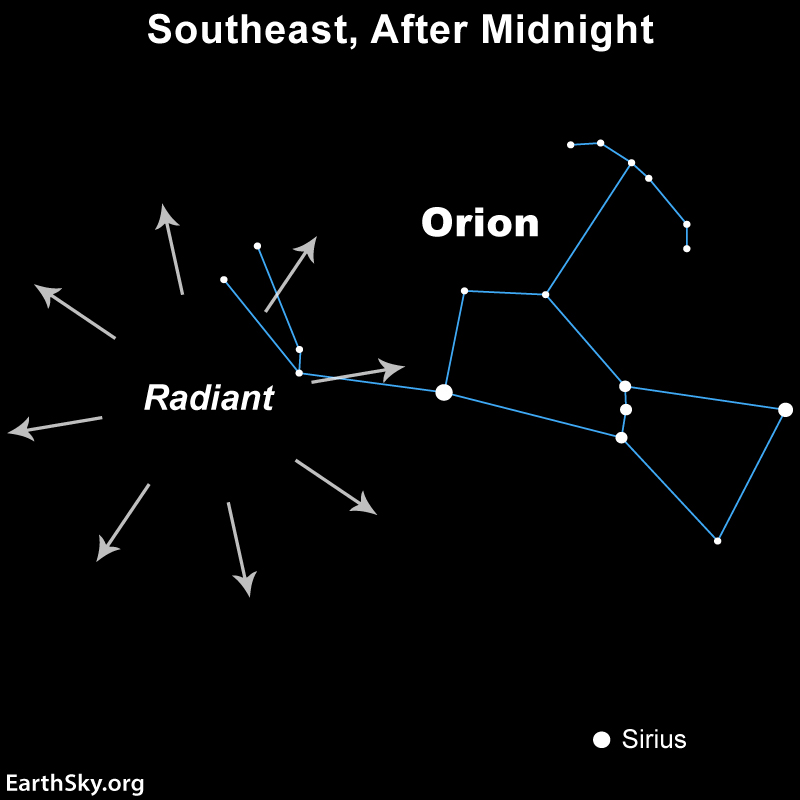
How will you know if the meteor you see is an Orionid? You’ll know because it’ll come from the shower’s radiant point. Meteors in annual showers are named for the point in our sky from which they appear to radiate. The radiant point for the Orionids is in the direction of the famous constellation Orion the Hunter, which you’ll find ascending in the east in the hours after midnight during October. Hence the name Orionids.
You don’t need to know Orion, or be staring toward it, to see the meteors. The meteors often don’t become visible until they are 30 degrees or so from their radiant point. And, remember, they are streaking out from the radiant in all directions. They will appear in all parts of the sky.
But if you do see a meteor – and trace its path backward – you might see that it comes from Orion. And, if so, that meteor will be an Orionid. You might know Orion’s bright, ruddy star Betelgeuse. The radiant is north of Betelgeuse.
So … in which direction do you look? No particular direction. It’s best to find a wide-open viewing area. Sometimes friends like to watch together, facing different directions. When somebody sees one, that person can call out meteor!
The parent comet of the Orionid meteor shower
From the late, great Don Machholz (1952-2022), who discovered 12 comets …
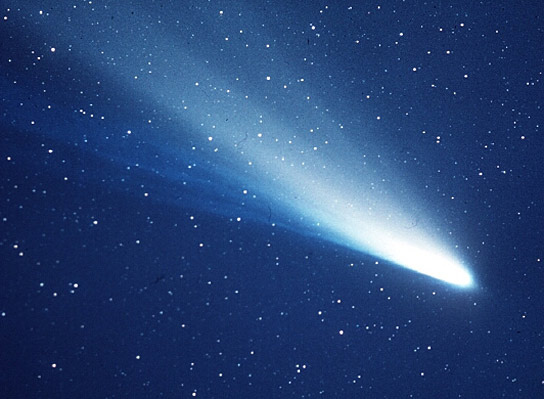
The Orionid meteors that we observe come from Halley’s comet. This comet orbits the sun every 76 years or so, and like steam coming from a locomotive, dust particles are expelled from the comet’s nucleus and are left behind in its path. We intercept this path in late October each year. The nucleus of the comet loses between 3 to 10 feet (1 to 3 meters) of material on each passage through the inner solar system. Measuring 5 by 9 miles (8 by 14 kilometers) in size, it can handle eons of orbits around the sun.
The official name for Halley’s comet is 1P/Halley. It was the first comet to have its return predicted, and Edmond Halley was the one who made that calculation. The comet typically gets bright enough to be easily visible with recorded observations since 240 CE. It is one of only a few comets named not after its discoverer but after the person who calculated its orbit.
Unlike most solar system objects, Halley’s comet orbits the sun in a retrograde orbit, going around the sun in the opposite direction than we do. Its orbit is also tilted a bit to ours, and it spends most of its time below the plane of our path. Presently, it is at its farthest point from the sun, near the head of the constellation Hydra the Water Snake, too faint to be seen.
Two meteor showers
The Orionids are produced from Halley’s comet’s particles on its inbound leg. They are moving in one direction, we are moving in nearly the opposite direction, and the combined speeds produce fast-moving meteors. But we also encounter its particles from its outbound leg when it’s leaving the inner solar system. We reach that point in early May. They produce the Eta Aquariid meteor shower. So this comet generates two meteor showers.
Halley’s comet was last here in 1986 and will return in 2061. But the Orionids never go away. They’re here every October. Go out and see some pieces of this famous comet.
Bottom line: In 2026, the Orionid meteor shower should rain down its greatest number of meteors on the morning of October 23. The bright gibbous moon will light up the sky when the radiant is highest in the sky, but it will set a few hours before dawn. So the best time to watch for meteors is in the dark hours before dawn.
**Predicted peak times and dates for meteor showers are from the American Meteor Society. Note that meteor shower peak times can vary.
EarthSky’s meteor shower guide
Like what you read?
Subscribe and receive daily news delivered to your inbox.
More from
Deborah Byrd


Total solar eclipse August 12, 2026: Best images
How to watch a solar eclipse safely: tips here
Mars Curiosity rover’s 7 minutes of terror 14 years ago
Earthquake in Japan triggers mall collapse in Kumamoto