October brings 2 meteor showers. The Draconids have passed, but the Orionid meteor shower is just beginning to ramp up, peaking around the mornings of October 20, 21 and 22. The Orionids’ radiant point is highest in the sky around 2 a.m. But this year, the moon — in a waxing gibbous phase — will interfere. In this video, EarthSky’s Deborah Byrd shows you when and where to look for the Orionids, plus their parent comet, history and other fun stuff! Watch in the player above or on YouTube.
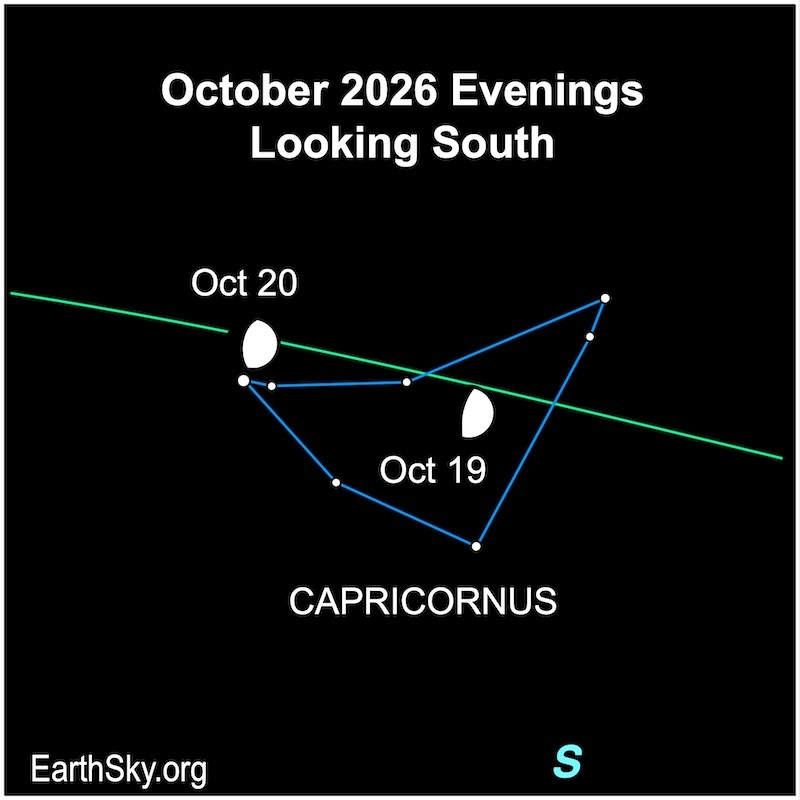
The waxing gibbous moon will lie among the stars of Capricornus the Sea-goat on the evenings of October 19 and 20. They’ll set after midnight. Chart via EarthSky.
Don’t miss the morning sky: Jupiter and Mars are getting closer!
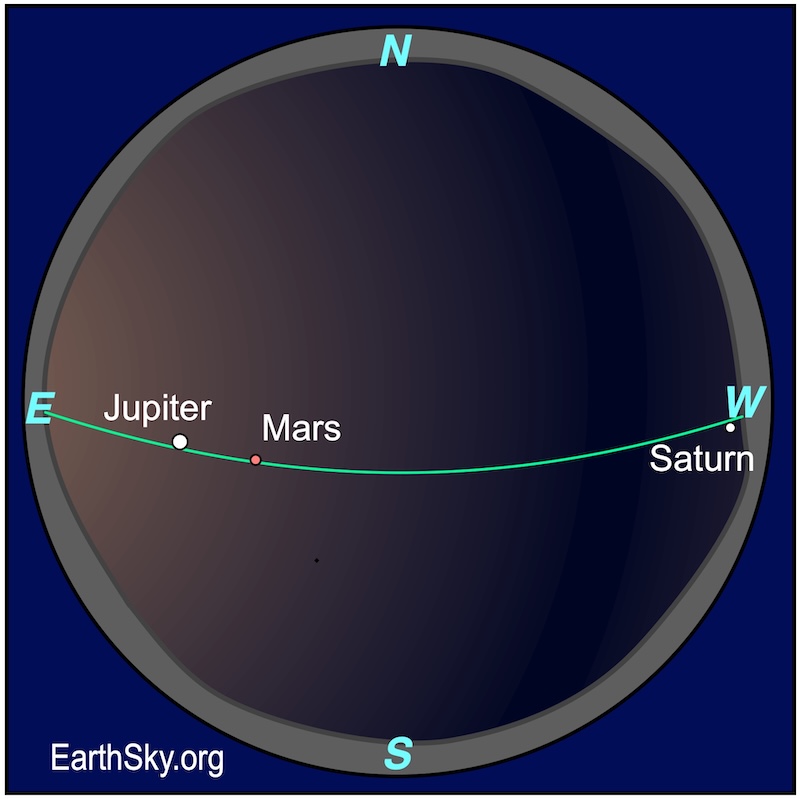
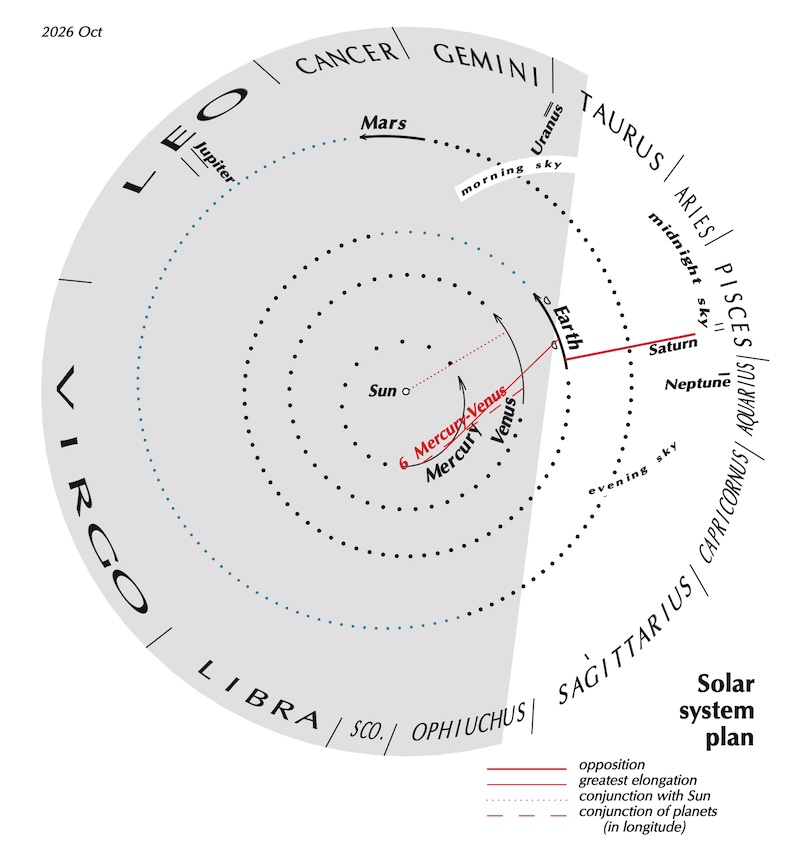
Jupiter — the 2nd-brightest planet — is now high in the east at dawn. Face the sunrise direction and look up. You can’t miss it. Then extend that line from the sunrise point, through Jupiter. You’ll soon come to much-fainter Mars. Jupiter and Mars are drawing closer. Mars will pass 1.2 degrees to the north of Jupiter on November 15. They are so much fun to watch! And will you see Saturn in the west? Saturn reached opposition on October 4. That’s when Earth passed between Saturn and the sun, bringing Saturn opposite the sun in our sky. During its opposition month, Saturn is generally closest and brightest for the year, but midway through October, you’ll begin to notice that Saturn isn’t there before dawn anymore. That’s because Earth has moved on in orbit around the sun. And so, as the weeks pass, Saturn appears higher and higher in our eastern sky at nightfall and below the horizon by dawn. Chart via EarthSky.
It’s Saturn time!
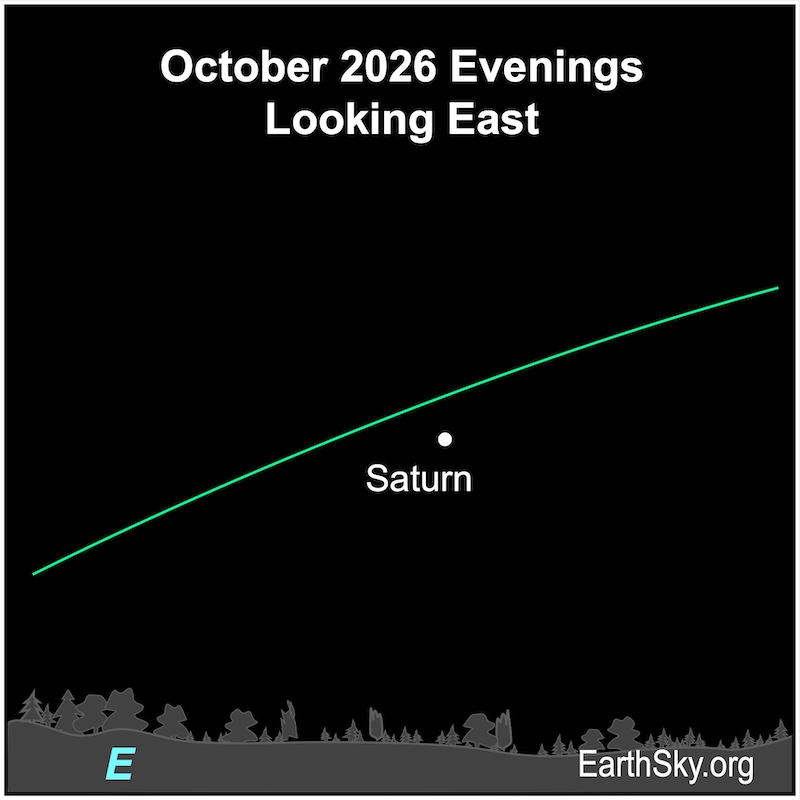
For the whole Earth, Saturn is putting on one of its best shows of the year. The ringed planet is bright, visible throughout the night and perfectly placed for observing. Saturn reached opposition on October 4, when Earth passed between it and the sun, marking the peak of its visibility for 2026. But the show is far from over! Watch the video above — with host Deborah Byrd — to look ahead to Saturn’s 2026–27 observing season. Watch in the player above, or on YouTube.Saturn lies in the east in the evening hours of October. It’s the brightest object in that part of the sky, other than the passing moon. Saturn reached opposition — when Earth passed between it and the sun — on October 4. Now is an excellent time to observe the ringed planet! Grab a telescope for a chance to see the planet’s iconic rings while it’s still well placed for observing. Chart via EarthSky.
Our charts are mostly set for mid-latitudes in the Northern Hemisphere. To see a precise view — and time — from your location, try Stellarium Online.
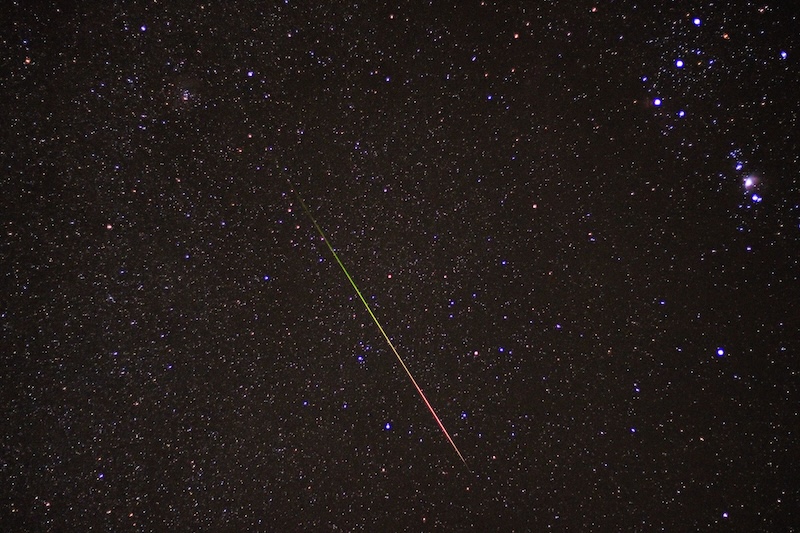
View at EarthSky Community Photos. | James McCue of Jemez Springs, New Mexico, captured this Orionid meteor on October 22, 2023, and wrote: “I was shooting through the night, following Orion, hoping to catch a full spectrum Orionid. I was not disappointed. This one landed perfectly.” Thank you, James! The Orionid meteor shower should rain down its greatest number of meteors on the morning of October 21. The waxing gibbous moon will brighten the night when the radiant is highest in the sky, but it will set a few hours before dawn. So the best time to watch for meteors is in the dark hours before dawn. Under dark skies, you might see 10–20 meteors per hour.
October 23 and 24 evenings: Moon near Saturn
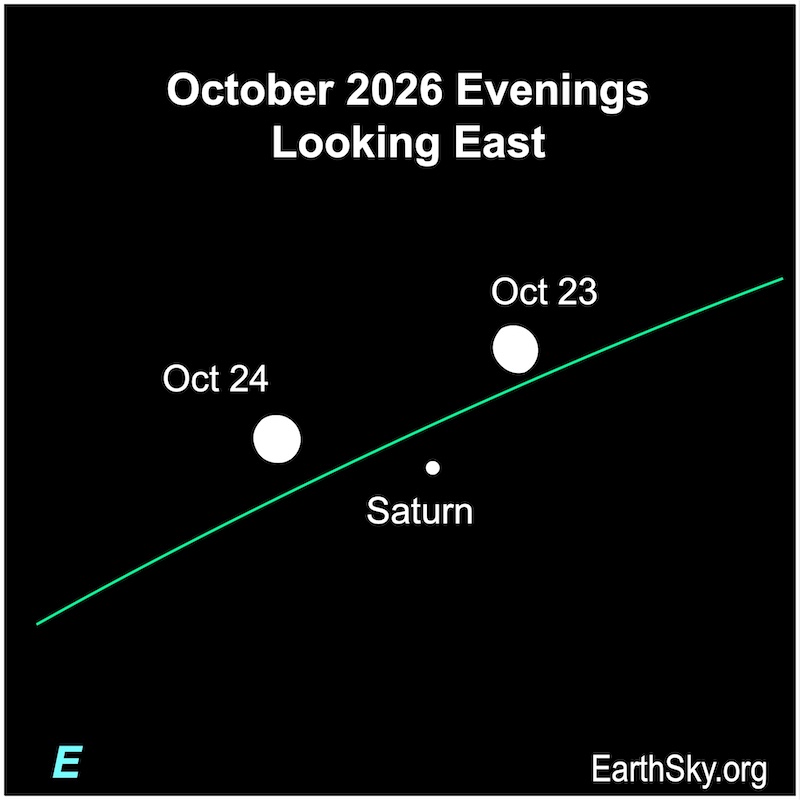
The waxing gibbous moon will lie near Saturn on October 23 and 24. They’ll set before sunrise the next morning. Chart via EarthSky.
Full Hunter’s Moon overnight October 25
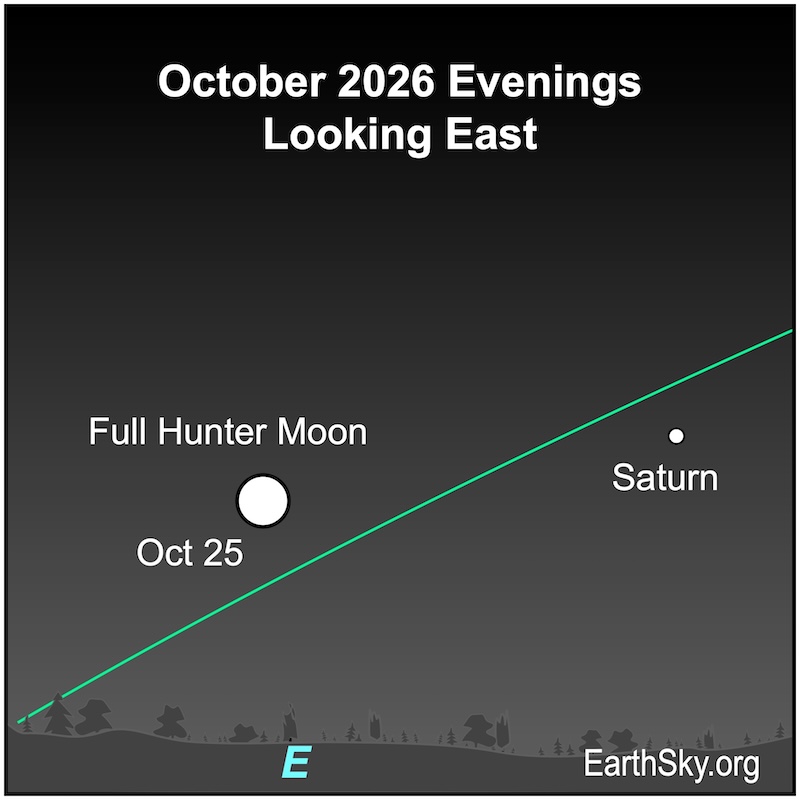
As the sun sets on October 25, the bright full Hunter’s Moon will be rising in the east. The steady golden light of Saturn is nearby. The crest of the full moon will fall at 4:12 UTC on October 26. That’s 11:12 p.m. CDT on October 25 in the Americas. The moon will be highest in the sky in the middle of the night and will set opposite the sunrise on the next morning. Chart via EarthSky.
Our charts are mostly set for mid-latitudes in the Northern Hemisphere. To see a precise view — and time — from your location, try Stellarium Online.
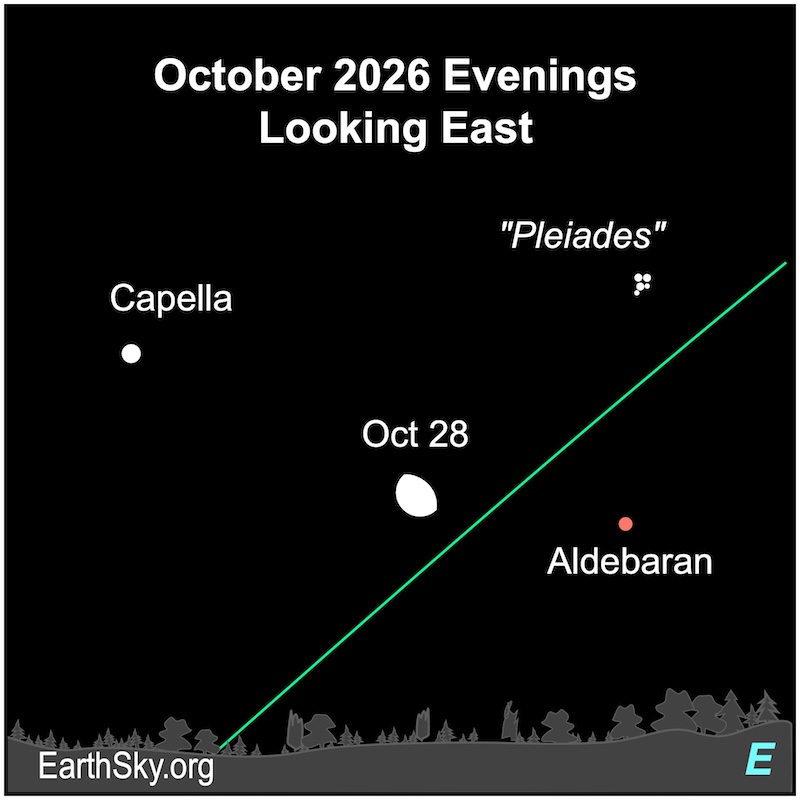
October 26 and 27 evenings: Moon near Aldebaran and the Pleiades
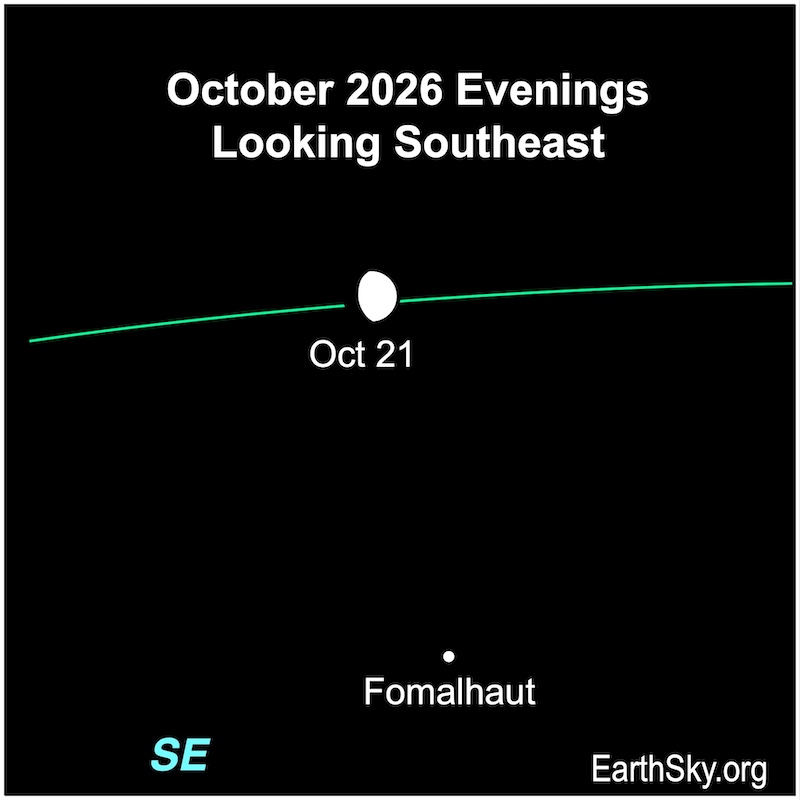
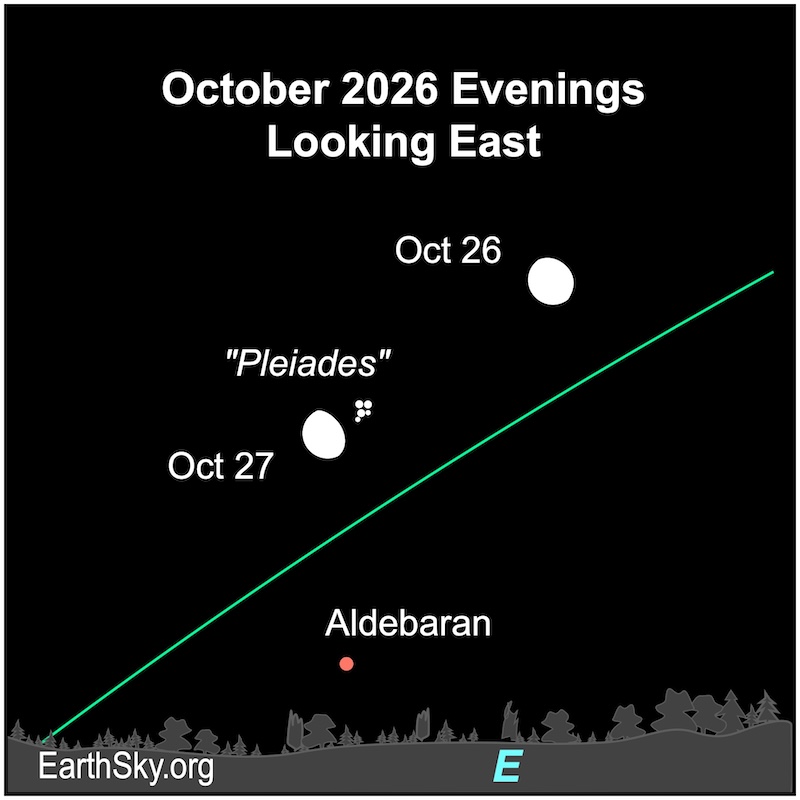
On the evening of October 26, the bright waning gibbous moon will lie near the Pleiades star cluster. On the next evening, October 27, it will lie close to the Pleiades star cluster. The brightest star of Taurus the Bull, Aldebaran, will shine nearby. They’ll be visible through dawn the next morning. Chart via EarthSky.
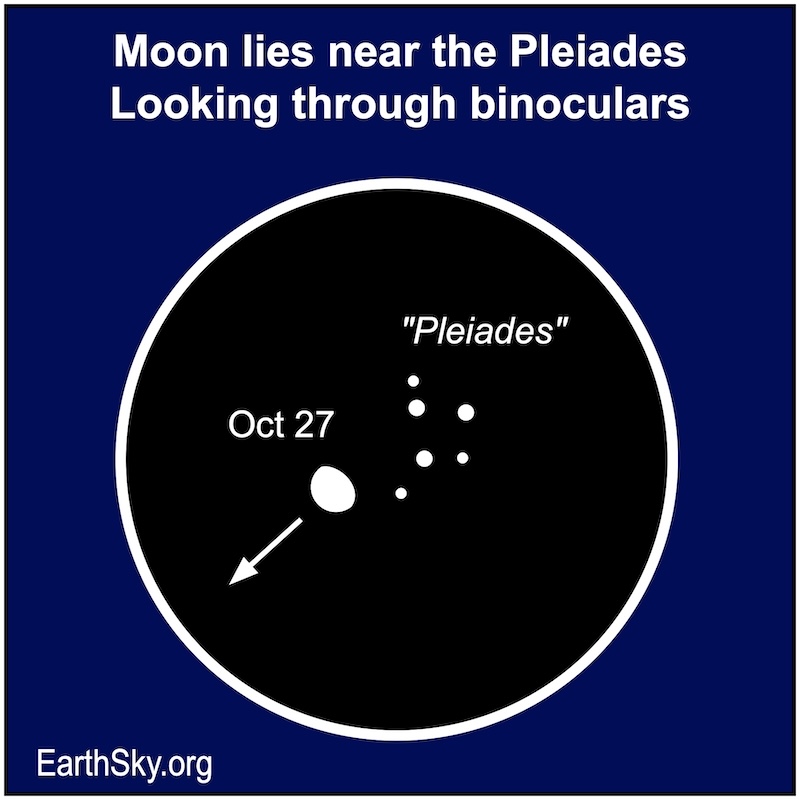
October 27 evening: Binocular view of the moon and Pleiades
Here’s a binocular view of the waning gibbous moon in the late evening of October 27, appearing close to the stars of the Pleiades star cluster. They’ll be closest at 2 UTC on October 28 (9 p.m. CDT on October 27). Chart via EarthSky.
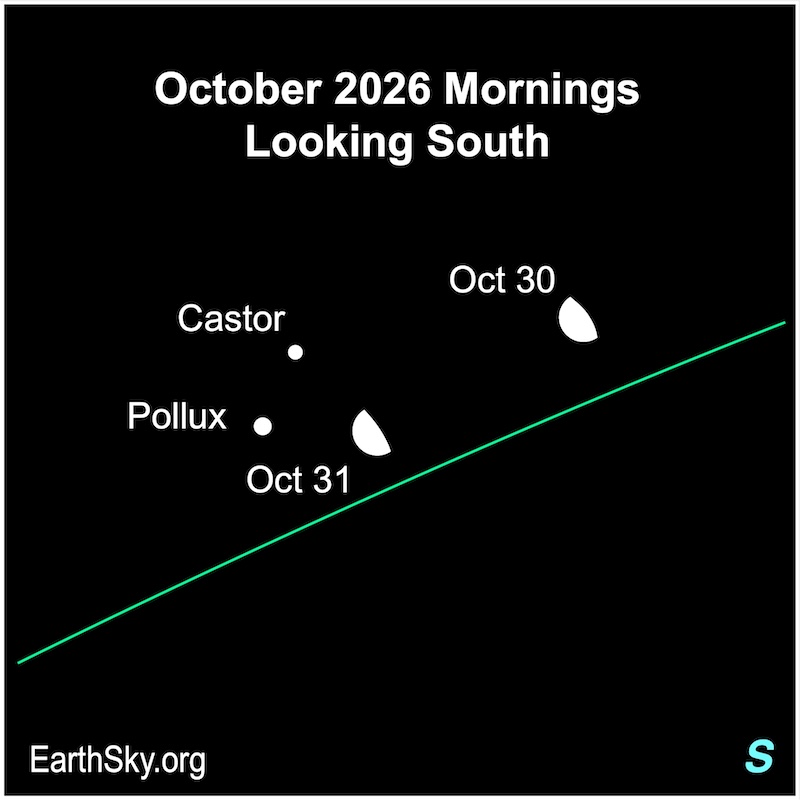
October 30 and 31 mornings: Moon near Pollux and Castor
Before dawn on the last 2 mornings of October, the moon, nearing its 3rd quarter phase, will approach Castor and Pollux, the twin stars of Gemini. (Pollux is the brighter of the pair.) On October 31, the moon will shine by the 2 stars. Chart via EarthSky.
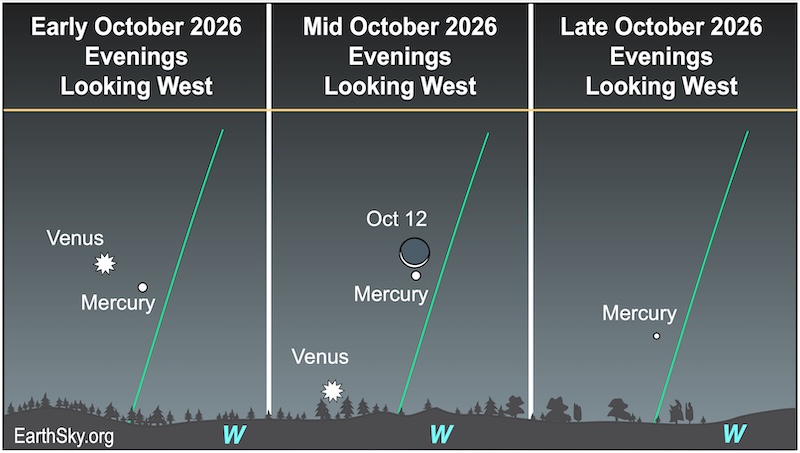
From the Southern Hemisphere, shortly after sunset in the first part of the month, Venus will shine brightly in the west. To its lower right lies the much dimmer Mercury in the bright twilight. The waxing crescent moon will visit Mercury on October 12, and Mercury is also at its greatest distance from the sun that evening. By the middle of the month, Venus has dropped close to the horizon, while Mercury maintains its height. Near the end of the month, Venus has disappeared. Mercury is still present but will appear less bright than it was earlier in October. For those in the Northern Hemisphere, Venus will slip away by mid-month and Mercury will be challenging to spot during this evening apparition. Chart via EarthSky.Saturn will be shining as a steady golden light in the east during the evening hours of October. It’s the brightest object in that part of the sky, other than the passing moon. It’ll be highest in the sky around the middle of the night and low in the western morning sky before dawn. Saturn reached opposition so it was at its biggest and brightest — when we flew between it and the sun — on October 4. Chart via EarthSky.
October visible planets: Morning
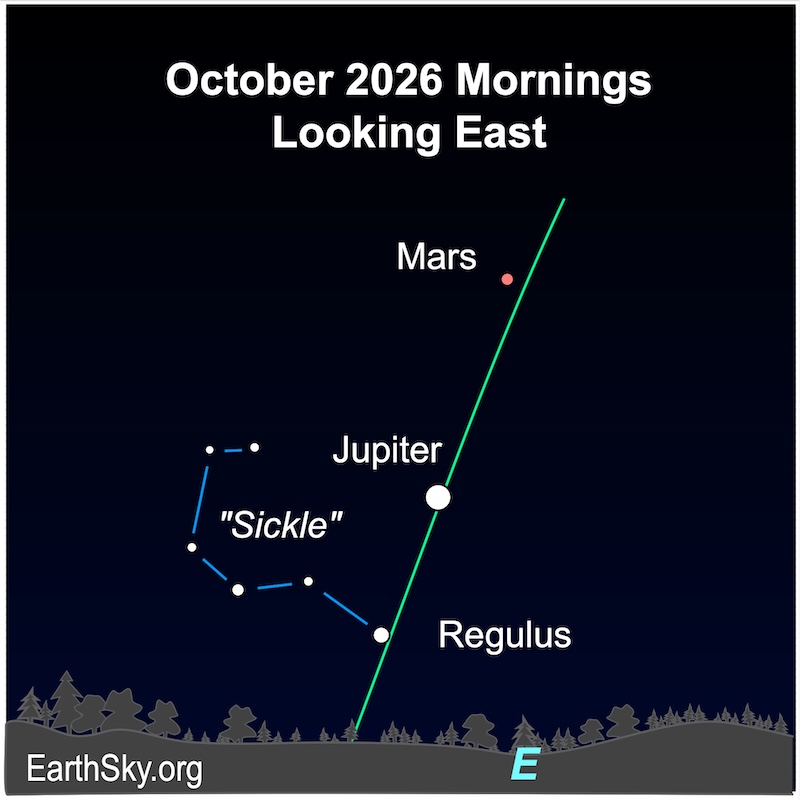
Bright Jupiter will lie in the east before sunrise in October. Above it is red Mars and below it is Regulus, the brightest star in Leo the Lion. By the end of the month, Jupiter and Mars will be closer to each other. Chart via EarthSky.
October stars
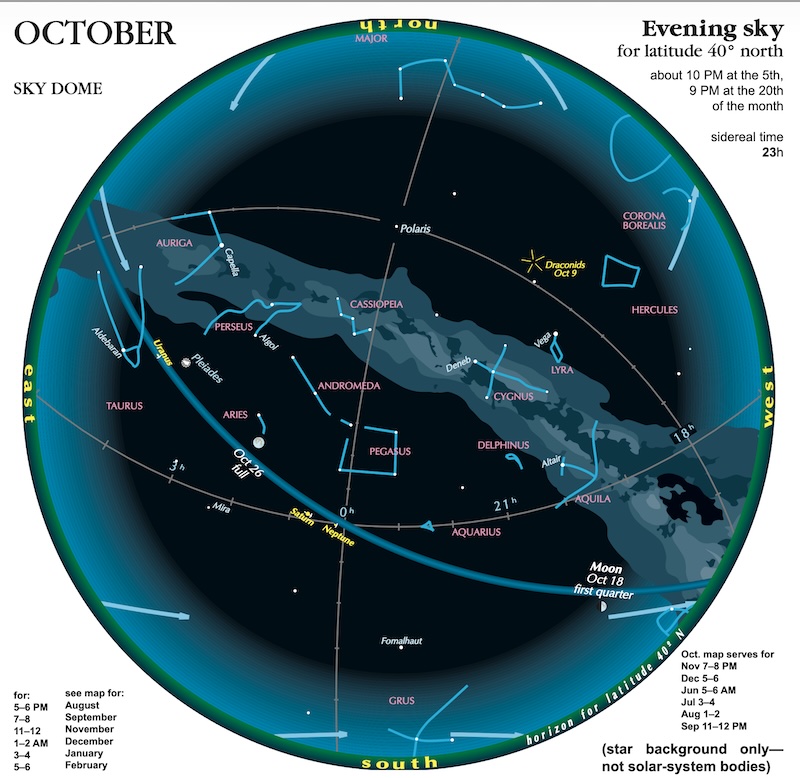
If you’re out stargazing on any October evening, look for these stars and constellations in the evening sky.
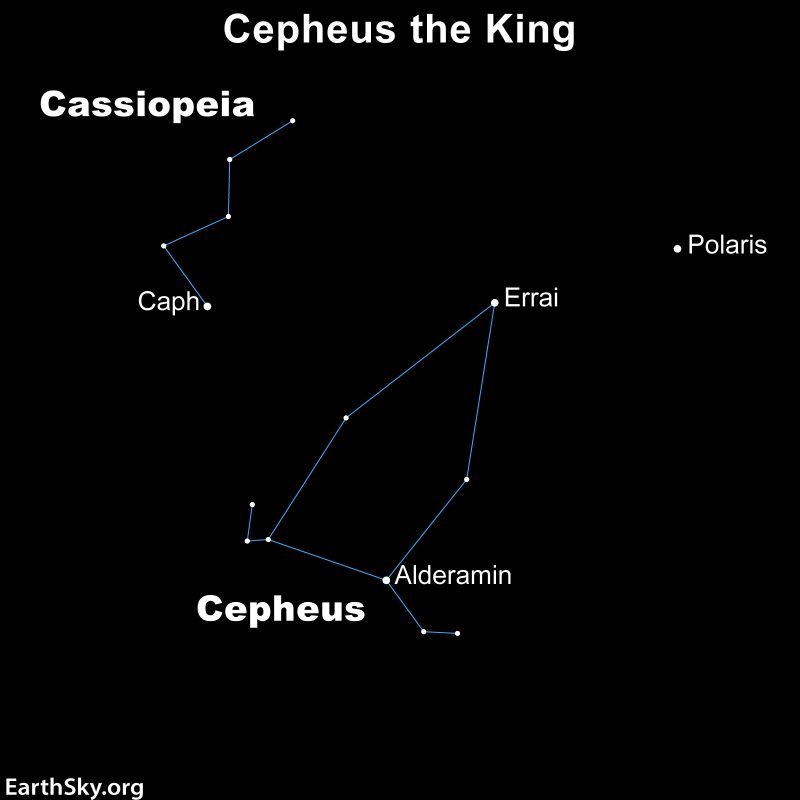
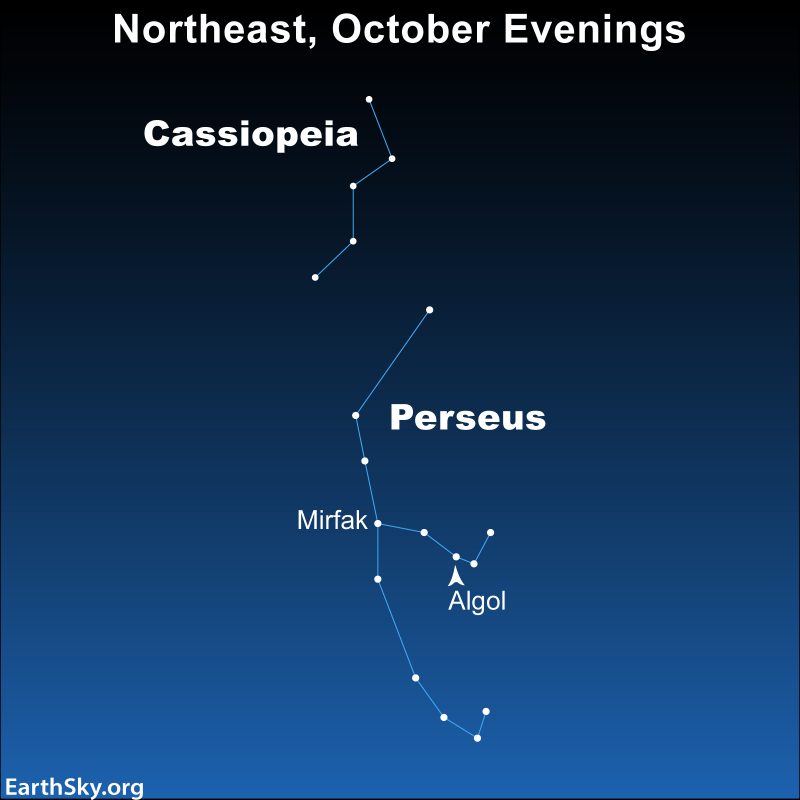
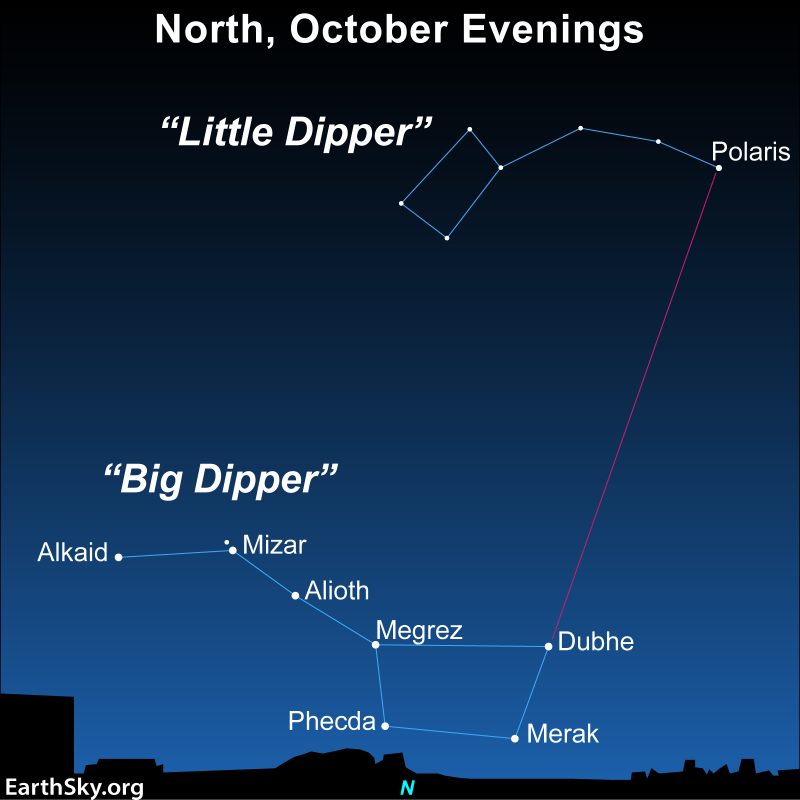
The house-shaped constellation Cepheus the King lies in the northern sky by the constellation Cassiopeia. Gamma Cephei, or Errai marks the peak of the roof of the house. And Errai is very near Polaris, the North Star.Find Algol the Demon Star in the constellation Perseus on autumn evenings. And Perseus lies below the easy-to-recognize W-shaped constellation Cassiopeia.Although the Big Dipper is low on the horizon — or below the horizon — for mid-northern latitudes now, the Little Dipper is high in the northern sky. In fact, the Big Dipper is tough to spot on late October evenings because it rides so low in the north. As always, the 2 outer stars in the Dipper’s bowl point to Polaris, the North Star.
Our charts are mostly set for the northern half of Earth. To see a precise view — and time — from your location, try Stellarium Online.
Here is the sky dome view for October 2026. It shows what is above the horizon at mid-evening for mid-northern latitudes. The view may vary depending on your location. Image via Guy Ottewell’s 2026 Astronomical Calendar.
Visible planets and night sky guide. The Orionid meteor shower is just beginning to ramp up! Ready to catch some shooting stars? Here’s when and where to look!
Meet Marcy Curran, our voice of the night sky on EarthSky YouTube. Check out her popular short videos in the Sky category on our YouTube channel. When she's not making videos, Marcy is an EarthSky editor, helping to keep our night sky guide up-to-date and just generally helping to keep the wheels turning around here. Marcy has enjoyed stargazing since she was a child, going on family camping trips under the dark skies of Wyoming. She bought her first telescope in time to see Halley’s Comet when it visited the inner solar system in 1986. She co-founded her local astronomy club and remains an active board member. Marcy taught astronomy at her local community college for over 20 years. She and her husband live in Wyoming, in a rural location, with an all-sky camera and super-good horizon views! And, they built an observatory to capture images of the night sky.
“I can sometimes see the moon in the daytime” was a cosmic revelation that John Jardine Goss first discovered through personal observations at age 6. It shook his young concept of the universe and launched his interest in astronomy and stargazing, a fascination he still holds today. John is past president of the Astronomical League, the largest U.S. federation of astronomical societies, with over 24,000 members. He's earned the title of Master Observer and is a regular contributor to the video series, “Global Star Party.” He has authored the celestial observing guides “Exploring the Starry Realm,” and “Carpe Lunam,” and “Take Your First Steps, an Introduction to Amateur Astronomy.” John also wrote for twenty years the monthly stargazing column, Roanoke Skies, for the Roanoke Times, and currently writes a bimonthly column, Skywatch, for Blue Ridge Country magazine. He has contributed to Sky and Telescope magazine, the IDA Nightscape, the Astronomical League’s Reflector magazine, and the RASC Observer’s Handbook.
Deborah Byrd (asteroid 3505 Byrd) helps edit EarthSky.org and is a frequent host of EarthSky videos. Deborah created the EarthSky radio series in 1991 and founded EarthSky.org in 1994. Prior to that, she had worked for the University of Texas McDonald Observatory since 1976, and created and produced their Star Date radio series. She has won a galaxy of awards from the broadcasting and science communities, including having an asteroid named in her honor in 1990, a Public Service Award from the National Science Board in 2003, and the Education Prize from the American Astronomical Society in 2020. A science communicator and educator since 1976, Byrd believes in science as a force for good in the world and a vital tool for the 21st century. "Being an EarthSky editor is like hosting a big global party for cool nature-lovers," she says.
Kelly Kizer Whitt writes and edits some of the most fascinating stories at EarthSky.org. She's been writing about science, with a focus on astronomy, for decades. She began her career at Astronomy Magazine and made regular contributions to other outlets, including AstronomyToday and the Sierra Club. She has nine published books, including a children's picture book, Solar System Forecast, and a young adult dystopian novel, A Different Sky.
Like what you read? Subscribe and receive daily news delivered to your inbox.
Thank you! Your submission has been received!
Oops! Something went wrong while submitting the form.