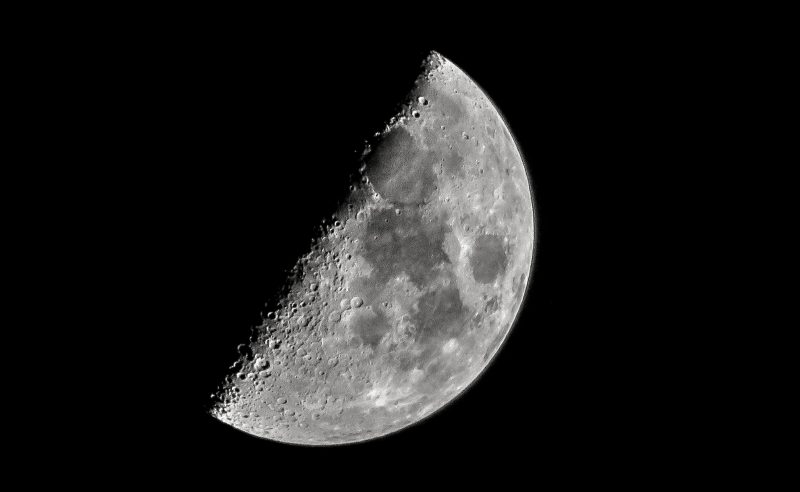
– As viewed from anywhere on Earth, a first quarter moon appears at its highest in the sky at sunset. It rises around noon and sets around midnight.
– It’s called a quarter moon, but, from Earth, it looks half-illuminated, like half a pie. Or you might say that – at first quarter moon – we’re seeing half the moon’s day side or a quarter of the whole moon.
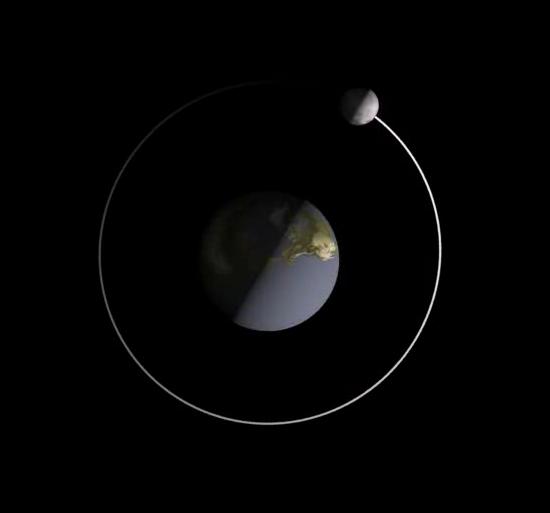
As seen from the north side of the moon’s orbital plane, the terminators (lines between sunny and shadowed sides) of the Earth and moon align at first quarter moon, and only the near half of the moon’s day side is visible from Earth. Image via Wikipedia Commons. Click here to see the animation.
Quarter moon? Half moon?
There’s another reason we call this moon a quarter and not a half. It’s because it’s one quarter of the way around in its orbit of Earth, as measured from one new moon to the next.
Do you have access to a small telescope? Here are some telescopic sights to see on a first quarter moon:
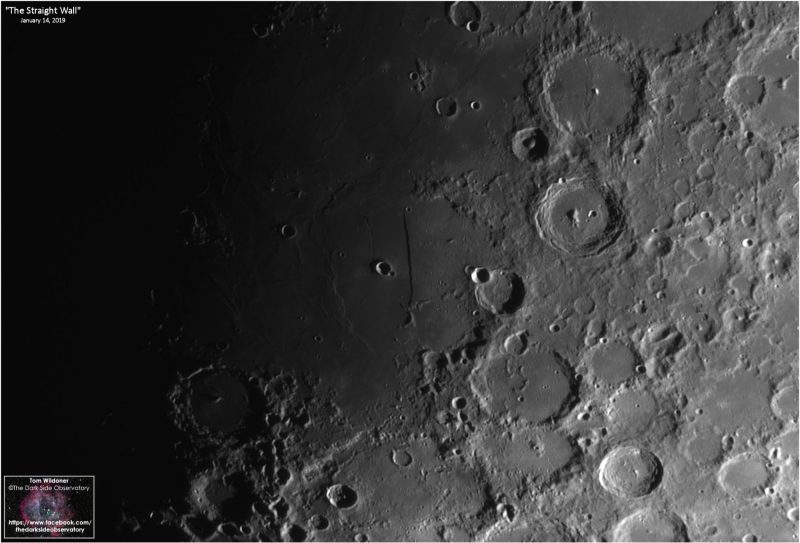
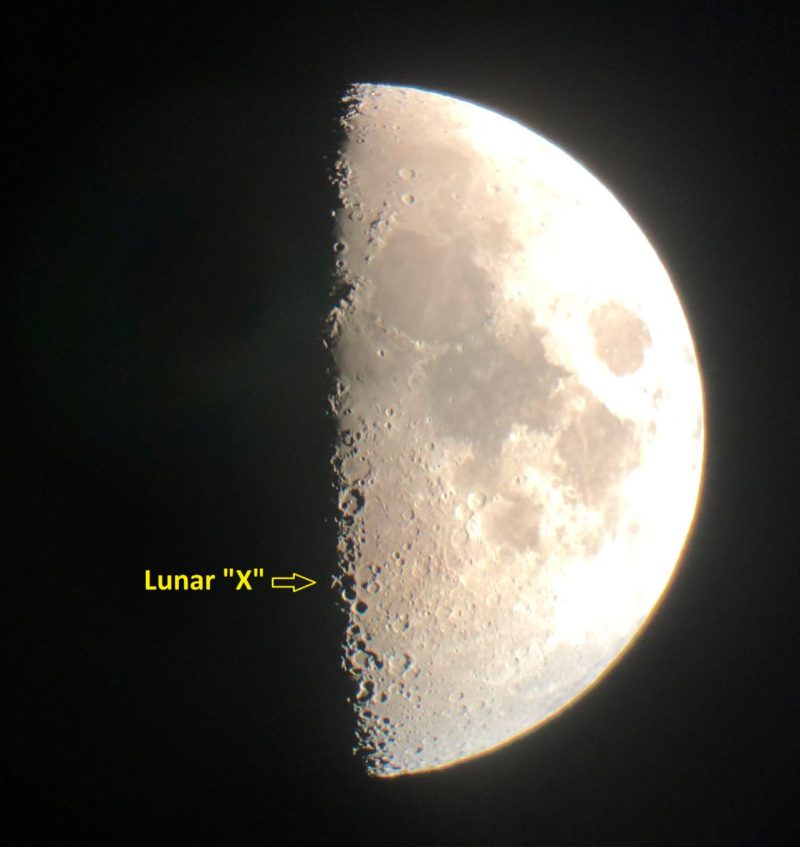
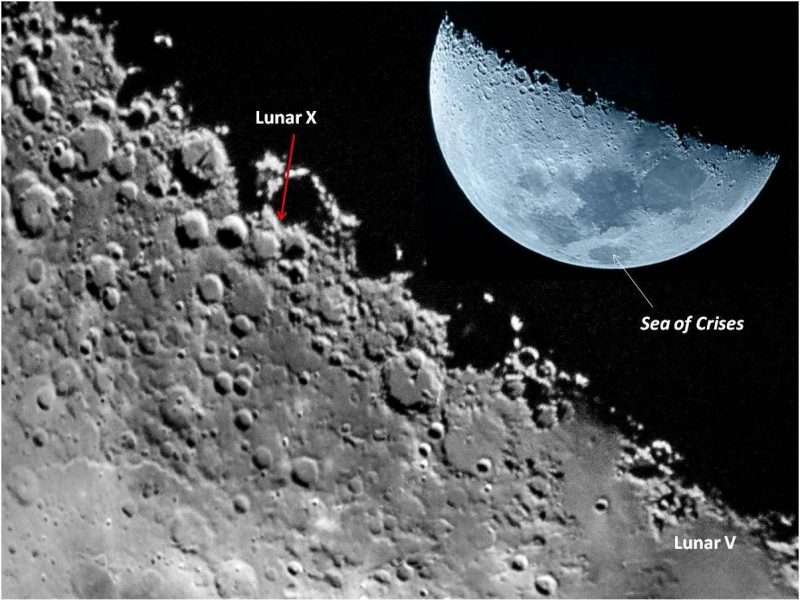
View at EarthSky Community Photos. | Tom Wildoner in Weatherly, PA, captured this photo of Rupes Recta on January 14, 2019. He wrote: “Rupes Recta, a linear fault line, or rille, appears as a straight shadow during the first quarter phase of the moon giving it the nickname the Straight Wall. This fault has a length of about 68 miles (110 kilometers). The small (11 miles wide) crater Birt lies just to the west.” Thank you, Tom!View at EarthSky Community Photos | For those of you with telescopes, or telescopic lenses, here’s something to watch for on a moon near 1st quarter. Tim Yacyshyn in Richmond, British Columbia, Canada captured this image on October 5, 2019. He wrote: “Taken exactly 12 hours after 1st quarter. As you can see, the famous Lunar X stands out quite prominently.” Thank you, Tim!View at EarthSky Community Photos. | Composite image of a moon nearly at 1st quarter with some of the features you can see on the moon at this phase – captured April 30, 2020 – by our friend Dr Ski in the Philippines. He wrote: ” … 10 hours before 1st quarter and the Lunar V and Lunar X are well defined … ” Thank you Dr Ski!
More articles about moon phases
As the moon orbits Earth, it changes phase in an orderly way. Follow the links below to understand the phases of the moon.
Bottom line: The first quarter moon occurs halfway between new moon and full moon. One quarter of the moon is visible from Earth, meaning that you see half of the daylit side of the moon, looking like half a pie.
Deborah Byrd created the EarthSky radio series in 1991 and founded EarthSky.org in 1994. Prior to that, she had worked for the University of Texas McDonald Observatory since 1976, and created and produced their Star Date radio series. Today, she serves as Editor-in-Chief of this website. She has won a galaxy of awards from the broadcasting and science communities, including having an asteroid named 3505 Byrd in her honor. In 2020, she won the Education Prize from the American Astronomical Society, the largest organization of professional astronomers in North America. A science communicator and educator since 1976, Byrd believes in science as a force for good in the world and a vital tool for the 21st century. "Being an EarthSky editor is like hosting a big global party for cool nature-lovers," she says.
Like what you read? Subscribe and receive daily news delivered to your inbox.
Thank you! Your submission has been received!
Oops! Something went wrong while submitting the form.