



Polaris is the North Star
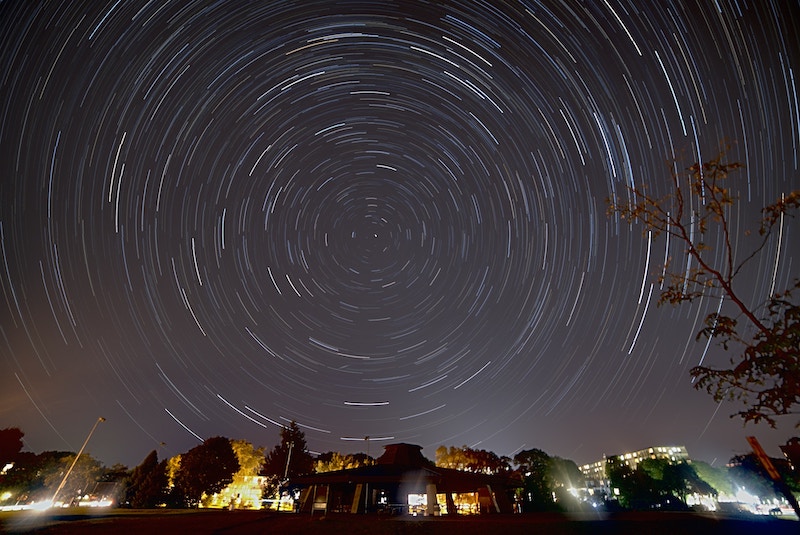
The North Star or Pole Star – aka Polaris – is famous for holding nearly still in our sky while the entire northern sky moves around it. That’s because it’s located very close to the north celestial pole: the point around which the entire northern sky turns.
Polaris is not the brightest star in the nighttime sky, despite the common belief. In fact, it’s only the 47th brightest star. But you can find it easily, and, once you do, you’ll see it shining in the northern sky every night from Northern Hemisphere locations.
Polaris marks the spot that is due north. As you face Polaris and stretch your arms sideways, your right hand points due east, and your left hand points due west. Then, an about-face from Polaris steers you due south.
A star to steer by
In a dark country sky, even when the full moon obscures a good deal of the starry heavens, the North Star is relatively easy to see. That fact has made this star a boon to travelers throughout the Northern Hemisphere, both over land and sea. So finding Polaris means you know the direction north.
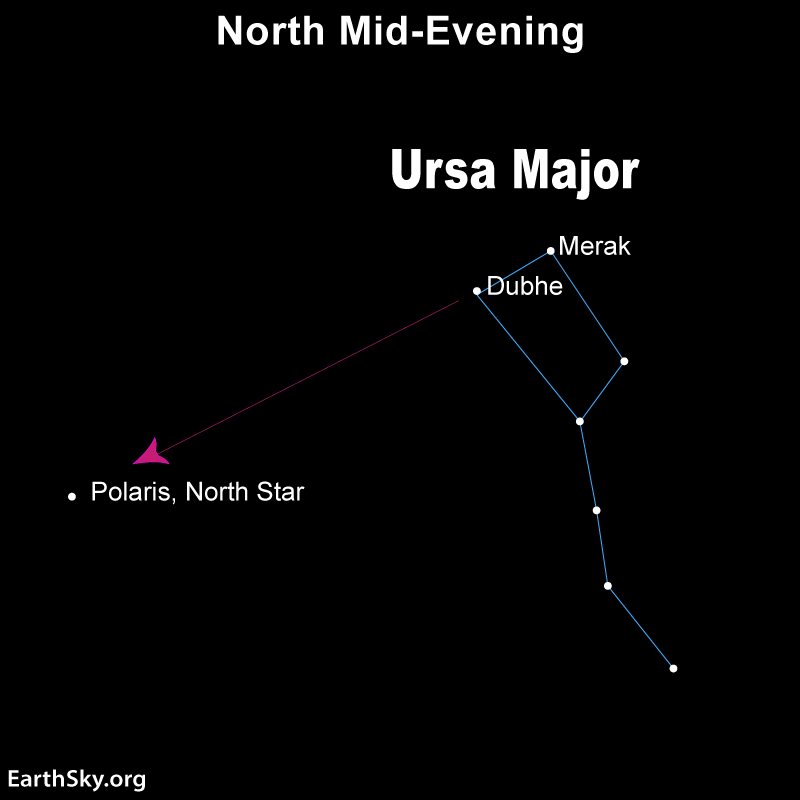
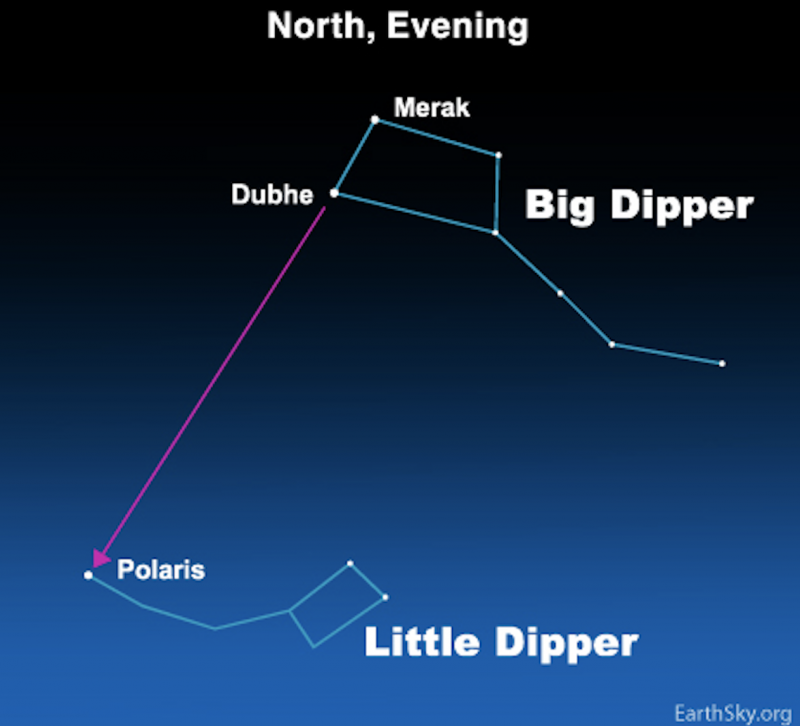
Best of all, you can readily find Polaris by using the prominent group of stars known as the Big Dipper, called the Plough in the United Kingdom, which may be the Northern Hemisphere’s most famous star pattern. To locate Polaris, all you have to do is to find the Big Dipper pointer stars Dubhe and Merak. These two stars outline the outer part of the Big Dipper’s bowl. Simply draw a line from Merak through Dubhe, and go about five times the Merak/Dubhe distance to Polaris.
This clock runs backward
Polaris marks the center of nature’s grandest celestial clock!
The Big Dipper, like a great big hour hand, goes full circle around Polaris in one day. More specifically, the Big Dipper circles Polaris – in a counterclockwise direction – in 23 hours and 56 minutes. You could set your watch by it!
Although the Big Dipper travels around Polaris all night long, the Big Dipper pointer stars always point to Polaris at any time of the night, and on any day of the year.
It’s part of the Little Dipper
Polaris is also famous for marking the end of the Little Dipper‘s handle. The Little Dipper is tougher to spot in the night sky than the Big Dipper. But if you use the Big Dipper’s pointer stars to locate Polaris, you’ll be one step closer to seeing the Little Dipper.
Its height in the sky depends on your location
As you travel northward, Polaris climbs higher in the sky. If you go as far north as the North Pole, you’ll see Polaris directly overhead.
As you travel south, Polaris drops closer to the northern horizon.
If you get as far as the equator, Polaris sinks to the horizon.
South of the equator, Polaris drops below the northern horizon.
Trusting Polaris with their lives
At one time in human history, people literally depended on their lucky stars for their lives and livelihood. Luckily, they could trust the Big Dipper and the North Star to guide them. People could sail the seas and cross the trackless deserts without getting lost. When slavery existed in the United States, people escaping slavery counted on the Big Dipper to show them the North Star, lighting their way to the free states and Canada.
While being honored as the North Star, Polaris enjoys the title of Lodestar and Cynosure as well.
What if you’re in the Southern Hemisphere?
Via Daniel Gaussen, Founder & Guide – Stargaze Mackenzie – New Zealand
Stargazers in the Southern Hemisphere can’t use Polaris to find the direction north. That’s because – as seen from Earth’s equator, and southward – this northernmost, moderately bright star remains permanently below the northern horizon. Instead, to find the south celestial pole, we rely on the distinctive Southern Cross.
By extending an imaginary line through the Southern Cross’ two pointer stars, Alpha and Beta Centauri, and drawing a triangle with the cross, we can locate the South Celestial Pole. This point in the sky acts like a pole star, guiding us in our navigation.
But wait, is there no pole star in the Southern Hemisphere?
Well, technically yes, there is a southern pole star: Sigma Octantis. Sometimes called Polaris Australis, this star is in the Octans constellation. It lies approximately 1 degree away from the south celestial pole.
Sigma Octantis is around 4.4 times the radius of the sun and radiates roughly 44 times more energy. Yet despite its impressive size and luminosity, its distance of 294 light-years means it appears extremely faint from Earth. It glows at just magnitude 5.5, making it visible only under dark skies and to observers with keen eyesight.
As a result, for many centuries, both European navigators and Polynesian sailors have had to rely on the Southern Cross to guide them across oceans. Like Polaris in the north, the Southern Cross and its pointer stars are circumpolar for much of the southern hemisphere, meaning they never set below the horizon and can be seen year-round.
Today, the Southern Cross proudly adorns the New Zealand and Australian national flag, a testament to its enduring importance as a celestial compass and a beacon for navigation.
History of Polaris
Polaris hasn’t always been the North Star and won’t remain the North Star forever. For example, a famous star called Thuban, in the constellation Draco the Dragon, was the North Star when the Egyptians built the pyramids.
But Polaris is a good North Star because it’s the sky’s 48th brightest star. So it’s noticeable in the sky. It served well as the North Star, for example, when the Europeans first sailed across the Atlantic over five centuries ago.
And Polaris will continue its reign as the North Star for many centuries to come. It will align most closely with the north celestial pole – the point in the sky directly above Earth’s north rotational axis – on March 24, 2100. The computational wizard Jean Meeus figures Polaris will be 27′ 09″ (0.4525 degrees) from the north celestial pole at that time (a little less than the angular diameter of the moon when at its farthest from Earth).
Meanwhile, there is currently no visible star marking the celestial pole in the Southern Hemisphere. What’s more, the Southern Hemisphere won’t see a pole star appreciably close to the south celestial pole for another 2,000 years.
Polaris is a triple star
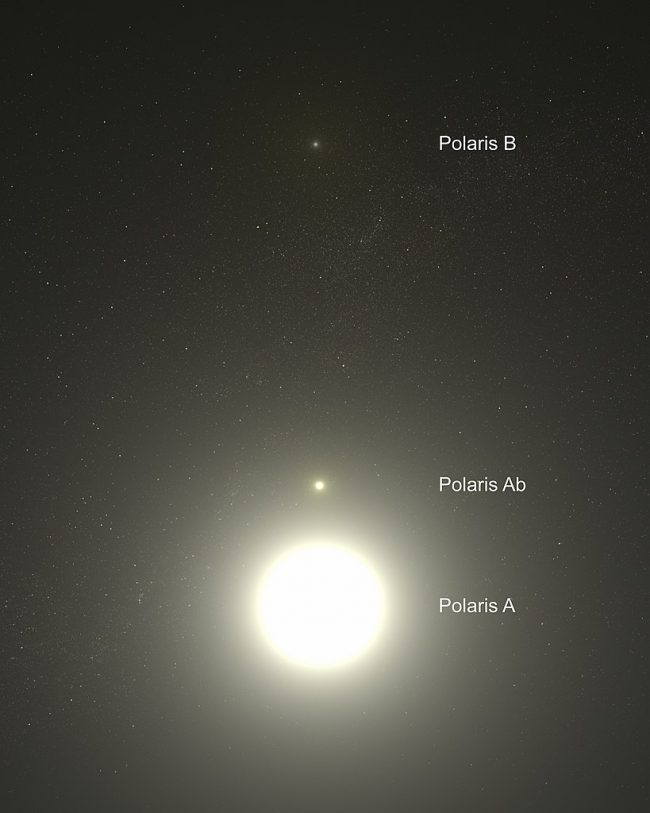
The single point of light that we see as Polaris is a triple star system, or three stars orbiting a common center of mass. The primary star, Polaris A, is a supergiant with about six times the mass of our sun. A close companion, Polaris Ab, orbits 2 billion miles (3.2 billion km) from Polaris. You are unlikely to ever see this star, because it is very close to Polaris.
Much farther away, near the top of this illustration, is the third companion, Polaris B. Polaris B, with magnitude 8.7, is located approximately 240 billion miles (390 billion km) from Polaris A. This translates to 18.4 arcseconds, and you can discern – split – these two stars in a small telescope. This split is always a hit at public star parties. The two companion stars have temperatures similar to Polaris A but are dwarf stars.
Star bright, star light
Astronomers estimate Polaris’ distance at 434 light-years. Considering the distance, Polaris must be a respectably luminous star. Polaris is a yellow supergiant star shining with the luminosity of 1,260 suns.
And it varies in brightness, too!
Polaris is a variable star. In the past, it had varied between magnitudes 1.86 and 2.13 every four days. In recent decades, this variability decreased from 10% to 2%, then it went back up to 4% variability. Astronomers are not sure why this happened. It’s the type of variable star known as a Cepheid variable star, a class of stars that astronomers use to figure distances to star clusters and galaxies.
Seeing Polaris in a telescope during the day
Since Polaris hardly moves, this makes it easy to see in the daytime. Set your telescope on Polaris in the early morning, before dawn. Focus sharply on it. Turn off your clock drive, if you have one, and keep your telescope stationary. Come back just after sunrise and look for it again. It should still be in your field of view, having moved about 30 arcminutes in the past three hours.
What’s the RA today?
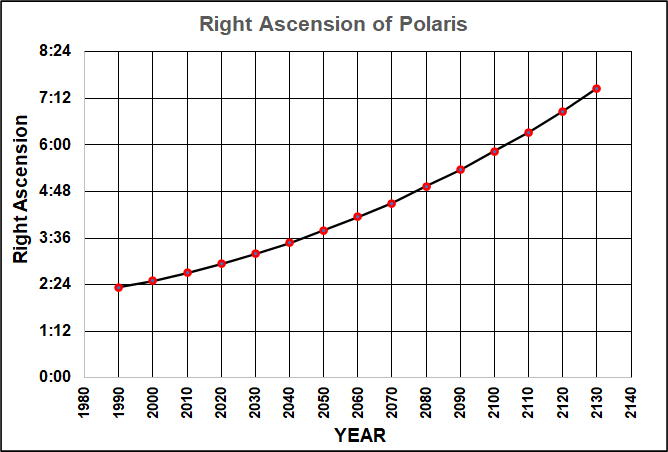
In the year 2000, Polaris’ position was RA: 2h 31m 48.7s, dec: +89° 15′ 51″. Due to precession, since this star is so close to the celestial north pole, its Right Ascension (RA) can change quickly. Presently it is sitting at about 03h 00m. Here is a graph showing how the RA of the star changes over the next century.
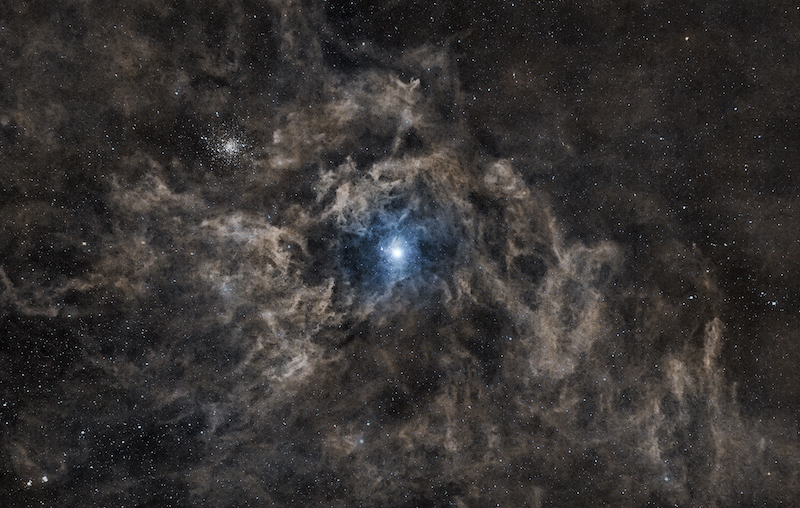
The view of Polaris you will never see: the Integrated Flux Nebula
Just when you think you have seen it all … maybe you have. Because this next bit will blow your mind, and you will never visually see it. Below we see an image of Polaris, which is several images stacked to bring out the contrast. Those are not clouds in our atmosphere. They are not clouds between us and Polaris. They are clouds well beyond Polaris, illuminated by the light of our galaxy. These clouds are called the Integrated Flux Nebula.
Bottom line: Polaris is the North Star, and the entire northern sky wheels around it. But it’s not the brightest star in the sky. In fact, Polaris ranks only 48th in brightness.
Like what you read?
Subscribe and receive daily news delivered to your inbox.
More from
Bruce McClure


Meet Aquarius the Water Bearer and its stars

Check out the Double Cluster in Perseus on October evenings
Find the Andromeda Galaxy using Cassiopeia
Alpha Cephei, or Alderamin, is a fast-spinning star



