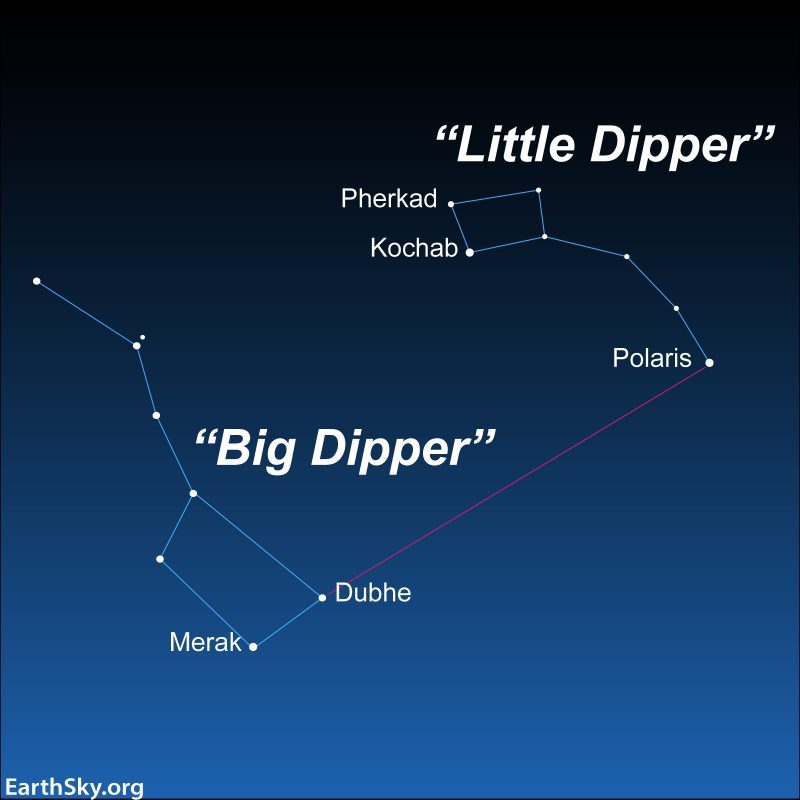
An imaginary line drawn from the 2 outermost stars in the bowl of the Big Dipper always points to Polaris. No matter what time of the year you look, the 2 outer stars in the Big Dipper’s bowl always point to Polaris, which marks the end of the handle of the Little Dipper. Chart via EarthSky.
The Dippers and the Pointers
Many people mistakenly believe that Polaris – the North Star – is the brightest star in the sky. Not so. It’s only a moderately bright star. It’s the location of Polaris in our sky that makes this star special. Earth’s northern axis nearly points to Polaris. Hikers and sailors know that finding Polaris means finding the direction north.
How can you find Polaris? The best way is to look for the famous Big Dipper asterism. It consists of seven stars in a distinct dipper-like shape. Unless it’s below your horizon, you’ll find it in the northern sky. The two outer stars in the bowl of the famous Big Dipper asterism always point to Polaris, the North Star. These stars are called Merak and Dubhe. They’re also called The Pointers.
The Dippers and Pointers from our community
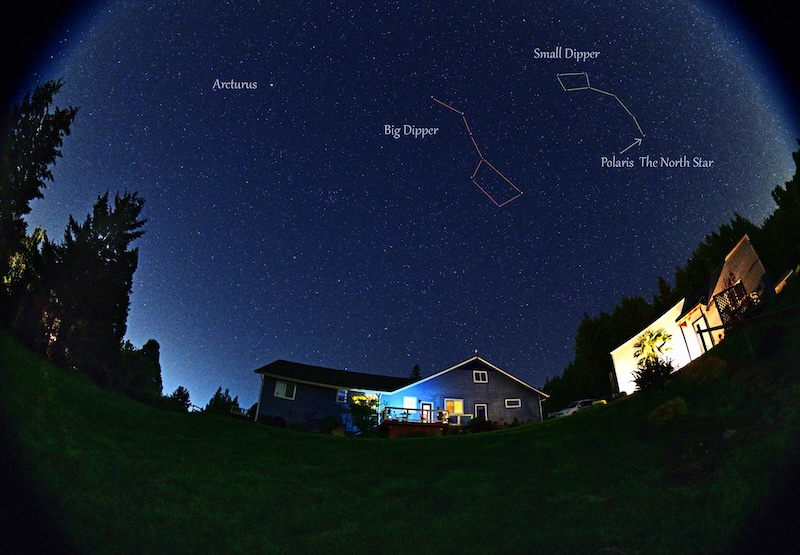
View at EarthSky Community Photos. | Cecille Kennedy captured this image on May 1, 2025, from Oregon and wrote: “The Big Dipper, Arcturus and Polaris, the North Star, shine brightly with the other stars in the still of the blue midnight. The 2 front stars of the Big Dipper are called Pointers because they point to Polaris, the North Star. Polaris, is the brightest star in the Little Dipper and the closest bright star to the north celestial pole. When you are looking at Polaris, you are facing north. Arcturus is a 1st-magnitude star and stands right behind the Big Dipper. Arcturus is the brightest star of the constellation Boötes the Herdsman.” Thank you, Cecille!
Bottom line: Want to find Polaris, the North Star? The entire northern sky turns around it. If you can find the Big Dipper, you can always find Polaris.
Deborah Byrd (asteroid 3505 Byrd) helps edit EarthSky.org and is a frequent host of EarthSky videos. Deborah created the EarthSky radio series in 1991 and founded EarthSky.org in 1994. Prior to that, she had worked for the University of Texas McDonald Observatory since 1976, and created and produced their Star Date radio series. She has won a galaxy of awards from the broadcasting and science communities, including having an asteroid named in her honor in 1990, a Public Service Award from the National Science Board in 2003, and the Education Prize from the American Astronomical Society in 2020. A science communicator and educator since 1976, Byrd believes in science as a force for good in the world and a vital tool for the 21st century. "Being an EarthSky editor is like hosting a big global party for cool nature-lovers," she says.
Like what you read? Subscribe and receive daily news delivered to your inbox.
Thank you! Your submission has been received!
Oops! Something went wrong while submitting the form.