Arcturus, a red giant, looks orange to the eye. It is the brightest star on the northern half of Earth’s sky dome. Arcturus is especially noteworthy for its large proper motion, or sideways motion across our sky. Only Alpha Centauri – our sun’s nearest neighbor among the stars – has a higher proper motion among the first-magnitude, or bright, stars in the stellar neighborhood. What can the proper motion of Arcturus be telling us?

Arcturus, brightest star in the constellation Bootes
It’s telling us that Arcturus is moving at a tremendous rate of speed (122 km/s) relative to our solar system. Moreover, Arcturus is not moving with the general stream of stars in the flat disk of our Milky Way galaxy. Instead, it is cutting perpendicularly through the galactic disk. Arcturus is thought to be an old star. It appears to be moving with a group of at least 52 other such stars, known as the Arcturus stream. Arcturus is likely to be considerably older than our sun. When the sun evolves to become a red giant, the sun might be a star much like Arcturus is now.
As it cuts through the galactic disk, Arcturus will eventually reach a closest point to our sun. The closest approach of Arcturus will happen in about 4,000 years, when the star will be a few hundredths of a light-year closer to Earth than it is today. But remember that Arcturus is not moving with the general stream of stars in the disk of our Milky Way galaxy. Thus, we will lose sight of this star relatively quickly. Millions of years from now, this star will be lost from the view of any future inhabitants of Earth, or at least those who are earthbound and looking with the eye alone.
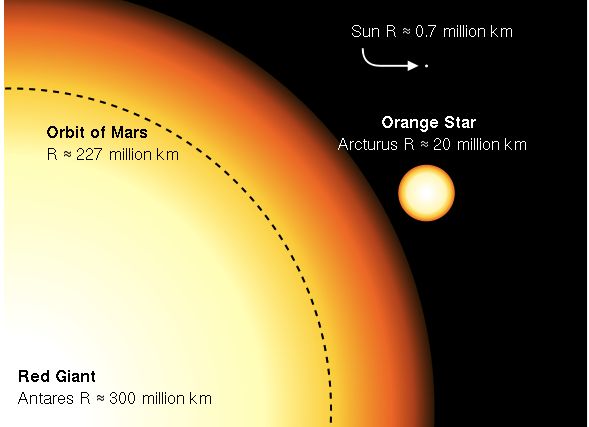
The red giant Arcturus is roughly 25 times the diameter of our sun. It is not the largest of the red giant, however, as the diagram below shows. Because of its larger size, in visible light Arcturus radiates more than 100 times the light of our sun. If you consider infrared and other forms of radiant energy, Arcturus is about 200 times more powerful than the sun. Its mass is hard to exactly determine, but may be slightly greater than that of our sun (1.1-0.4+0.6 solar mass).
The reddish or orange color of Arcturus signifies its temperature, which is about 7,300 degrees Fahrenheit. That makes it several thousand degrees cooler than the surface of the sun.
How to See It
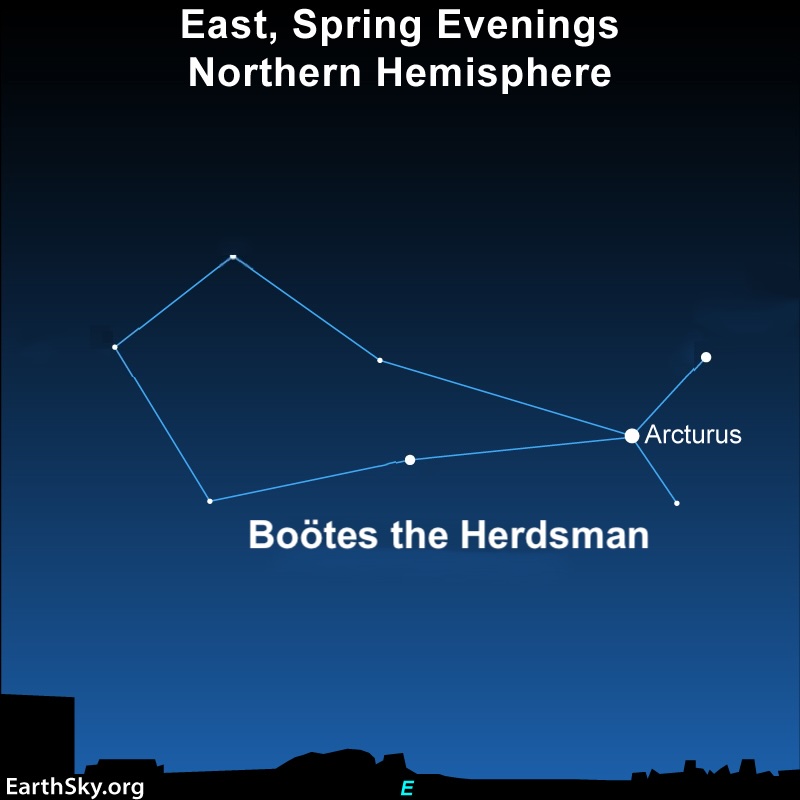
Arcturus is the alpha star of a cone-shaped constellation called Bootes the Herdsman. It is far enough north on the sky’s dome that – for northern hemisphere observers – it’s visible during some part of the night throughout most of the year.

Arcturus is the brightest star in the kite-shaped constellation Bootes.
You might notice this bright orange star passing high overhead on late spring evenings. In summer, Arcturus is high overhead shortly after dark. Autumn observers need to look early because then it sets by mid-evening. The best time to observe it in winter is in the wee hours before dawn.
Our chart shows this constellation as you stand facing south on spring evenings. Seeing a Herdsman in these stars might be difficult, but the constellation is easy to imagine as a kite.
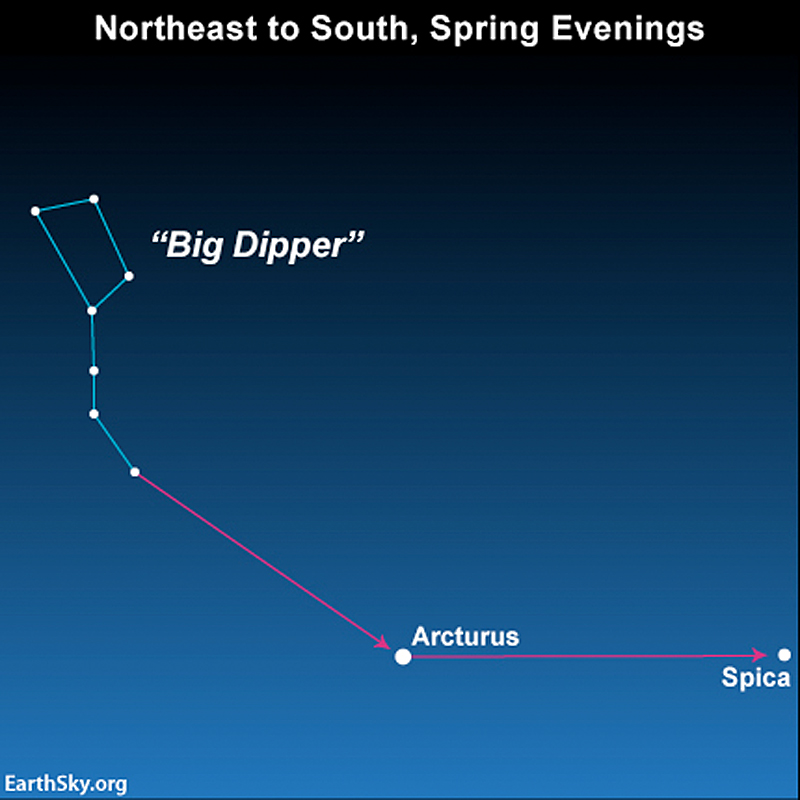
There’s an easy mnemonic for remembering how to identify this bright, orange star. Just remember the phrase: follow the arc to Arcturus.

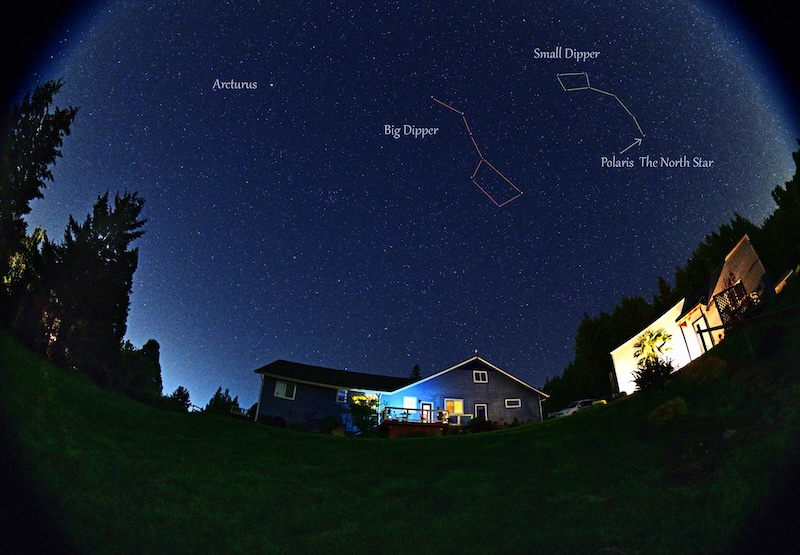
Spring evenings are a good time to "follow the arc to Arcturus." Face east. Find the Big Dipper. Follow the curve in the Dipper's handle to the orange star Arcturus.
First, locate the Big Dipper in the northern sky. Notice that the handle of the Big Dipper is a curve or arc. Extend this curve past the end of the Big Dipper’s handle, and you will come to Arcturus.
Arcturus is the brightest star north of the celestial equator. What does that mean? Imagine that Earth’s equator can be projected onto the sky. This line above Earth’s equator is called the celestial equator. It divides the sky into northern and southern hemispheres, just as Earth’s equator does for Earth. The three brightest stars of the sky – Sirius, Canopus and Alpha Centauri – are south of the celestial equator. Meanwhile, Arcturus is the brightest star in the northern part of the sky. It is only marginally brighter than the northern hemisphere’s second-brightest star, Vega. To the eye, Arcturus and Vega reign as co-stars in the northern half of the sky.
History and Myth
Arcturus’ constellation Bootes – the Herdsman – is sometimes pictured as guarding the Great Bear, or Ursa Major, which contains the Big Dipper asterism. We sometimes hear Arcturus called the Bear Guard.

Johannes Hevelius drew the constellation in Uranographia, his celestial catalogue in 1690. The view is mirrored following the tradition of celestial globes, showing the celestial sphere in a view from "ouside." (Wikimedia Commons)
In China, the constellation for which Arcturus is the chief star was sometimes called the Dragon. In some classical Greek stories, Bootes was Icarus, who in another story flew too close to the sun. Passing directly over the Hawaiian Islands, Arcturus was a particularly important navigational star to the islands’ native inhabitants and other Polynesians.
The translation may be questioned, but Arcturus is among the few stars mentioned in the Bible. (“Which maketh Arcturus, Orion, and Pleiades, and the chambers of the south” – Job 9:9 and “Canst thou bring forth Mazzaroth in his season? or canst thou guide Arcturus with his sons?” – Job 38:32, KJV.)
One interesting story about Arcturus relates to the 1933 Century of Progress Exhibition in Chicago. Its promoters wanted a flashy way to open the show, so they decided to have the light from Arcturus pass through a telescope onto a photocell. The photocell in turn worked as the switch that turned on the main spotlights to open the exhibition. There had also been a World’s Fair in Chicago in 1893, 40 years before the 1933 show. At the time, astronomers thought that Arcturus was 40 light-years away. So they thought that light left Arcturus at the end of the 1893 fair and traveled for 40 years through space like an Olympic torch bearer, to open the 1933 show.
The promoters of Chicago’s World’s Fair had a great idea, but today’s astronomers place the distance to Arcturus at just less than 37 light-years.
The position of Arcturus is RA: 14h 15 m 39.7s, dec: +19° 10′ 56″.


a myth was that a ceyote liked to show off to the girls and juggle his eyeballs. One day he threw one in to the sky too high and it got stuck up there (arcturus). This is a naitve american storie.
Hi, Whitney. Thanks for your story. I have a few drops of Cherokee blood flowing in my veins and I have always been interested in the stories and beliefs of my ancestors. I would like to request that anyone who has such stories to share them here, as you have done. I would ask one more thing, though. Please state the culture you are referring to in the story. In North America before Europeans came, there were hundreds of cultures and languages. In fact there were more than 400 individual and distinct languages. So to refer to something as “Native American” is a little unclear. It’s a bit like referring to a foreigner’s language as “european.” Considering that there are dozens of European cultures, countries and languages, that doesn’t tell us much. And in the case of American Indians, there were not just dozens, but hundreds. So I am just asking to share a little bit more information to make the story more meaningful. Thanks again.
I see this everynight with red and green lights flashing.
Husband tried to convince me that it was an airplane.
I had a lady here tonight that is into the stars and she was also amazed that it was flashing. Seems it revolving and moving with the earth and it is the reflections…
God does great work does he not>>>
Hi there, great site! I have noticed this star often the past few months. I have also noticed it disappear for about 40 seconds to return faintly then full light. Can you explain this. I have always thought its a UFO for the simple fact it is always over a military base that seems so secretive. lol! Maybe it is :)
If what u are seeing is truly a star, then perhaps u are seeing a “twinkling” phenomenon, which would b magnified the lower the star is, wherein the earth’s atmosphere affects the brightness and color of light passing thru, with greater effect the more of the atmosphere the light passes thru (i.e. objects seen as “low” in the sky).
Ditto to what Sean said.
DeAnna, I am sorry that I did not see this previously. I frankly cannot say anything definitive about what you saw without more details such as exact times, exact locations and directions of viewing. There are far simpler explanations for what you describe than a UFO (except in the fact that anything seen in the sky that is not immediately explained is, by definition, a “UFO”). But rather than being extraterrestrial, it is far more likely that it what you describe was a star, such as Arcturus, combined with certain atmospheric conditions. That could easily explain what you describe. Or it could have been some kind of aircraft on a regular nightly run. If you are lined up with a runway on some nearby airport, planes coming into that facitily from a distance can often have an odd, hover appearances and the brightness can vary due to various movements of the plane. The bottom line is that in the long run, you are far more often going to be right if you assume a simple explanation (such as a star or aircraft) than in positing any kind of extraterrestrial spacecravt apparition (which may not be what you meant by “UFO”, but it is what most people mean).
I was looking out at the stars this evening around 7pm and noticed a orange-red-white sparkling star about 50d west of north. To landmark it better, it was extended along the arc of the handle of the Big Dipper. I have never noticed this star before, specifically the red and orange sparkle. By 8:30pm it had fallen from the sky into the horizon. From what i can gather, it is Arcturus. I will look for it tomorrow morning before sunrise.
Gary, I think I can speak for everyone where when I say, “huh?” At 7 p.m. the curve of the handle of the Big Dipper was pointing below the northeastern horizon. My guess is that you are somewhere without Daylight Saving Time. In the US, we still have it, and Arcturus in most locations was already below the northwestern horizon at 7 p.m. However, if it was VERY low on the horizon, then yes, it likely was Arcturus. When a bright star is low on the horizon, it is more likely to twinkle maddly.
Good site, where did you come up with the knowledge in this article? Im happy I found it though, ill be checking back soon to see what other articles you have.
Thank you, Sasha. There are many sources, but a good one is “Star Names, Their Lore and Meaning” by R.H. Allen. We have many articles already and more on the way. Look around.
[...] following the curve in the Dipper’s handle until you come to a bright orange star. This star is Arcturus in the constellation Bootes, known in skylore as the ‘bear [...]
Re: Inconsistency in quoted data
I am a first time visitor to the website and I will return for more brain food.
Noticed an inconsistency with photo caption at top of article stating the speed of the star is 150 km/s and in the body of article, paragraph two, first sentence, the speed is stated as 122 km/s.
-Neville
Neville, sorry I just saw your notation of the discrepancy about the speed. The fact is that on a website such as EarthSky, there are several people, sometimes in various and widespread locations, who post to the page and edit it over time. The original value I had was 122 km/s, which is what was posted to the body of the article. The other reference was added by someone else later on.
However, in reality, such figures in Astronomy are rarely known with high certainty, and there often various estimates. It is a bit of irony that while science has the reputation of being highly accurate and precise, and some aspects are indeed worthy of that reputation, but many aspects of science are really only estimates. In some cases, such as quantum physics, we can state the probabilities of a certain subatomic event with an extremely high precision when considering a large collection of particles, but cannot be sure one way or another about one specific particle. And in astronomy, certain things can be known with high precision (the surface temperature of a star, for example), while we may be doing well to be within 10 percent on some other measurements (the speed of a star toward or away from us, for example). At any rate, there is often a range of values.
Some further analysis of the mention of Arcturus in the Book of Job in the Bible. The heavens are God’s handiwork, and what the Book of Job (one of the oldest, if not the oldest books of the Bible) describes can only have been inspired by the very One who made the heavens in the first place.
Firstly, the binding of Pleides. The stars that fill the night sky are separated by vast distances, moving at varying speeds and headed in various directions. The cluster of Pleides in contrast, as has been ‘discovered’, is moving at the same speed in the same direction – as if they were bound together.
Secondly, the belt of Orion, which at present appears as a near line of 3 stars will one day appear very differently. Two of the stars are moving closer together (from our perspective) and will one day look as if they are one large star, while the third is moving away from these two in a different direction completely – hence the loosening of Orion’s belt.
Thirdly, the bringing out of the constellations (Mazzaroth) in their seasons, of course provides the evidence of how the night sky and the constellations dip below the horizon and rise again according to the earth’s tilt and the beginning and end of the various seasons. Seems straight forward to us in these modern times, but remember not too long ago if you thought the earth was round let alone orbiting the sun (on a tilted axis) you were labelled a heretic!
Fourth and finally Arcturus, the Great Bear. This giant of the sky has been called a runaway. Newton described a star as being “in control” if it were moving no more than 40km/sec. Arcturus, approx 1000 times the size of our sun, is moving at such great speed (122-150km/sec or so) that it has been stated not even the combined force of all the known stars would be able to even shift it from its trajectory let alone stop it – such is the momentum of this giant. Nothing in creation can guide this Great Bear!
Incredible how such intimate details of the heavens are so clearly described in the Word of God. Truly, all heaven declares the glory of the risen Lord!
the sure size of the star is just mind-boggling
Sean, to me, pretty much everything about the Universe is mind-boggling!
absolutely
[...] Arcturus: follow the arc [...]
I think that its the best star ever because i adopted it for my girlfriend for her to always to look up to while im gone.
Is it me or I find a lot of references to the great god of this and the great god of that. I’m suprised and disappointed that goddish people take over a science site. It’s not enough to look up to the stars, study them and you’ll find out quick enough that god has nothing to do with it.
The belief in God is the majority belief. Empirical science has its limits and most the conjectures about the origins of the universe are not empirical science because they cannot be proven empirically. Some believe in the Big Bang and there are variants of this conjecture/theory of origins. The point I am trying to make is that those who have belief in God also have a place on websites such as this considering that Kepler and Galileo and Newton and Boyle and many others have held such beliefs it is not strange that there are scientists among the majority that believe in God.
Everyone has a right to believe what they want to believe. But scientific enquiry and religious belief are fundamentally different. This is a site that is dedicated to science, which means that it relies on information for which there is direct evidence or reasonable expectations based on direct evidence.While true science is open to new ideas, revisions and even reasoned speculations, it is based on observational evidence and logical extrapolations from such evidence.
Religion requires faith, which is belief without any form of rational evidence. Often religion requires followers to accept claims, without question, for which there is no logical or physical proof. Science demands evidence.
We do not claim that religous beliefs are wrong, but since they do not fit the criteria of science, they are not the focus on this website, and should be reserved for discussion on a website devoted to religion. Again, EasrthSky is a site dedicated as a “clear voice for science” and discussions should be kept in that vein.
Im in south Australia. I m new at this and my dream is to see the rings of Saturn. We have the big dipper here in southern hemisphere so would it b the same to find Saturn from here. Sounds like a dumb question but like I say I’m new at this stuff
Deidre, finding Saturn is not all that different. However, as far South as you are, I do not think that you are seeing the same “Big Dipper” as we see in North America. For us it is Ursa major, fairly close to the North Celestial pole and not, I think, visible at your latitude. No doubt you have a similarly named group of stars, but I was not aware of it. At any rate, references in the article about finding Arcturus with the Big Dipper likely will not work for you (although you can see Arcturus).
Saturn is easier. As with everything in the sky, it varies with the time of year, but right now Saturn rises in the East for you in S. Australia at about 10 p.m. (very roughly, depending on just where you are) in the eastern sky. It is near the bright star Spica in Virgo. Of course this will change as the months go on. For now, the help you observe it, on the evening of March 10, the Moon will be just above and the the left of Spica (in the eastern sky in late evening), and Saturn is a bit further down to the right from Spica. On the following evening, The Moon will be to the right of Saturn, and slightly above it. Just wait until 10 – 11 p.m., then look East. (You can see Arcturus not far away, too, but it does not rise until 2-3 horus later, in the northeastern sky.) Threre is more on this page:
http://earthsky.org/tonight/see-moon-star-spica-and-planet-saturn-on-march-10
Please note, however, that the article and note are written from a Northern Hemisphere perspective. The chart shows how it looks from North America or Europe, or most anywhere North of the Equator. For your viewpoint in Sotuhern Australia, you will need to rotate the chart given by about 90 degrees anti-clockwise.
Good luck in finding Saturn.
Has anyone else noticed Arcturus move east then directly west and just weird moving in general?
Ashley, if you saw it move like that, it had nothing to do with Arcturus. Stars simply do not move in that manner. Occasionally, the sky may be clear but actually very turbulent. This is the same phenomenon known in aviation as Clear Air Turbulence or CAT. It can cause a plane to suddenly jerk upward or downward or to the side, and concernt that they might fly through it is often the reason that pilots turn on the “Fasten Seat Belts” sign in mid-flight. Anyway, it can also affect the light coming to us from a star, causing the star to move around a little bit. That may have been what you experienced. Otherwise, there is no astronomical reason the star should appear to do that.
Yes ashley I have…actually a friend of mine has noticed it several times and tonite he pointed it out to me. I was amazed by the way it moved left and right….forward and back and in circular motions while all the surrounding stars were still. Truly a Site to see
Ken,
What you describe was not Arcturus, or at least it was not any motion or appearance caused by Arcturus itself. Astronomical objects, and in particular Arcturus, do not move that way. For a star at Arcturus’s distance to move as described would require it to move around several light years or perhaps several hundred light years at speeds vastly exceeding that of light itself. They simply don’t do that. The reason whatever you saw appeared to move that way was something much closer to home, quite possibly an effect of the atmosphere as previously described in my response to Ashley.
[...] Arcturus is a much larger star than our sun. Read more about Arcturus here. [...]
[...] bright star. This star is Spica in the constellation Virgo the Maiden. You can follow the arc to Arcturus AND drive a spike or, as some say, speed on to [...]