



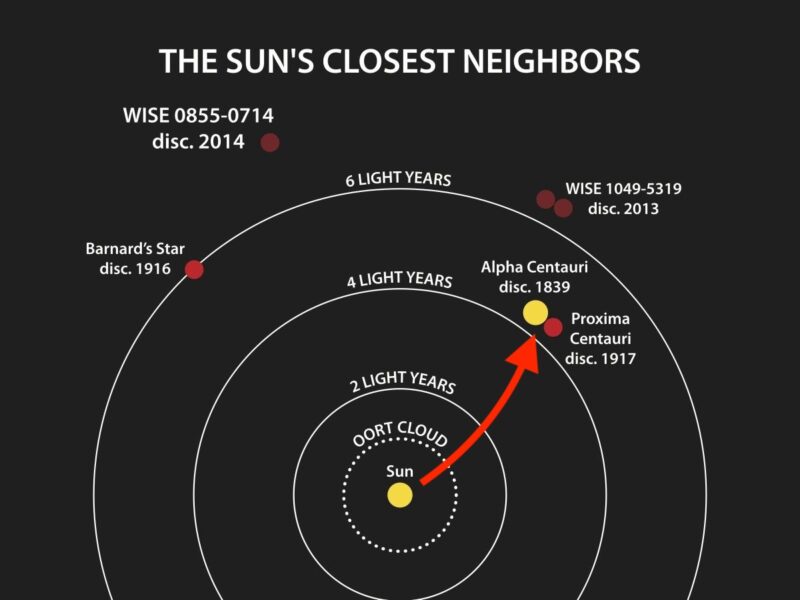
Alpha Centauri is often said to be the closest star to our sun. It’s true that when you look at this star – the 3rd-brightest star in our night sky – you can think of it as the closest star.
But, really, it’s the closest star system to our sun. The single star we see as Alpha Centauri becomes two stars through a telescope. This pair is just 4.37 light-years away from us. A third star in the system, Proxima Centauri, orbits around the two larger stars.
And, at 4.25 light-years away, Proxima is the closest known star.
The 2 main stars of the Alpha Centauri system
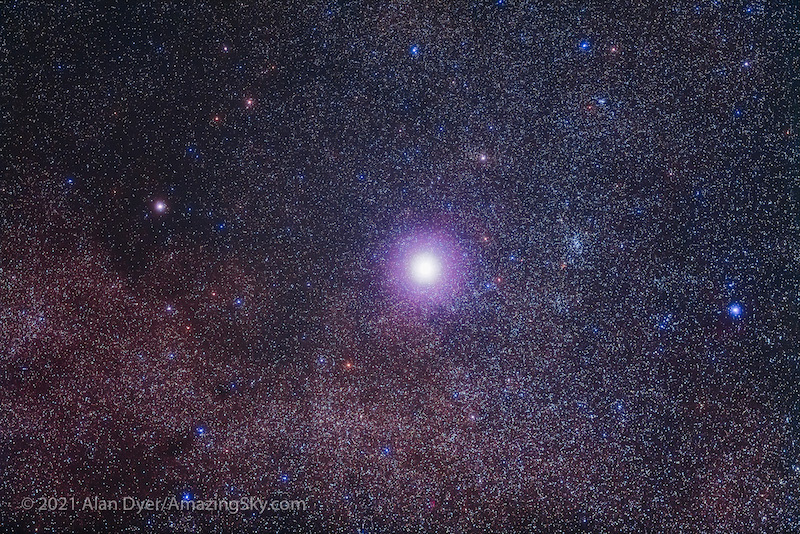
The two sunlike stars that make up Alpha Centauri are Rigil Kentaurus and Toliman. Rigil Kentaurus, also known as Alpha Centauri A, is a yellowish star. It’s slightly more massive than the sun and about 1.5 times brighter. Toliman, or Alpha Centauri B, has an orangeish hue. And it’s a bit less massive and half as bright as the sun. Studies of their mass and spectroscopic features indicate that both these stars are about 5 billion years old. That makes them slightly older than our sun.
Alpha Centauri A and B are gravitationally bound together. They orbit a common center of mass every 79.9 years at a relatively close proximity, varying between 11.2 to 35.6 astronomical units. That is, 11.2 to 35.6 times the distance between the Earth and our sun.
Meet Proxima Centauri
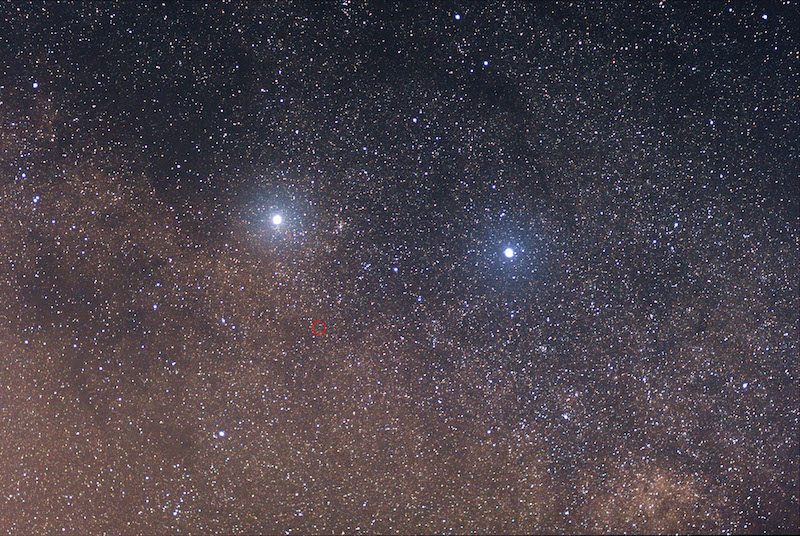
In comparison, Proxima Centauri is a bit of an outlier. And this dim reddish star, weighing in at just 12% of the sun’s mass, is currently about 13,000 astronomical units from Alpha Centauri A and B. Recent analysis of ground- and space-based data, published in 2017, has shown that Proxima is gravitationally bound to its bright companions. It has about a 550,000-year-long orbital period.
Proxima Centauri belongs to a class of low-mass stars with cooler surface temperatures. They are known as red dwarfs. Additionally. it’s also what’s known as a flare star. Flare stars randomly display sudden bursts of brightness due to strong magnetic activity.

The search for planets
So, in the past decade, astronomers have been searching for planets around the Alpha Centauri stars. Of course they are the closest stars to us, so the odds of detecting planets, if any exist, would be higher. So far, three planets have been confirmed orbiting Proxima Centauri, one in 2016 and another in 2020. And in 2022, a smaller planet, only about 25% of Earth’s mass, was found orbiting very close to the star. Then in 2025, the James Webb Telescope announced it found evidence of a gas giant planet around Alpha Centauri A. But so far, it has not been definitively confirmed.
How to see Alpha Centauri
Unluckily for many of us in the Northern Hemisphere, Alpha Centauri is located too far south on the sky’s dome to see. So most North Americans never see it. The cut-off latitude is about 29 degrees north, and anyone north of that is out of luck. So in the U.S. that latitudinal line passes near Houston and Orlando, but even from the Florida Keys, the star never rises more than a few degrees above the southern horizon. Things are a little better in Hawaii and Puerto Rico, where it can get 10 or 11 degrees high.
But for observers located far enough south in the Northern Hemisphere, Alpha Centauri may be visible at roughly 1 a.m. (local daylight saving time) in early May. That is when the star is highest above the southern horizon. By early July, it reaches its highest point to the south at nightfall. Even so, from these vantage points, there are no good pointer stars to Alpha Centauri. For those south of 29 degrees north latitude, when the bright star Arcturus is high overhead, look to the extreme south for a glimpse of Alpha Centauri.
Look for the Southern Cross
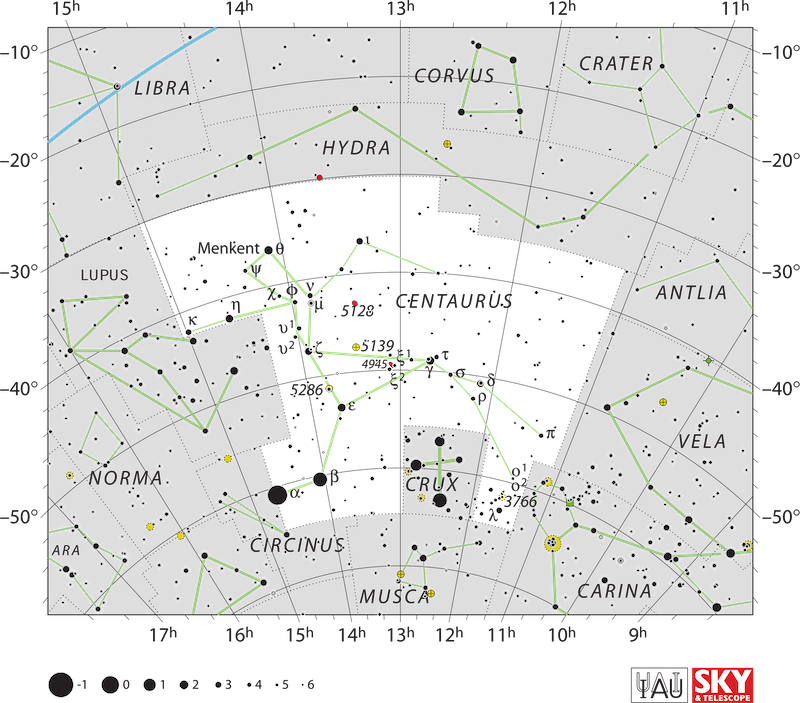
Observers in the tropical and subtropical regions of the Northern Hemisphere can find Alpha Centauri by first identifying the distinctive Southern Cross, also known as Crux. A short line drawn through the crossbar (Delta and Beta Crucis) eastward first comes to Hadar (Beta Centauri), then Alpha Centauri. Meanwhile, in Australia and much of the Southern Hemisphere, Alpha Centauri is circumpolar, meaning that it never sets.

The mythology of Alpha Centauri
Alpha Centauri has played a prominent role in the mythology of cultures across the Southern Hemisphere. For the Ngarrindjeri indigenous people of South Australia, Alpha and Beta Centauri were two sharks pursuing a stingray represented by stars of the Southern Cross. Some Australian aboriginal cultures also associated stars with family relationships and marriage traditions; for instance, two stars of the Southern Cross were through to be the parents of Alpha Centauri.
Astronomy and navigation were vital in the lives of ancient seafaring Polynesians as they sailed between islands in the vast expanse of the South Pacific. These ancient mariners navigated using the stars, with cues from nature such as bird movements, waves, and wind direction. Alpha Centauri and nearby Beta Centauri, known as Kamailehope and Kamailemua, respectively, were important signposts used for orientation in the open ocean.
For ancient Incas, a llama graced the sky, traced out by stars and dark dust lanes in the Milky Way from Scorpius to the Southern Cross, with Alpha Centauri and Beta Centauri representing its eyes.
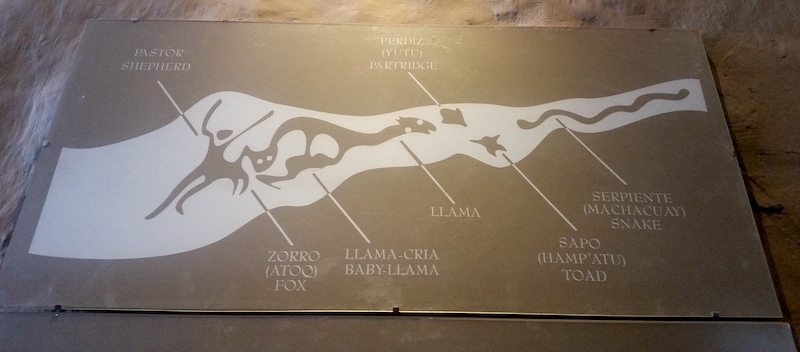
Ancient Egyptians revered Alpha Centauri, and may have built temples aligned to its rising point. In southern China, it was part of a star group known as the South Gate.
How it got its name
Alpha Centauri is the brightest star in the constellation Centaurus the Centaur, named after the mythical half human, half horse creature. Also, it represented an uncharacteristically wise centaur, Chiron, that figured in the mythology of Heracles and Jason. Hercules accidentally killed Chiron, who was placed in the sky after death by Zeus. Alpha Centauri marked the right front hoof of the centaur, although little is known of its mythological significance, if any.

Alpha Centauri’s position is RA: 14h 39m 36s, Dec: -60° 50′ 02″
Bottom line: Alpha Centauri is two binary stars that are sunlike stars. Plus, there’s a third star that’s gravitationally bound to them named Proxima Centauri. In fact, it’s the closest star to our sun.
Like what you read?
Subscribe and receive daily news delivered to your inbox.
More from
Larry Sessions


Why can’t I find the Big Dipper in September?

Fomalhaut is the Loneliest Star once again
Summer Triangle star: Altair is variable and spins fast!
Summer Triangle star Deneb is distant and luminous



