Sun news July 31: Two eruptions launch sun-stuff into space
(11 UTC to 11 UTC)


Yesterday evening, a long-lived prominence we’ve been watching on the southwest horizon finally erupted, hurling plasma into space. As seen by the SOHO spacecraft’s LASCO instrument, this coronal mass ejection (CME) soared out from our star in a textbook lightbulb shape. Forecasters’ models suggest a glancing blow to Earth is possible on August 2. At nearly the same time as this eruption, a massive filament in the northeast quadrant also erupted and launched material into space (see below). Early observations suggest this blast was directed too far north to affect Earth, but modeling is still underway. Stay tuned for updates as new data arrives.
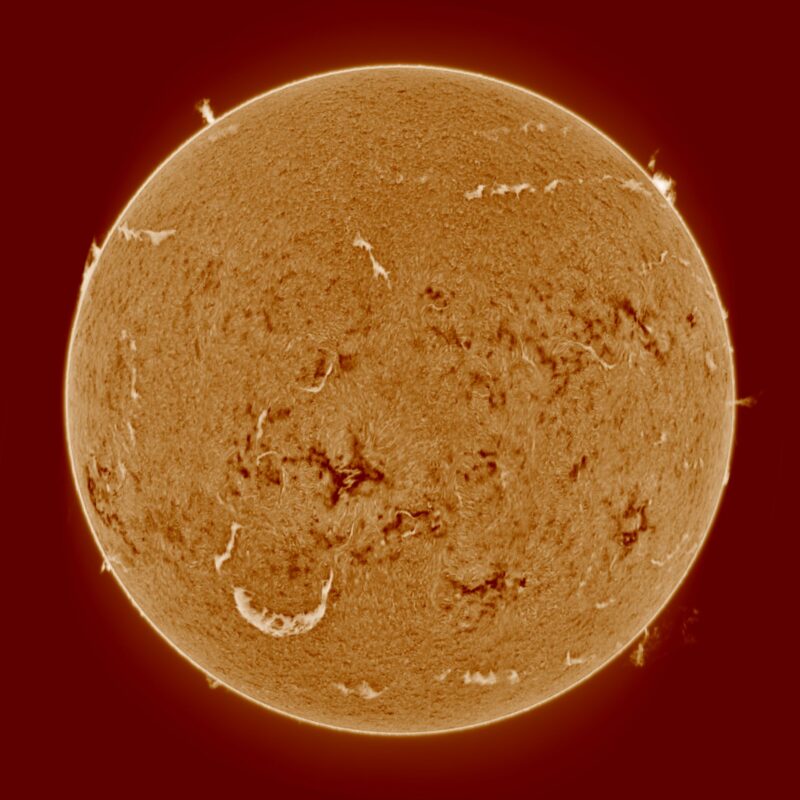
- Flare activity remained low over the past 24 hours. The sun produced 11 faint C-class flares. The largest event was a C2.2 flare from active region AR4155 at 11:29 UTC on July 30. The lead flare producer crown is shared between AR4155 in the southwest and AR4149 in the northwest. Both produced three C flares each.
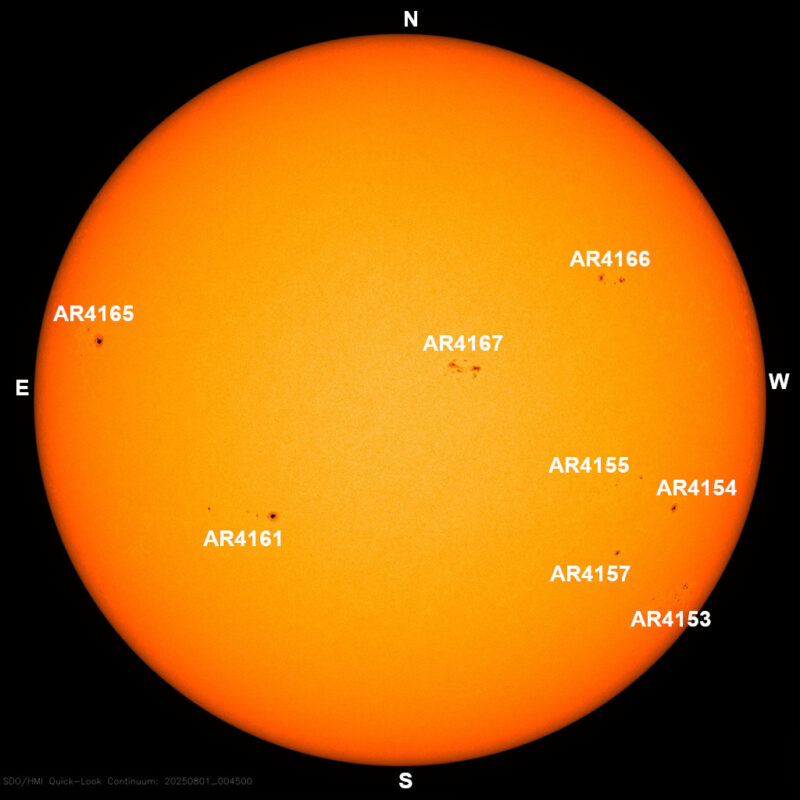
- There are nine sunspot regions currently populating the Earth-facing solar disk. All the labeled active regions have simple alpha or beta magnetic configurations and are either stable or in decay, suggesting a calm day to come. There are two newcomers on the Earth-facing side of our star: AR4165 near the northeast limb (edge) and AR4166 in the northwest.
- Blasts from the sun? A coronal mass ejection (CME) observed at 2:13 UTC on July 30 in the vicinity of AR4155 may provide a glancing blow on August 2.
- Solar wind speeds averaged around 420 km/s (939,513 mph) over the past day, with peaks of 570 km/s (1,275,000 mph) late on July 30. At the time of this writing (11 UTC on July 31) the solar wind speed is 472 km/s (1,056,000 mph). The interplanetary magnetic field (IMF) strength remained at a moderate level. The Bz component, which helps determine how much solar wind can enter Earth’s magnetosphere, kept moving intermittently between north and south. It is northward at the time of this writing. A southward Bz is favorable for auroras.
- Earth’s magnetic field was quiet to unsettled (Kp = 1-3) in the past day. It is at Kp = 2 at the time of this writing.
What’s ahead? Sun-Earth forecast
- Flare activity forecast: The chance for M (moderate) flares is 30% today, and the chance for X (strong) flares is 5% today.
- Geomagnetic activity forecast: Unsettled-to-active conditions are expected today, July 31. There is slight chance for a G1 (minor) geomagnetic storm as the solar wind from coronal hole in the northern hemisphere starts to reach Earth. Conditions should return to quiet on August 1 as the effects of solar wind shaking Earth’s magnetic field start to wane.
Sun news July 30: Eruptions in the west
(11 UTC to 11 UTC)

As in the previous 24 hours, the sun produced only minor flares – but a high number of flares – over the past day. We saw 18 C (common) flares in all. Meanwhile, in the west – the side of the sun that’s rotating out of view – prominence activity has picked up. Here at Earth, conditions remain relatively quiet, but there’s a growing chance of geomagnetic activity. Read more below.
- Flare activity has been low again over the past 24 hours, with only C class faint flares. But, once again – replicating the previous day’s dramatic increase in flare production – the sun produced 18 C flares. The largest event was a C4.7 flare from active region AR4155 at 6:16 UTC on July 30. The lead flare producer was a newcomer as-yet-unnumbered region in the northwest. It produced 11 C flares.
- There are seven sunspot regions on the Earth-facing solar disk. AR4153 remains the largest in extent, but it didn’t produce any flares over the past day. AR4155 showed some growth. All the labeled active regions on the solar disk have a simple alpha or beta magnetic configuration, suggesting a calm day to come today.
- Blasts from the sun? No Earth-directed coronal mass ejections (CMEs) were observed in the available coronagraph imagery.
- Solar wind averaged around 380 km/s (850,036 mph) with a peak at 600 km/s (1,342,000) at 7:28 UTC on July 30, ending the period at 370 km/s (827,660 mph). The interplanetary magnetic field (IMF) strength stayed at a moderate level. The Bz component, which helps determine how much solar wind can enter Earth’s magnetosphere, remained north-oriented late in the period, but moved to south-oriented at around 3 UTC on July 30 up to the time of this writing (11 UTC on July 30).
- Earth’s magnetic field was quiet to unsettled (Kp = 1-3) in the past day.
Sun news July 29: Flare count surges, solar wind on the way
(11 UTC to 11 UTC)

The number of sun flares surged dramatically over the past 24 hours, while the strength of the flares remained low. The sun produced 18 C-class (common) flares, a sharp increase from just four flares the previous day. This uptick suggests increased magnetic instability, even if no M-class (moderate) flares have occurred … yet. At the same time, a high-speed stream (HSS) from a northern coronal hole is forecast to become geoeffective (capable of affecting Earth) late today into July 30. It might get a boost from a smaller coronal hole, now rotating onto the Earth-facing side of the sun.
- Flare activity remained low over the past 24 hours, in terms of flare strength, but we saw a dramatic increase in flare production. Over the past day, the sun produced 18 C-class flares in contrast to the four the previous 24 hours. The largest was a C3.1 flare from active region AR4155 at 5:11 UTC on July 29. AR4155 was the lead flare producer of the period with five C flares.
- There are now 10 sunspot regions on the Earth-facing side of the sun. AR4153 is the largest in extent and was the 2nd lead flare producer of the past day, with four C flares. All the labeled active regions on the solar disk have simple alpha or beta configurations. There are two newcomers, AR4162 and AR4163 in the northwest quadrant.
- Blasts from the sun? No Earth-directed coronal mass ejections (CMEs) were observed in the available coronagraph imagery.
- Solar wind averaged around 360 km/s (805,297 mph), ending the period at 381 km/s (852,273). The interplanetary magnetic field (IMF) strength stayed low. The Bz component, which helps determine how much solar wind can enter Earth’s magnetosphere, remained predominantly south oriented. These are typical quiet solar wind conditions.
- Earth’s magnetic field has been quiet to unsettled (Kp = 1-3). The Kp index is 2 at the time of this writing.
Sun news July 28: All quiet, but solar wind might pick up
(11 UTC to 11 UTC)
Our sun has been tranquil over the past 24 hours, with only a few C-class (common) flares popping off from its surface. The most significant of these was a C3.1 flare. Although no coronal mass ejection (CME) was detected, solar wind from a new coronal hole could stir up some geomagnetic activity in the next two to three days, brightening night skies at northerly latitudes with a dazzling display of auroras.
- Flare activity is low. We saw four C-class flares over the past day. The strongest was a C3.1 flare from Active Region 4161 at 18:32 UTC on July 27.
- There are currently ten sunspot regions on the Earth-facing disk. The most significant regions are AR4153 and AR4155. Active Region 4155 showed some redistribution of its leader spots, hinting at potential future activity.
- Blasts from the sun? While we’ve had flares, no significant Earth-directed coronal mass ejections (CMEs) were observed in the past day. This means we’re unlikely to see any major space weather storms from these events.
- Solar wind conditions decreased, ending the period around 412 km/s (921,618 mph). The interplanetary magnetic field (IMF) strength reached a moderate level before returning to a low level. The Bz component, which helps determine how much solar wind can enter Earth’s magnetosphere, remained predominantly positive. These are typical quiet solar wind conditions.
- Earth’s magnetic field has been quiet (Kp = 1-2). This calmness, however, may be the calm before the storm, as the incoming solar wind could stir up some geomagnetic activity.
Sun news July 27: Waiting for a blob (CME) from the sun
(11 UTC to 11 UTC)
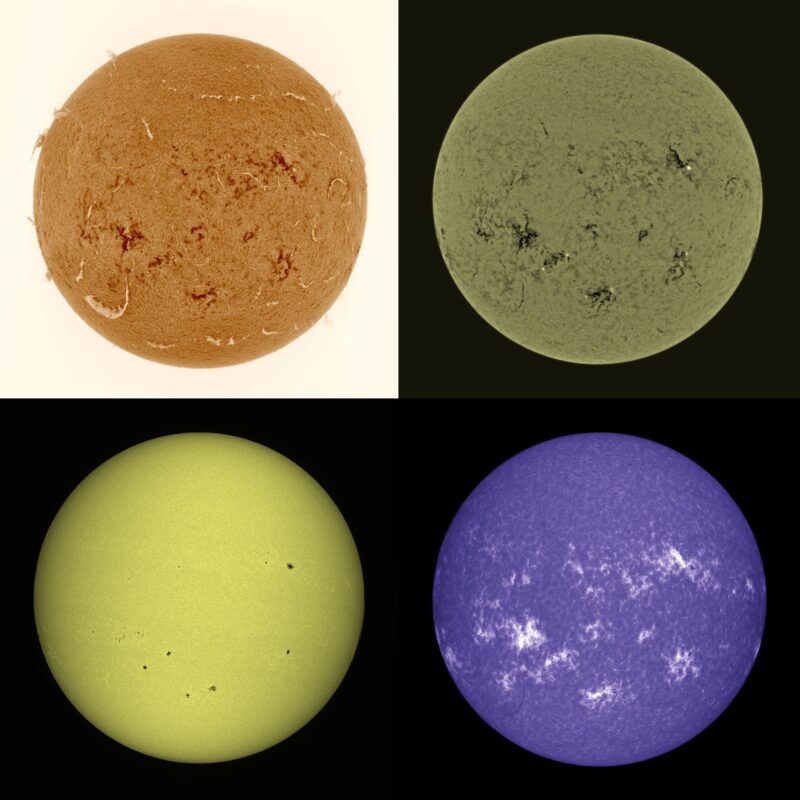
Solar wind enhancements from a solar blob (CME) that erupted on July 23 are expected to impact Earth today, possibly triggering G1 (minor) geomagnetic storm conditions. The first signs of this disturbance may have already arrived on July 26, with increasing solar wind speeds and a southward shift in the interplanetary magnetic field (IMF). The period ahead may bring auroras at high latitudes, with effects potentially lingering into July 28 before conditions settle. Stay tuned and clear skies!
- Flare activity remains low, with only C-class (common) flares recorded over the past 24 hours. The strongest was a C3.4 flare at 9:13 UTC from an unseen region between AR4155 and AR4159 near disk center. This region has already begun to decay as it rotates further into view. Other minor flares were observed from AR4149, but no M- or X-class flares have been detected.
- There are up to 10 sunspot regions visible, nine of them numbered. The largest region is a moderately large bipolar group in the northwest, showing some decay. The second-largest region is located in the southeast, but it has shown only minor growth. The rest are small and magnetically simple, with no major flare threats for now.
- Blasts from the sun? A narrow coronal mass ejection (CME) associated with a filament eruption on July 25 was observed but is not expected to impact Earth. The anticipated CME from July 23, however, may already be arriving and is the primary driver behind today’s geomagnetic forecast.
- Solar wind speeds were mostly between 500–600 km/s, then gradually declined to 450–500 km/s later in the day. The interplanetary magnetic field (IMF) strengthened, with the crucial Bz component turning southward between 09:00 and 17:00 UTC, then shifting northward. These changes point to an active interplanetary environment. A Bz south-oriented favors auroral displays.
- Earth’s magnetic field was quiet early in the day, but shifted to unsettled to active (Kp = 3 – 4) levels later. This increase likely reflects the CME’s initial impact.
What’s ahead? Sun-Earth forecast
- Moderate-to-low flare activity is expected in the coming day. The chance for M (moderate) flares is 40% today, and the chance for X (strong) flares is 5% today.
- Geomagnetic activity forecast: Geomagnetic storm activity is expected to peak on July 27, with G1 (minor) geomagnetic storm conditions likely and a slight chance of isolated G2 (moderate) periods, driven by the arrival of a CME launched on July 23. On July 28, conditions should gradually diminish, though some enhanced activity may linger early in the day. By July 29–30, geomagnetic conditions are forecast to be mostly quiet to unsettled, but a renewed chance for G1 storm activity emerges as a new northern coronal hole begins to influence Earth. Solar wind speeds are expected to decline steadily through July 28–29, before rising again late on July 29 or into July 30 as the next high-speed stream from the coronal hole arrives. Clear skies to all!
Sun news July 26: A CME coming to us at Earth
(11 UTC to 11 UTC)
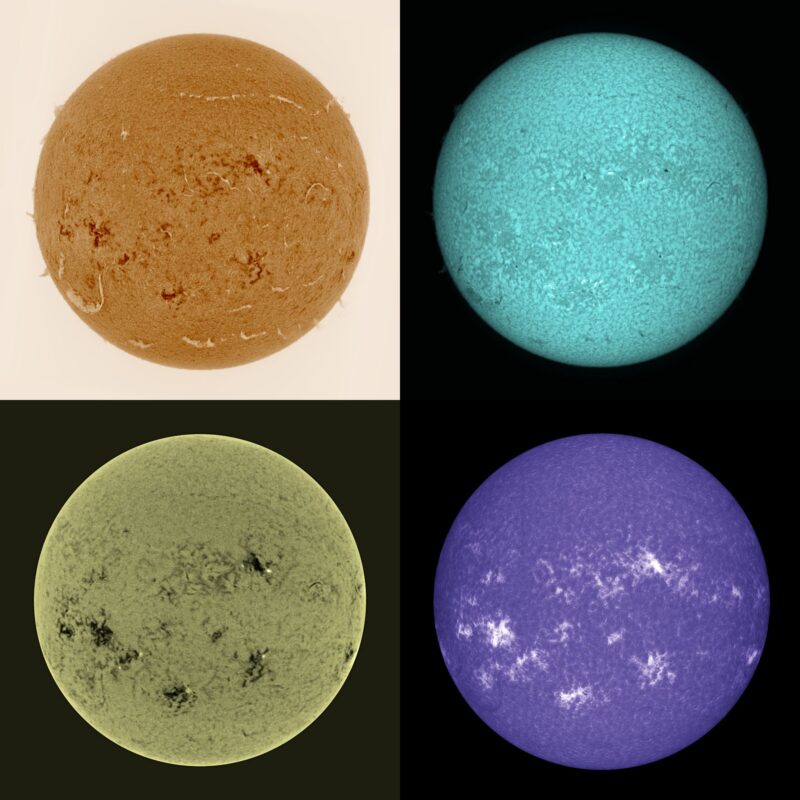
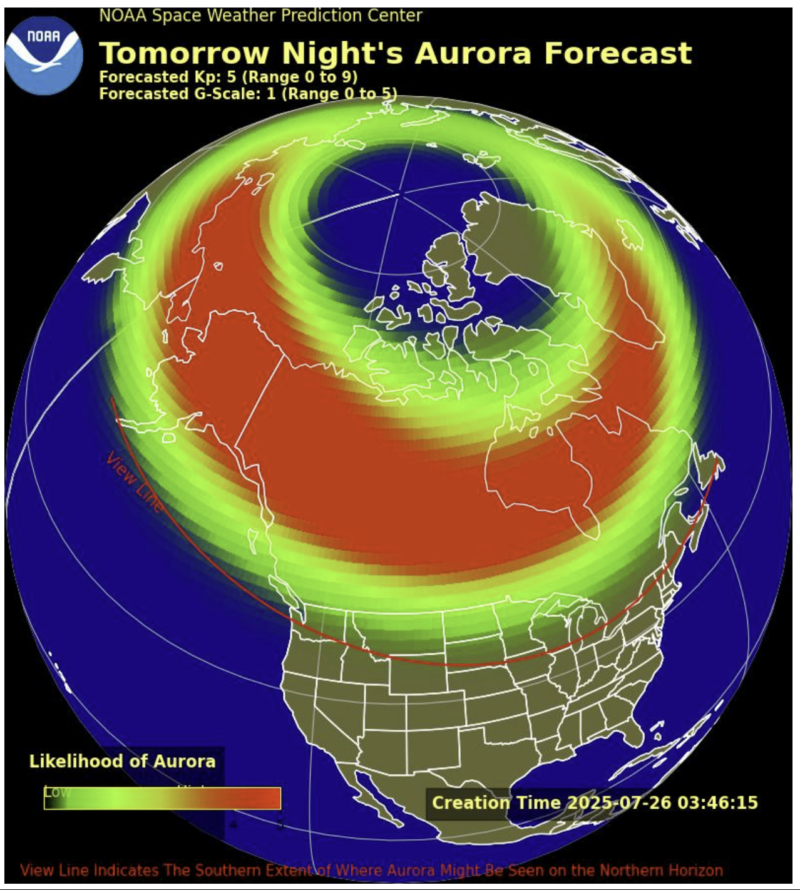
A blob of solar stuff is on its way to us at Earth. Its arrival time is estimated for tomorrow morning, Sunday, July 27, extending into July 28. The coronal mass ejection (CME) was hurled by the sun on July 23 while a lifting filament erupted. It is a rather small chunk of solar plasma and magnetic fields, but it might trigger conditions for auroral displays at high latitudes. A G1 (minor) geomagnetic storm is expected by 9:00 UTC on July 27. Isolated chances for a G2 (moderate) level may occur. Keep tuned.
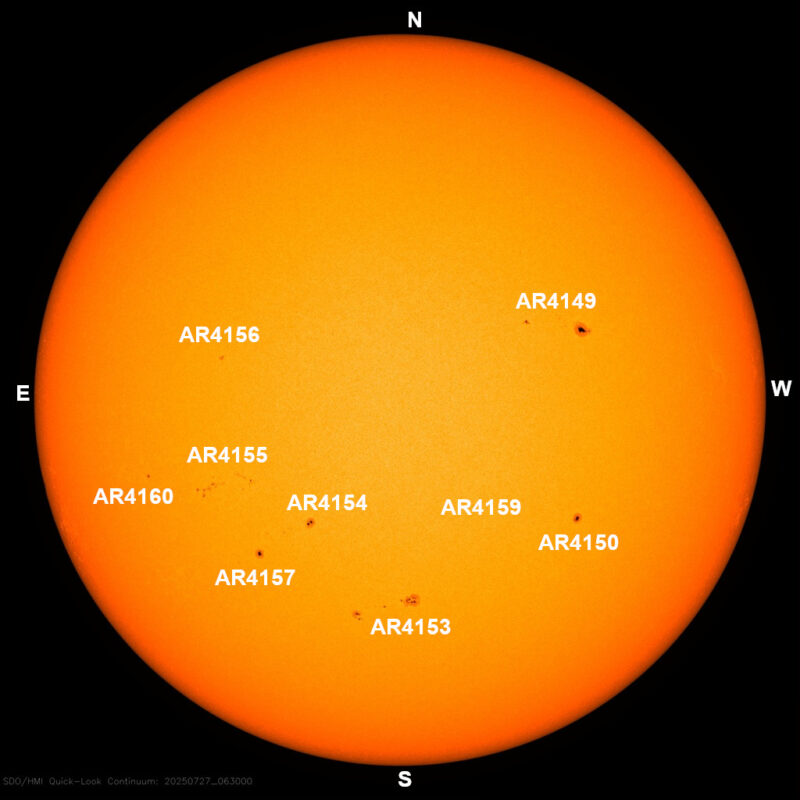
- Flare activity kept low over the past 24 hours with only faint C-class (common) flares. The sun produced only five C flares during our observation period. Two C1.2 flares were the strongest of the day. Active regions AR4155 in the southeast, and AR4149 in the southwest, produced them (the first at 18:07 UTC on July 25 and the second at 0:38 UTC on July 26). Overall, AR4153 and AR4155 produced two C flares each, making them the flare leaders of the past day.
- There are eight sunspot regions on the Earth-viewed side of the solar disk. Active regions AR4149 and AR4153 kept their beta-gamma magnetic complexity. AR4149 continued being the largest sunspot region in extent. The rest of the active regions on the solar disk have stable alpha or beta configurations.
- Blasts from the sun? Other than the coronal mass ejections (CME) described above, no new Earth-bound CMEs were observed in available coronagraph imagery over the past day.
- Solar wind speed averaged around 530 km/s with peaks almost reaching the 620s km/s during the period. At the time of this writing the solar winds keeps at 521 km/s. The interplanetary magnetic field (IMF) is at moderate level. The Bz intermittently moving beween south and north during the period, ended northward at 9:30 UTC on July 25. A Bz south oriented favors auroral displays.
- Earth’s magnetic field was at low-to-unsettled levels over the past day (Kp = 1 – 3). It was the calm before the storm. At the time of this writing the Kp index stays at the smallest digit = 1.

Sun news July 25: A CME and new moon from GOES-19
(11 UTC to 11 UTC)
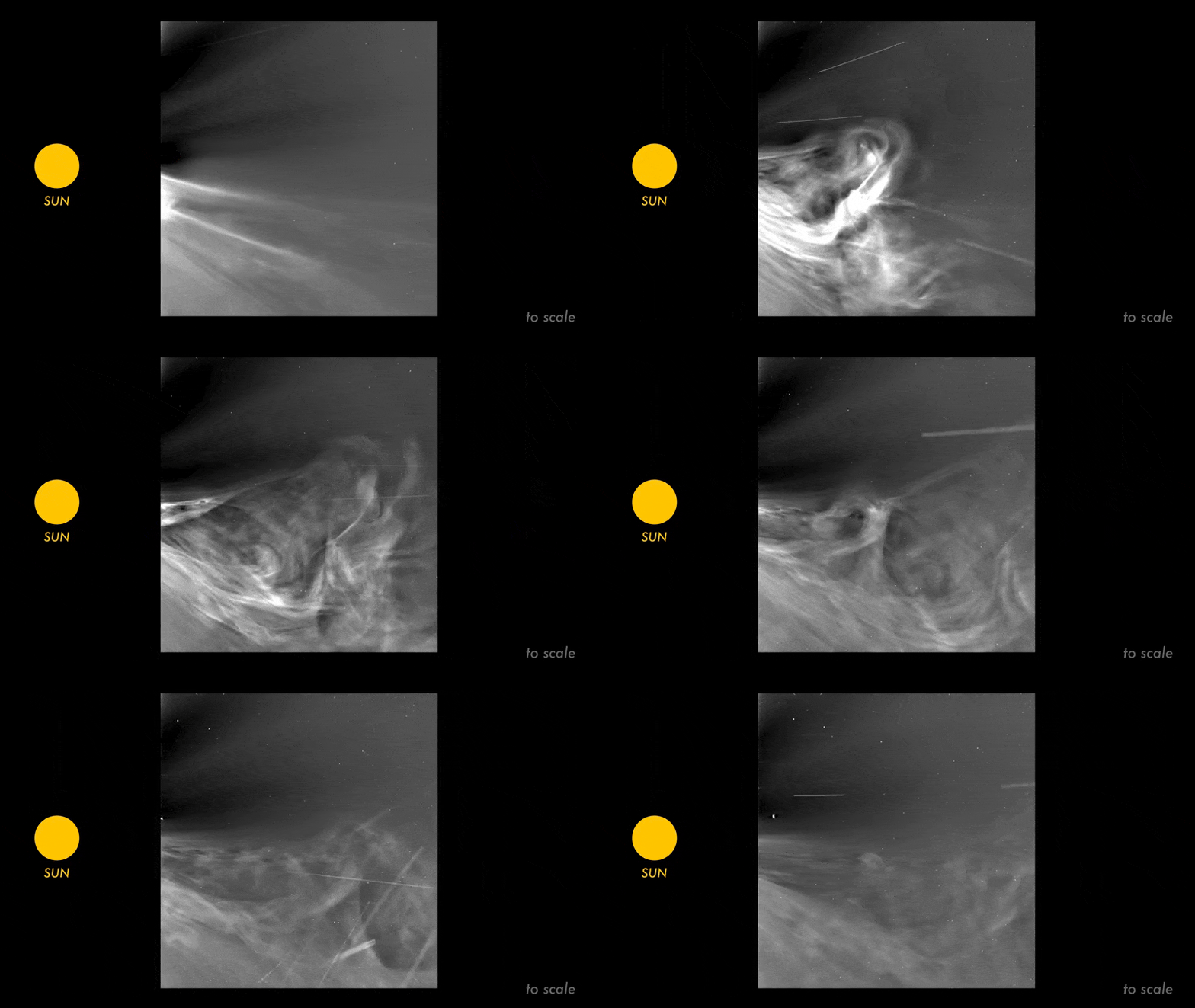

Although sun flaring has been low in recent days, the sun produced a couple of filament eruptions over the past day that hurled solar blobs of plasma and magnetic fields into space. GOES-19/CCOR-1 imager captured the 2nd one, the largest of the two, at around 16:00 UTC on July 24. See the image below. The blast occurred just before new moon – the time each month when the moon passes in front of (or nearly in front of) the sun – from Earth’s point of view. The spacecraft is orbiting Earth, so it gives us robot eyes on this new moon, the first we can recall. GOES-19 captured the moon in fantastic and amazing definition. It’s an amazing new imager!
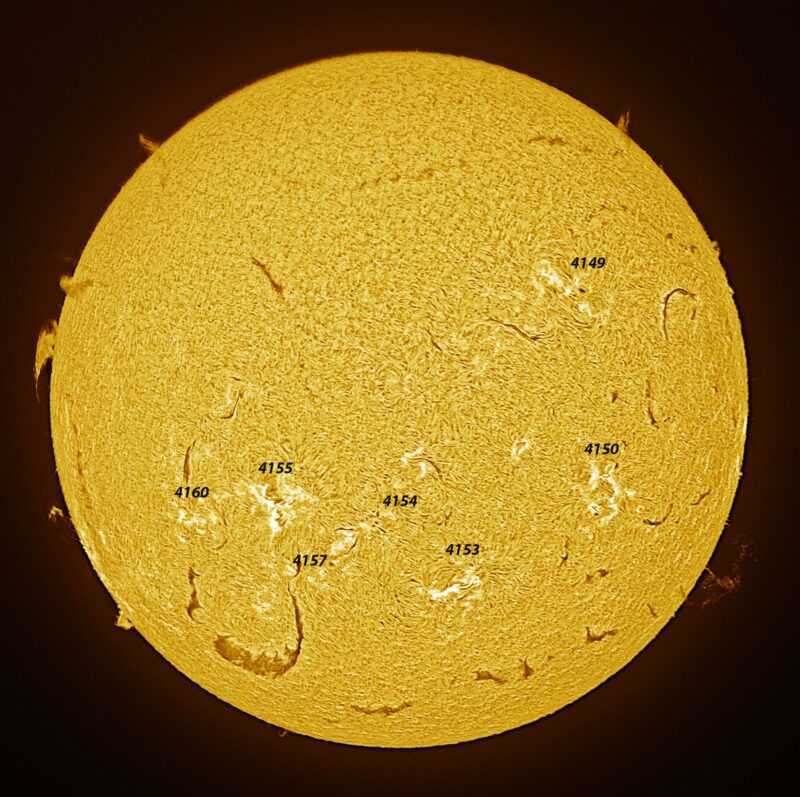
- Flare activity has been low, and remains low, with only faint C-class (common) flares in the last 24 hours. This time the sun produced 12 C flares, with the strongest being a C7.4 flare produced at 1:01 UTC on July 25. It originated from active region AR4149 in the sun’s northeast. Active regions AR4149 and an unnumbered region in the southwest share honors for lead flare producer. They produced four C flares each.
- There are nine sunspot regions on the solar disk as we see it from Earth. Active region AR4149 regained its gamma configuration while AR4153 also developed its own gamma configuration and both now show a beta-gamma magnetic complexity. AR4149 remains as the largest sunspot region in extent and started to “wake up” during the period. The rest of the active regions on the solar disk have stable alpha or beta configurations. There are four new numbered sunspot regions on the Earth-viewed solar disk this time, they are: AR4155, AR4156, AR4157 and AR4158.
- Blasts from the sun? Two coronal mass ejections (CMEs) were registered by SOHO’s LASCO C2 image. Both were in the sun’s southwest. The first was at 6:24 UTC, and the second, the largest, was at 16:12 UTC, both on July 24. It appears neither is coming toward Earth, but we have our eye on them.
- Solar wind speed averaged around 600 km/s with peaks almost reaching the 700 km/s during the period. At the time of this writing the solar winds keeps at 555 km/s. The interplanetary magnetic field (IMF) is at a low level. The Bz mostly north during the period, ended southward at 9:30 UTC on July 25. A Bz south oriented favors auroral displays.
- Earth’s magnetic field was at unsettled-to-active levels over the past day (Kp = 3 – 4). A Kp = 4 level was reached at 12 UTC on July 24. Afterwards, it reduced to Kp3 at around 9 UTC on July 25. The coronal hole high-speed stream CH HSS has started to wane.
Sun news July 24: Coronal hole moves on, delivers 2nd storm
(11 UTC to 11 UTC)

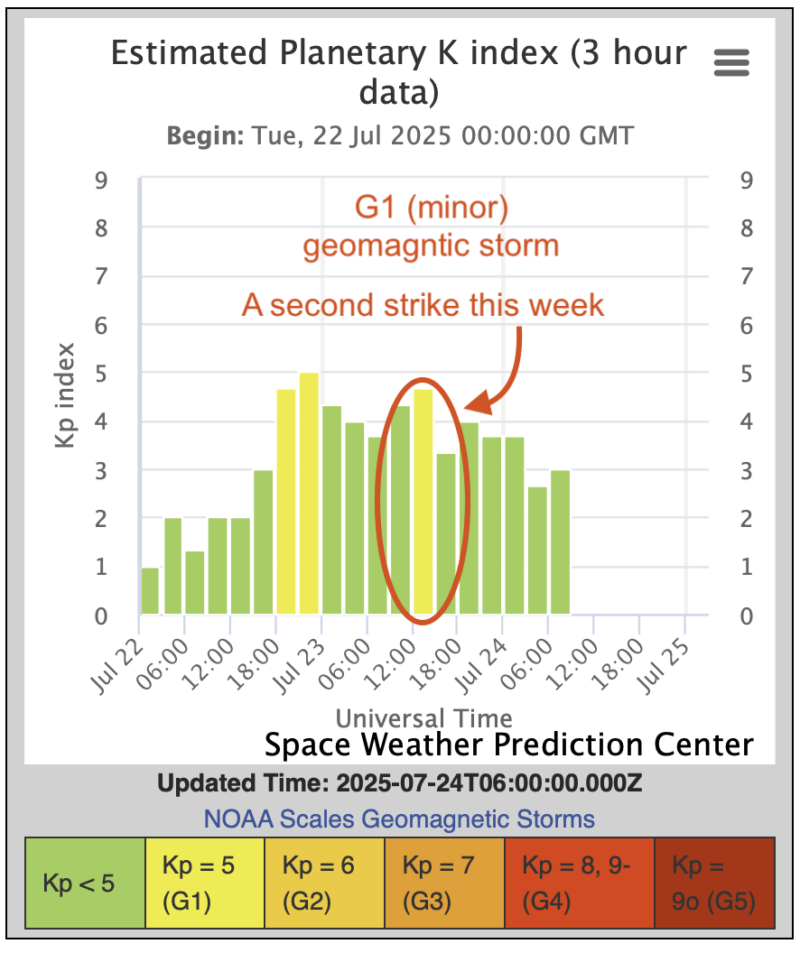
The sun’s rotation is now carrying the large coronal hole we’ve been monitoring out of its geoeffective position (where it’s capable of affecting Earth). As it’s going, it delivered another punch: the fast solar wind it launched toward Earth triggered a G1 (minor) geomagnetic storm. The Kp index reached 5 at 14:59 UTC yesterday (July 23), and that level was sustained for one 3-hour synoptic period. The disturbance was enhanced by a corotating interaction region (CIR)—a turbulent zone, where fast and slow solar wind streams mix. More G1 conditions are possible today (July 24), though activity is expected to ease as the solar wind begins to wane. So auroras could – still – appear at any time!
- Flare activity was low, with eight C-class (common) flares in the last 24 hours. The strongest event was a C8.1 flare produced at 5:45 UTC on July 24, originating from an unnumbered incoming active region in the southwest. Three regions shared the spotlight for most flares (two each): AR4153, an unnumbered region in the southeast, and the unnumbered region in the southwest.
- There are six sunspot regions on the Earth-facing disk. Active region AR4149 lost its gamma configuration and is now a simpler beta magnetic complexity. It remains the largest sunspot region in extent and remained flare unproductive during the period. The rest of the active regions on the solar disk have stable alpha or beta configurations. There is a new numbered sunspot region: AR4154 in the southeast. There are two awaiting numbers.
- Blasts from the sun? A filament eruption at 5 UTC on July 23 hurled plasma into space. The LASCO C3 observed it as a partial halo event. Preliminary modeling and analysis estimate an arrival at Earth early on July 27. No other Earth-oriented coronal mass ejections (CMEs) were observed in available coronagraph imagery.
- Solar wind speed averaged around 640 km/s reaching a peak of 796 km/s at 21:22 UTC on July 23 ending the period around 620 km/s. The interplanetary magnetic field (IMF) is at a low level. The Bz intermittently kept moving from south to north. At the time of this writing it is southward. A Bz south oriented favors auroral displays.
- Earth’s magnetic field was at unsettled-to-storming levels (Kp = 3 – 5). A G1 (minor) geomagnetic storm was observed late yesterday. The Kp = 5 threshold was reached at 14:59 UTC on July 23 and stayed there for one three-hour synoptic period. This was caused by a coronal hole high-speed stream CH HSS. As of this writing, the Kp index is 3 or active.
Sun news July 23: Minor geomagnetic storm last night
(11 UTC to 11 UTC)

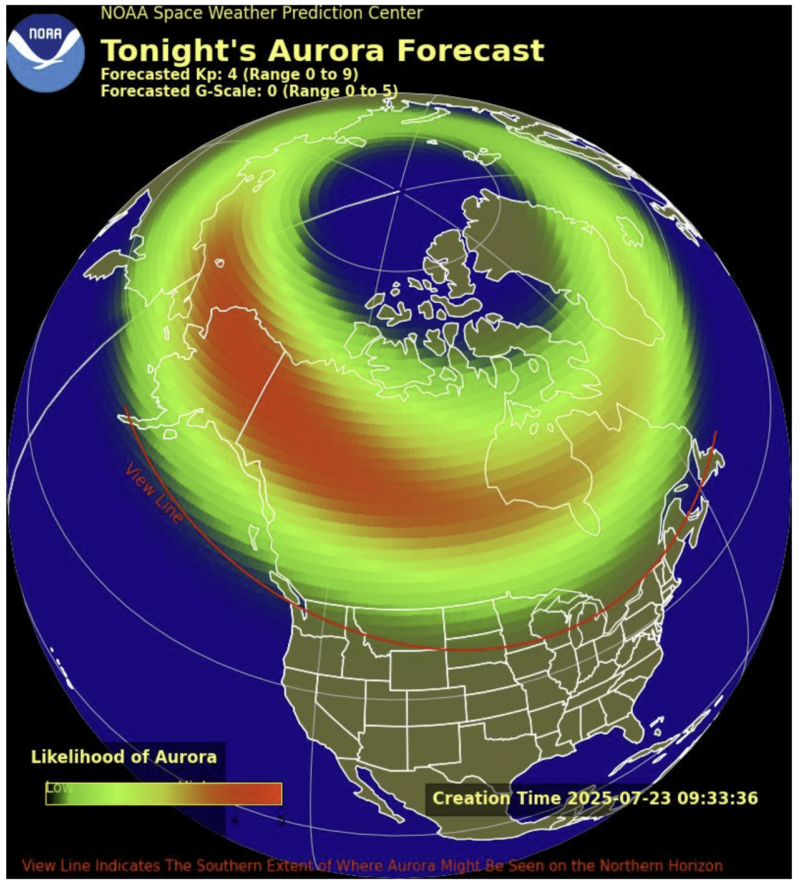
Auroras were visible at northern latitudes last night, as far south as Maine and Michigan, as a stream of high-speed solar wind triggered a G1 (minor) geomagnetic storm. The disturbance was amplified by a corotating interaction region, which indicates turbulent knots of fast and slow solar wind streams mixing together. Minor-to-moderate storms are expected to continue through today, so there’s a chance for more auroras tonight!
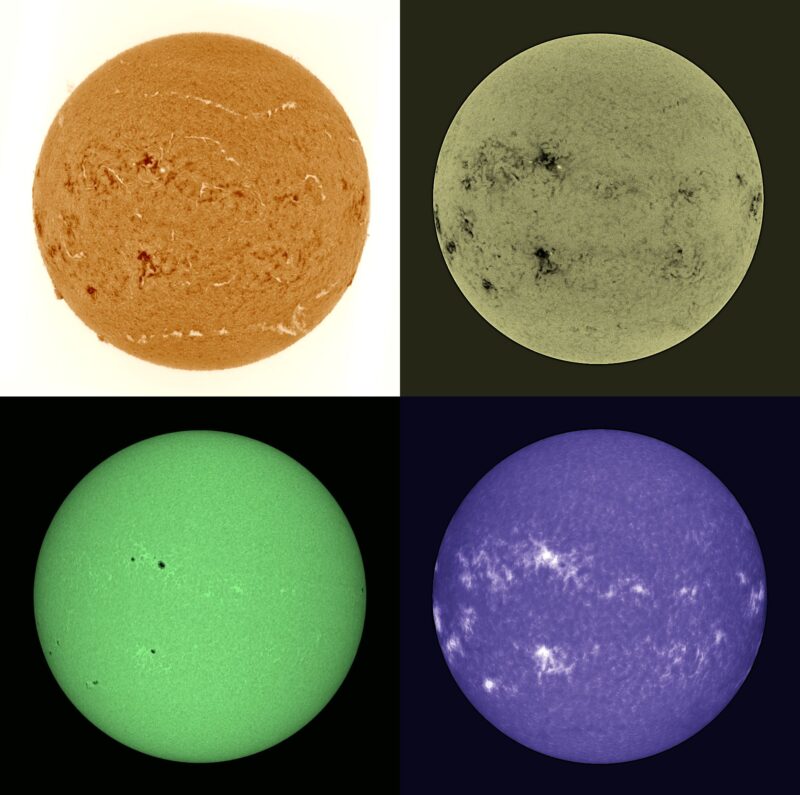
- Flare activity on the sun itself is low with only C-class (common) flares in the last 24 hours. There were 12 C flares in total and the strongest event was a C6.4 flare produced at 20:11 UTC on July 22. The blast was produced by active region AR4150 in the southeast. Active region AR4143 was the most flare productive with five C flares.
- There are seven sunspot regions on the Earth-facing disk. Active region AR4149 remains the largest and still has a beta-gamma magnetic complexity but remained flare unproductive during the period. The remaining active regions on the solar disk have stable alpha or beta configurations. There is a new numbered sunspot region: AR4153 in the southeast.
- Blasts from the sun? No Earth-oriented coronal mass ejections (CMEs) were observed in available coronagraph imagery.
- Solar wind speed increased from 346 km/s reaching a peak of 700 km/s ending the period around 650 km/s. The interplanetary magnetic field (IMF) is at a moderate level. The Bz intermittently moved south to north. At the time of this writing it is southward. A Bz south oriented favors auroral displays.
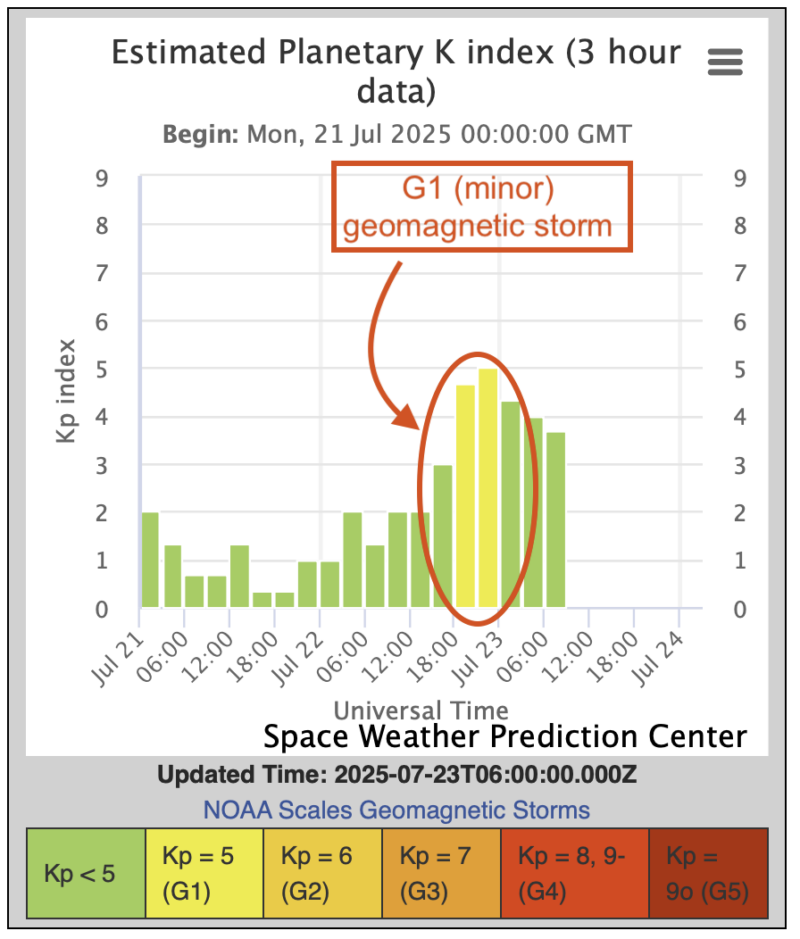
- Earth’s magnetic field was at quiet to storming levels (Kp = 1 – 5). A G1 (minor) geomagnetic storm was observed late yesterday. The Kp = 5 threshold was reached at 18 UTC on July 22 and stayed there for a two of three – hour synoptic periods. This was due to the arrival of a coronal hole high-speed stream CH HSS. As of this writing, the Kp index is 4 or active.
Sun news July 22: Auroras coming
(11 UTC to 11 UTC)
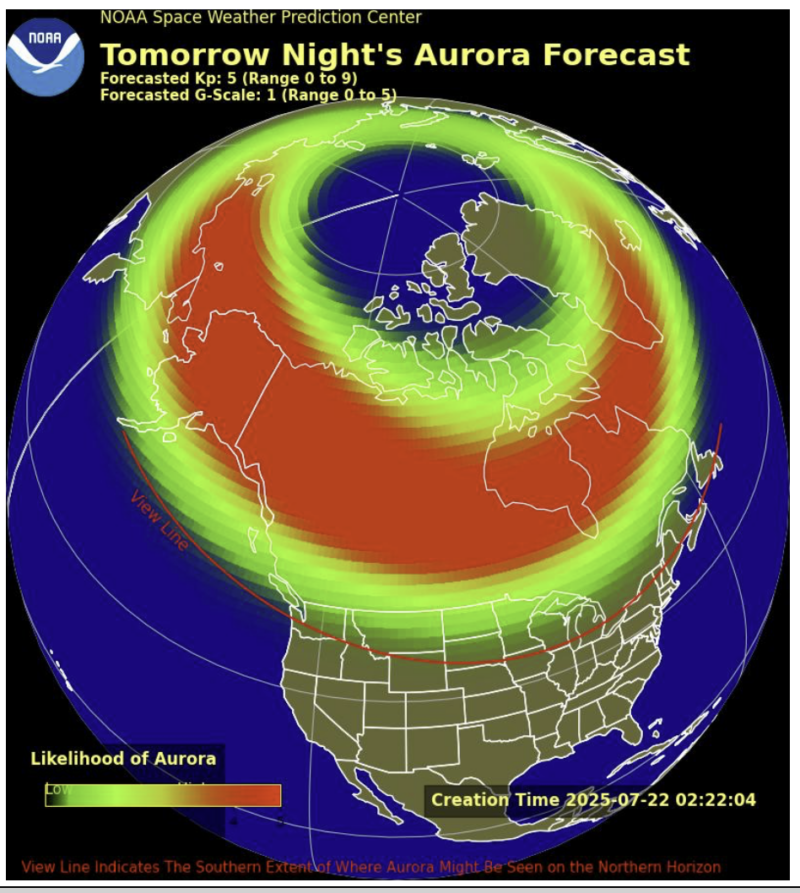
A stream of fast solar wind from a recurrent coronal hole is expected to arrive late today or early tomorrow (July 23, in the early hours UTC). This high-speed stream could trigger G1 (minor) geomagnetic storm conditions, especially during the initial impact. That means auroras might be visible at high latitudes tomorrow morning in Scandinavia, and possibly tomorrow evening for northern North America.
- Flare activity is low. We saw only C-class (common) flares over the past day, seven C flares in total. The strongest events were a couple of C2.8 flares produced during our observation period. The first C2.8 from AR4139 in the northwest at 21:09 UTC on July 21. The second C2.8 flare was produced by AR4143 at 8:08 UTC on July 22.
- There are currently six sunspot regions on the Earth-facing disk. Active region AR4149 shows a beta-gamma magnetic complexity and is for now the largest sunspot region with potential for moderate activity. Meanwhile the rest of the active regions on the solar disk as we see it from Earth remain with stable alpha or beta configurations.
- Blasts from the sun? A filament eruption occurred at around 3 UTC on July 21 in the solar southwest. It produced a narrow CMEs. Initial modeling and analysis efforts show an Earth miss. No other CMEs were observed in available coronagraph imagery.
- Solar wind conditions decreased, ending the period around 346 km/s, with the interplanetary magnetic field (IMF) remaining weak and Bz mostly northward. These are typical quiet solar wind conditions.
- Earth’s magnetic field has been quiet (Kp = 0 – 1). This calm is expected to shift tomorrow with the arrival of fast wind from the CH HSS. As of this writing, the Kp index is at 1.
Sun news July 21: See Earth block our view of the sun!
(11 UTC to 11 UTC)
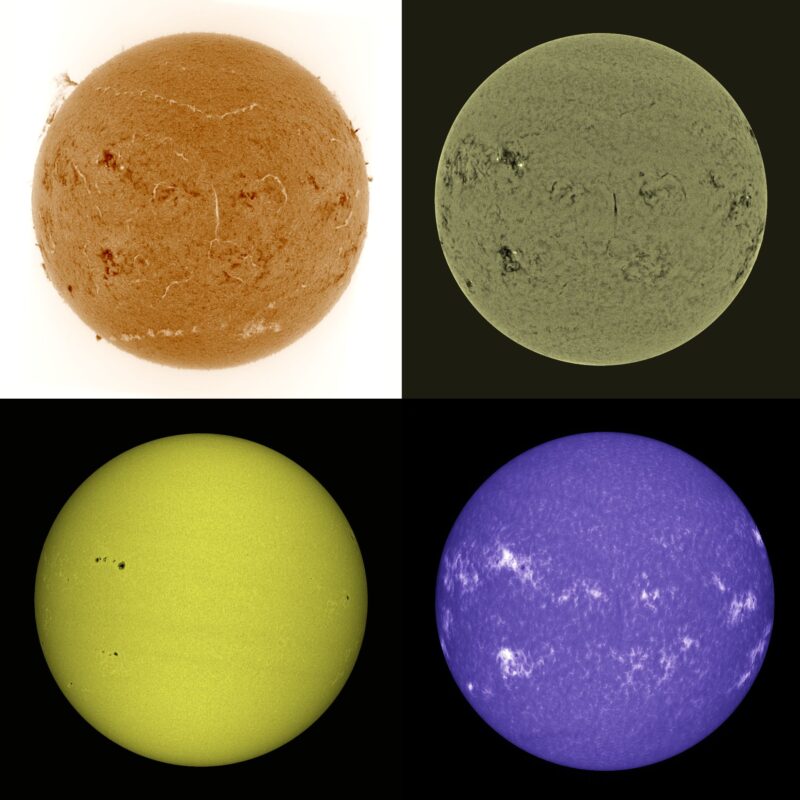

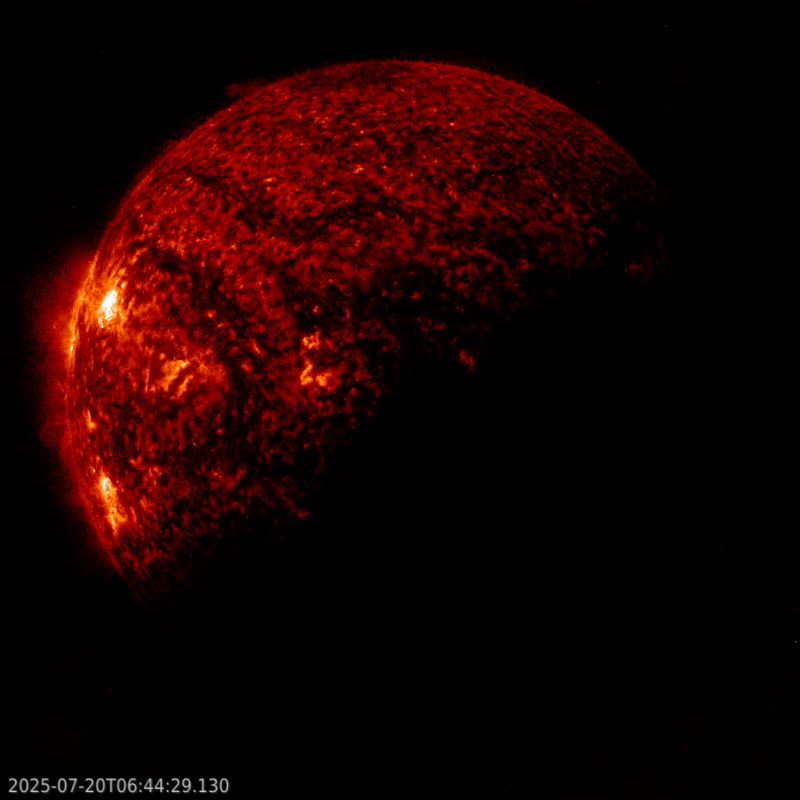
Happy SDO eclipse season! Twice a year, because of the SDO spacecraft’s geosynchronous orbit, Earth obstructs its view of our star for between 30 and 70 minutes every day for several weeks. The current eclipse season began on July 10 and will end on August 7. Thankfully, solar activity is currently low, so we’re not missing too much. But we did see a filament eruption early yesterday that fired a blast of sun-stuff into space. This coronal mass ejection (CME) is expected to miss Earth, although forecasters note it could give us a glancing blow around July 22–23. Stay tuned.
- Flare activity is low. We saw only C-class (common) flares over the past day, mainly from AR4136, AR4143, and AR4149. The most significant was a C6.5 flare at 15:37 UTC on July 20 from AR4136, now nearing the sun’s western limb (edge). No M-class (moderate) or stronger flares occurred, but NOAA and the UK MetOffice are both forecasting a chance for M-class flares in the coming days.
- There are currently 12 sunspot regions on the Earth-viewed sun. Notable activity is concentrated in the northwest, where magnetic looping remains visible even as some regions rotate out of view. A promising region in the northeast continues to develop, and newly numbered AR4151, near the center of the disk, is also showing minor growth. Overall, magnetic complexity remains moderate, with some regions carrying beta or beta-gamma classifications.
- Blasts from the sun? One coronal mass ejection (CME) was observed in connection with the July 20 filament eruption, but it is not clearly Earth-directed. However, models do suggest a glancing blow is possible late on July 22 or early July 23. No other CMEs were observed in available coronagraph imagery.
- Solar wind conditions decreased from 440 km/s (984,252 mph) to about 400 km/s (894,775 mph). The interplanetary magnetic field (IMF) was moderate, with a brief southward (Bz) dip, though overall conditions were calm. A southward Bz component is favorable for auroras.
- Earth’s magnetic field has been quiet (Kp = 0 – 1). The current solar wind stream shows signs of diminishing influence from prior coronal hole activity. As of this writing, the Kp index is at 1.
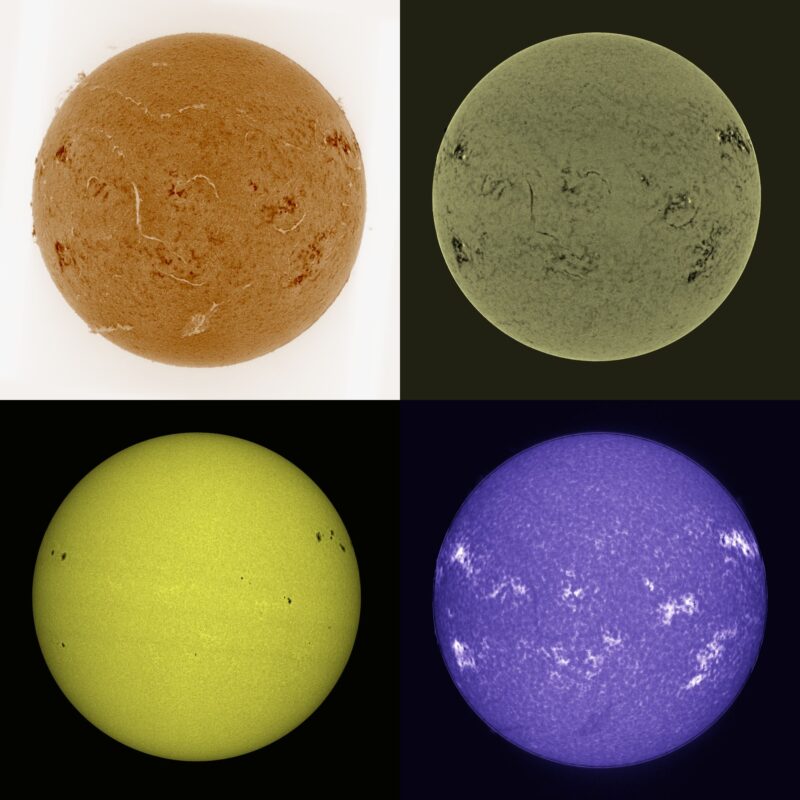
Sun news July 20: Active regions shift east, solar wind calms
(11 UTC to 11 UTC)
Solar activity remains low, but the dynamics on the Sun are shifting. A cluster of sunspot regions in the Sun’s northwest quadrant continues to fade, while two newly numbered regions (AR4149 and AR4150) are rotating into view on the eastern limb. These fresh arrivals are relatively large and will be monitored closely in the coming days for signs of increased flare activity. Meanwhile, fast solar wind from a coronal hole is tapering off, leaving Earth’s magnetic field in a quieter state—for now. Stay tuned for the latest updates on solar activity!
- Flare activity was again low, limited to minor C-class flares. Most flaring originated from AR4136, which has slightly decayed but remains magnetically complex. No M- or X-class flares were observed. The largest event was a C7.6 from AR4136 at 7:41 UTC on July 20.
- There are currently eight sunspot regions on the Earth-facing side of the Sun. Region AR4143 has a beta-gamma classification, suggesting potential for M-class flares—and possibly even X (strong) flares. The remaining all exhibit simpler alpha or beta configurations. The most prominent group is still in the northwest quadrant, though attention is shifting toward emerging activity on the eastern limb, where two newly visible sunspots appear large and potentially more magnetically interesting (AR4149 and AR4150.)
- Blasts from the sun? No Earth-directed coronal mass ejections (CMEs) were observed in available coronagraph imagery.
- Solar wind parameters were indicative of a waning connection to a coronal hole fast wind. Solar winds were initially at elevated levels, slowly declining from 550 km/s (1,230,000 mph) down to slightly elevated levels around 430 km/s (961,883 mph). As of this report, the speed is around 413 km/s (923,855 mph). The interplanetary magnetic field (IMF) was weak. The north-south component (Bz) was also weak, varying erratically. The net result of the above solar wind measures was for Quiet geomagnetic activity (Kp1-2).
- Earth’s magnetic field was quiet (Kp = 1 – 2. As of this writing, the Kp index is at 1.
What’s ahead? Sun-Earth forecast
- Moderate-to-low flare activity is expected in the coming day. The chance for M (moderate) flares is 40% today, and the chance for X (strong) flares is 10% today.
- Geomagnetic activity forecast: coronal hole” rel=”noopener” target=”_blank”>Coronal hole fast wind influences are currently underway but should continue to wane with no further enhancements expected until the very end of the period when the next fast wind will probably arrive. Generally quiet activity is expected through much of the period, with active to G1 (minor) geomagnetic storm intervals on July 23.
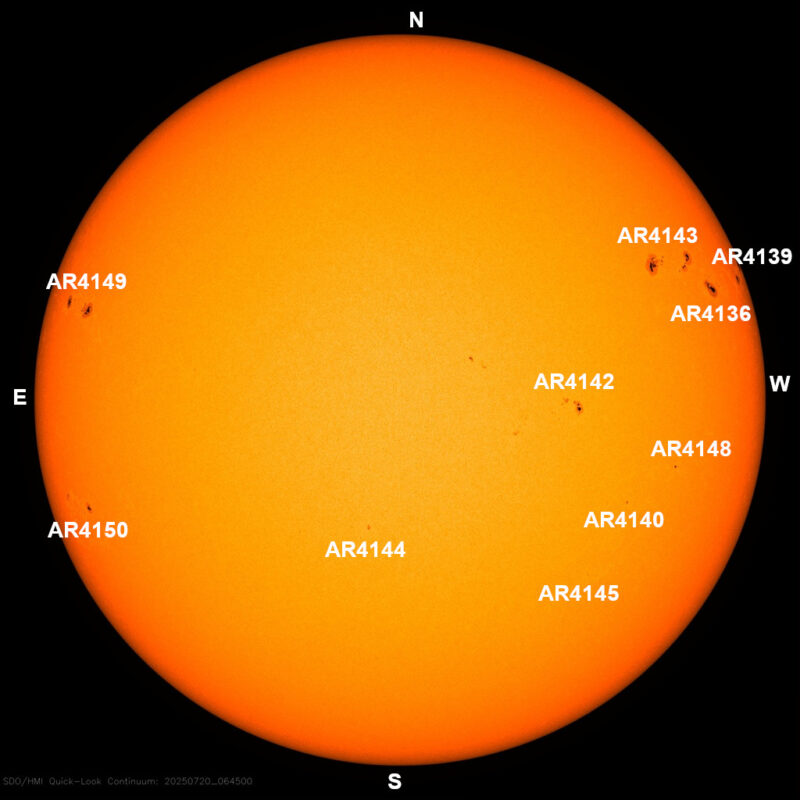
Sun news July 19: Newest coronal hole moves to center stage
(11 UTC to 11 UTC)
The large coronal hole reported yesterday is now approaching the center of the solar disk as seen from Earth. Meanwhile, the massive southern coronal hole is rotating out of view in the sun’s southwest quadrant. It was responsible for geomagnetic activity earlier this week. The incoming coronal hole isn’t as large, but it might still send fast solar wind our way in the coming days, potentially triggering more geomagnetic disturbances. We’ll be watching closely. Stay tuned for the latest updates on solar activity!
- Flare activity remained low, limited to C-class flares. A total of eight C-class flares were recorded, with the two strongest—both C2.4 flares—produced by AR4136 at 13:09 UTC on July 18 and 03:27 UTC on July 19. AR4136 led all active regions with six flares total over the past 24 hours.
- There are currently eight sunspot regions on the Earth-facing side of the Sun. Three regions show notable magnetic configurations, particularly AR4136, which maintains a beta-delta classification, suggesting potential for M-class flares—and possibly even X (strong) flares. Meanwhile, AR4142 and AR4143 have lost their gamma complexity and now exhibit simpler alpha or beta configurations.
- Blasts from the sun? No Earth-directed coronal mass ejections (CMEs) were observed in available coronagraph imagery.
- Solar wind speeds averaged around 530 km/s (1,186,000 mph), with a peak of 732 km/s (1,637,000 mph) at 06:52 UTC on July 19. As of this writing, the speed is around 537 km/s (1,201,000 mph). The interplanetary magnetic field (IMF) remains weak, with its north–south component (Bz) mostly southward late yesterday, fluctuating earlier today. Bz is currently southward, a favorable condition for auroras.
- Earth’s magnetic field ranged from quiet to active levels (Kp = 1 – 4), though it stayed mostly between Kp = 1–2. These variations were caused by a high-speed solar wind stream from a southern coronal hole. As of this writing, the Kp index is at 2.
What’s ahead? Sun-Earth forecast
- Moderate-to-low flare activity is expected in the coming day. The chance for M (moderate) flares is 50% today, and the chance for X (strong) flares is 10% today.
- Geomagnetic activity forecast: Quiet to unsettled conditions are expected for the rest of today as fast solar wind from the southern coronal hole continues to subside. On July 21, conditions are likely to be mostly quiet. A new fast wind stream may arrive around July 22, bringing a chance of active to minor storm intervals.
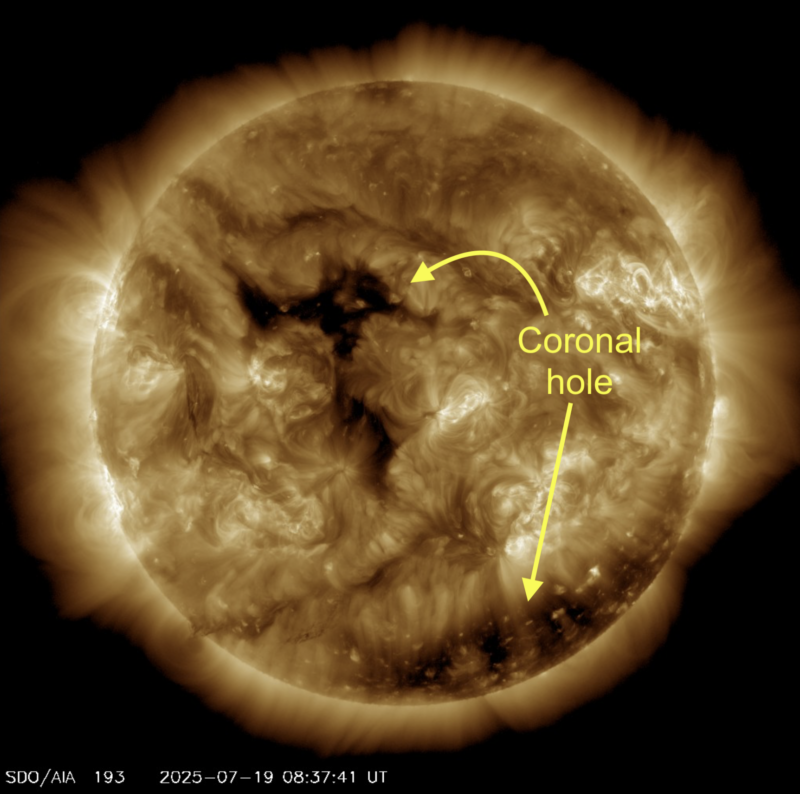
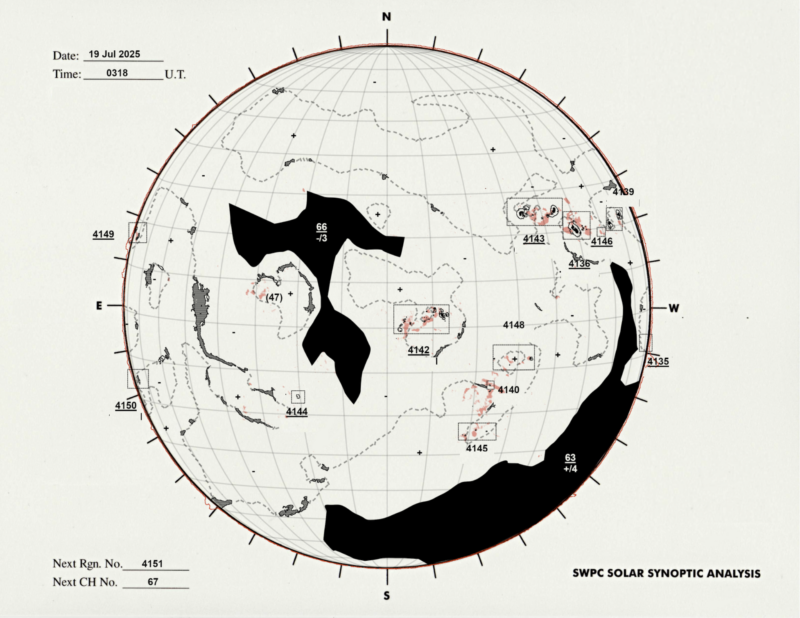
Sun news July 18: Coronal hole winds stir magnetic field
(11 UTC to 11 UTC)
A massive coronal hole in the sun’s southern hemisphere—now rotating out of view—drove this week’s space weather, sending fast solar wind that sparked up to three G1 (Minor) geomagnetic storms and chances for auroras. As that hole departs, a new large coronal hole is forming in the northeast. In the coming days, it will rotate into the center of the sun’s disk—putting Earth in the path of its high-speed stream. We could see more auroras early next week. Stay tuned.
- Flare activity remained low over the past 24 hours with only C-class flares. The largest flare of the 10 C flares of the past day was a C3.6 flare produced by AR4136 at 8:13 UTC on July 18. AR4146 became the lead flare producer of the past day with nine flares including the largest.
- The sun currently has 10 sunspot regions on its Earth-facing side. There are three sunspot regions with interesting magnetic configurations. Active regions AR4136 retained its beta-delta magnetic configuration while AR4142 and AR4143 show a beta-gamma complexity. These indicate the potential conditions for flares in the M (moderate) flare range and possibly X (strong) flares. The remaining regions have simpler alpha or beta configurations and are stable or in decay. There is a newcomer on the solar disk: AR4148 in the southwest.
- Blasts from the sun? No Earth-directed coronal mass ejections (CMEs) were observed in available coronagraph imagery.
- Solar wind speeds have decreased from around 750 km/s (1,678,000 mph) to 595 km/s (1,331,000 mph) as of this writing. The interplanetary magnetic field (IMF) remains at a low level, with its north–south component (Bz) oriented mostly southward late yesterday, shifting intermittently north–south earlier today. Bz is currently southward—a configuration that favors auroral activity.speeds reduced from around 750 km/s (1,678,000 mph) to 595 km/s (1,331,000 mph) at the time of this writing. The interplanetary magnetic field (IMF) was at a low level. The north-south component (Bz) was mostly south oriented late yesterday to move intermittently north-south early today. At the time of this writing the Bz component is south oriented. A southward Bz is more favorable for auroras.
- Earth’s magnetic field ranged from quiet to active levels (Kp = 1 – 4). Notably, it held at Kp = 4 for four consecutive 3-hour periods late yesterday before settling between Kp = 1–2. These disturbances were driven by a high-speed solar wind stream from a southern coronal hole. Earth’s magnetic field is at Kp = 2 at the time of this writing.

Sun news July 17: Beautiful twisting prominence yesterday
(11 UTC to 11 UTC)
Take a look at the stunning solar prominence below! Powered by incredibly strong magnetic fields, this rope of plasma emerged from near the solar south pole Wednesday evening, twisted like a tornado, and eventually fell back to the sun.
- Flare activity remained low over the past 24 hours. We observed 14 flares over the past 24 hours, all of them C-class flares. The largest flare was a C2.5 flare produced by AR4142 at 19:04 UTC on July 16. AR4142 produced the most flares with 10.
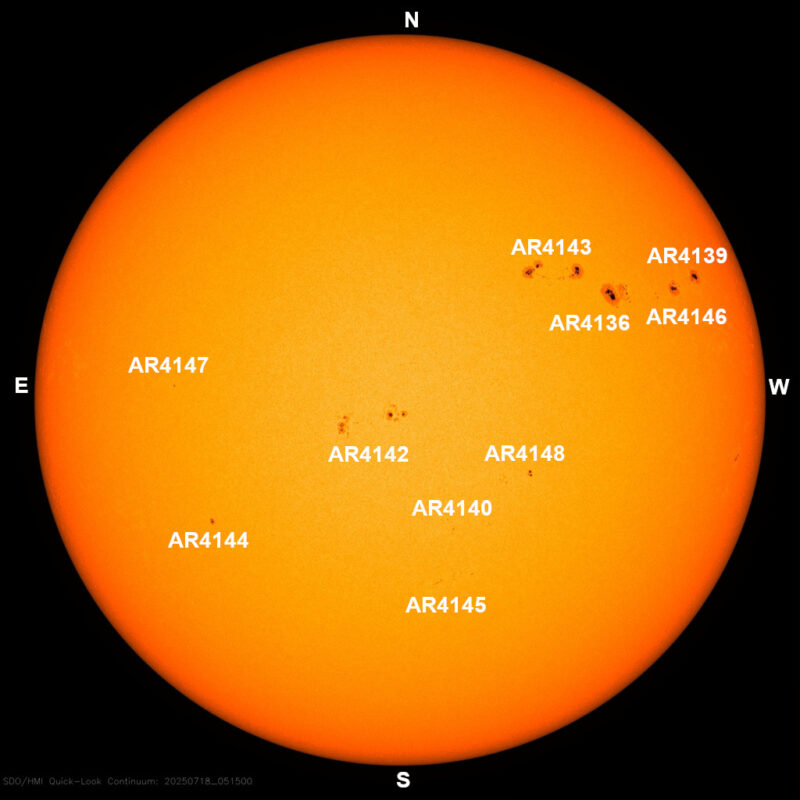
- The sun currently has 10 sunspot regions on its Earth-facing side. Today, we have three sunspot regions with interesting magnetic configurations. Active regions AR4136 and AR4142 developed delta regions, both now showing beta-delta magnetic configurations. AR4143 has a beta-gamma complexity. These regions now all show a good potential for flares in the M (moderate) flare range and possibly X (strong) flares. The remaining regions have simpler alpha or beta configurations and are stable or in decay. There are two newcomers on the solar disk: AR4146 in the northwest and AR4147 in the northeast.
- Blasts from the sun? No Earth-directed coronal mass ejections (CMEs) were observed in available coronagraph imagery.
- Solar wind speeds increased from around 550 km/s (1,230,000 mph) to 665 km/s (1,488,000 mph) at the time of this writing. The interplanetary magnetic field (IMF) was at a low level. The north-south component (Bz) was mostly south oriented, ending southward by the time of this writing. A southward Bz is more favorable for auroras.
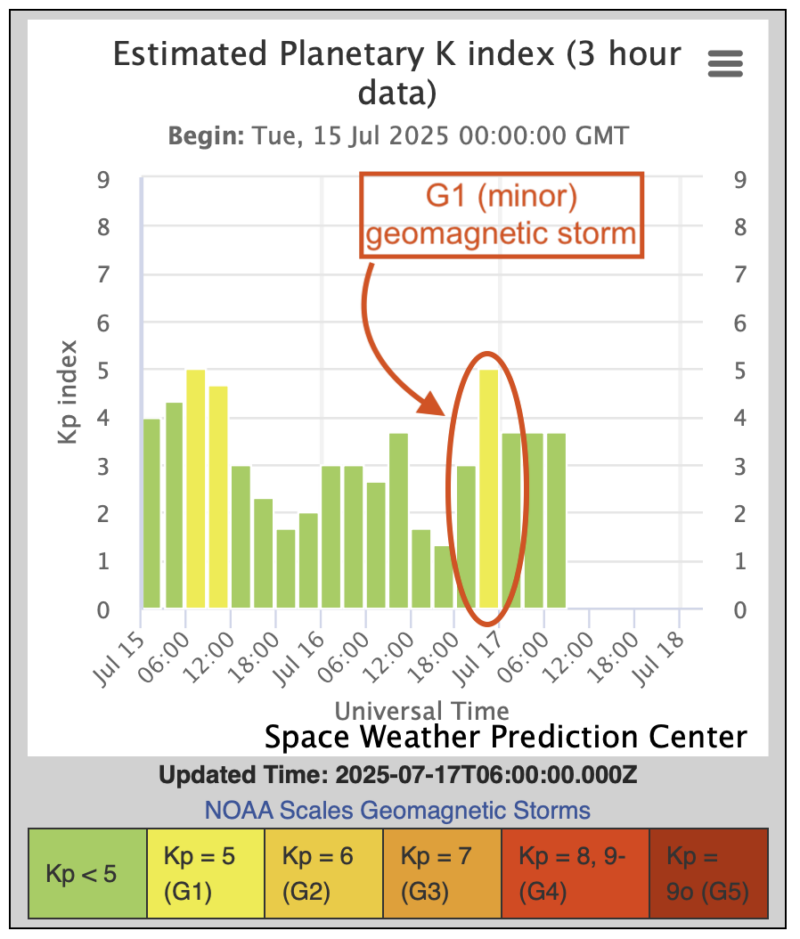
- Earth’s magnetic field ranged from quiet to minor geomagnetic storm levels (Kp = 2 – 5) over the past 24 hours. G1 (minor) geomagnetic storms were observed at the beginning of the period. These disturbances were the result of fast solar wind from a coronal hole now located in the south solar hemisphere. Earth’s magnetic field is at Kp = 3 at the time of this writing.

Sun news July 16: See a beautiful blob of sun stuff
(11 UTC to 11 UTC)

New imagery of yesterday’s spectacular prominence eruption has revealed that it produced an equally spectacular coronal mass ejection (CME), or blast of solar material and magnetic fields. As seen by the SOHO spacecraft’s LASCO C3 coronagraph, the blob of sun-stuff looked like a light-bulb: a classic shape for a CME. Beautiful!
- Flare activity over the past 24 hours was low. We observed 9 flares, all of which were C flares. The largest was a C5 produced by AR4143 at 3:58 UTC this morning. AR4143 produced the most flares with 5 C flares.
- The sun currently has nine sunspot regions on its Earth-facing side. Sunspot region AR4139 gained a beta-gamma magnetic configuration, increasing its potential for future flares, though it remained quiet during the past day. AR4142 showed some structural evolution. The remaining regions have simpler alpha or beta configurations and are stable or in decay.
- Blasts from the sun? No Earth-directed coronal mass ejections (CMEs) were observed in available coronagraph imagery.
- Solar wind speeds averaged around 550 km/s (1,230,000 mph) during the past 24 hours. The interplanetary magnetic field (IMF) was at a moderate level. The north-south component (Bz) moved between north and south, ending northward by the time of this writing. A southward Bz is more favorable for auroras.
- Earth’s magnetic field has ranged from quiet to minor (Kp = 2 – 5) over the past 24 hours. G1 (minor) geomagnetic storms were observed at the beginning of the period. These disturbances were the result of fast solar wind from a coronal hole now located in the south solar hemisphere. Earth’s magnetic field is at Kp = 3 at the time of this writing.
Sun news July 15: Spectacular eruption this morning
(11 UTC to 11 UTC)

This morning, a spectacular prominence – a rope of solar material and magnetic fields – erupted from the sun in style! The eruption hurled billions of tons of sun-stuff into space, none of which is expected to reach Earth and disturb our magnetic field. However, Earth is currently experiencing a G1 (minor) geomagnetic storm – with more disturbance expected later today – thanks to a stream of high-speed solar wind from a coronal hole currently buffeting our planet. Find out more below.
- Flare activity over the past 24 hours was low. We observed 15 flares in total, all C flares, the largest being a C4.6 produced by AR4141 at 17:06 UTC last night. No region produced more flares than AR4141, which fired off eight C flares.
- The sun has seven sunspot regions on its Earth-facing side. Sunspot region AR4136 retained its beta-gamma-delta magnetic configuration, and still is the most complex sunspot region on the solar disk. The remaining regions are simpler alpha or beta configurations and are stable or in decay. There is a newcomer in the northeast labeled AR4142, which has been flaring since yesterday.
- Blasts from the sun? The large eruptive prominence we saw this morning hurled ejecta into space, but this blast was not Earth directed. No Earth-directed coronal mass ejections (CMEs) were observed in available coronagraph imagery.
- Solar wind speeds averaged around 500 km/s (1,118,000 mph) during the past day, increasing to 682 km/s (1,526,000 mph) at the time of this writing. The interplanetary magnetic field (IMF) reduced to a low level. The north-south component (Bz) intermittently moved between north and south, ending northward by the time of this writing. A southward Bz is more favorable for auroras.
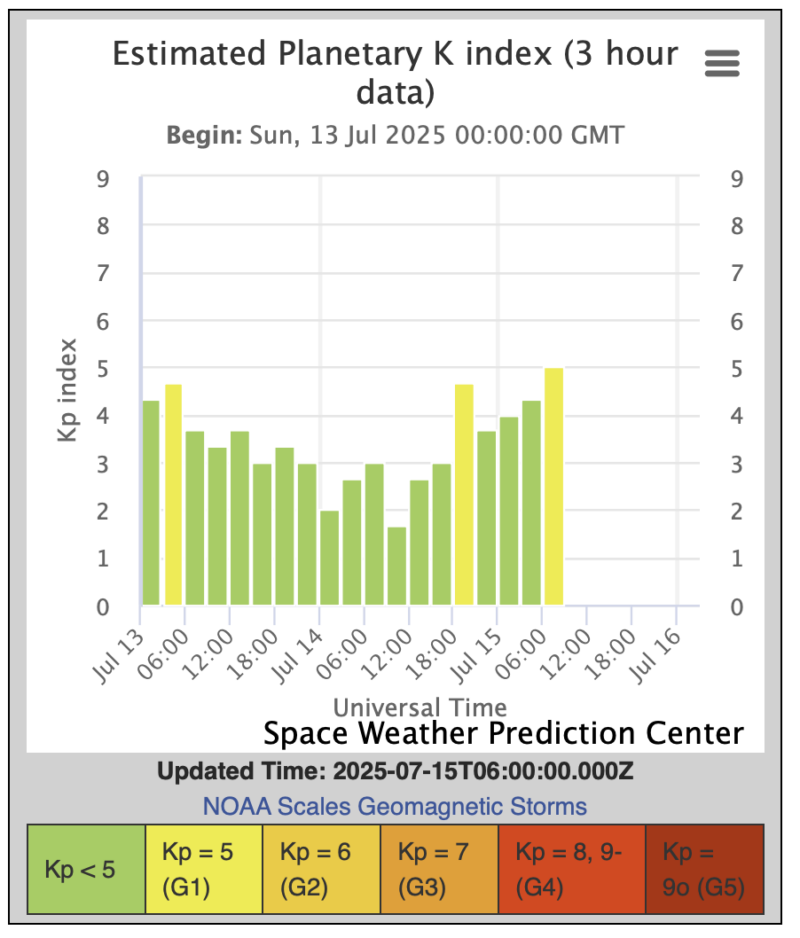
- Earth’s magnetic field has been unsettled to active (Kp = 2 – 5) for the past 24 hours. G1 (minor) geomagnetic storms were observed for two 3-hour periods. The first Kp = 5 level was reached at 20:59 UTC on July 14, and the second is in effect at the time of this writing. These disturbances are the result of fast solar wind from a coronal hole now located in the south solar hemisphere.
Sun news July 14: Beautiful jet from new sunspot region
(11 UTC to 11 UTC)



A sunspot region emerged in the solar southwest and produced some impressive activity over the past day. Now numbered AR141, it blasted 6 C (common) flares – the joint most of any region – and produced a beautiful jet that adorned the southwest horizon at around 21 UTC last night. This jet triggered a C1.5 flare and fired out a blob of sun-stuff that isn’t expected to collide with Earth’s magnetic field.
- Flare activity over the past day was low with the production of only C flares. We observed 17 flares during the last 24 hours, the largest being a C8.9 – almost an M flare – produced by AR4140 in the southeast at 21:50 UTC on July 13. Once again, no region produced more flares than AR4140, although newcomer AR4141 matched its total of 6 C flares.

- The sun currently has seven sunspot regions on its Earth-viewed side. Sunspot region AR4136 has kept its beta-gamma-delta magnetic configuration, making it the most complex sunspot region on the solar disk. The rest of the regions have simpler alpha or beta configurations. Sunspot regions AR4138 and AR4139 showed minor growth, while the rest of the active regions are stable or in decay. Newcomer AR4141 emerged on the very edge of the southwest limb.
- Blasts from the sun? No Earth-bound coronal mass ejections (CMEs) were observed in available coronagraph imagery over the past day.
- Solar wind speeds gradually decreased from 677 km/s (1,514,000 mph) to reach 525 km/s (1,174,000 mph) at the time of this writing. The interplanetary magnetic field (IMF) reduced to a low level. The north-south component (Bz) intermittently moved between north and south, ending northward by the time of this writing. A southward Bz is more favorable for auroras.
- Earth’s magnetic field has been unsettled to active (Kp = 2 – 4) for the past day, reaching the Kp=4 level for a 3-hour period at 12 UTC on July 13. Fast solar wind from a coronal hole has started to wane. Disturbance is at a Kp = 3 level at the time of this writing.
Sun news July 13: Stormy geomagnetic field last night!
(11 UTC to 11 UTC)
Earth’s magnetic field reached G1 (minor) storm conditions last night, as expected. Auroras were seen at high latitudes such as those in the U.S. states of Maine and Michigan. We hit the Kp=5 threshold early today (4:33 UTC on July 13). The cause is a huge coronal hole on the sun, which reached a geoeffective position, a position capable of affecting Earth, a couple of days ago. Now the fast solar wind from that hole has reached Earth, disturbing our world’s magnetic field. More G1 disturbance is predicted to during the day today, then to reduce to quiet-to-unsettled levels as fast solar wind effects wane. Did you see the auroras last night? Share your beautiful photos with EarthSky!

- Flare activity continued moderate over the past 24 hours with the production of an isolated M flare. We saw a total of 20 flares during the past day, an M plus 18 Cs and one B. The largest event of the period was the M1.6 flare blasted by AR4140 at 4:02 UTC on July 12. Shortly after the flare, a correspondent R1 (minor) radio black out was observed, affecting an area over Morocco. AR4140 was the most productive sunspot region on the sun’s Earth-facing side in the past day, with 15 flares the M plus another 13 C flares and a B flare.
- The sun currently has six sunspot regions on the side we see from Earth. Sunspot region AR4136 lost its delta complexity and now shows a beta-gamma-delta magnetic configuration. Meanwhile, the rest of the sunspot regions on the solar disk have either alpha or beta configurations. Sunspot regions AR4138, AR4139 and AR4140 all showed growth, the rest of the active regions are stable or in decay.
- Blasts from the sun? No Earth-bound coronal mass ejections (CMEs) were observed in available coronagraph imagery over the past day.
- Solar wind speeds gradually increased from 439 km/s (982,015 mph) over the past day with a peak of 720 Km/s (1,611,000 mph) at around 7:48 UTC on July 13 to then it came down to 677 km/s (1,514,000 mph) at the time of this writing. The interplanetary magnetic field (IMF) reduced to a low level. The north-south component (Bz) intermittently moving from north to southward It is oriented south at the time of this writing. A southward Bz is more favorable for auroras.
- Earth’s magnetic field has been unsettled to active (Kp = 3 – 5) for the past day reaching the Kp=5 level for a 3-hour synoptic period at 4:33 UTC on July 13. These conditions have been provoked by influence of a positive-polarity fast solar wind from a coronal hole. Disturbance is at a Kp = 4 level at the time of this writing.
What’s ahead? Sun-Earth forecast
- Moderate-to-low flare activity is expected in the coming day. The chance for M (moderate) flares increased from 50% to 65% today, and the chance for X (strong) flares increased from 5% to 15% today. These parameters increased due to AR4140’s activity.
- Geomagnetic activity forecast: Earth’s geomagnetic field might see more G1 (minor) geomagnetic storm levels during the day today. Then it’s expected to reduce to quiet-to-unsettled periods tomorrow (July 14).
Sun news July 12: 2 M flares! And auroras possible later today
(11 UTC to 11 UTC)
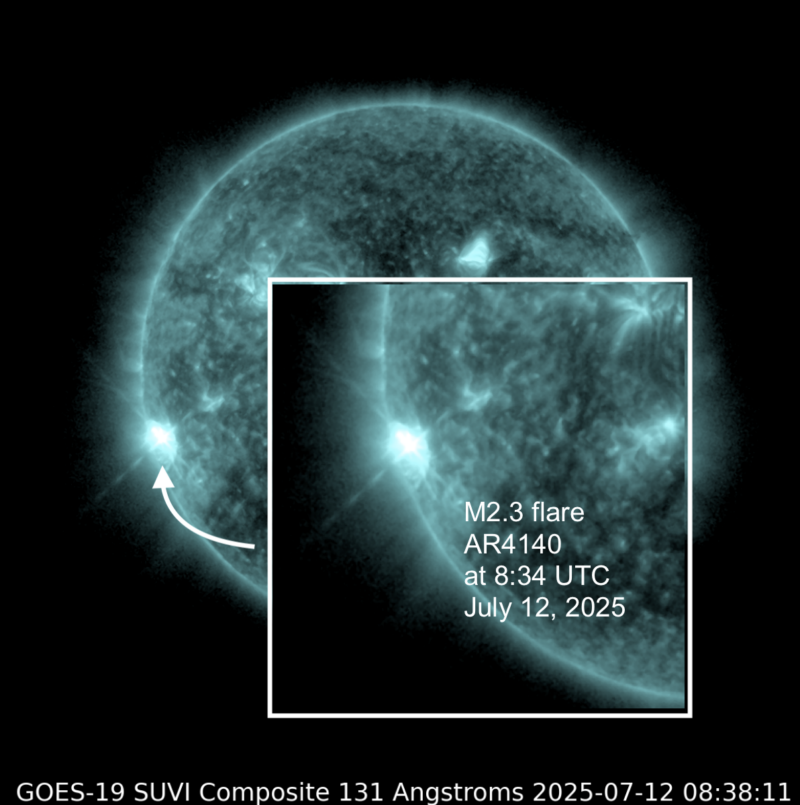
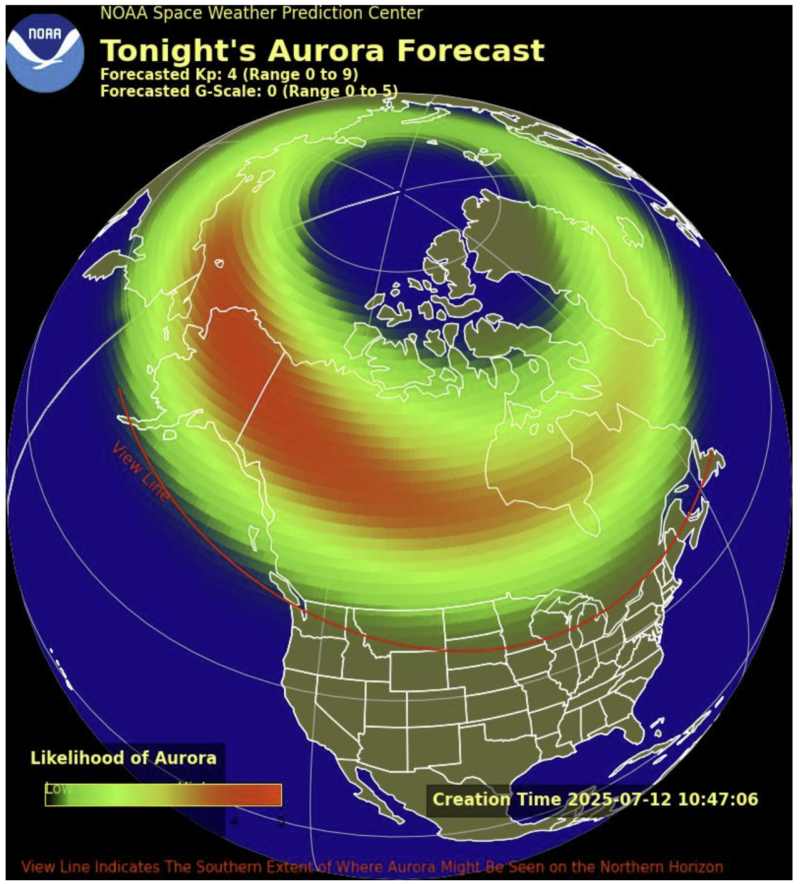
Active region AR4140 punched out two M flares, almost one after the other! The first M was an M1.4 blasted out at 4:02 UTC followed by a second M2.3 flare, the largest of the period, at 8:34 UTC. The ejecta hurled into space is under modeling and analysis. Plus, we expect a G1 (minor) geomagnetic storm later on today, and that means auroras may come. Good luck aurora hunters, clear skies.
- Flare activity jumped to moderate over the past day, with the production of two M flares. Overall, flare activity saw a significant increase with a total of 21 flares during the past day, the two Ms plus 19 C flares. Details on the M flares above. Both were produced on July 12, and both came from active region AR4140 in the sun’s southeast. After each M flare correspondent R1 (minor) radio black outs were observed affecting an area over Bahrain and Taiwan. This region was the most productive on the sun’s Earth-facing side in the past day, with 14 flares the two Ms plus another 12 C flares.
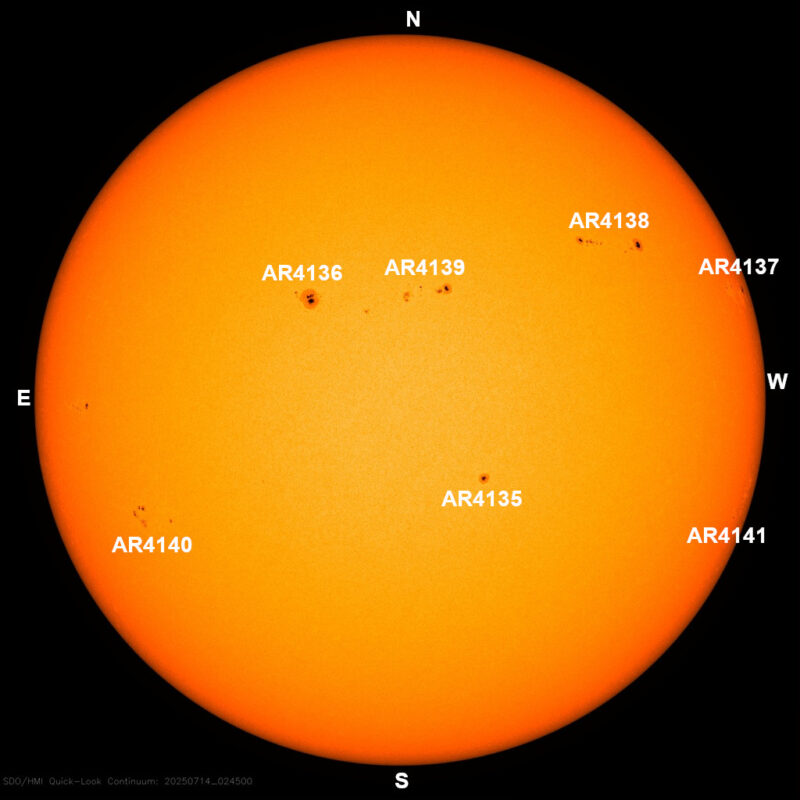
- The sun currently has six sunspot regions on its Earth-viewed side. Sunspot region AR4136 keeps its beta-gamma-delta magnetic configuration. With this configuration AR4136 has the potential for more M flares and even X (strong) flares, but, so far, it has showed low flare activity or none at all. Meanwhile, AR4140 – with a beta configuration – produced the 2 Ms. The rest of the sunspot regions on the solar disk have either alpha or beta configurations and are stable or in decay. Today there are three newcomers on the solar disk. They are now labeled AR4138, AR4139 and AR4140.
- Blasts from the sun? No Earth-bound coronal mass ejections (CMEs) were observed in available coronagraph imagery over the past day.
- Solar wind speeds averaged around 450 km/s (1,006,000 mph) over the past day with a peak of 510 Km/s (1,140,000 mph) at around 21:23 UTC on July 11 to reach 474 km/s (1,060,000 mph) at the time of this writing. The interplanetary magnetic field (IMF) continued at a moderate level. The north-south component (Bz) intermittently moving from north to southward It is oriented south at the time of this writing. A southward Bz is more favorable for auroras.
- Earth’s magnetic field has been unsettled to active (Kp = 3 – 4) for the past day reaching Kp = 4 levels for a couple of 3-hour synoptic periods at 12 UTC and 18 UTC on July 11. These conditions have been provoked by influence of a co-rotating interaction region (CIR), combined with positive-polarity fast solar wind from a coronal hole. Disturbance is at a Kp = 3 level at the time of this writing.
Sun news July 11: Huge coronal hole poised to affect Earth
(11 UTC to 11 UTC)

A huge coronal coronal hole is now located in a geoeffective position on the sun’s visible disk. That means its fast solar wind should start reaching us at Earth soon. Arrival of this high-speed solar wind might start as early as tomorrow, July 12. It means geomagnetic is likely to increase to unsettled-to-active levels in the early hours on Saturday. Auroras coming? Hopefully yes, at high latitudes. Otherwise, all eyes are now centered on AR4136, author of two M flares earlier this week. It’s now showing a beta-gamma-delta magnetic configuration, meaning it has good potential for more M flares and even X (strong) flares. Stay with us for updates!
- Flare activity continued low over the past day, with only C flares. But one blast was nearly M class. The sun produced a total of 15 C flares during our observation period. The largest flare was a C8.9 flare at 19:36 UTC on July 10 from an incoming as-yet-unnumbered sunspot region in the southeast. This region was the most productive on the sun’s Earth-facing side in the past day, with 12 C flares the largest included.
- The sun currently has three sunspot regions on its Earth-viewed side. Sunspot region AR4136 developed a delta complexity and now shows a beta-gamma-delta magnetic configuration. With this configuration AR4136 has the potential for more M flares and even X (strong) flares. The other two numbered sunspot regions on the solar disk have either alpha or beta configurations and are stable or in decay.
- Blasts from the sun? The C8.9 at 19:36 on July 10 produced a slow-moving ejecta. Initial modeling shows no Earth-directed component, but analysis will continue. No other Earth-bound coronal mass ejections (CMEs) were observed in available coronagraph imagery over the past day.
- Solar wind speeds averaged around 350 km/s (782,928 mph) over the past day to increase at around 6 UTC to reach 466 km/s (1,052,000 mph) at the time of this writing. The interplanetary magnetic field (IMF) moved to a moderate level. The north-south component (Bz) was north oriented late yesterday July 10, but, starting at around 1 UTC this morning, it moved southward. It is oriented south at the time of this writing. A southward Bz is more favorable for auroras.
- Earth’s magnetic field has been quiet to unsettled (Kp = 1-3) for the past day. These conditions have been provoked by waning influence of negative-polarity fast solar wind from a coronal hole. Disturbance is at a Kp = 3 level at the time of this writing.
Sun news July 10: Promising new region finally in view
(11 UTC to 11 UTC)
The sunspot region that fired two M flares in the past two days from over the northeast horizon has finally emerged fully into view and received a label. Meet AR4136! Now that a complete analysis can be performed on this region, specialists have confirmed a beta-gamma magnetic configuration, meaning it has good potential for more M flares. Today’s likelihood of an M flare is 35%, mainly due to AR4136. Let’s see what this promising new sunspot group brings.
- Flare activity is back to low, with only C class flares produced over the past day. The sun blasted out a total of eight C flares along our observation period. The largest flare was a C3.8 flare at 6:42 UTC on July 10 from an incoming as-yet-unnumbered sunspot region in the southeast. This region was the most productive on the Earth-viewed sun in the past day, with four C flares.
- The sun currently has six sunspot regions on its Earth-viewed side. Sunspot region AR4136 is showing a beta-gamma magnetic configuration. All of the rest of the numbered sunspot regions on the solar disk have either alpha or beta configurations and are stable or in decay. There are two newcomers on the solar disk today: the abovementioned AR4136 and AR4137 in the northwest quadrant.
- Blasts from the sun? At 5:24 UTC on July 9, a filament eruption lifted plasma into space. This blast is under analysis to see if it’s coming our way at Earth. No other Earth-bound coronal mass ejections (CMEs) were observed in available coronagraph imagery over the past day.
- Solar wind speeds reduced from around 455 km/s (1,018,000 mph) over the past day to 382 km/s (854,510 mph) at the time of this writing. The interplanetary magnetic field (IMF) is at a low level. The north-south component (Bz) was intermittently changing from southward to northward over the period. It is oriented northward at the time of this writing. A southward Bz is more favorable for auroras.
- Earth’s magnetic field has been quiet (Kp = 1-2) over the past day, mostly sitting at a Kp = 2 level. These conditions have been provoked by waning influence of negative-polarity fast solar wind from a coronal hole. Disturbance is at a Kp = 1 level at the time of this writing.

Sun news July 9: New sunspot region blasts another M flare
(11 UTC to 11 UTC)
The new sunspot region in the northeast – producer of an unexpected M flare yesterday – struck again this morning with an M1.3 flare at 4:25 UTC. As this region had still not emerged fully into view, both of its M flares were partly blocked by the solar horizon, so they would have been more powerful than our instruments registered. Our sunspot image below is now just barely showing this region, but it remains too close to the horizon to be analyzed and numbered. We’ll keep an eye on this one.
- Flare activity remained moderate over the past day with the production of the above-mentioned M1.3 flare. The blast provoked an R1 (minor) radio blackout that affected an area over the north of Taiwan. Flare productivity reduced over the past 24 hours, with only six flares compared to the previous day’s 16. Alongside the M, we saw two Cs and three B flares. The leading flare producer remained the newcomer in the northeast, this time with five flares including the M.
- The sun currently has four sunspot regions on its Earth-viewed side. All numbered sunspot regions on the solar disk show either alpha or beta magnetic configurations. All of them appear either stable or in decay.
- Blasts from the sun? No Earth-bound coronal mass ejections (CMEs) were observed in available coronagraph imagery over the past day.
- Solar wind speeds reduced from around 550 km/s (1,230,000 mph) to 425 km/s (950,698 mph) at the time of this writing. The interplanetary magnetic field (IMF) is at a low level. The north-south component (Bz) was southward for most of the period and remains so at the time of this writing. A southward Bz is more favorable for auroras.
- Earth’s magnetic field has been quiet to unsettled (Kp = 2-3), mostly sitting at a Kp = 3 level. These conditions have been provoked by the influence of negative-polarity fast solar wind from a coronal hole. Disturbance is at a Kp = 2 level at the time of this writing.
Sun news July 8: New sunspot region blasts an unexpected M flare
(11 UTC to 11 UTC)
After seeing only faint C flares and B flares for several days, our star surprised us this morning with an M flare! The M2.5 flare was blasted at 4:17 UTC on July 8 by an as-yet-unnumbered sunspot region currently rotating into view over the northeast horizon. Besides the M flare, this newcomer also produced an impressive 12 C flares. Promising! Let’s see what else it’s got in store.
- Flare activity jumped to a moderate level over the past day with the production of the M2.5 flare. The flare provoked an R1 (minor) radio blackout that affected an area over the north of Vietnam. Over the past 24 hours, the sun produced 16 flares, an increase of four flares compared to the previous day’s total and far more than we were seeing last week. The leading flare producer of the past day was the newcomer in the northeast, with 12 C flares to go with the M flare.
- The sun currently has seven sunspot regions on its Earth-viewed side. All numbered sunspot regions on the solar disk show either alpha or beta magnetic configurations. All of them appear either stable or in decay. There is a newcomer in the southeast quadrant now numbered AR4135.
- Blasts from the sun? No Earth-bound coronal mass ejections (CMEs) were observed in available coronagraph imagery over the past day. The huge burst of sun-stuff we saw yesterday is confirmed to not be coming our way at Earth.
- Solar wind speeds averaged around 550 km/s (1,230,000 mph) with a peak at 664 Km/s (1,284,000 mph) at 20:54 UTC on July 7. The speed is 527 km/s (1,179,000 mph) at the time of this writing. The interplanetary magnetic field (IMF) is at a low level. The north-south component (Bz) jumped from southward to northward during the period. At the time of this writing it is southward. A southward Bz is more favorable for auroras.
- Earth’s magnetic field has been unsettled to active (Kp 3 to 4), mostly sitting at a Kp = 4 level. All this was provoked by the influence of negative-polarity fast solar wind from a coronal hole. Disturbance is at a Kp = 3 level at the time of this writing.
Sun news July 7: Surprise storms and a huge eruption
(11 UTC to 11 UTC)
After surprise geomagnetic storms triggered auroras on Saturday night, G1 (minor) storming surprised us again yesterday evening! Earth’s geomagnetic field was disturbed to a Kp = 5 level between 21 UTC UTC on July 6 and 3 UTC on July 7, providing good conditions for auroral displays at high latitudes. Meanwhile, it seemed our sun might send some more disturbance our way when a long filament we’ve been observing in the north erupted spectacularly, sending a huge blast of sun-stuff into space. However, initial analysis suggests this coronal mass ejection (CME) is not heading our way.
- Flare activity has been low over the past day, but we saw a remarkable increase in flare production from the day before. During our observation period the sun produced 12 flares (nine C flares and three B flares) compared to the previous day’s total of four flares. The largest event of the past day was a C1.5 flare blasted out by an incoming sunspot region in the north-west at 3:54 UTC on July 7. The flare producer of the day was AR4128 with eight flares.
- The sun currently has five sunspot regions on its Earth-viewed side. All numbered sunspot regions on the solar disk show either alpha or beta magnetic configurations. All of them appear either stable or in decay. There is a newcomer in the southwest quadrant now numbered AR4134.
- Blasts from the sun? No Earth-bound coronal mass ejections (CMEs) were observed in available coronagraph imagery over the past day.
- Solar wind speeds gradually increased from around 410 km/s (917,144 mph) to peak at 574 Km/s (1,284,000 mph). The speed is 544 km/s (1,217,000 mph) at the time of this writing. The interplanetary magnetic field (IMF) is at a low level. The north-south component (Bz) was southward for half the past day and northward for the other half. At the time of this writing the magnetic field is southward. A southward Bz is more favorable for auroras.
- Earth’s magnetic field was unsettled to active (Kp 3 to 5) over the past day. A G1 (minor) geomagnetic storm level was recorded during two 3-hour observation periods. The Kp = 5 threshold was reached at 21 UTC on July 6. All this was provoked by the influence of negative-polarity fast solar wind from a coronal hole.
Sun news July 6: Auroras last night
(11 UTC to 11 UTC)

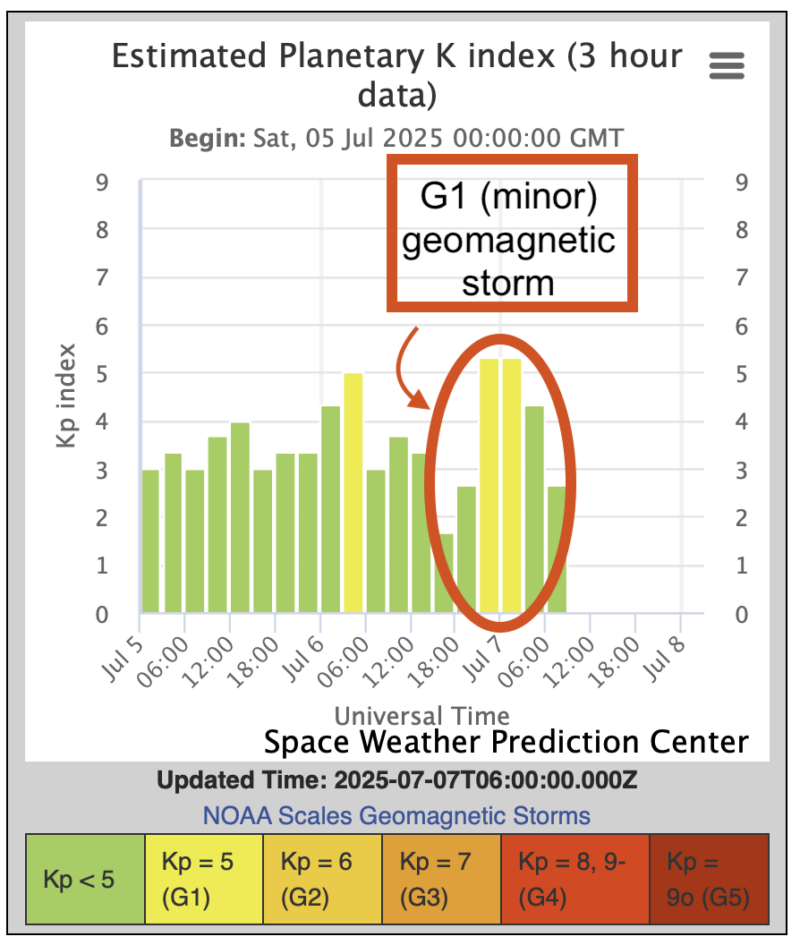
Surprise! We had a G1 (minor) geomagnetic storm last night. It brought conditions for auroral displays at high latitudes. Earth’s geomagnetic field was unsettled to active from late yesterday to early today. Then it suddenly jumped to a Kp = 5 level reaching this level at 5:38 UTC UTC on July 6 and staying there for one 3-hour synoptic period then returning to Kp = 4 and eventually to Kp = 3. These conditions might have been caused by residual effects of a coronal mass ejection (CME) – a chunk of solar materials – passing near Earth and provoking turbulence. Did you see the auroras last night? Share your beautiful photos with us. Submit them here.
- Flare activity has been low over the past day. But it increased a bit from the day before, with the sun producing five flares, four C flares and one B flare.
- The largest event of the past day was a C1.5 flare blasted out by sunspot region AR4130, at 12:18 UTC on July 5. Total flares of the day five with four Cs and one B. The flare producer of the day was AR4130 (three C flares).
- The sun currently has six sunspot regions on its Earth-viewed side. All numbered sunspot regions on the solar disk show either alpha or beta magnetic configuration. All of them appear either stable or in decay.
- Blasts from the sun? No Earth-bound coronal mass ejections (CMEs) were observed in available coronagraph imagery over the past day.
- Solar wind speeds averaged around 430 km/s (961,833 mph) during the period with peaks of 478 Km/s (1,069,000 mph). The speed is 424 km/s (948,461 mph) at the time of this writing. The interplanetary magnetic field (IMF) is at a moderate level. The north-south component (Bz) intermittently changing from north to south over the period. At the time of this writing the magnetic field is south oriented. A southward Bz is more favorable for auroras.
- Earth’s magnetic field was unsettled to active (Kp 3 – 5 ) over the past day. We observed G1 (minor) geomagnetic storm level with one 3-hour synoptic period at Kp = 5. The Kp = 5 threshold was reached at 5:38 UTC on July 6.
Sun news July 5: Another huge prominence in the sun’s northwest
(11 UTC to 11 UTC)
A huge, gorgeous prominence exploded off the sun’s northwestern horizon this morning, peaking at 8:55 UTC on July 5. It seems to have originated in the long filament in the sun’s northern hemisphere that we’ve seen for several days. That same region produced a powerful prominence a couple of days ago, too. This time, the blast started as an arch of solar plasma and magnetic fields. One of the side of the arch was close to the the sun’s northwestern limb, and the other side of the arch was on the sun’s far side, beyond the solar horizon. It was a beautiful and eye-catching event. Plasma hurled into space initially seemed to be too far north to be coming our way at Earth. But we will await on result from modeling and analysis by specialists. Stay with us for updates.
- Flare activity has been low over the past day. In the past 24 hours, the sun produced only one flare, a C1.0 flare, blasted at 11:33 UTC on July 4, from active region AR4129.
- The sun currently has five sunspot regions on the side we see from Earth. All numbered sunspot regions on the solar disk show either alpha or beta magnetic configuration. All of them appear stable or in decay.
- Blasts from the sun? No Earth-bound coronal mass ejections (CMEs) were observed in available coronagraph imagery over the past day. The huge prominence we are reporting today on the northwest limb is too far north for coming our way at Earth; nevertheless, we will wait for modeling and analysis from specialists.
- Solar wind: Solar wind speeds slowly but steadly increased from 330 km/s (738,188 mph) to a peak of 478 Km/s (1,069,000 mph) at 7:20 UTC on July 5. The speed is 440 km/s (984,251 mph) at the time of this writing. The interplanetary magnetic field (IMF) is at a low level. The north-south component (Bz) mostly south – oriented over of the period and remains so at the time of this writing. A southward Bz is more favorable for auroras.
- Earth’s magnetic field was quiet to unsettled (Kp 1 – 3 ) over the past day with one 3-hour synoptic period at Kp = 4. The Kp = 4 threshold was reached at 22:48 UTC on July 4.

Sun news July 4: Solar Cycle 25 update
(11 UTC to 11 UTC)
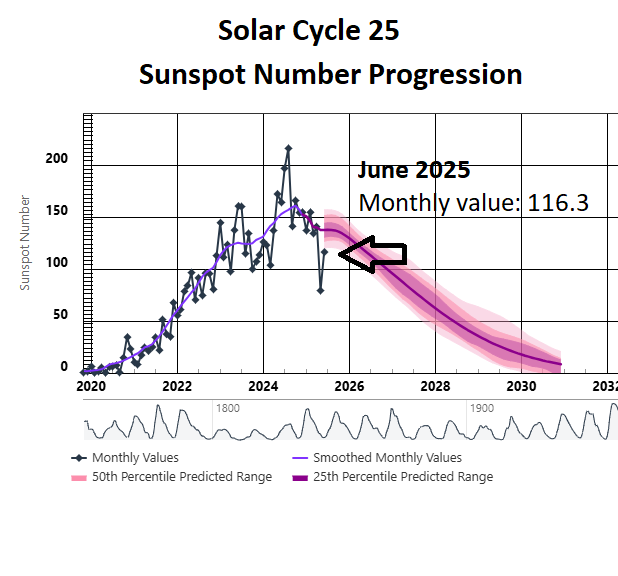
NOAA just released sunspot number results for June 2025. The results show a monthly sunspot number of 116.3 for June. That means August 2024 continues as the peak of the current solar cycle, Cycle 25. August 2024 had a monthly sunspot number of 216. June’s value did increase, however, in contrast to May 2025 (monthly sunspot number of 79). What does it all mean? It means we are still in solar maximum – the peak of our star’s 11-year cycle of activity – until officials declare it ended. Note that solar maximum typically extends a year or two beyond the peak sunspot number!
- Flare activity continued low over the past day. In the past 24 hours, the sun produced only three flares, two Cs and one B. That’s in contrast to 11 flares produced the day before. The largest flare of the past day was a C2.5 at 7:47 UTC on July 4, from active region AR4130. The leading flare producer of the period was AR4130 with two C flares, including the day’s largest.
- Currently, the sun has seven sunspot regions on its Earth-facing side. Sunspot region AR4129 lost its gamma configuration and today shows a simpler beta magnetic configuration. The rest of the active regions on the solar disk show simple alpha or beta configurations.
- Blasts from the sun? No Earth-bound coronal mass ejections (CMEs) were observed in available coronagraph imagery over the past day. The pair of prominences we saw yesterday are not coming to us at Earth but the one on the northwest will hit Venus on July 4.
- Solar wind: Solar wind speeds have averaged around 370 km/s (827,000 mph) with a peak of 406 Km/s (908,000 mph) at 17:30 UTC on July 3. The speed is 382 km/s (854,500 mph) at the time of this writing. The interplanetary magnetic field (IMF) is at a low level. The north-south component (Bz) was south-oriented for most of the period and remains so at the time of this writing. A southward Bz is more favorable for auroras.
- Earth’s magnetic field was unsettled to active (Kp 3 – 4) over the past day. The Kp = 4 threshold was reached at 14:40 UTC on July 3. It seems the expected coronal mass ejection passed aside Earth bringing only a Kp = 4 geomagnetic disturbance. But the ripples after the CME pass combined with fast solar wind from a coronal hole may bring some interesting geomagnetic activity.
Sun news July 3: Two beautiful prominences at once
(11 UTC to 11 UTC)
At around 4 UTC this morning, the sun produced a beautiful pair of prominences, or long ropes of solar material and magnetic fields hanging over the solar horizon. The largest, in the northwest, occurred as a long filament we’ve been observing finally erupted. And at almost the same time, a smaller prominence billowed in the solar northeast. Both blasted plumes of plasma into space, but none of this sun-stuff is expected to make its way to Earth, as both events seem to have occurred on the far side of our star. Perhaps this spectacular simultaneous blast was a celebration for Earth’s aphelion – farthest point from the sun for the year – which arrives today!
- Solar activity remained low over the past day, but we saw an increase in flare production. In the past 24 hours the sun produced 11 flares, compared to the three flares in the previous day. All of the past day’s flares were C flares. The largest event of the period was a C2.6 at 18:35 UTC on July 2 from active region AR4126. The leading flare producer of the period was AR4126 with five C flares, including the largest of the day.
- Currently, the sun has nine sunspot regions on its Earth-viewed side. Sunspot region AR4129 lost its gamma configuration and today shows a beta magnetic complexity. The rest of the active regions on the solar disk show either alpha or beta configurations.
- Blasts from the sun? No Earth-bound coronal mass ejections (CMEs) were observed in available coronagraph imagery over the past day, but the pair of prominences we saw today are under analysis. However, the blasts seemed to have occurred on the sun’s far side, so an Earth-bound component is unlikely.
- Solar wind: Solar wind speeds have averaged around 350 km/s (782,000 mph). The speed is 390 km/s (872,405 mph) at the time of this writing. The interplanetary magnetic field (IMF) is at a low level. The north-south component (Bz) was south-oriented for most of the period, but it peaked northward around 5:30 UTC today and remains so at the time of this writing. A southward Bz is more favorable for auroras.
- Earth’s magnetic field was quiet to unsettled (Kp 1-3) over the past day.


Sun news July 2: Blast of sun-stuff expected to reach Earth today
(11 UTC to 11 UTC)
A blob of solar stuff – a coronal mass ejection (CME) – hurled by the sun on June 28 is expected to reach Earth today, delayed from its originally anticipated arrival last night. When it does arrive, forecasters are expecting it to trigger G1 (minor) geomagnetic storms. And that could bring auroras to northern latitudes!
- Solar activity remained low over the past day. The sun only produced three flares in total during our observation period: two C flares and one B flare. Three different active regions produced the three flares: AR4126, AR4122 and AR4120. The largest flare of the period was a C1.4 at 0:30 UTC on July 2.
- Currently, the sun has ten sunspot regions on its Earth-viewed side. Active region AR4129 has retained its beta-gamma magnetic complexity. The rest of the active regions on the solar disk show either alpha or beta configurations. There are two newcomer spots on the solar disk: AR4131, which emerged in the northwest, and AR4132, which rotated into view in the southeast.
- Blasts from the sun? No Earth-bound coronal mass ejections (CMEs) were observed in available coronagraph imagery.
- Solar wind: Solar wind speeds dropped from 494 km/s (1,105,000 mph) late yesterday down to 381 km/s (852,272 mph) at the time of this writing. The interplanetary magnetic field (IMF) is at a low level, and the north-south component (Bz) was north oriented until 21 UTC last night, when it moved southward and remained there until the time of this writing. A southward Bz is more favorable for auroras.
- Earth’s magnetic field was quiet to unsettled (Kp 1-2) over the past day.
Sun news July 1: Auroras possible tonight!
(11 UTC to 11 UTC)
Our star fired out a powerful burst of solar material – a coronal mass ejection (CME) – on Sunday evening. And this blob of sun-stuff is expected to hit Earth’s magnetic field around 5 UTC tomorrow morning (late this evening in the Americas). That means those in northerly US latitudes could see auroras tonight! Clear skies, aurora chasers.
- Solar activity remained low over the past 24 hours. The total flare production over the past day was nine flares: six C flares and three B flares flares. An incoming active region in the southeast, now numbered AR4130, was the lead flare producer of the period. It blasted out four Cs and two Bs, including the largest flare of the period: a C1.4 at 13:27 UTC on June 30.
- Currently, the sun has nine sunspot regions on the side we see from Earth. Active region AR4129 developed a gamma configuration and now shows a beta-gamma magnetic complexity. The rest of the active regions on the solar disk show either alpha or beta configurations. A newcomer spot moved into view in the southeast and is now numbered AR4130.
- Blasts from the sun? No Earth-bound coronal mass ejections (CMEs) were observed in available coronagraph imagery.
- Solar wind: Solar wind speeds averaged around 480 km/s (1,073,000 mph) over the past day, with a peak of 873 km/s (1,952,000 mph) at around 8 UTC on July 1. The solar wind speed is 489 km/s (1,093,000 mph) at the time of this writing. The interplanetary magnetic field (IMF) is at a low level, and the north-south component (Bz) was mostly south-oriented late on June 30. It moved northward early today and remains so at the time of this writing. A southward Bz is more favorable for auroras.
- Earth’s magnetic field was quiet to unsettled (Kp 1-3) over the past day.


Like what you read?
Subscribe and receive daily news delivered to your inbox.
More from
C. Alex Young


Sun news: Meet monster sunspot region AR4551

Yes, there’s an aurora season, and it’s here
Sun activity archive for September 2026
Sun activity archive for August 2026