(11 UTC January 31 – 11 UTC February 01)
Flare activity: Solar activity reached high levels, with 21 flares observed (5 M-class, 16 C-class). The strongest event was an M6.6 from AR4366 (N11E43) at 09:53 UTC on February 1. It triggered an R2 (Moderate) radio blackout affecting HF users across the sunlit hemisphere, including aviation and maritime communications over southern Africa. In addition, other notable flares (chronological) included:
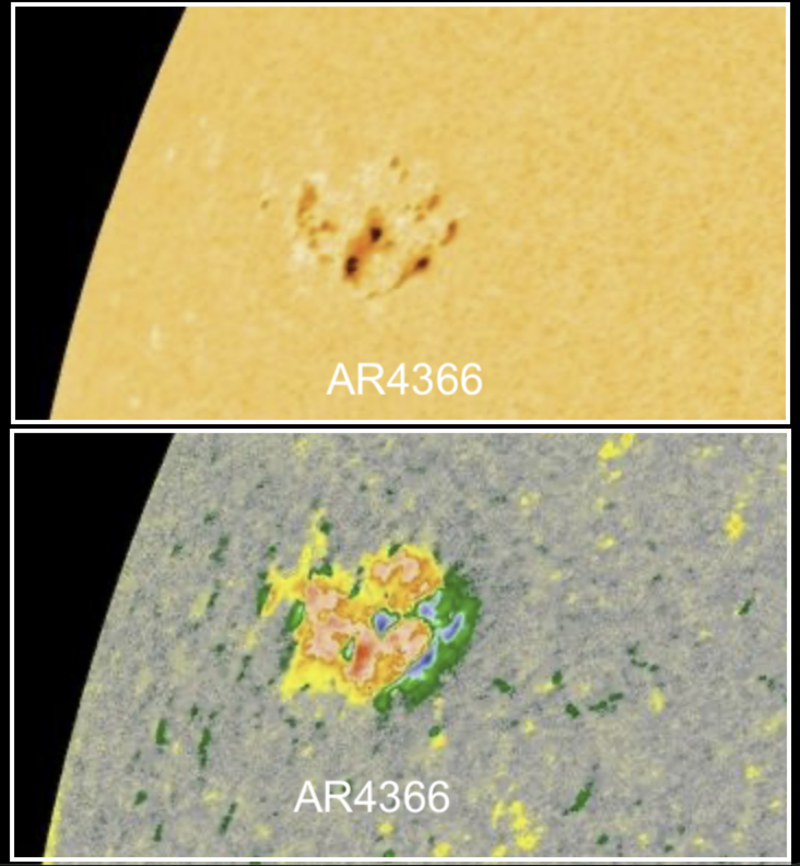
Sunspot regions: The Earth-facing solar disk displayed 10 numbered active regions. Leading the activity was a rapidly developing, magnetically complex northeast region, AR4366 (beta-gamma-delta). Throughout the period, AR4366 dominated flare production, accounting for the M6.6 event, the remaining M-class flares, and the majority of C-class activity, including several mid-to-upper C flares.
Blasts from the sun? Experts did not observe any Earth-directed coronal mass ejections (CMEs) over the past day.
Past 24 hours in space weather
Solar wind: Solar wind speeds decreased steadily as coronal-hole high-speed stream conditions faded. At the same time, the interplanetary magnetic field (IMF) remained weak. The Bz component stayed near neutral overall and showed little sustained southward turning. Without prolonged southward Bz, Earth’s magnetic field remained relatively closed, which limited auroral enhancement.
Earth’s magnetic field: Earth’s magnetic field ranged from quiet to very quiet levels, with Kp holding in the 0–2 range throughout the period and no geomagnetic storms observed.
What’s ahead? Sun–Earth forecast
Flare activity forecast: Low overall levels are expected, although a continued chance (35%) of M-class flares remains through February 3, primarily from AR4366 as it stays magnetically complex. In addition, a slight chance (5%) of an X-class event cannot be ruled out if the delta configuration strengthens; however, confidence remains low.
Geomagnetic activity forecast:
- February 1: Mostly quiet conditions are expected as an ambient solar wind regime persists; aurora activity should remain near background, best confined to Alaska, northern Canada, Iceland, and northern Scandinavia.
- February 2: Quiet to occasionally unsettled conditions are possible; however, no significant enhancements are forecast without an Earth-directed CME or renewed coronal-hole influence.
- February 3: Quiet conditions are favored overall; any brief unsettled intervals would most likely arise from minor variations in IMF orientation rather than strong solar wind speed increases.
SDO is in an eclipse season
NASA’s sun-observing Solar Dynamics Observatory (SDO) is currently in an eclipse season — a twice-yearly event in which Earth passes between SDO and the sun. In SDO images, you see a dark curve crossing the sun’s face. And it’s not the moon, and not a solar eclipse as we see from Earth. It’s an eclipse of the sun by Earth, as seen from space. EarthSky’s Deborah Byrd will show images of what SDO sees, and explain what the images show — and what they don’t show — and why perspective matters in astronomy. Join us – and bring your questions – beginning at noon central (18 UTC) on Wednesday, January 28. Watch in the player above, or on YouTube.
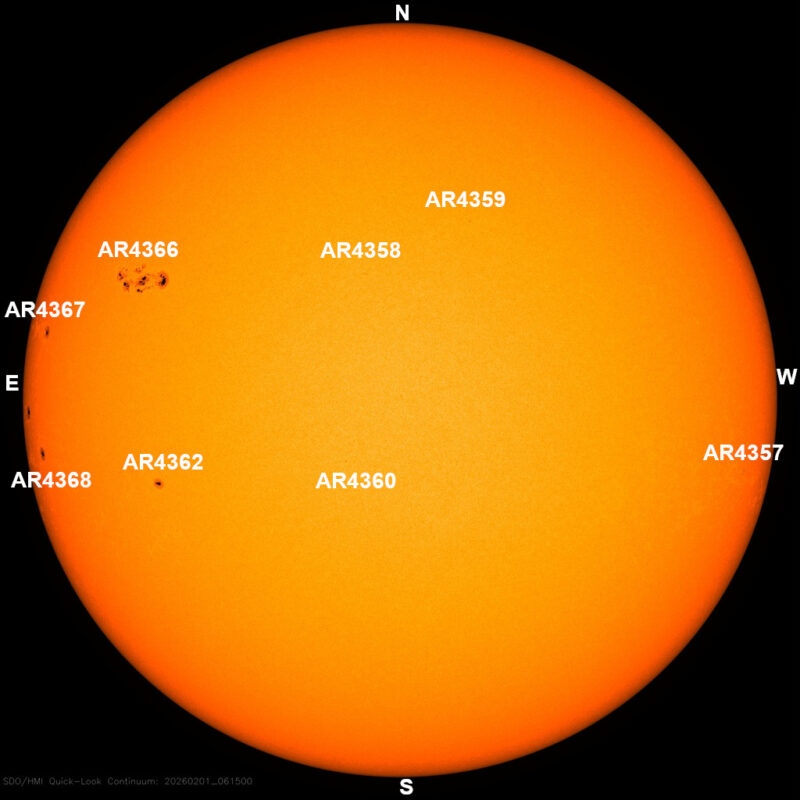
Sun news January 31: Meet newcomer sunspot region AR4366
Meet newcomer active region AR4366. Over the past day, sun activity showed an increase, in both flare production and flare strength. The boost came as newcomer sunspot regions started to rotate into view on the sun’s northeast horizon. One of those is active region AR4366; it comes with an interesting beta-delta magnetic complexity. This newcomer rapidly became the lead flare producer of the past day. It blasted out 6 C (common) flares and one of those flares was the second-strongest of the past day, a C4.9 flare this morning (4:40 UTC on January 31). This active region might have been one of the sunspots producing those long-lasting prominences we saw beyond the sun’s northeast horizon earlier this week.
Past 24 hours on the sun
(11 UTC January 30 – 11 UTC January 31)
Flare activity: Sun activity continued at low levels with only C (common) flares. But, overall, flare production increased over the past day. Total flare activity during this period included 14 C flares compared to the 10 C flares of the previous day.
Sunspot regions: Currently the sun shows 9 numbered active regions on its side as we see it from Earth.
- Lead flare producer: AR4366 was the most prolific flare producer of the past day with 6 C flares, a C4.9 included. The strength of the flares produced over the past day also increased. Today’s strongest flare was a C6.0 in contrast to the the largest flare of the previous day, a C1.9. Active region AR4349 produced today’s strongest flare (5:12 UTC on January 31).
Blasts from the sun? Observers did not see any Earth-directed coronal mass ejections (CMEs) in available coronagraph imagery over the past day.
Past 24 hours in space weather
Solar wind: Solar wind speeds dropped to low levels during the past day as a coronal hole’s fast solar wind stream started to wane. The interplanetary magnetic field (IMF) continued low. The Bz showed a south orientation for most of the past day (a southward Bz boosts aurora potential).
Earth’s magnetic field: Earth’s magnetic field was mostly quiet Kp 1–2. For the most part of the past day, the Kp index showed Kp = 2 and decreased just below Kp = 2 at the time of this writing (11 UTC on January 31, 2026).
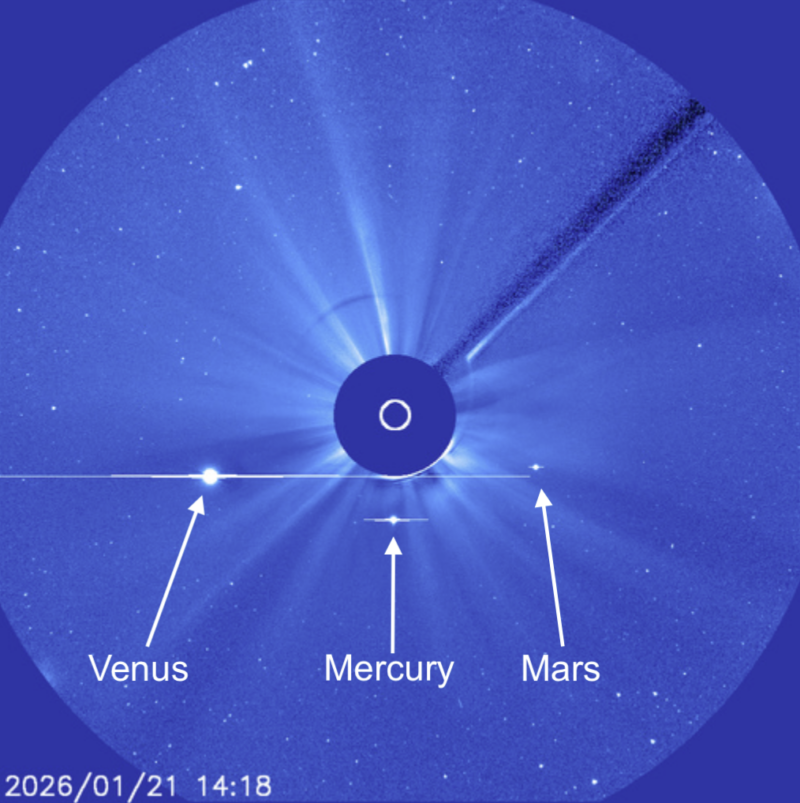
Where are Venus, Mars and Mercury?
Sun news January 30: Fiery activity on sun’s incoming horizon


The sun’s eastern horizon – the side rotating into view – continued to show fiery activity all day over the past day. All this strong activity is occurring on the sun’s far side, just behind the east limb (edge). We’re seeing long-lasting fiery prominences exploding and hurling plasma into space and repeatedly spewing strong jets. This fiery activity will rotate to the Earth-viewed side of our star in the next coming days. As an example, a newcomer – an as-yet-unnumbered sunspot region – produced the greatest number of flares (4) from any one region. It also produced the strongest flare – a C1.9 – seen over the past day. Stay with us, as flare activity might turn interesting!
Past 24 hours on the sun
(11 UTC January 29 – 11 UTC January 30)
Flare activity: Sun activity remained low, with only C-class (common) flares. But, overall, flare production increased over the past day. Total flare activity during the period included 10 C flares.
Sunspot regions: The sun shows 7 numbered active regions on its side as we see it from Earth.
- Lead flare producer: An active newcomer in the northeast, as-yet-unnumbered, produced 4 C flares, the day’s strongest included. The strongest flare was a C1.9 at 10:35 UTC on January 30.
Blasts from the sun? Experts did not observe any Earth-directed coronal mass ejections (CMEs) in available coronagraph imagery over the past day.
Past 24 hours in space weather
Solar wind: Solar wind speeds continued at high levels for most of the past day, due to a coronal hole’s fast solar wind stream. But solar wind speeds had dropped to moderately high by the time of this writing (11 UTC January 30). The interplanetary magnetic field (IMF) decreased to low. The Bz kept moving from northward to southward. But, in a way similar to the day before, the strongest peaks were oriented to the south (a southward Bz boosts aurora potential).
Earth’s magnetic field: Earth’s magnetic field ranged from quiet-to-active levels, Kp 2–4. The anticipated G1 (minor) storm did not arrive but disturbance level reached Kp = 4. For the most part of the period the Kp index showed Kp = 4 just to drop to Kp = 2 at the time of this writing.
What’s ahead? Sun–Earth forecast
Flare activity forecast: Low levels expected to continue, with a reduced chance for M-class (moderate) flares (15%) and minor chances for X-class (strong) flares (1%) on January 30–31. All this may change as active regions rotate into view next week.
Sun news January 29: Geomagnetic storm arrived last night
As anticipated, a G1 (minor) geomagnetic storm disturbed Earth’s magnetic field at around 23 UTC last night, bringing conditions for aurora sightings in high latitudes. The storm was triggered by fast solar wind streaming from a coronal hole currently adorning the Earth-facing side of our star. Did you see the auroras? Share a photo with us here!
Past 24 hours on the sun
(11 UTC January 28 – 11 UTC January 29)
Flare activity: Sun activity remained low, with 3 C-class (common) and one B-class (weak) flares produced over the past day. The strongest was a C1.5 flare at 12:47 UTC on January 28 from AR4345.
Sunspot regions: Today, the sun shows 6 numbered active regions on its Earth-facing side.
- Lead flare producer: The four flares produced during the period were produced by four different active regions: AR4353 (beta), AR4349 (alpha), AR4357 (beta) and AR4345 (now rotated to the far side).
Blasts from the sun? We observed no Earth-directed coronal mass ejections (CMEs) in available coronagraph imagery during the period.
Past 24 hours in space weather
Solar wind: Solar wind speeds jumped up to high late on January 28 due to a coronal hole’s fast solar wind stream, but it returned to moderately high levels at the time of this writing (11 UTC January 29). The interplanetary magnetic field (IMF) was moderate. The Bz kept shifting from north to south, but the strongest peak was southward (southward Bz boosts aurora potential).

Earth’s magnetic field: Earth’s magnetic field ranged from quiet to active levels, Kp 2–5. An isolated G1 (minor) storm was observed lasting one three-hour period. At the time of this writing, Kp = 2.
Sun news January 28: Incoming solar wind brings aurora chance today

Auroras are possible tonight with the arrival of fast solar wind from a coronal hole, an area of lower density in the sun’s outer atmosphere. Already, the speed of the solar wind reaching Earth increased this morning. NOAA has issued an alert for G1 (minor) geomagnetic storms, which could bring auroral displays in northern latitudes like Montana and Maine in the U.S. Clear skies!
Past 24 hours on the sun
(11 UTC January 27 – 11 UTC January 28)
Flare activity: Sun activity remains low, with only 3 C-class (common) flares produced over the past day. The strongest was a C2.7 flare at 23:40 UTC on January 27 from AR4342.
Sunspot regions: 6 numbered active regions currently populate the Earth-facing side of the solar disk.
- Lead flare producer: Three flare producers tied with one flare each: AR4353 (beta), AR4342, and an as-yet-unnumbered newcomer in the southeast.
Blasts from the sun? No Earth-directed coronal mass ejections (CMEs) were observed in available coronagraph imagery during the period.
Past 24 hours in space weather
Solar wind: Solar wind speed was low for most of the past day, but it jumped up at 9 UTC on January 28 due to a coronal hole’s fast solar wind stream. The interplanetary magnetic field (IMF) was moderate, and Bz stayed south oriented for most part of the period (southward Bz boosts aurora potential).
Earth’s magnetic field: Earth’s magnetic field has been ranging from quiet to unsettled levels, Kp 1–3.
What’s ahead? Sun–Earth forecast
Flare activity forecast: Low levels are anticipated, with a reduced chance for M-class (moderate) flares (25%) and slight chances for X-class (strong) flares (5%) on January 28–29.
Geomagnetic activity forecast:
- January 28: Unsettled-to-active levels are anticipated for today with chances for an isolated G1 (minor) storm as the fast solar wind from a coronal hole arrives. Auroras could be visible in cities such as Seattle, Minneapolis and Edinburgh if southward Bz continues.
- January 29: Unsettled-to-active levels could continue if we keep receiving the fast solar wind from this coronal hole.
NASA’s sun-observing Solar Dynamics Observatory (SDO) is currently in an eclipse season — a twice-yearly event in which Earth passes between SDO and the sun. In SDO images, you see a dark curve crossing the sun’s face. And it’s not the moon, and not a solar eclipse as we see from Earth. It’s an eclipse of the sun by Earth, as seen from space. EarthSky’s Deborah Byrd will show images of what SDO sees, and explain what the images show — and what they don’t show — and why perspective matters in astronomy. Join us – and bring your questions – beginning at noon central (18 UTC) on Wednesday, January 28.
Sun news January 27 (UTC): Fiery double eruption on our star

Around 16 UTC yesterday, we watched a fiery double solar eruption on the northeastern horizon of our star. A filament erupted violently and formed an arch of plasma on the Earth-viewed side of the sun, and – almost simultaneously – a filament on the far side responded with a similar eruption. Impressive!
Past 24 hours on the sun
(11 UTC January 26 – 11 UTC January 27)
Flare activity: Sun activity remained low over the past day, with a total of 14 C-class (common) flares produced. A C8.8 from AR4355 at 13:39 UTC on January 26 was the strongest flare.
Sunspot regions: Currently the Earth-facing side of our sun shows 7 numbered active regions.
- Lead flare producer: AR4351 (beta) produced 9 C faint flares to top the list. It continued to decay slowly.
- The next most productive was AR4342 with 4 C flares. The remaining 5 regions were stable and quiet.
Blasts from the sun? No significant Earth-directed coronal mass ejections (CMEs) were observed in available coronagraph imagery during the period.
Past 24 hours in space weather
Solar wind: Solar wind speeds continued to decrease as coronal hole fast solar wind influence waned. The interplanetary magnetic field (IMF) was weak, and Bz flipped between north and south (southward Bz boosts aurora potential).
Earth’s magnetic field: Earth’s magnetic field has been ranging from quiet to unsettled levels, Kp 2–3.
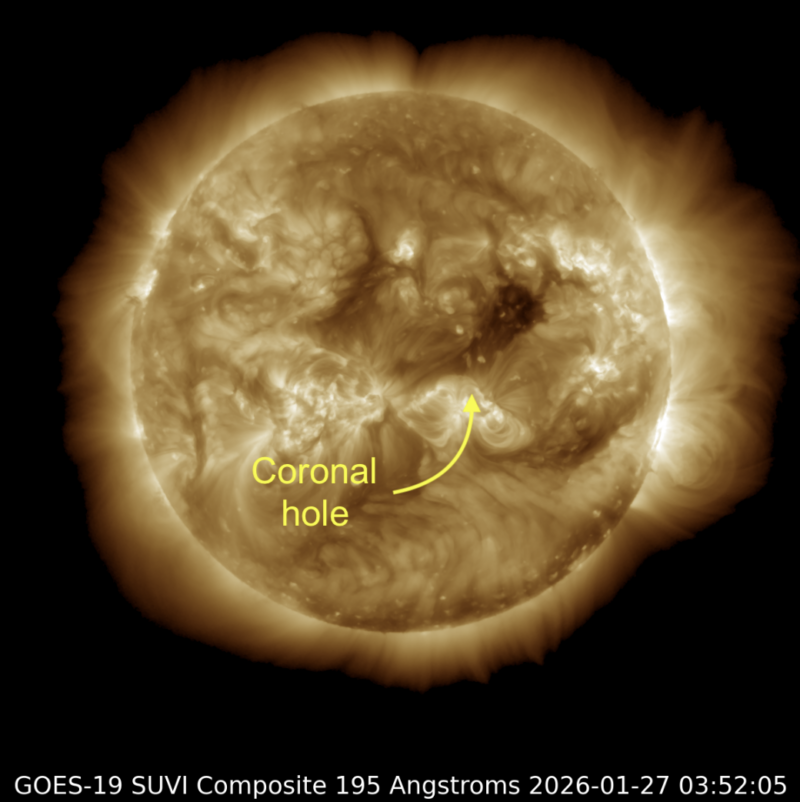
Sun news January 26 (UTC): A string of C flares from our star

The sun stayed slightly busy over the past day, firing a string of C-class (common) flares. This activity was capped by a C7.9 flare that erupted from AR4344 near the northwest horizon at 21:36 UTC on January 25. Despite this fairly quiet day, our star remains restless, and forecasters continue to flag the chance of M-class (moderate) flares over the next few days.
Past 24 hours on the sun
(11 UTC January 25 – 11 UTC January 26)
Flare activity: Solar activity remained low, with 13 C-class flares observed. A C7.9 from AR4344 at 21:36 UTC on January 25 was the strongest flare.
Sunspot regions: The Earth-facing solar disk displayed 10 numbered active regions.
- Lead flare producer: AR4351 (beta) produced multiple low-level C flares and a C6.3, with overall decay noted for much of the period but slight redevelopment late on.
- The remaining regions were largely stable and quiet. Despite being the most magnetically complex region on the disk, AR4353 produced little flare activity.
Blasts from the sun? No Earth-directed coronal mass ejection (CME) was observed in available coronagraph imagery during the period.
Past 24 hours in space weather
Solar wind: Solar wind speeds decreased overall as coronal hole fast solar wind influence weakened. The interplanetary magnetic field (IMF) was weak to modest, and Bz fluctuated between north and south without prolonged southward intervals (southward Bz is what most efficiently boosts aurora potential).
Earth’s magnetic field: Earth’s magnetic field ranged from quiet to unsettled levels, with Kp mainly 2–3 and no geomagnetic storm periods reported.
Sun news January 25 (UTC): Sun observations interrupted by Earth eclipse
While the sun continued producing steady C-flare activity, a different kind of interruption took center stage: the orbiting Solar Dynamics Observatory (SDO) is now in its biannual eclipse season. During these periods, which always happen near Earth’s equinoxes, Earth briefly passes between SDO and the sun, blocking the spacecraft’s view for up to 72 minutes per day. Now we’re in SDO’s eclipse period #32. It runs from January 6 through February 1. Today (January 25), the eclipse window lasted from 6:43 UTC to 7:47 UTC. During that time, continuous solar imagery paused, creating short data gaps that space-weather forecasters factor into daily monitoring. Outside those eclipse windows, SDO continues its around-the-clock watch of solar flares, sunspots, and eruptions—critical context as active regions evolve across the disk.
Past 24 hours on the sun
(11 UTC January 24 – 11 UTC January 25)
Flare activity: Beyond the SDO eclipse effects, the sun itself was at moderate levels, with 9 flares observed. Near Earth, aurora chances lingered at higher latitudes as our planet remained under the influence of a waning coronal hole fast-wind stream. Solar wind speeds eased, and the magnetic field orientation (Bz) flipped north and south frequently enough to keep geomagnetic conditions bouncing between quiet and active.
- Strongest flare: A C6.3 flare flashed from AR4351 late in the past day. It happened at 10:12 UTC on January 25.
- AR4351 was the lead flare producer, responsible for 4 of the 9 tracked C-class flares (C2.1–C6.3).
Sunspot regions: The Earth-facing solar disk displayed 10 numbered active regions (per UK Met Office summary), with several showing growth and/or magnetic complexity.
- AR4351 (beta-delta) briefly re-developed a weak delta configuration early, then weakened again with loss of trailing spots, but still produced the period’s strongest flare output.
- AR4353 (beta-delta) exhibited growth and re-developed its delta configuration, keeping it on the watch list for stronger flares.
- The remaining regions were largely unchanged or in slight decay during the period, maintaining an overall low-to-moderate flare-capable background.
Blasts from the sun? Sun observers didn’t detect any Earth-directed coronal mass ejections (CMEs) during the past day.
Past 24 hours in space weather
Solar wind: The solar wind remained in a coronal hole high-speed stream regime, with speeds slowly decreasing by the end of the period. The interplanetary magnetic field (IMF) stayed weak to modest. The Bz component swung between north and south; brief southward turns can “open the door” for energy to pour in and brighten aurora, but the lack of long sustained southward intervals limited storm potential.
Earth’s magnetic field: Earth’s magnetic field ranged from quiet to active levels, reaching Kp = 4 at times. A brief G1 (minor) geomagnetic storm interval earlier on January 24 (00:00–03:00 UTC), with conditions settling back toward unsettled/active thereafter as fast-wind influence slowly waned.
What’s ahead? Sun–Earth forecast
Flare activity forecast: Low levels are expected overall, but moderate (M-class, 55% chance) flare conditions remain likely on 25–27 Jan, with a slight chance (10% chance) for an X-class flare. The most likely sources are the magnetically complex regions AR4351 and AR4353 (both with beta-delta structure), with additional support from growing regions such as AR4349 and AR4355.
Geomagnetic activity forecast:
- January 25: Quiet to unsettled overall, with active periods possible early as the coronal hole fast-wind stream continues to fade.
- January 26: A return toward near-ambient solar wind is expected; geomagnetic conditions should trend quiet to unsettled.
- January 27: Quiet to unsettled for much of the day, then increasing late as a negative-polarity coronal hole high-speed stream moves into a more geoeffective position, bringing a higher likelihood of active intervals by day’s end.


Sun news January 24: Solar Cycle 25 sunspot number update
The 11-year solar cycle – driven by a magnetic dynamo inside the sun – causes the sun to go from a quiet solar minimum to a stormy solar maximum. We’re now just past the peak of Solar Cycle 25. And here’s a quick update on sunspot number. The number of visible spots on the sun’s face reduced in November 2025 to monthly value of 91.8. But, in December 2025, we saw an increase to 156.8. Meanwhile, August 2024 remains on the peak of Solar Cycle 25, with a monthly sunspot number of 216. So Solar Cycle 25 is declining. Still, specialists haven’t yet declared that solar maximum for Solar Cycle 25 has finished. The X1.9 flare this week is a proof of it. Stay tuned.
Past 24 hours on the sun
(11 UTC January 23 – 11 UTC January 24)
Flare activity: We observed low-level flaring and low-level flare production during the past day. We saw only 6 C common flares blasted out in the past 24 hours.
- Strongest flare: A C5.9 flare produced by an as-yet-unnumbered incoming region in the sun’s southeast. The event peaked at 23:29 UTC on January 23.
Sunspot regions: Currently the Earth-facing side of our star shows 8 numbered active regions.
Past day’s most active region: AR4353 and this newcomer in the southeast tied in flare production with two C flares each during the period.
Regions to watch:
- AR4345 (beta magnetic complexity) and AR4353 (beta) both regions lost their delta magnetic complexity. But they showed slight growth.
- AR4351 (beta magnetic complexity) producer of the X1.9 flare this week is still on our list of regions to observe.
Sun-stuff blasts? No Earth-bound coronal mass ejections CMEs were observed in available coronagraph imagery in the past 24 hours.
Past 24 hours in space weather
Solar wind: Solar wind speeds stayed at moderate levels during the past day, with Earth still under coronal hole influence. The interplanetary magnetic field (IMF) remained moderate. And the Bz component oscillated between north and south oriented, but stayed southward most of the period. Aurora chasers look for a south-oriented Bz because it’s most favorable for auroras. At 10 UTC today, the Bz component still shows south.
Earth’s magnetic field: Earth’s magnetic field was from active-to-quiet levels during the past day (Kp = 4 – 2). From 11 UTC January 23 through 3 UTC January 24 Kp index reached 4 level, just a hair below Kp = 5 or G1 (minor) geomagnetic storm level. All this under effects of fast solar wind from a large coronal hole. Shortly after that, the Kp index turned down to level 2. At the time of writing, the Kp index is at level 2.
Sun activity and space weather forecast
Flare activity forecast: Chances for a moderate flaring increase. Active region AR4353 and AR4345 are the drivers today. AR4341 is in the list as it was the producer of the X1.9 flare this week. There are slight chances for another X flare.
Geomagnetic activity forecast:
- January 24: Auroras may continue dancing across high latitudes. There’s a slight chance for a G1 (minor) geomagnetic storm today, as effects from of fast solar wind from the large coronal hole in the sun’s south hemisphere start to wane.
- January 25 -26: Quiet-to-unsettled conditions will prevail under the effects of fast speed solar wind from a large coronal hole.
Sun news January 23: Coronal holes drive continued geomagnetic storms


Earlier this week we had geomagnetic storming. – and strong auroral displays – thanks to an X flare on the sun. They subsided. But now Earth’s magnetic field is disturbed again, this time due to fast solar wind from a large coronal hole on the sun. The hole has now moved into a geoeffective position, where it’s capable of affecting Earth. And boom! Measuring devices registered an isolated G1 (minor) geomagnetic storm, with the kp = 5 threshold reached at 23:27 UTC on January 22. And more episodes of G1 (minor) or even G2 (moderate) storming might occur in the coming days. See the sun activity and space weather forecast below.
Past 24 hours on the sun
(11 UTC January 22 – 11 UTC January 23)
Flare activity: Solar activity continued at low levels. But flare production increased from 11 C (common) flares to 18 C flares in the past 24 hours.
- Strongest flare: A C9.5 flare, almost an M flare. Sunspot region AR4353 produced it. It peaked at 19:54 UTC on January 22.
Sunspot regions: 11 numbered active regions on the Earth-facing disk today.
- Past day’s most active region: AR4353 topped the list with seven C flares. This active region produced the strongest flare of the period.
Regions to watch:
- AR4345 (beta-delta) kept its delta magnetic complexity. This guy has potential for M and X-class flares.
- AR4353 (beta-delta) is on the scope today as it developed an unstable delta and it is today’s lead flare producer with an almost M flare.
Sun-stuff blasts? No Earth-bound coronal mass ejections CMEs were observed in available coronagraph imagery.
Past 24 hours in space weather
Solar wind: Solar wind speeds stayed at moderate levels during the past day, with Earth still under coronal hole influence. The interplanetary magnetic field (IMF) remained moderate. And the Bz component stayed southward most of the period. Aurora chasers look for a south-oriented Bz because it’s most favorable for auroras. At 10 UTC today, the Bz component still shows south.
Earth’s magnetic field: Earth’s magnetic field was from quiet-to-active storming levels during the past day (Kp = 2 – 5). Measuring devices recorded an isolated G1 (minor) geomagnetic storm. The Kp = 5 threshold was reached at 23:27 UTC on January 21 and lasted for a three-hour synoptic period. At the time of writing, the Kp index is just below level 4.

Sun news January 22: After three days, geomagnetic storms subside
After three days, the exciting round of geomagnetic storms has finally subsided. Since the arrival of a fast coronal mass ejection (CME) on January 19, we saw extended periods of G4 (strong) geomagnetic storms and even episodes of G5 (extreme) storming, with auroras dancing across high latitudes. Overall, this 3-day episode of geomagnetic storms turned out to be a fascinating event. A northward-oriented Bz – which describes the direction of the sun’s magnetic field – limited auroral displays at first. But, eventually, the Bz moved southward, bringing auroras as far south as the northern states in Mexico. Certainly an event for the record books!
Past 24 hours on the sun
(11 UTC January 21 – 11 UTC January 22)
Flare activity: Solar activity drops back to low levels with 11 C-class (common) flares observed in the past 24 hours.
- Strongest flare: A C8.6 flare from AR4341 peaked at 19:38 UTC on January 21.
Sunspot regions: 9 numbered active regions today adorn the Earth-facing disk.
- Past day’s most active region: AR4341 led flare production, releasing four C flares total (the strongest included).
Regions to watch:
- AR4345 (beta-delta) developed a delta in its magnetic complexity, giving it potential for M and X-class flares.
- AR4341, AR4342 and AR4349 show beta-gamma magnetic complexities, a moderately promising configuration.
Sun-stuff blasts? No Earth-bound coronal mass ejections CMEs were observed in available coronagraph imagery.
Past 24 hours in space weather
Solar wind: Solar wind speeds gradually declined from very high to moderate levels after the CME’s influence waned, with Earth still under coronal hole influence. The interplanetary magnetic field (IMF) remained moderate, while the Bz component stayed southward early in the period, enhancing auroral potential. At 8 UTC on January 22 it moved northward.
Earth’s magnetic field: After the severe geomagnetic storm, Earth’s magnetic field dropped back to quiet-to-active levels through much of the past day (Kp = 2 – 4). At the time of writing, the Kp index is just below level 3.
Sun activity and space weather forecast
Flare activity forecast: Moderate flaring is expected to continue, with ongoing chances for M-class flares and slight chances for another X-class flare through January 22.
Geomagnetic activity forecast:
- January 22: Activity should gradually ease toward unsettled levels as coronal hole influence persists and remaining CME effects fade. Isolated G1 (minor) geomagnetic storms may occur.
- January 23: Quiet-to-active conditions will prevail under the effects of fast speed solar wind from a large coronal hole.
- January 24: Geomagnetic activity may reduce to quiet or unsettled as coronal hole effects start to wane.

Sun news January 21: Geomagnetic storms keep on coming
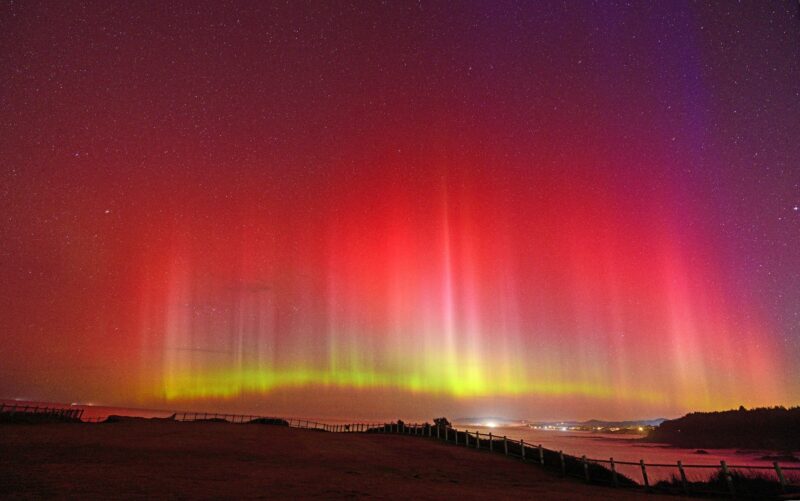
Like the Energizer Bunny, the current round of geomagnetic storming just kept going last night! As Earth’s magnetic field continued to reel from the arrival of a fast coronal mass ejection (CME) on January 19, we saw more periods of G4 (severe) storming, and auroras again danced across high latitudes. Overall, this 2-day episode of geomagnetic storms has turned out to be a fascinating event: exceptionally strong on paper, yet surprisingly muted in terms of auroras reaching into lower latitudes. But many northern skywatchers did see some beautiful sights, and there’s still the possibility of more tonight!
Past 24 hours on the sun
(11 UTC January 20 – 11 UTC January 21)
Flare activity: Solar activity remains moderate, with 11 flares recorded in the past 24 hours. Total flare production included 2 M-class (moderate) flares and 9 C-class (common) flares.
- Strongest flare: An M3.4 flare from AR4349 peaked at 7:12 UTC on January 21. The eruption triggered an R1 (minor) radio blackout affecting the South Indian Ocean.
- A second M flare: AR4345 produced an M1.2 flare at 1:41 UTC on January 21. A corresponding R1 (minor) radio blackout affected the Coral Sea, northeast of Australia.
Sunspot regions: The sun currently displays 11 numbered active regions on the Earth-facing disk.
- Past day’s most active region: AR4345 once again led flare production, releasing five flares total (one M-class and four C-class).
Regions to watch:
- AR4342 (beta-gamma-delta) developed the strongest magnetic complexity, giving it potential for X-class flares.
- AR4345, today’s lead flare producer, maintains moderately high flare potential with its beta-gamma configuration.
Past 24 hours in space weather
- Solar wind: Solar wind speeds gradually declined from very high to moderate levels following the CME arrival, though coronal hole influence persisted. The interplanetary magnetic field (IMF) remained moderate, while the Bz component stayed southward for much of the period, enhancing auroral potential.
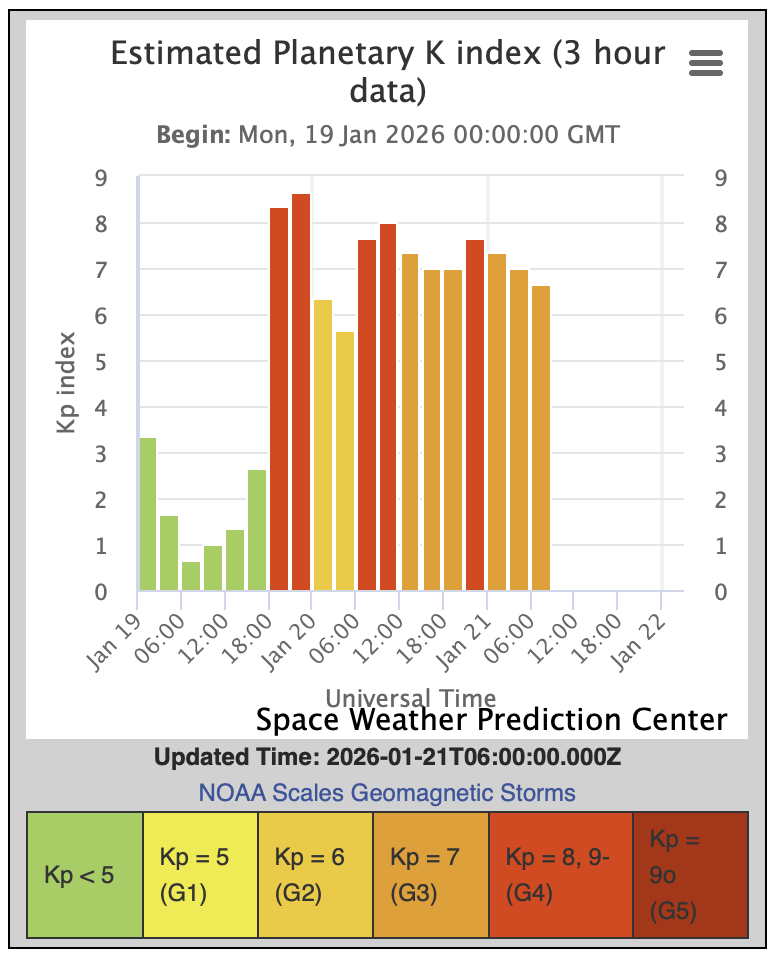
- Earth’s magnetic field: Earth’s magnetic field remained at severe geomagnetic storm levels through much of the period, reaching Kp = 8. At the time of writing, the Kp index stood near 7.

Sun news January 20: Sun-stuff blast brings severe storms
A blast of sun-stuff fired out by Sunday’s X1.9 (strong) flare impacted Earth last night. It reached our magnetic field at approximately 18:38 UTC, and it didn’t arrive quietly; we observed G4 (severe) geomagnetic storm levels overnight and into this morning. Many at northern latitudes saw the resulting auroras. But this light display was less widespread than you’d expect for such a strong storm. Why? Discover the intriguing science here.
Past 24 hours on the sun
(11 UTC January 19 – 11 UTC January 20)
Flare activity: Solar activity reached moderate levels, with 14 flares observed over the past day. The total included 1 M-class (moderate) flare and 13 C-class (common) flares.
- Strongest flare: M1.2 from AR4345 at 11:19 UTC on January 19.
Sunspot regions: The Earth-facing solar disk currently holds 10 numbered active regions.
- Past day’s most active region: AR4345 was the key driver of impacts, producing the M1.2 event and additional 8 C-class flares.
Regions to watch:
- AR4341 (beta) lost some magnetic complexity, but remains under a close eye after firing the recent X flare.
- AR4345 – today’s lead flare producer – and AR4342 both have moderately high-potential beta-gamma complexities.
Sun-stuff blasts? Other than the coronal mass ejection (CME) that triggered severe geomagnetic storming last night, no new Earth-bound CMEs have been observed.
Past 24 hours in space weather
Solar wind: Solar wind speeds dramatically increased to very high levels following the arrival of the CME last night, along with continuing coronal hole influence. The interplanetary magnetic field (IMF) was high. The Bz component was mainly oriented northward overnight, limiting aurora potential, although there was a brief southward period from 5-10 UTC today.
Earth’s magnetic field: Earth’s magnetic field ranged up to extreme geomagnetic storms, reaching Kp = 9. The Kp index is at 8 at the time of this writing.
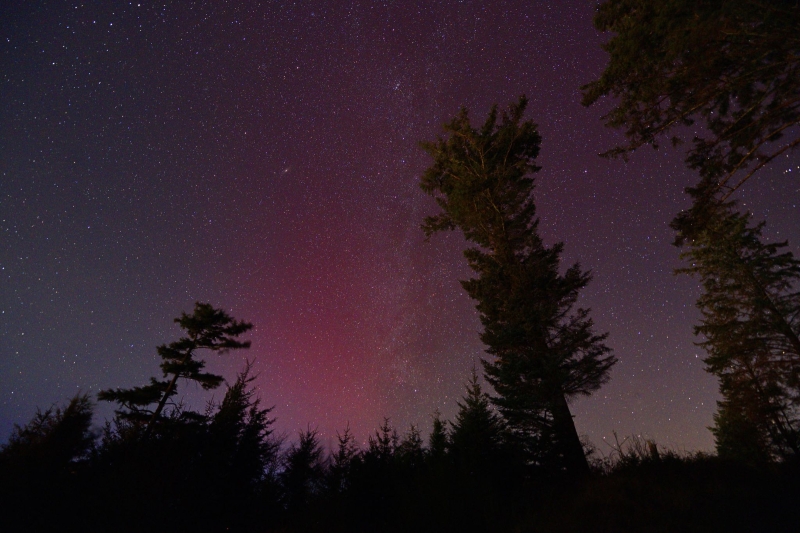
Sun news January 19: X flare and CME fired our way!
BAM! The sun exploded with a powerful X1.9 flare from sunspot region AR4341 yesterday. The blast triggered an R3 (strong) radio blackout across Earth’s sunlit hemisphere. And it also launched a huge blob of solar material – a coronal mass ejection, or CME – toward our planet. It’s the classic setup for geomagnetic storms and auroras once the plasma cloud reaches Earth.
Meanwhile, energetic protons from the sun are raining down on Earth in the wake of the X flare, causing an ongoing solar radiation storm at S3 (strong) levels. This has triggered what’s called a polar cap absorption event, degrading or completely disrupting high-frequency radio communications inside the Arctic Circle.

Past 24 hours on the sun
(11 UTC January 18 – 11 UTC January 19)
Flare activity: Solar activity reached high levels, with 9 flares observed (1 X-class [strong], 0 M-class [moderate], 8 C-class [common]).
Strongest flare: X1.9 from AR4341 at 17:27 UTC on January 18.
Sunspot regions: The Earth-facing solar disk currently holds nine numbered active regions.
- Past day’s most active region: AR4341 was the key driver of impacts, producing the X1.9 event and additional C-class activity.
Region to watch:
- AR4341 (beta-gamma) maintained a magnetically complex structure with a weak delta region, and produced the X flare.
Sun-stuff blasts? An Earth-directed, full-halo coronal mass ejection erupted at 18:09 UTC with the X1.9 flare. Analysts estimate Earth arrival around 1-3 UTC on 20 Jan. It’s expected to trigger a Kp of 7–9, which could mean G3-G5 (strong to extreme) geomagnetic storms.
Past 24 hours in space weather
Solar wind: Solar wind speeds decreased under continuing coronal hole influence. The interplanetary magnetic field (IMF) was moderate. The Bz component trended southward at times, briefly opening the door for enhanced aurora potential.
Earth’s magnetic field: Earth’s magnetic field ranged from quiet to active levels, reaching Kp = 4.
Sun news January 18 (UTC): Moderate flare activity continues
(11 UTC January 17 ? 11 UTC January 18)
A fast M1.2 flare from AR4341 snapped off at 23:46 UTC on Jan 17, briefly boosting solar activity and triggering an R1 (minor) radio blackout over Earth’s sunlit hemisphere. HF users just east of Australia were most likely to notice the blackout. Meanwhile, aurora watchers had reason to keep looking north: Earth remained under the influence of a fast stream from a coronal hole, with strong solar wind continuing to stream toward Earth near 700 km/s. Read more below!
- Flare activity on the sun remained at moderate levels, with 11 flares observed (1 M-class, 10 C-class).
- Sunspot regions: The Earth-facing solar disk displayed 8 numbered active regions.
- AR4341 (beta-gamma) maintained a complex configuration and produced the strongest flare activity, including an M-class flare late on January 17.
- AR4343 (beta-delta) continued producing lower-level C-class flares while retaining a weak delta signature, keeping its flare potential elevated compared to simpler regions.
- AR4344 (beta) underwent minor evolution, adding trailing spots and developing a more defined leading structure.
- AR4340 decayed to plage during the period, reducing its flare contribution.
- The remaining regions (AR4342, AR4345, AR4347) were smaller overall but still contributed scattered C flares, indicating broadly unsettled magnetic conditions across the disk.
- Blasts from the sun? No Earth-directed coronal mass ejection (CME) was observed during the past day.
- Solar wind: The Bz component of the incoming solar wind stream was largely northward in the past day. So the “door” into Earth’s magnetosphere only opened briefly during short southward dips. Even with that limitation, geomagnetic conditions still reached active-to-minor storm levels at times, supporting enhanced auroral potential at high latitudes (best odds near places like Reykjavik and northern Scandinavia, with occasional chances farther south when Bz briefly turns negative). Solar wind speeds remained elevated under coronal-hole high-speed-stream influence, averaging roughly 670–750 km/s with a peak near 780 km/s. The interplanetary magnetic field (IMF) was moderate.
- Earth’s magnetic field: Earth’s magnetic field ranged from unsettled-to-active levels, with an early G1 (minor) geomagnetic storming period noted in operational summaries. Conditions otherwise hovered mainly in the Kp 2–4 range, consistent with fast-wind driving but limited sustained coupling due to mostly northward Bz.
What’s ahead? Sun–Earth forecast
- Flare activity forecast: Moderate levels are expected, with a continued chance of isolated M-class (R1-R2) flares, mainly from AR4341 and flare-capable AR4343 as they evolve. (No specific NOAA percentage probabilities were provided in the source discussion for this period.)
- Geomagnetic activity forecast:
- 18 Jan: Geomagnetic storms at G1 (minor) levels are likely as coronal-hole high-speed-stream effects persist. If Bz turns southward for longer stretches, aurora could expand toward Seattle, Minneapolis, and Edinburgh (Kp ~5 scenario), otherwise remaining closer to higher latitudes.
- 19 Jan: Unsettled to active conditions are expected as the fast wind continues but gradually weakens; brief active intervals remain possible during southward Bz fluctuations.
- 20 Jan: Unsettled to active conditions continue, trending downward late as coronal-hole influence wanes further.

Sun news January 17: M flare observed, more may follow
An M2.2 flare from AR4341 snapped the sun back to attention this morning, underscoring the fact that Solar Cycle 25 remains lively. The flare peaked at 10:19 UTC on January 17 and triggered an R1 (minor) radio blackout, briefly roughening high-frequency (HF) radio conditions across southern Africa. This flare followed a sustained increase in activity from AR4341, which has just rotated into view. This region continues to show strong magnetic complexity and flare potential. Will we see more M flares during the week ahead?
Past 24 hours: The details
(11 UTC January 16 – 11 UTC January 17)
- Flare activity: As anticipated, flare production increased notably over the past day. Yesterday we reported five C-class (common) flares. Solar activity reached moderate levels, with 19 flares observed (1 M-class, 18 C-class), during this period.
- Strongest flare: M2.2 from AR4341 at 10:19 UTC on 17 Jan. It triggered an R1 (minor) radio blackout affecting HF communications across southern Africa.
- Lead flare producers: Active region AR4343 led the period with six C-class flares, closely followed by AR4342, which produced five C-class flares.
- Sunspot regions: Nine numbered active regions are visible on the Earth-facing solar disk.
- AR4341 (with a beta-gamma-delta magnetic configuration) remains the most magnetically complex region on the disk. This configuration carries potential for M-class and even X-class flares. The region produced four C-class flares during the period.
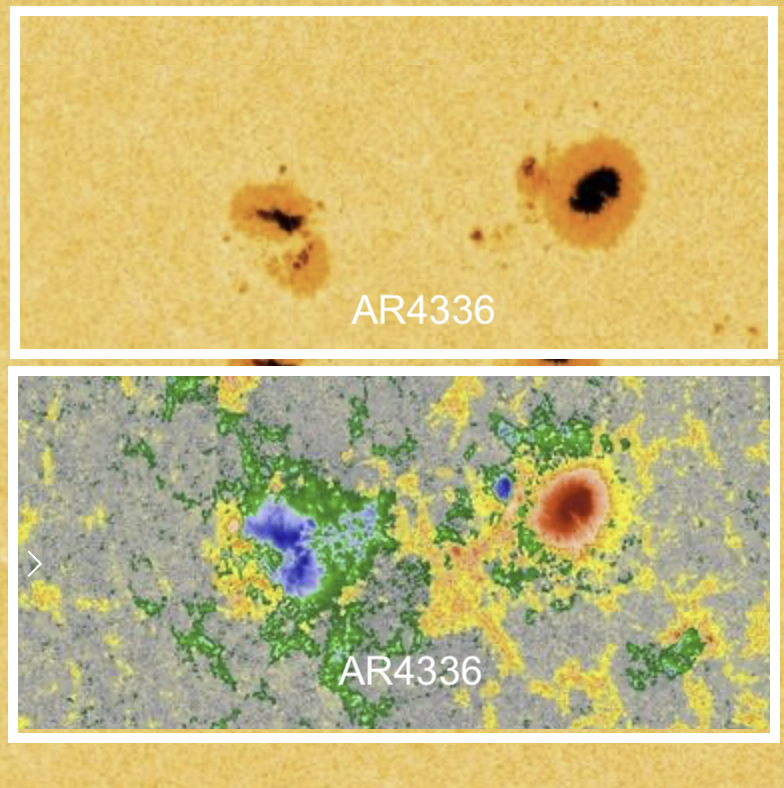
- AR4336 (alpha) lingered on the southwest limb before rotating out of view. Just before departure, it produced a fiery C4.7 flare at 02:46 UTC on January 16, launching a large prominence into space.
- AR4343 (beta-gamma) retained its gamma component, showed notable growth, and emerged as the lead flare producer.
- The remaining sunspot regions displayed simpler alpha or beta magnetic configurations and remained largely stable.
- Blasts from the sun? We didn’t observe any clearly Earth-directed coronal mass ejections (CMEs) over the past day. The prominent eruption observed on the southwest limb following the C4.7 flare from AR4336 was directed well away from Earth. Meanwhile, transient solar wind structures continued to buffet Earth.
- Solar wind: Solar wind speeds rose sharply from around 600 km/s into the 700 km/s range, peaking near 780 km/s at 03:46 UTC on January 17. By 10 UTC, speeds remained elevated near 704 km/s. Early in the period, the interplanetary magnetic field (IMF) stayed strong before dropping after 02:13 UTC. The north–south component, Bz, fluctuated significantly, reaching northward peaks and southward excursions. Periods of southward Bz supported auroral activity. By 11 UTC on January 17, Bz had turned northward.
- Earth’s magnetic field: Over the past day, Earth remained immersed in fast solar wind flowing from a large coronal hole. Solar wind speeds surged well above background levels, and intermittent southward turns in Bz allowed energy to couple efficiently into Earth’s magnetosphere. That combination pushed geomagnetic conditions to G1 (minor) storm levels at times, keeping aurora watchers on alert at high latitudes.


Sun news January 16: Large coronal hole aims solar wind our way
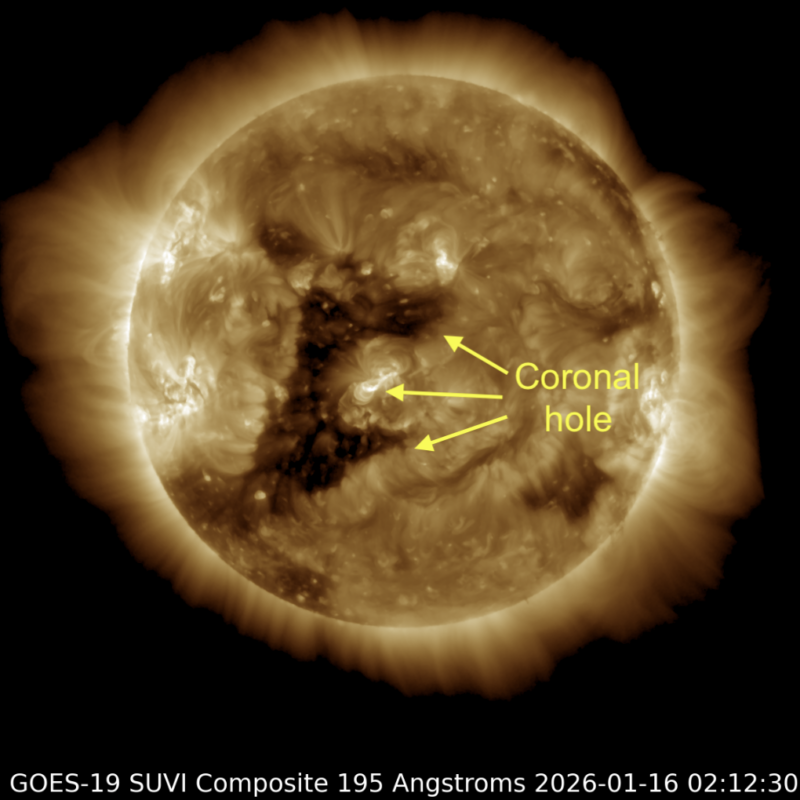
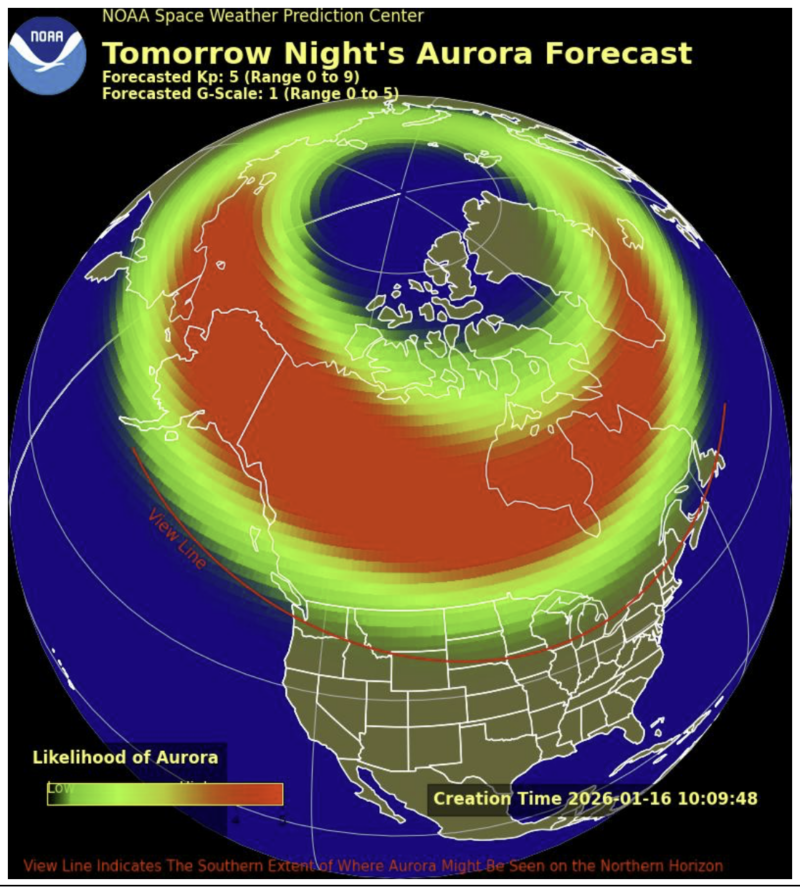
A large coronal hole on the sun is now sending its fast solar wind in Earth’s direction. But the solar wind stream hasn’t fully struck us yet. It’s expected as early as Saturday morning, January 17. If and when it arrives, it might provoke disturbances in Earth’s geomagnetic field, which could mean auroras at high latitudes. G1 (minor)geomagnetic storm levels are expected tomorrow to be extended through January 18. Weekend alert for aurora hunters! Bring those cameras out and polish lenses, for a possible display this weekend.
Past 24 hours: The details
(11 UTC January 15 – 11 UTC January 16)
- Flare activity has returned to low levels over the past day, with the production of fewer flares and only C (common) flares. Total flare production during the last 24 hours: five C-class (common) flares.
- The strongest flare was a C6.6 flare peaked at 9:09 UTC on January 16. It came from an incoming region in the sun’s southeast. It’s now numbered AR4345.
- The lead flare producer is a newcomer in the sun’s northeast, now designated AR4344. It produced two C flares.
- Sunspot regions: Today we see an increased number of numbered active regions on the Earth-facing side of the sun. Currently, the solar disk shows eight numbered active regions.
- AR4341 (with an alpha magnetic configuration) and AR4342 (alpha) showed some growth.
- AR4336 (alpha) reduced to simpler alpha configuration and did not produce flares during the past day. This region will soon depart to the sun’s far side.
- Over the past day, we’ve seen four newcomers on the solar disk. These fiery active regions rotated into view from the far side of the sun. The newly numbered active regions are: AR4343 (beta-gamma) that emerged almost over the central meridian in the sun’s southern hemisphere, AR4344 (beta) in the northeast, AR4345 (beta) and AR4346 (alpha) in the southeast.
- Blasts from the sun? A coronal mass ejection (CME) in the vicinity of active region AR4340 hurled plasma into space. Modeling and analysis suggest the blob of solar stuff will pass north of Earth. But a glancing blow might provide some enhancements on January 18.
- Solar wind: Solar wind speeds averaged around 600 km/s but at 2:38 UTC on January 16 the solar wind speed increased to 700 km/s levels. By 10 UTC this morning dropped down to 609 km/s. Early in the period, the interplanetary magnetic field (IMF) remained weak near 5 nT. But it started to increase with a peak of 13 nT levels at 3:20 UTC on January 16. The north–south component, Bz, oscillated between northward and southward values, ranging from +1 to -1 nT. Periods of southward Bz favor auroral activity. By 11 UTC on January 16, Bz had turned northward, slightly above 0 nT.
- Earth’s magnetic field: Earth’s magnetic field was from quiet to active levels. Kp values stayed between 1 and 4, and no G1 (minor) geomagnetic storm conditions were observed but Kp = 4 threshold was reached at 5:15 UTC. At the time of writing (11 UTC on January 16), Kp stood at 3.
What’s ahead? Sun–Earth forecast
- Flare activity forecast: Flare activity is expected to increase in the next 24 hours. All this is driven with the appearance of newcomers on the east horizon. These active regions showed fiery activity while they were on the far side of the sun.
- Geomagnetic activity forecast:
- January 16: Quiet-to-active levels (Kp 1–4) are anticipated for the rest of the day as residual effects from a coronal mass ejection (CME) may bring some enhancements.
- January 17: Fast solar wind flowing from a now located at geoeffective position coronal hole may provide unsettled to active levels with chances to reach G1 (minor) geomagnetic storm levels. G2 (moderate) levels cannot be ruled out.
- January 18: Unsettled-to-active conditions are expected. G1 (minor) geomagnetic storm levels may be extended through January 18. Alert for aurora chasers. Clean those lenses and get prepared for auroral displays.
Sun news January 15: Incoming sunspot brings an M-class flare

An incoming sunspot region in the southeast, now numbered AR4341, pushed solar activity up to moderate levels with the production of an M1.6 flare at 20:33 UTC last night. Scientists had been watching this region’s arrival closely, following several rounds of strong activity on the far side of our star in recent days. A second newcomer also rotated onto the Earth-facing solar disk from the northeast over the past day. Stay tuned as we track this evolving solar activity.
Past 24 hours: The details
(11 UTC January 14 – 11 UTC January 15)
- Flare activity: Solar activity climbed to moderate levels with the production of an M-class (moderate) flare during the past day. The sun produced eight flares in total over the last 24 hours: one M-class flare and seven C-class (common) flares.
- Strongest flare: An M1.6 flare peaked at 20:33 UTC on January 14 from an incoming region in the southeast, now numbered AR4341. The flare produced an R1 (minor) radio blackout over the Pacific Ocean east of Easter Island. This active region blasted out a second near-M flare, a C9.8, at 6:36 UTC on January 15.
- Lead flare producer: As in recent days, the leading flare producer was the formerly unnumbered active region in the southeast. Now designated AR4341, it produced five flares in total: four C-class flares and the lone M-class flare of the period. This newcomer is now a key region to watch.
- Sunspot regions: The Earth-facing side of the sun currently shows four numbered active regions.
- AR4334 (with an alpha magnetic configuration) rotated out of view to the far side of the sun.
- AR4336 (beta) showed signs of decay and did not produce flares during the period.
- AR4340 (beta) continued to decay and also produced no flares.
- Two newcomers appeared on the solar disk: the attention-grabbing region in the southeast now numbered AR4341, and a second newcomer sliding in from the northeast, AR4342 (beta).
- Blasts from the sun? No Earth-directed coronal mass ejections (CMEs) were detected during the period.
- Solar wind: Solar wind speeds increased from around 500 km/s to about 646 km/s by 10 UTC this morning. Early in the period, the interplanetary magnetic field (IMF) remained weak near 4 nT. The north–south component, Bz, oscillated between northward and southward values, ranging from +5 to -5 nT. Periods of southward Bz favor auroral activity. By 11 UTC on January 15, Bz had turned southward to -3 nT.
- Earth’s magnetic field: Earth’s magnetic field ranged from quiet to active levels. Kp values stayed between 1 and 3, and no G1 (minor) geomagnetic storm conditions were observed. At the time of writing (11 UTC on January 15), Kp stood at 3.
Sun news January 14: Huge eruption on our star’s far side

A powerful eruption billowed over the sun’s north pole yesterday evening, originating from a sunspot region on our star’s far side. This unseen region appears highly volatile, having already produced two similarly large eruptions in recent days. And over the next few days, this sunspot region should rotate onto the side of the sun facing Earth. That should mean an increased potential for strong flares and eruptions that could influence space weather near Earth. Let’s see what it’s got in store for us!
Past 24 hours: The details
(11 UTC January 13 – 11 UTC January 14)
- Flare activity: Solar activity remained low over the past day. The sun produced only C-class (common) and B-class (weak) flares, totaling 11 flares: 10 C flares and one B flare.
- Strongest flare: A C9.6 flare erupted from an as-yet-unnumbered active region in the northeast. It peaked at 3:50 UTC on January 14.
- Lead flare producer: As on the previous day, the leading flare producer was an unnumbered active region in the southeast. It generated five flares in total: four C-class flares and one B-class flare.
- Sunspot regions: Three numbered active regions remained visible on the Earth-facing side of the sun.
- AR4334 (with an alpha magnetic configuration) continued to decay and nearly disappeared over the southwest limb as it rotated toward the far side of the sun.
- AR4336 (with a beta magnetic configuration) also showed signs of decay. Even so, it managed to produce two C-class flares during the period.
- AR4340 (also beta) continued to decay but remained stable and did not produce any flares.
- Blasts from the sun? Observers noted an eruption at 11:50 UTC on January 13. Most of the ejected plasma fell back toward the sun. Scientists are still modeling the event to determine whether any material is headed toward Earth. Aside from this eruption, no Earth-directed coronal mass ejections (CMEs) were detected during the period.
- Solar wind: Solar wind speeds remained elevated, averaging around 500 km/s (1,120,000 mph). A notable peak of 696 km/s occurred at 15:20 UTC on January 13. By 10 UTC this morning, speeds measured about 555 km/s. Early in the period, the interplanetary magnetic field (IMF) hovered near 6 nT, which is average for the sun. Meanwhile, the north–south component, Bz, stayed mostly southward. This persistent southward orientation favored auroral activity. By 11 UTC on January 14, Bz had turned slightly northward.
- Earth’s magnetic field: Earth’s magnetic field ranged from quiet to active levels. Kp values stayed between 1 and 3. No G1 (minor) geomagnetic storm conditions were observed. At the time of writing (11 UTC on January 14), Kp stood just above 0.

Sun news January 13: Sun news: 3 planets photobombed the sun this morning
As the SOHO spacecraft imaged the sun this morning, it caught a striking planetary parade of Venus, Mars and Mercury all alongside our star! Mars was just emerging from behind the imager’s occulter (the disk blocking the sun’s glare) having reached solar conjunction – when the planet is most directly on the opposite side of the sun from Earth – on Friday.
Past 24 hours: The details
(11 UTC January 12 – 11 UTC January 13)
- Flare activity: Solar flare activity remained at low levels over the past 24 hours. The sun produced four flares in total: two C-class (common) flares and two B-class (weak) flares.
- Strongest flare: A C1.4 flare erupted from an as-yet-unnumbered active region in the southeast, peaking at 12:47 UTC on January 12.
- Lead flare producer: The same as-yet-unnumbered southeastern active region was the sole flare producer of the period, accounting for all four flares.
- Sunspot regions: Three numbered active regions are visible on the Earth-facing side of the solar disk.
- AR4334 (alpha) continued to decay and is now close to rotating off the southwest limb toward the far side of the sun.
- AR4336 (alpha) lost its earlier beta–gamma configuration. It produced an impulsive C5.3 flare at 10:15 UTC on January 12, but afterward it remained quiet.
- AR4340 (beta) showed signs of growth but did not produce any flares during this period.
- An additional, unnumbered active region in the southeast remained the most active area today and may become an important region to watch as it rotates further into view.
- Blasts from the sun? No Earth-directed coronal mass ejections (CMEs) were detected during this period.
- Solar wind: Solar wind speeds stayed elevated, averaging around 570 km/s. Several peaks approached 650 km/s, including around 18:38 UTC on January 12 and again near 1:44 UTC on January 13. Early in the period, the interplanetary magnetic field (IMF) measured near 9 nT and gradually declined to about 7 nT by the time of this writing. Meanwhile, the north–south component, Bz, stayed mostly southward. This persistent southward orientation allowed solar wind energy to couple efficiently into Earth’s magnetic field and supported enhanced auroral activity, with Kp reaching 4. By 10 UTC on January 13, Bz had turned slightly northward.
- Earth’s magnetic field: Earth’s magnetic field ranged from quiet to active conditions, with Kp values between 2 and 4. The Kp = 4 threshold was reached at 21 UTC on January 12. No G1 (minor) geomagnetic storm levels were observed. At the time of writing (11 UTC January 13), Kp stood just below 2.

Sun news January 12: Auroras lit up far-northern skies last night
Auroras lit up high-latitude skies for the second night in a row last night. The light show came as the combined influence of an earlier coronal mass ejection (CME) arrival and a fast stream of solar wind from a coronal hole continued to disturb Earth’s magnetic field. Conditions reached G1 (minor) geomagnetic storm levels as a southward-tilted magnetic field opened the door for energy to flow into Earth’s upper atmosphere. This allowed for auroras to be seen in northern Scotland, Iceland, northern Canada, northern Scandinavia and similar latitudes.
Past 24 hours: The details
(11 UTC January 11 – 11 UTC January 12)
- Flare activity: Solar activity was at moderate levels, with 4 flares (1 M-class [moderate], 1 C-class [common], 2 B-class [weak]) observed in the period.
- Strongest flare: An M3.4 flare from a region just rotating onto the disk over the eastern horizon peaked at 21:53 UTC yesterday. It triggered an R1 (minor) radio blackout over the sunlit hemisphere, primarily affecting high-frequency aviation and maritime communications across the Pacific Ocean.
- Lead flare producer: The complex region AR4336 was the top flare producer, responsible for the C3 flare and the B-class events. The strongest events, however, came from the region on the eastern horizon. This region is expected to rotate fully into view within the next 24 hours and may bring further M-class flares.
- Sunspot regions: The Earth-facing solar disk displayed 5 numbered active regions during the past day, with one new region emerging.
- AR4336 (beta-gamma) continued to decay and has lost its previous delta configuration. Despite that weakening, it still produced the majority of flaring.
- AR4339 (alpha) showed weak redevelopment and reorganization. Most trailing spots decayed, while new leader spots developed slightly to the west and north of the previous leader, but flare output stayed low.
- AR4340 (beta) was newly numbered and remains magnetically simple, with no significant flaring so far.
- AR4337 (beta) continued to decline and is rotating toward the west limb (edge), having produced only low-level B- and C-class activity.
- Another small, simple region on the northwest limb remained stable with minimal activity and is close to rotating out of view.
- The remaining minor regions and plage areas showed gradual decay with little to no flare production. The most magnetically interesting source, responsible for the M3.4 flare, is a returning region just beyond the east-southeast limb. It has not yet been assigned a number, but will rotate onto the disk over the next day.
- Blasts from the sun? No Earth-directed coronal mass ejections (CMEs) were observed during the period.
- Solar wind: Solar wind speeds remained elevated, averaging around 540 km/s with peaks near 580–600 km/s during the past day. Early in the period, the interplanetary magnetic field (IMF) was strong, near 17 nT. It gradually decreased to moderate levels. The crucial north–south component, Bz, oscillated between north and south early in the period, then turned mostly southward. This persistent southward tilt opened the door for solar wind energy to couple efficiently into Earth’s magnetic field, enhancing auroral activity.
- Earth’s magnetic field: Earth’s magnetic field ranged from unsettled to G1 (minor) storm levels. Storm intervals clustered between roughly 11 – 21 UTC on January 11 as southward Bz and elevated speeds combined. By around 11 UTC today, activity was trending downward but still elevated.
Sun news January 11: Auroras lit up high-latitude skies last night
Auroras lit up high-latitude skies last night as Earth remained under the combined influence of a recent coronal mass ejection (CME) and a fast solar wind stream flowing from a large coronal hole. As these solar drivers reached Earth, the geomagnetic field responded strongly. Conditions intensified to G2 (moderate) geomagnetic storm levels. At the same time, solar wind speeds surged above 620 km/s. Even more importantly, the crucial Bz component of the interplanetary magnetic field (IMF) briefly tipped strongly southward. This orientation opened Earth’s magnetic field and allowed energy to pour into the upper atmosphere. As a result, auroras intensified across Iceland, northern Scandinavia, Greenland, and northern Canada! Meanwhile, the sun itself remains restless. Several magnetically complex sunspot groups could still fire off an isolated M-class flare as CME and coronal hole effects on Earth slowly fade over the next few days.
The sun in the past 24 hours: The details
(11 UTC January 10 – 11 UTC January 11)
- Flare activity remained at low over the past day. Observers recorded eight flares in total in the past 24 hours, including five C-class and three B-class events.
- The strongest flare was a C3.8 flare, erupting from AR4337 near the sun’s northwest limb at 20:01 UTC on January 10, 2026.
- The lead flare producer was AR4337, near the sun’s northwest limb. It generated the C3.8 peak flare along with several additional C- and upper B-class flares. AR4336, near the central meridian, added several smaller C- and B-class events.
- Sunspot regions: Four numbered active regions were visible on the Earth-facing solar disk.
- AR4334 (beta) shrunk slightly in area but developed a small opposite-polarity spot just south of its main leader. This change modestly increased its internal complexity, although the region remained mostly quiet.
- AR4336 (formerly beta–gamma, now simple beta) continued to decay and lost its weak delta configuration. Even so, it remained a steady source of low-level C-class activity.
- AR4339 (beta) faded in and out of view as it decayed, but it still managed a C2.1 flare late on January 10.
- AR4337 (Bxo, beta) remained largely unchanged as it approached the western limb. It produced the period’s strongest C3.8 flare along with several additional C-class bursts.
- Smaller or emerging regions remained either too simple or too decayed to pose a significant flare threat and showed only background activity.
- Blasts from the sun? No new Earth-directed coronal mass ejections (CMEs) were confirmed during this 24-hour period. But an earlier CME from January 8 continued to drive geomagnetic conditions at Earth.
- Solar wind: The solar wind stayed elevated and then surged as the January 8 CME fully arrived. For much of the past day, solar wind speeds ranged between 450 and 500 km/s, reflecting lingering coronal hole influence. Then, at about 19:39 UTC on January 10, an interplanetary shock swept past the ACE spacecraft. The total magnetic field jumped from around 5 nT to nearly 19 nT, while solar wind speeds climbed rapidly to a peak near 629 km/s. During this interval, the IMF strengthened significantly, and the Bz component briefly turned strongly southward near –19 nT, a setup that strongly favors aurora.
- Earth’s magnetic field: Earth’s magnetic field shifted from active to storm levels under the combined CME and coronal hole influence. Geomagnetic activity reached G2 (moderate) storm levels after the CME shock arrived late on January 10. A sudden impulse of about 47 nT was recorded at the Heartland (HAD) magnetometer at 20:13 UTC. According to the UK Met Office, Kp reached 7 during 18:00–21:00 UTC, followed by Kp = 5 during 21:00–00:00 UTC. Outside the peak storm, Kp values ranged from 2 to 4. During the strongest interval, auroras were likely visible across Iceland, northern and central Scandinavia, Greenland, Alaska, and much of northern Canada. In the Southern Hemisphere, displays likely brushed Tasmania and New Zealand’s South Island. By the end of the period, storm conditions began to ease but remained elevated.
Sun news January 10: Venus and Mars beyond sun. What’s next?
Venus and Mars appear to cross paths in the image above, which is from the SOHO spacecraft’s LASCO C2 coronagraph. Both planets move counterclockwise around the sun as seen from earthly north. But why do they cross? Venus was most directly behind the sun as seen from Earth on January 6, and Mars on January 9. But – as seen from our earthly perspective – the sun and Venus are moving more quickly in front of the stars in contrast to slower Mars. Venus will pull away from the sun and become visible in the Northern Hemisphere’s evening sky by around mid-February. Mars will emerge on the opposite side of the sun, into the morning sky, probably by late February for the Southern Hemisphere but not until April or May for us in the north. The low angle of the ecliptic – or path of the sun, moon and planets – will keep Mars buried in the predawn murk on the eastern horizon, in the Northern Hemisphere’s morning sky.
The sun in the past 24 hours: The details
(11 UTC January 9 – 11 UTC January 10)
- Flare activity remained at low levels over the past day. The sun produced six flares in total, up slightly from five the day before. These included five C-class (common) flares and one weaker B-class flare.
- Strongest flare: The largest event was a C3.4 flare from AR4336, which peaked at 11:28 UTC on January 9, 2026.
- Lead flare producer: AR4339 led flare production by generating three flares, including the lone B-class event. AR4336 followed closely, producing two C-class flares, including the strongest of the period.
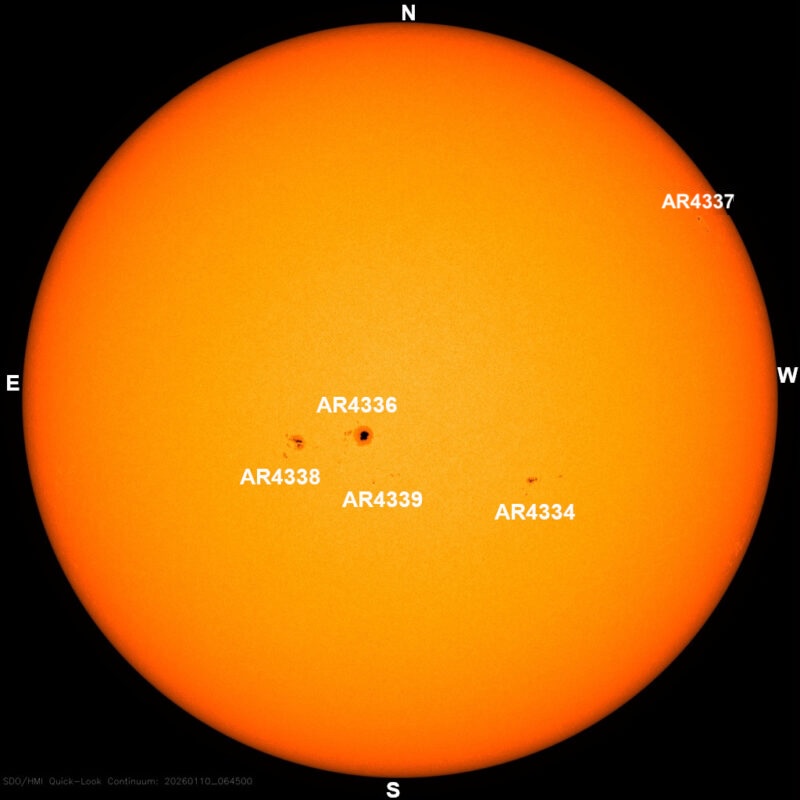
- Sunspot regions: Five numbered active regions currently face Earth.
- AR4334 (alpha) continued to decay and now shows the simplest magnetic configuration. It remained stable and produced no flares.
- AR4336 (beta–gamma–delta) regained its gamma component while retaining its delta structure. As a result, it remains the most magnetically complex region on the disk and continues to support the potential for M- and X-class flares. This region also produced the strongest flare of the period.
- AR4337 (beta) and AR4338 (beta) stayed stable and did not produce any flares.
- A newly emerged region in the southeast, now numbered AR4339 (beta), quickly became active. It produced three C-class flares and finished the period as the leading flare producer.
- Blasts from the Sun? No coronal mass ejections (CMEs) with Earth-directed components were observed during this period.
- Solar wind: The solar wind averaged near 500 km/s throughout the period before easing slightly to about 472 km/s by 10 UTC on January 10. At the same time, the interplanetary magnetic field (IMF) weakened from roughly 12 nT to about 6 nT. The north–south component, Bz, fluctuated frequently between northward and southward orientations. It reached highs near +10 nT and lows near –10 nT. Southward periods favor auroral activity. By the time of writing (11 UTC January 10), Bz had turned southward again, reaching around –6 nT.
- Earth’s magnetic field: Earth’s magnetic field ranged from quiet to active levels. Kp values varied between 2 and 4, with Kp = 4 reached during several three-hour intervals. At the time of writing (11 UTC), the Kp index stood just below 4.
Sun news January 9: Strong eruption on sun’s far side plus Mercury

We saw a powerful eruption on the far side of the sun on January 8, which produced a full halo event (image above). And three planets are showing today in SOHO’s LASCO imagery. The image above shows Mercury in LASCO C3 imagery. It will be most directly behind the sun on January 21. Look below for LASCO C2 imagery, showing Mars and Venus. Venus was most directly behind the sun on January 6. Mars is most directly behind the sun today (January 9). As soon as Mars and Venus move away the occulting disk in LASCO C3 imagery, we will see the entire inner solar system (assuming we look down to see the Earth beneath our feet) at the same time. Stay tuned.
Past 24 hours: The details
(11 UTC January 8 – 11 UTC January 9)
- Flare activity shifted noticeably over the past day. While the total number of flares dropped, several eruptions grew stronger. The sun produced only five C-class (common) flares over the past day, down from 15 the day before. But the flares that did occur were stronger on average. Even so, activity remains classified as low, since all events stayed within the C range.
- The strongest flare was a C5.7 flare from AR4334, which peaked at 17:30 UTC on January 8, 2026.
- The lead flare producer was AR4334. It produced four C-class flares, including the strongest of the period. AR4338 produced one C-class flare.
- Sunspot regions: Four numbered active regions currently face Earth.
- AR4334 (beta) lost its gamma component but continued flaring and ejecting plasma into space.
- AR4336 (beta-delta) also lost its gamma configuration but retained its delta component. It remains the most magnetically complex region on the visible disk and still has the potential to produce M- and X-class flares.
- AR4337 (beta) remained relatively quiet during the period.
- A newly emerged region in the southeast is now numbered AR4338 (beta). It produced one C-class flare.
- Blasts from the sun? Active region AR4334 continued to fire off flares and send plasma into space. Forecasters are currently modeling the C5.7 flare from 17:30 UTC on January 8 to determine whether its associated coronal mass ejection (CME) has an Earth-directed component. In addition, CMEs linked to the C2.7 and C3.4 flares from AR4334 are also under analysis. Meanwhile, the CME produced by yesterday’s C4.4 flare from the same region might arrive at Earth around January 10.
- Solar wind: The solar wind strengthened significantly during the period. Speeds climbed from about 384 km/s to nearly 560 km/s by 10 UTC on January 9. At the same time, the interplanetary magnetic field (IMF) increased to around 12 nT. The north–south component, Bz, stayed mostly southward and reached values as low as –11 nT. This southward orientation favors auroral activity. By the time of writing (11 UTC January 9), Bz had turned northward again, reaching about +9 nT.
- Earth’s magnetic field: Earth’s magnetic field ranged from quiet to active levels. Kp values ranged from 1 to 4, with the Kp = 4 threshold reached around 03 UTC on January 9. At the time of writing (11 UTC), the Kp index stands at 2.



Sun news January 8: Huge coronal hole almost forms a complete circle
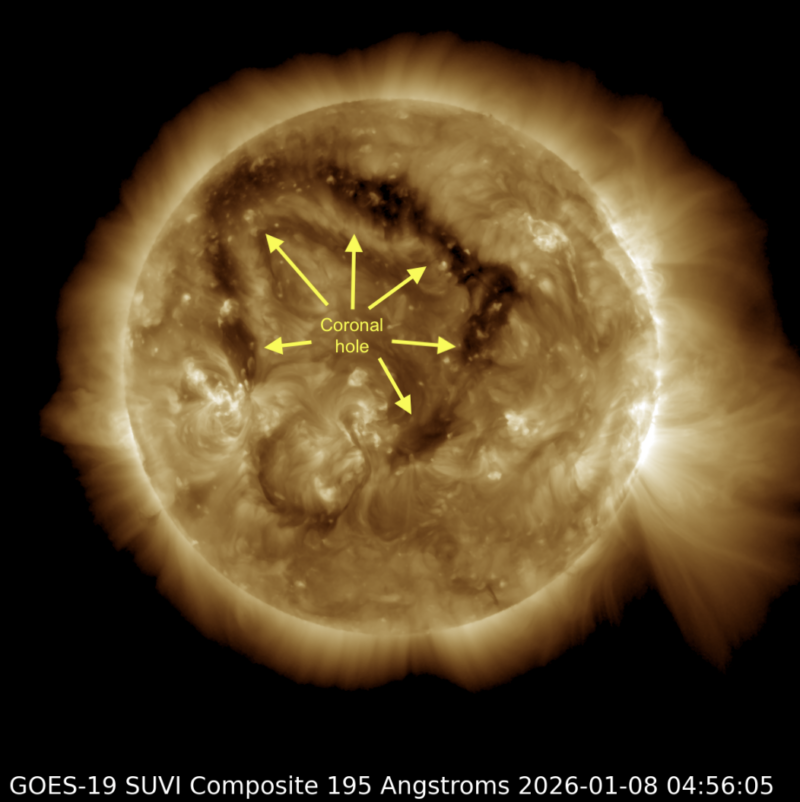
A large coronal hole – a cooler, lower density area in the sun’s outer atmosphere – has been growing on our star, and now has formed an enormous almost-complete circle. Much of the fast solar wind escaping from this hole is on its way to Earth, and should disturb our planet’s magnetic field over the next few days.
Past 24 hours: The details
(11 UTC January 7 – 11 UTC January 8)
- Flare activity: Solar flare production continued to rise over the past day. The sun produced 15 C-class (common) flares, up from 12 during the previous period. Even with the increase, activity remains classified as low, since all flares stayed in the C range.
- Strongest flare: The strongest event was a C4.4 flare from AR4334, peaking at 5:42 UTC on January 8, 2026.
- Lead flare producers: AR4334 and AR4325 tied as the most active regions, each producing four C-class flares. Close behind were AR4336 and AR4337, which both generated three C flares.
- Sunspot regions: Five numbered active regions currently face Earth.
- AR4323 (beta) rotated off the west limb and has moved to the far side of the sun.
- AR4324 (alpha) and AR4333 (beta) now sit very close to the west limb. Because of their positions, detailed analysis is difficult, and both regions are about to disappear from view.
- AR4325 (beta) also rotated to the far side. Before leaving, it shared top flare-producer honors with AR4334 by firing four C flares.
- AR4334 (beta-gamma) showed growth and maintained its beta-gamma configuration while producing four C flares.
- AR4336 (beta-gamma-delta) continued to grow and added a delta component, making it the most magnetically complex region on the disk. This configuration supports the potential for M- and X-class flares.
- A newcomer, now numbered AR4337 (beta), sits in the northwest quadrant. It produced two C flares yesterday before receiving its number and added three more C flares today.
- Blasts from the sun? Active region AR4334 continued flaring and ejecting plasma into space. Current modeling shows that most of this material is not headed toward Earth. However, a CME linked to today’s C4.4 flare at 5:42 UTC may include an Earth-directed component. Final confirmation will come after additional analysis by specialists.
- Solar wind: The solar wind began to strengthen during the period. Speeds rose from about 320 km/s to 384 km/s by 10 UTC on January 8. Earlier, a brief peak of 444 km/s occurred at 14 UTC on January 7. The interplanetary magnetic field (IMF) climbed to around 12 nT early this morning before dropping back near 5 nT. Meanwhile, the north–south component, Bz, stayed mostly southward, reaching values as low as –11 nT. This southward orientation favors auroral activity. At the time of writing (11 UTC January 8), Bz has returned to near 0 nT.
- Earth’s magnetic field: Earth’s magnetic field ranged from quiet to active levels. Kp values spanned 0 to 4, with the Kp = 4 threshold reached at 01:37 UTC on January 8. At the time of writing (11 UTC), the Kp index stands at 3.
What’s ahead? Sun–Earth forecast
- Flare activity forecast: Low-to-moderate solar activity is expected to continue today. Forecasters estimate a 40% chance of M-class (moderate) flares and a small (10%) chance of an X-class (strong) flare. This outlook could change quickly, however. AR4336 now shows a beta–gamma–delta configuration, and AR4334 remains active. Together, these regions are the main drivers of today’s forecast.
- Geomagnetic activity forecast:
- 8 Jan 2026: Quiet-to-active conditions (Kp 1–4) are expected as a co-rotating interaction region arrives, along with fast solar wind from a coronal hole. This combination will likely raise geomagnetic activity.
- 9 Jan 2026: G1 (minor) geomagnetic storm intervals are possible. A CME that left the sun on January 6 may arrive with a glancing blow and enhance activity.
- 10 Jan 2026: As the high-speed stream becomes established and then slowly weakens, geomagnetic activity should ease from active or G1 levels back to mostly unsettled. Still, brief storm intervals cannot be ruled out.
Sun news January 7: Two blobs of sun-stuff coming our way
(11 UTC January 6 – 11 UTC January 7)


Two blobs of sun-stuff – also known as coronal mass ejections (CMEs) – are currently headed toward Earth. Specialists have determined that both eruptions could deliver glancing blows around January 9. A single active region, AR4334, produced both CMEs. And over the past day, this region has appeared especially energetic, firing off multiple flares and hurling more plasma into space. Scientists are now analyzing this activity to determine whether additional CMEs may be on the way. Stay tuned!
Past 24 hours: The details
- Flare activity: Over the past day, solar activity ticked up slightly but remained at low levels overall. The sun produced 12 C-class (common) flares, up from 10 events during the previous period.
- Strongest flare: The strongest event was a C7.4 flare from AR4334, which peaked at 6:12 UTC on January 7, 2026.
- Lead flare producer: AR4334, now located in the southeast, led all regions by producing six C-class flares, including the strongest of the period.
- Sunspot regions: The Earth-facing side of the sun currently shows six numbered active regions.
- AR4323 (beta) led flare production yesterday. Today, however, it produced no flares and is now departing over the southwest limb (edge) of the sun.
- AR4324 (alpha) simplified to an alpha configuration and is preparing to rotate off the west limb.
- AR4325 (beta) also produced no flares today and is nearing departure to the far side of the sun.
- AR4333 (beta) continued to decay and generated no flares. This region will soon rotate out of view.
- AR4334 (alpha) showed signs of decay as its magnetic structure simplified from beta to alpha. Even so, it remained the most active flare producer of the period.
- AR4336 (beta-gamma) gained a gamma component, making it the most magnetically complex region on the disk today.
- In addition, a new, as-yet-unnumbered region emerged in the northwest and produced two C-class flares.

- Blasts from the sun? Two CMEs were observed during this period. The first followed a C2.1 flare from AR4334 in the southeast at 0:26 UTC on January 6. After modeling the eruption, specialists determined that it may deliver a glancing blow to Earth on January 9. Later, at 15:55 UTC, a second CME erupted in association with a C4.0 flare, also from AR4334. This second CME is likewise expected to glance Earth and, when combined with the earlier eruption, could lead to more noticeable disturbances.
- Solar wind: The solar wind continued a gradual slowdown, dropping from 379 km/s to about 350 km/s by 10 UTC on January 7. Earlier, speeds briefly peaked near 470 km/s around 21 UTC on January 6. Meanwhile, the interplanetary magnetic field (IMF) hovered near 5 nT. The north–south component, Bz, stayed mostly northward throughout the period, reaching values up to +6.7 nT. This northward orientation generally suppresses auroral activity.
- Earth’s magnetic field: Earth’s magnetic field remained quiet, with no geomagnetic storms observed. Kp values ranged from 0 to 2. At the time of this writing (11 UTC on January 7), the Kp index stands at 0.
Sun news January 6: Venus is beyond the sun today
(11 UTC January 5 – 11 UTC January 6)
Venus reaches superior conjunction today. That is, the planet is currently on the opposite side of the sun from Earth, forming a nearly straight line with us and our star. We’ve been watching Venus move through the field of view of the sun-observing SOHO spacecraft’s LASCO C3 instrument over recent weeks. Eventually it slipped behind the coronagraph’s occulting disk, which blocks the glare of the sun. But thankfully, SOHO’s C2 coronagraph lets us see even closer to the sun, revealing Venus as it reaches its striking superior conjunction. Plus, we’ve been able to see Mars approach from the opposite side, heading toward its own superior conjunction on Friday.
Read more: Venus superior conjunction (most behind the sun) today
Past 24 hours: The details
- Flare activity: Over the past day, solar activity stayed at low levels. The sun produced only C-class (common) flares, with 10 events observed during the period.
- Strongest flare: A C4.0 flare from AR4323 peaked at 7:54 UTC on January 6, 2026.
- Lead flare producer: AR4323, located in the southwest, led flare production by generating four C-class flares, including the strongest of the period.
- Sunspot regions: Currently, six numbered active regions face Earth. Overall, all regions maintain simple magnetic structures.
- AR4323 (beta) showed slight decay, yet it remained the most active flare producer today.
- AR4324 (beta) produced a single C1.6 flare during the period.
- AR4325 (beta) lost its earlier gamma configuration and did not produce flares during the period.
- AR4333 (beta) also showed slight decay and generated one C3.4 flare.
- AR4334 (beta) maintained a simple configuration and remains the largest region on the visible solar disk.
- AR4336 (beta) evolved from an alpha to a beta configuration and produced one C2.3 flare.
- In addition, several small regions and plage areas remained quiet and contributed little to overall flare activity.
- Blasts from the sun? Observers noted a filament eruption in the southwest, associated with a C3.4 flare from AR4333. SOHO’s LASCO C2 coronagraph detected the event at 18:57 UTC. Forecasters are now modeling the eruption to determine whether any material is Earth-directed.
- Solar wind: The solar wind gradually slowed, dropping from near 450 km/s to about 350 km/s. At 10 UTC on January 6, speeds measured 379 km/s. Meanwhile, the interplanetary magnetic field (IMF) ranged between 5–8 nT before settling closer to 5 nT. The north–south component, Bz, stayed mostly southward, fluctuating between 0 and –5 nT. This orientation allowed some solar wind energy to couple into Earth’s magnetic field. Even so, conditions only modestly favored auroras at high latitudes and remained insufficient for significant mid-latitude displays.
- Earth’s magnetic field: Earth’s magnetic field remained quiet to unsettled, with no geomagnetic storms observed. Kp values ranged from 0 to 3, with Kp = 0 at the time of writing (11 UTC on January 6).

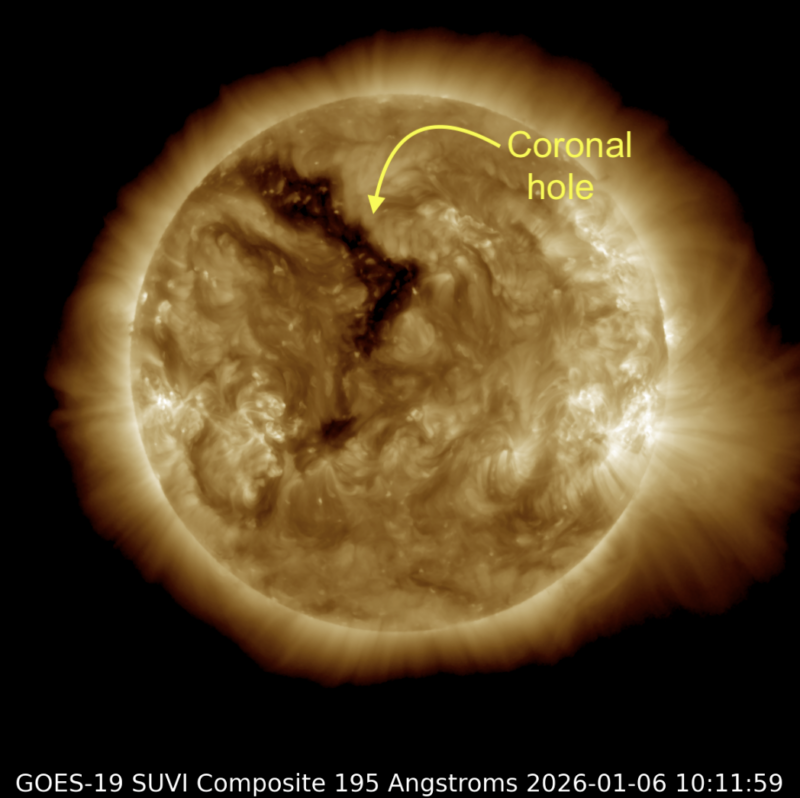
Sun news January 5: Space weather impact less than expected
(11 UTC January 4 – 11 UTC January 5)
A weak coronal mass ejection (CME) brushed past Earth’s magnetic field as anticipated last night. Forecasters had expected this impact to trigger geomagnetic storming, helped by a stream of fast solar wind. However, the CME only disturbed our magnetic field to quiet-to-unsettled levels, bringing just a slight enhancement to auroras across high-latitude regions such as Iceland, northern Norway and northern Canada.
Past 24 hours: The details
- Flare activity: Solar activity remained low-to-moderate, with 14 C-class (common) flares observed during the period.
- Strongest flare: A C3.0 C-class flare from AR4334 at 9:11 UTC on January 5, 2026.
- Lead flare producers: AR4325 and AR4336 were the most consistently active regions, each firing multiple low-level C-class flares, while AR4334 produced the strongest event (C3.0) of the period.
- Sunspot regions: The Earth-facing solar disk displayed seven numbered active regions, with several showing modest complexity and growth.
- AR4323 – Located near the southern hemisphere, this region remained relatively simple and quiet, producing only a single C2.0 flare during the period and showing little structural change.
- AR4324 (beta) showed decay in its intermediate spots and produced a few low-level C flares, indicating weakening flare potential.
- AR4325 (beta-gamma) is the largest region on the disk, and remained the primary engine for common C-class activity. Its mixed magnetic field makes it a candidate for future M-class (moderate) flares.
- AR4333 (beta) continued to elongate, with new intermediate spots emerging. Its flare potential is gradually growing, though it has only produced small C-class events so far.
- AR4334 is still being fully characterized, but has already produced the strongest flare of the day (C3.0). Its current magnetic classification is likely a simple beta, but continued observation is needed as it rotates further onto the disk.
- AR4336 (alpha) is a newly visible region just rotating onto the Earth-facing side. Despite its simple single-spot appearance, it has already fired several C-class flares, suggesting some underlying magnetic activity that may become clearer as it moves into better view.
- Additional small regions and plage areas on the disk remained simple and mostly quiet, contributing little to overall flare production.
- Blasts from the sun? The sun launched no Earth-directed coronal mass ejections (CMEs) during this reporting period.
- Solar wind: The solar wind environment remained only slightly disturbed, consistent with a weak, fading CME influence. Solar wind speeds were mostly steady, near 450 km/s, for much of the period, increasing modestly toward ~500 km/s after about 20:00 UTC on January 4 as the CME influence became more apparent. The total strength of the interplanetary magnetic field (IMF) hovered between 4–7 nT for most of the interval, briefly strengthening to about 10 nT around 20:00–20:30 UTC on January 4. The crucial north–south component, Bz, fluctuated between about +5 and -3 nT during most of the day, then tipped more firmly southward to around -7 nT with the CME’s arrival near 20:30 UTC. This southward turn opened the door for solar wind energy to couple into Earth’s magnetic field, but the interval was relatively short-lived and moderate in strength. Overall, conditions were mildly favorable for aurora at high latitudes but insufficient for significant mid-latitude displays.
- Earth’s magnetic field: Earth’s magnetic field ranged from quiet to unsettled, with no significant storming. NOAA reported global geomagnetic activity at quiet-to-unsettled levels through the period, consistent with Kp values generally in the 0–3 range. The brief interval of stronger southward Bz (to about -7 nT) following the CME arrival late on January 4 was not sufficient to push conditions into a clear G1 (minor) geomagnetic storm, but it likely enhanced auroral activity over the polar regions and high-latitude locations such as Iceland, northern Norway and northern Canada.

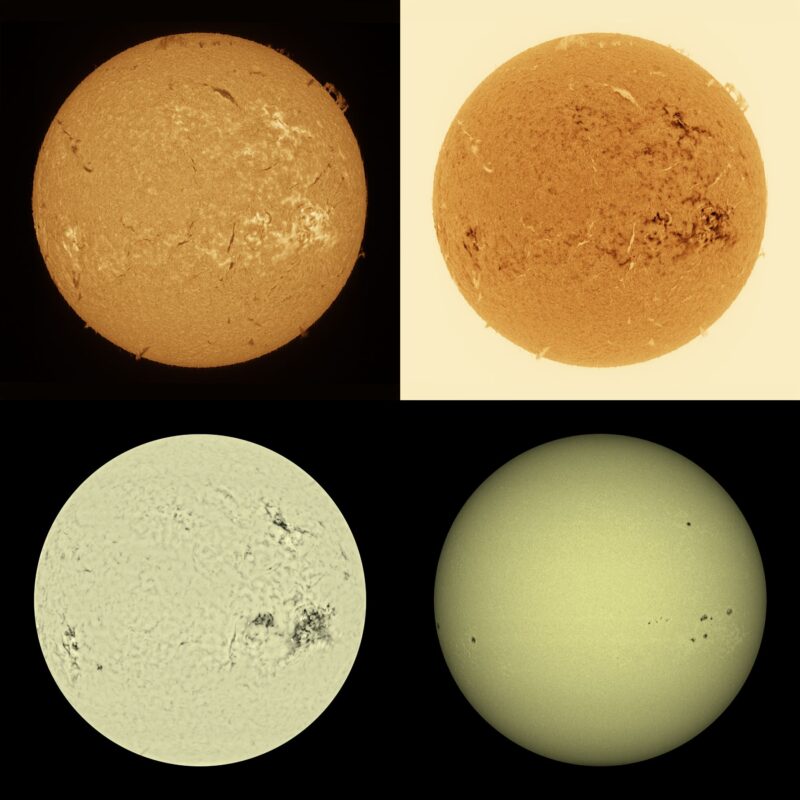
Sun news January 4 (UTC): Fast solar wind continues, solar blob coming
Auroras are poised to light up high-latitude skies tonight. Earth remains under the combined influence of a fast solar wind stream and an approaching coronal mass ejection (CME) launched earlier in the week. Together, these solar drivers are shaping near-Earth space and increasing the chances for visible auroral activity.
So far, Earth’s geomagnetic field has stayed mostly quiet to unsettled during this reporting window. But conditions are expected to change. The Kp index – a global indicator of activity in Earth’s magnetic field – is forecast to climb into storm levels on January 4. So auroras could brighten skies over Reykjavik, northern Canada, and Scotland. During stronger intervals, displays might even push farther south, reaching cities such as Seattle, Minneapolis, and Edinburgh.
At the same time, a fast solar wind flow has continued to pour in at speeds of about 500–600 km/s. This stream likely originates from a persistent coronal hole and is reinforced by earlier CMEs. Although the flow is gradually easing, it is still energizing Earth’s upper atmosphere and setting the stage for enhanced auroras once the new CME arrives.
Past 24 hours: The details
(11 UTC January 3 – 11 UTC January 4)
- Flare activity: The sun itself has taken a brief pause in major eruptions. Solar activity has remained moderate, marked by a series of low-level C-class flares. The strongest of these was a C8.3 flare from active region AR4325 in the southern hemisphere. Even so, the sun remains restless. Several active regions still show enough magnetic complexity to produce M-class flares in the coming days, just as disturbed solar wind conditions are forecast to peak. We observed 7 C-class flares in the past day.
- The strongest flare was a C8.3 from AR4325 (S07W40) at 17:23 UTC on January 3.
- Lead flare producers: AR4325 in the sun’s southern hemisphere and AR4324 in its northern hemisphere shared top billing, together responsible for all of the period’s C-class activity, including the C8.3 and C3.5 events identified with precise timing from LMSAL observations. LMSAL stands for Lockheed Martin Solar and Astrophysics Laboratory.
- Sunspot regions: The Earth-facing solar disk displayed 8 numbered active regions, with one new region emerging.
- AR4324 (beta) continued a slow decay trend, losing some intermediate and trailing spots but still capable of producing low-level C-class flares.
- AR4325 (beta–gamma) also showed decay, becoming more open with fewer intermediate spots and a somewhat simpler magnetic structure, yet it remained the source of the strongest C8.3 flare and several additional C-class bursts.
- AR4323 (beta) was the only region to show clear development, increasing in size, spot count, and magnetic complexity, and remains a candidate for future M-class flares.
- AR4335 (alpha) was newly numbered and appears as a small, simple unipolar spot with low flare potential at present.
- The remaining regions were simple and largely stable or weakening, contributing little to flare production during this interval but collectively maintaining the disk’s sunspot number near 100, consistent with an active phase of Solar Cycle 25.
- Blasts from the sun? Experts did not observe any Earth-directed coronal mass ejections (CMEs) leaving the sun during this past 24-hour period.
- Solar wind: Solar wind speeds remained elevated but showed a gradual easing trend, consistent with ongoing coronal hole high-speed stream influence and lingering CME effects. Solar wind speed briefly approached 600 km/s early on, then decreased toward ~500 km/s by the end of the interval. The total strength of the interplanetary magnetic field (IMF) was weak to moderate field overall. The critical north–south component, Bz, fluctuated between between northward and southward directions at low strength. A southward Bz opens the door for solar wind energy to couple into Earth’s magnetic field, which favors stronger auroras when other conditions (like speed and density) are also enhanced.
- Earth’s magnetic field: Earth’s magnetic field ranged from quiet-to-unsettled levels during this reporting window, with earlier minor storming in the broader 24-hour period but no sustained storm intervals between 11 UTC on January 3 and 11 UTC on January 4. Conditions were quiet to unsettled (roughly Kp 1–3) through the period covered here, reflecting the still-elevated but slowly declining solar wind speeds and moderate IMF strengths. At report time, the field was in a disturbed state; however, conditions are expected to increase again on January 4 as the next CME interacts with the existing high-speed stream, with a return to quiet-to-unsettled levels forecast for January 5-6.
- Flare activity forecast: Low to moderate flare levels are expected to continue over the next three days. NOAA SWPC and SIDC both indicate a solid chance for M-class (R1–R2) flares, with probabilities at or above about 50%, mainly from the more complex regions AR4323, AR4324, and AR4325 as they traverse the western half of the disk. A slight chance remains for an isolated X-class event (R3), though no region currently shows a strong delta configuration.
- Geomagnetic activity forecast:
- January 4, 2026: Geomagnetic activity is expected to increase to unsettled to active levels as the ongoing high-speed stream continues and a CME from January 1-2 arrives. NOAA forecasts a high likelihood of G1 (minor) geomagnetic storm conditions around local midday into the evening hours as solar wind speeds strengthen again. Under G1–G2 conditions, auroras could become visible from typical auroral-zone locations (Alaska, northern Canada, Iceland, northern Scandinavia) and may extend to cities such as Seattle, Minneapolis, and Edinburgh, and possibly into northern England during stronger peaks.
- January 5, 2026: As CME and high-speed stream effects begin to wane, geomagnetic conditions are expected to ease back to quiet to unsettled levels, with only a slight chance of isolated active periods. Auroral activity would likely retreat toward the higher-latitude auroral oval, favoring places like Tromsø, Reykjavik, and northern Canada, with reduced chances for mid-latitude sightings.
- January 6, 2026: Further relaxation toward more ambient solar wind conditions is anticipated, with quiet to unsettled geomagnetic activity most likely. Any auroras would be largely confined to the usual high-latitude regions, and significant impacts on power systems, satellites, or HF communications are not expected at this stage if the forecast verifies.
- Flare activity: The sun has eased back to low to moderate levels of activity, producing a series of routine C-class flares. The sun produced eight C-class flares during the past 24 hours.
- Strongest flare: A C3.1 solar flare from AR4324 peaked at 1:44 UTC on January 3, 2026.
- Lead flare producer: AR4324 led flare activity with three C-class events.
- Sunspot regions: Seven numbered active regions currently populate the Earth-facing side of the sun.
- AR4324 (beta) lost its delta configuration.
- AR4325 (beta-gamma) retained its gamma complexity and remains the most magnetically complex region on the disk.
- Three new regions rotated into view: AR4332 (alpha) in the northeast quadrant, AR4333 (beta) in the southwest, and AR4334 (beta) near the southeast limb.
- Other regions exhibited simpler alpha or beta configurations and showed stability or gradual decay.
- Blasts from the sun? No new CMEs appeared in available coronagraph imagery during the period.
- Flare activity forecast: Solar activity is expected to remain low to moderate over the next three days. Additional M-class flares remain possible (about a 50% chance), mainly from magnetically complex region AR4325 (beta-gamma). The probability of an isolated X-class flare remains near 10%.
- The anticipated geomagnetic storm arrived as expected, under the combined influence of a fast coronal hole high-speed stream and incoming coronal mass ejection (CME) material. Earth’s magnetic field briefly reached G1 (minor) storm levels. We had brighter auroral displays across Alaska, northern Canada, Iceland, and northern Scandinavia last night, with a chance for visibility as far south as northern Scotland under clear skies. Conditions could briefly rise again to G1 (minor), and a slight chance of a G2 (moderate) geomagnetic storm cannot be ruled out. Auroras remain possible tonight and into tomorrow at northerly latitudes. Good luck, aurora chasers!
- Solar wind: Solar wind speeds averaged near 600 km/s over the past day, peaking at 845 km/s at 16:10 UTC on January 2. At 10 UTC on January 3, speeds measured about 539 km/s. The total interplanetary magnetic field (IMF) strength stayed moderately elevated near 8 nT, while the north–south component (Bz) fluctuated between +10 nT and -10 nT, sitting near -2 nT at 10 UTC.
- Flare activity: Solar activity eased back to low levels, with only C-class flares observed. Observers logged 14 C-class flares during the past 24 hours.
- Strongest flare: A C6.3 solar flare from AR4324 peaked at 17:59 UTC on January 1, 2026.
- Lead flare producers: AR4317 and AR4330 tied as the most active regions, each producing four C-class flares. AR4325 followed closely with three C-class events.
- Sunspot regions: The Earth-facing solar disk currently shows five numbered active regions.
- AR4323 (beta) produced one C-class flare.
- AR4324 (beta-delta) continued to strengthen its magnetic structure and produced two C-class flares, including the strongest of the period.
- AR4325 (beta-gamma) lost its delta configuration but still shows moderate growth and remains a key flare candidate.
- AR4317 (beta-delta) rotated off the west limb but produced four C-class flares before departing.
- AR4328 (beta) and AR4331 (alpha) have not yet produced flares.
- Blasts from the sun? Several CMEs remain under active analysis. These include the M7.1-associated CME from December 31, along with additional eruptions from December 28–30 that may deliver glancing impacts. A CME observed in LASCO C2 imagery at 19:12 UTC on January 1 appears linked to the C6.3 flare from AR4324. Another CME, associated with a C2.0 eruption from AR4331 at 5:37 UTC on January 1, is modeled to brush past Earth late on January 2 or early January 3.
- Solar wind: Solar wind speeds averaged near 500 km/s over the past 24 hours and peaked above 550 km/s at 08:36 UTC on January 2. At 10 UTC, speeds measured about 563 km/s. The total interplanetary magnetic field (IMF) strength remained moderately elevated near 8.5 nT, while the north–south component (Bz) fluctuated between +5 nT and -7 nT, sitting near -5 nT at 10 UTC.
- Earth’s magnetic field: Earth’s magnetic field ranged from quiet to active levels, with Kp values between 2 and 4. At the time of this report (11 UTC on January 2), Kp measured 3.
- Flare activity: Solar activity increased to high levels, with 11 flares (1 M-class and 10 C-class) observed in the past 24 hours.
- Strongest flare: An M7.1 solar flare from AR4324 (N24E19) peaked at 13:12 UTC on 31 Dec 2025. It triggered an R2 (moderate) radio blackout, briefly degrading high-frequency communications across the sunlit Atlantic Ocean off the coast of Brazil.
- Lead flare producer: AR4325 was the top flare producer, responsible for the C6.0 flare and numerous additional C-class flares.
- Sunspot regions: The Earth-facing disk shows several numbered active regions, though none have produced strong new eruptions in the last 24 hours. These regions continue to be tracked for potential moderate activity.
- AR4321 (beta-delta), now near the southwest limb, produced one C-class flare.
- AR4324 (beta-gamma) remained a key source of activity and continues to draw attention in the northeast quadrant.
- AR4325 (beta-delta) lost its gamma configuration but remains a prime candidate for more M and even X flares.
- AR4317 (beta-delta) re-gained additional complexity but did not produce flares during this period. It will soon depart to the far side.
- AR4328 (beta), AR4329 (beta), AR4330 (beta), and AR4331 (alpha) have not yet produced flares.
- Blasts from the sun? Multiple coronal mass ejections (CMEs) are in play, including the M7.1-associated CME on December 31. Several earlier eruptions from December 28-30 may also deliver glancing blows. A partial-halo coronal mass ejection (CME) that left the sun near 23:00 UTC on December 28, 2025 has been modeled, with a glancing impact at Earth expected late on New Year’s Eve.
- Solar wind: Over the past 24 hours, solar wind speeds have fluctuated in the moderate range, generally between about 420 km/s and 450 km/s as Earth’s environment adjusts ahead of the expected CME arrival. Recent measurements show the total interplanetary magnetic field (IMF) strength moderately elevated near ~7 nT, with the north–south component (Bz) varying between northward (~+3 nT) and southward (~–3 nT) orientations.
- Earth’s magnetic field: Earth’s magnetic field ranged from quiet-to-unsettled levels during the period, with no significant storms yet.
What’s ahead? Sun–Earth forecast
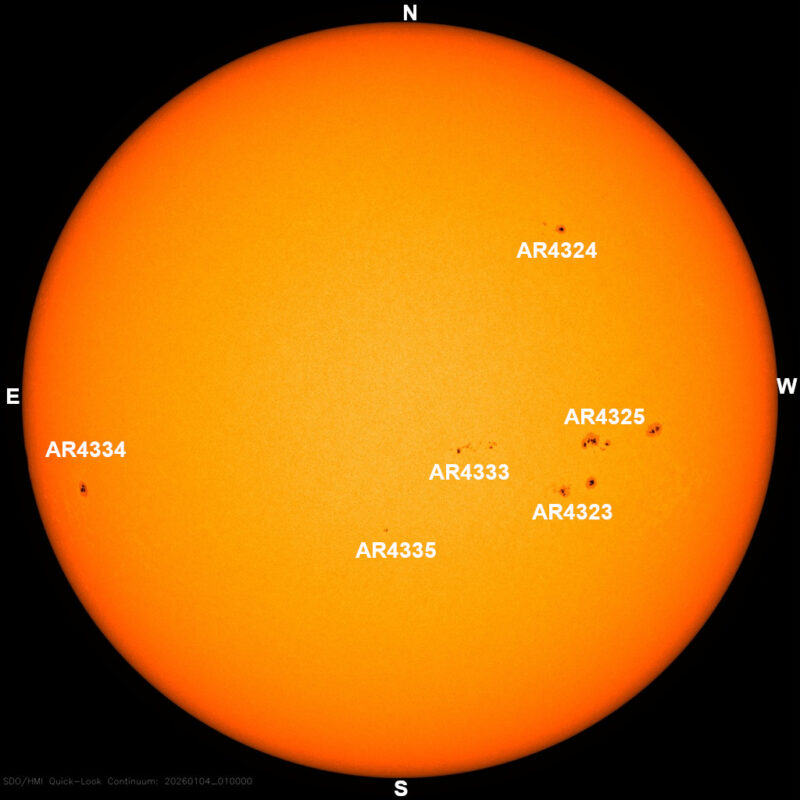
Sun news January 3: Happy perihelion, sun fans
Our closest point to the sun for 2026 comes at around 17 UTC today (around 11 a.m. CST). We’re about 3% closer to the sun – roughly 1.5 million miles (2.5 million km) closer – in contrast to Earth’s aphelion (farthest point) in early July. That’s in contrast to our average distance of about 93 million miles (150 million km). Sensitive instruments can detect that the sun is sending us about 7% more solar energy now than at aphelion, our most distant point, in July. That’s because – as detected by skilled photographers and other measuring instruments – the sun’s disk in our sky is now slightly bigger than in July. But of course you should never look at the sun! And you wouldn’t detect the size difference, anyway. Happy perihelion to all!
Past 24 hours on the sun: The details
(11 UTC January 2 – 11 UTC January 3)
Spaceweather and Earth’s magnetic field
(11 UTC January 2 – 11 UTC January 3)

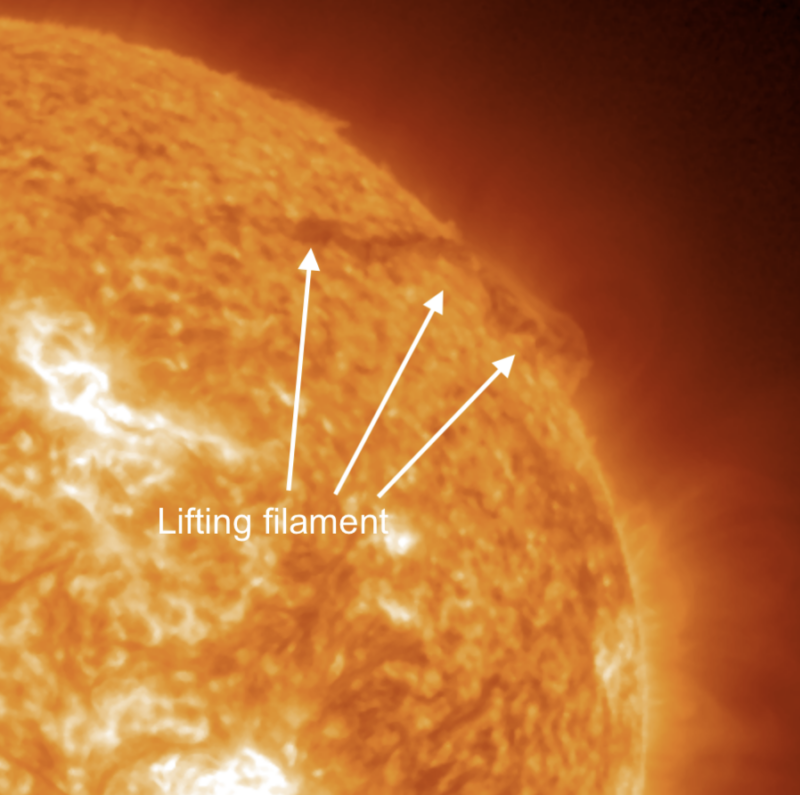
Sun news January 2: Incoming sun-stuff could bring auroras
Multiple blasts of sun stuff, or coronal mass ejections (CMEs), are currently converging on Earth. These eruptions, including the CME from the powerful M7.1 flare on New Year’s Eve, are expected to deliver glancing blows late tonight into tomorrow. While no single CME appears extreme on its own, their combined timing increases the likelihood that Earth’s magnetic field will be disturbed. Forecasters expect G2 (moderate) geomagnetic storms, which could trigger auroras at northerly latitudes tonight and tomorrow. Good luck, aurora chasers!
Past 24 hours: The details
(11 UTC January 1 – 11 UTC January 2)
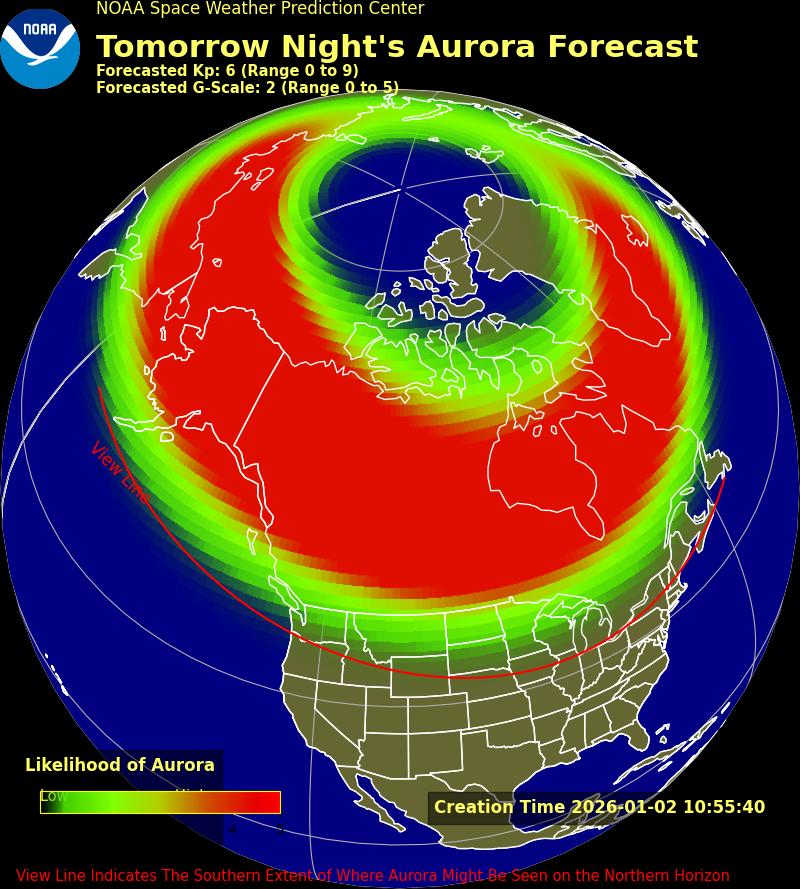

Sun news January 1: The sun rings in the New Year with fireworks
The sun rang out 2025 and welcomed 2026 in dramatic fashion with a powerful M-class flare on New Year’s Eve. An M7.1–M7.2 eruption burst from AR4324 at approximately 13:51 UTC on December 31. It briefly dimmed high-frequency radio signals and triggered an R2 (moderate) radio blackout over the sunlit Atlantic Ocean east of Brazil. The flare hurled a fast, partially Earth-directed coronal mass ejection (CME) into space. Modeling suggests it will sweep past Earth late on January 2. It potentially sets the stage for a festive round of geomagnetic storms and auroras at high latitudes into the weekend.
Past 24 hours: The details
(11 UTC December 31 – 11 UTC Jan 1)

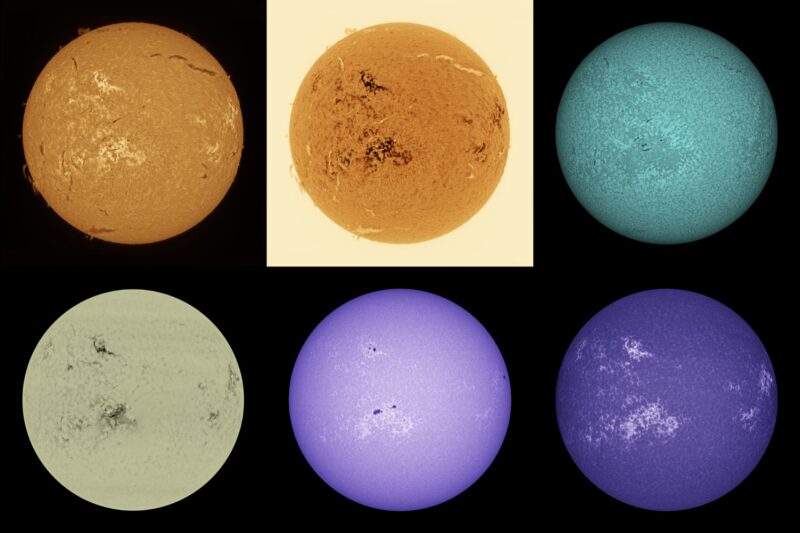
Like what you read?
Subscribe and receive daily news delivered to your inbox.
More from
C. Alex Young


Sun news: See a huge solar eruption

Yes, there’s an aurora season, and it’s here
Sun activity archive for September 2026
Sun activity archive for August 2026