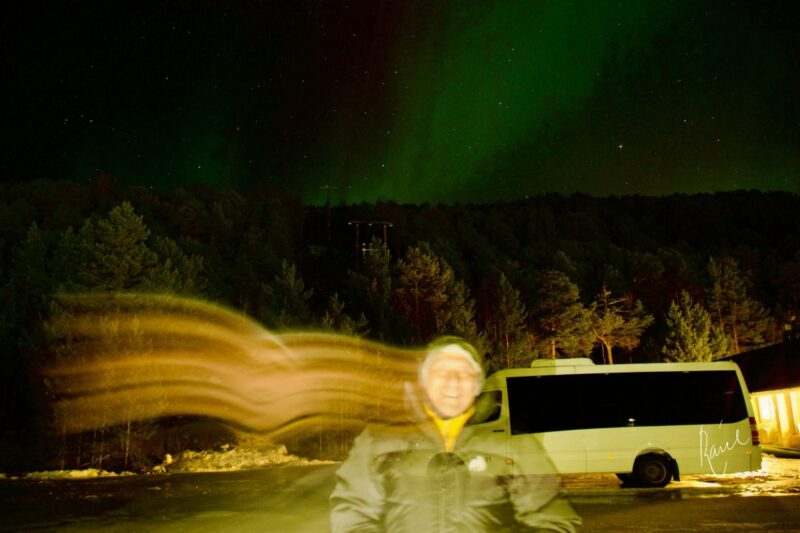
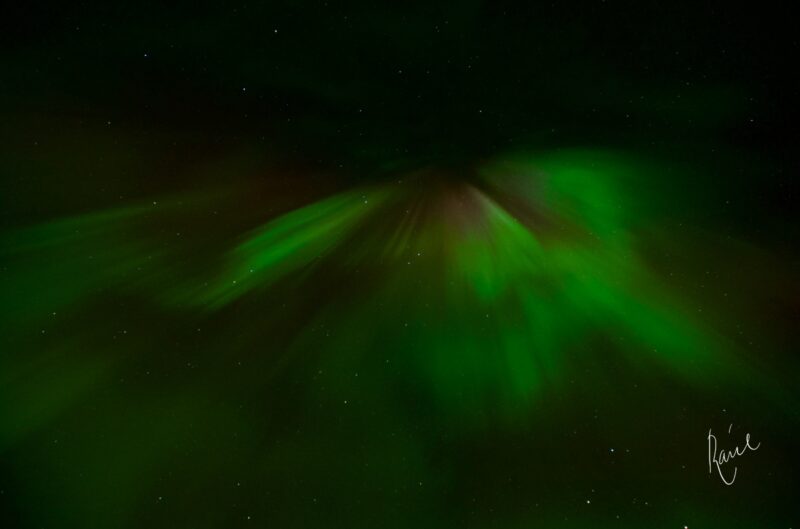
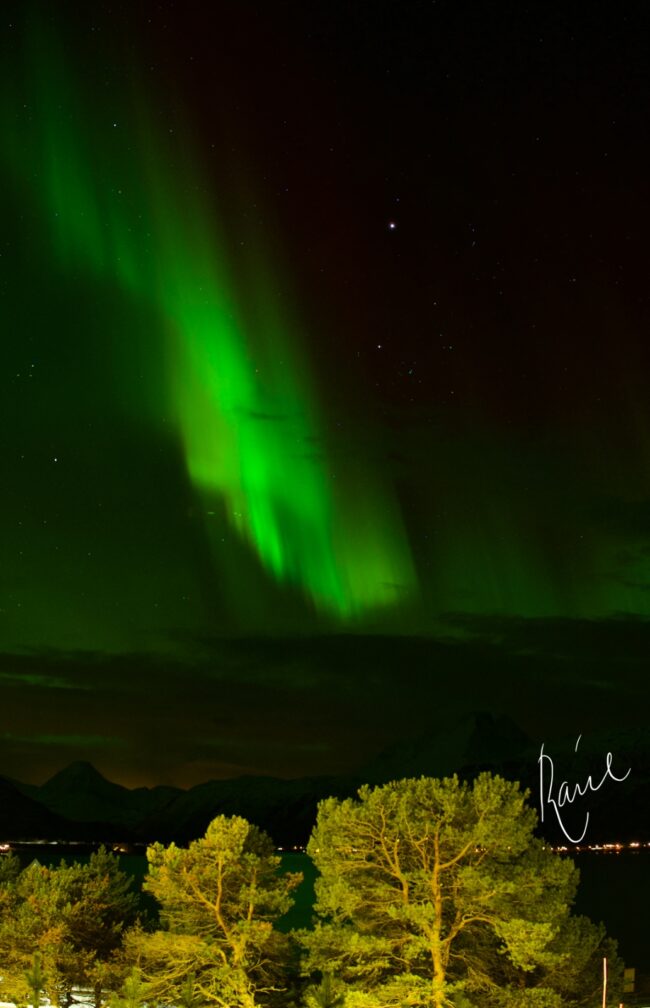
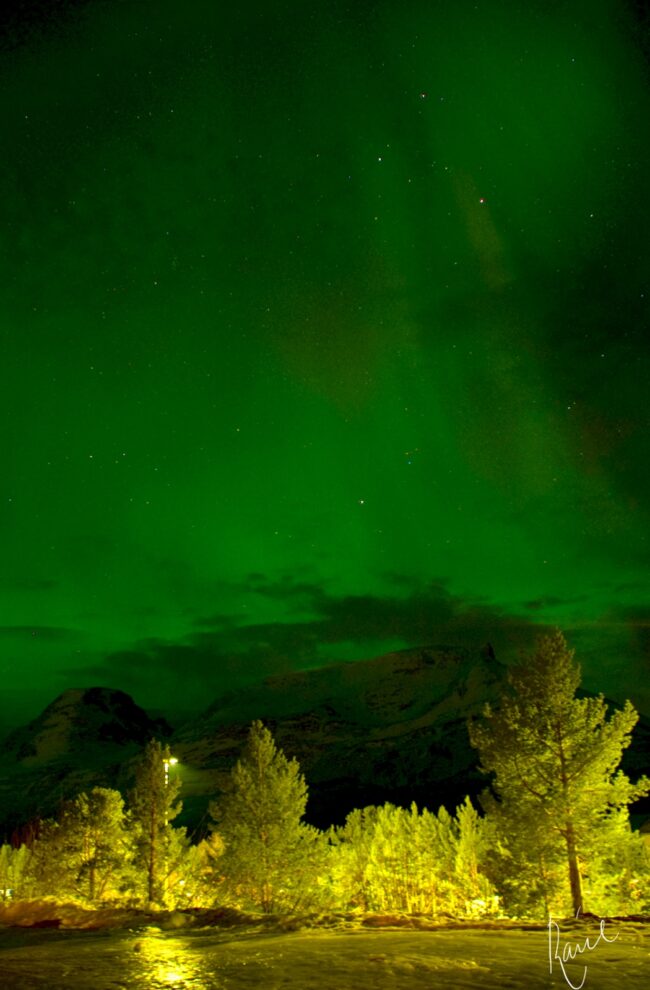
Sun news February 28. Just arrived! Photos of last night’s dancing aurora
(11 UTC to 11 UTC)
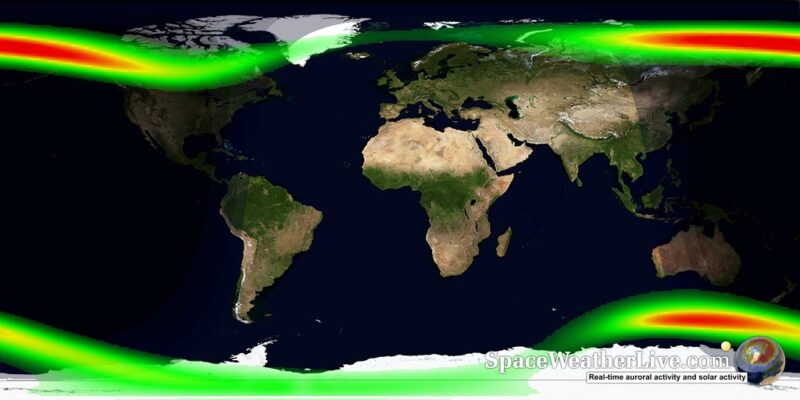
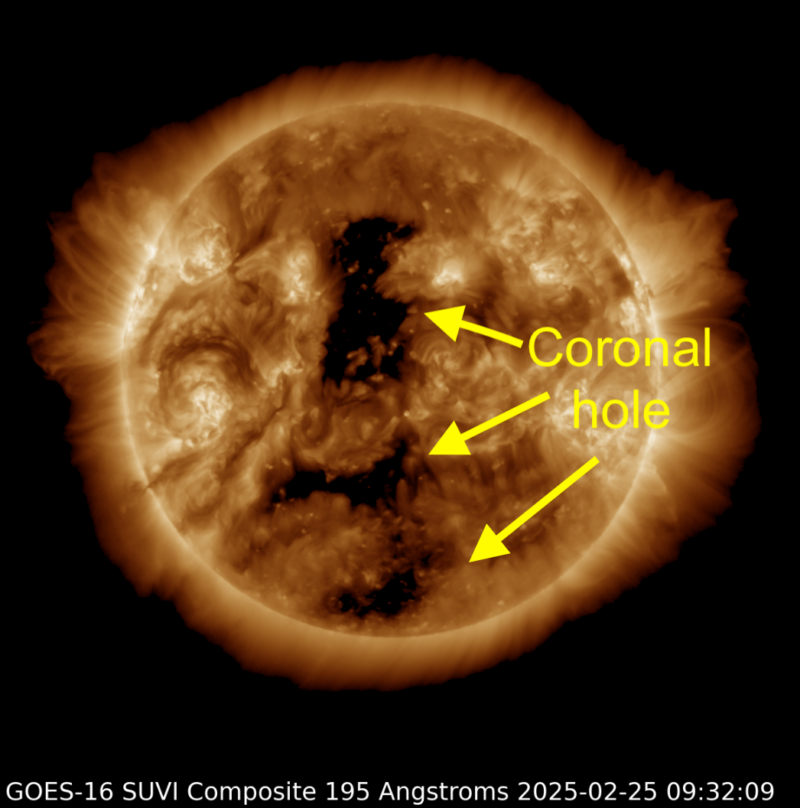
The solar wind remained strong over the past day, reaching 550-600 km/s (over 1 million mph). This high-speed stream of solar wind is from a coronal hole on the sun. It led to G2 (moderate) geomagnetic storming last night (Kp = 6). And this geomagnetic activity – with its subsequent auroral displays – might continue, giving us a chance of additional G1 (minor) storming today.
Sun-Earth highlights in the past day
- Flare activity remained low over the past 24 hours, barely. The largest event was a C9.3 flare, at 23:24 UTC on February 27 from just beyond the sun’s western limb (edge). It was from active region AR3996, which is no longer in visible to us but was still flaring like crazy. All the flares from this region were certainly stronger than observed, given that they were occulted (blocked) by the limb (edge) of the sun.
- Total flares: 11 C-class flares over the past 24 hours.
- There are seven active regions on the solar disk as seen from Earth.
- Blasts from the sun? A filament eruption near the sun’s northeast limb produced a coronal mass ejection (CME) around 17:52 UTC on February 27. Further imagery is needed to determine if Earth will be impacted.
- Solar wind. Solar wind speeds remain strong, ranging from 550-600 km/s due to ongoing coronal hole high-speed stream (CH HSS) influence. The interplanetary magnetic field (a critical factor in creating auroras) strengthened slightly then calmed. The Bz (north/south) component fluctuated between being north and south-directed, with extended southward periods contributing to increased geomagnetic activity.
- Geomagnetic activity: Just after our February 27 post, G2 (moderate) (Kp = 6) geomagnetic storm levels began to be observed at 11:14 UTC. They lasted during the 3-hour observation interval, then dropped back to active (Kp = 4) levels. G1 (minor) (Kp = 5) levels were reached again around 17 UTC on February 27. This was due to high-speed solar wind with a southward IMF.

Sun news February 27. Earth’s magnetic field is storming NOW!
(11 UTC to 11 UTC)
A G1 (minor) geomagnetic storm (Kp = 5) began at 10:52 UTC (at the time of this writing). Are any of you seeing auroras, or did you see them before dawn Friday? As we finalized this post, solar wind speeds were still rising, due to coronal holes on the sun. And we have a slight chance of additional geomagnetic storming in the coming two days. Looking sunward again, several filament eruptions have produced coronal mass ejections (CMEs) in the past day. One, in particular, might deliver a glancing blow to Earth. Read more below, and stay tuned for further updates!
Sun-Earth highlights in the past day
- Flare activity dropped to low over the past 24 hours. The largest event was a set of C5.7 flares, the first at 12:42 UTC on February 26 from active region AR4007 and the second at 6:34 UTC on February 27 from AR3996.
- Total flares: 15 C-class over the past 24 hours.
- There are six active regions on the solar disk as seen from Earth. All delta regions have decayed, taking with them their potential for strong flaring. There are three regions with a beta-gamma magnetic configuration: AR3998, AR4000, and AR4007. The remaining active regions have simpler alpha or beta configurations. The most active region, AR3996, has rotated out of view but produced nine of the C flares over the past 24 hours.
- Blasts from the sun? A filament eruption in the sun’s southwest produced a coronal mass ejection (CME) at 14:48 UTC on February 26. Analysis is ongoing to determine if Earth will be struck. Additional filament eruptions and CMEs were observed on February 26, with at least one potentially producing a glancing blow on February 28.
- Solar energetic particles: Energetic particle rates dropped to below S1 (minor) levels.
- Solar wind. Solar wind speeds have increased to 580 km/s (1.3 million mph), signaling the approach of a coronal hole high-speed stream (CH HSS). The interplanetary magnetic field (a critical factor in creating auroras) strengthened slightly. The Bz (north/south) component fluctuated between being north and south-directed.
- Geomagnetic activity: Over the past day, the geomagnetic field remained quiet to active (Kp = 1-4). Active Kp = 4 were observed between 3 and 6 UTC on February 27 due to a south-directed IMF (Bz).
Sun news February 26. Happy scientists! Powerful (preliminary) GOES-19 images now available
(11 UTC to 11 UTC)

NOAA’s Space Weather Prediction (SWPC) said yesterday (February 25, 2025) that the brand-new coronagraph images of the sun’s outer atmosphere from the recently launched GOES-19 satellite are now available. You can see images here. See an image below from today. The images will be updated every 15 minutes and will be presented as short videos available at the CCOR-1 Coronagraph page on SWPC’s website. The imagery is “preliminary and non-operational,” SWPC says. The official kick-off of operations is still slated for April 4, 2025. But no doubt sun scientists will be watching! Congrats to all for this accomplishment! See the images here.
Sun-Earth highlights in the past day
- Flare activity continued at moderate levels, though just barely, over the past 24 hours. We had an isolated M3.6 flare from active region AR3998 at 11:59 UTC on February 25, 2025. It caused an R1 (minor) radio blackout that affected an area over the Pacific Ocean.
- Total flares: One M-class and three C-class over the past 24 hours.
- There are eight active regions on the solar disk as seen from Earth. AR3998 keeps its beta-gamma-delta magnetic configuration, which indicates high flare potential. Meanwhile, AR400 lost its delta and now shows a simpler beta-gamma along with AR4006. Despite high flare potential, these guys have been low flare producers. Are they building to something? Will we shortly get a surprise? We’ll see. The remaining active regions have simpler alpha or beta configurations. There is a newcomer on the northeast quadrant near the solar equator. It’s now numbered AR4008.
- Blasts from the sun? A coronal mass ejection (CME) was observed associated with the M3.6 flare by AR3998. Modeling and analysis show there is a chance it will deliver a glancing blow to Earth on February 28.
- Solar wind. The solar wind was below 400 km/s levels (894,775 mph), then dropped down to 370 km/s (827,000 mph). The interplanetary magnetic field (a critical factor in creating auroras) strengthened slightly. The Bz (north/south) component remained south-directed, meaning the magnetic field can more easily excite Earth’s magnetic field.
- Geomagnetic activity: Over the past day, the geomagnetic field remained unsettled to active. The active Kp 4 threshold was reached at 5:53 UTC on February 26.
- Solar energetic particles: The burst of solar energetic particles associated with the M3.9 flare continued today at high levels, producing an S1 (minor) solar radiation storm.
Sun news February 25. Another big blast from beyond the west horizon
(11 UTC to 11 UTC)

We reported an X flare yesterday which came from the western edge of the sun. Over the past 24 hours, a relative calm came to the Earth-facing sun, and flare activity was moderate over the past day. But another blast – this time from beyond the sun’s western horizon (beyond the limb, or edge) – gave us a surprise. The event was an M3.9 flare at 23:06 UTC on February 24. It probably came from the same sunspot region that produced the X. The M flare was accompanied by a coronal mass ejection (CME) directed toward the southwest, and analysis is ongoing to determine if there is an Earth-directed component. Given the location and activity, this eruption was probably, in actuality, an X flare. But it appeared as an M to our sun-observing spacecraft because the body of the sun itself blocked part of the energy. Read more below. Meanwhile, fast solar wind from a coronal hole and CME influences could cause geomagnetic storming at a G1 (minor) level (Kp 5) later today. Stay tuned, things could get interesting any minute!
Sun-Earth highlights in the past day
- Flare activity was moderate over the past 24 hours with three M flares. The largest flare was an M3.9 from active region AR3990 at 23:06 UTC on February 24, 2025. Though beyond the sun’s limb, or edge, the eruption produced a level S1 (minor) radiation storm at Earth. It also caused an R1 (minor) radio blackout that affected an area over the Pacific Ocean west of the Fiji Islands. The other two Ms were an M1.5 by AR4000 and an M1.3 by AR3998.
- Total flares: Three M-class and seven C-class over the past 24 hours.
- There are 10 active regions on the solar disk as seen from Earth. AR3998 and AR4000 both show today a beta-gamma-delta magnetic configuration, indicating high flare potential. Despite their potential for M and X flares, both produced just one M flare over the past day. Maybe they are saving up and will give us some big blasts today? The remaining active regions have simpler alpha or beta configurations.
- Blasts from the sun? The M3.9 flare by AR3990 was a long-duration flare. It caused type II (640 km/s) and type IV radio sweep. These are indicative of a coronal mass ejection (CME). And a CME was observed with spacecraft imagery. Analysis is ongoing to determine if there is an Earth-directed component.
- Solar wind. The solar wind speed went up to 460 km/s levels (1,026,000 mph), then dropped down to 370 km/s (817,000 mph). And the interplanetary magnetic field (a critical factor in creating auroras) strengthened slightly. The Bz (north/south) component remained south-directed, meaning the magnetic field can more easily excite Earth’s magnetic field.
- Geomagnetic activity: Over the past day, the geomagnetic field remained unsettled to active. The active Kp 4 threshold was reached at 19:58 UTC on February 24.
- Solar energetic particles: The M3.9 flare associated eruption produced a burst of solar energetic particles that has reached S1 (minor) solar radiation storm levels.
Sun news February 24. POW! A powerful X flare explodes on the sun
(11 UTC to 11 UTC)


A massive explosion of energy on the sun – an X2.0 flare – happened late yesterday. It came from sunspot region AR4001, which had emerged recently on the sun’s disk, but has now rotated out of view. So this X flare was certainly larger than what we observed, because the flare was occulted (blocked) by the body of the sun itself. For that same reason, no direct Earth impact of a coronal mass ejection (CME) from the X flare is expected. But CMEs from previous days could deliver a glancing blow to Earth today, giving us minor geomagnetic disturbances and possible auroras. More below.
Sun-Earth highlights in the past day
- Flare activity jumped to high over the past 24 hours thanks to the X2.0 solar flare from sunspot region AR4001. The flare happened at 19:27 UTC on February 23, 2025. It caused an R3 (strong) radio blackout that affected an area over the Pacific Ocean west of South America. The sun also produced four M flares during the past 24 hours, an M1.6, M1.0, M1.1 and M3.3 from regions AR4001, AR3998, AR4001, and AR4000 respectively.
- The number of flares decreased to 13 flares, one X, four M and eight C flares over the past 24 hours.
- There are nine active regions on the Earth-directed solar disk. AR3998 and AR4000 have both increased in magnetic complexity, indicating a greater potential for flaring. AR4000 retained a beta-gamma-delta magnetic configuration and AR3998 retained a beta-gamma. Both regions have the potential for M and X flares. Interestingly, the largest activity came from AR4001, but this region has moved beyond the western limb (edge). So we can’t determine its current magnetic complexity. The remaining active regions have simpler alpha or beta configurations.
- Blasts from the sun? Despite the X flare, no Earth-directed coronal mass ejections (CMEs) were observed over the past 24 hours. The X flare likely released a CME, but it’s not headed our way.
- Solar wind. The solar wind speed remained at background levels from 300-360 km/s (671,081 mph to 805,297 mph) and the interplanetary magnetic field’s (a critical factor in creating auroras) strengthened slightly while the Bz (north/south) component remains south-directed, meaning the magnetic field can more easily excite Earth’s magnetic field.
- Geomagnetic activity: Over the past day, the geomagnetic field remained quiet to unsettled (Kp 1-3) during the past 24 hours. Possible geomagnetic disturbances ahead.
Sun news February 23. More M flares blasting, more sunspots emerging
(11 UTC to 11 UTC)
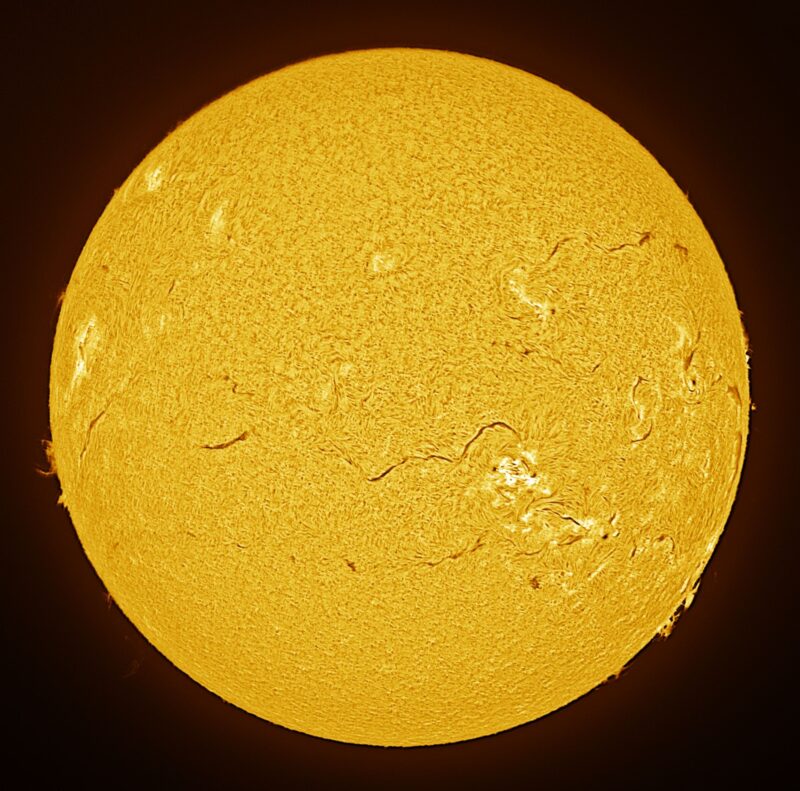
Solar activity remained moderate over the past 24 hours. We saw two moderate (M-class) and 16 common-class (C-class) flares. And sunspot activity appears to be increasing, with new regions appearing on the solar disk. Notably, a rapidly growing bipolar region (a positive and negative polarity pair of sunspots) in the far northwest produced the strongest flare of the period, an M4.9 … which is getting up there toward an X flare. Additionally, six new sunspot regions were numbered in the sun’s eastern hemisphere, the part of the sun that has just rotated into view. That should translate to more solar activity in the coming days. Stay tuned!
Sun-Earth highlights in the past day
- Flare activity remained moderate over the past 24 hours with two M (moderate) flares. The largest event – the M4.9 flare mentioned above – happened at 2:13 UTC from AR4001, on February 23. It caused an R1 (minor) radio blackout that affected an area over Papua New Guinea. The second was an M1.4 flare at 9:57 UTC from AR3998, on February 23. It caused an R1 (minor) radio blackout over southern Africa.
- The number of flares has also increased with 16 flares, two M and 16 C flares over the past 24 hours.
- There are nine active regions on the Earth-viewed solar disk. AR3998 and AR4000 have both increased in complexity. AR4000 developed a beta-gamma-delta magnetic configuration and AR3998 developed a beta-gamma. This means both regions have a higher chance for M and X flares. The remaining active regions have simpler alpha or beta configurations. Six new regions, AR4001-AR4006, are now on the disk, some having emerged on the disk with others rotating into view from the east.
- Blasts from the sun? No Earth-directed coronal mass ejection CME) were observed over the past 24 hours.
- Solar wind. The solar wind speed ranged from 280-350 km/s (196 miles/s), basically background conditions and the interplanetary magnetic field’s (a critical factor in creating auroras) weakened thoughBz (north/south) component remains south directed meaning the magnetic field can more easily excite Earth’s field.
- Geomagnetic activity: The geomagnetic field was quiet to unsettled (Kp 0-3) during most of the past 24 hours.
Sun news February 22. Terrific! Sunspot region AR4000 is here
(11 UTC to 11 UTC)
NOAA established the current numbering system for active regions (sunspots) on January 5, 1972. They started with AR0001. In 2002, when the sunspot number reached 10,000, they changed it to 0000, to keep sunspot numbers at four digits. So we had an earlier AR4000. And now we’ve reached this same number again. Today’s AR4000 emerged near the disk center and brought sun activity up to moderate, for the past 24 hours. That’s because this region produced two M-class (moderate) flares, with the largest, an M3.3, occurring at 12:15 UTC on February 21. This new region, along with AR3998, has been developing rapidly, increasing the likelihood of more moderate flares and even a slight chance of stronger X-class flares in the coming days.
Sun-Earth highlights in the past day
- Flare activity jumped up to moderate levels over the past 24 hours because of two M (moderate) flares from AR4000. The largest event was a M3.42 flare at 12:15 UTC on February 21. It caused an R1 (minor) radio blackout that affected an area over the south Atlantic Ocean. The second was an M1.4 flare at 15:35 UTC, also from AR4000, on February 21. It caused an R1 (minor) radio blackout over the south Atlantic Ocean.
- The number of flares has also increased with 16 flares, two M and 14 C flares over the past 24 hours.
- There are seven active regions on the Earth-viewed solar disk and yesterday’s emerging newcomer is numbered AR4000. The region rapidly developed a beta-gamma magnetic configuration releasing several C and two M flares. Sunspot region AR3998 also has a beta-gamma configuration but has not been a big flare producer. The remaining active regions have simpler alpha or beta configurations. There are three more active regions emerging awaiting to be numbered.
- Blasts from the sun? We observed a coronal mass ejection CME) from a filament eruption on the sun’s northeast quadrant, from the vicinity with newcomer AR4000. The eruption occurred before this active region emerged. Modeling and analysis is ongoing but initial observations indicate the chunk of solar stuff is headed north of Earth.
- Solar wind. The solar wind speed dropped to 316 km/s (196 miles/s) but the interplanetary magnetic field’s (a critical factor in creating auroras) Bz (north/south) component remains south directed, meaning there are chances for minor geomagnetic field disturbances.
- Geomagnetic activity: The geomagnetic field was quiet (Kp = 1) during most of the past 24 hours. Similar to what we saw yesterday, there was an enhancement to disturbed levels (Kp = 3) during one of the three-hour synoptic period at 0 to 3 UTC February 22. But auroras might be on their way. See the geomagnetic activity forecast below.
Sun news for February 20 – February 21. Big sun eruption! Heading our way?
(11 UTC to 11 UTC)

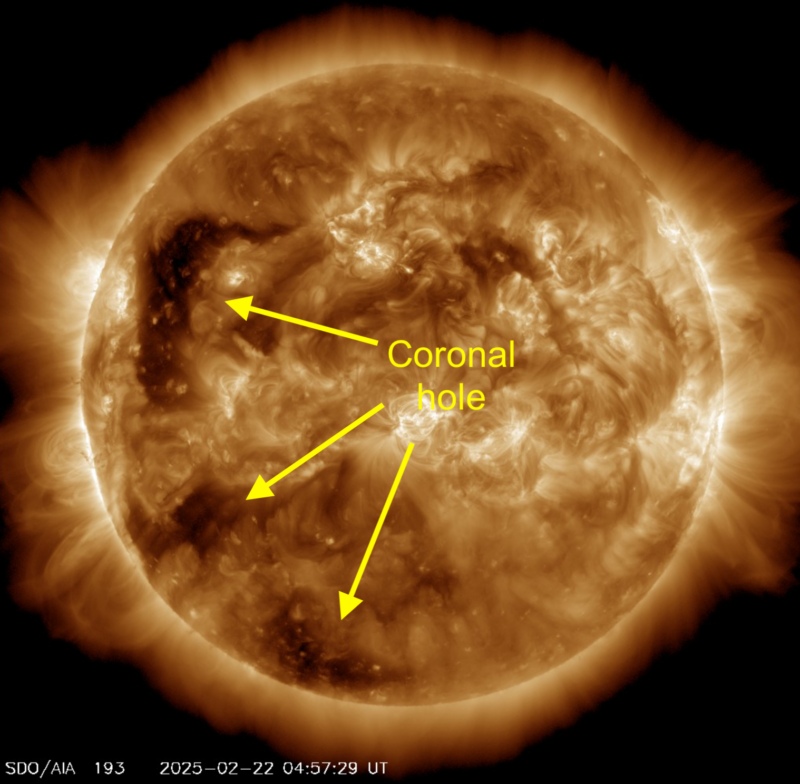

Solar activity has been low for a couple of days, with C (common) flares only. But the sun has been busy in other ways. Filament explosions have been launching chunks of solar materials and magnetic fields, known as coronal mass ejections (CMEs), into space. One event, in particular, caught our eye. It launched from the sun’s northeast quadrant. It lasted for hours, beginning around 20 UTC on February 20 and lasting until 3 UTC on February 21! The SOHO spacecraft’s LASCO C2 coronagraph captured this event as a large blast, and scientists are now modeling and analyzing the CME to determine if any portion is heading toward Earth. Stay tuned for updates!
Sun-Earth highlights in the past day
- Flare activity remained at low levels over the past 24 hours with only C (common) flares. The largest event was a C4.9 flare at 15:01 UTC on February 20 from AR3996.
- The number of flares increased slightly going from nine to 12 C flares during our observation period in the past 24 hours.
- There are seven active regions on the solar disk as seen from Earth. AR3998 lost its beta-delta magnetic configuration with a beta-gamma configuration along with AR3996. The remaining active regions have simpler alpha or beta configurations. We are awaiting the next newcomer emerging in the northeast quadrant. Will it be AR4000? We’ll see.
- Blasts from the sun? The large filament eruption we reported yesterday produced a CME, but, due to its location, initial analysis indicates it’s not coming toward Earth. The CME) associated with the C8.1 flare from AR3990 on February 19 caused a radio sweep Type II (553 km/s). Initial analysis shows it might deliver a glancing blow to Earth on February 24. Additionally, several smaller CMEs have been observed in the past day. One of these may deliver a glancing blow to Earth on February 23, but further analysis is needed to confirm its potential impact. Stay tuned for updates as we continue to monitor these solar eruptions.
- Solar wind. The solar wind speed dropped to 370 km/s (201 miles/s) but the interplanetary magnetic field’s (a critical factor in creating auroras) and the Bz (north/south) component is south directed, meaning it has a chance to causes minor geomagnetic field disturbanes.
- Geomagnetic activity: The geomagnetic field dropped to quiet (Kp = 1) levels during most part of the past 24 hours. There was an enhancement to disturbed levels (Kp = 3) during one of the three-hour synoptic period at 0 to 3 UTC February 21.
Sun news for February 19 – February 20. The sun always surprises us
(11 UTC to 11 UTC)



Over the past day, we saw only low sun activity, just nine C flares. Then … BAM! Seemingly out of nowhere, a filament blast hurled a huge amount of solar plasma into space. This beautiful prominence stemmed from the sun’s southeast quadrant, from the vicinity of active region AR3998. This happens to be the sunspot region with the strongest magnetic configuration (a beta-delta complexity, indicating a strong flaring potential) on the Earth-viewed solar disk. Elsewhere on the sun, we saw jets over the northeastern solar horizon, meaning they were produced on the sun’s far side. More action on its way? Plus … we had the tail end of effects from a faint glancing blow by a coronal mass ejection (CME), combined with solar wind, resulting in more auroras at high latitudes. Keep reading for details.
Sun-Earth highlights in the past day
- Flare activity was low over the past day, with only C (common) flares. The largest was a C8.1 flare – almost an M – at 23:45 UTC on February 19 from AR3990.
- The number of flares decreased from the previous day. It went from 11 C flares down to nine C flares in the past 24 hours.
- There are eight active regions on the Earth-facing side of our star. AR3998 still bears its beta-delta magnetic configuration today, and it is now the one with the strongest flare potential. AR3996 maintained a beta-gamma complexity while AR3990 lost its gamma and joins the remaining active regions on the solar disk with simpler alpha or beta configurations.
- Blasts from the sun? The blast from AR3998 wasn’t headed Earth’s way. No Earth-directed coronal mass ejections (CMEs) were observed in coronagraph imagery over the past 24 hours.
- Solar wind. The solar wind speed was enhanced slightly above 500km/s (310 miles/s) and interplanetary magnetic field (a critical factor in creating auroras) and the Bz (north/south) component south oriented for moments, meaning it had chances of causing an excited geomagnetic field.
- Geomagnetic activity: We had G1 (minor) geomagnetic disturbances last night (aka a Kp5). The magnetic storm we expected last night reached active levels Kp = 4. This disturbance lasted for hours, peaking from 18 UTC on February 19 through 3 UTC on February 20. It was caused by the waning effects from a glancing blow of a coronal mass ejection (CME), combined with fast solar wind from a coronal hole. Afterwards, the geomagnetic field dropped down to Kp1.
Sun news for February 18 – February 19. A blob of sun-stuff surprised us
(11 UTC to 11 UTC)
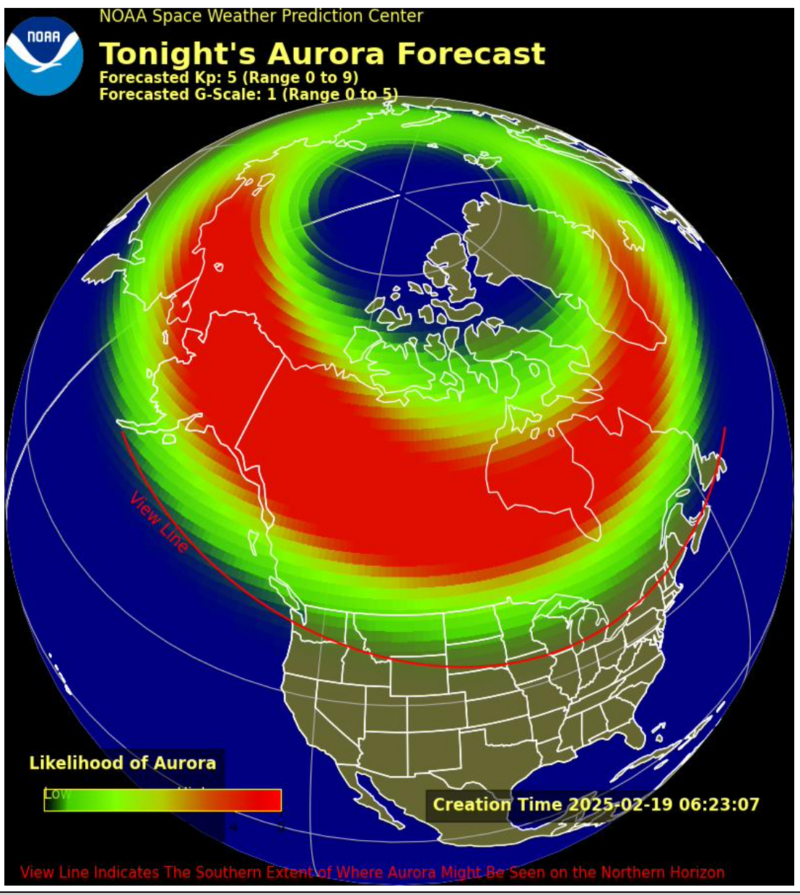
An anticipated blob of solar materials and magnetic fields, aka a coronal mass ejection or CME reached us at Earth, disturbing our world’s magnetic field. It caused a G1 (minor) geomagnetic disturbance (aka a Kp5). This glancing blow was expected. And auroras were expected at high latitudes. So what was the surprise? We got reports from as far south as Colorado! What’s more, the aurora forecast is for a possible G1 (minor) geomagnetic storm, possibly continuing into later today, as the glancing blow effects start to wane. At the time of this writing (11 UTC on February 19), Earth’s magnetic field is active (Kp = 4).
Sun-Earth highlights in the past day
- Flare activity on the sun has been low over the past day, with only C (common) flares. The largest was a C3.0 flare at 17:10 UTC on February 18 from AR3992.
- The number of flares also decreased from the previous day. We saw 11 C flares in the past 24 hours.
- There are eight active regions on the Earth-facing side of our star. AR3998 kept its beta-delta magnetic configuration, meaning it has strong flare potential. AR3990 and AR3996 maintained a beta-gamma complexity and the remaining active regions on the solar disk have simpler alpha or beta configurations.
- Blasts from the sun? No Earth-directed coronal mass ejections (CMEs) were observed in coronagraph imagery over the past 24 hours.
- Solar wind. The solar wind speed was at nominal levels at around 495km/s (307 miles/s) with a weak interplanetary magnetic field (a critical factor in creating auroras) and the Bz (north/south) component north oriented meaning it has a less chance of causing an excited geomagnetic field.
- Geomagnetic activity: Earth’s geomagnetic field was active (kp = 4) most of the past 24 hours, then reached a G1 (minor) geomagnetic storm (Kp = 5) at 1:49 UTC on February 18 caused by the glancing blow the expected coronal mass ejection (CME) provided combined with fast solar wind from a coronal hole.
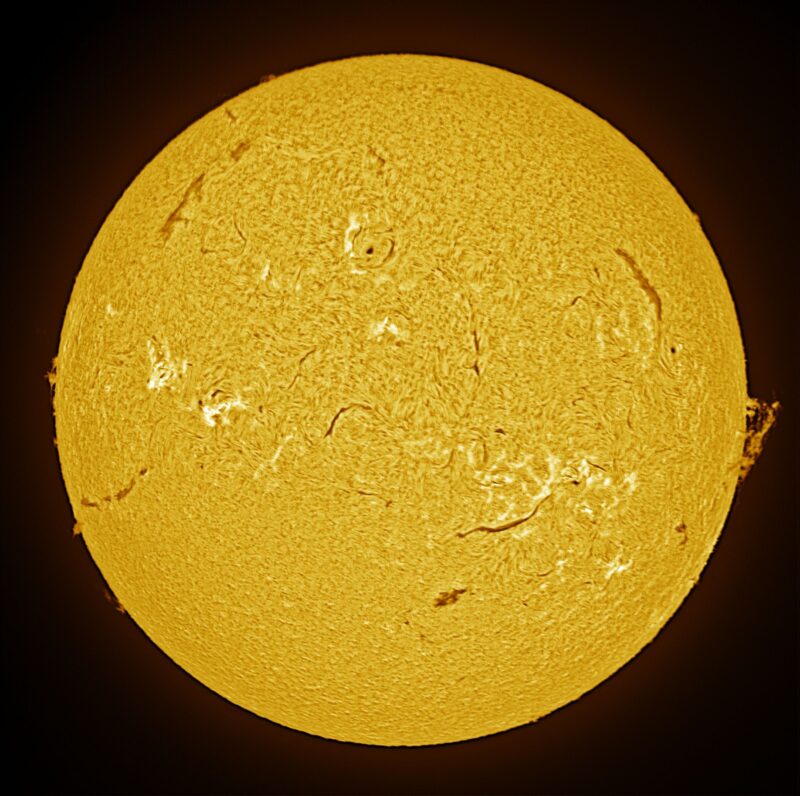
Sun news for February 17 – February 18. Flare activity is rising again
(11 UTC to 11 UTC)

Sun activity has been moderate over the past day, thanks to an isolated M1.0 flare. Overall, flare activity is picking up. Total flare production of the past day was 24 flares, one M plus 23 Cs. And AR3990 developed a delta region, giving it a beta-delta complexity (increased magnetic complexity can give rise to more and stronger flares). Meanwhile back at Earth, there is a slight chance for auroras, due to a possible glancing blow from a coronal mass ejection (CME). It might cause a G1 (minor) geomagnetic disturbance later today.
Sun-Earth highlights in the past day
- Flare activity increased to moderate. The largest event was an M1.0 flare at 15:13 UTC on February 17 from AR3992. The blast caused an R1 (minor) radio blackout over Brazil.
- The overall number of flares in the past day increased to 24.
- There are 11 active regions on the Earth-facing side of our star. AR3998 developed a beta-delta magnetic configuration, indicating increased flare potential. AR3990, AR3992 and AR3996 maintained a beta-gamma complexity and the remaining active regions on the solar disk have simpler alpha or beta configurations.
- Blasts from the sun? No Earth-directed coronal mass ejections (CMEs) were observed over the past 24 hours.
- Solar wind remains elevated, but is weakening. The solar wind speed declined to nominal levels at 484 km/s (300 miles/s) with a weak interplanetary magnetic field (a critical factor in creating auroras) and the Bz (north/south) component fluctuating between north and south.
- Geomagnetic activity: Earth’s geomagnetic field was active most of the past 24 hours, remaining at Kp 4. Fast solar wind from a coronal hole caused this activity.


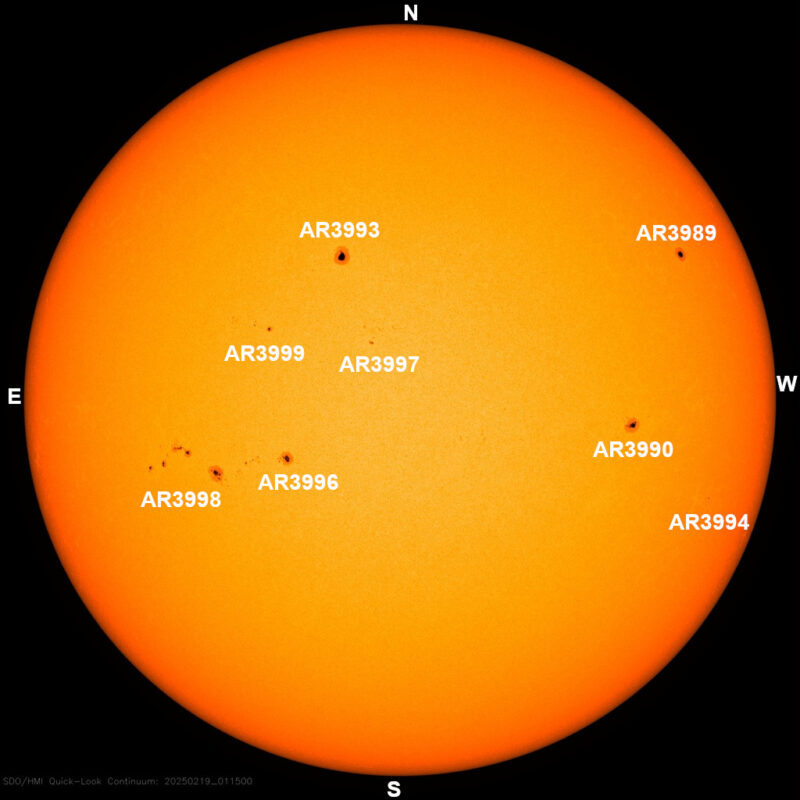
Sun news for February 16 – February 17. Sun flaring low. Auroras’ last gasp?
(11 UTC to 11 UTC)

Auroral displays were ongoing throughout the weekend, at high latitudes. And auroras remain possible at high latitudes today and tomorrow, but are expected to decline around February 19. For now, Earth remains under the influence of a waning high-speed solar wind stream, keeping geomagnetic activity unsettled-to-active (Kp 3-4) over the past day). A possible transition to another and weaker coronal hole high-speed stream might occur by February 19. If an anticipated glancing coronal mass ejection (CME) arrives, it might provide an extra boost to geomagnetic activity.
Sun-Earth highlights in the past day
- Flare activity on the sun remains low with 9 C flares over the past 24 hours. The most significant event was a C6.1 flare at 18:38 UTC on February 16, produced by Region 3998.
- There are 12 active regions on the Earth-facing side of the sun. AR3990, AR3992, AR3996 and AR3998 have a beta-gamma magnetic configuration, indicating flare potential. The remaining active regions on the solar disk have simpler alpha or beta configurations. There are two newcomers, now numbered AR3996 and AR3997. Regions AR3997, AR3998, and AR3999 were newly numbered during the past day.
- Blasts from the sun? No Earth-directed coronal mass ejections (CMEs) were observed over the past 24 hours.
- Solar wind remains elevated but weakening. The solar wind speed gradually declined from 640 km/s to 520 km/s, with a weak interplanetary magnetic field (a critical factor in creating auroras) and the Bz (north/south) component fluctuating between north and south.
- Geomagnetic activity: Earth’s geomagnetic field was unsettled to active (Kp 3-4) over the past day. G1 (minor) geomagnetic storming (Kp 5) remains possible on February 18 if a glancing CME influence arrives.
WOAHHHH INCREDIBLE SUBSTORM 5 MINUTES AGO! duck mountain provincial park, manitoba pic.twitter.com/LtFTLEZb54
— Jeremy Rand (@Jeremyrand101) February 17, 2025
Not much for the naked eye, but still a pretty decent aurora display for the European upper mid latitudes (57°N MLAT).
Taken from my front yard in Aalestrup, Denmark on 16 February at 21:30 UTC. pic.twitter.com/Dzq1YrGdNb
— Mikhaël Vervoort (@HaelVoort) February 16, 2025
Sun news for February 15 – February 16. What a great weekend for auroras!
(11 UTC to 11 UTC)

Today’s top story: We have auroras and maybe more tonight! A fast solar wind stream from a coronal hole is still blasting Earth. And it triggered a G1 (minor) geomagnetic storm at two separate intervals on February 15. These conditions could continue today (February 16), with another chance for G1 storming. So the fast solar wind persists, plus a glancing blow from a coronal mass ejection (CME) might arrive later today. With solar wind speeds still elevated at 630 km/s (391 miles/s) and a coronal hole high-speed stream (CH HSS) in effect, auroras remain possible at high latitudes on Sunday and Monday! Stay alert for possible northern lights displays, and don’t forget to share your aurora photos, if you catch any. Clear skies!
Sun-Earth highlights in the past day
- Flare activity on the sun dropped to low levels over the past 24 hours. We saw 10 total flares (all C-class). The largest flare was a C3.6 at 19:36 UTC on February 15 from beyond the western limb.
- There are ten active regions on the Earth-facing side of the sun. AR3990, AR3992, AR3993, AR3996 and AR3997 have a beta-gamma magnetic configuration. The remaining active regions on the solar disk are either alpha or beta. There are two newcomers, now numbered AR39956 and AR3997.
- Blasts from the sun? No new ones in the past day.
- Solar wind remains strong. The solar wind speed increased from ~530 km/s to 630 km/s due to ongoing high-speed wind from a coronal hole. The interplanetary magnetic field (a critical factor in creating auroras) weakened slightly. The Bz (north/south) component remained mostly southward, allowing energy transfer into Earth’s magnetosphere.
- Geomagnetic activity: G1 (minor) geomagnetic storm conditions (Kp = 5) were observed twice on February 15, from 09:00–11:59 UTC and 21:00–23:59 UTC. The geomagnetic field has since settled to unsettled-to-active conditions (Kp = 3-4) .
Just wanted to share this insane real-time video of the aurora Maia sent me last night during her tour. She drove guests to around Salcha, Alaska to escape a cloudy Fairbanks. Check out the real-time motion here, just crazy! High speed streams do wonders for high-latitudes. :) pic.twitter.com/bP9Y4Kx6Zu
— Vincent Ledvina (@Vincent_Ledvina) February 16, 2025
Sun news for February 14 – February 15. More auroras possible today and tomorrow
(11 UTC to 11 UTC)
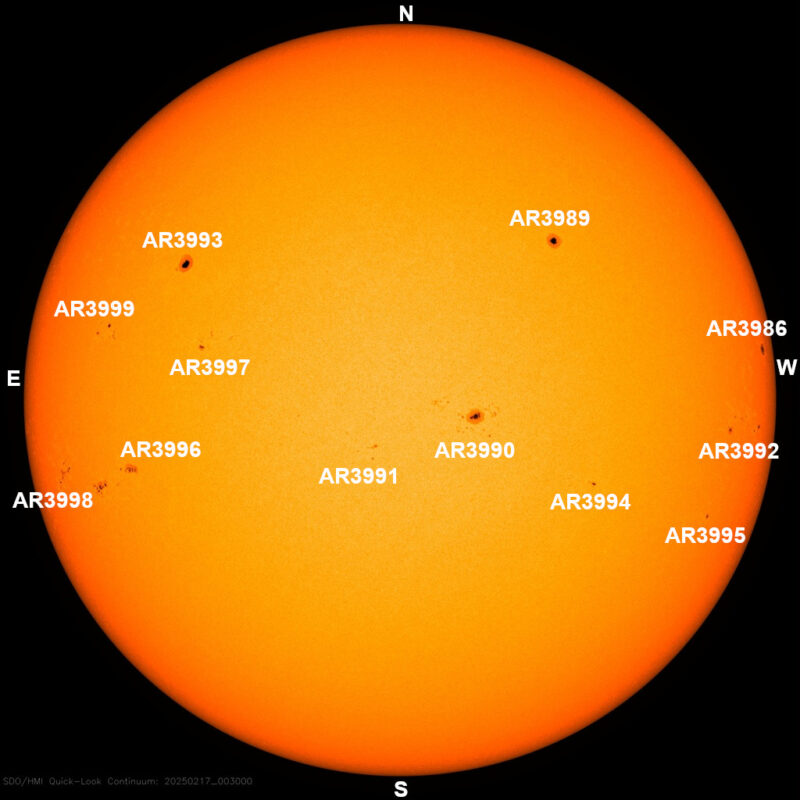
A G1 (minor) geomagnetic storm peaked at 12:00 UTC on February 14. So auroras lit up high latitudes on Valentine’s Day. The planetary K index fluctuated between Kp = 4 and Kp = 5 over the past day, keeping geomagnetic activity elevated. These active conditions may persist through the rest of today, as a fast solar wind from a coronal hole continues to blow at a moderate 561 km/s (348 miles/s), directing energy toward Earth. More auroras might be on the way, so keep your cameras ready! And don’t forget to share your stunning aurora photos with us.
Sun-Earth highlights in the past day
- Flare activity on the sun continues at moderate levels over the past 24 hours, thanks to an isolated M flare.
- The flare number over the past 24 hours reached 10, one M and nine C flares. The largest flare was an M1.8 flare at 20:57 UTC on February 14 from active region AR3990. The blast caused an R1 (minor) radio blackout that an affected an area in the middle of nowhere in the South Pacific Ocean.
- There are eight active regions on the Earth-facing side of the sun. AR3990, AR3992, AR3993, AR3996 and AR3997 have a beta-gamma magnetic configuration. The rest of the active regions on the solar disk are either alpha or beta. There is a newcomer that emerged in the southeast quadrant now numbered AR3995.
- Blasts from the sun? A partly Earth-directed coronal mass ejection (CME) was observed in LASCO C2 coronagraph imagery. It is associated with a C6.7 flare at 7:45 UTC on February 14 from active region AR3994. A glancing blow might be arriving at Earth on February 16.
- Solar wind speed is slightly up at 561 km/s (348 miles/s). At the moment of this writing the Bz (north/south) component of the interplanetary magnetic field (a critical factor in creating auroras) is south directed.
- Geomagnetic activity: The geomagnetic field, for a second time during the period, was disturbed to a G1 (minor) geomagnetic storm (Kp = 5) during a three hour period from 12:00 to 15:00 UTC on February 14. At the moment of this writing (11 UTC on February 14), Earth’s geomagnetic field is quiet (Kp = 3).
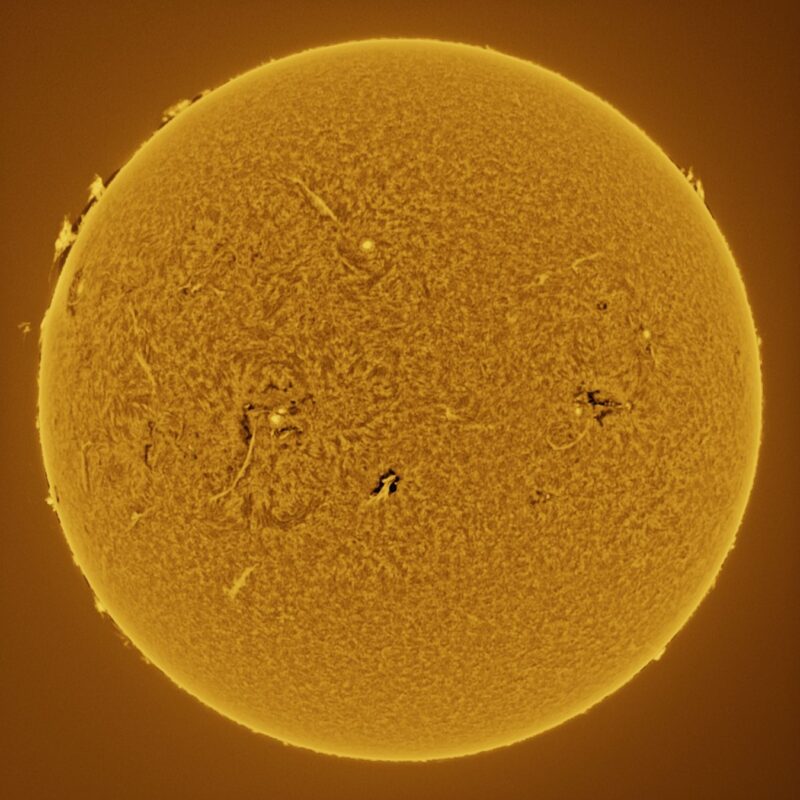
Sun news for February 12 – February 13. Auroral displays at high latitudes tonight?
(11 UTC to 11 UTC)

The arrival of a faint coronal mass ejection (CME) – combined with enhancements by fast solar wind from a coronal hole – might bring conditions for a G1 (minor) geomagnetic storm tonight. Will we have auroras tonight? Conditions look good for high latitudes. NOAA forecasters are not super confident. But we can say for sure that, at the time of this writing (11 UTC on February 13), an active period is ongoing. The active (Kp = 4) threshold was reached at 5:34 UTC this morning. Good luck aurora chasers!
Sun-Earth highlights in the past day
- Flare activity continued at low levels over the past 24 hours with only C flares.
- The flare number reduced over the past 24 hours to only 7 Cs. The largest flare of the period was a C3.9 flare at 12:47 UTC on February 12 from an as-of-yet-unnumbered incoming active region on the northeast.
- There are six active regions visible on the Earth-facing side of the sun now. AR3990 is showing a beta-gamma magnetic configuration. The rest of the active regions on the solar disk viewed from Earth are either alpha or beta.
- Blasts from the sun: No additional coronal mass ejections (CMEs) were observed in the SOHO spacecraft’s LASCO C2 and C3 imagery.
- Solar wind speed remains around 500 km/s (310 miles/s) and the interplanetary magnetic field (a critical factor in creating auroras) was slightly disturbed. The active (Kp = 4) threshold was reached at 5:34 UTC on February 13. The Bz (north/south) component of the interplanetary magnetic field is south directed. The solar wind speed and southward directed magnetic field can help to fuel geomagnetic activity.


Sun news for February 11 – February 12. More action rolling in from east
(11 UTC to 11 UTC)
The prominences we saw and reported on yesterday – on the eastern rim of the sun – continued over the past day. They’re an ongoing sign that more flare action might be moving to the Earth-facing side of our star, from the far side. There must be some active regions producing all this strong east-rim activity. But we can’t quite see them yet. Soon the sun’s rotation will carry them into view. Stay tuned.
Sun-Earth highlights in the past day
- Flare activity dropped to low levels over the past 24 hours with only C (common) flares.
- The flare number for the past day is 10 Cs. The largest flare of the period was a C7.7 peaking at 14:05 UTC on February 11 from departing active region AR3981. AR3981 is now out of view from Earth just behind the northwest solar limb (edge). If the region produces a large blast we should still observe it. We’ll keep watching.
- There are seven active regions visible on the Earth-facing side of the sun. There’s a newcomer on the southeast limb (edge) numbered AR3991.
- Blasts from the sun: A coronal mass ejection (CME) was observed by the SOHO spacecraft’s LASCO C2 imager at 18:12 UTC on February 11. It is associated with a C7.3 flare in the vicinity of AR3991. Further modeling and analysis is ongoing to determine if the plasma from this blast is Earth-directed.
- Solar wind speed remains around 500 km/s (310 miles/s) and the interplanetary magnetic field (a critical factor in creating auroras) was slightly disturbed. A 3-hour active (Kp = 4) period was observed from 3 – 6 UTC on February 12. The Bz (north/south) component of the interplanetary magnetic field is south directed. The solar wind speed and southward directed magnetic field can help to fuel geomagnetic activity.


Sun news for February 10 – February 11. A fiery sunspot region rotates into view
(11 UTC to 11 UTC)
Over the past day, we witnessed a fiery sunspot region blasting away on the sun’s northeast limb (edge). The sun’s rotation is just now carrying it into view, and so it hasn’t received a number yet. But it’s in addition to two newcomers mentioned yesterday: AR3989 and AR3990. Over the past day, an isolated M flare kept solar activity at moderate levels. The blast was a farewell flare from active region AR3981, which the sun’s rotation is now carrying to the far side. The new regions – and even departing AR3981 – are expected to keep flare activity moderate, or more than moderate, in the coming day.
Sun-Earth highlights in the past day
- Flare activity has been moderate over the past 24 hours, thanks to an isolated M (moderate) flare.
- The flare number for the past day is one M flare and 12 C flares. The largest flare of the period was an M1.6 peaking at 5:35 UTC on February 11 from departing active region 3981. The blast caused an R1 (minor) radio blackout over the South Indian Ocean northwest of Australia. AR3981 is now located at the sun’s northwesternmost limb (edge). It is returning to our star’s far side.
- There are seven active regions visible on the Earth-facing side of the sun today. AR3989, the largest sunspot cluster, is now evolving. And the incoming active region on the southeast we mentioned yesterday is numbered AR3990 and is our second region of focus.
- Blasts from the sun: Only small coronal mass ejections (CMEs) and plasma from jets were hurled into space over the past day. None are Earth-bound.
- Solar wind remained enhanced with speeds at around 500 km/s (310 miles/s) and the interplanetary magnetic field (a critical factor in creating auroras) was slightly disturbed. A 3-hour active (Kp = 4) period was observed from 0 – 3 UTC on February 11. At the time of this report the solar wind speed is 556 km/s (346 miles/s). And the Bz (north/south) component of the interplanetary magnetic field is south directed. All of that adds up a potential to fuel geomagnetic activity.


Sun news for February 9 – February 10. Flare boost from sun’s southeast? Solar wind!
(11 UTC to 11 UTC)
A new sunspot region – which the sun’s rotation has carried into view in the southeast – might become the next big-flare region. Meanwhile, the northwest sunspot cluster’s flare potential is decreasing as it rotates out of our view. All in all, in the next two to three days, observers expect moderate solar activity, with a continued likelihood of M-class flares. Plus, geomagnetic activity is expected to remain elevated, with G1 (minor) geomagnetic storm conditions likely today (February 10), driven by the ongoing influence of a high-speed solar wind stream from a coronal hole. Read more in the geomagnetic activity forecast below.
Sun-Earth highlights in the past day
- Flare activity increased to moderate levels over the past 24 hours, with an M flare and C flares.
- The flare number is one M flare and seven C flares. The largest flare of the period was an M1.0 peaking at 00:46 UTC on February 9 from Region 3981. This once-dominant region continues to decay as it approaches the western limb (edge). Consequently, its flare potential becomes less.
- There are 10 active regions visible on the Earth-facing side of the sun. But the most notable area of interest at this time remains the northwest quadrant, where the largest and most magnetically complex sunspot cluster continues to evolve. However, recent imagery suggests that a new sunspot region is emerging over the southeastern limb (edge), potentially replacing the northwest as the next area of solar activity focus.
- Blasts from the sun: No significant Earth-directed coronal mass ejections (CMEs) were observed over the past day. However, a slow, faint CME from February 8 is still being analyzed for any potential glancing impact on Earth.
- Solar wind conditions were initially calm over the past day, but activity increased significantly later in the day due to the arrival of a high-speed solar wind stream from a coronal hole. Accordingly, wind speeds rose from 350 km/s to 500-550 km/s (about 220 to 300-350 miles per second). As well, the interplanetary magnetic field (a critical factor in creating auroras) increased. The Bz (north/south) component indicating the direction remained northward until approximately 12:57 UTC, when it shifted southward. Because of that, its potential to fuel geomagnetic activity has increased.


Sun news for February 8 – February 9. A solar wind increase in Earth’s vicinity
(11 UTC to 11 UTC)
The large coronal holes we’ve been watching are rotating into a geoeffective position, that is, a position where they are capable of affecting Earth. Therefore, their fast solar wind will begin to reach Earth now, possibly disturbing Earth’s magnetic field. We call this type of solar wind a high-speed stream. These high-speed streams can disturb Earth’s geomagnetic field enough to create geomagnetic storms. The strongest storms come from coronal mass ejections (CMEs) riding on top of this solar wind. The combo increases a geomagnetic storm to the strongest levels.
Sun-Earth highlights in the past day
- Flare activity decreased to low levels with only C flare over the past 24 hours.
- The flare number was 11 (C flares) in the past day. The largest event was a C8.1 from AR3978 peaking at 12:54 UTC on February 8, 2025.
- There are eight active regions on the Earth-facing side of the sun. The northwest quadrant continues to be the most active area, with a cluster of interconnected sunspots showing magnetic complexity and ongoing interaction. While some of the intermediate spots in this cluster are decaying, the rearmost spot remains large and retains a weak delta configuration. Elsewhere on the disk, the remaining sunspots are small and magnetically simple.
- Blasts from the sun: A faint, slow coronal mass ejection (CMEs) was detected in coronagraph imagery at 10:00 UTC on February 8, associated with the M2.0 flare. No significant Earth-directed impact is expected. However, modeling is ongoing.
- Solar wind was slightly enhanced over the past day. The solar wind speed increased slightly to ~360 km/s. A few southward deflections occurred in the interplanetary magnetic field (a critical factor in creating auroras). Because of this, some energy transfer into Earth’s magnetosphere occurred.

Sun news for February 7 – February 8. Now, 2 coronal holes on the Earth-facing sun
(11 UTC to 11 UTC)
And then there were two! A new, large coronal hole has formed in the sun’s southeast quadrant. And we’ve been observing another one during the past week, which has moved into geoeffective position, that is, a position where it’s capable of affecting Earth. Especially, coronal holes play an important role in space weather, the conditions in near-Earth space (especially electromagnetic radiation and charged particles emitted by the sun) that can affect human technologies. For instance, fast solar wind from coronal holes can provoke disturbances in Earth’s geomagnetic field, sometimes spawning auroral displays. Therefore, when combined with incoming blobs of solar material (CMEs) the results can be dramatic … as with the huge geomagnetic storm back in May 2024 and the one in October 2024.
Sun-Earth highlights in the past day
- Flare activity deja vu! Just like yesterday and the day before, as we write this article, the sun has produced an M flare to keep solar activity at moderate over the past 24 hours. The blast was an M2.1 produced at 9:27 UTC on February 8. The week’s lead flare producer – sunspot region AR3981 – produced it. Again today, AR3981 remains the leader. And this time, it produced eight flares, the mentioned M plus seven C flares. The M flare by AR3981 provoked an R1 (minor) radio blackout that affected an area over Madagascar.
- The total number of flares in the past day was 15, including one M flares and 14 C flares.
- There are 10 active regions on the sun’s Earth-facing side. A new sunspot, AR3988, emerged in the southwest quadrant, near the intersection point of the central meridian and solar equator.
- Active region AR3981 lost its delta and today it shows a beta-gamma magnetic configuration. But, it remains the largest region on the solar disk as seen from Earth. Soon to depart AR3981 is approaching the west limb (edge). AR3978 continues to display a beta-gamma configuration. The rest of the labeled active regions show either alpha or beta.
- Blasts from the sun: No coronal mass ejections (CMEs) struck Earth in the past day.
- Solar wind remained at normal levels over the past day. Solar wind speed remains steady this time at 353 km/s (219 miles per second) as of 11 UTC on February 8.
- Geomagnetic activity: The interplanetary magnetic field (a critical factor in creating auroras) was mostly quiet at Kp = 1-2 over the past 24 hours. But, it suddenly went up to active levels (Kp = 4) in the couple of three-hour periods previous to this report.


Sun news for February 6 – February 7. Check out this image from GOES-19!
(11 UTC to 11 UTC)
The Space Weather Prediction Center (SWPC) in Boulder, Colorado, unveiled preliminary test images yesterday from the new GOES-19 satellite’s CCOR-1 instrument (the Compact Coronagraph, which uses an occulting disk to help capture white light imagery of the sun’s corona or outer atmosphere). GOES-19 launched in June, 2024. It’s been in its shakedown phase. The new images resemble those captured by SOHO’s LASCO C-3 imager, which has been operational since its launch in 1995. SWPC and NOAA plan to begin a regular series of operational images from GOES-19 – the ones that’ll be used by scientists – in April 2025. Scientists can’t wait! And neither can we. Meanwhile, on the sun itself, activity remains high. Read more below.
Sun-Earth highlights in the past day
- Flare activity remained at high levels over the past 24 hours. An M7.6 flare from AR3981 contributed to the heightened activity. The flare erupted at 9:21 UTC on February 7, triggering an R2 (moderate) radio blackout over the southwestern coast of Africa. AR3981 remains the most active region on the sun’s Earth-facing side. It produced 12 flares in the past day: three M (moderate) flares and nine C (common) flares.
- The total number of flares in the past day was 21, including five M flares and 16 C flares.
- There are 10 active regions on the sun’s Earth-facing side. Furthermore, a new sunspot, AR3987, has emerged on the southeast limb near the solar equator.
- Active region AR3981 retains its beta-gamma-delta configuration and remains the largest region on the solar disk as seen from Earth. But, AR3977 lost its gamma-delta and today shows a beta configuration. AR3978 continues to display a beta-gamma configuration while the rest of the labeled active regions show either alpha or beta.
- Blasts from the sun: No coronal mass ejections (CMEs) struck Earth in the past day.
- Solar wind remained at normal levels over the past day. Solar wind speed remains steady at 438 km/s (272 miles per second) as of 11 UTC on February 7.
- Geomagnetic activity: The interplanetary magnetic field (a critical factor in creating auroras) was mostly quiet at Kp = 1-2 over the past 24 hours.


Sun news for February 5 – February 6. Use eclipse glasses for sunspot region AR3981
(11 UTC to 11 UTC)
As it’s crossed the sun’s Earth-facing disk this week, AR3981 has been living up to its potential. It produced an M7.5 flare this morning. That’s just shy of the X-class threshold! This high activity aligns with expectations given this region’s magnetic and physical complexity. And this region is big. Grab your eclipse glasses for safe solar viewing if you want to see it with your own eyes. Yes, AR3981 is large enough to be visible from Earth without magnification. But AR3981 isn’t alone on the Earth-facing solar disk in its potential. AR3977 now also exhibits a beta-gamma-delta magnetic configuration. Though not as large as AR3981, AR3977 – part of the quintet of sunspot regions (AR3976, AR3977, AR3978, AR3981, and AR3984) – is becoming increasingly active. Overall, space weather analysts have increased the probability of X-class flares in the coming day from 20% to 25%. That’s a high potential. Stay tuned for more excitement.
Purchase your eclipse glasses here.
Sun-Earth highlights in the past day
- Flare activity jumped to high levels over the past 24 hours with an M7.5 flare from AR3981. This flare peaked at 11:02 UTC on February 6 and created an R2 (moderate) radio blackout over southern Africa. AR3981 remains the most active region on the sun’s Earth-facing side, having produced 10 C-class flares in the past day.
- The number of flares jumped overall, to 22 in the past day, up from 13 the day before.
- There are eight active regions on the sun’s Earth-facing side. A newcomer, AR3986, has emerged on the northeast limb near the solar equator.
- Blasts from the sun: No coronal mass ejections (CMEs) struck Earth in the past day.
- Solar wind has been at normal levels in the past 24 hours. Solar wind speed at 438 kilometers per second (272 miles per second) at the time of this report (11 UTC on February 6).
- Geomagnetic activity: The interplanetary magnetic field (a critical factor in creating auroras) was quiet (mostly Kp = 1-2) over the past 24 hours. However, a brief three-hour period reached unsettled levels (Kp = 3) at 3 UTC on February 6.


Sun news for February 4 – February 5: All eyes remain on AR3981
(11 UTC to 11 UTC)
Potent sunspot region AR3981 remains the one to watch on the sun. Even though its flare productivity decreased over the past day, and its growth slowed noticeably, there are more reasons to be excited about this region. Not only has AR3981 maintained its high-potential beta-gamma-delta magnetic configuration, but its delta region shows signs of what’s called shearing. That means its opposite magnetic polarities are moving in opposite directions, increasing the overall complexity and potential energy of the sunspot region. In simple terms, AR3981 is becoming more prone to sudden releases of energy, aka flares. Stay tuned, as this region could bring excitement at any minute.
Sun-Earth highlights in the past day
- Flare activity decreased to moderate levels over the past 24 hours. Flare productivity also decreased from 25 in the previous period to 13 in the past day: four M (moderate) flares and nine C (common) flares.
- The largest flare was an M4.7 at 11:09 UTC on February 4 from AR3981. It caused an R1 (minor) radio blackout over Madagascar.
- Sunspots: There are 10 active regions on the sun’s Earth-facing side. There are three newcomers: AR3983, AR3984 and AR3985. AR3981 remains the most active.
- Blasts from the sun: No coronal mass ejections (CMEs) struck Earth in the past day.
- Solar wind: Solar wind has been at normal levels in the past 24 hours, ranging from 400 km/s to 450 km/s (248 to 280 miles per second).
- Geomagnetic activity: The interplanetary magnetic field (a critical factor in creating auroras) was quiet (Kp = 0-1) over the past 24 hours.


Sun news for February 3 – February 4: Meet growing sunspot region AR3981
(11 UTC to 11 UTC)
Meet sunspot region AR3981! Activity remains high thanks to this region, which is now the largest and most complex of the eight sunspot groups on our star’s Earth-facing side. AR3981 has produced the most flares, and the biggest flares, over the past two days. As it moves closer to the center of the sun’s Earth-facing disk, its potential to affect Earth via the launch of blobs of solar materials and magnetic fields (aka CMEs) will rise. It hasn’t sent anything our way … yet. AR3981 first appeared on the solar disk on January 30, emerging in the sun’s northeast quadrant. It started with a simple alpha magnetic configuration, but rapidly grew to beta, soon gaining even more complexity. It now has a beta-gamma-delta magnetic complexity, signaling the capacity for large M flares and even X flares. Keep an eye on this sunspot region!
Sun-Earth highlights in the past day
- Flare activity remained high over the past 24 hours. And flare productivity increased slightly, from 23 to 25: seven M (moderate) flares and 18 C (common) flares.
- The largest flare was an M6.1 at 13:18 UTC on February 3 from AR3981. It caused an R2 (moderate) radio blackout over the South Atlantic Ocean.
- Sunspots: There are eight active regions on the sun’s Earth-facing side, with AR3981 the most active.
- Blasts from the sun: No coronal mass ejections (CMEs) have struck Earth in the past day.
- Solar wind: Solar wind from a large coronal hole is beginning to wane from 550 km/s to 450 km/s (340 to 280 miles per second) in the past 24 hours.
- Geomagnetic activity: The interplanetary magnetic field (a critical factor in creating auroras) was quiet (Kp = 0-1) over the past 24 hours.


Sun news for February 2 – February 3
(11 UTC to 11 UTC)
Sun activity has jumped to high after 12 M flares were fired over the past day, all of them from the same sunspot region! The prolific region, AR3981, has developed a high-potential beta-gamma-delta magnetic complexity, which is a sign that a region has the capacity for large M flares and even X flares. And, indeed, AR3981 came close to producing an X flare around 4 UTC this morning, blasting out an M8.8 flare (the X flare threshold is crossed at the equivalent of M10). This is definitely the region to watch!
Sun-Earth highlights in the past day
- Flare activity increased to high over the past day. Flare productivity increased too, climbing from 12 flares in the previous period to 23 over the past 24 hours: 12 M (moderate) flares and 11 C (common) flares.
- The biggest flare was an M8.8 at 3:58 UTC on February 3 from AR3981. It caused an R2 (moderate) radio blackout over the northwest coast of Australia.
- Sunspots: There are eight active regions on the sun’s Earth-facing side, AR3981 being the most active.
- Blasts from the sun: No coronal mass ejections (CMEs) have struck Earth in the past day.
- Solar wind: Solar wind speeds reached just below 700 km/s (435 miles per second) in the past day. Earth received the fast solar wind from a large coronal hole we have been observing over recent days, although its effects have started to wane.
- Geomagnetic activity: The interplanetary magnetic field (a critical factor in creating auroras) was mostly active (Kp = 4) over the past day.

Sun news for February 1 – February 2 (11 UTC to 11 UTC)
Solar activity dropped to moderate, with multiple C-class flares and the strongest event an M3.0 flare from Region AR3981. The northeast cluster of sunspots continues to be the primary source of activity, with magnetic interactions increasing flare potential. A high-speed solar wind stream from a coronal hole has arrived, pushing solar wind speeds beyond 600 km/s, contributing to unsettled to active geomagnetic conditions.
Sun-Earth highlights in past day
- Flare activity decreased to moderate over the past day. Flare production decreased to 12 flares: two M (moderate) flares and 10 C (common) flares.
- The biggest flare was an M3.0 at 10:12 UTC on February 2 from AR3981. It caused an R1 (minor) radio blackout over Southern Africa.
- Sunspots: There are six active regions on the sun’s Earth-facing side, with AR3976, AR3977, and AR3981 the most active.
- Blasts from the sun: No coronal mass ejections (CMEs) have struck Earth in the past day.
- Solar wind: Solar wind speeds reached beyond 600 km/s (373 miles per second) in the past day. Earth started to receive the fast solar wind from that large coronal hole we have been observing.
- Geomagnetic activity: The interplanetary magnetic field (a critical factor in creating auroral displays) was unsettled to active.

For sun activity prior to this date, see our January archive.
Like what you read?
Subscribe and receive daily news delivered to your inbox.
More from
C. Alex Young


Sun news: See a huge solar eruption

Yes, there’s an aurora season, and it’s here
Sun activity archive for September 2026
Sun activity archive for August 2026