



Sun news for December 31: Auroras joining the New Year’s Eve party?

There’s a chance 2025 could arrive in serious style, as auroras are forecast for this evening! A blob of sun-stuff, blasted from our star on Sunday, is anticipated to hit Earth’s magnetic field around midday (UTC) today. Forecasters are predicting that this coronal mass ejection (CME) will cause geomagnetic storms ranging from G1 (minor) to G2 (moderate), with the possibility of a G3 (strong) storm. And that could mean an auroral extravaganza for tonight’s New Year’s Eve celebrations! The displays could extend into January 1 for a great start to 2025. Good luck, aurora chasers, and clear skies. Share your photos with us at EarthSky community photos.
Last 24 hours: Solar activity remains high with eight M flares fired over the past day. Total flare production is also high, with 20 flares produced between 11 UTC yesterday and 11 UTC today: the eight Ms and 12 C-class flares. The largest flare was an M5.0 from active region AR3936 at 16:54 UTC on December 30. An R1 (minor) radio blackout affected an area over the Pacific Ocean off the west coast of Chile. The lead flare producer of the period was active region AR3936 with 14 flares. The M flares for the observation period were:
- M3.5 at 14:46 UTC on December 30 from AR3936. R1 (minor) radio blackout over the Atlantic Ocean off the east coast of Brazil.
- M5.0 at 16:54 UTC on December 30 from AR3936. R1 (minor) radio blackout over the Pacific Ocean off the west coast of Chile. The largest.
- M1.2 at 17:30 UTC on December 30 from AR3936. R1 (minor) radio blackout over the South Pacific Ocean.
- M1.6 at 17:42 UTC on December 30 from AR3936. R1 (minor) radio blackout over the South Pacific Ocean.
- M1.6 at 18:24 UTC on December 30 from AR3936. R1 (minor) radio blackout over the Pacific Ocean.
- M1.7 at 18:33 UTC on December 30 from AR3936. R1 (minor) radio blackout over Easter Island in the Pacific Ocean.
- M1.0 at 22:41 UTC on December 30 from AR3939. R1 (minor) radio blackout over French Polynesia.
- M1.0 at 5:00 UTC on December 31 from AR3932. R1 (minor) radio blackout over the Indian Ocean off the west coast of Australia.
AR3936 retained its high-flare-potential beta-gamma-delta magnetic configuration. AR3933 and AR3938 have beta-gamma configurations. AR3941 lost its gamma complexity and joined the remaining regions with simpler alphas or betas. The sun currently has nine sunspot regions on its Earth-facing side.
Sun news for December 30: Double X flares, auroras possible tomorrow!

The solar excitement continues! After an X flare early yesterday morning, the sun has fired off another two in the past 24 hours. In fact, these X flares occurred nearly simultaneously, peaking at 4:14 and 4:31 UTC this morning. And today’s excitement is not just on the sun. A filament eruption yesterday created a partial-halo coronal mass ejection (CME) – or blob of sun-stuff – that is headed toward Earth. Analysts are confident that this will cause a G3 (strong) geomagnetic storm, but the timing of this impact is less certain. Currently, it’s anticipated to reach Earth at 12 UTC on December 31. This means auroras could be visible at mid-northern latitudes in North America and Europe. That would really add some magic to a New Year’s Eve party!


Last 24 hours: Sun activity is high with two X flares, 17 M flares, and five C flares during our observation period (11 UTC yesterday to 11 UTC today). The largest flare was the X1.5 at 4:14 UTC on December 30 from sunspot region AR3936. A corresponding R3 (strong) radio blackout affected an area over the Indian Ocean. The second largest was an X1.1 at 4:31 UTC on December 30 from 3932. The X and M flares for the period were:
- Strength – Peak time, 12/29 (UTC) – Sunspot group
- M1.6 – 12:24 – AR3936
- M1.3 – 12:56 – AR3936
- M7.1 – 15:09 – AR3936
- M3.3 – 17:08 – AR3939
- M1.2 – 17:52 – AR3932
- M1.4 – 18:04 – AR3941
- M3.3 – 18:41 – AR3936
- M1.1 – 20:39 – AR3936
- M1.5 – 21:53 – AR3936
- M1.8 – 22:06 – AR3936
- M1.9 – 23:30 – AR3936
- Strength – Peak time, 12/30 (UTC) – Sunspot group
- M1.7 – 0:47 – AR3939
- M1.7 – 3:00 – AR3941
- X1.5 – 4:14 – AR3936
- X1.1 – 4:31 – AR3932
- M3.5 – 6:25 – AR3939
- M1.5 – 8:40 – AR3927
- M1.7 – 8:50 – AR3927
- M1.7 – 10:11 – AR3927
The lead flare producer was AR3936 with one X1.1 and five M flares. AR3936 retained its high-flare-potential beta-gamma-delta magnetic configuration. AR3933, AR3938, and AR3941 have beta-gamma configurations. The remaining regions are simple alphas or betas. The sun currently has nine sunspot regions its Earth-facing side.

Sun news for December 29: X flare! Activity rockets to high

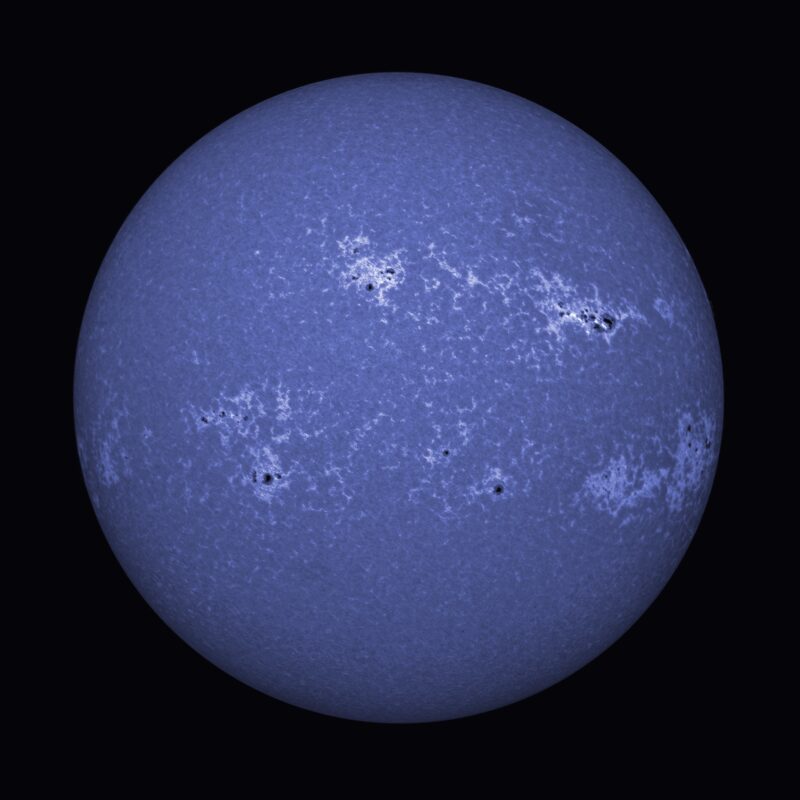
Pow! An X1 flare early this morning and a sharp increase in flaring has rocketed sun activity to high. In addition to the X flare, the sun blasted an impressive 14 M flares and a few larger C flares. The driver of most of this activity was sunspot region AR3936, which has a high-flare-potential beta-gamma-delta magnetic complexity. So we could still see some more substantial flaring! Stay tuned.
Last 24 hours: Sun activity is high, after the production of an X1.1, 14 Ms, and seven C flares during our observation period (11 UTC yesterday to 11 UTC today). The largest flare was the X1.1, fired at 7:18 UTC on December 29 from AR3936. A corresponding R3 (minor) radio blackout affected an area over the Indian Ocean. The M flares for the period were:
- M4.5 at 11:21 UTC on December 28 from AR3932. R1 (minor) radio blackout over the Atlantic Ocean off the east coast of Southern Africa.
- M1.3 at 15:18 UTC on December 28 from AR3932. R1 (minor) radio blackout over western Brazil.
- M1.2 at 22:14 UTC on December 28 from AR3933. R1 (minor) radio blackout over the Pacific Ocean.
- M1.0 at 2:35 UTC on December 29 from AR3929. R1 (minor) radio blackout over Australia.
- M1.3 at 2:46 UTC on December 29 from AR3936. R1 (minor) radio blackout over Australia.
- M1.3 at 3:30 UTC on December 29 from AR3936. R1 (minor) radio blackout over Australia.
- M1.2 at 4:05 UTC on December 29 from AR3940. R1 (minor) radio blackout over Australia.
- M2.0 at 4:30 UTC on December 29 from AR3939. R1 (minor) radio blackout over Australia.
- M3.1 at 5:26 UTC on December 29 from AR3933. R1 (minor) radio blackout over the Indian Ocean.
- M3.5 at 5:47 UTC on December 29 from AR3929. R1 (minor) radio blackout over the Indian Ocean.
- M3.0 at 6:59 UTC on December 29 from AR3936. R1 (minor) radio blackout over the Indian Ocean.
- X1.1 at 7:18 UTC on December 29 from AR3936. R3 (strong) radio blackout over the Indian Ocean.
- M4.2 at 7:59 UTC on December 29 from AR3936. R1 (minor) radio blackout over over the Indian Ocean.
- M1.4 at 9:48 UTC on December 29 from AR3936. R1 (minor) radio blackout over Southern Africa.
- M2.7 at 10:39 UTC on December 29 from AR3932. R1 (moderate) radio blackout over Southern Africa.
The lead flare producer was AR3936 with one X1.1 and five M flares. AR3936 retained a beta-gamma-delta magnetic configuration. AR3932, AR3933, and AR3938 have beta-gamma configurations. The remaining regions are simple alphas or betas. The sun has 11 sunspot regions its Earth-facing side.

Sun news for December 28: X flare! Activity rockets to high

Pow! An X1 flare early this morning and a sharp increase in flaring has rocketed sun activity to high. In addition to the X flare, the sun blasted an impressive 14 M flares and a few larger C flares. The driver of most of this activity was sunspot region AR3936, which has a high-flare-potential beta-gamma-delta magnetic complexity. So we could still see some more substantial flaring! Stay tuned.
Last 24 hours: Sun activity is high, after the production of an X1.1, 14 Ms, and seven C flares during our observation period (11 UTC yesterday to 11 UTC today). The largest flare was the X1.1, fired at 7:18 UTC on December 29 from AR3936. A corresponding R3 (minor) radio blackout affected an area over the Indian Ocean. The M flares for the period were:
- M4.5 at 11:21 UTC on December 28 from AR3932. R1 (minor) radio blackout over the Atlantic Ocean off the east coast of Southern Africa.
- M1.3 at 15:18 UTC on December 28 from AR3932. R1 (minor) radio blackout over western Brazil.
- M1.2 at 22:14 UTC on December 28 from AR3933. R1 (minor) radio blackout over the Pacific Ocean.
- M1.0 at 2:35 UTC on December 29 from AR3929. R1 (minor) radio blackout over Australia.
- M1.3 at 2:46 UTC on December 29 from AR3936. R1 (minor) radio blackout over Australia.
- M1.3 at 3:30 UTC on December 29 from AR3936. R1 (minor) radio blackout over Australia.
- M1.2 at 4:05 UTC on December 29 from AR3940. R1 (minor) radio blackout over Australia.
- M2.0 at 4:30 UTC on December 29 from AR3939. R1 (minor) radio blackout over Australia.
- M3.1 at 5:26 UTC on December 29 from AR3933. R1 (minor) radio blackout over the Indian Ocean.
- M3.5 at 5:47 UTC on December 29 from AR3929. R1 (minor) radio blackout over the Indian Ocean.
- M3.0 at 6:59 UTC on December 29 from AR3936. R1 (minor) radio blackout over the Indian Ocean.
- X1.1 at 7:18 UTC on December 29 from AR3936. R3 (strong) radio blackout over the Indian Ocean.
- M4.2 at 7:59 UTC on December 29 from AR3936. R1 (minor) radio blackout over over the Indian Ocean.
- M1.4 at 9:48 UTC on December 29 from AR3936. R1 (minor) radio blackout over Southern Africa.
- M2.7 at 10:39 UTC on December 29 from AR3932. R1 (moderate) radio blackout over Southern Africa.
The lead flare producer was AR3936 with one X1.1 and five M flares. AR3936 retained a beta-gamma-delta magnetic configuration. AR3932, AR3933, and AR3938 have beta-gamma configurations. The remaining regions are simple alphas or betas. The sun has 11 sunspot regions its Earth-facing side.

Sun news for December 28: Parker Solar Probe’s closest approach successful
Woohoo! It’s confirmed: Parker Solar Probe successfully completed its closest approach to the sun on December 24. Around 5 UTC yesterday, mission control at the Johns Hopkins Applied Physics Lab (JHUAPL) received a signal from the spacecraft, notifying them that it completed its perihelion and is in good health. More information about this history-making solar visit is expected from the spacecraft on January 1, 2025. And then the data from the mission will follow in the coming weeks. What new understanding of our star will Parker bring us? Stay tuned! And in the meantime, enjoy the solar activity news that we bring you every day.
Last 24 hours: Sun activity is moderate with the production of two M flares over the past 24 hours. Flare production increased to 16 flares during our observation period between 11 UTC yesterday and 11 UTC today: two Ms and 14 C flares. The largest was an M3.3, produced at 20:35 UTC on December 27 by sunspot region AR3938 in the northeast. A corresponding R1 (minor) radio blackout affected an area over French Polynesia in the Pacific Ocean. The second M flare was an M1.2 flare fired at 15:38 UTC on December 27 from AR3928. An R1 (minor) radio blackout affected an area over Brazil. The lead flare producers were AR3933 and AR3938 with five flares each. AR3938 and AR3933 lost their high-potential delta magnetic configurations. AR3933 now is a beta region, while AR3928, AR3932, and AR3938 show beta-gamma magnetic complexities. AR3936 is a beta-delta region. The remaining regions have simple alpha or beta configurations. The Earth-facing sun currently has 12 sunspot regions, with two newcomers: AR3940 and AR3941.
?? Woohoo! Parker Solar Probe completed its closest approach to the Sun on Dec. 24. ? Mission operation at APL received the signal notifying success from the spacecraft late Dec. 26 just before midnight (EST) or Dec. 27 around 5 UTC. ????? MORE on Parker at… pic.twitter.com/IHEjf1Bqvq
— Dr. C. Alex Young (@TheSunToday) December 27, 2024
Sun news for December 27-28, 2024. An artist’s impression of Parker Solar Probe making its closest-yet approach to the sun on December 24, 2024. Yesterday, mission control confirmed that this approach was successful. Images via NASA/SVS.
Sun news for December 27: Energetic jets and prominence in the solar east


Flaring has dropped to low in the past 24 hours, but energetic jets and prominences can be seen in the solar east, the side just now rotating into view. Some of this activity was within the vicinity of active regions AR3938 and AR3939. And some originated from active regions just around the sun’s eastern limb (edge). AR3936 and AR3933 also ejected plasma out into space. Meanwhile, on the sun’s west side, AR3926 is departing – rotating out of view – among jets and small prominences.
Last 24 hours: Flare production has dropped to low levels during the past 24 hours (11 UTC yesterday to 11 UTC today), with only seven C flares. The largest flare was a C9.5 flare from new unnumbered region along the sun’s southeast limb (edge). The lead flare producer was active region AR3938 in the northeast, with three flares. The Earth-facing side of our star has two active regions showing a beta-gamma-delta magnetic configuration, AR3933 and AR3938. Both have potential for M and X flares. AR3928 and AR3933 both show a beta-gamma magnetic complexity. All other active regions show a simpler alpha or beta configuration. The Earth-facing sun has 10 visible sunspot regions.

Sun news for December 26: Sun activity is high with an M7.3 flare

Sun activity is high today, with an M7.3 flare early this morning from active region AR3938. The blast happened at 3:15 UTC on December 26. A second nearly synchronized flare occurred in the vicinity of sunspot region AR3933. Earlier, we saw a similar event: a nearly synchronized flare from AR3938, with another flare in the vicinity of AR3936. These “sympathetic” solar flares occur when two active regions located far from each other on the sun’s surface are connected by loops of magnetism. Meanwhile, here on Earth, the coronal mass ejection (CME) hurled by the sun on December 23 didn’t arrive, or was simply weaker than expected. But we’re still waiting for the CME from December 24; it’s expected later today. It might bring conditions for a G1 (minor) or even a G2 (moderate) geomagnetic storm. Will it bring auroras? We’ll see.
Last 24 hours: Sun activity continues at high levels due to an M7.3 flare, which was one of two M flares over the past 24 hours. Flare production during the past day (11 UTC yesterday to 11 UTC today) consisted of two M and six C flares. That’s in contrast to eight M flares on the day before. The M7.3 flare from active region AR3938 was the largest of the past day. It caused an R2 (moderate) radio blackout over Australia. The second M flare came from the same active region – AR3938 – at 0:30 UTC on December 26. It caused an R1 (minor) radio blackout over the Indian Ocean off the west coast of Australia. The lead flare producer was again active region AR3938 in the northeast with four flares, the two Ms and two C flares. Active region AR3933 retained its beta-gamma-delta magnetic configuration with potential for more M flares and even X flares. AR3928, AR3932 and AR3938 all show a beta-gamma magnetic complexity. All other active regions show a simpler alpha or beta configurations. Our star today is covered with 11 numbered sunspot regions on the Earth-facing side. AR3939 is the newest region.
Sun news for December 25: Auroras possible Christmas night and Boxing Day



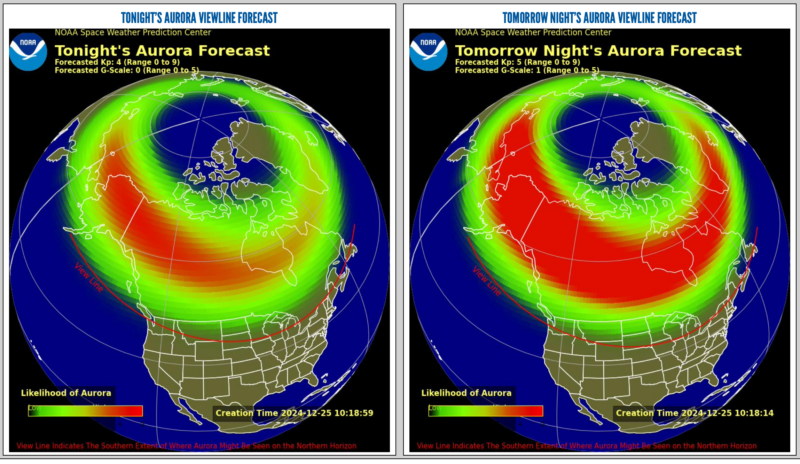
Two coronal mass ejections (CMEs) are headed to Earth. They were hurled by the sun during M flare events, one associated with an M8.9 flare by AR3932 on December 23 and a second associated with a 4.2 flare by AR3932 on December 24. The arrival of the first CME – a chunk of solar materials and magnetic fields – is anticipated late today, December 25. It’s expected to bring conditions for a G1 (minor) or even a G2 (moderate) geomagnetic storm. Geomagnetic storm conditions might extend through December 26, as the second CME arrives. Will we have two days of possible auroral displays? We’ll see. Polish those lenses and clean your cameras. Get ready for the show. And remember to share your beautiful photos with us!
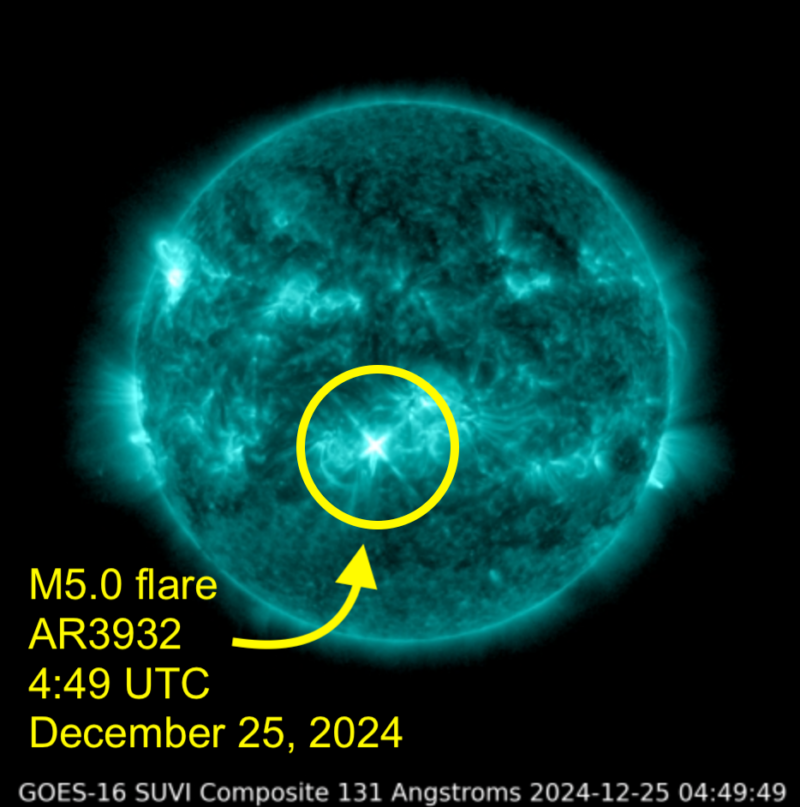
Last 24 hours: Sun activity is high, with the production of seven M flares over the past 24 hours. Flaring productivity is also high with 25 flares produced during our observation period (11 UTC yesterday to 11 UTC today). There were the seven Ms plus 18 C flares. The largest event was an M5.0 flare produced by active region AR3932 at 4:49 UTC on December 25. An R2 (moderate) radio blackout was observed affecting an area over the Indian Ocean off the west coast of Australia. The lead flare producer was newcomer active region in the northeast, AR3938, with 11 flares, two M and C flares. The M flares for the period are:
- M1.1 at 14:10 UTC on December 24 from AR3932. R1 (minor) radio blackout over the Atlantic Ocean off the east coast of Brazil.
- M1.3 at 16:34 UTC on December 24 from AR3932. R1 (minor) radio blackout over western Brazil.
- M1.0 at 18:24 UTC on December 24 from AR3932. R1 (minor) radio blackout over the Pacific Ocean off the west coast of Chile.
- M1.0 at 20:28 UTC on December 24 from AR3933. R1 (minor) radio blackout over the Pacific Ocean.
- M1.2 at 22:34 UTC on December 24 from AR3938. R1 (minor) radio blackout over the Pacific Ocean.
- M2.9 at 04:30 UTC on December 25 from AR3938. R1 (minor) radio blackout off the west coast of Australia.
- M5.0 at 04:49 UTC on December 25 from AR3932. R2 (moderate) radio blackout over the Indian Ocean off the west coast of Australia.The largest.
Active region AR3932 lost its delta and now is showing a beta-gamma magnetic configuration. AR3928 and AR3938 both also show a beta-gamma magnetic complexity. But AR3933 grew to develop a delta, so it now has beta-gamma-delta complexity; it has the potential for more M flares and even X flares. All other active regions show a simpler alpha or beta. There are 11 sunspot regions on the Earth-facing solar disk. Did we mention there is a newcomer now numbered AR3938?
Sun news for December 24: High sun activity, Parker touches sun, Christmas auroras?
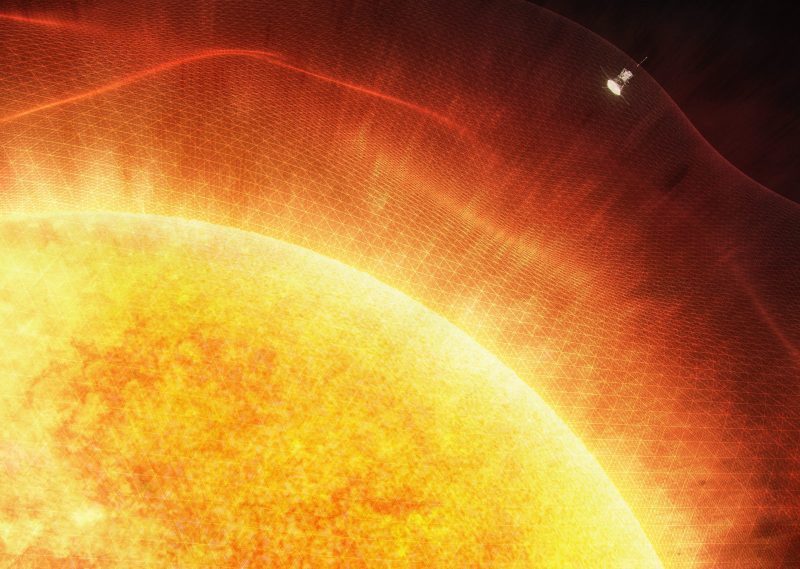
An M8.9 and two M4 flares boosted sun activity to high over the past day, coinciding with Parker Solar Probe’s historic closest-ever approach to the sun. The spacecraft was closest at 11:53:48 UTC today, December 24. It swept 3.86 million miles (6.2 million km) from our star. So it’s an exciting day for humanity! And the sun appears to be joining in the celebration. Sunspot region AR3932 – which produced the M8.9 and other M flares over the past day – also produced a coronal mass ejection (CME) that’s currently headed toward Earth. The CME is expected to reach us late on December 25 and might produce a G1 (minor) or even a G2 (moderate) geomagnetic storm for Christmas. Aurora watchers, get ready.
Last 24 hours: The M8.9 flare drove solar activity to high levels over the past 24 hours. It happened at 11:12 UTC on December 23, and came from active region AR3932. It caused an R2 (moderate) radio blackout over the west coast of southern Africa. But overall flare productivity was also high, this time with 28 flares in total during our observation period (11 UTC yesterday to 11 UTC today), four M and 14 C flares. The M flares for the period are:
- M8.9 at 11:12 UTC on December 23 from AR3932. R2 (moderate) radio blackout off the west coast of southern Africa.
- M4.7 at 0:19 UTC on December 24 from AR3932. R1 (minor) radio blackout over the Fiji Islands in the Pacific Ocean.
- M1.0 at 2:10 UTC on December 24 from AR3933. R1 (minor) radio blackout over the east coast of Australia.
- M4.2 at 8:41 UTC on December 24 from AR3932. R1 (minor) radio blackout over Madagascar.
Active region AR3932 developed is now showing a beta-gamma-delta magnetic configuration, with increased potential for more M flares and even X flares. AR3933 also developed a delta complexity and is now showing a beta-delta configuration. Meanwhile, AR3928 kept its beta-gamma. All other active regions show a simpler alpha or beta. There are 11 sunspot regions on the Earth-facing solar disk.

Sun news for December 23: Flare activity still going up with 6 Ms

The increase in solar activity and flare production continued over the last 24 hours, with 6 M flares in all. The sun’s disk is peppered with sunspot regions, and more from the far side will soon rotate into view. The newest regions in the eastern hemisphere – those just now rotated into view – are the largest and most complex of those on the sun’s Earth-facing side now. In addition, a new region in the northeast is making itself known with small flares and coronal loops emerging over the limb (edge). Will this activity increase continue? Stay tuned to see what will come next.
Last 24 hours: Six M (moderate) flares kept sun activity at a moderate level over the past day (11 UTC yesterday to 11 UTC today). Flare production increased to 31 flares, six M flares and 25 C flares. The largest event was an M1.2 produced at 20:49 UTC on December 22 from AR3932. An R1 (minor) radio blackout affected an area over the Pacific Ocean. Active regions AR3928 and AR3932 retained their beta-gamma magnetic configuration. All other active regions show a simpler alpha or beta. We have four newcomers on the solar disk: AR3934, AR3935, AR3936, and AR3937. There are 10 sunspot regions on the Earth-facing solar disk.
The M flares for the period are:
- M1.1 at 14:14 UTC on December 22 from AR3930. R1 (minor) radio blackout off the east coast of Brazil.
- M1.0 at 14:14 UTC on December 22 from AR3930. R1 (minor) radio blackout off the east coast of Brazil.
- M1.2 at 20:49 UTC on December 22 from AR3932. R1 (minor) radio blackout over the Pacific Ocean. The largest
- M1.1 at 20:49 UTC on December 22 from AR3932. R1 (minor) radio blackout over the Pacific Ocean.
- M1.0 at 02:31 UTC on December 23 from AR3924. R1 (minor) radio blackout over Eastern Australia.
- M1.0 at 06:29 UTC on December 23 from AR3928. R1 (minor) radio blackout over the Indian Ocean.


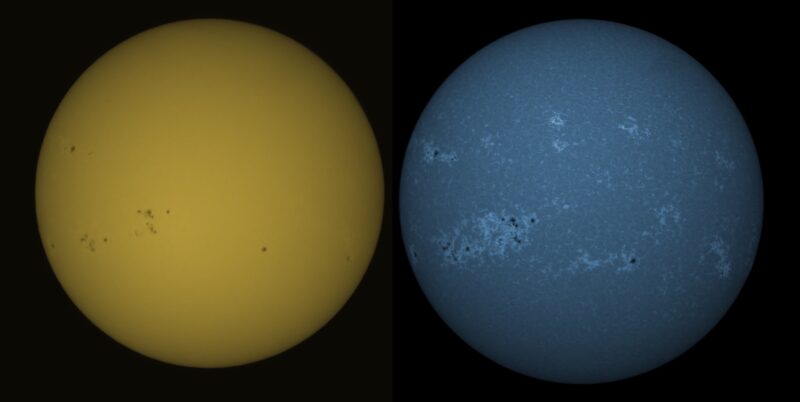
Sun news for December 22: Flare production increases as filaments reign
Happy sun day! Activity remained moderate and flare production increased from 8 to 22 flares. Filament eruptions over the last 24 hours took the spotlight. The first notable eruption was from the northeast limb (edge) around 20:41 UTC, and then a solar plasma surge came from the southeast around 23:37 UTC. The next large blast from the north-northwest region came at 5:05 UTC. Over the next 24 hours, analysts will determine if any of these eruptions will have an Earth-directed component. Stay tuned.
Last 24 hours: An isolated M (moderate) flare kept sun activity at moderate levels. During our observation period of 11 UTC yesterday to 11 UTC today, flare production increased to 22 flares, the one M flares and 21 C flares. The M flare was an M1.1 produced at 4:10 UTC on December 22 from AR3932. An R1 (minor) radio blackout affected an area over western Australia. Active regions AR3928 and AR3932 developed a beta-gamma magnetic configuration. All other active regions show a simpler alpha or beta. We have two newcomers on the solar disk: AR3932 and AR3933.

Sun news for December 21: On this solstice, sun activity is moderate
Happy solstice! The sun reached its southernmost point in our sky at 9:21 UTC (3:21 a.m. CDT in the Americas) this morning. And, on this solstice, sun activity remains moderate with two M flares. Plus – as we write this, around 10 UTC on December 21 – a prominence is dancing over the sun’s northwest quadrant, while a nearby filament is in the process of erupting into space. Will that erupting plasma head in our direction? Given its location, probably not, but we’ll have to wait and see. Yesterday’s livestream with EarthSky founder Deborah Byrd and heliophysicist C. Alex Young, co-author of this daily news sun post, had to be rescheduled! It’s now set for 19:15 UTC (1:15 p.m. CST) on Monday, December 23, just hours before Parker Solar Probe’s closest-ever sweep past our star on Tuesday, December 24 (Christmas Eve). For a “notify me” button, click here or into the video below.
Last 24 hours: Two M (moderate) flares kept sun activity at moderate levels. Over the past day, flare production dropped to eight flares, the two M flares and six C flares. The first M flare and largest event was an M2.5 produced at 11:18 UTC on December 20 from AR3928. An R1 (minor) radio blackout affected an area over Madagascar. The second M flare was an M1.9 at 0:38 UTC on December 21 by AR3932. An R1 (minor) radio blackout affected an area over Fiji Island. The lead flare producer of the past day was newcomer AR3932 with the two M flares and three C flares. This all occurred during our observation period of 11 UTC yesterday to 11 UTC today. The Earth-facing solar disk today has eight numbered active regions. Active regions AR3922, AR3924, and AR3927 lost their beta-gamma magnetic configuration. All active regions show a simpler alpha or beta. We have four newcomers on the solar disk: AR3929, AR3931, AR3932, and AR3930.

Parker Solar Probe will make humanity’s closest approach to the sun on Christmas Eve, December 24! For the latest, watch the livestream above at the RESCHEDULED time of 1:15 p.m. CST (19:15 UTC) on Monday, December 23. EarthSky founder Deborah Byrd will host. Heliophysicist C. Alex Young, co-author of this daily sun news update, will join. Join us in marveling at a spacecraft that can touch the sun!
Sun news for December 20: Solar activity jumped up!
Yesterday’s M1.7 flare from AR3924 at 10:37 UTC produced a full halo event observed by the LASCO C3 imager on the SOHO spacecraft, starting at around 15:50 UTC on December 19. It was one of the final events from this active region before it departed in the sun’s southwest, and was carried out of view by the sun’s rotation. Over the past day (11 UTC yesterday to 11 UTC today), sun activity increased with the production of three M flares. Don’t miss today’s livestream with EarthSky founder Deborah Byrd and heliophysicist C. Alex Young, co-author of this daily news sun post. They will be talking about the Parker Solar Probe and its closest approach to our sun on December 24. It’s about to make history!
Last 24 hours: Three M (moderate) flares keep solar activity at moderate levels. The largest was an M3.8 at 15:34 UTC on December 19 from a newcomer on the southeast, AR3928. Shortly after the blast, an R1 solar radio blackout affected an area over Brazil. Overall, flare production increased to 19 flares. The sun produced three M and 16 C flares during our observation period (11 UTC yesterday to 11 UTC today). The lead flare producer of the period was newcomer AR3928, with two M and ten C flares. This is the list of the M flares f the period:
- M3.8 at 15:34 UTC on December 19 from AR3928. R1 (minor) radio blackout over Brazil. The largest.
- M1.8 at 19:00 UTC on December 19 from AR3928 .R1 (minor) radio blackout over Easter Island in the Pacific Ocean.
- M2.1 at 7:26 UTC on December 20 from AR3924. R1 (minor) radio blackout over the South Indian Ocean.
Also in the past day, a prominence danced around the solar south pole in the south, and a long filament erupted, hurling plasma into space. Flaring potential increased today as three active regions on the Earth-facing solar disk, AR3922, AR3924, and AR3927, all show a beta-gamma magnetic configuration. The remainder show simpler alpha or beta configurations. The sun has six sunspot regions on its Earth-facing side. The newcomer on the southeast limb (edge) is numbered AR3928.


Sun news for December 19: The party continues! But on the far side
Solar activity has picked up only slightly on the sun’s Earth-facing side. But the far side is rockin’! We don’t have spacecraft on that side of the sun. But we do have helioseismology – the study of the sun’s interior via analysis of sound waves moving through the sun – using the GONG telescope network. This technique shows two active regions on the far side, including one that should be rotating into our view within the next few days. Meanwhile, the other region was probably the source of December 17’s super-fast coronal mass ejection (CME), which we talked about yesterday. It broke some records! And there’s more. Areas on the front and the back of the sun are showing prominence activity. We can see backside solar plasma from the sun’s northeast limb (edge), while frontside activity is coming from AR3927 on the sun’s Earth-facing disk. We await what might soon rotate into view.
Last 24 hours: Solar activity on our star’s Earth-facing side is moderate. During our observation period (11 UTC yesterday to 11 UTC today), the sun produced one M (moderate) flare and 12 C (small) flares. The largest event was an M1.7 flare from AR3924 at 10:37 UTC on December 19. The eruption produced an R1 solar radio blackout over southern Africa. The lead flare producer of the period was AR3927 with seven C flares. With the M1.7 flare it produced today, sunspot region AR3924 reached some of the flaring potential of its beta-gamma magnetic configuration. The remaining regions have simpler alpha or beta configurations. The sun has five sunspot regions on its Earth-facing side. The newcomer on the northeast limb (edge) is numbered AR3927.


Sun news for December 18: One of the fastest CMEs ever recorded on December 17!
A blazingly fast burst of sun-stuff – a coronal mass ejection (CME) – was fired from the sun yesterday afternoon. It soared into space at a minimum of 3,100 kilometers per second (1,926 miles per second), making it one of the fastest CMEs ever recorded! It was possibly even faster than the infamous solar blast of July 12, 2012, which might have caused a Carrington Event-level geomagnetic storm on Earth if it had been directed our way. Yesterday’s event was only surpassed by the massive blast of September 10, 2017, which traveled at 4,300 kilmeters per second (2,670 miles per second). No event that could have caused yesterday’s CME was observed on the Earth-facing solar disk, so it seems the eruption came from the sun’s far side. That means no sun-stuff is heading our way. Will the region that caused this historic CME keep up its activity when it rotates onto our side of the sun? Stay tuned.
Last 24 hours: It seems the party is exclusively on the sun’s far side right now, with only 12 C-class flares produced on the Earth-facing sun during our observation period from 11 UTC yesterday to 11 UTC today. That places activity at low. The largest event was a C8.2 flare by an incoming new region in the southeast. It was produced at 7:34 UTC on December 18. The lead flare producer of the period was this unnumbered newcomer, with eight C flares. Sunspot region AR3924 retained its moderate flaring potential with a beta-gamma magnetic configuration. The remaining regions have simple alpha or beta configurations. Today, the sun has five sunspot regions on its Earth-facing side.

Sun news for December 17: Sun-stuff arrives, auroras tonight?
At 5:19 UTC this morning, a cloud of solar material and magnetic fields – a coronal mass ejection (CME) – hit Earth. This glancing blow disturbed Earth’s magnetic field, causing a G1 (minor) geomagnetic storm. NOAA’s analysts are predicting that auroras could be visible at northern latitudes tonight thanks to this disturbance. If you see an auroral spectacle, share your photos with us!
Last 24 hours: Solar activity is low, with only C-class flares produced over the past day. Productivity was similar to the day before, with 12 C flares fired during our observation period from 11 UTC yesterday to 11 UTC today. The largest event was a C4.5 flare from AR3917 at 1:30 UTC on December 17. The lead flare producer of the period was sunspot region AR3917, which produced six C flares. Earlier today we saw an erupting filament in the southeast rise as a gorgeous prominence over the limb (edge). Sunspot region AR3924 retained its moderate flaring potential with a beta-gamma magnetic configuration. The remaining regions have simple alpha or beta configurations. The sun currently has five sunspot regions on its Earth-facing side.


Sun news for December 16: Giant eruption, action incoming
Yesterday afternoon, the SOHO spacecraft spotted a huge eruption coming from the far side of the sun. Take a look in the imagery above. It’s very hard to tell from this perspective which side of the sun the eruption came from … But scientists have established the blast of solar material must have come from the sun’s far side, because they can see no corresponding events on the Earth-facing solar disk that could have produced it. And the sunspots that caused this solar excitement could be on their way to our side of the sun! Scientists performing helioseismology – the study of vibrations on the sun – have detected several large sunspot regions over the sun’s eastern horizon, soon to rotate into view. This is supported by the fact that we can see the movement of coronal magnetic field lines over the eastern limb (edge), indicating the presence of sunspot regions just over that horizon. Stay tuned to see what’s coming our way!
Last 24 hours: Flare activity on the sun is moderate today due to an isolated M flare. The sun produced 14 flares – an M and 13 C flares – across our observation period from 11 UTC yesterday to 11 UTC today. The largest event was an M3.1 flare from AR3920 at 20:24 UTC. Shortly after the flare, a corresponding R1 (minor) radio blackout affected an area over the Pacific Ocean. Sunspot region AR3924 retained its moderate flaring potential with a beta-gamma magnetic configuration. The remaining regions have simple alpha or beta configurations. The sun currently has five sunspot regions on the Earth-facing side.

Sun news for December 15: How sun scientists will keep us SAFE
Over this past week, 26,000+ Earth and space scientists came together in Washington, D.C., for the 2024 meeting of the American Geophysical Union. One of those scientists was Dr. C. Alex Young, a co-author of this daily sun post. We spoke to Alex about the meeting, to hear his thoughts on Parker Solar Probe, soon to become the closest spacecraft to the sun in all of human history. And he shared with us what scientists said at this meeting … how they’re working to help keep human society safe from extremes in space weather. Hear the latest, in the video above! Or click into YouTube.
Last 24 hours: Happy Sun Day! Flare activity on the sun and geomagnetic activity at Earth are both low today. Only C flares were observed over the past 24 hours. This gives a quiet day. But this is not the only activity on the sun. Filaments and prominences have not been calm. They were observed by the GOES spacecraft erupting from the east and west sides of the sun, while the SOHO LASCO C2 coronagraphs captured their eruptions into space. We don’t yet know if any of these coronal mass ejections (CMEs) have Earth-directed components. We await space weather analysts’ determination! Stay tuned for that. In all, the sun produced 17 C flares during our observation period from 11 UTC yesterday to 11 UTC today. Sunspot region AR3924 has a beta-gamma magnetic configuration The remaining regions are alpha or beta. The sun has five sunspot regions on the Earth-facing side.




Sun news for December 14: Jets continue, flare production up
The sun produced jets all day long, in particular in the southwest quadrant. This is in the vicinity of active region AR3917, which was a prolific flare producer over the period. These observed jets were slow and narrow filament eruptions. They hurled plasma into space, with a portion headed our way. These weak coronal mass ejections (CMEs) may provide a weak glancing blow on December 17. Flaring productivity is keeping up! Stay tuned for more.
Last 24 hours: Solar activity remained at moderate levels over the past day. The sun produced three M flares and 17 Cs during our observation period from 11 UTC yesterday to 11 UTC today. The largest flare was an M2.0 at 11:24 UTC on December 13 from AR3917. Shortly after the blast, an R1 (minor) radio blackout, affected an area over the Atlantic Ocean off the west coast of Southern Africa. AR3917 was the top flare producer, two M flares including the largest and 10 C flares. This is the list of the M flares of the day:
- M2.0 at 11:24 UTC on December 13 from AR3917. R1 (minor) radio blackout over the Atlantic Ocean off the west coast of Southern Africa. The largest.
- M1.0 at 14:24 UTC on December 13 from AR3922. R1 (minor) radio blackout over the Atlantic Ocean off the east coast of Brazil.
- M1.0 at 17:21 UTC on December 13 from AR3917. R1 (minor) radio blackout over the Atlantic Ocean.
Sunspot regions AR3920 and AR3917 lost their delta magnetic configuration losing some of their potential for stronger flares. The sun has four active regions on its Earth-facing side, AR3917, AR3920, and AR3924 are beta-gamma regions and AR3922 is a beta.


Sun news for December 13: Beautiful prominences and jets
Over the past day, our star has been adorned with beautiful jets of plasma and two gorgeous prominences (long ropes of solar material and magnetic fields visible over the sun’s horizon). Both prominences hurled sun-stuff into space, but due to their locations – one on the western horizon and the other in the southeast – none of it seems to be on its way to Earth. But we’ll update you when the space weather experts have completed their modeling and analysis.
Last 24 hours: Sun activity is back to moderate after the production of three M flares over the past day. However, overall flaring productivity is rising, with a total of 18 flares fired between 11 UTC yesterday and 11 UTC today: the three Ms plus 15 C flares. The largest was an M2.2 blasted out at 17:43 UTC on December 12 from sunspot region AR3922 in the sun’s southeast. The flare caused an R1 (minor) radio blackout, affecting an area over the Pacific Ocean off the west coast of Chile. AR3922 was the past day’s top flare producer, firing the three M flares plus another four Cs for a total of seven flares. This is the list of the M flares of the day:
- M2.2 flare at 17:43 UTC on December 12 by AR3922. R1 (minor) radio blackout over the Pacific Ocean off the west coast of Chile. The largest.
- M1.6 flare at 21:07 UTC on December 12 by AR3922. R1 (minor) radio blackout over the Pacific Ocean east of Easter Island.
- M1.0 flare at 3:18 UTC on December 13 by AR3922. R1 (minor) radio blackout over Australia.
Today, sunspot region AR3920 keeps its good flaring potential, retaining its beta-delta magnetic configuration. AR3917 also kept its beta-gamma complexity, while remaining regions show simpler alpha or beta configurations. The sun now has five active regions on its Earth-facing side. There is a newcomer on the southeast quadrant near the central meridian now numbered AR3924.



Sun news for December 12: Large M flare brings high activity
After a big flare-producing day earlier this week, the sun over the past day went back to lower numbers of flares. But sunspot region AR3912 fired off an isolated M6.7 flare, pushing the sun activity level to high. The region’s location over the sun’s western limb (edge) indicates the flare might have been larger than M6.7 (because the flare was partially blocked by the body of the sun). Meanwhile, the effects on Earth of solar coronal holes are waning, which means quiet geomagnetic conditions at Earth for the next two days. Stay tuned for updates!
Last 24 hours: Solar activity is high, thanks to the M6.7 flare from active region AR3912 in the sun’s southwest. It happened at 15:49 UTC on December 11. The flare caused an R2 (moderate) radio blackout, affecting an area over the Atlantic Ocean. Overall, flare production over the past day (11 UTC yesterday to 11 UTC today) dropped back to a total of nine flares – the M, plus eight C flares – in contrast to 27 flares the day before. AR3917 (top producer of the past day) blasted three flares, and AR3912 and AR3922 produced two flares each. Today, sunspot region AR3920 increased its flare potential; it now has a beta-delta magnetic configurations. AR3917 kept its beta-gamma, while remaining regions show simpler alpha or beta configurations. The sun now has four active regions on its Earth-facing side.

Sun news for December 11: Wow! 27 flares in 24 hours
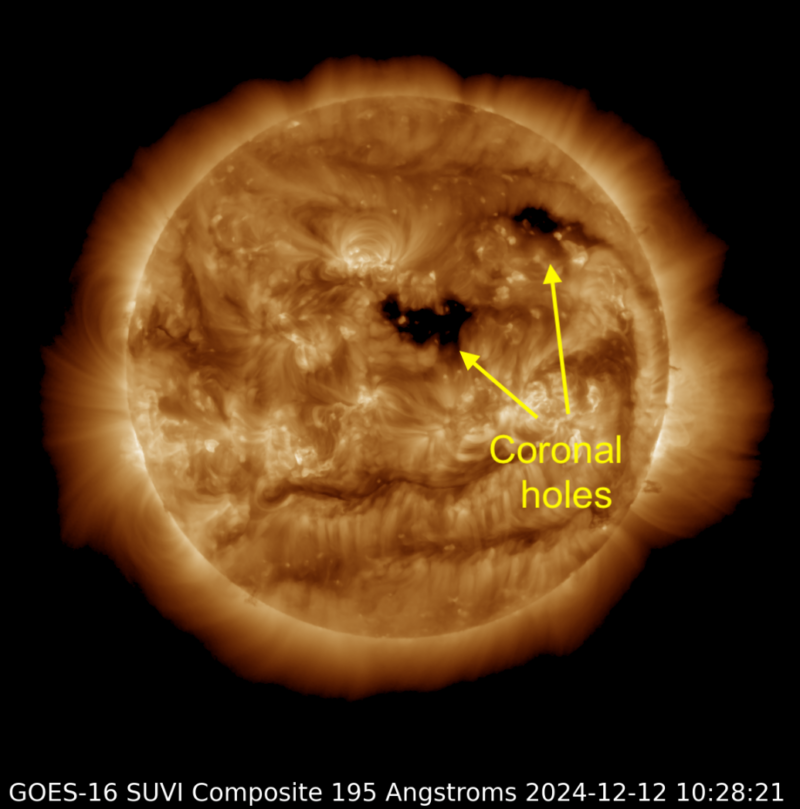
Boom, boom, boom, boom! In the past 24 hours (11 UTC yesterday to 11 UTC today), the total number of flares increased in contrast to to the day before. We had 27 flares in 24 hours! Potential for more is still high, so we’re watching closely. In the meantime, the northern hemisphere coronal holes we’ve been watching are now in geoeffective positions, meaning their fast solar wind will likely impact Earth’s magnetic field in the coming day (possibly in the early hours of December 12 UTC, which could be this evening for the Americas). This could bring enhanced auroras to higher latitudes. Clear skies, aurora chasers!
Last 24 hours: Sun activity has slid back to moderate from the previous day’s high. Why, when there were so many flares? Because we typically need a relatively large M flare (an M5 or higher), to consider sun activity high. And, in the past day, had four small M flares, one from sunspot region AR3920 and the remaining three came from yesterday’s new region, just rotated into view over the sun’s eastern edge, now labeled AR3922. This new region had produced the previous day’s M6.4 flare. In all, we had four M and 23 C-class events, over our 24-hour observation window. The largest flare was an M2.7 from AR3920 at 10:06 UTC on December 11. It caused an R1 (minor) radio blackout, affecting an area over southern Africa. AR3917 is showing decent flare potential with beta-gamma magnetic configurations though the two most active regions have been the newest region AR3922 and AR3920. The remaining regions show simpler alpha or beta configurations. The sun has seven active regions on its Earth-facing side.
The list of the M flares from the past 24 hours is:
- M1.5 at 11:02 UTC on December 10 from AR3922. R1 (minor) radio blackout over southern Africa.
- M1.6 at 17:58 UTC on December 10 from AR3922. R1 (minor) radio blackout over the Atlantic Ocean.
- M1.9 at 06:04 UTC on December 11 from AR3922. R1 (minor) radio blackout over the Indian Ocean.
- M2.7 at 10:06 UTC on December 11 from AR3920. R1 (minor) radio blackout over southern Africa.
Sun news for December 10: New sunspot region brings high activity

Sun activity has jumped back up to high levels thanks to an M6.4 flare from a new, as-yet-unlabeled region just over the southeastern limb (edge). This region was in a back-and-forth flare duel with AR3912, as this familiar region approached the western limb (edge). AR3912 produced 12 C flares, while the newer region produced nine flares, including the M6.4 and two smaller M flares. We’ll keep an eye on these productive regions. In the meantime, two coronal holes are moving into geoeffective positions, meaning their fast solar wind will impact Earth’s magnetic field in the next two days. This could bring enhanced auroras to higher latitudes. Clear skies, aurora chasers!
Last 24 hours: Activity has increased to high due to an M6.4 flare from an unlabeled region just over the southeast limb (edge). The sun produced 21 flares – three M flares and 18 C flares – over our 24-hour observation window from 11 UTC yesterday to 11 UTC today. The largest flare was an M6.4 from the southeast limb (edge) at 6:48 UTC on December 10. It caused an R2 (moderate) radio blackout, affecting an area over the Indian Ocean. AR3912 and AR3917 are showing decent flare potential with beta-gamma magnetic configurations. The remaining regions show simpler alpha or beta configurations. The sun has six active regions on its Earth-facing side.
The list of the M flares from the past 24 hours is:
- M6.5 at 6:48 UTC on December 10 from the SE limb. R2 (moderate) radio blackout over the Indian Ocean.
- M1.4 at 7:09 UTC on December 10 from the SE limb. R1 (minor) radio blackout over the Indian Ocean.
- M1.5 at 11:02 UTC on December 10 from the SE limb. R1 (minor) radio blackout over Namibia.


Sun news for December 9: M flare and promising filaments
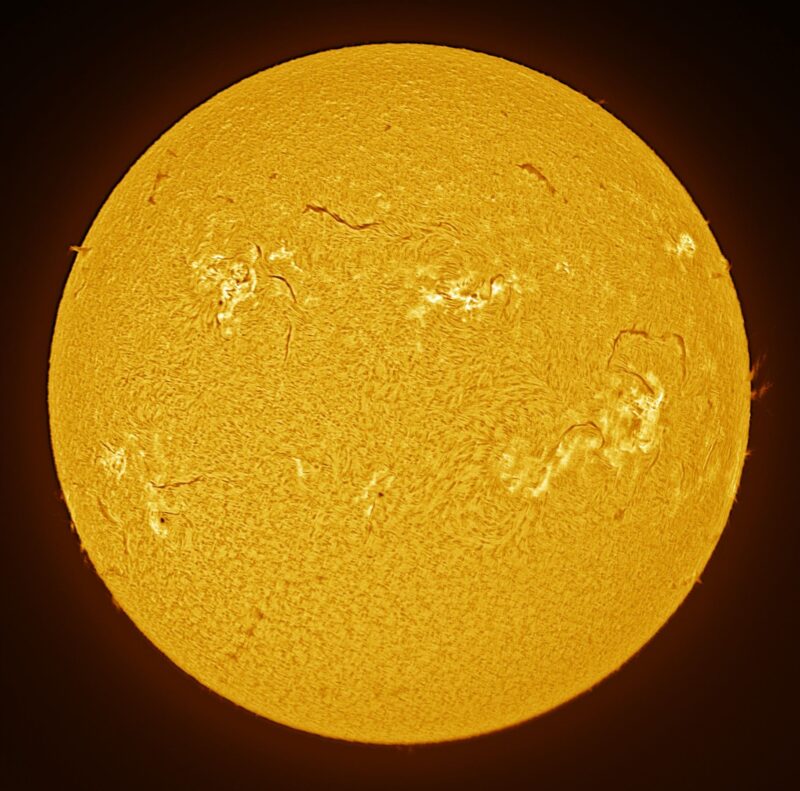
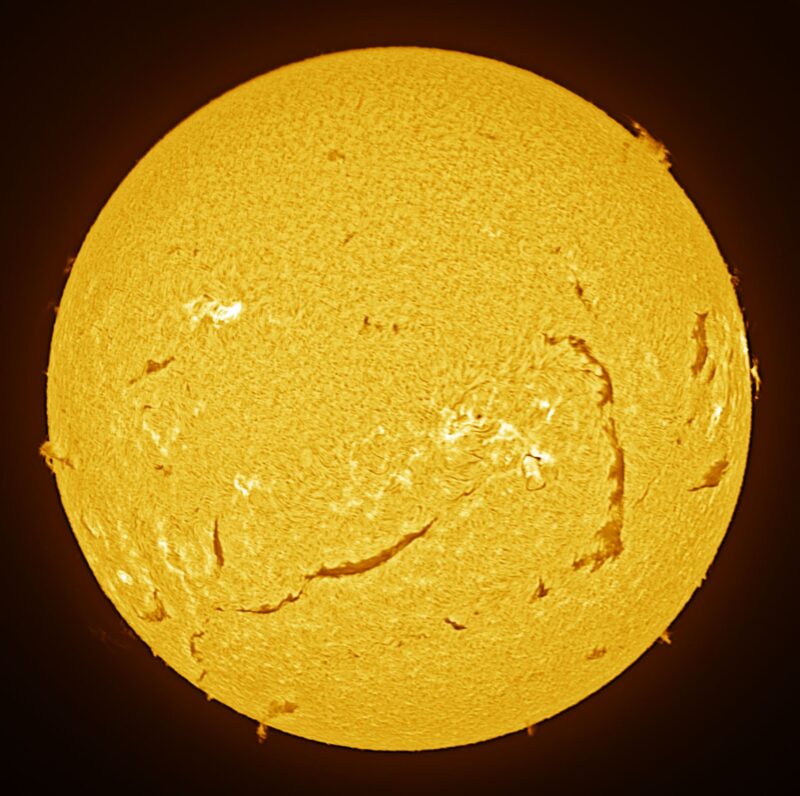
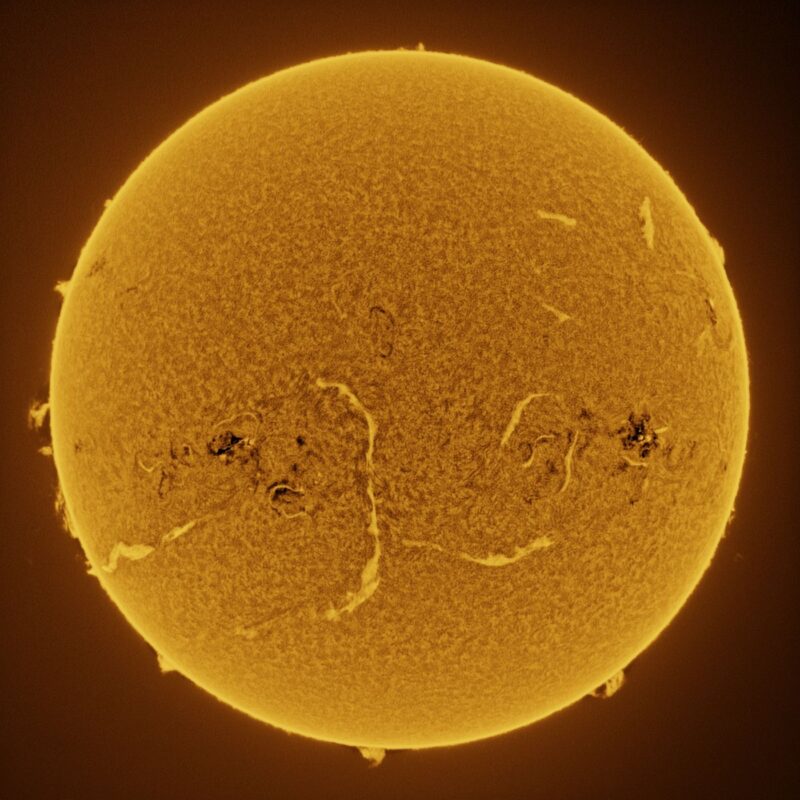
After yesterday’s X flare excitement, activity has dropped to moderate with a single M1.5 solar flare. We now know that the X flare did fire out a blob of sun-stuff – a coronal mass ejection (CME) – but it was sent westward, and is expected to miss Earth. It is possible that the X flare-producing region AR3912 could create some more major activity, but the chance for this decreases with passing time. The most promising source of action currently is the range of filaments lying across the solar disk. Take a look at the photo above, captured with an H-alpha filter by community photographer Jim Militello. These huge ropes of solar plasma have the potential to erupt, sending coronal mass ejections into space. And coronal mass ejections have the potential to cause auroras on Earth, if they’re sent our way! Stay tuned.
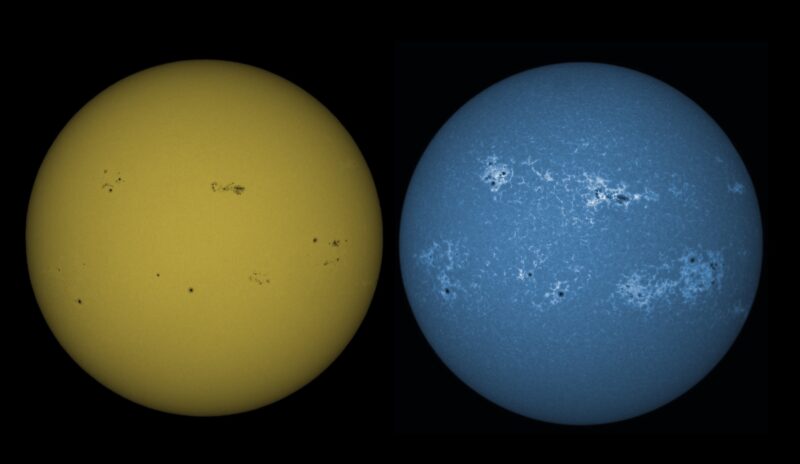
Last 24 hours: As quickly as sun activity shifted from low to high yesterday, it’s now dropped to moderate thanks to an isolated M flare. The sun produced 18 flares – an M flare and 17 C flares – over our 24-hour observation window from 11 UTC yesterday to 11 UTC today. The largest flare was an M1.5 from active region AR3912 at 16:11 UTC on December 8. It caused an R1 (minor) radio blackout, affecting an area over South America. AR3912 and AR3917 are showing decent flare potential with beta-gamma magnetic configurations. The remaining regions show simpler alpha or beta configurations. The sun has five active regions on its Earth-facing side. Regions AR3919 and AR3920 are newcomers to the the solar disk. In the photo below, captured by Eliot Herman in Tucson, Arizona, the sun’s magnetic froth or plage reveals the magnetic band driving the sunspot regions in the southern hemisphere. Thanks, Eliot!


Sun news for December 8: KABOOM! X2.3 flare!

Surprise! The sun produced an X2.3 flare early this morning. X is the strongest category of solar flare. It was surprising, partly because sun activity has been low to moderate all week, and also because sunpot region AR3912 – which produced the flare – was relatively simple, magnetically speaking (generally, the greater the complexity, the more chances for strong flares). Yet AR3912 erupted with this X flare at around 9 UTC this morning (December 8). With data still unavailable from NASA’s Solar Dynamics Observatory, NOAA’s GOES-SUVI observed the solar plasma both at the 304-angstrom wavelength, and also in the 195-angstrom wavelength, where a darkening wave was seen, representing a material loss from the sun’s corona, or outer atmosphere. In other words, the flare sent sun-stuff westward into space. We await updated coronagraph imagery to determine if the resulting coronal mass ejection (CME) is Earth-directed.
Last 24 hours: Sun activity quickly shifted from low to high thanks to the X2.3 flare. The sun produced 15 flares, an X, two M, and 12 C over our 24-hour observation window from 11 UTC yesterday to 11 UTC today. The most significant flare was an X2.3 from active region AR3912 at 9:06 UTC on December 8. It caused an R3 (strong) radio blackout, affecting an area over Madagascar. The list of the X and M flares is:
- M2.3 at 13:08 UTC on December 7 from AR3917. R1 (minor) radio blackout over the Atlantic Ocean.
- M3.2 at 22:15 UTC on December 7 from AR3917. R1 (minor) radio blackout over the Pacific Ocean.
- X2.3 at 09:06 UTC on December 8 from AR3912. R3 (major) radio blackout over Madagascar.
AR3917 has maintained its beta-gamma magnetic configuration. The remaining regions show simpler alpha or beta configurations.The sun has four active regions on the Earth-facing side. Two of the regions from our posted GONG data have decayed, AR3915 and AR3918.


Sun news for December 7: Small flares, but numbers going up


Despite the overall low level of sun activity over the past day, our star remains dynamic. On the sun’s southwest quadrant, sunspot region AR3912 stands out as one of the leading flare producers of the past day (11 UTC yesterday to 11 UTC today). Throughout this period, this region and its vicinity displayed continuous activity, including C flares (aka common flares), plasma jets, and small prominences ejecting material into space. None of this solar ejecta is Earth-directed. On the eastern horizon, a prominent area above and below the solar equator shows long-lasting prominences, suggesting potential activity moving into Earth’s view in the near future. If you missed our livestream yesterday, Dr. C. Alex Young, a co-author of these daily sun new updates, and Deborah Byrd, EarthSky’s founder, discussed recent flooding at Stanford University’s data center. This flooding has disrupted access to vital solar activity data from NASA’s Solar Dynamics Observatory (SDO), which is critical for scientists and sun-watchers alike. Catch the replay of yesterday’s livestream here.
Last 24 hours: No M or X flares in the past day: sun activity has dropped back to low. But the number of flares increased during the past day. The sun produced 21 flares in all, in contrast to the previous period’s 17 flares. The largest flare was a C8.6 flare from active region AR3912; it happened in the sun’s southwest at 9:04 UTC this morning (December 7). The lead flare producer of the period was active region AR3917, which produced 10 C flares. AR3916 lost its gamma configuration during this period, leaving only AR3917 with a beta-gamma magnetic configuration. The remaining regions show simpler alpha or beta configurations. A newcomer, AR3918, emerged in the northwest, very close to the solar equator and near the western limb (edge) horizon. The sun has six active regions on the Earth-facing side.
Sun news for December 6: We’re livestreaming on SDO’s data disruption today
Don’t miss today’s our livestream today. Dr. C. Alex Young, one of the authors of our daily sun new updates, will be talking with Deborah Byrd about the flooding at the data center at Stanford University. NASA’s Solar Dynamics Observatory (SDO) is still working well in space. But the failure is preventing scientists and other sun-watchers from accessing SDO’s important data about solar activity. Join our Sun News of the Week livestream at 12:15 p.m. (18:15 UTC) today (Friday, December 6). Otherwise, in the past day, flaring productivity has been on the rise this time with 17 flares in total. Keep reading …
Last 24 hours: Over the past day, sun activity has maintained at moderate levels with only an isolated M flare. But the number of flares has increased. During our observation period (11 UTC yesterday to 11 UTC today), the sun produced 17 flares: an M and 16 C flares. The largest was an M1.2 from AR3917 at 9:20 UTC this morning (December 6). An R1 (minor) radio blackout was observed affecting an area over the Mozambique Channel off the west coast of Madagascar. Lead flare producer honors are shared between two active regions: AR3906, which just rotated out of view over the sun’s western horizon, and AR3917. Both regions had seven flares. AR3916 gained a gamma configuration during this period and joined AR3917, which had a beta-gamma magnetic configuration. The remaining regions show simpler alpha or beta configurations. There are seven sunspot regions visible on the sun’s Earth-facing side today.
Sun news for December 6, 2024. NASA’s Solar Dynamics Observatory (SDO) is a beloved spacecraft for sun-watchers and the world’s primary source for observing and studying the sun. The spacecraft itself and its valuable data are secure. But a broken pipe in late November – at the Joint Science Operations Center (JSOC) at Stanford University in California, the facility responsible for processing and distributing SDO data — caused severe flooding and extensive damage. Now JSOC is saying SDO data will be unavailable until 2025! Join EarthSky founder Deborah Byrd and heliophysicist C. Alex Young of NASA Goddard Spaceflight Center as we discuss SDO’s dilemma. The livestream begins at 12:15 CST (18:15 UTC) on Friday, December 6.
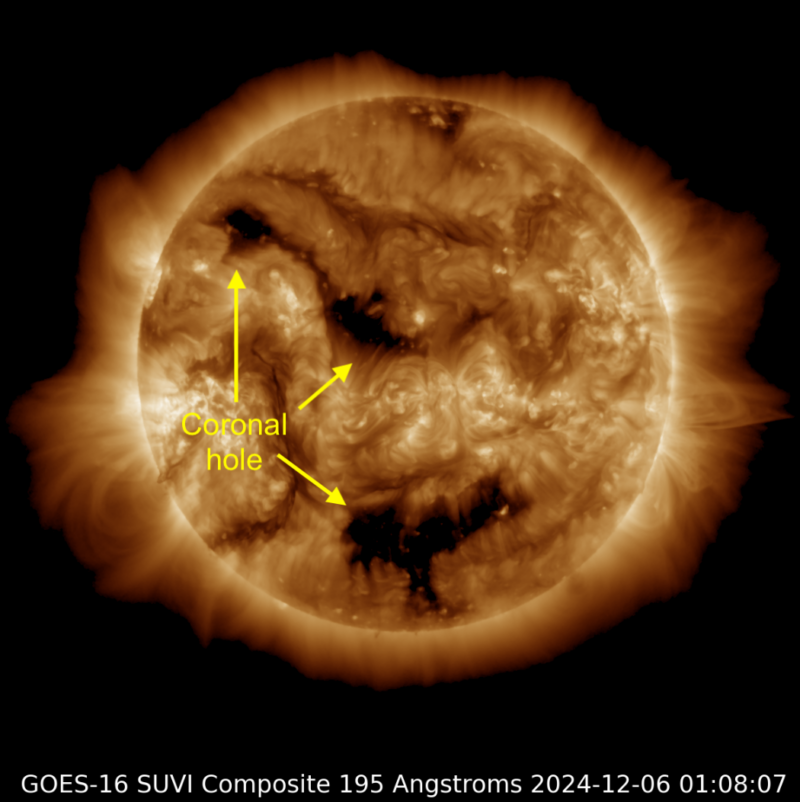
Sun news for December 5: Action continues with 5 M flares

The sun is still producing small M flares, maintaining a moderate level of solar activity. Yes, we’re at the peak of Solar Cycle 25. But there was a lull earlier this week. Plus, sunspot regions across the sun’s Earth-facing side could be more impressive. They could be blasting out massive X flares! But they’re not, and these little Ms have kept sun activity interesting for the past couple of days. By the way, NASA’s sun-observing Solar Dynamics Observatory (SDO) is still out there in space, working just fine. But the data pipeline has been interrupted, due to a broken pipe and subsequent flooding at the data center at Stanford University. There are no updates on that front today, but we’ll be discussing the data breakdown during tomorrow’s Sun News of the Week livestream. Join us at 12:15 p.m. (18:15 UTC) on Friday, December 6.
Last 24 hours: Solar activity is still moderate, with five M flares over the past 24 hours. Flare numbers also increased with 16, five Ms, and 11 C flares, during our observation period (11 UTC yesterday to 11 UTC today). The most significant flare was an M1.4 from active region AR3917 at 21:05 UTC on December 4. It caused an R1 (minor) radio blackout, affecting an area over French Polynesia. The lead flare producers of the past day were sunspot regions AR3906 and AR3917, which each produced six flares. AR3917 produced two M flares, and AR3906 an M flare. The list of the M flares is:
- M1.3 at 20:46 UTC on December 4 from AR3916. R1 (minor) radio blackout over the Ocean Pacific east of the French Polynesia.
- M1.4 at 21:05 UTC on December 4 from AR3917. R1 (minor) radio blackout over the French Polynesia.
- M1.0 at 07:09 UTC on December 5 from AR3917. R1 (minor) radio blackout in the middle of South Indian Ocean.
- M1.1 at 08:20 UTC on December 5 from AR3906. R1 (minor) radio blackout over the Indian Ocean off the east coast of Madagascar.
- M2.6 at 10:42 UTC on December 5 from AR3906. R1 (minor) radio blackout over South Africa. The largest.
AR3906 and AR3917 have beta-gamma magnetic configurations. The remaining regions show simpler alpha or beta configurations. There are six sunspot regions visible on the sun’s Earth-facing side. We have a newcomer in the southeast now numbered AR3917.

Sun news for December 4: M flare ends activity lull
An M flare has broken the recent dry spell of solar activity. After several days of only C flares, a new sunspot region on the sun’s southeast limb (edge) fired the M2.4 flare, raising activity to moderate. The question is: will activity continue to rise, spearheaded by this new region? Stay tuned!
Last 24 hours: Solar activity increased to moderate with the production of an isolated M flare. Flaring activity increased compared to the day before; we saw 13 flares between 11 UTC yesterday and 11 UTC today, compared to eight the day before. The past day’s total included 12 C flares and the M2.4, produced at 10 UTC this morning by an as-yet-unnumbered incoming active region in the southeast. A corresponding R1 (minor) radio blackout affected an area off the southeast coast of Mozambique. The lead flare producer of the period was sunspot AR3916, which produced five C flares closely followed by AR3905 and this newcomer that blasted four flares each. Today, AR3912 joined AR3905 and AR3906 in showing a moderate flaring potential with a beta-gamma magnetic complexity. The remaining active regions on the solar disk have simple beta configurations. There are six sunspot regions visible on the sun’s Earth-facing side, including a newcomer in the southeast now numbered AR3916.


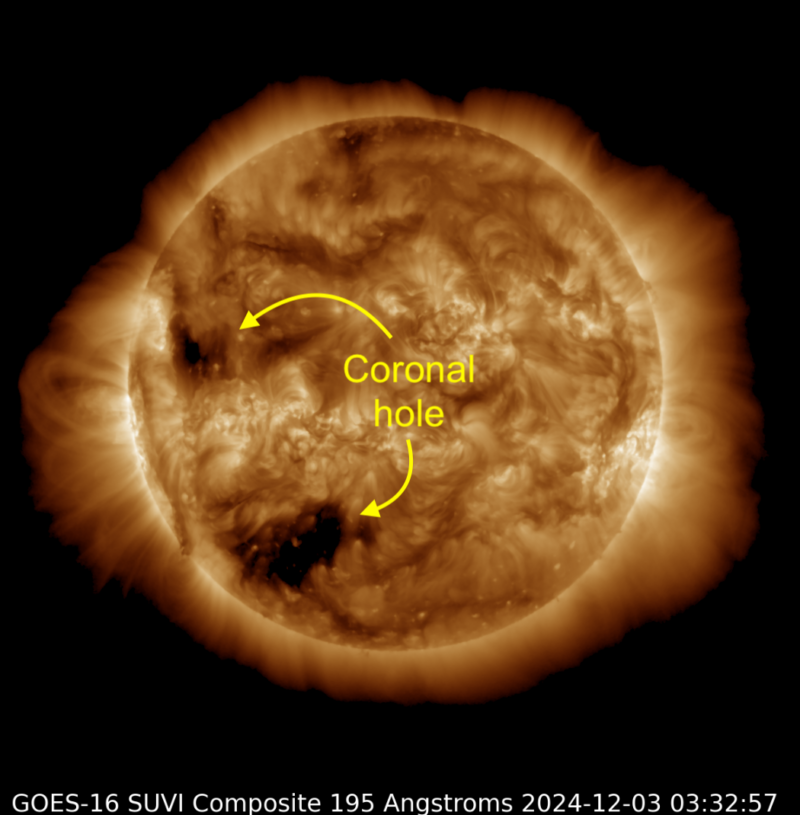
Sun news for December 3: Two new coronal holes
Two new coronal holes have emerged on our star, one in the northeast and the other in the southeast. And the one in the southeast look gigantic! Fast solar wind streams out of coronal holes. So when these holes rotate in line with Earth – moving into what’s called a geoeffective position – their solar wind could disturb our planet’s magnetic field, possibly provoking auroral displays. Stay tuned!
Last 24 hours: The sun is currently in a lull, with eight C flares keeping solar activity at low over the past day. But we did see faint jets and prominences around the solar horizon. The largest event between 11 UTC yesterday and 11 UTC today was a C6.1 flare by sunspot region AR3907 in the southwest at 5:44 UTC this morning. The lead flare producer of the period was an as-yet-unnumbered region in the southeast, with four C flares. There are two active regions showing a moderate flaring potential, with beta-gamma magnetic complexities: AR3905 and AR3906. AR3912 has lost its gamma configuration and is now a beta. The rest of the active regions on the solar disk have simple alpha or beta configurations. There are six sunspot regions visible on the sun’s Earth-facing side, including a newcomer now labeled AR3915.
Sun news for December 2: GONG filling solar observatory gap
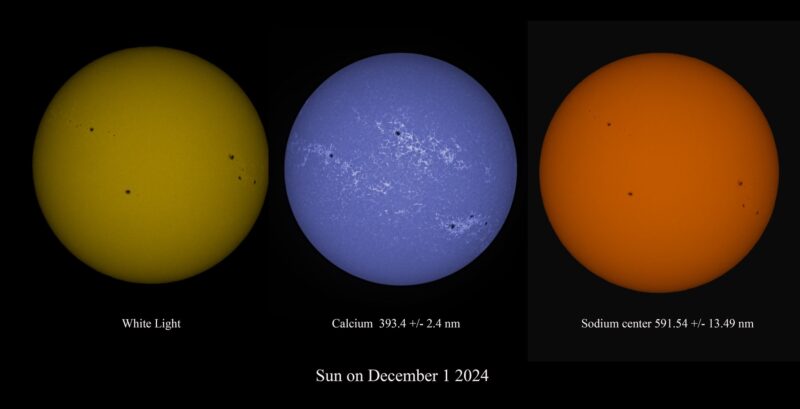
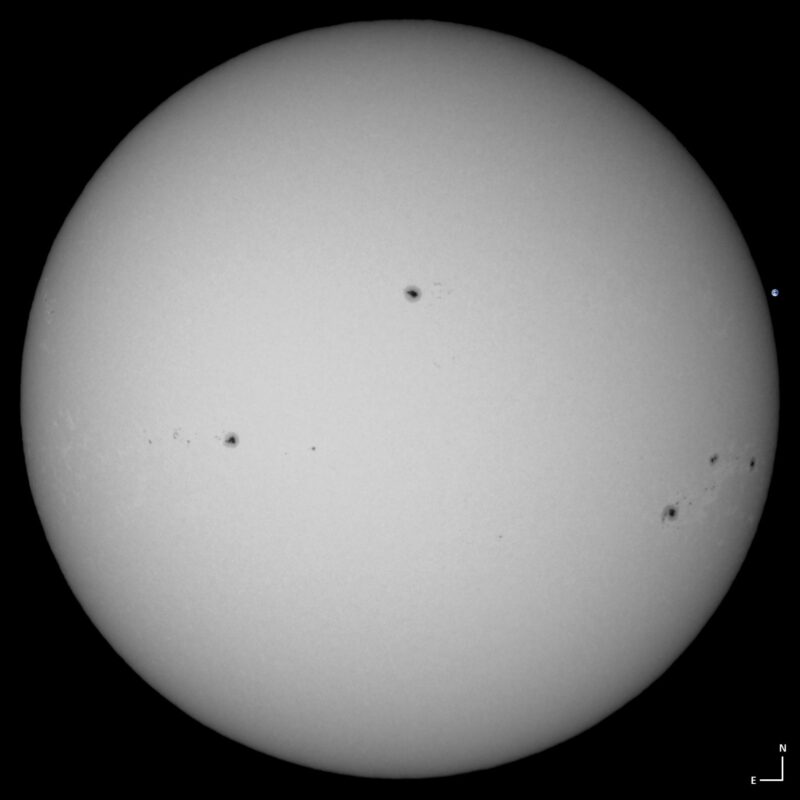
It’s another day without data from the Solar Dynamics Observatory (SDO), which will be unavailable until 2025. With activity on the sun currently low, it’s a good time to talk about sources of solar imagery that can fill in for SDO. Today, we’re using imagery from GONG, the Global Oscillations Network Group. GONG is a solar observing network that has been around for decades and is an integral part of the sun-observing infrastructure. It consists of six identical telescopes placed strategically across the world in order to monitor the sun 24 hours a day, seven days a week. The EarthSky sun team regularly uses GONG to determine if any active regions are developing on the far side of the sun. We use this in conjunction with the data usually provided by the SDO HMI instrument. GONG also provides images of the sun in H-alpha, an important wavelength for studying the mysterious chromosphere, our star’s lower atmosphere. There is a single space-based observatory that provides H-alpha views, the Hinode satellite, but it doesn’t provide full-sun images.
Last 24 hours: Over the past 24 hours, solar flare activity remained low with only C-class flares. The sun produced seven flares between 11 UTC yesterday and 11 UTC today. This is almost half the number of the day before. The largest was a C5.5 flare at 16:22 UTC on December 1 from sunspot region AR3906. Three active regions are showing moderate flaring potential with beta-gamma magnetic complexities: AR3905, AR3906, and AR3912. Five sunspot regions are currently visible on the sun’s Earth-facing side.
Sun news for December 1: Setback! SDO data unavailable until 2025
The Solar Dynamics Observatory (SDO), which serves as the world’s source for observing and studying the sun, will be unavailable until 2025 due to unexpected infrastructure damage. Luckily, the spacecraft itself and its valuable data are secure. But the Joint Science Operations Center (JSOC) at Stanford University in California – the facility responsible for processing and distributing SDO data – suffered extensive damage from severe flooding, caused by a broken pipe. This flooding compromised critical servers and equipment essential for processing and delivering the observational data that SDO collects, continuously. Although efforts are underway to access and recover the affected systems, the scale of the damage has significantly impacted JSOC’s ability to function, and the repairs and rebuilding process are expected to extend into early 2025. In the meantime, the global community of professional (and amateur) sun observers will need to rely heavily on alternative resources, such as GOES-SUVI and GONG. Additionally, contributions from the public and amateur astronomers will play a vital role in filling observational gaps. High-quality community-sourced photos of the sun, particularly those highlighting active regions or sunspots, can be instrumental in maintaining solar activity monitoring and analysis. This collective effort will ensure that despite the temporary loss of SDO’s processed data, the global scientific community can continue tracking solar phenomena, studying the sun’s behavior, and predicting space weather events that could impact Earth. Stay tuned for updates on SDO’s return!
Last 24 hours: Over the past 24 hours, solar flare activity has remained low, with only C-class flares. The sun produced 12 flares between 11 UTC yesterday and 11 UTC today. The most significant was a C3.7 flare at 23:23 UTC on November 30 from active region AR3906. The overall magnetic complexity of the regions has decreased. No regions contain a delta configuration with two beta-gamma regios, AR3906 and AR3912. Five sunspot regions are visible on the sun’s Earth-facing side.


Like what you read?
Subscribe and receive daily news delivered to your inbox.
More from
C. Alex Young


Sun news: See a huge solar eruption

Yes, there’s an aurora season, and it’s here
Sun activity archive for September 2026
Sun activity archive for August 2026



