
Here’s a unique view of the comet many have been photographing, Comet C/2025 R3 (PanSTARRS). It streaked across the field of view of the GOES 19 satellite’s CCOR 1 coronograph on April 24, 2026. The comet reached perihelion, its closest point to the sun, on April 19. It’ll be closest to Earth tomorrow (April 26) at 45.5 million miles (roughly 73.2 million km), moving away from our planet. To give you a sense of scale, it’s passing at slightly less than half the distance between the Earth and the sun. See more photos below.
Comet R3 PanSTARRS to pass closest to Earth tomorrow
Comet C/2025 R3 (PanSTARRS) passed closest to the sun on April 19, 2026. It will pass closest to Earth on April 26. The comet will get as close as 45.5 million miles (73.2 million km) from Earth. That’s slightly closer than half the Earth-sun distance. But when Comet PanSTARRS passes closest to Earth, it will be in the sun’s direction as seen from Earth. So we won’t see it in our sky. But, as you can see from the image above, our sun-watching spacecraft caught its passage!
By the time the comet is far enough from the sun in the Northern Hemisphere to spot, it’ll likely be quite dim again. But astrophotographers can give it a try. And observers in the Southern Hemisphere will have a chance in late April to try to spot Comet PanSTARRS low on the western horizon just after sunset. Keep track of the comet’s brightness here.
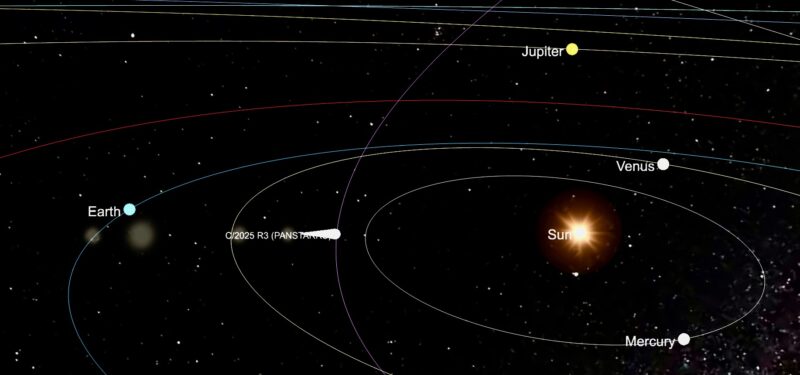
View larger. | Here’s Comet 2025 R3 (PanSTARRS) on April 25, 2026. See how it’s passing between the sun and Earth? Although it’s passing quite far from our planet, Southern Hemisphere observers might get a chance to spot it. Image via TheSkyLive.
Images of the comet from our community
EarthSky friend John Ashley shared his video of Comet R3 PanSTARRS rising before the sun in Arizona on April 12, 2026. John wrote: “Comet PanSTARRS rises beyond the Smithsonian’s Whipple Observatory. The comet is barely visible to the eye but an easy target with binoculars. And it’s getting brighter each morning.” Thank you, John!
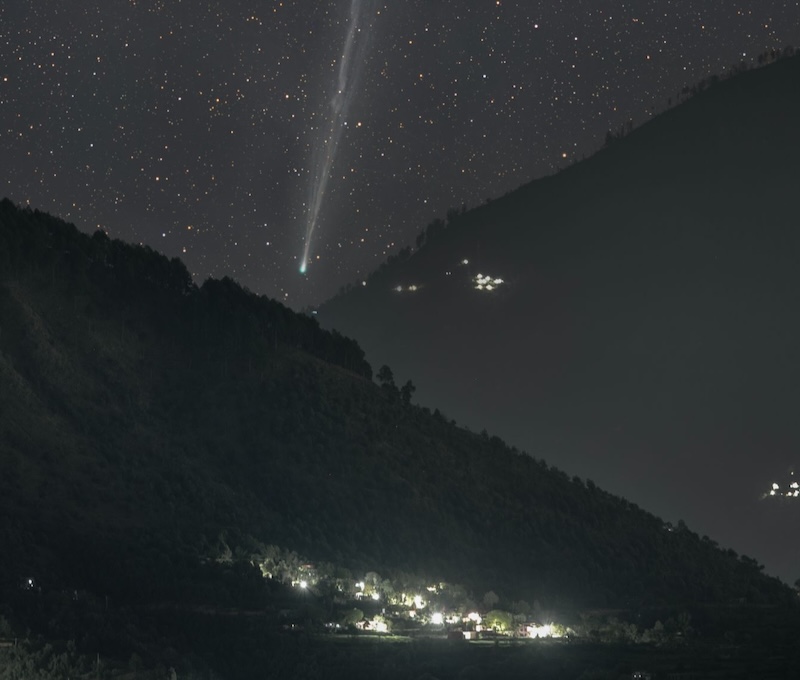
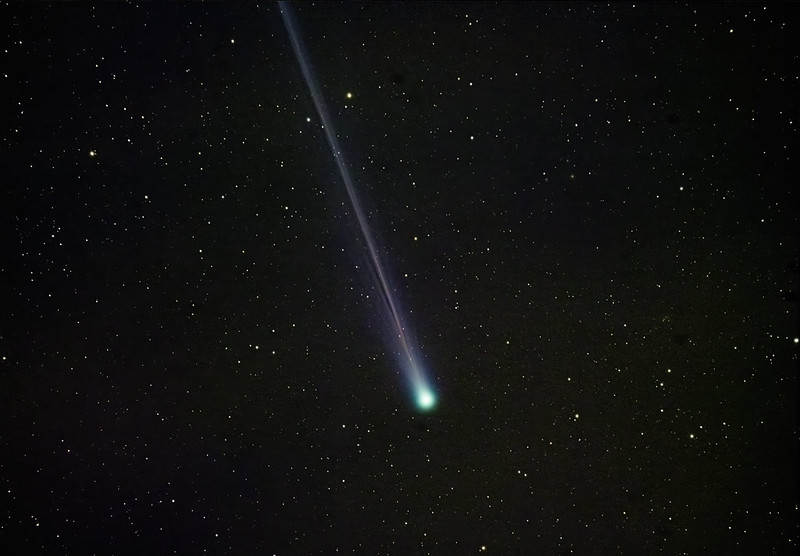
View at EarthSky Community Photos. | Samit Saha in Mohalla, India, captured this image of Comet PanSTARRS on April 13, 2026, and wrote: “In the pre-dawn sky over a Himalayan valley in Jammu and Kashmir, India, Comet C/2025 R3 (PANSTARRS) appears just above a dark mountain ridge. Its small, greenish coma marks the nucleus, while a long, narrow ion tail rises steeply through a dense star field. Shaped by the solar wind, the tail points away from the sun and shows faint filamentary structure.” Thank you, Samit!EarthSky friend Eliot Herman shared a photo of Comet R3 PanSTARRS from Tucson on April 12, 2026, on his Flickr page. Eliot wrote: “Conditions were actually rather poor seeing. As the time continued toward dawn, the haze was worse. Just as the comet rose above the Catalina Mountains, the sky was nice, and then minutes later it changed.” Thank you, Eliot!View at EarthSky Community Photos. | Samit Saha in Mohalla, Jammu and Kashmir, India, captured Comet R3 PanSTARRS on April 12, 2026. Samit wrote: “Moments before this capture, a mild earthquake (magnitude 4.6) originating near Bhaderwah subtly shook the region, adding an unexpected layer of intensity to the experience. Despite the brief disturbance, the sky remained calm and offered a striking contrast to the restless world below.” Thank you, Samit!View at EarthSky Community Photos. | Ross Stone in Big Pine, California, captured the comet on April 11, 2026. Ross wrote: “So many satellites wanted to be in the photo with our otherworldly visitor, comet C/2025 R3 (PanSTARRS).” Thank you, Ross!
More comet pics
View at EarthSky Community Photos. | Bartlomiej Grzywacz in Poland captured Comet R3 on April 9, 2026. Bartlomiej wrote: “The object was very low above the horizon. It was getting bright quickly. It’s not an easy comet to capture from Poland due to the timing and its low altitude.” Thank you, Bartlomiej!View at EarthSky Community Photos. | Petr Horalek in Prosec u Sece, Czech Republic, captured the comet on April 9, 2026. Petr wrote: “In the morning sky, just before the twilight, you can easily find Comet C/2025 R3 (PanSTARRS) in the constellation Pegasus. It’s by the asterism of the Great Square. Northerners can succeed with spotting it through a small telescope. The comet’s tail exceeded 14 degrees in the photographs, making it such a nice object along with the Andromeda Galaxy located on the left. The moonlight made the foreground decently illuminated at the same moment when an early-bird driver went in a car down on the road.” Thank you, Petr!View at EarthSky Community Photos. | Jelieta Walinski also caught the comet. Jelieta wrote: “What happens when a comet barely clears the horizon before dawn? On April 9, under the dark skies of Arizona, I captured Comet C/2025 R3 just moments after rising into view. From the Desert Bloom Observatory, the comet appeared extremely low in the sky, its faint glow filtered through thick layers of Earth’s atmosphere.” Thank you, Jelieta!
Bottom line: Comet R3 PanSTARRS is closest to Earth on April 26. Check out this cool image from a sun-watching spacecraft! And enjoy these fantastic community photos.
Kelly Kizer Whitt writes and edits some of the most fascinating stories at EarthSky.org. She's been writing about science, with a focus on astronomy, for decades. She began her career at Astronomy Magazine and made regular contributions to other outlets, including AstronomyToday and the Sierra Club. She has nine published books, including a children's picture book, Solar System Forecast, and a young adult dystopian novel, A Different Sky.
The EarthSky team has a blast bringing you daily updates on your cosmos and world. We love your photos and welcome your news tips. Earth, Space, Sun, Human, Tonight. Since 1994.
Like what you read? Subscribe and receive daily news delivered to your inbox.
Thank you! Your submission has been received!
Oops! Something went wrong while submitting the form.