Got a dark sky? Look for the Northern Crown
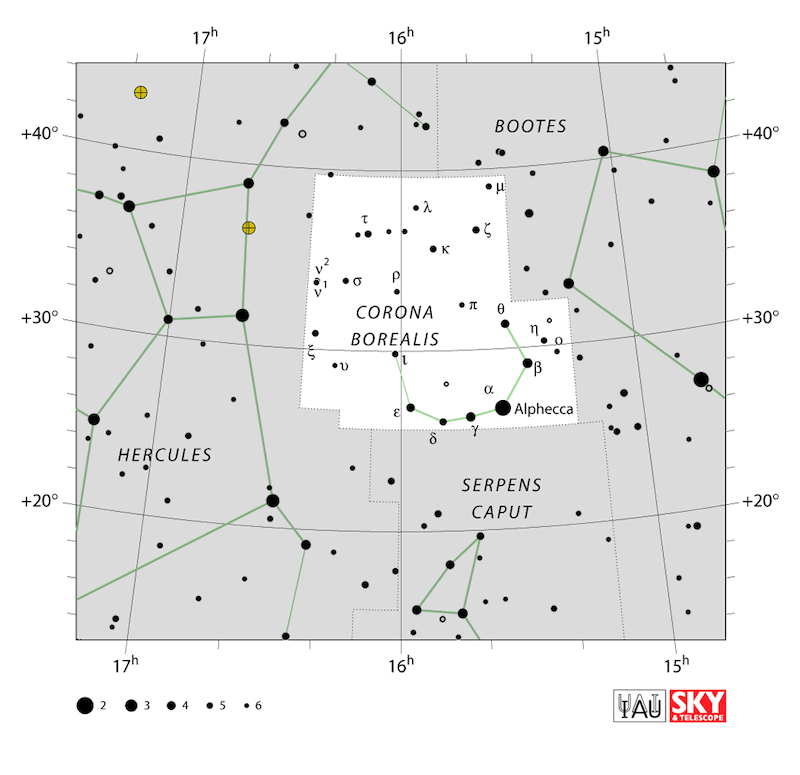
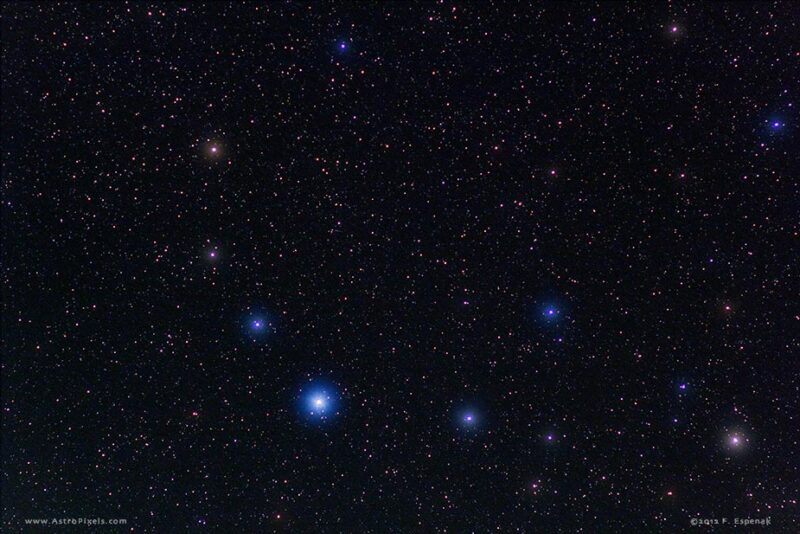
If your sky is dark enough, Corona Borealis – aka the Northern Crown – is exciting to find. And it’s easy to pick out, because it’s an almost-perfect semicircle of stars.
So your eye might easily pick it out ascending in the east on a Northern Hemisphere spring evening.
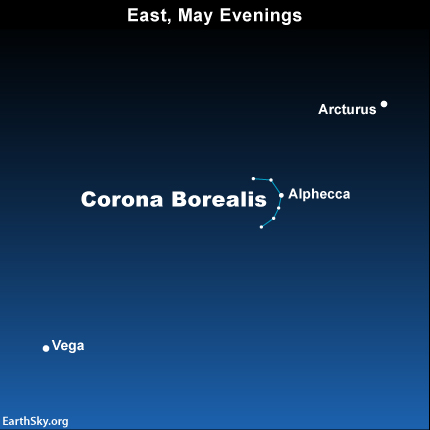
But, if not, look for two bright guide stars: Arcturus in the constellation Boötes the Herdsman and Vega in the constellation Lyra the Harp. Corona Borealis is located more or less along a line between these two. It’s a bit closer to Arcturus.
The Northern Crown is noticeable for its semicircular shape. But you’ll need a dark sky to see it clearly.
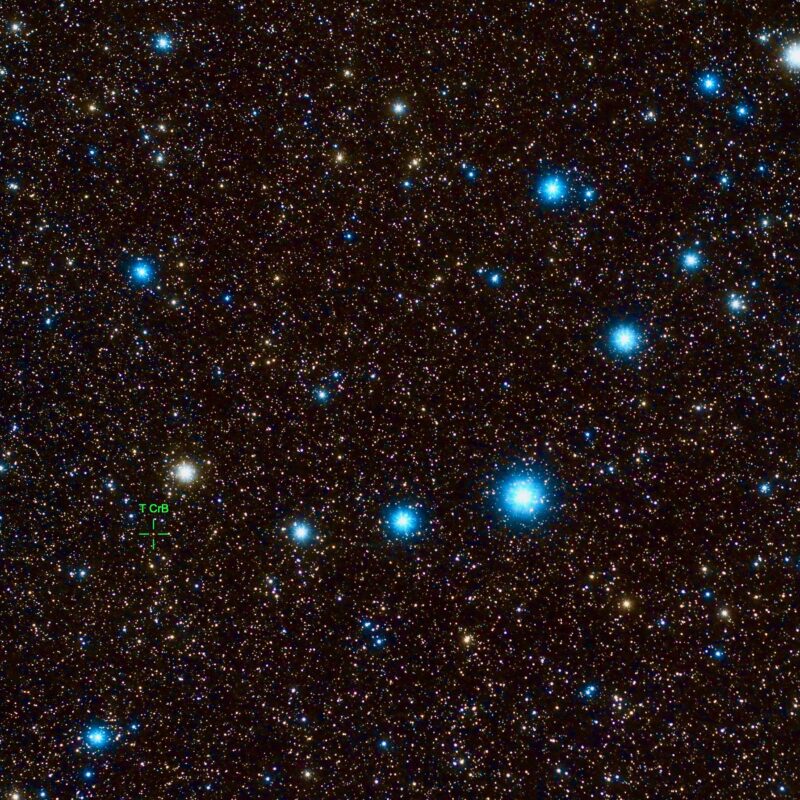
And here’s a plus! This constellation is home to a famous nova, a star that’s due to brighten noticeably. The star is called T Coronae Borealis (T CrB, pronounced “T Cor Bor”). Nowadays, people often call it the Blaze Star.
And, in 2026, we are waiting for the Blaze Star to erupt!
Where to look from the Southern Hemisphere
Via Daniel Gaussen, Founder & Guide – Stargaze Mackenzie – New Zealand
We all live under the same sky. But Earth’s Northern and Southern Hemispheres see the sky from different perspectives.
And Corona Borealis is far to the north on the sky’s dome. From deep in the Southern Hemisphere – for example, the latitude of New Zealand and southern Australia – Corona Borealis rises to only around 20 to 25 degrees above the northern horizon at its highest. So, in addition to a dark sky, you’ll also want a clear view to the north.
Look north to northeast for a delicate semicircle or backward C shape of stars between the bright orange star Arcturus and the bright blue-white star Vega. The famous Keystone pattern in Hercules is also between these two, right next to Corona Borealis.
Because this constellation is so far to the north, observers in the Southern Hemisphere have a shorter viewing seasons for Corona Borealis. It first becomes visible in the predawn around March. It gradually climbs higher into the night sky each day. It appears in the evening sky from about June to September.
So the best viewing time changes with the seasons. In May, Corona Borealis is still relatively low after sunset and reaches its highest point around midnight. By July, it is already well placed earlier in the evening, making the constellation much easier to spot during the first half of the night.
Binoculars can also help reveal the faint curve of stars more clearly, especially from suburban skies or locations with some northern haze.
Want an exact view from an exact time or your exact location on the globe? Try Stellarium.
Alphecca, the pearl of the Northern Crown
The brightest star in Corona Borealis is Alphecca, also known as Gemma, sometimes called the Pearl (or Jewel or Gem) of the Crown.
Alphecca is a blue-white star, with an intrinsic luminosity some 60 times that of our sun. It’s located about 75 light-years from Earth.
The name Alphecca originated with a description of Corona Borealis as the “broken one.” This was in reference to the fact that these stars appear in a semicircle, rather than a full circle.
Mythology of Corona Borealis
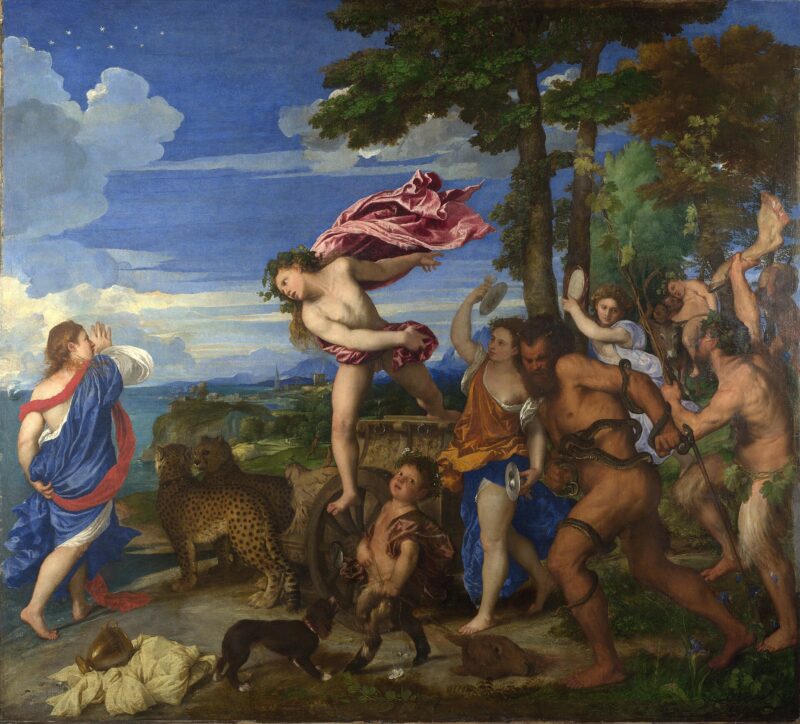
In Greek mythology, the crown came into the possession of Ariadne, daughter of King Minos of Crete. She fell in love with an Athenian hero, Theseus. And it was she who helped him escape the Labyrinth after killing the dreaded Minotaur, a beast with the body of a man and the head of a bull. She accomplished this feat by giving him a thread, so he could find his way back out of the maze, in one of the most famous problem-solving tricks in mythology.
Theseus promised to take her with him. But then he abandoned her on the island of Naxos.
And that’s where the story turns. Dionysus – Greek god of wine and ecstasy – finds Ariadne. He falls in love with her and gives her a beautiful crown. The crown is sometimes said to have been made by Hephaestus, god of fire.
When Ariadne died (or, in some versions, was made immortal), Dionysus tossed the crown into the heavens, where we see it today as Corona Borealis, the Northern Crown.
Bottom line: Corona Borealis, the Northern Crown, is an almost-perfect semicircle of stars. Learn to find it and identify its brightest star, and find out about its mythology.
Like what you read?
Subscribe and receive daily news delivered to your inbox.
More from
Deborah Byrd


Visible planets and night sky guide for October

Stargazing tips! 10 great tips for beginning astronomers
Mars calendar year begins September 30: Happy New Year, Mars!
Alpha Cephei, or Alderamin, is a fast-spinning star