Don’t miss the next unmissable night sky event. Sign up for EarthSky’s free newsletter and get daily night sky updates!
What is the Blaze Star?
The now-infamous Blaze Star — also known as T Coronae Borealis or “T Cor Bor” (T CrB) — is late. This object is a recurring nova, a type of binary star system that undergoes explosive thermonuclear explosions multiple times over humanly observable timescales (typically every few decades to once a century). It last erupted in 1946. And scientists expected another outburst as early as 2024.
But so far no luck.
While they’re waiting, researchers have been exploring whether the elusive, fundamental, subatomic particles known as neutrinos might provide an early warning of the Blaze Star’s coming eruption. When it finally erupts, the Blaze Star might become briefly bright enough to see with the unaided eye, perhaps as bright as the brightest star in the constellation Corona Borealis, called Gemma or Alphecca.
But before those photons reach our eyes, scientists say, neutrinos could reach Earth first.
Could neutrinos provide an early warning?
On April 14, 2026, researchers published a study in The Astrophysical Journal Letters that first suggested neutrinos as a possible early warning of the Blaze Star’s next nova.
The research explores how the Blaze Star might produce high-energy particles during its next eruption. Neutrinos rarely interact with matter, so they can escape dense regions that trap other signals. That makes them useful messengers from violent events in space. The scientists modeled two possible ways that particles could gain energy, through shock waves or changes in magnetic fields.
The shock wave method. Material blasted from the white dwarf crashes into surrounding gas. The collisions could produce high-energy gamma rays and neutrinos.
The magnetic field method. It involves what’s called magnetic reconnection, a fundamental astrophysical process taking place in the highly conductive plasma of a star — its superheated matter. Magnetic reconnection is when magnetic field lines abruptly break, rearrange and reconnect. In this scenario, tangled magnetic fields would release energy, accelerating particles near the white dwarf. The dense material surrounding the white dwarf might trap gamma rays, while neutrinos escape and travel toward Earth.
The researchers also studied another recurring nova, RS Ophiuchi, which erupted in 2021. They used those observations to help predict what might happen when the Blaze Star erupts.
The researchers found that neutrinos in the magnetic reconnection model could reach Earth about 9 to 10 hours earlier than photons or gamma rays. The early neutrinos could give astronomers a head start on pointing their telescopes. It could also help them determine the mechanism of what is happening in the Blaze Star system during the eruption.
By the way, because neutrinos carry no electrical charge and almost never interact with matter, they cannot be detected directly. Instead, scientists detect them by looking for the charged particles or flashes of light produced when a neutrino occasionally collides with an atom. Look here for details on neutrino detection methods.
Seeing the Blaze Star — Northern Hemisphere
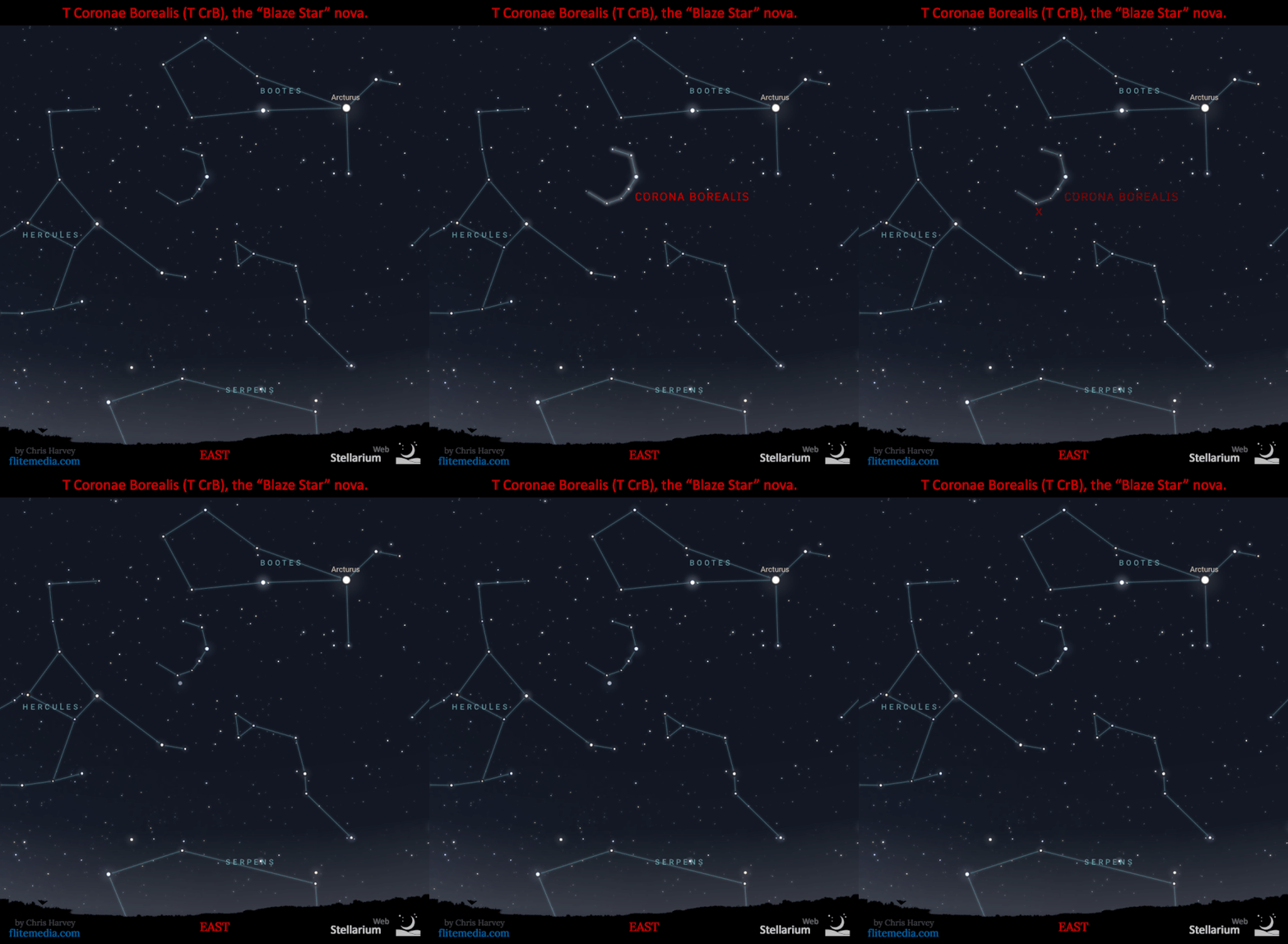
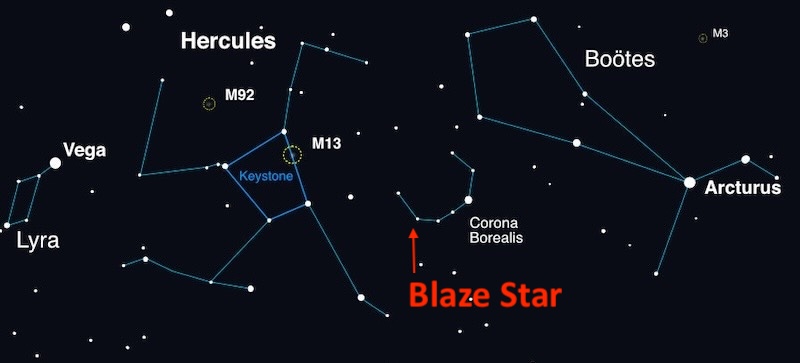
Corona Borealis is almost, but not quite, circumpolar from mid-northern latitudes. So it’s not visible all year round for most northern observers, but it is up much of the year. Northern spring is the best time to start looking for this easy-to-find constellation. In northern fall, look low in the west-northwest.
No matter where you are on the globe, the constellation looks like a letter C. You’ll find Corona Borealis approximately on a line between the bright stars Arcturus and Vega. And Corona Borealis is next to another famous star pattern for those with dark skies. It’s the squarish 4-star pattern of the Keystone in Hercules the Strongman.
Did you hear those words dark sky? You can see the bright stars Arcturus and Vega from inside cities. But you’ll need a dark sky to pick out the Keystone and Corona Borealis. Visit EarthSky’s Best Places to Stargaze.
Do you need binoculars? No. You don’t need them. But binoculars are always a good idea.
Want an exact view from an exact time or your exact location on the globe? Try Stellarium.
Seeing the Blaze Star — Southern Hemisphere
Via Daniel Gaussen, Founder & Guide – Stargaze Mackenzie – New Zealand
We all live under the same sky. But Earth’s Northern and Southern Hemispheres see the sky from different perspectives.
And remember how we said that Corona Borealis was almost — but not quite — circumpolar for the Northern Hemisphere? That means it’s far to the north on the sky’s dome. From deep in the Southern Hemisphere — for example, the latitude of New Zealand and southern Australia — Corona Borealis rises to only around 20 to 25 degrees above the northern horizon at its highest. So, in addition to a dark sky, you’ll also want a clear view to the north.
Look north to northeast for a delicate semicircle or backward C shape of stars between the bright orange star Arcturus and the bright blue-white star Vega. The famous Keystone pattern in Hercules is also between these two, right next to Corona Borealis.
Want an exact view from an exact time or your exact location on the globe? Try Stellarium.
What is it?
T Coronae Borealis — called “T Cor Bor” by many — is located about 3,000 light-years from Earth. It’s a double star system, consisting of a large cool star and a smaller hot star, which orbit each other every 228 days.
This system is what’s called a recurring nova. It’s not a supernova or star that blows itself to bits. Novas operate differently from supernovas. They survive to brighten again. T Cor Bor has outbursts about every 80 years.
Its last outburst was in 1946. That’s why astronomers believe another outburst will occur soon.
What makes the nova erupt? The cool star in the T Corona Borealis system is a swollen red giant. It continually transfers material to its companion in the system, the hot star. The hot star is a white dwarf, surrounded by an accretion disk made of material transferred over from the other star.
All of this is hidden inside a dense cloud of material from the red giant. When the system is quiescent, the red giant dominates the visible light output of the entire system. So the system appears as an M3 giant.
But during outbursts, the transfer of material from the red giant to the hot white dwarf increases greatly. The hot star then expands. And the luminosity of the system increases. Voila. We have a nova.

Why hasn’t the Blaze Star blazed?
Astronomers have been waiting several years for the Blaze Star to erupt. One recent prediction came from Jean Schneider of the Paris Observatory, publishing in the Research Notes of the American Astronomical Society in October 2024.
He pinpointed possible dates of March 27, 2025, and November 10, 2025. Those dates have come and gone with no big kablooey.
Schneider came to his possible dates using a combination of the previous eruption dates and the orbital data of the binary system. But Schneider admits in his paper that no one can exactly predict the eruption.
And, clearly, predicting eruptions of stars isn’t an exact science. The Blaze Star underwent two known eruptions recorded by astronomers. Those events were on May 12, 1866, and on February 9, 1946. Those eruptions were 80 years apart. So scientists thought that, in another 80 years, the star would erupt again. Eighty years from 1946 would be 2026.
And still we wait …
How bright will the Blaze Star be?
How bright will it get in our sky? Astronomers expect it to reach an apparent magnitude of 2. That’s a respectable brightness for a star. It’s conveniently comparable to the brightest star in the Northern Crown, the Jewel of the Crown, Alphecca. So, for a few days, the Northern Crown will have two jewels!
T Corona Borealis — the Blaze Star — is also one of the most distant stars you’ll ever see. Alphecca is around 75 light-years away, while the Blaze Star is 3,000 light-years away.
So that gives you some perspective on the absolute magnitude (brightness) of this enormous blast. The actual explosion of the Blaze Star nova will likely dwarf any explosion you’ll ever see. But the star is far away. This explosion has traveled 3,000 years to get here. So, in relative terms, the nova will have happened during the Bronze Age.
Remember when viewing Alphecca and T Corona Borealis side-by-side with approximately the same brightness, the nova is 40 times farther away than Alphecca. Also, we are not seeing the two stars at the same moment in time. One we see as it was 75 years ago. And the other we see as it was 3,000 years ago. It can be hard to get your head around that!
The nova will brighten the star by thousands of times, typically over just a few hours, and then take some days to fade away again. When it’s done, it will go back to its normal appearance … which means we won’t be able to see it anymore, with the eye alone.
So erupt already!
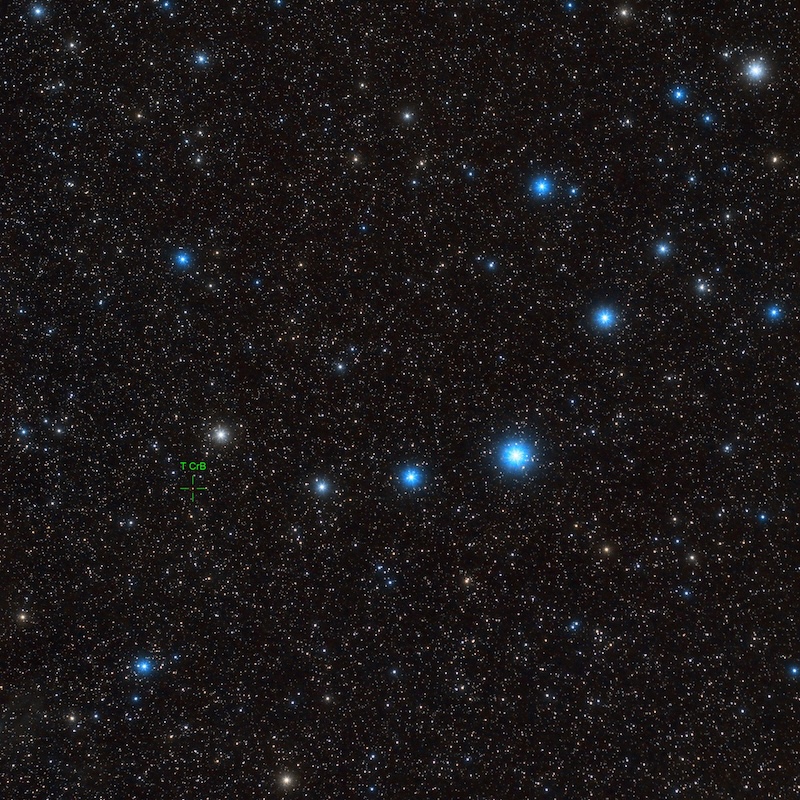
Bottom line: Astronomers are still waiting for the Blaze Star, T Coronae Borealis, to erupt. New research suggests neutrinos could provide an early warning of its next outburst. Here’s how to find it in the sky.
Like what you read?
Subscribe and receive daily news delivered to your inbox.
More from
Editors of EarthSky


November birthstone: Choose from either topaz or citrine

Algol the Demon Star, named for its strange behavior
Meteor shower guide 2026: Up next … the Taurids
Comet Halley is parent of 2 meteor showers