The 2026 EarthSky lunar calendar makes a great gift. Get yours today!
Earliest sunset isn’t on the shortest day
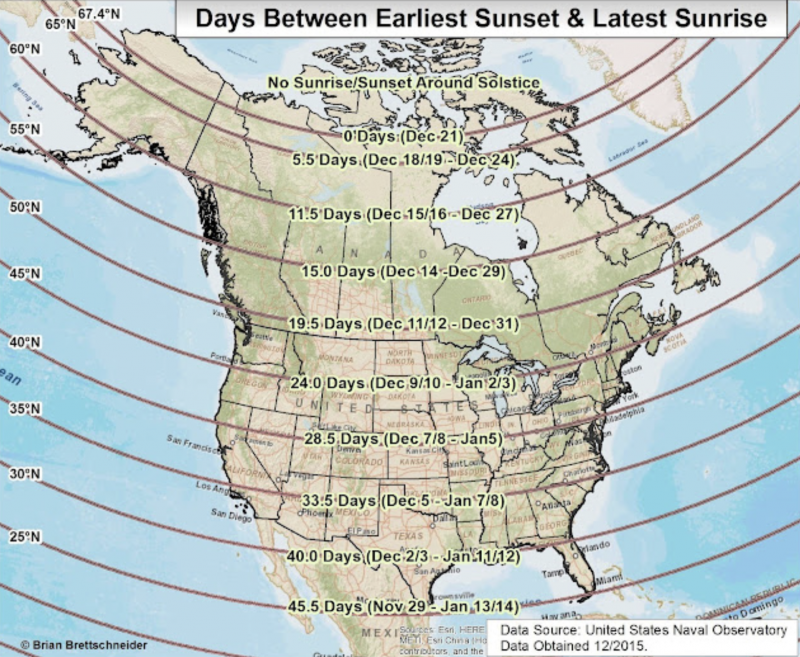
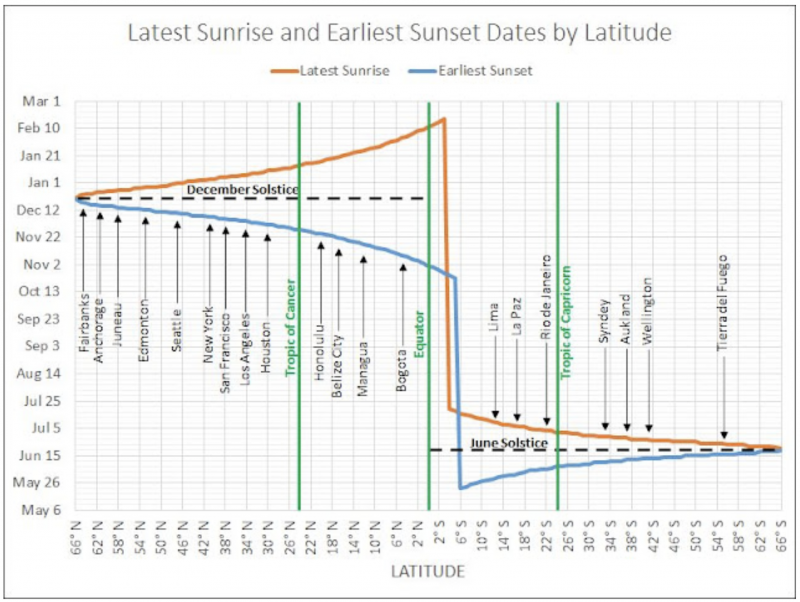
Have you noticed your sunsets coming later now? That’s true for many of us, even though the December solstice is still a few weeks aways. For example, for the mid-northern U.S. and similar latitudes – around 40 degrees north latitude – the earliest sunsets of the year occur around December 8. That would be the latitude of New York City; Philadelphia, Pennsylvania; Kansas City, Missouri; Denver, Colorado; Reno, Nevada; Beijing, China; Madrid, Spain, and Naples, Italy.
Likewise, for more southerly latitudes – say around 30 degrees north latitude – the earliest sunsets of the year came in late November and early December.
And what about the Southern Hemisphere? At this same time, the year’s earliest sunrises have happened or are happening, as you progress toward your longest day at the December solstice.
Then, closer to the Arctic and Antarctic Circles, the earliest sunset and earliest sunrise happen nearer the solstice.
Want to know the date of your earliest sunset (or sunrise)? Sunrise-sunset.org provides the sunrise/sunset times to the second for locations around the globe.
The exact date of the Northern Hemisphere’s earliest sunset and the Southern Hemisphere’s earliest sunrise varies by latitude.
But at temperate latitudes, both of these annual hallmarks in our sky come a few to several weeks before the December solstice, not at the solstice as you might expect.
Why?
The next solstice in 2025 comes at 15:03 UTC on December 21 and marks an unofficial beginning for winter in the Northern Hemisphere. So, for the Northern Hemisphere, this upcoming solstice brings the shortest day and longest night of the year. Then why isn’t the earliest sunset on the year’s shortest day?
Basically, it’s because of the discrepancy between the clock and the sun. A clock ticks off exactly 24 hours from one noon to the next. But an actual day – as measured by the spin of the Earth, from what is called one solar noon to the next – rarely equals 24 hours exactly.
Also, solar noon is simply called midday, because it refers to that instant when the sun reaches its highest point for the day. Thus, in the month of December, the time period from one solar noon to the next is actually half a minute longer than 24 hours. For example, in Philadelphia, Pennsylvania on December 7 the sun reaches its noontime position at 11:52 a.m. local standard time. Then, two weeks later – on the winter solstice – the sun will reach its noontime position around 11:59 a.m. So that’s seven minutes later than on December 7.
Visit Sunrise Sunset Calendars to know the clock time for sunrise, solar noon and sunset plus day length in your part of the world, remembering to check the solar noon and day length boxes.
In addition, another key point is that the later clock time for solar noon means a later clock time for sunrise and sunset. This can be seen in the table below.
For Philadelphia, Pennsylvania
| Date | Sunrise | Solar Noon (Midday) | Sunset | Daylight Hours |
| December 7 | 7:09 a.m. | 11:52 a.m. | 4:35 p.m. | 9 hours 27 minutes |
| December 21 | 7:19 a.m. | 11:59 a.m. | 4:38 p.m. | 9 hours 20 minutes |
Latest sunrise and earliest sunset aren’t on the solstice
As you might have guessed, the latest sunrises aren’t on the day of the solstice either. For middle latitudes in the Northern Hemisphere, the latest sunrises come in early January.
And, although there’s variation in the exact dates, the sequence is always the same for both hemispheres. First, earliest sunset before the winter solstice, the winter solstice itself, latest sunrise after the winter solstice. Then, half a year later, earliest sunrise before the summer solstice, the summer solstice itself, latest sunset.
So by all means, check out the earliest and latest sunsets and sunrises in your area. They are always lovely and happen around every solstice.
Sunsets from the EarthSky Community

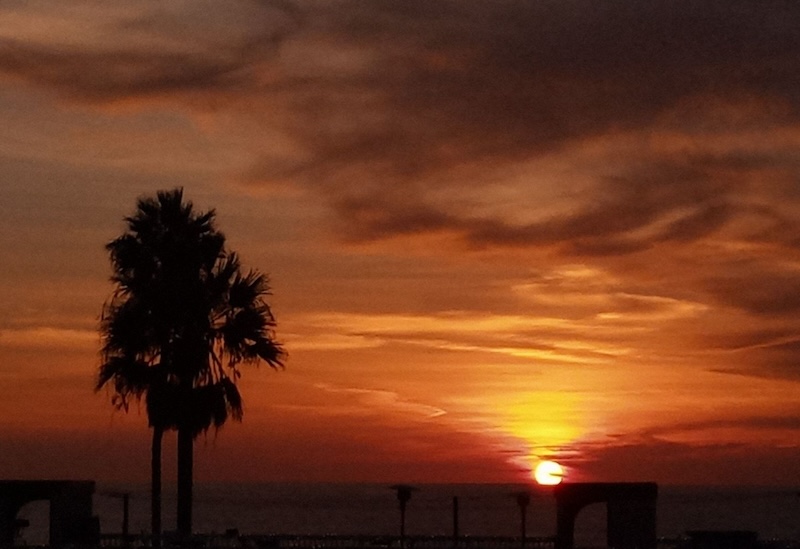

Bottom line: When are the the earliest sunsets? It depends on where you live. The earliest sunsets at mid-northern latitudes happen weeks before the solstice. But latitudes closer to the equator have their earliest sunsets in late November, or earlier in December. And then, latitudes closer to the Arctic Circle will have their earliest sunsets closer to the December solstice.
EarthSky’s monthly night sky guide: Visible planets and more
Like what you read?
Subscribe and receive daily news delivered to your inbox.
More from
Bruce McClure


Meet Aquarius the Water Bearer and its stars

Check out the Double Cluster in Perseus on October evenings
Find the Andromeda Galaxy using Cassiopeia
Alpha Cephei, or Alderamin, is a fast-spinning star