




Sun news December 23: Fast solar wind continues to buffet Earth
(11 UTC December 22 – 11 UTC December 23)
Today’s top story: Auroras likely brushed the polar skies overnight as Earth continued to feel the effects of a strong stream of fast solar wind from a large coronal hole. With this solar wind streaming past Earth at 700-800 km/s, our planet’s geomagnetic field was disturbed to G1 (minor) geomagnetic storm levels, briefly opening the door for enhanced auroras around high-latitude locations such as northern Scandinavia and northern Canada.
Past 24 hours: The details
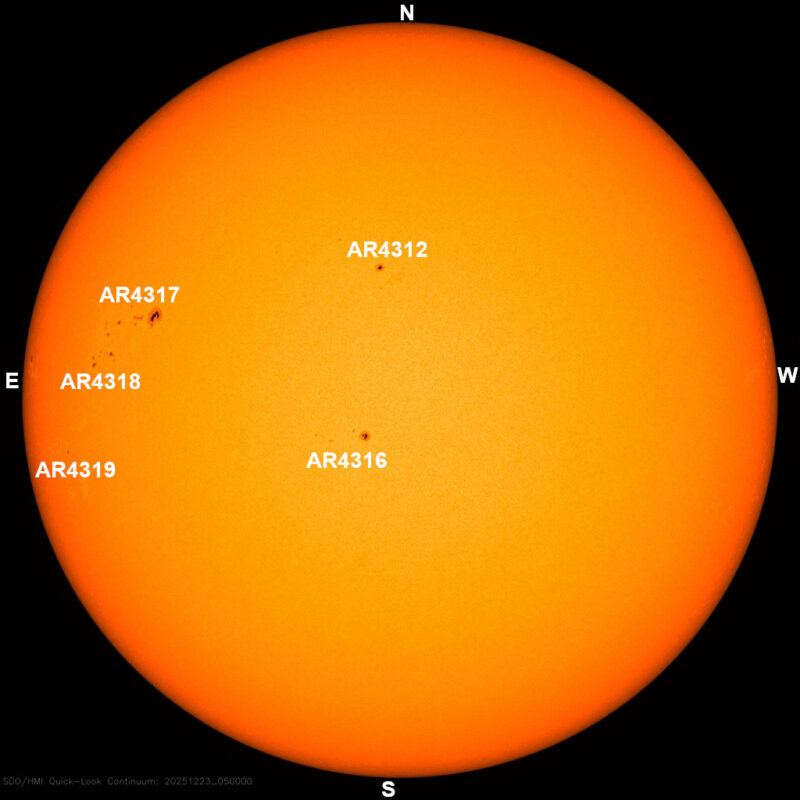
- AR4316 (beta) continued growing in size and shows hints of a gamma configuration in its leading portion.
- AR4317 (beta-gamma) showed minor growth as it developed a gamma configuration.
- AR4318 (beta) showed minor growth.
- AR4312 (alpha) is stable with no flare production.
- There is a newcomer sunspot region in the southeast quadrant now numbered AR4219. It shows a beta configuration.
What’s ahead? Sun–Earth forecast
- Flare activity forecast: Moderate-to-high levels of flare activity are expected to continue. NOAA SWPC indicates that solar activity is likely to be at low-to-moderate levels overall, but chances of M-class (moderate) flares will increase to about 30% on December 24. The primary source regions for additional M-class events will be the rapidly developing AR4316 in the southern hemisphere and, to a lesser extent, the growing, high-latitude region AR4317 as it rotates further onto the disk. The probability of an X-class (strong) flare remains low, at 5%, but non-zero; an isolated stronger event cannot be entirely ruled out if AR4316 continues to accumulate magnetic complexity.
- Geomagnetic activity forecast:
- December 23: The high-speed stream influence is forecast to persist, though a gradual decline in geomagnetic activity is anticipated. Active levels are still expected, with additional G1 intervals possible. Aurora visibility should continue across typical auroral-zone locations (Alaska, northern Canada, Iceland, northern Scandinavia), with a somewhat lower chance of reaching as far south as northern Scotland.
- December 24: Active conditions expected, with Earth under waning solar wind conditions combined with a glancing blow from a coronal mass ejection (CME) hurled by the sun on December 20.


Sun news December 22 (UTC): M flare and magnetic storm hint at more activity
(11 UTC December 21 – 11 UTC December 22)
The sun stayed restless over the past day, with a modest M1.3 flare from rapidly growing sunspot region AR4316 at 18:12 UTC last night raising activity to moderate. That flare capped a flurry of C-class flares, largely from that same region and the high-latitude region AR4317. Meanwhile, auroras danced from Reykjavik to the Scottish Highlands overnight as Earth remained under the influence of a fast solar wind stream flowing out of a large, southern coronal hole. With this solar wind stream expected to persist and the active sunspot regions rotating into more geoeffective positions, both aurora and flare activity are poised to continue over the next few days.
- Flare activity: Solar activity remained at moderate-to-high levels, with 20 flares (1 M-class, 19 C-class) observed in the 24-hour period.
- Strongest flare: An M1.3 M-class flare from AR4316 peaked at 18:12 UTC on December 21. It triggered an R1 (minor) radio blackout over the sunlit South Atlantic, briefly affecting high-frequency communications used by aviation and maritime operators over western South America.
- Other notable flares: A cluster of strong C-class events came from AR4316, including C6.2 at 20:51 UTC, C6.1 at 19:51 UTC, C4.0 at 20:16 UTC, and multiple C3–C3.9 flares between 16:47–22:28 UTC on December 21. Region AR4317 contributed several low C-class events (C1.6 at 13:52 UTC and C2.6 at 05:18 UTC on December 22), while smaller regions such as AR4312 and AR4315 added isolated C1–C2 flares.
- Lead flare producer: AR4316 was the dominant flare engine of this period, responsible for the M1.3 flare and the majority of mid-to-upper-level C-class activity, indicating rising magnetic complexity and energy storage in this emerging southern-hemisphere group.
- Sunspot regions: The Earth-facing solar disk displayed six numbered active regions, with one rapidly developing complex region drawing particular attention.
- AR4316 (beta with emerging delta structure) continued rapid flux emergence on the western edge of its leading spot. Its growing size and hints of a delta configuration in the leading portion explain its role as the top flare producer, with one M-class and numerous C-class flares during the period.
- AR4317 (beta) rotated further onto the disk from the northeast limb. Despite strong foreshortening, it showed growth and produced multiple low C-class flares, suggesting moderate magnetic complexity. This region could soon become more geoeffective as it approaches the center of the solar disk.
- AR4313 has largely decayed into plage, with little remaining spot structure and minimal flare output.
- AR4312, AR4315, and the remaining smaller regions were either stable or in slow decay, contributing only sporadic low C-class flares and showing simple alpha–beta magnetic configurations.
- The overall sunspot population remains modest in number but includes at least one rapidly evolving, increasingly complex region (AR4316) that will be the main focus for further M-class flare potential in the coming days.
- Blasts from the sun? No Earth-directed coronal mass ejections (CMEs) were observed during the period.
- Available coronagraph imagery from spacecraft such as SOHO showed no halo or partial-halo CMEs aimed toward Earth, and none of the flares from AR4316 or AR4317 exhibited clear CME signatures.
- As a result, the current and expected geomagnetic disturbances are being driven primarily by the coronal hole high-speed stream rather than by recent CME impacts.
- Solar wind: The solar wind environment became clearly enhanced under the influence of a corotating interaction region (CIR) followed by a positive-polarity coronal hole high-speed stream. Solar wind speeds increased from around 450 km/s to peaks near 650–700 km/s beginning around 00:00 UTC on 21 December, and remained elevated through the period. The total field strength of the interplanetary magnetic field (IMF) reached up to about 15 nT. The crucial Bz component oscillated between roughly +10 and –10 nT for several hours before easing to smaller ±3 nT fluctuations, with the southward intervals opening the door for enhanced energy transfer into Earth’s magnetosphere and fueling auroral activity. These conditions – strong, steady high-speed flow, moderate IMF strength, and intermittently southward Bz – are classic drivers of recurring geomagnetic activity and high-latitude auroras, even in the absence of fresh CME impacts.
- Earth’s magnetic field: Earth’s magnetic field ranged from active to stormy levels, with brief G1 (minor) geomagnetic storms. At the time of this report (11 UTC on December 22), the field remains under the influence of the high-speed stream, and further active-to-minor storm intervals are anticipated as the stream continues.

The sun in recent days
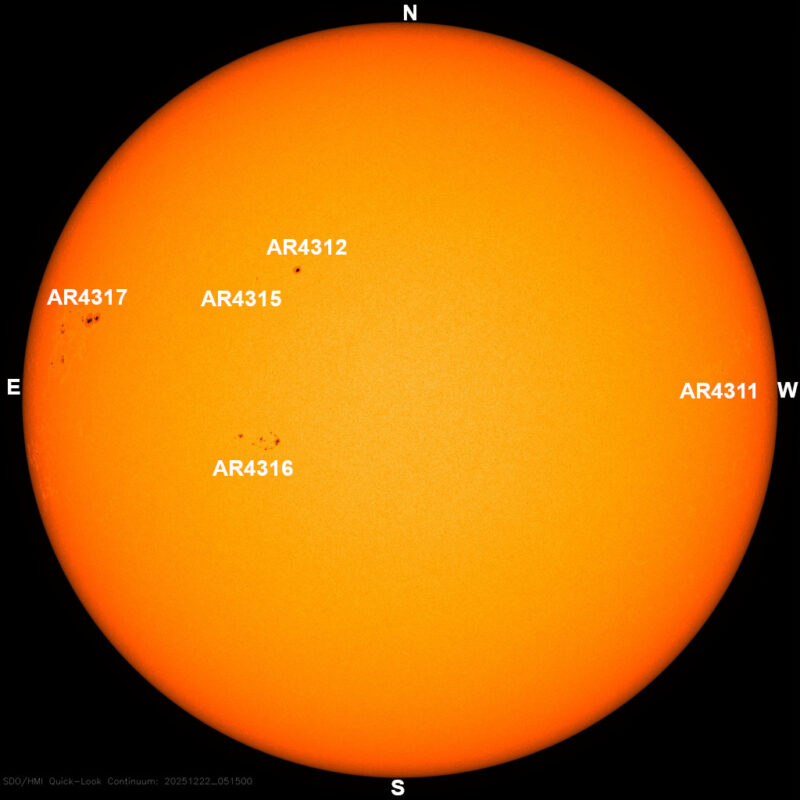

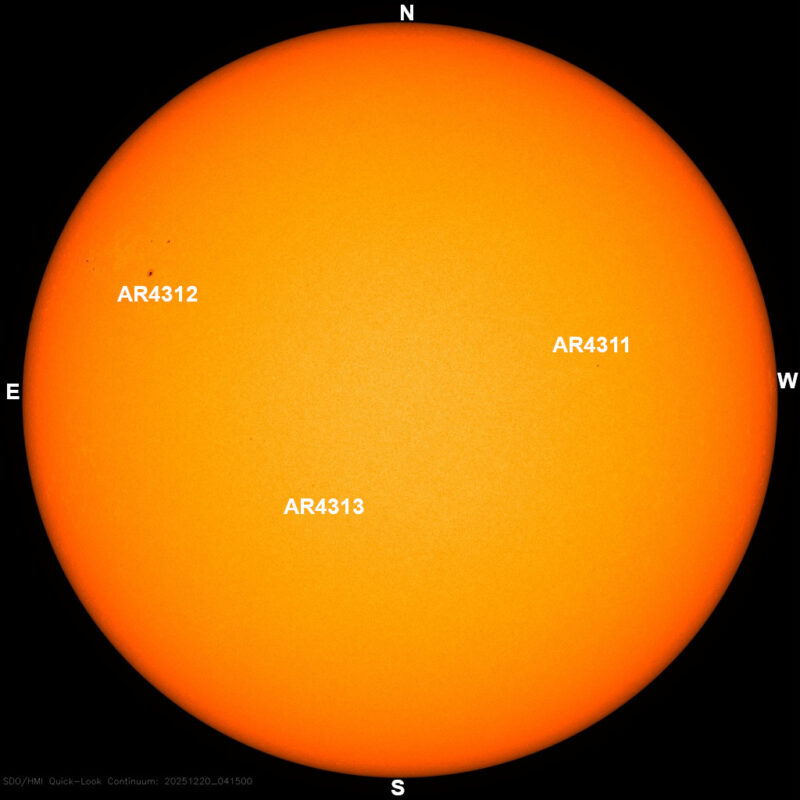
Sun images from our community
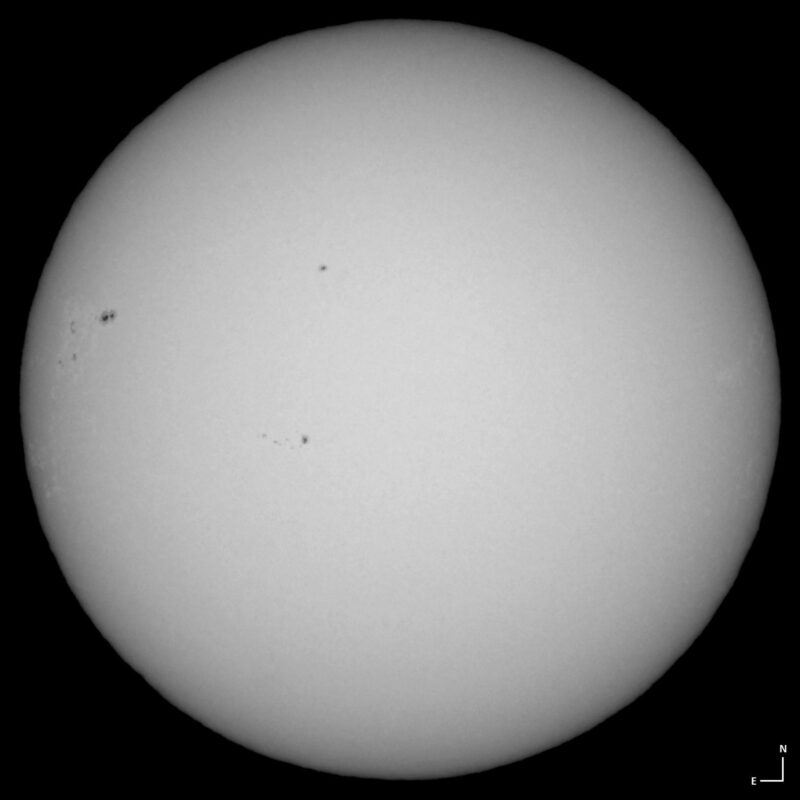
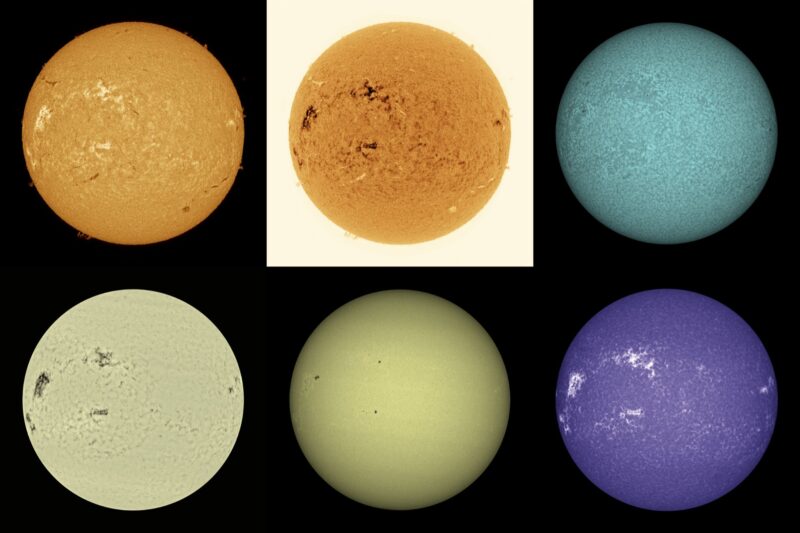
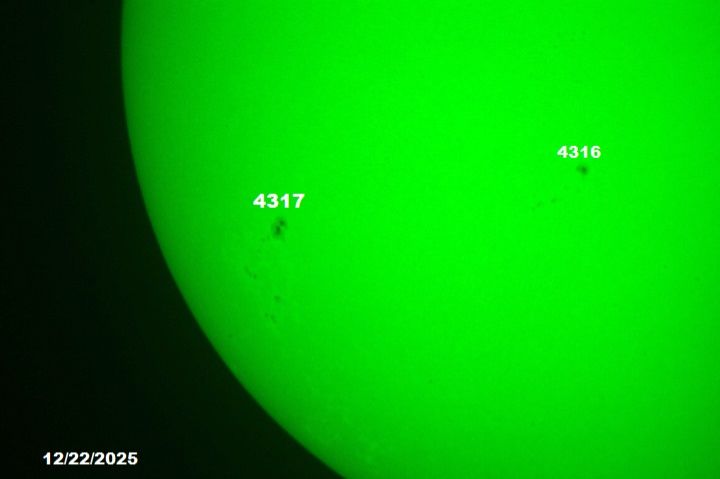
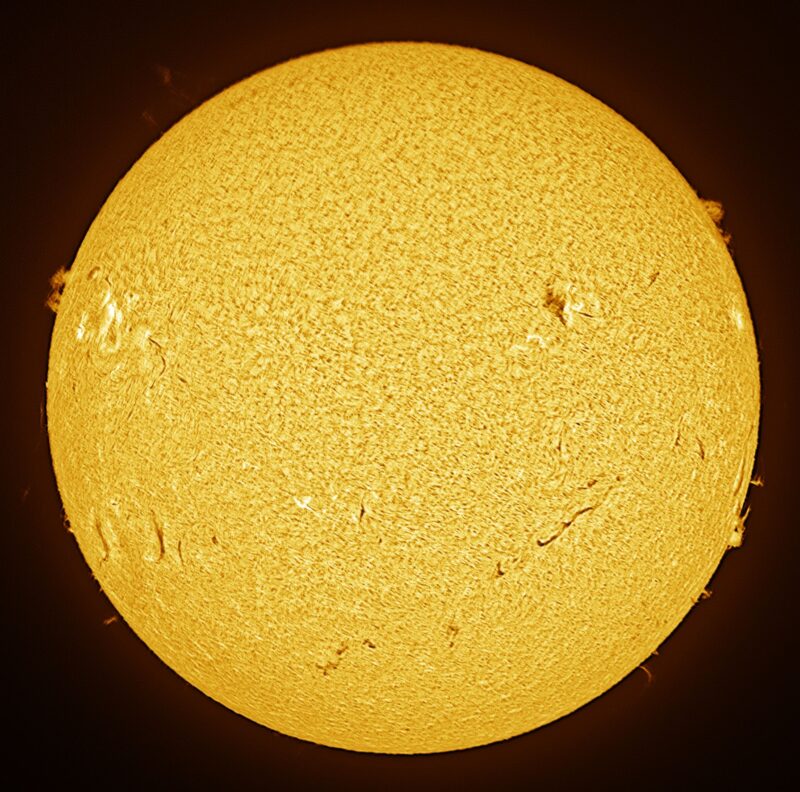
We sometimes feature sun images obtained using hydrogen-alpha filters. Read why.
Bottom line: Sun news December 23, 2025: Minor geomagnetic storming was recorded last night as Earth continued to feel the effects of fast solar wind from a huge coronal hole.
Like what you read?
Subscribe and receive daily news delivered to your inbox.
More from
C. Alex Young


Sun activity archive for December 2025

Sun activity archive for November 2025
Sun activity archive for October 2025
It’s aurora season. Why more auroras at equinoxes?


