



Sun news November 30 (UTC): A new set of active sunspots coming into view
The Sun maintained moderate to high activity levels over the past 24 hours, unleashing 18 flares including four M-class events. The strongest was an M2.9 flare that erupted at 15:36 UTC on November 29 from an unnumbered region near the northeast limb (N20E89), triggering an R1 (minor) radio blackout that briefly disrupted high-frequency communications across the sunlit Pacific and Asian sectors. The newly numbered AR4294, still rotating around the southeastern limb, dominated flare production with 14 of the 19 events, including three additional M-class flares. Meanwhile, Earth’s magnetic field experienced unsettled to active conditions under the waning influence of coronal hole high-speed streams. Solar wind speeds gradually declined, with the Bz component of the interplanetary magnetic field (IMF) frequently turning southward, opening the door for enhanced auroral displays across high-latitude regions. As AR4294 continues to emerge into view, revealing what appears to be a large and magnetically complex structure, the potential for continued M-class activity—and possibly an isolated X-class flare—remains elevated through the weekend.
Past 24 hours: The details
(11 UTC November 29 – 11 UTC November 30)
- Flare activity: Solar activity remained at moderate to high levels, with 19 flares observed: 4 M-class and 15 C-class events.
- Strongest flare: M2.9 from an unnumbered region near N20E89 at 15:36 UTC on November 29. It triggered an R1 (minor) radio blackout affecting high-frequency communications across the Pacific and Asian sectors for approximately 30 minutes.
- Other M-class flares: M1.4 at 21:34 UTC on November 29 from AR4294; M1.4 at 20:04 UTC on November 29 from AR4294; M1.1 at 13:02 UTC on November 29 from AR4294. Each produced brief R1 (minor) radio blackouts over their respective sunlit hemispheres.
- Lead flare producer: AR4294 (S16E64, partially behind the limb) was responsible for 14 of the 18 flares, including all three M-class events attributed to numbered regions. This emerging region continues to rotate into view and appears to be a large, magnetically complex structure with multiple sunspots, though detailed magnetic classification remains difficult while partially obscured.
- Other notable C flares: AR4292 produced a C8.3 flare at 10:07 UTC on November 30. The remaining C-class activity consisted of modest C3-C8 flares, primarily from AR4294 and unnumbered regions near the limb.
- Sunspot regions: The Earth-facing solar disk displayed five numbered active regions.
- AR4294 (beta) continued its rotation around the southeastern limb and remains the largest and most magnetically complex region on the visible disk. Though still partially obscured, the region appears to contain multiple sunspots with more detail expected to emerge as it rotates further into view. It dominated flare production with 14 events including three M-class flares.
- AR4291 (southwest disk, relatively complex magnetic structure) maintained its configuration but produced no significant flaring activity during the period. Despite its complexity, this region has remained relatively quiet.
- AR4292 produced a C8.3 flare at 10:07 UTC on November 30, marking its most significant contribution to the period’s activity.
- The remaining numbered regions (AR4290 and one other) are smaller, magnetically simple, and stable, showing minimal flare activity. These regions are classified as alpha or simple beta configurations.
- Blasts from the sun? No Earth-directed coronal mass ejections (CMEs) were observed during the period. Occasional CME activity was detected on or around the eastern limb in available coronagraph imagery, and analysis of these events remains ongoing. However, none of the observed ejecta appeared to have a clear Earth-directed component based on initial assessments.
- Solar wind: Solar wind speeds gradually decreased from approximately 650 km/s to 600 km/s, reflecting the waning influence of a positive polarity coronal hole high-speed stream. The interplanetary magnetic field (IMF) remained weak to moderate, with total field strength (Bt) varying between 3–8 nT. The Bz component fluctuated frequently between –6 nT and +5 nT, with periods of sustained southward orientation that favored enhanced auroral activity at high latitudes. The phi angle remained predominantly oriented in the positive (away) solar sector throughout the period.
- Earth’s magnetic field: Earth’s magnetic field ranged from unsettled to active levels, with Kp values reaching 4 during the period. Geomagnetic conditions responded to the combination of elevated solar wind speeds and frequent southward Bz excursions. No geomagnetic storm levels were reached, though active conditions persisted for several three-hour periods. Aurora displays were likely visible across high-latitude regions including northern Canada, Alaska, Scandinavia, and Iceland during periods of enhanced activity.
What’s ahead? Sun–Earth forecast
- Flare activity forecast: Moderate to high levels are expected to continue, with M-class (R1-R2) flares likely (65% chance) from AR4294 as more of this large, complex region rotates into view. A slight chance remains for an isolated X-class (R3) event (15% chance), primarily from AR4294, though confidence in this scenario is low until the region’s full magnetic complexity can be assessed. AR4291 and AR4292 may also contribute occasional C-class to low M-class activity.
- Geomagnetic activity forecast:
- November 30: Unsettled to active conditions (Kp 3-4) are expected as positive polarity coronal hole high-speed stream influences continue to wane. A slight chance exists for a brief G1 (minor) geomagnetic storm interval if solar wind coupling remains favorable. Aurora may be visible from northern Alaska, northern Canada, Iceland, and northern Scandinavia where skies are clear.
- December 01: Mostly quiet conditions (Kp 1-2) are expected with a chance of unsettled (Kp 3) intervals as the solar wind environment transitions toward ambient levels. Aurora activity should return to background levels, visible primarily within the auroral zones.
- December 02: Quiet to unsettled conditions (Kp 1-3) are forecast under ambient solar wind conditions, though confidence decreases by the end of the period with the potential for further fast wind influences from additional coronal hole streams. No significant geomagnetic storms are anticipated.
Sun news November 29: Far-side fireworks burst into view
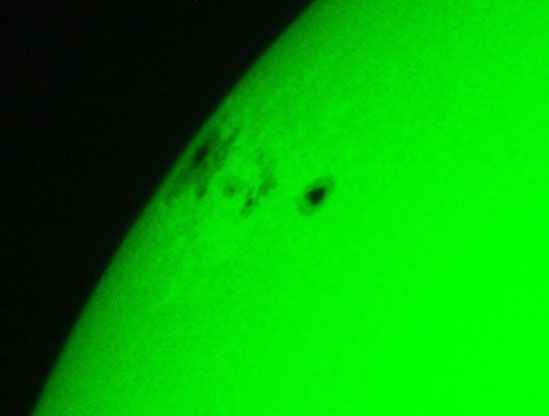
The Sun’s once-hidden, highly active far side is now rotating into view and it brought the fireworks with it. The incoming region we reported yesterday, now officially numbered AR4294, did not disappoint. As it rotated onto the visible disk, its activity intensified dramatically. Solar activity jumped to high levels thanks to three M-class flares from AR4294, including a powerful M5.9 flare on November 28. This eruption triggered an R2 (moderate) radio blackout over the Pacific Ocean. At the same time, the northeast limb welcomed another major player. A huge prominence erupted at 05:28 UTC on November 29, likely produced by the same active region responsible for the impressive far-side prominences seen earlier this week. The region has only begun to peek over the limb, just its “nose” is visible, but it already shows strong potential. With two major flare producers now emerging, solar activity on the Earth-facing side is set to increase. Stay tuned.
Past 24 hours: The details
(11 UTC November 28–11 UTC November 29)
- Flare activity: Solar activity on the Earth-facing side jumped to high levels with multiple M-class flares. In total, the Sun produced 13 flares: three M-class and 10 C-class.
- Strongest flare: An M5.9 from AR4294 at 22:22 UTC on November 28. The flare triggered an R2 (moderate) radio blackout over the Pacific Ocean.
- Other M flares: AR4294 also produced two M1.6 flares on November 29. The first at 00:02 UTC caused an R1 (minor) blackout over the Pacific Ocean. The second at 04:20 UTC caused another R1 blackout, this time over northwestern Australia.
- Notable C flares: AR4294 remained highly active, producing numerous mid-level C flares:
November 28: C5.1 at 13:45 UTC, C4.3 at 16:24 UTC, C5.1 at 16:46 UTC, C5.4 at 18:28 UTC, C5.3 at 18:56 UTC, and C4.9 at 23:42 UTC. November 29: C9.0 at 01:45 UTC and C6.4 at 07:10 UTC.
- Sunspot regions: Six numbered active regions were visible on the disk.
- AR4294 (beta-gamma) gained gamma complexity, increasing its flare potential.
- The remaining regions displayed simple alpha or beta configurations and stayed stable and flare-quiet.
- A newcomer in the northeast, now numbered AR4294 (beta), is rapidly emerging as a major player. Although currently classified as beta, better assessment of its magnetic complexity will become possible as it rotates farther onto the disk.
- Lead flare producer: AR4294 dominated the period with 12 of the 13 flares, including all three M flares.
- Blasts from the sun? Coronal mass ejections (CMEs) associated with the M and C flares from AR4294 are being modeled to determine whether any components may be Earth-directed. So far, no clear Earth-directed coronal mass ejections have appeared in coronagraph imagery.
- Solar wind: Solar wind speeds gradually decreased from 650 km/s to 613 km/s at 10 UTC on November 29. The IMF averaged 6.2 nT. The Bz component continued flipping north–south, with strongest southward dips near –5 nT. At 10 UTC, Bz remained southward, a configuration favorable for auroras.
- Earth’s magnetic field: Earth’s magnetic field stayed unsettled to active, with the Kp index hovering around 4 most of the period. No G1 (Kp 5) storm levels were reached. At the time of writing, Kp remains at 4.
What’s ahead? Sun–Earth forecast
- Flare activity forecast: Low to moderate activity is expected today. The chance of M-class flares has increased to 40% (up from 20% yesterday). The chance of an X-class flare also rose to 5% (up from 1%). AR4294, the powerful newcomer on the southeast limb, appears capable of producing further significant flares as it rotates into clearer view.
- Geomagnetic activity forecast:
- November 29: Active levels (Kp 4) expected as coronal hole high-speed stream influences continue to wane. Solar wind speeds should gradually decline toward 550–600 km/s. Brief G1 (Minor) storm periods remain possible if the Bz component turns strongly southward. Aurora may be visible from Anchorage, Reykjavik, Oslo, and northern Scotland where skies are clear.
- November 30: Quiet to unsettled levels (Kp 1–3) likely as coronal hole stream influences fade further. Mild disturbances remain possible as the coronal hole rotates out of a geoeffective position and solar wind speeds decrease. Solar wind speeds expected to continue gradual decline toward 500 km/s. Aurora activity should return to background levels, visible primarily from high-latitude locations like northern Alaska, northern Canada, Iceland, and northern Scandinavia. A new coronal hole is developing in the northeast and will become geoeffective in the coming days, sending additional fast solar wind toward Earth.
- December 1: Mostly quiet conditions (Kp 1–2) expected with the return of ambient solar wind environment. Background solar wind speeds around 400–450 km/s anticipated. No significant geomagnetic storm activity forecast. Aurora confined to auroral zone (northern Alaska, northern Canada, Iceland, northern Scandinavia).
Sun news November 28: Far-side firestorm spins into view



The strong activity that’s been blazing on the far side of the sun over the past few days — including huge prominences rising over the northeast limb (edge) — now appears to be rotating into view. A fiery as-yet-unnumbered sunspot region lit up the southeast horizon over the past 24 hours, producing a flurry of 15 C-class flares. The flaring gradually grew stronger, suggesting some of the region is still hidden by the solar horizon; as it rotates fully onto the disk, we see more light from its flares and they register more strongly. While this region might not necessarily be responsible for the recent northeast prominences, it’s clearly a highly active area worth watching.
Past 24 hours: The details
(11 UTC November 27 – 11 UTC November 28)
- Flare activity: The Earth-facing side of the sun continued producing low-level C-class flares, but flare counts increased from 10 yesterday to 16 today.
- Strongest flare: A C5.1 from the incoming southeast region at 5:54 UTC on November 28. C-class flares do not produce radio blackouts.
- Other notable flares: This same region produced several additional events. On November 27 it fired a C1.4 at 12:22 UTC, a C1.9 at 13:21 UTC, a C1.5 at 16:22 UTC, a C1.8 at 20:54 UTC, and a C2.0 at 21:09 UTC. On November 28 it produced a C3.3 at 0:54 UTC, a C3.9 at 3:24 UTC, a C4.9 at 4:20 UTC, and multiple smaller C flares.
- Sunspot regions: The Earth-facing disk shows five numbered active regions.
- AR4291 (beta) lost its delta configuration and remained stable, with no flare production.
- The remaining numbered regions showed alpha or beta configurations and stayed simple, stable, and flare-quiet.
- The lead flare producer this period was the incoming southeast region, currently unnumbered, which produced 15 C-class flares including the largest of the day.
- Blasts from the sun? No Earth-directed coronal mass ejections (CMEs) appeared in available coronagraph imagery.
- Solar wind: Solar wind speeds gradually decreased from 717 km/s at the start of the period to 650 km/s at 10 UTC on November 28. The interplanetary magnetic field (IMF) averaged 6.4 nT. The Bz component continued flipping north–south, with the strongest southward dips near –5 nT. At 10 UTC, Bz remained southward: a configuration that favors auroras.
- Earth’s magnetic field: Earth’s magnetic field remained disturbed at active levels throughout the period. The Kp index hovered around 4 for most of the day. A G1 (minor) geomagnetic storm level (Kp 5) was reached during two three-hour intervals at 12 UTC and 18 UTC on November 27. At the time of writing, the Kp is holding at 4.
What’s ahead? Sun–Earth forecast
- Flare activity forecast: Low activity remains in the forecast today. Chances for moderate M-class flares rose slightly to 20% (up from 15% yesterday), while the chance for an X-class flare stays low (1%). The active newcomer on the southeast limb appears capable of producing increased activity as it rotates farther onto the disk.
- Geomagnetic activity forecast:
- November 28: Unsettled-to-active conditions are likely as high-speed wind from a coronal hole high-speed stream (CH HSS) begins to wane. Isolated G1 (minor) storming remains possible, especially with added influence from a co-rotating interaction region (CIR).
- November 29–30: Unsettled-to-active conditions to continue through the weekend. Mild geomagnetic disturbances possible as the coronal hole rotates out of a geoeffective position and solar wind speeds gradually decrease.
Sun news November 27: Far-side fireworks light up the solar limb


Strong activity on the far side of the sun continues, with huge prominences rising over the northeast solar limb. Around 23:00 UTC on November 26, towering sheets of plasma lifted and swayed above the horizon for nearly two hours, lasting noticeably longer than the prominences seen the previous day. These eruptions came from active regions hidden from Earth’s view, hinting at powerful activity unfolding just beyond the limb and soon to rotate into view.
Past 24 hours: The details
(11 UTC November 26 – 11 UTC November 27)
- Flare activity: Despite the strong activity on the far side, the Earth-facing side remained at low levels, with only faint C-class and B-class flares fired over the past day. The sun generated a total of 10 flares: eight C-class (common) and two B-class (weak).
- Strongest flare: A faint C2.7 flare from AR4291 at 0:47 UTC on November 25. C-class flares do not produce radio blackouts.
- Other notable flares: AR4291 produced several additional events on November 24: a C1.2 at 13:34 UTC, a C1.3 at 17:15 UTC, a C1.0 at 20:42 UTC, and a C1.3 at 21:45 UTC. On November 25, AR4291 fired a C1.0 at 4:30 UTC and two C1.1 flares at 1:43 UTC and 4:44 UTC.
- Sunspot regions: The Earth-facing disk shows five numbered active regions.
- AR4291 (beta-delta) lost and then regained its delta configuration, increasing its potential for larger events.
- AR4292 (beta) lost its gamma classification and produced only one C-class flare during the period.
- AR4290 (alpha), AR4288 (alpha), and AR4287 (alpha) remained simple, stable, and flare-quiet.
- Blasts from the sun? As with yesterday’s prominence eruption, today’s dramatic prominence originated on the far side. The plasma it hurled into space is not directed toward Earth. No Earth-directed coronal mass ejections (CMEs) appeared in available coronagraph imagery.
- Solar wind: Solar wind speeds remained moderately high, fluctuating between 700–750 km/s for much of the period, with a brief dip to about 650 km/s at 18 UTC on November 26. By 10 UTC on November 27, speeds measured 682 km/s. The interplanetary magnetic field (IMF) averaged around 6 nT. The Bz component repeatedly flipped northward and southward, with the strongest southward dips reaching -5 nT. At 10 UTC, Bz was southward, a configuration that favors auroras.
- Earth’s magnetic field: Earth’s magnetic field stayed disturbed, holding at active levels throughout the period. The Kp index hovered near 4, just one step below G1 storm level (Kp 5). At the time of writing, the Kp remains at 4.
What’s ahead? Sun–Earth forecast
- Flare activity forecast: Low activity is expected to continue today. Chances for moderate M-class flares remain near 15%, while the chance for X-class events stays low (1%). With AR4291 and AR4292 both showing beta-delta structures, the potential for larger flares may rise over the next few days.
- Geomagnetic activity forecast:
- November 27: High-speed solar wind from a coronal hole high-speed stream (CH HSS) will keep Earth’s geomagnetic field at unsettled-to-active levels. Isolated G1 (minor) storming remains possible, especially with added influence from a co-rotating interaction region (CIR).
- November 28: Unsettled conditions are likely as the coronal hole rotates out of a geoeffective position and solar wind speeds begin to decrease.
- November 29: Quiet-to-unsettled conditions expected as solar wind parameters return to background levels. The coronal hole high-speed stream influence should subside, bringing a return to mostly quiet geomagnetic conditions.
Sun news November 26: Stunning far-side eruption steals the show

While activity on the Earth-facing side of our star is currently low, there seems to be drama on the far side! Around 19:44 UTC last night we observed a gorgeous, towering prominence of solar material and magnetic fields billowing over the northeastern horizon. This fired out a blob of solar plasma – a coronal mass ejection (CME) – which is not headed toward Earth, since the event occurred on the far side of our star. But the region that produced this eruption should soon rotate into view, so more excitement might be on the way. Stay tuned.
Past 24 hours: The details
(11 UTC November 25 – 11 UTC November 26)
- Flare activity: The sun produced 13 flares over the past 24 hours, up from nine the previous day. However, these were only faint C- and B-class flares, meaning activity remains at low. The total was eight C-class (common) and five B-class (weak) flares.
- Strongest flare: A faint C2.2 flare from AR4290 at 3 UTC on November 25. These low-level flares do not cause radio blackouts.
- Other notable flares: C2.1 from AR4292 at 15:56 UTC; C1.9 from AR4291 at 14:35 UTC; C1.6 from AR4288 at 16:28 UTC; and a C1.1 from AR4292 at 21:12 UTC— all on November 24. On November 25, AR4291 produced a C1.0 at 5:22 UTC, and AR4292 produced a C1.1 at 5:56 UTC and a C1.2 at 6:12 UTC.
- Sunspot regions: The Earth-facing solar disk shows six numbered active regions today.
- AR4291 (beta-gamma) remains the largest and most complex region on the disk. It produced two C-class flares and still holds the potential for larger events.
- AR4292 (beta-gamma) showed growth and gained a gamma component. Its flare production increased, and it now has similar potential to AR4291 for strong flares.
- AR4290 (alpha) and AR4288 (beta) each produced one faint C-class flare and otherwise remained simple and stable.
- The remaining regions stayed mostly stable or in gradual decay, producing no significant flares.
- Blasts from the sun? The CME linked to yesterday’s prominence eruption was launched from the far side of the sun, so none of the plasma is headed toward Earth. Aside from this far-side activity, no Earth-directed CMEs appeared in available satellite imagery.
- Solar wind: Solar wind speeds fluctuated dramatically. Winds hovered near 800 km/s for much of November 25, peaking around 820 km/s. By 10 UTC on November 26, speeds measured 755 km/s. The interplanetary magnetic field (IMF) averaged around 6 nT. The Bz component repeatedly switched between northward and southward, with the strongest southward dips reaching -10 nT. At 10 UTC, Bz was northward – a configuration that limits auroral activity.
- Earth’s magnetic field: Earth’s magnetic field remained disturbed, ranging from unsettled to active levels. No G1 (minor) geomagnetic storm occurred, but the Kp index stayed near 4 for much of the period — just one step below storm level (Kp 5). At the time of writing, Kp remains at 4.

Sun news November 25: Solar coronal holes spark geomagnetic storms!

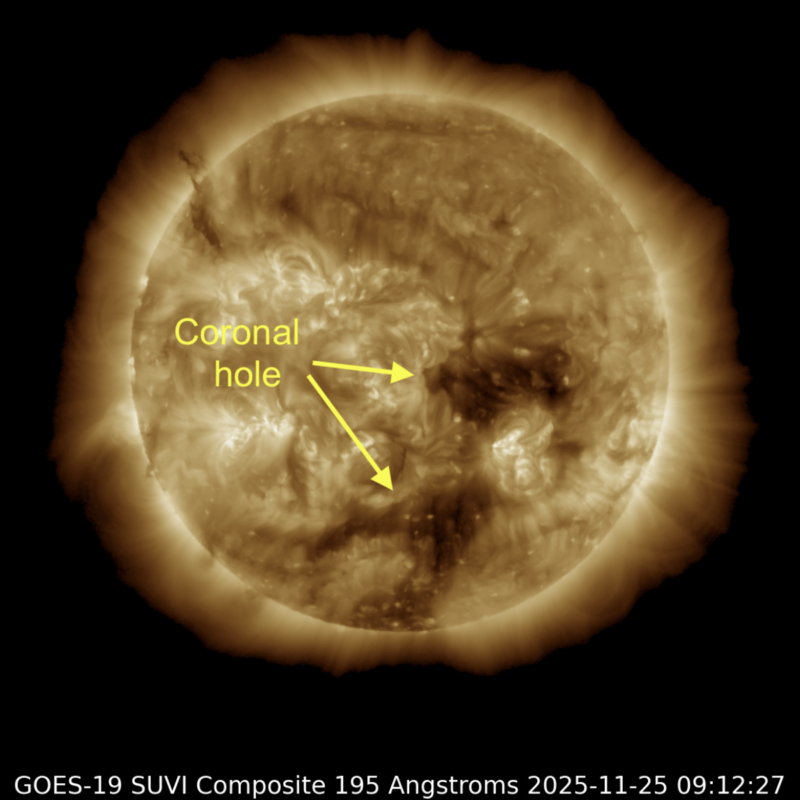
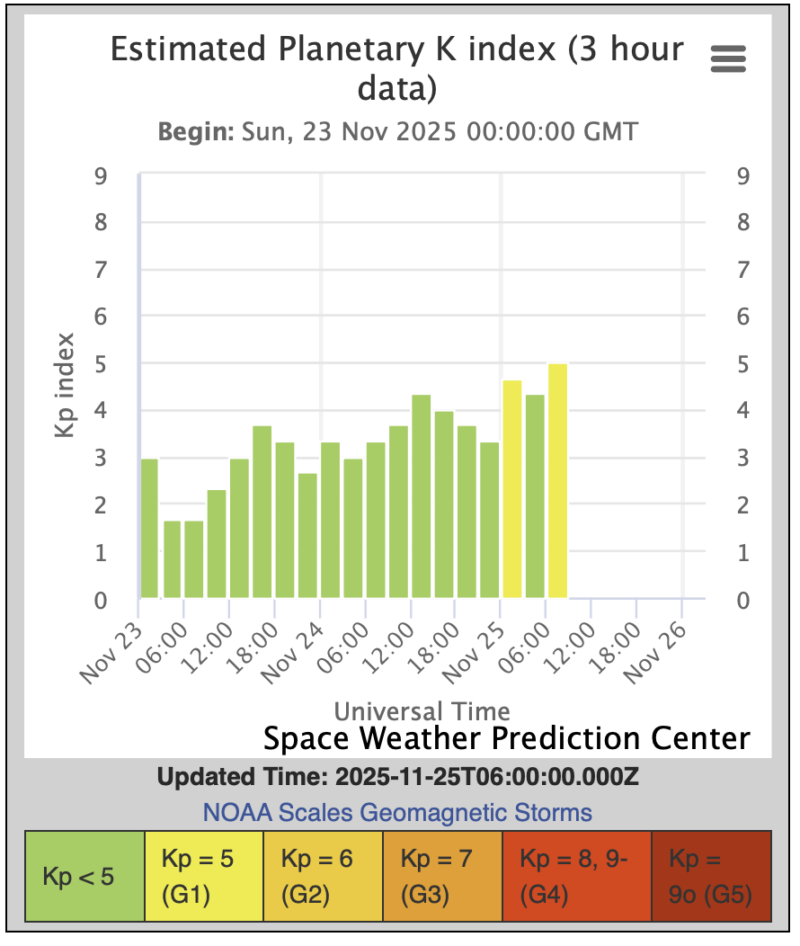
Surprise! We got a G1 (minor) geomagnetic storm last night, with auroras at high latitudes, beginning around 0 UTC on November 25. The stormy conditions stemmed from an early-arriving co-rotating interaction region (CIR), which is fast solar wind streams interacting with slower solar wind ahead of it. Long story short … the solar wind disturbed Earth’s magnetic field and pushed the Kp index (a measure of the disturbance) to level 5 during two three-hour synoptic periods. As of this writing, Kp = 5 remains ongoing. And here’s more exciting news! The coronal holes are still in a geoeffective position, where they are capable of affecting Earth. So active conditions with isolated G1 geomagnetic storming might continue through November 27. Did you see the auroras last night? Took photos? Share them with our community!
Past 24 hours: The details
(11 UTC November 24 – 11 UTC November 25)
- Flare activity: Sun activity remained at a very low level, with mostly B-class (weak) flares during the 24-hour period. A total of nine flares were observed: two C-class (common) and seven B-class flares.
- Strongest flare: A faint C1.6 flare from AR4291 at 22:03 UTC on November 24. These common, low-level eruptions do not produce radio blackouts.
- Other notable flares: A C1.3 from AR4291 at 22:20 UTC on November 24. All remaining flares were B-class.
- Sunspot regions: Six numbered active regions appeared on the Earth-facing side of the sun.
- AR4291 (beta-gamma) remained the most complex region on the disk, producing both C- and B-class flares. It retains the potential for larger flares.
- AR4290 (beta) showed decay and produced no flares.
- AR4289 (alpha) produced one faint B-class flare and otherwise remained simple and stable.
- AR4293, a newcomer in the northeast quadrant, remained quiet.
- The remaining numbered regions stayed mostly stable or in gradual decay, contributing minimal flare activity.
- Blasts from the sun? No Earth-directed coronal mass ejections (CMEs) appeared in available satellite imagery during the period. Coronagraph data from SOHO and other spacecraft showed no significant eruptions heading toward Earth.
- Solar wind: Solar wind speeds fluctuated dramatically. Speeds hovered near 700 km/s during the first half of the period (on November 24), dropped to 260 km/s by 5 UTC today, then surged to 765 km/s by 10 UTC on November 25. The interplanetary magnetic field (IMF) remained moderate, averaging around 8 nT. The Bz component repeatedly switched from northward to southward, with the strongest southward peaks reaching -10 nT. Bz remained southward at 10 UTC on November 25, a configuration that favors auroral activity.
- Earth’s magnetic field: Earth’s magnetic field ranged from unsettled to active levels. G1 (minor) geomagnetic storm conditions occurred, with the Kp index reaching 5 from 0–3 UTC and again from 6–9 UTC on November 25. At the time of this writing, Kp remains at 5.
Sun news November 24: Solar activity breather continues
Our star appears to be taking a breather, firing only C (common) and B (weak) flares over the past day. The strongest of these was a C2.5 flare from sunspot region AR4290, which briefly lit up the solar disk. The most productive region, however, was AR4291 in the southeast, which shows promising complexity and continues to develop more sunspots. This region is the one to watch, especially as it starts to rotate into a more geoeffective position.
Past 24 hours: The details
(11 UTC November 23 – 11 UTC November 24)
- Flare activity: Solar activity remained at low levels, with 8 C-class flares and 3 B flares observed during the 24-hour period.
- Strongest flare: C2.5 from AR4290 at 6:21 UTC on November 24. This common, low-level eruption produced no radio blackouts.
- Other notable flares: C2.5 from AR4291 at 6:03 UTC on November 24; C1.6 from AR4290 at 20:10 UTC on November 23; C1.5 from AR4291 at 12:30 UTC on November 23; C1.3 from AR4290 at 2:32 UTC on November 24.
- Sunspot regions: The Earth-facing solar disk currently displays 6 numbered active regions, with one newly formed region appearing over the past day.
- AR4291 (beta-gamma) remained the most complex region on the disk, developing additional intermediate spots and maintaining its status as the lead flare producer. This southeast region is responsible for the majority of C-class activity and bears watching as it rotates into a more geoeffective position.
- AR4292 (beta) was newly numbered during the period. This fresh region remained mostly inactive but adds to the overall sunspot count.
- AR4290 produced multiple C-class flares including the period’s strongest C2.5 event. This region shows modest activity despite its simpler magnetic configuration.
- AR4288 contributed a single C1.0 flare but otherwise remained relatively quiet.
- The remaining numbered active regions were either mostly stable or in gradual decay, showing minimal flare production during the period.
- Blasts from the sun? No Earth-directed coronal mass ejections (CMEs) were observed in available satellite imagery during the period. Coronagraph data from SOHO and other spacecraft showed no significant plasma eruptions heading toward Earth.
- Solar wind: Solar wind speeds initially hovered near 350 km/s – typical background conditions – before rising to around 500 km/s at 16:44 UTC on November 23. The interplanetary magnetic field (IMF) remained moderate, with total field strength peaking at 13 nT at 18:33 UTC on November 23. The important north–south Bz component reached as far south as –8 nT at 11:57 UTC on November 23. A southward Bz favors aurora displays.
- Earth’s magnetic field: Earth’s magnetic field ranged from quiet to unsettled levels, with Kp indices reaching 4 during an isolated active period from 15–18 UTC on November 23. Geomagnetic activity remained below storm levels throughout the period. The brief active interval corresponded with the moderately southward Bz orientation, which enhanced energy coupling between the solar wind and Earth’s magnetosphere. Conditions returned to quiet-to-unsettled levels following this period.

Sun news for November 23-24, 2025. The sun appears to be taking a break, firing only C (common) and B (weak) flares over the past 24 hours. Here, the sun is captured in the 304 and 171 angstrom wavelengths of the Solar Dynamics Observatory (SDO). Images via NASA/ SDO. Sun news November 23 (UTC): Sun mostly settled, but one region lights up
(11 UTC November 22 ? 11 UTC November 23)
The sun took a breather this past earthly day, maintaining low levels of activity with only B- and C-class flares observed. The strongest event was a C6.6 flare produced by the newly numbered AR4291, which is being carried by the sun’s rotation onto the southeast limb. This modest uptick in activity came from the region’s magnetically complex configuration, which now stands as the most intricate on the sun’s visible disk. AR4290, also emerging from the east limb, contributed several low-level C-class flares as well, showing the potential for continued modest activity as both regions rotate into more geoeffective positions (positions where they are capable of affecting Earth). Meanwhile, Earth’s magnetic field remained quiet to unsettled over the past day, with solar wind speeds eased from slightly elevated levels back toward background conditions. There was little opportunity for enhanced auroral displays. Looking ahead, a complex of coronal holes in the sun’s southeast is expected to deliver a high-speed solar wind stream by November 25. That might elevate geomagnetic activity to unsettled-to-active levels with a chance for G1 (minor) geomagnetic storm conditions.
- Flare activity: Solar activity remained at low levels, with 12 flares observed during the period—10 C-class flares and 2 B-class flares.
- Strongest flare: C6.6 from AR4291 (S14E65) at 19:00 UTC on November 22.
- Lead flare producer: AR4291 was responsible for 7 flares, including the C6.6 peak event and four additional C-class flares (C1.8, C1.5, C1.2, C1.1). This newly numbered region displayed the most magnetically complex configuration on the visible disk.
- Other notable C flares: AR4290 (S10E65) produced a C6.3 flare at 18:49 UTC on November 22, along with a C4.8 flare at 11:41 UTC, a C1.6 at 15:18 UTC, and a C1.5 at 16:13 UTC.
- The remaining numbered active regions were mostly unchanged and stagnant, contributing no significant flare activity.
- Sunspot regions: The Earth-facing solar disk displayed 7 numbered active regions, though most remained small and magnetically simple.
- AR4291 (beta) is now the most magnetically complex region on the visible disk and was the primary flare producer, responsible for the C6.6 peak event and multiple C-class flares as it rotated onto the southeast limb.
- AR4290 (beta) also contributed several low-level C-class flares as it turned onto the disk from the east limb.
- The remaining numbered active regions were mostly unchanged and stagnant, showing little evolution or flare productivity. All displayed alpha or beta magnetic configurations with no delta structures observed.
- Blasts from the sun? No Earth-directed coronal mass ejections (CMEs) were observed during the past day.
- A filament eruption was observed from approximately 13:01–13:41 UTC on November 22. The northern half of an approximately 12-degree-long filament, centered near S22E06, was observed erupting in GONG H-alpha and SUVI imagery. Initial indications suggest most of the material was reabsorbed, with no discernible CME detected in available coronagraph imagery.
- Solar wind: Solar wind speeds decreased slightly during the period, averaging 420 km/s with a peak of 450 km/s, reflecting the waning influence of a negative polarity coronal hole. The interplanetary magnetic field (IMF) remained weak, ranging between 4–9 nT. The Bz component fluctuated between +5 nT and -5 nT, remaining mostly weak and variable in direction. These nominal conditions offered little opportunity for enhanced auroral activity.
- Earth’s magnetic field: Earth’s magnetic field ranged from quiet to unsettled levels, with Kp indices reaching 0–3. No geomagnetic storm conditions were observed. Geomagnetic activity remained subdued under the influence of nominal solar wind conditions and a weak, variable IMF.
What’s ahead? Sun–Earth forecast
- Flare activity forecast: Low levels are expected to continue through November 25, with a slight chance for moderate levels (R1-R2/Minor-Moderate) mainly due to the flare potential of AR4291, the most magnetically complex region on the visible disk. M-class flares remain possible as this region rotates into a more geoeffective position, though X-class activity remains unlikely given the current configurations.
- Geomagnetic activity forecast:
- November 23: Quiet to unsettled conditions expected as solar wind speeds ease toward background levels. Kp indices 2–4 likely, with no geomagnetic storm activity anticipated.
- November 24: Unsettled to active conditions possible as the leading edge of a coronal hole high-speed stream may begin to arrive. Kp indices 3–5 forecast, with a slight chance for G1 (minor) storm levels late in the day. Aurora may become visible from Seattle, Oslo, Reykjavik, and Anchorage if conditions align.
- November 25: Unsettled to active conditions with a chance for G1 (minor) storm levels as the coronal hole high-speed stream fully impacts Earth. Kp indices 4–5 expected, potentially reaching 6 if the Bz component turns southward. Aurora displays may be visible from Seattle, Minneapolis, Edinburgh, and the Scottish Highlands under favorable conditions. Peak effects are expected to continue beyond this forecast period.

Sun news for November 22-23, 2025. SDO/AIA 193 Å reveals a complex of coronal holes in the southeast, expected to send a high-speed solar wind stream toward Earth by November 25—potentially boosting geomagnetic activity to unsettled or active levels with a chance for G1 (minor) storm conditions. Images via NASA/SDO. 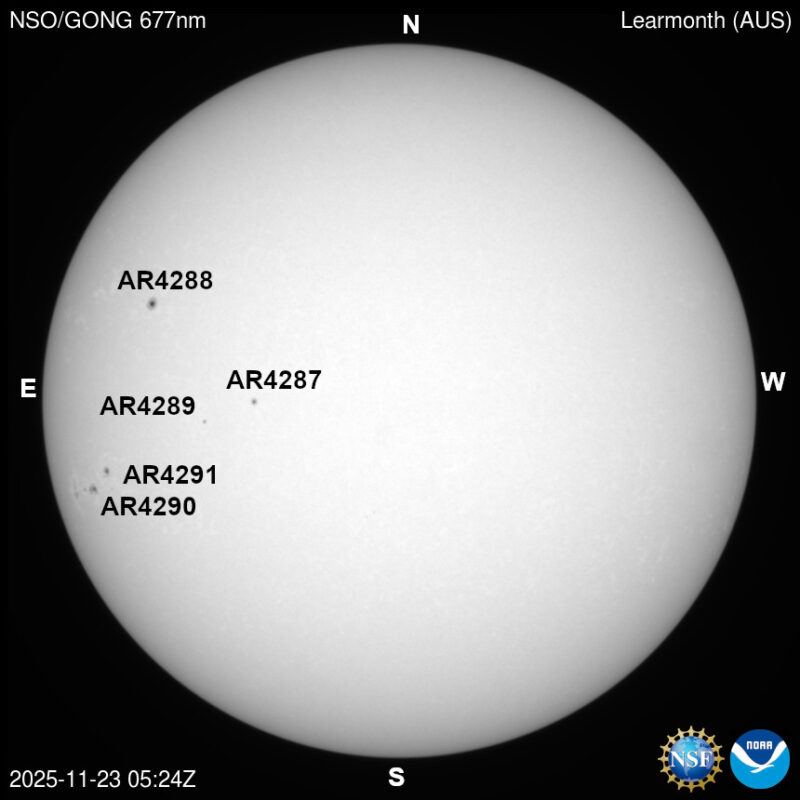
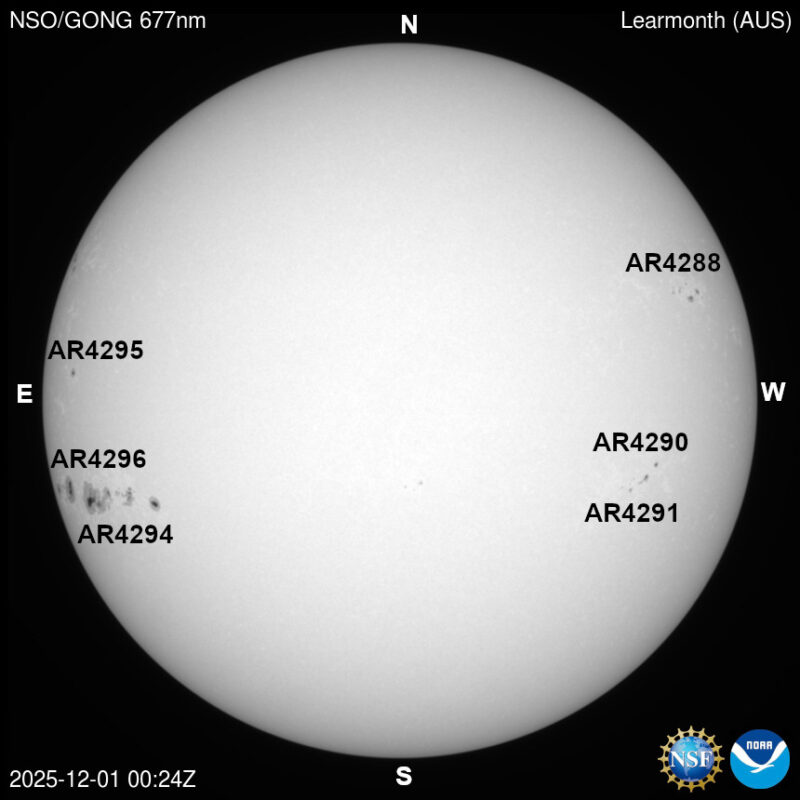
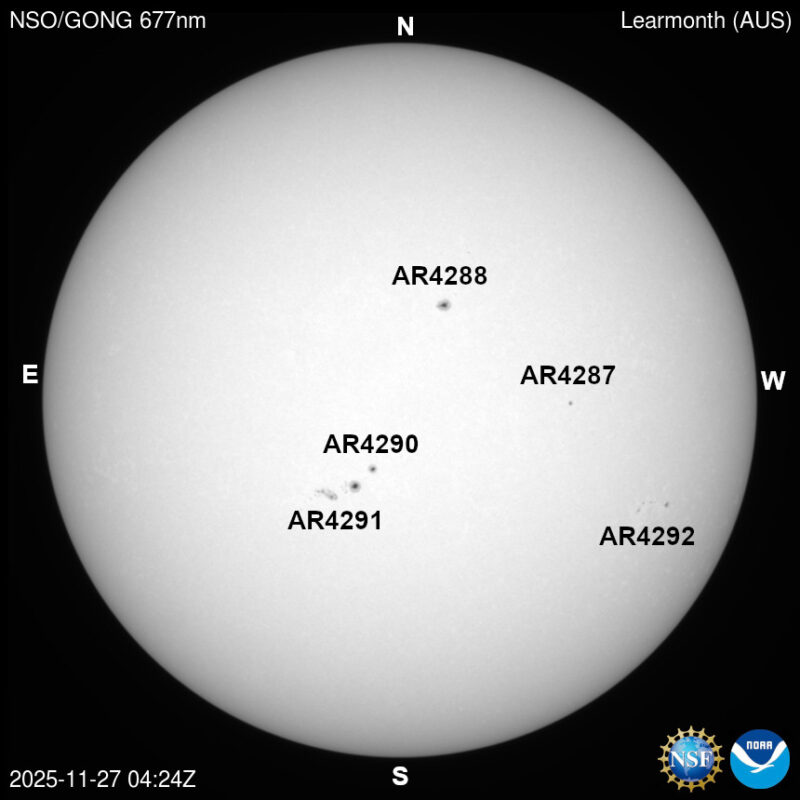
This image shows sun activity – with the most active regions labeled – as of 5 UTC on November 23, 2025, as seen from Learmonth Solar Observatory in Australia. Original image, without labels, via NSO/GONG. Armando Caussade posted today’s sun. Why are east and west on the sun reversed? Sun news November 22: Beautiful double prominences steal today’s show
(11 UTC November 21 – 11 UTC November 22)
The sun put on a stunning show today with two gorgeous prominences. The first – from the sun’s southeast limb – hurled plasma into space, but early analysis suggests most of this material is not Earth-directed. We are waiting for specialists to confirm. The second prominence – over the sun’s north pole – was smaller than the massive far-side event we saw two days ago, but still dramatic. Meanwhile, flare production increased to 18 total events yet remained at low levels, consisting only of faint C-class (common) and B-class (weak) flares. Stay tuned for more solar action.
- Flare activity: The Earth-facing side remained at low activity, producing only faint C and B flares. We observed 18 flares: 16 Cs and two Bs.
- Strongest flare: A C3.8 flare from AR4290 in the southeast at 13:30 UTC on November 21.
- Other notable flares: AR4284 produced three additional C flares—a C1.5 at 16:53 UTC, a C1.3 at 19:54 UTC, and a C1.0 at 12:00 UTC—all on November 21. AR4290 contributed several more flares: a C2.1 at 22:27 UTC on November 21, plus a C2.3 at 1:20 UTC, a C1.2 at 1:08 UTC, a C1.1 at 2:32 UTC, and a C1.0 at 5:45 UTC on November 22.
- Lead flare producer: AR4290 topped the list with 13 flares during the period.
- Sunspot regions: Four numbered active regions appear on the Earth-facing side.
- AR4284 (beta) now sits at the very edge of the west limb.
- AR4287 (alpha) remained stable with no flare production.
- AR4288 (beta) in the northeast quadrant strengthened its magnetic configuration.
- Two new regions were numbered this period: AR4289 and AR4290, both in the southeast quadrant.
- Blasts from the sun? LASCO C2 detected a narrow coronal mass ejection (CME) from the southeast beginning at 21:12 UTC on November 21. Modeling is underway to determine whether any Earth-directed component exists. No additional CMEs were observed.
- Solar wind: Solar wind speeds ranged from 400–450 km/s, peaking at 465 km/s at 19:35 UTC on November 21 and settling at 430 km/s by 10 UTC on November 22. The interplanetary magnetic field (IMF) remained moderately strong at 7 nT. The Bz component flipped north–south several times but stood northward at 10 UTC, limiting geomagnetic storm potential.
- Earth’s magnetic field: Earth’s magnetic field stayed quiet to unsettled, with Kp values of 1–3. No geomagnetic storms occurred. Kp = 1 at the time of writing.
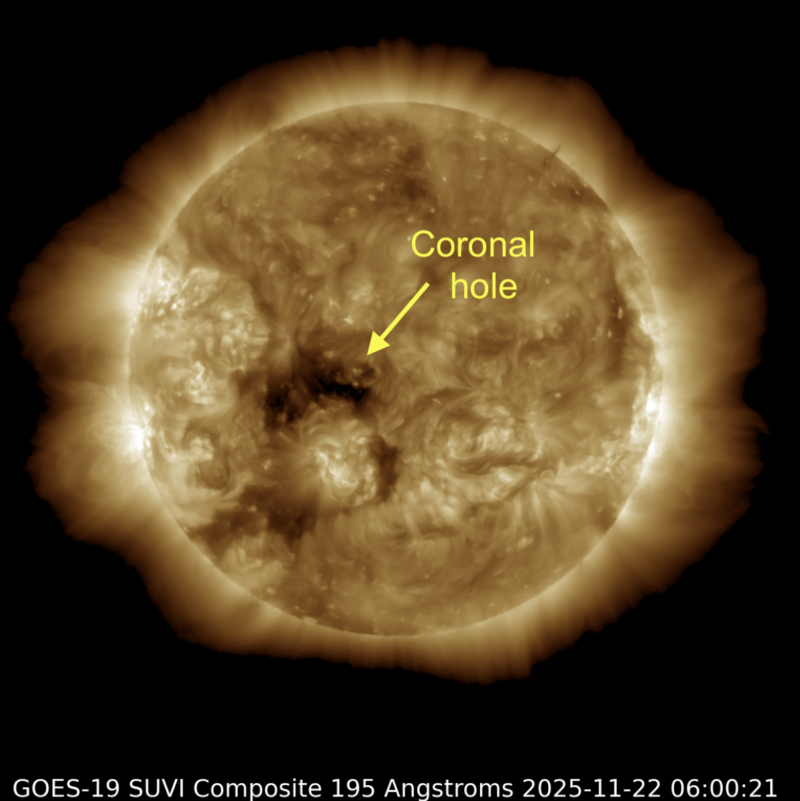
A new coronal hole in the southeast quadrant soon to move into a geoeffective position, seen here in GOES-19 SUVI 195 Å data from November 22, 2025. Images via NOAA/GOES. 
Sun news for November 21-22, 2025. Two spectacular solar prominences graced the sun’s edges over the past day. The 1st erupted as a lifting filament from the sun’s southeast limb late yesterday (around 23:32 UTC on November 21). It rose into a fiery arch and blasted plasma into space. Hours later, a 2nd prominence burst above the sun’s north pole around 3:00 UTC this morning (November 22). It was smaller than the recent far-side giant, but still beautifully dramatic. Images via NOAA/GOES-19. Images via NOAA/GOES. Sun news November 21: Huge far-side sun blast to strike Venus
(11 UTC November 20 – 11 UTC November 21)
It’s confirmed! The massive far-side eruption we reported yesterday – a towering, crown-like prominence that rose over the sun’s north pole and later appeared over its south pole – is currently sending enormous amounts of solar plasma into space toward Venus, the sun’s 2nd planet. Note that Earth and Venus are on opposite sides of the sun now. And the estimated arrival date of this mass of sun-stuff at Venus is tomorrow, November 22. Meanwhile, the Earth-facing side of our star remained quiet over the past day, with only low-level flare activity. Stay tuned for updates.
- Flare activity: The Earth-facing side of the sun remained at low activity levels, producing only faint C (common) and B (weak) flares over the past day. A total of 10 flares were recorded: nine C flares and one B flare.
- Strongest flare: A C1.4 from an incoming, as-yet-unnumbered southeast region at 5:36 UTC on November 20.
- Other notable flares: AR4284 produced four C flares: two C1.1 flares at 0:41 UTC and 0:55 UTC, a C1.2 at 0:55 UTC, and a C1.0 at 8:03 UTC (all on November 21). The unnumbered southeast region produced four additional flares: C1.1 at 16:48 UTC and 22:57 UTC on November 20, a B8.8 at 0:26 UTC, and the C1.4 flare listed above.
- Lead flare production was shared between AR4284 and the unnumbered southeast region, each producing four flares.
- Sunspot regions: Three numbered active regions appear on the Earth-facing side of the sun.
- AR4284 (beta) is approaching the west limb and will soon rotate out of view.
- AR4287 (alpha) remained stable and produced one C1.1 flare.
- AR4288 (alpha) emerged and was numbered during the period in the northeast quadrant.
- Blasts from the sun? No Earth-directed coronal mass ejections (CMEs) appeared during the period.
- Solar wind: Solar wind speeds increased slightly from 400 km/s to 490 km/s during the period, settling at 426 km/s at 10 UTC on November 21. The interplanetary magnetic field (IMF) remained moderately strong at 10 nT. The Bz component was southward during the first half of the period, then turned northward during the second half. At 10 UTC it was southward again, a configuration that enhances geomagnetic storm potential.
- Earth’s magnetic field: Earth’s magnetic field stayed quiet to unsettled, with Kp values of 1–3. No geomagnetic storms occurred. Kp was just above 0 at the time of writing.

Sun news for November 20-21, 2025. The huge far-side sun blast we reported yesterday sent a blob of solar material – a coronal mass ejection, or CME – into space in the direction of Venus. In this simulation from ENLIL (a solar-storm forecast model used by NOAA and NASA), an estimated arrival time to the planet appears to be November 22. In this image, note that Venus is green. Earth is yellow. The sun is the white ball in the center. Image via NASA. 
On November 20, 2025. LASCO C2 observed the big blast from the far side of our star. This impressive far side eruption is headed straight for the planet Venus. Image via NASA/SOHO. Sun news November 20: Huge eruptions from the far side of our star!
(11 UTC November 19 – 11 UTC November 21)
Huge eruptions emerged from the far side of our star last night. A towering, crown-like prominence of solar material arched over the sun’s north pole around 19 UTC, hurling tons of plasma into space. And after this subsided, a second spectacular prominence appeared over the south pole around 0 UTC. Were these two separate blasts or one huge eruption? It’s unclear, but solar scientists suspect volatile sunspot AR4274 – which recently rotated off the Earth-facing side of the sun – might have been involved.
- Flare activity: Solar activity on the Earth-facing side remains at low levels, with only eight C-class (common) and five B-class (weak) flares fired over the past day for a total of 14 events.
- Strongest flare: A C1.9 from an incoming, as-yet-unnumbered southeast region at 8:23 UTC on November 20.
- Other notable flares: AR4284 produced a C1.2 at 15:13 UTC on November 19, and AR4282 generated a C1.1 at 0:20 UTC on November 20. An incoming unnumbered region produced six C flares: C1.7 at 4:11 UTC, C1.3 at 7:32 UTC, C1.2 at 3:36 UTC, C1.1 at 3:14 UTC on November 20, plus two C1.0 flares at 23:14 UTC on November 19 and 5:55 UTC on November 20.
- The unnumbered northeast region led activity with eight flares: six Cs and two Bs.
- Sunspot regions: Only two labeled sunspot regions currently occupy the Earth-facing side.
- AR4284 (beta) showed signs of decay.
- AR4282 (alpha) produced one C-class flare before disappearing.
- AR4287 (alpha) was numbered during the period after emerging on the southeast limb.
- Blasts from the sun? No Earth-directed coronal mass ejections (CMEs) appeared during the period.
- Solar wind: Solar wind speeds averaged around 470 km/s, reaching 577 km/s at 10 UTC on November 20. The interplanetary magnetic field (IMF) remained moderately strong at 13.44 nT. The Bz component fluctuated both northward and southward but was mostly north-oriented, limiting geomagnetic storm potential.
- Earth’s magnetic field: Earth’s magnetic field remained quiet, with Kp values of 0–2. No geomagnetic storms occurred. Kp = 1 at the time of writing.
What’s ahead? Sun–Earth forecast
- Flare activity forecast: Low-to-moderate activity is expected. Chances for M-class (moderate) flares remain near 15%. The chance for an X-class (strong) flare remains very low at 1%.
- Geomagnetic activity forecast:
- November 20–21: Unsettled-to-active conditions may develop as solar wind from a minor coronal hole becomes geoeffective. These conditions may extend through November 21.
- November 22: Quiet-to-unsettled conditions expected as the influence of the fast wind stream gradually declines.
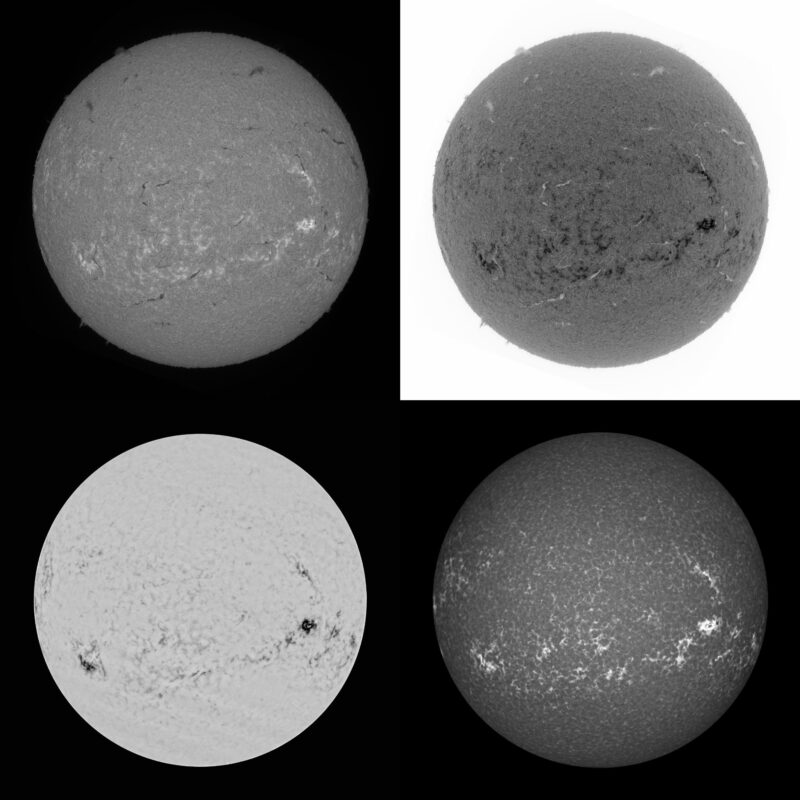
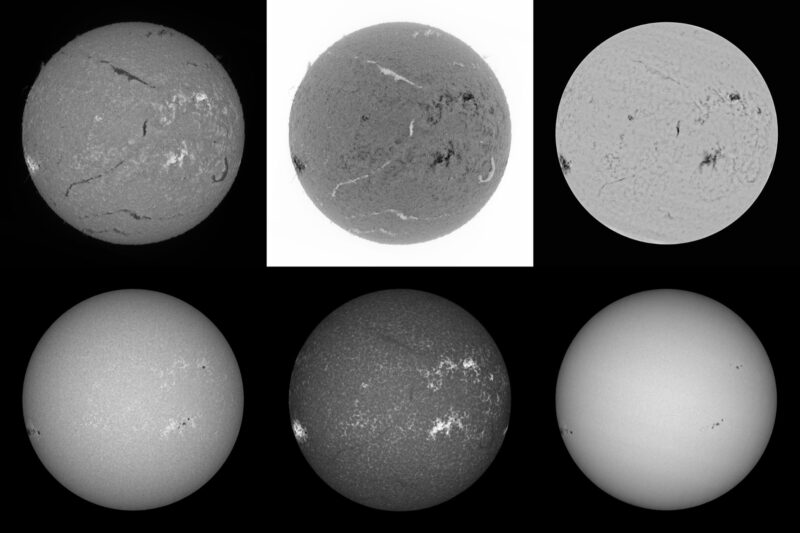
View at EarthSky Community Photos. | Mario Rana in Hampton, Virginia, captured these filtered images on November 19, 2025. Mario wrote: “The sun in hydrogen-alpha (positive and negative), helium D3, and calcium-H.” Thank you, Mario! 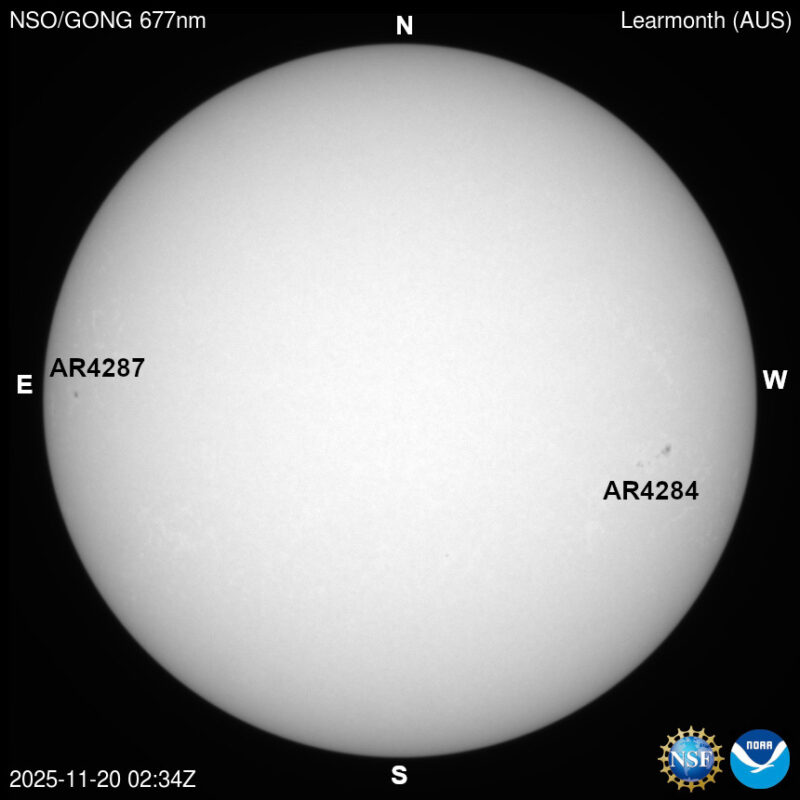
This image shows sun activity – with the most active regions labeled – as of 2 UTC on November 20, 2025, as seen from Learmonth Solar Observatory in Australia. Original image, without labels, via NSO/GONG. Armando Caussade posted today’s sun. Why are east and west on the sun reversed? Sun news November 19: New sunspot region comes out swinging
(11 UTC November 18 – 11 UTC November 19)
Sun activity had dropped to very low levels, with only faint B-class (weak) flares fired over the past day, until a new sunspot region suddenly stirred things up this morning. At 9:53 UTC, just as we were preparing this report, the region erupted with a C9.9 flare. That’s just a hair shy of the M flare threshold. And since some of the blast’s light was obscured by the eastern horizon, it most likely was an M-class event in reality. The blast launched sun-stuff into space, but its position on the edge of the solar disk means the material is not headed toward Earth. With prolific AR4274 now fully rotated onto the far side of the sun, this new region may be the next one to watch. Stay tuned as we track its evolution.
- Flare activity: Sun activity is low, with only one C-class (common) flare and five B-class (weak) flares for a total of six events over the past day.
- Strongest flare: A C9.9 flare from the incoming, as-yet-unnumbered northeast region at 9:53 UTC on November 19.
- Other notable flares: B9.8 at 19:58 UTC on November 19 from the same incoming region; B9.6 at 5:20 UTC and B9.3 at 0:55 UTC from AR4282; and B8.4 at 21:41 UTC on November 18 from the unnumbered northeast region.
- The unnumbered northeast region led activity, producing the only C flare and two B flares.
- Sunspot regions: Only two labeled sunspot regions currently occupy the Earth-facing side of the sun.
- AR4284 (beta) showed slight growth during the period.
- AR4283 (alpha) remains magnetically simple and stable, producing no flares.
- AR4282 (alpha) produced two faint flares before fading from view.
- Blasts from the sun? No Earth-directed coronal mass ejections (CMEs) appeared during the period.
- Solar wind: Solar wind speeds decreased from 450 km/s to 418 km/s at 10 UTC on November 18, then briefly spiked to 577 km/s at 22 UTC before easing again. The interplanetary magnetic field (IMF) held moderate strength at 7.47 nT. The Bz component stayed northward throughout the period, limiting geomagnetic storm potential.
- Earth’s magnetic field: Earth’s magnetic field stayed quiet, with Kp values of 0–1. No geomagnetic storms occurred. Kp = 1 at the time of writing.

Sun news for November 18-19, 2025. The GOES-19 SUVI instrument captured the near M-class eruption over the eastern limb, showing the ejecta heading into space. Images via NOAA/GOES. 
Sun news for November 18-19, 2025. The GOES-19 CORR1 coronagraph, designed to show the sun’s wispy outer atmosphere, captured a rare view of the near-new moon this morning. We can’t see the moon from Earth during this phase, as its unlit side faces us in the daytime sky. But the coronagraph is so sensitive to light that the near-new moon appears full, even though the side we’re seeing is actually only being lit by earthshine, or light reflected from Earth. Images via NOAA/GOES. Sun news November 18: Update on Solar Cycle 25 as solar max continues
(11 UTC November 17 – 11 UTC November 18)
NOAA has announced October 2025’s sunspot number, which is a measure of long-term solar activity. October’s value of 114 represents a slight dip from September’s 129, continuing a gradual downward trend since August 2024, the apparent peak of Solar Cycle 25. But after a week featuring 4 X (strong) flares and spectacular auroras, solar scientists still consider us to be in solar maximum, the peak of our star’s roughly 11-year activity cycle.
- Flare activity: Solar activity remains at low levels, with only 11 C-class (common) flares and 1 B-class (weak) flare fired over the past day.
- Strongest flare: C6.1 from AR4274 at 16:06 UTC on November 17.
- Other notable flares: C5.4 at 16:54 UTC on November 17 from AR4284, C2.2 at 3:25 UTC on November 18 from AR4284, C2.1 at 13:22 UTC on November 17 from AR4274.
- AR4284 continues to lead flare production, firing nine of the 12 flares.
- Sunspot regions: Only two labeled sunspot regions currently appear on the Earth-facing side of our star.
- AR4284 (beta) continues to grow.
- AR4283 (alpha) remains magnetically simple and stable, producing only faint flares during the period.
- Blasts from the sun? No Earth-directed coronal mass ejections (CMEs) appeared during the period.
- Solar wind: Solar wind speeds averaged around 500 km/s, with an early peak of 563 km/s. By 6 UTC on November 18, speeds dipped to 463 km/s. The interplanetary magnetic field (IMF) remained moderate at 5.74 nT. The Bz component alternated between northward and southward, but its strongest peak remained northward, limiting geomagnetic storm potential. Solar wind speeds are expected to stay elevated through November 18 under waning CME influence and lingering coronal hole high-speed stream effects.
- Earth’s magnetic field: Earth’s magnetic field ranged from quiet to unsettled, with Kp values of 1–3. No geomagnetic storm conditions occurred. Kp = 2 at the time of writing.
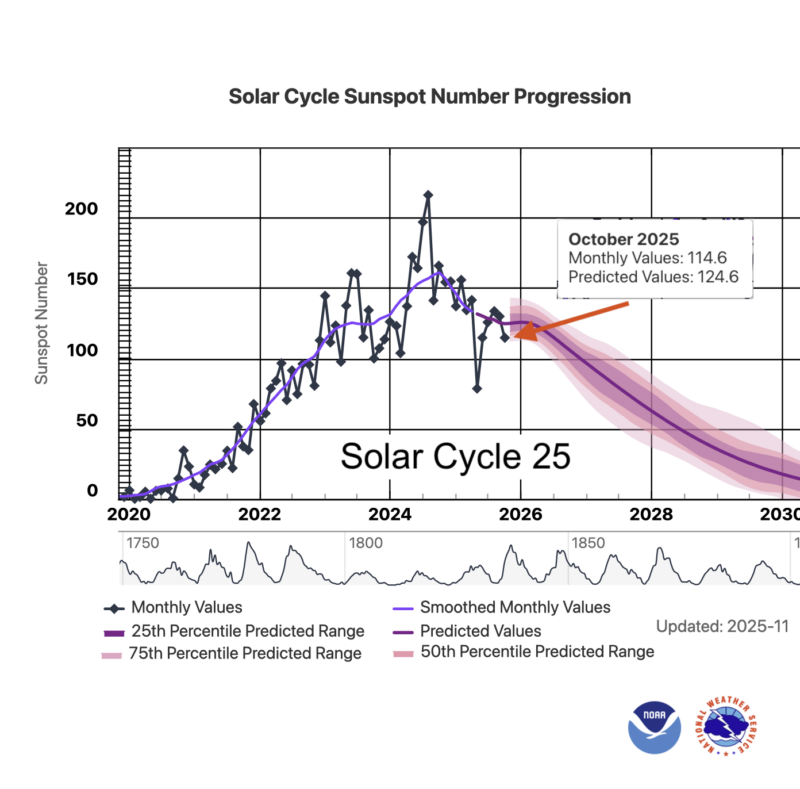
Sun news for November 17-18, 2025. NOAA has released October 2025’s sunspot number, which is a measure of long-term solar activity. The monthly value is 114, down from the September value of 129. It continues to appear that we’re in the downward part of solar maximum. Images via NOAA/ SWPC. 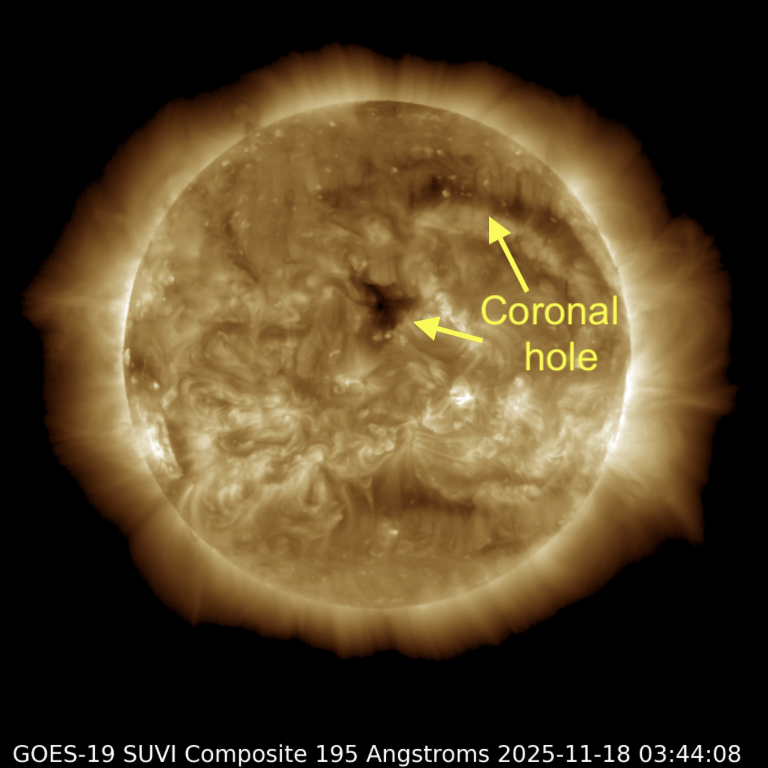
Sun news for November 17-18, 2025. A pair of coronal holes are sending high-speed solar wind at Earth, one in the center of the disk and the other in the northwest. Images via NOAA/ SWPC. Sun news November 17: New dominant region emerges as activity drops
(11 UTC November 16 – 11 UTC November 17)
The sun is currently taking a breather, with solar activity dropping to low after the departure of powerhouse region AR4274 over the northwest horizon. But a new sunspot group, AR4284, is stepping up to the plate. Having emerged near the center of the solar disk, this active region generated 14 of the 15 flares fired over the past 24 hours. Stay tuned to see what else AR4284 has got in store for us.
- Flare activity: Solar activity dropped to low levels, with 15 flares observed during the period.
- Strongest flare: C7.5 from AR4284 at 1:23 UTC on November 17. This modest event produced no radio blackout.
- Other notable flares: C5.0 at 19:40 UTC on November 16 from AR4284; C3.9 at 21:36 UTC on November 16 from AR4274; C4.0 at 16:40 UTC on November 16 from AR4274.
- AR4284 was the dominant flare producer, firing 14 of the 15 flares observed, including six C-class (common) events and eight B (weak) flares.
- Sunspot regions: The Earth-facing solar disk displays three numbered active regions, with AR4284 the most notable.
- AR4284 (beta) developed rapidly during the past day and immediately began producing flares. While relatively small, this region continues to show growth and remains the primary source of flare activity.
- The remaining regions on the visible disk are magnetically simple and either mostly stable or in gradual decay, contributing minimal flare activity during the period.
- Blasts from the sun? A filament eruption beginning after 22:00 UTC on November 15 produced a northern-oriented, narrow coronal mass ejection (CME). Subsequent coronagraph imagery and modeling showed the ejecta traveling well north of the sun-Earth line, with no impact at Earth expected. No Earth-directed CMEs were observed during the period.
- Solar wind: Solar wind speeds remained elevated throughout the period, averaging approximately 600–650 km/s with a peak near 720 km/s at 5:15 UTC on November 16. The enhancement reflected the combined influence of a glancing CME associated with the November 14 X4.0 (strong) flare and a negative polarity coronal hole high-speed stream. The interplanetary magnetic field (IMF) strength increased at 5:15 UTC on November 16 before settling back down. The Bz component saw weak southward deflections early in the period, but turned predominantly northward after 12:00 UTC on November 16, limiting geomagnetic storm potential. Solar wind speeds are expected to remain elevated through November 17 under waning CME influence and continued coronal hole high-speed stream effects.
- Earth’s magnetic field: Earth’s magnetic field ranged from quiet to active levels during the period, with the Kp reaching 4 (active) between 0:00 and 3:00 UTC on November 16. The brief enhancement reflected a prolonged period of southward Bz combined with a sudden increase in the total interplanetary magnetic field around 1:00 UTC associated with the glancing blow from the November 14 CME. Conditions subsequently settled to mostly quiet-to-unsettled levels (Kp 1–3) as the Bz component turned predominantly northward. No geomagnetic storm levels were reached during the period.

Sun news for November 16-17, 2025. A new dominant sunspot region, AR4284, has emerged near the center of the solar disk. This split view shows the region in an extreme ultraviolet wavelength on the left and visible light on the right. The ultraviolet view shows the flares and hot coronal loops from the region, while the visible light image shows the sunspots that make up the active region. Images via NASA/SDO and JHelioviewer. 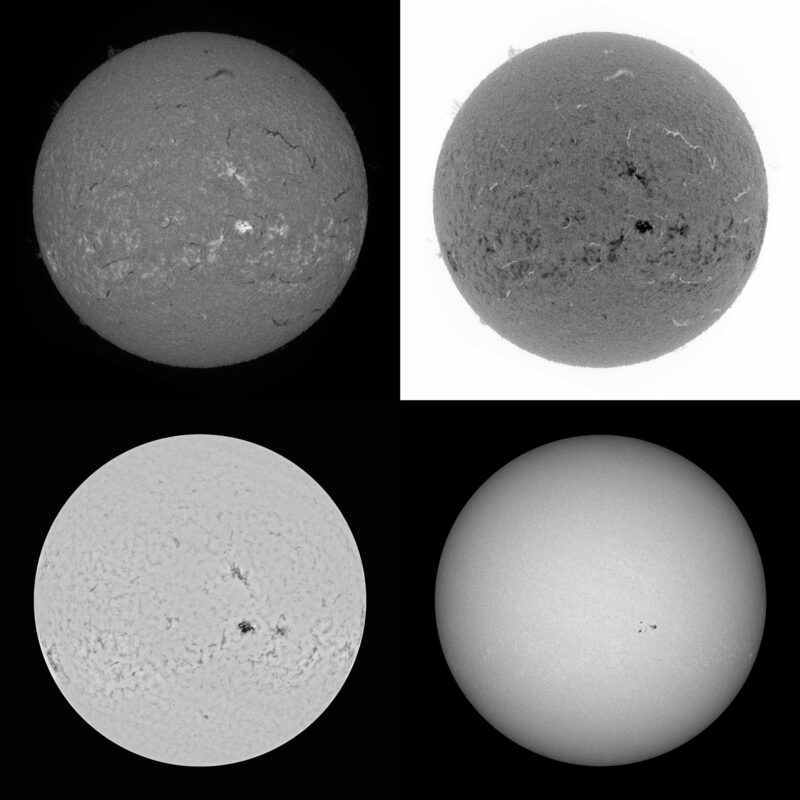
View at EarthSky Community Photos. | Mario Rana in Hampton, Virginia, captured these filtered images on November 17, 2025. Mario wrote: “The sun in hydrogen-alpha (positive and negative), helium D3, and iron 588.4 nm.” Thank you, Mario! Sun news November 16: Sunspots exit, new solar winds stir Earth
Today’s top story: The powerhouse sunspot region AR4274 has finally reached the sun’s northwest limb, ending a remarkable 2nd appearance on the Earth-facing side of our star. During this past week, the region delivered four X-class flares and several Earth-directed coronal mass ejections (CMEs). As it rotates out of view, solar activity has eased to low levels. But Earth’s space weather – which was driven by this sunspot region for most of the past week – remains in motion. Now, a new surge of coronal-hole–driven solar wind is beginning to take over. High-speed streams of solar wind are expected to raise geomagnetic activity again later today.
Past 24 hours: The details
(11 UTC November 15 – 11 UTC November 16)
- Flare activity: Solar activity remained at moderate levels, driven entirely by flare production from departed active region AR4274. Over the past 24 hours, the sun produced a total of 20 flares — one R1 (minor)–triggering M-class event and 19 C-class flares — all fired from just behind the northwest limb.
- Strongest flare: An M3.1 flare from AR4274 peaked at 07:49 UTC on November 16. The eruption triggered an R1 (minor) radio blackout over the Indian Ocean.
- Other notable C flares: AR4274 also produced several stronger C-class events, including a C8.7 at 22:42 UTC, a C7.2 at 00:32 UTC, a C4.2 at 01:36 UTC, and multiple flares in the C2–C3 range throughout the period.
- Lead flare producer: AR4274 was responsible for all 20 flares in this reporting window, continuing to fire off activity even as it rotates out of view.
- Sunspot regions: Seven numbered active regions remained on the Earth-facing disk.
- AR4274 continued its transit around the northwest limb. Its beta-gamma-delta complexity still supports isolated moderate flares, but limb foreshortening makes analysis difficult.
- AR4276, AR4277, and AR4280 showed minor decay.
- AR4283 was newly numbered (Hrx/alpha) and showed little activity.
- The remaining regions were small, magnetically simple, and showed little change.
- Blasts from the sun: A filament eruption in the southeast quadrant around 15/0430 UTC produced a slow-moving, south-directed coronal mass ejection (CME). Modeling shows the ejecta traveling below the sun–Earth line, with no impact expected. A glancing shock from the earlier X4.0 CME remains possible early November 16, though confidence is low.
- Solar wind: Solar wind parameters showed gradually declining CME influence from the November 11 event. Speeds held between 525–625 km/s. The interplanetary magnetic field (IMF) stayed weak at ~5 nT, with the Bz component varying between ±5 nT. Later on November 16, a co-rotating interaction region (CIR) and the leading edge of a negative-polarity coronal hole high-speed stream (CH HSS) are expected to increase solar wind speeds again.
- Earth’s magnetic field: Earth’s geomagnetic field remained quiet to unsettled, with Kp values between 1 and 3 throughout the day.
What’s ahead? Sun–Earth forecast
- Flare activity forecast: Solar activity should stay low but may reach isolated moderate levels (R1–R2) (30% chance) while AR4274 completes its rotation around the west limb. The chance of an additional X-class (strong) flare (30% chance) continues to decline and becomes low after November 17. By November 18, only occasional C flares and a slight chance of an M flare remain.
- Geomagnetic activity forecast:
- November 16: Mostly quiet to unsettled conditions. If the X4.0 CME shock arrives, brief G1 (minor) storming is possible early. Later in the day, a CIR followed by a CH HSS will likely elevate conditions to active or G1 levels, with a low chance of isolated G2 (moderate) periods if the effects combine.
- November 17: G1 (minor) conditions are likely as Earth continues to encounter the high-speed stream and residual CME effects. Activity may peak early, then trend downward.
- November 18: Conditions should return to quiet to unsettled levels (Kp 1–3) as high-speed stream influences gradually decline.

Sun news for November 15-16, 2025. The solar disk is display in visible light (continuum) to show sunspots. AR4274 is finally seen rotating completely out of view from SDO. The solar flares it’s still producing remain visible over the sun’s limb, or edge, high up in the sun’s corona, or outer atmosphere, observed in extreme ultraviolet light from SDO 171- and 131-angstrom wavelength. Images via NASA/SDO and jhelioviewer Sun news November 15: Hello and goodbye to powerhouse AR4274
Today’s top story: Hello and goodbye, sunspot region AR4274! This powerhouse sunspot is now slipping off the sun’s northwest limb, right at the edge of the solar horizon. When it first reappeared on the northeast limb, AR4274 raised big expectations. It had been a prolific flare producer when we first saw it on the sun’s near side some weeks ago. And it had been blasting away on the sun’s far side. And – at this passage across the sun’s visible face – this region did not disappoint. Over this transit, it produced four powerful X flares, X1.8, X1.2, X5.2, X4, plus a steady stream of M- and C-class flares. In just the past day alone, AR4274 fired two M1.3 flares and 14 C flares, staying in charge to the end. Earlier in the week, AR4274’s X flares launched a series of coronal mass ejections (CMEs) that slammed into Earth’s magnetic field between November 10–11. These impacts drove geomagnetic storms as strong as G3–G4, pushing bright auroras deep into the mid-northern latitudes. Skywatchers across the continental U.S., southern Canada, northern Europe, and even parts of northern Mexico (including Sonora, Zacatecas and Icamole near Monterrey) reported vivid curtains, arcs, and pillars of red and green light. For many skywatchers, these storms produced the most vivid auroral displays since the May 2024 “once-in-a-generation” and October 2024 events. Solar activity eased to moderate levels during this latest 24-hour period. With AR4274 now rotating away and only a few trailing CMEs left to arrive, we say a fond hello–goodbye to the region that powered this week’s solar fireworks. Farewell AR4274—well played!
Past 24 hours: The details
(11 UTC November 14 – 11 UTC November 15)
- Flare activity: Solar activity returned to moderate levels with two M-class flares and 15 C-class flares, for a total of 17 eruptions.
- Strongest flares: Two M1.3 flares from AR4274 at 20:12 UTC and 21:31 UTC on November 14. Both triggered R1 (minor) radio blackouts over the central Pacific Ocean.
- Other notable C flares: AR4274 produced a C6.2 at 5:28 UTC, a C3.8 at 17:55 UTC, and a C3.2 at 16:41 UTC. Newcomer AR4281 fired a C4.7 flare at 2:49 UTC shortly after emerging.
- Lead flare producer: AR4274 dominated the day with 16 of the 17 total flares.
- Sunspot regions: Seven numbered active regions populate the Earth-facing disk.
- AR4274 retains a complex beta-gamma-delta magnetic configuration. Although its structure shows minor growth, its position on the extreme northwest limb makes precise analysis difficult. It still holds the potential for more M or even X flares as it departs.
- AR4276, AR4277, and AR4280 each showed signs of decay.
- The remaining regions remained stable with simple alpha or beta configurations.
- Two regions were numbered this period: AR4281 and AR4282. AR4281 produced one C-class flare shortly after emergence and then quickly faded.
- Blasts from the sun: Modeling of yesterday’s X4.0 flare shows the main body of its coronal mass ejection (CME) will miss Earth. However, LASCO C3 imagery indicates a faint glancing blow may still reach us late November 15 or early November 16. CMEs from the two M flares are undergoing analysis.
- Solar wind: Solar wind speeds averaged around 570 km/s, with peaks near 640 km/s. By 10 UTC, speeds measured 535 km/s. The interplanetary magnetic field (IMF) reached a moderate 4.8 nT. The Bz component remained mostly northward with occasional southward dips. A southward orientation opens Earth’s magnetosphere to solar wind entry and drives auroras, but Bz stayed northward for much of the period.
- Earth’s magnetic field: Earth’s geomagnetic field stayed quiet, with Kp values between 0 and 2. Kp = 2 at the time of writing.
What’s ahead? Sun–Earth forecast
- Flare activity forecast: High solar activity remains possible while AR4274 is still in view. There is a 70% chance of additional M-class flares and a 30% chance of another X-class flare. These probabilities will drop once AR4274 rotates onto the far side.
- Geomagnetic activity forecast:
- November 15: Quiet to unsettled conditions expected for the remainder of the day. A high-speed solar wind stream could trigger a G1 (minor) storm, though the chance is low.
- November 16: An isolated G1 (minor) geomagnetic storm is possible from a glancing CME arrival.
- November 17: G1 (minor) geomagnetic storms remain possible.
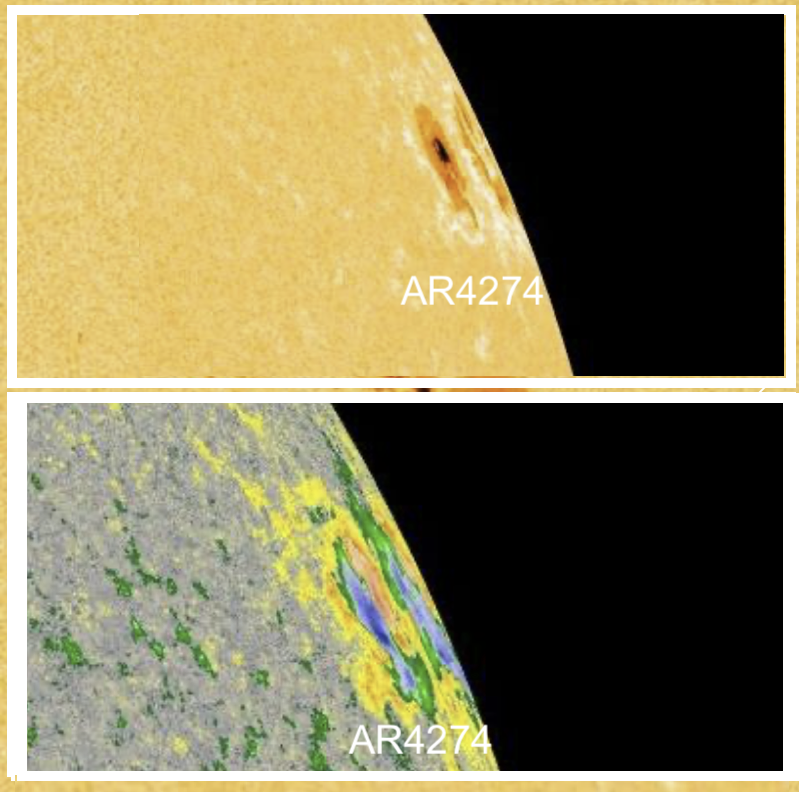
Sun news for November 14-15, 2025. A shout out and a farewell to this amazing sunspot region, AR4274. During its passage across the Earth-facing side of our star – over this past week – this sunspot group generated 4 X flares! And the resulting CMEs – or burps of sun material flung across space toward Earth – led to the 3rd-largest geomagnetic storm of Solar Cycle 25. It produced the spectacular auroral displays seen across North America this past week. The top image above shows AR4274 as it’s seen in visible light. And the bottom image shows the placement of this region’s localized magnetic fields. Now the sun’s rotation is carrying AR4274 out of view. Farewell, mighty sunspot region! Images via SDO. 
Sun news for November 14-15, 2025. A look at the final flaring activity from AR4274 before the region rotates out of view. The AR releases 2 M flares, 14 C flares for its farewell display. Images via NOAA/GOES. 
Sun news for November 14-15, 2025. Eruptions of plasma from the sun in the vicinity of AR4274 captured by the GOES-19 SUVI 304 angstrom wavelength channel. Images via NOAA/GOES. 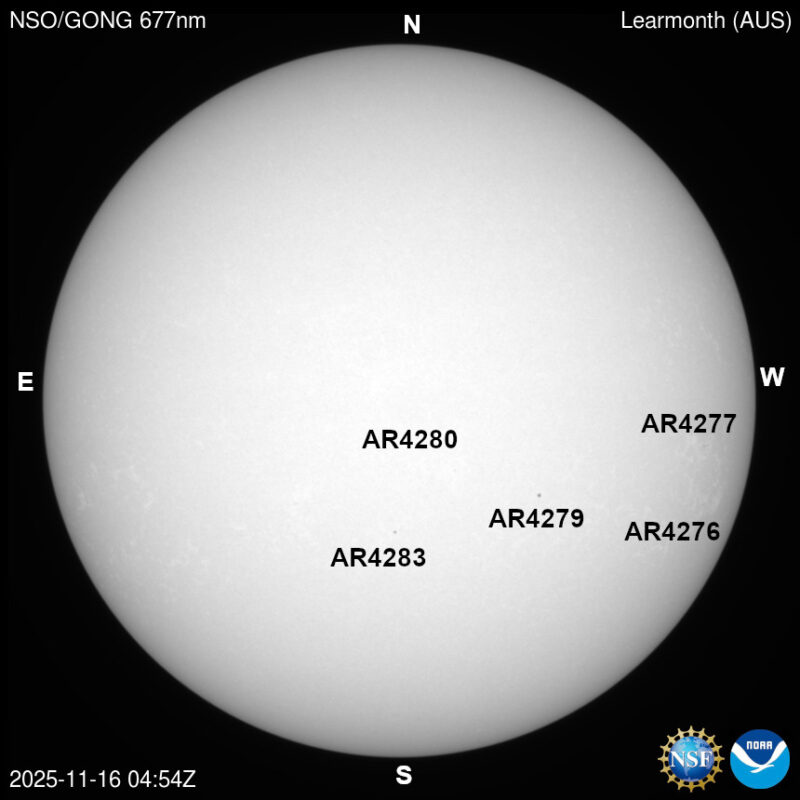
This image shows sun activity – with the most active regions labeled – as of 4 UTC on November 16, 2025, as seen from Learmonth Solar Observatory in Australia. Original image, without labels, via NSO/GONG. Armando Caussade posted today’s sun. Why are east and west on the sun reversed? Sun news November 14: The week’s 4th X flare from AR4274!
Active region AR4274 did it again, blasting out an X flare! It’s the 4th X flare of the week from this very prolific and unstable active region. This time, this region – our hero of the week – produced a mighty X4.0 flare at 8:30 UTC on November 14. AR4274 had just sparked an M1.8 flare at 7:39 UTC, when, barely an hour later, bam, it blasted today’s X flare. AR4274 is now on the northwest horizon of our star. Soon, it’ll depart to the sun’s far side, carried out by the sun rotation. The X flare provoked an R3 (strong) radio blackout over Madagascar. Right after the blast occurred, specialists started modeling and analysis of the coronal mass ejection (CME) launched during the event. Stay tuned as we will bring you the results.
Past 24 hours: The details
(11 UTC November 13 – 11 UTC November 14)
- Flare activity: Solar activity jumped back to high, with the production of this morning’s X flare. During our observation period, the sun produced 18 flares in total, an X, one M flare and 16 C-class flares.
- Strongest flare: X4.0 flare from AR4274 at 8:30 UTC.
- M flare and other notable flares: Just before the X flare, AR4274 produced an M1.8 flare at 7:39 UTC. The M flare provoked an R1 (minor) radio blackout that affected an area east of Madagascar. We also saw a C5.0 flare at 13:226 UTC from AR4276, a C3.9 at 16:39 UTC from AR4276, and a C3.4 at 17:25 UTC from AR4276. AR4274 produced a C2.4 flare at 14.31 UTC and a C2.2 at 19:39 UTC.
- Lead flare producer: This time AR4274 and AR4276 share the honors for top flare producer. Each active region produced seven flares.
- Sunspot regions: Our star shows today six numbered active regions on its Earth-facing side.
- AR4274 keeps its beta-gamma-delta magnetic configuration. A slight decay was observed in its trailing spots but it showed growth in its main spot. That means it continues being a potential source of more M-class or even X-class flares. Soon will see this active region on the edge of the northwest solar horizon.
- AR4276 lost again its gamma component for a beta configuration, but started producing C flares. Seven C flares in total.
- AR4280 showed a slight growth.
- Other regions stayed stable or slowly decayed, showing simple alpha or beta magnetic configurations.
- Blasts from the sun: The event of today’s X flare is under modeling and analysis to determine any component heading our way at Earth. Other than that no CMEs were observed to be Earth-oriented.
- Solar wind: During the first half of the period, solar wind started to reduce from 825 km/s down to 595 km/s by 10 UTC. The interplanetary magnetic field (IMF) reached at moderate 5.86 nT at 0:00 UTC and remains elevated at 35 nT at the time of writing. The Bz component stayed mostly northward during the period whole period. A southward orientation opens Earth’s magnetosphere to solar wind and fuels auroral activity.
- Earth’s magnetic field: Earth’s geomagnetic field ranged from active-to-quiet levels (Kp = 5–1). A G1 (minor) storm was observed at 15 UTC on November 13 as a reverberating effect from all the disturbance we saw during the week. After that, Earth’s magnetic field dropped down to Kp =1 levels.

Sun news November 14, 2025. Active region AR4274 granted us with another X flare. An X4.0 flare was observed at 8.30 UTC on November 14. An R3 (strong) radio blackout was registered after the blast. It affected an area over Madagascar. GOES-19 SUVI 131 angstrom. Image via NOAA. 
November 14, 2025. A gorgeous prominence on the sun’s southwest horizon, shortly after the X4.0 flare from AR4274. We might soon be seeing prominences like this, as this active region rotates to the far side. GOES-19 SUVI 304 angstrom. Image via NOAA. Sun news November 13: More spectacular auroras last night
Auroras lit up the skies again last night! Though not as widespread as those seen on Tuesday evening, stunning displays were still seen across much of the Northern Hemisphere. The anticipated coronal mass ejection (CME) launched by an X5.1 flare from AR4274 impacted Earth’s magnetic field weaker than expected, but it still drove geomagnetic storm conditions up to G3 (strong). This allowed shimmering green and pink curtains of light to be spotted well into the mid-tier states of the U.S. including Nebraska, Iowa, Illinois, Ohio, Pennsylvania, and Maryland, as well as across Europe and Canada. We’ve collected some of our favorite aurora shots from the past 2 nights in this video gallery. Enjoy!
Past 24 hours: The details
(11 UTC November 12 – 11 UTC November 13)
- Flare activity: Solar activity remained at a low level, with only C-class (common) flares fired over the last 24 hours. The sun produced nine C-class flares in total.
- Strongest flare: A C6.1 flare from AR4274 at 3:34 UTC.
- Other notable flares: A C4.5 flare at 16:39 UTC, a C4.3 at 0:10 UTC, and a C4.0 at 0:57 UTC, all from AR4274. AR4276 produced a C3.1 flare at 5:08 UTC and a C2.3 at 6:40 UTC.
- Lead flare producer: AR4274 again dominated activity, producing 7 of the 9 flares.
- Sunspot regions: Seven numbered active regions currently feature on the Earth-facing solar disk.
- AR4274 still holds the most complex beta-gamma-delta magnetic configuration. It shows slight decay but maintains polarity inversion lines, meaning it remains capable of producing more M-class or even X-class flares. The region is now approaching the western horizon.
- AR4276 regained its gamma component for a beta-gamma configuration, but produced only two weak C flares.
- Other regions stayed stable or slowly decayed, showing simple alpha or beta magnetic configurations.
- Blasts from the sun: The CME from the X5.1 flare on November 11 appeared in LASCO C3 images as an asymmetric halo event, and its weaker-than-expected impact yesterday caused last night’s more modest but still vibrant auroras. We’re still awaiting the arrival of additional CMEs from two M flares, expected around November 15.
- Solar wind: During the first half of the period, solar wind speeds rose from 679 km/s and peaked at 986 km/s around 9 UTC on November 13, then eased to 825 km/s by 10 UTC. The interplanetary magnetic field (IMF) reached a moderate 12 nT at 0:00 UTC and remains elevated at 35 nT at the time of writing. The Bz component stayed northward during the first half of the period, then turned southward at 23:17 UTC. A southward orientation opens Earth’s magnetosphere to solar wind and fuels auroral activity.
- Earth’s magnetic field: Earth’s geomagnetic field ranged from active to very active levels (Kp = 5–7). A G1 (minor) storm began at 12 UTC on November 12 and strengthened into a G3 (strong) storm from 0:00 to 6 UTC on November 13. As of this report, conditions have eased to G2 (moderate) with Kp = 6.
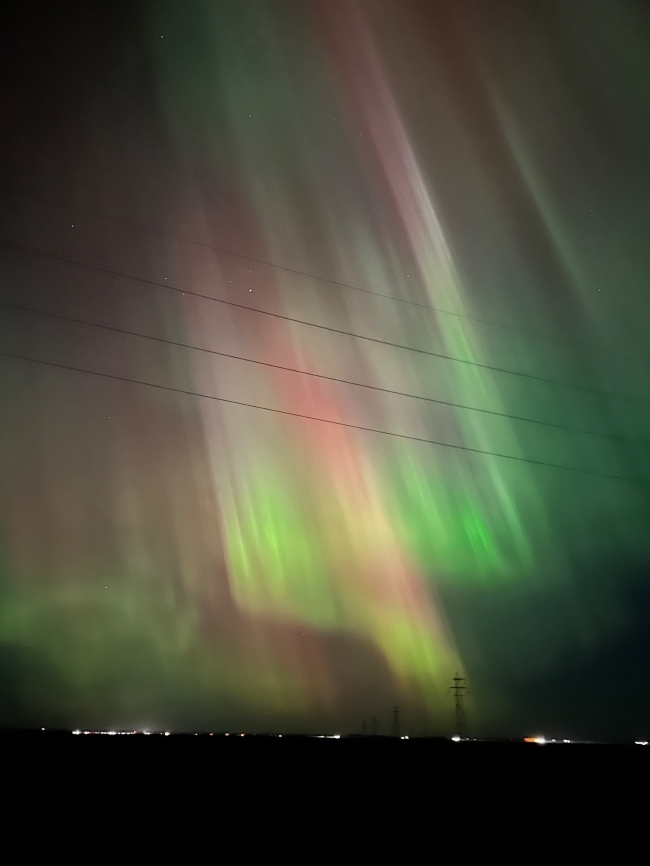
Sun news for November 13, 2025. | View at EarthSky Community Photos. | Terence Bergmann captured this view from Manitoba, Canada last night, as this week’s explosion of auroras continued. Thank you, Terence! 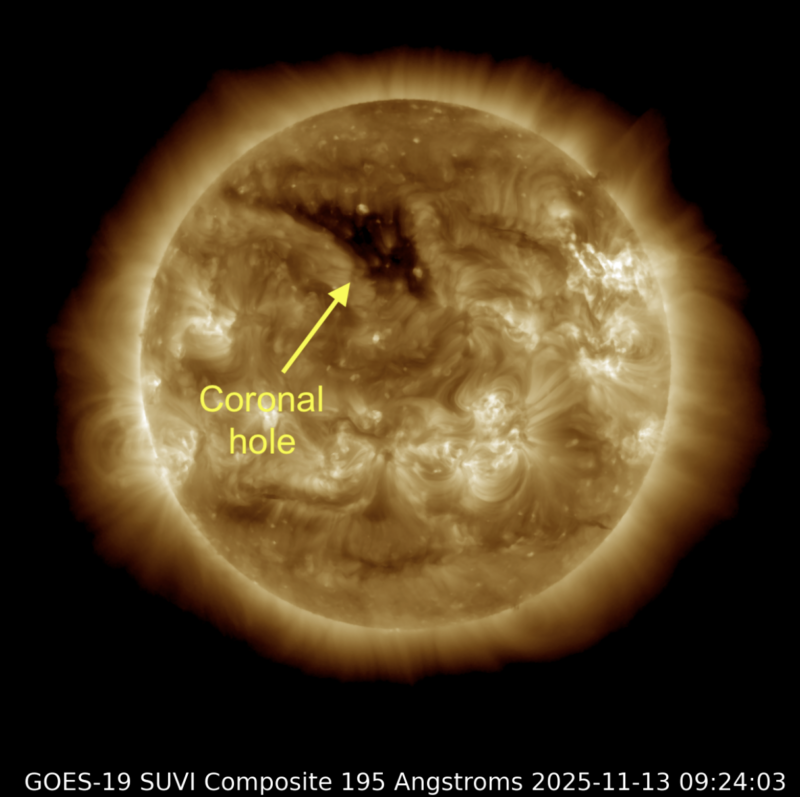
Sun news for November 12-13, 2025. A new coronal hole is rotating into view and could soon send high-speed solar wind toward Earth. Images via NOAA/GOES. 
Sun news for November 12-13, 2025. Sunspot region AR4274 continues to blow solar stuff into space as it makes its approach to the western limb (edge). Images via NOAA/GOES. Sun news November 12: Spectacular auroras last night! More coming?
A brilliant burst of auroras lit up skies across the globe last night. Skywatchers saw vivid greens and reds after a string of coronal mass ejections (CMEs) launched by the sun’s recent X-class flares slammed into Earth’s magnetic field, triggering a G4 (severe) geomagnetic storm. Auroras were reported across much of the continental U.S. — as far south as Sonora and Zacatecas, Mexico — in one of the most widespread light shows of the current solar cycle. Meanwhile, multiple CMEs from this week’s X-class flares continue to race toward Earth, meaning more auroral activity is possible within the next 24 hours. Did you catch the auroras last night? Share your photos with us and stay tuned, because the show may not be over yet.
Past 24 hours: The details
(11 UTC November 11 – 11 UTC November 12)
- Flare activity: Solar activity has dropped to a low level, with only C-class (common) flares recorded over the past day. The sun produced 10 C-class flares during this period, compared to 28 eruptions the previous day.
- Strongest flare: A C4.2 flare from AR4274 at 16:48 UTC.
- Other notable flares: C3.1 at 8:55 UTC, C2.9 at 22:21 UTC, C2.8 at 15:36 UTC, and C2.5 at 2:56 UTC — all from AR4274.
- Lead flare producer: AR4274 remained dominant, producing 7 of the 10 C flares in this period.
- Sunspot regions: The Earth-facing solar disk continues to display seven numbered active regions.
- AR4274 maintains a complex beta-gamma-delta magnetic configuration. It showed slight growth and retains strong polarity inversion lines: the primary indicator of flare potential. More M- and X-class flares remain possible from this region.
- AR4276 lost its previous gamma complexity. It’s now classified as beta, and produced only two weak C-class flares.
- Other regions stayed stable or in slow decay, showing simple alpha or beta configurations with minimal change.
- Blasts from the sun: No Earth-oriented coronal mass ejections (CMEs) were observed in available coronagraph imagery in the past 24 hours. The reported CME from the X5.1 flare on November 11 arrived late on November 12 and brought back geomagnetic disturbances at Earth for more auroral displays. We’re still awaiting arrival of the additional CMEs from the two M flares also Earth-directed, expected to arrive around November 15.
- Solar wind: During the first half of the period, solar wind speeds averaged near 400 km/s before spiking sharply to 735 km/s at 0:00 UTC due to the cannibal CME’s arrival. Speeds briefly dipped between 6–9 UTC, then rose again to 679 km/s at 10 UTC. The interplanetary magnetic field (IMF) peaked at 60 nT at 0:00 UTC and remains elevated at 35 nT at the time of writing. The Bz component stayed mostly southward — a configuration that opens Earth’s magnetic field to solar wind entry, fueling strong auroral activity.
- Earth’s magnetic field: Conditions shifted from quiet late yesterday to severe geomagnetic storm levels overnight (Kp = 0–8). A G4 (severe) storm began at 1:22 UTC and persisted through 9 UTC on November 12. At the time of this report, conditions remain at G1 (minor) storm level, with Kp at 5.
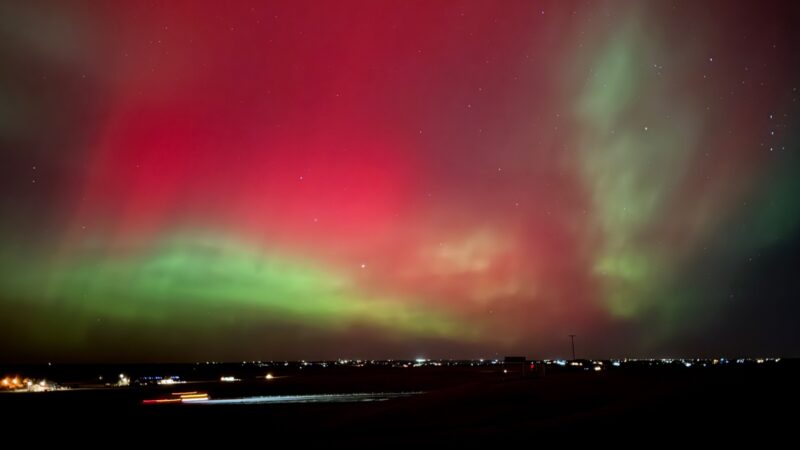
Sun news for November 11-12, 2025. View at EarthSky Community Photos. | Martin Curran in Cheyenne, Wyoming, photographed the aurora on November 11, 2025, and wrote: “This is facing east. You can spot Orion, to the right, Jupiter in the middle with Castor and Pollux above it. Wow, what a show tonight.” Thank you, Martin! 
View at EarthSky Community Photos. | Darrell Reese spotted last night’s auroras from Ohio! Thank you for sharing your photo, Darrell. 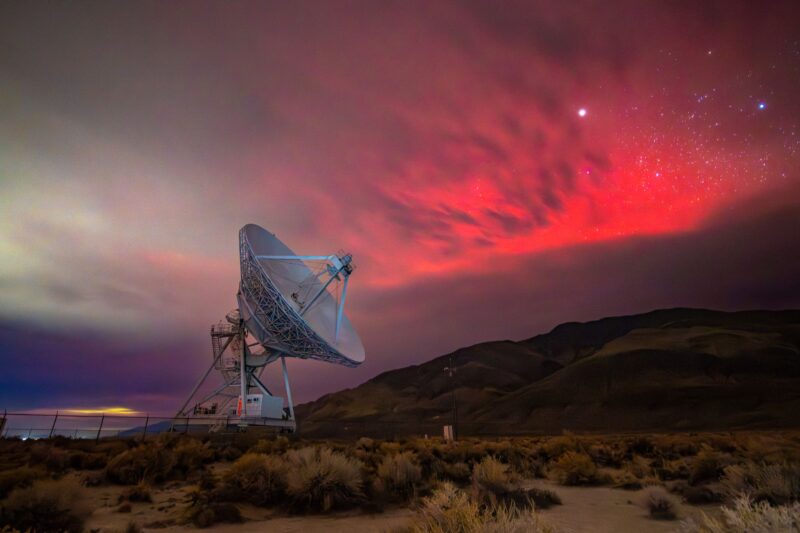
View at EarthSky Community Photos. | Ross Stone in Big Pine, California, captured this stunning view on November 11, 2025, and wrote: “The NRAO radio telescope in Owens Valley and the beautiful red aurora in the Novemebr sky. This was awesome, and the sky was so bright.” Thank you, Ross! 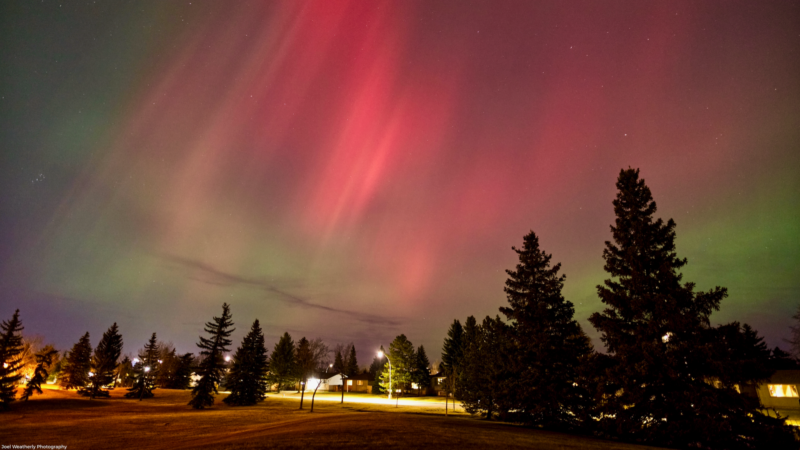
View at EarthSky Community Photos. | Joel Weatherly in Edmonton, Alberta, Canada, captured this aurora on November 11, 2025. Joel wrote: “Tonight, the auroras have been sporting a vibrant red hue. As seen from Edmonton, the activity was most prominent in the southern sky (Saturn is the bright point at the top of the tree) as the auroral oval arched overhead.” Thank you, Joel! See more aurora photos in our new gallery. 
Sun news for November 11-12, 2025. As we finish a night of aurora, we await the next round of coronal mass ejections headed our way. The most recent X flare – the X5.1 – not only sent material our way, but also a blast of high-energy particles that can be seen as snow on the coronagraph camera. Images via NASA/SOHO. Sun news November 11: X flare frenzy! Auroras to come?
The action keeps coming! At 10:04 UTC this morning, powerhouse sunspot region AR4274 fired off an X5.2 (strong) flare, its 3rd X flare in 3 days. This massive flare pushed solar activity to very high levels, flooding the sun’s atmosphere with energy and hurling a coronal mass ejection (CME) directly toward Earth. In fact, multiple coronal mass ejections (CMEs) from this region’s recent X flares are now racing toward our planet. Models suggest they may merge into a cannibal CME, when a faster blast of sun-stuff overtakes an earlier one, amplifying its impact. If so, Earth could experience a geomagnetic storm within the next 24 hours, potentially lighting up the skies with brilliant auroras. Stay tuned!
Past 24 hours: The details
(11 UTC November 10 – 11 UTC November 11)
- Flare activity: Solar activity stayed at a very high level, with one X-class flare, two M-class (moderate) flares, and 25 C-class (common) flares for a total of 28 eruptions. That’s twice as many as the previous day.
- Strongest flare: The X5.2 flare from AR4274 at 10:04 UTC on November 11. This caused an R3 (strong) radio blackout over southern Africa.
- Other notable flares: An M1.5 from AR4274 at 19:57 UTC on November 10 (R1 minor blackout over the Pacific north of Easter Island) and an M1.4 from AR4274 at 8:09 UTC on November 11 (R1 minor blackout over the Indian Ocean east of Madagascar). Largest C flares: C7.8 at 15:22 UTC, C6.8 at 8:38 UTC, and C6.0 at 14:18 UTC, all from AR4274.
- Lead flare producer: AR4274 dominated the day with 26 of the 28 total flares, including both M flares and the X5.2 event.
- Sunspot regions: Seven numbered active regions currently cover the Earth-facing disk.
- AR4274 maintained its beta-gamma-delta magnetic configuration, expanding in size and developing new polarity inversion lines, a strong indicator of continued flare potential.
- AR4276 (beta-gamma) stayed stable and quiet.
- Other regions remained magnetically simple (alpha or beta) with little change.
- Blasts from the sun: Multiple CMEs have erupted from AR4274 during the recent series of X flares. Two of these CMEs are likely to merge into a cannibal CME, with an expected arrival around November 12. This could potentially spark geomagnetic storms and spectacular auroral displays. The two M flares produced during the period produced corresponding coronal mass ejections directed to us at Earth, with anticipated arrivals by November 15.
- Solar wind: Solar wind speeds averaged near 430 km/s as the influence of a waning coronal hole high-speed stream (CH HSS) continued to fade. The interplanetary magnetic field (IMF) remained weak, while the Bz component stayed mostly southward. A southward configuration opens Earth’s magnetic field to solar wind entry, priming conditions for auroras once the CMEs arrive.
- Earth’s magnetic field: Conditions remained mostly quiet (Kp = 2–3) as earlier solar wind influences waned. This calm likely won’t last; strong geomagnetic storm activity is expected once the new CMEs impact Earth.

Sun news for November 10-11, 2025. Sunspot region AR4274 is at it again with its 3rd X (strong) flare in 3 days! The GOES-19 SUVI instrument captured this view of the X5.2 event. There appears to be sun-stuff soaring out of the region after the beginning of the eruption. Images via NOAA/GOES. 
Sun news for November 10-11, 2025. A NOAA computer simulation showing the multiple coronal mass ejections (CMEs) heading toward Earth and possibly combining as a cannibal CME. Images via NOAA/SWPC. Sun news November 10: Another X flare! Sun-stuff on the way
The sun is at it again! For the second time in just over 24 hours, volatile sunspot region AR4274 erupted with a powerful X flare. The X1.2 flare came at 8:55 UTC this morning, keeping solar activity at very high levels. It triggered an R3 (strong) radio blackout that disrupted high-frequency communications across southern Africa. The eruption produced a coronal mass ejection (CME), which is under analysis to determine if it’s heading Earthward. Meanwhile, another CME from yesterday’s X1.8 flare is expected to arrive tomorrow. This could potentially bring G1-G2 (minor-moderate) geomagnetic storms and auroral displays to northerly latitudes.
Past 24 hours: The details
(11 UTC November 09 – 11 UTC November 10)
- Flare activity: Solar activity remained very high, with 14 flares observed, including an X-class event.
- Strongest flare: X1.2 from AR4274 at 8:55 UTC on November 10. It triggered an R3 (strong) radio blackout affecting the Earth’s sunlit hemisphere. Primarily, it disrupted aviation and maritime radio operations around southern Africa for approximately 30 minutes.
- Other notable flares: The period also saw C5.5 and C3.5 flares from AR4276 at 18:10 UTC and 17:48 UTC on November 9, along with multiple C2-class flares from AR4274 at 7:06 UTC, 6:42 UTC, 5:24 UTC, and 3:35 UTC on November 10.
- AR4274 was the lead flare producer, responsible for 8 flares including the X-class event. AR4276 contributed 4 C-class flares, while AR4277 and AR4279 each produced single C-class flares.
- Sunspot regions: The Earth-facing solar disk currently displays 6 numbered active regions.
- AR4274 (beta-gamma-delta) maintained its magnetically complex configuration and continued to dominate solar activity. This large region shows ongoing development, and remains the most significant flare candidate on the visible disk.
- AR4276 (beta-gamma) continued to show slight growth during the past day and produced multiple C-class flares, establishing itself as the second most active region.
- AR4277 (beta) also showed slight growth and contributed a C1.8 flare.
- The remaining regions were relatively unchanged and remained inactive throughout the period.
- Blasts from the sun? Two significant Earth-directed coronal mass ejections (CMEs) were detected during the period.
- A halo CME erupted at 7:48 UTC on November 9 from the north-northeast limb (AR4274), associated with yesterday’s X1.8 flare. The CME was first observed in SOHO LASCO C2 imagery, which showed an asymmetric halo structure. Initial analysis indicates an Earth-directed component with anticipated arrival around midday on November 11. The eruption produced Type II radio emissions (804 km/s) and Type IV radio bursts, which indicate a significant eruption.
- A second halo CME associated with today’s X1.2 flare from AR4274 at 8:55 UTC on November 10 is currently under analysis. Given the region’s location and the flare’s magnitude, Earth-impact potential is being assessed.
- An earlier CME from November 7 is expected to pass in close proximity to Earth on November 10, potentially producing mildly enhanced solar wind conditions.
- Solar wind: Solar wind speeds gradually decreased from 600 km/s to around 525 km/s as a waning coronal hole high-speed stream continued to ease. The interplanetary magnetic field (IMF) remained weak. The Bz component fluctuated between northward and southward throughout the period. A southward Bz favors auroras, by opening Earth’s magnetic field to solar wind penetration.
- Earth’s magnetic field: Earth’s magnetic field remained at quiet levels throughout most of the past day, with Kp values ranging from 1 to 3. No geomagnetic storm conditions were observed. The quiet conditions reflect the waning influences from earlier solar wind disturbances as the coronal hole high-speed stream effects dissipated.

Sun news for November 9-10, 2025. The sun has blasted yet another X (strong) flare! The X1.2 from AR4274 came roughly 24-hours after yesterday’s X flare, and also produced a possibly Earth-directed coronal mass ejection (CME). Images via NASA/ SDO, NASA/ SOHO, and JHelioviewer. Sun news November 9: X1.8 EXPLOSION rocks the sun, stuff on the way!
(11 UTC November 8 – 11 UTC November 9)
Today’s top story: The sun exploded with a powerful X1.8-class flare at 7:01 UTC this morning (November 9, 2025). The flare marked a dramatic surge to very high activity levels. The eruption originated from the magnetically complex AR4274, a large region near disk center. The powerful blast triggered a radio blackout, disrupting high-frequency communications across the sunlit hemisphere. The eruption also sent a blob of blob of material, a coronal mass ejection (CME) in Earth’s direction. The CME is observed as a halo event in the LASCO C2 coronagraph. A EIT or coronal wave rushed across the solar surface. This X-class event capped a period of sustained C-class flare production recorded throughout the past 24 hours, most originating from the same prolific sunspot region, AR4274. Meanwhile, Earth’s magnetic field eased to unsettled levels. With the Sun’s most complex region still near disk center and additional CME arrivals possible, the coming days promise continued solar fireworks and potential geomagnetic disturbances.
- Flare activity: Solar activity surged to very high levels, with 14 flares observed during the period—including one powerful X-class event.
- Strongest flare: X1.8-class from AR4274 at 07:01 UTC on November 09. It triggered an R3 (strong) radio blackout, disrupting high-frequency communications across the sunlit hemisphere—particularly affecting aviation routes over the Pacific Ocean and maritime radio operations in the Indian Ocean—for over an hour.
- Lead flare producer: AR4274 was the dominant source, responsible for 8 flares including the X1.8 event and multiple C-class flares: C4.3 at 05:36 UTC, C2.9 at 05:03 UTC, C1.9 at 01:33 UTC, C2.9 at 21:50 UTC on November 08, C2.1 at 21:19 UTC, C1.7 at 20:41 UTC, C2.0 at 14:50 UTC, and C3.8 at 12:55 UTC.
- Other notable flares: AR4276 produced a C6.3 flare at 03:57 UTC on November 09, while AR4277 contributed three C-class events: C1.9 at 03:29 UTC, C1.7 at 23:58 UTC on November 08, and C2.4 at 19:16 UTC. One additional C4.0 flare at 06:07 UTC on November 09 originated from an unknown source region.
- Sunspot regions: The Earth-facing solar disk displayed 5 numbered active regions, with AR4274 dominating the landscape.
- AR4274 (beta-gamma-delta) remained the largest and most magnetically complex region on the visible disk.
- AR4276 (beta-gamma) exhibited slight growth during the period and produced several C-class flares. This southeast region showed increasing activity as it rotated into a more geoeffective position.
- AR4277 (beta) also showed slight growth and contributed three C-class flares during the period. Located in the southeast quadrant, this region demonstrated modest but persistent activity.
- AR4278 (beta configuration) produced C-class flares according to SIDC observations, though it remained smaller and simpler than the three dominant regions.
- The remaining regions were relatively unchanged and inactive, showing simple magnetic configurations and little to no flare production during the period.
- Blasts from the sun? One CME with potential Earth impact was tracked, while no new Earth-directed CMEs were detected during the current period. This morning’s X flare appears to be headed our way thanks to a halo CME observed in the SOHO LASCO C2 coronagraph. We await analysis from space weather experts.
- A partial halo CME erupted at 07:23 UTC on November 07 from AR4274. NASA computer modeling shows Earth arrival potential.The model predicts Earth arrival on November 09 around 18:00 UTC. Kp indices forecast to reach 4–7, indicating G1-G2 (minor-moderate) geomagnetic storm with potential for isolated G3 (Strong) levels. Aurora possibly visible from Seattle, Minneapolis, Edinburgh, Toronto, Chicago, and northern England may also be visible as far south as New York, London, Paris, northern France, and possibly southern Australia.
- A partial halo CME was detected in SOHO/LASCO-C2 data around 12:48 UTC on November 07, likely associated with a C3.1 flare from AR4274. Analysis of this CME’s Earth-directed component is ongoing.
- Solar wind: Solar wind speeds ranged from 575–700 km/s, reflecting remnant CME effects and coronal hole high-speed stream (CH HSS) influences. The interplanetary magnetic field (IMF) total strength gradually decreased during the period. The Bz component was sustained southward.
- Earth’s magnetic field: Earth’s magnetic field eased to active and then quiet to unsettled levels (Kp 1–4) by mid-period as the southward Bz component weakened.
What’s ahead? Sun–Earth forecast
- Flare activity forecast: M-class flares (R1-R2) are 70% likely on November 09–11, with a 20% chance for isolated X-class events primarily from AR4274. The magnetically complex beta-gamma-delta region near disk center remains the primary threat, though AR4276 and AR4277 in the southeast also show potential for moderate activity.
- Geomagnetic activity forecast:
- November 9: Periods of G1-G2 (minor-moderate) storming are likely in response to the anticipated arrival of the November 07 CME. The shock front is forecast to arrive around 13:47 UTC, with the main CME material following around 18:00 UTC. Kp indices may reach 5–7, with aurora potentially visible from Seattle, Minneapolis, Edinburgh, Toronto, Chicago, northern England, and possibly as far south as New York, London, and Paris if conditions align favorably. Negative polarity CH HSS influences will continue contributing to elevated activity levels.
- November 10: Periods of G1-G2 (minor-moderate) storming are likely due to continued negative polarity CH HSS influences and any remnant effects from the November 07 CME. Aurora displays may continue across high-latitude regions including Scotland, Scandinavia, Alaska, northern Canada, and Tasmania. Kp indices are expected to range from 4–6, with the potential for isolated periods reaching Kp 7 if CME effects persist longer than anticipated.
- November 11: Isolated active periods are likely as negative polarity CH HSS influences and any remnant CME effects wane. Geomagnetic conditions should gradually return toward quiet to unsettled levels (Kp 2–4), though brief active intervals (Kp 4–5) remain possible. Aurora visibility will likely be limited to auroral zone locations such as northern Alaska, northern Canada, Iceland, and northern Scandinavia by late in the day.

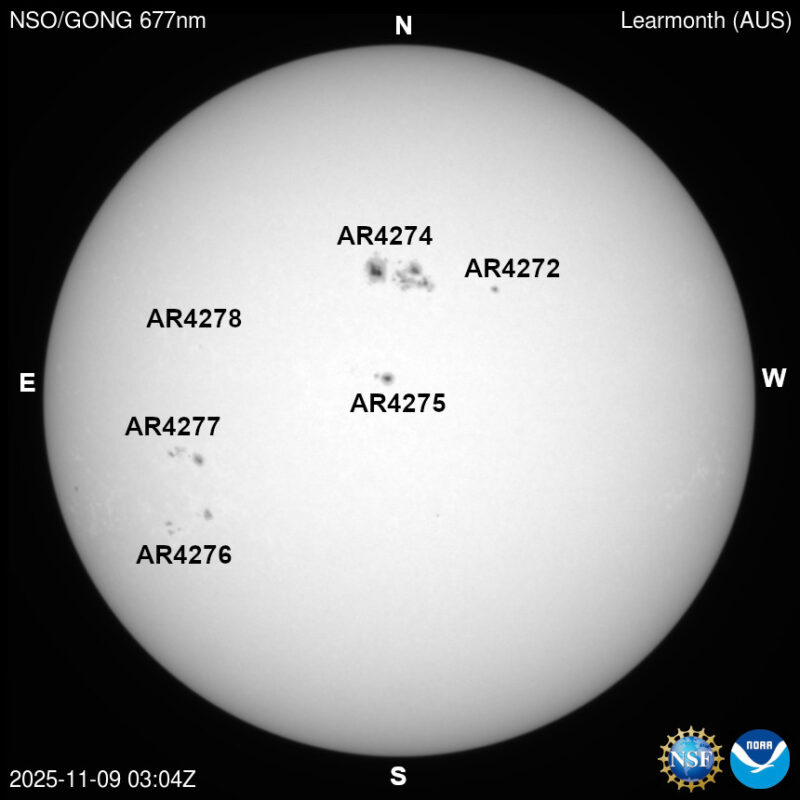
This image shows sun activity – with the most active regions labeled – as of 3 UTC on November 9, 2025, as seen from Learmonth Solar Observatory in Australia. Original image, without labels, via NSO/GONG. Armando Caussade posted today’s sun. Why are east and west on the sun reversed? Sun news November 8: Auroras, auroras, and more auroras!
(11 UTC November 7 – 11 UTC November 8)
Auroras danced across the skies again last night as Earth remained under the influence of multiple incoming coronal mass ejections (CMEs). Observers reported colorful displays as far south as the northern U.S. and Europe last night. Another round of geomagnetic storming is possible in the coming days as more CMEs approach Earth. Meanwhile, the sun itself took a breather, with flare production over the past day dropping from high and moderate to low (only C flares). Even so, our star remains restless, with mighty active region AR4274 still holding the magnetic complexity needed for more surprises.
- Flare activity: Solar activity fell to low levels over the past 24 hours, with only C flares. Despite the decrease in intensity, the number of flares remained high — 22 in total, matching the previous day’s count.
- Strongest flare: A C6.9 flare erupted from AR4274 at 15:51 UTC on November 7.
- Notable C flares: A C5.8 flare (20:45 UTC) from AR4276; a C5.1 flare (17:04 UTC) from AR4274; a C4.8 flare (01:28 UTC) from AR4277; a C4.1 flare (06:17 UTC) from AR4276; and a C3.7 flare (07:14 UTC) from AR4274.
- Lead flare producer: The week’s standout region, powerful AR4274, continued to dominate with 14 flares, including the strongest of the period.
- Sunspot regions: The Earth-facing side of the Sun currently shows seven numbered active regions, with AR4274 still the largest and most magnetically complex.
- AR4274 (beta-gamma-delta) remains the dominant player, maintaining its size and magnetic complexity while continuing to produce frequent C flares.
- AR4275 (beta-gamma), AR4272 (alpha), and AR4273 (alpha) remained quiet and showed continued decay.
- AR4276 (beta-gamma) remained an active C-class producer, firing off four flares.
- Two new active regions rotated into view: AR4277 (beta) in the southeast, producing five C flares; and AR4278 (beta) in the northeast, which showed little activity so far.
- Blasts from the sun: The M1.7 flare from AR4274 on November 7 launched a faint, asymmetric-halo coronal mass ejection (CME). Analysis indicates that this CME is Earth-directed and should arrive on November 10. Several smaller CMEs from the same region appear to be on a similar trajectory, also targeting Earth around November 10.
- Meanwhile, earlier CMEs and a co-rotating interaction region (CIR) continue to influence space weather, sustaining G1 (minor) geomagnetic storm conditions alongside ongoing high-speed solar wind flows.
- Solar wind:
- Solar wind speeds decreased from 850 km/s to around 600 km/s during the period. At 10:30 UTC on November 8, speeds were near 632 km/s, with residual CME influence still in effect.
- The interplanetary magnetic field (IMF) weakened from moderate (~12 nT) to ~6 nT. The Bz component remained northward through the first half of the period before turning southward at 23:50 UTC on November 7 — a favorable shift for renewed geomagnetic and auroral activity.
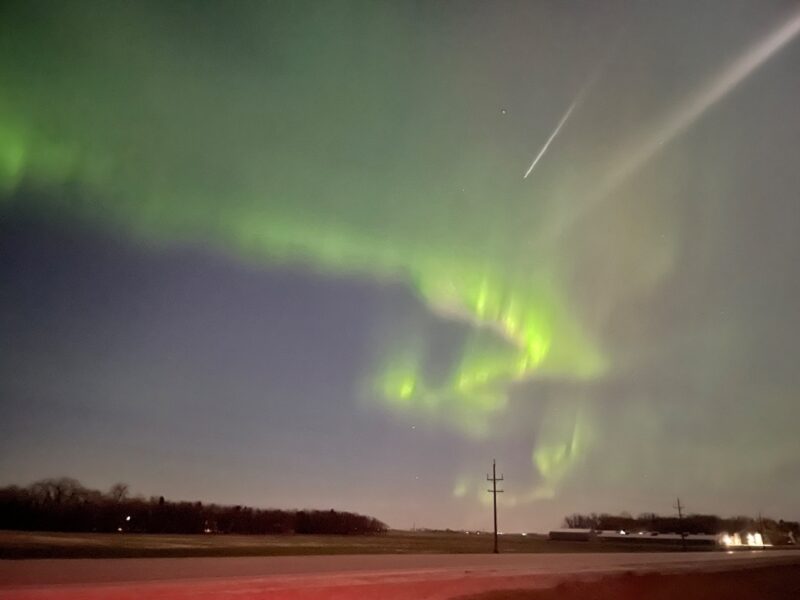
View at EarthSky Community Photos. | Sun news for November 7-8, 2025. Barbara Klassen in Horndean, Manitoba, Canada captured this photo of the aurora on November 5, 2025. Thank you, Barbara! This has been a big week for auroras. And more are coming! 
Sun news for November 7-8, 2025. Active Region AR4274 was in overdrive — flaring almost nonstop throughout the day and launching multiple coronal mass ejections (CMEs) into space. Each burst sent waves of hot plasma arcing high above the solar surface. This sequence, captured by GOES-19 SUVI in the 304 angstrom wavelength, shows the Sun in extreme ultraviolet light — revealing the dynamic, fiery motion of solar material erupting from the active region as it twists and expands outward. Images via NOAA/GOES. Sun news November 7: Auroras, auroras, auroras!
(11 UTC November 6 – 11 UTC November 7)
Right on schedule, another powerful coronal mass ejection (CME) struck Earth’s magnetic field at 05:17 UTC this morning (November 7). That was the middle of the night last night in central North America. We’d seen it start on the sun as a full-halo CME on November 5, launched by a M7.4 flare. It supercharged the solar wind and drove Earth’s magnetic field into G1 (minor) geomagnetic storming. Stunning auroral displays reached mid-latitude skies across northern England, Scotland, and the northern U.S. states. A 2nd CME is expected to deliver a glancing blow late on November 8, potentially extending this week’s multi-day aurora fest through this weekend.
- Flare activity: Solar activity stayed at moderate levels over the past day, with one M and numerous Cs from sunspot region AR4274, as the sun continues its slide into the declining phase of Solar Cycle 25. In all, the sun produced 22 flares — one M-class and 21 C-class — in contrast to 18 flares the previous day.
- Strongest flare: An M1.8 flare erupted from AR4274 at 07:16 UTC on November 7, causing an R1 (minor) radio blackout over the southern Indian Ocean.
- Notable C flares: A C9.4 flare (20:02 UTC) from AR4276; a C5.6 (18:25 UTC) from AR4272; a C5.2 (05:29 UTC) and a C4.2 (13:06 UTC) from AR4274; and a C4.4 flare (22:09 UTC) from the new southeastern region.
- Lead flare producer: AR4274 dominated again with 12 flares, including the day’s only M-class event.
- Sunspot regions: Five numbered active regions remain visible on the Earth-facing solar disk, with AR4274 still the largest and most magnetically complex.
- AR4274 (N24E18, Ekc, beta-gamma-delta) remains the dominant region, maintaining its complex magnetic structure though its flare production slightly decreased.
- AR4275 (N08E29, Cao, beta-gamma), AR4272 (N22E07, Hsx, alpha), and AR4273 (S13W29, Hsx, alpha) stayed quiet and continued to decay.
- AR4276 (S17E60)—a new region that produced an X1.1 flare on November 4—has now rotated further into view. It shows a beta-gamma configuration (Dai) and ranked second in flare activity with six C-class flares.
- Blasts from the Sun: No new Earth-directed coronal mass ejections (CMEs) appeared in coronagraph imagery during the past day.
- The full-halo CME launched by the M7.4 flare from AR4274 on November 5 reached Earth on November 6 with a glancing impact, enhancing auroral visibility through early November 7.
- Multiple CMEs and a co-rotating interaction region (CIR) continue to influence space weather, sustaining G1 (minor) geomagnetic storm conditions alongside high-speed solar wind flows.
- Solar wind:
- Solar wind speeds surged to over 800 km/s, peaking at 850 km/s at 10:30 UTC on November 7 following the CME’s impact.
- The interplanetary magnetic field (IMF) strengthened from weak (<7 nT) to moderate (~13 nT). The Bz component fluctuated between northward and southward orientations, creating favorable conditions for strong geomagnetic activity and auroral displays.
- Earth’s magnetic field: Earth’s magnetic field fluctuated between quiet and active conditions. A Kp = 5 event, equivalent to a G1 (minor) geomagnetic storm, persisted across four consecutive three-hour intervals starting at 21 UTC on November 5. G1 storming remains ongoing at the time of this report.
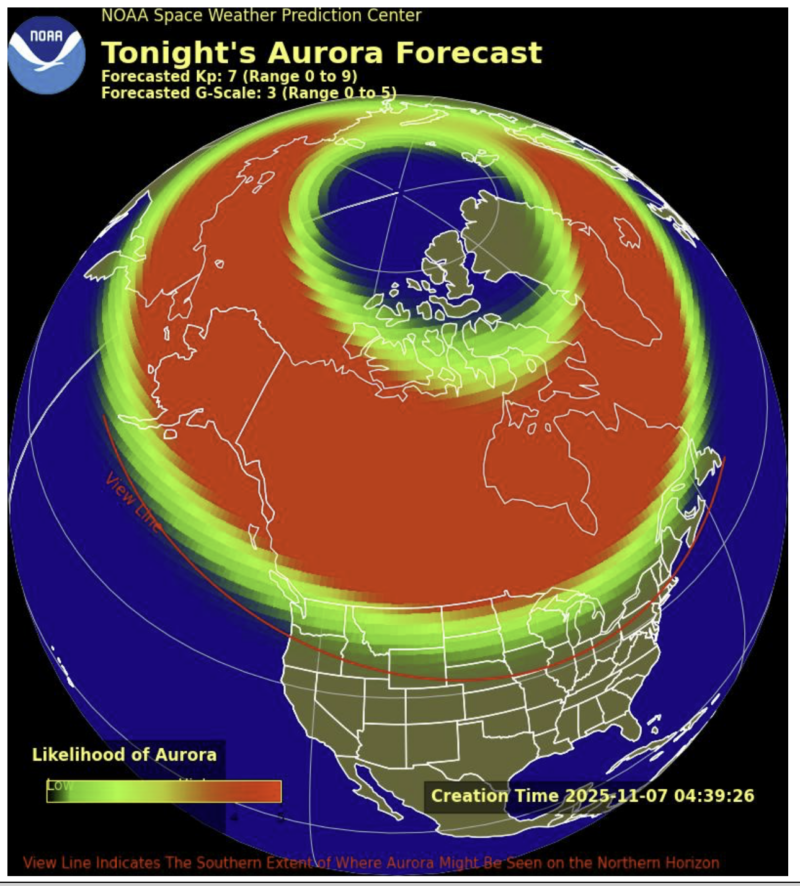
Sun news for November 6-7, 2025. The NOAA/SWPC forecast for Friday night shows a possible Kp = 7 or G2 (moderate) geomagnetic storm possibility. Notice the red line extending down to mid-latitude U.S. states. That approximate line of latitude is about the furthest south on the globe you might expect to see auroras on your northern horizon. Above that line … wow. Good luck aurora watchers! Images via NOAA/SWPC. 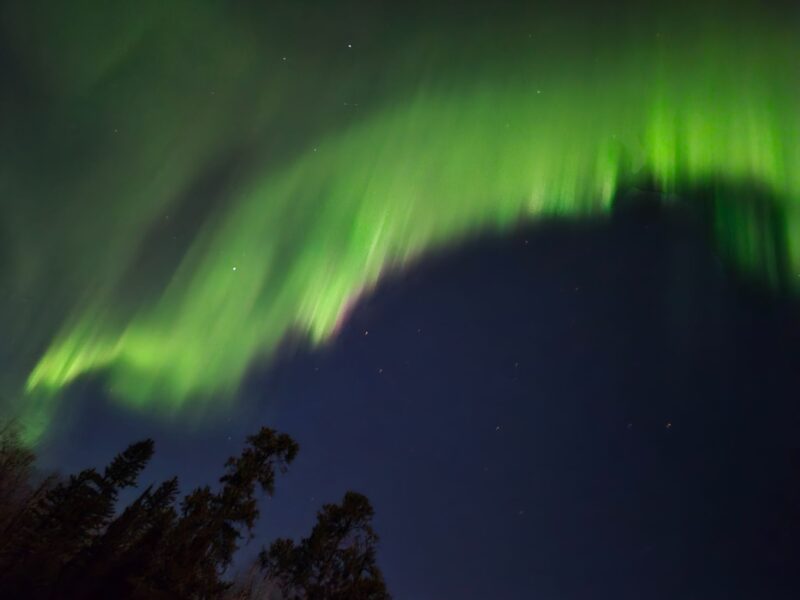
View at EarthSky Community Photos. | Sun news for November 7, 2025. What a fabulous week – and weekend – for auroras! Robert Pelland in Ontario, Canada captured this image on November 5. in Ontario, Canada. 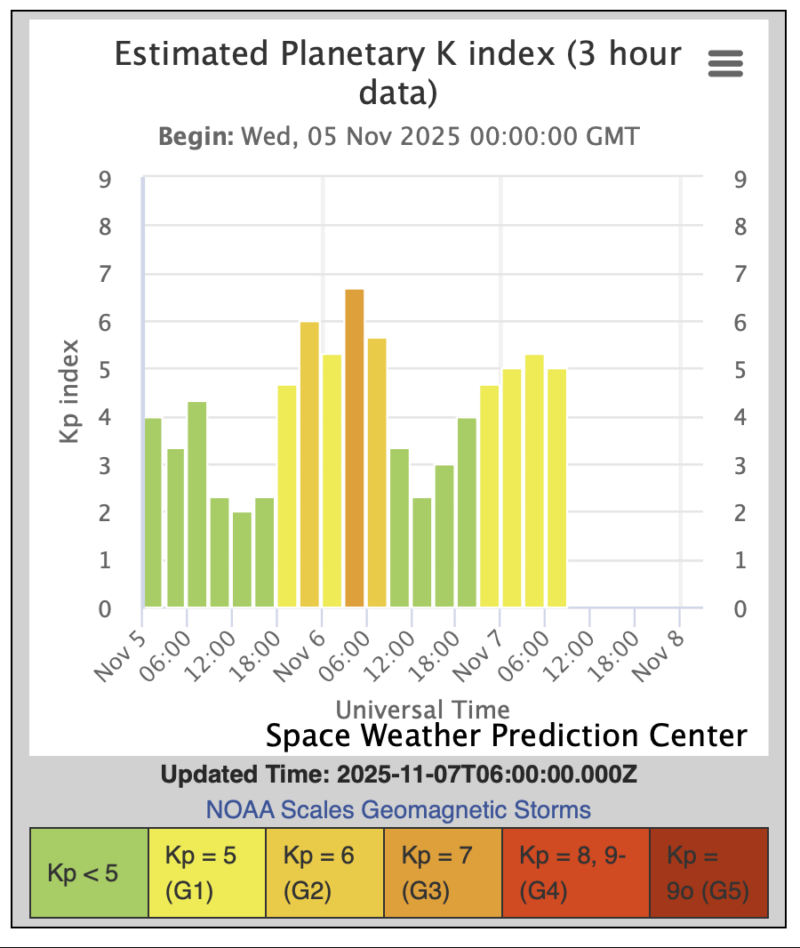
Sun news for November 6-7, 2025. A burst of geomagnetic activity displayed in the Kp index showing a G1 (minor) storm early today, November 7. Images via NOAA/SWPC. Science, powered by real people. That’s you. Help support EarthSky!
Sun news November 6: Supermoon skies lit by auroras
(11 UTC November 5 – 11 UTC November 6)
While many of us slept, coronal mass ejections (CMEs) from this week’s high sun activity slammed into Earth’s magnetic field. The blasts ignited G1 to G3 (minor to strong) geomagnetic storms and painted the skies with vivid auroras, visible around the world … even under the bright glare of the closest and brightest moon of 2025. The storm erupted after sunspot region AR4274 unleashed a series of powerful flares earlier this week. So the source of last night’s display isn’t completely certain yet. But it likely involves the filament eruption associated with the X1.8 flare on November 4. Last night, magnetometers spiked across the globe as the interplanetary magnetic field (IMF) turned sharply southward, allowing charged solar particles to stream in and light up the atmosphere in brilliant greens, reds, and purples. Meanwhile, the sun is still active!
- Flare activity: Solar activity remained high over the past day, with four M-class flares and 14 C-class events for a total of 18 flares over the past 24 hours.
- Strongest flare: An M8.6 eruption from AR4274 at 21:52 UTC on November 5 triggered an R2 (Moderate) radio blackout that disrupted high-frequency communications across the Pacific and impacted aviation systems across the sunlit hemisphere.
- Other M flares: An M7.5 flare from AR4274 peaked at 11:19 UTC, producing an R1 (minor) blackout over Angola, Africa. Two additional M flares came from an incoming, as-yet-unnumbered region in the southeast: an M1.4 at 12:26 UTC that caused an R1 (minor) radio blackout over the South Atlantic, and an M1.1 at 4:31 UTC that affected the Indian Ocean northwest of Australia.
- Notable C flares: A C8.3 flare (14:30 UTC) from AR4275, a C5.3 (6:56 UTC) from AR4274, and two C3.8 flares from the new southeastern region—one at 03:01 UTC and another at 09:01 UTC.
- Lead flare producers: AR4274 and the incoming southeastern region shared the spotlight, each producing seven flares during the period.
- Sunspot regions: Five numbered active regions are visible on the Earth-facing solar disk, with AR4274 remaining the largest and most magnetically complex.
- AR4274 (N24E40, Ekc, beta-gamma-delta) maintained its highly complex magnetic field and continued to grow, increasing its spot count, size, and area while driving the period’s most intense flaring activity.
- AR4275 (N06E47, Dai, beta-gamma) produced several C-class flares as it rotated further into view. Its leader spot stabilized and became more symmetrical.
- AR4272 (alpha/Hsx) and AR4273 (beta/Cso) stayed quiet and continued to decay.
- A region at S15 just beyond the east limb produced an X1.1 flare on November 4. Satellite imagery suggests it may now be decaying or remains out of view until it rotates further onto the disk.
- The remaining regions showed modest C-class flare activity, contributing to the Sun’s overall high-energy environment.
- Blasts from the sun: Multiple coronal mass ejections (CMEs) associated with the recent X- and M-class flares are under analysis for Earth-directed components.
- The CME from the X1.8 flare formed a partial halo moving at 700–800 km/s.
- A full-halo CME linked to the M7.4 flare from AR4274 at 11:19 UTC on November 5 appears to have Earth-directed components, with arrival expected between late November 6 and early November 7, likely as a glancing impact.
- The M8.6 flare at 21:52 UTC produced clear coronal dimming around AR4274, confirming CME lift-off. Analysis continues as new imagery becomes available.
- Earlier CME data from November 4 showed ejections traveling at 1,100–1,400 km/s, with the most significant arrival expected near the UTC day boundary on November 7.
- No fully confirmed Earth-directed CMEs yet, though several show potential partial alignment.
- Solar wind:
- Solar wind speeds climbed from 350 km/s to about 540 km/s, peaking at 550 km/s at 8 UTC on November 6 following the CME’s initial impact.
- The interplanetary magnetic field (IMF) strengthened from weak (<7 nT) to moderate (~15 nT). The Bz component turned sharply southward to -14 nT, opening the door for strong geomagnetic activity and enhanced auroral displays.
- Earth’s magnetic field: Earth’s magnetic field started quiet to active, then intensified as the CME struck, reaching Kp = 7, equivalent to a G3 (strong) geomagnetic storm. The peak coincided with the southward Bz phase, and forecasters expect elevated conditions to persist as additional CMEs approach. Kp = 6 (G2 moderate) ongoing at the time of this writing.
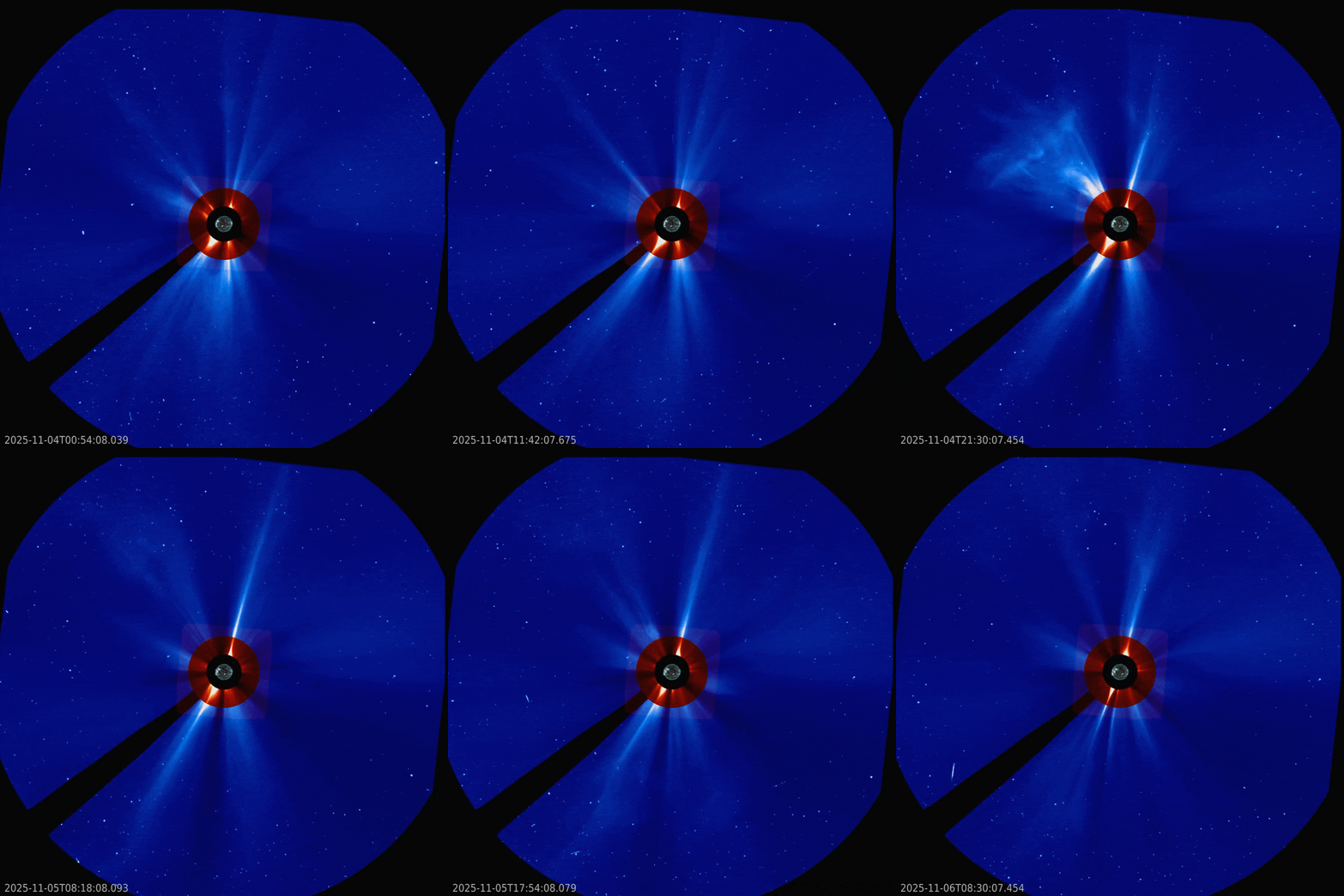
Sun news for November 5-6, 2025. Several days of coronal mass ejections (CMEs) associated with X and M flares began reaching Earth. This combined with solar wind has already sparked strong geomagnetic storms and resulting auroral displays. More CMEs and more auroras are expected over the next several days. Images via NASA/SDO, NASA/SOHO, and JHelioviewer. 
Sun news for November 5-6, 2025. The NASA ENLIL computer model shows CMEs from the sun beginning November 4 heading first near Earth then some finally reaching Earth. This has resulted in geomagnetic activity and aurora. More are expected over the next two days. Stay tuned! Images via NASA/CCMC. 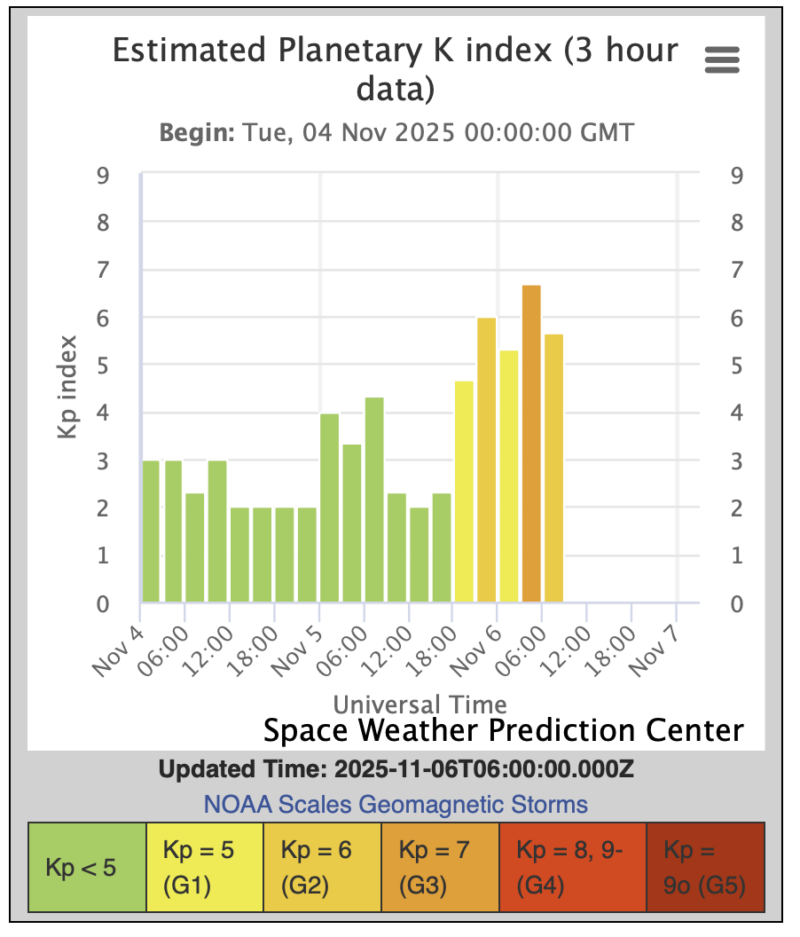
The past 24 hours has seen an increase in geomagnetic activity from G1 (minor) to G3 (strong) storms and aurora. Images via NOAA/SWPC. 
A beautiful solar eruption associated with an M8.6 flare observed by the GOES SUVI instrument in the 304 angstrom wavelength images. Images via NOAA/SWPC. Sun news November 5: Double X flares light up the sun!
(11 UTC November 4 – 11 UTC November 5)
Solar activity rocketed to very high over the past day as our star unleashed not one but two powerful X flares. The first, an X1.8, came from sunspot region AR4274, which appears to be old powerhouse region AR4246 now back on the Earth-facing side of the sun. Peaking at 17:34 UTC on November 4, this eruption triggered an R3 (strong) radio blackout across the sunlit Pacific. And a few hours later, a new region just beyond the southeastern horizon blasted out an X1.2 flare, capping an explosive day on the sun. These powerful flares came exactly 22 years after the sun’s biggest flare ever recorded during the space age: the legendary November 4, 2003 event observed by the SOHO spacecraft. That historic blast was so powerful it maxed out detectors. It was estimated to be at least an X28 flare, and possibly as high as X40!
- Flare activity: Solar activity reached very high levels with a total of 24 flares: two X-class, two M-class, and 20 C-class events.
- Strongest flare: An X1.8 flare from AR4274 peaked at 17:34 UTC, producing an R3 (strong) radio blackout over the Pacific Ocean, west of Peru.
- Second X flare: An X1.2 flare erupted at 22:01 UTC from a new region just beyond the southeast limb, causing another R3-level blackout over the central Pacific.
- M flare: An M1.7 flare from AR4272 peaked at 22:47 UTC, producing an R1 (minor) blackout over French Polynesia in the Pacific Ocean.
- Other notable C flares: C9.9 (05:05 UTC), C9.3 (20:19 UTC), C8.0 (03:01 UTC), C6.2 (01:55 UTC), and C4.9 (07:49 UTC), all from AR4274.
- Lead flare producer: AR4274 dominated the day, firing 17 of the 20 total flares.
- Sunspot regions: The Earth-facing solar disk currently displays four numbered active regions.
- AR4274 (beta–gamma–delta / Ekc): Maintains its delta magnetic complexity and remains the dominant flare producer.
- AR4273 (beta–gamma / Dso): Slowed in growth and produced only a single C-class flare.
- AR4272 (alpha / Hsx): Remained stable after producing an M1.7 flare late in the period.
- AR4275 (beta / Dao): Moving into better view for analysis and remained quiet through the period.
- AR4267 (alpha / Hsx): Rotated out of view on the west limb.
- Blasts from the Sun? Coronal mass ejections (CMEs) associated with the two X flares and the M1.7 flare are under analysis to determine any Earth-directed components.
- The CME from the X1.8 flare formed a partial halo at speeds of 700–800 km/s.
- No Earth-directed CMEs have been confirmed so far.
- Solar wind:
- Solar wind speeds gradually decreased from 420 km/s to 350 km/s by the end of the period.
- The interplanetary magnetic field (IMF) has been near 6 nT, with the Bz component completely southward (~5 nT), a favorable configuration for auroras.
- Earth’s magnetic field:
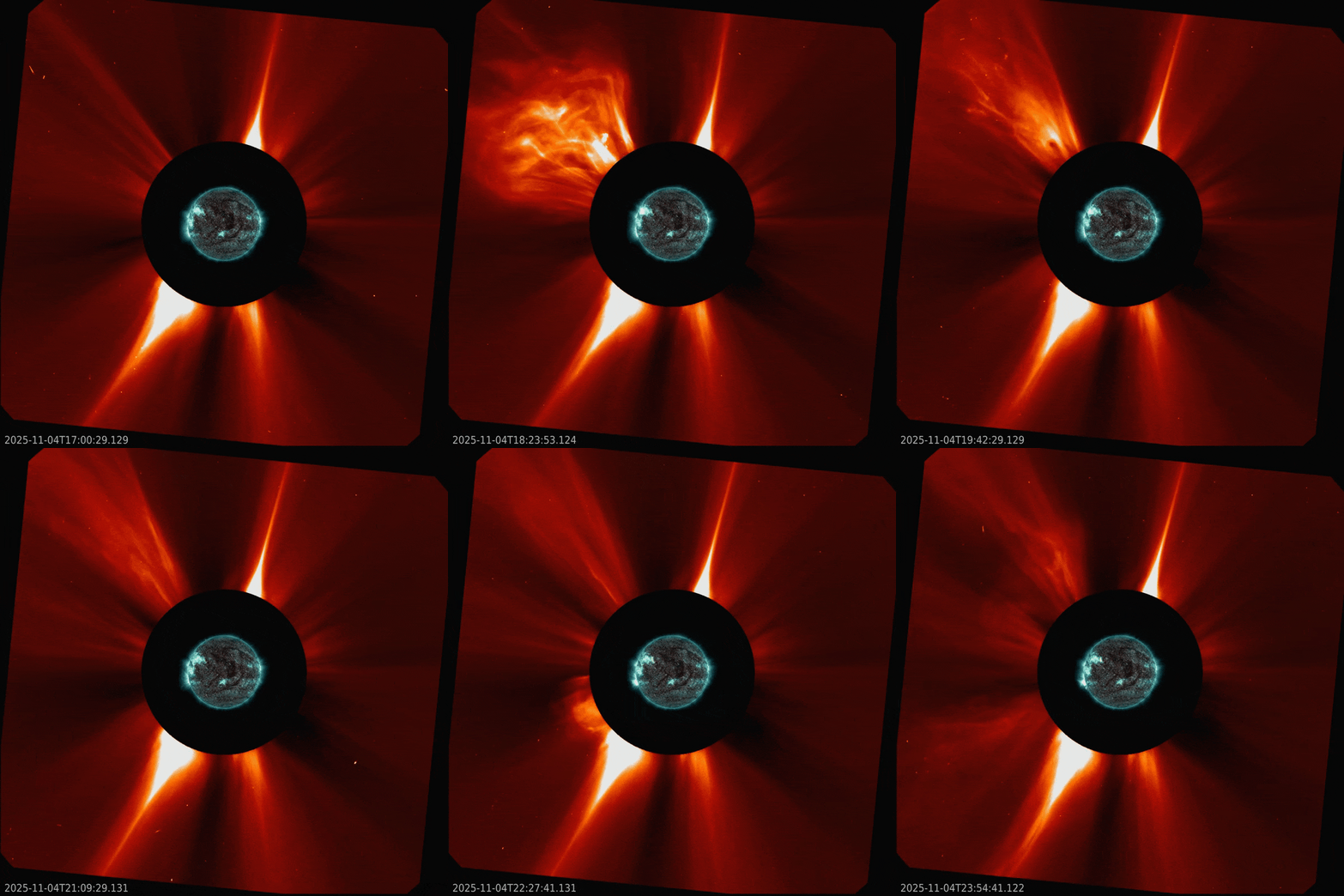
Sun news for November 4–5, 2025. The sun came alive yesterday with two powerful X-class flares from two different regions: AR4274 and an as-yet-unnumbered region just over the eastern solar limb (edge). These are most likely returning regions AR4246 and AR4248 respectively, which produced many C- and M-class flares during their previous journey across the Earth-facing side of the sun. Both eruptions launched coronal mass ejections (CMEs) that appear primarily eastward-directed and are expected to miss Earth, though a glancing impact cannot be ruled out. Images via NASA/SDO, NASA/SOHO, and JHelioviewer. 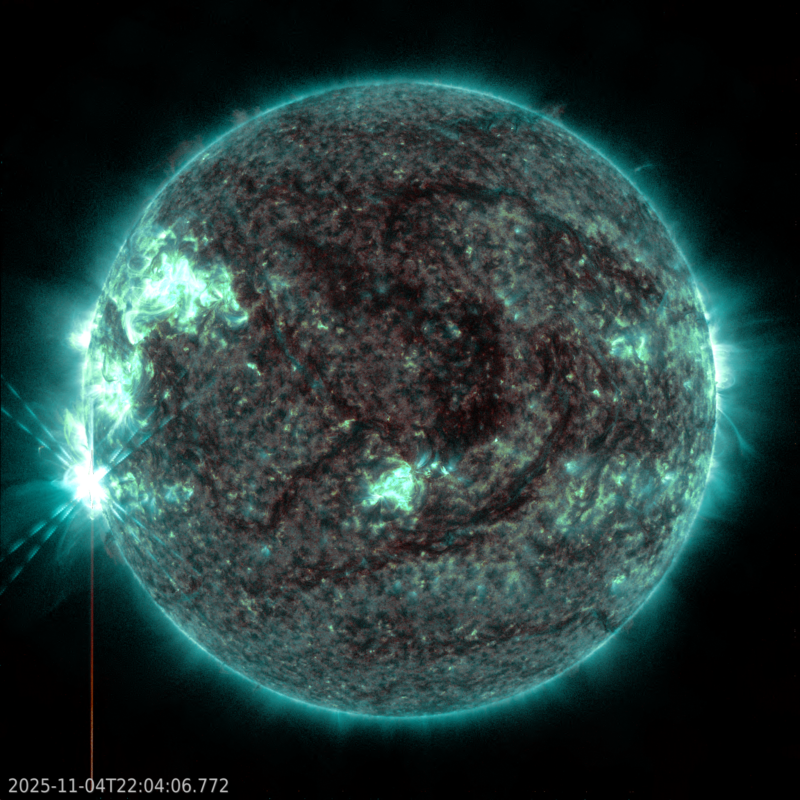
This was the X1.2 flare, fired at 22:30 UTC from an incoming region in the southeast. It may be another returning sunspot region: AR4248. Images via NASA/SDO ? Boom! Sunspot AR4274 just unleashed an X1.8 solar flare around 17:30 UTC — one of the most enormous bursts of energy the Sun can throw! ? Its magnetic field has become complex, and material has blasted into space. Could more be on the way? ??? Stay tuned bit.ly/sunactivity
— Dr. C. Alex Young (@thesuntoday.bsky.social) 2025-11-04T18:45:09.395Z
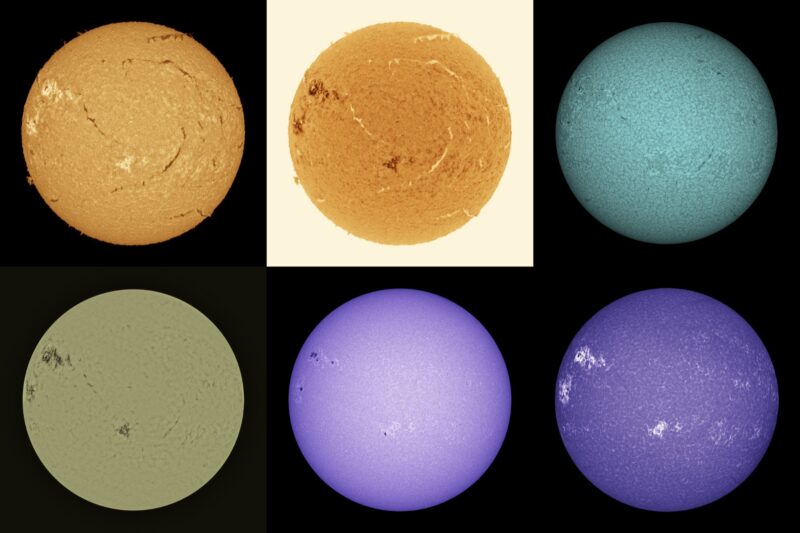
View at EarthSky Community Photos. | Mario Rana in Hampton, Virginia, captured these filtered images on November 4, 2025. Mario wrote: “The sun in hydrogen-alpha (positive and negative), hydrogen-beta, helium D3, G-band, and calcium-H.” Thank you, Mario! Sun news November 4: A powerhouse sunspot region is back!
(11 UTC November 3 – 11 UTC November 4)
Solar activity dropped to moderate over the past day, as active region AR4274 continued flaring. This is an old sunspot region – called AR4246 when we saw it on the sun 10 days ago – now labeled AR4274 for this new journey across the Earth-facing side of our star. When we last saw this region on the Earth-facing sun, it produced a total of 90 C-class (common) and 27 M-class (moderate) flares! Now it’s back, and it unleashed the past day’s strongest flare, an M3.5 flare, earlier today (01:31 UTC on November 4). This blast from the sun’s northeastern visible limb or edge triggered an R1 (minor) radio blackout, affecting the sunlit side of Earth.
- Flare activity: Solar activity is now moderate, with four M-class events over the past day. Our observation period ended with a total of 19 flares in 24 hours, with 15 Cs added to the four Ms.
- Strongest flare: The M3.5 flare from AR4274 peaked at 1:48 UTC on November 4. Shortly after the blast, an R1 (moderate) radio blackout affected an area over the Solomon Islands in the Coral Sea, northeast of Australia.
- Other M flares: M2.9 flare at 12:35 UTC; M3.2 flare at 12:47; M1.5 at 17:08 UTC. All the M flares of the period were produced by newly returning active region AR4274.
- Other notable events: a C8.7 flare at 0:16 UTC; C6.5 flare at 1:29 UTC; C4.5 flare at 22:28 UTC; C3.4 flare at 5:28 UTC; C2.7 flare at 9:02 UTC. All these C flares product of AR4274.
- A C4.4 flare at 1:08 was produced by AR4272.
- Lead flare producer: AR4274 is on top with 16 flares out of the 18 of the past day. It was the producer of all four M flares of the period plus another 12 Cs.
- Sunspot regions: The Earth-facing solar disk currently is populated with five numbered active regions.
- AR4274 (beta-gamma-delta/ Ekc) developed a delta magnetic complexity. A beta-gamma-delta configuration is now developing, which is a sign of high flare potential.
- AR4267 (beta complexity/ Cso): Now located on the shoulder of the sun in the west, prompt to depart.
- AR4273 (beta-gamma/ Dsi): Formed a ring-like structure with multiple spots.
- AR4272 (beta/ Cso): Its structure remained stable.
- There is a newcomer in the east, almost over the solar equator, now numbered AR4275.
- Blasts from the sun? The coronal mass ejections (CMEs) observed during the M flare events are now under modeling and analysis to determine any component Earth oriented.
- The CME produced during yesterday’s M5.0 flare, after analysis, was found to pass behind Earth but it is interacting with fast wind from a coronal hole to arrive at Earth on November 6 or 7.
- No Earth-directed CMEs have been confirmed so far, though modeling is ongoing to assess any glancing components.
- Solar wind:
- Solar wind speeds slowly dropped from 500 km/s levels to 400 km/s. It rose a bit by the end of the period (it is now at 418 km/s).
- The interplanetary magnetic field (IMF) is at 7 nT. Bz component was south oriented for most part of the period with a brief shift to north. It returned to ~6 nT south oriented at the end of the period, which is favorable for auroras.
- A new coronal hole emerged from the east and it is now located at a geoeffective position. In a couple of days we will start receiving at Earth the fast wind it produces.
- Earth’s magnetic field:
- Geomagnetic activity ranged from active to quiet levels, peaking at Kp = 2 – 4.
- No G-scale storms were recorded and conditions settle down as fast solar wind effects wane, awaiting for next coronal hole influence.

Sun news for November 3-4, 2025. Solar activity was moderate over the past day. Newly visible active region AR4274 kept up its activity with 4 M (moderate) flares and 12 C (common) flares. Its magnetic classification is at least beta-gamma, meaning more action is likely to come. Images via NOAA/GOES. 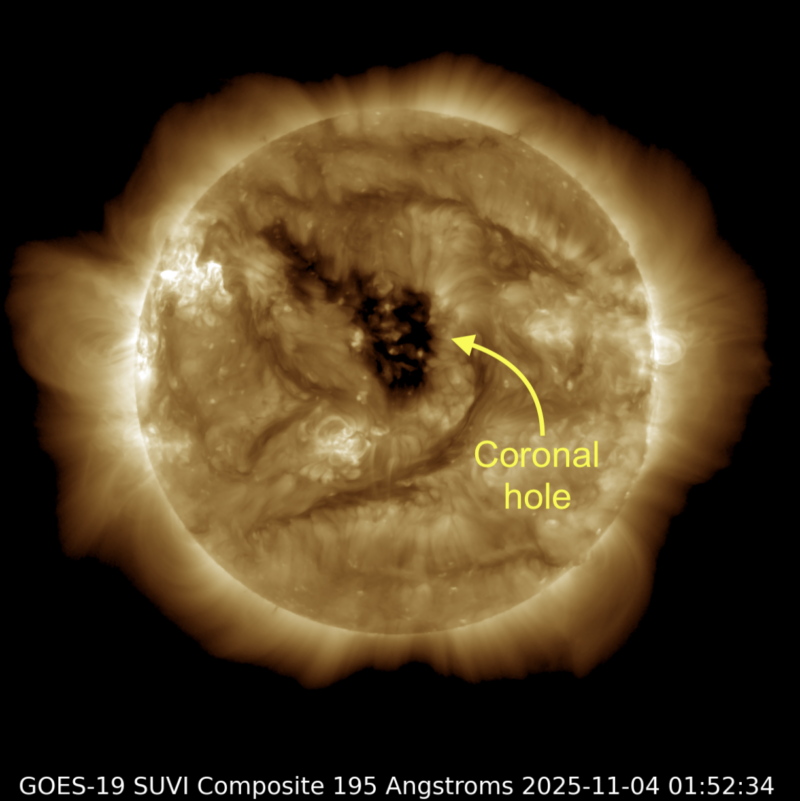
Sun news for November 3-4, 2025. A new coronal hole is moving into a geoeffective position to soon send high-speed solar wind to Earth. More geomagnetic activity is on the way. Images via NOAA/GOES. 
Sun news for November 3-4, 2025. Prominence action adds more excitement to the southwestern solar limb. Captured by the GOES-19 SUVI 304 angstrom wavelength. Images via NOAA/GOES. Sun news November 3: The sun roars back with a powerful M5 flare!
(11 UTC November 2 – 11 UTC November 3)
The sun has kicked into high gear! A powerful M5 (moderate) solar flare erupted from new active region AR4274 in the northeast at 9:25 UTC this morning. This flare, the strongest of November so far, triggered an R2 (moderate) radio blackout over southern Africa. And, with another M1.6 flare at 8:41 UTC this morning and a handful of fairly strong C (common) flares over the past day, it marks the return of major magnetic players to the Earth-facing side of the sun.
- Flare activity: Solar activity has surged to high levels, with 11 recorded flares – including two M-class events – over the past day.
- Strongest flare: M5.0 flare from AR4274 peaking at 9:25 UTC on November 3. This event caused an R2 (moderate) radio blackout over southern Africa.
- Second strongest: M1.6 flare at 8:41 UTC on November 3 from the same active region, part of a rapid increase in activity as AR4274 rotated into view.
- Other notable events: a C8.2 flare from AR4267 at 12:46 UTC, plus several C-class flares from AR4272 near the northeast limb – including C4.5, C3.7, C2.8, and C1.4 flares throughout the day.
- Earlier events included a C4.5 flare at 10:56 UTC and a C1.7 at 2:44 UTC, indicating continuous moderate activity across multiple regions.
- Sunspot regions: The Earth-facing solar disk showed increasing magnetic complexity as new regions emerged and older ones evolved.
- AR4274 (newly numbered): The newest and most active region, now visible on the northeast limb, produced both M-class flares and multiple C-class events. Magnetic analysis suggests a beta-gamma configuration developing, which is a sign of high flare potential.
- AR4267 (beta complexity/ Cso): Produced the long-duration C8.2 flare and remains stable but active.
- AR4273 (beta/ Dri): Continued developing during the period, showing gradual flux emergence and minor C-class output.
- AR4272 (alpha/ Hax): Produced several moderate C-class flares and remains magnetically simple but persistently active.
- Blasts from the sun? Two coronal mass ejections (CMEs) were observed in LASCO C2 imagery during the period.
- The first CME appeared just after 11:00 UTC on November 2, likely originating from AR4274 before the region fully rotated into view. The eruption was directed eastward and is not expected to impact Earth.
- A second CME was detected at 9:48 UTC on November 3 following the M1.6 flare from AR4274. Based on current imagery, it appears to be primarily eastward-facing. Further analysis will be performed when additional coronagraph data come through.
- No Earth-directed CMEs have been confirmed so far, though modeling is ongoing to assess any glancing components.
- Solar wind:
- Solar wind speeds continued to decline from earlier coronal hole influences, averaging around 500 km/s by the end of the period (down from 620 km/s).
- The interplanetary magnetic field (IMF) remained at 5–8 nT with brief southward (Bz ~ -6 nT) intervals, which are favorable for auroras.
- Overall, solar wind conditions are stabilizing as coronal hole effects wane.
- Earth’s magnetic field:

Sun news for November 2–3, 2025. Bam! The sun released a powerful M5 (moderate) flare at around 10 UTC on November 3. The blast, from new sunspot region AR7274, possibly ejected a burst of sun-stuff (a coronal mass ejection) into space. This material will probably not head our way, though we await more imagery to be certain. Images via NASA/ SDO and JHelioviewer. 
Sun news for November 2–3, 2025. An M1.6 solar flare occurred around 9:30 UTC from AR4272 on the northeast limb. Shortly after, a coronal mass ejection (CME) was observed by the SOHO LASCO C2 coronagraph. Images via NASA/SOHO and JHelioviewer. 
View at EarthSky Community Photos. | Mario Rana in Hampton, Virginia, captured these filtered images on November 1, 2025. Mario wrote: “The sun in hydrogen-alpha, hydrogen-beta, iron c, and magnesium b1.” Thank you, Mario! Sun news November 2: An M flare over the horizon!!
(11 UTC November 01 – 11 UTC November 02)
The sun is stirring again! After several days of low activity on the Earth-facing side of our star, a returning powerhouse just beyond the northeast limb (edge) unleashed an M1.1 flare. The flare peaked at 00:26 UTC on November 2. It produced an R1 (minor) radio blackout over the Pacific Ocean. Though still partly hidden from view, the region that produced the M is likely tied to one of the returning active complexes that drove last week’s far-side fireworks. Other than this excitement from beyond the horizon, the Earth-facing side of the sun remained relatively calm over the past day. Lingering effects of a coronal hole high-speed stream are slowly fading. And geomagnetic activity here on Earth is settling back to normal. The stage is set for more action as the new active regions rotate into view. Stay tuned, aurora and flare watchers!
- Flare activity: Solar activity increased slightly, featuring the first M-class flare of November amid otherwise low activity levels.
- Strongest flare: An M1.1 flare erupted from just beyond the northeast limb (N04E89) at 00:26 UTC on November 2. This event generated an R1 (Minor) radio blackout across the Pacific Ocean and is likely associated with returning active region AR4246.
- Additional C-class (common) flares were observed during the day, including a C4.7 from Region 4267 at 16:55 UTC on November 1.
- No X-class (strong) flares were detected during the period.
- Solar X-ray flux remains elevated at C-level, signaling continued active potential as new regions emerge.
- Sunspot regions: Two numbered active regions are visible on the Earth-facing disk, while new magnetic activity brews just beyond the limb.
- AR4267 (N01W52, Cso/Beta): Small but stable, this region produced the day’s strongest C-class flare and continues to show minor flux emergence.
- AR4272 (N22E76, Hax/Alpha): Newly numbered near the northeast limb, this region marks the leading edge of an active complex expected to grow as it rotates into view.
- Previous regions (4266, 4269, 4270, and 4271) have decayed into plage, leaving a mostly quiet disk — for now.
- Blasts from the sun? No Earth-directed coronal mass ejections (CMEs) were detected during this reporting period.
- While far-side activity continues, coronagraph imagery confirmed no significant CMEs heading toward Earth.
- GONG far-side data reveal several bright active regions on the far side — the likely source of today’s M-class flare — preparing to rotate into view over the next 2–3 days.
- Solar wind:
- Solar wind speeds steadily decreased from around 650 km/s to near 500 km/s as the coronal hole high-speed stream weakened.
- The interplanetary magnetic field (IMF) held remained low to moderate, while the Bz component fluctuated north and southward directions.
- Earth’s magnetic field:
What’s ahead? Sun–Earth forecast
- Flare activity forecast: Activity is expected to remain low to moderate but rising. With the return of flare-active regions on the eastern limb, there is an increasing chance of M-class (R1–R2) events through November 2–4. A slight chance persists for an X-class (R3) flare as former regions AR4246 and AR4248 rotate back into view — these were prolific producers, responsible for more than 100 flares last week alone.
- Geomagnetic activity forecast:
- November 2: Quiet to active conditions expected, with a slight chance of a G1 (Minor) geomagnetic storm due to weak CME influences from October 30 and lingering coronal hole effects.
- November 3: Continued quiet to active levels as solar wind gradually stabilizes; no major disturbances expected.
- November 4: Return to quiet background conditions as solar wind parameters normalize and coronal hole effects fully subside.
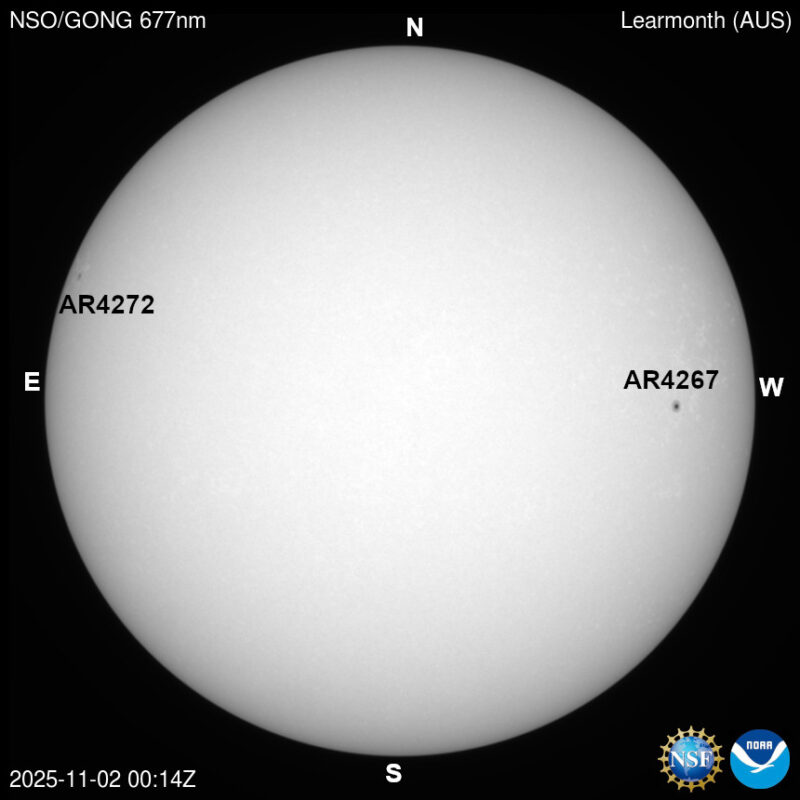
This image shows sun activity – with the most active regions labeled – as of 0 UTC on November 2, 2025, as seen from Learmonth Solar Observatory in Australia. Original image, without labels, via NSO/GONG. Armando Caussade posted today’s sun. Why are east and west on the sun reversed? Sun news November 1: One sunspot now, more on the way?
(11 UTC October 31 – 11 UTC November 1)
This morning, the Earth-facing disk of our sun shows just one numbered sunspot region. It’s a lull near solar maximum, the peak of the sun’s 11-year cycle, reached in 2024. But don’t get too comfy. Bright activity is bubbling up on the sun’s northeast limb, the side just now rotating into view. And the far-side fireworks we’ve watched in recent days continue with multiple coronal mass ejections (CMEs) and towering prominences, likely from the regions we knew as AR4246 and AR4248 when they were on the Earth-facing solar disk more than a week ago. A spotless day is still unlikely — we haven’t had one since June 8, 2022 — and new regions might rotate into view soon.
- Flare activity on the near side: Flare activity stayed low but climbed out of the B (weak) range: seven C-class (common) flares were recorded.
- Strongest flare: A C7.1 from an as-yet-unnumbered incoming region on the northeast limb at 20:43 UTC on October 31.
- Sunspot regions: Only one numbered active region, AR4267, sits on the Earth-facing disk.
- Blasts from the sun? Several CMEs appeared in coronagraph imagery, but they originated on the far side and initial analysis suggests they are not Earth-directed. Two larger CMEs — ~06:45 UTC on October 30 and 01:23 UTC on October 31 from the northeast — remain under modeling for any glancing component. No Earth-bound ejecta identified so far.
- Solar wind:
- Solar wind speeds eased from ~680 km/s to ~531 km/s by 09:00 UTC. Magnetic field strength was moderate (Bt ~5.7 nT).
- The Bz component flipped between north and south; the stronger intervals were southward, which favors auroras.
- Earth’s magnetic field: Conditions declined from unsettled to quiet (Kp 4?2). Kp sat a little above 2 at 11:00 UTC.

Sun news for October 31-November 1, 2025. Here comes the sun — and the sunspots! Active regions are now emerging over the sun’s eastern limb, finally revealing the sources of the farside filament eruptions we’ve been watching in recent days. We can now see magnetic loops in the solar corona arching out from these newly visible sunspots. Until now, we’ve tracked these regions indirectly through helioseismology — the study of sound waves inside the sun — but today we can see their magnetic fields breaking the surface directly. Over the coming week, we’ll be watching closely to see what these active regions bring as they rotate fully into view. Images via NASA/SDO and JHelioviewer.
Like what you read?
Subscribe and receive daily news delivered to your inbox.
More from
C. Alex Young


Sun news: See a huge solar eruption

Yes, there’s an aurora season, and it’s here
Sun activity archive for September 2026
Sun activity archive for August 2026



