



Sun news December 31: Auroras could kick off the New Year!
Those in northerly latitudes could see a magical start to 2026, with auroras in the forecast! That’s because a coronal hole is starting to send its high speed solar wind our way, and a glancing coronal mass ejection (CME) impact is expected late on December 31 into early January 1. These effects will open the door for up to G2 (moderate) geomagnetic storms as the new year begins. That could mean auroras visible as soon as tonight – although more likely tomorrow evening – from locations as far south as northern Scotland, Iceland, and the northernmost U.S. states. Clear skies!
Past 24 hours: The details
(11 UTC December 30 – 11 UTC December 31)
- Flare activity: Solar activity remained at low levels, with 13 C-class flares observed in the period.
- Strongest flare: C6.0 from AR4325 at 1:23 UTC on December 31, 2025.
- Lead flare producer: AR4325 was the top flare producer, responsible for the C6.0 flare and numerous additional C-class flares.
- Sunspot regions: The Earth-facing disk shows several numbered active regions, though none have produced strong new eruptions in the last 24 hours. These regions continue to be tracked for potential moderate activity.
- AR4321 (beta-delta), now near the southwest limb, produced one C-class flare.
- AR4324 (beta-gamma) remained a key source of activity and continues to draw attention in the northeast quadrant.
- AR4325 (beta-delta) lost its gamma configuration but remains a prime candidate for more M and even X flares.
- AR4317 (beta-delta) re-gained additional complexity but did not produce flares during this period. It will soon depart to the far side.
- AR4328 (beta), AR4329 (beta), AR4330 (beta), and AR4331 (alpha) have not yet produced flares.
- Blasts from the sun? No new clearly Earth-directed CMEs were launched during this 24-hour window, but an earlier event remains en route. A partial-halo coronal mass ejection (CME) that left the sun near 23:00 UTC on December 28, 2025 has been modeled, with a glancing impact at Earth expected late on New Year’s Eve.
- Solar wind: Over the past 24 hours, solar wind speeds have fluctuated in the moderate range, generally between about 420 km/s and 450 km/s as Earth’s environment adjusts ahead of the expected CME arrival. Recent measurements show the total interplanetary magnetic field (IMF) strength moderately elevated near ~7 nT, with the north–south component (Bz) varying between northward (~+3 nT) and southward (~–3 nT) orientations.
- Earth’s magnetic field: Earth’s magnetic field ranged from quiet-to-unsettled levels during the period, with no significant storms yet.
What’s ahead? Sun–Earth forecast
- Flare activity forecast: Solar activity is expected to remain low to moderate over the next three days. Additional M-class flares remain possible (60% chance) from magnetically complex regions still on the Earth-facing disk, particularly AR4325. The chance of an isolated X-class flare remains at 25%.
- Geomagnetic activity forecast:
- December 31: Geomagnetic conditions are forecast to range from quiet to active, as Earth increasingly connects to the coronal hole’s high speed solar wind stream. The expected late-day arrival (around 20:43–22:04 UTC) of the December 28 CME could begin to disturb the solar wind near Earth by the end of the UTC day, but the main geomagnetic response is more likely to manifest on January 1. Brief active intervals (Kp up to 4) are possible late in the period, with aurora mainly over Iceland, northern Scandinavia, and high-latitude Canada and Alaska.
- January 1, 2026: Following the CME’s arrival, forecasters call for up to G2 (moderate) geomagnetic storm levels. Auroras could be visible from cities like Seattle, Minneapolis, and Edinburgh, and potentially as far south as Toronto, Chicago, northern England, Hobart (Tasmania), and New Zealand’s South Island during stronger intervals, especially around local midnight.
- January 2, 2026: As the CME influences wane but high-speed solar wind persists, geomagnetic activity is expected to ease somewhat but remain elevated, with a slight chance of an isolated G1 (minor) storm period if Bz turns strongly southward. Auroras may briefly dip into northern Scotland and similar latitudes if the Kp reaches 4–5.


Sun news for December 30–31, 2025. The sun appears relatively quiet today, producing only low-level solar flares. But action is on its way to Earth, with a CME fired on December 28 set to trigger possible auroras tonight through tomorrow. Images via NOAA/ GOES. 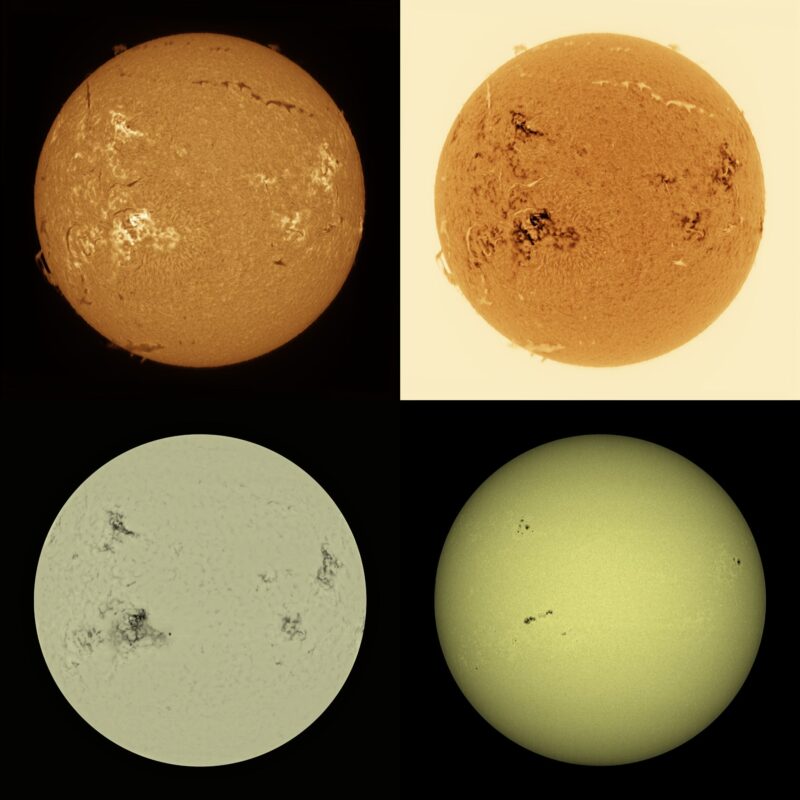
View at EarthSky Community Photos. | Mario Rana in Hampton, Virginia, captured these filtered images on December 30, 2025. Mario wrote: “The sun in hydrogen-alpha, helium D3, and iron.” Thank you, Mario! Sun news December 30: 4 more blasts of sun-stuff erupt from our star
Over the past 24 hours, 4 eruptions on our star fired blasts of sun-stuff – coronal mass ejections, or CMEs – into space. Specialists are modeling these eruptions to see if any could be on course for Earth. Meanwhile, forecasters continue to monitor an Earth-directed CME launched on Sunday. Experts expect this CME to arrive late on December 31. If its arrival coincides with a strengthening coronal hole’s high-speed solar wind stream, conditions could escalate to as high as G3 (strong) geomagnetic storms. And that could mean New Year’s Eve auroras!
Past 24 hours: The details
(11 UTC December 29 – 11 UTC December 30)
-
-
- Flare activity: Solar activity dropped to low levels, with only C-class flares recorded. We observed 14 C-class flares during the 24-hour window. The strongest event, a C6.5 flare, erupted from AR4324 and peaked at 20:40 UTC on December 29. Other notable flares included a C5.1 at 6:45 UTC and a C4.9 at 0:27 UTC from AR4325 on December 30, along with a C4.6 flare from AR4321 at 8:43 UTC on December 30. AR4325 and AR4324 led flare production during the period, each generating six C-class flares.
- Sunspot regions: The Earth-facing solar disk displayed nine numbered active regions, several with increasing magnetic complexity and elevated flare potential.
- AR4321 (beta-delta), now near the southwest limb, produced two C-class flares.
- AR4324 (beta-gamma) remained a key source of activity and continues to draw attention in the northeast quadrant.
- AR4325 (beta-gamma-delta) underwent rapid growth and now hosts the most complex magnetic structure on the disk, making it a prime candidate for more M and even X flares.
- AR4317 (beta-gamma) gained additional complexity but did not produce flares during this period.
- Four newly numbered regions – AR4328 (beta), AR4329 (beta), AR4330 (beta), and AR4331 (alpha) – rotated into view and have not yet produced flares.
- Blasts from the sun? Four eruptions during the period produced potentially geoeffective (Earth-affecting) CMEs and are currently under analysis. The first occurred around 15 UTC on December 29 near active regions in the southeast. A second eruption from the northeast quadrant around 18 UTC accompanied a C3.3 flare from AR4324 that peaked at 18:27 UTC. A third eruption followed from the southwest near AR4321 around 19:39 UTC. The fourth occurred in the northeast at 7:12 UTC this morning. Analysts continue to assess all of these events.
- Solar wind: Solar wind speeds gradually declined from about 420 km/s to near 400 km/s for much of the period, before rising slightly back to around 420 km/s by 10 UTC on December 30. The total interplanetary magnetic field (IMF) strength remained weak near 2.7 nT. The north–south component (Bz) fluctuated between about +5 nT early in the period and -5 nT later, settling near -1 nT by 10 UTC.
- Earth’s magnetic field: Earth’s magnetic field stayed quiet to unsettled, with Kp values ranging from 0 to 3. At the time of this report (11 UTC on December 30), the Kp measured 2.
-
Sun news for December 30-31, 2025. The sun is quiet and calm today with only low-level flaring, as seen in GOES-19 SUVI 304 Å. Forecasters continue to monitor conditions from an M-class flare on December 28 that may make its way to earth today. Images NOAA/GOES. 
Sun news for December 29-30, 2025. A bright solar prominence rises from an incoming active region on the sun’s southwest limb, seen in GOES-19 SUVI 304 Å. Images via NOAA/GOES. 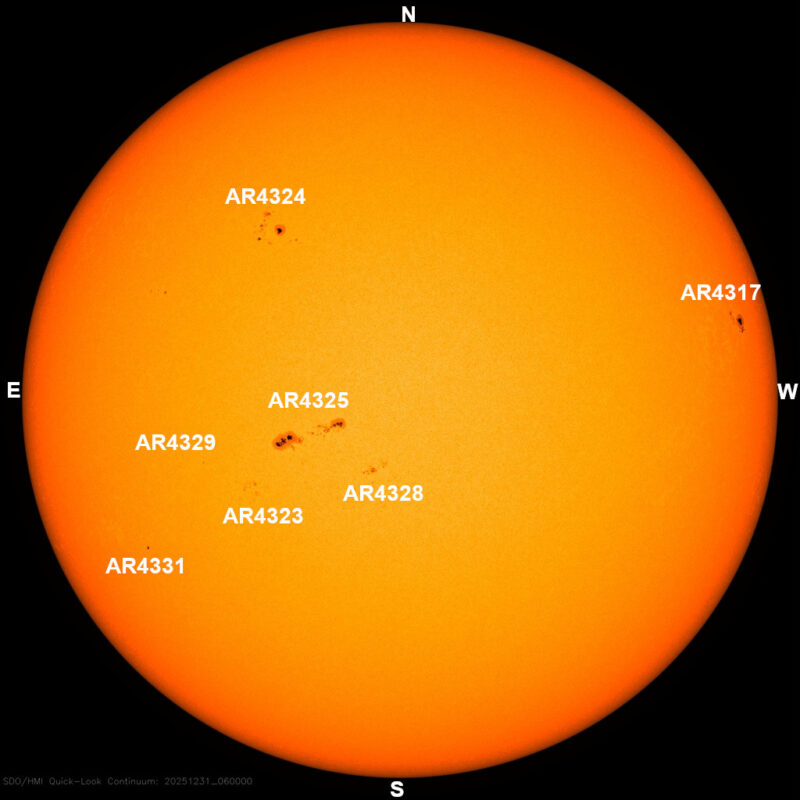
This image shows sun activity – with the most active regions labeled – as of 6 UTC on December 31, 2025. Original image, without labels, via NASA SDO. Courtesy of NASA/SDO and the AIA, EVE, and HMI science teams, with labeling by EarthSky. Armando Caussade posted today’s sun. Why are east and west on the sun reversed? Sun news December 29: Restless sun fires 4 M flares. Sun-stuff incoming!
A strong M4.2 (moderate) flare around 22 UTC last night capped a day of restless activity from our star, which produced a total of 4 M flares and 14 Cs (common). The M4.2 flare, fired by sunspot region AR4317, sent a burst of solar material and magnetic fields – a coronal mass ejection (CME) – toward Earth. Experts expect this blast to reach us late on December 31. If the impact combines with an incoming coronal hole’s high-speed solar wind stream, it could bring up to G3 (strong) geomagnetic storms. Could we see New Year’s Eve auroras? Stay tuned!
Past 24 hours: The details
(11 UTC December 28 – 11 UTC December 29)
-
-
- Flare activity: Solar activity increased to moderate-to-high, with 18 flares (4 M-class, 14 C-class) observed in a 24-hour window.
- Strongest flare: An M4.2 flare from AR4317 peaked at 22:01 UTC on December 28. It triggered an R1 (minor) radio blackout over the sunlit Pacific Ocean.
- Other M-class flares:
- M1.3 from AR4325 at 21:03 UTC on December 28 (R1, minor high-frequency communication impacts over the Pacific Ocean).
- M2.2 from AR4324 at 23:57 UTC on December 28 (R1, minor radio blackout over the central Pacific).
- M1.0 from AR4325 at 6:34 UTC on December 29 (R1, minor radio impacts over the Indian Ocean and parts of eastern Africa and western Australia).
- Lead flare producers:
- AR4325 was the most prolific sunspot region. It generated a sequence of C- and M-class flares as it continued to grow and develop more complex magnetic structure.
- AR4324 contributed multiple C flares and one M2.2 flare.
- AR4317 produced the period’s strongest M4.2 flare but otherwise showed fading trailing spots and limited additional activity.
- Sunspot regions: The Earth-facing solar disk displayed 11 numbered active regions, with several magnetically complex groups maintaining elevated flare potential.
- AR4321 (beta-delta) remained the largest region on the disk. It became more compact in its interior with increasing intermediate spots, preserving its delta configuration and thus significant flare potential, although during this period it produced only C-class activity.
- AR4324 (beta-gamma) grew in size and spot count. Its mixed-polarity structure supported frequent C-class flares and the M2.2 flare late on December 28, marking it as one of the key sources for ongoing activity.
- AR4325 (beta) is a rapidly developing bipolar group. Over the past day it grew in area and spot number, with more complex magnetic structure emerging in intermediate spots.
- AR4317 (beta) hosted the M4.2 flare but showed fading trailing spots afterward, trending toward a simpler, more unipolar configuration.
- AR4326 and AR4327 (beta) are newly numbered small bipolar regions, contributing little flare activity so far.
- Additional smaller regions were generally simple alpha or beta groups showing minor evolution and mostly low-level C-class or sub-C activity. Overall, the presence of at least one beta-gamma-delta region (AR4321) plus growing bipolar groups (AR4324, AR4325) means a sustained chance for further M-class flaring.
- Blasts from the sun? One newly modeled, potentially geoeffective CME came from the M4.2 flare. This could cause G1–G2 (minor to moderate) geomagnetic storms if the CME’s magnetic field turns sufficiently southward. This could mean auroras extending as far as Toronto, Chicago, Boston, northern England and southern New Zealand.
- Solar wind: The solar wind gradually relaxed toward near-background conditions as the influence of a previous high-speed stream waned. Speeds at Earth generally held between about 450–500 km/s, with a slow and somewhat erratic downward trend. The total interplanetary magnetic field (IMF) strength (Bt) remained weak-to-moderate, mostly around 4–7 nT. The Bz component fluctuated between about +4 and -5 nT, spending significant time near neutral with only brief southward excursions.
- Earth’s magnetic field: Earth’s magnetic field remained mostly quiet, with only brief unsettled intervals and no storm-level activity during the period. Global indices from NOAA show conditions ranging from quiet to unsettled, with Kp values generally at 1–3 and no three-hour periods reaching the G1 (minor) geomagnetic storm threshold of Kp 5. At the report time (11 UTC on 29 December), Kp is near quiet levels.
- Flare activity: Solar activity increased to moderate-to-high, with 18 flares (4 M-class, 14 C-class) observed in a 24-hour window.
-
What’s ahead? Sun–Earth forecast
-
-
- Flare activity forecast: Moderate levels of solar activity are expected to continue over the next three days, with a sustained chance of further M-class (moderate) flares. There is roughly a 45% daily chance of M-class flares, with a slight (~10% or less) chance of an X-class event. The main source regions are the magnetically complex AR4321 (beta-delta), the growing mixed-polarity regions AR4324 and AR4325, and, to a lesser extent, AR4317.
- Geomagnetic activity forecast:
- December 29: Geomagnetic conditions are expected to remain mostly quiet to unsettled as Earth continues to drift out of the influence of the prior high-speed stream. NOAA forecasts predominantly quiet levels, with only isolated unsettled periods possible. Under this regime, auroras should remain largely confined to the usual auroral oval.
- December 30: Quiet-to-unsettled conditions are again favored, with perhaps a slight chance of brief active intervals (Kp 4) if the next coronal hole high-speed stream connects a bit earlier than expected.
- December 31: By New Year’s Eve, conditions become more interesting. A recurrent coronal hole is expected to send a stronger high-speed stream. Modeling predicts the arrival of the coronal mass ejection (CME) associated with the December 28 M4.2 flare late in the day (around 20:43–22:04 UTC). The combined influence of the high-speed stream and CME could raise Kp into the 5–6 range, corresponding to G1–G2 (minor to moderate) geomagnetic storms. Under Kp 5–6, auroras may become visible from Seattle, Minneapolis and the Scottish Highlands, and could reach as far south as Toronto, Chicago, Boston, northern England and the South Island of New Zealand if the CME’s magnetic field turns strongly southward. There is also a very slight chance of isolated G3 (strong) intervals if both the CME and high-speed stream align favorably, which would push potential aurora visibility toward New York, London and northern France, but this is currently a low-confidence scenario.
-
Sun news for December 28-29, 2025. This SDO spacecraft imagery shows an M4.2 (moderate) solar flare erupting from sunspot region AR4317 at around 22 UTC last night. This flare produced a coronal mass ejection (CME), which the SOHO spacecraft’s LASCO C2 coronagraph imaged. Early analysis suggests this CME is Earth-directed, with arrival expected late on New Year’s Eve. Impacts could include G1–G2 (minor-moderate) geomagnetic storms, with a chance of G3 (strong) levels if the CME combines with a high-speed solar wind stream. Images via NASA/SDO, NASA/SOHO, and JHelioviewer. Sun news December 28 (UTC): An almost M-class flare tops an active day
The sun stayed busy over the past day, barely maintaining moderate levels of activity, capped by a strong C9.9 flare (an almost M1 flare) from region AR4318. This region is near disk center on the sun’s evening side, the side that will soonest rotate out of view. Despite this flurry of flares, Earth’s space environment remained calm. No coronal mass ejections (CMEs) are heading directly toward Earth. And the Kp index – a measure of magnetic activity near Earth – stayed in the quiet range. Yet the solar disk remains crowded with complex sunspot groups. The large and magnetically tangled region AR4321 continues to store energy capable of powering stronger M-class flares. Overall, the sun remains restless. And forecasters continue to watch closely for any escalation toward M- or X-class outbursts in the days ahead.
Past 24 hours: The details
(11 UTC December 27 – 11 UTC December 28)
- Flare activity remained at moderate levels, with 11 C (common) flares recorded during the most recent 24-hour window and no M- or X-class flares (but an almost M1) in that interval.
- Strongest flare was a C9.9 from AR4318 (N04W10) at 22:14 UTC on 27 December. The flare produced a radio blackout over the Pacific Ocean.
- Other notable flares: Multiple mid-C flares erupted from AR4324, AR4325, AR4321, and AR4322, highlighting steady energy release across several active regions.
- Sunspot regions: The Earth-facing solar disk displayed a crowded field with roughly 8 numbered active regions, several of which are magnetically complex.
- AR4321 (beta-gamma-delta) grew further in size and complexity.
- AR4317 (beta) also increased its penumbral area and complexity.
- AR4325 (beta) is a newly numbered region near the southeast limb. It erupted with the earlier M5.1 flare (outside this 24-hour window) and continued to generate several C-class flares, suggesting it still holds significant free magnetic energy even though it appears smaller and less complex than AR4321.
- AR4324 (eastern hemisphere, precise coordinates not specified; likely simple bipolar configuration) fired off several C-class flares (C3.8, C3.2, C2.7, C4.0) and has undergone rapid growth, but its exact magnetic classification is still uncertain due to foreshortening near the limb.
- AR4322 (disk interior) produced at least one mid-C flare (C3.8 at 23:27 UTC), indicating modest activity from a smaller, likely beta-type region.
- AR4318 (smaller region with simple magnetic structure) was responsible for the period’s strongest C9.9 flare.
- Other numbered regions on the disk were smaller and magnetically simpler.
- Blasts from the sun? No Earth-directed CMEs occurred during the past day.
- Solar wind: The solar wind gradually relaxed as the coronal hole high-speed stream weakened, with speeds easing from near 500 km/s to about 460 km/s. The interplanetary magnetic field (IMF) stayed weak near 5 nT, while the north–south component (Bz) fluctuated modestly between +2 nT and +5 nT, limiting energy transfer into Earth’s magnetic field. IMF polarity remained predominantly positive, consistent with the trailing edge of a positive-polarity coronal hole, and energetic electrons at geostationary orbit reached high levels typical of elevated wind speeds.
- Earth’s magnetic field: Earth’s magnetic field remained mostly calm under the waning high-speed stream. Global geomagnetic activity stayed quiet to unsettled, with Kp generally between 1 and 3 and no G-scale geomagnetic storms. These conditions confined auroras to high-latitude regions such as northern Alaska, northern Canada, Iceland, and northern Scandinavia, with only modest displays possible near cities like Tromsø or Reykjavik.
What’s ahead? Sun–Earth forecast
- Flare activity forecast: Solar activity is expected to remain low, with a chance of returning to moderate levels. The probability of M-class (moderate) flares has increased to about 65%, while the chance of an X-class flare has edged up to around 20%. The main regions to watch are AR4325 (produced yesterday’s M5.1 flare), AR4321 in the southwest due to its evolving magnetic structure, and the newly active AR4324 in the northeast.
- NOAA SWPC guidance indicates that solar activity is likely to remain in the R1–R2 range (minor to moderate radio blackouts) on 28–30 December, with a slight chance for an X-class flare.
- Geomagnetic activity forecast:
- December 28, 2025: With no Earth-directed CMEs en route and the current high-speed stream fading, geomagnetic conditions are expected to stay mostly quiet to unsettled. Kp should generally remain in the 1–3 range, with only a slight chance of brief Kp 4 intervals. Aurora will remain largely confined to the high-latitude auroral oval, with good viewing potential from northern Alaska, northern Canada, Iceland, and northern Scandinavia under clear skies.
- December 29, 2025: Background-like solar wind conditions are forecast to dominate as the influence of the present coronal hole continues to wane. Kp is again expected in the 1–3 range, with quiet to occasionally unsettled levels.
- December 30, 2025: Mostly ambient solar wind is anticipated, keeping geomagnetic activity at quiet to unsettled levels. However, both NOAA and the UK Met Office note that a new coronal hole in the northeastern solar hemisphere may begin to connect to the sun–Earth line late in this period or into December 31.
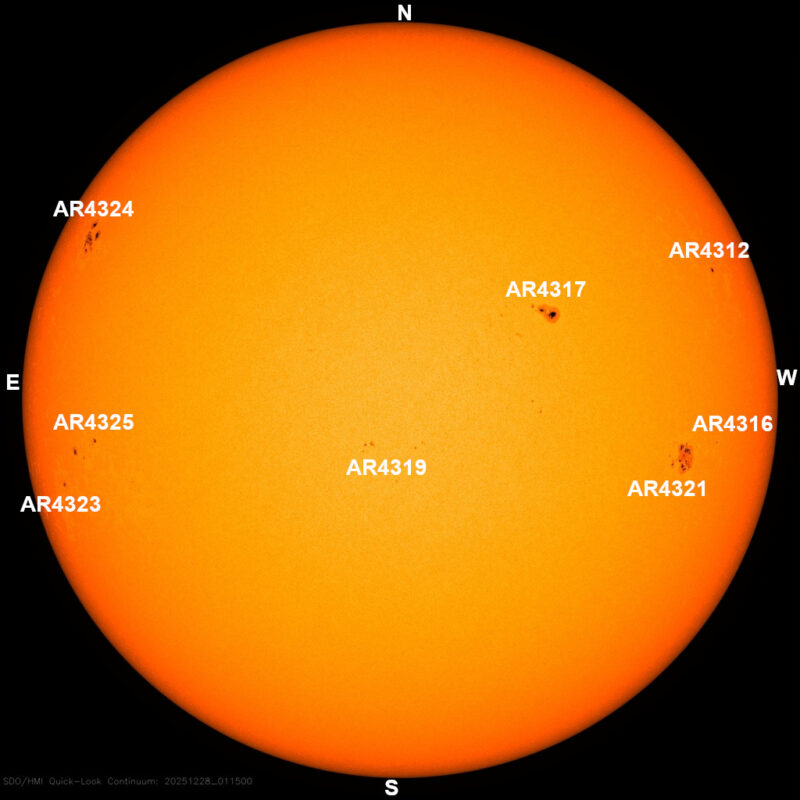
This image shows sun activity – with the most active regions labeled – as of 1 UTC on December 28, 2025. Original image, without labels, via NASA SDO. Courtesy of NASA/SDO and the AIA, EVE, and HMI science teams, with labeling by EarthSky. Armando Caussade posted today’s sun. Why are east and west on the sun reversed? Sun news December 27 (UTC): Strong M flare, as sun activity jumps to high
After more than a week of low flare activity, the sun produced a strong M5.1 flare, pushing solar activity to high. The eruption burst from newcomer sunspot region AR4323 at 1:50 UTC on December 27, just as this region was rotating onto the sun’s southeast limb (edge). The flare triggered an R2 (moderate) radio blackout over Earth’s Coral Sea, west of New Caledonia. This same incoming region also produced yesterday’s strongest flare, a C6.9 event, before it was officially numbered, though that earlier eruption likely appeared weaker because it was partially hidden behind the sun’s east limb. Meanwhile, the sun continues to show signs of strong activity on its far side. A striking prominence over the solar north pole hints at energetic far-side flaring. Specialists now expect the likelihood of additional M-class flares in the coming days, as the prolific regions that were labeled AR4294 and AR4296 rotate back into view. When on the sun’s near side, a week or so ago, these regions produced 17 and 2 M-class flares, respectively. Will they repeat their performance? Time will tell. Stay tuned.
Past 24 hours: The details
(11 UTC December 26 – 11 UTC December 27)
- Flare activity rose to a high in the past day, with an isolated M-class (moderate) flare. The sun produced a total of nine flares over the past 24 hours: one M and eight Cs.
- Strongest flare was an M5.1 from incoming active region AR4323 in the sun’s southeast quadrant. The flare peaked at 1:50 UTC on December 27.
- Other notable flares: Active region AR4318 in the northwest produced two C flares on December 26: a C2.7 at 19:23 UTC and a C2.1 at 22:54 UTC. On December 27, it produced a C4.5 flare at 7:58 UTC. Meanwhile, AR4324 generated four C flares on December 27: a C4.8 at 0:32 UTC, a C2.5 at 1:50 UTC, a C3.7 at 5:39 UTC, and a C2.9 at 6:47 UTC.
- Lead flare producer of the past 24 hours was AR4324 in the northeast quadrant. It topped the list with four C flares.
- Sunspot regions: The sun currently displays eight numbered active regions on its Earth-facing side.
- AR4317 (beta) remained the largest region by area but showed slight decay and produced no flares during the period.
- AR4319 (beta) showed no growth and produced no flares.
- AR4321 (beta-delta) produced no flares. But its asymmetric magnetic structure remains a configuration often associated with energetic flare potential.
- The remaining active regions stayed stable or continued to decay without flare activity.
- Two new regions appeared on the Earth-facing disk: AR4323 (alpha), which rotated into view from the southeast limb, and AR4324 in the northeast.
- Blasts from the sun? Experts didn’t observe any Earth-directed coronal mass ejections (CMEs) during the past day.
- Solar wind: Solar wind speeds briefly increased, peaking at 592 km/s at 13:00 UTC on December 26, before declining toward 550 km/s. By 10:30 UTC on December 27, wind speeds measured 471 km/s. The interplanetary magnetic field (IMF) strength hovered near 5.57 nT. The north–south component, Bz, remained northward early in the period (up to +3 nT) before turning southward to around –4 nT for the remainder. At 11 UTC, Bz remained southward. These intermittent southward intervals can still drive brief geomagnetic activity and high-latitude auroras, even without fresh CME impacts.
- Earth’s magnetic field: Geomagnetic conditions on Earth stayed quiet to unsettled. A weakening fast solar wind stream from a positive-polarity coronal hole rotated out of a geoeffective position, and no CMEs headed toward Earth. As a result, auroral activity remained confined to the Arctic Circle. At 11 UTC on December 27, the Kp index stood at 2.
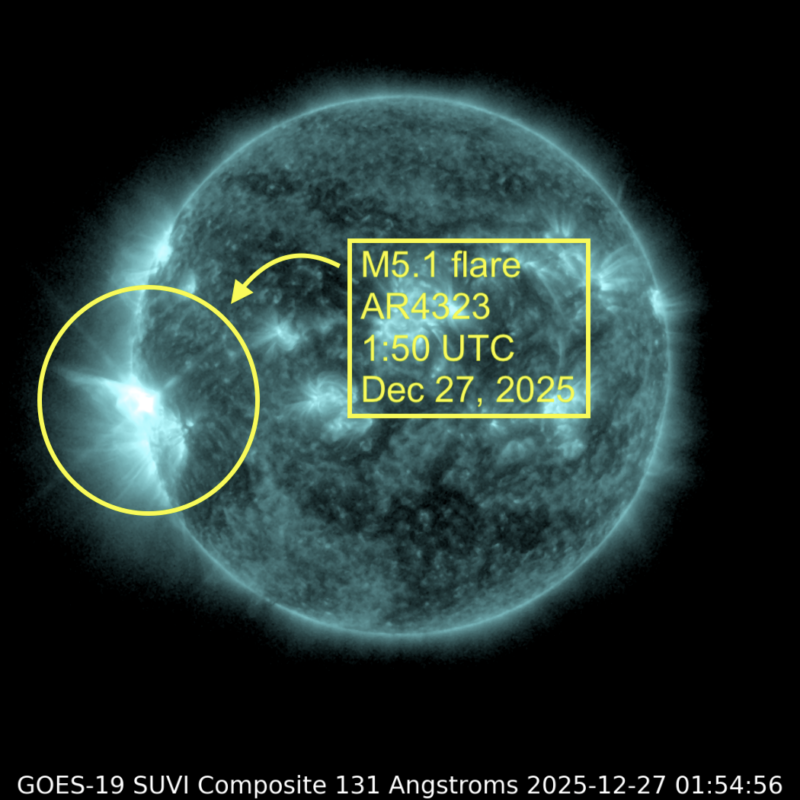
Sun news for December 26–27, 2025. A powerful M5-class solar flare erupted from an incoming active region near the sun’s southeast limb. The GOES-19 SUVI instrument captured the flare in this image, in the 131-angstrom wavelength, which highlights extremely hot flare plasma in the solar corona. This energetic blast marked a jump from low to high solar activity and triggered a radio blackout over parts of the Pacific. Images via NOAA/GOES. 
Sun news for December 26-27, 2025. Meanwhile, the far side continued showing off strong activity with prominences near the sun’s north pole. This view from the GOES-19 SUVI instrument in the 304-angstrom wavelength highlights cooler plasma in the sun’s chromosphere, revealing towering prominences arching above the solar limb and hinting at ongoing activity beyond Earth’s view. Images via NOAA/GOES. Sun news December 26 (UTC): A twisted sunspot breaks the rules
Sunspot region AR4321 has calmed down a bit, but it still looks odd. Normally, sunspots line up in a predictable magnetic pattern, like bar magnets laid end to end. AR4321 breaks that rule. Its magnetic poles are rotated sideways compared to what scientists expect, a sign that its magnetic fields are twisted and stressed. Twisted magnetic fields can store energy, and when that energy is released, it can power strong solar flares. AR4321 hasn’t done that yet. But it might have a surprise in store for us, soon.
Past 24 hours: The details
(11 UTC December 25 – 11 UTC December 26)
- Flare activity remained low, with only C-class (common) flares observed over the past day. The sun produced a total of seven C flares during the past 24 hours.
- Strongest flare was a C6.9 from an incoming, as-yet-unnumbered active region in the sun’s southeast, peaking at 09:14 UTC on December 26.
- Other notable flares: Two unnumbered incoming regions accounted for most of the activity. The southeast region produced a C2.5 at 03:03 UTC, a C2.4 at 03:20 UTC, a C2.7 at 03:32 UTC, and a C3.5 at 07:29 UTC on December 26. An incoming region in the northeast produced a C2.4 flare at 21:53 UTC on December 25. In addition, AR4318 produced a C2.1 flare at 03:56 UTC on December 26.
- Lead flare producer: An unnumbered incoming active region in the southeast quadrant topped the list with five C flares.
- Sunspot regions: The Earth-facing solar disk displayed seven numbered active regions.
- AR4317 (beta) remained the largest region by area but produced no flares during the past day.
- AR4319 (alpha) showed no growth and remained flare-quiet.
- AR4321 (beta-delta) lost its gamma configuration and did not produce flares. But its asymmetric structure remains a configuration often associated with energetic flare potential.
- The remaining active regions stayed stable or continued to decay without flare activity.
- A new region, AR4322 (alpha), emerged near the northwest limb.
- Blasts from the sun? No Earth-directed coronal mass ejections (CMEs) were observed over the past day.
- Solar wind: Solar wind speeds continued to decline from near 600 km/s to around 550 km/s, with brief dips close to 500 km/s. At 10:26 UTC on December 26, wind speeds measured 557 km/s. The interplanetary magnetic field (IMF) strength hovered near 4.9 nT. The north–south component, Bz, oscillated between +5 and –5 nT, turning southward near –5 nT late in the period. These intermittent southward intervals can still drive brief geomagnetic activity and high-latitude auroras, even without fresh CME impacts.
- Earth’s magnetic field: Here on Earth last night, auroras remained largely confined to polar regions as Earth continued to slip out from under a waning high-speed stream. Geomagnetic conditions stayed quiet to unsettled, limiting aurora viewing mainly to Alaska, northern Canada, Iceland, and northern Scandinavia, with only a slim chance of faint glows across far northern Scotland. Fast solar wind from a positive-polarity coronal hole continued to flow past Earth, but weak magnetic structure prevented the development of a stronger geomagnetic storm. While no Earth-directed coronal mass ejections (CMEs) were observed in the past day, AR4321’s strangely twisted magnetic confirguration – among other things seen on the sun today – hint that returning regions could soon raise the odds for stronger flares as the solar wind environment continues to calm. At 11 UTC on December 26, the Kp index stood at 2.
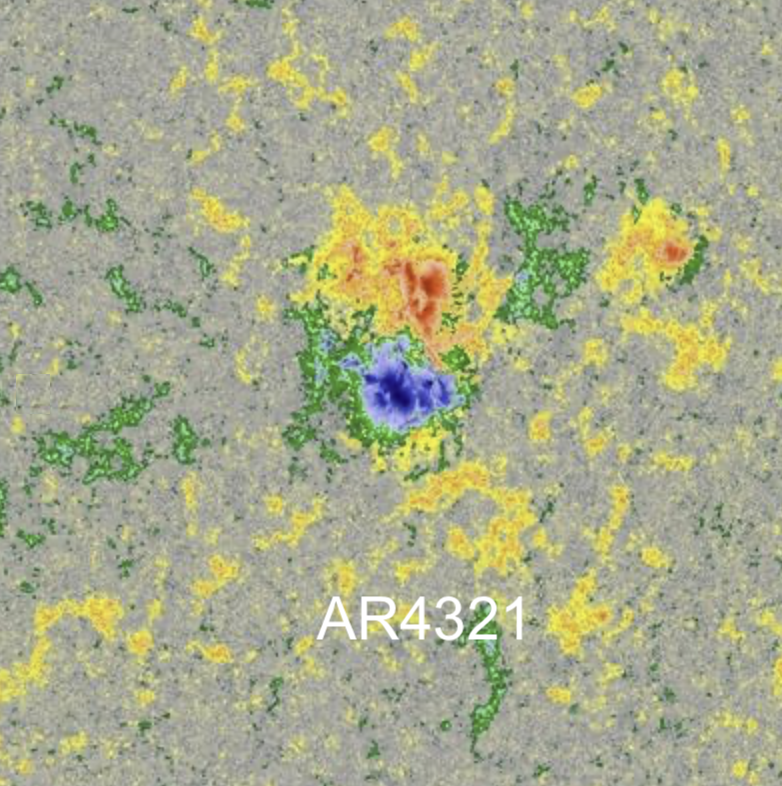
Sun news for December 25-26, 2025. This sunspot – AR4321 – breaks the typical magnetic rules. As seen in this Solar Dynamics Observatory HMI magnetogram, the spot’s negative polarity (red–yellow) is sitting above its positive polarity (blue–green). That’s a ~90° rotation from the orientation predicted by Hale’s polarity law – an empirical law governing the orientation of magnetic fields in solar active regions – and signaling a twisted, energy-laden magnetic field. Read more below. Images via NASA/SDO. 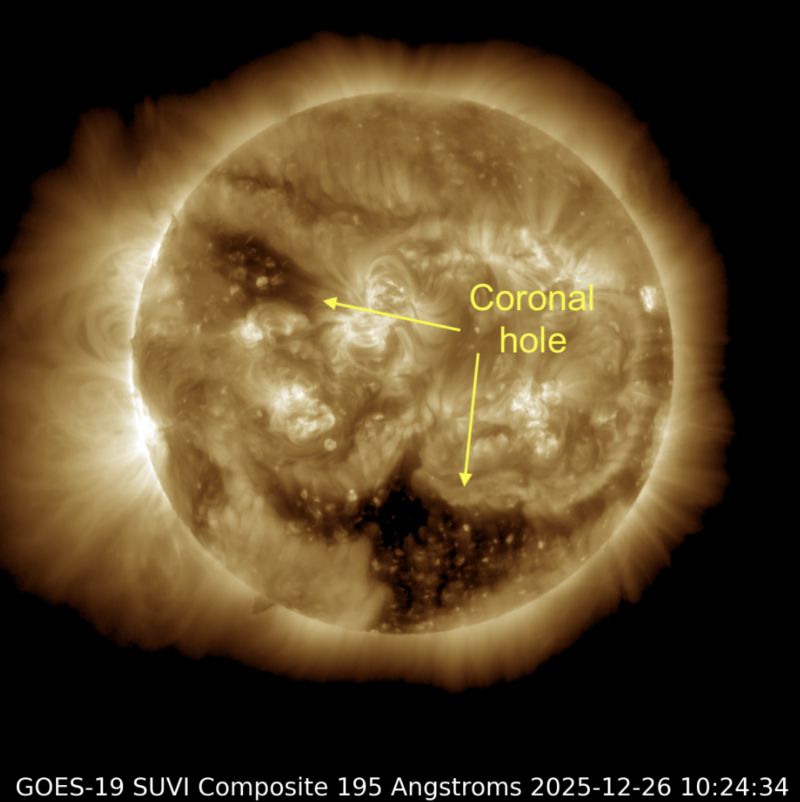
Sun news for December 25-26, 2025. A new coronal hole opens in the northeast. This GOES-19 SUVI 195 Å view reveals a freshly emerged coronal hole in the sun’s northeast quadrant, where darker regions mark lower-density plasma and open magnetic field lines that can release fast solar wind into space. Images via NOAA/GOES. Sun news December 25 (UTC): Will AR4321 bring us a Christmas X flare?
A newcomer sunspot region with X-class flare potential has emerged in the sun’s southwest quadrant. This region is now numbered AR4321. And over the past day, we’ve seen it rapidly expand in both size and magnetic complexity, reaching a beta-gamma-delta configuration, the classification with the strongest flare potential. Regions with this level of complexity are capable of producing powerful eruptions. We last saw an X1.1 flare on December 8, 2025. Could Christmas Day bring another X flare?
Past 24 hours: The details
(11 UTC December 24 – 11 UTC December 25)
- Flare activity: Solar activity remained at low levels, with only C-class (common) flares observed over the past day. We saw a total of five Cs during the past 24 hours.
- Strongest flare was a C2.8 from active region AR4317. It peaked at 20:13 UTC on December 24.
- Other notable flares: AR4317 produced a C2.7 flare at 23:13 UTC on December 24; AR4319 produced a C2.7 flare at 04:24 UTC; and newcomer AR4321 produced a C2.3 flare at 06:09 UTC on December 25.
- Lead flare producer was AR4317, topping the list with two C-class flares.
- Sunspot regions: The Earth-facing side of the sun currently shows seven numbered active regions.
- AR4317 (beta-gamma) retained its gamma configuration and showed slight growth during the period. The region produced two C-class flares, and filament activity was observed nearby.
- AR4319 (alpha) showed minor growth.
- AR4321 (beta-gamma-delta) emerged as a newly numbered region during the period and rapidly developed into the most magnetically complex region on the disk. Its structure appears asymmetric, a configuration often associated with energetic flare potential.
- The remaining active regions on the solar disk remained stable or in decay and did not produce any flares.
- Blasts from the sun? No Earth-directed coronal mass ejections (CMEs) were observed during the period.
- Solar wind: Solar wind speeds gradually declined from around 700 km/s to near 600 km/s. At 10 UTC on December 25, solar wind speed measured 579 km/s. The total interplanetary magnetic field (IMF) strength held near 5.22 nT. The critical Bz component oscillated between northward and southward orientations, with a strongest southward excursion near –5 nT and a northward peak near +2 nT. At 10 UTC, Bz was oriented southward. These intermittent southward Bz intervals are classic drivers of recurring geomagnetic activity and high-latitude auroras, even without fresh CME impacts.
- Earth’s magnetic field: The anticipated geomagnetic disturbance didn’t arrive, or might be delayed, as the Kp index remained near Kp = 4. Aurora chances appear reduced tonight as fast solar wind speeds eased while the large southern coronal hole, which now spans much of the Sun’s south pole, rotates out of a geoeffective position. At the time of this report (11 UTC on December 25), the Kp index stood at 3.

Sun news for December 24-25, 2025. A newly emerged sunspot region, AR4321, has rapidly developed a beta-gamma-delta magnetic configuration—the most complex classification and one strongly associated with energetic eruptions. This level of magnetic complexity gives the region the potential to produce M-class flares and, more notably, X-class flares as it continues to evolve on the Earth-facing solar disk. The region is shown here in magnetic detail using the Helioseismic and Magnetic Imager (HMI) instrument aboard NASA’s Solar Dynamics Observatory (SDO). Image via NASA/SDO. 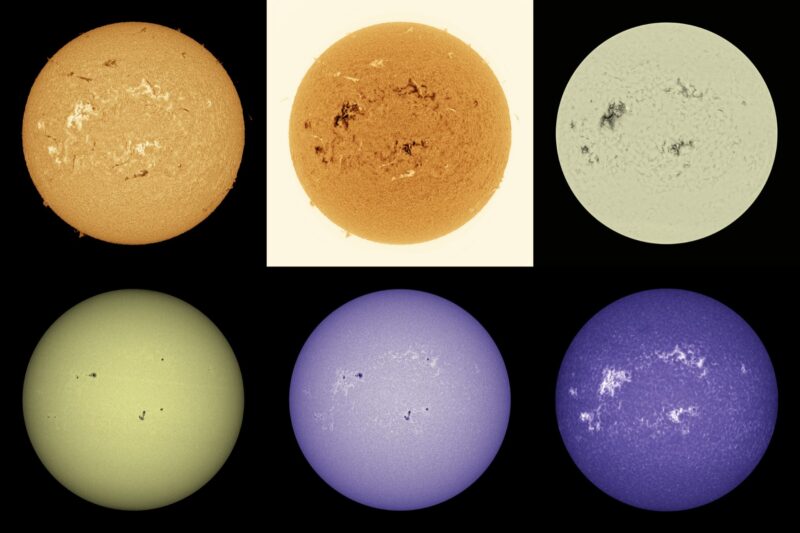
View at EarthSky Community Photos. | Mario Rana in Hampton, Virginia, captured these filtered images on December 24, 2025. Mario wrote: “The sun in hydrogen-alpha, helium D3, iron, G-band, and calcium-H.” Thank you, Mario! Sun news December 24 (UTC): An auroral display on Christmas Eve?
Aurora chances remain in play for tonight, as Earth continues to feel the combined effects of fast solar wind and possible incoming solar material. A blob of solar plasma and magnetic fields, known as a coronal mass ejection (CME), might deliver a glancing blow late on December 24. And when paired with ongoing enhancements from a strong stream of fast solar wind, it raises the possibility of Christmas Eve auroral displays at high latitudes. That solar wind continues to flow from a large, southern coronal hole that now spans the sun’s south pole, keeping speeds elevated. As a result, Earth’s magnetic field has remained unsettled to active, allowing auroras to flirt with high-latitude skies across northern Canada, Iceland, Greenland, and northern Scandinavia, with only a slim chance of brief sightings farther south, such as the Scottish Highlands. Will we see the auroras on Christmas? Stay tuned.
Past 24 hours: The details
(11 UTC December 23 – 11 UTC December 24)
- Flare activity: Sun activity was low over the past day with only C-class flares. Flare production also low with five C flares observed during the last 24-hour period.
- Strongest flare: A C4.9 flare from AR4318 peaked at 10:21 UTC on December 24.
- Other notable flares: Region AR4317 contributed with two C-class events (C1.5 at 15:29 UTC on December 23 and C1.2 at 0:12 UTC on December 24), while the unnumbered incoming active region produced another C1.3 flare blasted out at 4:19 UTC on December 24, C1.4 flare from an incoming active region as-yet-unnumbered peaked at 8:08 UTC on December 24.
- Lead flare producer: AR4317 and this unnumbered incoming region finished in a tie with two C-class flares each.
- Sunspot regions: The Earth-facing solar disk displayed six numbered active regions.
- AR4317 (beta-gamma) kept its gamma configuration and showed a moderate growth during the period. This active region is the largest in extent and shows the strongest magnetic configuration for now on the Earth-viewed solar disk.
- AR4318 (beta) showed a slight growth.
- AR4312 (alpha) and AR4316 (beta) are the two larger sunspot region on the solar disk after AR4317. They remained stable and did not produce any flares.
- There is a newcomer in the northeast quadrant now numbered AR4320 and it shows an alpha configuration.
- Blasts from the sun? No Earth-directed coronal mass ejections (CMEs) were observed during the period.
- Solar wind: The solar wind moderately high averaged around 700 km/s during the first half of this period to increase slightly with peaks of 770 km/s this morning. Solar wind speed is 750 km/s at 10 UTC on December 24. The total field strength of the interplanetary magnetic field (IMF) reached up to about 5.22 nT. The crucial Bz component oscillated between roughly +5 and –5 nT but mostly stayed south oriented. It shows south orientation at 10 UTC this morning. These conditions intermittently southward Bz – are classic drivers of recurring geomagnetic activity and high-latitude auroras, even in the absence of fresh CME impacts.
- Earth’s magnetic field: Earth’s magnetic field ranged from active to unsettled levels (Kp = 3 – 4). The magnetic field stayed at a Kp = 4 level for most part of the period (four three-hour synoptic periods). At the time of this report (11 UTC on December 24), Kp index shows slightly above 3 level.
-
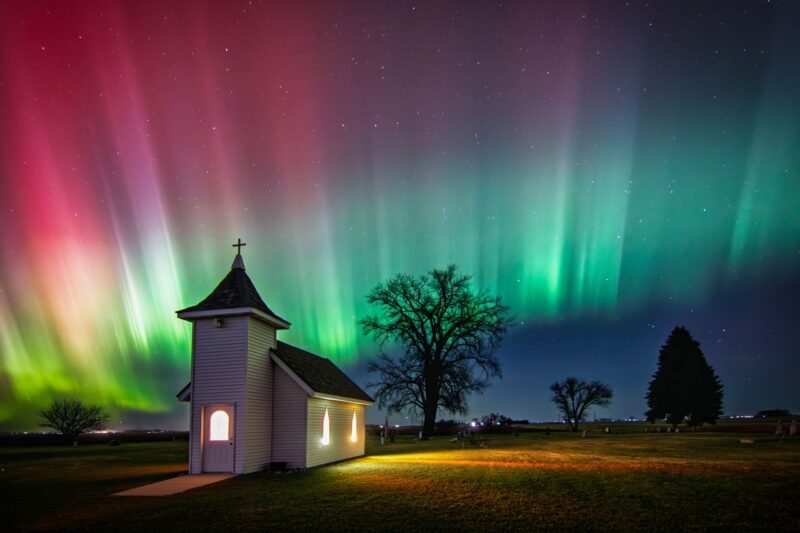
View at EarthSky Community Photos. | JD Smith in Clay County Minnesota caught this beautiful image earlier this month. Aurora chances for tonight? 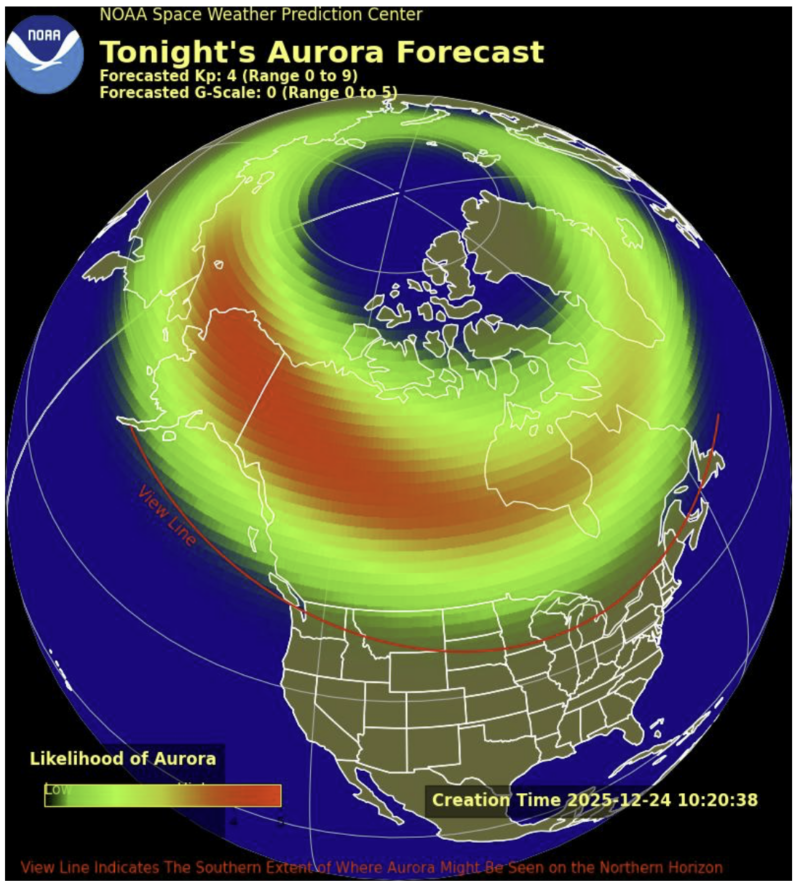
Sun news for December 23-24, 2025. This map shows the forecast intensity and location of the aurora borealis tonight over North America. It includes a viewline marking the southernmost locations where the aurora may be visible low on the northern horizon. The forecast is based on the OVATION model and uses the maximum expected geomagnetic activity (Kp) between 6 pm and 6 am U.S. Central Time.
Auroral brightness and position appear as a green oval centered on Earth’s magnetic pole, turning red when stronger activity is expected. Auroras are visible only during darkness, typically after sunset and before sunrise, and do not need to be directly overhead—bright displays can sometimes be seen from up to 1,000 km away if conditions cooperate. Image via NOAA/SWPC.
Sun news for December 23-24, 2025. Stronger solar activity appears to be unfolding on the far side of the sun, revealed by large prominences rising above the limb. This view was captured by the SUVI instrument aboard GOES-19 in the 304-angstrom wavelength, which highlights cooler plasma in the sun’s chromosphere and makes prominences especially visible as they arc into space. Images via NOAA/GOES. 
Sun news for December 23-24, 2025. Fiery activity on the sun’s northeast limb hints at an active region rotating into view in the coming days. This scene was captured by the SUVI instrument aboard GOES-19 in the 304-angstrom wavelength, which highlights cooler plasma in the sun’s chromosphere and makes prominences stand out clearly. Images via NOAA/GOES. Sun news December 23: Fast solar wind continues to buffet Earth
Auroras likely brushed the polar skies overnight as Earth continued to feel the effects of a strong stream of fast solar wind from a large coronal hole. With this solar wind streaming past Earth at 700-800 km/s, our planet’s geomagnetic field was disturbed to G1 (minor) geomagnetic storm levels, briefly opening the door for enhanced auroras around high-latitude locations such as northern Scandinavia and northern Canada.
Past 24 hours: The details
(11 UTC December 22 – 11 UTC December 23)
- Strongest flare: A C8.6 (common) flare produced by active region AR4317 at 22:31 UTC on December 22.
- Other notable flares: Active region AR4317 produced another two C-class flares: a C1.2 at 0:11 UTC and a C1.7 at 1:50 UTC, on December 23. Region AR4316 contributed one C-class flare: a C1.3 flare at 9:24 UTC on December 23.
- Lead flare producer: AR4317 was the dominant flare producer of the past day, with three C flares.
- Sunspot regions: Today, the Earth-facing solar disk shows five numbered active regions.
- AR4316 (beta) continued growing in size and shows hints of a gamma configuration in its leading portion.
- AR4317 (beta-gamma) showed minor growth as it developed a gamma configuration.
- AR4318 (beta) showed minor growth.
- AR4312 (alpha) is stable with no flare production.
- There is a newcomer sunspot region in the southeast quadrant now numbered AR4219. It shows a beta configuration.
- Blasts from the sun? No Earth-directed coronal mass ejections (CMEs) were observed during the period. An earlier CME that left the sun on December 20 is expected to pass close to Earth on December 24, with a chance of some enhancement to solar wind and geomagnetic activity. However, current guidance suggests any impact would be glancing rather than a direct hit. As a result, the current and expected geomagnetic disturbances are being driven primarily by the coronal hole high-speed stream rather than by recent CME impacts.
- Solar wind: The solar wind environment is under the influence of fast solar wind speeds averaging around 700 km/s over the period, with a peak of 847 km/s at 15:35 UTC on December 22. The speed was 720 km/s by 11 UTC on December 23. The total field strength of the interplanetary magnetic field (IMF) reached up to about 5.06 nT. The crucial Bz component oscillated between roughly +5 and –5 nT throughout the period, with the southward intervals opening the door for enhanced energy transfer into Earth’s magnetosphere and fueling auroral activity. These conditions – strong, steady high-speed flow, moderate IMF strength, and intermittently southward Bz – are classic drivers of recurring geomagnetic activity and high-latitude auroras, even in the absence of fresh CME impacts. Earth’s magnetic field stays southward at the time of this writing (11 UTC on December 23).
- Earth’s magnetic field: Earth’s magnetic field ranged from unsettled to stormy levels, with an isolated G1 (minor) geomagnetic storm at 14:10 UTC on December 22. At the time of this report the Kp index stays at 3.

Sun news for December 22-23, 2025. The large coronal hole we’ve been tracking is now rotating out of a geoeffective position, reducing its direct influence on Earth. But the fast solar wind streaming from it still triggered G1 (minor) geomagnetic storms last night. Images via NOAA/GOES. 
Sun news for December 22-23, 2025. Solar activity remained low, with only 4 C-class (common) flares recorded during the day. Most visible activity stayed near the solar limb, including an eye-catching prominence extending eastward from the north pole. This towering structure formed on the far side of the sun, hinting at active regions rotating just out of view. Observed by the SUVI instrument aboard GOES-19 in the 304-angstrom wavelength, which highlights cooler plasma in the sun’s chromosphere and prominences. Images via NOAA/GOES. 
December 23, 2025. LASCO C3 captured Venus and Mars moving in opposite directions, both soon to be in conjunction with the sun. A gorgeous display. Image via SOHO/NASA. Sun news December 22 (UTC): M flare and magnetic storm hint at more activity
(11 UTC December 21 – 11 UTC December 22)
The sun stayed restless over the past day, with a modest M1.3 flare from rapidly growing sunspot region AR4316 at 18:12 UTC last night raising activity to moderate. That flare capped a flurry of C-class flares, largely from that same region and the high-latitude region AR4317. Meanwhile, auroras danced from Reykjavik to the Scottish Highlands overnight as Earth remained under the influence of a fast solar wind stream flowing out of a large, southern coronal hole. With this solar wind stream expected to persist and the active sunspot regions rotating into more geoeffective positions, both aurora and flare activity are poised to continue over the next few days.
- Flare activity: Solar activity remained at moderate-to-high levels, with 20 flares (1 M-class, 19 C-class) observed in the 24-hour period.
- Strongest flare: An M1.3 M-class flare from AR4316 peaked at 18:12 UTC on December 21. It triggered an R1 (minor) radio blackout over the sunlit South Atlantic, briefly affecting high-frequency communications used by aviation and maritime operators over western South America.
- Other notable flares: A cluster of strong C-class events came from AR4316, including C6.2 at 20:51 UTC, C6.1 at 19:51 UTC, C4.0 at 20:16 UTC, and multiple C3–C3.9 flares between 16:47–22:28 UTC on December 21. Region AR4317 contributed several low C-class events (C1.6 at 13:52 UTC and C2.6 at 05:18 UTC on December 22), while smaller regions such as AR4312 and AR4315 added isolated C1–C2 flares.
- Lead flare producer: AR4316 was the dominant flare engine of this period, responsible for the M1.3 flare and the majority of mid-to-upper-level C-class activity, indicating rising magnetic complexity and energy storage in this emerging southern-hemisphere group.
- Sunspot regions: The Earth-facing solar disk displayed six numbered active regions, with one rapidly developing complex region drawing particular attention.
- AR4316 (beta with emerging delta structure) continued rapid flux emergence on the western edge of its leading spot. Its growing size and hints of a delta configuration in the leading portion explain its role as the top flare producer, with one M-class and numerous C-class flares during the period.
- AR4317 (beta) rotated further onto the disk from the northeast limb. Despite strong foreshortening, it showed growth and produced multiple low C-class flares, suggesting moderate magnetic complexity. This region could soon become more geoeffective as it approaches the center of the solar disk.
- AR4313 has largely decayed into plage, with little remaining spot structure and minimal flare output.
- AR4312, AR4315, and the remaining smaller regions were either stable or in slow decay, contributing only sporadic low C-class flares and showing simple alpha–beta magnetic configurations.
- The overall sunspot population remains modest in number but includes at least one rapidly evolving, increasingly complex region (AR4316) that will be the main focus for further M-class flare potential in the coming days.
- Blasts from the sun? No Earth-directed coronal mass ejections (CMEs) were observed during the period.
- Available coronagraph imagery from spacecraft such as SOHO showed no halo or partial-halo CMEs aimed toward Earth, and none of the flares from AR4316 or AR4317 exhibited clear CME signatures.
- As a result, the current and expected geomagnetic disturbances are being driven primarily by the coronal hole high-speed stream rather than by recent CME impacts.
- Solar wind: The solar wind environment became clearly enhanced under the influence of a corotating interaction region (CIR) followed by a positive-polarity coronal hole high-speed stream. Solar wind speeds increased from around 450 km/s to peaks near 650–700 km/s beginning around 00:00 UTC on 21 December, and remained elevated through the period. The total field strength of the interplanetary magnetic field (IMF) reached up to about 15 nT. The crucial Bz component oscillated between roughly +10 and –10 nT for several hours before easing to smaller ±3 nT fluctuations, with the southward intervals opening the door for enhanced energy transfer into Earth’s magnetosphere and fueling auroral activity. These conditions – strong, steady high-speed flow, moderate IMF strength, and intermittently southward Bz – are classic drivers of recurring geomagnetic activity and high-latitude auroras, even in the absence of fresh CME impacts.
- Earth’s magnetic field: Earth’s magnetic field ranged from active to stormy levels, with brief G1 (minor) geomagnetic storms. At the time of this report (11 UTC on December 22), the field remains under the influence of the high-speed stream, and further active-to-minor storm intervals are anticipated as the stream continues.

Sun news for December 21-22, 2025. An M1.3 (moderate) solar flare erupts on the sun, captured by NASA’s Solar Dynamics Observatory (SDO) in the 131-angstrom wavelength. This channel highlights extremely hot plasma – often exceeding 18 million Fahrenheit, or 9 million degrees Celsius – revealing the intense energy release and magnetic reconnection driving the flare. Images via NASA/SDO. Sun news December 21 (UTC): Solar activity quiets to C flares
(11 UTC December 20 – 11 UTC December 21)
The sun kept up a gentle but steady pace over the past day, with a cluster of modest C-class flares flickering from just behind the sun’s northeastern limb. The most energetic event was a C3.2 flare from region AR4317 near the far-east limb around 19:58 UTC on 20 December. It was a compact burst that didn’t significantly disturb radio communications on Earth. Overall, the sun’s output stayed at low-to-moderate levels, with no new Earth-directed coronal mass ejections (CMEs). Meanwhile, Earth’s magnetic environment remained calm: the waning influence of a previous coronal hole allowed the solar wind to relax toward background conditions, keeping geomagnetic activity in the quiet range and limiting aurora mainly to the usual polar regions such as northern Canada, Iceland, and northern Scandinavia. Looking ahead, forecasters are watching the next coronal hole high-speed stream expected late on December 21–22, which could nudge Kp into geomagnetic storm territory and briefly expand aurora visibility to places like northern Scotland, Edmonton, and possibly Seattle.
- Flare activity: Solar activity remained at low levels, with 6 C-class flares observed in the past day.
- Strongest flare: C3.2 flare from limb region associated with AR4317 near the northeast limb (around N10E89) at 19:58 UTC on December 20, based on precise timing from LMSAL observations.
- Other notable flares:
- C2.7 from AR4312 at 19:15 UTC on December 20.
- C2.8 and C3.2 in quick succession from AR4317 between 19:48–19:58 UTC on December 20.
- C1.4 from AR4317 at 23:10 UTC on December 20.
- C1.2 and C1.8 from AR4317 at 01:19 UTC and 02:14 UTC on December 21.
- Lead flare producer: AR4317 on the northeast limb was the top flare producer, responsible for 5 of the 6 recorded C-class flares. All were modest events, without significant space-weather impacts at Earth.
- Sunspot regions: The Earth-facing solar disk displayed at least 7 numbered active regions in the past day, with several new, small groups emerging.
- AR4315 (beta) produced the earlier M1.1 flare outside this report window and remained a modest, simple group during the period, with no additional significant flaring reported.
- AR4314 (beta) was newly numbered and remained quiet and unremarkable with no notable flares.
- AR4316 (beta) underwent rapid flux emergence and development, increasing in size and complexity but so far producing only low-level flaring.
- AR4317 (region, near the northeast limb, likely beta) was the primary C-flare source this period. Its near-limb position makes detailed magnetic assessment difficult, but current signatures suggest a simple to modestly complex configuration with potential for continued C-class activity as it rotates further onto the disk.
- Older regions AR4305 and AR4307 have rotated off the west limb, while AR4308 and AR4310 decayed into plage, removing some of the previously active sources from the Earth-facing side.
- The remaining regions were small, magnetically simple, and produced only occasional minor flares, consistent with the overall low to moderate activity level.
- Blasts from the sun? Experts did not observe any Earth-directed coronal mass ejections (CMEs) during the 11 UTC December 20 – 11 UTC December 21 period.
- The M1.1 flare from AR4315 at 07:53 UTC on December 20 (just before this report window) produced a CME accompanied by a Type II radio sweep (~558 km/s). But modeling by NOAA/SWPC indicates it will pass mostly behind Earth’s orbit with only a small chance of a glancing influence late on December 24. Any such glancing impact would likely be modest, perhaps briefly enhancing geomagnetic activity if it arrives concurrently with high-speed stream effects.
- Far-side or limb events may be occurring from regions not yet visible from Earth, but current data do not indicate additional geoeffective CMEs aimed toward our planet.
- Solar wind: The solar wind decreased toward more ambient conditions as the influence of a negative-polarity coronal hole high-speed stream waned. NOAA/SWPC reported total magnetic field (Bt) values mostly in the 1–5 nT range, increasing briefly to about 7 nT late in the period, indicating a generally weak to modest interplanetary magnetic field (IMF). Solar wind speeds gradually decreased from previously elevated values toward below 400 km/s, consistent with a transition away from coronal-hole-driven fast flow and back toward the slow solar wind regime. The Bz component remained mostly benign, fluctuating weakly around zero with limited sustained southward excursions. This orientation kept the “door” to Earth’s magnetic field only slightly open, limiting the transfer of energy into the magnetosphere and keeping auroral activity near background polar levels.
- Earth’s magnetic field: Earth’s magnetic field remained quiet throughout the period, with no storms. At the time of this report (around 11 UTC on December 21), conditions remain quiet, with auroras largely confined to typical high-latitude locations such as northern Alaska, northern Canada, Greenland, Iceland, and northern Scandinavia.
What’s ahead? Sun–Earth forecast
- Flare activity forecast: Low to moderate levels of flare activity are expected over the coming 3 days. NOAA/SWPC indicates a slight chance for M-class flares (around 15% today and December 22, increasing to about 20% by December 23) as some older active regions rotate back onto the visible disk and as newly emerged regions like AR4316 and AR4317 develop. The probability for an X-class flare remains low (on the order of a few percent or less) but cannot be entirely ruled out if any region quickly evolves a more complex beta-gamma or beta-gamma-delta magnetic configuration.
- Geomagnetic activity forecast:
- December 21: Mostly quiet conditions are expected as Earth remains in slow to ambient solar wind. Kp is forecast to stay in the 1–2 range, with only a small chance of brief Kp 3 (unsettled) intervals. Auroras should remain confined to the usual auroral oval over northern Canada, Alaska, Iceland, and northern Scandinavia.
- December 22: Geomagnetic activity is likely to increase as a co-rotating interaction region (CIR) and the leading edge of a coronal hole high-speed stream arrive. NOAA/SWPC notes that active conditions and periods of G1 (Minor) geomagnetic storms are likely, with Kp potentially reaching 5 at times. If Kp 5 is realized, auroras could expand southward to be visible from cities such as Seattle and Minneapolis in North America, and Edinburgh and the Scottish Highlands in the UK, as well as Hobart in Tasmania and similar geomagnetic latitudes in the Southern Hemisphere, especially under clear, dark skies.
- December 23: Continued influence from the high-speed stream is expected, keeping geomagnetic activity elevated. Additional active intervals and further episodes of G1 (Minor) storming are likely, again with Kp values near 5 possible. Aurora visibility during any storm periods should be similar to December 22, with good chances across Alaska, northern Canada, Iceland, Scandinavia, and potential sightings as far south as northern Scotland, southern Alaska, and the northern tier of the continental United States (e.g., Seattle, Duluth) if the Bz component turns persistently southward.

This image shows sun activity – with the most active regions labeled – as of 4 UTC on December 21, 2025. Original image, without labels, via NASA SDO. Courtesy of NASA/SDO and the AIA, EVE, and HMI science teams, with labeling by EarthSky. Armando Caussade posted today’s sun. Why are east and west on the sun reversed? Sun news December 20: 2 M flares! Sun activity jumps to moderate
After not seeing an M flare for more than a week, the sun produced not one but two M flares over the past day! The two Ms erupted on almost-opposite sides of the sun’s visible face. The first was an M1.0 flare blasted out at 15:58 UTC on December 19 from AR4307 as it departs on the sun’s western horizon. The blast might be larger than what was measured; it was partly behind the sun. The flare produced an R1 (minor) radio blackout over Porto Alegre in Brazil. The second M – an M1.1 flare at 7:53 UTC on December 20 – arose from active region AR4312, now located near the sun’s northeast horizon. Shortly after the flare, sun-watchers registered an R1 (minor) radio blackout affecting an area over the South Indian Ocean east of Mauritius. During this event, a blob of solar stuff – aka a coronal mass ejection or CME – left the sun. Modeling and analysis is ongoing to determine if any component is Earth-bound. The event also produced a gorgeous prominence, seen in the image above.
Past 24 hours: The details
(11 UTC December 19 – 11 UTC December 20)
- Flare activity: The sun is now considered moderate, thanks to two M flares in the past day. There were a total of 14 flares over the past day, two Ms, nine Cs and three Bs.
- Strongest flare was the M1.1 flare produced by active region AR4312.
- Other notable flares:
- C1.0 from AR4307 at 11:16 UTC on December 19.
- C2.3 from an incoming active region as yet unnumbered in the northeast at 13:43 UTC on December 19.
- C2.3 from AR4307 at 17:16 UTC on December 19.
- C1.8 from AR4312 at 22:23 UTC on December 19.
- From an incoming active region as yet unnumbered: a C1.2 at 1:09 UTC, a C1.3 at 5:34 UTC, a C1.2 at 5:46 UTC, a C1.4 at 7:06 UTC and a C1.4 at 9:19 UTC, all produced on December 20.
- Lead flare producer: Is this incoming active region in the northeast. It was producer of nine flares over the period (six C-class and three B-class).
- Sunspot regions: There are three numbered active regions showing today on the Earth-facing side of our sun.
- AR4307 is still a flare producer from behind the solar horizon on the west. It was producer of one of today’s M flares.
- AR4311 (alpha) and AR4313 (beta) remained stable or continued decaying, with no flare production.
- AR4312 (alpha) produced three C class flares.
- There is a newcomer on the solar disk. It’s an unnumbered yet active region in the northeast and a flare producer. It doesn’t have a number due to a lack of growth. It’s still located too close to the horizon for analysis.
- Blasts from the sun? We didn’t have any Earth-directed coronal mass ejections (CMEs) over the past day.
- Solar wind: Solar wind speeds slowly dropped from 520 km/s (1,163,000 mph) yesterday to 459 km/s (1,031,000 mph) at 10 UTC today, December 20. The interplanetary magnetic field (IMF) strength held near 2.78 nT. The north–south component, Bz, showed mostly south-oriented during the whole period. It stays south-oriented at the time of this writing. A south orientation is favorable for auroral activity.
- Earth’s magnetic field: Geomagnetic conditions stayed at quiet levels (Kp 1–2) over the past day. It’s at Kp 1 as of the time of writing. A large coronal hole is now moving into a geoeffective position, that is, a position where it’s capable of affecting Earth. The fast solar wind it produces will start reaching us at Earth in the next couple of days, possibly bringing conditions for auroras.
What’s ahead? Sun–Earth forecast
- Flare activity forecast: Solar activity is expected to remain low to moderate levels. Today, chances for M-class (moderate) flares is 10%.
- The chance of an X-class (strong) flare continues low at around 1%. No regions on the sun’s near side currently show the delta magnetic structure typically associated with major eruptions.
- Geomagnetic activity forecast:
- December 20-21: Quiet conditions are expected as solar wind effects gradually weaken.
- December 22: Quiet-to-unsettled conditions are anticipated with chances of an isolated G1 (minor) geomagnetic storm. This is due to the arrival of fast solar wind from a recurrent large coronal hole moving into a geoeffective position.

Sun news December 19, 2025. Sun activity jumped up to moderate over the past day, thanks to a couple of M flares. This incoming active region in the northeast – AR4312 – produced an M1.1 flare this morning (7:53 UTC on December 20). An R1 (minor) radio blackout occurred affecting an area over the South Indian Ocean east of Mauritius. During the event, the sun-observing GOES-19 spacecraft captured this gorgeous prominence extending from the sun’s edge. Image via NOAA. 
This imagery shows an M1.0 flare at 15:58 UTC on December 19 produced by active region AR4307 from behind the solar horizon on the southwest. The blast provoked an R1 (minor) radio blackout affecting an area over Porto Alegre in Brazil. GOES 19 SUVI 131 angstrom. Image via NOAA. 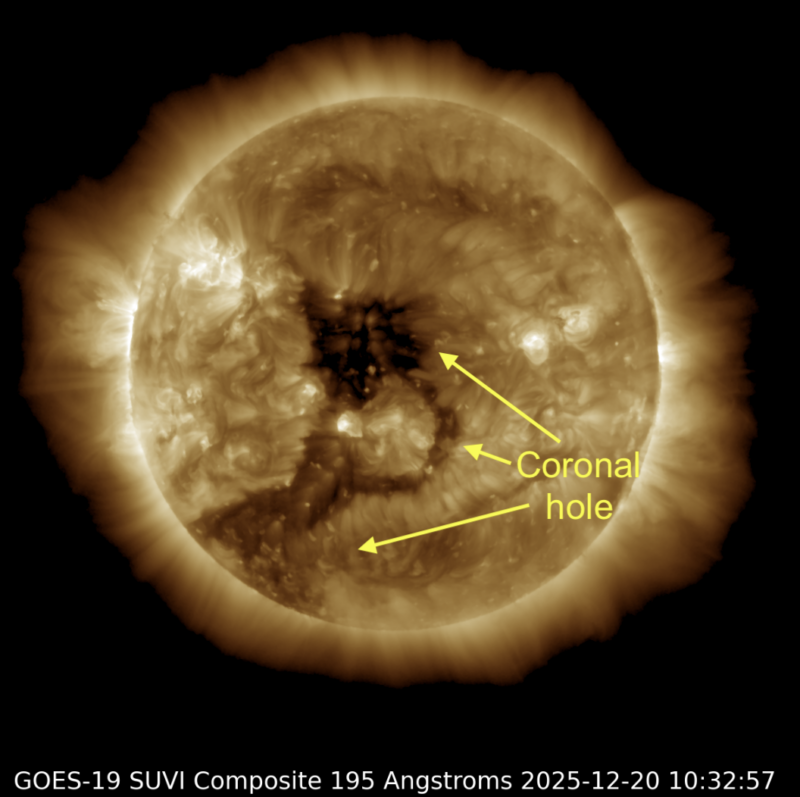
December 20, 2025. A large transequatorial coronal hole forme in the east hemisphere of our star. It is moving now into a geoeffective position, meaning the fast solar wind will start coming directly to us. It may arrive by December 22, with chances for enhancements to produce up to G1 (minor) geomagnetic storms. GOES-19 SUVI 195. Image via NOAA. 
December 19, 2025. ENLIL computer generated simulation shows the coronal mass ejection (CME) hurled by the sun from its far side hit Mercury yesterday. Image via NOAA. Sun news December 19: Blob of solar stuff hit Mercury
A blob of solar stuff – aka a coronal mass ejection or CME – hurled by the sun a couple of days ago from its far side struck Mercury last night (the night of December 18) according to the computer model ENLIL. We on Earth saw this CME over the sun’s horizon as a fiery and beautiful prominence (reported by us on December 17). It means the very active regions we began seeing a couple of weeks ago – which brought strong activity to the Earth-viewed side of our sun (including an X1.1 flare on December 8) – are still alive on the sun’s far side. Chances are, we’ll soon see them again on the near side, carried out by the sun’s rotation. Will those very active region survive or decay? We’ll let you know. Meanwhile the sun is taking a break on flare production on its near side … Read on.
Past 24 hours: The details
(11 UTC December 18 – 11 UTC December 19)
- Flare activity: Sun activity is low. Experts observed only C-class (common) and B-class (weak) flares over the past day. There were a total of seven flares, four Cs and three Bs.
- Strongest flare was a C1.9 flare produced by active region AR4307 at 5:43 UTC on December 19.
- Other notable flares:
- C1.0 from AR4308 at 17:29 UTC on December 18.
- C1.3 from active region AR4307 in the southwest at 5:58 UTC on December 19.
- C1.7 from AR4307 at 6:20 UTC on December 19.
- Sub-C flares and background: A B7.4 flare from AR4307 at 16:436 UTC, ad a B9.4 flare from AR4312 at 20:38 UTC on December 18. A B9.2 flare from an incoming region in the northeast as-yet-unnumbered at 9:20 UTC on December 19.
- Lead flare producer: AR4307 is the lead flare producer of the period, producing four flares (three C-class and one B-class).
- Sunspot regions: Five numbered active regions are showing today on the Earth-facing side of our sun.
- AR4307 (beta) has departed, carried to the sun’s far side. It left producing flares and was the lead flare producer today before departing. Farewell, AR4307!
- AR4308 (alpha), AR4310 (alpha) and AR4311 (beta) all remained stable or continued decaying, with no flare production.
- There are two newcomers on the solar disk: AR4312 near the horizon in the northeast quadrant and AR4313 in the southeast.
- Blasts from the sun? We didn’t have any Earth-directed coronal mass ejections (CMEs) over the past day.
- Solar wind: Solar wind speeds slowly dropped from 646 km/s yesterday to show today 520 km/s at 10 UTC today. The interplanetary magnetic field (IMF) strength held near 3 nT. The north–south component, Bz, fluctuated between northward and southward orientations, with the strongest intervals turning northward to end the period with this north orientation, a configuration is not favorable for auroral activity.
- Earth’s magnetic field: Geomagnetic conditions ranged from unsettled to quiet (Kp 3–1). Earth’s magnetic field reduced from Kp = 3 to a Kp = 1 at the time of writing. All this as the fast solar wind that produced yesterday’s enhancements wanes.
Sun news December 18: Fast solar wind brought magnetic storms last night
Fast solar wind from the huge coronal hole we highlighted yesterday arrived sooner than expected and disturbed Earth’s magnetic field last night, producing a G1 (minor) geomagnetic storm. The storm triggered auroral displays across northern latitudes, including parts of Washington and Montana in the United States. Additional storm intervals remain possible today as fast solar wind continues to buffet Earth’s magnetic field. Aurora watchers should remain alert, as more activity could unfold tonight.
Past 24 hours: The details
(11 UTC December 17 – 11 UTC December 18)
- Flare activity: Only C-class (common) and B-class (weak) flares were observed over the past day, keeping solar activity at low levels. The sun produced eight flares in total: four Cs and four Bs.
- Strongest flare: A C3.2 flare erupted from an incoming, as-yet-unnumbered active region in the sun’s northeast at 7:50 UTC on December 18.
- Other notable flares:
- C2.0 from an unnumbered incoming region in the northeast at 23:35 UTC on December 17.
- C1.3 from active region AR4306 in the southwest at 0:11 UTC on December 18.
- C1.7 from AR4308 at 3:15 UTC on December 18.
- Sub-C flares and background: A B9.1 flare from an unnumbered incoming region in the northeast at 16:44 UTC, a B9.8 flare from AR4307 at 20:09 UTC on December 17, a B7.7 flare from AR4311 at 6:49 UTC, and a B8.3 flare from an unnumbered incoming region in the northeast at 9:30 UTC on December 18.
- Lead flare producer: The incoming active region in the northeast again topped the list, producing four flares (two C-class and two B-class).
- Sunspot regions: The sun currently shows four numbered active regions on its Earth-facing side.
- AR4307 (beta): Showed slight growth while approaching the west limb (edge), where it will soon rotate to the far side.
- AR4311 (beta): Continued to decay, with increased separation among its spots.
- AR4305 (alpha) and AR4310 (beta): Remained stable or continued decaying, with no flare production.
- Blasts from the sun? An eruption near the northeast limb around 12:30 UTC on December 17 was observed. The associated coronal mass ejections (CMEs) remain under analysis to determine whether any component is Earth-directed.
- Solar wind: Solar wind speeds averaged between 640 km/s and 700 km/s during the period and measured 646 km/s at 10 UTC today. The interplanetary magnetic field (IMF) strength held near 6 nT. The north–south component, Bz, fluctuated between northward and southward orientations, with the strongest intervals turning southward. By 10:30 UTC, Bz shifted northward, a configuration that limits energy transfer into Earth’s magnetosphere and suppresses auroral activity.
- Earth’s magnetic field: Geomagnetic conditions ranged from quiet to active (Kp 2–5), briefly reaching G1 (minor) storm levels. At the time of writing, Kp remains at 4.

Sun news for December 17-18, 2025. This artist’s concept shows Earth’s magnetosphere immersed in fast solar wind, which typically speeds along at about 300–500 miles per second (roughly 500–800 kilometers per second). Fast solar wind streams originate from coronal holes: darker, lower-density regions of the sun’s atmosphere where magnetic field lines open into interplanetary space, allowing solar material to escape more easily. When a fast solar wind stream reaches Earth it can buffet and compress the magnetosphere, much like a windsock snapping in a strong breeze. This can allow energy to flow into Earth’s space environment, causing geomagnetic storms and auroras. And this is exactly what happened last night. Images via NASA/ SVS. 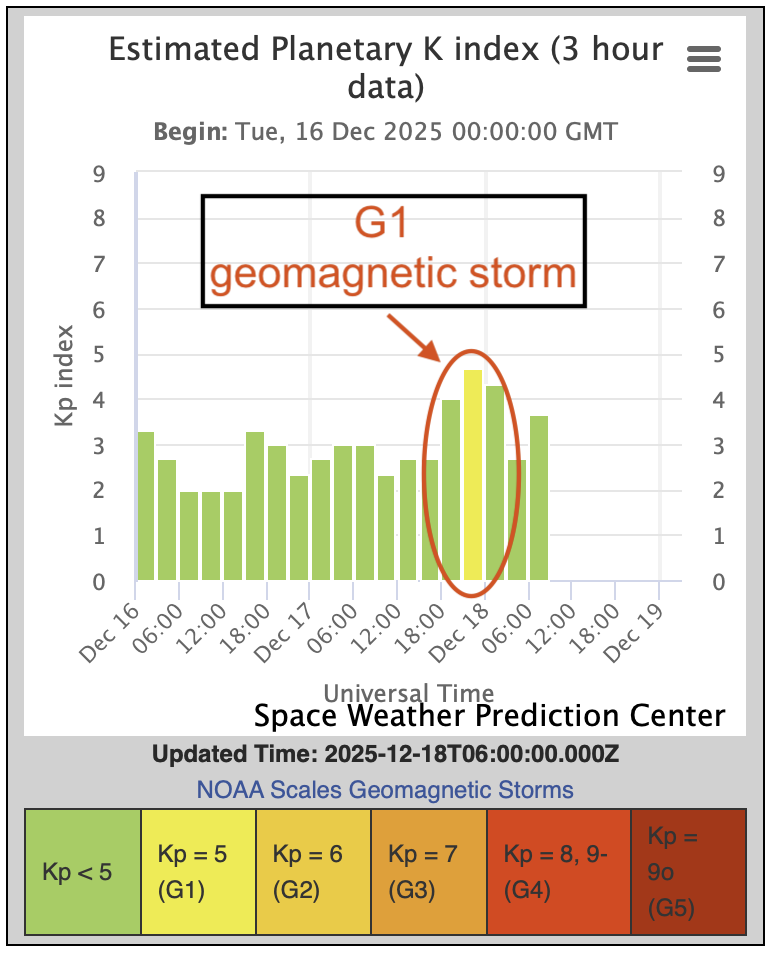
December 18, 2025. The expected G1 (minor) geomagnetic storm arrived earlier than forecast. Kp reached 5 at 0:00 UTC on December 18, producing auroral displays visible across northern latitudes, including Washington and Montana in the United States. Image via NOAA.
December 18,2025. Venus continued its transit to superior conjunction on January 6, captured in the field of view of SOHO’s LASCO C3 instrument. And today, Mars joins the party! Image via NASA/SOHO. Sun news December 17: Huge eruption on sun’s far side!
Ropes of solar material erupted over the sun’s northeast horizon in the early hours this morning (December 17). Experts didn’t detect corresponding flare activity on the Earth-facing disk. So the event must have originated on the far side of our star. The eruption also launched a cloud of solar material — commonly known as a coronal mass ejection (CME) — into space. But the launch site on the sun’s far side means this sun-stuff isn’t headed toward Earth. Judging from the prominence’s position over the sun’s northeast horizon, the sunspot region that fired out the CME might rotate into view in the coming days. If so, it’ll increase the potential for renewed activity on the Earth-facing side of the sun.
Past 24 hours: The details
(11 UTC December 16 – 11 UTC December 17)
- Flare activity: Solar activity remained at low levels over the past day, with only 6 C-class (common) and B-class (weak) flares observed (4 Cs and 2 Bs).
- Strongest flare was a C1.9 flare from an incoming, as-yet-unnumbered active region in the sun’s northeast, at 13:51 UTC on December 16.
- Other notable flares:
- C1.5 from an unnumbered incoming region in the northeast at 13:43 UTC on December 16.
- C1.1 from an unnumbered incoming active region in the northeast at 17:59 UTC on December 16.
- C1.4 from AR4307 at 8:40 UTC on December 17.
- Sub-C flares and background: A B7.5 flare from AR4310 at 11:11 UTC and a B8.3 flare from AR4309 at 14:54 UTC on December 16.
- Lead flare producer: An incoming active region in the northeast led flare production with three C-class flares.
- Sunspot regions: Five numbered active regions were visible on the Earth-facing solar disk.
- AR4310 (beta): Showed slight growth during the period.
- AR4305 (alpha), AR4307 (beta), and AR4308 (beta) remained stable or continued decaying, with no flare production.
- A new region, AR4311, emerged in the northeast quadrant.
- Blasts from the sun? Experts did not detect any Earth-directed coronal mass ejections (CMEs) over the past day.
- Solar wind: Solar wind speeds increased from about 600 km/s to nearly 700 km/s during the first half of December 16, then dipped to near 500 km/s before rebounding to around 600 km/s early today. The interplanetary magnetic field (IMF) strength remained steady near 6 nT. The north–south component, Bz, fluctuated between northward and southward orientations, though the strongest intervals were southward. By 10 UTC, Bz had turned northward, a configuration that limits energy transfer into Earth’s magnetosphere and suppresses auroral activity.
- Earth’s magnetic field: Geomagnetic conditions ranged from quiet to unsettled (Kp 2–3). At the time of writing, Kp remains at 3.

Sun news for December 16-17, 2025. A powerful explosion on the sun’s far side in the early hours of this morning produced a striking prominence rising above the northeast horizon. Based on the prominence’s position, the active region that caused it may soon rotate into view, raising expectations for increased activity on the Earth-facing disk. GOES-19 SUVI 304 Å image via NOAA. Sun news December 16: A giant coronal hole fires fast solar wind our way
(11 UTC December 15 – 11 UTC December 16)
A large coronal hole is now directing its fast solar wind toward Earth. This impressive coronal hole has an inverted “U” shape, with a prominent vertical portion that stretches from the northern hemisphere through the solar equator and deep into the southern hemisphere. It nearly connects with a smaller southern coronal hole. Coronal holes are less dense, cooler areas in the sun’s outer atmosphere, where open magnetic field lines let fast solar wind escape into space. And NOAA forecasters expect the leading edge of this fast solar wind stream to begin arriving at Earth by December 17. So it could potentially up to G1 (minor) geomagnetic storms late on December 18.
In related news, new data from NASA’s Parker Solar Probe have enabled scientists to produce the first map of the outer boundary of the sun’s atmosphere, where solar wind escapes into space. This boundary, known as the Alfvén surface, is a point of no return. It’s where solar material becomes fast enough to break free of the sun’s magnetic grasp. The researchers found that this surface becomes more structured and extended during solar maximum. Read more here.
- Flare activity: Solar activity remains at low levels, with only C-class (common) and B-class (weak) flares observed over the past day. A total of 11 flares were recorded during the past 24 hours: six C-class and five B-class events.
- Strongest flare: A C4.0 flare from AR4304 at 17:28 UTC on December 15.
- Other notable flares:
- C1.3 from AR4308 at 12:05 UTC on December 15
- C2.0 from AR4304 at 12:25 UTC on December 15
- C1.3 from AR4307 at 23:36 UTC on December 15
- C1.4 from AR4310 at 9:21 UTC on December 16
- C3.0 from an unnumbered active region at 03:02 UTC on December 16
- Sub-C flares and background: A series of upper B-class flares (B6.5–B9.4) from AR4307 and AR4310 filled the quieter intervals between C-class events.
- Lead flare producer: AR4307 led flare activity with four total flares (one C-class and three B-class).
- Sunspot regions: The Earth-facing solar disk currently shows four numbered active regions.
- AR4307 (beta): Showed slight growth and ranked as the most active region of the period.
- AR4304: Continued to decay and is now classified as plage.
- AR4309: Quickly decayed to plage shortly after being numbered.
- AR4308 (beta): Continued to decay.
- AR4305 (alpha): Remained stable with no flare production.
- A newcomer, AR4310, emerged in the southwest quadrant during the period.
- Blasts from the sun? Experts did not detect any Earth-directed coronal mass ejections (CMEs) over the past day.
- Solar wind: Solar wind speeds gradually increased from about 440 km/s to a peak near 615 km/s at 6 UTC on December 16, before easing slightly to 599 km/s by 10 UTC. The total interplanetary magnetic field (IMF) strength remained steady near 8 nT. The north–south component, Bz, stayed northward throughout the period, a configuration that effectively limits energy transfer into Earth’s magnetosphere and suppresses auroral activity.
- Earth’s magnetic field: Geomagnetic conditions ranged from quiet to unsettled (Kp 1–3). At the time of writing, Kp remains at 2.

Sun news for December 15-16, 2025. A large coronal hole, spanning both the sun’s northern and southern hemispheres, dominates this GOES-19 satellite image. Its dark appearance marks regions of open magnetic field lines, which allow fast solar wind to escape into space. Because this coronal hole crosses the solar equator, its high-speed wind stream can persist for several days and has an increased chance of interacting with Earth’s magnetic field, potentially driving elevated geomagnetic activity. Images via NOAA/ GOES. 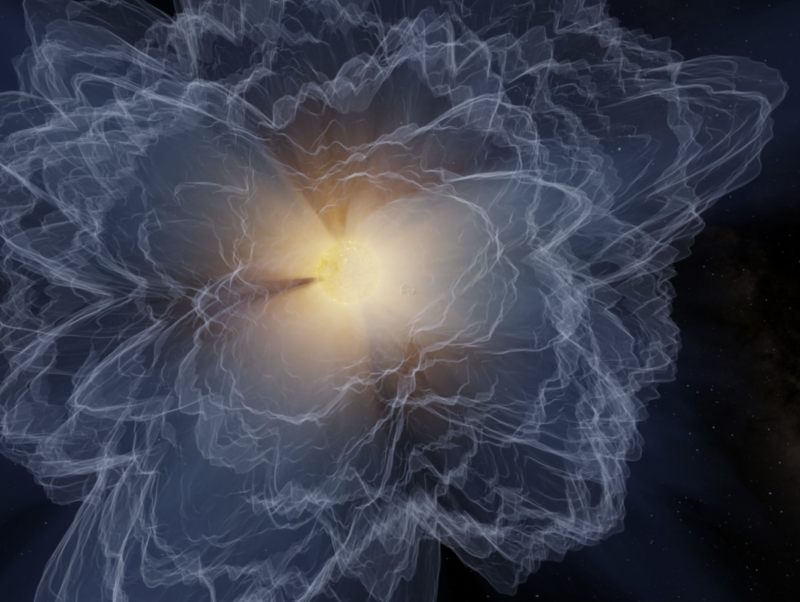
Sun news for December 15-16, 2025. Artist’s concept of the sun’s Alfvén surface, the dynamic boundary marking the outer edge of the solar atmosphere. This surface represents the point of no return where the outward-flowing solar wind breaks free from the sun’s magnetic control. The Alfvén surface is not smooth or static. Instead, it shifts between spiky and frothy structures as solar activity changes. By combining repeated close passes through this boundary by NASA’s Parker Solar Probe with complementary remote observations from other spacecraft, scientists have been able to trace how the Alfvén surface evolves over the solar cycle. These measurements have enabled the 1st detailed maps of this previously unexplored frontier, offering new insight into how the sun releases energy and plasma into interplanetary space. Find out more here. Image via CfA/ Melissa Weiss/ NASA/ JHUAPL. Sun news December 15: Impressive filament eruption this morning
(11 UTC December 14 – 11 UTC December 15)
A powerful filament eruption billowed from the sun’s southwest horizon in the early hours of this morning (December 15). It fired a burst of solar material and magnetic fields – a coronal mass ejection (CME) – into space. But this CME isn’t expected to impact Earth. Otherwise, the sun kept up a modest but steady pace over the past day, firing off a sequence of small C-class (common) flares. But our star remains restless. Forecasters are keeping a watchful eye on sunspot group AR4307 and nearby regions, which retain enough magnetic complexity to produce M-class (moderate) flares in the days ahead.
- Flare activity: Solar activity remained at low to moderate levels, with 10 flares recorded in the past 24 hours: 6 Cs and 4 high Bs (weak).
- Strongest flare: C-class flare of magnitude C2.3 from AR4307 at 16:55 UTC on December 14.
- Other notable flares:
- C1.9 from AR4304 at 12:23 UTC on December 14 .
- C1.0 from AR4307 at 18:04 UTC on December 14 .
- C1.9 from AR4307 at 1:20 UTC on December 15 .
- C1.8 from AR4304 at 1:40 UTC on December 15 .
- C1.4 from AR4307 at 3:02 UTC on December 15.
- Sub-C flares and background: A run of upper B-class flares (B7–B9 range) from AR4307 between about 21:35–22:27 UTC on December 14 filled in the quieter intervals between C-class events.
- Lead flare producer: AR4307 was the dominant source region, responsible for the strongest flare (C2.3) and at least five additional B- and C-class events, indicating a persistently active but not yet explosive magnetic configuration.
- Sunspot regions: The Earth-facing solar disk showed five numbered regions in NOAA/SWPC analysis, with one new region emerging.
- AR4307 (beta): Continued to grow and spread, with a proliferation of intermediate and trailing spots. It was the main flare producer, generating multiple C-class events including the C2.3 and frequent B-class flares. Its evolving structure and size keep it a key candidate for any future M-class flares.
- AR4304 (beta): Produced at least two modest C-class flares (C1.9 and C1.8). Its magnetic configuration remained relatively simple, supporting low-level activity but with a lower probability for stronger events compared with AR4307.
- AR4309 (beta): Newly numbered in this period, this small spot group emerged near the longitude of AR4307. It remained magnetically simple and did not contribute significant flaring.
- AR4306 and AR4308: These smaller, more stable regions showed limited evolution and only minor or no flaring, behaving largely as background contributors to the disk’s overall complexity.
- The remainder of the visible disk consisted of quiet areas and decayed plage, with one complex region (formerly AR4296) having rotated off the west limb earlier, removing a previous source of higher flare potential from view.
- Blasts from the sun? No Earth-directed coronal mass ejections (CMEs) were observed during the period.
- Solar wind: The solar wind remained elevated. But it showed a clear weakening trend as Earth continued to exit a coronal hole high-speed stream.
Speeds decreased from around 650 km/s at the start of the period to a more sustained ~500 km/s after about 18:00 UTC on December 14. The total strength of the interplanetary magnetic field (IMF) (Bt) hovered near background levels. The crucial north–south component, Bz, stayed mostly neutral or northward through this reporting window. A northward Bz tends to close Earth’s magnetic “door,” limiting the entry of solar wind energy and thus keeping auroral activity subdued. - Earth’s magnetic field: Earth’s magnetic field remained mostly quiet under the waning influence of the high-speed stream. Global geomagnetic conditions were primarily in the quiet-to-unsettled range, with Kp generally at 1–3.

Sun news for December 14-15, 2025. Amid another quiet day on the sun, we saw a large filament eruption off the western limb in the early hours of this morning. Initial indications are that the event is largely or completely directed away from Earth. By the way, that dazzling blob on the right of the widest field of view is Venus! Images via NOAA/GOES, NASA/SDO, and NASA/SOHO. Sun news December 14 (UTC): The sun takes a rest on a quiet day.
(11 UTC December 13 – 11 UTC December 14)
The sun took a breather this period, maintaining low to moderate levels of activity while Earth’s magnetic field stayed relatively calm under a waning stream of fast solar wind. The most notable event was a C3.8 solar flare that erupted just beyond the sun’s southwest limb around 07:42 UTC, sending a bright but non-Earth-directed cloud of plasma into space. That eruption was accompanied by a Type II radio burst and a coronal mass ejection (CME) seen by NASA/SOHO, but the geometry keeps it safely off our line of fire. Meanwhile, the fast stream from a southern coronal hole continued to pour past Earth at up to 700 km/s, yet its magnetic field stayed mostly northward, limiting auroral activity to the usual high-latitude zones such as northern Canada, Iceland, and northern Scandinavia. Even so, our star remains restless: several modest but magnetically complex sunspot groups persist on the Earth-facing disk, keeping a chance of M-class flares on the table over the coming days.
- Flare activity: Solar activity remained at low to moderate levels, with 6 C-class flares observed in the 24-hour period.
- Strongest flare: C3.8 flare from a region just beyond the southwest limb (source region not yet numbered on the visible disk) at 07:42 UTC on 14 December. This event was associated with a Type II radio burst and a CME seen off the southwest in SOHO/LASCO imagery.
- Other notable flares:
- C1.2 from AR4304 at 00:12 UTC on 14 December [precise timing from LMSAL observations].
- C2.4 from AR4304 at 17:55 UTC on 13 December.
- C2.1 from AR4298 at 17:18 UTC on 13 December.
- C1.3 from AR4296 (now near/over the west limb) at 16:35 UTC on 13 December.
- C2.8 from AR4304 at 13:01 UTC on 13 December (closely matching the C2.8 event reported by SIDC at 13:04 UTC).
- Lead flare producer: AR4304 was the top flare producer in this window, responsible for at least three C-class events (C2.8, C2.4, C1.2). The limb region responsible for the C3.8 flare will be monitored as it rotates further out of view on the far side.
- Sunspot regions: The Earth-facing solar disk displayed four numbered active regions, all relatively modest in size but with one region retaining some magnetic complexity.
- AR4308 (beta) showed slight development, with some consolidation of spots and minor new spot emergence. It remains a simple bipolar group with limited but non-zero potential for additional C-class activity.
- AR4307 (beta-gamma) is currently the most magnetically complex region on the disk. Although not yet a major flare producer in this period, its mixed polarities keep it as a candidate for isolated M-class flares if further complexity develops.
- AR4304 (beta) produced multiple C-class flares earlier in the period as it approached the western limb. It is now near or just past the limb, with its trailing spots contributing to the flare activity seen from just beyond the southwest edge of the disk.
- AR4296 has rotated across the west limb and is no longer fully visible from Earth. It contributed a C1.3 flare before exiting the disk and will continue its evolution on the far side.
- SIDC Sunspot Group 724 has decayed into plage, leaving no significant spot structure. The remaining smaller regions on the disk are simple, with alpha–beta magnetic classifications and limited flare potential beyond low-level C-class events.
- Blasts from the sun? No Earth-directed coronal mass ejections (CMEs) were observed during the period.
- Solar wind: The solar wind remained elevated but showed a gradual weakening trend as Earth stayed under the waning influence of a negative-polarity coronal-hole high-speed stream. Speeds increased to a peak near 700 km/s around 19:00 UTC on 13 December, then slowly decreased to about 550–570 km/s by the end of the period. This is well above the typical slow-wind background of ~400 km/s. The total strength of the interplanetary magnetic field (IMF) Bt declined from around 14 nT early in the interval to weak levels near 2 nT later on, indicating a relaxing solar-wind environment. The crucial north–south component, Bz, varied between about ?5 nT and +10 nT but spent much of the time neutral to northward (positive). A northward Bz effectively “closes the door” to strong energy transfer into Earth’s magnetic field, which helped keep auroral activity modest despite the fast flow.
- Earth’s magnetic field: Earth’s magnetic field ranged from quiet to unsettled levels under the influence of the high-speed stream, without developing into a full-fledged geomagnetic storm. Global Kp values stayed mostly in the 1–3 range (quiet to unsettled).
What’s ahead? Sun–Earth forecast
- Flare activity forecast: Low to moderate levels of solar activity are expected over the next three days, with continued frequent C-class flares and a chance of isolated M-class flares. NOAA SWPC indicates a chance for M-class (R1–R2) flares on 14–16 December. While explicit percentages are not provided in the text products, this typically corresponds to roughly a 20–30% probability for at least one M-class event each day.
- Geomagnetic activity forecast:
- 14 December 2025: Under the continued but weakening influence of a coronal-hole high-speed stream, geomagnetic conditions are expected to remain mostly quiet to unsettled, with a chance of isolated active periods (Kp up to 4). Any brief Kp 4 intervals could bring aurora into view across typical high-latitude locations such as Reykjavik, Tromsø, northern Finland, and coastal Alaska.
- 15 December 2025: As the current high-speed stream gradually relaxes, NOAA SWPC and SIDC both anticipate mildly enhanced but declining solar-wind conditions. Geomagnetic activity should trend toward quiet to unsettled levels, with only a small chance of short-lived active periods. Aurora will likely be confined to the usual auroral oval over northern Canada, Greenland, Iceland, and northern Scandinavia.
- 16 December 2025: Background to mildly enhanced solar-wind conditions are expected to continue, with Earth moving further out of the main influence of the present coronal hole. Quiet conditions should dominate, with occasional unsettled intervals. No CMEs are currently forecast to arrive, so the probability of reaching G1 (minor) storm levels remains low.
- Looking toward 17 December 2025: Both NOAA SWPC and the UK Met Office note the potential arrival of another coronal-hole high-speed stream around midweek. This could produce a fresh uptick in geomagnetic activity, with a chance of reaching G1 (minor) geomagnetic storm levels. If Kp were to reach 5, aurora could become visible from cities such as Seattle, Minneapolis, and Edinburgh, and from Hobart in Tasmania in the Southern Hemisphere, weather permitting. Forecast confidence for this later period is moderate, pending updated coronal-hole modeling.
Gorgeous lights o' the north last night…
— Barbara Exon (@barbaraexonwriter.bsky.social) 2025-12-13T11:55:34.932Z
Sun news for December 12-13, 2025. The last 3 nights have seen auroral displays primarily at higher latitudes. What did it look like? These images from Barbara Exon (@barbaraexonwriter.bsky.social) in Scotland provide a sampling.Sun news December 13: Auroral displays, 3 nights in a row!
For the 3rd consecutive night, Earth experienced G1 (minor) geomagnetic storming! Last night’s disturbance lasted through three consecutive 3-hour synoptic periods, beginning around 18 UTC on December 12 and easing by about 3 UTC on December 13. Aurora watchers reported displays from locations such as Trondheim and Kiruna in Scandinavia, as well as Wisconsin and Montana in the United States. Earth’s magnetic field was driven to unsettled-to-active levels by a combination of lingering solar ejecta and special conditions of the solar wind. Additional active periods remain possible tonight and tomorrow as this layered “sandwich” of disturbance-generating solar wind continues to buffet Earth’s magnetosphere, with conditions expected to gradually wane around December 15.
Past 24 hours: The details
(11 UTC December 12 – 11 UTC December 13)
- Flare activity: Flare production increased slightly, with 16 flares over the past day in contrast to 13 flares the day before. Overall solar activity remained at low levels, with only C-class flares recorded over the past day. Despite the low flare levels, striking jets and prominences were observed near sunspot region AR4296 in the southwest and a second region, AR4304, in the northwest.
- Strongest flare: A C3.6 flare from AR4296 at 17:58 UTC on December 12.
- Lead flare producer: AR4296 led flare production during the period, generating six C-class flares.
- Other notable C-class flares: A C2.2 at 13:48 UTC (AR4296), C2.8 at 14:47 UTC (AR4296), C3.3 at 17:57 UTC (AR4298), C2.9 at 18:19 UTC (AR4307), and a C2.5 at 19:04 UTC (AR4296), all on December 12. The remaining flares were weaker events below C2.0.
- Sunspot regions: The sun currently shows five numbered active regions on its Earth-facing side, with the most complex groups clustered in the western hemisphere.
- AR4296 (alpha) remains difficult to classify magnetically as it nears the western limb and prepares to rotate out of view. Despite this, it remained the leading flare producer of the period.
- AR4304 (beta) lost its gamma component and stayed stable, producing no flares.
- AR4305 (beta) also lost its gamma complexity and produced a single C-class flare.
- AR4307 (beta) continued to grow near the solar central meridian in the southwest quadrant and produced three C-class flares.
- A new region, AR4308, emerged in the northeast quadrant with a beta magnetic configuration.
- Blasts from the sun? No coronal mass ejections (CMEs) were detected in available coronagraph imagery.
- Solar wind: Last night’s display was driven in part by enhanced negative-polarity solar wind, and a co-rotating interaction region (CIR) containing an embedded transient. Solar wind speeds gradually increased from about 417 km/s to nearly 605 km/s by 10 UTC on December 13. The interplanetary magnetic field (IMF) strengthened to around 14 nT. The Bz component remained southward through the first half of the period until about 00:33 UTC, then turned northward through the end of the observation window.
- Earth’s magnetic field: Geomagnetic conditions ranged from quiet to active, with storm levels reaching Kp = 2–5. A G1 (minor) geomagnetic storm developed around 18 UTC on December 12 and persisted until approximately 03 UTC on December 13. At the time of this report (11 UTC on December 13), Kp has returned to 2.
What’s ahead? Sun–Earth forecast
- Flare activity forecast: As the most magnetically complex regions rotate to the far side of the sun, the probability of M-class flares has dropped to about 45%, with only a 5% chance of X-class flares. Overall moderate-to-high activity is expected to decline as AR4294 has fully departed and AR4296 nears the western limb.
- Geomagnetic activity forecast:
- December 13: Unsettled-to-active conditions are expected, with a chance for isolated G1 (minor) storm periods driven by recurrent negative-polarity fast solar wind from a coronal hole, combined with CIR and transient effects. Aurora watchers should remain alert.
- December 14: Unsettled-to-active (Kp=3-4) geomagnetic conditions may persist.
- December 15: Conditions are expected to trend toward unsettled (Kp=3) as fast solar wind influences gradually weaken.

A towering, inverted U-shaped coronal structure dominates this view in GOES-19 SUVI’s 195-angstrom channel. Part of this feature is driving fast solar wind directly toward Earth, helping fuel the geomagnetic disturbances seen this week. Images via NOAA/GOES. 
The Sun fired off fiery jets and glowing prominences along the west limb as heavyweight sunspot regions, packed with complex magnetic fields, rotated off to the far side—captured in GOES-19 SUVI’s 304-angstrom channel. Images via NOAA/GOES. 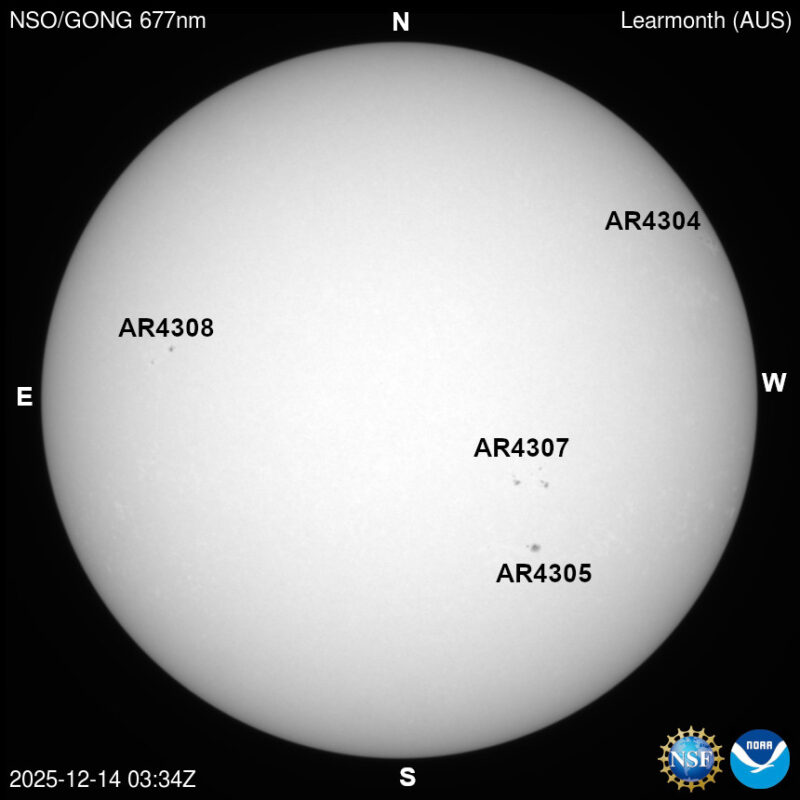
This image shows sun activity – with the most active regions labeled – as of 3 UTC on December 14, 2025, as seen from Learmonth Solar Observatory in Australia. Original image, without labels, via NSO/GONG. Armando Caussade posted today’s sun. Why are east and west on the sun reversed? Sun news December 12: Geomagnetic storm struck again last night
The strange week for aurora-watching continued over the past day, as Earth’s magnetic field stayed unsettled under the combined influence of lingering solar ejecta and shifting solar wind conditions. After a surprising G2 (moderate) geomagnetic storm on December 10, another overnight surge pushed activity back to storm levels, briefly reaching G1 (minor) overnight last night. This renewed disturbance was driven by enhanced solar wind flowing through a changing magnetic sector and reinforced by a co-rotating interaction region (CIR). Auroral displays were largely confined to high latitudes: Alaska, northern Canada, Iceland, and northern Scandinavia, including cities like Reykjavik, Tromsø, and Fairbanks. With a coronal hole high-speed stream rotating into a more geoeffective position (a position where it is capable of affecting Earth, the sun–Earth connection remains lively, keeping aurora watchers on alert!
Past 24 hours: The details
(11 UTC December 10 – 11 UTC December 11)
- Flare activity: The sun itself remained moderately active over the past day. A pair of M-class flares erupted from regions near the southwest limb, and we also had 11 C-class (common) flares. So total flare production was 13 flares over the past day. Adding visual drama, a long-lived prominence along the southeast limb put on a striking display: twisted magnetic fields formed a tornado-like structure before flinging part of its plasma into space.
- Strongest flare: An M2.0 flare from AR4296 at 5:05 UTC on December 12, producing an R1 (minor) radio blackout that affected an area over the Indian Ocean, off the northeast coast of Australia.
- Second M-class flare: An M1.1 flare from AR4294 at 5:44 UTC on December 12, also causing an R1 (minor) radio blackout over the Indian Ocean, east of Australia.
- Lead flare producer: AR4294 still is the lead flare producer before departing this time with eight total flares: one M and seven Cs.
- Other notable C-class flares: C4.5 at 15:21 UTC (AR4294), C5.0 at 15:29 UTC (AR4294), C9.7 flare almost an M flare at 15:46 UTC (AR4294), all these flare produced on December 11.
- Sunspot regions: The sun shows five active regions on the Earth-facing side, three with complex magnetic structures.
- AR4294 (beta-gamma-delta) was the top flare producer of the period. Although it has now rotated off the western solar limb, its activity may still reveal itself through prominences rising along the edge of the Sun.
- AR4296 (beta-delta) produced one of the two M flares today, the strongest one. It will soon rotate out of view.
- AR4299 (beta) will also soon rotate out of view.
- AR4304 (beta) lost its gamma configuration and remained stable with no flares produced.
- AR4305 (beta-gamma) retained its magnetic complexity and produced one C flare.
- There is a newcomer on the Earth-viewed solar disk now numbered AR4307 located in the southeast quadrant near the solar central meridian.
- Blasts from the sun? No coronal mass ejections (CMEs) were detected in available coronagraph imagery.
- Solar wind: Solar wind speeds ranged from 420 km/s to a peak of 450 km/s with a peak of 500 km/s at 2:40 UTC this morning then declined to 416 km/s by 10 UTC today. The interplanetary magnetic field (IMF) is at 9 nT. The Bz component remained southward almost the whole period. It remained southward at the time of this writing.
- Earth’s magnetic field: Conditions ranged from quiet to active, with storming levels of Kp = 2-5. An isolated G1 (minor) storm started around 18 UTC on December 11. At the time of this report, Kp = 3.
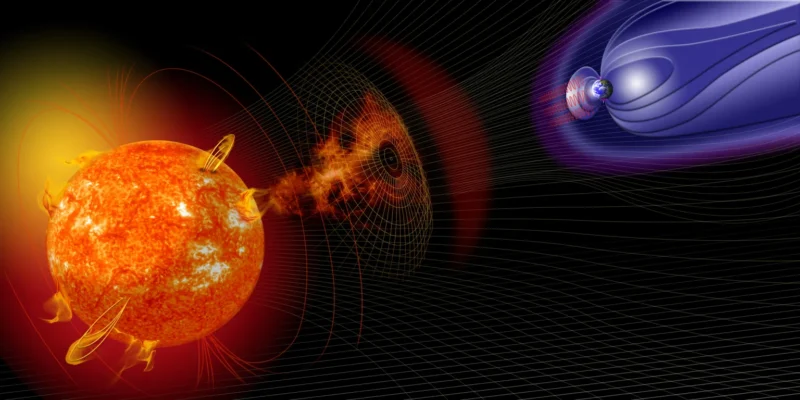
Sun news December 11, 2025. Artist’s concept showing how events on the sun change the conditions in near-Earth space. As of early December 11, Earth’s magnetic field has stayed unsettled over the past day. The combined influence of lingering solar ejecta and shifting solar wind conditions is causing this geomagnetic storming. Image via NASA. 
Sun news December 12, 2025. Sun activity is moderate with the production of 2 M (moderate) flares on December 12. Sunspot regions AR4294 and AR4296 did the one-two punch, with the 2 M flares almost in sequence. The first an M2.0 at 5:05 UTC from AR4296 and the second, an M1.1 at 5:44 UTC. Both flares produced on December 12. Being produced one after the other, both flares provoked correspondent R1 (minor) radio blackouts that affected close areas over the Indian Ocean, east of Australia. GOES-19 SUVI 131 angstrom. Image via NOAA. 
December 12, 2025. While the sun flare activity is at moderate levels, the southeast solar horizon showed a fiery very turbulent long lasting prominence. The twisting magnetic fields can be see forming a tornado-like prominence to finally hurl plasma into space. GOES-19 SUVI 3404 angstrom. Image via NOAA. 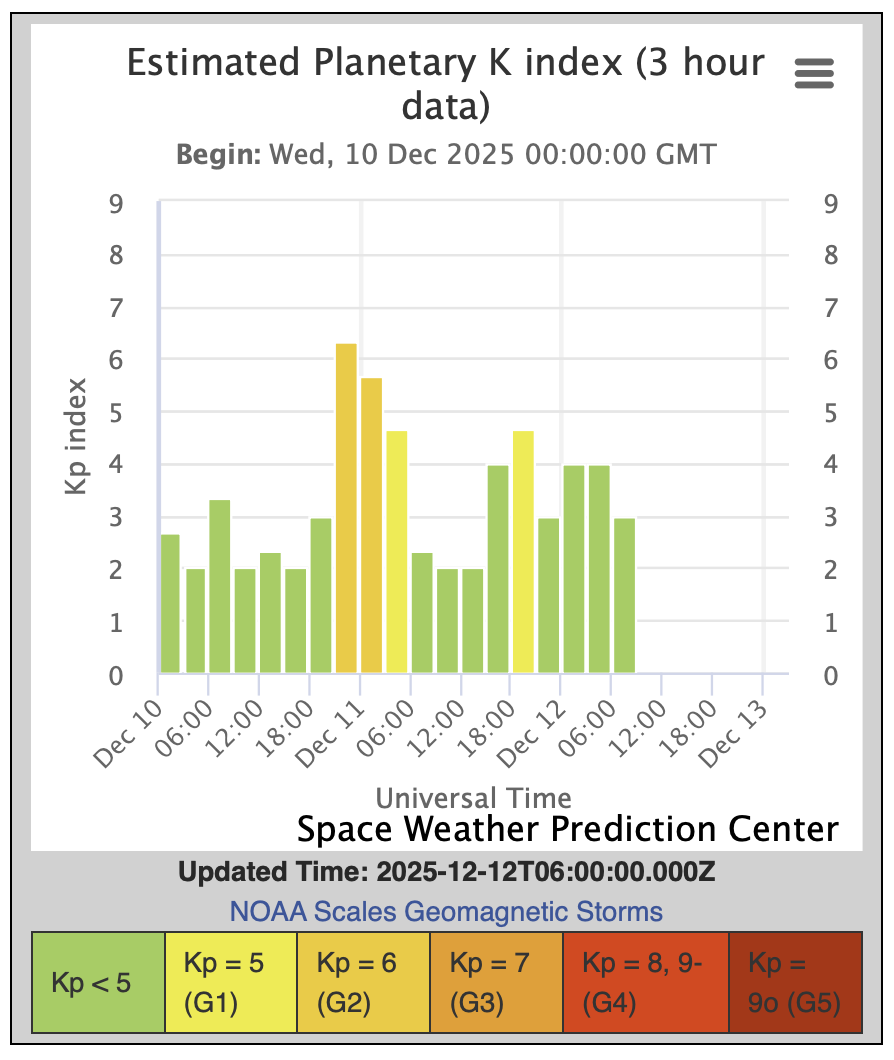
December 12, 2025. An isolated G1 (minor) geomagnetic storm was observed late on December 12. it brought conditions for auroral displays in places like Reykjavik in Iceland and Tromso in Norway. Image via NOAA. Sun news December 11: Surprising geomagnetic storm last night
It’s been a strange week for aurora watching! After the major geomagnetic storm anticipated on Tuesday night failed to materialise, expectations for auroras were low. But last night, our star provided a surprise G2 (moderate) geomagnetic storm, bringing auroras as far south as Oregon and Illinois. This storm was driven partly by a knot of solar winds known as a co-rotating interaction region, and partly by an unknown blast of sun-stuff. Was this the December 6 coronal mass ejection (CME), which was expected to provide the storms on Tuesday? No; this has already passed Earth. But it might have been a delayed portion of that CME, or a different CME, or another space weather effect entirely … it’s hard to say!
Past 24 hours: The details
(11 UTC December 10 – 11 UTC December 11)
- Flare activity: Flare production dropped to 11, down from 31 yesterday, but the sun remained at moderate levels with two M-class flares and nine C-class flares.
- Strongest flare: An M4.4 flare from AR4294 at 22:08 UTC on December 10, producing an R1 (minor) radio blackout over the sunlit hemisphere.
- Second M-class flare: An M1.6 flare from AR4294 at 13:43 UTC on December 10, also causing an R1 (minor) radio blackout.
- Lead flare producer: AR4294 dominated activity again with eight total flares: two Ms and six Cs. Flare production will likely decrease as AR4294 approaches the southwest limb and rotates out of view.
- Other notable C-class flares: C3.4 at 15:05 UTC (AR4294), C3.7 at 19:28 UTC (AR4296), C4.9 at 23:05 UTC (AR4294). On December 11: C2.0 at 02:51 UTC (AR4294), C1.7 at 06:15 UTC (AR4296), C2.4 at 09:29 UTC (AR4294), and C5.0 at 09:38 UTC (AR4299).
- Sunspot regions: The visible disk contains five numbered active regions, four of which show complex magnetic structures.
- AR4294 (beta-gamma-delta) remained the top flare producer. Instability in its main spot continues to drive flaring. It is now approaching the southwest limb and will soon rotate to the far side, likely reducing activity.
- AR4296 (beta-delta) regained its delta configuration and produced two C flares. It remains the largest sunspot region on the disk and will also soon rotate off the southwest limb.
- AR4298 (alpha), producer of the X1.1 flare on December 8, has now rotated to the far side.
- AR4299 (beta) decayed but still produced a notable C5.0 flare.
- AR4304 (beta-gamma) and AR4305 (beta-gamma) retained their magnetic complexity but produced no flares.
- Blasts from the sun? No coronal mass ejections (CMEs) were detected in available coronagraph imagery.
- Solar wind: Solar wind speeds rose from 370 km/s to a peak of 486 km/s at 21 UTC during the G2 (moderate) storm, then declined to 405 km/s by 10 UTC today. The interplanetary magnetic field (IMF) strengthened from 7 nT to 19 nT. The Bz component remained southward during the first half of the period and dropped sharply southward during the G2 storming, enabling auroral activity.
- Earth’s magnetic field: Conditions ranged from quiet to active, with storming levels of Kp = 2-6. The surprise G2 (moderate) storm started around 21 UTC, and was followed by a G1 (minor) period. At the time of this report, Kp = 2.
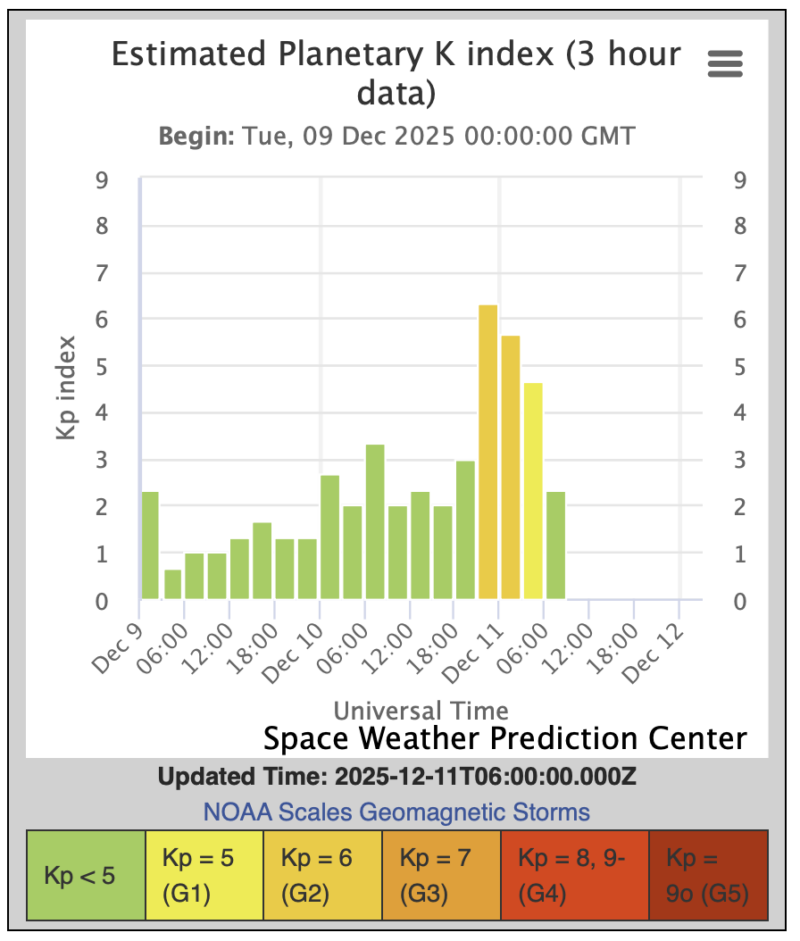
Sun news for December 11, 2025. A surprising G2(moderate) geomagnetic storm was observed late last night, bringing conditions for auroral displays in north-to-mid-latitude states in US. Image via NOAA. 
December 10, 2025. Sun activity remained at moderate levels thanks to a couple of M flares produced by our star. This image shows the largest M event of the period, an M4.4 flare, from active region AR4294 at 22:08 UTC on December 10. The blast provoked an R1 (minor) radio blackout that affected an area over the sunlit Earth. GOES-19 SUVI 131 angstrom. Image via NOAA. 
December 10, 2025. During the M4.4 flare event, gorgeous jets and prominences were seen in the vicinity of active region AR4294. GOES 19 SUVI 304 angstrom. Image via NOAA. Sun news December 10: Impressive flurry of 31 flares in 24 hours
Many aurora hunters were disappointed last night, with the anticipated geomagnetic storms failing to materialise. There’s a small chance the coronal mass ejection (CME) arrival was delayed, but the forecast no longer looks promising. However, excitement continues on our star, where we observed an impressive 4 M-class flares and 27 C-class flares over the past day. The underlying driver of this activity is a magnetically complex cluster of sunspot regions in the solar southwest, where AR4294 and its neighbors continue to emerge and interact, opening the door for further eruptions. Our star remains restless, so stay tuned!
Past 24 hours: The details
(11 UTC December 9 – 11 UTC December 10)
- Flare activity: Solar activity continued at moderate-to-high levels with 4 M-class flares and 27 C-class flares for an impressive total of 31.
- Strongest flare: An M1.9 flare from AR4294 at 7:37 UTC on 10 December, producing an R1 (minor) radio blackout over the sunlit hemisphere.
- Other M-class flares: M1.5 flare from AR4294 at 15:14 UTC (Dec 9), M1.5 from AR4296 at 23:27 UTC (Dec 9); M1.2 from AR4294 at 4:22 UTC (Dec 9). All M-class flares provoked corresponding R1 (minor) radio blackouts.
- Lead flare producer: Once again, the prolific sunspot region AR4294 was the lead flare producer of the period with 23 flares: three Ms and 20 Cs.
- Other notable C-class flares: C4.0 at 11:15 UTC (AR4294), C6.0 at 12:06 (A4294), C4.8 at 13:25 UTC (AR4294), C5.6 at 13:35 UTC (unnumbered region in the southwest), C4.0 at 21:09 UTC (AR4298), C5.1 at 21:42 UTC (AR4294), C4.0 at 0:08 UTC (AR4294), C4.5 at 0:46 UTC (AR4294), C5.6 at 1:10 UTC (AR4294), C7.8 at 1:25 UTC (AR4294), C8.0 at 2:47 UTC (AR4294), C6.5 at 3:13 UTC (AR4294), C9.5 almost an M flare at 3:24 UTC (AR4294), C4.1 at 5:03 UTC (AR4296).
- Sunspot regions: The Earth-facing solar disk is currently populated with six numbered active regions, three of them showing complex magnetic structures.
- AR4294 (beta-gamma-delta) remained the dominant flare producer. It shows high instability, hence its prolific activity. It’s now approaching the southwest horizon and will soon depart to the far side of our star.
- AR4296 (beta) lost its delta component. It is now the largest sunspot region. It produced one of the four M flares of the day.
- AR4298 (alpha), the producer of the X1.1 flare on December 8, decayed to a simple alpha configuration and produced only one C flare.
- AR4299 (beta) lost its gamma-delta component and produced no flares.
- There are two newcomers: AR4304 (beta-gamma), which produced two C flares, and AR4305 (beta-gamma), which produced one C flare.
- Blasts from the sun? No coronal mass ejection (CMEs) were observed in available coronagraph imagery.
- Solar wind: Solar wind averaged around 370 km/s in the first half of the past day and increased to an average of 400 km/s in the second half. It was at 395 km/s at 10 UTC this morning. The interplanetary magnetic field (IMF) dropped from 12 nT to 7 nT. The Bz component remained southward for the whole period, which is favorable for auroras.
- Earth’s magnetic field: Earth’s magnetic field was quiet-to-unsettled during the period at Kp = 1-3. The anticipated geomagnetic storms did not arrive, or may perhaps be delayed. At the time of this report, Kp = 3.

Sun news for December 10, 2025. The sun produced four M-class flares during the past day, alongside 27 C-class flares. This image shows the largest, an M1.9 flare produced at 7:37 UTC on December 10 by sunspot region AR4294. GOES-19 SUVI 131 angstrom. Image via NOAA. 
December 9, 2025. Fiery activity was seen all around the solar periphery over the past day, including this arching prominence in the northeast. GOES-19 SUVI 304 angstrom. Image via NOAA. 
December 9, 2025. We also saw this fiery prominence stretching from the southwest horizon. GOES-19 SUVI 304 angstrom. Image via NOAA. Sun news December 9: Auroras to light up high latitudes tonight
Auroras are poised to return to high-latitude skies tonight, as Earth prepares for impact from a fast-moving blob of solar material launched on 6 December. This coronal mass ejection (CME) impact could drive G3 (strong) geomagnetic storming, with auroras potentially visible at the latitudes of Seattle, Minneapolis and northern England, or even as far south as London if conditions are favorable. Stay tuned.
Past 24 hours: The details
(11 UTC December 8 – 11 UTC December 9)
- Flare activity: Solar activity settled to moderate levels with 25 flares in total: 9 M-class and 16 C-class.
- Strongest flare: An M3.1 flare from AR4294 at 21:17 UTC on 8 December, producing an R1 (minor) radio blackout over the sunlit hemisphere.
- Other M-class flares: M1.1 from AR4294 at 13:05 UTC (Dec 8); M1.2 from AR4299 at 22:28 UTC (Dec 8); M1.0 from AR4299 at 00:58 UTC (Dec 9). AR4294 produced five additional M-class flares on 9 December: M1.2 at 1:38 UTC, M1.0 at 7:29 UTC, M1.3 at 7:39 UTC, M1.6 at 7:47 UTC, and M1.2 at 8:05 UTC. All M-class flares triggered corresponding R1 (minor) radio blackouts.
- Lead flare producer: AR4294 dominated the period with 20 flares: seven M-class and 13 C-class events.
- Other notable C-class flares: C5.2 at 12:36 UTC (AR4294); C4.8 at 14:06 UTC (AR4299); C4.7 at 15:53 UTC (AR4299); C8.1 at 1:52 UTC (AR4294); C6.7 at 2:10 UTC (AR4294); C8.9 at 7:02 UTC (AR4294).
- Sunspot regions: Seven numbered active regions populated the Earth-facing disk, with several maintaining complex magnetic structures.
- AR4294 (beta-gamma-delta) continued to grow in its leading and intermediate spots and remained the dominant flare producer.
- AR4296 (beta-delta) strengthened its delta component and is the second-largest region on the disk. It produced no flares during the past day.
- AR4298 (beta), the region responsible for the X1.1 flare on December 8, produced only one C2.8 flare.
- AR4299 (beta-delta) lost its gamma component and produced an M-class and a C-class flare.
- The remaining regions — and a newly emerged unnumbered region in the northwest — showed minimal evolution and produced mostly low-level C-class flares or remained quiet.
- Blasts from the sun? A major halo CME from the M8.1 flare on December 6 continues to dominate geomagnetic forecasts, with several earlier CMEs also en route.
- Solar wind: Solar wind averaged around 350 km/s over the past day, with a peak of 462 km/s at 9 UTC this morning. The interplanetary magnetic field (IMF) peaked near 9 nT at 10 UTC before declining to 8 nT. The Bz component remained entirely southward the whole period, which is favorable for auroras.
- Earth’s magnetic field: Earth’s magnetic field was quiet during the period at Kp = 0-2. No geomagnetic storms occurred. At the time of this report, Kp = 2.
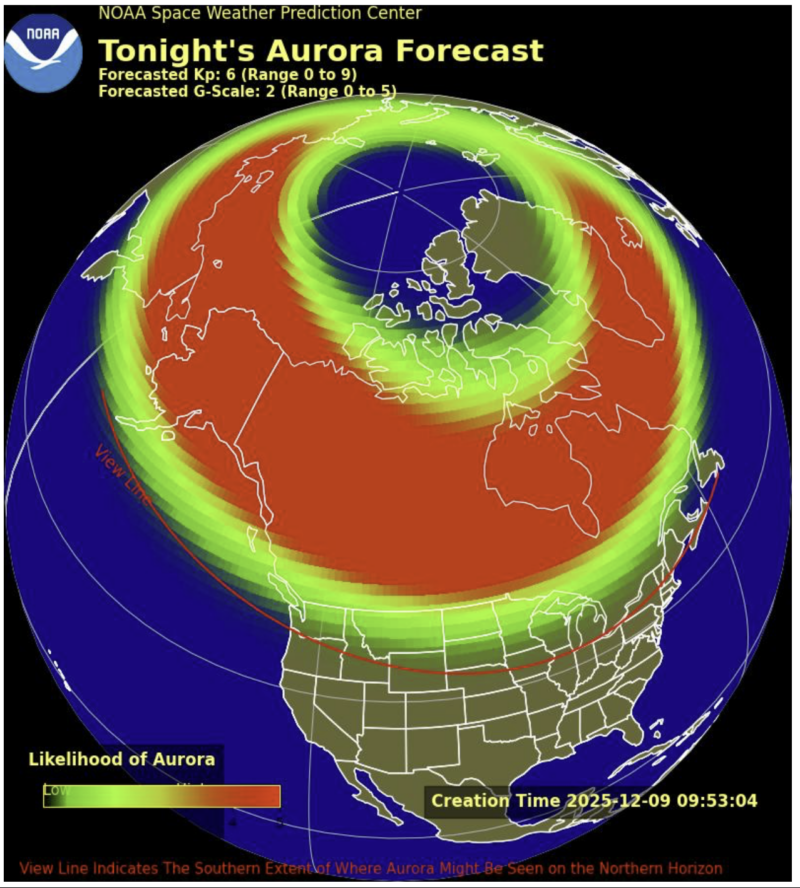
Sun news for December 9, 2025. Auroral displays are in the forecast tonight as a large coronal mass ejection (CME) nears its impact with Earth’s magnetic field. Image via NOAA. 
December 8, 2025. This is the largest M flare of the period: an M3.1 flare at 21:17 from active region AR4294. GOES-19 SUVI 131 angstrom. Image via NOAA. Sun news December 8: X1.1 flare this morning, auroras possible tonight!
Our star erupted with a powerful X1.1 flare from sunspot region AR4298 at 4:49 UTC this morning, rocketing solar activity to very high. And more excitement is on the cards tonight! Multiple coronal mass ejections (CMEs) are currently racing toward Earth. The strongest of these — which came from the M8.1 (moderate) flare on Saturday — produced a full-halo signature in coronagraphs, suggesting it was fired directly our way, and is expected to arrive between 4 and 8 UTC on December 9. That’s late Monday night into early Tuesday for those in North America. Forecasts call for G2-G3 (moderate-strong) geomagnetic storms, with a very small chance of reaching G4 (severe) levels. If we’re lucky, auroras may be visible far from the poles, including the northern United States (for example, and possibly Chicago), London and Paris. Clear skies!
Past 24 hours: The details
(11 UTC December 7 – 11 UTC December 8)
- Flare activity: Solar activity surged to very high levels, with 24 flares observed during the period.
- Strongest flare: The X1.1 flare from AR4298 at 4:49 UTC on December 8. This powerful eruption triggered an R3 (strong) radio blackout across the Indian Ocean.
- Other M-class flares: M2.5 from AR4299 at 23:56 UTC on December 7, triggering an R1 (minor) radio blackout; M2.1 from AR4294 at 0:33 UTC on December 8, also causing R1 conditions; and M1.8 at 6:40 UTC on December 8.
- Lead flare producer: AR4294 was the most active region, responsible for 5 flares including the M2.1 and multiple C-class events.
- Other notable C (common) flares: C8.0 at 8:50 UTC; C6.7 at 22:40 UTC; C6.4 from AR4298 at 20:41 UTC; C6.2 at 4:17 UTC; and C5.4 from AR4294 at 21:18 UTC on December 7. The remaining 15 C-class flares ranged from C2.5 to C4.1, distributed among AR4294, AR4296 and AR4298.
- Sunspot regions: The Earth-facing solar disk currently displays 8 numbered active regions, with several maintaining magnetically complex configurations.
- AR4294 (beta-gamma-delta) continued to develop and remained the largest region on the visible disk. This magnetically complex region produced the M2.1 flare and was the top flare producer with 5 events, including multiple C-class flares.
- AR4296 (beta) was the second-largest region on the disk and produced several C-class flares, including a C3.7 at 22:55 UTC and a C3.6 at 2:47 UTC.
- AR4298 unleashed the powerful X1.1 flare at 4:49 UTC and also produced a C6.4 flare at 20:41 UTC on December 7, demonstrating significant eruptive potential.
- AR4299 (beta-gamma-delta) produced the M2.5 flare at 23:56 UTC on December 7, marking its continued activity.
- The remaining regions — AR4297, AR4300, AR4301 and a newly emerged unnumbered region in the northwest — showed only minor changes and produced mostly low-level C-class activity or remained quiet.
- Blasts from the sun? A significant halo coronal mass ejection (CME) erupted on December 6, with multiple earlier CMEs also en route to Earth.
- The halo CME erupted at 21:12 UTC on December 6, associated with an M8.1 flare that peaked at 20:39 UTC. Analysis shows:
- Leading edge analysis: Three model runs predict Earth arrival between 4:09 and 4:41 UTC on December 9, or late Monday night to early Tuesday morning in the U.S. Kp indices are forecast to reach 6–8, indicating G2–G3 (moderate-strong) geomagnetic storm potential, with auroras possibly visible as far south as Toronto, Chicago, Boston, London, northern France, and Germany.
- Shock front analysis: One model run predicts earlier shock arrival at 0:14 UTC on December 9, creating initial disturbance conditions before the main CME material arrives.
- An earlier CME from 7:09 UTC on December 5 has two model runs predicting Earth arrival around 8:00 UTC on December 8, with Kp indices potentially reaching 3–5, suggesting unsettled to G1 (minor) conditions.
- Two CMEs from December 4 have model runs predicting arrivals between 4:00 and 6:00 UTC on December 8, with Kp indices reaching 2–4, indicating mostly quiet to unsettled conditions with possible minor enhancements.
- Additional CMEs from December 5 and 6 are also approaching, with arrivals predicted for December 9–10, though these are expected to produce only minor-to-moderate geomagnetic effects (Kp 2–5). There is a small chance that peak conditions could briefly approach G4 (severe) levels if the CME arrives with an especially strong and sustained southward Bz, but this outcome is considered unlikely.
- The halo CME erupted at 21:12 UTC on December 6, associated with an M8.1 flare that peaked at 20:39 UTC. Analysis shows:
- Solar wind: Solar wind speeds decreased from approximately 550 km/s to around 400 km/s by the end of the period, reflecting the waning influence of a negative polarity coronal hole high-speed stream and possible onset of a weak blast of sun-stuff that left the sun on December 4. The interplanetary magnetic field (IMF) showed a steady upward trend beginning after 11 UTC yesterday, peaking around 10 nT at 13 UTC before declining. The Bz component remained entirely positive (northward) throughout the period, which is unfavorable for auroras.
- Earth’s magnetic field: Earth’s magnetic field ranged from quiet to active levels during the period, with Kp values reaching 3 due to waning negative polarity coronal hole influences. No geomagnetic storms occurred during this period. At the time of this report, disturbance remains at quiet-to-unsettled levels.

Sun news for December 7-8, 2025. This powerful X1.1 solar flare blasted from sunspot region AR4298 at 4:49 UTC this morning. The blast unleashed an intense wave of high-energy radiation, triggering an R3 (strong) radio blackout over the Indian Ocean and disrupting aviation and maritime communications for nearly an hour. Imagery via NASA/SDO. 
Sun news for December 7-8, 2025. A dramatic filament lift-off from AR4299. Images via NASA/SDO Sun news December 7: Boom! Sun activity surges to high
Over the past day, the sun roared back to its best life with an explosive M8.1 flare from AR4299. This flare pushed solar activity to high levels. Experts were surprised. While AR4299 does contain a delta magnetic configuration, indicating flare potential, even larger flare potential resided within the sunspot trio in the sun’s southern hemisphere. But it was the northern region (AR4299) that released an M1 flare followed by an M8 flare. Both eruptions threw coronal material largely in an Earthward direction. An initial analysis indicates an arrival on December 9. The flare also produced a Type-II radio burst (shock wave speed ~1,143 km/s), and a Type-IV sweep. These are classic signatures of a major magnetic eruption event.
Past 24 hours: The details
(11 UTC December 6 – 11 UTC December 7)
- Flare activity: Solar activity surged to high levels, with 17 flares observed during the period, including 2 M-class flares and 15 C-class flares.
- Strongest flare: M8.1 from AR4299 (N20E01) at 20:39 UTC on December 06. The eruption triggered an R2 (Moderate) radio blackout that disrupted high-frequency communications across the sunlit South American region for roughly 30 minutes, affecting aviation and maritime operations.
- Other M-class flare: M1.2 from AR4299 at 18:58 UTC on December 6, triggering an R1 (Minor) radio blackout.
- Lead flare producer: AR4299 was the top flare producer, responsible for 4 flares including both M-class events and 2 C-class flares. This region has rapidly increased its magnetic complexity to beta-gamma-delta configuration, with complex magnetic mixing zones in both trailing and leading sections showing continued development.
- Other notable C flares: AR4294 produced 6 C-class flares, including a C4.4 at 7:40 UTC and a C3.4 at 8:06 UTC on December 7. AR4296 contributed 4 C-class flares, with a C2.7 at 7:12 UTC and a C2.5 at 3:20 UTC. AR4301 produced a C2.4 flare at 2:37 UTC.
- Sunspot regions: The Earth-facing solar disk displayed 8 numbered active regions, with significant development in the sun’s northern hemisphere.
- AR4299 (beta-delta) showed impressive development around its leader spot, with increased magnetic complexity now classified as beta-gamma-delta by some analyses. The region produced both M-class flares and demonstrated complex magnetic mixing zones in trailing and leading sections, making it the most active region on the visible disk.
- AR4294 (beta-gamma-delta) remained the largest region on the visible disk, displaying a strong trailing spot, diffuse and weaker leading region, and numerous smaller intermediate spots. Despite its impressive size and complex magnetic configuration, it produced only C-class activity during the period.
- AR4296 (beta) was the second-largest region, producing multiple C-class flares but maintaining a relatively simple magnetic structure.
- AR4301 is rotating toward the western limb and contributed modest C-class activity.
- The remaining numbered regions (AR4295, AR4297, AR4298, AR4300) were small and simple, showing minimal flaring activity during the period.
- Blasts from the sun? Two Earth-directed coronal mass ejections (CMEs) erupted from AR4299 in association with the M1.1 and M8.1 flares on December 6. Both NOAA and SOHO coronagraphs have detected a full-halo storm cloud heading directly toward Earth—a clear signature of an Earth-directed eruption. NASA simulations indicate an expected arrival on December 9, with the potential for geomagnetic disturbances depending on the CME’s magnetic orientation. Coronagraph analysis is ongoing to refine arrival timing and assess storm strength.
- A CME erupted at 19:21 UTC on December 6 from N20E01 (AR4299), associated with the M1.1 flare. Coronagraph imagery shows indications of an Earth-directed component, but the feature was likely overshadowed by the faster CME from the subsequent M8.1 flare. Additional imagery is needed to determine precise parameters and arrival timing.
- A more significant CME erupted at 20:39 UTC on December 6 from N20E01 (AR4299), associated with the M8.1 flare. The eruption was accompanied by a Type-II radio burst with an estimated shock speed of 1,143 km/s and a Type-IV radio sweep, indicating a fast and potentially geoeffective CME. Preliminary coronagraph imagery shows a likely Earth-directed component given the source region’s favorable disk position. Analysis is ongoing to determine arrival timing and geomagnetic impact potential, with updates expected as additional imagery becomes available.
- A weak CME from the southwest disk on December 4 has a slight chance of delivering a glancing blow on December 7. Another faint CME from early December 5 may arrive on December 8, though confidence remains low for both events.
- Solar wind: Solar wind speeds remained elevated under the ongoing influence of a negative polarity coronal hole high-speed stream, varying mostly between 600–700 km/s with a peak of 730 km/s. The interplanetary magnetic field (IMF) strength was mildly elevated, ranging between 4–8 nT. The Bz component remained relatively weak and variable, briefly reaching as far south as –6 nT but not sustaining prolonged southward orientations. The phi angle was predominantly oriented in the negative solar sector (directed toward the sun), reflecting the polarity of the geoeffective coronal hole. These conditions maintained the door open for geomagnetic activity, though the weak Bz limited significant energy transfer into Earth’s magnetosphere.
- Earth’s magnetic field: Earth’s magnetic field ranged from quiet to active levels during the period, with Kp values between 1 and 3. The elevated solar wind speeds from the coronal hole high-speed stream maintained unsettled to active conditions at times, but the relatively weak and variable Bz component prevented sustained geomagnetic storm conditions. No G-scale storm levels were reached during the period. Current conditions remain quiet to unsettled as the coronal hole influence continues.
What’s ahead? Sun–Earth forecast
- Flare activity forecast: M-class flares (R1-R2) are likely over December 7–9, with high levels of activity expected to continue. AR4299 remains the primary threat given its recent M8.1 flare and complex beta-gamma-delta magnetic configuration showing continued development. A slight chance exists for X-class flares (R3 or higher), particularly from AR4299, given its past flare history and magnetic complexity. AR4294 and AR4296 also retain moderate flare potential with their large areas and beta-gamma-delta and beta configurations, respectively.
- Geomagnetic activity forecast:
- December 7: G1 (Minor) geomagnetic storm levels are possible, with a slight chance for enhancement due to ongoing coronal hole high-speed stream influences and potential glancing effects from the weak December 4 CME. Solar wind speeds expected to remain elevated near 600–700 km/s. Aurora may be visible from high-latitude locations including Anchorage, Reykjavik, Oslo, and northern Scandinavia if conditions align.
- December 8: G1-G2 (Minor to Moderate) storm levels are likely due to anticipated arrival of the December 6 CMEs from AR4299, combined with possible glancing influence from the faint December 5 CME. Confidence is increased for geomagnetic enhancement, though precise arrival timing remains uncertain pending additional coronagraph analysis. If the M8.1 CME arrives with favorable Bz orientation, aurora may be visible from Seattle, Minneapolis, Edinburgh, Toronto, and northern England, with a slight chance of visibility from Chicago and northern France if G2 conditions materialize.
- December 9: Geomagnetic activity likely to trend toward mostly quiet levels as CME influences wane and solar wind speeds gradually decline toward background conditions. Isolated periods of unsettled conditions remain possible if CME effects persist longer than expected. Aurora visibility expected to return to high-latitude locations only (northern Canada, Alaska, Iceland, northern Scandinavia).Initial observations of the two CMEs associated with the M1 and M8 flares on December 6 could bring geomagnetic activity to Earth from G2 to G3 levels with aurora reaching well into the northern U.S. states but we await a more detailed analysis.
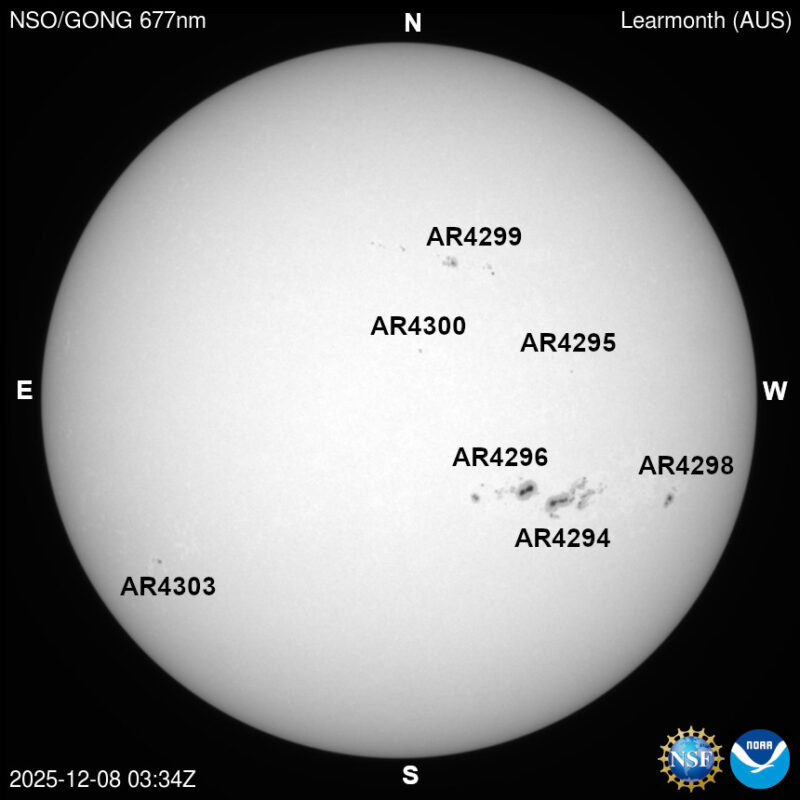
This image shows sun activity – with the most active regions labeled – as of 3 UTC on December 8, 2025, as seen from Learmonth Solar Observatory in Australia. Original image, without labels, via NSO/GONG. Armando Caussade posted today’s sun. Why are east and west on the sun reversed? Sun news December 6: Solar trio is quiet, hiding big potential
The sun took a breather this period, with flare activity dropping back to low levels after several days of heightened eruption. The strongest event was a modest C 6.5 flare from AR4299, producing no significant space-weather impacts. Even with this lull, the solar disk remains crowded with complex and potentially explosive regions. A sunspot trio – AR4294, AR4296, and AR4298 – continued hurling jets and ejecting plasma throughout the day. Much of this material fell back to the sun, but some faint blobs of “solar stuff” escaped into space. These small eruptions can amplify disturbances when swept up by stronger, faster events. Meanwhile, Earth’s magnetic environment continues to feel the effects of fast solar wind from a recurrent coronal hole, keeping solar wind speeds near 600–700 km/s (1,300,000-1,600,000 mph) and driving occasional unsettled-to-active geomagnetic conditions. Looking ahead, moderate solar activity is expected to return. A weak coronal mass ejection (CME) from December 4 may also deliver a glancing blow late on December 7, possibly sparking G1 (minor) geomagnetic storming and auroras across high-latitude regions.
Past 24 hours: The details
(11 UTC December 5 – 11 UTC December 6)
- Flare activity: Solar activity remained at low levels, with 17 C-class flares recorded over the past day.
- Strongest flare: A C6.5 flare from AR4299 in the northeast at 03:09 UTC on December 6.
- Lead flare producer: AR4294 (beta-gamma-delta) led activity with seven C-class flares.
- Other notable C flares: From AR4294: C4.3 at 16:26 UTC, C2.5 at 17:54 UTC, C2.4 at 18:51 UTC, C1.8 at 04:41 UTC, C1.9 at 06:02 UTC, and C1.7 at 07:24 UTC. From AR4296: C2.5 at 19:02 UTC, C3.8 at 20:11 UTC, C2.5 at 21:03 UTC, C2.4 at 21:16 UTC, C5.2 at 22:48 UTC, and C1.7 at 07:30 UTC.
- Sunspot regions: Eight numbered active regions appeared on the Earth-facing disk. One region held a beta-gamma-delta configuration, and another held a beta-delta configuration.
- AR4294 (beta-gamma-delta) remains the largest and most magnetically complex region. It produced only C-class flares this period but still carries strong potential for higher activity.
- AR4299 (beta-delta) maintained its delta component and produced the largest flare of the period (C6.5).
- AR4296 (beta) simplified from beta-gamma-delta to beta. Together with AR4294 and AR4298, it forms an impressive multi-region complex.
- The remaining regions hold alpha or beta configurations.
- Blasts from the sun? No Earth-directed CMEs were observed in available coronagraph imagery.
- Solar wind: Solar wind speeds increased from ~600 km/s to 658 km/s by 11 UTC on December 6. The interplanetary magnetic field (IMF) strength remained moderate at 6 nT. The Bz component fluctuated frequently and ended southward at 10 UTC, an orientation that supports geomagnetic activity.
- Earth’s magnetic field: Conditions ranged from unsettled to active (Kp 2-4). No G1 storming occurred. At report time, Kp = 4.

Sun news for December 5-6, 2025. The sun has been relatively quiet the past 2 days but 3 regions near disk center harbor great potential, AR4296, AR4294, and AR4298. This is especially true for AR4294, which has a delta region. That means it has high magnetic complexity and potential energy that could be released in the form of a solar eruption like a large flare. Stay tuned! Images via NASA/SDO/ JHelioviewer. 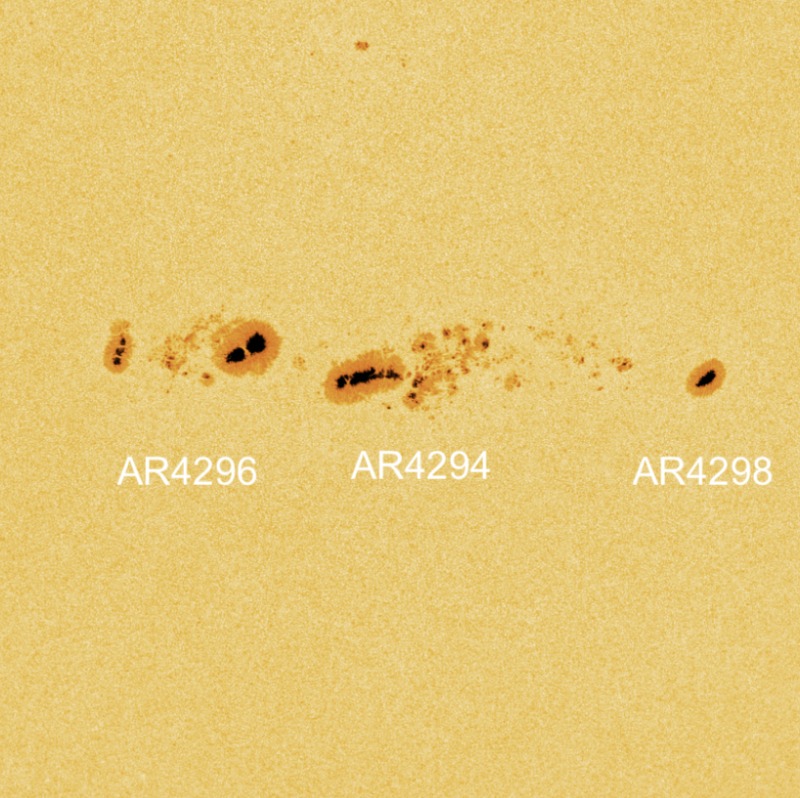
Sun news for December 5-6, 2025. One of these guys has potential, AR4294 (beta-gamma-delta). It could unleash a larger flare any minute. Image via NASA/SDO. 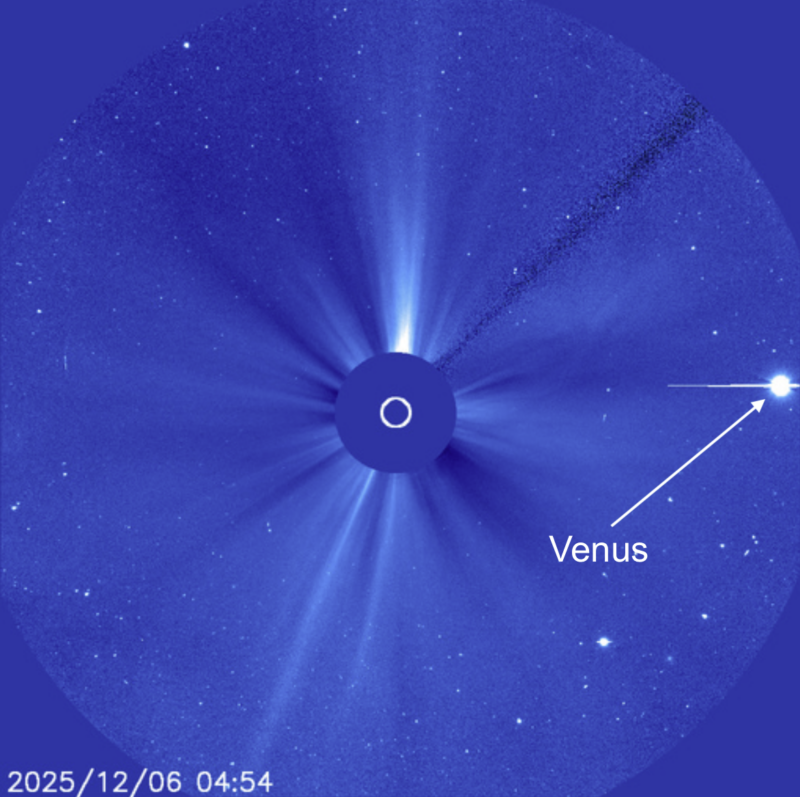
Sun news for December 5-6, 2025. Venus, now visible with its full glory, captured in the SOHO LASCO C2 coronagraph telescope. Images via NASA/SOHO. 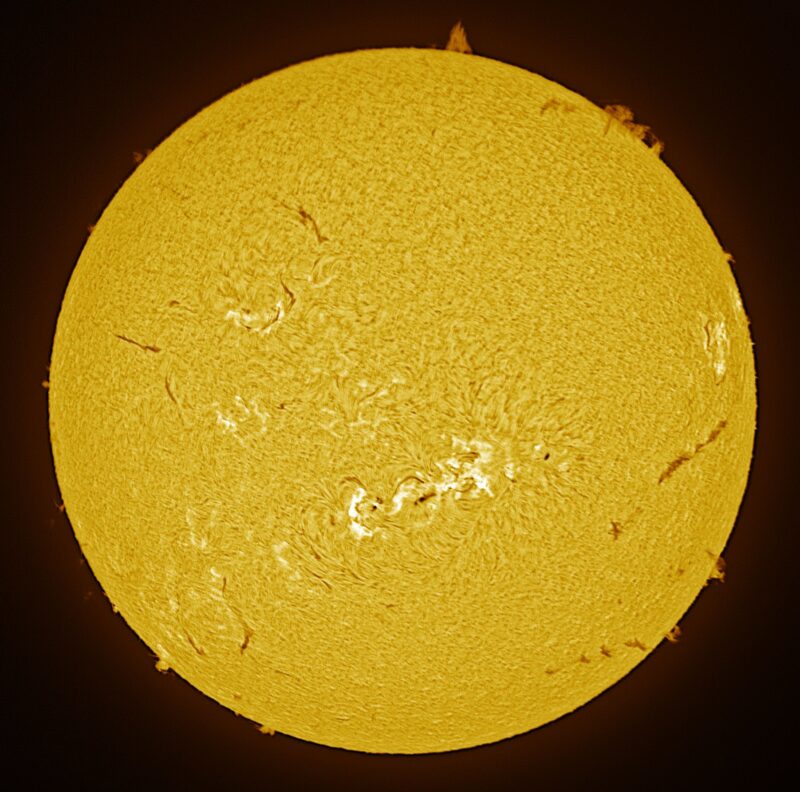
View at EarthSky Community Photos. | Jim Militello in Tucson, Arizona, captured this filtered image of the sun on December 5, 2025. Jim wrote: “Hydrogen-alpha image of the sun with sunspot active regions, prominences and filaments.” Thank you, Jim! Sun news December 5: Strong sunspots, weak flares, rising potential
The sun currently hosts two active regions with the most powerful magnetic complexity possible! But flare activity remained low over the past day, with C-class flares only. A sunspot triumvirate – AR4294, AR4296, and AR4298 – spent the period unleashing jets and ejecting plasma. Yet all of these events produced only C flares. Meanwhile, both AR4294 and AR4296 maintain a beta-gamma-delta magnetic configuration, the strongest classification, with the most potential for larger flares. We’ll keep watching. Meanwhile, a fiery prominence on the sun’s southwest limb signals ongoing activity on the far side of the sun. By the way … check out the image below. Venus – the brightest planet in Earth’s sky – has been gone behind the sun for some weeks. Now it has made its majestic entrance into the field of view of SOHO’s LASCO C3 coronagraph.
Past 24 hours: The details
(11 UTC December 3 – 11 UTC December 4)
- Flare activity: Solar activity returned to low levels, with only C-class flares observed. A total of 10 C flares were recorded over the past 24 hours.
- Strongest flare: A C7.4 flare from AR4299 in the northeast at 02:09 UTC on December 5.
- Lead flare producer: AR4298 (beta-gamma-delta) led the period with four C-class flares.
- Other notable C flares: AR4298 produced a C4.0 at 11:02 UTC, a C3.3 at 19:09 UTC, a C3.9 at 19:20 UTC, and a C2.7 at 07:45 UTC. AR4296 produced a C3.4 at 18:19 UTC, a C6.8 at 23:24 UTC, and a C4.0 at 00:11 UTC.
- Sunspot regions: Seven numbered active regions appear on the Earth-facing side today. Two regions retain the strongest possible magnetic classification (beta-gamma-delta), and one region shows a beta-delta configuration.
- AR4294 (beta-gamma-delta) shows slight decay but remains the largest and most magnetically complex region on the disk. It produced only one C3.4 flare during the period but retains the potential for stronger activity.
- AR4299 (beta-delta) kept its delta configuration and produced a single C7.4 flare. It is now smaller than during its previous transit as AR4274, when it produced major activity in mid-November.
- AR4296 (beta-gamma-delta) developed additional complexity and remains part of the extended active complex formed with AR4294 and AR4298. It showed slight decay but still produced three C flares.
- The remaining regions show alpha or beta configurations, including AR4300 (beta), which produced no flares, and AR4301 (beta), which produced a single C4.4 flare.
- Blasts from the sun? A coronal mass ejection (CME) erupted near AR4296 and was captured by LASCO C2 at 06:48 UTC on December 4. Modeling suggests this CME may deliver a glancing blow to Earth late on December 7. No other Earth-directed CMEs were observed.
- Solar wind: Solar wind speeds ranged from 650–700 km/s, with peaks near 720 km/s and a brief low of 490 km/s at 01:50 UTC. Speeds measured 634 km/s at 11 UTC on December 5. The IMF remained moderate at 5.77 nT. The Bz component fluctuated frequently but trended southward early on December 5—an orientation that favors geomagnetic activity—before ending the period northward at +2 nT.
- Earth’s magnetic field: Conditions ranged from unsettled to active (Kp 3–4). No G1 (minor) storming occurred. At report time, Kp = 3.
What’s ahead? Sun–Earth forecast
- Flare activity forecast: M-class flares remain possible today, though chances for X-class events have decreased. Today’s probabilities: 75% for M-class, 25% for X-class. This forecast is driven by the strong beta-gamma-delta regions AR4294 and AR4296, along with AR4299’s beta-delta configuration.
- Geomagnetic activity forecast:
- December 05: Active levels likely, with a chance for G1 (minor) geomagnetic storm levels as the coronal hole high-speed stream influence continues to wane. Aurora may be visible from high-latitude locations including Reykjavik, Tromsø, and Fairbanks.
- December 06: Unsettled to active levels expected as the high-speed stream weakens further. A slight chance for G1 (minor) storms persists.
- December 07: G1 (minor) geomagnetic storm levels are likely late in the day due to the anticipated glancing blow from the weak CME observed on December 04, though confidence remains low. If the CME delivers a more direct impact than currently modeled, aurora may briefly appear from Seattle, Oslo, and Edinburgh, though this scenario is considered unlikely.

Sun news for December 4-5, 2025. The new sunspot triumvirate – AR4294, AR4296, and AR4298 – kept spewing jets all day long over the past day, as seen in this GOES-19 SUVI 304-angstrom view. And notice the sun’s southwest horizon, where a fiery prominence lifts off, hinting at powerful activity brewing on the far side of the sun. Images via NOAA/GOES 
Sun news for December 4-5, 2025. Venus has now made its majestic entrance into the field of view of SOHO’s LASCO C3 coronagraph, shining brightly as it glides behind the sun’s outer corona. Venus is the brightest planet visible from Earth. It left our morning sky some weeks ago. Its superior conjunction, when it will be most directly aligned behind the sun from Earth, will come in early January. It’ll return to our evening sky in February 2026. Images via NASA/SOHO. Sun news December 4: Unexpectedly strong geomagnetic storm last night
As anticipated, the coronal mass ejection (CME) launched by Monday morning’s X1.9 flare struck Earth’s magnetic field last night. And the impact exceeded expectations: instead of the predicted G2 (moderate) storm, Earth’s field surged to G3 (strong) conditions at 18 UTC. This elevated response was driven by the combined effects of the CME, a complex knot of solar winds known as a co-rotating interaction region (CIR), and a stream of fast solar wind from a coronal hole. Did you see any auroras? Share your photos with us here. G1 (minor) storming is expected to persist through tonight.
Past 24 hours: The details
(11 UTC December 2 – 11 UTC December 3)
- Flare activity: Solar activity jumped to high levels thanks to an M6 flare this morning. This came alongside 13 C flares.
- Strongest flare: A M6.0 flare from AR4300 in the northeast at 2:50 UTC on December 4. The event triggered an R2 (moderate) radio blackout across the sunlit side of Earth.
- Lead flare producer: AR4294 (beta-gamma-delta) led with six C-class flares.
- Other notable C flares: AR4298 produced a C3.5 at 14:09 UTC and a C4.0 at 17:44 UTC. AR4299 fired a C3.0 at 16:30 UTC, followed by a C3.9 at 21:31 UTC on December 3. AR4294 sparked a C3.4 at 16:06 UTC, a C3.3 at 16:02 UTC, a C3.0 at 20:03 UTC, a C2.6 at 21:57 UTC, a C4.0 at 21:13 UTC and a C4.4 at 5:38 UTC.
- Sunspot regions: The sun currently shows eight numbered active regions on its Earth-facing side. Two regions hold the strongest magnetic classification possible (beta-gamma-delta), with one region showing beta-delta and two more showing beta-gamma.
- AR4294 (beta-gamma-delta) remains the largest and most magnetically complex region on the disk. Although it may be beginning to simplify, it still produced six C flares.
- AR4299 (beta-delta) maintained its delta configuration and produced two C flares. Despite its quiet behavior this period, expectations remain high due to its history as the sunspot region formerly known as AR4274, which produced major activity on its last pass across the Earth-viewed sun in mid-November.
- AR4296 (beta-gamma-delta) gained a gamma component and retains its delta configuration. It produced only one flare (a C9.2, nearly an M flare) despite its strong magnetic potential. Along with AR4294 and AR4298, it forms a large active complex in the southeast quadrant.
- AR4300 (beta-gamma) in the northeast quickly demonstrated its capability, producing today’s M-class flare.
- AR4301 is a newcomer in the southwest quadrant.
- The remaining regions are smaller and magnetically simple, though some still produced low-level C flares.
- Blasts from the sun? Two CMEs were detected in coronagraph imagery: one from a filament eruption in the northwest near 12 UTC on December 3, and a faster eruption in the southwest around 12:30 UTC. Modeling suggests both will pass ahead of Earth, with no impact expected.
- Solar wind: Solar wind speeds climbed from 373 km/s to around 700 km/s, peaking at 730 km/s at 5:09 UTC before relaxing to 679 km/s by 11 UTC on December 4. The IMF strength remained moderate at 7 nT. The Bz component fluctuated frequently but trended southward late on December 3, an orientation that supports geomagnetic activity. It ended the period at –3 nT.
- Earth’s magnetic field: Conditions ranged from active to storm levels (Kp 5–7). The arrival of the CME from the X1.9 flare drove G1 (minor) storming through most of the period and briefly intensified to G3 (strong) at 18 UTC on December 3. At the time of this report, Kp = 5.
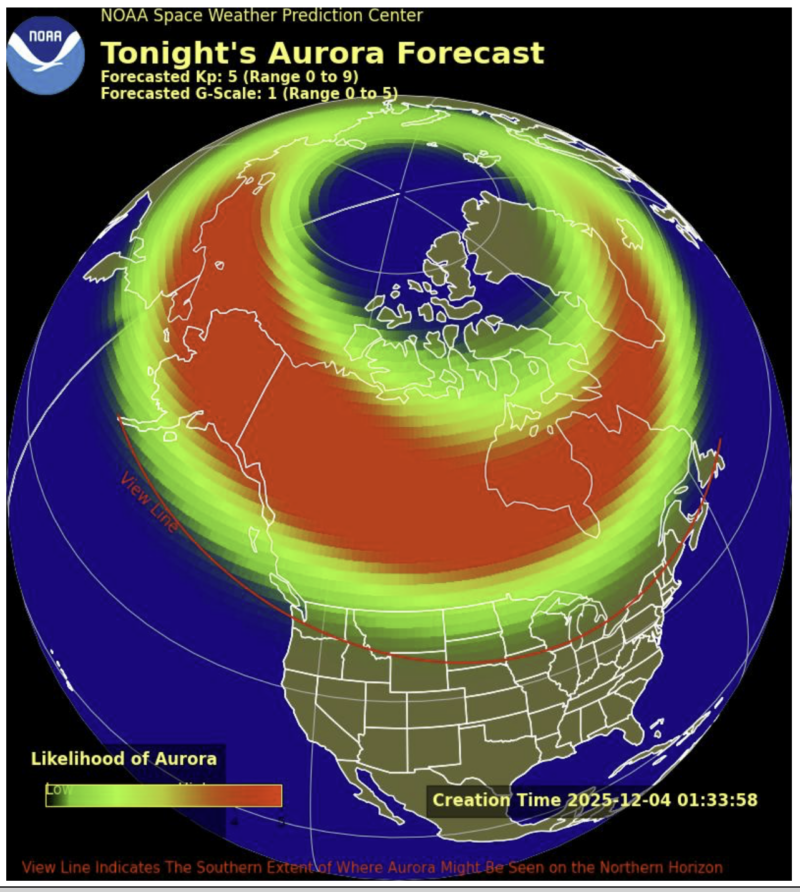
Sun news for December 4, 2025. Earth’s magnetic field underwent a G3 (strong) geomagnetic storm late yesterday. As seen above, more geomagnetic storming is anticipated tonight. Image via NOAA. 
December 4, 2025. Newcomer AR4300 showed its credentials with the production of an M6.0 flare. The blast occurred earlier today at 2:50 UTC. It provoked an R2 (moderate) radio blackout that affected the sun-lit side of Earth. GOES-19 SUVI131 angstrom. Image via NOAA. 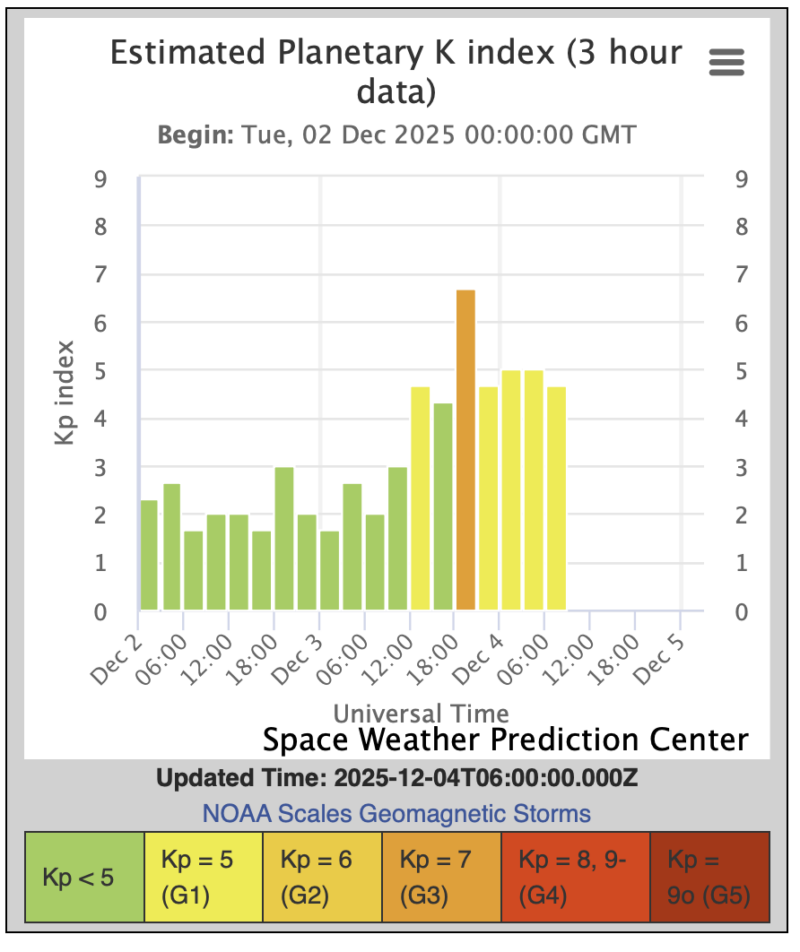
December 4, 2025. Late on December 3, the arrival of a coronal mass ejection (CME) from the X1.9 flare on Monday disturbed Earth’s magnetic field, reaching the G3 (strong) geomagnetic storm level. Its impact was amplified by a co-rotating interaction region (CIR) and fast solar wind from a coronal hole. More disturbances are anticipated tonight. Image via NOAA. Sun news December 3: NOAA just released a Solar Cycle 25 update
NOAA’s latest Solar Cycle 25 update shows the Sunspot Number dropping to 91.8 in November. That’s down sharply from 114.6 in October and far below the cycle’s peak of 216 in August 2024. These numbers suggest we’re sliding well into the declining phase of Solar Max. But specialists haven’t declared the peak officially over yet. Solar activity stayed at low levels over the past day, with 11 C-class flares. At the same time, space weather forecasters are watching the coronal mass ejection (CME) launched by yesterday’s X1.9 flare, which came from returning active region AR4299 (formerly AR4274, the source of November’s surprise G4 storm and magnificent auroral display). Modeling suggests this CME could deliver a glancing blow on December 3, with the potential for G2 (moderate) geomagnetic storming and a slight chance for G3 (strong) if conditions align. High-latitude auroras are likely, and additional solar activity remains possible as AR4299 continues rotating into a more geoeffective position.
Past 24 hours: The details
(11 UTC December 2 – 11 UTC December 3)
- Flare activity: Solar activity stayed at low levels, with 11 C-class flares recorded over the past day.
- Strongest flare: A C5.4 from AR4288 in the northwest at 20:38 UTC on December 2.
- Lead flare producers: AR4288 (beta) and AR4299 (beta-delta) tied with three C-class flares each.
- Other notable C flares: AR4298 fired a C3.5 at 14:09 UTC and a C4.0 at 17:44 UTC. AR4299 produced a C4.4 at 23:57 UTC. On December 3, AR4299 fired a C4.1 at 1:31 UTC, AR4297 produced a C2.8 at 2:23 UTC, and AR4299 fired another C2.8 at 3:55 UTC.
- Sunspot regions: The sun continues to display nine numbered active regions on the Earth-facing side.
- AR4294 (beta-gamma-delta) remains the largest and most magnetically complex region on the disk.
- AR4299 (beta-delta), the region responsible for yesterday’s X1.9 flare, lost its gamma component. It produced only three flares during this period. Expectations remain high for renewed activity based on its history as former AR4274, a major flare and CME producer in mid-November.
- AR4296 (beta-delta) developed a delta configuration but produced no flares. Along with nearby AR4294 and AR4298, it forms an extended active complex in the southeast quadrant.
- The remaining regions are smaller and magnetically simple, though some produced minor C-class flares.
- A newcomer, AR4300, emerged in the northeast.
- Blasts from the sun? No Earth-directed coronal mass ejections (CMEs) were detected in available coronagraph imagery over the past day.
- Solar wind: Solar wind speeds decreased from around 400 km/s early in the period to 373 km/s by 11 UTC on December 3. The interplanetary magnetic field (IMF) strengthened slightly to 9 nT. The Bz component spent much of the period oriented southward, with short northward intervals from 23 UTC December 2 to 5 UTC December 3. It ended the period strongly southward at –8 nT.
- Earth’s magnetic field: Conditions ranged from quiet to unsettled (Kp 2–3). No G-level geomagnetic storms occurred. At report time, Kp = 2.
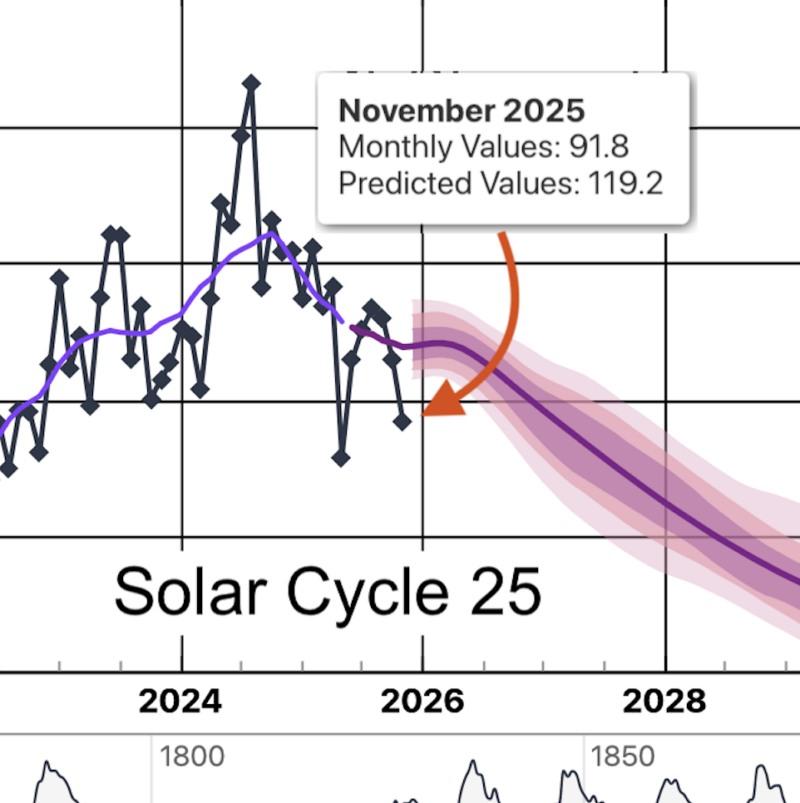
Sun news for December 2-3, 2025. NOAA’s latest Solar Cycle 25 update shows November 2025’s sunspot number dropping to 91.8, continuing the cycle’s downward trend from its peak in August 2024. While we’re still in Solar Maximum, the data suggest the sun is on a slide into the cycle’s declining phase, even as major flares continue to erupt. Images via NOAA. 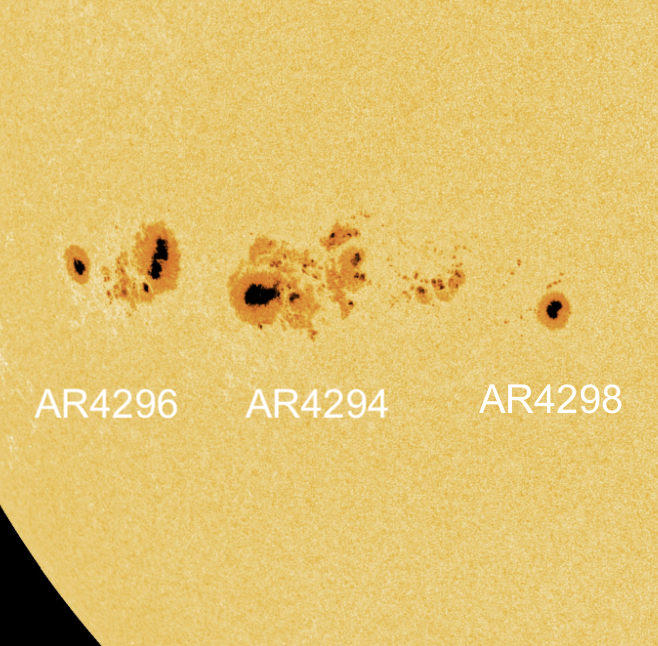
Sun news for December 2-3, 2025. Meet the sun’s newest sunspot triumvirate! This SDO close-up highlights AR4296, AR4294, and AR4298—three active regions clustered together on the solar disk, creating a powerful magnetic neighborhood worth watching. Images via NASA/SDO. 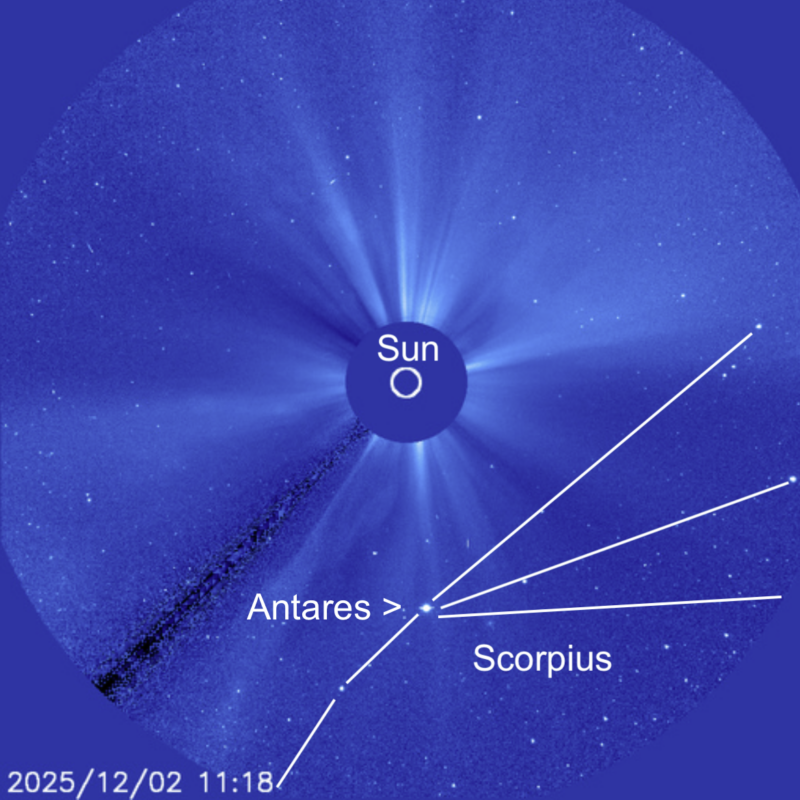
Sun news for December 2-3, 2025. SOHO’s LASCO C3 captures the Sun passing through the constellation Scorpius, with the star Antares highlighted. The outlined constellation offers a stunning backdrop as the sun makes its annual trek across the zodiac. Images via NASA/SOHO. Sun news December 2: Prolific sunspot region returns with a bang!
A formidable sunspot region has returned! AR4274, the region whose huge blasts in mid-November triggered stunning widespread auroras, has completed its journey round the far side of the sun and has now rotated back onto the Earth-facing solar disk. Now labeled AR4299, this region announced its return yesterday with a powerful X1.9 flare. Some of the sun-stuff fired out in this eruption could give Earth a glancing blow on December 3, bringing the potential for G2 (moderate) geomagnetic storms and auroral displays across higher latitudes. We also saw a huge prominence of solar material rising out from this region yesterday evening, but most of this plasma returned to the solar surface.
Past 24 hours: The details
(11 UTC December 1 – 11 UTC December 2)
- Flare activity: Following the excitement of yesterday morning’s X flare, solar activity dropped to low levels, with the production of only C-class (common) flares over the past 24 hours.
- Strongest flare: A C4.8 flare from AR4294 in the northeast. The blast occurred at 21:54 UTC on December 1.
- Lead flare producer: AR4294 (beta-gamma-delta) topped the list of flare producers with seven C-class flares.
- Other notable C flares: From AR4294: a C3.5 at 14:23 UTC, a C4.2 at 16:37 UTC, a C3.3 at 19:01 UTC, and a C3.3 at 19:19 UTC – all on December 1. AR4296 produced two C3.9 flares at 5:22 UTC and 5:35 UTC on December 2.
- Sunspot regions: Currently the sun shows nine numbered active regions on its Earth-facing side.
- AR4294 (beta-gamma-delta) continues to show a magnetically complex configuration. It is the largest region and the lead flare producer of the past day, though it produced only C-class flares.
- The incoming region in the northeast that produced yesterday’s X flare is now numbered AR4299 (beta-gamma-delta). As it moved into a better position for analysis, specialists identified it as the return of former AR4274, which showed notable flare and coronal mass ejection (CME) production during its last transit on the Earth-facing side and while on the far side.
- AR4296 (beta-gamma) moved into a better viewing position and upgraded in magnetic complexity. It is large in size, and together with nearby AR4294 and AR4298, it forms an extended active complex on the southeast disk.
- The remaining regions are smaller and appear more magnetically simple, though several contributed C-class flares during the period.
- Three newcomers were numbered during the period: the returning AR4299 in the northeast, plus AR4297 (beta) in the southwest and AR4298 (alpha) in the southeast.
- Blasts from the sun? The CMEs observed during the X1.9 (strong) flare mostly headed northeast. Because the event appeared as a semi-halo in coronagraph imagery, computer models indicate a glancing blow may reach Earth late on December 3. No other Earth-bound CMEs were observed.
- Solar wind: Solar wind levels gradually decreased from 500 km/s to near 386 km/s by 11 UTC on December 2. The interplanetary magnetic field (IMF) remained weak to moderate, with total field strength between 5–6 nT. The Bz component was mostly oriented south during much of the period. At the end of the period, it remains southward.
- Earth’s magnetic field: Earth’s magnetic field ranged from quiet to unsettled, with Kp values reaching 3. No G-scale geomagnetic storm levels were observed. At the time of this report, Kp = 2, indicating quiet conditions.

Sun news for December 2, 2025. The sun blasted off a huge fiery prominence in the northeast yesterday evening. The blast came from AR4299, a formidable sunspot region that has completed a journey round the far side of the sun and returned to the Earth-facing solar disk. Most of the sun-stuff that lifted during this event returned to the sun. GOES-19 SUVI 304 angstrom. Image via NOAA. 
December 2, 2025. Computer modeling shows the coronal mass ejection (CME) produced during the X1.9 flare event on December 1. Most of the ejecta is heading away from us at Earth (the green dot), but a small portion may provide a glancing blow late December 3 to early December 4. Image via NOAA. 
December 1, 2025. The SOHO spacecraft’s LASCO C2 instrument (red) captured dramatic footage of the X1.9 flare on December 1, while LASCO C3 (blue) shows the formation of a semi-halo event. Image via NOAA. 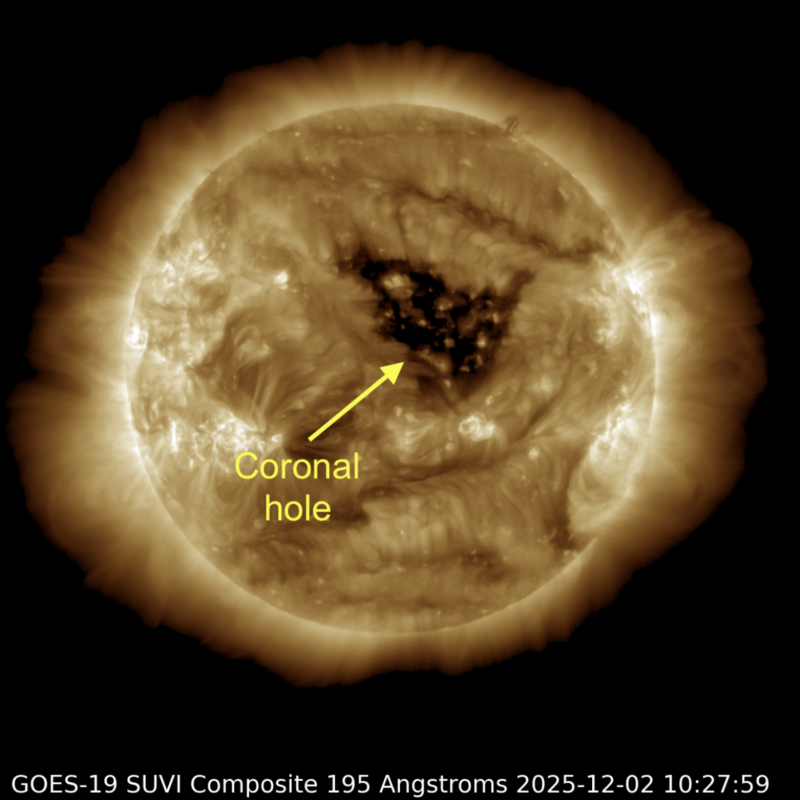
December 2, 2025. A large coronal hole is now at a geoeffective position, meaning the fast solar wind it produces is now heading to us at Earth. This fast solar wind may start arriving at Earth late today or early tomorrow. GOES-19 SUVI 195 angstrom. Image via NOAA. Sun news December 1 (UTC): BAM! X flare from new sunspot region!
The sun has kicked off December in style, exploding with a powerful X1.9 flare at 2:27 UTC this morning and pushing activity to very high. The eruption came from a large region that’s just rotating into view on the northeast horizon, having already produced a C9.0 (common) flare yesterday. All signs indicate this region has significant magnetic complexity, meaning we could see more intense flaring as it continues to turn toward Earth. Stay tuned!
Past 24 hours: The details
(11 UTC November 30 – 11 UTC December 1)
- Flare activity: Solar activity surged to very high with 12 flares observed over the past day, including 1 X flare and 11 C-class flares.
- Strongest flare: X1.9 from an as-yet-unnumbered sunspot region in the northeast at 2:27 UTC on December 1. It triggered an R3 (strong) radio blackout across Australia, affecting aviation communications and maritime radio operations for approximately 30 minutes.
- Lead flare producer: AR4294 (beta-gamma-delta) was responsible for 4 flares, maintaining its status as the most magnetically complex region on the visible disk.
- Other notable C flares: C9.9 at 12:30 UTC on November 30 from an unnumbered region; C9.0 at 10:47 UTC from AR4294; C8.0 at 11:19 UTC from AR4295; C7.9 at 6:16 UTC on December 1 from AR4296; and C7.5 at 13:41 UTC from AR4294. The remaining flares ranged from C4.8 to C6.0, with most originating from AR4294, AR4296, AR4288 and AR4292.
- Sunspot regions: The Earth-facing solar disk displays 9 numbered active regions, 3 of them numbered since the chart below was created. Two large regions dominated the southeast quadrant.
- AR4294 (beta-gamma-delta) persisted as the largest and most magnetically complex region on the disk. It produced most of the C-class activity during the period.
- AR4296 (beta) was newly numbered during the period and is large in size, though less magnetically complex than AR4294. It produced a notable C7.9 flare.
- A near-horizon region rotated into view during the period and immediately demonstrated significant eruptive potential with the X1.9 flare. It’s too close to the horizon for specialists to be sure about its magnetic configuration, but it contains many mature spots.
- The remaining regions – AR4288, AR4292, AR4295, and others – are smaller and appear more magnetically simple, though several contributed C-class flares during the period.
- Blasts from the sun? No Earth-directed coronal mass ejections (CMEs) were observed in available coronagraph imagery during the period. Occasional CME activity was noted near the east limb, likely associated with the X1.9 flare and activity from the new incoming region, but none showed a clear Earth-directed trajectory. Analysis of any potential Earth-affecting components is ongoing.
- Solar wind: Solar wind levels dropped from approximately 625 km/s to near 525 km/s by the end of the period thanks to waning influence from a coronal hole. The interplanetary magnetic field (IMF) remained weak to moderate, with total field strength between 5–6 nT. The Bz component was primarily oriented southward during much of the period, which helped sustain modest geomagnetic activity despite declining wind speeds.
- Earth’s magnetic field: Earth’s magnetic field ranged from quiet to active levels, with Kp values reaching 4 during the period under waning positive polarity coronal hole high-speed stream influences. No G-scale geomagnetic storm levels were observed. Current Kp at the time of this report is 2, indicating quiet conditions.

Sun news for November 30-December 1, 2025. A powerful X1.9 flare erupted from the sun’s northeast horizon early this morning! This imagery shows the eruption’s towering structure and intense energy as it breaks over the limb (edge). The sunspot region that fired it is just rotating into view, and it’s already proving explosive. Stay tuned for more action as it continues to turn toward Earth. Images via NASA/SDO and JHelioviewer.
Like what you read?
Subscribe and receive daily news delivered to your inbox.
More from
C. Alex Young


Sun news: See a huge solar eruption

Yes, there’s an aurora season, and it’s here
Sun activity archive for September 2026
Sun activity archive for August 2026



