Sun news October 31: Ghost action on the edge, auroras under way
(11 UTC October 30 – 11 UTC October 31)


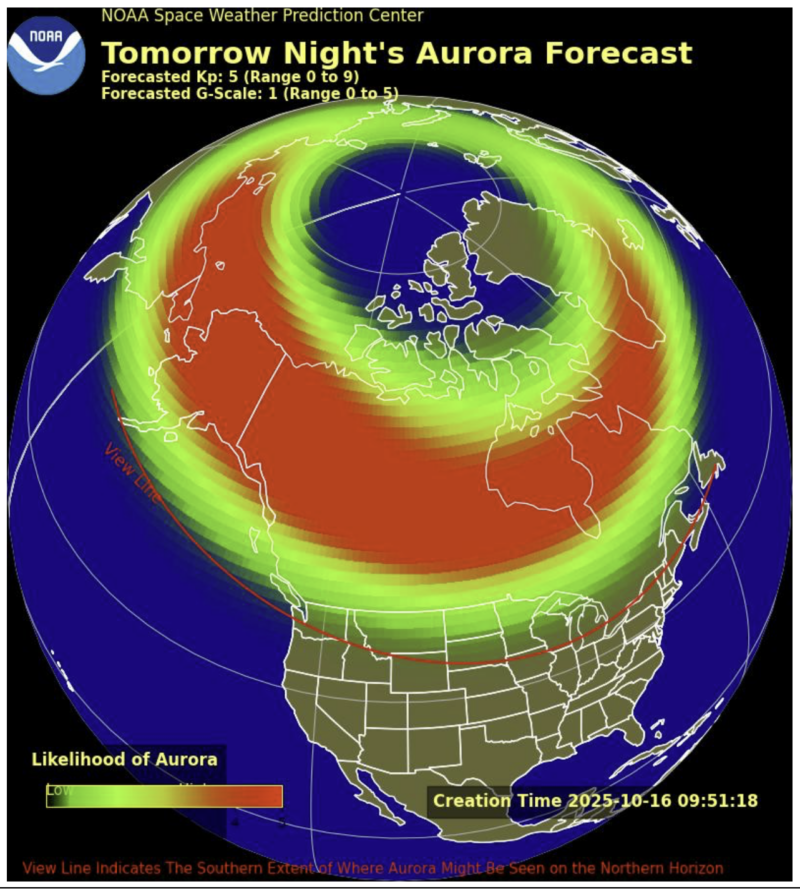
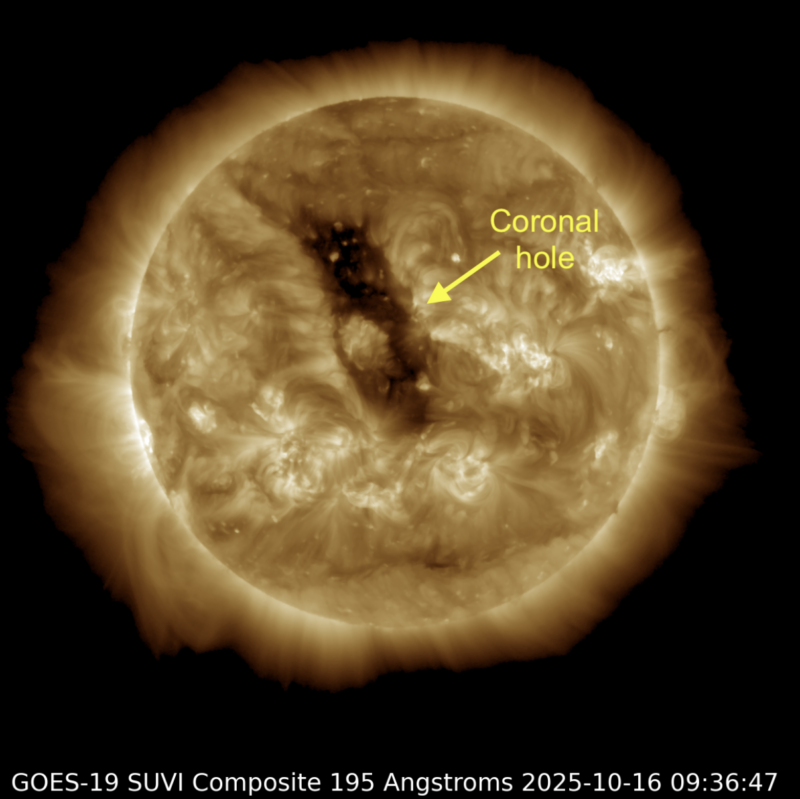

The Earth-facing side of our star stayed mostly quiet. But small prominences and erupting filaments popped up along the solar periphery. And some far-side eruptions rose high enough to clear the limb and become visible from Earth. Yesterday’s huge far-side blast showed dramatically in SOHO/LASCO C2 coronagraph imagery as a partial-halo event. The eruption launched from the northeast and appears aimed generally toward Mercury. Next week could get livelier on our side, as the far-side powerhouses rotate into view. Will the headline-maker – the sunspot region formerly known as AR4246 – return? We’re watching. Meanwhile, a large coronal hole continues streaming fast solar wind toward Earth. Result: a sustained G1 (minor) geomagnetic storm in multiple three-hour intervals, most recently with Kp = 5 at 06:02 UTC today.
- Flare activity on the near side: Flare activity stayed low with three C-class (common) flares and three B-class (weak) flares (six total).
- Strongest flare: A C1.8 from an as-yet-unnumbered incoming region in the northeast at 02:01 UTC on October 31.
- Other flares: C1.4 at 12:37 UTC from AR4257; a C1.1 at 8:38 UTC from AR4271; B6.4 at 11:29 UTC from AR4257; B6.5 at 23:44 UTC and B6.8 (time near 23:44–00:00 UTC) from the same incoming northeastern region.
- Sunspot regions: Four numbered active regions dot the Earth-facing disk.
- All are small and magnetically simple (alpha or beta groups) with little to no flare production.
- Blasts from the sun? Filament-channel activity in the northwest produced coronal mass ejections (CMEs). Modeling is under way to determine whether any component has an Earth-directed (glancing) trajectory.
- Solar wind:
- Solar wind speeds increased from ~510 km/s to a peak of 793 km/s at 02:40 UTC, then eased to ~680 km/s by 09:00 UTC. Magnetic field strength was moderate (Bt ~7.5 nT).
- The Bz component was mostly southward (with brief northward flips), favoring auroras.
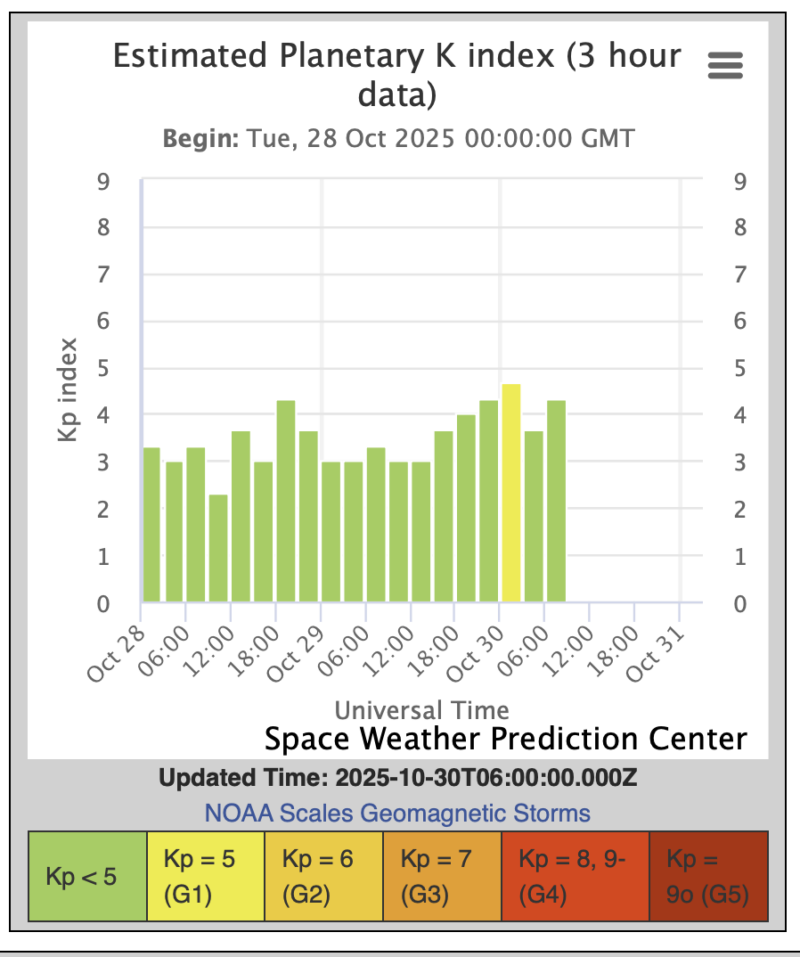
- Earth’s magnetic field: Conditions ranged from unsettled to active (Kp 3–5). A G1 (Minor) storm occurred from 11–18 UTC on October 30, Kp then dipped to 4, and another G1 interval followed with Kp = 5 at 06:02 UTC on October 31. Kp hovered a bit above 4 at 11:00 UTC.
Sun news October 30: Another monster blast from the far side!
(11 UTC October 29 – 11 UTC October 30)

Boom! The quiet face of the sun we see from Earth stayed calm over the past day. But beyond our direct view – on the sun’s far side — a powerful eruption lit up space early today. While we can’t see the exact culprit, all signs point to the soon-to-return giant active region, what we called AR4246 when we saw it on the sun’s near side. This region was famous for its fiery flares last week. This time, it erupted around 03:45 UTC on October 30 from the sun’s northeast limb, sending a huge cloud of plasma blasting into space (not toward Earth!). Meanwhile, a large coronal hole is still streaming fast solar wind straight at us, stirring Earth’s magnetic field. The result? A G1 (Minor) geomagnetic storm already hit, with Kp = 5 reached at 00:00 UTC today. It’s possible more auroras will dance across high-latitude skies tonight. Keep your eyes to the north and your cameras ready!
- Flare activity on the near side: Flare activity on the Earth-facing sun remained very low over the past day, with three B-class (weak) flares.
- Sunspot regions: The Earth-facing solar disk currently shows four numbered active regions.
- AR4266 showed slight growth.
- All visible regions are small and magnetically simple (alpha or beta groups) with little to no flare activity.
- Blasts from the sun? The big northeast eruption on the sun’s far side produced a coronal mass ejection (CME). Because it originated on the far side, the ejecta is not directed toward Earth. A filament eruption in the northwest around 00:58 UTC on October 29 produced a small CME; modeling suggests a glancing blow is possible on November 2.
- Solar wind:
- Solar wind speeds averaged near 500 km/s, peaked at 586 km/s at 04:22 UTC on October 30, then eased to ~508 km/s by 09:00 UTC. Magnetic field strength was moderately strong (Bt ~13 nT).
- The Bz component flipped between northward and southward through the period, then turned predominantly southward near 06:00 UTC and remained mostly southward through 11:00 UTC — a configuration that favors auroras.
- Earth’s magnetic field: Geomagnetic conditions ranged from unsettled to active (Kp 3–5). A G1 (minor) geomagnetic storm occurred, with Kp reaching 5 at 00:00 UTC on October 30; Kp was a little above 4 at 11:00 UTC.
Science, powered by real people. That’s you. Help support EarthSky!
Sun news October 29: Auroras possible tonight and tomorrow!
(11 UTC October 28 – 11 UTC October 29)
The sun continues its quiet streak of flare activity after last week’s impressive display. But that large coronal hole – an area of lower density in the sun’s outer atmosphere – is now sending fast solar wind directly toward Earth. These solar winds are disturbing our planet’s magnetic field, and conditions might reach G1 (minor) geomagnetic storm levels – and possible auroras – later today. Activity already reached Kp = 4 around 18 UTC on October 28. The disturbance could persist through tomorrow, possibly reaching G2 (moderate) levels. These conditions are ripe for bringing auroras to high latitudes, a treat for skywatchers, while we await the active regions from the far side of the sun to rotate into view. Clear skies!
- Flare activity: Solar activity remained low over the past day, with one C-class (common) flare and five B-class (weak) flares. So we had six flares in all over the past day.
- Sunspot regions: The Earth-facing solar disk currently shows six numbered active regions.
- All visible regions remain small and magnetically simple (alpha or beta groups) and show little to no flare activity.
- Blasts from the sun? No new coronal mass ejections (CMEs) were observed in available coronagraph imagery during the past day.
- Solar wind:
- Solar wind speeds gradually increased from 320 km/s to a peak of 524 km/s at 6:40 UTC on October 29, then eased to around 490 km/s by 9 UTC. The magnetic field strength was moderate (Bt ~10 nT).
- The Bz component was strongly southward for several hours, with intermittent northward peaks. Southward Bz conditions favor auroral activity.
- At the time of this report (11 UTC, October 29), the solar wind has shifted northward.
- Earth’s magnetic field: Earth’s geomagnetic field ranged from quiet-to-active levels (Kp 2–4) during the period. The Kp index reached 4 at 18 UTC on October 28 and was 3 at the time of this report.
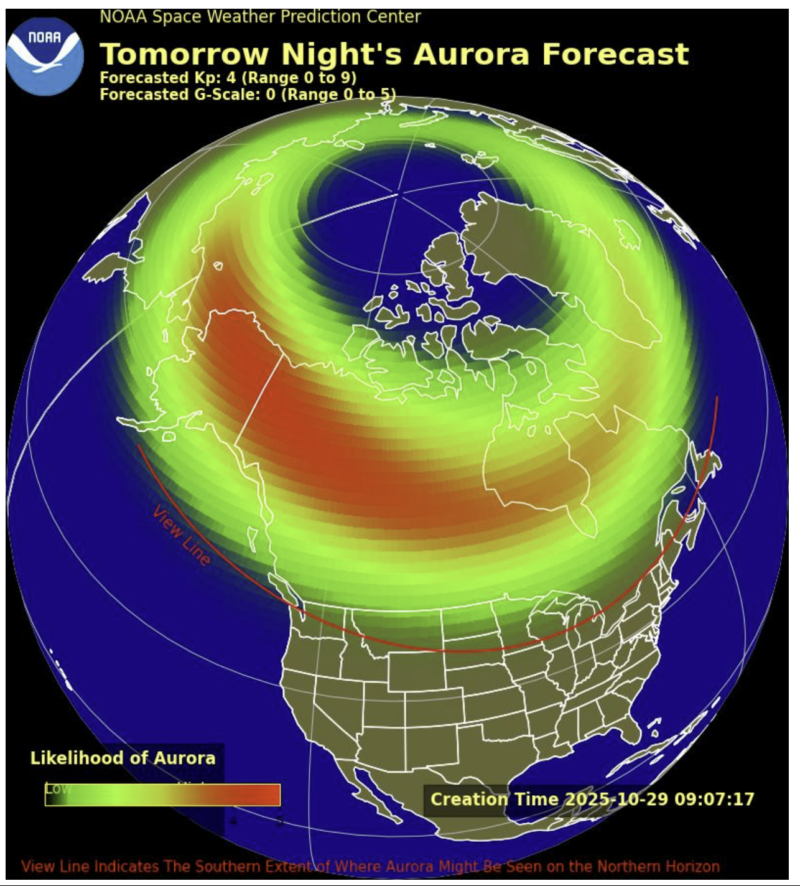
Sun news October 28: Auroras tonight?
(11 UTC October 27 – 11 UTC October 28)
A large coronal hole – an area of low density in the sun’s outer atmosphere – is currently releasing a wave of charged solar particles toward Earth. This could combine with a coronal mass ejection (CME) fired from our star last Thursday to disturb Earth’s magnetic field later today. And that could mean beautiful auroras at high latitudes!
- Flare activity: Solar activity dropped to very low levels, with only one B-class (weak) flare recorded over the past day.
- Sunspot regions: Seven active regions are currently visible on the Earth-facing solar disk.
- A new region appeared suddenly in the southwest quadrant and is now numbered AR4270.
- All visible regions remain small and magnetically simple (alpha or beta groups) and show no signs of flare activity.
- Blasts from the sun? No new coronal mass ejections (CMEs) were observed in available coronagraph imagery during the past day.
- Solar wind:
- Solar wind speeds gradually increased from 350 km/s to a peak of 454 km/s at 7 UTC on October 28, accompanied by a moderately strong magnetic field (Bt ~9 nT).
- The Bz component fluctuated between northward and southward orientations, with stronger southward intervals. Southward Bz conditions favor auroral activity.
- At the time of this report (11 UTC, October 28), the solar wind remains directed southward, which is favorable for auroras.
- Earth’s magnetic field: Earth’s geomagnetic field remained quiet to unsettled (Kp 0–3) throughout the period, with no storm conditions observed. The Kp index was 3 at the time of this report.
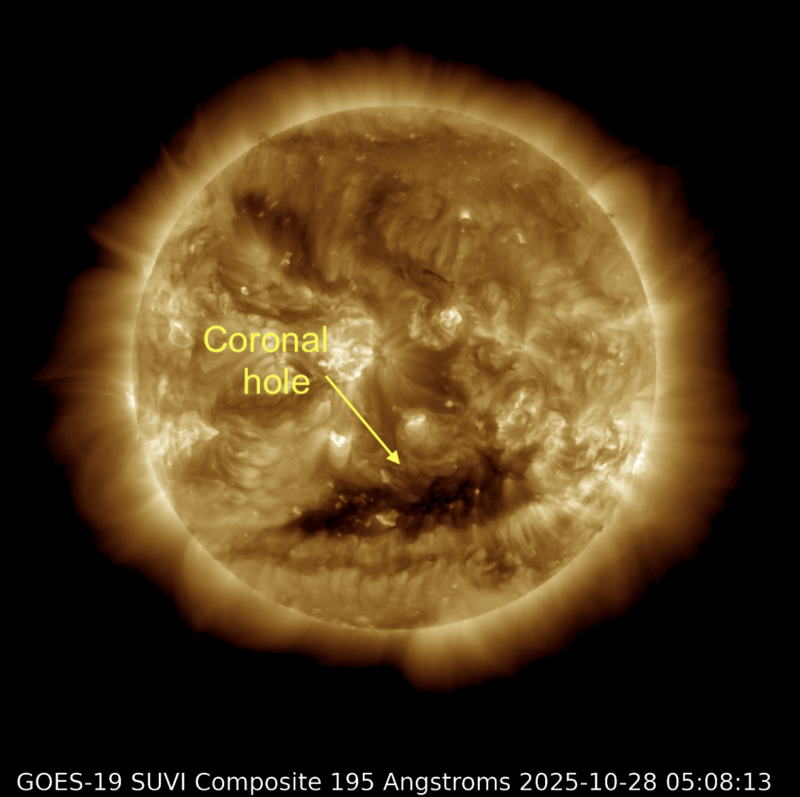
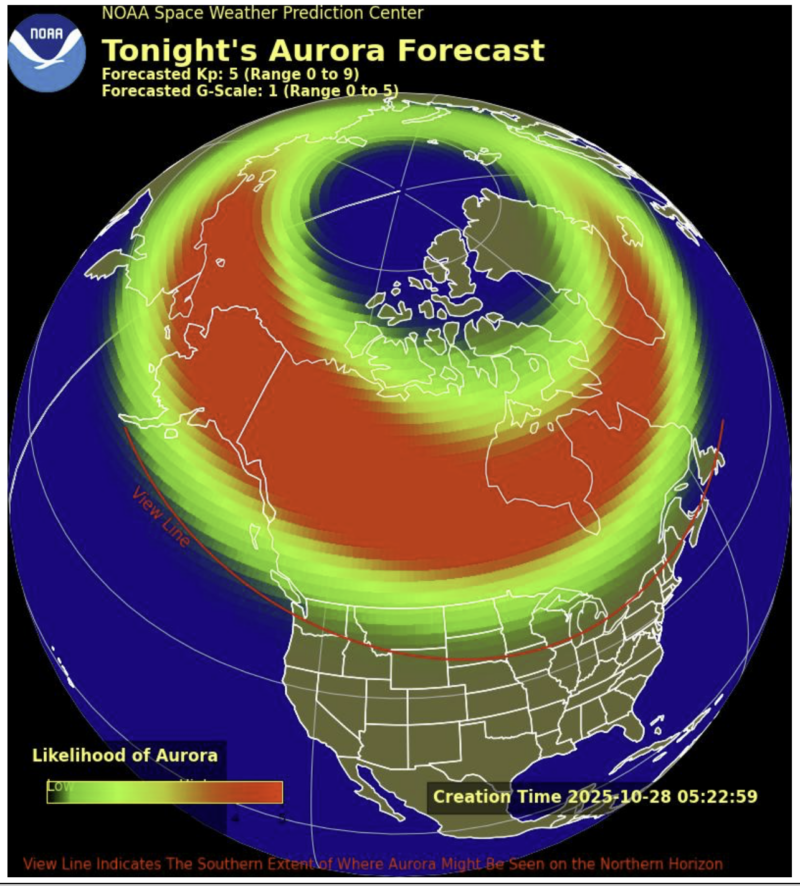
Sun news October 27: Auroras expected in coming days
(11 UTC October 26 – 11 UTC October 27)
Space weather forecasters are keeping an eye on an approaching disturbance. A coronal mass ejection (CME) fired from the sun on October 23 is expected to glance Earth’s magnetic field today, followed by a wave of stronger solar winds from a large coronal hole on October 28–29. These effects could spark geomagnetic storms and auroras over the next few days. Clear skies, aurora chasers!
- Flare activity: Solar activity remains low, with three minor flares detected during the past 24 hours: two B-class (weak) flares and one C (common).
- Sunspot regions: The Earth-facing sun now shows eight active regions.
- AR4256 in the southwest continues to decay, with its smaller satellite sunspots fading.
- AR4262 and AR4266 remain relatively stable but simple in structure.
- One southeastern region showed consolidation of its leading spot but a reduction in intermediate spots, while another near the northern central disk is slowly fading.
- All other regions remain small and magnetically simple (alpha or beta groups).
- Blasts from the sun? No new CMEs were observed in the past day. The two weak CMEs from October 23–24 continue to be tracked. They are expected to deliver only glancing blows, with stronger effects expected from the coronal hole solar winds arriving later this week.
- Solar wind: The solar wind remained near normal levels.
- Speeds ranged from 350–450 km/s, with a weak magnetic field (Bt ~6 nT).
- The Bz component showed no significant southward periods and was mostly northward, limiting geomagnetic disturbances. Southward Bz orientations are more favorable for auroras
- Solar wind enhancement is expected later today or early tomorrow as the October 23 CME approaches.
- Earth’s magnetic field: Earth’s geomagnetic field was quiet (Kp 0–2) throughout the period, with no storm conditions reported.

Sun news October 26: Calm before the storms at Earth?
(11 UTC October 25 – 11 UTC October 26)
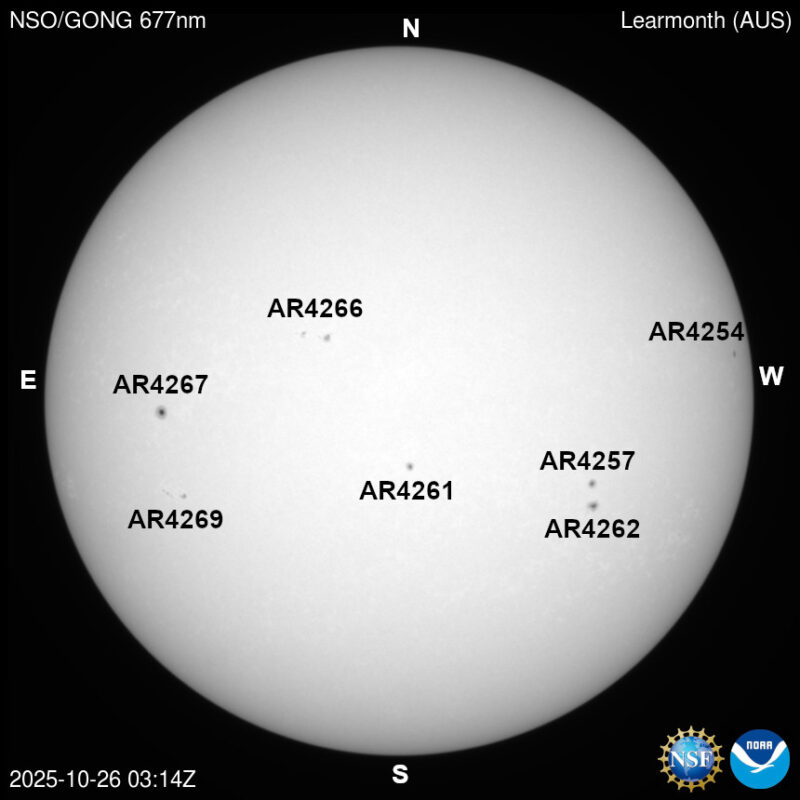
The sun’s Earth-facing side remains mostly quiet, but the stage is being set for possible geomagnetic storm activity in the coming days. Solar activity stayed low, with only a few small C-class (common) and B-class (basic) flares. On the other hand, the solar wind that has been buffeting Earth is calming down. This quieter spell might not last long, though forecasters expect an incoming coronal mass ejection (CME) from October 23 to arrive within the next 24 hours, bringing the potential for a G1 (Minor) geomagnetic storm, and possibly stronger activity later in the week.
- Flare activity: Solar activity was low with five flares recorded during the period, three C-class and two B-class.
- Strongest flare: A C2.2 flare from AR4267 at 22:58 UTC on October 25.
- Lead flare producer: AR4256 in the southwest remained the most active, producing four of the five flares: a C1.4, C1.2, C1.4, and a B9.4.
- AR4267, located in the northeast, contributed one C-class flare (C2.2 at 22:58 UTC).
- No M-class (moderate) or X-class (strong) flares were detected.
- Sunspot regions: There are now seven numbered active regions on the Earth-facing sun.
- Newcomer AR4269 appeared in the southeast (S11E41) and showed slight growth.
- AR4266 and AR4262 remain the most complex regions on the disk, each showing beta magnetic structure with some internal mixing.
- All other regions are small and magnetically simple (alpha groups).
- Blasts from the sun? Two earlier filament eruptions from October 24 continue to be analyzed. Both produced CMEs that modeling suggests are directed south of the Earth–Sun line so they are not expected to impact Earth directly.
- Solar wind: The solar wind is slowing down as the negative-polarity coronal hole high-speed stream (CH HSS) weakens.
- Wind speeds decreased steadily from ~550 km/s to around 400 km/s during the period.
- The total magnetic field (Bt) was low-to-moderate.
- The Bz component briefly dipped south to moderate levels early in the period but stayed mostly northward afterward, limiting auroral activity.
- Earth’s magnetic field: The geomagnetic field was generally quiet to active (Kp 1–4), with activity tapering off after 09 UTC. The interplanetary K-index was around Kp = 2 by 11 UTC on October 26.
What’s ahead? Sun–Earth forecast
- Flare activity forecast: Solar activity is expected to remain low with a slight chance of an isolated M-class flare over October 26–28. The likelihood for M flares remains near 10%, and for X flares around 1%.
- Geomagnetic activity forecast:
- October 26: Quiet to unsettled conditions as coronal hole effects fade.
- October 27: Active conditions are likely as the CME from October 23 arrives. A G1 (Minor) geomagnetic storm is expected, with a chance of G2 (Moderate) activity.
- October 28: A large, positive-polarity coronal hole may drive strong solar winds, bringing further chances of G1–G2 storms, and possibly brief G3 (Strong) intervals.
- October 29: Conditions should begin to settle, though active intervals could persist.
Science, powered by real people. That’s you. Help support EarthSky!
Sun news October 25: The action is still on the sun’s far side
(11 UTC October 24 – 11 UTC October 25)


The far side of our star continues as the focus of flare and eruption activity. Signs of this activity show around the whole horizon of the Earth-facing sun now. A huge prominence on the sun’s southeast limb or edge attracted our attention. This filament eruption occurred at around 18:20 UTC on October 24. No flare activity was associated with this event, since it was a blast from the far side. As usual with eruptions on the far side, ejecta hurled into space is not headed our way at Earth. But here’s something interesting. A long-lasting fiery prominence on the northeast horizon might be coming our way, to the side of our sun we see from Earth, carried by the sun’s rotation. The Earth-facing sun appears to have been taking a break! Will this northeastern action end it? We’ll know for sure in the coming days.
- Flare activity: Three C-class (common) flares plus a B-class (basic) flare gave us a total of four flares on the Earth-facing sun during the past day. So we say solar activity is low.
- Strongest flare: A C1.5 flare sparked by AR4267 at 13:01 UTC on October 24.
- Lead flare producer: AR4267 was at the top, with three of the four flares during of the past day, two Cs plus one B flares.
- The rest of the C flares of the past day: a C1.3 at 18.40 UTC, a C1.4 at 20:04 UTC and a B8.6 at 4:53 UTC.
- No M-class (moderate) or X-class (strong) flares were observed during the past day.
- Sunspot regions: Currently the sun has six active regions on its Earth-facing side.
- Active regions AR4262 and AR4266 showed some growth.
- All of the active regions on the solar disk show simple alpha or beta configurations and are stable or in decay.
- Blasts from the sun? A couple of filament eruptions were observed. The first at 12 UTC on October 24 in the southeast and the second also in the southeast at 15:50 UTC on Ocotber 24. Both eruption produced coronal mass ejections (CMEs) which are now under modeling and analysis to determine any component heading our way at Earth.
- Solar wind: Solar wind speeds averaged moderately high at around 530 km/s during the first half of this period with peaks reaching out 580 km/s levels. At 1 UTC on October 25 solar wind speed dropped down to the 450’s m/s to end at the time of this writing (11 UTC on October 25) at 430. km/s. Negative polarity coronal hole’s high-speed solar wind stream (CH HSS) is doing its effects.
- The interplanetary magnetic field (IMF) is at a moderate level.
- The Bz component was similar to the prior day, intermittently shifting northward-to-southward during the whole period. It is oriented northward at the time of this writing (11 UTC on October 25). A south orientation favors auroral displays.
- Earth’s magnetic field: Earth’s geomagnetic was at quiet-to-active levels (Kp 1 – 4) during the period. A Kp = 4 was observed, threshold reached at 5:57 UTC on October 5. Interplanetary K index is at Kp = 2 at 11 UTC on October 25.
What’s ahead? Sun–Earth forecast
- Flare activity forecast: The solar activity forecast is low to moderate. The chance for M-class flares and X flares continue same as the previous day at 10% and 1% respectively.
- Geomagnetic activity forecast:
- October 25: Quiet levels may continue for the rest of the day today.
- October 26: Quiet-to-unsettled conditions may be seen on October 26 under the influence of negative polarity solar wind from a coronal hole.
- October 27: Active levels with chances for an isolated G1(minor) geomagnetic storm are likely due to the arrival of a coronal mass ejection (CME) that left the sun on October 23.
Science, powered by real people. That’s you. Help support EarthSky!
Sun news October 24: More blasts from the sun’s far side!
(11 UTC October 23 – 11 UTC October 24)


The far side of our sun is still blasting huge prominences and jets. We’re seeing them over the sun’s northwest and west horizons. The blasts are big enough to show plasma being hurled into space. On October 21, we saw a huge prominence that eventually produced a big coronal mass ejection (CME) that hit Venus yesterday. This time another blast, not as big as its predecessor, sent plasma into space and, once again, Venus is in the crosshairs. ENLIL computer modeling indicates an arrival at Venus on October 26. Meanwhile the sun’s west limb showed powerful jets also being produced from the far side. All this fiery activity on the far side suggests sunspot regions AR4246 and AR248 are still active. The good news is that if they survive their transit on the far side, there are chances to see these two guys again on the Earth-viewed side of our star. We will keep watching. Stay tuned.
- Flare activity: The Earth-facing side of the sun continues at low activity levels. We saw only C-class (common) flares during the past day. Over our 24-hour watch period (11:00 UTC yesterday to 11:00 UTC today), the sun sparked seven C flares.
- Strongest: A C2.9 flare blasted out 2:57 UTC on October 24 from active region AR4256.
- Lead flare producer: An unnumbered active region has been producing flares for the last couple of days. It was lead flare producer over the past day. And now it has been labeled: AR4267. This active region produced six C flares out of the total seven flares of the past day.
- The rest of the C flares of the period were produced by AR4267. We saw a C1.2 at 14.43 UTC, a C1.3 at 14:50 UTC, a C2.1 at 15:06 UTC, a C1.1 at 5:18 UTC and a C1.1 at 8:27 UTC and a C1.4 at 8:56 UTC.
- No M-class (moderate) or X-class (strong) flares were observed during the past day.
- Sunspot regions: We are seeing seven active regions on the Earth-facing solar disk.
- All of the active regions on the solar disk show simple alpha or beta configurations and are stable.
- There are two newcomers in the neighborhood, now numbered AR4266 in the northeast quadrant and AR4267 near the east limb (edge) almost aligned with the solar equator.
- Blasts from the sun? The solar activity producing coronal mass ejections (CMEs) is now on the far side and so not coming Earth’s way. But the one observed at 18:40 on October 23 will reach Venus on October 26.
- Solar wind: Solar wind speeds averaged moderately high at around 509 km/s at the time of this writing (11 UTC on October 24). It increased from 400 km/s with peaks of 589 km/s by 5 UTC on October 23. All this caused by a negative polarity coronal hole’s high-speed solar wind stream (CH HSS) centered at a geoeffective position.
- Earth’s magnetic field: Earth’s geomagnetic was at quiet-to-unsettled levels (Kp 1 – 3) during the period. Kp = 2 at 11 UTC on October 24.
Science, powered by real people. That’s you. Help support EarthSky!
Sun news October 23: Yesterday’s huge blast of sun-stuff to hit Venus
(11 UTC October 22 – 11 UTC October 23)
The huge burst of sun-stuff that blasted from the sun’s far side on Tuesday night is set to hit Venus today, computer models have revealed. The characteristics and position of this coronal mass ejection (CME) suggest it was produced by prolific sunspot region AR4246, which gave us a flurry of M flares in recent weeks before rotating to the far side of our star. We also saw a slightly smaller blast of solar material emerging from the unseen side of our star last night, appearing over the south pole at around 20:45 UTC. With the Earth-facing side of the sun currently quiet, the party is very much out of view.
- Flare activity: The sun fired five C (common) flares and one B (basic) flare over the past 24 hours, meaning activity is low.
- Strongest: A C3.2 flare sparked by an as-yet-unnumbered incoming active region in the northeast at 5:08 UTC on October 23.
- All of the flares of the period were produced by this unnumbered region in the northeast: a C2.4 at 13:38 UTC, a B8.9 at 23:03 UTC, a C2.5 at 1.59 UTC, a C2.0 at 4:24 UTC and a C1.5 at 8:54 UTC.
- No M-class (moderate) or X-class (strong) flares were observed during the period.
- Sunspot regions: Six numbered active regions currently populate the Earth-viewed solar disk.
- All of the active regions on the solar disk show simple alpha or beta configurations and are stable.
- Blasts from the sun? The pair of coronal mass ejections (CMEs) observed yesterday have been found to not be on a course for Earth, as most of their solar material was reabsorbed by the sun. No other Earth-bound CMEs were observed in available coronagraph imagery.
- Solar wind: Solar wind speeds averaged around 430 km/s, dropping down to 403 km/s by 10 UTC on October 23. A coronal hole’s high-speed solar wind stream (CH HSS) continued waning.
- Earth’s magnetic field: Earth’s geomagnetic field stayed at quiet levels (Kp 1 – 2) during the period. At the time of this writing (11 UTC on October 23) the planetary K index is just above Kp = 0.

Sun news October 22: Huge blast of sun-stuff last night
(11 UTC October 21 – 11 UTC October 22)



Around 21:00 UTC last night, the sun fired out an enormous blast of solar material and magnetic fields, or a coronal mass ejection (CME). No visible flare was associated with the event, so it appears the eruption occurred on the far side of the sun. Could this blast have come from last week’s hero sunspot region AR4246, which has now rotated out of view? It’s very possible, but we have no data to confirm this. None of the sun-stuff from this far-sided blast will be heading our way. But, a pair of near-simultaneous filament eruptions around 0:35 UTC this morning hurled out plasma that might be on a course for Earth. Analysis is ongoing. Stay tuned.
- Flare activity: The sun produced only 6 C flares over the 24 hours, meaning activity is at a low level.
- Strongest: A C4.7 flare was sparked by active region AR4259 in the southeast at 1:52 UTC on October 22.
- Other C flares of the period: a C1.2 at 20:06 UTC from AR4261, a C1.5 at 23:47 UTC from an unnumbered active region in the northeast, a C4.4 at 0:34 UTC from AR4257, a C1.8 at 6:36 UTC and a C4.2 at 7:20 UTC from an unnumbered active region in the northeast.
- Lead flare producer: The top flare producer of the period is the new as-yet-unnumbered sunspot region in the northeast, which produced three C flares.
- No M-class (moderate) or X-class (strong) flares were observed during the period.
- Sunspot regions: The Earth-viewed solar disk shows today 10 numbered active regions.
- AR4252 (southwest) and AR4263 (southwest) showed slight development as they gained additional spots.
- There are two labeled newcomers on the sun today: sunspot regions AR4263 in the southwest, which emerged from nowhere, and AR4264 close to the horizon in the northeast.
- All of the active regions on the solar disk show simple alpha or beta configurations and are stable.
- Blasts from the sun? A huge blast registered by LASCO C2 at 20:24 UTC on October 21 hurled a coronal mass ejection (CME) into space. The lack of a corresponding flare on the Earth-viewed solar disk suggests it was produced on the far side of our sun, and therefore is not coming to us at Earth. However, the two abovementioned CMEs from filament eruptions are under modeling and analysis to determine any impending Earth impact.
- Solar wind: Solar wind speeds slowly dropped from 527 km/s down to 432 km/s by 10 UTC on October 22. This was due to the waning of a coronal hole’s high-speed solar wind stream (CH HSS).
- Earth’s magnetic field: Earth’s geomagnetic field stayed at quiet levels (Kp 1 – 2) during the period. At the time of this writing (11 UTC on October 22) the planetary K index is just above Kp = 1.
Sun news October 21: Looking back at powerhouse AR4246
(11 UTC October 20 – 11 UTC October 21)


After a few action-packed weeks on the sun, activity has finally dropped down to low, with just 6 C (common) flares fired over the past day. That gives us a good chance to reflect on AR4246, the powerhouse sunspot region that drove much of the recent action. This region, which has now rotated out of view, blasted at least 133 flares during its path across the Earth-viewed side of the sun (the real total is likely higher, as some data have not been updated due to the US government shutdown). This impressive total included 21 M (moderate) flares, 109 Cs and 3 Bs (weak). Its largest blast was an M4.8 on October 15, fired during the 5-day period from October 13-17 when this region had a beta-gamma-delta magnetic complexity, the most volatile configuration possible. Thanks for all the excitement, AR4246!
- Flare activity: Solar activity dropped to low levels with the production of only C flares over the past 24 hours. Flare production decreased again over this period, dropping from the previous total of 12 flares to just 6 in the past day.
- Strongest: C3.7 flare from an as-yet-unnumbered incoming active region in the northeast at 6:49 UTC on October 21.
- Other C flares of the period: a C3.0 at 8:12 UTC from AR4256, a C2.1 at 23:24 UTC from AR4248, a C1.9 at 0:01 UTC from AR4257, a C1.8 at 1:24 UTC from AR4248, and a C1.3 at 6 UTC from AR4248.
- Lead flare producer: AR4248 leads with three C flares.
- No X-class (strong) flares were observed during the period.
- Sunspot regions: Today’s sun is populated with eight numbered active regions on the side we see from Earth.
- AR4257 (southeast) split into two separate active regions, creating AR4262.
- There are two newcomers in the southeast quadrant. They are now numbered AR4261 and AR4262.
- All of the active region on the solar disk show simple alpha or beta configurations and are stable.
- Blasts from the sun? There were no Earth-directed coronal mass ejections (CMEs) observed in available coronagraph imagery over the past day.
- Solar wind: Solar wind speeds averaged around 500 km/s, peaking around 590 km/s from 22:50 UTC to 5:38 UTC. The slight increase in solar wind speed was due to a coronal hole’s high-speed solar wind stream (CH HSS).
- The speed was 502 km/s as of 9:31 UTC on October 21.
- The interplanetary magnetic field (IMF) is at a low-to-moderate level.
- The Bz component started this period northward and moved southward from 19:30 to 2 UTC. It then jumped back to northward and remained that way until the time of this writing (11 UTC on October 21). A southward orientation favors auroral displays.
- Earth’s magnetic field: Earth’s geomagnetic field ranged from quiet to unsettled levels (Kp 1 – 3) during the period. At the time of this writing (11 UTC on October 21) the planetary K index is just above Kp = 1.

Sun news October 20: 2 M flares drive moderate activity
(11 UTC October 19 – 11 UTC October 20)

A pair of M (moderate) flares fired over the past day have kept sun activity at a moderate level, although flare productivity has lowered. The M flares were joined by 10 C (common) flares for a total of 12 flares, a considerable drop from the 20 flares in the previous day. The largest of the past day’s flares came from sunspot region AR4246, still driving the action even though it’s passed out of view over the sun’s western horizon.
- Flare activity: Solar activity is moderate, with 12 flares fired over the past day.
- Strongest: M1.8 flare from AR4246 (behind the northwest horizon) at 20:15 UTC on October 19. An R1 (minor) radio blackout was observed affecting an area over in the Pacific Ocean north of Easter Island.
- The second M was an M1.1 produced by AR4248 at 5:27 UTC on October 20. A corresponding R1 (minor) radio blackout was registered affecting an area over the Indian Ocean, west of Indonesia.
- Other C flares from AR4246 and AR4248: From AR4248 a C6.5 at 4:11 UTC and a C3.6 at 7:48 UTC on October 20. From AR246 a C6.0 at 2:34 UTC, C3.7 at 18:22 UTC, a C3.4 at 2:20 UTC and a C2.9 at 13:42 UTC.
- Lead flare producer: AR4246 still leads with six flares: one M plus five Cs.
- No X-class (strong) flares were observed during the period.
- Sunspot regions: The Earth-viewed solar disk today shows seven numbered active regions.
- AR4246 (northwest) is out of view, but still producing flares and leading flare production during the period.
- AR4252 and AR4256 showed minor decay in their trailing spots.
- Two newcomers emerged in the southeast quadrant near the solar horizon. They are now numbered AR4259 and AR4260.
- The rest of the five active region on the solar disk show simple alpha or beta configurations and remained stable.
- Blasts from the sun? There were no Earth-directed coronal mass ejections (CMEs) observed in available coronagraph imagery over the past day.
- Solar wind: Solar wind speeds averaged at 570 km/s, with peaks of 626 km/s at 21:54 UTC and 7:50 UTC. This is due to the combined effects of a coronal mass ejection arrival and a coronal hole’s high-speed solar wind stream (CH HSS).
- Speeds had increased to 527 km/s by 9:43 UTC on October 20.
- The interplanetary magnetic field (IMF) is at a moderate level.
- The Bz component was intermittently moving northward to southward during the whole period. It jumped northward at 5:38 UTC and remained that way until the time of this writing (11 UTC on October 20). A southward orientation favors auroral displays.
- Earth’s magnetic field: Earth’s geomagnetic field ranged from quiet to unsettled levels (Kp 2 – 3) during the period. At the time of this writing (11 UTC on October 20) the planetary K index is Kp = 2.
Sun news October 19: Auroras last night! More tonight?
(11 UTC October 18 – 11 UTC October 19)
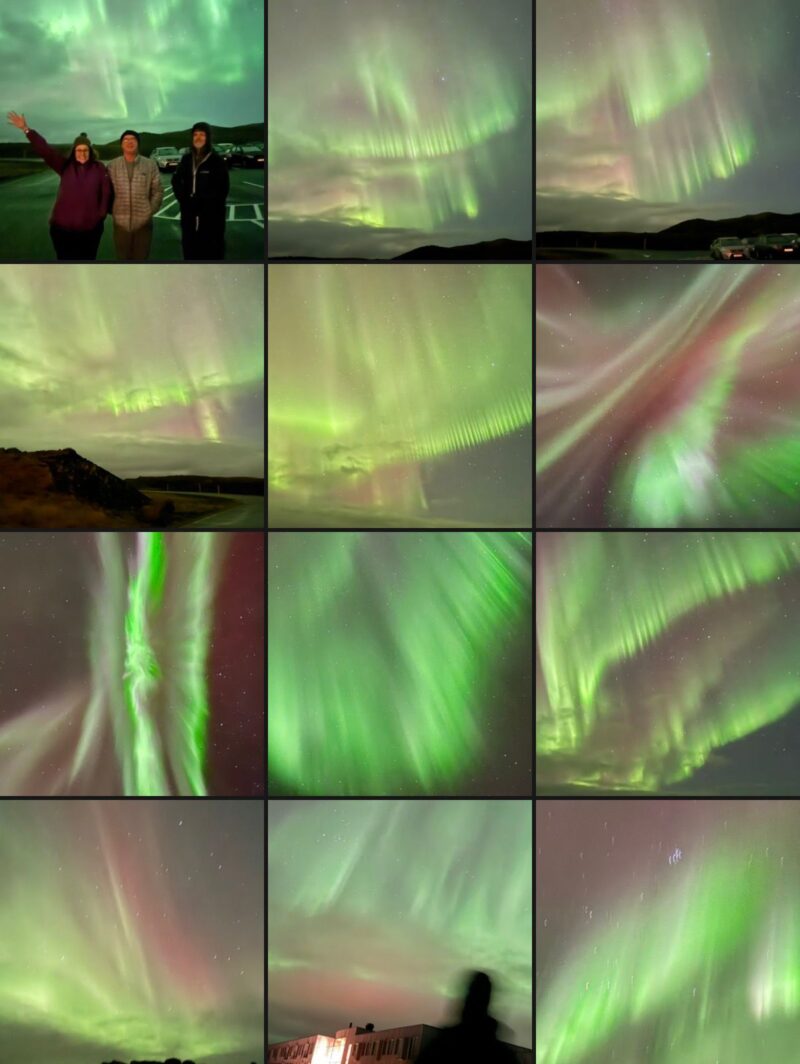
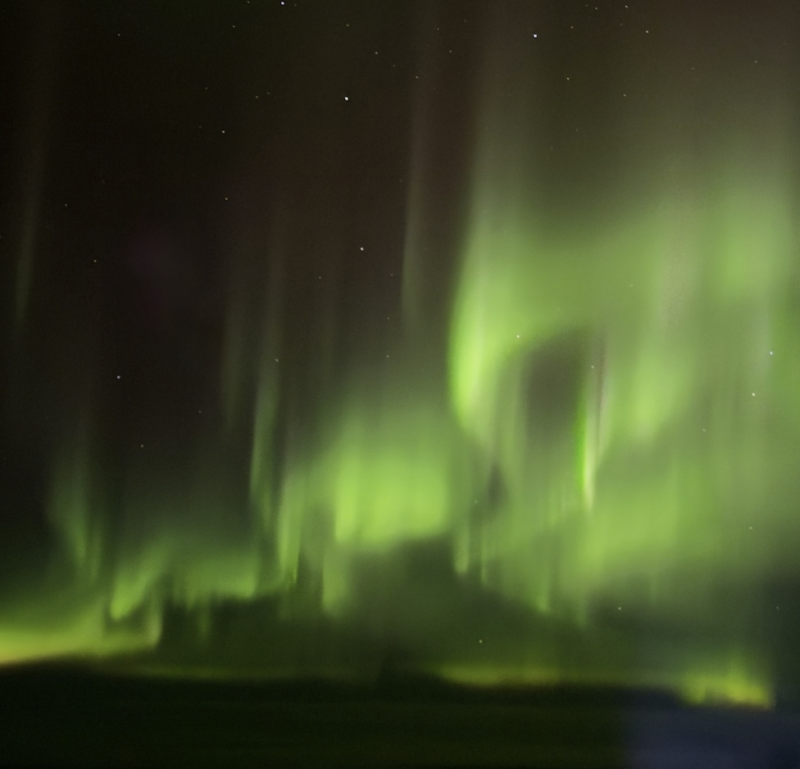
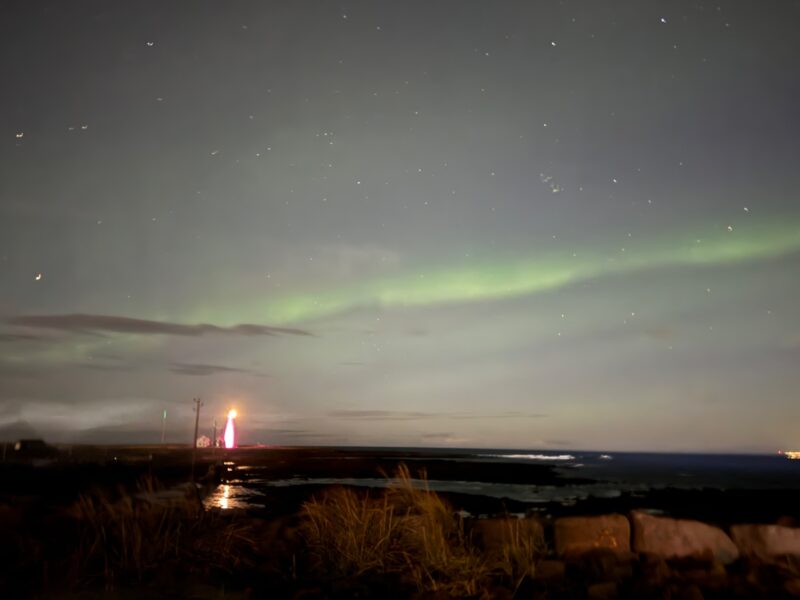
We received photos from Iceland (above) and Greenland (below) this morning of auroras overnight in those locations. And it’s possible more auroral displays will grace northern skies tonight. A glancing blow from a coronal mass ejection (CME) hurled by the sun on October 15 combined with fast solar wind from a coronal hole provoked a G1 (minor) and a G2 (moderate) geomagnetic storm late yesterday. More G1 conditions may be possible during the day today as effects from the CME and a co-rotating interaction region (CIR) continue. This means auroral displays in high latitudes. Time to bring those cameras out. Good luck and clear skies aurora chasers!
- Flare activity: Sun activity is now moderate, thanks to a couple of M flares. Our star blasted out 20 flares in all over the past 24 hours, two Ms plus 18 C flares. That prolific flare-producer – sunspot region AR4246 – has gone to the far side of the sun now, but it’s still flaring and its flares being registered from beyond the Earth-facing sun horizon. The sun itself blocks out part of our view, so the flares might be stronger than what are being registered.
- Strongest: M1.5 flare from AR4246 (northwest) at 11 UTC on October 18. An R1 (minor) radio blackout was observed affecting an area over Africa.
- Second M and largest C flares from AR4246: M1.0 at 1.56 UTC on October 18. The eruption provoked an R1 (minor) radio blackout that affected an area over the Atlantic Ocean. C8.0 at 21:54 UTC, a C7.4 at 15:14 UTC, a C6.6 at 2:47 UTC, a C4.7 at 8:02 UTC and a C4.0 at 14 UTC.
- Lead flare producer: AR4246 keeps being the lead flare producer even blasting flares from behind the solar horizon. Over the past day, this region produced a total 16 flares (two Ms and 14 Cs).
- No X-class (strong) flares were observed during the period.
- Sunspot regions: The solar disk as seen from Earth shows today seven numbered active regions.
- AR4246 (northwest) all gone, still lead flare producer of the period. Its configuration can’t be classified as this active region is behind the limb or edge on the northwest.
- A newcomer emerged from nowhere in the southwest quadrant and it is now numbered AR4258.
- The rest of the five active region on the solar disk show simple alpha or beta configurations and remained stable.
- Blasts from the sun? There were no Earth-directed coronal mass ejections (CMEs) observed in available coronagraph imagery over the past day.
- Solar wind: Solar wind speeds jumped to average 550 km/s from 14 UTC to 21 UTC then it dropped down to around 450 km/s. All this due to a combined effect of a coronal mass ejection that left the sun on October 15 and a coronal hole’s high-speed stream (CH HSS).
- Speeds increased to 559 km/s at 9:43 UTC on October 19.
- The interplanetary magnetic field (IMF) is at a moderate level.
- The Bz component was south oriented during most part of the period to jump northward at 3:24 UTC on October 19 to continue north oriented by 11 UTC on October 19. A south oriented condition favors auroral displays.
- Earth’s magnetic field: Earth’s geomagnetic field was from unsettled-to-active levels (Kp 3-6) during the period. A glancing blow of a coronal mass ejection hurled by the sun on October 15 combined with fast solar wind from a coronal hole triggered a G1 (minor) geomagnetic storm starting at 15 UTC. Then it jumped up to a G2 (moderate) geomagnetic storm level Kp = 6 at 18 UTC to dropped again to a G1 at 21 UTC.
- At the time of this writing (11 UTC on October 19) the planetary K index is Kp = 2.
Sun news October 18: AR4246 departs in a blaze of M flares
(11 UTC October 17 – 11 UTC October 18)



This week’s powerhouse sunspot region – AR4246, producer of most of this week’s flares – is now departing to the sun’s far side. And it’s going out with a fiesta of M flares! M flare production of the past day was of 10 flares, and AR4246 produced eight of those Ms. So sun activity is currently considered high. Take a look at our top image. AR4246 is the bright spot at the 2 o’clock position on the sun’s face. It’s almost out of view. A nearby active region seemed to say farewell with a gorgeous prominence. Meanwhile, on the other side of the sun’s visible disk, the side now rotating into view, AR4256 fired two Ms over the past day. Shall it be the next big flare producer? We’ll keep watching. Stay with us. By the way, at the time of this writing (11 UTC on October 18), a glancing blow from a coronal mass ejection (CME) hurled by the sun on October 15 is provoking a G1 (minor) geomagnetic storm. Good luck, aurora chasers!
- Flare activity: The sun continued producing M flares. We saw 10 Ms in the past 24 hours, bringing sun activity high. Total flare production of the period was 21 flares, 10 Ms plus 11 Cs. This is the breakdown of the M flares:
-
- Strongest: M1.4 flare from AR4246 (northwest) at 16:32 UTC on October 17. An R1 (minor) radio blackout was observed affecting an area over Natal in Brazil.
- M1.2 at 12:45 UTC on October 17 from AR4246. R1 (minor) radio blackout over Atlantic Ocean west of Africa.
- M1.0 at 14:32 UTC on October 17 from AR4246. R1 (minor) radio blackout over the middle of the Atlantic Ocean.
- M1.2 at 16:58 UTC on October 17 from AR4256. R1 (minor) radio blackout over Peru in South America.
- M1.0 at 17:32 UTC on October 17 from AR4256. R1 (minor) radio blackout over the Pacific Ocean south of Galapagos.
- M1.1 at 19:05 UTC on October 17 from AR4246. R1 (minor) radio blackout over the Pacific Ocean southwest of Galapagos.
- M1.0 at 0:40 UTC on October 18 from AR4246. R1 (minor) radio blackout over the Pacific Ocean north of Fiji Island.
- M1.1 at 2:39 UTC on October 18 from AR4246. R1 (minor) radio blackout over New Guinea.
- M1.2 at 6:39 UTC on October 18 from AR4246. R1 (minor) radio blackout over the Indian Ocean.
- M1.3 at 6:58 UTC on October 18 from AR4246. R1 (minor) radio blackout over the Indian Ocean.
- Largest C flares from AR4246 were almost-M flares: C9.9 at 6:05 UTC, a C9.5 at 18 UTC, a C9.5 at 2:24 UTC, a C9.0 at 23.30 UTC and a C8.6 at 13:12 UTC.
- Lead flare producer: Absolute lead flare producer of the period and the week was AR4246. Over the past day, this region produced a total 19 flares (eight Ms and 11 Cs).
- No X-class (strong) flares were observed during the period.
-
- Sunspot regions: The Earth-facing side of our sun is currently populated with seven numbered active regions.
- AR4246 (northwest) at the very edge of the northwest horizon makes it difficult to register its beta-gamma-delta magnetic complexity. As per its flare activity it most keep its configuration.
- AR4248 (northeast) lost its delta and gamma magnetic complexities. It shows now a simpler beta configuration and remained quiet with no flare production.
- There is a newcomer in the sun’s southeast quadrant: AR4257.
- The rest of the five active region on the solar disk simple alpha or beta configurations with no relevant activity.
- Blasts from the sun? There were no Earth-directed coronal mass ejections (CMEs) observed in available coronagraph imagery over the past day.
- Solar wind: Solar wind speeds averaged around 400 km/s as a coronal hole’s high-speed stream (CH HSS) wanes.
- Speeds gradually increased starting at 7:30 UTC to 458 km/s at 9 UTC on October 18.
- The interplanetary magnetic field (IMF) is at moderate-high level.
- The Bz component was north oriented the first half of the period, then it moved southward at 1 UTC this morning to continue south oriented by 11 UTC on October 18. This south oriented condition along with a G1 geomagnetic storm level favors auroral displays.
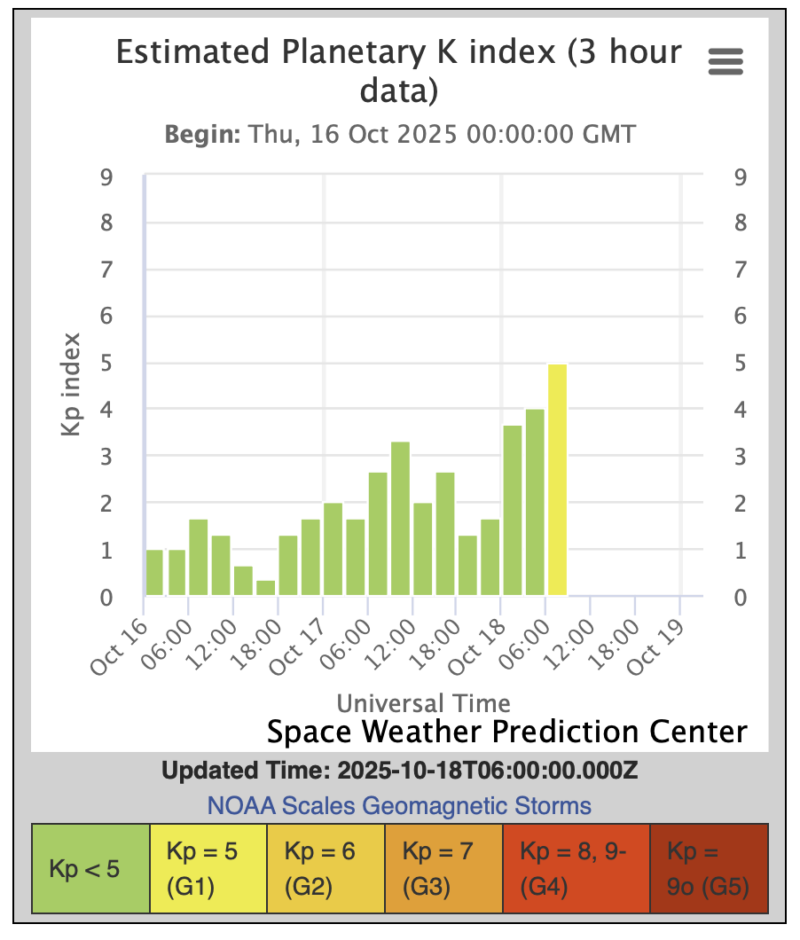
- Earth’s magnetic field: Earth’s geomagnetic field registered quiet-to-active levels (Kp 2-5) during the period. A glancing blow of a coronal mass ejection hurled by the sun on October 15 triggered a G1 (minor) geomagnetic storm. Kp = 5 threshold reached at 8:36 UTC on October 18.
- At the time of this writing (11 UTC on October 18) a G1 geomagnetic storm is ongoing. The planetary K index is Kp = 5.
No hype. Just real science, powered by real people. That’s you. Help support EarthSky!
Sun news October 17: Super-active AR4246 will depart soon
(11 UTC October 16 – 11 UTC October 17)
The very active and prolific sunspot region AR4246 – which has been granting us with M flares and C flares this whole week – is getting near the sun’s western horizon now. Soon, it’ll disappear from our sight, carried out of view by the sun’s rotation to the far side of our star. Over the past day (11:00 UTC October 16 – 11:00 UTC October 17), AR4246 was the only flare producer on the sun’s visible face. It blasted out 20 flares in a row, four Ms plus 16 Cs! And it seems it’s got more in store as it maintains its volatile beta-gamma-delta magnetic complexity. Will AR4246 grant us with an X flare before departing? We’ll keep watching. By the way, the expected train of blobs of sun-stuff – coronal mass ejections or CMEs – arriving at Earth, was too small to disturb Earth’s magnetic field to the anticipated G2 (moderate) geomagnetic storm, levels. But a G1 (minor) geomagnetic storm might still be possible later today. Stay with us for more sun news.
- Flare activity: The sun produced 4 M flares in the past 24 hours, to continue at a moderate activity level. Total flare production of the period was 20 flares, four Ms and 16 C class flares.
- Strongest: M1.5 flare from AR4246 (northwest) at 1:28 UTC on October 15. An R1 (minor) radio blackout was observed affecting an area over the Pacific Ocean, north of Fiji Island.
- AR4246 also produced the other three M flares: M1.3 at 14:18 UTC on October 15, associated with an R1 (minor) radio blackout over the Atlantic Ocean east of Brazil. M1.2 flare at 19:16 UTC, with its correspondent R1 radio blackout that affected an area over the Pacific Ocean, west of Galapagos and an M1.0 flare at 23:19 UTC, which caused an R1 (radio blackout) over the Pacific Ocean north of Papeete.
- Largest C flares from AR4246: C8.4 at 12:03 UTC, a C8.0 at 5:54 UTC, a C7.2 at 6:51 UTC, a C7.1 at 7:29 UTC and a C7.0 at 23:35 UTC.
- Lead flare producer: Active region AR4246 with a total 20 flares (four Ms and 16 Cs).
- No X-class (strong) flares were observed during the period.
- Sunspot regions: The sun shows now seven numbered active regions on its Earth-facing side.
- AR4246 (northwest) continues showing its strong beta-gamma-delta magnetic complexity.
- AR4248 (northeast) is the second strongest region but it lost its delta and now shows a beta-gamma complexity. This active region did not show much growth and kept relatively quiet.
- There are two newcomers in the sun’s southeast quadrant: AR4255 and AR4256.
- The rest of the five active region on the solar disk simple alpha or beta configurations with no relevant activity.
- Blasts from the sun: There were no Earth-directed coronal mass ejections (CMEs) observed in available coronagraph imagery over the past day.
- Solar wind: Solar wind speeds continued dropping slowly as influence from a coronal hole’s high-speed stream (CH HSS) wanes.
- Speeds gradually dropping from 440 km/s to 379 km/s at 9 UTC on October 17. We saw a peak of 458 km/s at 20:34 UTC on October 16.
- The interplanetary magnetic field (IMF) is at moderate-high level.
- The Bz component was mostly south oriented most part of the period, with two brief peaks northward at around 8:30 UTC this morning to drop down to south oriented by 11 UTC on October 17.
- Earth’s magnetic field: Earth’s geomagnetic conditions kept at quiet-to-unsettled level (Kp 0-3) during the period.
- At the time of this writing (11 UTC on October 17) the planetary K index is just below Kp = 3.
Sun news October 16: A train of CMEs is arriving today
(11 UTC October 15 – 11 UTC October 16)
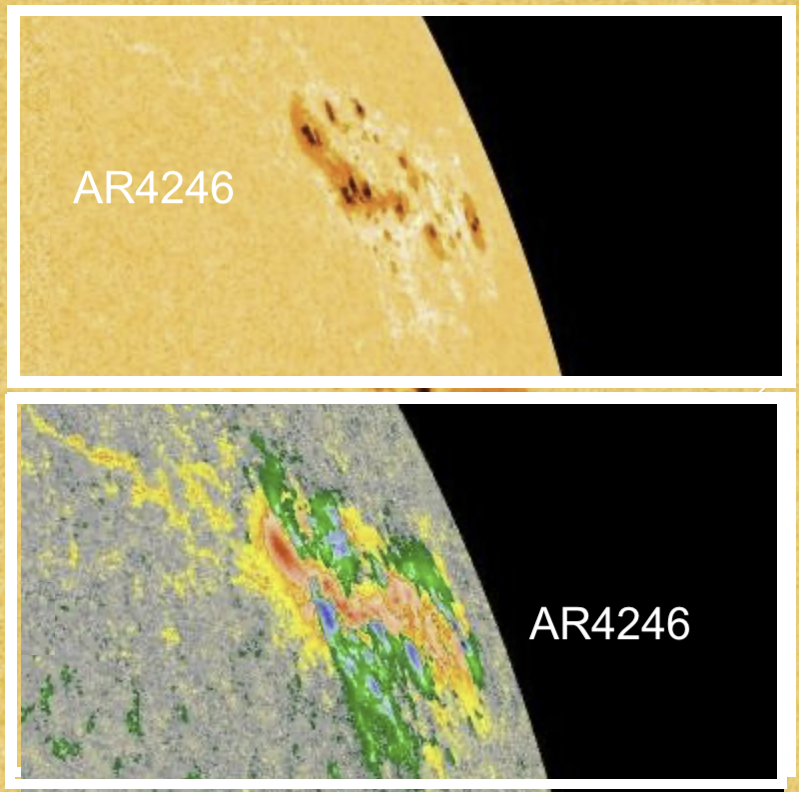
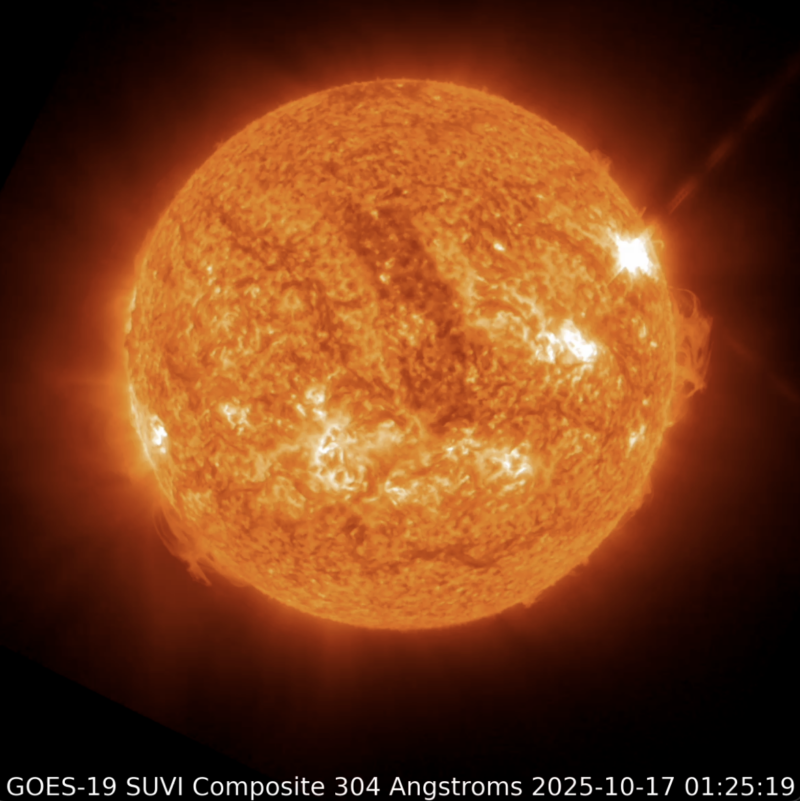

Prolific sunspot region AR4246 has been firing out a barrage of flares this week, including 4 M flares in the past day. And many of its eruptions have launched blobs of sun-stuff – coronal mass ejections, or CMEs – toward Earth. A train of CMEs it fired between October 11 and 13 is expected to impact Earth’s magnetic field later today. While the bursts themselves are small, their combined weight could trigger G1 (minor) or G2 (moderate) geomagnetic storms, and possible auroras. Stay tuned!
- Flare activity: Moderate activity continues thanks to 4 M-class flares, although the total flare production dropped by 9 from the previous day to 18.
- Strongest: M2.7 flare from AR4246 (northwest) at 22:28 UTC on October 15. An R1 (minor) radio blackout was observed affecting an area over the Pacific Ocean, north of Bora Bora.
- The rest of the M flares were produced by AR4246: M1.2 at 14:10 UTC on October 15, which caused an R1 (minor) radio blackout over the Atlantic Ocean east of Brazil. M2.4 flare at 23:45 UTC, which provoked an R1 radio blackout that affected an area over the Pacific Ocean. M1.1 flare at 0:21 UTC, which caused an R1 (radio blackout) over the Pacific Ocean north of Fiji Island.
- Other notable C flares from AR4246: C8.3 at 18:07 UTC, a C5.5 at 6:43 UTC, two C5.2 flares, the first at 19:39 UTC and the second at 4:46 UTC.
- Lead flare producer: Once again AR4246 was the top flare producer. Over the past day, this region fired 17 of the total 18 flares (four Ms and 13 Cs).
- No X-class (strong) flares were observed during the period.
- Sunspot regions: Five numbered active regions currently populate the sun’s side we see from Earth.
- AR4246 (northwest) keeps its volatile beta-gamma-delta magnetic complexity, and remains the region with the highest flare potential on the disk. It’s soon to rotate out of view over the western horizon.
- AR4248 (northeast) remains the second strongest region. It kept its beta-gamma-delta complexity, and showed growth in its intermediate regions.
- All the other three active regions are small or in decay, exhibiting simple alpha or beta configurations.
- Blasts from the sun: The coronal mass ejections (CMEs) observed from AR4246’s M flares are under modeling and analysis to determine if they’re heading our way at Earth.
- Solar wind: Solar wind speeds continued dropping slowly as influence from a coronal hole’s high-speed stream (CH HSS) wanes. This is expected to change with the arrival of the coronal mass ejections (CMEs) hurled by the sun on October 11 -13. Also, a large coronal hole emerged from the east and now is getting close to a geoeffective position.
- Earth’s magnetic field: Earth’s geomagnetic conditions kept at a quiet level (Kp 1-2) during the period.
- At the time of this writing (11 UTC on October 16) conditions are just above Kp = 1.

Sun news October 14: Powerhouse sunspot region, spectacular prominences
(11 UTC October 13 – 11 UTC October 14)



Powerhouse sunspot region AR4246 continues to dominate flare production. Living up to its high level of magnetic complexity (beta-gamma-delta), this region produced 18 of the past day’s 20 flares, including two M-flares. Several of AR4246’s recent flares have fired out bursts of sun-stuff, or coronal mass ejections, which should be impacting Earth’s magnetic field over the coming few days. Alongside AR4246’s flurry of flares, we also observed a spectacular pair of near-perfectly synchronized prominence eruptions last night. Take a look below.
- Flare activity: Solar activity stayed at a moderate level over the past day, with two M-class flares and 18 C-class flares.
- Strongest: M2.0 flare from AR4246 (northwest) at 0:41 UTC on October 14. This event caused an R1 (minor) radio blackout over the Pacific Ocean north of Fiji.
- Other M flare: M1.3 from AR4246 at 13:18 UTC on October 13, which triggered an R1 (minor) radio blackout over the Atlantic Ocean east of Brazil.
- AR4246 also produced several strong C-class flares, including a C8.0 at 19:08 UTC, a C7.2 at 16:53 UTC, and a C6.1 at 18:59 UTC.
- Lead flare producer: AR4246 remained the dominant source, responsible for 18 of the 20 flares: both Ms and 16 Cs.
- No X-class (strong) flares were observed.
- Sunspot regions: The Earth-facing solar disk displays six numbered active regions today.
- AR4246 (northwest) retained its beta-gamma-delta magnetic complexity, continued to grow in size, and developed new spots. Once again, it produced all the day’s M-class flares and multiple high-end C-class flares. It remains the region with the highest flare potential on the disk.
- AR4248 (northeast) also retained its beta-gamma-delta complexity, continuing to expand slightly while showing minor decay in its intermediate area. It produced two C-class flares during the period.
- AR4250 (northeast) and AR4247 (southwest) continued to decay with little change.
- The remaining active regions are small or in decay, exhibiting simple alpha or beta configurations.
- Blasts from the sun: Coronal mass ejections (CMEs) were associated with yesterday’s two M flares (M2.8 and M1.9). Analysis indicates that both contain Earth-directed components, with expected arrivals around October 17. Earlier eruptions from the same region have created a “train” of solar material heading toward Earth, with possible impacts on October 15 and 16. These successive arrivals could produce extended geomagnetic activity later this week.
- Solar wind: Solar wind speeds remained moderately high throughout the period due to continued influence from a coronal hole’s high-speed stream (CH HSS). The stream may be beginning to weaken, but new enhancements are likely around October 15 as CMEs from October 11–12 arrive.
- Speeds averaged around 700 km/s (1,560,000 mph), with peaks at 750 km/s (1,670,000 mph) at 12 UTC on October 13 and 740 km/s (1,650,000 mph) at 1:47 UTC on October 14. By 9 UTC, speeds had slowed slightly to 594 km/s (1,320,000 mph).
- The interplanetary magnetic field (IMF) remained at moderate-to-low strength.
- The Bz component was mostly northward during the period, with short intervals of southward orientation. It was northward again by 11 UTC on October 14.
- Earth’s magnetic field: Earth’s geomagnetic conditions ranged from quiet to unsettled (Kp 2-4) during the period.
- The Kp index peaked at Kp 4 around 12 UTC on October 13, then decreased to just above Kp 2 by 11 UTC on October 14.
Sun news October 13: Action increases with M flares and fast solar wind
(11 UTC October 12 – 11 UTC October 13)
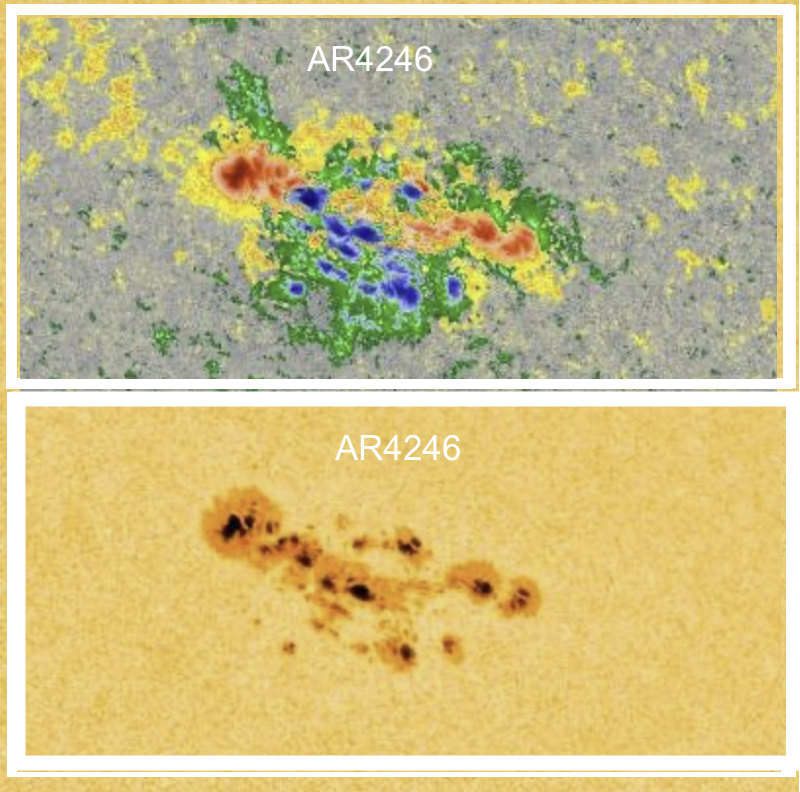
Solar activity has jumped up to moderate levels with two M-class (moderate) flares from AR4246. The most powerful of these, an M2.8 fired at 8:55 UTC on October 13, hurled plasma into space and may have launched a coronal mass ejection (CME) partially toward Earth. Meanwhile, Earth remains under the influence of strong solar wind from a coronal hole, setting the stage for more active space weather in the coming days.
- Flare activity: The sun produced 27 flares over the past 24 hours – two M-class flares and 25 C-class (common) events – pushing solar activity to moderate.
- Strongest: M2.8 flare from AR4246 (northwest) at 8:55 UTC on October 13. The event produced an R1 (minor) radio blackout over southern Africa near Madagascar.
- Other notable M flare: M1.9 from AR4246 at 4:59 UTC, which produced an R1 radio blackout over Sumatra.
- Additional strong C flares included C9.8 at 7:39 UTC and C9.3 at 0:36 UTC, both from AR4246, and a C6.4 from AR4248 at 0:13 UTC.
- Lead flare producer: AR4246 dominated activity with over half of all flares, continuing to exhibit strong magnetic mixing and dynamic development.
- No X-class (strong) flares were observed.
- Sunspot regions: Seven active regions are now visible across the sun’s Earth-facing disk.
- AR4246 (northwest) grew in size and magnetic complexity (beta-gamma-delta). It produced both M-class flares and several high-end C-class flares.
- AR4248 (northeast) also shows a beta-gamma-delta complexity and remains active, contributing multiple C flares.
- AR4253 (southwest) remains small, stable and quiet.
- The remaining regions are small or decaying, showing simple alpha or beta configurations.
- A new region may emerge soon on the southeast limb, hinted at by brightening in extreme ultraviolet imagery.
- Blasts from the sun: The C9.6 flare from AR4246 at 13:50 UTC on October 12 produced a CME that’s now under analysis. Early modeling indicates a possible Earth-directed component, with a potential arrival near October 15.
- No additional Earth-directed CMEs were detected in coronagraph imagery during this period.
- Solar wind: Solar wind conditions remain elevated, transitioning from a corotating interaction region (CIR) into a high-speed stream (HSS).
- Speeds increased from ~500 km/s to a peak of ~750 km/s in the early UTC hours and remained strong between 650–700 km/s afterward.
- The interplanetary magnetic field (IMF) peaked at moderate levels before easing.
- The Bz component was mostly northward but briefly dipped south, allowing bursts of geomagnetic activity.
- Solar wind flow continues to originate from a coronal hole, keeping conditions turbulent.
- Earth’s magnetic field: Earth’s geomagnetic field stayed active, reaching G1 (minor) storm levels on October 12 between 18:00–21:00 UTC before easing slightly.
- During this interval, the Kp index reached 5, then dropped back to Kp = 4 by the end of the period.
- Geomagnetic activity remains responsive to fluctuations in solar wind and Bz polarity.

Sun news October 12: A rush of solar wind strikes Earth
(11 UTC October 11 – 11 UTC October 12)
Earth is continuing to feel the effects of a strong stream of solar wind this morning. The wind is flowing from a large coronal hole on the sun. This rush of solar wind has kept geomagnetic activity near G1 (minor storm) levels over the past day. While the sun’s flare activity remains low, several active regions show growth and magnetic complexity. These are signs that stronger flares could return soon. Meanwhile, a faint coronal mass ejection (CME) linked to a region near the sun’s center might also give Earth a glancing blow around October 15, adding to this week’s dynamic space weather. Stay tuned!
- Flare activity: Solar activity remained at a low level over the past 24 hours, producing only C-class flares. A total of nine flares occurred during the period, most from AR4246 and AR4247.
- Strongest: C2.7 flare from AR4247 (southwest) at 19:15 UTC on October 11.
- Other notable events: A series of small flares came from AR4246, including a C1.7 at 11:55 UTC, followed by five low-level C flares between 00:21 UTC and 06:30 UTC on October 12.
- Lead flare producer: AR4246, responsible for six of the nine flares in the period.
- No M-class (moderate) or X-class (strong) flares occurred.
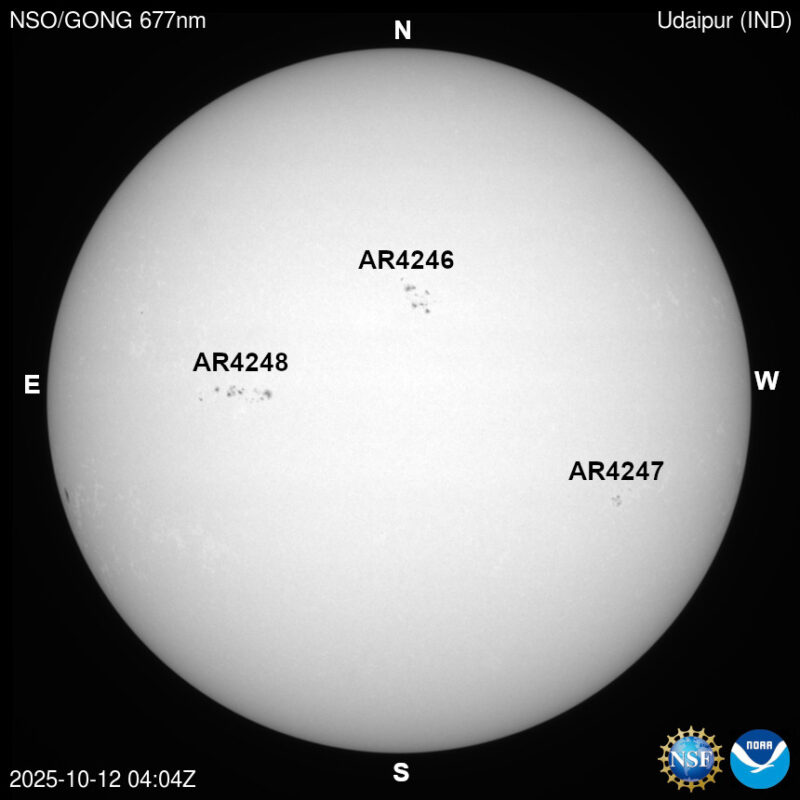
- Sunspot regions: Six numbered active regions are now visible on the Earth-facing solar disk.
- AR4247 (southwest) grew slightly and produced the strongest flare of the day.
- AR4246 (northwest) showed continued spot development and was the most active region in flare output.
- AR4248 (northeast) and AR4250 (east-northeast) also developed additional spots, while AR4249 remained stable.
- A new region is emerging on the southeast limb but is still difficult to analyze due to its position near the solar horizon.
- Most regions currently exhibit simple alpha or beta magnetic configurations, with only AR4248 showing hints of greater magnetic mixing.
- Blasts from the sun: A faint, slow-moving coronal mass ejection (CME) appeared in SOHO/LASCO imagery at 02:48 UTC on October 11, associated with coronal dimming near AR4246.
- Initial modeling suggests a very weak Earth-directed component that could arrive around October 15.
- No other Earth-directed CMEs were detected in recent imagery.
- Solar wind: Solar wind conditions strengthened during the period as Earth entered a fast stream from a coronal hole. Wind speeds rose to nearly 600 km/s, while the interplanetary magnetic field (IMF) peaked at a moderate level. The Bz component turned strongly southward at times, an orientation that enhances auroral potential.
- Earth’s magnetic field: Earth’s geomagnetic field responded with quiet to minor storm (G1) levels. A G1 storm occurred between 06:00–09:00 UTC on October 11. The rest of the period saw conditions ranging from unsettled to active, with Kp fluctuating between 3 and 5.
What’s ahead? Sun–Earth forecast
- Flare activity forecast: Solar activity should remain low, with a slight (15%) chance of M-class (R1–R2) flares. AR4246 and AR4248 are the most likely sources of any moderate flaring as their magnetic fields evolve.
- Geomagnetic activity forecast: Fast solar wind from the large coronal hole will continue to buffet Earth through at least October 13, keeping aurora chances high for high-latitude observers.
- October 12–13: Active to G1 (minor) storm levels likely, with a slight chance for isolated G2 (moderate) intervals if southward IMF conditions persist.
- October 14: Conditions should begin to ease back to unsettled levels as the coronal hole influence wanes.
- October 15: A faint CME from October 11 could deliver a glancing blow, briefly increasing geomagnetic activity once again.
Sun news October 11: Stormy Saturday today, as solar wind blasts past
(11 UTC October 10 – 11 UTC October 11)
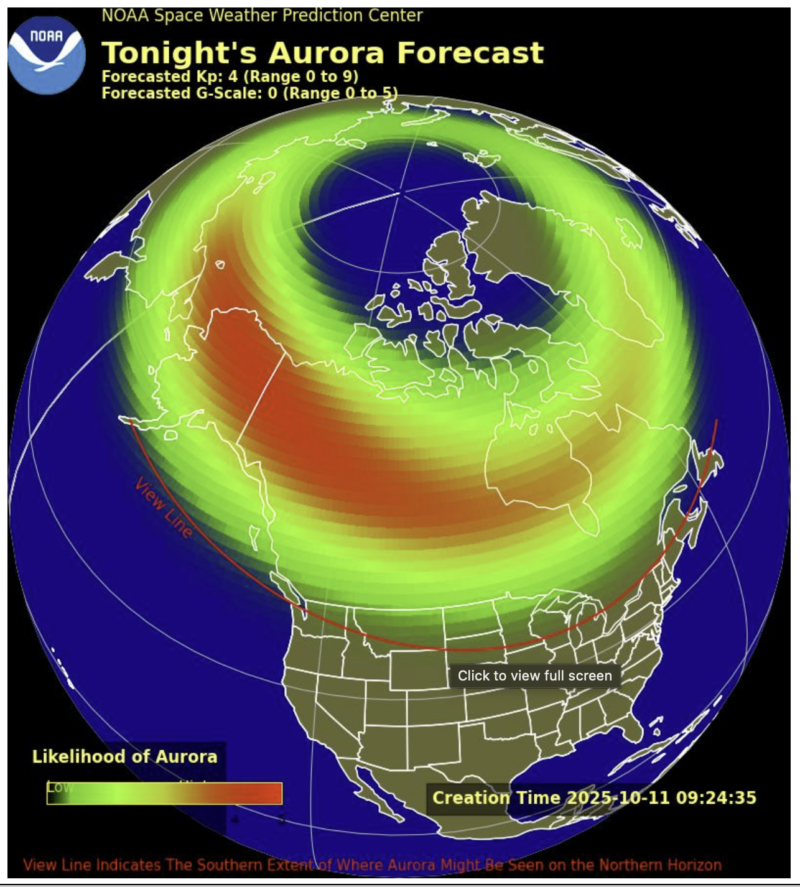
As predicted, auroras are lighting up skies around the world at this writing (11:00 UTC on October 11), as Earth’s magnetic field reacts to a blast of fast solar wind from a large solar coronal hole. A G1 (minor) geomagnetic storm is underway as we write, with conditions expected to remain active through the weekend. So the coming few days could bring extended auroral displays for skywatchers across high latitudes. Meanwhile, the sun – the source of the disturbance – itself remains relatively calm in terms of flaring. It produced only weak C-class and B-class flares over the past day.
- Flare activity: has been low over the past day, limited to C-class and B-class flares. A total of eight flares were recorded — five C-class and three B-class.
- Strongest: C1.8 flare from AR4246 (northwest) at 22:02 UTC on October 10.
- Other notable events: AR4246 in the northeast produced five additional flares — a B6.1 at 14:36 UTC, a C1.1 at 19:33 UTC, a B9.4 at 19:45 UTC, a C1.7 at 20:16 UTC, and a B8.2 at 21:10 UTC. AR4248 released a C1.1 flare at 05:42 UTC, while AR4245 produced a C1.0 flare at 08:04 UTC.
- Lead flare producer: AR4246, with six flares during the period.
- No M-class (moderate) or X-class (strong) flares occurred.
- Sunspot regions: The sun currently shows four labeled active regions on its Earth-facing side.
- Two new regions rotated into view: AR4248 in the northeast and AR4249 in the southeast.
- AR4248 exhibits a beta-gamma magnetic configuration, showing mixed polarity in its leading spots. It produced one C1.1 flare today.
- The other three regions remained small, stable, and magnetically simple (alpha or beta configurations).
- Blasts from the sun: No coronal mass ejections (CMEs) were observed in the latest coronagraph imagery.
- Solar wind: Solar wind speeds increased steadily from 377 km/s to 464 km/s by 08:31 UTC on October 11, then slightly declined to 424 km/s at the time of this writing. The interplanetary magnetic field (IMF) remained moderately strong. The Bz component stayed strongly southward through most of the period, the ideal orientation for funneling solar wind energy into Earth’s magnetic field and triggering auroras. A few brief northward peaks occurred before returning southward by 11 UTC today.
- Earth’s magnetic field: Earth’s geomagnetic field fluctuated between quiet and active (Kp = 1–5) over the past day, reaching G1 (minor storm) status at 09 UTC this morning (October 11). At the time of this report, the Kp index remains elevated at 5, confirming ongoing geomagnetic storming.
Sun news October 10: Sun activity bumps up to moderate
(11 UTC October 9 – 11 UTC October 10)
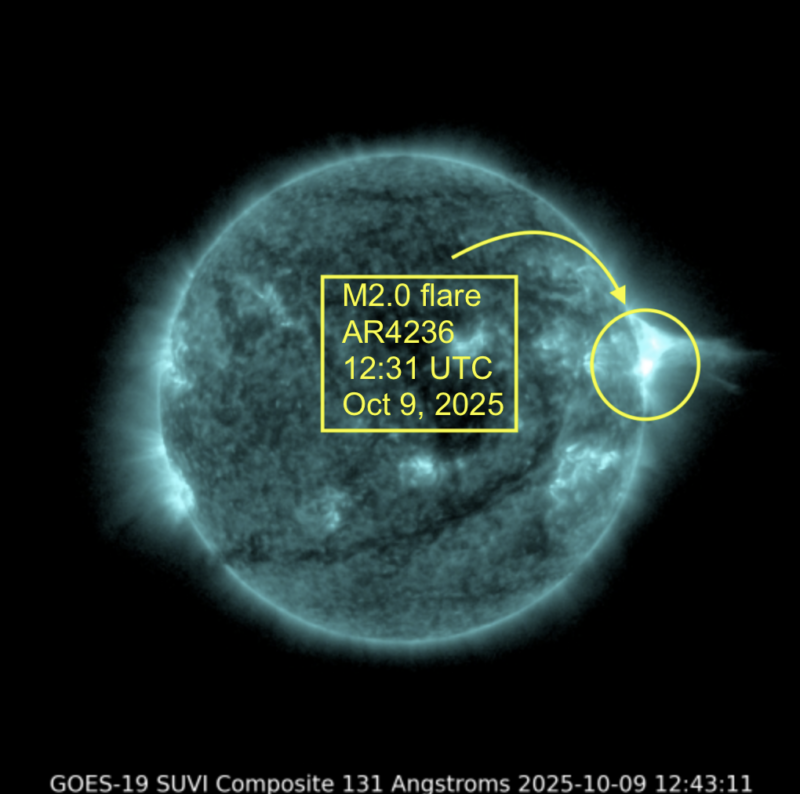
After several days of low solar activity featuring only C and B flares, the sun surprised us with a moderate M2.0 flare. The eruption occurred at 12:31 UTC on October 9. It originated from AR4236 — just as this sunspot region rotated out of view onto the far side of the sun. Because the flare erupted from behind the sun’s limb, or edge. So the sun itself partially obscured the blast, suggesting the eruption might have been even stronger than what we observed.
- Flare activity: Solar activity jumped to a moderate, with the production of an isolated M-class flare over the past day. A total of five flares were recorded: one M-class, three C-class, and one B-class.
- Strongest: M2.0 flare from AR4236 (northwest) at 12:31 UTC on October 9.
- Other notable events: AR4241 in the northwest produced three flares — a C2.4 at 06:29 UTC, a C1.3 at 18:48 UTC, and a B7.6 at 23:17 UTC. The fifth flare of the period was a C1.9 from AR4249 at 19:45 UTC.
- Lead flare producer: AR4241, with three flares during the period.
- No X-class (strong) flares occurred.
- Sunspot regions: Four numbered active regions currently populate the Earth-facing side of the Sun.
- All four regions remained small and stable, exhibiting simple alpha or beta magnetic configurations.


- Blasts from the sun: A coronal mass ejection (CME) was observed in the northeast and is now linked to a filament eruption at 06:30 UTC on October 9. Modeling and analysis suggest the plasma ejected into space could deliver a glancing blow to Earth around October 13.
- Solar wind: Solar wind speeds began the period near 404 km/s, then dropped to a low of 286 km/s at 05 UTC on October 10. By 09 UTC, speeds recovered slightly to 377 km/s. The interplanetary magnetic field (IMF) remained moderately strong. The Bz component stayed southward for most of the period and continued in that orientation through 11 UTC today.
- Earth’s magnetic field: Geomagnetic conditions ranged from quiet to active (Kp = 1–4). The Kp index was at 2 by 11 UTC on October 10.
Sun news October 9: Large coronal hole facing Earth
(11 UTC October 8 – 11 UTC October 9)
The anticipated coronal mass ejection (CME) did arrive and unsettle Earth’s magnetic field yesterday, but disturbance didn’t reach the predicted G1 (minor) geomagnetic storm threshold. However, more disturbance could be on the way. A large coronal hole has just moved into view on our star, and it’s facing right at Earth – in what’s known as a geoeffective position – meaning the fast solar wind streaming from it should begin disturbing our magnetic field around October 11.
- Flare activity: Solar activity remained low, with a mix of C-class and B-class flares over the past 24 hours. A total of seven flares were recorded: two Cs and five Bs.
- Strongest: C1.7 flare from AR4241 (northwest) at 5:17 UTC on October 9.
- Other notable events included a C1.2 from AR4242 at 12:48 UTC, a B9.9 and B9.7 from AR4236 at 11:36 and 18:44 UTC, a B9.1 from an unnumbered region in the southeast at 20:03 UTC, and a B7.1 from AR4232 at 11:10 UTC.
- Lead flare producer: AR4236 led the period with three B-class flares.
- No M-class (moderate) or X-class (strong) flares occurred.
- Sunspot regions: The sun currently shows four numbered active regions on its Earth-facing side.
- AR4236 (beta-gamma) rotated out of view and is now behind the western limb.
- AR4232 (beta) also moved beyond the west limb and is no longer visible.
- The remaining active regions on the Earth-facing side stayed small and stable, showing slow decay or little change. All exhibit simple alpha or beta magnetic configurations.
- Blasts from the sun: No Earth-directed coronal mass ejections (CMEs) were detected in the latest coronagraph imagery.
- Solar wind: Solar wind speeds averaged around 390 km/s during the period, peaking briefly at 890 km/s at 23:24 UTC on October 8 before decreasing to 395 km/s by 9 UTC on October 9. The interplanetary magnetic field (IMF) remained at moderate strength. The Bz component stayed southward through much of the first half of the period, then rotated northward around 21 UTC on October 8 and maintained that orientation through 11 UTC today.
- Earth’s magnetic field: Geomagnetic conditions ranged from quiet to active (Kp = 1–4). Activity decreased from Kp = 4 early in the period to nearly Kp = 0 by 11 UTC on October 9.

Sun news October 8: Sun-stuff arrival could bring auroras today
(11 UTC October 7 – 11 UTC October 8)
A blast of sun-stuff, or a coronal mass ejection (CME), is expected to impact Earth’s magnetic field later today. Having been hurled into space by the sun on October 3-4, this blob of solar material could trigger G1 (minor) to G2 (moderate) geomagnetic storming and auroral displays at high latitudes tonight. Clear skies, aurora chasers!
- Flare activity: Sun activity remains at low levels with only C-class and B-class flares over the past 24 hours. We saw a total of six flares: four Cs and two Bs.
- Strongest: C9.1 flare from AR4233 (northwest) at 20:07 UTC on October 7.
- Other significant flares included a C5.6 from AR4236 at 11:29 UTC, a C1.9 from AR4232 at 4:37 UTC, a C1.0 from AR4242 at 5:15 UTC, a B8.2 from AR4247 at 17:52 UTC, and a B8.2 from an as-yet-unnumbered active region in the southeast at 13:31 UTC.
- Lead flare producer: The six flares of the period were shared between six different active regions.
- No M-class (moderate) or X-class flares occurred.
- Sunspot regions: Today the sun shows seven numbered active regions on the side we see from Earth.
- AR4236 (beta-gamma) retained its gamma configuration, but produced only one C flare during our observation period.
- AR4232 (beta) is soon to depart on the southwest horizon.
- The rest of the active regions on the Earth-viewed solar disk stayed small and stable, showing slow decay or little change. All of them have alpha or beta configurations.
- Blasts from the sun: After modeling and analysis, the coronal mass ejection associated with the C5.1 flare from AR4233 at 20:37 UTC on October 6 is not heading for Earth.
- Ejecta from the dramatic prominence in the southeast around 9 UTC on October 7 is also not Earthbound.
- No additional Earth-directed CMEs were detected in recent coronagraph imagery.
- Solar wind: Solar wind speeds averaged around 400 km/s, with several peaks as high as 587 km/s. Speeds dropped to 399 km/s by 9 UTC on October 8. The interplanetary magnetic field (IMF) rose slightly to moderate levels. The Bz component remained southward throughout the period and continued at that orientation by 11 UTC on October 8.
- Earth’s magnetic field: Geomagnetic conditions stayed quiet to unsettled with a couple of peaks at active disturbance (Kp = 1–4). A disturbance just above the Kp = 4 level was reported at 12 UTC on October 7. The threshold was reached for the second time at 5:36 UTC, and continues at this level at the time of this writing.
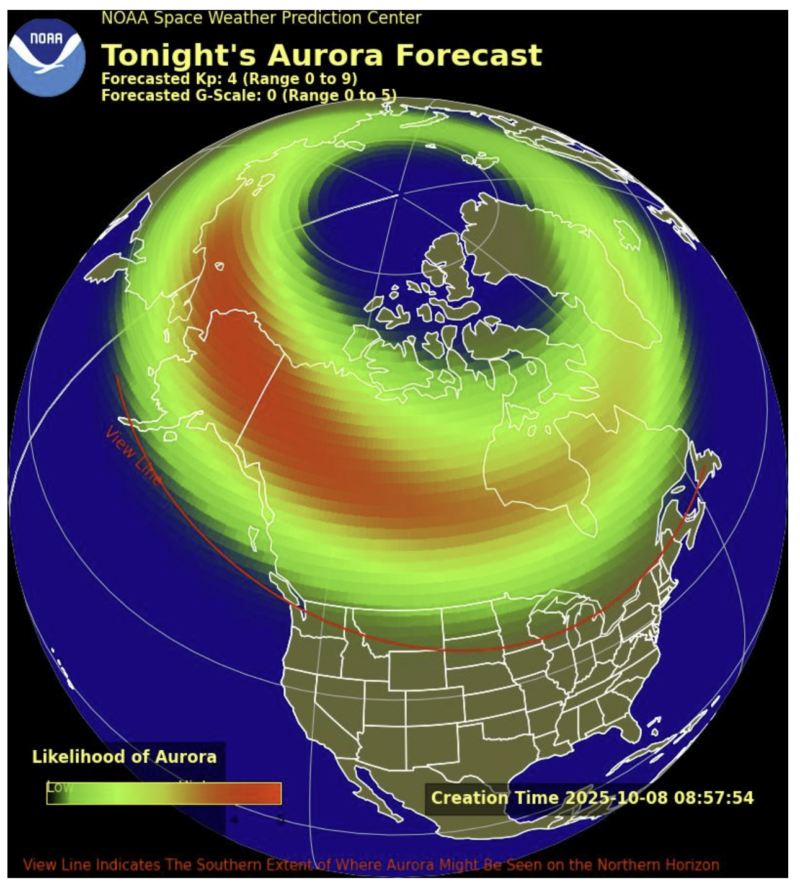

Sun news October 7: Stunning prominence fires out sun-stuff
(11 UTC October 6 – 11 UTC October 7)

Around 9 UTC this morning, we observed a beautiful erupting prominence over the sun’s southeast horizon. The event launched plasma out into space, and specialists are now working to establish if this plasma could impact our planet’s magnetic field. They’re also analysing another burst of sun-stuff – or coronal mass ejection (CME) – produced during a C5.1 flare at 20:37 UTC last night. Meanwhile, two other CMEs are expected to reach Earth over the next day, potentially triggering geomagnetic storms and auroras. Stay tuned.
- Flare activity: The sun produced seven C-class (common) flares and one B-class over the past 24 hours, keeping activity at a low level.
- Strongest: C5.1 flare from AR4233 (northwest) at 20:37 UTC on October 6.
- Other significant flares included a C2.4 from AR4233 at 21:21 UTC, a C2.1 from AR4233 at 21:04 UTC, a C1.7 from AR4232 at 12:31 UTC, a C1.5 from AR4242 at 15:21 UTC, and a C1.3 from AR4233 at 15:21 UTC.
- Lead flare producer: AR4233 led the period with four C-class flares.
- No M-class (moderate) or X-class flares occurred.
- Sunspot regions: The Earth-facing solar disk today hosts six numbered active regions.
- AR4236 (beta-gamma) remains the largest and most magnetically complex region, showing a mixed-polarity configuration but no significant flaring.
- AR4241 (beta) continued developing additional trailing sunspots and mild magnetic complexity.
- AR4242 (beta) and AR4245 (beta) both showed slight growth.
- The remaining regions stayed small and stable, showing slow decay or little change.
- Blasts from the sun: The C5.1 flare from AR4233 at 20:37 UTC on October 6 was associated with a coronal mass ejection. This is now under modeling to determine if any portion is Earth-directed.
- Ejecta from the dramatic prominence in the southeast around 9 UTC on October 7 initially appears too far eastward for a direct Earth impact, but analysis is ongoing.
- No additional Earth-directed CMEs were detected in recent coronagraph imagery.
- Two earlier CMEs – one from an M-class flare on October 3 and another from a complex filament eruption on October 3–4 – remain en route, with low-confidence arrival estimates for October 7–8.
- Solar wind: Solar wind speeds continued to decline as Earth’s connection to a coronal hole high-speed stream (CH HSS) weakened. Speeds dropped from about 448 km/s to 375 km/s, settling near 395 km/s by 9 UTC on October 7. The interplanetary magnetic field (IMF) rose slightly to moderate levels. The Bz component remained primarily southward throughout the period and continued at that orientation by 11 UTC on October 7.
- Earth’s magnetic field: Geomagnetic conditions stayed quiet to unsettled (Kp = 1–3), consistent with the waning influence of the coronal hole. At the time of this report, Kp = 3.

Sun news October 6: Solar wind slow, but sun-stuff on the way
(11 UTC October 5 – 11 UTC October 6)
After triggering geomagnetic storms at Earth last week, the influence of fast solar wind flowing from coronal holes continues to weaken. However, more geomagnetic disturbance could be imminent. A pair of slow-moving coronal mass ejections (CMEs) that launched on October 3–4 appear to be on course to reach Earth over the next couple of days, potentially sparking another round of geomagnetic activity around October 7–8.
- Flare activity: Solar activity stayed at low levels, with a total of 12 C-class (common) flares recorded over the past day.
- The strongest was a C4.2 flare from newly numbered AR4244 (alpha complexity) at 1:10 UTC on October 6.
- Other significant events included a C4.1 flare from AR4236 at 13:49 UTC, and several from AR4238 near the west limb (C2.1–C4.1 between 12:05–18:43 UTC).
- Regions AR4242, AR4233, and AR4236 contributed smaller flares through the period, ranging from C1.9–C3.5.
- No M- (moderate) or X-class flares occurred.
- Sunspot regions: Eight active regions currently dot the Earth-facing solar disk.
- AR4232 (beta) and AR4236 (beta-gamma) remain the largest and most magnetically complex. These regions continue to be linked, with minor sunspot development between them.
- AR4241 developed additional trailing spots and mild magnetic complexity.
- AR4244 (alpha) rotated further into view but remained quiet, aside from its single C4.2 flare.
- The remaining regions were small and stable, showing slow decay or little change.
- Blasts from the sun: A filament eruption in the southeast began around 20:00 UTC on October 5 and was still ongoing at the time of reporting.
- No new Earth-directed CMEs were detected in the latest coronagraph imagery.
- Two earlier CMEs – one from an M-class flare on October 3 and another from a complex filament eruption on October 3–4 – remain en route, with low-confidence arrival estimates for October 6–8.
- Solar wind: Solar wind speeds continued to decline as Earth’s connection to the positive-polarity coronal hole high-speed stream (CH HSS) weakened. Speeds decreased from about 550 km/s to 430 km/s. The interplanetary magnetic field (IMF) stayed weak, with no significant southward Bz intervals observed.
- Earth’s magnetic field: Geomagnetic activity was mostly quiet to unsettled (Kp = 1–3), consistent with the weakening coronal hole influence. Minor storm intervals (G1) remain possible once CME effects begin to arrive.

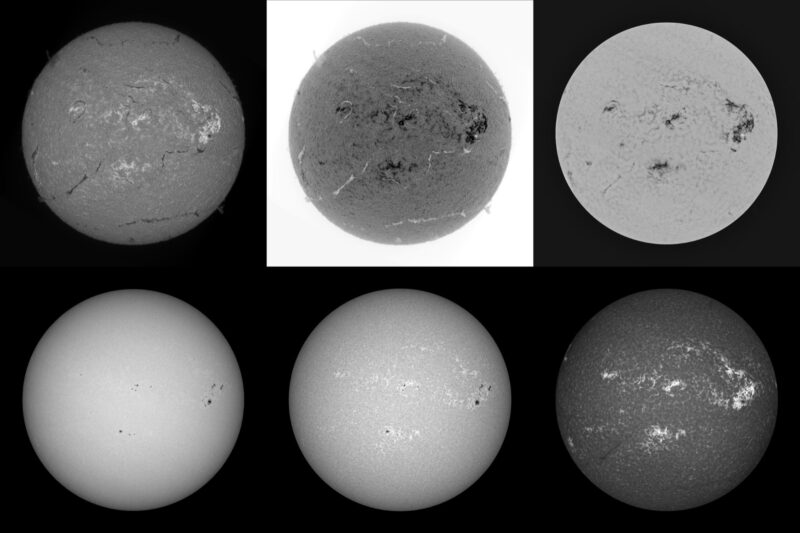
Sun news October 5: Fast solar wind eases as sun quiets down
(11 UTC October 4 – 11 UTC October 5)
The fast solar wind stream that fueled nearly a week of geomagnetic activity continues to weaken. Solar wind speeds declined to around 550 km/s, and Earth’s magnetic field settled to mostly quiet and unsettled levels. No new Earth-directed CMEs were observed, though slow-moving ejecta from October 3 remain under watch for possible arrival in the next few days. Solar activity dipped to low levels, with only C-class flares detected over the past day.
- Flare activity: The sun produced low-level activity during the period, with 10 C-class flares recorded.
- The strongest was a C5.4 flare from AR4242 (S11E13, Dai/beta) at 01:42 UTC on October 4.
- Other notable events included: C3.5 from AR4241 at 17:52 UTC; C3.0 from AR4238 at 19:05 UTC; C3.3 from AR4226 at 04:04 UTC; and several smaller C-class flares (C1.9–C2.7) from AR4230, AR4232, and AR4242.
- No M-class or X-class flares occurred during the interval.
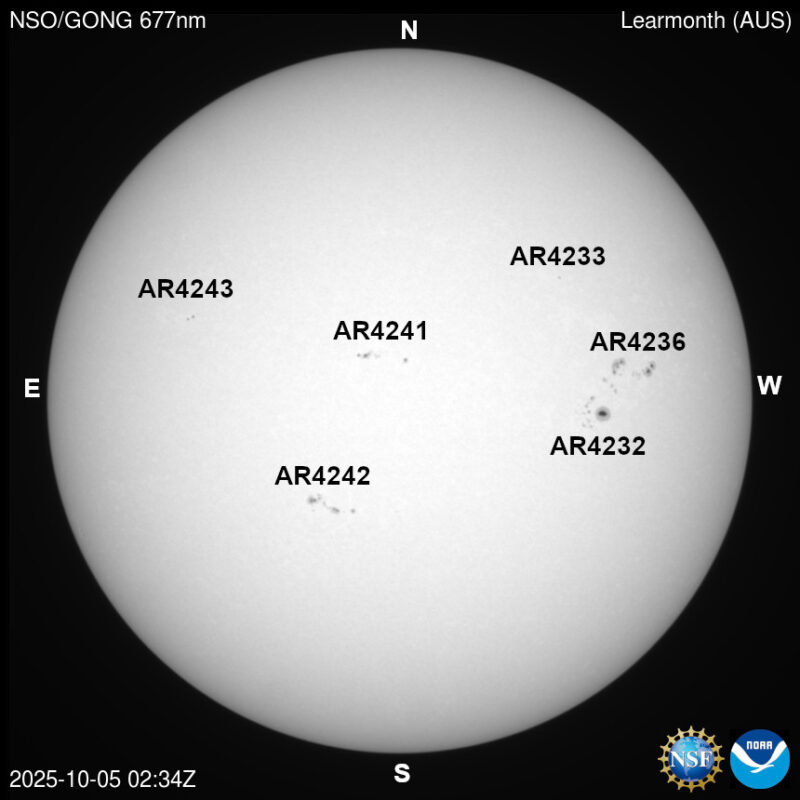
- Sunspot regions: Six active regions were visible on the Earth-facing disk.
- AR4236 (N10W43, beta-gamma) and AR4232 (N04W34, beta) remain the most magnetically complex and linked by a broader magnetic connection showing minor spot development between them.
- AR4242 (S11E13, beta) produced the largest flare of the day.
- AR4243 (southeast) continued to grow in its intermediate area.
- AR4230 rotated off the disk, while the remaining regions were small, simple, or in decay.
- Blasts from the Sun: No new Earth-directed CMEs were detected.
- A Type II radio sweep (284 km/s) was observed at 16:43 UTC on October 4, linked to eruptive activity near the sun’s west limb.
- Two earlier CMEs from October 3 remain under analysis. The first, tied to an M-class flare, may reach Earth on October 6. The second, from a filament eruption in the northeast, could arrive between October 7–8, though confidence remains low due to its slow speed and complex structure.
- Solar wind: Solar wind continued under the influence of a positive polarity coronal hole high-speed stream (CH HSS). Speeds ranged from 550–700 km/s, gradually declining through the period. The interplanetary magnetic field (IMF) remained weak, and the Bz component fluctuated between north and southward directions.
- Earth’s magnetic field: Geomagnetic activity ranged from quiet to active levels (Kp = 2–4) as the high-speed stream influence waned. Conditions are easing but remain elevated.
What’s ahead? Sun–Earth forecast
- Flare activity forecast: Solar activity is expected to remain low to moderate with a continuing chance (60%) of isolated M-class (R1–R2) flares from AR4232 or AR4236. The chance of a strong (R3) flare remains low (15%).
- Geomagnetic activity forecast:
- Oct 5: Mostly quiet to unsettled conditions, with a slight chance for isolated G1 (Minor) storming while the high-speed stream continues to weaken.
- Oct 6–8: Unsettled to active levels are expected, with possible G1–G2 (Minor–Moderate) geomagnetic storms if one or both slow CMEs from October 3 arrive. A very slight chance exists for G3 (Strong) storming if CME impact is stronger than forecast.
Sun news October 4: Geomagnetic storms begins to ease
(11 UTC October 3 – 11 UTC October 4)
After five days of activity – and dazzling auroras at high latitudes – the geomagnetic storm is finally starting to ease. The fast solar wind from a coronal hole that fueled this storm is now declining. Solar wind speeds dropped from 768 km/s late on October 3 to 608 km/s at 9:00 UTC on October 4 — still strong enough to trigger isolated G1 (minor) storm levels. But the storming is dying down as the solar wind weakens, and geomagnetic activity should continue to settle. Meanwhile, a small coronal mass ejection (CME) launched by yesterday’s M1.5 flare might bring another disturbance around October 8. Clear skies to all you aurora chasers – and please share your aurora photos with our community!
- Flare activity remained at moderate levels, highlighted by one M-class flare among 16 total events. In all, we saw 1 M flare and 15 C-class flares over the past day.
- The strongest, an M1.2 flare, erupted from active region AR4238 at 14:36 UTC on October 3, producing an R1 (minor) radio blackout that affected an area over Brazil.
- Other notable flares included a C8.0 (just below M level) from AR4238 at 15:35 UTC, a C7.4 from AR4226 at 17:16 UTC, a C5.5 from AR4242 at 1:42 UTC, a C4.7 from AR4246 at 3:22 UTC, a C3.5 from AR4232 at 5:02 UTC, and a C3.4 from AR4242 at 0:35 UTC.
- AR4242 was the most active region of the day, producing seven C-class flares.
- Sunspot regions: The Earth-facing solar disk displayed eight numbered active regions. All regions that previously contained delta configurations lost them during this period. Losing a delta means the potential for strong flaring has decreased.
- AR4230 (southwest, beta-gamma): lost its delta configuration and remained stable, producing no flares.
- AR4232 (southeast, beta-gamma): lost its delta configuration and produced one C-class flare.
- AR4236 (northeast, beta-gamma): quiet with no flare activity.
- The remaining regions stayed small, simple, or in decay, with alpha or beta configurations.
- Blasts from the sun: A coronal mass ejection (CME) accompanied the M1.5 flare from AR4236 at 5:23 UTC. ENLIL model simulations suggest it may reach Earth around October 8. A filament eruption on the northeast limb at 14:51 UTC on October 3 also ejected material into space; analysis continues to determine whether any part of it is Earth-directed.
- Solar wind: Solar wind remained fast, averaging around 768 km/s before decreasing to 608 km/s at 9 UTC on October 4. The interplanetary magnetic field (IMF) weakened to moderate levels, while the Bz component stayed mostly southward, thereby continuing to favor auroras.
- Earth’s magnetic field: The five-day geomagnetic storm is easing. Conditions ranged from unsettled to active (Kp = 3–4), with Kp = 4 at the time of this report.
Sun news October 3: The geomagnetic storm are still going
(11 UTC October 2 – 11 UTC October 3)
At the time of this writing (11:00 UTC, October 3), Earth’s magnetic field is still disturbed up to G1 (minor) storm levels. We saw similar levels for three consecutive 3-hour synoptic periods over the past day. The high-speed stream of solar wind came from broad coronal holes on the Earth-facing side of the sun. Earth’s equinox-season orientation, which is also still ongoing, helped sustain this geomagnetic storming. Auroral displays lit up northerly latitudes, and the storming is still going! Clear skies to all you aurora chasers. Please share your beautiful aurora photos with our community.
- Flare activity: An isolated M flare kept solar activity at moderate levels over the past day. In addition, there were nine C flares, for a total of 10 flares during the observation period.
- The strongest flare, an M1.5, erupted from AR4236 at 5:23 UTC on October 3. The blast triggered an R1 (minor) radio blackout that affected an area over Malaysia.
- Other notable flares included a C9.8 (almost an M) from AR4236 at 6:11 UTC; C3.0 from AR4226 at 14:17 UTC; C3.0 from AR4236 at 17:03 UTC; C3.0 from an unnumbered active region in the northeast at 23:45 UTC; C3.0 from an unnumbered active region in the southeast at 23:47 UTC; and C2.4 from AR4236 at 16:38 UTC.
- AR4236 was the top flare producer of the period, blasting out five flares, including the M1.5 and four additional C flares.
- Sunspot regions: The Earth-facing solar disk displayed eight numbered active regions.
- AR4230 (southwest, beta-gamma-delta) maintained its delta configuration. Despite this unstable setup, it did not produce flares during the period.
- AR4232 (southeast, beta-gamma-delta) regained its delta configuration, but produced only a faint C2.2 flare.
- AR4236 (northeast, beta-gamma) lost its delta magnetic complexity and showed no growth but led flare production, including the M-class event.
- The remaining regions stayed small, simple, or in decay, with alpha or beta configurations.
- Blasts from the sun? A coronal mass ejection (CME) accompanied the M1.5 flare from AR4236 at 5:23 UTC. This region is now in a geoeffective position. Initial analysis suggests part of the ejecta might cause notable effects at Earth. Specialists continue modeling and analysis.
- Solar wind: Solar wind remained very strong, averaging around 780 km/s with a peak of 1,093 km/s at 21:30 UTC on October 2. At 9 UTC on October 3, solar wind measured 764 km/s. The interplanetary magnetic field IMF dropped to moderate levels. The Bz stayed strongly southward most of the time, with occasional northward peaks. By 9 UTC, it shifted northward. A southward Bz favors auroras.
- Earth’s magnetic field: Earth’s field fluctuated from quiet to active stormy levels throughout the day, ranging from active to storm levels (Kp = 2–5). Disturbances reached Kp = 5, or G1 (minor) geomagnetic storm levels, for three consecutive three-hour synoptic periods, including 9 UTC on October 3.
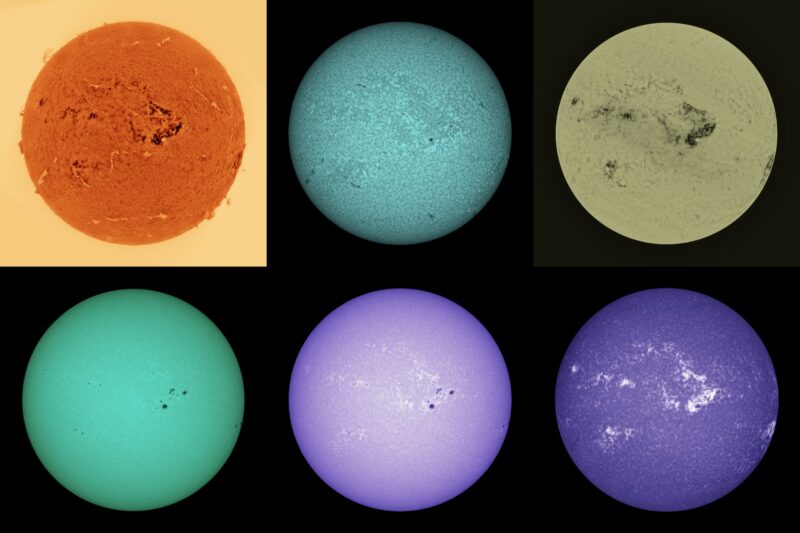



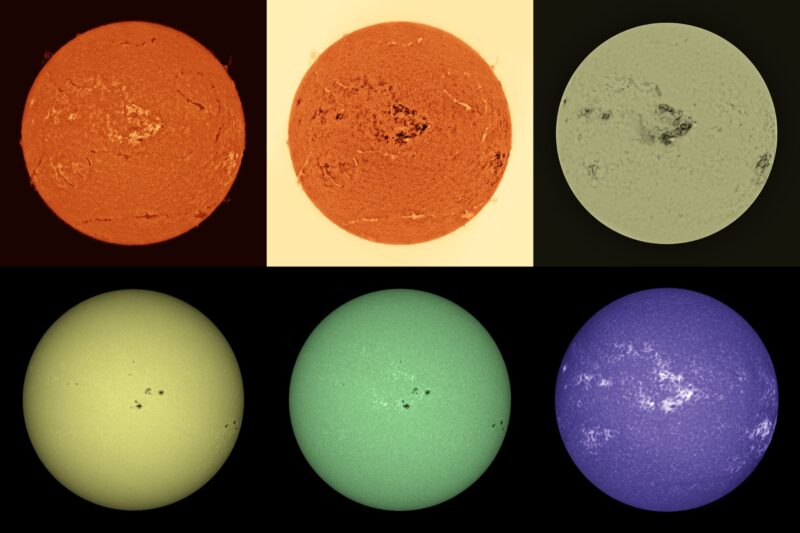
Sun news October 2: Strong storms this morning, auroras tonight?
(11 UTC Oct 1 – 11 UTC Oct 2)
Earth’s magnetic field has been rocked by fast solar wind overnight, driving disturbances up to G3 (strong) geomagnetic storm levels in the early hours of this morning. The high-speed stream of solar wind came from broad coronal holes on the sun, amplified by Earth’s equinox-season orientation, which strengthens the connection of solar wind to our planet. Disturbance is expected to continue tonight, with G2 (moderate) storming in the forecast. And that could mean auroras at northerly latitudes!
- Flare activity: Stayed at moderate levels, with 10 flares in the past day: two Ms and eight Cs.
- Strongest: Two M1.2 flares erupted: one from AR4232 at 16:50 UTC on October 1, and another from AR4226 at 2:09 UTC on October 2. Each triggered an R1 (minor) radio blackout, the first over Ecuador and the second over the Pacific Ocean east of Papua New Guinea.
- Other notable flares: C8.6 (AR4236 at 11:35 UTC), C8.3 (AR4238 at 11:30 UTC), C5.2 (AR4235 at 2:22 UTC), C4.6 (AR4239 at 12:45 UTC), C4.1 (AR4235 at 2:30 UTC), and C4.1 (AR4233 at 4:47 UTC).
- AR4238 and AR4235 led flare production with two C-class flares each.
- Sunspot regions: Nine numbered active regions are currently visible on the Earth-facing disk.
- AR4230 (southwest, beta-gamma-delta) remained the largest and most complex region, but stayed surprisingly quiet.
- AR4232 (southeast, beta-gamma) kept its gamma configuration, although it’s showing signs of decay.
- AR4236 (northeast, beta-gamma-delta) grew further over the past day and maintained its maximum magnetic complexity.
- The rest of the regions stayed small, simple, or in decay, with alpha or beta configurations.
- A new spot in the northeast received the designation AR4241.
- Blasts from the sun? A coronal mass ejection (CME) appeared in coronagraph imagery at 11 UTC on October 1. The eruption came from the far side of the sun, with no associated flares on the Earth-facing disk.
- Solar wind: Solar wind stayed very strong, going from 832 km/s at the start of the period to 793 km/s at 9 UTC on October 2. The interplanetary magnetic field IMF peaked at moderately high levels, while the Bz held strongly southward most of the time before turning northward at the end of the period. A southward Bz is favorable for auroras.
- Earth’s magnetic field: Earth’s field stayed stormy throughout the day, ranging from active to storm levels (Kp = 5–7). Disturbances spanned G1 (minor), G2 (moderate), and G3 (strong) levels, with the Kp = 7 threshold reached at 5:59 UTC on October 2.

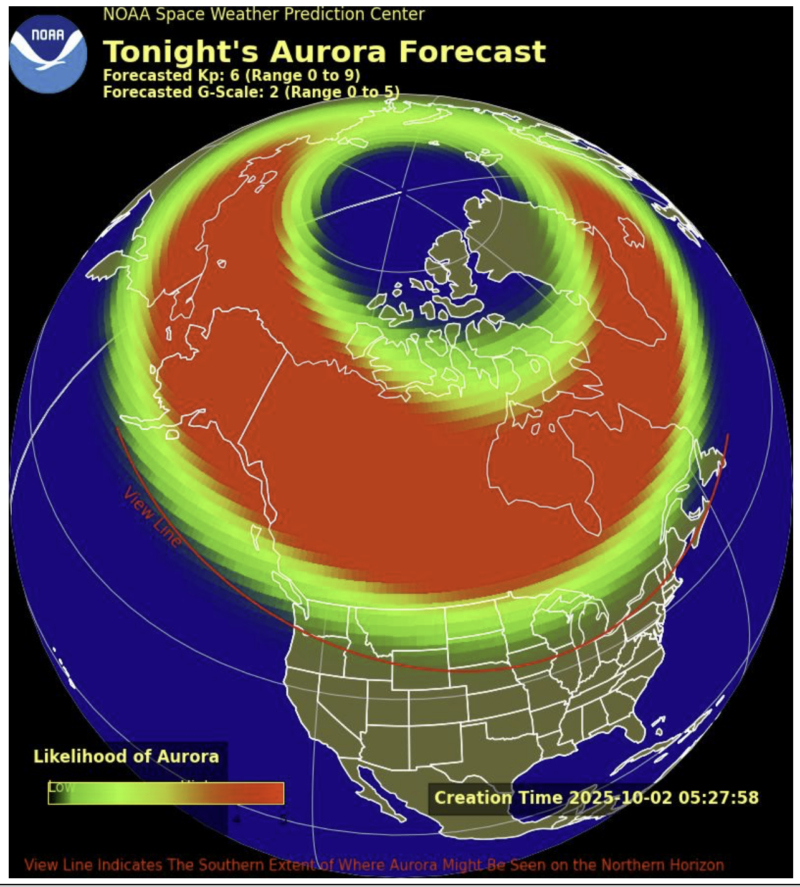
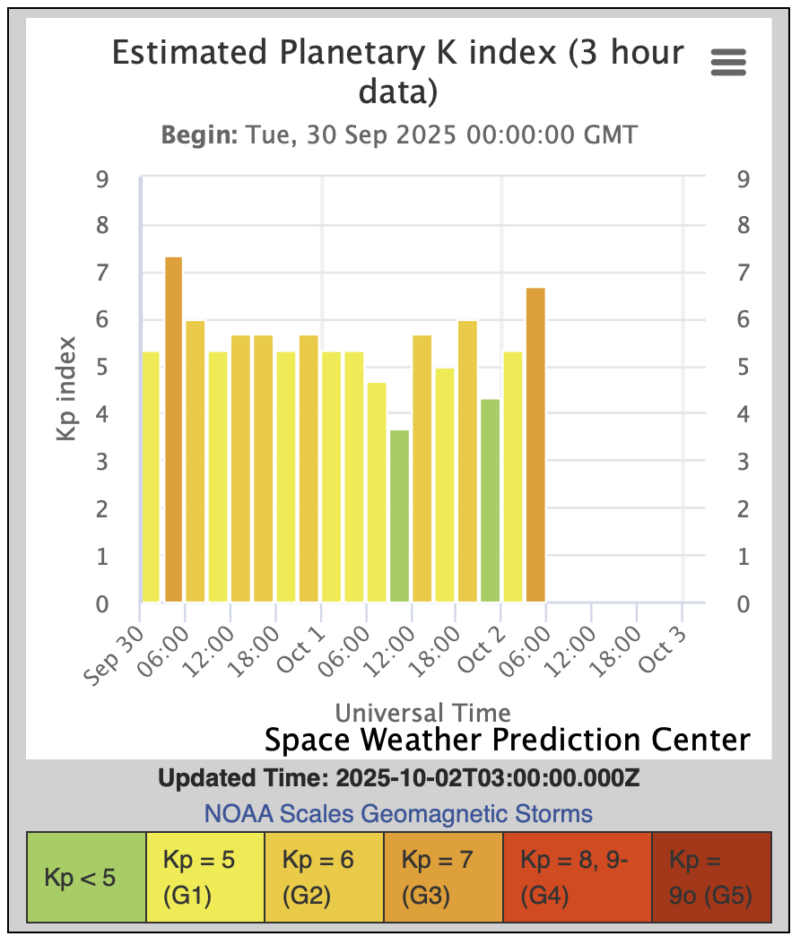

Sun news October 1: G2 storm rattles Earth as sunspot regions heat up
(11 UTC Sept 30 – 11 UTC Oct 1)
Our star remains lively, firing 2 M flares over the past day, while several sunspot regions suggest more action is on the way. Regions AR4236 and AR4230 have developed potent beta-gamma-delta complexities, meaning they have good potential for more M flares and even X flares. Meanwhile, Earth’s magnetic field endured solar wind speeds surging past 740 km/s, likely from a coupling of a glancing coronal mass ejection (CME) and a coronal hole’s high-speed stream. This powerful combination sparked G2 (moderate) geomagnetic storming at Earth over the past day.
- Flare activity: Sun activity remains at moderate-to-high levels, with 12 flares over the past day: 2 M-class flares and 10 C-class flares.
- Strongest: M1.8 from AR4230 at 12:26 UTC on Sept 30. It caused an R1 (minor) radio blackout over the Pacific Ocean east of Papua New Guinea.
- Other notable flares: M1.2 (AR4232 at 2:26 UTC), C9.2 (AR4236 at 13:01 UTC), C7.9 (AR4239 at 1:30 UTC), C4.1 (AR4240 at 7:21 UTC) and C4.0 (AR4226 at 21:42 UTC).
- AR4230 and AR4232 shared the honors for top flare producer of the period with three flares each, both firing one M and two Cs.
- Sunspot regions: The Earth-viewed side of our sun is today populated with nine active regions. Two active regions, AR4230 and AR4236, developed a delta in their configurations to reach the highest level of magnetic complexity: beta-gamma-delta.
- AR4230 (southwest, beta-gamma-delta) attained the maximum magnetic complexity.
- AR4232 (southeast, beta-gamma) kept its gamma configuration with some decay.
- AR4236 (northeast, beta-gamma-delta) continued growing during the period to reach the maximum magnetic complexity.
- The rest of the regions remained small, simple, or in decay, with alpha or beta configurations.
- There’s a newcomer in the northeast now numbered AR4240.
- Blasts from the sun? A coronal mass ejection (CME) appeared in coronagraph imagery at 2:24 UTC on September 29. The ejecta may deliver a slight glancing blow to Earth on October 1, though confidence in this is low.
- Solar wind: Solar wind speeds increased from 440 km/s up to 747 km/s at 9 UTC today, with a peak at 788 km/s at 3:20 UTC. The interplanetary magnetic field (IMF) peaked at moderately high levels, while the Bz stayed strongly southward during most of the period. A southward Bz is favorable for auroras.
- Earth’s magnetic field: Geomagnetic activity stayed at active levels (Kp = 5–6) throughout the past day, ranging from G1 (minor) to G2 (moderate) geomagnetic storming. It sits at a Kp = 5 level at the time of this writing.

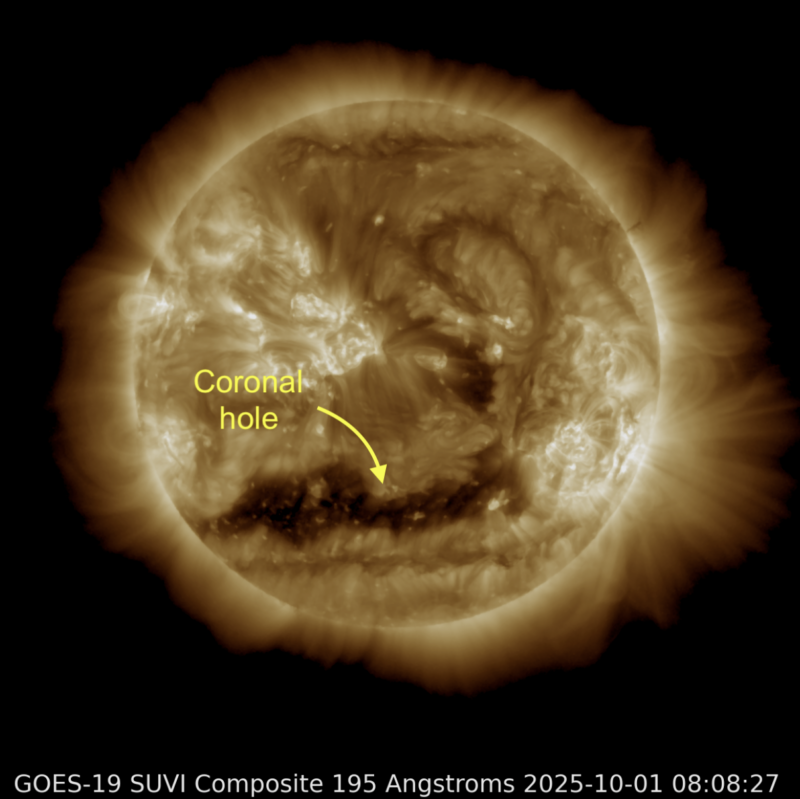
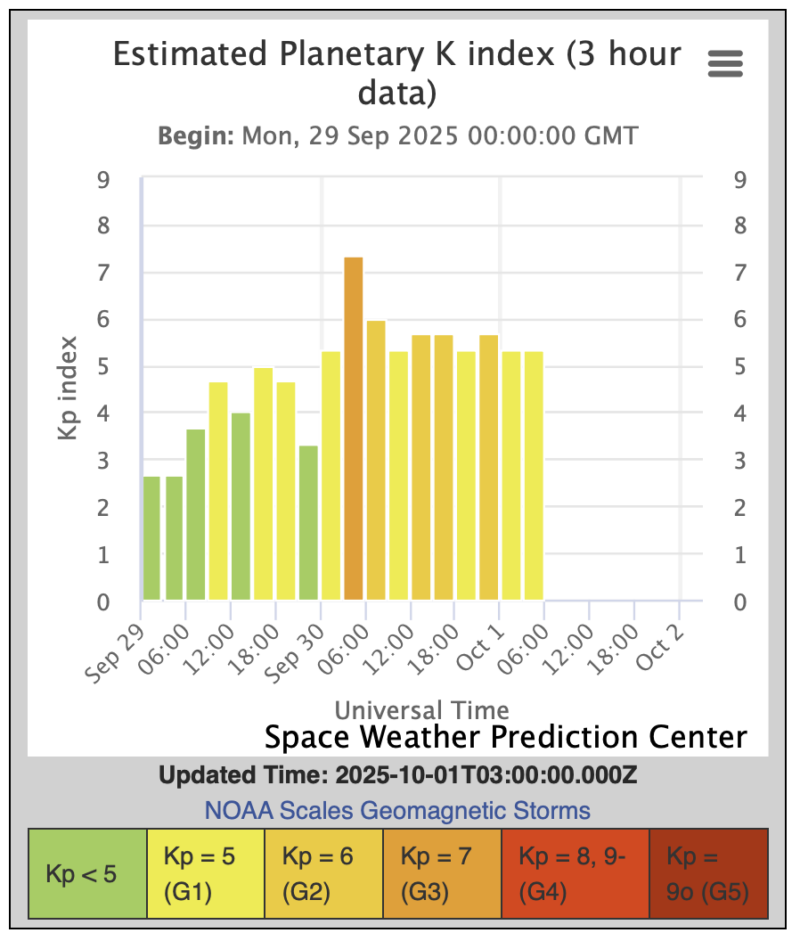
Like what you read?
Subscribe and receive daily news delivered to your inbox.
More from
C. Alex Young


Sun news: See a huge solar eruption

Yes, there’s an aurora season, and it’s here
Sun activity archive for September 2026
Sun activity archive for August 2026