Some famous pairs of stars
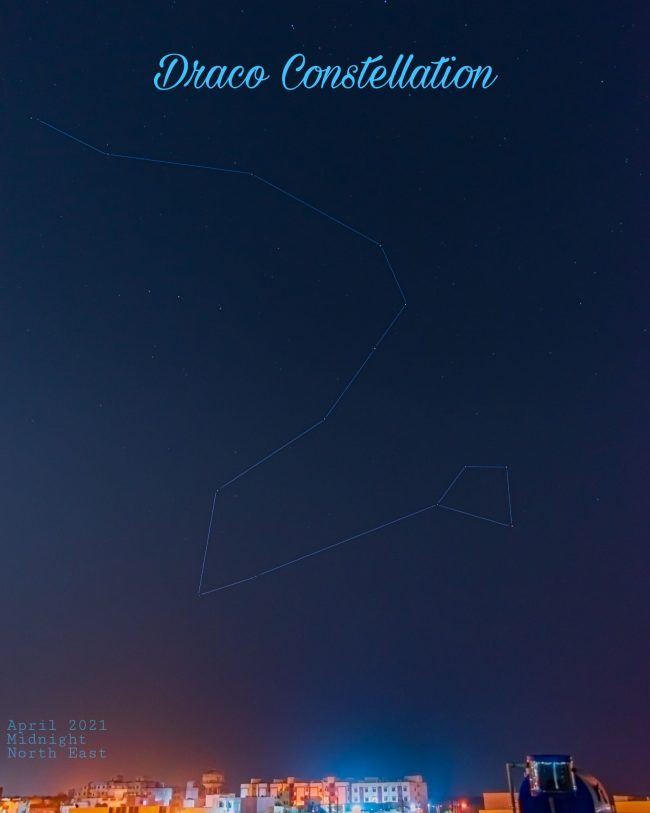
Our human eyes and brains easily pick out pairs of stars on the dome of night, especially if the two stars are relatively bright. On Northern Hemisphere summer nights, a famous pair of stars peers down at us from the northern sky. The two stars are Eltanin and Rastaban. They represent the fiery eyes of the constellation Draco the Dragon.
Like other well-known pairs of stars in our night sky, Eltanin and Rastaban are very noticeable. In that way, they’re like the two stars of the constellation Gemini the Twins, called Castor and Pollux. And they’re like the Little Dipper’s bowl stars Kochab and Pherkad.
Each of these starry pairs is easy to spot. Yet none of the pairs of stars mentioned here are true partners in space. The stars are located at different distances in space and only lie near one another along our line of sight.
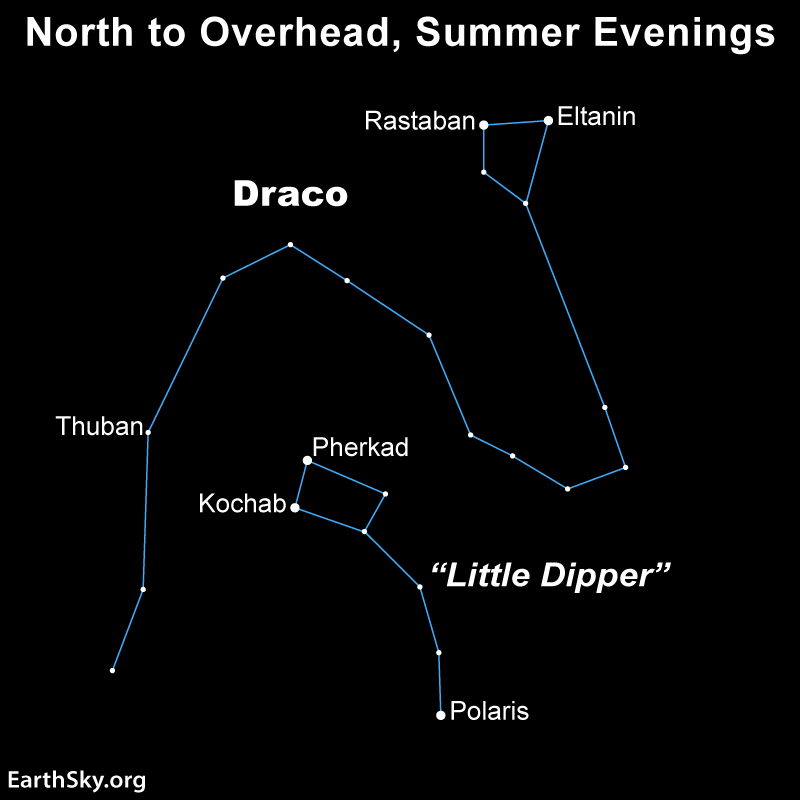
How to spot Eltanin and Rastaban
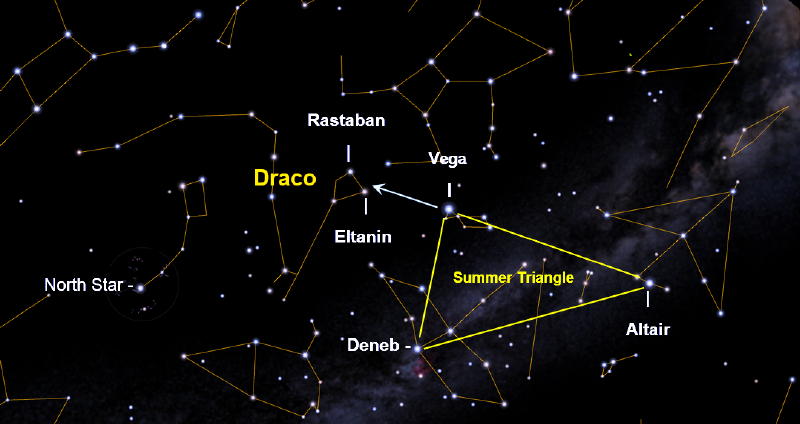
Once you become familiar with the brilliant Summer Triangle star pattern – a large asterism consisting of three bright stars in three different constellations – it’s easy to star-hop to the Dragon’s eyes.
Draw an imaginary line from the star Altair through the star Vega to locate nearby Eltanin and Rastaban.
As seen from the mid-northern latitudes, the Dragon’s eyes appear in the northeast sky on spring evenings, nearly overhead on late summer evenings, and in the northwest evening sky in late autumn and early winter.
Science and history of the Dragon’s eyes
Modern astronomy has determined that the star Rastaban lies well over 200 light-years farther away than its counterpart in Draco, Eltanin. Best estimates place Eltanin at 154 light-years and Rastaban at 380 light-years distant.
As seen from Earth, Eltanin appears as the brighter star, but that’s because it’s so much closer to us than Rastaban. If these stars were the same distance away, Rastaban would shine some six times more brightly than Eltanin, and we’d probably no longer think of the two stars as the Dragon’s Eyes. Where they are now, Eltanin is magnitude 2.36 and Rastaban is magnitude 2.79. See if you can discern the difference in brightness between these two stars.
Eltanin looms large in the history of astronomy. James Kaler wrote on his website:
In attempting to find stellar parallax, the annual shift in stellar position caused by the shifting position of the orbiting Earth (from which we get stellar distance), in 1728 James Bradley discovered an aberration of starlight, which is caused by the velocity of the moving Earth relative to the speed of the light coming from the star.
The discovery once and for all proved that Copernicus was right and that the Earth truly does move around the central sun.
The Draconid meteor shower originates from this area every year around October 9. The stars have nothing to do with the meteors. The meteors appear to radiate from this region.
Draco’s identity issues
Normally, with some exceptions, the brightest star in a constellation is called “Alpha” followed by the generative name of the constellation with the second brightest star called “Beta” and the third brightest called “Gamma”, and so on, using letters from the Greek alphabet. Not so with Draco. Eltanin is the Gamma star in its constellation Draco, and yet it is Draco’s brightest star. It outshines Rastaban (Beta Draconis) and also outshines Thuban (Alpha Draconis). Why does Thuban have the Alpha designation in Draco? It’s because Thuban is a former pole star!
This sounds to me like a simple case of identity theft.
The constellation Draco has some identity issues. The Alpha star (Thuban) is its ninth brightest star, the Beta star (Rastaban) is its third brightest star, and the Gamma star (Eltanin) is its second brightest star. And the star Eltanin? For hundreds of years, it answered to the name Rastaben. Wait a minute. Isn’t that the name of the other star in Draco? No, not really. Eltanin was Rastaben, while the other star is Rastaban. That second to the last letter makes all the difference in the world.
Rastaban is derived from the Arabic word meaning the head of the serpent/dragon. Maybe this is where Draco’s identity crisis began: Am I a serpent or a dragon? These things matter. In 1603, Johann Bayer, who assigned these Greek letters to each of the stars in Draco, referred to the star Eltanin as Rastaben.
In 2016, the International Astronomical Union’s Working Group on Star Names set the record straight and approved the names we now have for these two stars.
3 more things about Eltanin
First, the mathematical wizard Jean Meeus (page 363 of Mathematical Astronomy Morsels V) calls Eltanin the “Queen of the Poles” because this star will be the north pole star in the year 92,020 and then the south pole star in the year 2,083,470! So maybe someday Eltanin will be known as Polaris twice, as pole stars are traditionally named.
Second, Eltanin, now 154 light-years away, is headed toward us. Don’t worry, it will miss us by a cool 28 light-years. But 1,333,000 years from now it will become the brightest star in our sky, and 220,000 years after that it will reach its brightest, at magnitude -1.39. It will remain the brightest star in our nighttime sky for a whopping 700,000 years. By then its name would have been Polaris, then back again to Eltanin, or maybe Rastaben. The International Astronomical Union’s Working Group on Star Names will have something to say about that. Be sure to read updates here at EarthSky.
A zenith star to guide you
Finally, Eltanin is the zenith star. What is a zenith star? The name is used for several things. Zenith Star is a wristwatch, you might be wearing one now. Zenith Star is also a model of a popular telescope, perhaps you have one. And Zenith Star was a military system designed in the 1980s, did you take part in that? If you can check all three boxes, well, that’s just plain weird.
But the zenith star that I’m talking about is a star that passes overhead (the zenith) once a day, or more precisely, every 23 hours, 56 minutes. If the declination of the star matches your latitude on earth, then the star will pass right through your zenith. And Eltanin, at a declination of +51.5 degrees, passes over the heads of the astronomers at Greenwich Observatory in London, England. So it became known as the zenith star. This is important because the Royal Observatory located there keeps track of the time and the prime meridian. And the telescope pointed straight up will pick up this star as it passes overhead each day.
There’s that star again, time to set your watch.
In fact, it is very close to being exactly overhead, only 1/600 of a degree off of true zenith. With precession, that will slowly change over the decades. I doubt they will relocate the observatory to follow it.
What is your zenith star?
So, what is your zenith star? What passes over your head each day? First, find your latitude, then find a star near that declination. How close is close enough? The rules of the zenith star have never been established, so let’s try to find something within one degree of zenith. So, if you live at 35 degrees north latitude, find something between 34 and 36 degrees north.
If you live in Brasilia, Brazil, you have hit the jackpot as your zenith star is the brightest star in the sky: Sirius. Those in Mexico City can claim Arcturus. Portland, Oregon, has Capella. Tokyo gets one of the less bright ones: the star Mirach. And what do Kansas City and Washington, D.C., have in common? Probably nothing, except their zenith star is Vega. Chicago looks straight up to see the Andromeda galaxy. But now we have drifted into zenith galaxies, a topic for another day.
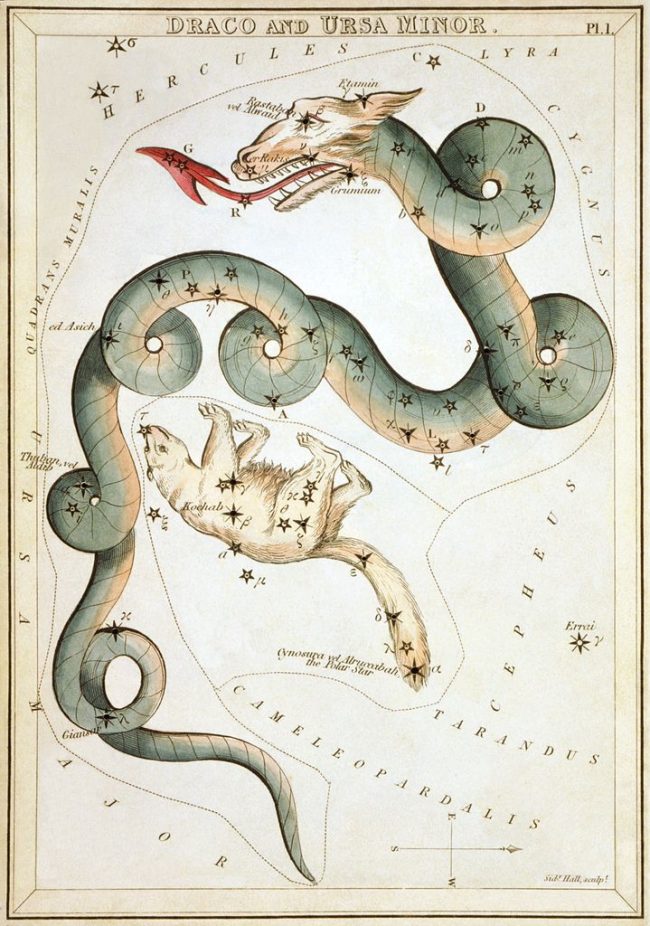
Bottom line: Eltanin and Rastaban represent the fiery eyes of the constellation Draco the Dragon. Eltanin is also the zenith star for the Greenwich Observatory.
Read more: Here’s how to find the Big Dipper and Little Dipper
Like what you read?
Subscribe and receive daily news delivered to your inbox.
More from
Bruce McClure


Cor Caroli, named for the heart of a king

1st eclipse season of 2024 starts March 24-25
On the equinox, are day and night equal?
Equinox fun: Track sun’s shift between now and the solstice