Coming up: Mercury’s farthest from the sunset this weekend
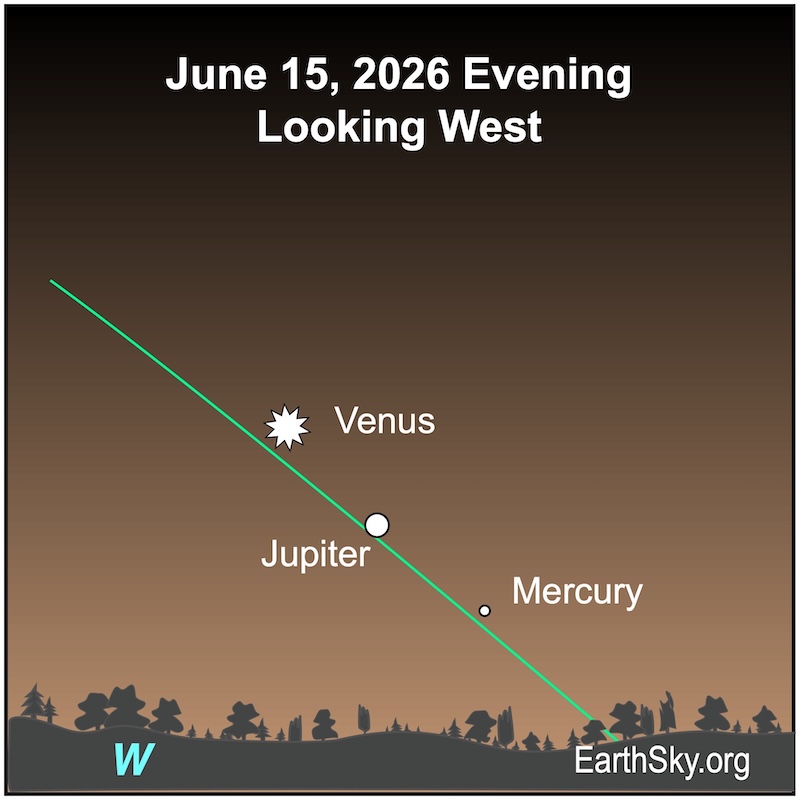
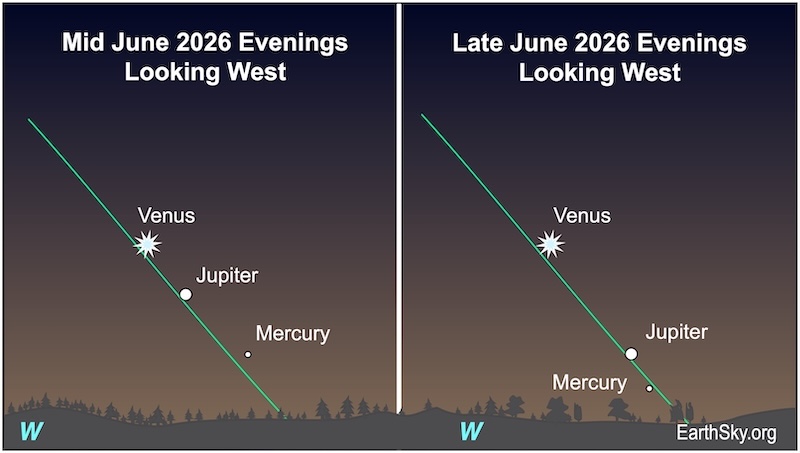
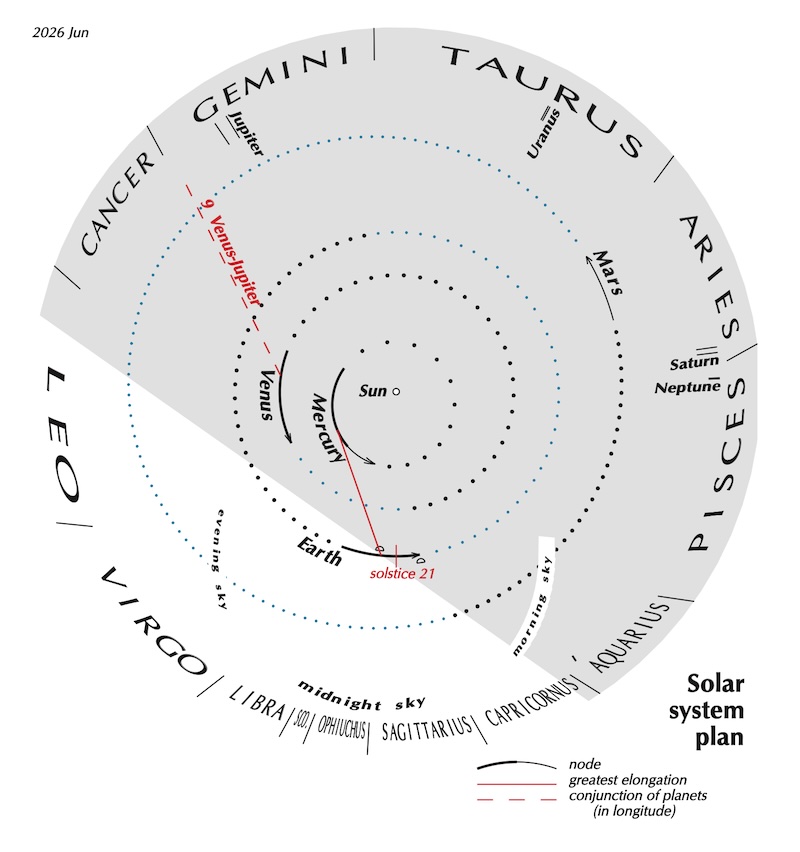
As seen from the whole Earth this weekend, the sun’s innermost planet, Mercury, is farthest from the sunset and so is in the best place to observe for this evening apparition. Notice that a line between blazing Venus and bright Jupiter points to fainter Mercury, low in the west. Look for them after sunset. Mercury will slip away before the end of the month. Chart via EarthSky.
The year’s earliest sunrises don’t happen on the summer solstice. For most of the Northern Hemisphere – except the Arctic, where it’s continuous daylight now – your earliest sunrise might already have happened. Or it might be happening now. And those in the Southern Hemisphere are facing their earliest sunsets. To find out more about this yearly rhythm, watch EarthSky’s Deborah Byrd in Texas and Dan Gauseen in Twizel, New Zealand, as they discuss sunrises and sunsets around the solstice. Watch in the player above or on YouTube.
Video: the best of the night sky for June 2026
Join EarthSky’s Marcy Curran in a video preview of stars, constellations and visible planets for the month of June 2026. Don’t miss Venus and Jupiter as a dazzling duo in the evening sky. Plus there’s the full Strawberry Moon. Check it out! Watch in the player above, or on YouTube.
June 15: New supermoon
The moment of new moon will fall at 2:54 UTC on June 15, 2026. That’s 9:54 p.m. CDT on June 14. In fact, this is the 3rd of 5 new supermoons in a row. And it’s the closest new supermoon of 2026. It’ll be 221,966 miles (357,221 km) away. Compare that with the average moon distance of 238,900 miles (384,472 km). New moons rise and set with the sun. Nights around the new moon are great for stargazing. See EarthSky’s best places to stargaze.
June 16 after sunset: Don’t miss! Moon, Venus, Jupiter and Mercury
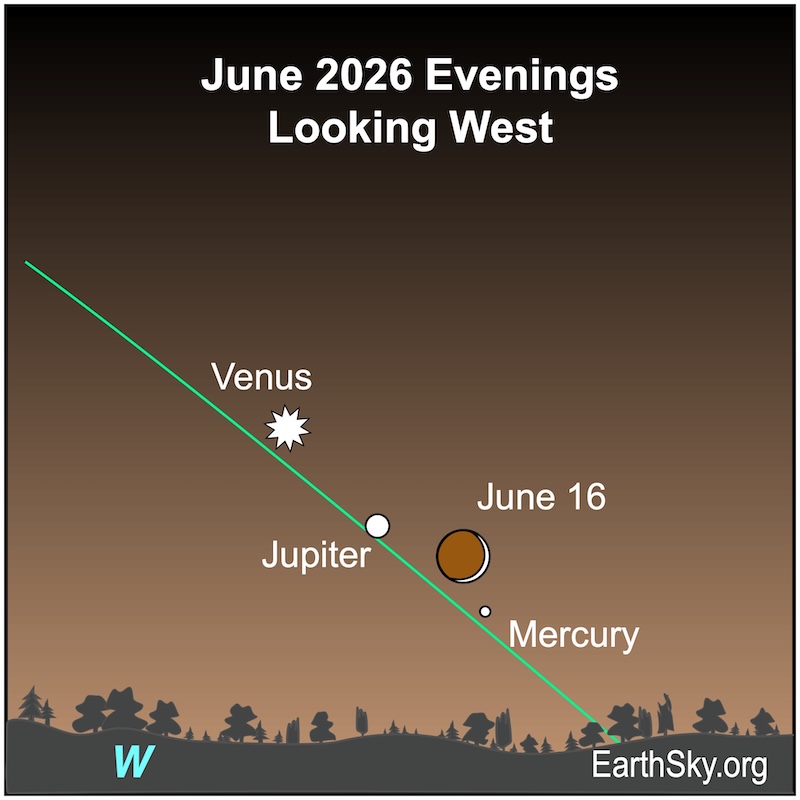
On the evening of June 16, shortly after sunset, check out the young moon. It’ll hang low in the western sky after sunset. And it’ll be near the brilliant planet Venus and the bright planet Jupiter, and close to the elusive planet Mercury. Look for them about 35 minutes after sunset. Binoculars will enhance the view. Chart via EarthSky.
Our charts are mostly set for mid-latitudes in the Northern Hemisphere. To see a precise view – and time – from your location, try Stellarium Online.
June 17 after sunset: Spectacular! Moon, Venus, Jupiter and Mercury
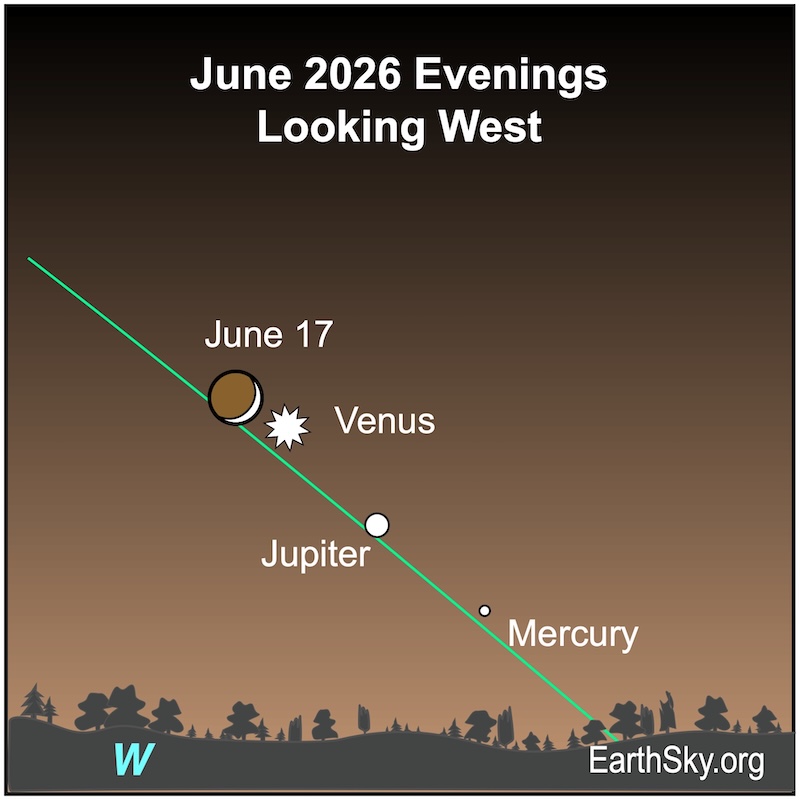
On the evening of June 17, about 40 minutes after sunset, check out the pretty waxing crescent moon. It’ll be close to the brilliant planet Venus and near the bright planet Jupiter. Plus the planet Mercury is nearby. Also look for the glow of earthshine on the unlit portion of the moon. That’s light reflected off Earth. Chart via EarthSky.
Our charts are mostly set for mid-latitudes in the Northern Hemisphere. To see a precise view – and time – from your location, try Stellarium Online.
June 18 and 19 evenings: Moon, Venus and Regulus
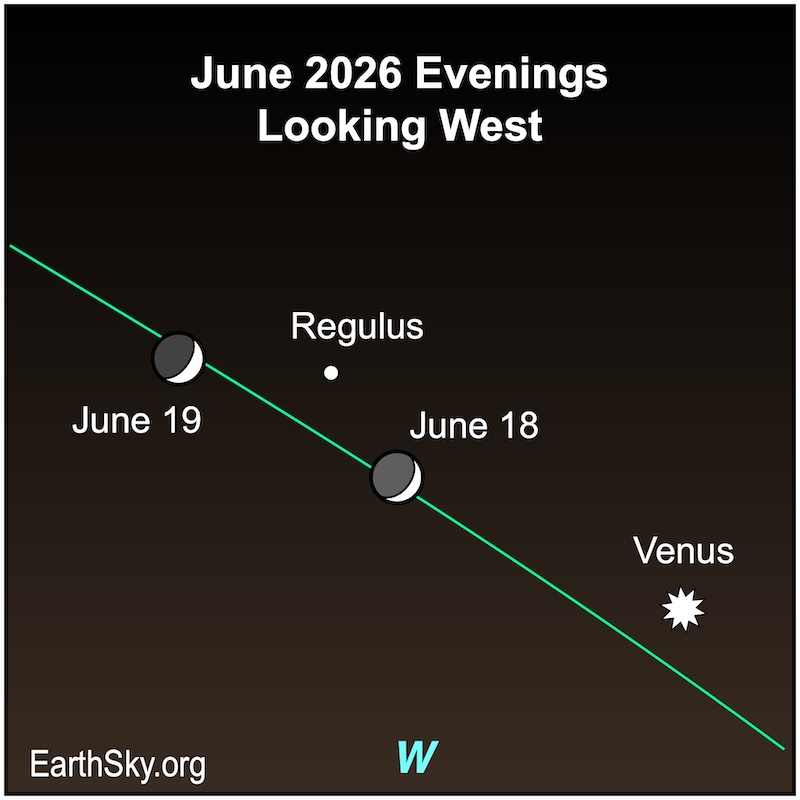
On the evenings of June 18 and 19, the waxing crescent moon will be near brilliant Venus and Regulus, the brightest star in Leo the Lion. Regulus is the bright dot at the bottom of a backward question-mark pattern of stars known as the Sickle. They’ll set around midnight. Chart via EarthSky.
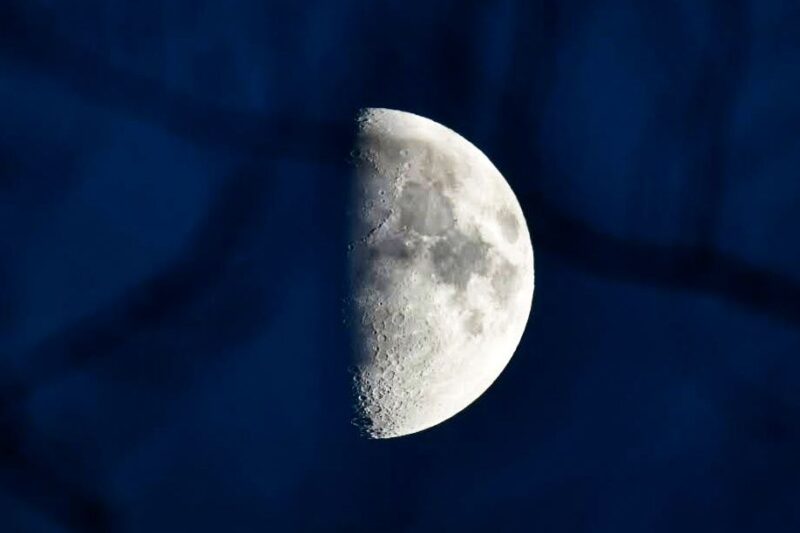
View at EarthSky Community Photos. | Lorraine Boyd captured this view from New York on November 9, 2024. She wrote: “Peeking through tree limbs at the first quarter moon (50% illumination), just after sunset.” Thank you, Lorraine. This month’s moment of 1st quarter moon will fall at 21:55 UTC on June 21, 2026. That’s 4:55 p.m. CDT. A 1st quarter moon rises around noon your local time and sets around midnight. Watch for a 1st quarter moon high in the sky at sundown.
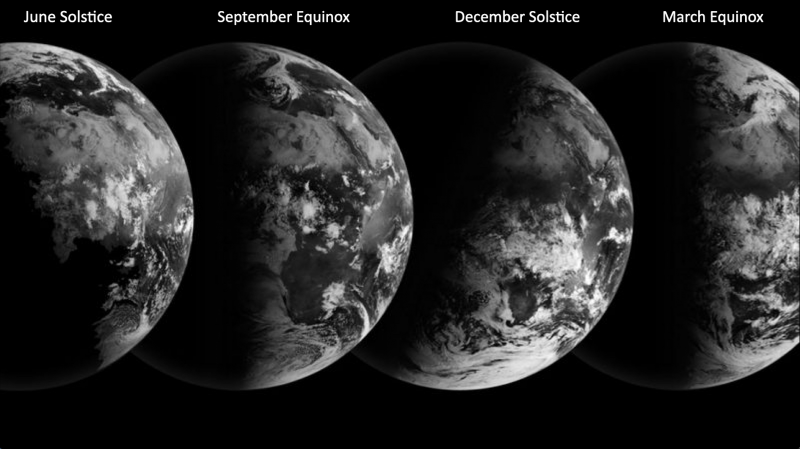
In 2026, the June solstice moment will fall at 8:25 UTC (3:25 a.m. CDT) on June 21. Here’s a satellite views of Earth on the solstices and equinoxes. From left to right, a June solstice, a September equinox, a December solstice and a March equinox. To understand these images, look at the poles. Notice that at the June solstice, the North Pole is in sunlight. At the December solstice, the South Pole is in sunlight. Read more about these images, which are via Robert Simmon (Sigma Space Corporation)/ NASA.
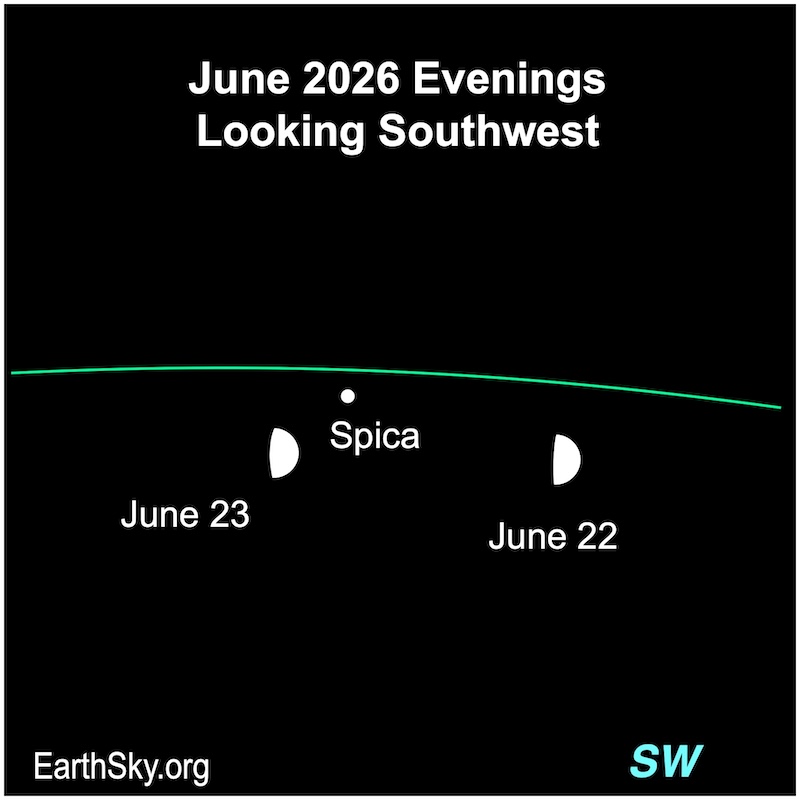
On the evenings of June 22 and 23, the waxing gibbous moon will be near Spica, the brightest star in Virgo the Maiden. You can also catch them until after midnight. Chart via EarthSky.
Our charts are mostly set for mid-latitudes in the Northern Hemisphere. To see a precise view – and time – from your location, try Stellarium Online.
June 26 and 27 evenings: Moon near Antares
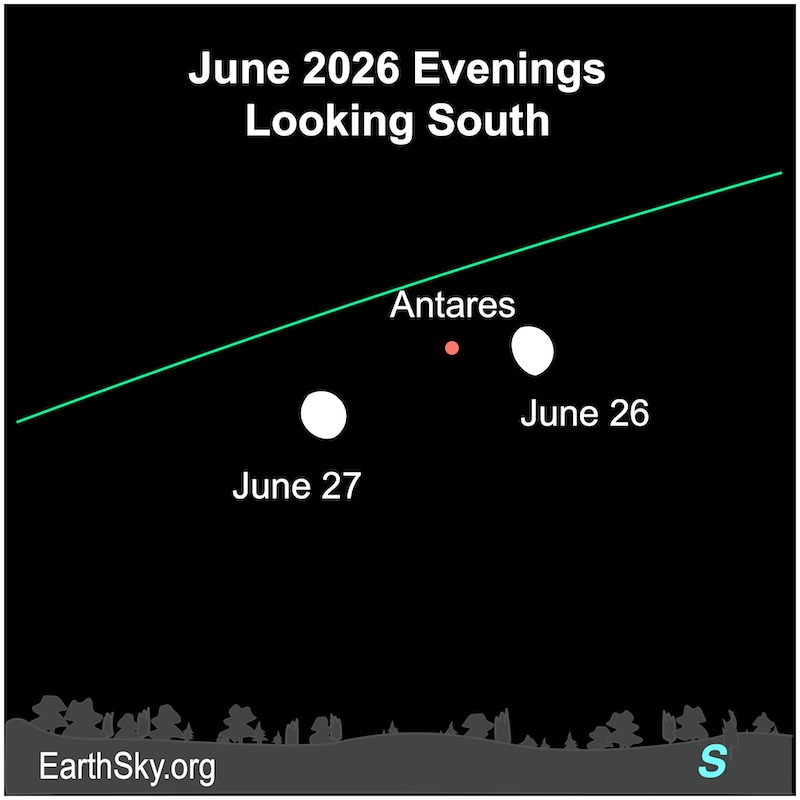
As darkness falls on June 26 and 27, the bright waxing gibbous moon will shine near Antares. Antares is the brightest star in Scorpius the Scorpion. Chart via EarthSky.
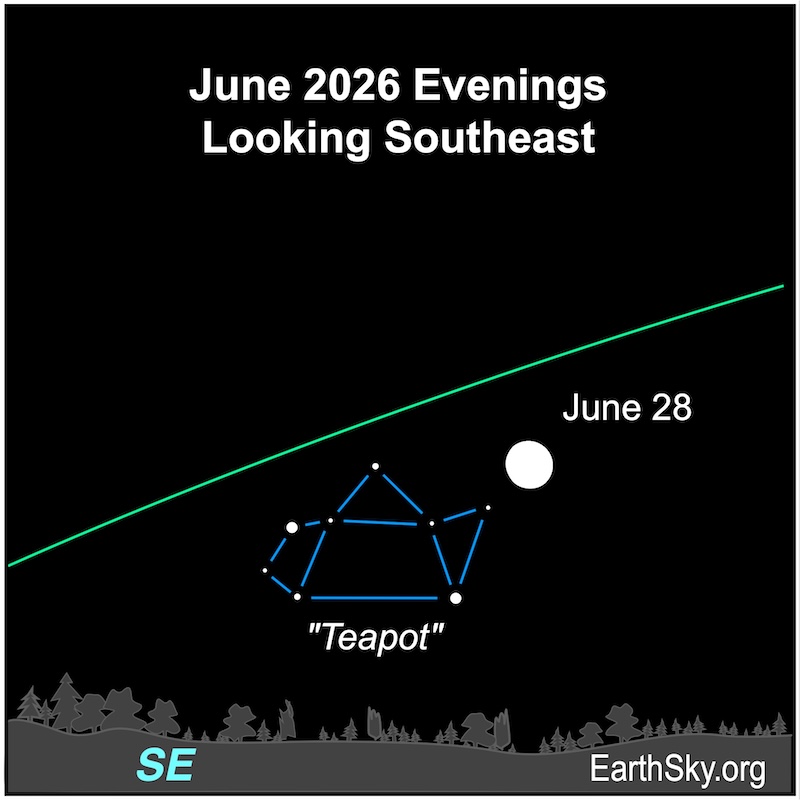
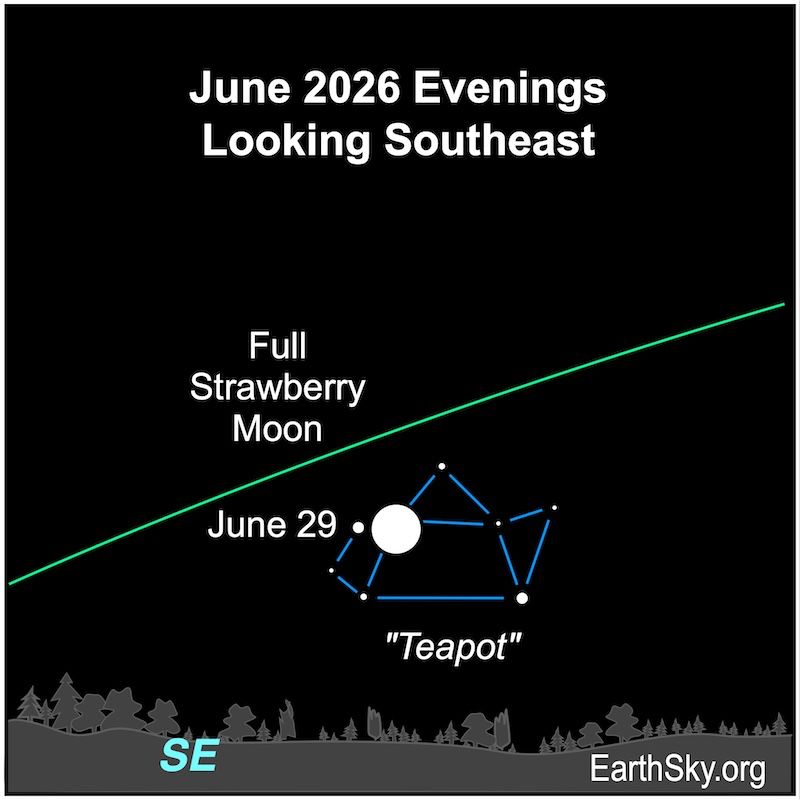
At sunset on June 29, the full Strawberry Moon will rise in the east near the asterism of Sagittarius called the Teapot. Though the moon will be so bright that it will drown out the Teapot’s stars. The crest of the full moon falls at 23:57 UTC on June 29. That’s 6:57 p.m. CDT. Plus it’s the last of 3 full micromoons – or most distant full moons – in a row in 2026. It’ll be 251,811 miles (405,251 km) away. The average moon distance is 238,900 miles (384,472 km) away. Chart via EarthSky.
June 30 evening: Moon near Teapot
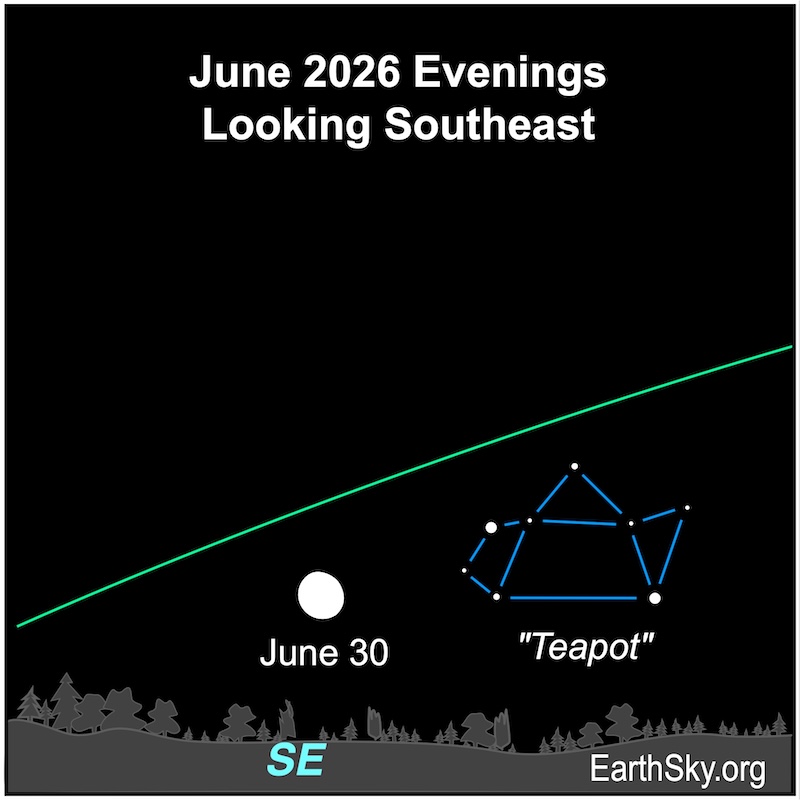
On the evening of June 30, the bright waning gibbous moon will hang near the stars of the asterism of Sagittarius called the Teapot. Look for them about an hour after sunset. They’ll be visible all night. Chart via EarthSky.
Our charts are mostly set for mid-latitudes in the Northern Hemisphere. To see a precise view – and time – from your location, try Stellarium Online.
June evening planets
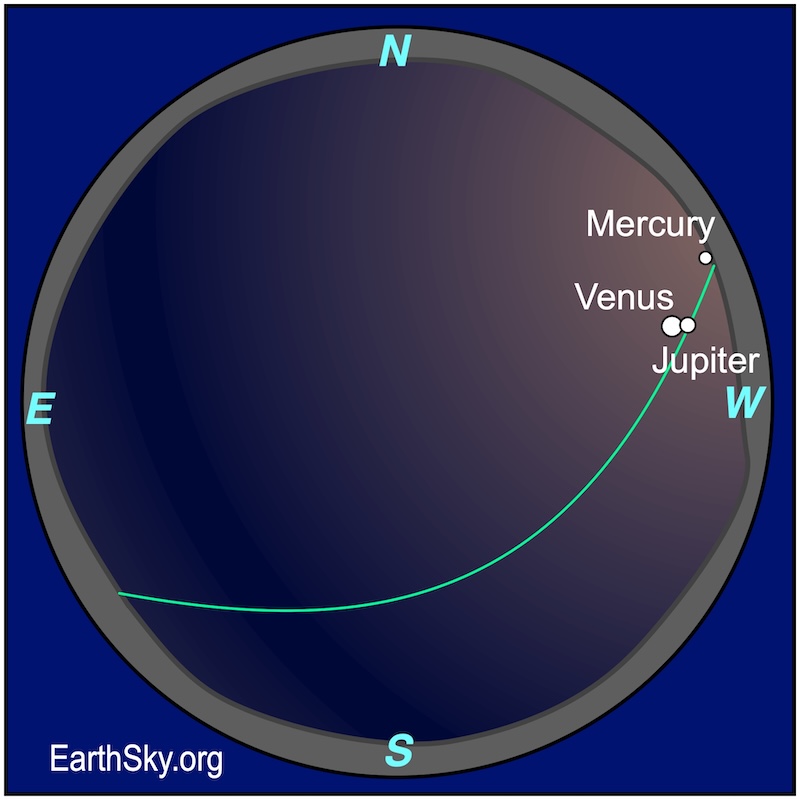
Here’s an all-sky chart – centered around June 8 – showing brilliant Venus shining in the west about 60 minutes after sunset with bright Jupiter lying next to it. Much closer to the western horizon is the fainter Mercury. Note that these planets lie along the path the sun travels in the sky (the green line on our chart). Chart via EarthSky.In the 2nd half of June, Venus and Jupiter will move away from each other, with Jupiter slowly approaching the horizon. The much fainter Mercury will lie below Jupiter. As the month proceeds, Mercury will move closer to the horizon and become even fainter and more difficult to spot. Chart via EarthSky.
June morning planets: Northern Hemisphere
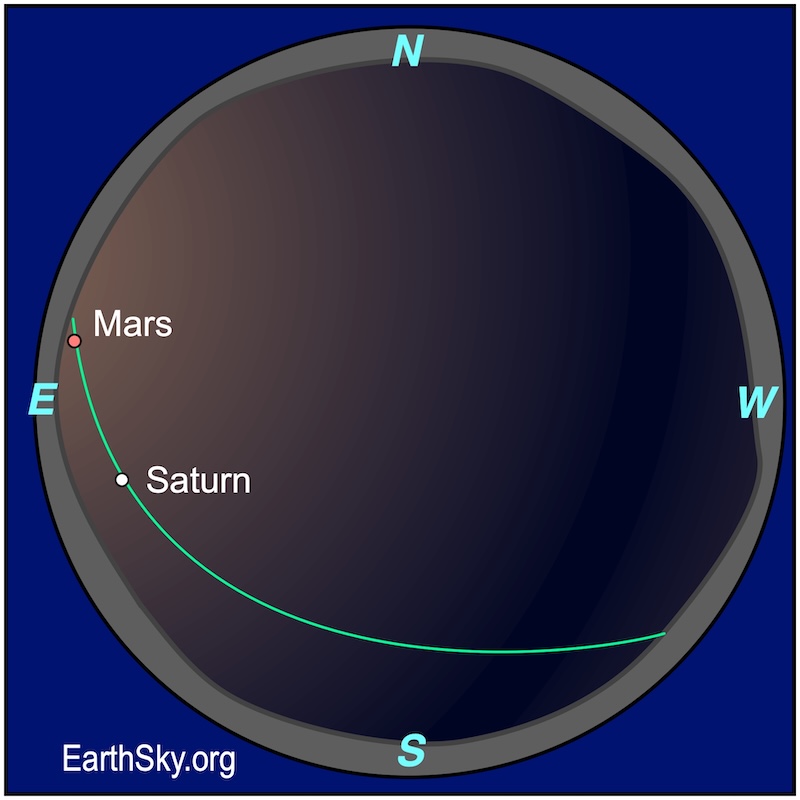
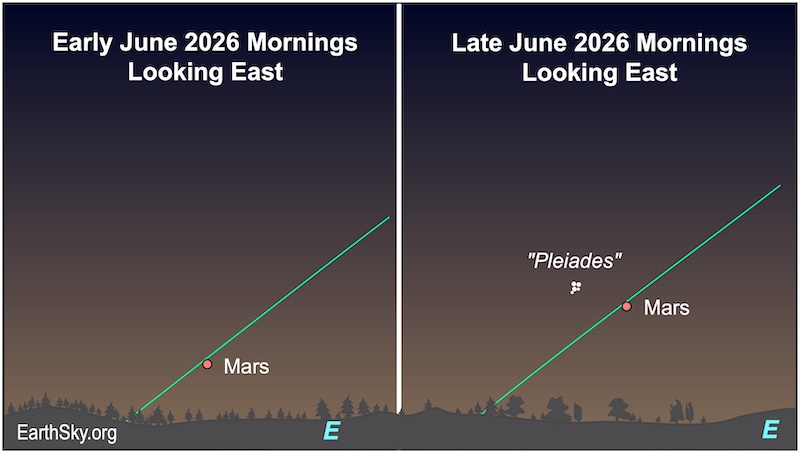
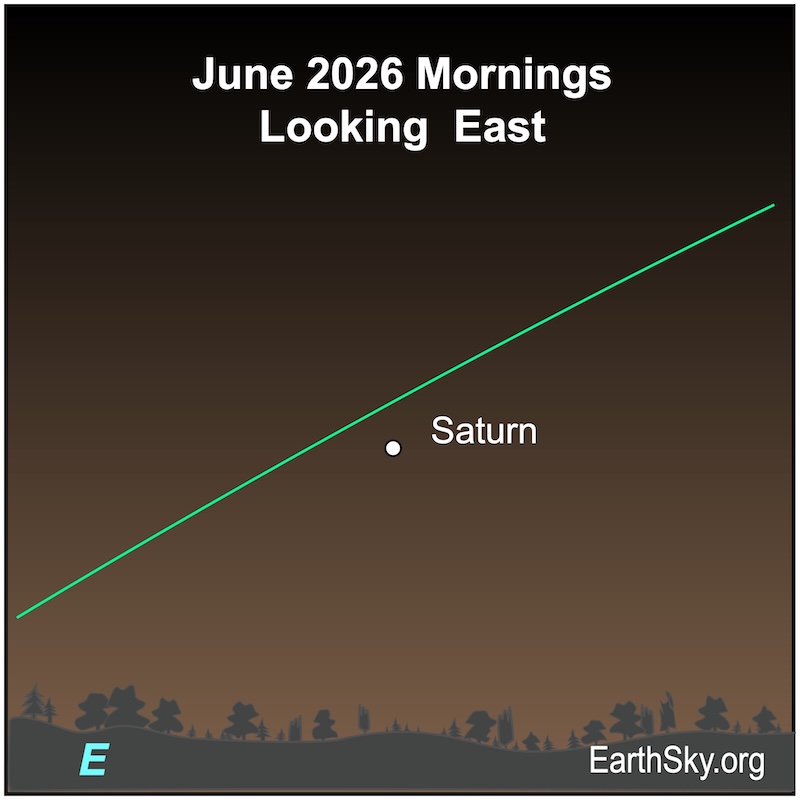
Here’s an all-sky chart showing the 2 planets in the eastern sky shortly before sunrise in June. The brightest and highest planet is Saturn. Closer to the horizon is Mars. As the month proceeds, Saturn will pull farther away from the slowly ascending Mars. Note that these planets lie along the path the sun travels in the sky (the green line on our chart). Chart via EarthSky.In the first half of June, Mars sits low in the bright eastern twilight shortly before sunrise. In the second half of June, it rises higher and moves near the delicate Pleiades star cluster. Chart via EarthSky.In June, Saturn will lie in the east as morning twilight begins. Chart via EarthSky.
June stars
If you’re out stargazing on any June evening, look for these stars and constellations overhead in the sky.
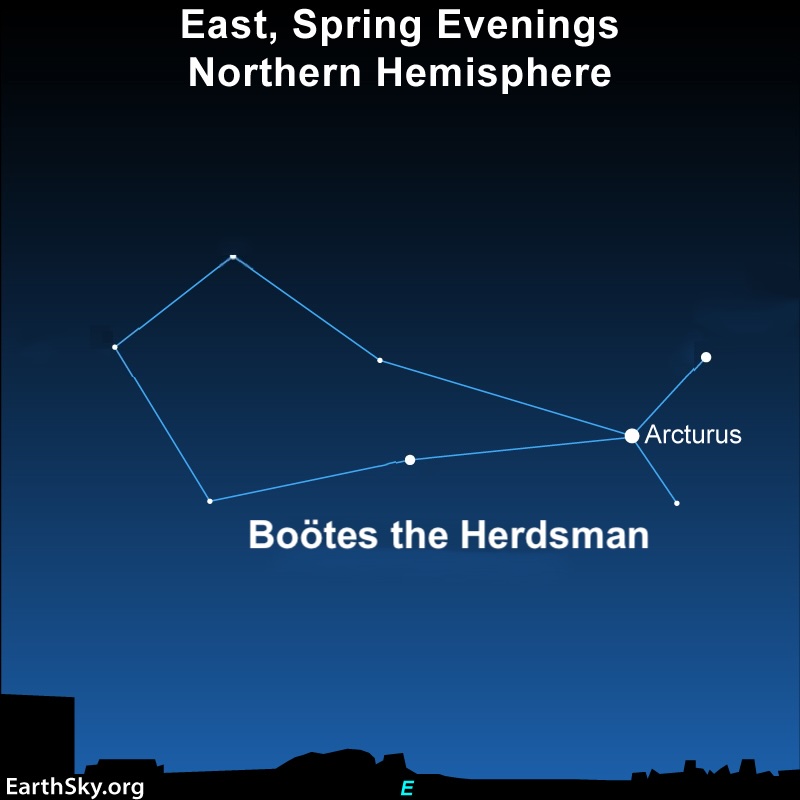
Boötes the Herdsman
Almost overhead on June evenings is bright orange Arcturus. It’s in the constellation Boötes the Herdsman. Boötes has the shape of a kite, and Arcturus is at the point where you’d attach a tail. You can’t miss its distinctive shape. Chart via EarthSky.
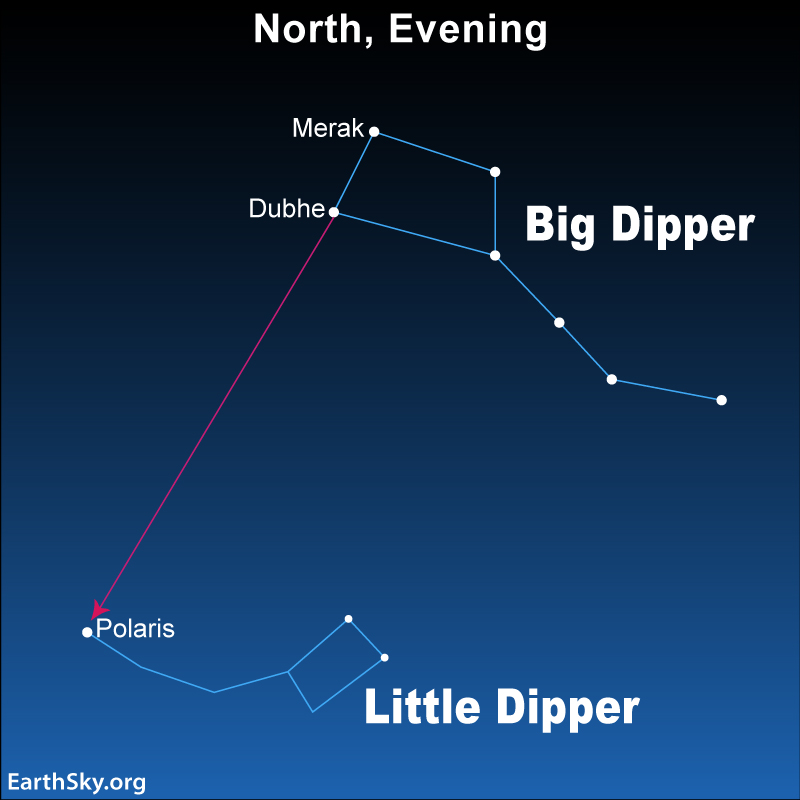
The Big Dipper and Little Dipper
Ursa Major the Great Bear is home to the Big Dipper. The Big Dipper is an asterism – a well-known group of stars – not an official constellation. You’ll find the Big Dipper high overhead from mid-northern latitudes in June evening skies. You can use the 2 outer stars in the Big Dipper’s bowl – sometimes called the Pointers – to find Polaris, the North Star. It is the end star in the handle of the Little Dipper. Chart via EarthSky.
Hercules the Hero and the Hercules Cluster
Hercules the Strongman is a faint constellation. But its midsection contains the easy-to-see Keystone asterism. You can find Hercules between the bright stars Vega in Lyra the Harp and Arcturus in Boötes the Herdsman. And once you find the Keystone, you can easily locate M13, the Hercules Cluster. Chart via EarthSky.
Have fun exploring the sky!
Our charts are mostly set for the northern half of Earth. To see a precise view – and time – from your location, try Stellarium Online.
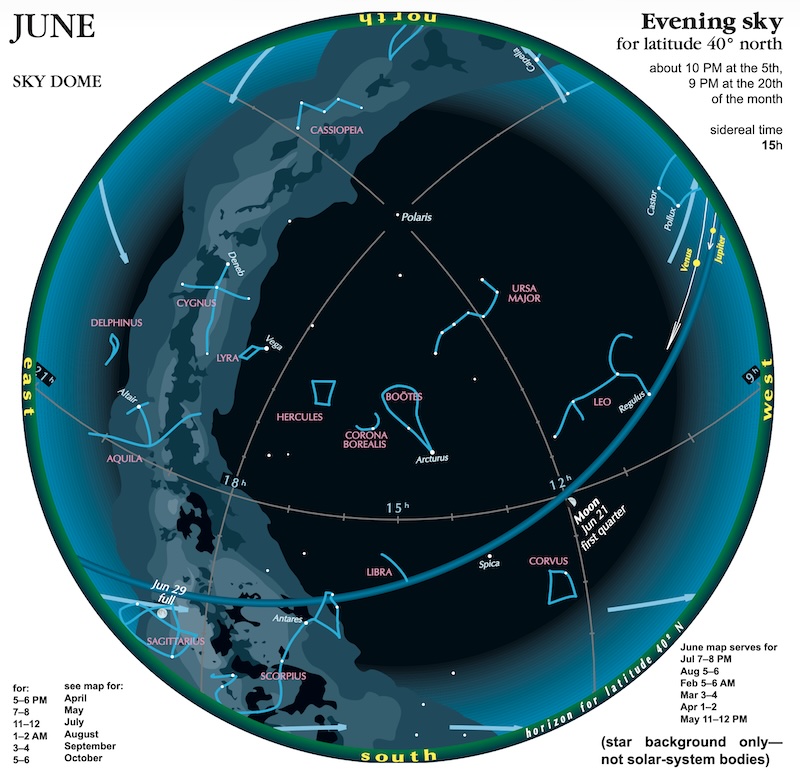
Sky dome map for visible planets and night sky
Here is the sky dome view for June 2026. It shows what is above the horizon at mid-evening for mid-northern latitudes. The view may vary depending on your location. Image via Guy Ottewell’s 2026 Astronomical Calendar.
Bottom line: Visible planets and night sky guide. Now’s your chance to spot elusive Mercury in the twilight western sky. It’ll be farthest from the sunset point on June 15.
Meet Marcy Curran, our voice of the night sky on EarthSky YouTube. Check out her popular short videos in the Sky category on our YouTube channel. When she's not making videos, Marcy is an EarthSky editor, helping to keep our night sky guide up-to-date and just generally helping to keep the wheels turning around here. Marcy has enjoyed stargazing since she was a child, going on family camping trips under the dark skies of Wyoming. She bought her first telescope in time to see Halley’s Comet when it visited the inner solar system in 1986. She co-founded her local astronomy club and remains an active board member. Marcy taught astronomy at her local community college for over 20 years. She and her husband live in Wyoming, in a rural location, with an all-sky camera and super-good horizon views! And, they built an observatory to capture images of the night sky.
“I can sometimes see the moon in the daytime” was a cosmic revelation that John Jardine Goss first discovered through personal observations at age 6. It shook his young concept of the universe and launched his interest in astronomy and stargazing, a fascination he still holds today. John is past president of the Astronomical League, the largest U.S. federation of astronomical societies, with over 24,000 members. He's earned the title of Master Observer and is a regular contributor to the video series, “Global Star Party.” He has authored the celestial observing guides “Exploring the Starry Realm,” and “Carpe Lunam,” and “Take Your First Steps, an Introduction to Amateur Astronomy.” John also wrote for twenty years the monthly stargazing column, Roanoke Skies, for the Roanoke Times, and currently writes a bimonthly column, Skywatch, for Blue Ridge Country magazine. He has contributed to Sky and Telescope magazine, the IDA Nightscape, the Astronomical League’s Reflector magazine, and the RASC Observer’s Handbook.
Deborah Byrd (asteroid 3505 Byrd) helps edit EarthSky.org and is a frequent host of EarthSky videos. Deborah created the EarthSky radio series in 1991 and founded EarthSky.org in 1994. Prior to that, she had worked for the University of Texas McDonald Observatory since 1976, and created and produced their Star Date radio series. She has won a galaxy of awards from the broadcasting and science communities, including having an asteroid named in her honor in 1990, a Public Service Award from the National Science Board in 2003, and the Education Prize from the American Astronomical Society in 2020. A science communicator and educator since 1976, Byrd believes in science as a force for good in the world and a vital tool for the 21st century. "Being an EarthSky editor is like hosting a big global party for cool nature-lovers," she says.
Kelly Kizer Whitt - EarthSky’s nature and travel vlogger on YouTube - writes and edits some of the most fascinating stories at EarthSky.org. She's been writing about science, with a focus on astronomy, for decades. She began her career at Astronomy Magazine and made regular contributions to other outlets, including AstronomyToday and the Sierra Club. She has nine published books, including a children's picture book, Solar System Forecast, and a young adult dystopian novel, A Different Sky.
Like what you read? Subscribe and receive daily news delivered to your inbox.
Thank you! Your submission has been received!
Oops! Something went wrong while submitting the form.