



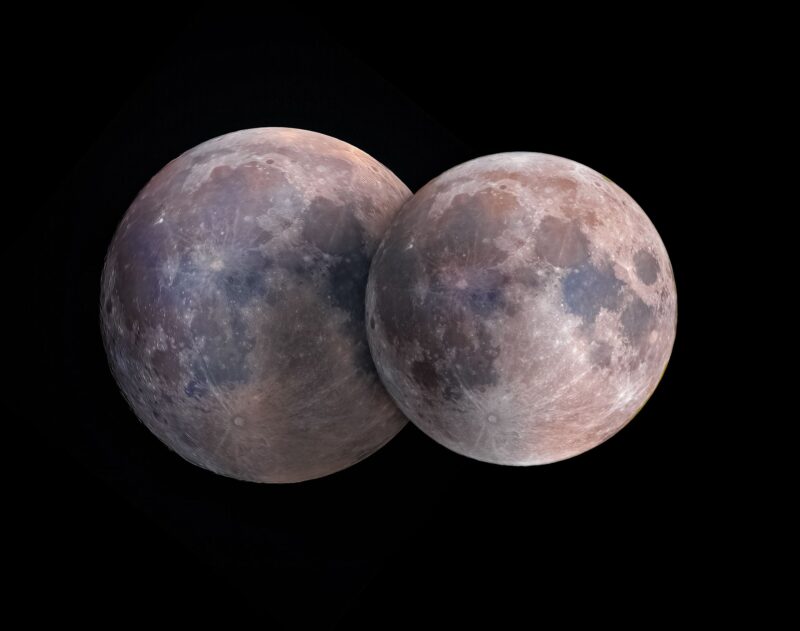
What’s a micromoon?
A micromoon is a full or new moon that occurs when the moon is roughly at its farthest from Earth in its orbit.
The moon takes about a month to orbit Earth once (that’s where the word “month” or “moon-th” comes from). And the moon’s orbit around Earth isn’t a perfect circle. So the moon has a nearest point (perigee) and a farthest point (apogee) each month.
When we have a full moon around the time of apogee, that’s a full micromoon.
There’s no strict definition of how close to apogee the moon should be to be called a micromoon. That can lead to some disagreement over what is and isn’t a micromoon! For instance, in 2026, according to Fred Espenak’s AstroPixels website, we have a micromoon with the full Flower Moon of May 1 … but not all sources consider this quite distant enough to be a micromoon.
For example, Timeanddate.com doesn’t considered the full Flower Moon on May 1 a micromoon. Instead, it says the first micromoon of 2026 is the Blue Moon of May 30-31. Astropixels also lists this as a micromoon. In fact, the full moon at the end of May will be 2026’s most distant full moon of the year. It’ll be 252,360 miles (406,135 kilometers) away, in contrast to the moon’s average distance of 238,900 miles (384,472 km).
However, both sources agree the full Strawberry Moon of June 29 is a micromoon. So there are either two or three micromoons in a row this year, depending on which source you use.
The moon never stops moving in orbit. So its exact distance from Earth changes continuously. But it’s safe to say that a full micromoon appears about 12-14% smaller than a full supermoon (an exceptionally close full moon). A full micromoon appears about 7% smaller than a full moon at an average distance.
Can a new moon be a micromoon? Sure! There’s only one new micromoon in 2026. It’ll come on December 9. That new micromoon is the most distant new moon this year. It’ll lie 251,460 miles (404,687 kilometers) away.
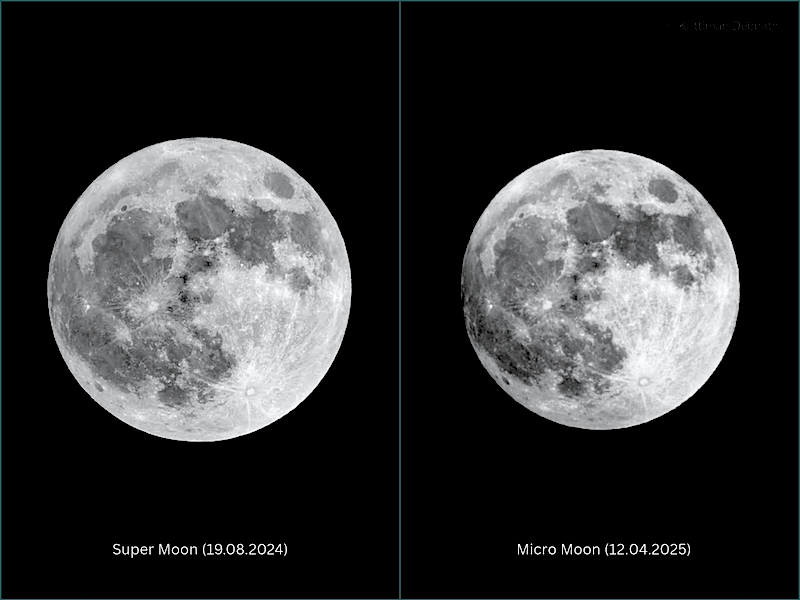
2 full micromoons in 2026? Or 3?
Again, as with supermoons – which are exceptionally close moons – there are no hard and fast rules as to what constitutes a micromoon. The late Fred Espenak’s great Astropixels website lists three full micromoons for 2026 (May 1, May 31 and June 29). And it defines micromoons like this:
In contrast to the supermoon there is the micromoon. When either the new moon or full moon phase occurs near apogee (within 90% of its greatest distance to Earth in a given orbit), the moon subtends its smallest apparent diameter as seen from Earth. This phenomenon, referred to as a apogee syzygy or apogee new/full moon, is popularly known as a micromoon. Using the definition above and applying it to the moon’s mean apogee and perigee distances results in a mean limiting distance of 401,293 km for a micromoon.
Meanwhile, Timeanddate.com lists just two full micromoons for 2026 (May 31 and June 29). It defines micromoons and supermoons like this:
- Micromoon: A full moon or new moon that takes place when the center of the moon is farther than 405,000 kilometers (251,655 miles) from the center of Earth.
- Supermoon: A full or new moon that occurs when the center of the moon is less than 360,000 kilometers (223,694 miles) from the center of Earth.
Bottom line: What is a micromoon? It’s a full or new moon near its farthest from Earth for the month. Depending on your definition, 2026 has either two or three full micromoons.
Like what you read?
Subscribe and receive daily news delivered to your inbox.
More from
Deborah Byrd


Visible planets and night sky guide for October

Hera mission hits the brakes to arrive at asteroid
Flashing star in autumn? Here are 3 candidates
Stargazing tips! 10 great tips for beginning astronomers



