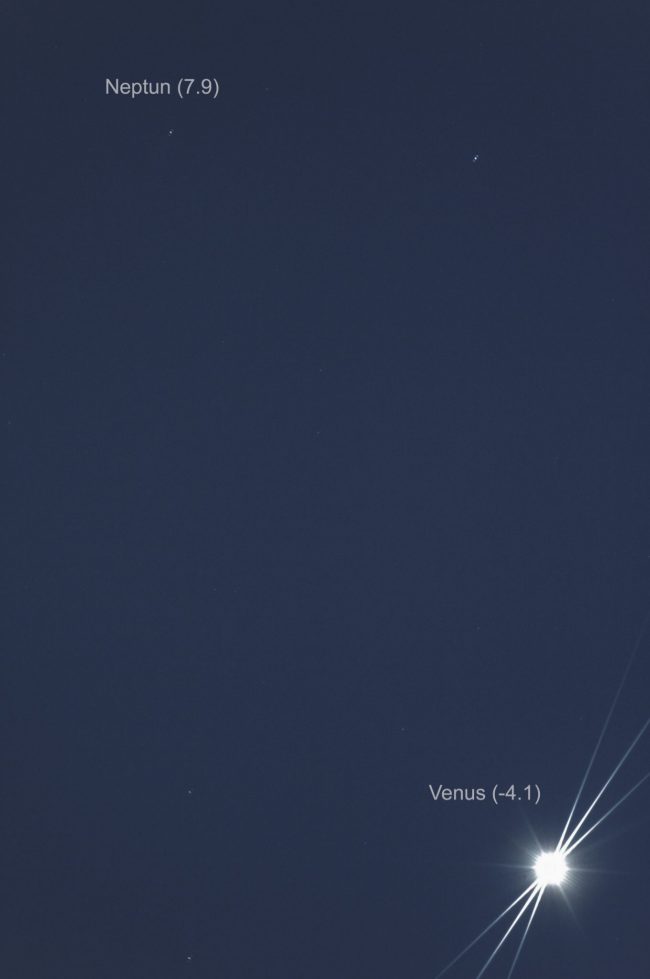
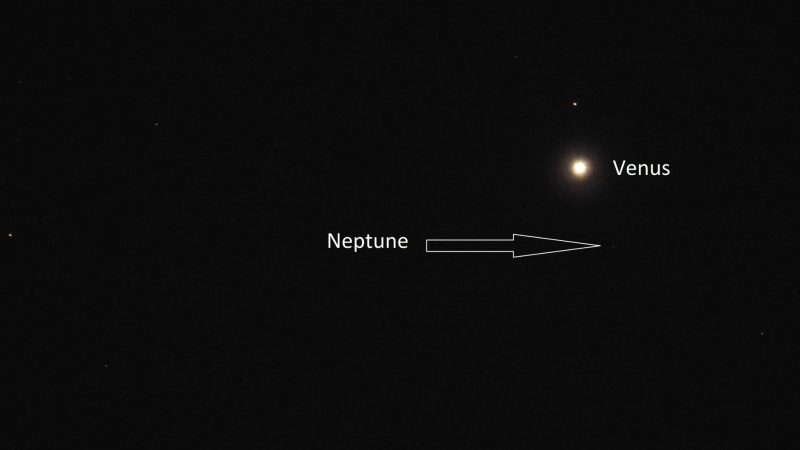
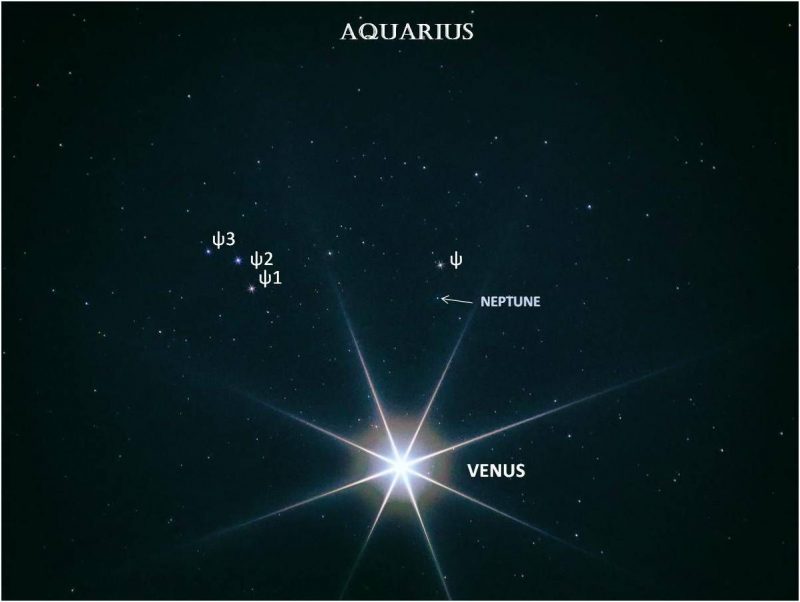
View at EarthSky Community Photos. | This image by Radu Anghel in Bacau, Romania, shows the contrast in brightness between Venus (the sky’s brightest planet) and Neptune (the only major planet in our solar system you absolutely cannot see with the eye alone). Their conjunction was one day after this image was taken, on January 27. At conjunction, Venus and Neptune passed within only 1/12th of one degree. For comparison, the moon spans about 1/2 degree in our sky. Thank you, Radu!
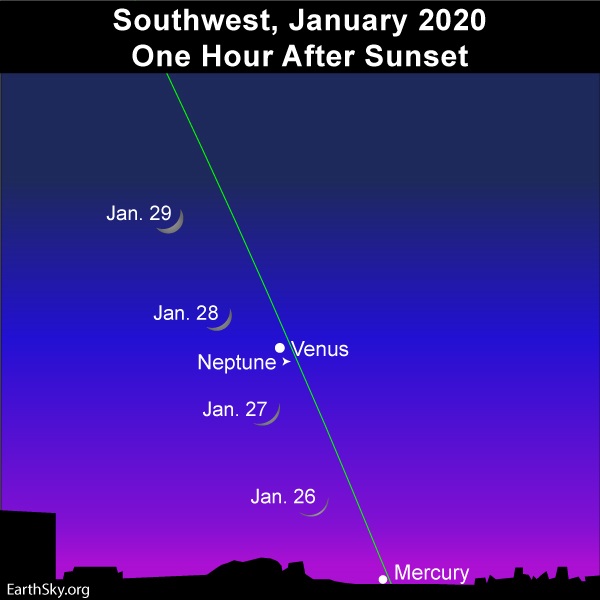
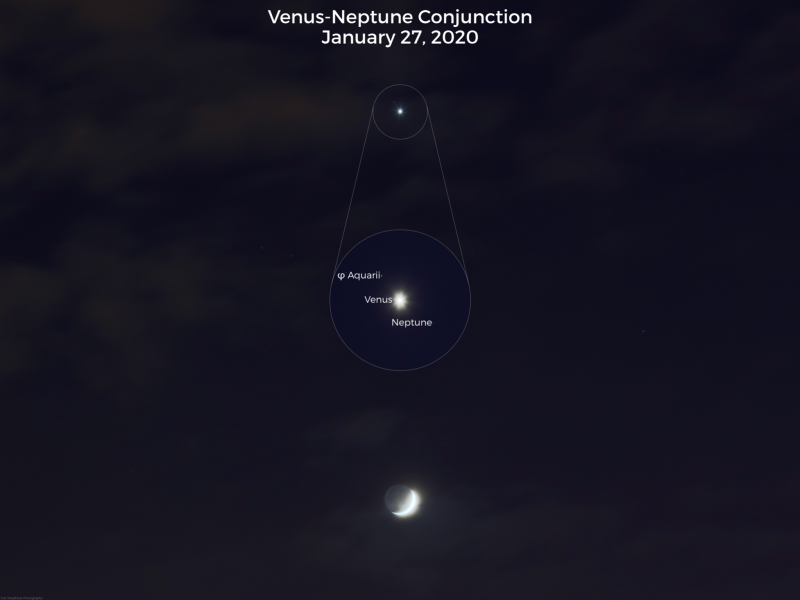
A Venus-Neptune conjunction took place on January 27, 2020. It was the closest conjunction of any two planets this year, with Neptune only 1/12th of one degree from Venus on our sky’s dome. And yet – because Neptune is so distant (the most distant major planet in our solar system) – the Venus-Neptune conjunction wasn’t easy to catch, even with optical aid. Venus was about 60,000 times brighter than Neptune!
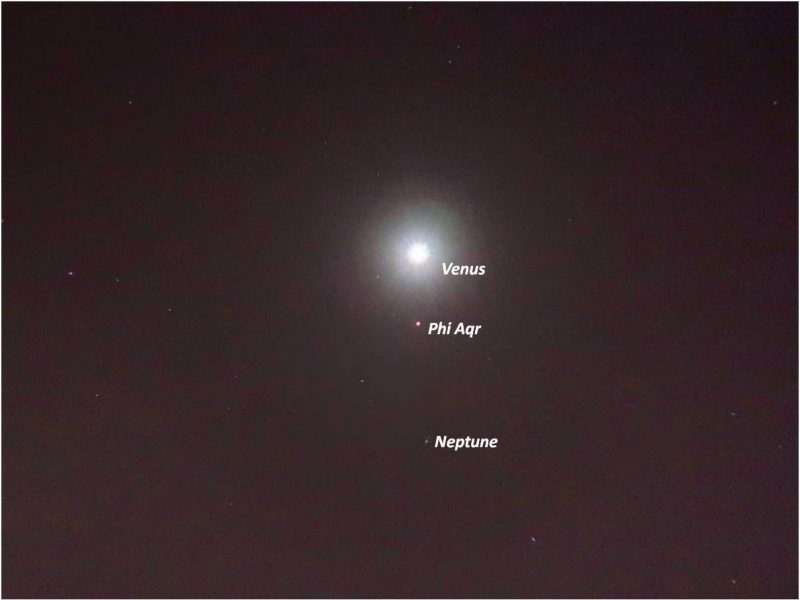
Plus, as the conjunction was taking place, Venus was noticeably near 4th magnitude star Phi Aquarii. Many did indeed mistake Phi Aquarii for Neptune. Phi Aquarii, though rather faint, is a good 30 times brighter than Neptune and can be seen by the eye alone on a dark night.
For many of us, it’ll be easier to view Neptune with an optical aid several days to a week after the January 27 Venus-Neptune conjunction. Venus will have moved away from Neptune, yet Neptune and the star Phi Aquarii will remain close together. This dim star will allow you locate Neptune, absent the glare of Venus.
By the way, for all of these photos, you might want to click in and view them larger at EarthSky Community Photos, to have a better shot at glimpsing faint Neptune!
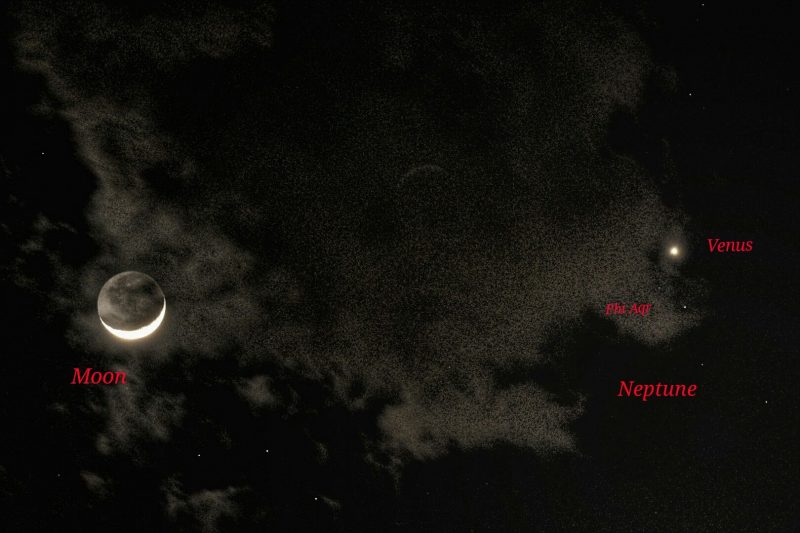
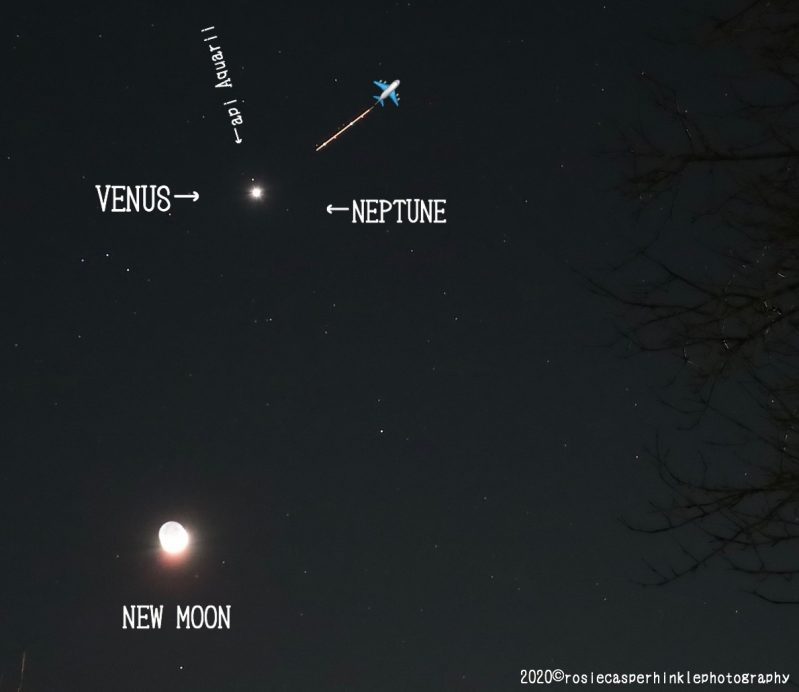
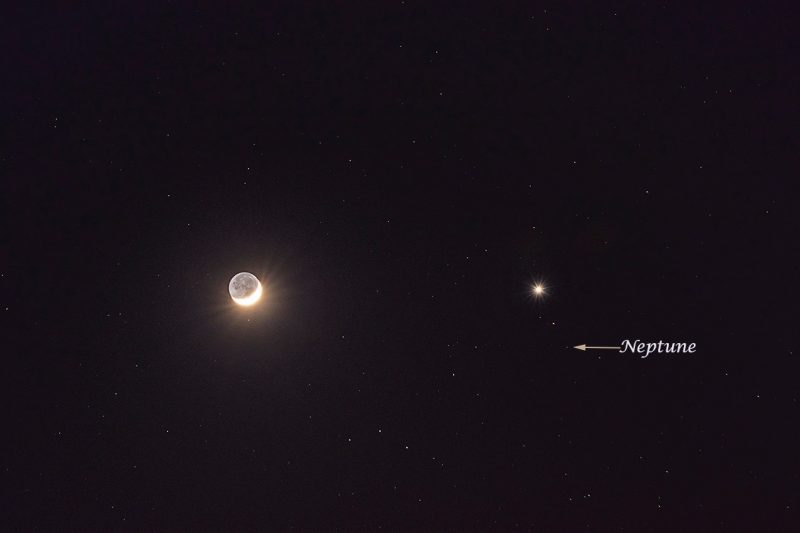
View at EarthSky Community Photos. | The waxing moon with Venus – the 2 brightest objects in the night sky – with faint Neptune on January 28, 2020. Image via Rupesh Patel in Gandhinagar, Gujarat, India. Thank you, Rupesh!View at EarthSky Community Photos. | Dr Ski in Valencia, Philippines, wrote on January 28, 2020: “Excellent study in color and magnitude contrast! Phi Aqr is 40x brighter than Neptune. Venus is 1500x brighter than phi Aqr. Venus is now 2/3° east of Neptune.” Thanks, Dr Ski!The waxing moon swung close to Venus this week. You can still see the moon near Venus on January 29, 2020. Look west!View at EarthSky Community Photos. | Joel Weatherly in Edmonton, Aberta, Canada, caught the moon, Venus and Neptune on the night of the conjunction, January 27, 2020. He wrote: “Despite invading clouds, I had to try to glimpse a view of Venus, Neptune, and the moon together in Edmonton’s evening sky. Light pollution, Venus’ glare, and clouds made Neptune difficult to view and photograph but the planet’s signature blue was visible. Venus was bright enough to develop a striking halo and present diffraction spikes. The moon, while not the focus of my viewing, was also a lovely sight being 9.1% illuminated, Earthshine was plainly visible.” Thank you, Joel!View at EarthSky Community Photos. | Rosie Hinkle of Gastonia, North Carolina captured this image on January 27.View at EarthSky Community Photos. | Here’s a shot by Raul Cortes, January 27, from Monterrey Mexico.Nikolaos Pantazis in Glyfáda, Greece, wrote: “A 13.5% waxing moon, with planets Venus and Neptune (arrow tip).”View at EarthSky Community Photos. | Amateur astronomers with small telescopes began training them on Venus some days before the conjunction. Dr Ski in Valencia, Philippines, caught Neptune near Venus on January 25, 2020. He wrote: “The conjunction of Venus and Neptune will occur 2 nights from now. But Neptune will be lost in Venus’ glare and very difficult to image. Venus is 60,000 times brighter than Neptune! Even tonight I cannot make out Neptune through my binoculars.” Thank you, Dr Ski!
Bottom line: Photos from the EarthSky community of the Venus-Neptune conjunction on January 27, 2020.
Eleanor Imster has helped write and edit EarthSky since 1995. She was an integral part of the award-winning EarthSky radio series almost since it began until it ended in 2013. She and her husband live in Tennessee, where they enjoy guitar playing and singing. They have 2 grown sons.
Deborah Byrd (asteroid 3505 Byrd) helps edit EarthSky.org and is a frequent host of EarthSky videos. Deborah created the EarthSky radio series in 1991 and founded EarthSky.org in 1994. Prior to that, she had worked for the University of Texas McDonald Observatory since 1976, and created and produced their Star Date radio series. She has won a galaxy of awards from the broadcasting and science communities, including having an asteroid named in her honor in 1990, a Public Service Award from the National Science Board in 2003, and the Education Prize from the American Astronomical Society in 2020. A science communicator and educator since 1976, Byrd believes in science as a force for good in the world and a vital tool for the 21st century. "Being an EarthSky editor is like hosting a big global party for cool nature-lovers," she says.
Like what you read? Subscribe and receive daily news delivered to your inbox.
Thank you! Your submission has been received!
Oops! Something went wrong while submitting the form.
If EarthSky has ever helped you discover something new, prepare for an eclipse, spot a planet, or simply inspired a moment of wonder, today is the perfect day to give back. Your donation helps keep trusted science news, expert night sky guides, and independent science journalism free for everyone.
Please help keep EarthSky going by donating today!
Please help keep
EarthSky going!
If you've already donated, we apologize for the popup and greatly appreciate your support.