Science matters. Wonder matters. You matter. Join our 2026 Donation Campaign today.
See Milky Way’s core in most detailed photo yet
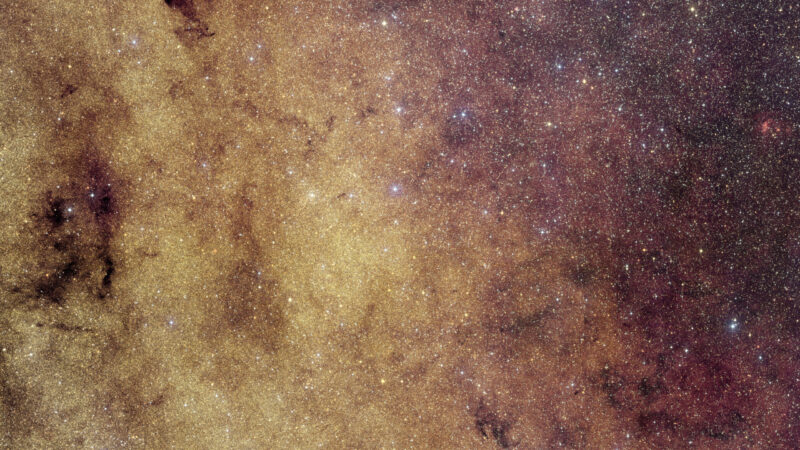
On June 24, 2026, the European Space Agency (ESA) shared the largest and most detailed photo yet of our Milky Way galaxy’s heart. Captured by the Euclid space telescope, this view contains more than 60 million stars. Incredibly, that is still much less than even 1% of the stars that make up our Milky Way galaxy.
The Euclid telescope’s normal target is the faraway galaxies in our distant universe. The goal of the mission is to track the expansion of the universe, and in so doing, uncover the mysteries of dark matter and dark energy.
But for one day – March 23, 2025 – Euclid was tasked with a different mission. Euclid surveyed a part of our galaxy’s core that amounted to an area equal to 22 full moons in our sky. And the result is breathtaking.
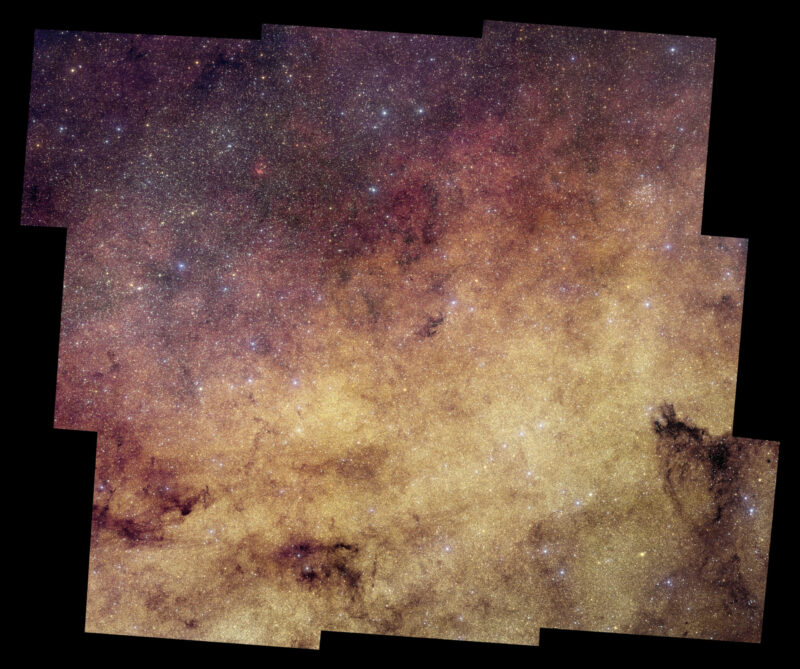
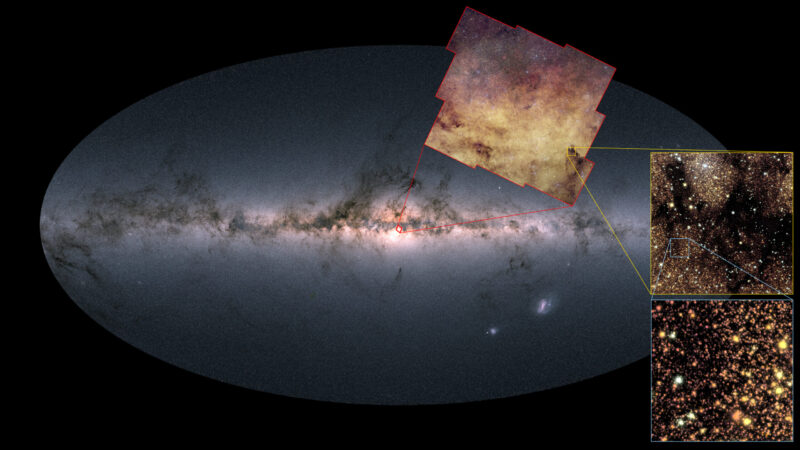
What part of the Milky Way does the image cover?
This packed, incredibly dense region of the Milky Way’s central zone is only a tiny portion of the galactic bulge. But zooming in on Euclid’s image shows just how much detail we can see among the stars. The dark areas in the insets are black, obscuring clouds of gas and dust that astronomers call dark nebulae.
Why point Euclid at the Milky Way’s core?
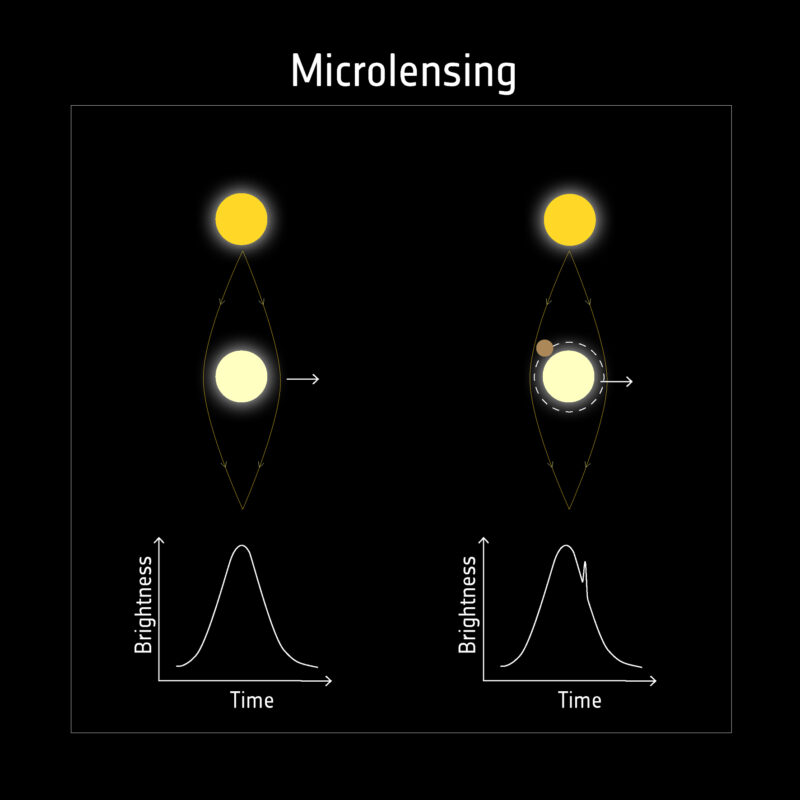
Although the Euclid mission was not designed to observe the Milky Way’s core, astronomers wanted a view of this dense region without light from the stars overpowering one another. And Euclid has this capability. Getting a good look at individual stars near the galactic center allows astronomers to look for planets using microlensing. Microlensing is a phenomenon where the light from a more distant star bends around the nearer star. If the star that’s closest to us has a planet circling it, the light curve from the more distant star will show a spike. This technique only works when two stars happen to lie in the same path from Earth. And what better region to look at than one teeming with stars?
Following up with future missions
Because it takes time for astronomers to see microlensing events, the Euclid image will provide a starting point for future surveys with instruments such as the Nancy Grace Roman Space Telescope. The leader of the Euclid galactic bulge survey, Natalia Rektsini, said:
In 24 hours, Euclid has already captured the stars involved in all the future microlensing events that the Roman space telescope will detect, but before the stars and planets involved have aligned. This means that anyone who detects a microlensing event in the same region, for example with Roman, will be able from now on to use Euclid data as a time reference in the past and see how the stars looked before they overlapped. Since Euclid can clearly separate individual stars, one can then measure how fast they move over time and use that information to confirm the existence of a planet and determine its mass. This would not be possible with data from one point in time.
Enjoy the beauty of the dense starfield in our galactic heart
The new image from Euclid will support future investigations into planets lurking around stars near the center of our galaxy. But it also allows us – right now – to bask in the beauty that is our home galaxy. Enjoy this video of the crowded, starry region near the Milky Way’s core.
Bottom line: ESA released a new image of the Milky Way’s core. This view, from the Euclid space telescope, is the largest and most detailed image yet of the galactic center.
Like what you read?
Subscribe and receive daily news delivered to your inbox.
More from
Kelly Kizer Whitt


The MMX mission launches to Mars’ moons on Monday

Visible planets and night sky guide for October
No more leap seconds! Timekeeping is officially changing
Space is getting crowded. Here’s the latest satellite report