This video from the Korean Aerospace Administration shows before and after images of where the SpaceX rocket hit the moon. Look closely as the images zoom in. Can you see a dark streak that wasn’t there before? Video via KASA.
SpaceX rocket before and after pics
Update, 18 UTC August 6: The Korean Aerospace Administration (KASA) has released a video showing the lunar surface before and after the SpaceX rocket impact. It’s subtle but observable. Watch in the player above. The translated caption reads:
The Korea Aerospace Administration (KASA; Administrator Oh Tae-seok) announced that South Korea’s lunar orbiter, Danuri (KPLO*), captured images of the upper stage of the SpaceX Falcon 9 rocket before and after its impact with the lunar surface, which occurred at 15:34 (KST) on August 5 (Wednesday). The observation process involved a total of eight imaging sessions – starting with an initial shot at 15:01 (approximately 30 minutes prior to impact) and followed by seven subsequent sessions after the impact – with all operations concluded by around 07:00 on August 6 (Thursday).
We’ll continue to update this story and add new images and observations as they become available. Stay tuned!
Wednesday’s update
Update, 18 UTC August 5: The European Southern Observatory reports that it has detected sodium and lithium in the debris plume. ESO posted to LinkedIn:
Earlier today, the discarded upper stage of a Falcon 9 rocket impacted on the moon …
As part of this coordinated observing campaign, our VLT [Very Large Telescope] detected spectral lines (the ‘chemical fingerprints’) of sodium and lithium gas in the impact plume lasting for 5-10 minutes after impact. The temporal sequence of spectra is shown in the clip here.
The sodium likely originated from the lunar soil, whereas the lithium could come from the rocket itself.
The team will provide more details after a full analysis has been conducted.
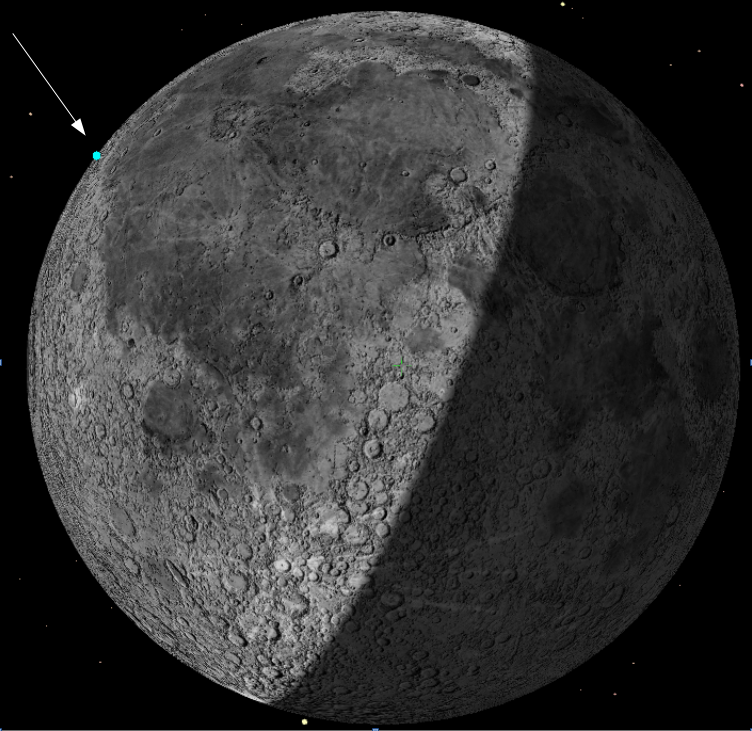
Falcon 9 rocket expected to hit the moon on August 5
In January 2025, a SpaceX Falcon 9 rocket launched two missions toward the moon. One was the Blue Ghost mission that went on to spend 14 days on the lunar surface. And the other was Hakuto-R, a private Japanese mission, which was meant to land on the moon, but failed. After the upper stage of the Falcon 9 completed its own mission to boost these two moonward, it became just another piece of space junk. But now the Falcon 9 rocket is going to the moon, too, to collide with it on August 5.
Current estimates are that the Falcon 9 upper stage will hit the moon at 6:35 UTC (1:35 a.m. CDT) on August 5, 2026. When it hits, it should send a huge cloud of dusty lunar soil a few miles into space above the impact site.
The rocket will strike near Einstein crater, close to the moon’s limb (edge) as seen from Earth. That crater is close to the moon’s western limb in lunar coordinates.
Gray estimates the space junk will hit the moon at about 1.51 miles (2.43 kilometers) a second. That equates to 5,400 miles (8,700 kilometers) an hour. Because the moon has no real atmosphere, there will be nothing to slow it down.
Will we be able to see the strike? Read on.

Will earthly observers see the strike?
The impact is unlikely to be visible from Earth with the unaided eye. However, space-based telescopes — and possibly some observatories in the Americas — could detect it. At that time, it will be nighttime across much of the Americas and the moon’s position in the sky will allow observatories in the region to monitor the impact. A recent paper said:
Potential observables from this event include the flash at the time of impact (likely lasting less than a second) and the ejecta plume (lasting minutes to tens of minutes).
Whether you’ll actually see anything from the Falcon 9 strike depends on several factors:
- Timing. The impact is predicted to occur at about 6:35 UTC (1:35 a.m. CDT) on August 5, although the predicted time could shift slightly as the trajectory is refined.
- Weather. Clear skies, of course, are essential.
- Your telescope. Binoculars won’t be enough. A medium- to large-aperture telescope, preferably equipped to record high-speed video, offers the best chance of catching a brief flash or dust plume.
- Lunar lighting. The impact site is expected to lie near the moon’s day-night boundary (the terminator). That geometry could make any dust plume easier to spot because sunlight would illuminate it against the darker lunar sky.
Professional astronomers will be watching
On July 27, 2026, a new paper came out on arXiv from researchers at University of Texas-Austin. Lead author William Jo contacted EarthSky to explain what the new paper details:
My group at UT Austin submitted a paper to Geophysical Research Letters modeling the physical processes … We predict the debris plume from the August 5 impact (6:35 UTC) will have the central ejecta spike reaching ~75 to 100 km (45-60 miles) altitude, the curtain ~15 to 20 km (10 to 12 miles), and spread 183 km (113 miles) laterally near the [moon’s] sunlit limb …
Our calculations suggest the plume should be several orders of magnitude brighter than the dark-sky background for the first few minutes after impact.
So the plume should be visible [through telescopes or special imaging equipment] …
A spent rocket stage is a hollow, human-made body, and there are very few impact models for objects like it. They seem to produce very different plumes than natural impactors (like asteroids or comets) do. Watching this one gives us a rare chance to open up ejecta-plume science and calibrate those models against a real event, which matters for every future thing we deliver to the moon. My concern is that most observers will stop at the sub-second flash and never track down the ejecta, which is the part that should actually be visible, and where the science is.
Our work shows that this impact may be worth a look [if you have the right equipment].
Read on for more about where and when to look!
What part of Earth will be facing the moon?
The moon will be close to last quarter phase on August 5, 2026. By 1:35 a.m. CDT, those in the Central Time Zone will be able to see the moon, as it will have already risen in the east. The planet Saturn will be nearby. If you’re farther west, check Stellarium to see if the moon will be above your horizon at the time of impact. The timing will favor people in the eastern half of the U.S. and Canada, plus much of South America.
On July 17, 2026, another paper came out with details on planning observations for the upcoming collision. This event provides scientists and nonscientists alike a perfect opportunity to record a lunar impact in real time. The data collected can help scientists better understand dust dynamics from impacts, the hazards of the resulting debris and more.
Gouging a new crater
In the July 17 paper, scientists used Bill Gray’s tracking data to show that the rocket body (39 feet or 12 meters long and 13 feet or 4 meters wide at a weight of around 8,800 pounds or 4,000 kilograms) will gouge a new crater into the surface.
The crater won’t be as large as one created by a solid object such as an asteroid, because the rocket body is largely hollow.
But still, the new crater should be around 66–98 feet or 20–30 meters wide.
Previous lunar impact
After the impact, NASA’s Lunar Reconnaissance Orbiter might be able to get an image of the resulting crater. It’s happened before.
Back in 2022, Bill Gray also predicted a rocket impact with the moon. There was a little confusion about where the rocket came from, but the space junk did indeed hit the moon on March 4, 2022. And it left a mark, too. NASA’s Lunar Reconnaissance Orbiter took an image of the aftermath.
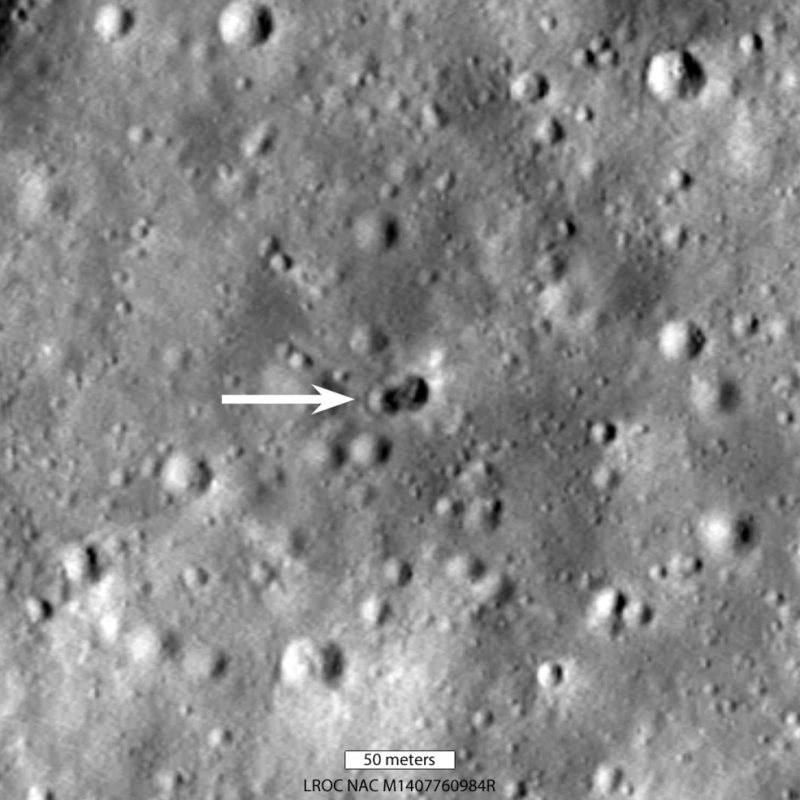
Tracking the Falcon 9 upper stage
There have been hundreds of Falcon 9 launches. The first stage (booster) returns to Earth and is reused. But the second stage (upper stage) does not return. It’s the upper stage of a Falcon 9 that’s going to strike the moon.
Most Falcon 9 upper stages orbit closely to Earth and eventually reenter our atmosphere. But some have gone on to orbit the sun. This one has spent most of its time farther out than average, around the distance of the moon. Asteroid surveys pick up objects like this as they scan for dangerous space rocks. As Gray said:
The asteroid surveys would actually prefer not to observe space junk. Time spent observing junk is time not spent finding rocks. But both the rocks and the high-altitude space junk are slowly moving points of light in their images; they aren’t easy to distinguish. So the asteroid surveys find this sort of junk whether they want to or not.
Gray provides software tools for astronomers that help them distinguish between space rocks and space junk. He also computes orbits for high-orbiting objects the military doesn’t track. And he’s been tracking this piece of space junk for months. He’s known since September 2025 that the upper stage was likely on a collision course with the moon. And as he told EarthSky, he wasn’t surprised:
I’ve been checking for such possible impacts for about 20 years, ever since we started having many large bits of junk in orbits that could hit the moon. In a way, the only real surprise is that only two objects have hit the moon.
Rocket will hit the moon despite tiny pushes from sunlight
Over the past months he’s continued to track the object. The reason it can change course a tiny bit is due to the gentle push of sunlight on objects. And that little bit of push is tricky to track. As Gray said:
As an object tumbles, it may catch more or less sunlight, and may reflect some of it sideways.
But, as Gray told EarthSky:
I was reasonably sure a month or two later, but was in no rush to say anything about it. I figured I’d wait until the impact location was well established. So it was something of a gradual process, with no ‘Aha! It’s gonna hit!’ moment.
Not a lot of tracking farther from Earth
Gray told EarthSky:
I am an astronomer working under contract with both asteroid and artificial object observers. I started out doing this for natural objects (asteroids, comets, moons of other planets) about 30 years ago. A few years later, the asteroid surveys started to notice the occasional artificial object and asked me if I could find orbits for them as well.
And as Gray explains on his website, various countries carefully track objects in low-Earth orbit because there are so many pieces of debris with risks of collision with military and science satellites. Farther from Earth, there is less tracking. Or, as Gray said:
Generally speaking, high-altitude junk goes ignored. (Except, it appears, by me.)
Gray works with asteroid hunters. As he said:
My ‘day work’ is for the asteroid-hunting community. … Most artificial objects are close to the Earth and move fast enough that there is no risk of mistaking them for an asteroid. But there are about a dozen ‘high-flying’ objects that can move slowly enough to look like a rock, at least briefly. For about 15 or 20 years now, I’ve taken these observations and computed orbits. Then, when the surveys find such objects, they can fairly quickly say ‘Never mind; it’s not a rock; it’s just another nuisance artificial object,’ and go back to looking for actual rocks.
Bottom line: A SpaceX rocket hit the moon on August 5. Here’s what astronomers have observed so far from this historic lunar event.
Source: Observational planning for the 2026 August 5 Falcon 9 Upper Stage lunar impact
Source: Predicted Ejecta Dynamics and Observability of the 2026 Falcon 9 Upper Stage Lunar Impact
Like what you read?
Subscribe and receive daily news delivered to your inbox.
More from
Kelly Kizer Whitt


Visible planets and night sky guide for October

Another satellite breakup raises concerns about space junk
Smile mission releases its stunning 1st aurora footage!
Hera mission hits the brakes to arrive at asteroid