



9 mind-blowing space facts that will shock you
Almost everything about outer space is amazing, from what we might find on Earth’s moon to the visible boundary of our universe … it can all leave you scratching your head. Here are nine truly mind-blowing facts about our Earth, sun, solar system and universe. Enjoy … and share (you’ll be a hit at your next dinner party).
1. There might be dinosaur fossils on the moon
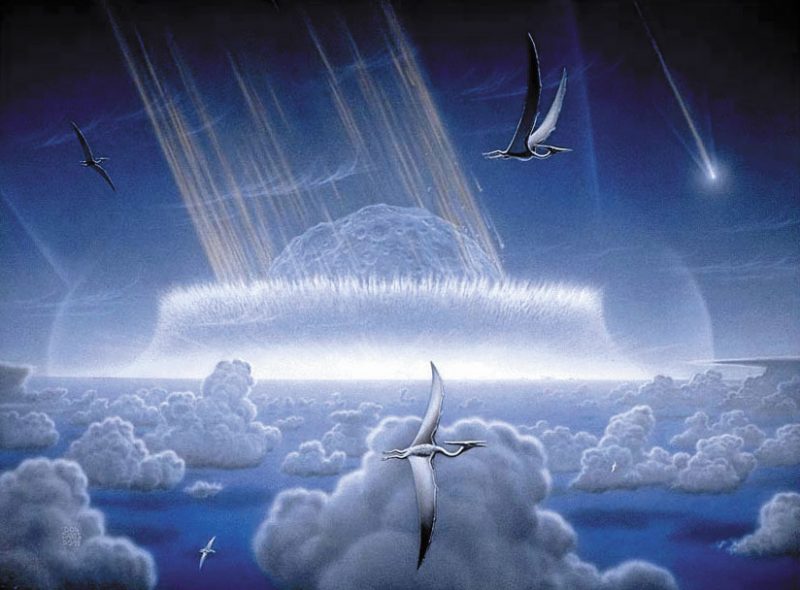
Some 65 million years ago, an asteroid hurtled toward Earth. When it hit, it triggered a mass extinction, ending the rein of the dinosaurs. At that time, dinosaurs had already been around for some 200 million years. So, many generations had already died and their bones had become fossilized in earthly rocks.
And, when the dinosaur-killing asteroid hit Earth, it impacted so violently that some of the rocks jettisoned from the impact flew into space. And it’s possible some of those rocks with fossilized dinosaurs might have ultimately ended up on the moon, colliding with it in much the same way a SpaceX rocket is colliding with the moon tonight, August 5, 2026.
So there could be rocks with dinosaur fossils on the moon!
2. All the planets could fit between Earth and the moon
The distance between objects in space is vast. As an example of this, if you took all the other planets in the solar system, you could pack them tightly between Earth and the moon.
There are a couple of caveats here. First, we are stacking the planets pole to pole so we don’t have to worry about Saturn’s rings.
Second, we’re performing this feat during apogee, or when the moon is farthest away from Earth in its elliptical orbit.

3. If we could hear the sun, its noise would be deafening
Sound waves can’t travel through the vacuum of space. They need a medium (like air or water) to travel because they are vibrations of particles. Space is a vacuum with almost no particles, so sound cannot travel through it.

And while it might seem charming to not only see – but also hear the universe around us – mostly what we’d hear is the sound of the sun screaming.
If sound waves could travel through space, we’d hear the sun roaring. That roar would pound our ears at about 100 decibels. It’d be like standing next to Niagara Falls all day long. It’d only be as night fell, and we turned away from the sun, that we’d get some peace and quiet.
4. That roar would linger
But what if you could hear the sun, and it suddenly disappeared? In that case, the light from it would be gone in eight minutes. But the sound from the sun would continue for 13 years.
Light traveling from the sun to Earth takes 8 minutes to reach us. But light is more than 850,000 times faster than sound. So if sound could similarly travel through space, what we hear at this moment is really closer to 13 years old.
So it’d take eight minutes to see the sun wink out. But its roar would continue for 13 years.
5. The dinosaurs didn’t see the same constellations we do
Stars are born, evolve and die, just like humans. Some of the stars we see now didn’t exist during the age of the dinosaurs, from about 252 million to 66 million years ago.
So when the dinosaurs looked up at the night sky, they saw different stars and constellations than we see now.
Consider the constellation Orion the Hunter. Its famous bright blue star Rigel is just 8 million years old. And its famous red star Betelgeuse – marking Orion’s shoulder – is only 10 million years old.
If they ever looked up, the dinosaurs couldn’t have seen the figure of Orion. Likewise, they never saw the Big Dipper, or the Teapot of Sagittarius.
And, also, remember, our solar system is orbiting the center of our Milky Way galaxy. So during the height of the dinosaurs’ rein, Earth was on the opposite side of the galaxy from now.
6. Galaxies collide, but stars don’t (usually)
You might have already guessed it from mind-blowing fact number two, but there is a lot of space in space.
In fact, there’s so much space between things in our universe that even though the Milky Way and Andromeda galaxies might merge one day, it’s unlikely that any of stars (or planets) will collide. Instead, they’ll pass through one another like ghosts.
The galaxies themselves won’t be unaffected, though. The interaction will distort their shapes. And collisions between clouds of gas and dust in the two galaxies are expected to ignite bursts of new star formation!
The feature image represents Earth’s night sky in 3.75 billion years. The Andromeda galaxy (left) will fill our field of view as it gets closer to our Milky Way galaxy. Image via NASA/ ESA/ Z. Levay and R. van der Marel, STScI/ T. Hallas/ A. Mellinger.
7. There are countless galaxies packed into every patch of sky
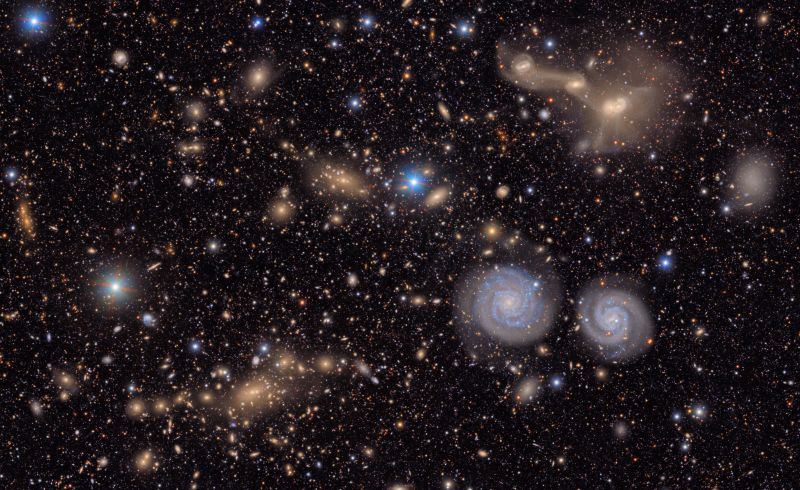
If you’ve ever taken time to gaze at some of the deep-field images from our best telescopes, you already know the universe is absolutely packed with galaxies. From the Hubble Ultra Deep Field to the James Webb Space Telescope’s view of distant galaxies to the new Vera C. Rubin Observatory’s look at our distant universe, galaxies are everywhere we look. Brian Greene is a theoretical physicist at Columbia University and author of Until the End of Time. He said:
Hold your thumb at arm’s length against the night sky, and it will cover more than 10 million galaxies in the observable universe.
8. The observable universe is wider than light has had time to travel
So what is the observable universe? It’s all the light we can see in the universe.
And although light is speedy, it still has its limits. We can only see light that has had time to reach Earth since it was emitted.
So while the universe might be infinite, our view of it is not. Our view of the universe stretches in every direction around us for about 46.5 billion light-years. That means the total width of the observable universe from one side of us to the other is 93 billion light-years wide. But we measure the observable universe at nearly 14 billion years old, starting with the Big Bang.
So how can the observable universe be wider than the universe is old? It’s because the universe has been expanding throughout the time the light has been traveling.
Light from the most distant objects has been on its way for about 13.8 billion years. But, during that time, the space between those objects and us has stretched. As a result, those objects are now about 46.5 billion light-years away, even though their light has been traveling for only 13.8 billion years.
9. Most of the universe will move beyond our sight
If we look far, far into the future, our view from the Milky Way galaxy will become increasingly limited by the expanding universe. Astronomers call the ultimate boundary of what we can ever observe the cosmic event horizon. Because light travels at a finite speed and the expansion of the universe is accelerating, there are regions of space whose light will never reach us.
Over time, galaxies that are not gravitationally bound to our own will recede ever farther away. Eventually, the light from those galaxies will become so stretched and faint that we will no longer be able to see them. In fact, the universe’s expansion has been accelerating for about the last 5 billion years. As Katie Mack explains in her book The End of Everything:
As the expansion of the universe accelerates, galaxies that are currently inside our Hubble radius will be outside it. Eventually, no galaxies outside our Local Group will be visible.
Someday, every galaxy beyond our Local Group will disappear from view, leaving future astronomers with no direct evidence that the vast universe we see today ever existed.
Bottom line: Read nine mind-blowing space facts that will surprise and delight you. You’ll be a hit at your next dinner party!
See a new map of the Andromeda Galaxy and its colossal ecosystem
Like what you read?
Subscribe and receive daily news delivered to your inbox.
More from
Kelly Kizer Whitt


Visible planets and night sky guide for October

Hera mission hits the brakes to arrive at asteroid
The ghost of Biela’s Comet: It created a storm and disappeared



