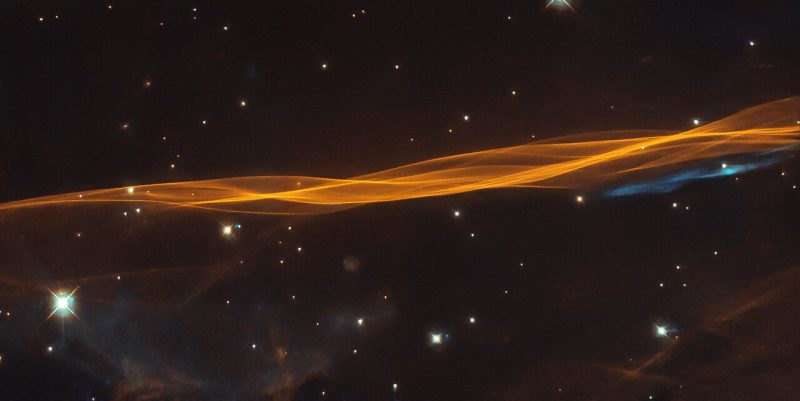
View larger. | While appearing as a delicate and light veil draped across the sky, this image from the Hubble Space Telescope actually depicts a very small section of what’s known as the Cygnus Loop Nebula – a supernova remnant – in this case located around 2,400 light-years away. The name of the supernova remnant comes from its position in the northern constellation of Cygnus the Swan. NASA said: “The original supernova explosion blasted apart a dying star about 20 times more massive than our sun between 10,000 and 20,000 years ago. Since then, the remnant has expanded 60 light-years from its center. The shockwave marks the outer edge of the supernova remnant and continues to expand at around 200 miles per second (350 km/sec). The interaction of the ejected material and the low-density interstellar material swept up by the shockwave forms the distinctive veil-like structure seen in this image.” Image via ESA/ NASA Hubble Space Telescope/ W. Blair/ Leo Shatz.
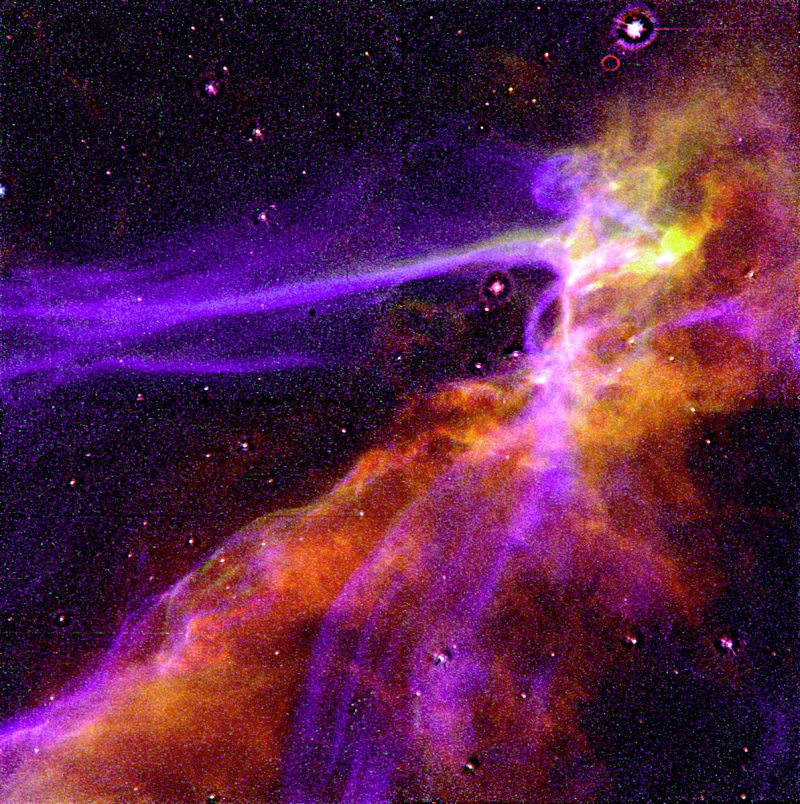
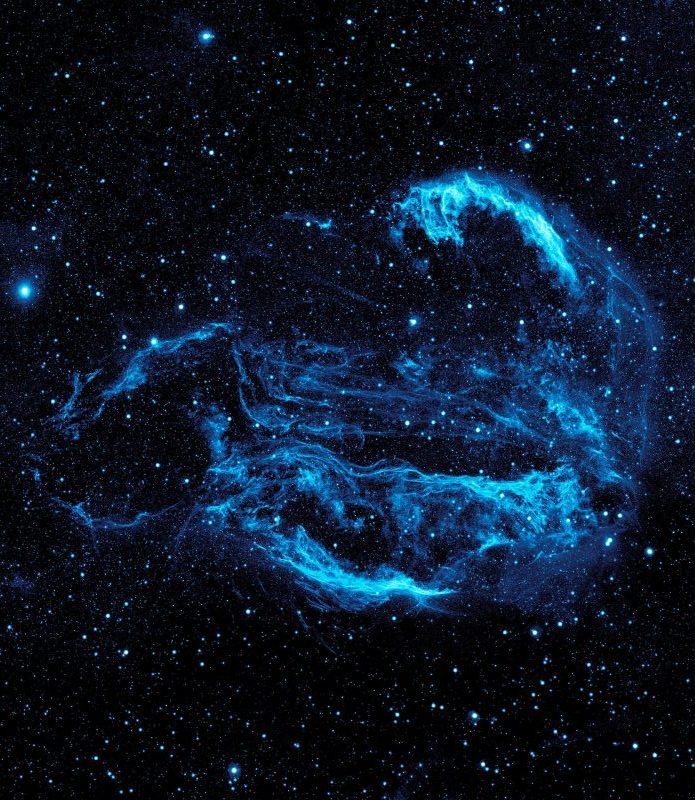
This image – also acquired with the Hubble Space Telescope – shows a larger portion of the Cygnus Loop supernova remnant, which marks the edge of a bubble-like, expanding blast wave from a colossal stellar explosion that occurred thousands of years ago. Read more about this image from NASA on the Commons. Image via Flickr.Now here is an image of the entire Cygnus Loop Nebula, captured in ultraviolet light by NASA’s Galaxy Evolution Explorer. The nebula looks small through telescopes (the visual component is called the Veil Nebula), but the entire region covers an area in our sky 36 times larger than a full moon. Read more about this image from NASA/ JPL-Caltech.
Bottom line: A detailed look at a small portion of the Cygnus Loop Nebula – a supernova remnant – followed by two images that show the nebula from more and more distant perspectives.
Deborah Byrd (asteroid 3505 Byrd) helps edit EarthSky.org and is a frequent host of EarthSky videos. Deborah created the EarthSky radio series in 1991 and founded EarthSky.org in 1994. Prior to that, she had worked for the University of Texas McDonald Observatory since 1976, and created and produced their Star Date radio series. She has won a galaxy of awards from the broadcasting and science communities, including having an asteroid named in her honor in 1990, a Public Service Award from the National Science Board in 2003, and the Education Prize from the American Astronomical Society in 2020. A science communicator and educator since 1976, Byrd believes in science as a force for good in the world and a vital tool for the 21st century. "Being an EarthSky editor is like hosting a big global party for cool nature-lovers," she says.
Like what you read? Subscribe and receive daily news delivered to your inbox.
Thank you! Your submission has been received!
Oops! Something went wrong while submitting the form.