The EarthSky community has many talented astrophotographers who capture stunning images of the deep sky. We gathered some of our favorite deep-sky photos from June 2026 for you to enjoy. Do you have images of your own to share? You can submit them to EarthSky here. We’d love to see them and share them!
Deep-sky photos of diffuse nebulae
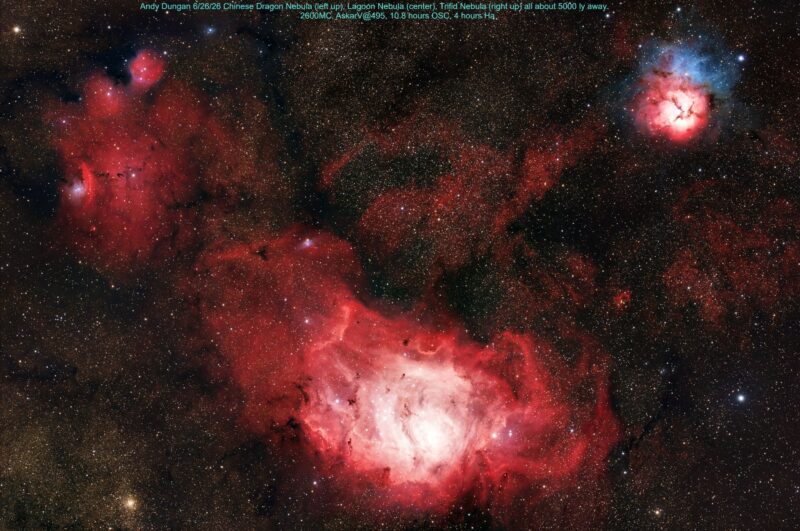
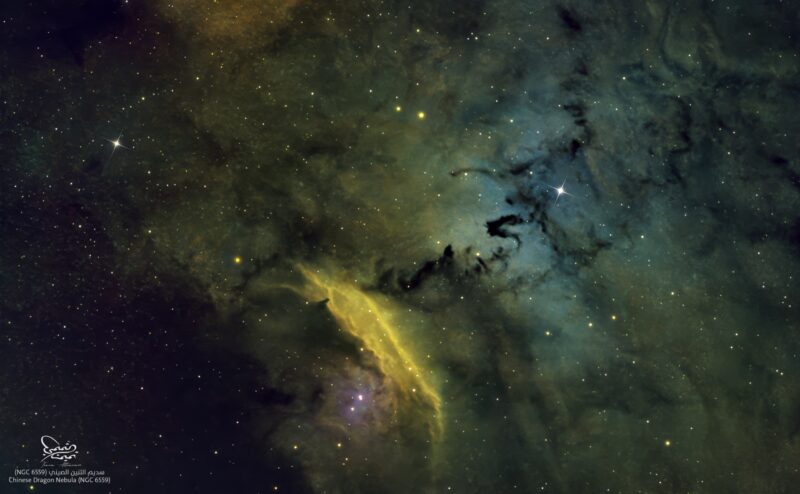
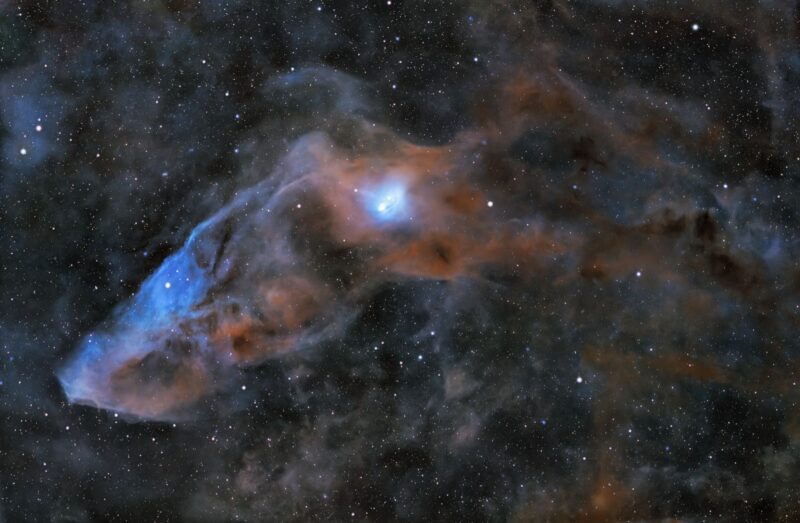
View at EarthSky Community Photos. | Andy Dungan near Cotopaxi, Colorado, captured this telescopic view of the Lagoon Nebula and its surroundings in Sagittarius the Archer, on June 10. Andy wrote: “Chinese Dragon Nebula (left up), Lagoon Nebula (center) and Trifid Nebula (right up) all about 5,000 light-years away. If you look closely at the Chinese Dragon Nebula you will see a snake-like creature winding through the nebula.” Thank you, Andy!View at EarthSky Community Photos. | Tameem Altameemi in the United Arab Emirates captured this telescopic view of the Chinese Dragon Nebula on June 14. Tameem wrote: “Located in the constellation Sagittarius about 5,000 light-years away, NGC 6559 is a complex star-forming region composed of emission nebulae, reflection nebulae and dark dust clouds. The interplay between glowing gas, scattered starlight and obscuring dust creates the dragon-like appearance that inspired its popular nickname. Although often overshadowed by the nearby Lagoon Nebula (M8), NGC 6559 is a fascinating region in its own right, revealing active star formation and intricate interstellar structures within the Milky Way.” Thank you, Tameem!View at EarthSky Community Photos. | Steven Bellavia in Livingston Manor, New York, captured this telescopic view of the Blue Horsehead Nebula on June 15. Steven wrote: “The Blue Horsehead Nebula (IC4592) is a reflection nebula in the constellation of Scorpius the Scorpion that is lit by Nu Scorpii, which is the bright star in the most blue portion. It spans 40 light-years and is 400 light-years from Earth. Being so close, it takes up much of the sky. The image shown is 7.0 degrees x 4.6 degrees, or approximately 14 full moons by 9 full moons.” Thank you, Steven!
More photos of diffuse nebulae
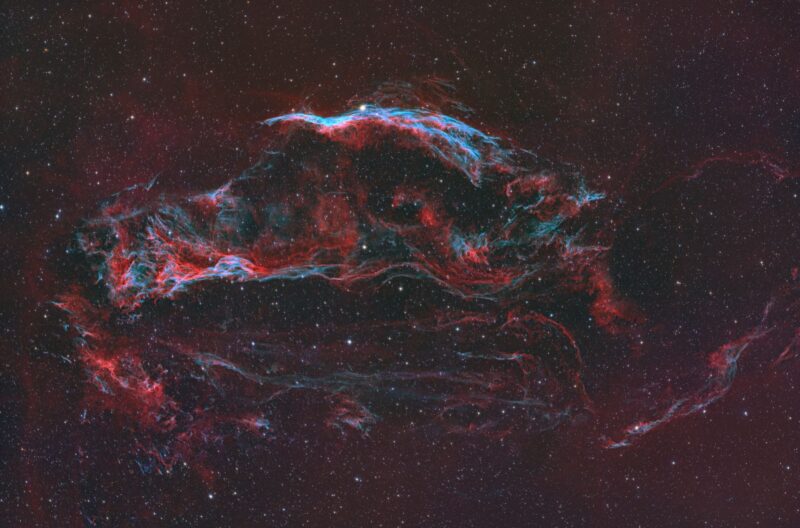
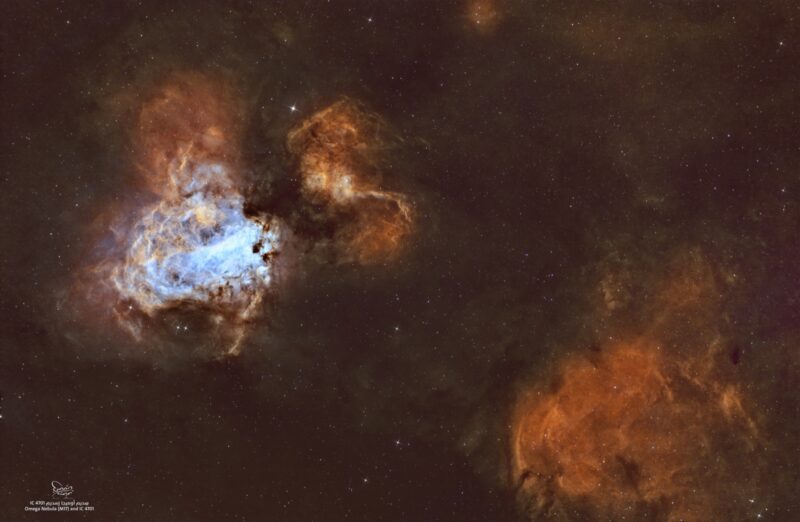
View at EarthSky Community Photos. | Oleg Rumiancev in Bainsville, Ontario, Canada, captured this telescopic view of the Cygnus Loop on June 15. Oleg wrote: “A first light of an extra fast imaging Newtonian telescope from Sharpstar, incredible level of detail from a modest 2 hours of imaging data.” Thank you, Oleg!View at EarthSky Community Photos. | Tameem Altameemi in the United Arab Emirates captured this telescopic view of Messier 17, the Omega Nebula in Sagittarius, on June 20. Tameem wrote: “My image of the Omega Nebula (M17) and the surrounding emission nebula IC4701, captured from the skies of the United Arab Emirates. The Omega Nebula is one of the brightest star-forming regions in our galaxy. It is also known as the Swan Nebula, Horseshoe Nebula or Lobster Nebula because its appearance changes depending on the orientation and field of view. Its intense ultraviolet radiation from young, massive stars causes the surrounding hydrogen gas to glow, while dark dust clouds sculpt its intricate structure. The wide field also reveals part of IC4701, an extended emission nebula sharing the same giant molecular cloud complex, highlighting the rich network of gas and dust spread across this region of the Milky Way.” Thank you, Tameem!
Deep-sky photos of distant galaxies
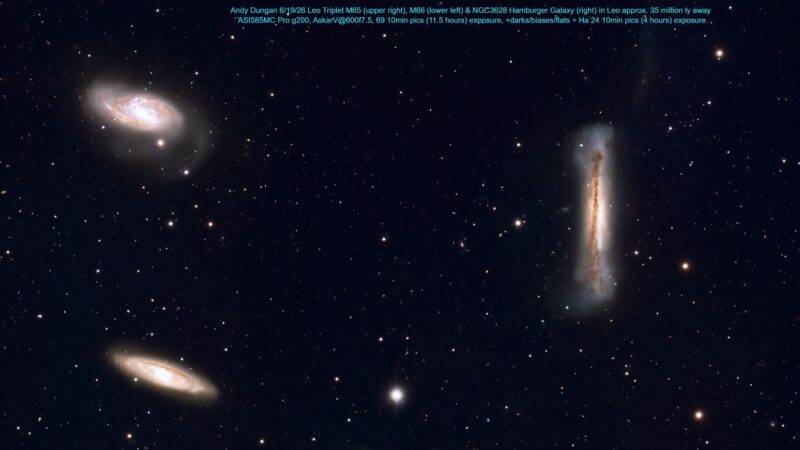
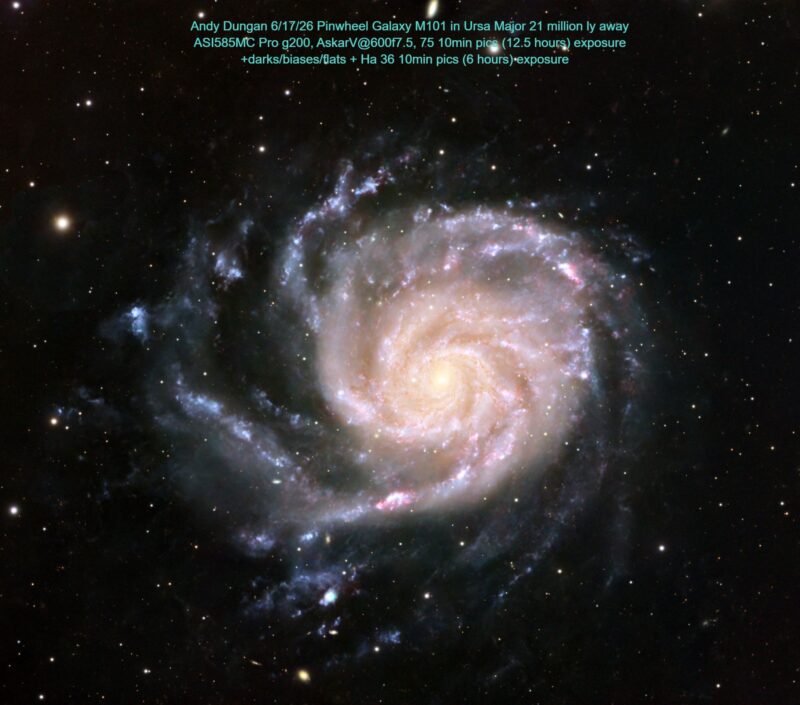
View at EarthSky Community Photos. | Andy Dungan near Cotopaxi, Colorado, captured this telescopic view of the Leo Triplet of Galaxies on June 24. Andy wrote: “M66 (top left), M65 (lower left), Hamburger Galaxy NGC 3628 (right). Pics were taken in May and processed in June. It was encouraging to see how using hydrogen-alpha data enriched the result. These galaxies are a long way away, 37 million light-years. So, I am pretty happy with this pic.” Thank you, Andy!View at EarthSky Community Photos. | Andy Dungan near Cotopaxi, Colorado, captured this telescopic view of Messier 101, the Pinwheel Galaxy in Ursa Major the Great Bear, on June 17. Andy wrote: “Pics were taken during May 26 and processed in June. The most fun about this image was it was the first time I used an OSC camera to also take hydrogen-alpha images. The result was that the reds in the image had greater emphasis thus making a more interesting image. Ya, I finally figured out how to do that with PixInsight.” Thank you, Andy!
Bottom line: Enjoy this gallery of deep-sky photos from June 2026 by our EarthSky community. If you have a great photo to share, we’d love to see it!
Armando is known primarily as an astronomy educator, after 30+ years of extensive public outreach and 10 years teaching in colleges. As one of only a handful of science communicators in Puerto Rico during Comet Halley's last visit, he assumed a pioneering role starting in 1985 when science was just beginning to enter the collective mindset. Over the years, his work as a teacher, speaker and writer, inspired people to pursue interests in science and brought enduring change to Puerto Rican culture. After being accepted into the 2014–2015 Antarctic season of PolarTREC, Armando was assigned to the Amundsen-Scott South Pole Station, where in 2015 he successfully conducted 10 days of work at the IceCube Neutrino Observatory. His affiliations include Ana G. Méndez University, Cupey campus (2014 to 2021), the University of Puerto Rico, Aguadilla campus (2015 to 2017), NASA JPL's Solar System Ambassadors (2004 to 2006), and NASA Space Grant (2017 to 2019) where he served as an affiliate representative.
Like what you read? Subscribe and receive daily news delivered to your inbox.
Thank you! Your submission has been received!
Oops! Something went wrong while submitting the form.