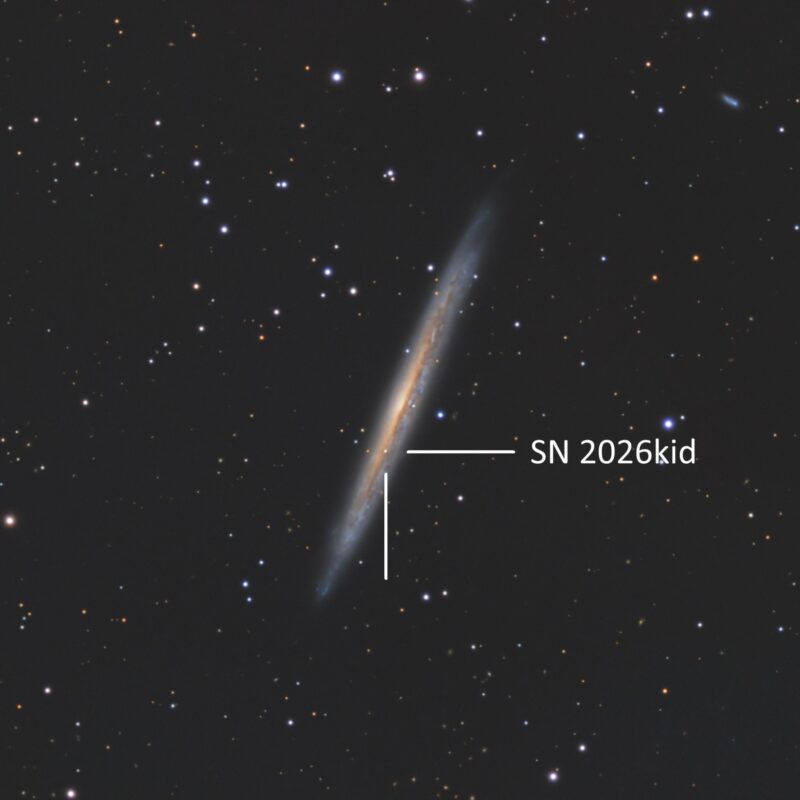
View at EarthSky Community Photos. | Steven Bellavia in Smithfield, Virginia, captured this telescopic image on April 29, 2026. The indicator marks are pointing to a bright star, where no star appeared before. Steven wrote: “Another star has exploded in a galaxy within the boundaries of the constellation Draco. This time it’s supernova SN2026kid, in galaxy NGC 5907.” About the supernova’s name … Steven pointed out that the letters after the year are the order of discovery, with “a” for 1, “z” for 26, and then “aa” for 27 and so on. If more than 702 supernovae are discovered in a single year, 3-letter designations are used. Hence, “kid” after 2026. Wow! That’s a lot of supernovae in 2026 so far! Thank you, Steven. See more deep-sky photos from April 2026 below.
The EarthSky community has many talented astrophotographers who capture stunning images of the deep sky. We gathered some of our favorite deep-sky photos from April 2026 for you to enjoy. Do you have images of your own to share? You can submit them to EarthSky here. We’d love to see them and share them!
Diffuse nebulae in the deep sky
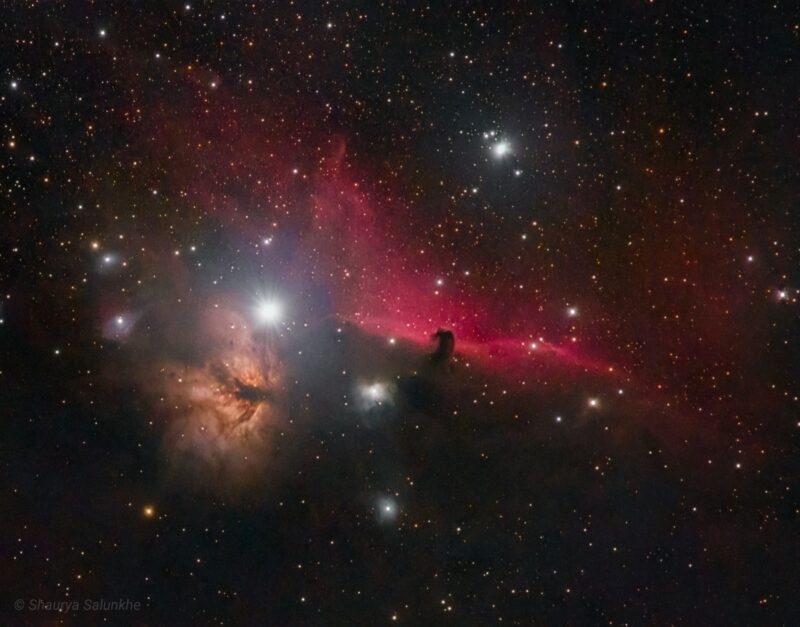
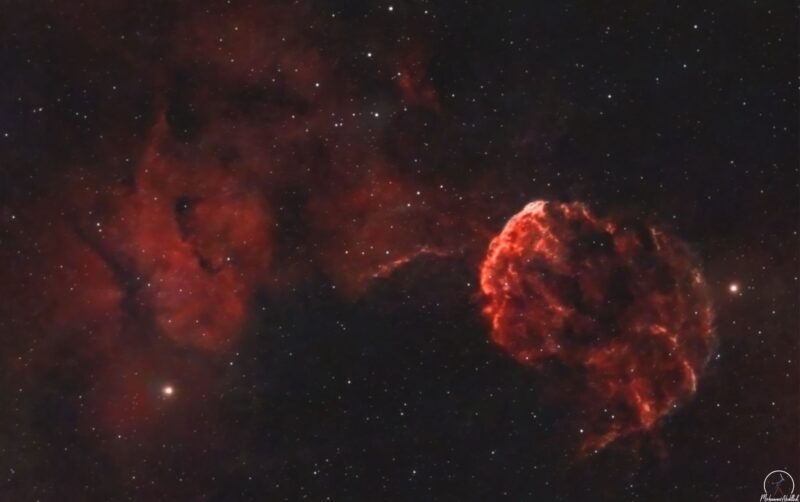
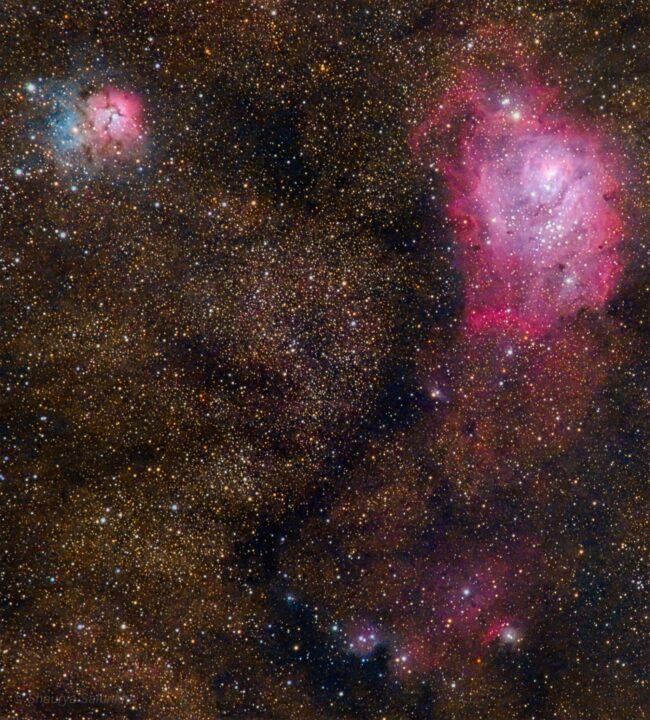
View at EarthSky Community Photos. | Shaurya Salunkhe in Pune, Maharashtra, India, used a telephoto lens to capture this view of the Horsehead and Flame Nebulae on April 13, 2026. Shaurya wrote: “Located 1,400 light-years away in the constellation Orion, this pair of nebulae are part of a vast cloud complex known as the Orion molecular cloud complex. The dark regions of the nebula (including the Horsehead) are regions of active star formation.” Thank you, Shaurya!View at EarthSky Community Photos. | Mohammed Ahmed in Suez, Egypt, used a telephoto lens to capture this view of the Jellyfish Nebula, in the constellation Gemini, on April 10, 2026. Mohammed wrote: “A supernova remnant from a star that probably exploded 30,000-35,000 years ago. It makes you wonder how small we are, and how small our problems are.” Thank you, Mohammed!View at EarthSky Community Photos. | Shaurya Salunkhe in Pune, Maharashtra, India, used a telephoto lens to capture this view of the Lagoon and Trifid Nebulae (Messier 8 and Messier 20), on April 19, 2026. Shaurya wrote: “Located 4,100 light years away in the constellation Sagittarius, this is an active star-forming region with a strong emission in the hydrogen-alpha region of the spectrum. This, along with their close proximity, makes them some of the brightest nebulae in the night sky, often visible to the unaided eye from dark sites.” Thank you, Shaurya!
Deep-sky photos of star clusters
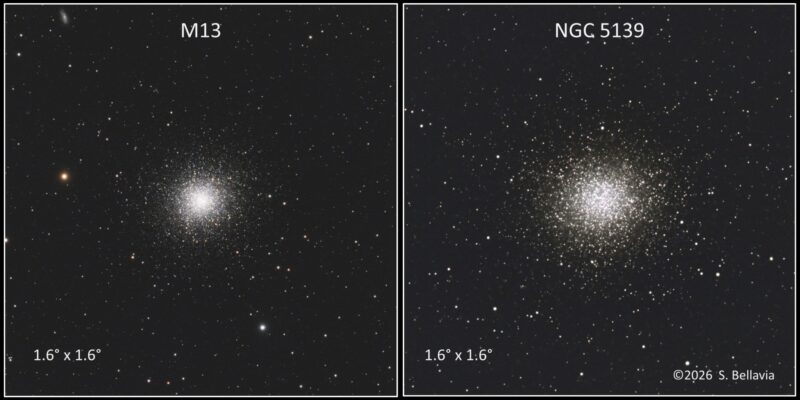
View at EarthSky Community Photos. | Steven Bellavia in Surry, Virginia, made this comparison of 2 famous globular star clusters on April 17, 2026. Steven wrote: “A large and a giant globular cluster: M13 and Omega Centauri (NGC 5139), imaged with the same gear on the same night.” Steven told us that M13 – the cluster on the left, about 22,000 light-years away – contains approximately 400,000 stars and takes up about 0.36 degrees of sky. Omega Centauri, aka NGC 5139, is a giant globular cluster. It’s on the right in this composite. It contains 10 million stars and takes up about 0.6 degrees of sky, larger than a full moon seen from Earth. It is 17,000 light years away. Thank you, Steven!
Deep-sky photos of distant galaxies
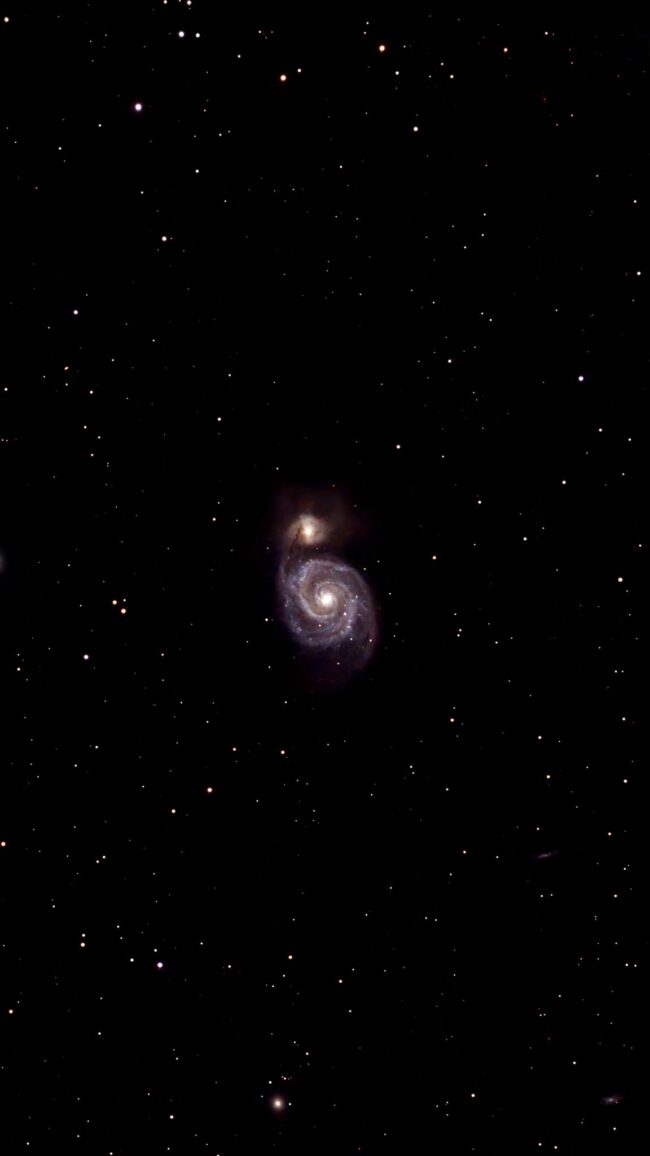
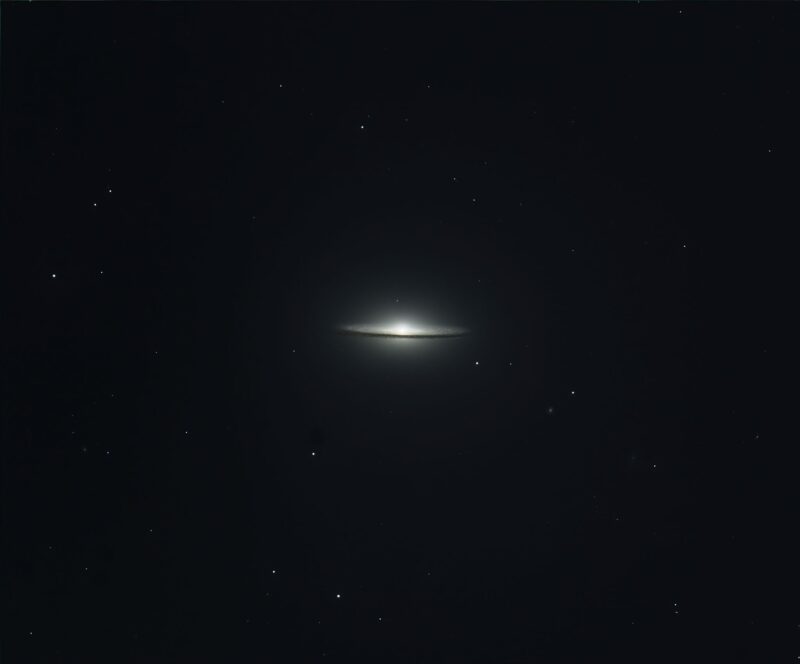
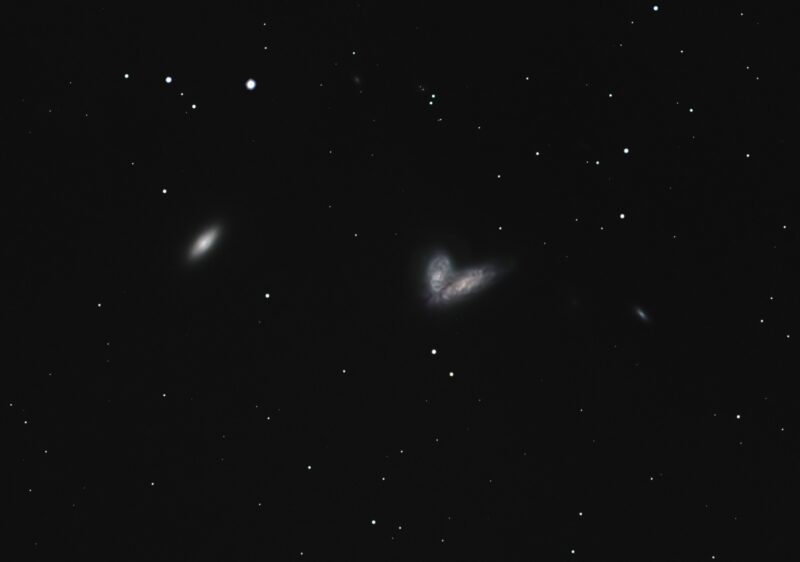
View at EarthSky Community Photos. | Anthony Faulkner in Tucson, Arizona, captured this telescopic view of the Whirlpool Galaxy, aka Messier 51, in the constellation Ursa Major, on April 19, 2026. Thank you, Anthony!View at EarthSky Community Photos. | Catherine Hyde in Cambria, California, captured this telescopic view of the Sombrero Galaxy on April 16, 2026. Catherine wrote: “This is M104, the Sombrero Galaxy in Virgo. Years ago, I saw the Hubble image of this galaxy. And it played an outsized role in my decision to try my hand at astrophotography. This is 157 (300-second) images taken over 3 nights, stacked.” Thank you, Catherine!View at EarthSky Community Photos. | Jelieta Walinski at Desert Bloom Observatory in St. David, Arizona, captured this telescopic view of the the Siamese Twins galaxies on April 5, 2026. Jelieta wrote: “What happens when galaxies meet? In this striking deep-sky portrait, 2 spiral galaxies – NGC 4567 and NGC 4568 – appear locked in a delicate gravitational dance. Located about 60 million light-years away in the direction of the Virgo Cluster, this pair is commonly known as the Siamese Twins. Although they seem to overlap, these galaxies are only in the early stages of interaction. Over cosmic time, their mutual gravity will distort their elegant spiral arms, triggering waves of star formation. Ultimately, they will merge into a single, larger galaxy. Such encounters are not rare in the universe. They are a fundamental process in galactic evolution. They help shape the structure of galaxies we observe today.” Thank you, Jelieta!
Another distant supernova
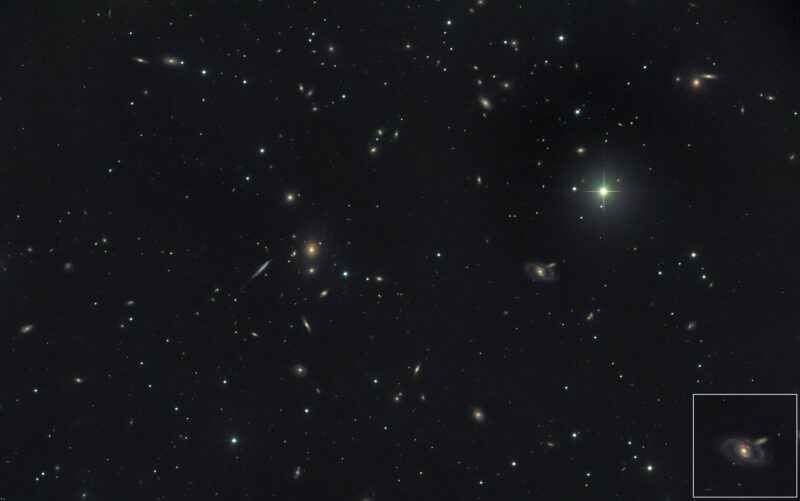
View at EarthSky Community Photos. | Eliot Herman of Tucson, Arizona, used a large remote telescope in Utah to capture this image of another distant supernova on April 8, 2026. Eliot wrote: “This is Supernova 2026ihi in galaxy NGC3681. It’s within the Leo Cluster of galaxies. Note a bright supernova; there is an inset showing its location. Galaxy clusters are the large-scale organization of the universe. They are beautiful. Deep imaging such as Hubble has shown so many clusters throughout the sky. With a half-meter scope only a few galaxy clusters are easily imaged and the Leo Cluster is among them.” Thank you, Eliot!
Bottom line: Without a doubt, you’ll enjoy this gallery of deep-sky photos for April 2026 from our EarthSky community. If you have a great photo to share, send it in, too. We love to see them!
Armando is known primarily as an astronomy educator, after 30+ years of extensive public outreach and 10 years teaching in colleges. As one of only a handful of science communicators in Puerto Rico during Comet Halley's last visit, he assumed a pioneering role starting in 1985 when science was just beginning to enter the collective mindset. Over the years, his work as a teacher, speaker and writer, inspired people to pursue interests in science and brought enduring change to Puerto Rican culture. After being accepted into the 2014–2015 Antarctic season of PolarTREC, Armando was assigned to the Amundsen-Scott South Pole Station, where in 2015 he successfully conducted 10 days of work at the IceCube Neutrino Observatory. His affiliations include Ana G. Méndez University, Cupey campus (2014 to 2021), the University of Puerto Rico, Aguadilla campus (2015 to 2017), NASA JPL's Solar System Ambassadors (2004 to 2006), and NASA Space Grant (2017 to 2019) where he served as an affiliate representative.
Like what you read? Subscribe and receive daily news delivered to your inbox.
Thank you! Your submission has been received!
Oops! Something went wrong while submitting the form.