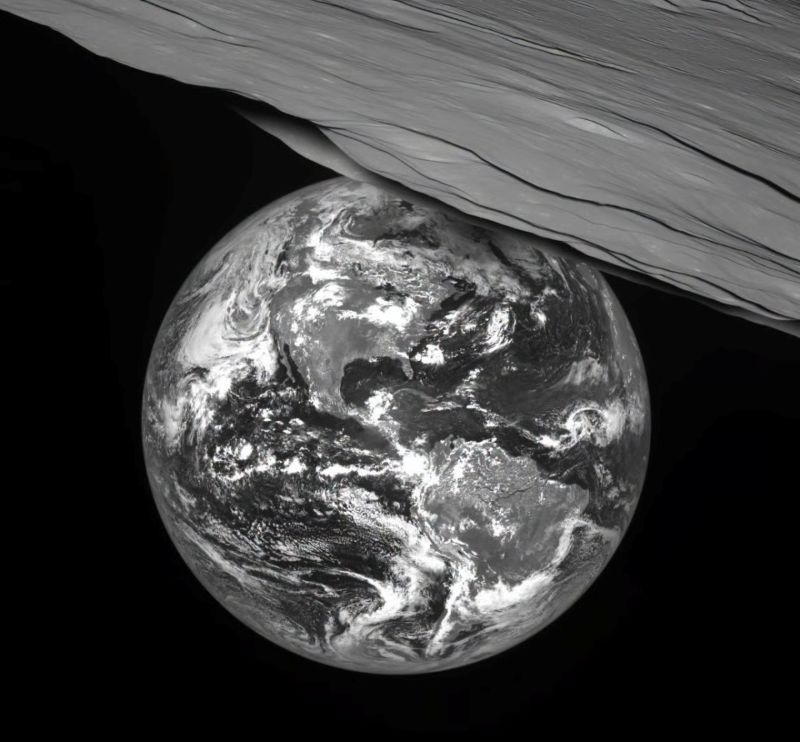
August’s solar eclipse as seen from lunar orbit
The total solar eclipse captivated millions on August 12, 2026, as it crossed from Greenland to Iceland and then swept across Spain. We’ve seen stunning images of the event – both the partial and total phase – from EarthSky community members around the world. The images show the moon as it passed in front of the sun from Earth’s point of view. And now we’ve got another incredible perspective: that of the Korean Aerospace Research Institute’s lunar orbiter Danuri, as it looked back at Earth from lunar orbit.
Danuri, which launched to the moon in 2022, began orbiting the moon on December 26 of that year. The mission will continue operations until 2027. On August 12, 2026, the Danuri space probe was near the lunar south pole, heading from the moon’s far side to the near side when it caught Earth rising. And that was also the moment the moon’s shadow was crossing Earth in the vicinity of Greenland.
Solar eclipse from 236,000 miles (380,000 km) away
The Korea Aerospace Research Institute shared the image online and said:
In the early hours of August 13 [for Korea], the sun vanished from the skies over Europe.
This marked the first total solar eclipse visible from the Spanish mainland in 121 years, since 1905. Danuri captured this moment – which was not visible from Korea – from its orbit around the moon.
While moving from the far side to the near side of the moon and approaching the lunar south pole, Danuri photographed the moment the Earth rose above the lunar surface.
Do you see the dark patch cast upon the Earth in the photo?
That is the ‘moon’s shadow’ covering the Greenland region. Some parts of the shadow fell outside the field of view, obscured by the moon itself.
Even at this very moment, Danuri is recording the cosmos—views unseen from Earth.
Other eclipse views from space
This is not the first time we’ve seen eclipses from a vantage point in space. A weather satellite from the European Union also caught the August 12, 2026, eclipse.
During the 2024 total solar eclipse, astronauts aboard the International Space Station captured a view of Earth darkened by the moon’s shadow as well.
And in 2017, NASA’s Lunar Reconnaissance Orbiter caught the total solar eclipse from lunar orbit, but this view didn’t include the moon’s limb.
So the view of the total solar eclipse crossing Earth with the moon in the foreground is a truly unique view! Someday, perhaps an astronaut will capture a view of an eclipse on Earth with the lunar soil under their feet.
Bottom line: The Korean Aerospace Research Institute’s lunar orbiter, Danuri, captured a view of the solar eclipse on August 12, 2026. This unique perspective includes the moon’s limb in the foreground.
Like what you read?
Subscribe and receive daily news delivered to your inbox.
More from
Kelly Kizer Whitt


The MMX mission launches to Mars’ moons on Monday

Visible planets and night sky guide for October
No more leap seconds! Timekeeping is officially changing
Space is getting crowded. Here’s the latest satellite report