



Get pointers on viewing the August 27-28 nearly total lunar eclipse from EarthSky’s Deborah Byrd. Watch in the player above, or on YouTube.
People in Africa, Europe, most of the Americas and the eastern Pacific Ocean will see a deep lunar eclipse overnight on August 27-28, 2026. The eclipse won’t be total. But it’ll be nearly total, with 96% of the moon within the Earth’s dark umbral shadow at mid-eclipse.
Lunar eclipses are a whole-Earth event. But you must be in nighttime when the eclipse happens, in order to see it. The half of Earth facing the full moon – that is, the whole half of Earth that’s in nighttime – will see the lunar eclipse during the exact same moments. Of course, the times shown on our clocks will be different!
From start to finish, the eclipse will last 339 minutes. And the moon will be in Earth’s dark shadow – during the partial phases of the eclipse – for 199 minutes.
Check timeanddate.com for precise timing from your location.
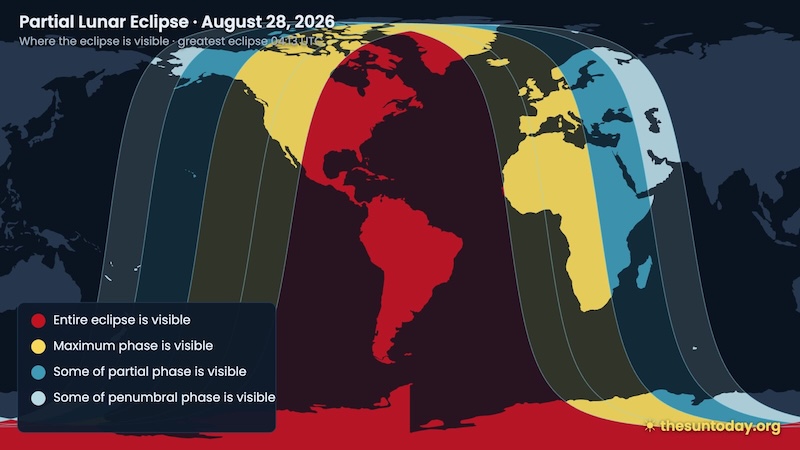
What will you see?
You don’t need any special equipment to view a lunar eclipse. Lunar eclipses are safe to view with the eye alone. But binoculars and telescopes do enhance the view.
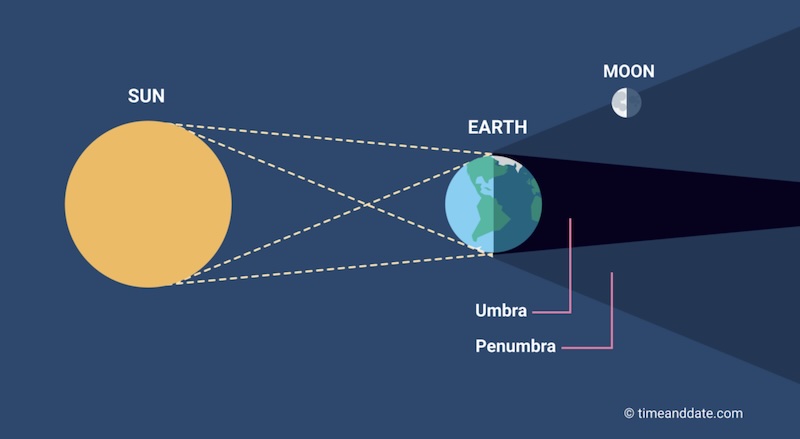
Lunar eclipses start with a subtle kind of eclipse called a penumbral eclipse. That’s when the moon is in the lighter part of Earth’s shadow, called the penumbra. Very observant people do notice Earth’s shadow on the moon during the penumbral phases of a lunar eclipse. Don’t worry if you can’t see it. The eclipse is happening! It’s just very subtle at this phase.
You will see the eclipse, for sure, when the partial eclipse begins. Then it’ll look as if a dark bite has been taken out of the moon’s face. That darkness will slowly creep across the moon’s face until the moon is almost fully submerged in Earth’s shadow.
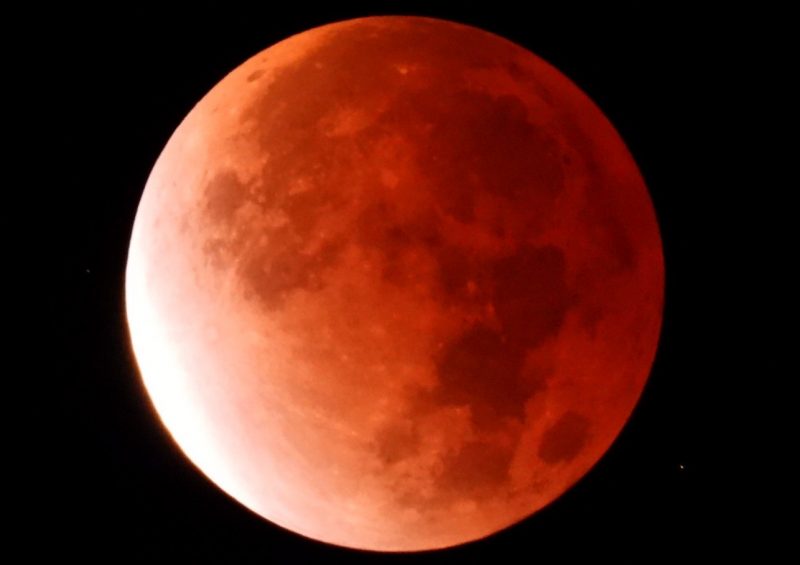
As the eclipse become deeper – and approaches maximum – you should begin to notice a red glow on the moon. There are varying opinions as to when this red color might become visible. Some say by 90%. Some say 95%. The darker your sky, the better chance you’ll have of seeing the red color sooner. Since 96% of the moon will be in Earth’s shadow at mid-eclipse, you’ll hopefully see some redness by then.
And you should see a bright white patch along the moon’s northeastern limb. That is the portion of the moon not yet submerged in the shadow. In other words, that’s the unshaded, daytime part of the moon.
Note: People in wildfire areas might have a darker eclipse. If that’s you, you might notice more of the red color during the eclipse. Or you might just see a dark eclipse. Much of your individual experience will depend on the condition of your local sky.
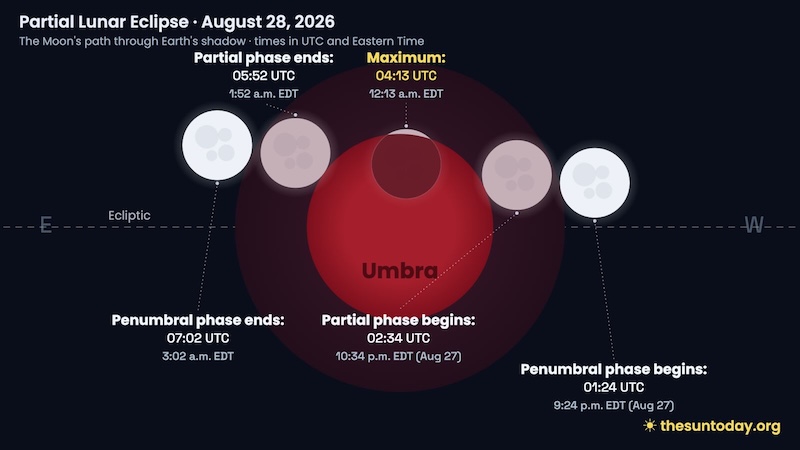
When the lunar eclipse occurs worldwide
Penumbral eclipse begins at 1:24 UTC on August 28, 2026. That’s 8:24 p.m. CDT on August 27. Earth’s lighter penumbral shadow will begin crossing the moon’s face. You probably won’t notice it at first. But, as the eclipse progresses, you should see a subtle shading on the moon.
Partial eclipse begins at 2:34 UTC on August 28, 2026. That’s 9:34 p.m. CDT on August 27. As the partial eclipse begins, it’ll appear as if a tiny, but dark, bite is taken from one edge of the moon.
Greatest eclipse at 4:13 UTC on August 28, 2026. That’s 11:13 p.m. CDT on August 27. At maximum eclipse, about 96% of the moon’s disk will lie inside Earth’s dark umbral shadow.
Partial eclipse ends at 5:52 UTC on August 28, 2026. That’s 12:52 a.m. CDT.
Penumbral eclipse ends at 7:02 UTC on August 28, 2026. That’s 2:02 a.m. CDT.
By the way, the moment of greatest eclipse takes place 5.8 days after the moon reaches apogee, its farthest point from Earth for the month of August, 2026. So the moon will be at more or less an average distance from Earth when this eclipse takes place.
Animated map of the lunar eclipse.
Moon and saros
The saros catalog describes the periodic recurrence of solar and lunar eclipses over time. Eclipses separated by one saros period (18 years, 11 days and 8 hours) belong to the same saros series and share nearly identical elements (including distance from Earth, season of the year and eclipse duration).
This August 27-28 total lunar eclipse belongs to Saros 138. It is number 29 of 82 lunar eclipses in the series. All eclipses in this series occur at the moon’s ascending node (where the moon’s path cut northward along the ecliptic, or Earth-sun plane). The moon will move southward with respect to this node with each succeeding eclipse in Saros 138.
The instant of greatest eclipse – when the axis of Earth’s shadow cone passes closest to the moon’s center – takes place at 4:12 UTC on August 28.
At that time, the moon will lie at zenith (directly overhead) at a point in the Brazilian Amazon. But, again, all of us on Earth’s night side at that moment will see the greatest eclipse.
Will everyone see the eclipse equally well?
A full moon is up all night. And – as mentioned above – a lunar eclipse is visible from all parts of Earth that are experiencing night while the eclipse is taking place.
But some will see the eclipse more clearly, or more thoroughly, than others, depending on location.
For example, some will see it at moonrise or moonset, when the moon is low in the sky.
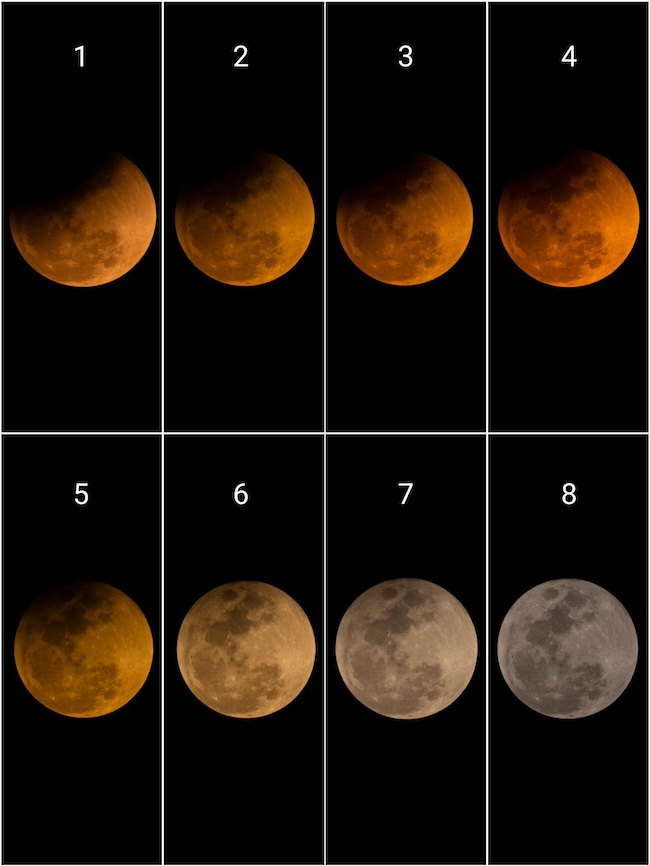
The constellation behind the partial lunar eclipse
The lunar eclipse occurs when the moon is in the constellation of Aquarius the Water Bearer.
Find the moon’s path with respect to Earth’s dark umbral and lighter penumbral shadows below.
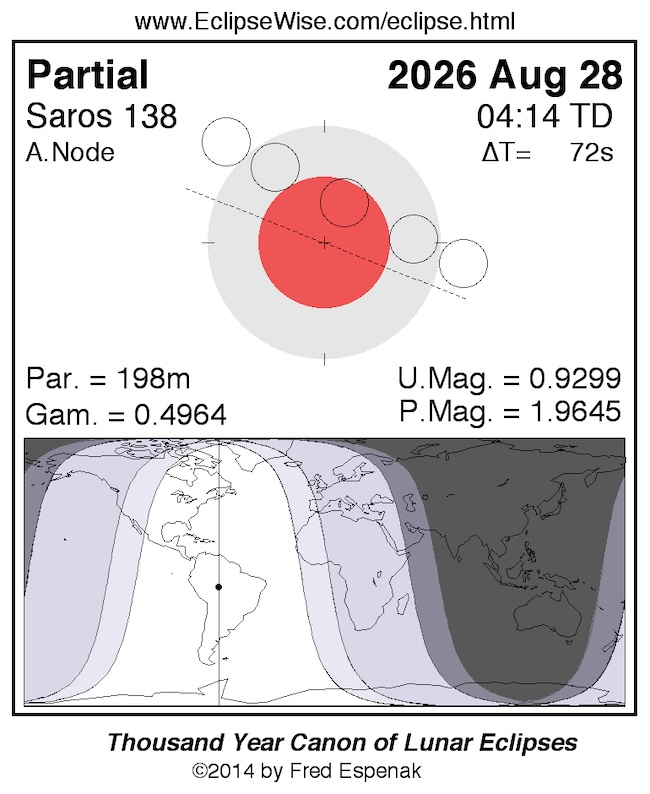
Maps and data for the total lunar eclipse
- Detailed lunar eclipse figure
- Visual Appearance of Lunar Eclipses
- Danjon Scale of Lunar Eclipse Brightness
- August 28, 2028, eclipse map animation
More resources
See Spectacular total lunar eclipse images from March 2-3, 2026
How to photograph a lunar eclipse
Submit your lunar eclipse photo to EarthSky here.
EarthSky’s monthly night sky guide: Visible planets and more
Bottom line: A deep partial lunar eclipse takes place on August 27-28, 2026, visible in Africa, Europe, most of the Americas and eastern Pacific Ocean. Maps and details here.
Like what you read?
Subscribe and receive daily news delivered to your inbox.
More from
Marcy Curran


Visible planets and night sky guide for October

Smart scopes are amazing. Here’s why I love mine
Meteor shower guide 2026: Up next … the Draconids
Teapot of Sagittarius points to the Milky Way’s center



