



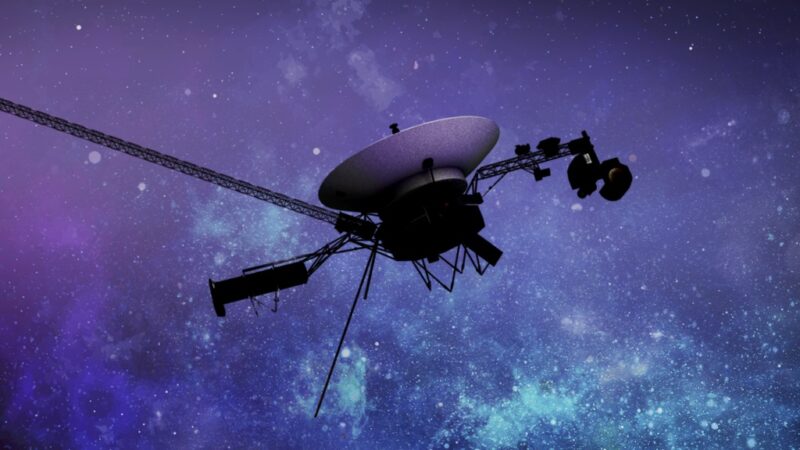
Voyager 1 to reach 1 light-day from Earth in November
Voyager 1 is the most distant human-made object from Earth. It launched into space on September 5, 1977, and visited Jupiter and Saturn before heading out of the solar system. It officially crossed out of our solar system, passing the heliopause – the sphere of the sun’s influence – back in 2012. And at 12:16:07 a.m. CST on November 18, 2026, NASA said that Voyager 1 will reach a major milestone: 1 light-day from Earth. That’s the distance it takes light to travel in 24 hours.
This historic milestone of 1 light-day is equal to about 16.1 billion miles (25.9 billion kilometers), or 173.14 astronomical units (AU). As of early October, the Voyager 1 spacecraft is about 15.98 billion miles (25.72 billion km) away from Earth. If we could peer at Voyager 1 through a telescope on Earth, the light we see left the spacecraft 23 hours, 52 minutes and 30 seconds ago. On November 18, it will breach the 24-hour mark.
And how long did it take Voyager 1 to travel 1 light-day? It took 49 years, 2 months, and 11 days to travel that distance from Earth.
What about Voyager 2?
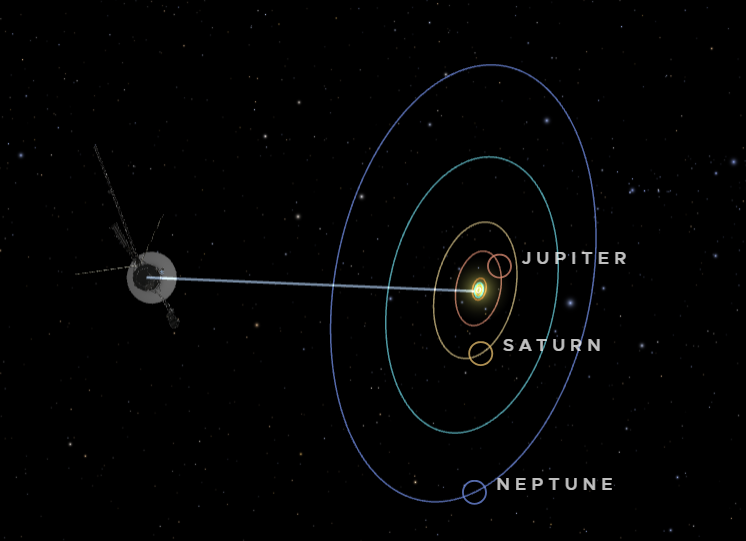
And where is Voyager 2? You might know that Voyager 2 actually launched a few weeks before its sister craft. But while Voyager 1 only visited Jupiter and Saturn, Voyager 2 took a Grand Tour, visiting all the gas giant planets: Jupiter, Saturn, Uranus and Neptune. So it’s not as far from Earth as Voyager 1.
But it’s not too far behind, relatively speaking. Voyager 2 is about 2 billion miles (3.2 billion km) closer to Earth than Voyager 1. It’s also moving a bit slower, so it can never catch up. Besides, Voyager 1 and 2 are not headed in the same direction anyway. Voyager 1 is headed “up” out of the solar plane, while Voyager 2 is headed “down.” Voyager 1 is moving toward the direction of the constellation Ophiuchus. And Voyager 2 is headed in the direction of the constellation Andromeda.
So when will Voyager 2 reach a distance of 1 light-day from us? NASA said not for nine more years, in November 2035.
Are the Voyager spacecraft still functioning?
Both Voyager spacecraft are still in communication with Earth, even though that process takes approximately a day for one-way messages. But most of the instruments on the Voyagers are no longer working. Over the years, NASA has turned off one system after another in order to save power. Just this year, in April 2026, NASA turned off the Low-Energy Charged Particle (LECP) instrument to save energy. This instrument was detecting electrons, ions and cosmic rays in the interstellar medium. But NASA could still turn it on at some point in the future for new measurements.
Both Voyager spacecraft carry a golden record that is etched with images and sounds to represent life on Earth. The golden records were a largely symbolic gesture meant to represent Earth in the wider universe and with the off-chance that an alien civilization would one day find them and learn something of their origins. As Carl Sagan said:
The spacecraft will be encountered and the record played only if there are advanced space-faring civilizations in interstellar space, but the launching of this ‘bottle’ into the cosmic ‘ocean’ says something very hopeful about life on this planet.
Bottom line: The Voyager 1 spacecraft — which launched from Earth in 1977 — will reach 1 light-day from Earth on November 18, 2026. It is the first human-made object to travel that far from Earth.
Read more: Why are the Voyager spacecraft getting closer to Earth now?
Like what you read?
Subscribe and receive daily news delivered to your inbox.
More from
Kelly Kizer Whitt


Visible planets and night sky guide for October and November

Is the Mars Grand Canyon still tectonically active?
Why does anything exist? New theory emerges
Euclid was mapping the universe. Then it found a comet



