Sun news September 30: Near-M flare! Sun waking up?

Today’s top story: Our star surprised us again over the past day. This time the sun’s activity lull was broken by a near-M flare from sunspot region AR4535. The blast, a fiery C8.6, peaked at 2:46 UTC on September 30. We can clearly see a huge chunk of solar stuff was sent to space by this eruption. Modeling and analysis is underway to see if this blast could be heading to Earth. We have been observing this sunspot region, AR4535, since it developed a gamma magnetic complexity, and it’s now showing an even-more-promising beta-gamma configuration. A spark like this is what we have all have been expecting from this region. Is this AR4535 — and the sun — waking up?
Past 24 hours on the sun
(11 UTC September 29 – 11 UTC September 30)
Flare activity: Solar activity continued at low levels during the past 24 hours, but the near-M flare increased flare activity almost to moderate levels. We have not seen an actual M flare since September 5. Observers registered 5 flares in total: 3 C-class (common) and 2 B-class (weak).
- Strongest flare: A C8.6 from AR4535, peaking at 2:46 UTC on September 30.
- Lead flare producer: There is a newcomer in the northeast that dominated, firing three of the five flares: two Cs and one B flare.
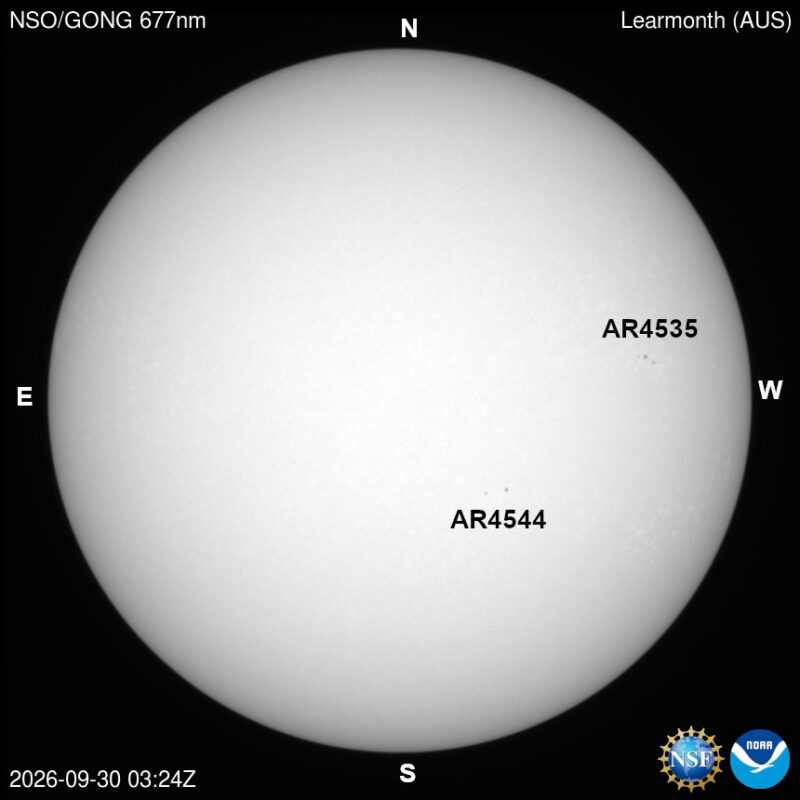
Sunspot regions: Today our sun shows two numbered sunspot regions. A newcomer in the southwest received its official number during this period: AR4544. But the sunspot region producing C and B flares in the northeast hasn’t received an official number yet.
- AR4535 (beta-gamma magnetic complexity): This region surprised with an almost-M flare during the period.
- AR4544 (beta): Newcomer numbered during this period. Remained inactive.
Blasts from the sun? All eyes concentrated on the C8.6 flare by AR4535 this morning. An imminent coronal mass ejection (CME) may be confirmed. For now specialists are running modeling and analysis to determine if there is an Earth-directed component from this event.
Past 24 hours in space weather
Solar wind: Solar wind speeds held at low at background levels as the coronal hole high-speed stream waned.
Bt, Bz and magnetic coupling: The total interplanetary magnetic field stayed weak but we saw some moderate peaks during the period. Meanwhile, once again, the north-south component (Bz) pointed mostly southward for the entire period.
Earth’s magnetic field: Geomagnetic activity continued at very quiet levels during this period. Kp index ranged from 0 to 1. At the time of this report, the Kp index sits at level 1.
What’s ahead? Sun–Earth forecast
Flare activity forecast: Forecasters expect low activity over the next few days. The C-class flare probability increased from 40% yesterday to 45% today. Chance of M-class (moderate) activity stays at 15% but it may increase due to active region AR4535’s flare activity. It is now the only region to watch, given its beta-gamma configuration.
Geomagnetic activity forecast:
- September 30: Mostly quiet conditions anticipated for the rest of the day. No auroras are expected at typical viewing latitudes.
- October 1: Quiet geomagnetic conditions may extend through tomorrow under ambient solar wind.
- October 2: Conditions may change with the arrival of the chunk of solar stuff the sun hurled out on September 28. G1 (minor) geomagnetic storms are possible. Heads up, aurora chasers, and clear skies!
Sun news September 29: Huge eruption sends blob to Earth!


Yesterday, amid a period of solar calm, the sun took us by surprise. A huge eruption blasted from a filament in the northwest. The filament began lifting plasma at around 13 UTC and ended in a powerful eruption. That fiery blast hurled plasma into space as a chunk of solar stuff, known as a coronal mass ejection (CME). Early analysis suggests part of it may head straight for Earth, with arrival estimated by October 2. If it does, it could disturb Earth’s magnetic field up to G1 (minor) geomagnetic storm levels. That could trigger auroras at northerly latitudes.
Past 24 hours on the sun
(11 UTC September 28 – 11 UTC September 29)
Flare activity: Solar activity stayed low during the past 24 hours. Observers recorded 8 faint flares in total: 3 C-class (common) and 5 B-class (weak).
- Strongest flare: A C2.5 from AR4536, peaking at 15:19 UTC on September 28.
- Lead flare producer: AR4536 dominated, firing seven of the eight flares: 3 Cs and 4 Bs. In fact, it would have produced every flare of the period, if not for a single faint B flare from an as-yet-unnumbered newcomer.
Sunspot regions: Currently, the solar disk as seen from Earth shows only one numbered sunspot region, now that AR4536 has departed. Meanwhile, a newcomer in the northeast produced a B flare this morning. It hasn’t received an official number yet.
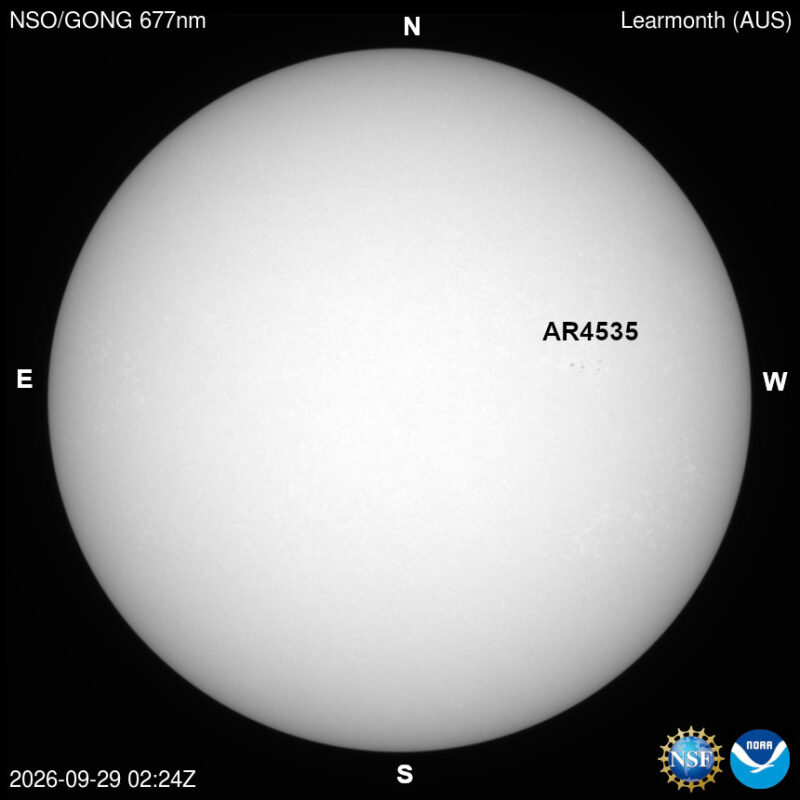
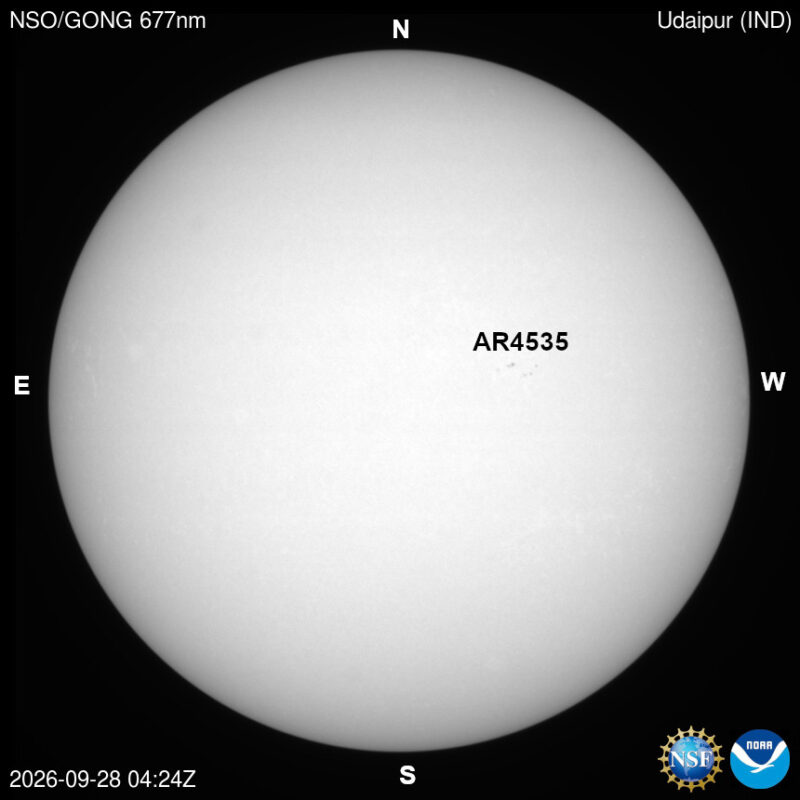
- AR4535 (beta-gamma): This region grew during the period and developed a gamma magnetic complexity. Even so, it produced no flares.
- AR4536 (beta): This region produced nearly every flare of the period. However, by the time of this writing, the sun’s rotation has carried it out of view over the west limb.
Blasts from the sun? The filament eruption described above produced a CME. Initial analysis suggests it carries an Earth-directed component. It could arrive on October 2 and bring conditions for a G1 (minor) geomagnetic storm. Further modeling and analysis continue.
Past 24 hours in space weather
Solar wind: Solar wind speeds held at low, background levels as the coronal hole high-speed stream waned.
Bt, Bz and magnetic coupling: The total interplanetary magnetic field (Bt) stayed weak. Meanwhile, the north-south component (Bz) pointed mostly southward for the entire period, with only a couple of weak northward peaks. At the time of this writing, it still points south.
Earth’s magnetic field: Geomagnetic activity stayed quiet (Kp 0 to 2) during the period. At the time of this report, the Kp index sits slightly above level 0.
Sun news September 28: Fast solar wind fades, quiet sun returns
The sun is taking a breather. Solar activity dropped to low levels over the past 24 hours, with only small C-class (common) flares popping off from a handful of modest sunspot regions. And conditions are quiet around Earth too, with fast solar wind from a coronal hole finally ceasing to disturb our planet’s magnetic field. Forecasters expect this tranquil stretch to continue for the next few days.
Past 24 hours on the sun
(11 UTC September 27 – 11 UTC September 28)
Flare activity: Solar activity stayed low. Observers recorded several small C-class flares during the period.
- Strongest flares: We saw only C1-level flares, from AR4534, AR4535 and AR4536.
- Lead flare producer: AR4535 and AR4536 shared the low-level flaring. AR4534, sitting at the west limb, also contributed as it rotated out of view.
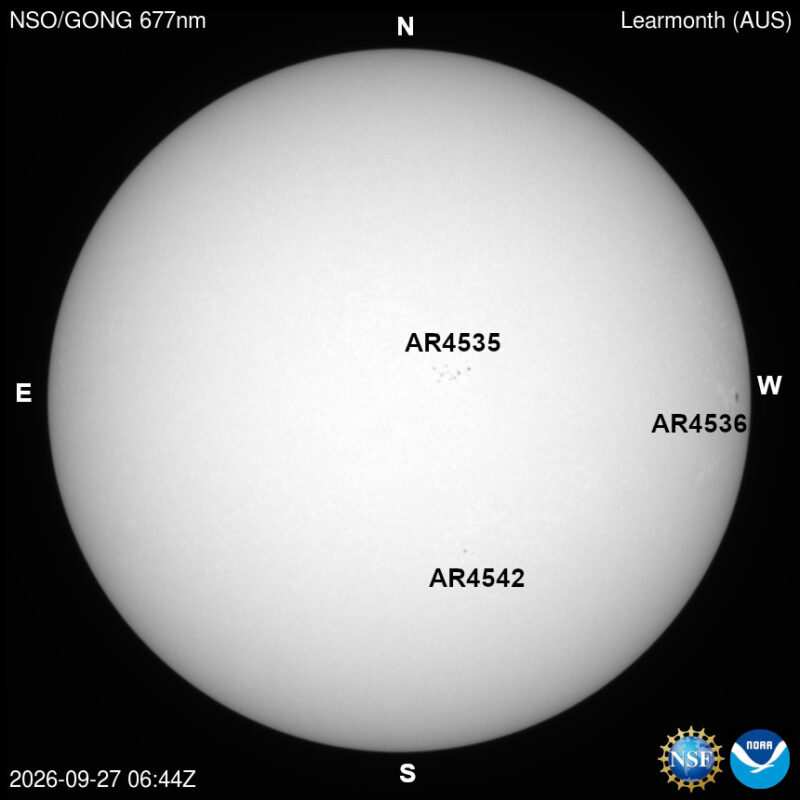
Sunspot regions: SWPC lists three numbered active regions. The SIDC counts five groups on the disk, though some are decaying or about to rotate off the west limb.
- AR4534: This region fired the strongest recent flare, a C3.1. However, it now sits at or behind the west limb. So its Earth-facing influence is effectively over.
- AR4535 (beta): This is the most notable region left near the center of the disk. Forecasters noted additional spot development during the period. Still, its simple beta configuration limits its flare potential.
- AR4536 (beta): This region is approaching the west limb. It produced small C-class flares but will soon rotate out of view.
Blasts from the sun? Analysts detected no Earth-directed coronal mass ejections (CMEs) in available coronagraph imagery.
Past 24 hours in space weather
Solar wind: Solar wind speeds gradually decreased to background conditions as the coronal hole high-speed stream waned.
Bt, Bz and magnetic coupling: The total interplanetary magnetic field (Bt) stayed weak. Meanwhile, the north-south component (Bz) fluctuated between northward and southward.
Earth’s magnetic field: Geomagnetic activity reached unsettled to active levels (Kp 3 to 4) early on, driven by the tail end of the coronal hole stream. Conditions then calmed to mostly quiet (Kp 0 to 2). No geomagnetic storms occurred.
The sun in recent days
Earlier sun images
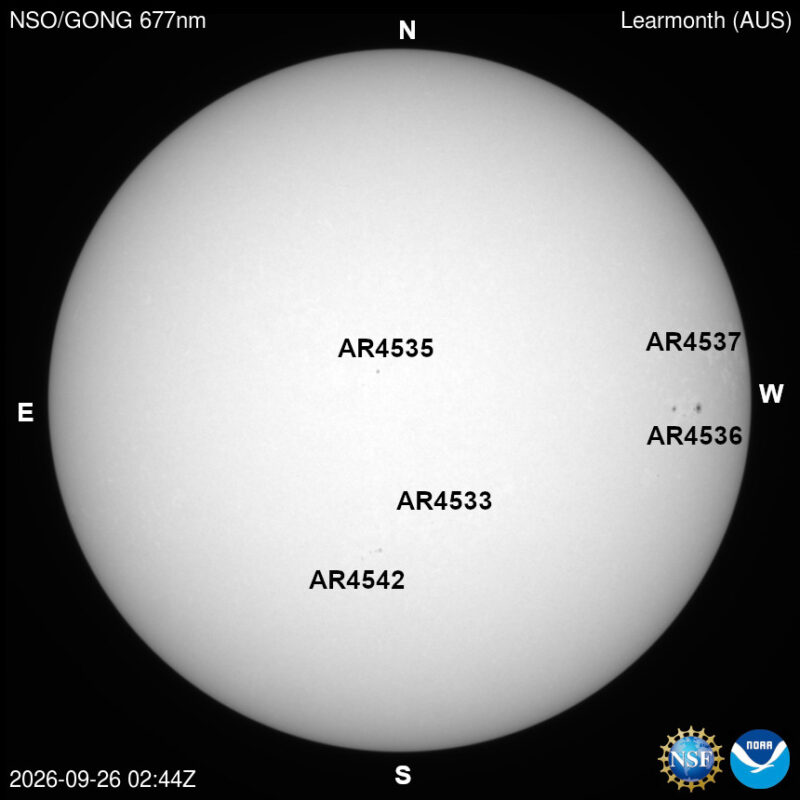
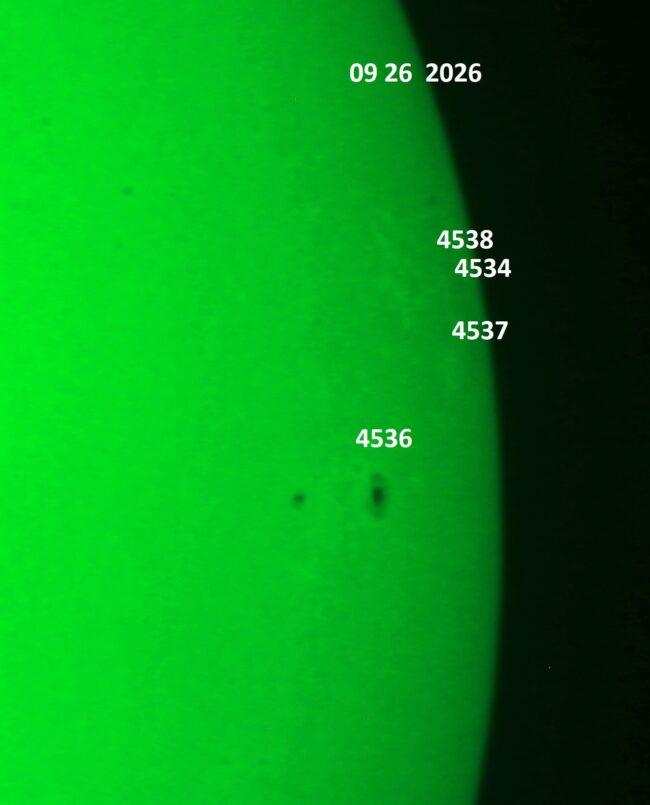
Sun images from our community
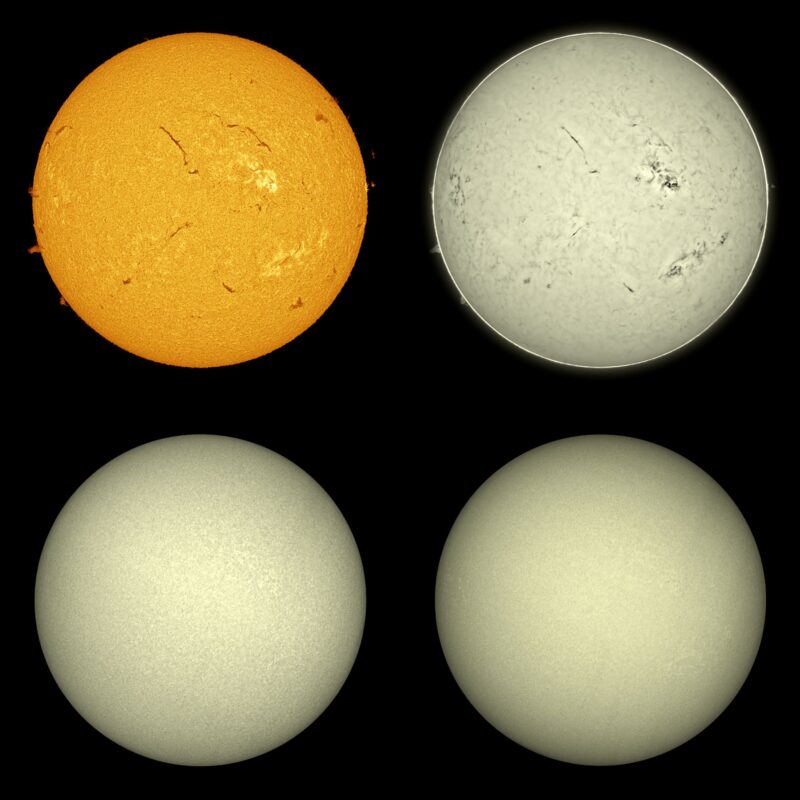
We sometimes feature sun images obtained using hydrogen-alpha filters. Read why.
Bottom line: Sun news, September 30, 2026: Our star surprised us with an almost-M flare. It was a C8.6 flare from active region AR4535. Is the sun waking up?
Like what you read?
Subscribe and receive daily news delivered to your inbox.
More from
C. Alex Young


Yes, there’s an aurora season, and it’s here

Sun activity archive for July 2026
Sun activity archive for June 2026
Sun activity archive for May 2026