Sun news June 30 : Two M flares, three potent sunspot regions!
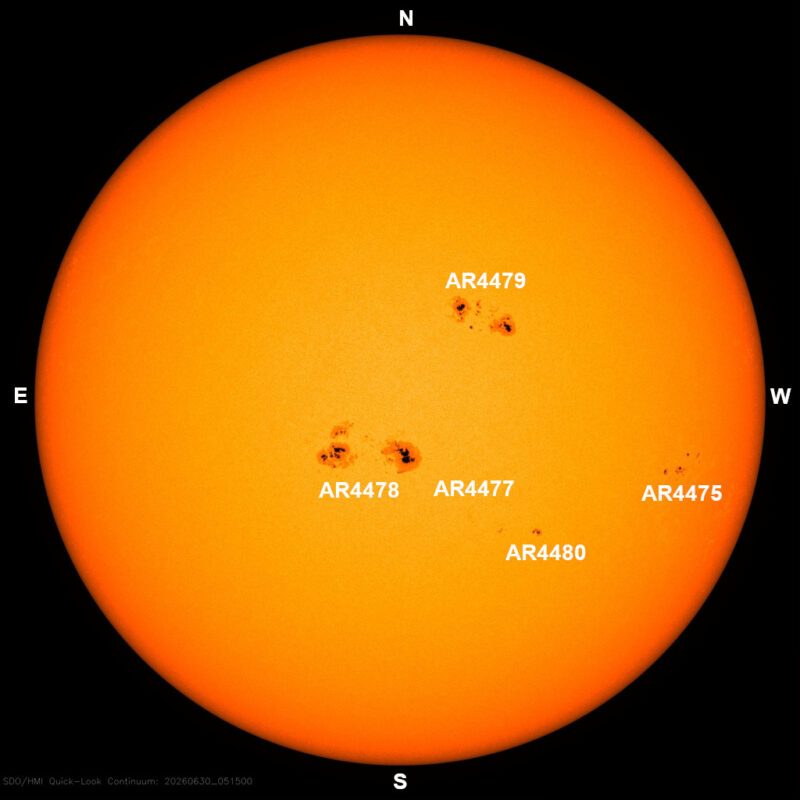
Over the past day, the sun blasted out 2 M (moderate) flares: an M1.4 at 21:40 UTC last night from sunspot region AR4479, and an M1.3 at 1:16 UTC this morning from AR4475. Excitingly, both of these regions – along with AR4478 – have the highest possible level of magnetic complexity, beta-gamma-delta. That means they have a strong potential to fire more M flares and even X (strong) flares! Meanwhile at Earth, we are awaiting the arrival of a coronal mass ejection (CME) fired late on Friday, June 26, which could trigger a G1–G2 (minor to moderate) geomagnetic storm. Stay tuned!
Past 24 hours of sun news
(11 UTC June 29 – 11 UTC June 30)
Flare activity
Over the past day, solar activity continued at moderate levels. In total, the sun fired 17 flares: 2 M-class and 15 C-class (common) events.
- Strongest flare: M1.4 from AR4479, peaking at 21:40 UTC on June 29. It triggered an R1 (minor) radio blackout over the Pacific Ocean northeast of Hawaii.
- Second M flare: M1.3 from AR4475 at 1:16 UTC on June 30. It also triggered an R1 (minor) radio blackout over the Pacific Ocean.
- Lead flare producer: AR4475 topped the list with 10 of the 17 flares, including one of the M-class events. Meanwhile, AR4479 contributed 5 flares, including the period’s strongest.
Sunspot regions
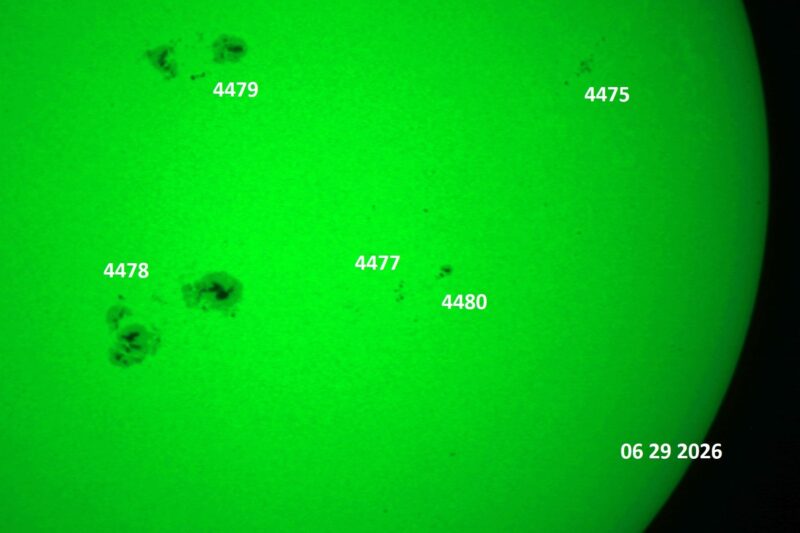
Currently, the Earth-facing solar disk shows 5 numbered active regions. Three carry notable magnetic complexity.
AR4478 (beta-gamma-delta) remains the largest region on the disk. It showed slight growth in its intermediate area. And it remains capable of producing significant flares as it moves toward the center of the solar disk.
AR4479 (beta-gamma-delta) continued to evolve, acquiring additional magnetic complexity over the past day and reaching the strongest possible classification: beta-gamma-delta.
AR4475 (beta-gamma-delta) developed a delta component and joins the new triumvirate of beta-gamma-delta active regions. This region was the leading flare producer of the period.
Blasts from the sun?
The two M-class flares produced during this period are under modeling and analysis to determine if a component is heading our way at Earth. No newer coronal mass ejections (CMEs) appeared in available coronagraph imagery.
Past 24 hours in space weather
Solar wind
Solar wind conditions reflected the continued weakening of a coronal hole high-speed stream. Speeds decreased from moderate to moderate-low levels by the end of the period. Meanwhile, the total interplanetary magnetic field continued at weak levels.
Bz and magnetic coupling
The Bz component pointed northward late on June 29. Then it shifted southward around 18 UTC on June 29 and held that orientation through the rest of the period. At the time of this writing, the Bz remains southward oriented. But the arriving CME later today could change that picture dramatically.
Earth’s magnetic field
Over the past day, Earth’s magnetic field stayed very quiet (Kp 0–1). No geomagnetic storm conditions occurred. But that quiet is about to end. The June 26 CME is on its way. At the time of this writing, Earth’s magnetic field remains quiet at just above Kp 0.
What’s ahead? Sun–Earth forecast
Flare activity forecast
Forecasters raised their outlook to low-to-moderate levels as three sunspot regions developed complex configurations. The chance for M-class flares increased from 50% yesterday to 60% today. And the chance for an X-class event holds steady at 10%.
Geomagnetic activity forecast
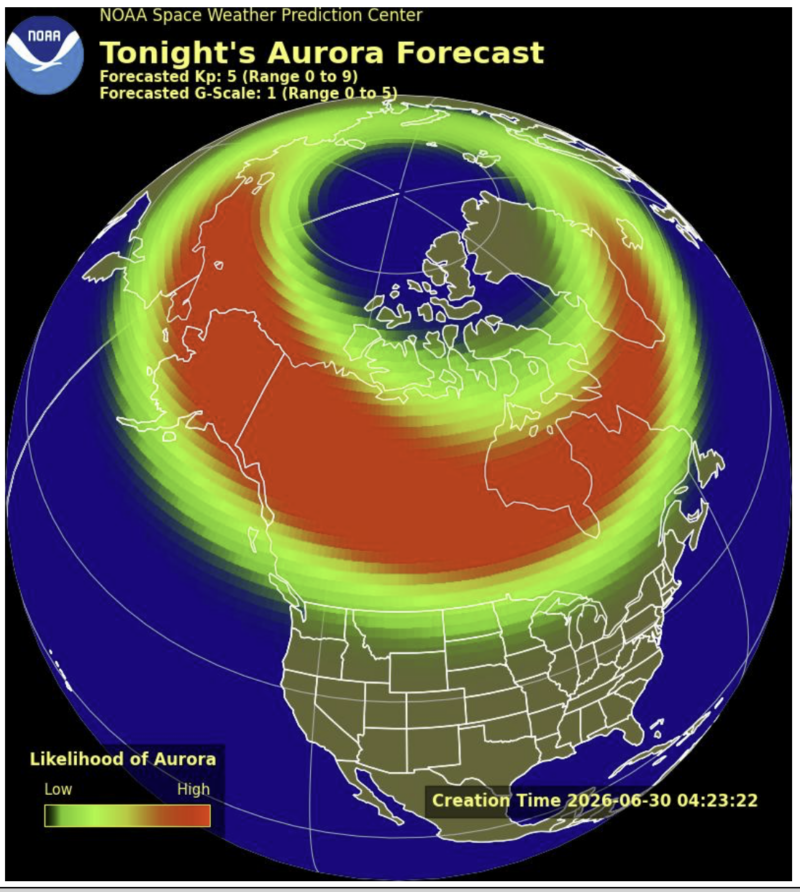
- June 30: The main event. Expect unsettled-to-active conditions with isolated G1 (minor) storm periods likely and a chance of G2 (moderate) conditions as the June 26 CME arrives.
- July 1: Unsettled-to-active conditions are possible as a second CME from June 27 arrives. But expectations stay modest given that CME’s low speed.
- July 2: Expect waning unsettled-to-active conditions as lingering CME effects fade. Geomagnetic conditions should gradually return to quiet levels.
Sun news update: Bam!! X flare!

Our star just produced an X flare, the largest-category flare there is. It was not a surprise. It was just a matter of time. That’s because we have three sunspot regions showing the highest possible level of magnetic complexity; AR4479, AR4478 and AR4475. Any of these active regions could have produced this blast. But, in the end, it was AR4479 in the northwest that produced this X1.1 flare. The event peaked at 20:50 UTC on June 30. It provoked an R3 (strong) radio blackout that affected an area over the Pacific Ocean, east of Hawaii. The blast will be under modeling and analysis in the coming hours to find any component of solar stuff coming to us at Earth. Check back in the morning for more updates. We will update around 11 UTC on Wednesday, July 1.
Sun news June 29: A near M-flare while waiting for CME
The sun maintained a steady drumbeat of moderate activity over the past 24 hours. We saw 16 C flares, including one that was nearly an M (moderate) flare: a C9.5 (common) from sunspot region AR4475, fired at 21:17 UTC last night. Meanwhile at Earth, we’re awaiting the arrival of a coronal mass ejection (CME) that was fired late on Friday. This burst of sun-stuff is expected to reach us tomorrow, bringing the potential for G1–G2 (minor to moderate) geomagnetic storms. Plus, a second slower CME from June 27 may follow late on July 1 or into July 2, potentially extending unsettled conditions and keeping aurora watchers on alert.
Past 24 hours of sun news
(11 UTC June 28 – 11 UTC June 29)
Flare activity
Over the past day, solar activity held at low to moderate levels. In total, the sun fired 16 C-class flares.
- Strongest flare: C9.5 from AR4475, peaking at 21:17 UTC on June 28.
- Other notable flares: A C8.7 from AR4479 at 21:55 UTC on June 28, a C8.1 from AR4479 at 8:06 UTC on June 29 and a C6.6 from AR4479 at 7:40 UTC on June 29.
- Lead flare producer: AR4479 topped the list with 9 of the 16 flares, including three above C5.0. Meanwhile, AR4478 contributed 3 flares, AR4477 added 2 low-level events and AR4475 contributed 2 flares including the period’s strongest.
Sunspot regions
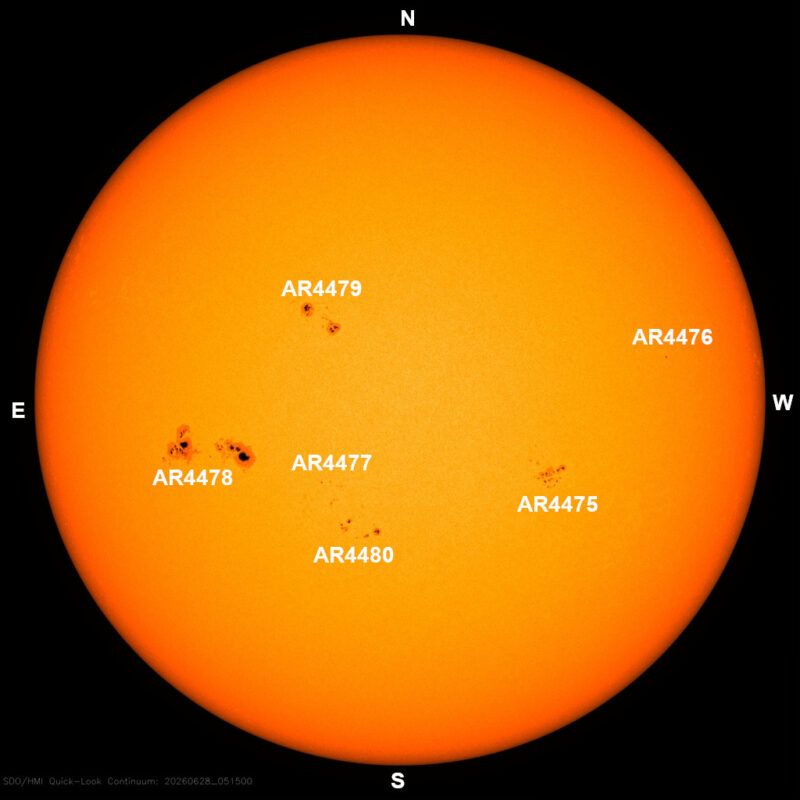
The Earth-facing solar disk shows at least 6 numbered active regions. Three carry notable magnetic complexity.
AR4478 (beta-gamma-delta) remains the most magnetically complex region on the disk. It showed slight growth in its intermediate area. And it remains capable of producing significant flares as it moves toward the center of the solar disk.
AR4479 (beta) was the most active flare producer by far, generating 9 C-class flares. And it continues to develop, acquiring additional magnetic complexity over the past day.
AR4475 (beta-gamma) continues to decline slowly, but it still produced the period’s strongest flare.
AR4477 contributed 2 low-level C-class flares. The remaining regions on the disk were mostly unchanged, showing simple magnetic configurations and remaining inactive or in gradual decline.
Blasts from the sun?
Several CMEs were observed during the period, but none of the newly detected events carry a significant Earth-directed component. The focus remains on two earlier CMEs now en route to Earth.
June 26 CME: the main event. This eruption, directed mainly southward but with an Earth-directed component, is expected to arrive tomorrow morning and trigger a G1 (minor) or G2 (moderate) geomagnetic storm.
June 27 CME: This faint, slow CME from the area around AR4475 is harder to model. A very low-confidence estimated arrival sits around 8:00 UTC on July 1. Kp estimates range from 2 to 4, suggesting quiet-to-unsettled conditions if it arrives.
Past 24 hours in space weather
Solar wind
Solar wind conditions reflected the continued weakening of a coronal hole’s high-speed stream. Speeds decreased to normal levels by the end of the period. Meanwhile, the total interplanetary magnetic field stayed weak.
Bz and magnetic coupling
The Bz component showed no sustained southward excursions. As a result, Earth’s magnetic shield stayed firmly closed and aurora potential remained limited. But the arriving CME on June 30 could change that picture dramatically.
Earth’s magnetic field
Over the past day, Earth’s magnetic field stayed quiet (Kp 1–2). No geomagnetic storm conditions occurred. But that quiet is about to end. The June 26 CME is on its way.
Sun news June 28: Possible G2 storm due overnight June 29? Aurora alert!

A coronal mass ejection (CME) that erupted from the sun late on June 26 is forecast to arrive at Earth early on June 30 (overnight on June 29 according to clocks in the Americas). It could potentially drive G1–G2 (minor to moderate) geomagnetic storming. If so, it could keep aurora-watchers across Earth’s northerly latitudes on the alert through midweek. The sun continued churning out a steady stream of C-class flares over the past 24 hours, with AR4475 firing flare after flare including a notable double-peaked C7.4/C7.5 event around 21:00 UTC on June 27, and despite its visually decaying appearance, AR4475 remained the most prolific flare producer on the disk while AR4478, the most magnetically complex region currently facing Earth with its beta-gamma-delta configuration, continued growing and developing intermediate spots, keeping forecasters watchful for a potential upgrade to M-class activity in the coming days.
Past 24 hours of sun news
(11 UTC June 27 – 11 UTC June 28)
Flare activity
Over the past day, solar activity remained at low levels. In total, the sun fired 9 C-class flares. No M-class or X-class events occurred.
- Strongest flare: C7.5 from AR4475 (S06W20) peaking at 21:06 UTC on June 27. This was part of a long-duration double-peaked episode. A C7.4 peaked just minutes earlier at 20:53 UTC, followed immediately by the C7.5 at 21:06 UTC.
- Lead flare producer: AR4475 dominated the period, firing 8 of the 9 C-class flares despite showing an overall decaying sunspot structure. A reminder that the sun does not always follow the textbook.
Sunspot regions
The Earth-facing solar disk showed 7 numbered active regions.
AR4478 (beta-gamma-delta) remains the most magnetically complex region on the disk. It continued developing intermediate spots and showed overall growth. Its weak delta configuration persists. And as it transits toward the disk center over the coming days, its potential for stronger flares increases. AR4475 (beta-gamma) continued an overall decaying trend in its sunspot structure. But, it remained the most flare-productive region of the period. It fired the double-peaked C7.4/C7.5 episode and multiple other C-class events.
Blasts from the sun?
No new Earth-directed CMEs appeared in available coronagraph imagery during the reporting period. Several CMEs were detected in LASCO imagery from the evening of June 27, including a fast event at 936 km/s at 19:12 UTC. But none carried Earth-directed components. The broad, double-peaked C7.4/C7.5 flare from AR4475 produced a weak CME that is still being analyzed.
Past 24 hours in space weather
Solar wind
Solar wind conditions remained slightly elevated as the influence of a coronal hole high-speed stream continued to weaken. Speeds began the period near 675 km/s. Then they gradually declined to approximately 525 km/s by the end of the period. Meanwhile, the total interplanetary magnetic field (IMF) averaged a modest 2–4 nT.
Bz and magnetic coupling
The Bz component oscillated between +3 and ?3 nT. It never sustained a strong southward orientation long enough to drive significant geomagnetic activity. As always, a sustained southward Bz is what opens the door for significant auroral displays. The arriving CME on June 30 could deliver exactly that.
Earth’s magnetic field
Over the past day, Earth’s magnetic field ranged from quiet to unsettled levels (Kp up to 3). No geomagnetic storm thresholds were reached. But conditions are expected to become more active as the week progresses and the June 26 CME approaches.
What’s ahead? Sun–Earth forecast
Flare activity forecast
Forecasters expect predominantly low levels to continue through June 29–30. But the chance for M-class (R1–R2) flares sits at 50% or greater. And a slight chance (10%) exists for X-class (R3) flares. The primary candidate is AR4478, whose beta-gamma-delta configuration and ongoing growth make it the most likely source of a significant eruption. And AR4475 continues producing frequent C-class flares despite its decaying structure. AR4480 also warrants monitoring as it develops.
Geomagnetic activity forecast
- June 28: Expect active conditions as the negative-polarity coronal hole stream continues to wane. The June 22 CME may also arrive early today, providing additional solar wind enhancements. Kp values of 3–4 are likely, with isolated active periods possible. Aurora stays confined to the auroral zone: Alaska, northern Canada, Iceland, and northern Scandinavia. And short summer nights further constrain any viewing window.
- June 29: Expect a return toward quieter background conditions as the coronal hole stream and any June 22 CME effects dissipate. Mostly quiet conditions forecast (Kp 1–3).
- June 30: The main event arrives. The June 26 CME should reach Earth early to mid-day, between approximately 6:00–11:01 UTC. NOAA forecasts active to isolated G1 (minor) geomagnetic storm conditions. And the UK Met Office raises the possibility of G2 (moderate) storms if a trailing magnetic cloud delivers a sustained southward Bz. Kp could reach 4–5. If so, aurora may reach Seattle, Minneapolis, Edinburgh, and the Scottish Highlands. Storm effects could linger into July 1 as the slower June 27 CME may also arrive around 8:00 UTC. Share your aurora photos with us!
Sun news June 27: Action on sun’s far side over the past day


In addition to a big CME over the sun’s south pole, the past day featured a couple of beautiful jet-like prominences from the sun’s south and southeast, and a third dancing above the solar south pole. All three came from the far side of our star over the past day. Meanwhile, on the Earth-facing disk, two powerhouse sunspot regions – AR4478 with its beta-gamma-delta configuration and AR4475 with its beta-gamma – stayed relatively calm. They produced only C-class flares. Perhaps they’re building up potential for M- or even X-class flares in the coming days? We’ll keep watching and bring you the latest. Stay with us!
Past 24 hours of sun news
(11 UTC June 26 – 11 UTC June 27)
Flare activity
Over the past day, solar activity held at low levels. The sun fired only C-class flares, 10 in total.
- Strongest flare: C5.8 from AR4478 in the sun’s southeast, peaking at 12:48 UTC on June 26.
- Lead flare producer: Sunspot region AR4475 produced 5 C flares. And the other large sunspot region, AR4478, fired 4 C-class flares. Finally, an incoming as-yet-unnumbered region in the sun’s southwest contributed one C-class flare.
Sunspot regions
Currently, the Earth-facing solar disk shows 5 numbered active regions. AR4478 stands out as the largest in extent. It carries a beta-gamma-delta magnetic configuration, the strongest classification there is. This region carries real potential for M-class and even X-class flares. It is the main region to watch on the Earth-facing disk right now.
AR4475 retained its beta-gamma complexity. It is the 2nd-largest active region on the disk now.
The remaining active regions carry simpler alpha or beta configurations.
Blasts from the sun?
A coronal mass ejection (CME) appeared in SOHO LASCO C2 imagery at 21:36 UTC on June 26, launching over the solar south pole. No flare on the Earth-facing disk was associated with this event. That means the blast originated either from the very edge of the sun’s southern horizon, or from the far side. No Earth-directed component has been identified so far.
Past 24 hours in space weather
Solar wind
Solar wind speeds climbed to moderate-high levels for most of the period. Then they slowly dropped back to moderate levels starting at 5:30 UTC on June 27. A pattern similar to what we observed yesterday. At the time of this writing, speeds hold at moderate levels. Meanwhile, the total interplanetary magnetic field (IMF) stayed at weak levels throughout the period.
Bz and magnetic coupling
The Bz component pointed mostly southward for most of the period. A couple of weak northward peaks appeared late on June 26. But at the time of this writing, the Bz has returned to a northward orientation. As always, a sustained southward Bz is what opens the door for significant auroral displays.
Earth’s magnetic field
Over the past day, Earth’s magnetic field ranged from quiet to unsettled (Kp 2–3). Currently, the Kp index sits at level 2.
What’s ahead? Sun–Earth forecast
Flare activity forecast
Forecasters expect low to moderate levels of flare activity to continue through June 28. The chance for M-class flares holds at 50% today. And the chance for X-class (strong) flares also holds at 10% today. The main drivers are AR4478 with its beta-gamma-delta configuration and AR4475 with its beta-gamma setup. These two remain the most magnetically complex regions on the disk.
Geomagnetic activity forecast
- June 27–28: Expect active conditions (Kp 2–4) with chances of geomagnetic storming periods. Fast solar wind from a coronal hole continues driving conditions. And late on June 28, the arrival of a CME that left the sun on June 22 may add further enhancements. A chance of isolated G1 (minor) geomagnetic storm intervals (Kp 5) exists late on June 28. Aurora watchers at high latitudes should stay alert!
- June 29: Expect Earth’s geomagnetic activity to return to quiet levels as CME and coronal hole influences fade.
Sun news June 26: AR4478 is a monster sunspot region!

Hotly anticipated sunspot region AR4478 has finally rotated into clear view, and it’s a monster! Specialists have now been able to confirm that this region has the strongest possible magnetic complexity: beta-gamma-delta. Combined with its impressive size, this region therefore holds good potential for strong M flares and even X-class flares in the coming days. We’ll keep watching and bring you the latest. Stay tuned!
Past 24 hours of sun news
(11 UTC June 25 – 11 UTC June 26)
Flare activity
Over the past day, solar activity held at low. In total, the sun produced 8 C-class flares. Flare production continued from the active regions in the southeast quadrant.
- Strongest flare: C6.6 from AR4478 in the southeast, peaking at 15:03 UTC on June 25.
- Lead flare producer: AR4478 topped the list. It fired 6 of the 8 C-class events. Meanwhile, AR4477 and AR4475 each contributed one C-class flare.
Sunspot regions
The Earth-facing solar disk shows 7 numbered active regions.
AR4478 is now the standout. With it in a better position for analysis, specialists confirmed a beta-gamma-delta magnetic configuration. That is the strongest classification there is. And its sheer extent makes it one of the more impressive regions we have seen in recent weeks. Our initial impressions were not short of the mark. This region carries real potential for M-class and even X-class flares.
AR4475 retained its beta-gamma complexity. Together, AR4478 and AR4475 carry the highest flare potential on the disk right now.
Blasts from the sun?
Available coronagraph imagery showed no Earth-directed coronal mass ejections (CMEs) during the period.
Past 24 hours in space weather
Solar wind
Solar wind speeds averaged moderate-high levels for most of the period. Then they slowly dropped to moderate levels starting at 4:30 UTC on June 26. At the time of this writing, speeds hold at moderate levels. Meanwhile, the total interplanetary magnetic field (IMF) decreased from moderate to weak levels throughout the period.
Bz and magnetic coupling
The Bz component shifted intermittently between south and north throughout the period. At the time of this writing, the Bz is northward. A sustained southward Bz is what opens the door for significant auroral displays.
Earth’s magnetic field
Over the past day, Earth’s magnetic field ranged from unsettled to active (Kp 2–4). No G1 (minor) geomagnetic storm conditions occurred during this period. The Kp 4 threshold was reached at 19:40 UTC on June 25. Currently, the Kp index sits just above level 2.
Sun news June 25: Surprise geomagnetic storm hits overnight
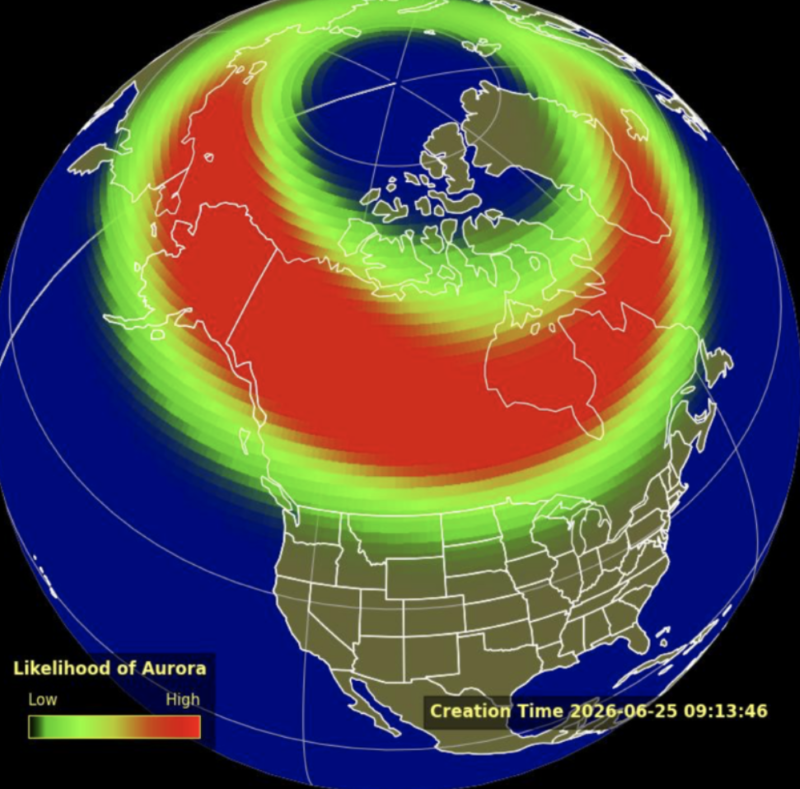
Bam! A surprising G1 (minor) geomagnetic storm arrived overnight. It came as fast solar wind from a coronal hole buffeted Earth’s magnetic field, combining with a complex knot of solar winds known as a co-rotating interaction region (CIR). Effects from a glancing blow of the CME hurled into space on June 20 also might have contributed. The disturbance crossed the G1 (minor) storm threshold at 4:43 UTC this morning. More active and storming periods are possible during the rest of today and through June 27. Stay tuned!
Past 24 hours of sun news
(11 UTC June 24 – 11 UTC June 25)
Flare activity
Over the past day, solar activity continued at low levels. In total, the sun sparked 16 C-class flares. The bulk originated from the incoming regions in the southeast quadrant.
- Strongest flare: C4.3 from newcomer AR4478 in the southeast at 0:22 UTC on June 25.
- Lead flare producer: AR4478 topped the list. It fired 10 C-class events. Meanwhile, AR4475 closely followed with 5 C-class flares. The remaining flare came from elsewhere on the disk.
Sunspot regions
Currently, the Earth-facing solar disk shows 7 numbered active regions.
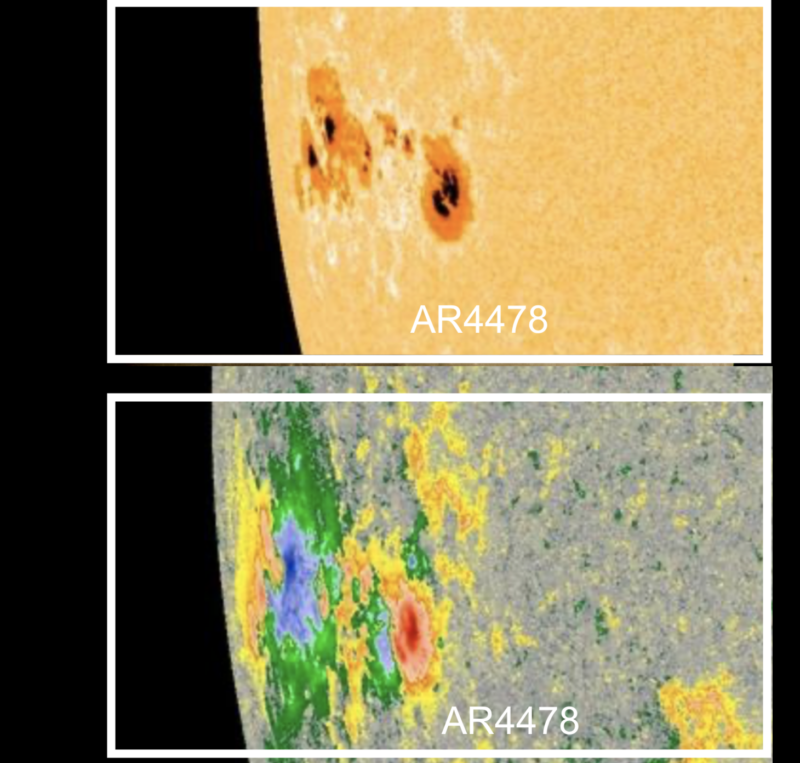
AR4478 is the newcomer making waves. The large active region we noted yesterday rotating onto the southeastern limb received its official number during this period. It still sits too close to the southeast horizon for a complete analysis. But initial impressions suggest a beta-gamma configuration. And given how large this region appears, its true complexity may be even greater once it rotates further into view. Forecasters will release a more complete analysis as it becomes clearer.
AR4475 also carries a beta-gamma complexity. Together, these two regions carry the highest flare potential on the disk right now.
Blasts from the sun?
Available coronagraph imagery showed no Earth-directed coronal mass ejections (CMEs) during the period.
Past 24 hours in space weather
Solar wind
Solar wind speeds stayed at background levels late on June 24. But at 20 UTC, they climbed sharply to moderate-high levels. And they held there through 11 UTC on June 25 at the time of this writing. Meanwhile, the total interplanetary magnetic field (IMF) ranged from strong to moderate levels throughout the period.
Bz and magnetic coupling
The Bz component pointed southward for much of the period. A few northward peaks occurred starting at 2:44 UTC on June 25. As always, a sustained southward Bz is what opens the door for significant auroral displays.
Earth’s magnetic field
Over the past day, Earth’s magnetic field ranged from unsettled to active (Kp 3–5). A G1 (minor) geomagnetic storm period occurred. The Kp 5 threshold was reached at 4:43 UTC on June 25. And at the time of this writing, storming conditions continue.
Sun news June 24: Powerful sunspot group rotating into view
A large, complex sunspot group is rotating into view over the sun’s eastern horizon. It marked its grand entrance with a C8.7 flare at 23:18 UTC, which was partially blocked by the solar horizon and therefore was likely more powerful than a C8.7 in reality. It accompanied this flare with a steady drumbeat of C-class activity that kept the limb glowing throughout the day. The sunspot group appears to be a substantial region first spotted on the sun’s far side by the Solar Orbiter spacecraft. Once it fully arrives onto the Earth-viewed sun over the next day, the chance for M-class flares is expected to climb. Stay tuned!
Past 24 hours of sun news
(11 UTC June 23 – 11 UTC June 24)
Flare activity
Over the past day, solar activity held at low levels. But the eastern limb stayed busy. In total, the sun fired 21 C-class flares. The bulk originated from the incoming region and from AR4475.
- Strongest flare: C8.7 from the eastern limb at 23:18 UTC on June 23. This was a partially occulted event, meaning its true intensity was likely higher than measured.
- Lead flare producer: AR4475 was the top identified on-disk producer. It fired at least 5 C-class events: C3.5, C2.0, C1.9, C1.8, and C1.4. The remaining C-class events came from the incoming limb region or had unassigned source regions.
Sunspot regions: Key players
The Earth-facing solar disk showed 7 numbered active regions. Several continued to decay. A large, unnumbered region is rotating onto the southeastern limb and should be catalogued soon.
Blasts from the sun?
No Earth-directed coronal mass ejections (CMEs) were observed during the period. Three CMEs were cataloged in coronagraph imagery, but none are expected to impact Earth directly.
Past 24 hours in space weather
Solar wind
Solar wind conditions stayed at background levels for most of the period. The total interplanetary magnetic field (IMF) stayed unremarkable for most of the period. But solar wind speeds and IMF strength rose a little last night and again this morning.
Bz and magnetic coupling
The Bz component was northward for much of the period. A southward Bz turn is needed to open the door for significant auroral activity.
Earth’s magnetic field
Over the past day, Earth’s magnetic field ranged from quiet to unsettled (Kp up to 3). Conditions are expected to become more active over the coming days as a coronal hole high-speed stream intensifies.

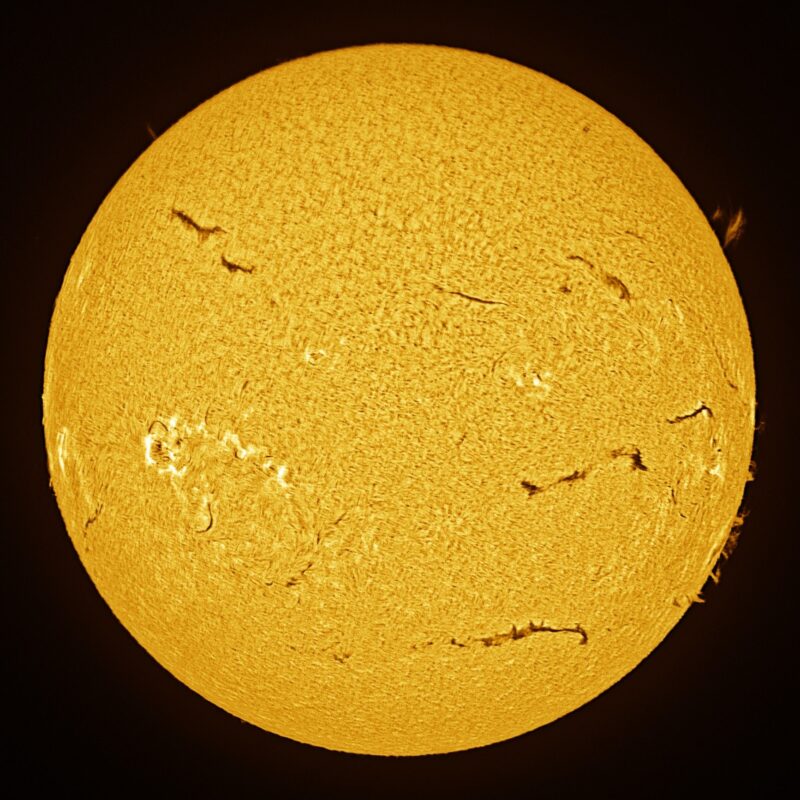
Sun news June 23: Three sun blobs to brush past Earth
After a round of high activity from sunspot region AR4473, including an impressive M6.8 flare on June 21, the sun has dialed back to very low activity. But the sun-stuff fired out during AR4473’s eruptions is still traveling through space. Analysis shows that slow coronal mass ejections (CMEs) from June 19, 20, and 21 might deliver minor glancing blows to Earth late on June 23, June 24, and June 28. No major geomagnetic storms are expected, but some mild disturbance should be on the way.
Past 24 hours of sun news
(11 UTC June 22 – 11 UTC June 23)
Flare activity
Over the past day, solar activity dropped to very low levels. In total, the sun fired just 3 faint B-class (weak) flares. Each came from a different active region.
- Strongest flare: B9.1 from an incoming as-yet-unnumbered region at 11:31 UTC on June 22.
Sunspot regions
Currently, the Earth-facing solar disk shows 5 numbered active regions. Notably, three of them carry beta-gamma configurations: AR4473, AR4474, and AR4475. That makes them the top candidates for stronger flare production.
AR4475 is the newcomer and the largest of the three. It received its official number during this period, after splitting off from the former AR4473 to become a distinct region.
AR4474 is approaching the northwest limb and should depart to the far side soon. But newcomers are approaching the east limb and may begin to rotate into view in the coming days.
Blasts from the sun?

Analysis of the eruptions on June 19, 20, and 21, including the M6.8, shows slow CMEs traveling through interplanetary space. These blobs of solar material may catch up with each other along their paths. And when combined with an anticipated corotating interaction region (CIR), they could deliver glancing blows at Earth on late June 23, June 24, and June 28.
Specifically, the June 19 CME may deliver a minor glancing blow late today, on June 23. And the June 20 CME may arrive late on June 24. Kp estimates for both range from 3 to 5. But timing carries considerable uncertainty for both events.
Past 24 hours in space weather
Solar wind
Solar wind conditions continued at slow background levels throughout the period. Meanwhile, the total interplanetary magnetic field (IMF) stayed weak, with a slight increase at the end of the period.
Bz and magnetic coupling
The Bz component pointed mostly southward late yesterday into early today. But at 4:30 UTC this morning, it shifted sharply northward for about two hours. At the time of this writing, the Bz has returned to a southward orientation. As always, a sustained southward Bz favors auroral displays.
Earth’s magnetic field
Over the past day, Earth’s magnetic field continued at quiet levels (Kp 0–2). No geomagnetic storm levels were reached. Aurora visibility remained limited to the highest latitudes. And short northern summer nights further constrained any viewing opportunities.
Sun news June 22: M6.8 flare erupts, activity surges!

The sun fired its strongest flare in days! An M6.8 (moderate) eruption from AR4473 peaked at 19:17 UTC on June 21. The blast released a burst of sun-stuff – a coronal mass ejection (CME) – into space, although it doesn’t appear to be heading toward Earth. AR4473 was the undisputed star of the period, producing every significant flare of the 24-hour window. And an earlier M2.6 from the same region on Sunday morning had already set the tone for an active day. This region is growing rapidly and its beta-gamma complexity makes it the one to watch. Stay tuned!
Past 24 hours of sun news
(11 UTC June 21 – 11 UTC June 22)
Flare activity
Over the past day, solar activity reached high levels. In total, the sun fired 8 flares: 1 M-class, 3 C-class (common) and 4 B-class (weak) events. AR4473 was the sole driver, producing every flare of the period.
- Strongest flare: M6.8 from AR4473 at 19:17 UTC on June 21. It triggered an R2 (moderate) radio blackout over the Americas and eastern Pacific.
- Earlier M-class activity: An M2.6 from AR4473 peaked at 2:46 UTC on June 21. It also produced a faint, west-directed CME.
Sunspot regions
The Earth-facing solar disk showed 3 or 4 numbered active regions. The exact count in the far southeast remains uncertain due to viewing geometry as new spots rotate into view.
AR4473 (beta-gamma) was the star of the period. It continued vigorous development and was responsible for all significant flaring. As it rotates further onto the disk, its complexity is likely to grow further.
Blasts from the sun?
Multiple CMEs were observed during the period, but none are expected to have a direct impact on Earth. Analysis of the M6.8-associated CME from AR4473 is still being refined, but because AR4473 sits well east of the sun-Earth line, the CME should sweep east of Earth.
And the M2.6-associated CME from 2:46 UTC on June 21 was a faint, west-directed event. Earth arrival is not expected from that one either.
However, two CMEs from prior days remain in the forecast pipeline. The June 19 CME might deliver a glancing blow around 8:00 UTC on June 23. Kp estimates range from 3 to 5, suggesting at most G1 (minor) geomagnetic storm potential. And the June 20 CME may arrive around 10:00 UTC on June 24. Kp estimates also range from 3 to 5. But timing carries considerable uncertainty for both events.
Past 24 hours in space weather
Solar wind
Solar wind conditions remained firmly in a slow background regime throughout the period. Meanwhile, the total interplanetary magnetic field stayed well within normal bounds.
Bz and magnetic coupling
The Bz component showed no significant southward dips. It stayed weak and variable. As a result, Earth’s magnetic shield remained effectively closed and aurora activity stayed suppressed.
Earth’s magnetic field
Over the past day, Earth’s magnetic field stayed quiet (Kp 0–2). No geomagnetic storm levels were reached. Aurora visibility remained limited to the highest latitudes. And the short hours of northern summer darkness further constrained any viewing opportunities.

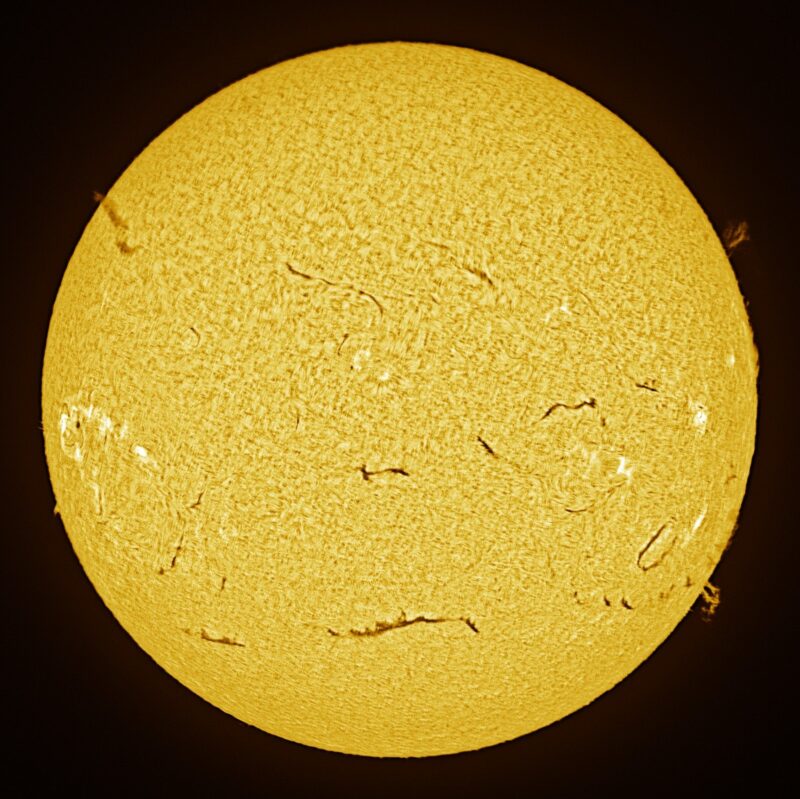
Sun news June 21: M flare brightens the June solstice!
Happy June solstice! And what a way to mark it. The sun continued to simmer at moderate to high levels on the longest day of the year in the Northern Hemisphere. Newly numbered AR4473 stole the spotlight, firing an M2.6 flare at 2:25 UTC this morning. It was the strongest blast of the period. The flare triggered an R1 (minor) radio blackout, briefly disrupting HF communications over the Pacific and eastern Asia. And AR4473 is just getting started. It’s growing as the sun’s rotation carries it further onto the visible disk. Its increasing magnetic complexity makes it the region to watch over the coming days. Earlier in the period, neighboring AR4472 contributed its own M1.0 flare along with a string of C-class events. The solstice also marks a turning point for aurora watchers. Today is the peak of the seasonal disadvantage for aurora viewing in the Northern Hemisphere. The sun-Earth geometry works against displays right now. But from here, the nights gradually grow longer again. And as they do, aurora opportunities will slowly improve. In the Southern Hemisphere, today is the winter solstice, and darkness is at its peak, giving southern aurora chasers their best seasonal window in terms of light.
Past 24 hours of sun news
(11 UTC June 20 – 11 UTC June 21)
Flare activity
Over the past day, solar activity reached moderate levels. In total, the sun fired 12 flares: 2 M-class and 6 C-class events, plus several B-class flares.
- Strongest flare: M2.6 from AR4473 (S07E65) at 2:25 UTC on June 21. It triggered an R1 (minor) radio blackout over the Pacific region.
- Other M-class flare: M1.0 from AR4472 at 14:50 UTC on June 20. It also produced an R1 (minor) radio blackout, affecting the sunlit African and European sectors.
- Notable C-class events: C4.9 from AR4472 at 21:22 UTC on June 20; C1.3 from AR4472 at 23:01 UTC on June 20; C1.1 from AR4472 at 1:01 UTC on June 21; C1.2 from AR4473 at 8:31 UTC on June 21.
- Lead flare producers: AR4473 fired the period’s strongest event, the M2.6. And AR4472 generated the bulk of the overall activity with an M1.0 and multiple C-class flares. Together they drove all the significant activity of the period.
Sunspot regions
The Earth-facing solar disk showed approximately 7 numbered active regions. But the majority remained small and quiet.
AR4473 (beta) received its official number this period. It is growing as it rotates further onto the visible disk. It produced the period’s strongest flare, the M2.6, plus additional C- and B-class events. Its increasing magnetic complexity makes it the primary region of concern going forward.
AR4472 (beta) was the most prolific flare producer of the period. It fired an M1.0 and several C-class events. Its position near the southeast limb makes full analysis difficult. But it shows some mixed-polarity magnetic structure worth monitoring.
The remaining 5 numbered regions were small and simple. They were either stable or in gradual decay. Several areas of pores appeared in the western hemisphere. But most decayed before developing into numbered sunspot groups.
Blasts from the sun?
Two CMEs were observed during the period. But neither is expected to deliver a direct hit to Earth.
Past 24 hours in space weather
Solar wind
On the space weather front, solar wind conditions remained subdued. The influence of a waning coronal hole high-speed stream faded further. Speeds ranged between 350–420 km/s, settling near 400 km/s by the end of the period. Meanwhile, the total interplanetary magnetic field (IMF) ranged from 5–7 nT.
Bz and magnetic coupling
The Bz component was variable throughout. It briefly dipped as far south as ?7 nT. But it recovered quickly. That southward dip was too brief and weak to drive significant geomagnetic activity. As a result, Earth’s magnetic shield stayed mostly closed.
Earth’s magnetic field
Over the past day, Earth’s magnetic field ranged from quiet to unsettled (Kp 1–3). No geomagnetic storm thresholds were reached. Conditions continued transitioning toward background levels.
What’s ahead? Sun–Earth forecast
Flare activity forecast
Forecasters expect low-to-moderate levels to continue through June 23. A chance (35%) exists for M-class (R1) flares. Both AR4472 and AR4473 drive the outlook. And AR4473 is especially worth watching as it grows and rotates further into view.
A slight chance (5%) for an X-class event cannot be entirely ruled out if AR4473 continues to develop. But this remains a low probability for now.
Geomagnetic activity forecast
- June 21: Expect quiet-to-unsettled conditions (Kp 1–3) as the coronal hole stream influence continues to fade. No significant aurora is expected. And today being the June solstice means the shortest nights of the year in the Northern Hemisphere, further limiting any viewing window.
- June 22–23: Expect mostly quiet conditions (Kp 1–2) under background solar wind. But a slight enhancement is possible late on June 22 into June 23 if the flank of the June 19 CME delivers a glancing blow. If realized, an unsettled-to-active spell (Kp 3–5) could develop. At Kp 5, aurora could reach Seattle, Edinburgh, and the Scottish Highlands. But the brief summer nights at these latitudes will severely limit any viewing window.
- June 24: A very low-confidence possibility exists for minor unsettled conditions (Kp 3–4) if the flank of the June 20 CME arrives as one model run suggests. But quiet background conditions are more likely. A new coronal hole fast-wind enhancement may also begin arriving, though confidence remains low.
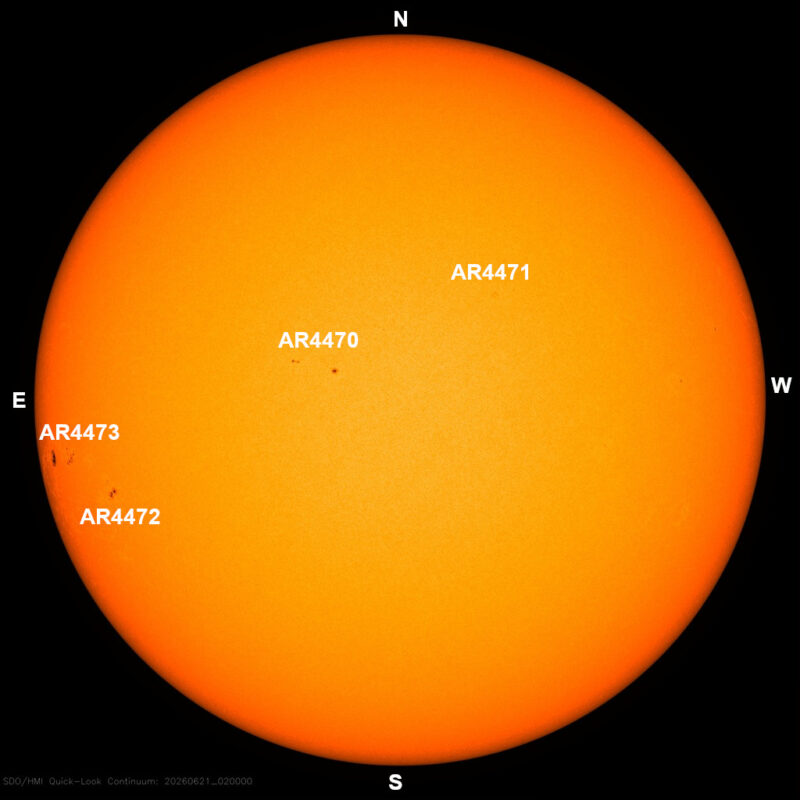
Sun news June 20: Bam! M flare from a newcomer sunspot
We called it! Yesterday, we flagged a newcomer sunspot region as one to watch. And it delivered. This region sparked a M1.3 flare at 1:51 UTC on June 20. The blast triggered an R1 (minor) radio blackout over the Philippine Sea, southeast of Japan.
And this newcomer now has a name. It has been officially designated AR4472. It sits near the sun’s northeast limb (edge), still too close to the horizon for a complete magnetic analysis. Specialists initially assigned a simple alpha configuration. But we need to wait until more of this region rotates into view to define its magnetic complexity more fully.
Here is what makes this exciting. AR4472 already fired an M-class flare before fully rotating into view. If it carries significant magnetic complexity once fully visible, it could become a major player. As always, the sun keeps us guessing. Stay tuned!
Past 24 hours of sun news
(11 UTC June 19 – 11 UTC June 20)
Flare activity
Over the past day, solar activity reached moderate levels with the production of an M1.3 flare. In total, the sun fired 8 flares: 1 M-class (moderate), 2 C-class (common), and 5 B-class (weak).
- Strongest flare: M1.3 from AR4472 in the southeast at 1:51 UTC on June 20. It triggered an R1 (minor) radio blackout over the Philippine Sea southeast of Japan.
- Lead flare producer: AR4470 in the northeast topped the list. It fired 4 of the 8 flares. And newcomer AR4472 closely followed with 3 flares, including the M1.3. The remaining flare came from elsewhere on the disk.
Sunspot regions
Currently, the Earth-facing solar disk shows just 4 numbered active regions. All four carry either alpha or beta configurations. In other words, they’re magnetically simple. So the risk of strong flares from the currently numbered regions stays low.
But AR4472 is the one to watch. It already delivered an M1.3 flare before fully rotating into view. Its position near the northeast limb means its true complexity remains hidden for now. As more of this region rotates onto the disk, its potential will become clearer.
Blasts from the sun?
Experts are currently modeling and analyzing the M1.3 flare from AR4472. A faint coronal mass ejection (CME) was observed during the event. But initial analysis suggests an Earth miss. The ejecta appears directed too far southward. In addition, a filament eruption in the southeast around 3 UTC on June 19 produced a slow-moving CME. Specialists anticipate a portion of that ejecta to deliver a glancing blow at Earth around June 23.
Past 24 hours in space weather
Solar wind
Solar wind speeds continued at moderate-low levels throughout the period. Meanwhile, the total interplanetary magnetic field (IMF) stayed at weak levels.
Bz and magnetic coupling
The Bz component kept shifting intermittently between northward and southward throughout the period. At the time of this writing on June 20, the Bz shows a northward orientation. As always, a southward Bz is what favors auroral displays.
Earth’s magnetic field
Over the past day, Earth’s magnetic field ranged from quiet to unsettled levels (Kp 1–3). Currently, the Kp index sits at level 2.


Sun news June 19: A fiery prominence from the far side
Departed sunspot region AR4464 is still making its presence felt from the far side of our sun! It continued blasting flares and hurling plasma into space with beautiful jets and prominences, especially the gorgeous jet-like eruption shown above. It was strong enough to show above the southwest horizon, even though AR4464 has been on the far side for more than two days. That is a testament to just how energetic this region remains. Will we see AR4464 return to the Earth-facing disk, after traveling around the sun’s far side? Stay tuned!
Past 24 hours of sun news
(11 UTC June 18 – 11 UTC June 19)
Flare activity
Over the past day, solar activity continued at very low levels. In total, the sun fired 12 flares: 2 C-class (common) and 10 B-class (weak).
- Strongest flare: C2.0 from AR4470 in the northeast at 11:56 UTC on June 18.
- Lead flare producer: An as-yet-unnumbered newcomer in the southeast topped the list. It fired 7 of the 12 flares, more than double its nearest rival.
Sunspot regions
Currently, the Earth-facing solar disk shows just 3 numbered active regions. All three carry stable beta configurations. They are magnetically simple. And the risk of strong flares from the currently numbered regions stays low.
Notably, a newcomer in the southeast is barely showing its nose over the horizon. It has not yet received an official number, but it is already firing flares from the very edge of the southeast limb (edge). One to watch.
Blasts from the sun?
Available coronagraph imagery showed no coronal mass ejections (CMEs) during the period.
Past 24 hours in space weather
Solar wind
Solar wind speeds averaged moderate-low levels throughout the period. Meanwhile, the total interplanetary magnetic field (IMF) started the period at weak levels. Then it gradually increased to moderate levels.
Bz and magnetic coupling
The Bz component pointed southward for the first 16 hours of the period. Then at around 3 UTC this morning, it shifted sharply northward for about 4 hours. At 7:20 UTC it returned southward and remains there at the time of this writing. As always, a southward Bz favors auroral displays.
Earth’s magnetic field
Over the past day, Earth’s magnetic field ranged from quiet to unsettled levels (Kp 1–3). Currently, the Kp index sits just above level 2.

Sun news June 18: Sunspot region keeps flaring from the far side
Yesterday we saw the fiery sunspot region AR4464 departing over the southwest horizon. And over the past day, this prolific region continued to fire a string of jets and prominences from the far side. They were large enough to appear over sun’s limb (edge), and several of the eruptions were registered as C and B flares. This region just can’t say goodbye!
Past 24 hours of sun news
(11 UTC June 17 – 11 UTC June 18)
Flare activity
Over the past day we’ve seen a slight increase in flare production, but the overall activity level remained very low, as the majority of the flares produced were B-class (weak). In total, the sun fired 12 flares: 3 C-class (common) and 9 B-class (weak).
- Strongest flare: C2.5 from active region AR4464 in the southwest at 15:06 UTC on June 17.
- Lead flare producer: A newcomer now numbered AR4470 became the lead flare producer of the period as it blasted out 4 flares of the 12. It was shortly followed by AR4464 with 3 flares from the far side.
Sunspot regions
Currently our star shows just 2 numbered active regions on its side we see from Earth. Both are magnetically simple, with stable beta configurations. We have not seen a spotless day since February 2, 2026. Could one be coming soon? Perhaps, although there is a string of sunspot regions on the far side that may appear on the Earth-viewed solar disk in the coming days.
Blasts from the sun?
A couple of coronal mass ejections (CMEs) were observed on available coronagraph imagery during the period. A first CME detected at 0:38 UTC on June 17 was concluded to have an Earth-bound component. An additional CME was registered by LASCO C2 at 1:35 UTC on June 17. Both events are under modeling and analysis. We will bring you further data as soon as it is released.
Past 24 hours in space weather
Solar wind
Solar wind speeds saw a slight increase to moderate-high levels from 12-to-16 UTC on June 17, before dropping back to moderate-low levels for the rest of the period. Meanwhile, the total interplanetary magnetic field (IMF) drew back to weak levels.
Bz and magnetic coupling
The Bz component was oriented south for most of the day. A few northward peaks were seen, but they were weak. As always, a south oriented Bz component favors auroral displays.
Earth’s magnetic field
Over the past day, Earth’s magnetic field remained at quiet levels (Kp 0–2). No geomagnetic storm conditions occurred. Currently, the Kp index sits just above level 1.
Sun news June 17: Fiery sunspot region departs from view
While solar activity dropped to very low levels over the past day, one sunspot region remained fiery. We’re talking about AR4464, which kept firing jets as it made its way out of view over the southwest solar horizon. And just as it reached the edge of the solar disk, it sparked a gorgeous farewell prominence. Bye, AR4464!
Past 24 hours of sun news
(11 UTC June 16 – 11 UTC June 17)
Flare activity
Over the past day, solar activity dropped to very-low levels, as the majority of the flares produced were B-class (weak) flares. In total, the sun fired 8 flares: 2 C-class (common) and 6 B-class (weak).
- Strongest flare: C1.2 from active region AR4465 in the northwest at 5:20 UTC on June 17.
- Lead flare producer: AR4464 was the top flare producer of the period. It blasted 4 flares out of the 8 of the period. It was shortly followed by AR4465 with 3 flares. Today’s lead flare producer has left the building and gone to the far side.
Sunspot regions
4 numbered active regions can be seen from Earth on the solar disk. AR4465 lost its (gamma) magnetic complexity and today it shows a simpler (beta) configuration. All the rest of the sunspot regions are magnetically simple and relatively inactive.
Blasts from the sun?
No Earth-directed coronal mass ejections (CMEs) observed on available coronagraph imagery during the period.
Past 24 hours in space weather
Solar wind
Solar wind speeds averaged at moderate levels during the period. Meanwhile, the total interplanetary magnetic field (IMF) started to show an increase at 1 UTC on June 17 that lasted until 6 UTC when it started to draw back to weak levels this morning.
Bz and magnetic coupling
The Bz component was oriented north for most of the day. As a result, Earth’s magnetic shield stayed firmly closed and auroral activity stayed suppressed.
Earth’s magnetic field
Over the past day, Earth’s magnetic field continued at quiet levels (Kp 1–2). No geomagnetic storm conditions occurred. Currently, the Kp index sits just above level 1.

Sun news June 16: Gorgeous eruption! Sun-stuff still awaited
Over the past day, we observed a gorgeous eruption of solar material over the southwest solar horizon. Take a look above. Beautiful! Meanwhile, we are still awaiting a possible glancing blow at Earth from a burst of sun-stuff that left the sun on June 12. This could disturb our magnetic field, though forecasters aren’t expecting any geomagnetic storming. Celestial geometry is not helping aurora watchers right now. We are just a few days from the June 2026 solstice, which arrives on Sunday morning. The angle at which Earth sits relative to the sun does not cooperate much for auroral displays this time of year. This effect is the opposite of what occurs during the equinoxes, when a favorable angle boosts aurora chances.
Past 24 hours of sun news
(11 UTC June 15 – 11 UTC June 16)
Flare activity
Over the past day, solar activity remained in a lull at low levels. In total, the sun fired 9 flares: 6 C-class (common) and 3 B-class (weak).
- Strongest flare: C1.9 from an incoming as-yet-unnumbered active region in the northeast at 18:51 UTC on June 15.
- Lead flare producer: This northeast newcomer topped the list. It fired 6 of the 9 events, including the C1.9 peak.
Sunspot regions
Currently, the Earth-facing solar disk shows 5 numbered active regions. AR4465 (beta-gamma) regained a gamma component during the period. The remaining sunspot regions are magnetically simple and relatively inactive.
Blasts from the sun?
Available coronagraph imagery showed no Earth-directed coronal mass ejections (CMEs) during the period. But forecasters continue to track the CME that departed the sun on June 12. It may deliver a glancing blow around June 16–17. A direct hit is not expected. But it could modestly enhance geomagnetic activity upon arrival. No G1 (minor) geomagnetic storms are expected from this event.
Past 24 hours in space weather
Solar wind
Solar wind speeds averaged moderate-low levels during the period. Meanwhile, the total interplanetary magnetic field stayed weak. But it showed a slight increase at the end of the period. That uptick could be an early sign of the approaching CME material.
Bz and magnetic coupling
The Bz component kept shifting between north and south. But the strongest and longest peaks pointed northward. As a result, Earth’s magnetic shield stayed firmly closed and auroral activity stayed suppressed.
Earth’s magnetic field
Over the past day, Earth’s magnetic field continued at quiet levels (Kp 1–2). No geomagnetic storm conditions occurred. Currently, the Kp index sits just above level 1.


Sun news June 15: Sun-stuff could give us a glancing blow tomorrow
The sun has taken a breather over the past 24 hours, with only minor C-class (common) flares sputtering from a handful of small, magnetically simple sunspot regions. But solar activity from a few days ago could soon bring excitement to Earth. A glancing blow from a coronal mass ejection (CME) that left the sun on June 12 could brush Earth tomorrow, potentially lifting geomagnetic activity to active levels.
Past 24 hours of sun news
(11 UTC June 14 – 11 UTC June 15)
Flare activity
Over the past day, solar activity remained at low levels. In total, the sun fired 7 flares: 5 C-class (common) and 2 B-class (weak). No M-class (moderate) or X-class events occurred.
- Strongest flare: C1.7 from AR4464 at 1:50 UTC on June 15.
- Lead flare producer: AR4464 topped the list with 4 of the 7 events. These included the C1.7.
Sunspot regions
The Earth-facing solar disk shows 4 numbered active regions. All are magnetically simple and relatively inactive.
Blasts from the sun?
Available coronagraph imagery showed no Earth-directed coronal mass ejections during the period. But forecasters continue tracking a CME that departed the sun on June 12. It may deliver a glancing blow around June 16–17. A direct hit is not expected. But it could modestly enhance geomagnetic activity upon arrival.
Past 24 hours in space weather
Solar wind
Solar wind speeds reflected the continued but waning influence of a coronal hole high-speed stream. Speeds gradually declined to normal levels over the period. Meanwhile, the total interplanetary magnetic field remained weak.
Bz and magnetic coupling
The Bz component showed no significant southward dips. It remained weak and variable. As a result, Earth’s magnetic shield stayed firmly closed. And aurora activity stayed suppressed.
Earth’s magnetic field
Over the past day, Earth’s magnetic field stayed quiet (Kp 1–2). No geomagnetic storm conditions occurred.
Sun news June 14: Sun blasts still expected, G1 storm possible
Material launched from the sun on June 9 and 11 might sweep past Earth today. It could push geomagnetic conditions to G1 (minor) geomagnetic storm levels. Aurora watchers in , Edinburgh, and Anchorage should stay on alert. Meanwhile, Earth’s magnetic field has been under the influence of a coronal hole high-speed stream and a glancing coronal mass ejection (CME) that arrived on June 13. But conditions stayed mostly quiet to unsettled over the past day. It wasn’t enough to spark significant aurora displays. Read more details under Earth’s magnetic field, below.
Past 24 hours of sun news
(11 UTC June 13 – 11 UTC June 14)
Flare activity
Over the past day, the sun took a breather. Flare production stayed at low levels. Only a handful of flares occurred: 3 C-class (common) and 3 B-class (weak). No M-class or X-class flares occurred. And no radio blackouts were triggered.
- Strongest flare: C2.5 from a filament eruptionS21W73) at 12:40 UTC on June 13. The flare produced a CME signature in GOES-19 CCOR-1 imagery at 13:45 UTC. But analysis confirmed the ejecta aimed well away from Earth.
- Other notable events: AR4462 fired a C1.0 at 14:28 UTC on June 13. And AR4466 contributed a C1.5 at 8:48 UTC on June 14, the most recent flare of the period. Three B-class flares (B6.8–B8.2) rounded out the activity.
Sunspot regions
The Earth-facing solar disk showed 4 small, magnetically simple active regions. All were mostly stable or in gradual decay. And a new active region is emerging on the northeast disk, rotating into view from behind the limb.
Blasts from the sun?
One CME was observed during the period. But it poses no threat to Earth. A separate faint CME first appeared in SOHO LASCO C2 around 16:36 UTC on June 12. The bulk should miss Earth. But a glancing blow may be possible from late June 14 into June 15.
Forecasters continue tracking the potential arrival of earlier CMEs from June 9 and June 11. Those may deliver glancing blows today.
Past 24 hours in space weather
Solar wind
Solar wind conditions reflected the combined influence of a negative-polarity coronal hole high-speed stream and a likely glancing CME arrival. Speeds had been running near 550 km/s under the stream’s influence. Then they surged to a peak of roughly 674 km/s at 10:26 UTC on June 13. That coincided with a mild shock detected at 9:51 UTC, likely the arrival of the June 11 CME. Speeds then gradually eased back to around 530 km/s by the end of the period. Meanwhile, the total interplanetary magnetic field (IMF) peaked at 8 nT during the CME passage before settling back.
Bz and magnetic coupling
The Bz component was weak and variable throughout. It briefly reached as far south as ?6 nT. But it generally did not sustain a prolonged southward orientation. As a result, aurora potential remained limited. A sustained southward Bz is what is needed to open the floodgates. The arriving CME material today could still deliver that.
Earth’s magnetic field
Over the past day, Earth’s magnetic field ranged from quiet to unsettled (Kp 1–3). An isolated active period occurred. But no G-scale geomagnetic storm thresholds were reached. Here is what happened. Solar wind speeds surged briefly to roughly 674 km/s before easing back to around 530–550 km/s. The interplanetary magnetic field (IMF) peaked at 8 nT during the CME passage. And the Bz component dipped briefly to ?6 nT. But it never sustained a deep enough southward orientation to open the door for widespread auroras. Looking ahead, forecasters are watching for more CME arrivals today.
What’s ahead? Sun–Earth forecast
Flare activity forecast
Forecasters expect low levels to continue through June 16. C-class flares are very likely. And a slight chance (10%) exists for M-class (R1–R2) flares, primarily from AR4464, which has shown growth and holds the highest flare potential on the visible disk. The new region emerging on the northeast limb also bears watching. X-class flares are not expected (1%).
Geomagnetic activity forecast
- June 14: Earth’s magnetic field is likely to reach G1 (minor) geomagnetic storm levels. The negative-polarity coronal hole stream continues. And CMEs from June 9 and 11 should still be passing through. Kp values of 4–5 are forecast. Aurora may reach , Minneapolis, Edinburgh, Anchorage, and the Scottish Highlands if sustained southward Bz develops. A further weak enhancement is possible late today from a potential glancing blow of the June 12 CME.
- June 15: Active conditions (Kp 4) are likely as coronal hole effects persist. Possible weak interactions from the June 12 CME could sustain isolated G1 (minor) storm intervals. Fast solar wind should begin gradually easing.
- June 16–17: Expect conditions to gradually settle as the coronal hole stream wanes. Solar wind should fade from elevated to background levels. But a small positive-polarity coronal hole crossed the central meridian on June 13. Its fast wind may arrive later on June 17. That could bring a renewed round of unsettled-to-active conditions.

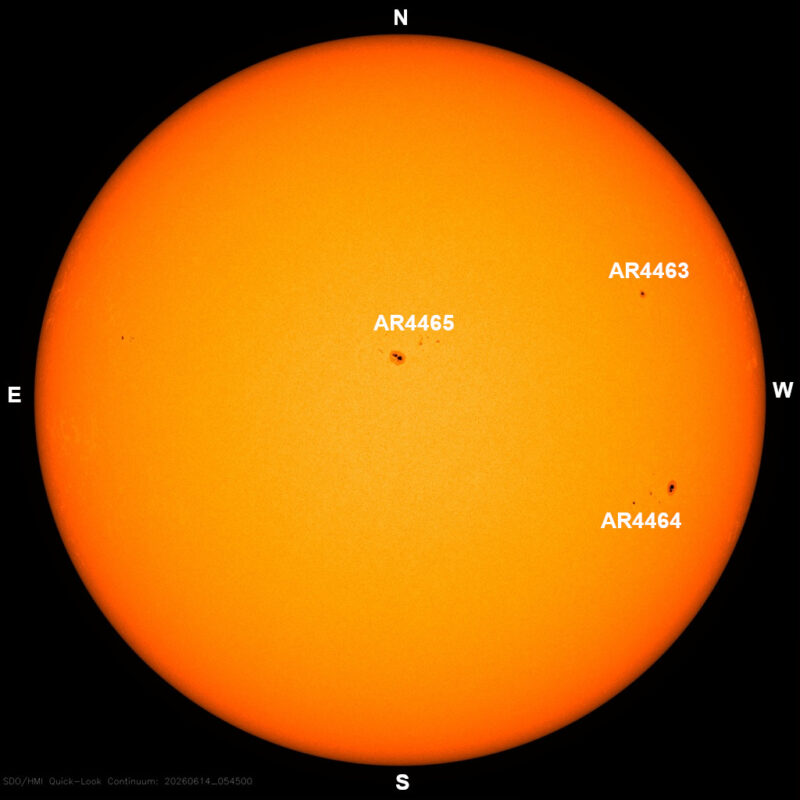
Sun news June 13: Sun-stuff expected to arrive today
A couple of chunks of solar stuff are expected to reach Earth’s magnetic field today. These are coronal mass ejections (CMEs), mixtures of solar materials and magnetic fields. The sun hurled these particular CMEs into space on June 9 and 11. And they might deliver glancing blows to Earth today. That could trigger conditions up to G1 (minor) and even G2 (moderate) geomagnetic storming. So NOAA’s aurora alert continues this weekend. Clear skies to you! Click here to share your aurora photos.
Past 24 hours of sun news
(11 UTC June 12 – 11 UTC June 13)
Flare activity
Over the past day, solar activity held at low levels. In total, the sun sparked 9 flares: 8 C-class (common) and 1 B-class (weak).
- Strongest flare: C1.9 from an incoming as-yet-unnumbered region in the southeast at 19:36 UTC on June 12.
- Lead flare producer: A tie at the top! An incoming as-yet-unnumbered region in the southeast is making its presence felt. It tied for lead flare producer with 3 C-class flares. Sunspot region AR4464 fired the other 3.
Sunspot regions
Currently, just 3 numbered active regions populate the Earth-facing solar disk. That is a lean count. AR4465 (beta) lost its gamma-delta complexity during the period. It now shows a simpler beta configuration. Even so, it remains worth watching given its recent flare history. AR4464 (beta) continued with its beta setup. It tied for the lead in flare production this period. AR4463 carries a simpler alpha configuration.
Blasts from the sun?
And a small filament eruption in the northeast launched a CME that forecasters are now modeling. The blast left the sun at 16 UTC on June 12. And the main CME story remains the approaching material from June 9 and 11. Those blobs of solar stuff should begin reaching Earth today.
Past 24 hours in space weather
Solar wind
Solar wind speeds continued at moderate-high levels throughout the period. Meanwhile, the total interplanetary magnetic field (IMF) stayed at weak levels this morning.
Bz and magnetic coupling
The Bz component kept shifting between northward and southward during the period. But the strongest and most frequent peaks pointed south. As always, a strongly sustained southward Bz is what opens the floodgates for auroral displays. The arriving CME material could deliver exactly that.
Earth’s magnetic field
Over the past day, Earth’s magnetic field showed quiet-to-unsettled levels (Kp 2–3). Kp 3 prevailed for most of the period. Currently, the Kp index sits slightly below level 3.
What’s ahead? Sun–Earth forecast
Flare activity forecast
Forecasters expect low levels to continue. M-class (moderate) flare odds saw a slight increase from 30% yesterday to 35% today. And X-class (strong) flare chances hold at 5%.
The main drivers remain AR4465 and AR4464. And the incoming southeast newcomer adds growing potential as it rotates further into view.
Geomagnetic activity forecast
- June 13: Active conditions anticipated with storming periods possible. CMEs hurled by the sun on June 9 and 11 may reach Earth’s magnetic field with a glancing blow. That could bring geomagnetic enhancements up to G2 (moderate) levels. Aurora watchers, this weekend could deliver!
- June 14: G1 (minor) geomagnetic storming possible as effects from the CMEs start to wane. Aurora may still be visible at high latitudes.
- June 15: Expect Earth’s geomagnetic field to ease to unsettled-to-active levels as CME influences fully fade.


Sun news June 12: Surprise storm last night, more to come?
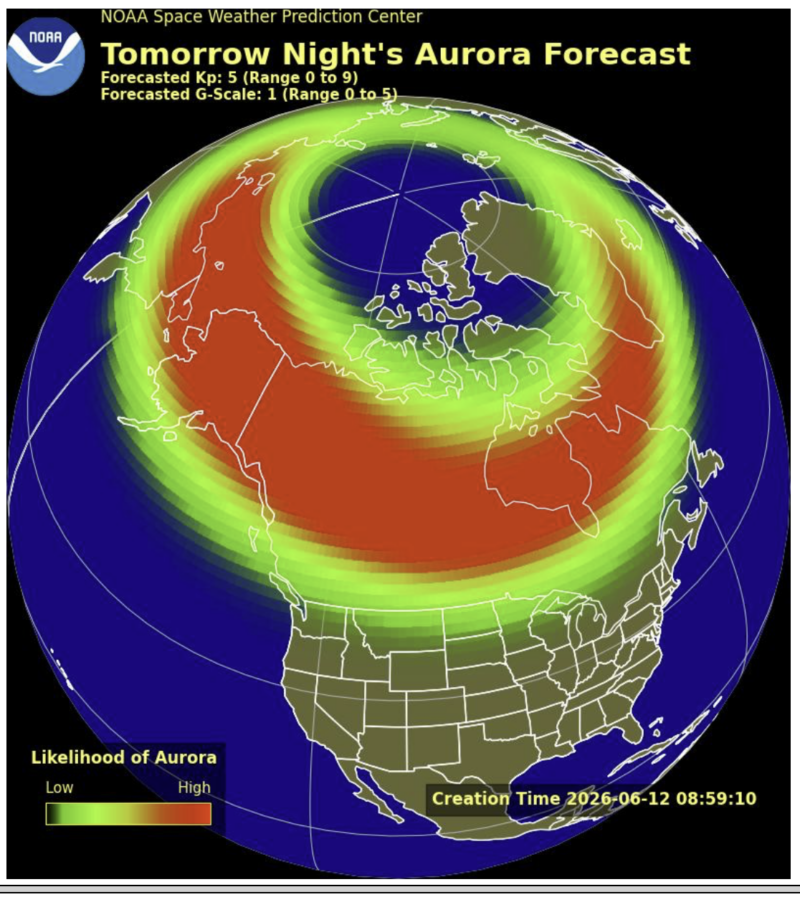
A surge of fast solar wind triggered an unexpected G1 (minor) geomagnetic storm last night. The disturbance was bolstered by a complex knot of solar wind known as a co-rotating interaction region (CIR). More minor disturbance could come tonight. And tomorrow, a couple of chunks of sun-stuff fired on June 9 and 11 could give Earth glancing blows, possibly triggering G2 (moderate) geomagnetic storms. That could bring a round of weekend auroras! Clear skies to you, and don’t forget to share your beautiful aurora photos with us.
Past 24 hours of sun news
(11 UTC June 11 – 11 UTC June 12)
Flare activity
Over the past day, solar activity continued at low levels, with our star firing 8 C-class flares.
- Strongest flare: C5.2 from AR4465 in the northeast at 2:14 UTC on June 12.
- Lead flare producer: AR4465 and an incoming as-yet-unnumbered region in the southeast topped the list with 3 C flares each.
Sunspot regions
Today the solar disk shows 5 numbered active regions on its side seen from Earth.
AR4465 (beta-gamma) lost its delta component during the period, but remains the highest potential region on the disk.
AR4464 (beta) also dropped in magnetic complexity, losing its gamma component.
The remaining sunspot regions carry simpler alpha or beta configurations. They appear stable or in decay.
Blasts from the sun?
It is now confirmed that the CME produced during the AR4465’s C6.7 event will give us a glancing blow on June 13.
Past 24 hours in space weather
Solar wind
Solar wind speeds slowly increased from moderate to moderate-high levels during the period. Meanwhile, the total interplanetary magnetic field (IMF) peaked at strong levels from 15 UTC on June 11 through 3 UTC on June 12. It returned to weak levels this morning.
Bz and magnetic coupling
The Bz component shifted southward during the geomagnetic storm. That kept Earth’s magnetic shield open. A strongly sustained southward Bz is what opens the floodgates for auroral displays.
Earth’s magnetic field
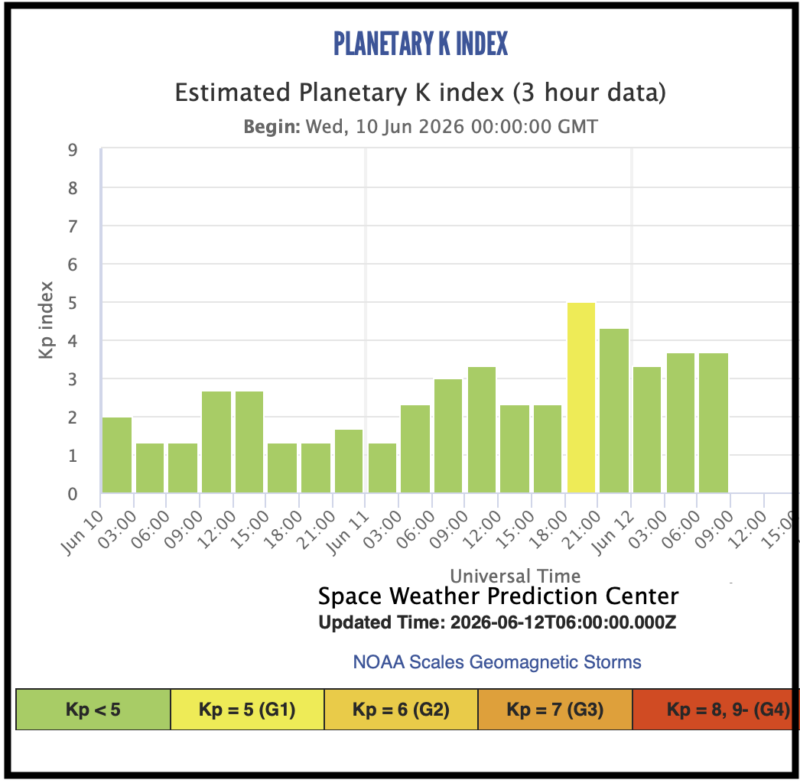
Over the past day, Earth’s magnetic field showed quiet-to-active levels (Kp 2–5). A minor G1 geomagnetic storm (Kp5) was observed for one three-hour period from 20:40 UTC on June 11. Currently, the Kp index sits slightly below level 4.
Sun news June 11: A blob of sun-stuff is headed for Earth

A blob of sun-stuff is heading our way! Sunspot region AR4465 fired a C6.7 flare at 0:02 UTC this morning. The blast produced a coronal mass ejection (CME) that the SOHO spacecraft registered as a halo event. Initial analysis suggests some of this sun-stuff is heading toward Earth, and should give us a glancing blow around June 14. The blast was not that strong, but it might still disturb our magnetic field. Plus, we could see more eruptions soon. The sunspot that fired this sun-stuff has been evolving rapidly. It now carries a beta-gamma-delta configuration, the highest complexity there is. That makes it the top candidate for M-class and even X-class flares. Stay tuned!
Past 24 hours of sun news
(11 UTC June 10 – 11 UTC June 11)
Flare activity
Over the past day, solar activity held at low levels. In total, the sun fired 11 C-class flares.
- Strongest flare: C9 from AR4465 in the northeast at 8:28 UTC on June 11.
- Lead flare producer: AR4456 and AR4465 topped the list with 5 flares each.
Sunspot regions
Currently, the Earth-facing solar disk shows 5 numbered active regions.
AR4465 (beta-gamma-delta) is the clear standout. It gained a delta component during the period. That gives it the most complex magnetic configuration on the disk. As a result, it sits firmly at the top of the watch list for M and X flares.
AR4464 (beta-gamma) regained a gamma component. It is the second most complex region on the disk. It adds to the potential for stronger activity.
The remaining sunspot regions carry simpler alpha or beta configurations. They appear stable or in decay.
Blasts from the sun?
The C6.7 flare from AR4465 produced a CME that LASCO C3 registered as a halo event. A component might be directed toward Earth. A glancing blow is anticipated around June 14. In addition, a couple of earlier CMEs were observed in coronagraph imagery during the period, but both were confirmed to carry no Earth-bound component.
Past 24 hours in space weather
Solar wind
Solar wind speeds continued averaging at moderate levels during the period. Meanwhile, the total interplanetary magnetic field (IMF) showed a couple of peaks at moderate levels. But it returned to weak levels this morning.
Bz and magnetic coupling
The Bz component pointed northward for most of the period. That kept Earth’s magnetic shield closed. But at 3:55 UTC this morning on June 11, the Bz turned southward. A strongly sustained southward Bz is what opens the floodgates for auroral displays.
Earth’s magnetic field
Over the past day, Earth’s magnetic field continued at quiet levels (Kp 1–3). Currently, the Kp index sits slightly above level 2.
Sun news June 10: Solar Cycle 25 activity rises again
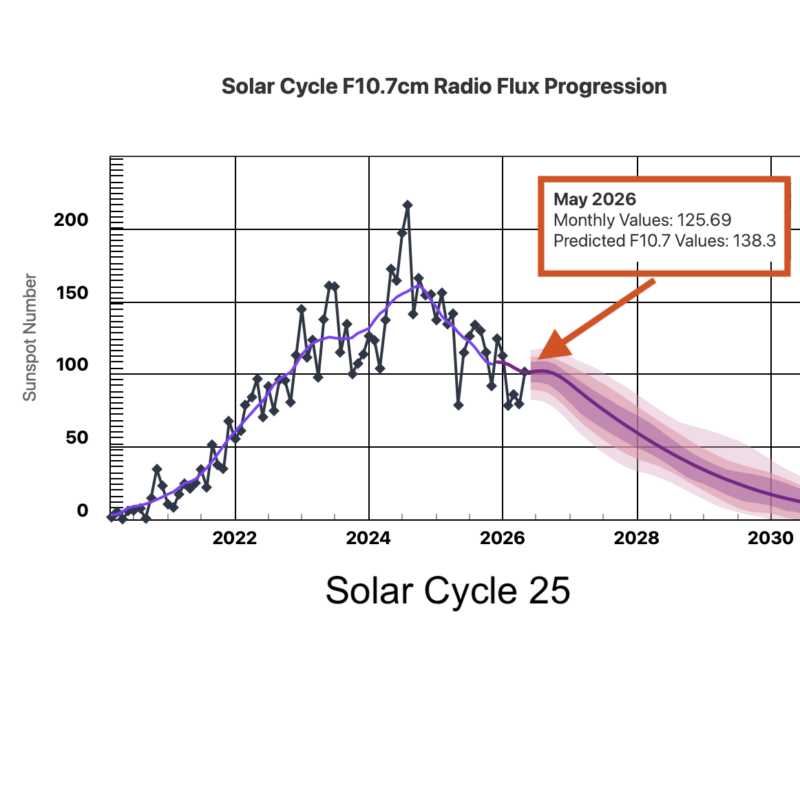
Time for a Solar Cycle 25 update! May 2026 registered a monthly sunspot number of 125.69, up from April’s value of 120 and the highest value since January. That’s a welcome recovery after the sharper declines seen in February, March, and April. Those months had dipped below the forecast in the downward trend from solar maximum. The peak of Solar Cycle 25 remains August 2024, with a sunspot number of 245.
Past 24 hours of sun news
(11 UTC June 9 – 11 UTC June 10)
Flare activity
Over the past day, solar activity remained at low levels. Only C-class (common) flares occurred. In total, the sun fired 10 C-class flares.
- Strongest flare: C2.6 from AR4465 in the northeast at 0:59 UTC on June 10. Other notable events included a C2.3 from AR4461 at 19:18 UTC, a C2.1 from AR4464 at 21:33 UTC, and a C1.9 from AR4464 at 21:10 UTC, all on June 9.
- Lead flare producer: AR4465 topped the list with 4 C-class flares. AR4466 closely followed with 3 C-class flares.
Sunspot regions
The Earth-facing solar disk continued to show 7 numbered active regions. AR4465 (beta-gamma) is the standout today. It gained a gamma component during the period. It now carries the most complex magnetic configuration on the disk. As a result, it moves to the top of the watch list for stronger flare production.
Blasts from the sun?
An eruption in the vicinity of AR4463 hurled plasma into space at 16:30 UTC on June 9. A component of this event was found to be approaching Earth. Initial analysis suggests a glancing blow around June 14. No other Earth-directed coronal mass ejections (CMEs) appeared in available coronagraph imagery during the period.
Past 24 hours in space weather
Solar wind
Solar wind speeds averaged at moderate levels during the period. Any influence from the earlier CME glancing blow continued to wane. Meanwhile, the total interplanetary magnetic field (IMF) stayed weak and steady.
Bz and magnetic coupling
The Bz component pointed southward for most of the period. That mostly southward orientation produced a slightly strong geomagnetic response, but conditions were not enough for storm levels. As always, a strongly sustained southward Bz is what opens the floodgates for auroral displays.
Earth’s magnetic field
Over the past day, Earth’s magnetic field continued at quiet levels (Kp 1–3). The waning effects from the earlier CME glancing blow produced no significant disturbances. Currently, the Kp index sits slightly above level 1.
Sun news June 9: Sun-stuff arrives, but disturbance only mild
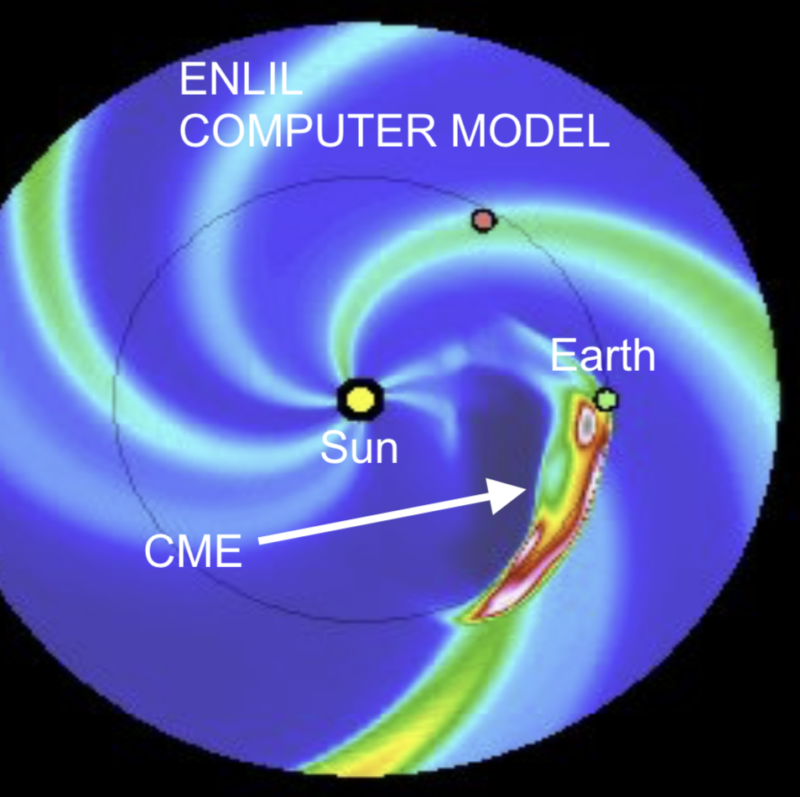
An eagerly awaited coronal mass ejection (CME) reached Earth yesterday, but the disturbance was only mild. What happened to the
geomagnetic storms? It turns out the bulk of the sun-stuff passed to the south and east of Earth, as models had suggested was possible. That limited the geomagnetic response, and lowered expectations for more disturbance later today.
Past 24 hours of sun news
(11 UTC June 8 – 11 UTC June 9)
Flare activity
Over the past day, solar activity continued at low levels. Only C-class (common) flares occurred. In total, the sun fired 14 C-class flares.
- Strongest flare: C4.5 from AR4465 in the northeast at 4:23 UTC on June 9. Other notable events included a C3.2 at 7:00 UTC, a C3.0 from AR4455 at 6:52 UTC and a C2.7 from AR4456 at 6:06 UTC on June 9.
- Lead flare producer: AR4465 dominated the period. It fired 9 of the 14 C-class flares, including the strongest event. The remaining 5 flares came from other regions on the disk.
Sunspot regions
Currently, the Earth-facing side of our sun shows 7 numbered active regions. AR4464 (beta-gamma) is the standout today. It developed a gamma component during the period. It now carries the most complex magnetic configuration on the disk. As a result, it moves to the top of the watch list for stronger flare production.
Blasts from the sun?
No new Earth-directed coronal mass ejections (CMEs) appeared in available coronagraph imagery during this period.
Past 24 hours in space weather
Solar wind
Solar wind speeds decreased from moderate to moderate-low levels during the period. The waning CME influence was evident. Meanwhile, the total interplanetary magnetic field stayed weak, with only a slight increase.
Bz and magnetic coupling
The Bz component pointed mostly southward during the period. Only a few northward peaks occurred. That southward orientation produced a slightly stronger geomagnetic response compared to the previous day. But conditions still fell well short of storm levels. As always, a strongly sustained southward Bz is what opens the floodgates for auroral displays.
Earth’s magnetic field
Over the past day, Earth’s magnetic field stayed at quiet levels (Kp 1–2). The CME glancing blow produced only mild disturbances. Currently, Kp sits at low levels.
Sun news June 8: Auroras tonight? Strong storm watch issued
Aurora watchers across high latitudes should be on alert! A coronal mass ejection (CME) launched by an M1.8 (moderate) flare on June 6 is bearing down on Earth. Arrival is expected by midday UTC today. Both NOAA and the UK Met Office have issued a G3 (strong) geomagnetic storm watch. That means auroras could possibly dance at mid-northern latitudes. However, there’s a chance that the bulk of the material will just miss Earth, so the ultimate severity of this storm is a close call. Let’s see what happens!
Past 24 hours of sun news
(11 UTC June 7 – 11 UTC June 8)
Flare activity
Over the past day, solar activity returned to low levels. In total, the sun fired 14 C-class (common) flares. No M-class or X-class (strong) events occurred. Notably, the period was quieter than the preceding 24 hours, which featured the M1.8 eruption from AR4461.
- Strongest flare: C7.2 from an as-yet-unnumbered region near the eastern horizon at 2:36 UTC on June 8. As a C-class event, it produced no radio blackout. Other notable events included a C4.5 at 5:00 UTC on June 8 and a C3.3 from AR4456 at 4:19 UTC on June 7.
- Lead flare producers: Activity was spread broadly across the disk. Flares originated from multiple regions, including AR4455, AR4458, AR4459, AR4462 and AR4464. No single region dominated.
Sunspot regions: key players
Over the past day, 8 numbered active regions spanned the full Earth-facing solar disk. AR4456 remains the most magnetically complex region on the disk. It experienced minor decay during the period. But it still carries the highest complexity available: beta-gamma-delta. It produced the C3.3 flare and remains the primary candidate for stronger activity.
Blasts from the sun?
No new Earth-directed CMEs were observed during this period. The CME from June 6 remains the dominant story.
Past 24 hours in space weather
Solar wind
Solar wind conditions reflected a waning coronal hole high-speed stream. Speeds peaked at moderately high early in the period and then declined a little. Meanwhile, the total interplanetary magnetic field stayed moderate. A significant enhancement in solar wind speed, density and magnetic field strength is expected by early to mid UTC on June 8 as the CME shock arrives.
Bz and magnetic coupling
The Bz component fluctuated between mildly northward and southward. As a result, only modest geomagnetic coupling occurred. But that is about to change. When the CME arrives, the Bz orientation will determine the storm’s severity. A strongly southward Bz would open the floodgates for auroral displays.
Earth’s magnetic field
Over the past day, Earth’s magnetic field ranged from quiet to unsettled (Kp 2–3). No G-scale geomagnetic storm thresholds were reached. But the calm will not last. The CME is on its way.
Sun news June 7: M-flare launches fast CME toward Earth

The sun fired a moderate M1.9 flare yesterday afternoon. Sunspot region AR4461 produced it. The eruption peaked at 13:40 UTC on June 6. And it unleashed a fast coronal mass ejection (CME) that’s now barreling toward Earth at over 1,400 km/s (~3.1 million mph)! The blast was impressive! It triggered an R1 (minor) radio blackout over the Atlantic Ocean west of Africa. A filament eruption accompanied the flare. So did a radio burst and a Type II radio sweep, clocked at 838 km/s (these are indicative of CMEs and provide approximate speeds). All are hallmarks of a significant solar blast. When will it arrive? Multiple model runs predict the CME’s shock front could reach Earth as early as 0:17 UTC on June 8. The main body should follow around 6 UTC on June 8. Forecasters expect G1–G2 (minor to moderate) geomagnetic storming. And isolated periods of G3 (strong) are possible. And AR4456 kept busy too. The evolving region churned out a near-M-class C8.8 flare and a string of smaller eruptions. It now carries a beta-gamma-delta configuration, the highest complexity there is. The stage is set for an eventful 48 hours. Share your aurora photos with us!
Past 24 hours of sun news
(11 UTC June 6 – 11 UTC June 7)
Flare activity
Over the past day, solar activity reached moderate levels. In total, the sun fired 15 flares: 1 M-class and 14 C-class.
- Strongest flare: M1.9 from AR4461 (S23E25) at 13:40 UTC on June 6. It triggered an R1 (minor) radio blackout over the Atlantic Ocean west of Africa. The eruption was accompanied by a filament eruption, a 190 solar flux unit radio burst, and a Type II radio sweep at 838 km/s.
- Near-M-class event: C8.8 from AR4456 at 13:04 UTC on June 6. That was fired just minutes before the M1.9 from AR4461. Two significant eruptions back-to-back!
- Lead flare producer: AR4456 dominated the period. It fired 10 of the 14 C-class flares, including the C8.8 and multiple C1–C3 events. Meanwhile, AR4455 contributed a C2.5 at 5:41 UTC on June 7. And AR4462 added a C2.0 at 1:45 UTC on June 7.
Sunspot regions: key players
The Earth-facing solar disk showed 8 numbered active regions. New unnumbered spots were also emerging. AR4456 (beta-gamma-delta) continued evolving significantly. It gained additional spots, with an asymmetric penumbra and a delta signature in its central region. It was by far the most active and complex region on the disk. It produced the majority of the period’s flares. AR4455 has a beta-gamma magnetic configuration, indicating potential for activity.
Blasts from the sun?
The M1.9 flare from AR4461 produced the headline CME of this period. It first appeared as a partial halo event in SOHO LASCO C2 imagery at 14:01 UTC on June 6. The bulk of the material passes south and east of Earth. But the CME is both fast and wide enough to carry a significant Earth-directed component. The leading-edge analysis at 1,396 km/s predicts Earth arrival around 5:57–6:01 UTC on June 8. Kp estimates range from 6 to 8. That points to G2–G4 (moderate to severe) storm potential depending on the CME’s magnetic orientation upon arrival. Kp estimates for the shock range from 7 to 9, indicating G3–G4 (strong to severe) potential.
Past 24 hours in space weather
Solar wind
Solar wind conditions reflected the waning influence of the earlier CME passage. Speeds gradually eased from 650 km/s down to the 550–600 km/s range. Meanwhile, the total interplanetary magnetic field (IMF) decreased to 4–5 nT. These declining conditions should continue waning on June 7. But when the June 6 CME shock arrives, it will reinvigorate the solar wind environment.
Bz and magnetic coupling
The Bz component was mostly calm. Only brief southward dips reached -5 to -6 nT early in the period. As always, a sustained southward Bz is what opens the door for auroral displays. The incoming CME could deliver exactly that.
Earth’s magnetic field
Over the past day, Earth’s magnetic field ranged from quiet to active levels. Kp reached 3–4 early in the period as the earlier CME influence lingered. Then it settled to Kp 2 as those effects faded. No G-scale geomagnetic storm thresholds were reached this period. But that is about to change.
What’s ahead? Sun–Earth forecast
Flare activity forecast
Forecasters expect low-to-moderate levels through June 9. M-class flare odds hold at 55%. The primary sources are AR4456 (beta-gamma-delta), AR4458, and AR4462. And AR4455 contributes with its flare history. A slight chance (10%) exists for an X-class event, mainly from the increasingly complex AR4456 in the northwest.
Geomagnetic activity forecast
- June 7: Expect quiet-to-unsettled conditions (Kp 1–3) as the current solar wind regime continues to wane. A weaker CME from June 4 may produce a minor uptick around 17:00 UTC. But it should not drive storm-level activity.
- June 8: The big day. G1–G2 (minor to moderate) geomagnetic storming expected to begin by early to mid UTC with the arrival of the June 6 CME. The shock front could arrive as early as 0:17 UTC. The main CME body should follow around 6:00 UTC. Isolated periods of G3 (strong) storming are possible. Kp could reach 7–9 depending on the CME’s magnetic orientation at arrival. Aurora may reach , , northern France and Germany, Toronto, Chicago, and Boston. But June’s limited darkness hours across the Northern Hemisphere will constrain viewing. In the Southern Hemisphere, aurora could reach southern New Zealand and possibly Tasmania. Get those cameras ready!
- June 9: G1–G2 storming may linger into the early hours. Then conditions should ease to unsettled-to-active levels as CME effects wane. Aurora chances should diminish through the day.
- June 10: Expect conditions to ease to quiet-to-unsettled levels as the CME influence fully subsides. But any new eruptions from the increasingly complex AR4456 could change the picture.

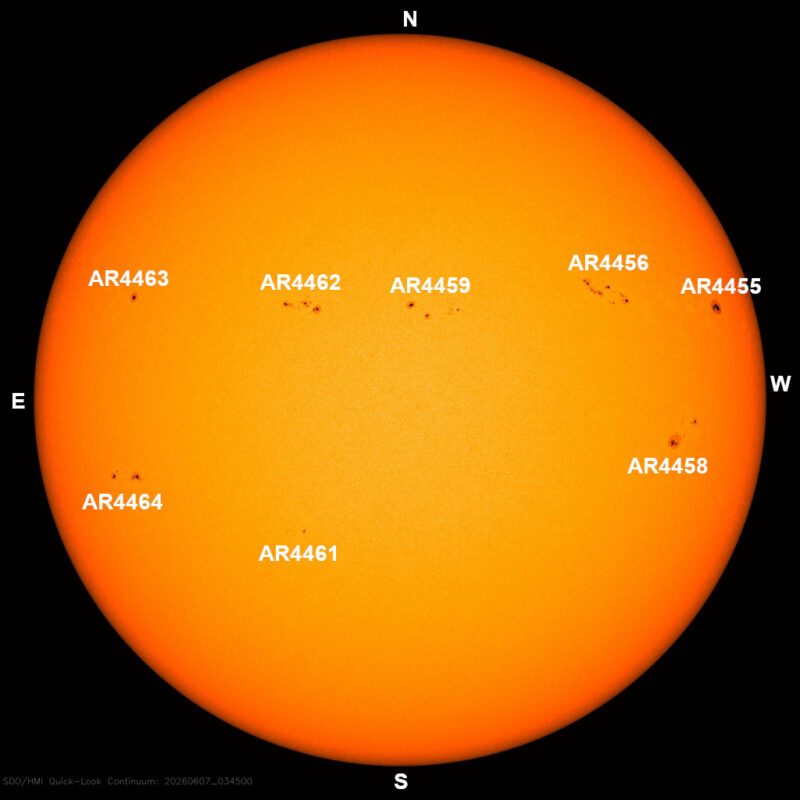
Sun news June 6: Cannibal CME delivers G2 storm!
A cannibal coronal mass ejection (CME) – when a faster solar eruption overtakes and merges with a slower eruption ahead of it – delivered! We reported its first impact yesterday. Initially, it arrived as a Kp 4 geomagnetic disturbance. But as Earth plunged deeper into the abundant cannibal CME material, conditions escalated. Geomagnetic storming followed. Earth’s magnetic field reached G1 (minor) geomagnetic storm levels at 12 UTC on June 5. Then it climbed to G2 (moderate) at 15 UTC. G1 and G2 impacts lasted for four three-hour synoptic periods. That is a solid stretch of storming. Did you see the auroras? Share your beautiful photos with us!
Past 24 hours of sun news
(11 UTC June 5 – 12 UTC June 6)
Flare activity
Over the past day, solar activity held at low levels. Only C-class (common) flares occurred. In total, the sun fired 12 C flares.
- Strongest flare: C4.7 from AR4462 in the northeast at 22:45 UTC on June 4.
- Lead flare producer: A close race at the top! AR4462 led with 3 C-class flares. But AR4455, AR4456, AR4457, and AR4462 each fired 2 C-class flares. The activity was spread broadly across the disk.
Sunspot regions: key players
Currently, the Earth-facing side of our sun shows 7 numbered active regions. A newcomer on the northeast limb was designated AR4463.
AR4458, with its beta-delta magnetic configuration, is the standout. It grew its gamma into a delta during the period. That upgrade gives it the potential for M-class flares and even an X-class blast. It is now the most complex region on the sun’s disk.
AR4456 (beta-gamma) developed a gamma component during the period. It joins the list of regions worth watching.
Sunspot regions: supporting cast
AR4455 (beta) lost its anti-Hale instability. It now shows a simpler beta configuration. Even so, it still fired 2 C-class flares. AR4459 also carries a beta-gamma setup. The remaining regions show simpler beta configurations.
Blasts from the sun?
Available coronagraph imagery showed no new Earth-directed coronal mass ejections (CMEs) during the period. As of this writing (11 UTC on June 6), effects from the cannibal CME have started to wane.
Past 24 hours in space weather
Solar wind
Solar wind speeds averaged high levels during the peak of the cannibal CME passage. They then slowly decreased to moderate-to-high levels as of this writing. Meanwhile, the total interplanetary magnetic field (IMF) reached strong levels late on June 5. But it has since dropped to weak levels.
Bz and magnetic coupling
The Bz component shifted between northward and southward during the period. But it spent most of the time pointing south. That kept Earth’s magnetic shield open. As a result, auroral displays were possible during the cannibal CME event. This morning on June 6, the Bz shifted to a northward orientation. That closes the door on aurora for now.
Earth’s magnetic field
Over the past day, geomagnetic conditions reached storming levels (Kp 2–6). Both G1 (minor) and G2 (moderate) geomagnetic storm conditions occurred. The cannibal CME delivered as expected. Currently, the Kp index sits just below level 4. Conditions are now easing.
What’s ahead? Sun–Earth forecast
Flare activity forecast
Forecasters expect low-to-moderate levels of solar activity to continue. M-class flare odds hold at 50%. Three active regions drive the outlook: AR4455, AR4458, and AR4462. And AR4456 contributes with its beta-gamma configuration.
X-class (strong) flare chances remain at 10%. AR4458’s new beta-delta configuration makes it the top candidate for a powerful eruption. That delta component is worth watching closely.
Geomagnetic activity forecast
- June 6: Expect quiet-to-unsettled conditions as the cannibal CME influence wanes. But active instances remain possible from remnant lingering effects. Solar wind speeds should continue declining.
- June 7: Expect continued quiet-to-unsettled conditions as CME influences fully fade. Solar wind should return toward background levels. No significant geomagnetic drivers are in play.
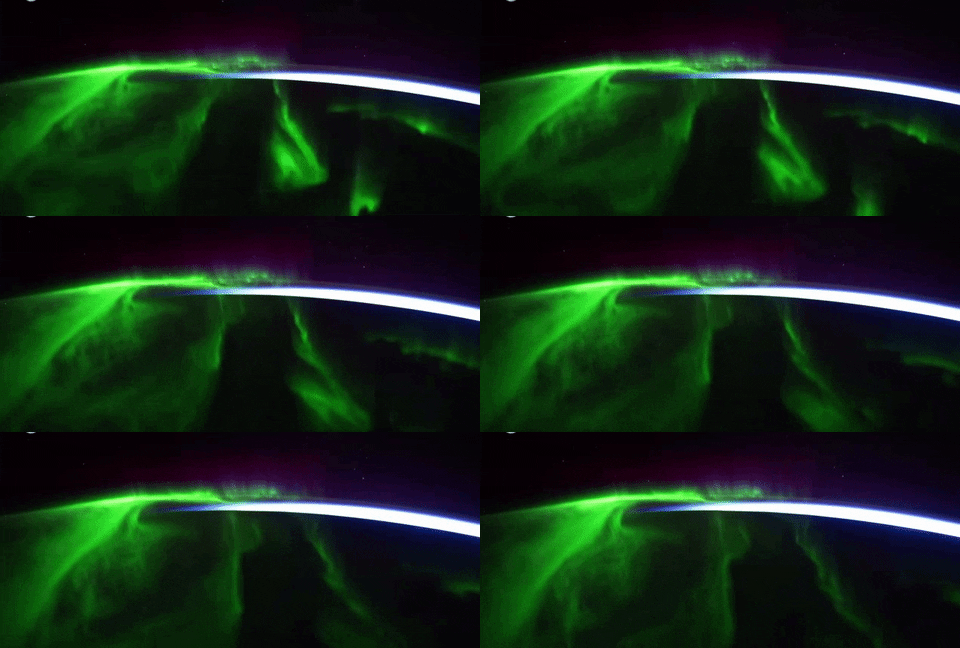
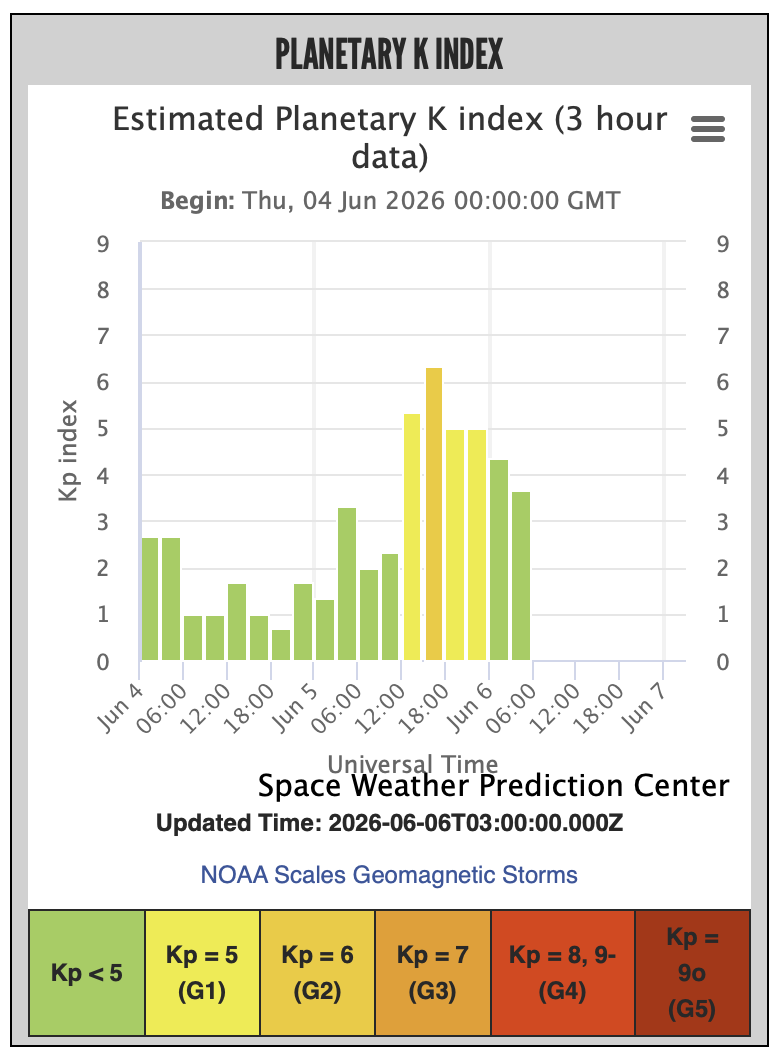
Sun news June 5: Cannibal CME arrives … More to come?
The cannibal coronal mass ejection (CME) we reported on yesterday has started arriving. An abrupt jump in solar wind speed around 4:30 UTC this morning marked the arrival of CME material at Earth. It hasn’t caused any significant disturbance yet, but cannibal CMEs are complex structures. More solar material may be trailing behind, soon to reach us. If more CME material does arrive, conditions could escalate to G2 (moderate) and possibly even G3 (strong) geomagnetic storms. And that would likely mean beautiful auroras! So stay tuned.
Past 24 hours of sun news
(11 UTC June 4 – 12 UTC June 5)
Flare activity
Over the past day, solar activity continued at low levels. Only C-class flares occurred. In total, the sun fired 8 C-class (common) flares.
- Strongest flare: C2.1 from AR4458 in the southwest at 20:59 UTC on June 4.
- Lead flare producer: AR4457 topped the list this period. It fired 3 of the 8 flares, all C-class events.
Sunspot regions
The Earth-facing side of our sun shows 6 numbered active regions today. Three sunspot regions carry beta-gamma configurations: AR4455, AR4458, and AR4459. Notably, AR4458 gained a gamma component during the period, while AR4461 lost its gamma.
AR4455 quieted down significantly. It sparked only one C-class flare this period. But its anti-Hale instability could wake it up again at any time.
Blasts from the sun?
Available coronagraph imagery showed no new Earth-directed coronal mass ejections (CMEs) during the period. The cannibal CME from the June 3 eruptions has now begun arriving at Earth. Monitoring continues to assess whether additional components follow.
Past 24 hours in space weather
Solar wind
Solar wind speeds averaged moderate levels until 4:20 UTC this morning on June 5. Then an abrupt spike to moderate-high levels was observed. That jump marked the arrival of the cannibal CME material at Earth. Speeds returned to moderate levels at the time of this writing. The total interplanetary magnetic field (IMF) showed similar behavior. It remained relatively weak, then surged to strong levels at 4:30 UTC. Cannibal CMEs are complex structures. More material may follow over the next day.
Bz and magnetic coupling
The Bz component pointed northward through the entire period. That orientation kept Earth’s magnetic shield closed. As a result, no significant geomagnetic coupling occurred. This morning on June 5, the Bz still shows a northward orientation. As always, a sustained southward shift is needed to open the door for auroral displays. If trailing CME material arrives with a southward Bz, the picture could change quickly.
Earth’s magnetic field
Over the past day, geomagnetic conditions ranged from quiet to unsettled (Kp 1–3). No geomagnetic storm conditions occurred. Currently, the Kp index sits just above level 3. The initial CME arrival has been registered. But the full impact remains to be seen.

Sun news June 4: Cannibal sun-stuff heading for Earth!
Amid yesterday’s flurry of 4 M (moderate) flares and an X (strong) flare on our star, 2 major bursts of solar material – coronal mass ejections or CMEs – were fired our way. Interestingly, the first CME, from the M7.7 flare, was bigger than the second CME from the X flare. But smaller CME is much faster, and so will soon catch up and merge with the first. This so-called cannibal CME is set to hit Earth’s magnetic field late today into early tomorrow. This should trigger geomagnetic storms up to G2 (moderate) and possibly even G3 (strong) levels. That means auroras are on the way! Get those cameras out and prepare for gorgeous displays!
Past 24 hours of sun news
(11 UTC June 3 – 12 UTC June 4)
Flare activity
Over the past day, solar activity dropped to low levels. Only C-class flares occurred. In total, the sun fired 13 C-class (common) flares.
- Strongest flare: C5.1 from AR4459 in the northeast at 23:43 UTC on June 3.
- Lead flare producer: AR4455 dominated once again. It fired 8 of the 13 flares, all C-class events.
Sunspot regions
Currently, the Earth-facing side of our sun shows 8 numbered active regions. Two newcomers received official numbers during the period. Notably, three sunspot regions carry beta-gamma configurations: AR4455, AR4459, and AR4461. The remaining regions show simpler beta setups.
AR4455 is the standout. After briefly reaching the strongest beta-gamma-delta configuration, it has settled back to beta-gamma. But specialists observed that a series of spots appeared around the main spot. They developed instability due to an unusual distribution of magnetic polarities known as an anti-Hale region. That means this sunspot region is unstable. It remains capable of producing more M-class or even X-class flares.
Blasts from the sun?
After modeling the M-class and X-class flares from AR4455, specialists determined that two blobs of solar stuff head toward Earth. A larger, slower CME will be caught by a faster one. Together they form a cannibal CME. Arrival is expected late today, on June 4, into early June 5. Geomagnetic enhancements are likely upon arrival.
Past 24 hours in space weather
Solar wind
Solar wind speeds averaged at moderate levels during the period. Think of it as the calm before the storm. A pretty large CME is now approaching Earth. Meanwhile, the total interplanetary magnetic field (IMF) stayed relatively weak.
Bz and magnetic coupling
The Bz component pointed mostly southward through the period. A brief northward peak occurred around 21 UTC on June 3. It lasted about two hours before returning to a southward orientation. As always, southward favors geomagnetic coupling and auroral displays. This morning on June 4, the Bz still shows southward. That bodes well for what is coming.
Earth’s magnetic field
Over the past day, geomagnetic conditions ranged from quiet to unsettled (Kp 2–3). No geomagnetic storm thresholds were reached. Currently, the Kp index sits just below level 3. But that number could climb quickly once the cannibal CME arrives.

Sun news June 3: X flare from an unlikely source!
The sun has come alive over the past day! Sunspot region AR4455 blasted out 4 M flares, including an M9.3 that almost breached the X flare threshold. And then just after we finished writing today’s update, it fired an actual X flare! AR4455’s X1.07 flare peaked at 11:48 UTC. Surprisingly, its producer spent much of the past day with a relatively simple beta magnetic configuration, indicating a low chance for big flares. And yet it’s been explosive! Read on for the full details of AR4455’s impressive flaring over the past day. Plus, don’t miss the imagery of several fiery eruptions that have been taking place elsewhere on our star. It’s been a busy day on the sun!
Past 24 hours of sun news
(11 UTC June 2 – 12 UTC June 3)
Flare activity
Over the past day, solar activity jumped to high levels, after 4 M-class flares and an X flare. In total, it produced 14 flares: 1 X-class (strong), 4 M-class (moderate), and 9 C-class (common).
- Strongest flare: X1.07 from AR4455 in the northwest at 11:48 UTC on June 3. The event triggered an R3 (strong) radio blackout.
- Other M-class flares: AR4455 did not stop there. It also fired an M9.3 at 1:36 UTC (R2 radio blackout southeast of Japan), an M1.3 at 10:05 UTC on June 3 (R1 blackout over Egypt), an M3.3 at 16:50 UTC on June 2 (R1 blackout over Puerto Rico), and an M7.7 at 7:00 UTC on June 3 (R2 blackout over India). Four M flares and an X flare from a single region in 24 hours!
- Lead flare producer: AR4455 dominated the period. It fired 11 of the 14 flares: all 5 M- and X-class events plus 6 C-class flares. Meanwhile, newcomer AR4461 contributed 2 C-class events.
Sunspot regions
Currently, the Earth-facing side of our sun shows 7 numbered active regions. Two newcomers received official numbers: AR4461 in the southeast and AR4462 in the northeast near the limb (edge).
Blasts from the sun?
Specialists are currently modeling the M and X flares from AR4455 to determine if any sun-stuff has been sent toward Earth. The strong prominence at 12:04 UTC on June 2 in the southeast and the far-side prominence in the northeast at 16:56 UTC on June 2 are both too far off the sun-Earth line for any component to reach us.
Past 24 hours in space weather
Solar wind
Solar wind speeds averaged at moderate levels during the period. A couple of brief peaks reached moderate to high. That signals the remnant influence of fast solar wind from a coronal hole. Meanwhile, the total interplanetary magnetic field (IMF) stayed relatively weak late on June 2, but it has started increasing to moderate levels as of this writing.
Bz and magnetic coupling
The Bz component pointed mostly southward through the period. That orientation favors geomagnetic coupling and auroral displays. But at 2:30 UTC this morning on June 3, the Bz shifted northward.
Earth’s magnetic field
Over the past day, geomagnetic conditions ranged from quiet to unsettled. Kp reached level 3. No geomagnetic storm thresholds were reached. Currently, the Kp index sits just above level 2.
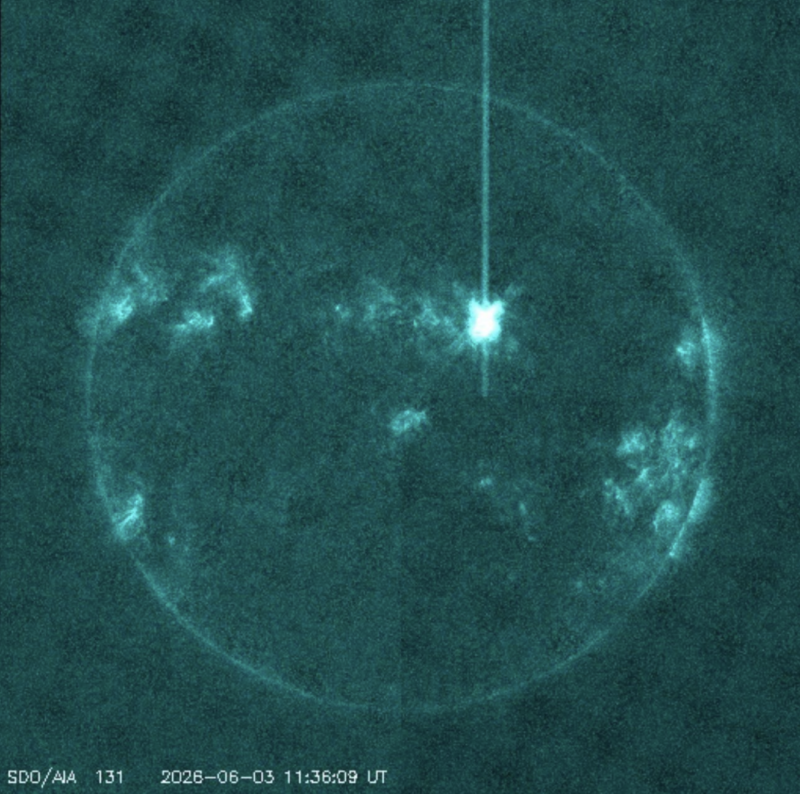


Sun news June 2: M1.2 flare breaks the quiet spell
After an unusual 21 hours without a single flare, the sun blasted out a powerful M1.2 flare at 4:45 UTC this morning. The flare came from an as-yet-unnumbered sunspot region that’s just started rotating into view over the southeast horizon. Quite the introduction! Let’s see what else this region has in store.
Past 24 hours of sun news
(11 UTC June 1 – 11 UTC June 2)
Flare activity
Over the past day, solar activity jumped to moderate levels with an isolated M-class (moderate) flare. In total, the sun fired 6 flares: 1 M-class and 5 C-class (common).
- Strongest flare: M1.2 from a newcomer on the southeast horizon at 4:45 UTC on June 2. The event triggered an R1 (minor) radio blackout over Taiwan.
- Lead flare producer: AR4455 topped the list with 3 C-class flares. Meanwhile, the southeast newcomer contributed 2 flares: a C-class event and the M1.2.
Sunspot regions
The Earth-facing solar disk continued showing 8 numbered active regions. Two newcomers received official numbers during the period: AR4458 in the southeast and AR4459 in the northeast near the limb (edge). All numbered sunspot regions on the disk carry simpler alpha or beta configurations. As a result, the risk of strong flares stays low from the currently numbered regions.
Blasts from the sun?
Available coronagraph imagery showed no Earth-directed coronal mass ejections (CMEs) during the period.
Past 24 hours in space weather
Solar wind
Solar wind speeds dropped from moderate to moderate-low levels during the period. That signals the waning influence of fast solar wind from a coronal hole. Meanwhile, the total interplanetary magnetic field stayed relatively weak.
Bz and magnetic coupling
The Bz component pointed southward during most of this period. A sustained southward Bz favors auroral displays.
Earth’s magnetic field
Over the past day, geomagnetic conditions ranged from quiet to unsettled. Kp reached just above level 3. The coronal hole stream drove the increase. But conditions started to wane. Currently, the Kp index sits just below level 2.

Sun news June 1: Quiet sun as coronal hole winds ease
Over the past earthly day, the sun took a breather. Flare production stayed at low levels. Only C-class (common) flares peppered the visible disk. The strongest event was a modest C1.9 from near the sun’s northeast limb late on May 31. At the same time, Earth stayed under the waning influence of a coronal hole high-speed stream. Solar wind speeds held slightly elevated in the 450–550 km/s range. Geomagnetic conditions were mostly quiet to unsettled.
Looking ahead, unsettled-to-active conditions might return to Earth’s magnetic field today, as residual coronal hole effects linger. A new coronal hole now crossing the sun’s central meridian might drive enhanced activity by June 3. It might bring a chance for G1 (minor) geomagnetic storm conditions. But limited hours of darkness in the Northern Hemisphere will make aurora sightings challenging for most northern observers. Southern Hemisphere watchers at high latitudes have the better shot!
Past 24 hours of sun news
(11 UTC May 31 – 11 UTC June 1)
Flare activity
Over the past day, solar activity held at low levels. In total, the sun fired 8 C-class flares and 1 high B-class (weak) event. No M-class (moderate) or X-class (strong) flares occurred.
- Strongest flare: C1.9 from near the sun’s east limb at 21:42 UTC on May 31. As a C-class event, it produced no radio blackout.
- Lead flare producer: AR4446 topped the list. It fired 5 events: C1.8, C1.5, C1.2, C1.0, and B9.5. Meanwhile, AR4449 contributed 2 C-class flares. And AR4447 fired the period’s broadest event, a C3.1 at 2:09 UTC on May 31.
Sunspot regions: key players
The Earth-facing solar disk showed 8 numbered active regions. Several continued to decay. The overall magnetic complexity was low. No delta configurations are present at the time of this writing (11 UTC on June 1).
Blasts from the sun?
Two coronal mass ejections (CMEs) left the sun’s southwest limb in the past day. But both were assessed as non-Earth-directed. One originated from the sun’s far side. The other came from a region already too far west to threaten Earth.
Past 24 hours in space weather
Solar wind
Solar wind speeds reflected the ongoing influence of the negative-polarity coronal hole high-speed stream. Speeds oscillated between roughly 450 km/s and 550 km/s. Meanwhile, the total interplanetary magnetic field was relatively weak, ranging from 3–7 nT after declining from earlier elevated values near 11 nT.
Bz and magnetic coupling
The Bz component started the period with brief southward dips reaching -5 nT. But it then settled to near-neutral or northward for most of the remainder. That configuration limited geomagnetic coupling. As a result, auroral activity stayed subdued over the past day.
Earth’s magnetic field
Geomagnetic conditions started at unsettled-to-active levels in the past day. Kp reached 3 to 4+ between 18:00 UTC on May 30 and 3:00 UTC on May 31. The onset of the coronal hole stream drove the increase. But conditions then settled to mostly quiet levels (Kp 1–2) for the rest of the period. No G1 or higher geomagnetic storm thresholds were reached.
Like what you read?
Subscribe and receive daily news delivered to your inbox.
More from
C. Alex Young


Sun news: Solar wind disturbs our magnetic field

Yes, there’s an aurora season, and it’s here
Sun activity archive for September 2026
Sun activity archive for August 2026