Sun

Sun news: M-flare launches fast CME toward Earth

Sun news for June 7, 2026. This video from NASA’s Solar Dynamics Observatory (SDO) shows 3 wavelengths, capturing the M1.9 flare from sunspot region AR4461 on June 6. The sequence opens with a full-disk view at 304 angstroms, then switches to 131 angstroms. Finally, the video zooms in on the eruption site at 211 angstroms. Video via NASA/SDO.

Sun news June 7: M-flare launches fast CME toward Earth

Today’s top story: The sun fired a moderate M1.9 flare yesterday afternoon. Sunspot region AR4461 produced it. The eruption peaked at 13:40 UTC on June 6. And it unleashed a fast coronal mass ejection (CME) that’s now barreling toward Earth at over 1,400 km/s (~3.1 million mph)! The blast was impressive! It triggered an R1 (minor) radio blackout over the Atlantic Ocean west of Africa. A filament eruption accompanied the flare. So did a radio burst and a Type II radio sweep, clocked at 838 km/s (these are indicative of CMEs and provide approximate speeds). All are hallmarks of a significant solar blast. When will it arrive? Multiple model runs predict the CME’s shock front could reach Earth as early as 0:17 UTC on June 8. The main body should follow around 6 UTC on June 8. Forecasters expect G1–G2 (minor to moderate) geomagnetic storming. And isolated periods of G3 (strong) are possible. And AR4456 kept busy too. The evolving region churned out a near-M-class C8.8 flare and a string of smaller eruptions. It now carries a beta-gamma-delta configuration, the highest complexity there is. The stage is set for an eventful 48 hours. Share your aurora photos with us!

Past 24 hours of sun news

(11 UTC June 6 – 11 UTC June 7)

Flare activity

Over the past day, solar activity reached moderate levels. In total, the sun fired 15 flares: 1 M-class and 14 C-class.

  • Strongest flare: M1.9 from AR4461 (S23E25) at 13:40 UTC on June 6. It triggered an R1 (minor) radio blackout over the Atlantic Ocean west of Africa. The eruption was accompanied by a filament eruption, a 190 solar flux unit radio burst, and a Type II radio sweep at 838 km/s.
  • Near-M-class event: C8.8 from AR4456 at 13:04 UTC on June 6. That was fired just minutes before the M1.9 from AR4461. Two significant eruptions back-to-back!
  • Lead flare producer: AR4456 dominated the period. It fired 10 of the 14 C-class flares, including the C8.8 and multiple C1–C3 events. Meanwhile, AR4455 contributed a C2.5 at 5:41 UTC on June 7. And AR4462 added a C2.0 at 1:45 UTC on June 7.

Sunspot regions: key players

The Earth-facing solar disk showed 8 numbered active regions. New unnumbered spots were also emerging. AR4456 (beta-gamma-delta) continued evolving significantly. It gained additional spots, with an asymmetric penumbra and a delta signature in its central region. It was by far the most active and complex region on the disk. It produced the majority of the period’s flares. AR4455 has a beta-gamma magnetic configuration, indicating potential for activity.

Blasts from the sun?

The M1.9 flare from AR4461 produced the headline CME of this period. It first appeared as a partial halo event in SOHO LASCO C2 imagery at 14:01 UTC on June 6. The bulk of the material passes south and east of Earth. But the CME is both fast and wide enough to carry a significant Earth-directed component. The leading-edge analysis at 1,396 km/s predicts Earth arrival around 5:57–6:01 UTC on June 8. Kp estimates range from 6 to 8. That points to G2–G4 (moderate to severe) storm potential depending on the CME’s magnetic orientation upon arrival. Kp estimates for the shock range from 7 to 9, indicating G3–G4 (strong to severe) potential.

Past 24 hours in space weather

Solar wind

Solar wind conditions reflected the waning influence of the earlier CME passage. Speeds gradually eased from 650 km/s down to the 550–600 km/s range. Meanwhile, the total interplanetary magnetic field (IMF) decreased to 4–5 nT. These declining conditions should continue waning on June 7. But when the June 6 CME shock arrives, it will reinvigorate the solar wind environment.

Bz and magnetic coupling

The Bz component was mostly calm. Only brief southward dips reached -5 to -6 nT early in the period. As always, a sustained southward Bz is what opens the door for auroral displays. The incoming CME could deliver exactly that.

Earth’s magnetic field

Over the past day, Earth’s magnetic field ranged from quiet to active levels. Kp reached 3–4 early in the period as the earlier CME influence lingered. Then it settled to Kp 2 as those effects faded. No G-scale geomagnetic storm thresholds were reached this period. But that is about to change.

What’s ahead? Sun–Earth forecast

Flare activity forecast

Forecasters expect low-to-moderate levels through June 9. M-class flare odds hold at 55%. The primary sources are AR4456 (beta-gamma-delta), AR4458, and AR4462. And AR4455 contributes with its flare history. A slight chance (10%) exists for an X-class event, mainly from the increasingly complex AR4456 in the northwest.

Geomagnetic activity forecast

  • June 7: Expect quiet-to-unsettled conditions (Kp 1–3) as the current solar wind regime continues to wane. A weaker CME from June 4 may produce a minor uptick around 17:00 UTC. But it should not drive storm-level activity.
  • June 8: The big day. G1–G2 (minor to moderate) geomagnetic storming expected to begin by early to mid UTC with the arrival of the June 6 CME. The shock front could arrive as early as 0:17 UTC. The main CME body should follow around 6:00 UTC. Isolated periods of G3 (strong) storming are possible. Kp could reach 7–9 depending on the CME’s magnetic orientation at arrival. Aurora may reach , , northern France and Germany, Toronto, Chicago, and Boston. But June’s limited darkness hours across the Northern Hemisphere will constrain viewing. In the Southern Hemisphere, aurora could reach southern New Zealand and possibly Tasmania. Get those cameras ready!
  • June 9: G1–G2 storming may linger into the early hours. Then conditions should ease to unsettled-to-active levels as CME effects wane. Aurora chances should diminish through the day.
  • June 10: Expect conditions to ease to quiet-to-unsettled levels as the CME influence fully subsides. But any new eruptions from the increasingly complex AR4456 could change the picture.
Sun news for June 7, 2026. This video from NASA’s Solar Dynamics Observatory (SDO) and SOHO takes you through the M1.9 flare from AR4461 on June 6 in stunning multi-wavelength detail. The sequence opens with a full-disk view that blends the 131 and 304-angstrom channels. Then the view shifts to a four-channel composite of 304, 171, 211, and 131 angstroms. Next, the video zooms in on the eruption site across all four channels. Finally, the video jumps to the SOHO LASCO C2 coronagraph. Here, the resulting coronal mass ejection (CME) appears as a partial halo expanding outward from the sun at 14:01 UTC. G1–G3 (minor to strong) geomagnetic storms are possible upon arrival. Aurora watchers, get ready! Video via NASA/SDO and ESA/NASA SOHO.
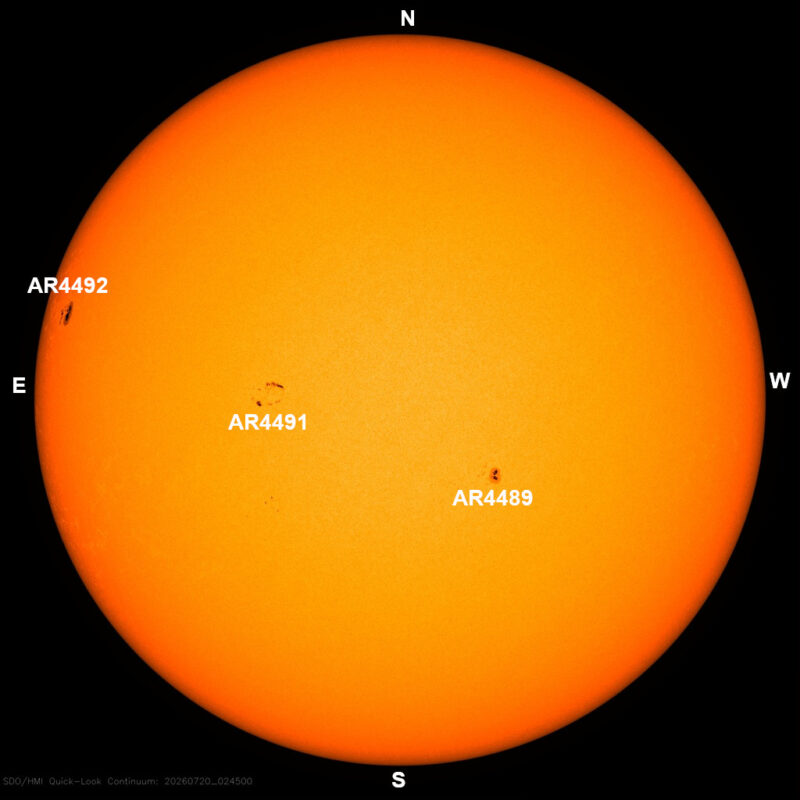
The sun, seen as a large yellow sphere with dark spots, each labeled.
This image shows sun activity – with the most active regions labeled – as of 3 UTC on June 7, 2026. Original image, without labels, via NASA SDO. Courtesy of NASA/SDO and the AIA, EVE, and HMI science teams, with labeling by EarthSky. Armando Caussade posted today’s sun. Why are east and west on the sun reversed?

Sun news June 6: Cannibal CME delivers G2 storm!

Today’s top story: A cannibal coronal mass ejection (CME) – when a faster solar eruption overtakes and merges with a slower eruption ahead of it – delivered! We reported its first impact yesterday. Initially, it arrived as a Kp 4 geomagnetic disturbance. But as Earth plunged deeper into the abundant cannibal CME material, conditions escalated. Geomagnetic storming followed. Earth’s magnetic field reached G1 (minor) geomagnetic storm levels at 12 UTC on June 5. Then it climbed to G2 (moderate) at 15 UTC. G1 and G2 impacts lasted for four three-hour synoptic periods. That is a solid stretch of storming. Did you see the auroras? Share your beautiful photos with us!

Past 24 hours of sun news

(11 UTC June 5 – 12 UTC June 6)

Flare activity

Over the past day, solar activity held at low levels. Only C-class (common) flares occurred. In total, the sun fired 12 C flares.

  • Strongest flare: C4.7 from AR4462 in the northeast at 22:45 UTC on June 4.
  • Lead flare producer: A close race at the top! AR4462 led with 3 C-class flares. But AR4455, AR4456, AR4457, and AR4462 each fired 2 C-class flares. The activity was spread broadly across the disk.

Sunspot regions: key players

Currently, the Earth-facing side of our sun shows 7 numbered active regions. A newcomer on the northeast limb was designated AR4463.

AR4458, with its beta-delta magnetic configuration, is the standout. It grew its gamma into a delta during the period. That upgrade gives it the potential for M-class flares and even an X-class blast. It is now the most complex region on the sun’s disk.

AR4456 (beta-gamma) developed a gamma component during the period. It joins the list of regions worth watching.

Sunspot regions: supporting cast

AR4455 (beta) lost its anti-Hale instability. It now shows a simpler beta configuration. Even so, it still fired 2 C-class flares. AR4459 also carries a beta-gamma setup. The remaining regions show simpler beta configurations.

Blasts from the sun?

Available coronagraph imagery showed no new Earth-directed coronal mass ejections (CMEs) during the period. As of this writing (11 UTC on June 6), effects from the cannibal CME have started to wane.

Past 24 hours in space weather

Solar wind

Solar wind speeds averaged high levels during the peak of the cannibal CME passage. They then slowly decreased to moderate-to-high levels as of this writing. Meanwhile, the total interplanetary magnetic field (IMF) reached strong levels late on June 5. But it has since dropped to weak levels.

Bz and magnetic coupling

The Bz component shifted between northward and southward during the period. But it spent most of the time pointing south. That kept Earth’s magnetic shield open. As a result, auroral displays were possible during the cannibal CME event. This morning on June 6, the Bz shifted to a northward orientation. That closes the door on aurora for now.

Earth’s magnetic field

Over the past day, geomagnetic conditions reached storming levels (Kp 2–6). Both G1 (minor) and G2 (moderate) geomagnetic storm conditions occurred. The cannibal CME delivered as expected. Currently, the Kp index sits just below level 4. Conditions are now easing.

What’s ahead? Sun–Earth forecast

Flare activity forecast

Forecasters expect low-to-moderate levels of solar activity to continue. M-class flare odds hold at 50%. Three active regions drive the outlook: AR4455, AR4458, and AR4462. And AR4456 contributes with its beta-gamma configuration.

X-class (strong) flare chances remain at 10%. AR4458’s new beta-delta configuration makes it the top candidate for a powerful eruption. That delta component is worth watching closely.

Geomagnetic activity forecast

  • June 6: Expect quiet-to-unsettled conditions as the cannibal CME influence wanes. But active instances remain possible from remnant lingering effects. Solar wind speeds should continue declining.
  • June 7: Expect continued quiet-to-unsettled conditions as CME influences fully fade. Solar wind should return toward background levels. No significant geomagnetic drivers are in play.
Animated gif showing auroras from space.
The expected cannibal coronal mass ejection (CME) did arrive! It arrived as G1 (minor) and G2 (moderate) geomagnetic storms. The auroras last night lasted awhile! Did you get a photo? Please submit your image to EarthSky. This animated gif shows auroras from the International Space Station. It’s from NASA /Giphy.
Sun news for June 6, 2026. This chart shows the Kp index from last night. The Kp index is a measure of disturbance, used by space weather scientists to quantify activity in Earth’s magnetic field. Image via NOAA.

Sun news June 5: Cannibal CME arrives … More to come?

The cannibal coronal mass ejection (CME) we reported on yesterday has started arriving. An abrupt jump in solar wind speed around 4:30 UTC this morning marked the arrival of CME material at Earth. It hasn’t caused any significant disturbance yet, but cannibal CMEs are complex structures. More solar material may be trailing behind, soon to reach us. If more CME material does arrive, conditions could escalate to G2 (moderate) and possibly even G3 (strong) geomagnetic storms. And that would likely mean beautiful auroras! So stay tuned.

Past 24 hours of sun news

(11 UTC June 4 – 12 UTC June 5)

Flare activity

Over the past day, solar activity continued at low levels. Only C-class flares occurred. In total, the sun fired 8 C-class (common) flares.

  • Strongest flare: C2.1 from AR4458 in the southwest at 20:59 UTC on June 4.
  • Lead flare producer: AR4457 topped the list this period. It fired 3 of the 8 flares, all C-class events.

Sunspot regions

The Earth-facing side of our sun shows 6 numbered active regions today. Three sunspot regions carry beta-gamma configurations: AR4455, AR4458, and AR4459. Notably, AR4458 gained a gamma component during the period, while AR4461 lost its gamma.

AR4455 quieted down significantly. It sparked only one C-class flare this period. But its anti-Hale instability could wake it up again at any time.

Blasts from the sun?

Available coronagraph imagery showed no new Earth-directed coronal mass ejections (CMEs) during the period. The cannibal CME from the June 3 eruptions has now begun arriving at Earth. Monitoring continues to assess whether additional components follow.

Past 24 hours in space weather

Solar wind

Solar wind speeds averaged moderate levels until 4:20 UTC this morning on June 5. Then an abrupt spike to moderate-high levels was observed. That jump marked the arrival of the cannibal CME material at Earth. Speeds returned to moderate levels at the time of this writing. The total interplanetary magnetic field (IMF) showed similar behavior. It remained relatively weak, then surged to strong levels at 4:30 UTC. Cannibal CMEs are complex structures. More material may follow over the next day.

Bz and magnetic coupling

The Bz component pointed northward through the entire period. That orientation kept Earth’s magnetic shield closed. As a result, no significant geomagnetic coupling occurred. This morning on June 5, the Bz still shows a northward orientation. As always, a sustained southward shift is needed to open the door for auroral displays. If trailing CME material arrives with a southward Bz, the picture could change quickly.

Earth’s magnetic field

Over the past day, geomagnetic conditions ranged from quiet to unsettled (Kp 1–3). No geomagnetic storm conditions occurred. Currently, the Kp index sits just above level 3. The initial CME arrival has been registered. But the full impact remains to be seen.

Animation showing two separate waves of solar wind merging before reaching the Earth orbit.
Sun news for June 5, 2026. This top-down animation shows solar material traveling from the sun (yellow dot) to Earth (green dot). See the second blast catch up and merge with the first? That is what is known as a cannibal coronal mass ejection (CME). And it has begun arriving. An abrupt spike in solar wind speed and magnetic field strength at 4:20 UTC this morning marked the initial contact. And there may be more on the way! Animation via NOAA/SWPC.

Sun news June 4: Cannibal sun-stuff heading for Earth!

Amid yesterday’s flurry of 4 M (moderate) flares and an X (strong) flare on our star, 2 major bursts of solar material – coronal mass ejections or CMEs – were fired our way. Interestingly, the first CME, from the M7.7 flare, was bigger than the second CME from the X flare. But smaller CME is much faster, and so will soon catch up and merge with the first. This so-called cannibal CME is set to hit Earth’s magnetic field late today into early tomorrow. This should trigger geomagnetic storms up to G2 (moderate) and possibly even G3 (strong) levels. That means auroras are on the way! Get those cameras out and prepare for gorgeous displays!

Past 24 hours of sun news

(11 UTC June 3 – 12 UTC June 4)

Flare activity

Over the past day, solar activity dropped to low levels. Only C-class flares occurred. In total, the sun fired 13 C-class (common) flares.

  • Strongest flare: C5.1 from AR4459 in the northeast at 23:43 UTC on June 3.
  • Lead flare producer: AR4455 dominated once again. It fired 8 of the 13 flares, all C-class events.

Sunspot regions

Currently, the Earth-facing side of our sun shows 8 numbered active regions. Two newcomers received official numbers during the period. Notably, three sunspot regions carry beta-gamma configurations: AR4455, AR4459, and AR4461. The remaining regions show simpler beta setups.

AR4455 is the standout. After briefly reaching the strongest beta-gamma-delta configuration, it has settled back to beta-gamma. But specialists observed that a series of spots appeared around the main spot. They developed instability due to an unusual distribution of magnetic polarities known as an anti-Hale region. That means this sunspot region is unstable. It remains capable of producing more M-class or even X-class flares.

Blasts from the sun?

After modeling the M-class and X-class flares from AR4455, specialists determined that two blobs of solar stuff head toward Earth. A larger, slower CME will be caught by a faster one. Together they form a cannibal CME. Arrival is expected late today, on June 4, into early June 5. Geomagnetic enhancements are likely upon arrival.

Past 24 hours in space weather

Solar wind

Solar wind speeds averaged at moderate levels during the period. Think of it as the calm before the storm. A pretty large CME is now approaching Earth. Meanwhile, the total interplanetary magnetic field (IMF) stayed relatively weak.

Bz and magnetic coupling

The Bz component pointed mostly southward through the period. A brief northward peak occurred around 21 UTC on June 3. It lasted about two hours before returning to a southward orientation. As always, southward favors geomagnetic coupling and auroral displays. This morning on June 4, the Bz still shows southward. That bodes well for what is coming.

Earth’s magnetic field

Over the past day, geomagnetic conditions ranged from quiet to unsettled (Kp 2–3). No geomagnetic storm thresholds were reached. Currently, the Kp index sits just below level 3. But that number could climb quickly once the cannibal CME arrives.

Sun news for June 4, 2026. This video from NOAA’s GOES-19 SUVI instrument captures the M7.7 flare from AR4455 in the northwest at 7 UTC on June 3. Most of the CME was deflected northward by fast solar wind streaming from a nearby coronal hole. But a portion is heading our way at Earth. That Earth-directed component, combined with the faster CME from the X-class flare overtaking it from behind, forms the cannibal CME now racing toward us. Arrival expected late today into early tomorrow. Video via NOAA/GOES.

Sun news June 3: X flare from an unlikely source!

The sun has come alive over the past day! Sunspot region AR4455 blasted out 4 M flares, including an M9.3 that almost breached the X flare threshold. And then just after we finished writing today’s update, it fired an actual X flare! AR4455’s X1.07 flare peaked at 11:48 UTC. Surprisingly, its producer spent much of the past day with a relatively simple beta magnetic configuration, indicating a low chance for big flares. And yet it’s been explosive! Read on for the full details of AR4455’s impressive flaring over the past day. Plus, don’t miss the imagery of several fiery eruptions that have been taking place elsewhere on our star. It’s been a busy day on the sun!

Past 24 hours of sun news

(11 UTC June 2 – 12 UTC June 3)

Flare activity

Over the past day, solar activity jumped to high levels, after 4 M-class flares and an X flare. In total, it produced 14 flares: 1 X-class (strong), 4 M-class (moderate), and 9 C-class (common).

  • Strongest flare: X1.07 from AR4455 in the northwest at 11:48 UTC on June 3. The event triggered an R3 (strong) radio blackout.
  • Other M-class flares: AR4455 did not stop there. It also fired an M9.3 at 1:36 UTC (R2 radio blackout southeast of Japan), an M1.3 at 10:05 UTC on June 3 (R1 blackout over Egypt), an M3.3 at 16:50 UTC on June 2 (R1 blackout over Puerto Rico), and an M7.7 at 7:00 UTC on June 3 (R2 blackout over India). Four M flares and an X flare from a single region in 24 hours!
  • Lead flare producer: AR4455 dominated the period. It fired 11 of the 14 flares: all 5 M- and X-class events plus 6 C-class flares. Meanwhile, newcomer AR4461 contributed 2 C-class events.

Sunspot regions

Currently, the Earth-facing side of our sun shows 7 numbered active regions. Two newcomers received official numbers: AR4461 in the southeast and AR4462 in the northeast near the limb (edge).

Blasts from the sun?

Specialists are currently modeling the M and X flares from AR4455 to determine if any sun-stuff has been sent toward Earth. The strong prominence at 12:04 UTC on June 2 in the southeast and the far-side prominence in the northeast at 16:56 UTC on June 2 are both too far off the sun-Earth line for any component to reach us.

Past 24 hours in space weather

Solar wind

Solar wind speeds averaged at moderate levels during the period. A couple of brief peaks reached moderate to high. That signals the remnant influence of fast solar wind from a coronal hole. Meanwhile, the total interplanetary magnetic field (IMF) stayed relatively weak late on June 2, but it has started increasing to moderate levels as of this writing.

Bz and magnetic coupling

The Bz component pointed mostly southward through the period. That orientation favors geomagnetic coupling and auroral displays. But at 2:30 UTC this morning on June 3, the Bz shifted northward.

Earth’s magnetic field

Over the past day, geomagnetic conditions ranged from quiet to unsettled. Kp reached level 3. No geomagnetic storm thresholds were reached. Currently, the Kp index sits just above level 2.

Solar ultraviolet image showing a bright solar flare near the center-right of the Sun, with active regions visible across the solar disk.
Sun news for June 3, 2026. BAM! This image from NASA’s Solar Dynamics Observatory captures a powerful X-class flare erupting from sunspot region AR4455 around 11:30 UTC this morning. And this region has also fired 4 M-class flares over the past day, despite having a relatively simple magnetic configuration! Image via SDO.
Sun news.
June 2, 2026. The sun today gave us a fan of fiery activity; we saw jets from AR4455, a fiery prominence from a filament eruption in the southeast, and a strong far-sided prominence in the northeast. GOES-19 SUVI 04 angstrom. Image via NOAA.
Sun news.
June 2, 2026. A closer look to the fiery eruptions, jets and prominences the sun gave us today. GOES-19 SUVI 304 angstrom. Images via NOAA.

Sun news June 2: M1.2 flare breaks the quiet spell

After an unusual 21 hours without a single flare, the sun blasted out a powerful M1.2 flare at 4:45 UTC this morning. The flare came from an as-yet-unnumbered sunspot region that’s just started rotating into view over the southeast horizon. Quite the introduction! Let’s see what else this region has in store.

Past 24 hours of sun news

(11 UTC June 1 – 11 UTC June 2)

Flare activity

Over the past day, solar activity jumped to moderate levels with an isolated M-class (moderate) flare. In total, the sun fired 6 flares: 1 M-class and 5 C-class (common).

  • Strongest flare: M1.2 from a newcomer on the southeast horizon at 4:45 UTC on June 2. The event triggered an R1 (minor) radio blackout over Taiwan.
  • Lead flare producer: AR4455 topped the list with 3 C-class flares. Meanwhile, the southeast newcomer contributed 2 flares: a C-class event and the M1.2.

Sunspot regions

The Earth-facing solar disk continued showing 8 numbered active regions. Two newcomers received official numbers during the period: AR4458 in the southeast and AR4459 in the northeast near the limb (edge). All numbered sunspot regions on the disk carry simpler alpha or beta configurations. As a result, the risk of strong flares stays low from the currently numbered regions.

Blasts from the sun?

Available coronagraph imagery showed no Earth-directed coronal mass ejections (CMEs) during the period.

Past 24 hours in space weather

Solar wind

Solar wind speeds dropped from moderate to moderate-low levels during the period. That signals the waning influence of fast solar wind from a coronal hole. Meanwhile, the total interplanetary magnetic field stayed relatively weak.

Bz and magnetic coupling

The Bz component pointed southward during most of this period. A sustained southward Bz favors auroral displays.

Earth’s magnetic field

Over the past day, geomagnetic conditions ranged from quiet to unsettled. Kp reached just above level 3. The coronal hole stream drove the increase. But conditions started to wane. Currently, the Kp index sits just below level 2.

Sun news for June 2, 2026. This video from NASA’s Solar Dynamics Observatory (SDO) opens with a full-disk view of our star over the past 24 hours, blending the 304, 211 and 131 angstrom channels. Together, they paint a complete picture of a sun that spent 21 hours without a single flare. Then, using the 131-angstrom channel alone, the view zooms in on the southeast limb (edge), where an M1.2 (moderate) flare erupted at 4:45 UTC on June 2. Video via NASA/ SDO.

Sun news June 1: Quiet sun as coronal hole winds ease

Over the past earthly day, the sun took a breather. Flare production stayed at low levels. Only C-class (common) flares peppered the visible disk. The strongest event was a modest C1.9 from near the sun’s northeast limb late on May 31. At the same time, Earth stayed under the waning influence of a coronal hole high-speed stream. Solar wind speeds held slightly elevated in the 450–550 km/s range. Geomagnetic conditions were mostly quiet to unsettled.

Looking ahead, unsettled-to-active conditions might return to Earth’s magnetic field today, as residual coronal hole effects linger. A new coronal hole now crossing the sun’s central meridian might drive enhanced activity by June 3. It might bring a chance for G1 (minor) geomagnetic storm conditions. But limited hours of darkness in the Northern Hemisphere will make aurora sightings challenging for most northern observers. Southern Hemisphere watchers at high latitudes have the better shot!

Past 24 hours of sun news

(11 UTC May 31 – 11 UTC June 1)

Flare activity

Over the past day, solar activity held at low levels. In total, the sun fired 8 C-class flares and 1 high B-class (weak) event. No M-class (moderate) or X-class (strong) flares occurred.

  • Strongest flare: C1.9 from near the sun’s east limb at 21:42 UTC on May 31. As a C-class event, it produced no radio blackout.
  • Lead flare producer: AR4446 topped the list. It fired 5 events: C1.8, C1.5, C1.2, C1.0, and B9.5. Meanwhile, AR4449 contributed 2 C-class flares. And AR4447 fired the period’s broadest event, a C3.1 at 2:09 UTC on May 31.

Sunspot regions: key players

The Earth-facing solar disk showed 8 numbered active regions. Several continued to decay. The overall magnetic complexity was low. No delta configurations are present at the time of this writing (11 UTC on June 1).

Blasts from the sun?

Two coronal mass ejections (CMEs) left the sun’s southwest limb in the past day. But both were assessed as non-Earth-directed. One originated from the sun’s far side. The other came from a region already too far west to threaten Earth.

Past 24 hours in space weather

Solar wind

Solar wind speeds reflected the ongoing influence of the negative-polarity coronal hole high-speed stream. Speeds oscillated between roughly 450 km/s and 550 km/s. Meanwhile, the total interplanetary magnetic field was relatively weak, ranging from 3–7 nT after declining from earlier elevated values near 11 nT.

Bz and magnetic coupling

The Bz component started the period with brief southward dips reaching -5 nT. But it then settled to near-neutral or northward for most of the remainder. That configuration limited geomagnetic coupling. As a result, auroral activity stayed subdued over the past day.

Earth’s magnetic field

Geomagnetic conditions started at unsettled-to-active levels in the past day. Kp reached 3 to 4+ between 18:00 UTC on May 30 and 3:00 UTC on May 31. The onset of the coronal hole stream drove the increase. But conditions then settled to mostly quiet levels (Kp 1–2) for the rest of the period. No G1 or higher geomagnetic storm thresholds were reached.

Sun news for June 1, 2026. We talk a lot about the solar wind, but we seldom actually see it. Here’s an image created using data from the STEREO coronagraph in 2016. It’s processed to isolate the weaker solar wind. Image via SwRI/ Craig DeForest/ NASA SVS.

The sun in recent days

The sun, seen as a large yellow sphere with dark spots, each labeled.
This image shows sun activity – with the most active regions labeled – as of 4 UTC on June 6, 2026. Image via NASA/ SDO.
The sun, seen as a large yellow sphere with dark spots, each labeled.
This image shows sun activity – with the most active regions labeled – as of 4 UTC on June 5, 2026. Image via NASA/ SDO.
The sun, seen as a large yellow sphere with dark spots, each labeled.
This image shows sun activity – with the most active regions labeled – as of 1 UTC on June 4, 2026. Image via NASA/ SDO.

Earlier sun images

The sun, seen as a large yellow sphere with dark spots, each labeled.
This image shows sun activity – with the most active regions labeled – as of 5 UTC on June 3, 2026. Image via NASA/ SDO.
The sun, seen as a large yellow sphere with dark spots, each labeled.
This image shows sun activity – with the most active regions labeled – as of 4 UTC on June 2, 2026. Image via NASA/ SDO.
The sun, seen as a large yellow sphere with dark spots, each labeled.
This image shows sun activity – with the most active regions labeled – as of 4 UTC on June 1, 2026. Image via NASA/ SDO.
The sun, seen as a large yellow sphere with dark spots, each labeled.
This image shows sun activity – with the most active regions labeled – as of 4 UTC on May 31, 2026. Image via NASA/ SDO.

Sun images from our community

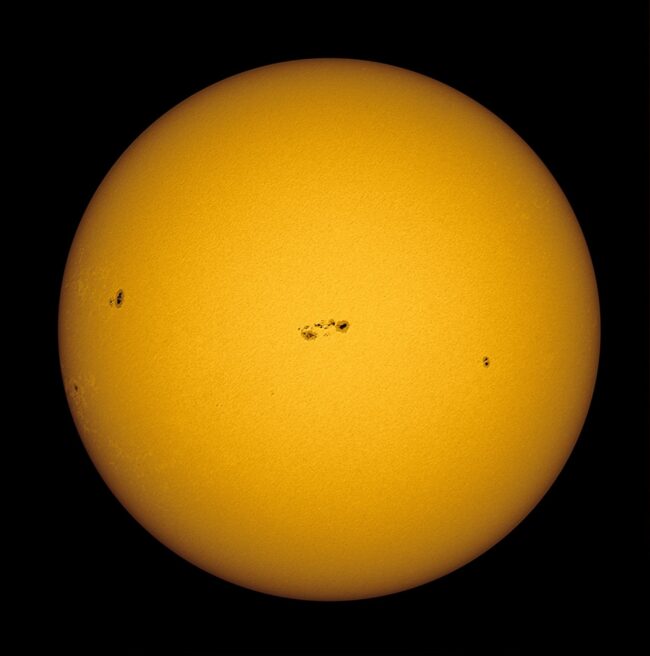
The sun, seen as a large white sphere with small dark spots.
View at EarthSky Community Photos. | Patricio León in Santiago, Chile, captured this filtered image on June 6, 2026. Patricio wrote: “The sun shows a distinct belt of four delicate sunspots across its northern equatorial zone; one of them, AR4456 second from right, has a delta magnetic component which can trigger strong flares while it approaches and passes over the western limb.” Thank you, Patricio!
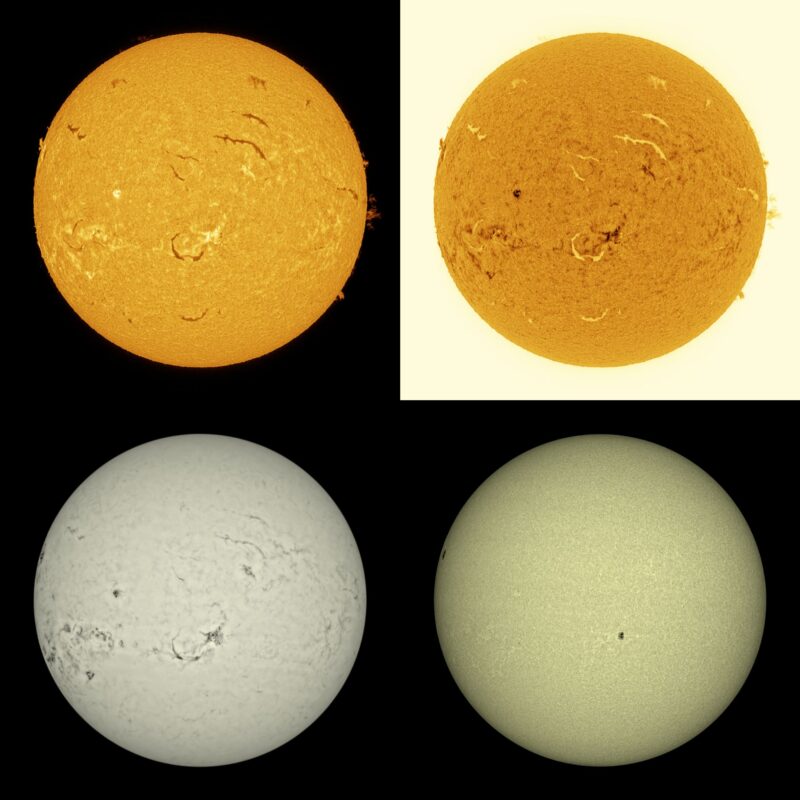
The sun, seen as four spheres in different shades of gray.
View at EarthSky Community Photos. | Mario Rana in Hampton, Virginia, captured these filtered images on June 6, 2026. Mario wrote: “The sun in hydrogen-alpha, helium D3 and iron.” Thank you, Mario!
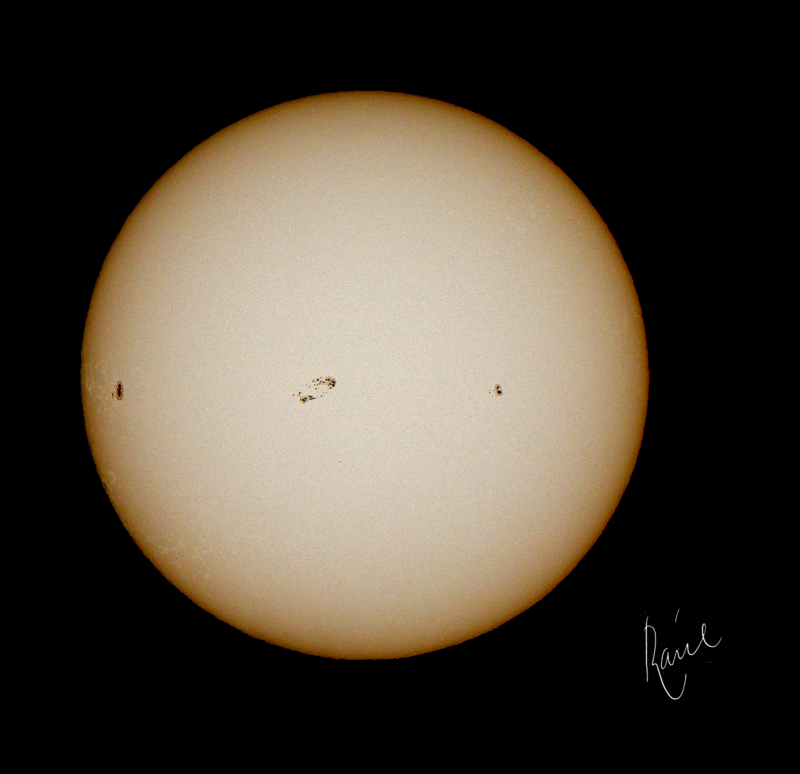
The sun, seen as a green sectional sphere with dark spots, each labeled.
View at EarthSky Community Photos. | Victor Rogus in Sedona, Arizona, captured this filtered image on June 6, 2026. Victor wrote: “This morning the most active sunspot on the solar disk is, Sunspot 4456 that has a ‘beta-gamma’ magnetic field that poses a threat for strong M-class solar flares. Seen through clear Arizona skies.” Thank you, Victor!

More sun images from our community

The sun, seen as a large yellow sphere with a mottled surface.
View at EarthSky Community Photos. | Jim Militello in Tucson, Arizona, captured this filtered image on June 5, 2026. Jim wrote: “Hydrogen-alpha image of the sun with active regions, filaments and prominences.” Thank you, Jim!

We sometimes feature sun images obtained using hydrogen-alpha filters. Read why.

Bottom line: Sun news for June 7, 2026: M1.9 flare launches fast CME at 1,400 km/s! G1–G3 storms possible June 8. Aurora may reach and . Get ready!

Submit your photos here.

View community photos here.

Posted 
June 7, 2026
 in 
Sun

Like what you read?
Subscribe and receive daily news delivered to your inbox.

Your email address will only be used for EarthSky content. Privacy Policy
Thank you! Your submission has been received!
Oops! Something went wrong while submitting the form.

More from 

C. Alex Young

View All