Sun news May 31: Boom! An almost-X flare and a fast CME
(11 UTC to 11 UTC)


The sun has awakened with four M flares, one of them an almost-X. The largest event was a long-duration M8.2 flare from active region AR4100. The blast released a full halo coronal mass ejection (CME) visible in the LASCO C3 imager of the sun-observing SOHO spacecraft. This massive CME is coming toward Earth. It’s estimated to arrive by June 1 and could bring significant geomagnetic storming and auroras. Stay tuned!
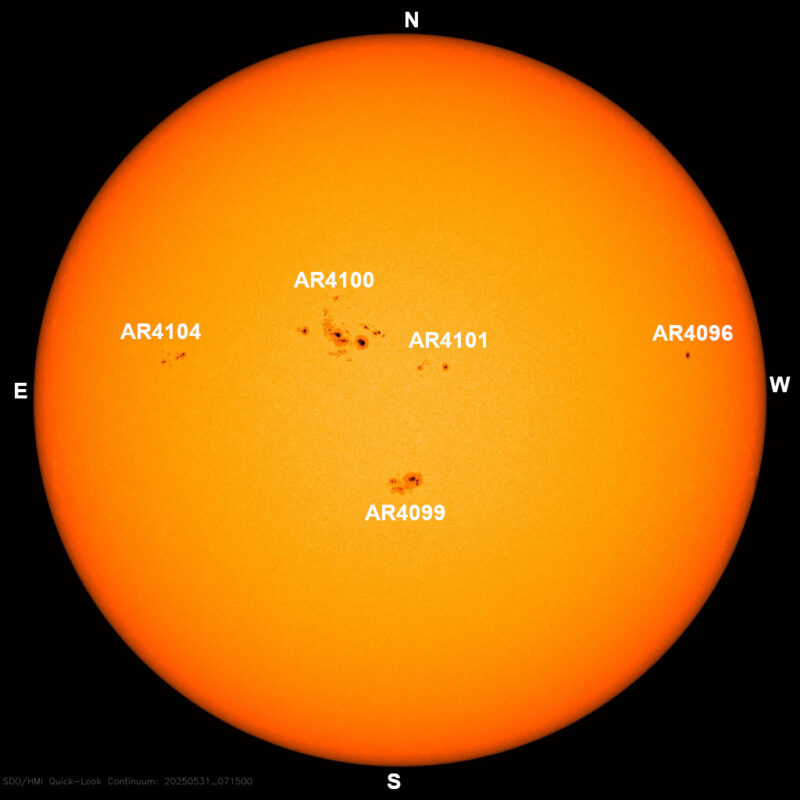
- Flare activity jumped to high over the past 24 hours, with four M flares, including the M8.2 at 0:05 UTC on May 31 from AR4100. An R2 (moderate) radio blackout was observed over the Pacific Ocean west of Hawaii. The other three M flares were an M1.7 at 18:45 UTC on May 30 from active region AR4104 in the northeast with an R1 (minor) radio blackout affecting an area over México, an M2.4 at 5:18 UTC on May 31 from AR4100 with an R1 (minor) radio blackout over Myanmar and an M4.5 at 8:18 UTC on May 31 that with an R1 (minor) radio blackout over Saudi Arabia. Our star produced 11 flares in the past 24 hours, the four Ms and seven Cs.
- The sun currently has five numbered active regions on its Earth-facing side. AR4100 kept its lead as main flare producer with eight flares, three M flares including the largest one and five C flares. Active region AR4099 developed a full beta-gamma-delta magnetic configuration, the most complex with potential for more M flare including chances for an X flare. AR4100 retained its beta-gamma magnetic complexity. The remaining sunspot regions show either alpha or beta configurations. The newcomer on the solar disk is labeled AR4104.
- Blasts from the sun? The M flares of the period are under analysis for any coronal mass ejections (CMEs) Earth bound but still in preliminary analysis, coronal imagery shows a massive halo CME produced during the long duration M8.2 flare from AR4100. Radio emission shows a speed of up to 1900 km/s (4,250,179). The preliminary arrival time is estimated to be June 1.
- Solar wind: Late yesterday, the solar wind averaged around ~750 km/s (1,678,000 mph), with peaks at 810 km/s (1,812,000 mph). At the time of this writing (11 UTC on May 31), the solar wind speed dropped to 671 km/s (1,501,000 mph). The Bz component (north-south orientation) during most part of the period was southward and it remains southward at the time of this writing. A southward Bz is more favorable for auroras.
- Geomagnetic activity: Earth’s geomagnetic field was at active levels (Kp 4) during the period.
What’s ahead? Sun-Earth forecast
- Moderate-to-low flare activity is expected in the coming day. The chance for M (moderate) flares is 65% today and the chance for X (strong) flares is 15%.
- Geomagnetic activity forecast: At the time of this writing (11 UTC on May 31), the geomagnetic field is unsettled at (Kp 3). The geomagnetic storms we saw yesterday and the day before started to wane but today a G1 (minor) geomagnetic storm may be possible as the high-speed stream (CH HSS) from a transequatorial coronal hole combined with a co-rotating interaction region (CIR) persist. A coronal mass ejection hurled by the sun early today after an M8.2 flare from AR4100 is coming our way at Earth with an estimated arrival time of June 1. G2 to G3 geomagnetic storms may be possible. Stay alert.

Sun news May 30: A 2nd strike! More surprising geomagnetic storming
(11 UTC to 11 UTC)
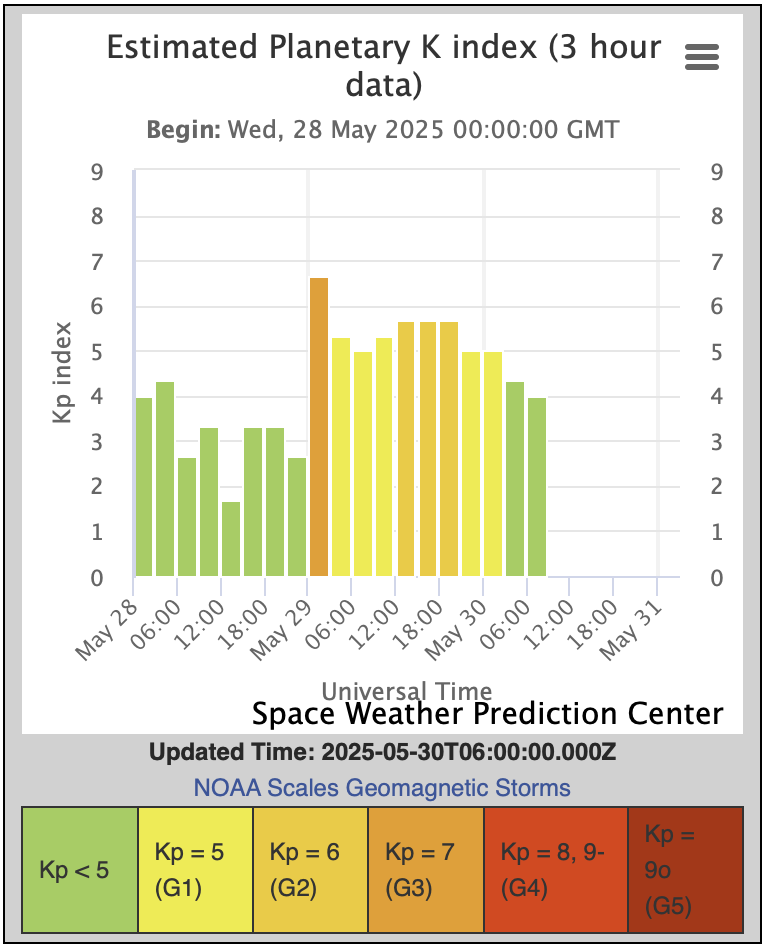
The surprising geomagnetic storm we reported on yesterday – which happened overnight on Wednesday – struck again yesterday (Thursday). Forecasters had predicted chances for G1 (minor) geomagnetic storming. But conditions kept up to a G2 (moderate) geomagnetic storm all day long Thursday. And, last night, there were auroral displays as far south as South Dakota and Oregon in the U.S. The cause was a stream of fast solar wind straight at Earth from a coronal hole, a cooler, less dense region in the sun’s atmosphere. On its way to us at Earth, this stream of charged particles merged with a complex knot of solar winds known as a co-rotating interaction region (CIR). The combined effect was strong enough to keep Earth’s geomagnetic field disturbed. And it’s still disturbed. At this writing (11 UTC on May 30), we’re at Kp4 (the K-index is used to characterize the magnitude of geomagnetic storms). All this means more chances for auroral displays tonight. Share your photos with us here. Stay tuned.
- Flare activity was moderate over the past day, with the production of an M3.4 flare from active region AR4100 in the sun’s northeast. It happened at 6:13 UTC on May 30. Shortly after the spark, an R1 (minor) radio blackout was registered affecting an area over Bangladesh. Our star produced 10 flares in the past 24 hours, the M plus six Cs and three Bs.
- The sun currently has five numbered active regions on its Earth-viewed side. AR4100 was lead flare producer of the past day: eight flares total, the M flare included. Active region AR4099 keeps its beta-delta magnetic configuration, and AR4100 keeps its beta-gamma magnetic complexity. The rest of the sunspot regions on the solar disk show either alpha or beta configurations.
- Blasts from the sun? Specialists have not found any coronal mass ejections (CMEs) in the filament eruption under analysis. No other CMEs observed in available coronagraph imagery.
- Solar wind: Late yesterday, the solar wind increased to average around ~700 km/s (1,566,000 mph), with peaks at 840 km/s (1,655,000 mph). At the time of this writing (11 UTC on May 30), the solar wind speed remains high at 748 km/s (1,673,000 mph). The Bz component (north-south orientation) fluctuated between north and southward during most of the period. At the time of this writing it is north oriented. A southward Bz is more favorable for auroras.
- Geomagnetic activity: Earth’s geomagnetic field kept at a G2 (moderate) geomagnetic storm levels (Kp 6) during three three-hour synoptic periods, then dropped down to a G1 geomagnetic storm level during another two three-hour synoptic periods.
Sun news May 29: Surprise geomagnetic storm last night!
(11 UTC to 11 UTC)
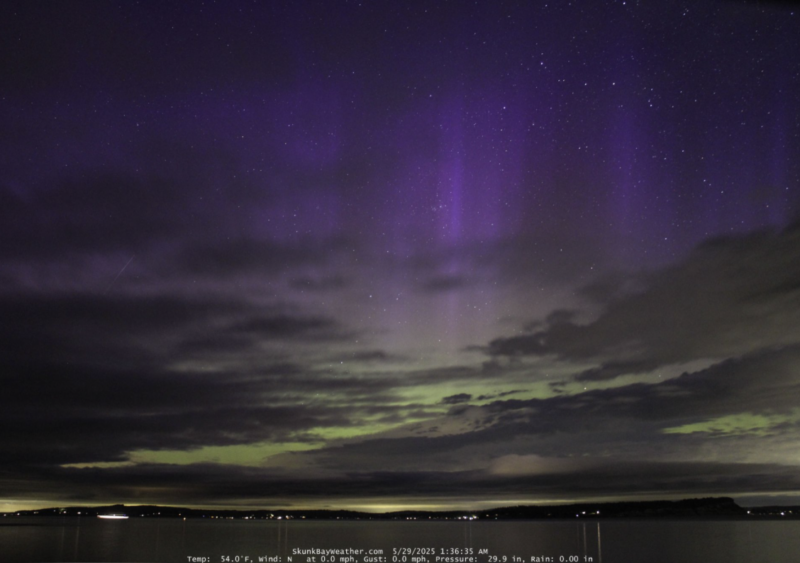
Did you see the auroras last night? Forecasters had predicted only a G1 (minor) geomagnetic storm, but conditions ramped up to G3 (strong), causing auroral displays as far south as Iowa in the U.S. The cause was a coronal hole – a cooler, less dense region in the sun’s atmosphere – which has rotated into a geoeffective position, sending a stream of fast solar wind straight at Earth. And on its way this stream combined with a complex knot of solar winds known as a co-rotating interaction region (CIR), causing the unexpectedly strong disturbance. Did you see the auroras last night? Share your photos with us here. Geomagnetic disturbance may continue tonight, so stay tuned.
- Flare activity remains low, with the production of seven C (common) flares and one B (weak) flare over the past 24 hours. The largest blast was a C7.0 flare at 3:01 UTC on May 29 from AR4100.
- The sun currently has eight numbered active regions on its Earth-viewed side. This time the lead flare producer title is shared by two active regions: AR4099 and AR4100. Both produced four flares each. Things are getting interesting, as AR4099 in the southeast solar quadrant developed a delta region, meaning it now has a beta-delta magnetic configuration. Meanwhile, AR4100 now has a beta-gamma magnetic complexity. There is a newcomer on our star today: AR4103 just south of the solar disk’s center.
- Blasts from the sun? A filament eruption at around 12 UTC on May 28 produced a coronal mass ejection (CME) that specialists are now studying to determine if a component is headed to Earth.
- Solar wind: Late yesterday, the solar wind was around ~470 km/s (1,051,000 mph), dropping momentarily as low as 373 Km/s (834,000 mph) at 22:49 UTC on May 28. Early this morning it jumped up to ~744 km/s (1,664,000 mph). At the time of this writing (11 UTC on May 29), the solar wind speed remains high at 705 km/s (1,577,000 mph). The Bz component (north-south orientation) was southward during most of the period. At the time of this writing it moved northward. A southward Bz is more favorable for auroras.
- Geomagnetic activity: Earth’s geomagnetic field has been undergoing a G3 (strong) geomagnetic storm (Kp 7). The G3 geomagnetic storm level was reached around 0:00 UTC on May 29 and dropped down to a G2 (moderate) level (Kp 6) by 3 UTC on May 29.
Sun news May 28: Geomagnetic storms possible today
(11 UTC to 11 UTC)
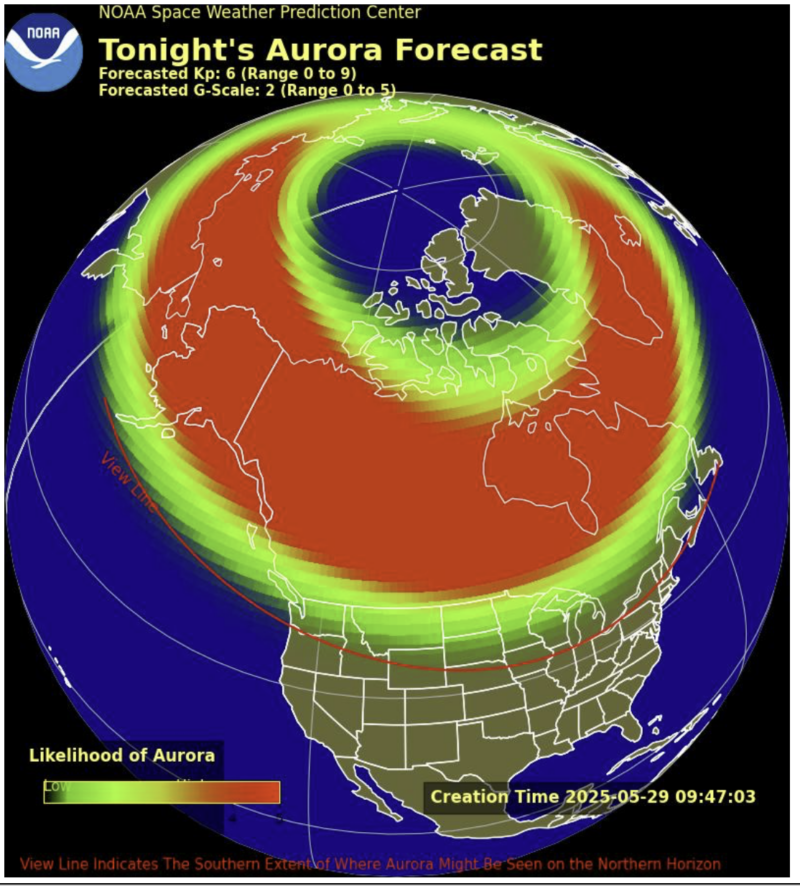

A coronal hole – a cooler, less dense region in the sun’s atmosphere – has rotated into a geoeffective position. That means the fast solar wind streaming from it is on a course for Earth. This stream could disturb our magnetic field later today, potentially causing a G1 (minor) geomagnetic storm. And that means high latitudes could see beautiful auroras tonight! Clear skies, aurora hunters.
- Flare activity is down to a low level, with the production of only five C (common) flares in total over the past 24 hours. The largest blast was a C1.8 flare at 5:48 UTC on May 28 from AR4099.
- The sun currently has six numbered active regions on the side we see from Earth. The lead flare producer of the period was AR4100, which fired three C flares. All the labeled active regions on the solar disk today show simple alpha or beta magnetic configurations. There are two newcomer on our star today: AR4101 in the northeast quadrant and AR4102 in the southeast near the central meridian.
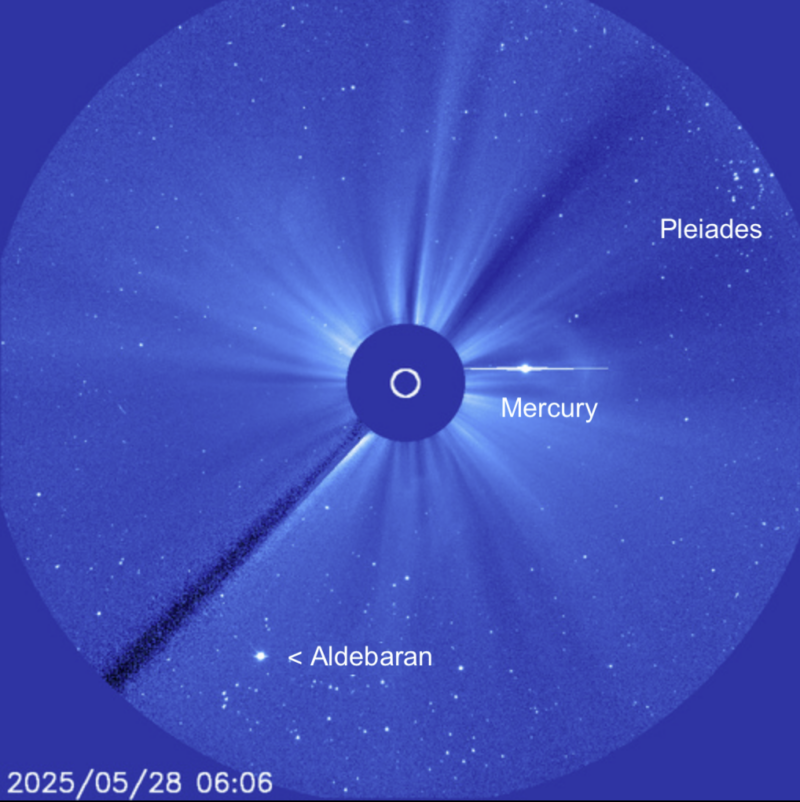
- Blasts from the sun? A coronal mass ejection (CME) was observed coming from a C5 flare by AR4100 at 9:36 UTC on May 27. Initial analysis suggests it will miss Earth, but modeling is ongoing to check for any Earth-bound components.
- Solar wind: Late yesterday, the solar wind was around ~420 km/s (939,513 mph). Early this morning it jumped up to ~635 km/s (1,420,000 mph). At the time of this writing (11 UTC on May 28), the solar wind speed remains at 554 km/s. The Bz component (north-south orientation) was southward late yesterday. Early today it has been fluctuating between southward and northward. At the time of this writing it remains southward. A southward Bz is more favorable for auroras.
- Geomagnetic activity: Earth’s geomagnetic field has been at quiet levels (Kp = 1 – 2).
Sun news May 27: Huge sunspot region is back!
(11 UTC to 11 UTC)
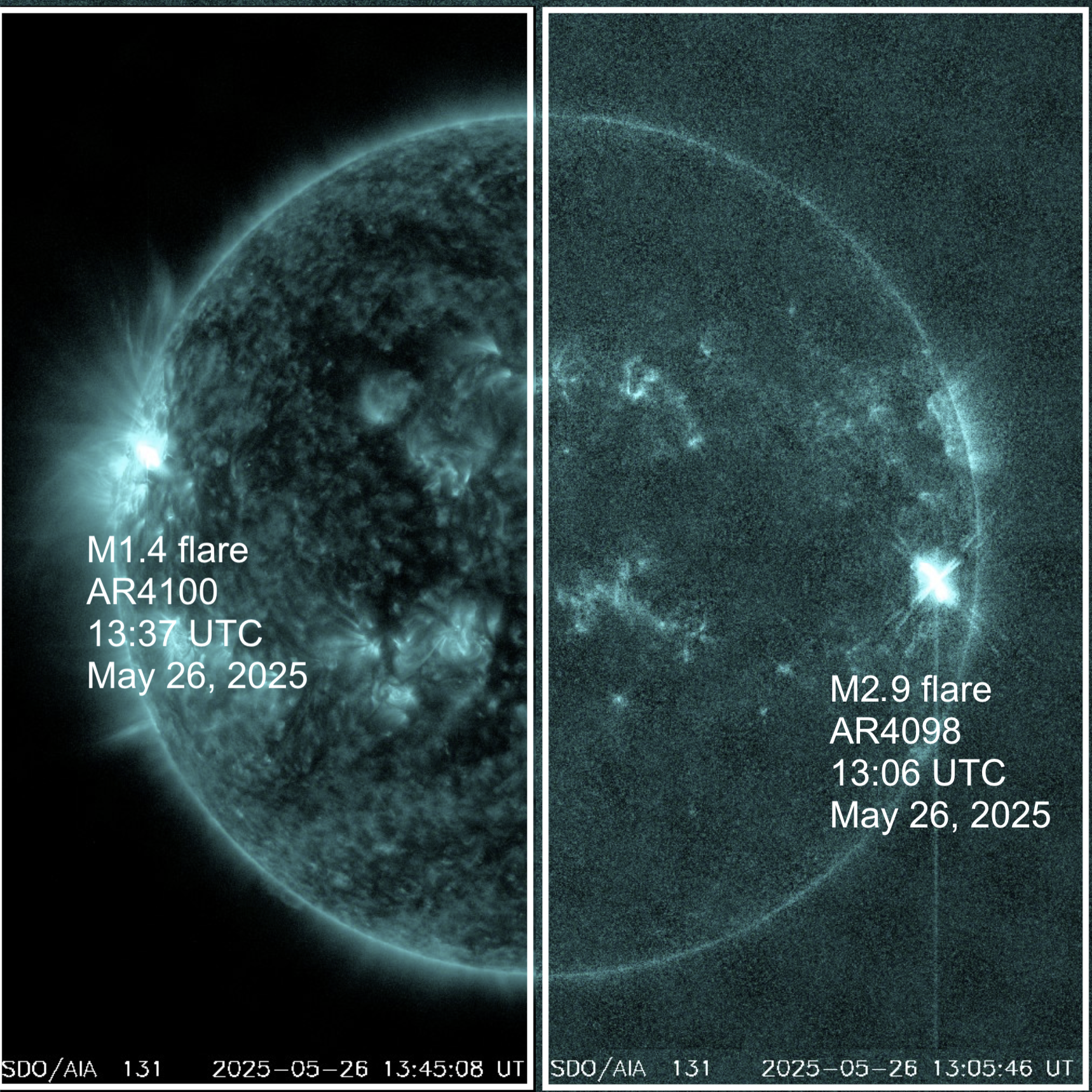
Earlier this month, our star hosted a sunspot region so enormous it was visible from Earth through just eclipse glasses, without magnification. Eventually, this region – AR4079 – rotated out of view over the western horizon. But now it’s back! It stayed intact as it journeyed round the sun’s far side, and emerged again in the northeast over the past day. Now labeled AR4100, it announced its arrival with an M1.4 (moderate) flare yesterday afternoon. Stay tuned to see what this region has in store this time around.
- Flare activity has dropped back to a moderate level with the production of 2 M flares, seven C (common) flares and two B (weak) flares over the past 24 hours. The largest event was an M2.9 flare at 13:06 UTC on May 26 from AR4098. The flare produced an R1 (moderate) radio blackout over the Atlantic Ocean. The second M flare of the period was an M1.4 blasted out at 13:37 UTC on May 26. This one was produced by active region AR4100 in the northeast.
- The sun has six numbered active regions on its Earth-facing side. AR4098 continues to be the lead flare producer, firing the largest M and four C flares. Newcomer AR4100 also produced five flares: the second M and three Cs, plus a B flare. AR4098 has lost its delta region, but retained its beta-gamma magnetic configuration. The remaining active regions, including newcomer AR4100, have either alpha or beta configurations.
- Blasts from the sun? No Earth-directed coronal mass ejections (CMEs) were observed in available coronagraph imagery.
- Solar wind: The solar wind was around ~450 km/s (1,037,000 mph) late yesterday. Early today it dropped down to an average of ~420 km/s (939,513 mph). At the time of this writing (11 UTC on May 27), the solar wind speed remains at 420 km/s. The Bz component (north-south orientation) was southward the whole period, and remains so at the time of this writing. A southward Bz is more favorable for auroras.
- Geomagnetic activity: Earth’s geomagnetic field has been at quiet levels (Kp = 1 – 2).

Sun news May 26: AR4098 keeps activity high with a huge M8.9 flare
(11 UTC to 11 UTC)
Solar activity remains high thanks to the prolific sunspot region AR4098. After kicking things off yesterday with an X1.1 (strong) flare at 1:52 UTC, this region followed up with a powerful M8.9 (moderate) flare at 16:18 UTC. It also produced a cluster of C-class (common) flares, with newly numbered AR4099 and AR4094 also providing some minor activity. The activity from dominant region AR4098 produced several narrow coronal mass ejections (CMEs), but analysis confirms these will pass ahead of Earth’s orbit and not impact our magnetic field.
- Flare activity remains at a high level with the production of an almost-X flare and ten C flares. The largest blast was an M8.9 flare at 16:18 UTC on May 25 from active region AR4098. The M flare produced an R2 (moderate) radio blackout over the western pacific.
- The sun has seven numbered active regions on its Earth-facing side. AR4098 is the new lead flare producer, firing the M and four C flares. AR4098 retained its beta-gamma-delta magnetic configuration. The remaining active regions, including newcomer AR4099, have either alpha or beta configurations.
- Blasts from the sun? No Earth-directed coronal mass ejections (CMEs) were observed in available coronagraph imagery.
- Solar wind: The solar wind declined from ~500 km/s to ~350 km/s over the past day, before rising to ~398 km/s (800,823 mph) at the time of this writing (11 UTC on May 26). The Bz component (north-south orientation) fluctuated between northward and southward, though was mostly northward. At the time of this writing it is northward. A southward Bz is more favorable for auroras.
- Geomagnetic activity: Earth’s geomagnetic field has been at quiet levels (Kp = 1 – 2).
Sun news May 25: Solar activity surges today with an X flare
(11 UTC to 11 UTC)
Solar activity surged to high levels as sunspot region AR4098 fired off a sequence of significant flares, including an X1.1 flare at 1:46 UTC, an M2.1 flare at 20:15 UTC, and most recently, an M3.4 flare at 10:05 UTC. These eruptions make AR4098 the dominant feature on the solar disk, and it continues to exhibit rapid growth and increasing magnetic complexity. Minor C-class flares were recorded from multiple regions, including one near the eastern limb. Despite the flare activity, no Earth-directed CMEs have been observed.
- Flare activity jump to a high level over the past 24 hours with the production of one X (high), two M (moderate) and ten C (minor) flares. The largest blast was an X1.1 flare at 1:46 UTC on May 25 from active region AR4098. The region produced an M1.2 at 20:15 UTC on May 24 and an M3.4 at 10:05 UTC. The X flare produced an R3 radio blackout over the western pacific. The M flares produced R1 radio blackouts over the eastern pacific and Africa, respectively.
- The sun has nine numbered active regions on the Earth-facing side. AR4098 is the new lead flare producer, with the X, two M, and seven C flares. AR4097 retained its gamma magnetic configuration with a beta-gamma complexity. The remaining seven active regions are either simple alpha or beta configurations.
- Blasts from the sun? No Earth-directed coronal mass ejections (CMEs) were observed in available coronagraph imagery.
- Solar wind: The solar wind declined from ~450 km/s (1,007,000 mph) to ~358 km/s (800,823 mph) at the time of this writing (11 UTC on May 25). The Bz component (north-south orientation) fluctuated between northward and southward. At the time of this writing it is southward. A southward Bz is more favorable for auroras.
- Geomagnetic activity: Earth’s geomagnetic field was at quiet levels (Kp = 1 – 2).
What’s ahead? Sun-Earth forecast
- Moderate-to-low flare activity is expected in the coming day. The chance for M (moderate) flares is 25% and the chance for X (strong) flares is 5%. Note these are based on the size and magnetic configuration of the current active region yet AR4098 is much more active than its classification would indicate. Also, the X flare and most recent M flare occurred after the current percentages were determined.
- Geomagnetic activity forecast: At the time of this writing (11 UTC on May 25), the geomagnetic field is quiet (Kp = 2). The CH HSS influence is expected to wane by May 26, with speeds likely declining further to near-background levels in the ~380–400 km/s range. Mostly quiet to unsettled conditions are expected, with a slight chance of active intervals (Kp 4), especially if solar wind disturbances increase.
Sun news May 24: Solar wind still streaming, as sun’s disk quietly evolves
(11 UTC to 11 UTC)

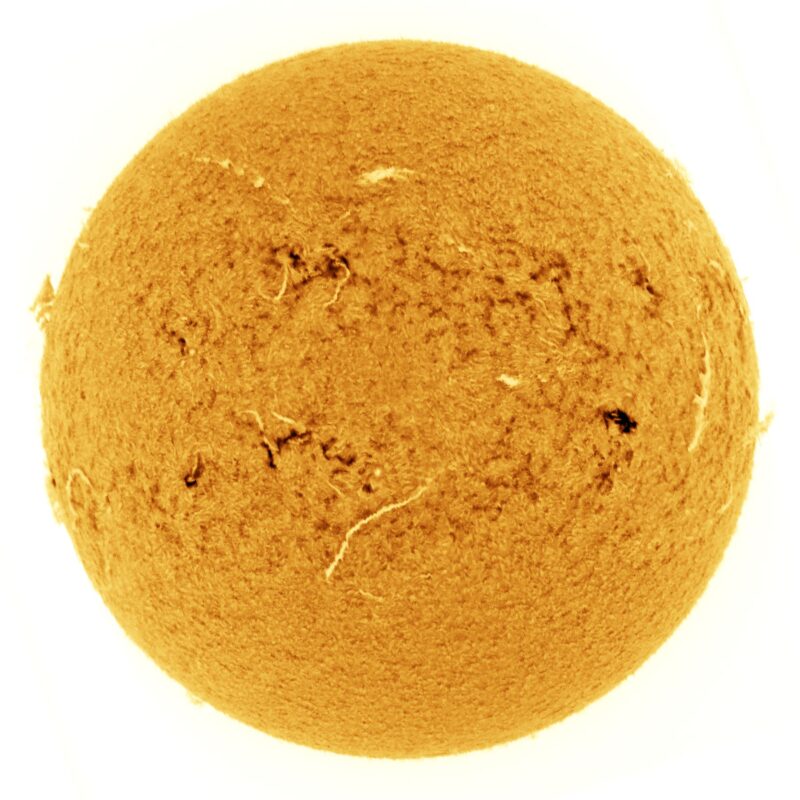

Solar activity remained low over the past day, with only B to C-class flares reported from a few growing regions, notably AR4098. While no Earth-directed coronal mass ejections (CMEs) were observed, a far-sided halo CME was detected around later on May 23. It’s not Earth-directed, but look out Mercury! Meanwhile, the solar wind remained elevated under the influence of a persistent coronal hole high-speed stream (CH HSS). Solar wind speeds were moderate, and although the interplanetary magnetic field stayed mostly weak, it exhibited moderate fluctuations primarily southward. This fast solar wind helped maintain quiet to unsettled geomagnetic conditions, with a slight chance for increased activity if glancing effects from the May 18 CME materialize. With signs of sunspot growth and a large region soon to rotate onto the disk, the space weather environment remains quietly dynamic. Stay tuned!
- Flare activity continued at low levels over the past 24 hours with the production of three C (common) and two B (weak) flares. The largest blast was a C3.8 flare at 6:02 UTC on May 24 from active region AR4098. There is a newcomer on the solar disk, AR4098, located in the western hemisphere near the equator.
- The sun has nine numbered active regions on the Earth-facing side. AR4098 is the new lead flare producer, with two C and two B flares. AR4097 developed a gamma magnetic configuration with a beta-gamma complexity. The remaining seven active regions are either simple alpha or beta configurations.
- Blasts from the sun? No Earth-directed coronal mass ejections (CMEs) were observed in available coronagraph imagery. A halo CME observed at 17:00 UTC on May 23 is believed to be far-sided. Initial analysis indicates the CME is directed toward Mercury.
- Solar wind: The solar wind ranged from 550 km/s (1,230,000 mph) down to ~430 km/s (961,883 mph) by end of period. At the time of this writing (11 UTC on May 24), the solar wind is 406 km/s (908,196 mph). The total interplanetary magnetic field has been at a low level. The Bz component (north-south orientation) fluctuated between northward and southward. At the time of this writing it is southward. A southward Bz is more favorable for auroras.
- Geomagnetic activity: Earth’s geomagnetic field was at quiet levels (Kp = 1 – 2).
What’s ahead? Sun-Earth forecast
- Moderate-to-low flare activity is expected in the coming day. The chance for M (moderate) flares is 25% and the chance for X (strong) flares is 5%. Sun activity may increase slightly through May 25–26 as a large returning region nears the solar limb.
- Geomagnetic activity forecast: At the time of this writing (11 UTC on May 24), the geomagnetic field is quiet (Kp = 2). A smaller adjacent coronal hole may contribute a slight boost in solar wind speeds on May 24, potentially returning to elevated levels. After that, speeds are likely to slow slightly but remain above background. Expect quiet to unsettled (Kp 1–3) conditions, with a chance of isolated active (Kp 4) periods. A slight chance of G1 (minor) geomagnetic storm intervals remains, especially if any glancing CME effects arrive. These conditions are expected to be extend through May 27.
Sun news May 23: Prominences dance as sun stays quiet, for now
(11 UTC to 11 UTC)
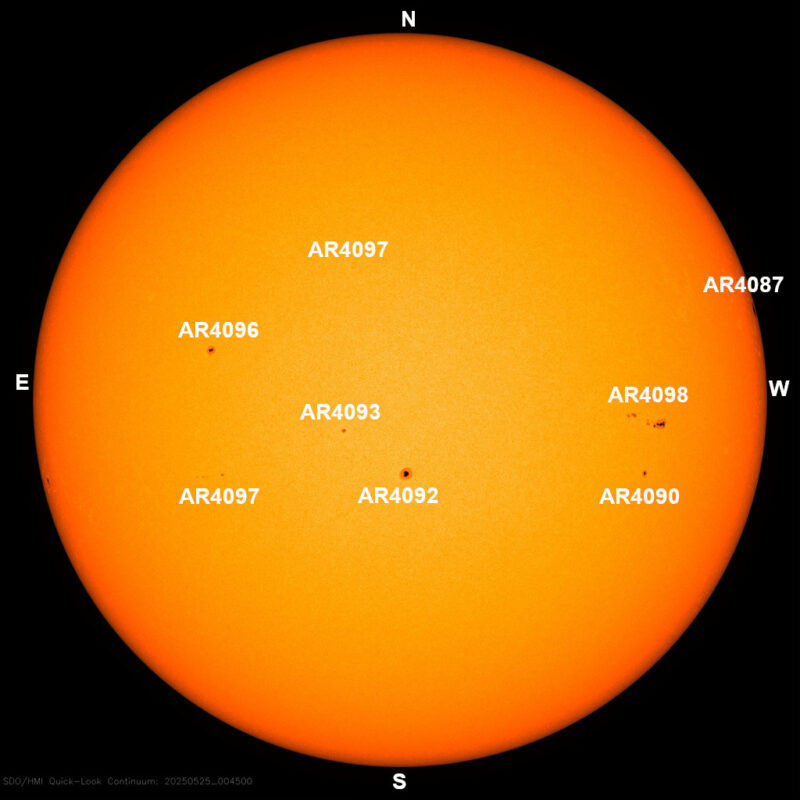
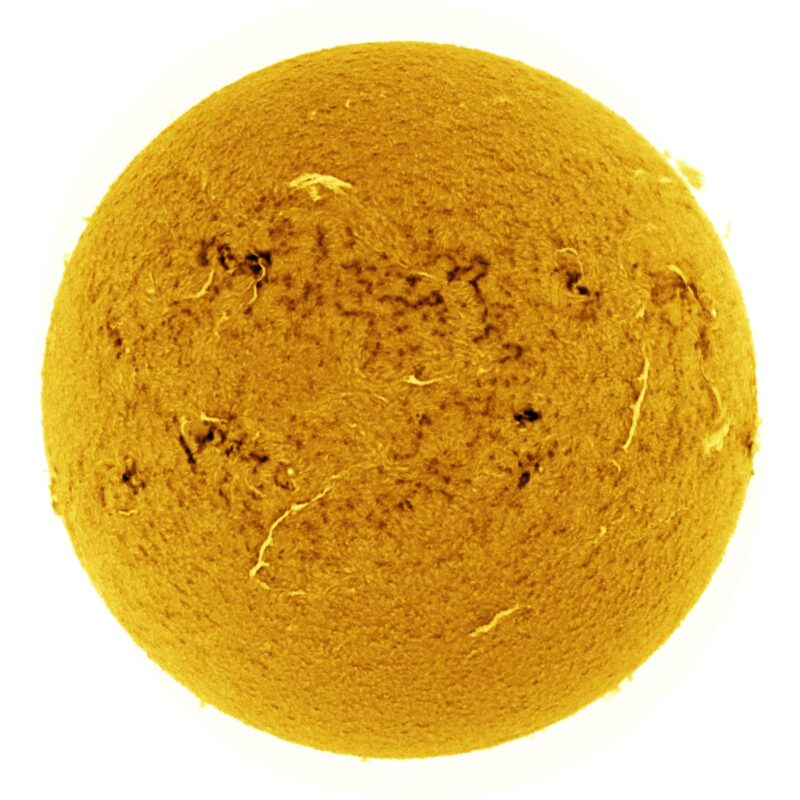
Sunspots stayed quiet over the past day, but the sun’s periphery was active. A long-lasting prominence on the sun’s northeast limb (edge) erupted, culminating in powerful, gorgeous ropes of solar material and magnetic fields thrown into space. A filament just beyond the solar horizon drove this activity. It’ll come into view soon. Elsewhere on the sun’s visible disk, two additional filaments lifted off, one near the central meridian around 08:00 UTC on May 22. It produced a coronal mass ejection (CME), not directed at Earth. And another lifted off in the sun’s northeast around 09:30 UTC (with no CME).
- Flare activity continued at low levels over the past 24 hours with the production of seven C (common) and two B (weak) flares. The largest blast was a C2.5 flare at 22:41 UTC on May 22 from active region AR4095. There is a newcomer on the solar disk, AR4097, located in the southeast quadrant.
- The sun has eight numbered active regions on the Earth-facing side. AR4095 continues as the lead flare producer, with four C and two B flares. AR4097 produced the remaining three C flares of the period. Active region AR4095 developed a gamma magnetic configuration with a beta-gamma complexity. The remaining seven active regions are either simple alpha or beta configurations.
- Blasts from the sun? No Earth-directed coronal mass ejections (CMEs) were observed in available coronagraph imagery.
- Solar wind: The solar wind reduced to average at ~500 km/s (1,118,000 mph), peaking near 550 km/s (1,230,000 mph) early today. At the time of this writing (11 UTC on May 23), the solar wind is 520 km/s (1,163,000 mph). The total interplanetary magnetic field has been at a low level. The Bz component (north-south orientation) fluctuated between northward and southward. At the time of this writing it is northward. A southward Bz is more favorable for auroras.
- Geomagnetic activity: Earth’s geomagnetic field was at quiet levels (Kp = 1 – 2).
Sun news May 22: Prominences blaze on the solar horizons
(11 UTC to 11 UTC)


While activity on the Earth-facing solar disk has significantly quietened over the past day, the solar horizons have come alive. Towering, fiery prominences – long ropes of solar material and magnetic fields – have been dancing on both the east and west limbs (edges). The prominence on the western horizon is rotating out of view, while the one on the eastern limb could signal that more active regions are poised to rotate into view in the next day or two. Stay tuned.
- Flare activity has dropped to low. Over the past day, our star produced one C (common) and five B (weak) flares. Flare production dropped to six over the past 24 hours, compared to 16 flares in the day before. There are three newcomer active regions on the solar disk: AR4094 in the northeast, AR4095 in the southwest quadrant close to the limb, and AR4096, which has rotated into view from the east. The largest event was a C2.6 flare at 18:07 UTC on May 21 from active region AR4095.
- The sun has seven numbered active regions on the Earth-facing side. The lead flare producer was the newly numbered active region AR4095, firing the C flare and three Bs. AR4087 lost its delta magnetic configuration. All seven active regions show either simple alpha or beta configurations.
- Blasts from the sun? No Earth-directed coronal mass ejections (CMEs) were observed in available coronagraph imagery.
- Solar wind: The solar wind averaged at ~600 km/s (1,342,000 mph), with peaks around 650 km/s (1,454,000 mph) early today. At the time of this writing (11 UTC on May 22), the solar wind is 549 km/s (1,228,000 mph). The total interplanetary magnetic field has been at a low level. The Bz component (north-south orientation) was mostly northward. At the moment of this writing it is northward. A southward Bz is more favorable for auroras.
- Geomagnetic activity: Earth’s geomagnetic field has been quiet (Kp 2-3).


Sun news May 21: Promising region wakes up, solar wind intensifies
(11 UTC to 11 UTC)
After a period of relative quiet, promising sunspot region AR4087 briefly snapped back to life with an M1.2 flare at 1 UTC on May 21, reminding us it still has strong flare potential as it moves toward the western horizon. This flare has pushed solar activity into the moderate range, interrupting a stretch of mostly C-class activity. We also observed an increase in solar wind activity over the past day. Earth continues to feel the effects of a coronal hole’s high speed stream (CH HSS), which caused speeds to rise from ~500 km/s to near 600 km/s over the past 24 hours. And activity could ramp up again on May 23, when a glancing CME impact and a co-rotating interaction region (CIR) – a powerful knot of solar winds – are expected to arrive.
- Flare activity has jumped to a moderate level due to an isolated M (moderate) flare. Flare numbers increased too: over the past 24 hours the sun released 16 flares, compared to the previous day’s nine flares. The sun produced the aforementioned M, eight Cs and seven B flares. The largest event was an M1.2 flare at 0:08 UTC on May 21 from active region AR4087. The blast caused an R1 (minor) radio blackout over the Pacific Ocean west of Hawaii.
- The sun has five numbered active regions on its Earth-facing side. The lead flare producer was the newly labelled active region AR4093 with ten flares. AR4087 retained its promising beta-delta magnetic configuration, but it’s approaching the western limb (edge).
- Blasts from the sun? No Earth-directed coronal mass ejections (CMEs) were observed in available coronagraph imagery.
- Solar wind: The solar wind speed increased from ~460 km/s (1,028,990 mph) late yesterday to a peak of 650 km/s (1,454,000 mph) early today. At the time of this writing (11 UTC on May 21), the solar wind speed is 617 km/s (1,380,000 mph). The total interplanetary magnetic field has been at a low level. The Bz component (north-south orientation) oscillated between the northward and southward direction. At the moment of this writing it is northward. A southward Bz is more favorable for auroras.
- Geomagnetic activity: Earth’s geomagnetic field has been quiet for most part (Kp = 2-3) with a peak of Kp = 4 at 0 UTC on May 21.


Sun news May 20: Solar wind could surge today
(11 UTC to 11 UTC)
Earth’s magnetic field remained quiet-to-unsettled over the past day, as high-speed solar wind from a coronal hole wanes. But the solar wind speeds are still elevated enough to keep Earth’s magnetosphere on edge. And another surge in the solar wind is possible later today or tomorrow if Earth connects with the fast flow from a large coronal hole in the sun’s southern hemisphere. This could result in periods of active geomagnetic conditions (Kp = 4). At the same time, a newly active sunspot region just beyond the northeast limb is showing signs of strength. As it rotates into view, it could become a significant driver of solar activity in the days ahead. With strong solar wind still in play and fresh flare potential emerging, there’s a good chance for auroral excitement this week. Stay tuned!
- Flare activity dropped to a low level with the production of only C (common) and B (weak) flares. Over the past day the sun released nine flares: three Cs and six B flares. The largest event was a C5.3 flare at 5:54 UTC on May 20 from an as-yet-unnumbered active region in the southeast.
- The sun has four numbered active regions on its Earth-facing solar disk. Once again, the lead flare producer of the period was an unnumbered region, this time on the southeast limb. AR4087 lost its gamma magnetic configuration and is now showing a beta-delta complexity. That means it’s still capable of strong flaring, although it remained stable with no flare production over the past 24 hours. Is it building up to something? Meanwhile, the other three sunspot regions on the Earth-facing sun have alpha or beta configurations, indicating lower flare potential.
- Blasts from the sun? A filament eruption hurled plasma into space. The event occurred around 1 UTC on May 19. The resulting coronal mass ejection (CME) may glance Earth on May 23. No other Earth-directed coronal mass ejections (CMEs) were observed in available coronagraph imagery over the past 24 hours.
- Solar wind: The solar wind speed reduced to ~460 km/s (1,028,990 mph) over the past 24 hours with peaks in the range of 580 km/s (1,297,000 mph). At the time of this writing (11 UTC on May 20), the solar wind speed is 499 km/s (1,116,000 mph). The total interplanetary magnetic field was at a low level. The Bz component (north-south orientation) oscillated between the northward and southward direction. A southward Bz is more favorable for auroras.
- Geomagnetic activity: Earth’s geomagnetic field has been between quiet and unsettled conditions (Kp = 2-3).


Sun news May 19: Surprise! M flare erupts from unseen sunspot
(11 UTC to 11 UTC)
An unseen and unnumbered sunspot region just over the sun’s northeast horizon fired off an M3.2 (moderate) solar flare early this morning, catching solar forecasters off guard. The flare triggered a dramatic movement of coronal field lines – strands of plasma tracing powerful magnetic fields in the sun’s upper atmosphere – suggesting the possible ejection of solar material. Analysis is underway to assess whether a coronal mass ejection (CME) was indeed launched, and if any of that sun-stuff is heading toward Earth. Stay tuned as we keep a close watch on this stealthy sunspot!
- Flare activity jumped up to a moderate level thanks to the M3.2 flare from the region over the northeast limb. This flare, fired at 8:13 UTC on May 19, caused an R1 (minor) radio blackout over the Arabian Peninsula. The rest of the nine total flares included three B flares and five C flares.
- The sun has five numbered active regions on the Earth-facing solar disk. A new region, AR4092, emerged in the southeast. The lead flare producer was the unnumbered region on the northeast limb. AR4087 retained its beta-gamma-delta magnetic configuration, indicating a strong flaring potential, although it didn’t live up to this potential over the past day. Is it saving itself for a big blast? Meanwhile, the other three sunspot regions on the Earth-facing sun have alpha or beta configurations, indicating lower flare potential.
- Blasts from the sun? Two filament eruptions were observed late in the evening on May 18. Scientists are awaiting satellite imagery to assess potential CME development. No other Earth-directed coronal mass ejections (CMEs) were observed in available coronagraph imagery over the past 24 hours.
- Solar wind: The solar wind speed mostly ranged from 600-650 km/s (1,342,000 – 1,454,000 mph) over the past 24 hours, gradually decreasing after peaking at 835 km/s (1,868,000 mph). At the time of this writing (11 UTC on May 19), the solar wind speed is 549 km/s (1,228,000 mph). The total interplanetary magnetic field was at a low level. The Bz component (north-south orientation) oscillated between the northward and southward direction. A southward Bz is more favorable for auroras.
- Geomagnetic activity: Earth’s geomagnetic field was between quiet and active conditions (Kp = 2-4).


Sun news May 18: Solar wind frenzy! G1 storm rattled Earth last night
(11 UTC to 11 UTC)
Earth remained under the influence of fast solar wind overnight last night. A powerful coronal hole high-speed stream (CH HSS) pushed solar wind speeds to a peak of 750-800 kilometers per second! That’s over a million miles per hour. This intense solar wind drove G1 (minor) geomagnetic storming last night, with occasional auroras lighting up high-latitude skies. Expect continued stormy conditions through May 19, with solar wind gradually decreasing to 600-700 km/s.
- Flare activity remains very low, with six B flares and one C flare over the past day. The isolated C2.2 flare happened at 19:44 UTC on May 17 from AR4088.
- The sun now has four numbered active regions on the Earth-facing solar disk. A new region, AR4091, emerged in the southeast, but is small and magnetically simple. The lead flare producers were AR4087 and an unnumbered region on the southeast limb. AR4087 retained its beta-gamma-delta magnetic configuration, indicating a strong potential, upon which it didn’t deliver over the past day. Is it saving up for a big bang? Meanwhile, the other three sunspot regions on the Earth-facing sun have beta configurations, indicating less flare potential.
- Blasts from the sun? No Earth-directed coronal mass ejections (CMEs) were observed in available coronagraph imagery over the past 24 hours.
- Solar wind: The solar wind speed ranged from 750-800 km/s (950,698 mph) over the past 24 hours. At the time of this writing (11 UTC on May 18), the solar wind speed is 692 km/s (1,186,000 mph). The total interplanetary magnetic field is at a low level. However, the Bz component (north-south orientation) increased significantly in the southward direction. A southward Bz is more favorable for auroras.
- Geomagnetic activity: Earth’s geomagnetic field was between active and storming conditions. It reached a G1 (minor) geomagnetic storm level (Kp = 5). The threshold was reached at 11:52 UTC on May 17.
What’s ahead? Sun-Earth forecast
- Moderate-to-low flare activity is expected in the coming day. After the modest flare production of AR4087 in the past day – despite its beta-gamma-delta configuration – forecasters lowered the chance for M (moderate) flares to 35% today, and the chance for X (strong) flares to 10% today.
- Geomagnetic activity forecast: At the time of this writing (11 UTC on May 18), the geomagnetic field is at a G1 (minor) (Kp = 5) level. Active to G1 (minor) levels should continue through May 19 due to CH HSS effects. Quiet to unsettled conditions likely by May 20, though isolated G1 (minor) intervals remain possible.

Sun news May 17: Surprise geomagnetic storm rocked Earth earlier today
(11 UTC to 11 UTC)
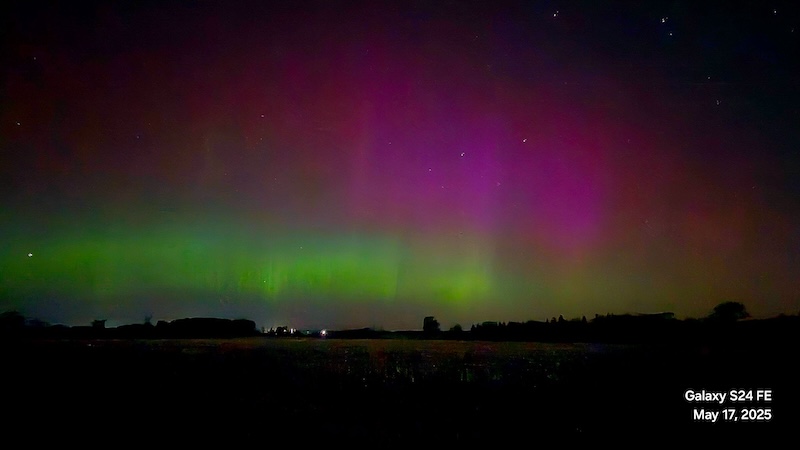
Early this morning, an unexpected geomagnetic storm – measuring G2 (moderate) on NOAA space weather scales – hit Earth, catching forecasters off guard. A glancing blow from a giant burp of sun-stuff known as coronal mass ejection (CME) triggered the storm. A stunning magnetic filament eruption in the sun’s northern hemisphere launched the CME from the sun on May 12. Initially expected to miss Earth, this CME delivered a surprising blow to Earth’s magnetic field, sparking elevated geomagnetic activity and auroras in Earth’s high-latitude regions. Looking ahead, a corotating interaction region (CIR) associated with a large southern coronal hole is expected to arrive by May 18, followed by increasing solar wind speeds on May 19, potentially bringing another round of geomagnetic storming. Waiting for some auroras!
- Flare activity dropped to a very low level, with faint and fewer flares. Over the past day the sun produced almost only B flares, with six B flares and one C (seven flares total). The isolated C1.1 flare happened at 22:41 UTC on May 16. It came from AR4087.
- The sun has three numbered active regions on the Earth-facing solar disk. The lead flare producer was AR4087, which kept its beta-gamma-delta magnetic configuration, indicating a strong potential, upon which it didn’t deliver over the past day. Meanwhile, the other two sunspot regions on the Earth-facing sun showed either alpha or beta configurations, indicating less flare potential. Today, there are two newcomers on the Earth-facing solar disk. AR4089 and AR4090 rotated into view on the eastern limb (edge).
- Blasts from the sun? No Earth-directed coronal mass ejections (CMEs) were observed in available coronagraph imagery over the past 24 hours.
- Solar wind: The solar wind averaged around 425 km/s (950,698 mph) late yesterday, but increased early today to above 500 km/s (1,118,000 mph). At the time of this writing (11 UTC on May 17), the solar wind speed is ~530 km/s (1,186,000 mph). The total interplanetary magnetic field is at a moderately high level. The Bz component (north-south orientation) remained mostly northward, but it turned southward at the time of this writing. A southward Bz is more favorable for auroras.
- Geomagnetic activity: Earth’s geomagnetic field was quiet to active the past 24 hours, but it reached an unexpected G2 (moderate) geomagnetic storm level (Kp = 6). The threshold was reached at 0 UTC on May 17. The geomagnetic field remained at the Kp= 6 level for one three-hour synoptic period, then it dropped to a G1 (minor) geomagnetic storm (Kp = 5) for another three-hour synoptic period.

Sun news May 16: Mighty AR4087 keeps flaring, as solar wind ramps up
(11 UTC to 11 UTC)
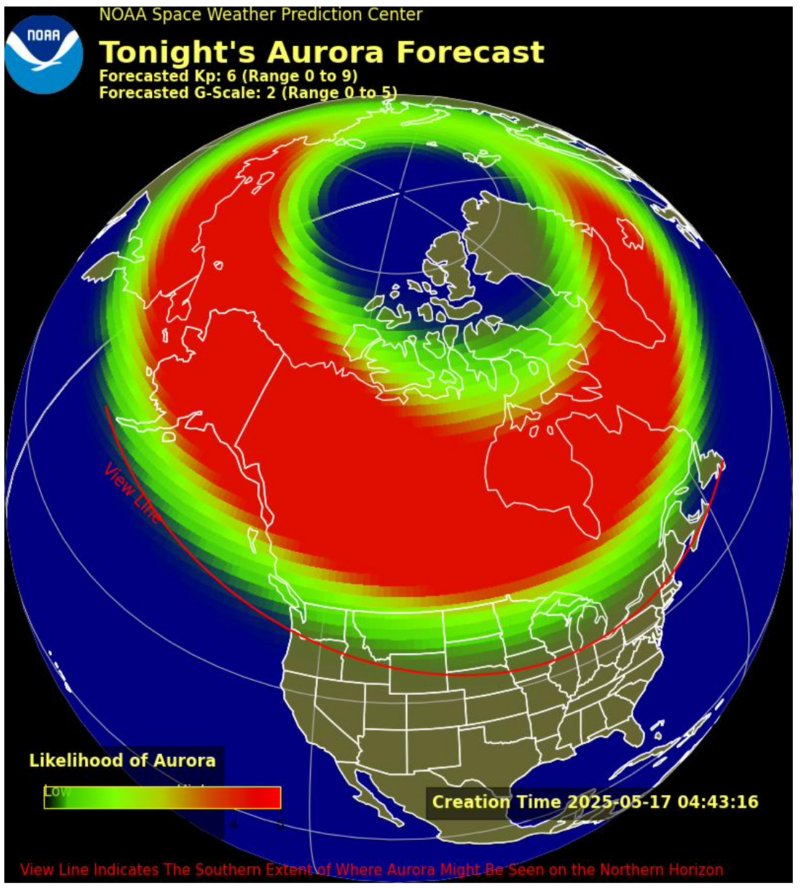
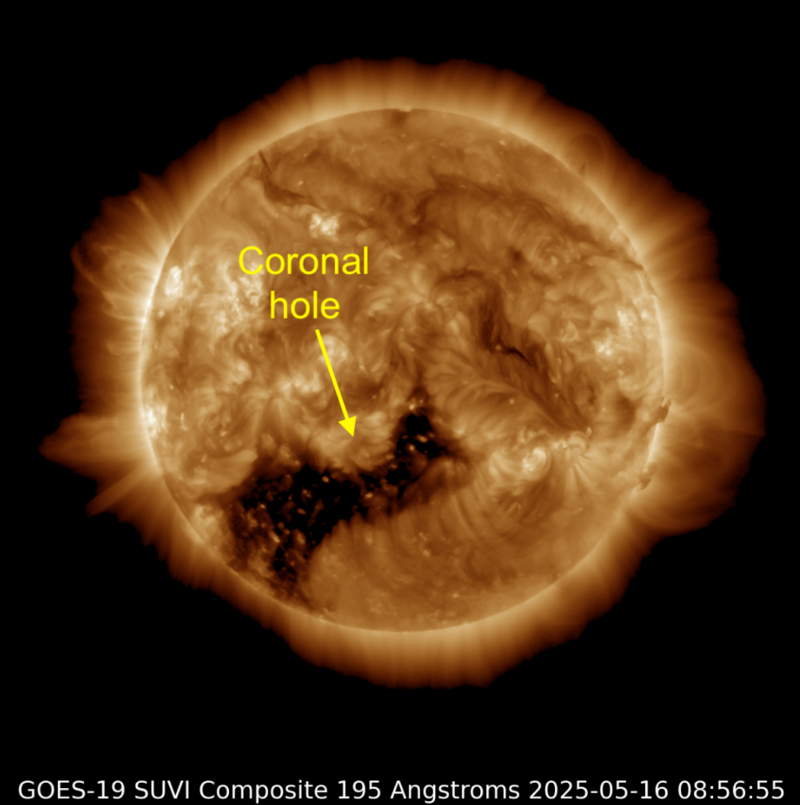
Solar activity has been high this week, but it dipped to moderate levels over the past day with a single M2.1 flare from sunspot region AR4087. But don’t let the lull fool you – this sunspot region still packs a punch with its unstable beta-gamma-delta magnetic configuration. It’s capable of delivering more X-class flares like those we saw earlier in the week. While forecasters have reduced the chance of M flares to 65%, the chance of X-class flares remains at 30% today. Meanwhile, a large coronal hole in the southeast has rotated into a geoeffective position, setting up a stream of fast solar wind aimed at Earth. The new high-speed solar plus slower wind formed a corotating interaction region (CIR). Combine that with today’s expected glancing blow from a CME, and we could see enhanced geomagnetic activity, potentially a G1 (minor) geomagnetic storm around May 18. Stay alert – the sun’s not done yet!
- Flare activity dropped to moderate, with the production of an isolated M2.1 flare at 17:21 UTC on May 15 from AR4087. An R1 (minor) radio blackout affected an area over the southern U.S. The sun produced 17 flares over the past 24 hours: the M, 11 C and five B flares. One of the C flares almost reached an M level, a C9.7 at 22:19 UTC on May 15 from AR4087.
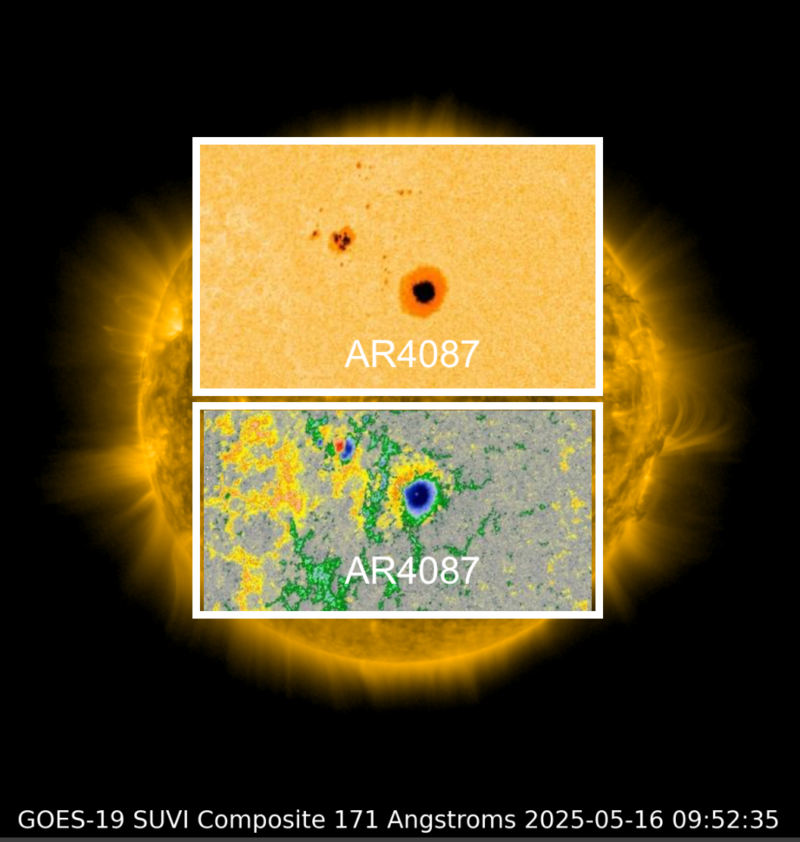
- The sun has two numbered active regions on the Earth-facing solar disk. The lead flare producer was AR4087. The region produced 10 flares, the M and nine C flares. Region AR4087 kept its beta-gamma-delta magnetic configuration, meaning it has the potential for more M and X flares. The other sunspot region, AR4088, shows a beta configuration.
- Blasts from the sun? No coronal mass ejections (CMEs) observed over the past day in available coronagraph imagery.
- Solar wind: The solar wind speed increased, averaging around 425 km/s (950,698 mph), with a peak at 470 km/s (1,051,000 mph). At the time of this writing (11 UTC on May 16), the solar wind speed is ~421 km/s (941,750 mph). The total interplanetary magnetic field is at a moderate level. The Bz component (north-south orientation) remained mostly southward, and is southward at the time of this writing. A southward Bz is more favorable for auroras.
- Geomagnetic activity: Earth’s geomagnetic field was unsettled for most of the past 24 hours at Kp = 3. But we saw a peak at Kp = 4, reached at 3 UTC on May 15.

Sun news May 15: Explosive AR4087 firing on all cylinders
(11 UTC to 11 UTC)


Solar activity is soaring thanks to powerhouse active region AR4087, now in a prime spot on the sun’s northeast limb (edge). After firing off an X-class flare yesterday, it kept the flares coming with two M-class eruptions, including an M7.7. That’s not far from the X flare threshold, which is the equivalent of an M10. This intense blast caused an R2 (moderate) radio blackout over the Mediterranean Sea. With AR4087 now fully in view, it’s showing a beta-gamma-delta magnetic configuration, which is the most complex and therefore most volatile arrangement. Accordingly, forecasters have upped the flare forecast to a 75% chance of M-class flares and a 30% chance of X-class flares. Stay tuned! This solar beast is just getting started.
- Flare activity remains high with the production of an M7.7 flare. The blast was the largest event of the period, fired at 11:19 UTC on May 14 by AR4087. An R2 (moderate) radio blackout was observed affecting an area over the Mediterranean Sea east of Tunisia. Over the past 24 hours, the sun produced eight flares: two Ms (moderate), four Cs (common) and one B (weak) flare. The second M flare of the period was an M4.7 at 18:11 UTC on May 14 from AR4087. This caused an R1 (minor) radio blackout over the northeast of Mexico.
- The sun has three numbered active regions on the Earth-facing disk. The lead flare producer of the period was AR4087 in the northeast with four flares: the two Ms and two Cs. Region AR4087 developed a beta-gamma-delta magnetic configuration, meaning it has the potential for more M and X flares. The other active regions show alpha or beta configurations.
- Blasts from the sun? Although the M flares hurled ejecta into space, none of these coronal mass ejections (CMEs) appear to be Earth-directed. No other Earth-directed CMEs were observed in the available coronal imagery.
- Solar wind: The solar wind speed increased, averaging around 400 km/s (894,780 mph), with a peak at 542 km/s (1,212,000 mph). At the time of this writing (11 UTC on May 15), the solar wind speed is ~460 km/s (1,029,000 mph). The total interplanetary magnetic field is at a moderate level. The Bz component (north-south orientation) remained mostly southward, and is southward at the time of this writing. A southward Bz is more favorable for auroras.
- Geomagnetic activity: Earth’s geomagnetic field was active for most of the past day, reaching Kp 4 levels. The Kp 4 threshold was reached at 18:03 UTC on May 14.
Sun news May 14: A pair of powerful X flares!
(11 UTC to 11 UTC)

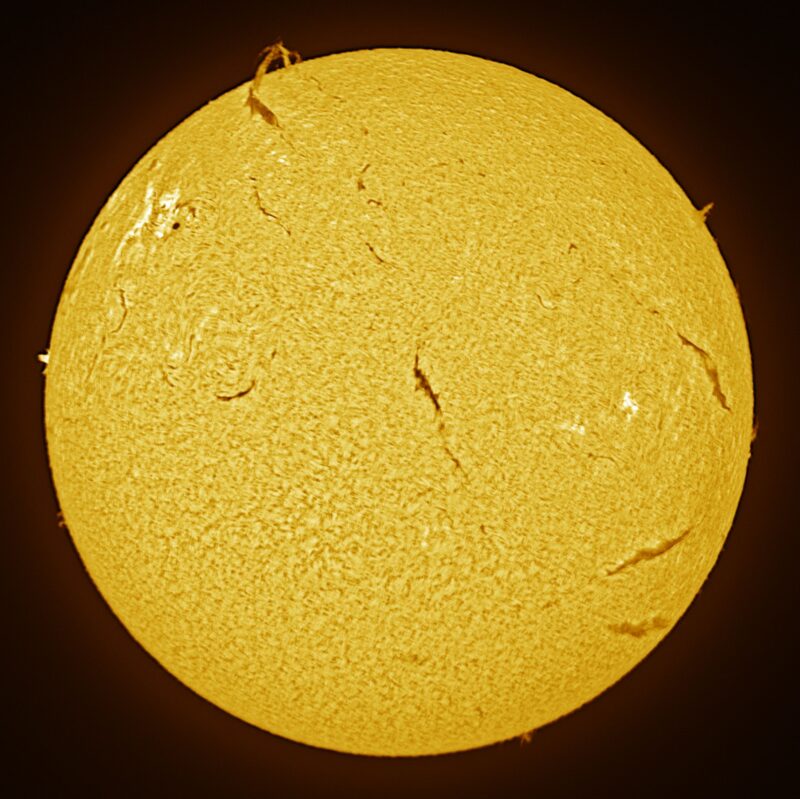
BAM, BAM! Sun activity rocketed to high over the past day after 2 regions each fired an X flare, the most powerful category of solar blast. The first, an X1.2 fired at 15:25 UTC yesterday, came from sunspot region AR4086 as it began to rotate out of view in the west. And on the opposite side of the sun, AR4087 blasted a spectacular X2.7 flare at 8:04 UTC this morning as it rotated into full view in the east. This region also blasted an M5.3 at 3:05 UTC and M1.2 at 7:36 UTC. What else has it got in store for us? Stay tuned.
- Flare activity is at high levels after the production of the two X flares. Over the past 24 hours, the sun produced 11 flares: two Xs (strong), two Ms (moderate), seven Cs (common) flares and one B (weak) flare. The largest event of the period was an X2.7 flare at 8:04 UTC on May 14 from active region AR4087.
- The sun currently has four numbered active regions on its Earth-facing side. The lead flare producer of the period was AR4087 in the northeast with seven flares: the X2.7, two Ms, three Cs and a B flare. Region AR4082 has an alpha magnetic configuration while the rest of the active regions show beta configurations.
- Blasts from the sun? A filament eruption at 8 UTC on May 13 hurled ejecta into space that may provide a glancing blow to Earth’s magnetic field on May 17. The past day’s two X flares and two M flares are under modeling and analysis to determine if any components are headed toward Earth. Early indications suggest that these events produced no Earth-directed coronal mass ejections (CMEs), because they were too far to the north.
- Solar wind: The solar wind slowed down, averaging around 380 km/s (244,199 mph), as Earth continues to transition from one coronal hole’s high-speed stream to another’s. At the time of this writing (11 UTC on May 14), the solar wind speed is currently around 393 km/s (939,513 mph). The total interplanetary magnetic field is at a moderate level. The Bz component (north-south orientation) remained mostly southward for the entire period. It is northward at the time of this writing. A southward Bz is more favorable for auroras.
- Geomagnetic activity: Earth’s geomagnetic field has been quiet (Kp = 1 – 2).

? Solar Drama! ?
AR4086 just roared to life in the northwest, firing off an X1.2 flare and a giant structure of solar plasma at 15:25 UTC.Is Earth in the line of fire?
Stay tuned – analysts are tracking it right now. ?
bit.ly/sunactivity #spaceweather #solarflare
— Dr. C. Alex Young (@thesuntoday.bsky.social) May 13, 2025 at 3:01 PM
Sun news May 13: Giant filament eruption steals the spotlight
(11 UTC to 11 UTC)

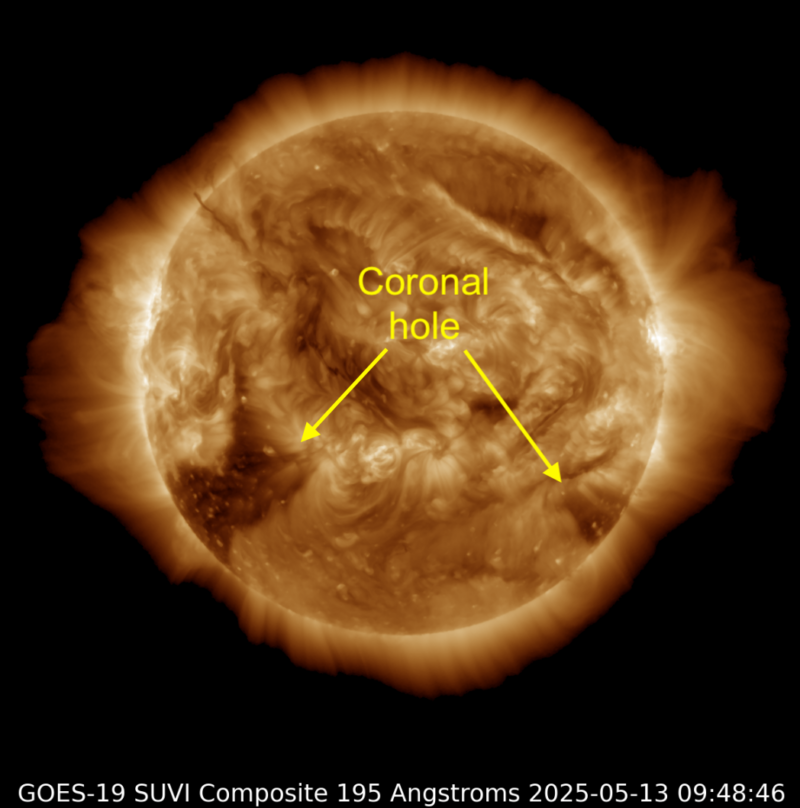
A massive filament eruption grabbed our attention over the past day, with plasma visibly lifting off into space in the northwest around 22:05 UTC last night. Analysis is ongoing to determine if any of this plasma could be on its way to disturb Earth’s magnetic field. Meanwhile, we’re starting to feel the effects of an approaching stream of fast solar wind from a coronal hole, which could also cause geomagnetic disturbance in the coming days. Stay tuned.
- Flare activity is back to low levels. Over the past 24 hours, our star produced eight flares: seven C (common) flares and one B (weak) flare. The largest event of the period was a C2.7 flare. In fact, it was two C2.7 flares, the first one at 13:08 UTC on May 12 from AR4079, and the second at 15:02 UTC on May 12 from AR4087.
- The sun currently has four numbered active regions on its Earth-facing side. The lead flare producer of the period was AR4086 with four C flares. Region AR4079 is no longer visible, meaning its magnetic complexity cannot be determined, but it did produce one of the largest flares of the period. Meanwhile, newly numbered sunspot region AR4087 rotated into view along the eastern limb and produced a few C-class flares, although it’s also too close to the horizon for analysts to determine its magnetic complexity. All the other active regions on the Earth-viewed solar disk have simple alpha or beta configurations.
- Blasts from the sun? Two filament eruptions are under analysis to determine if any ejecta is headed toward Earth. The first event occurred at 12 UTC on May 12 in the northeast. The second was at 0:30 UTC on May 13 in the northwest. No other Earth-directed coronal mass ejections (CMEs) were observed in available coronagraph imagery.
- Solar wind: The solar wind remained mildly elevated, averaging around 380 km/s (850,036 mph), as Earth continues to transition from one coronal hole’s high-speed stream to another’s. At the time of this writing (11 UTC on May 13), the solar wind speed is currently around 420 km/s (939,513 mph). The total interplanetary magnetic field is at a moderate level. The Bz component (north-south orientation) remained northward the entire period. At the time of this writing it is northward. A southward Bz is more favorable for auroras.
- Geomagnetic activity: Earth’s geomagnetic field has been quiet (Kp = 1 – 2). The current coronal hole’s high-speed solar wind is waning.
Sun news May 12: AR4079 goes out with a bang!
(11 UTC to 11 UTC)


Just when we thought it was done, giant sunspot region AR4079 fired off a parting M1.9 (moderate) flare last night after slipping out of sight behind the solar horizon. Talk about dramatic exits! High above the sunspot, magnetic loops snapped and crackled, sending out a burst of energy visible from Earth. But here’s the kicker: since our view of the region was partially blocked by the horizon, the flare was likely even bigger than we measured. Stay tuned, as AR4079 may still have a few more surprises up its sleeve. And meanwhile, something else appears to be brewing just out of view over the opposite horizon. We saw a C5.1 (common) flare light up the sky in the northeast over the past day, hinting that a new active region in that area might be rotating into view soon. Could it be a replacement for prolific AR4079? Let’s see.
- Flare activity rose to moderate levels over the past day with 15 C flares and one M flare. The largest was an M1.9 flare at 23:55 UTC on May 11 from AR4079. The region produced 13 C flares and the one M flare. The remaining two C flares came from an as-yet-unseen region over the northeast limb that should soon rotate into view.
- The sun has five numbered active regions on its Earth-viewed side. Active region 4079 is no longer visible, meaning its magnetic complexity cannot be determined, but it remains the lead flare producer for the moment. The remaining regions have simple alpha or beta configurations. A new region emerged in the northwest: AR4086.
- Blasts from the sun? No Earth-oriented coronal mass ejections (CMEs) were observed in available coronagraph imagery.
- Solar wind: The solar wind remained mildly elevated, fluctuating between 375 km/s (838,851 mph) and 460 km/s (1,029,000 mph), as Earth continues to transition from one coronal hole’s high-speed stream to another’s. At the time of this writing (11 UTC on May 12), the solar wind speed is currently around 400 km/s (894,775 mph). The total interplanetary magnetic field is at a low level. The Bz component (north-south orientation) transitioned from a northward orientation to a southward direction. At the time of this writing it is southward. A southward Bz is more favorable for auroras.
- Geomagnetic activity: Earth’s geomagnetic field was at quiet (Kp = 1) to G1 (minor) geomagnetic storm levels over the past 24-hours thanks to the waning influence of a coronal hole’s high-speed solar wind.

Sun news May 11: Giant sunspot winds down, as solar wind shifts gears
(11 UTC to 11 UTC)
Sunspot region AR4079, the flare leader of recent days, is fading as the sun’s rotation carries it westward. Soon it’ll be out of view. Despite its decline, AR4079 still managed to produce a C5.5 flare during the last 24 hours. And, in fact, it produced all of the past day’s flares, all C-class. Meanwhile, the solar wind remains slightly elevated as Earth continues to feel the effects of a coronal hole high-speed solar wind stream (CH HSS), with speeds close to background levels. Another CH HSS is expected to arrive by tomorrow, May 12, potentially increasing geomagnetic activity once again.
-
- Flare activity continued at low levels over the past day with 12 C flares from AR4079. The largest was a C5.5 flare at 16:16 UTC on May 10 from AR4079.
- The sun has six numbered active regions on its Earth-viewed side. Active region 4079 remains the only region with a beta-gamma magnetic complexity, and it continues as the largest in extent on the visible sun and the lead flare producer. The region has rotated around the limb. It is just barely visible but even given what we can see and helioseismology imagery confirms it is still the largest region. Over the past day, it produced all the flares of the period. The sunspot regions on the Earth-viewed solar disk now show simpler beta configurations. The newest region is AR4085.
- Blasts from the sun? No coronal mass ejections (CMEs) Earth-oriented were observed in available coronagraph imagery.
- Solar wind: Solar wind speeds remain near background levels over the past 24 hours. Speeds averaged around 400 km/s (894,775 mph) over the past day with a short peak at 550 km/s (1,230,000 mph). At the time of this writing (11 UTC on May 10), the solar wind speed is currently around 450 km/s. The total interplanetary magnetic field is at a low level. The Bz component (north-south orientation) fluctuated between north and south during the last 24-hour period. At the time of this writing it is southward. A southward Bz is more favorable for auroras.
- Geomagnetic activity: Earth’s geomagnetic field was at quiet levels (Kp 4) during most of the last 24 hours.
Sun news May 10: Check out these auroras over Antartica
(11 UTC to 11 UTC)

The southernmost continent, Antartica, underwent geomagnetic disturbances in the past day – reaching of Kp = 4 levels – for most part of the period. The disturbance started late yesterday when the Kp = 4 threshold was reached at 19:56 UTC on May 9 and remained at that level for about 12 hours. A G1 (minor) geomagnetic storm was expected as Earth received a glancing blow from a coronal mass ejection (CME) that left the sun on May 5. Chances are it reached us in the form of this Kp 4 disturbance. We can expect an unsettled-to-active geomagnetic field today, as effects wane. The disturbance affects both Earth’s North and South Poles. But the northernm ost part of Earth is now entering its period of 24-hour daylight, while the southernmost part of Earth is edging toward 24-hour night. Antartica must have seen a beautiful auroral display.
- Flare activity continued at low levels over the past day with 10 flares in total, eight C (common) and two B (weak) flares. The largest was a C4.9 flare at 11:21 UTC on May 9 from AR4079.
- The sun has four numbered active regions on its Earth-viewed side. Same as yesterday, active region 4079 is the only one showing a beta-gamma magnetic complexity, and it continues being the largest in extent on the visible sun and the lead flare producer. Over the past day, it produced all the flares of the period. The other three sunspot regions on the Earth-viewed solar disk now show simpler beta configurations.
- Blasts from the sun? No coronal mass ejections (CMEs) Earth-oriented were observed in available coronagraph imagery.
- Solar wind: Solar wind speeds remained reduced over the past day. Speeds averaged around 430 km/s (961,883 mph) over the past day, but early this morning it peaked at around 550 km/s (1,230,000 mph). At the time of this writing (11 UTC on May 10), the solar wind speed is moderate at 489 km/s. The total interplanetary magnetic field is at a low level. The Bz component (north-south orientation) has been mostly north oriented during the period. At the time of this writing it continues northward. A southward Bz is more favorable for auroras.
- Geomagnetic activity: Earth’s geomagnetic field was disturbed at active levels (Kp 4) during most of the past day. The Kp = 4 threshold was reached at 19:56 UTC on May 9.
What’s ahead? Sun-Earth forecast
- Low-to-moderate flare activity is expected in the coming day. The chance for M (moderate) flares is 40%, and the chance for X (strong) flares is 5% today.
- Geomagnetic activity forecast: At the time of this writing (11 UTC on May 10), geomagnetic field returned to a quiet level at a Kp = 2. A G1 (minor) geomagnetic storm early this morning but chances are it already peaked at the reported Kp = 4 we saw late yesterday – early today. All this due to the arrival of a coronal mass ejection (CME) that left the sun on May 5, combined with high-speed solar wind from a coronal hole. Nevertheless some disturbance may occur as effects wane. Quiet-to-unsettled conditions are expected for May 11.
Sun news May 9: A fiery sun with long, lifting filaments
(11 UTC to 11 UTC)

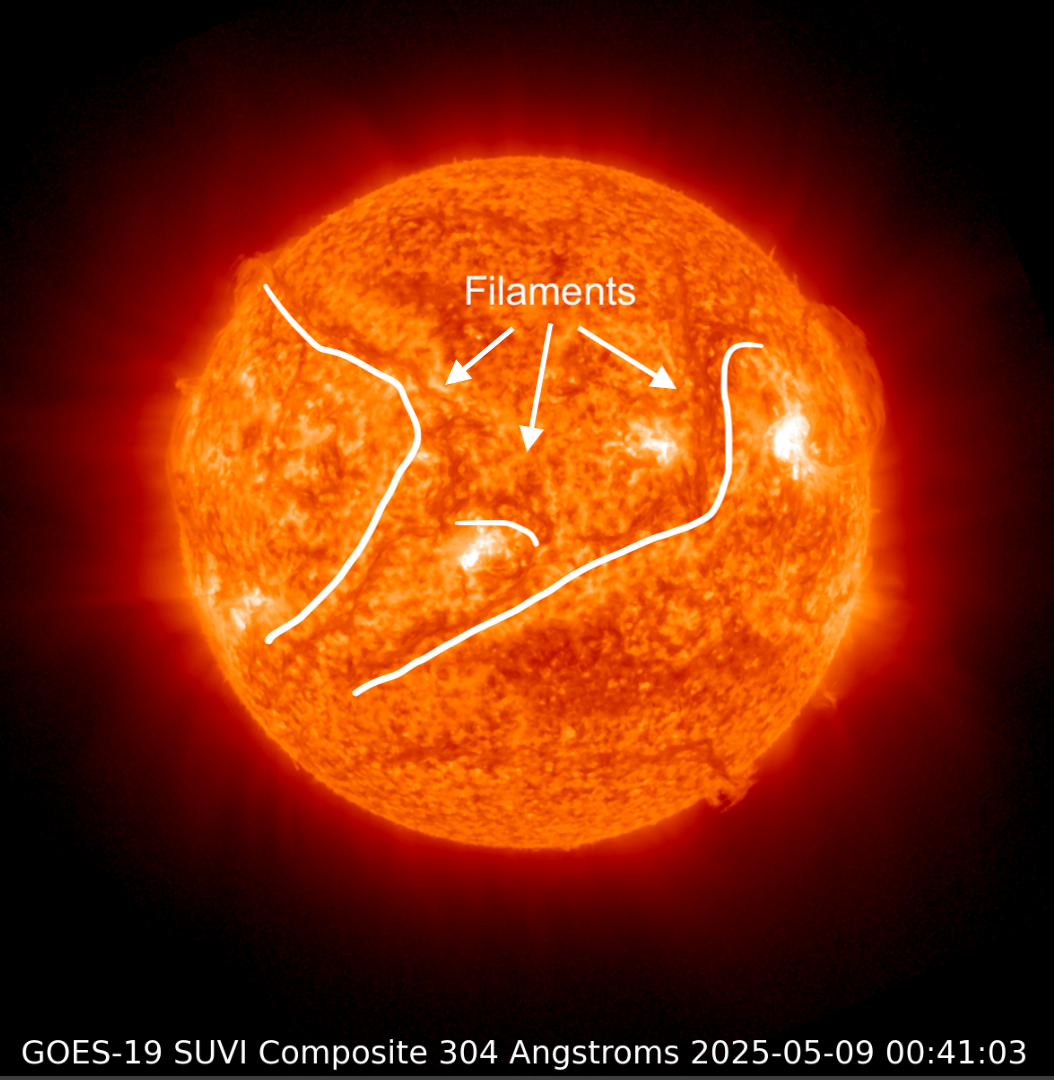
Sun flares were low over the past day, but strong filament action told a different story. Just take a look at the image below. You can see fiery filament eruptions lifting plasma into space. There are now couple of long trans-equatorial filaments (see that image below, too). One starts in the northwest in the vicinity with AR4081 and runs down, crossing the solar equator, to end in the southeast quadrant. The second originates in the northeast with the lifting filament we have been observing; it runs down to cross the equator and also ends in the southeast. Both long filaments developed a connection rope between the two, located near where the central meridian and the equator meet. Meanwhile, coronal holes are producing their fast solar wind, and it has been disturbing Earth’s magnetic field. NOAA forecasters anticipate a G1 (minor) geomagnetic storm later on today (May 9) if, as anticipated, Earth receives a glancing blow from a coronal mass ejection (CME) that left the sun on May 5.
- Flare activity kept at low levels over the past day, as the sun continued producing only C (common) flares. This time, it was 11 C flares in total. Even though all flares were C flares, AR4079 and AR4082 seem to start ping-ponging toward larger flares, getting close to our human M-flare boundary. The largest event of the past day was a C7.0 flare at 11:41 UTC from AR4082, followed by a C6.4 by AR4079 at 13:56 UTC both flares produced on May 8..
- The sun has four numbered active regions on its Earth-viewed side. Region AR4079 is the only one showing a beta-gamma magnetic complexity. It continues being the largest in extent and lead flare producer. It produced eight flares during the last 24-hour out of the 11 flares of the period. AR4082 lost its gamma complexity and belongs now to the rest of the group of only simpler beta configurations. There is a newcomer on the Earth-facing solar disk: AR4084 in the southeast.
- Blasts from the sun? Several filament eruptions observed during the period produced coronal mass ejections (CMEs). None are Earth-bound, however.
- Solar wind: Solar wind speeds remained reduced over the past day. Speeds averaged around 450 km/s (1,007,000 mph) over the past day, with a peaks of 500 km/s (1,118,000 mph). At the time of this writing (11 UTC on May 9), the solar wind speed i moderate at 450 km/s. The total interplanetary magnetic field is at a low level. The Bz component (north-south orientation) has been fluctuating between north and south oriented. At the time of this writing it continues northward. A southward Bz is more favorable for auroras.
- Geomagnetic activity: Earth’s geomagnetic field was disturbed at quiet-to-unsettled levels (Kp 2-3) but there was a peak of active level during one three-hour period. The Kp = 4 threshold was reached at 22:34 UTC on May 8.

Sun news May 8: Is a powerful sunspot region just around the corner?
(11 UTC to 11 UTC)

The Earth-facing side of the sun has had low flare activity in the past 24 hours. But we see sun activity on the sun’s east limb (edge), which the sun’s rotation will soon carry into view. The large, lifting filament in the northeast – which we reported earlier this week as a long-lasting prominence – finally erupted. Also on the solar east horizon, we see more action at the equator level. All this, while colossal sunspot region AR4079 is back to stable now, after releasing a staggering 23 C flares day before yesterday. In the past day, it produced only eight C flares. AR4079 is showing a beta-gamma magnetic complexity. It’s still the biggest spot on the sun. Can you still spot it with your eclipse glasses? It’s getting closer to the northwest limb now. Stay tuned, as we keep a close eye on this powerhouse sunspot.
- Flare activity continued at low levels, with only C (common) flares during the past 24 hours. We saw 15 total flares during this period, in contrast to 25 in the previous day. The largest event of the past day was a C3.9 flare at 3:33 UTC on May 8 from AR4079.
- The sun has three numbered active regions on the side we see from Earth. Region AR4079 continues being the largest in extent and lead flare producer. It produced eight flares during the last 24-hour period and still is visible from Earth without any magnification aid only wearing proper eye protection such as eclipse glasses. AR4079, along with AR4082, shows a beta-gamma magnetic complexity. These regions are capable of producing M-class (moderate) or even even X-class (strong) flares. But will they? Meanwhile, the other active region on the solar disk – AR4081 – has a simpler beta configuration.
- Blasts from the sun? The couple of almost-simultaneous filament eruptions we reported yesterday, occurring in the northwest and southeast, did produce coronal mass ejections (CMEs), but they are not heading Earth’s way. No Earth-bound CMEs were found in available coronagraph imagery.
- Solar wind: Solar wind speeds remained reduced over the past day. Speeds averaged around 450 km/s (1,007,000 mph) over the past day, with a peak of 500 km/s (1,118,000 mph). At the time of this writing (11 UTC on May 8), the solar wind speed remains moderate at 456 km/s. The total interplanetary magnetic field is at a low level. The Bz component (north-south orientation) has been mostly southward. At the time of this writing it continues southward. A southward Bz is more favorable for auroras.
- Geomagnetic activity: Earth’s geomagnetic field was disturbed at quiet-to-unsettled levels (Kp 2-3).
Sun news May 7: Huge sunspot region roars into life
(11 UTC to 11 UTC)
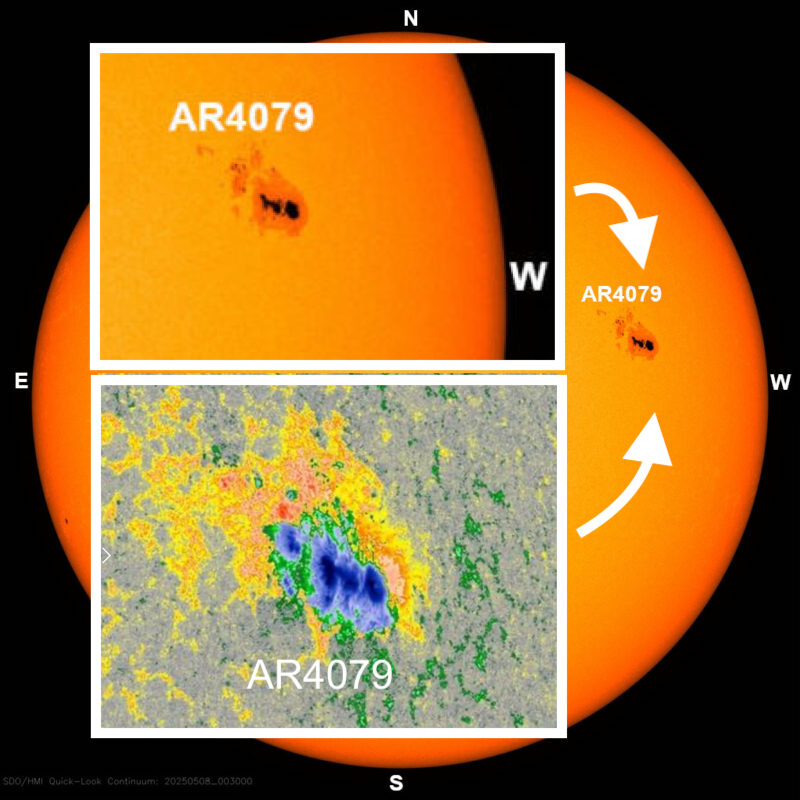
The colossal sunspot region AR4079 is back in action! This monster sunspot roared to life, unleashing a staggering 23 flares in just 24 hours. That’s especially impressive considering we only saw 10 total flares in the previous day. AR4079 has held a volatile beta-gamma-delta magnetic setup for several days, but showed little activity. Now, its complexity has dropped to beta-gamma, but – strangely – its activity has ramped up. The sun never ceases to surprise. Stay tuned, as we’ll be keeping a close eye on this powerhouse sunspot.
- Flare activity remains at low levels with only C (common) flares fired in the past 24 hours, but total flaring increased dramatically. We observed 25 flares in the past 24 hours, compared to 10 flares in the previous day. The largest event of the period was a C4.5 flare at 17:07 UTC on May 6 from AR4079.
- The sun has three numbered active regions on its Earth-facing side. Region AR4079 blasted out 23 of the 25 flares of the period. This region remains the largest, and is still visible from Earth without any magnification aid if you protect your eyes using eclipse glasses. It has lost its delta structure, now showing a beta-gamma magnetic complexity, as is AR4082. These two sunspot groups are capable of producing M-class (moderate) or even X-class (strong) flares. Meanwhile, the other active region on the solar disk – AR4081 – has a simpler beta configuration.
- Blasts from the sun? Some of AR4079’s many flares produced narrow coronal mass ejections (CMEs), particularly the largest event, the C4.5 flare. These events are now being modeled and analysed to determine if any components are headed to Earth.
- Solar wind: Solar wind speeds remained moderately elevated over the past day. Speeds averaged between 520 and 620 km/s (1,163,000 and 1,387,000 mph) over the past day, with a peak of 853 km/s (1,908,000 mph). At the time of this writing (11 UTC on May 7), the solar wind speed remains moderately elevated at 538 km/s. The total interplanetary magnetic field is at a low level. The Bz component (north-south orientation) has been mostly southward. At the time of this writing it has moved northward. A southward Bz is more favorable for auroras.
- Geomagnetic activity: Earth’s geomagnetic field was disturbed at unsettled-to-active levels (Kp = 3 – 4).
Sun news May 6: Solar wind buffeting Earth’s magnetic field
(11 UTC to 11 UTC)

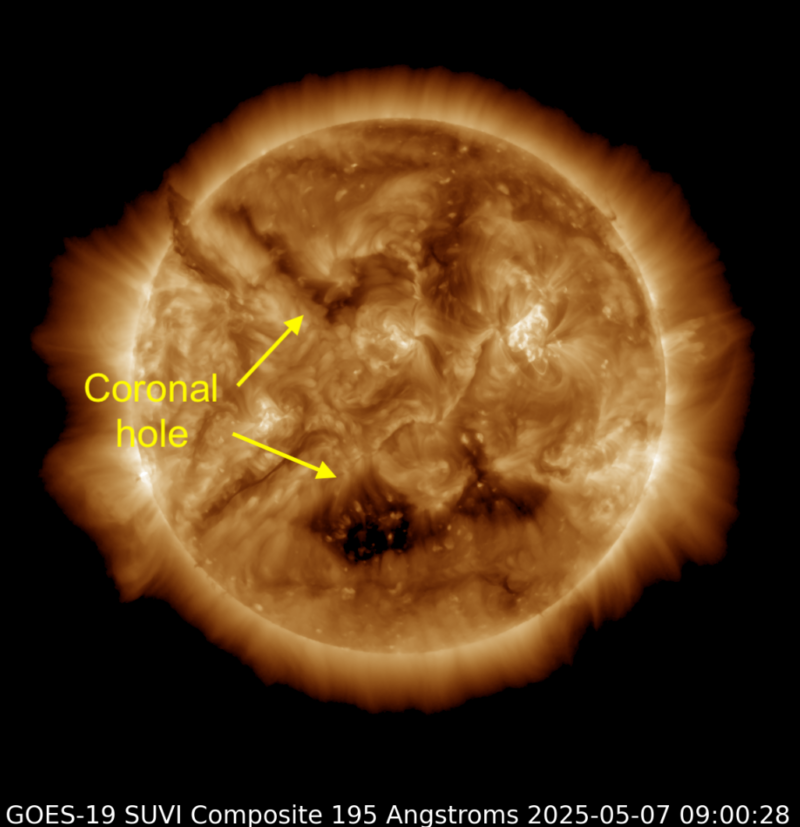

The sun has been continuing its powerful assault on Earth’s magnetic field with blistering fast solar wind. Holding firm between 725 and 800 km/s, this high-speed stream from a coronal hole fueled G1 (minor) geomagnetic storms over the past day, causing auroras across high-latitude skies. And although it is waning, the solar wind is still elevated and could bring more auroras at higher latitudes tonight.
- Flare activity remains at low levels with the production of only C (common) and B (weak) flares in the past 24 hours. The largest event of the period was a C2.3 flare at 18:39 UTC on May 5 from AR4082. Over the past 24 hours the sun produced 10 flares: nine Cs and one B flare. AR4081 was the lead flare producer. It blasted half of the flares of the period, five Cs.
- The sun has four numbered active regions on the Earth-facing side. Region 4082 has emerged as a flare frontrunner, producing the largest flare of the past day. But AR4079 remains the largest sunspot region. The region can still be seen from Earth without magnification, if you use eclipse glasses. And it has regained its delta structure, giving it a potent beta-gamma-delta magnetic complexity, which is a classic setup for M-class (moderate) or even X-class (strong) flares. AR4082 is showing a beta-gamma complexity, while the other active regions on the solar disk have a simpler alpha or beta configurations.
- Blasts from the sun? A filament eruption in the southeast hurled a fast, narrow coronal mass ejection (CME) into space at 8:20 UTC on May 5. Although most of the CME is expected to pass behind Earth, a glancing impact is possible on May 9, and we’ll be watching closely.
- Solar wind: Solar wind speeds remained elevated. Speeds averaged around 720 km/s (1,610,000 mph) over the past day, with a peak of 811 km/s (1,814,000 mph). At the time of this writing (11 UTC on May 6), the solar wind speed remains moderately elevated at 620 km/s. The total interplanetary magnetic field is at low level. The Bz component (north-south orientation) has been mostly southward. At the time of this writing, it is southward. A southward Bz is more favorable for auroras.
- Geomagnetic activity: Earth’s geomagnetic field was disturbed at unsettled-to-active levels (Kp = 3 – 4). A G1 (minor) geomagnetic storm level was reached around 15 UTC on May 5.
Sun news May 5: Solar wind blasts Earth while sunspots stir
(11 UTC to 11 UTC)
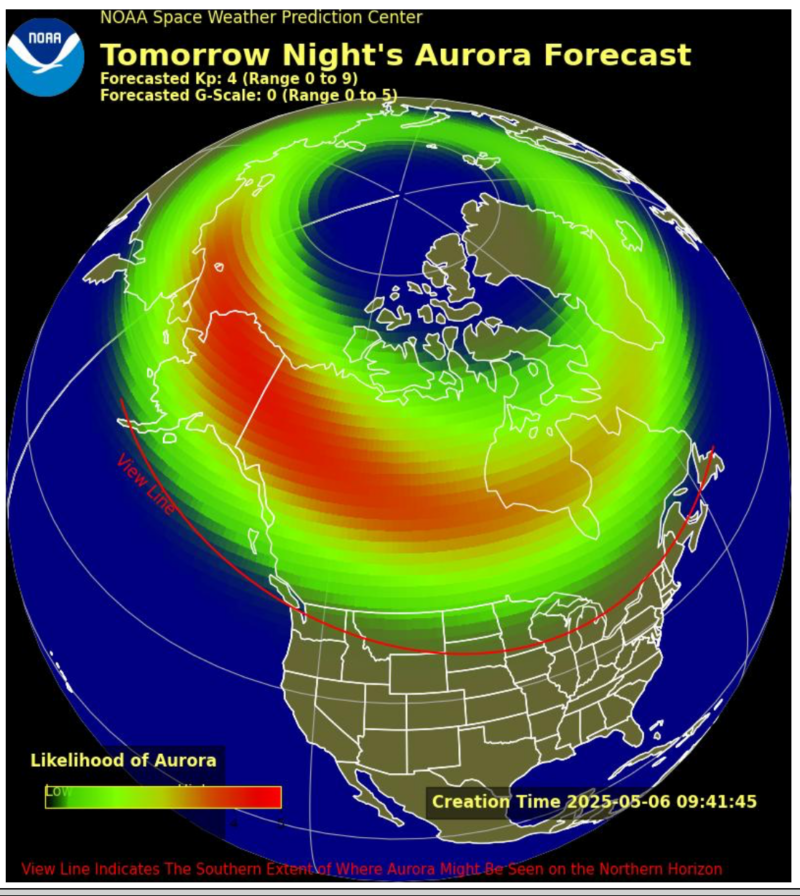

Earth is still feeling the impact of a fast solar wind stream, with speeds holding strong between 600–650 kilometers per second (1,342,000–1,454,000 mph). This persistent wind is from a coronal hole, which is currently keeping Earth’s magnetic field active and triggering isolated G1 (minor) geomagnetic storm intervals. Although the wind peaked near 700 km/s early in the period, it’s expected to wane gradually over the coming days, as coronal hole effects begin to fade. Meanwhile, over the past day, solar flare activity remained low. Sunspot region AR4082 emerged as the new flare leader. The previously dominant AR4079 stayed quiet, despite its large size and beta-gamma magnetic structure, showing only minor spot development. Region 4081 exhibited some intermediate spot growth and contributed a few weak C-class flares.
- Flare activity remains at a low level. The sun released 8 C (common) flares in the past 24 hours. The largest flare was a C5.4 flare at 12:26 UTC on May 4 from AR4082. AR4079 lost its position as lead flare producer with two C flares and now AR4082 takes the position with four C flares.
- The sun has four numbered active regions on the Earth-facing side. AR4079 remains the largest sunspot region. The region can still be seen from the ground safely without magnification using eclipse glasses. It has a beta-gamma magnetic configuration. AR4079 still has potential for M and even X flares. The other active regions on the solar disk have a simpler alpha or beta configuration.
- Blasts from the sun? No Earth-directed coronal mass ejections (CMEs) were observed in the available coronagraph imagery.
- Solar wind: The solar wind speeds remained elevated. Its speeds averaged from 600-650 km/s (1,342,000-1,454,000 mph) with a peak of 700 km/s (1,566,000 mph). At the time of this writing (11 UTC on May 5), the solar wind speed remains elevated at 705 km/s. The total interplanetary magnetic field is at a moderate level. The Bz component (north-south orientation) fluctuated between northward and southward, though it has been more southward than northward. At the time of this writing, it is northward. A southward Bz is more favorable for auroras.
- Geomagnetic activity: Earth’s geomagnetic field was disturbed from unsettled to active levels (Kp = 3-4) but reached G1 (minor) geomagnetic storm levels during one 3-hour synoptic periods. The G1 threshold (Kp = 5) was reached at 5:59 UTC on May 5. Did you see auroras? Did you take photos? Share them with us.
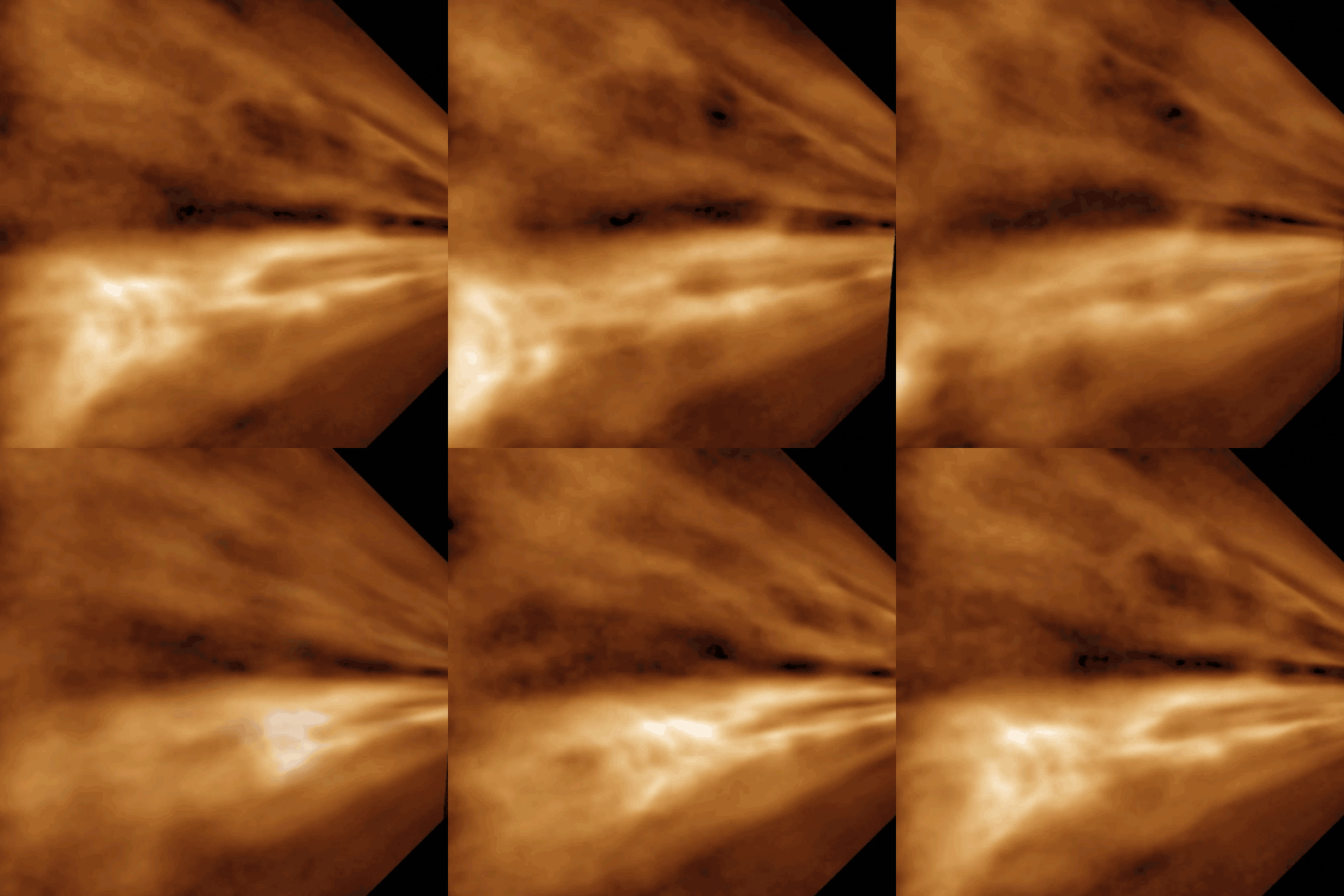
Sun news May 4: Enormous coronal holes send solar wind our way
(11 UTC to 11 UTC)
While solar flares held at low levels over the past day, the real action came from space weather’s stealthy storm-maker: fast solar wind. A blustery stream of plasma, launched from a coronal hole high in the sun’s northern hemisphere, slammed into Earth’s magnetic field, pushing solar wind speeds up to ~874 km/s. Combined with a southward Bz, the result was G1 (minor) geomagnetic storm conditions — and the potential for auroras lighting up high-latitude skies. That fast wind might not be finished yet. Another coronal hole, this one in the sun’s southern hemisphere, is poised to send another gust Earth’s way. Keep those cameras ready and your sky alerts active. Auroras may dance again tonight! Turning back to the sun itself, Region 4079 remains the largest and most magnetically complex sunspot group on the Earth-facing solar disk. Although it shows only beta-gamma magnetic complexity and slight spot growth, the region holds potential for stronger flares, including M-class and possibly even X-class eruptions. Stay tuned.
- Flare activity remains at a low level. The sun released 12 C (common) flares in the past 24 hours. The largest flare was a C2.4 flare at 14:01 UTC on May 3 from AR4079. AR4079 produced 11 of the 12 flares.
- The sun has four numbered active regions on the Earth-facing side. AR4079, in the northeast, remains the largest sunspot region. The region can still be seen from the ground safely without magnification using eclipse glasses. It has a beta-gamma magnetic configuration. AR4079 still has potential for M and even X flares. The other active regions on the solar disk have a simpler alpha or beta configuration.
- Blasts from the sun? No Earth-directed coronal mass ejections (CMEs) were observed in the available coronagraph imagery.
- Solar wind: The solar wind intensified. Solar wind speeds surged from ~580 km/s (1,297,000 mph) to a peak of ~874 km/s (1,955,000 mph) at 21:34 UTC on May 3. At the time of this writing (11 UTC on May 4), the solar wind speed is 677 km/s (about 1,514,000 mph). The total interplanetary magnetic field is at at moderate level. The Bz component (north-south orientation) fluctuated between northward and southward during the period with a southward period driving geomagnetic activity. At the time of this writing, it is northward. A southward Bz is more favorable for auroras.
- Geomagnetic activity: Earth’s geomagnetic field was disturbed at active levels (Kp = 4) but reached G1 (minor) geomagnetic storm levels during two 3-hour synoptic periods. The G1 threshold (Kp = 5) was reached at 10:30 UTC on May 3 at 7:52 UTC on May 4. Did you see auroras? Did you take photos? Share them with us.

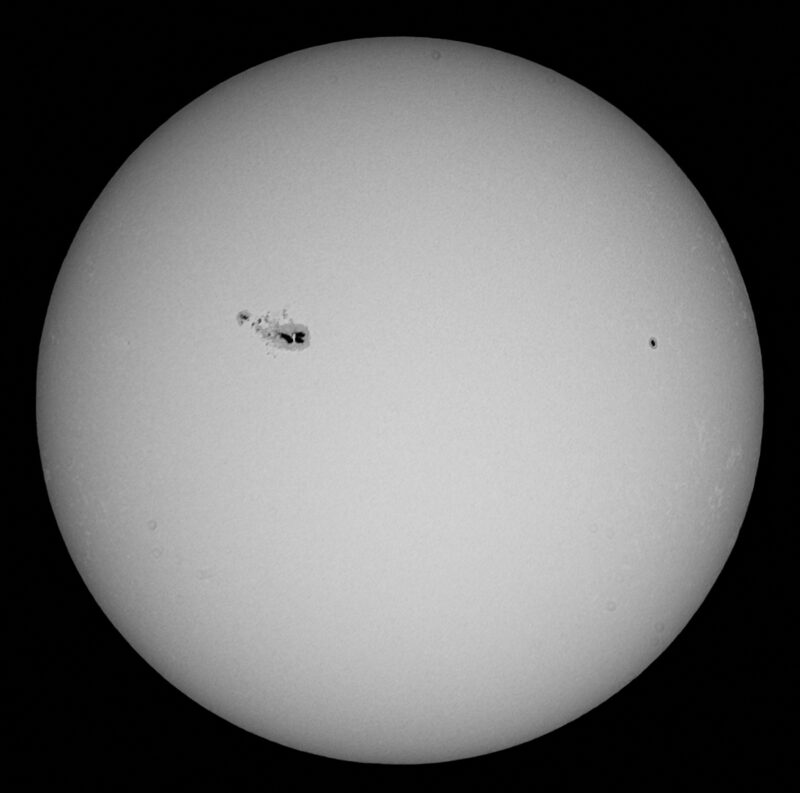
Sun news May 4: Enormous coronal holes send solar wind our way
(11 UTC to 11 UTC)
While solar flares held at low levels, the real action came from space weather’s stealthy storm-maker: fast solar wind. A blustery stream of plasma, launched from a coronal hole high in the sun’s northern hemisphere, slammed into Earth’s magnetic field, pushing solar wind speeds up to ~874 km/s. Combined with a southward Bz, the result was G1 (minor) geomagnetic storm conditions — and the potential for auroras lighting up high-latitude skies. That fast wind might not be finished yet. Another coronal hole, this one in the sun’s southern hemisphere, is poised to send another gust Earth’s way. Keep those cameras ready and your sky alerts active. Auroras may dance again tonight! Turning back to the sun itself, Region 4079 remains the largest and most magnetically complex sunspot group on the Earth-facing solar disk. Although it shows only beta-gamma magnetic complexity and slight spot growth, the region holds potential for stronger flares, including M-class and possibly even X-class eruptions. Stay tuned.
- Flare activity remains at a low level. The sun released 12 C (common) flares in the past 24 hours. The largest flare was a C2.4 flare at 14:01 UTC on May 3 from AR4079. AR4079 produced 11 of the 12 flares.
- The sun has four numbered active regions on the Earth-facing side. AR4079, in the northeast, remains the largest sunspot region. The region can still be seen from the ground safely without magnification using eclipse glasses. It has a beta-gamma magnetic configuration. AR4097 still has potential for M and even X flares. The other active regions on the solar disk have a simpler alpha or beta configuration.
- Blasts from the sun? No Earth-directed coronal mass ejections (CMEs) were observed in the available coronagraph imagery.
- Solar wind: The solar wind intensified. Solar wind speeds surged from ~580 km/s (1,297,000 mph) to a peak of ~874 km/s (1,955,000 mph) at 21:34 UTC on May 3. At the time of this writing (11 UTC on May 4), the solar wind speed is 677 km/s (about 1,514,000 mph). The total interplanetary magnetic field is at at moderate level. The Bz component (north-south orientation) fluctuated between northward and southward during the period with a southward period driving geomagnetic activity. At the time of this writing, it is northward. A southward Bz is more favorable for auroras.
- Geomagnetic activity: Earth’s geomagnetic field was disturbed at active levels (Kp = 4) but reached G1 (minor) geomagnetic storm levels during two 3-hour synoptic periods. The G1 threshold (Kp = 5) was reached at 10:30 UTC on May 3 at 7:52 UTC on May 4. Did you see auroras? Did you take photos? Share them with us.
What’s ahead? Sun-Earth forecast
- Low-to-moderate flare activity is expected in the coming day. The chance for M (moderate) flares is 35%, and the chance for X (strong) flares is 5% today.
- Geomagnetic activity forecast: At the time of this writing (11 UTC on May 4), geomagnetic activity is at a Kp = 5 level. Unsettled-to-active conditions are anticipated through May 6 with a chance for more G1 (minor) geomagnetic storming today. This is due to incoming high-speed solar wind stream, disturbing Earth’s magnetic field.
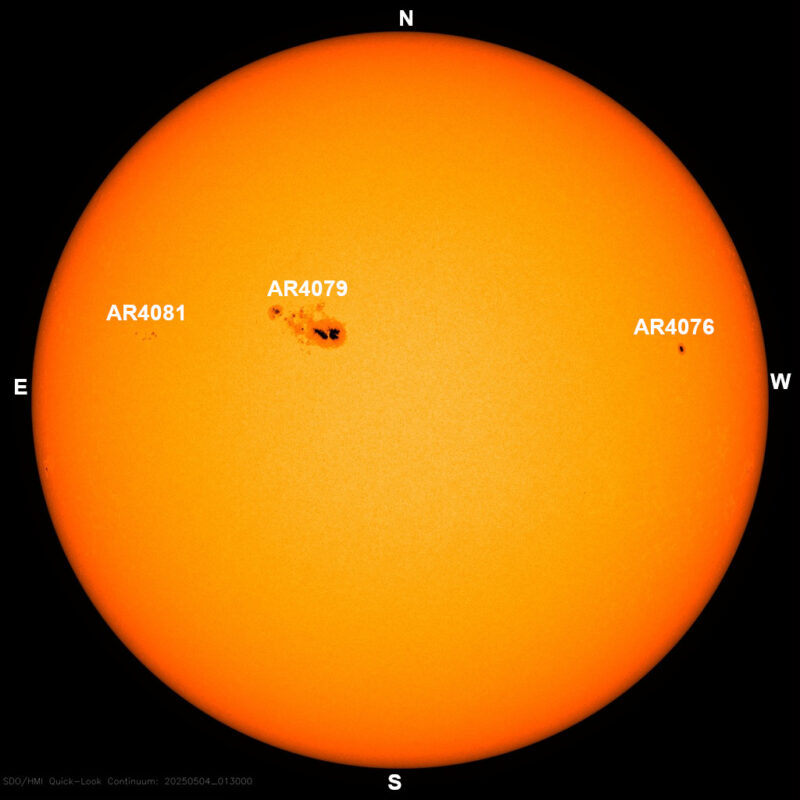
Sun news May 3: Sunspot data show a downward trend
(11 UTC to 11 UTC)
NOAA just released its April 2025 solar data. The monthly sunspot number climbed to 140.6, up from 134.2 in March, a clear signal that we remain firmly in solar maximum for Solar Cycle 25. This peak phase could continue for several more months before experts call the downturn. Leading the charge is AR4079, a behemoth sunspot region now dominating the sun’s northeast quadrant. Stretching six to seven Earths wide, it’s easily visible with eclipse glasses (always use proper eye protection!). While the region recently downgraded from delta to a beta-gamma magnetic configuration, it still carries serious flare potential, including M (moderate) and X (strong) class events. For now, it’s been surprisingly calm, producing only C (common) and B (weak) class flares over the past day, but with a spot this large, don’t count it out. Eyes on the sun!
- Flare activity remains at a low level. The sun released only C (common) and B (weak) flares in the past 24 hours. The largest flare was a C3.7 flare at 21:43 UTC on May 2 from AR4079. The sun produced 10 flares during the past 24 hours: eight C flares and two B flares. AR4079 produced seven of these 10 flares.
- The sun has two numbered active regions on the Earth-facing side. AR4079, in the northeast, continues as the largest sunspot region. The region can be seen from the ground safely without magnification using eclipse glasses. It lost its delta region and now has a beta-gamma magnetic configuration. AR4097 still has potential for M and even X flares. The other active region on the solar disk, AR4076, has a simpler alpha configuration.
- Blasts from the sun? No Earth-directed coronal mass ejections (CMEs) were observed in the available coronagraph imagery, but around 7:25 UTC on May 3, AR4079 released a C1.2 flare. The event threw ejecta into space. Initially, it appears not Earth-directed, nevertheless it is under analysis by specialists to determine if there is a component heading toward Earth.
- Solar wind: The solar wind reached high levels. It averaged around 700 km/s (1,566,000 mph) with a peak at 800 km/s (1,790,000 mph). At the time of this writing (11 UTC on May 3), the solar wind speed is 716 km/s (about 1,602,000 mph). The total interplanetary magnetic field is at at moderate level. The Bz component (north-south orientation) fluctuated between northward and southward during the period. At the time of this writing, it is southward. A southward Bz is more favorable for auroras.
- Geomagnetic activity: Earth’s geomagnetic field was disturbed at active levels (Kp 4) but reached G1 (minor) geomagnetic storm levels during four 3-hour synoptic periods. The G1 threshold (Kp 5) was reached at 2 UTC on May 2, remaining there for two 3-hour synoptic periods. It dropped to Kp 4, returning to G1 levels, at 0:55 UTC on May 3 for another two 3-hour synoptic periods. Did you see auroras? Did you take photos? Share them with us.

Sun news May 2: Big sunspot gets bigger, auroras possible tonight
(11 UTC to 11 UTC)

Giant sunspot region AR4079 is now fully visible in the sun’s northeast quadrant. It’s grown in size from six to seven planet-Earth-diameters. Do you still have eclipse glasses lying around? Use them to protect your eyes while peering toward this giant spot on the sun. This region has developed a beta-gamma-delta configuration, the most complex magnetic structure, with the most potential for flaring. Yet, over the past earthly day, AR4079 has produced only a fair number (9) of minor C-class flares. Could a major flare be building? We’re watching closely. Stay tuned. Meanwhile, Earth’s magnetic field remained active (Kp 4 – 5) throughout the past day, with G1 (minor) geomagnetic storm levels peaking at 20:22 UTC on May 1. The disturbances are being driven by fast solar wind streaming from a coronal hole. And NOAA forecasters expect these disturbances to continue, with a chance of G2 (moderate) storming tonight (May 2).
- Flare activity continues at low with only faint C flares in the past 24 hours. The largest event was a C1.8 flare at 22:59 UTC on May 1 from AR4079. The sun produced 10 flares during the past 24 hours. AR4079 produced nine of these 10.
- The sun has three numbered active regions on the Earth-facing side. AR4079, in the northeast, is the largest sunspot region on the Earth-facing solar disk. Its current beta-gamma-delta magnetic configuration indicates the potential for M flares and even X flares. The remaining two regions have simpler alpha or beta configurations.
- Blasts from the sun? No Earth-directed coronal mass ejections (CMEs) were observed in the available coronagraph imagery.
- Solar wind: Solar wind averaged around 520 km/s (1,163,000 mph) with peaks at 560 km/s (1,253,000 mph). At the time of this writing (11 UTC on May 2), the solar wind speed is 546 km/s (about 1,221,000 mph). The total interplanetary magnetic field is at a low to moderate level. The Bz component (north-south orientation) fluctuated between north and southward during the period. At the time of this writing, it moved northward. A southward Bz is more favorable for auroras.
- Geomagnetic activity: Earth’s geomagnetic field was at active levels (Kp = 4) over the past 24 hours. G1 (minor) geomagnetic storm levels were observed during four synoptic periods of three hours. The Kp = 5 threshold was reached at 20:22 UTC on May 1.
What’s ahead? Sun-Earth forecast
- Low-to-moderate flare activity is expected in the coming day. The chance for M (moderate) flares is 50%, and the chance for X (strong) flares is 10% today.
- Geomagnetic activity forecast: At the time of this writing (11 UTC on May 2), geomagnetic activity is at a Kp = 4 level. Mostly unsettled-to-active conditions are anticipated May 2, with possible G1 (minor) geomagnetic storm periods that could reach G2 (moderate) levels. The cause is an incoming high-speed solar wind stream.
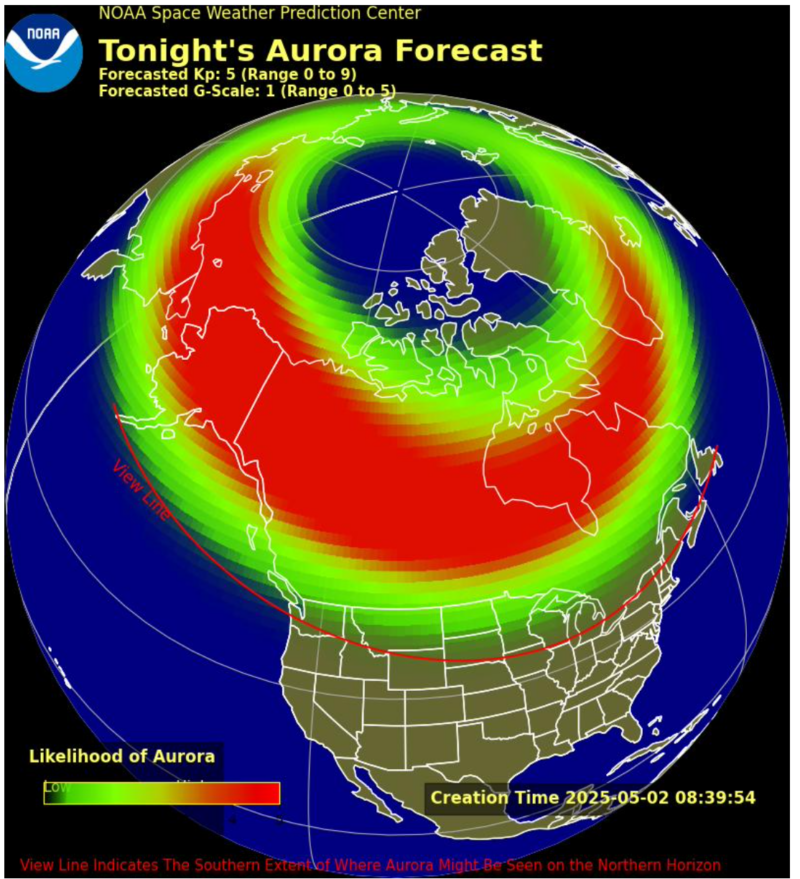
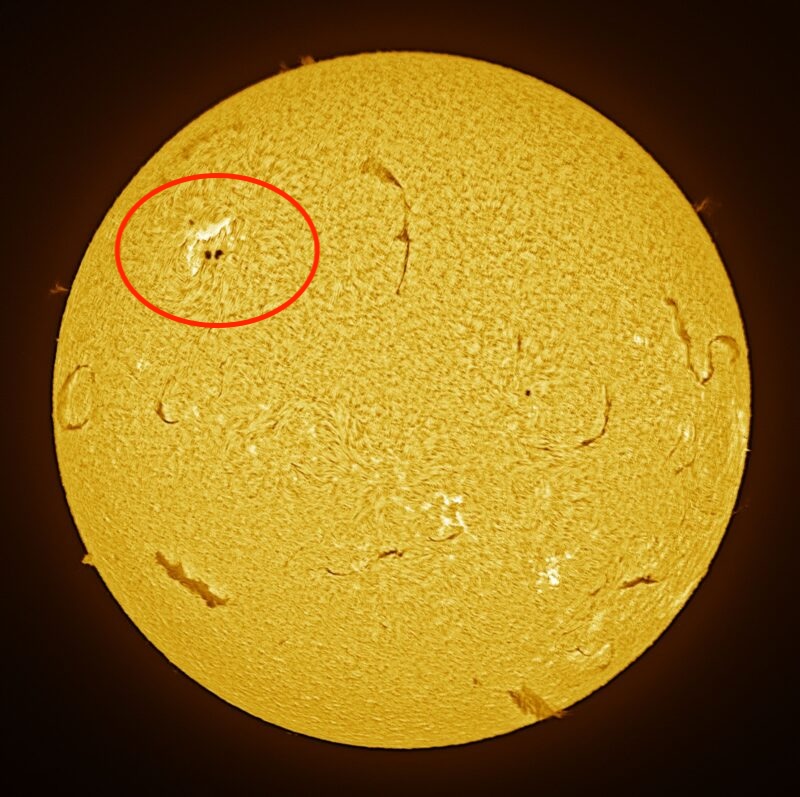
Sun news May 1: Huge region calms after an explosive entrance
(11 UTC to 11 UTC)
After an impressive arrival onto the Earth-viewed side of the sun, mammoth sunspot region AR4079’s activity has dropped. Over the past day we observed nothing stronger than a C flare from this region, and it even produced a B9.4 flare last night, one of the faintest flares we’ve seen for a long time. Is it saving up its energy for some huge flaring? We’ll see. For now it retains its promising beta-gamma complexity, and has grown to larger than six Earths side by side. Don’t count this region out yet, as it retains the potential for more M flares and possibly even X flares. Stay tuned.
- Flare activity has dropped to low, with the production of only C and B flares in the past 24 hours. The largest flare was a C2.5 flare at 7:19 UTC on May 1 from AR4079. The sun produced six flares during the past 24 hours: five C flares and a faint B9.4 flare. AR4079 was the day’s only flare producer.
- The sun has four numbered active regions on its Earth-facing side. Active region AR4079 in the northeast remains the largest sunspot region and keeps its promising beta-gamma magnetic configuration. The remaining sunspot regions have simpler alpha or beta configurations.
- Blasts from the sun? No Earth-directed coronal mass ejections (CMEs) were observed in the available coronagraph imagery.
- Solar wind: Solar wind averaged around 450 km/s (1,007,000 mph) with peaks at 488 km/s (1,092,000 mph). At the time of this writing (11 UTC on May 1), the solar wind speed is 453 km/s (about 1,013,000 mph). The total interplanetary magnetic field is at a low to moderate level. The Bz component (north-south orientation) was mostly oriented southward during the period. At the time of this writing it remains southward. A southward Bz is more favorable for auroras.
- Geomagnetic activity: Earth’s geomagnetic field was at unsettled-to-active levels (Kp 3-4) over the past 24 hours. The Kp 4 threshold was reached at 5:32 UTC on May 1.

Like what you read?
Subscribe and receive daily news delivered to your inbox.
More from
C. Alex Young


Sun news: See a huge solar eruption

Yes, there’s an aurora season, and it’s here
Sun activity archive for September 2026
Sun activity archive for August 2026