Sun news March 31: Powerful region continues its flaring reign
(11 UTC to 11 UTC)
Solar activity increased to moderate-high over the past 24 hours, driven by a series of five M-class (moderate) flares from prolific sunspot region AR4048. This new region is continuing to rotate into better view, revealing a large trailing penumbral spot group. The penumbra is the slightly lighter area of an active region surrounding one or more dark spots – umbras – where the sunspot’s magnetic field is strongest. So this region is showing promising size and magnetic complexity, although it’s too close to the solar horizon to give it a confident classification. Several other regions on the disk have been showing modest development, but none matched the activity of AR4048.
Sun-Earth highlights in the past day
- Flare activity over the past 24 hours increased to moderate-high levels with five M (moderate) flares. Region AR4048 remains the lead flare producer with 23 flares, including the five M flares. The largest event was an M1.6 flare beginning at 16:27 UTC on March 30 from AR4048. The event caused an R1 (minor) radio blackout over northern South America. The region also produced an M1.4 at 21:19 UTC on March 29 and an M1.5 flare at 1:19 UTC on March 30. The M1.4 and M1.5 flares also produced R1 radio blackouts over the Pacific Ocean.
- There are six active regions on the solar disk viewed from Earth. AR4043 and AR4046 have beta-gamma magnetic complexities. The remaining sunspot regions have either alpha or beta configurations. Recent newcomer AR4048 is still too close to the limb (edge) to be sure of its classification.
- Blasts from the sun? No new Earth-directed coronal mass ejections (CMEs) have been observed.
- Solar wind: Solar wind speeds declined from 500 km/s to ~450 km/s during the last 24 hours. At the time of this writing (11 UTC) the solar wind speed is 417 km/s. The total interplanetary magnetic field (IMF) is at low levels. The Bz component (north-south orientation) was mostly southward and remains southward. A southward Bz is favorable for auroras.
- Geomagnetic activity: Earth’s geomagnetic field was at quiet-to-unsettled levels during the past day, Kp = 1-3.

Sun news March 30: A new region takes the lead in activity
(11 UTC to 11 UTC)
A new region has emerged over the sun’s southeastern limb and immediately become the most active region we can see on our star. It produced an impressive 18 of the 20 flares fired over the last 24 hours, including three M-class flares. One of these flares fired out a coronal mass ejection (CME) that may prove to be Earth-directed. Since we saw an X flare yesterday and not today, we deem solar activity to have decreased from high to moderate. But this new active region is certainly cause for excitement.
Sun-Earth highlights in the past day
- Flare activity over the past 24 hours decreased to moderate levels with three M flares. Region AR4046 may have produced an X1.1 flare on Friday, but region AR4048 has now emerged and taken the lead in activity. AR4048 produced the three M flares as well as 15 C flares. The total flare production was 20 flares over the last 24 hours, with the remaining two flares from AR4046. The largest event was an M1.9 flare beginning at 22:38 UTC on March 29 from AR4048. The region also produced an M1.4 at 21:19 UTC on March 29 and an M1.5 flare at 1:19 UTC on March 30. The M1.9 flare caused an R1 (minor) radio blackout over the Pacific Ocean. The M1.4 and M1.5 flares also produced R1 radio blackouts over the Pacific Ocean.
- There are six active regions on the solar disk viewed from Earth. AR4043, AR4046, and AR4048 all have beta-gamma magnetic complexities. The remaining sunspot regions have either alpha or beta configurations. There is a newcomer, AR4048.
- Blasts from the sun? A fast coronal mass ejection (CME) associated with the March 28 X1.1 flare is expected to travel behind Earth, but potential shock influences could impact Earth today. A CME from an M flare blasted near the solar disk’s center at 21:38 UTC yesterday is still under review for any Earth-directed component.
- Solar wind: Solar wind speeds declined from 625 to 520 km/s during the last 24 hours. At the time of this writing (11 UTC) the solar wind speed is 458 km/s. The total interplanetary magnetic field (IMF) is at low levels. The Bz component (north-south orientation) was mostly southward and is now northward. A southward Bz is favorable for auroras.
- Geomagnetic activity: Earth’s geomagnetic field was at quiet-to-unsettled levels during the past day, Kp = 1-3.

Sun news March 29: Ka-BOOM! X flare and a powerful sun blast
(11 UTC to 11 UTC)

An X flare – the strongest category of solar flare – erupted from the sun’s eastern limb yesterday at 14:57 UTC (9:57 a.m. CDT on March 28). The X1.1 flare occurred on the northeast limb (edge) from an incoming active region, now numbered AR4046. And it produced a glorious coronal mass ejection (CME) – a great blast of solar materials and magnetic fields – which is not headed in Earth’s direction. The size of the prominence it hurled into space was dramatic. The event registered as an X1.1 flare, but part of the sun blocked our view of the huge prominence, so surely it was a much bigger blast. The blast caused an R3 (strong) radio blackout affecting an area over the Atlantic Ocean, east of French Guiana.
Sun-Earth highlights in the past day
- Flare activity over the past 24 hours increased to strong levels after the production of an X1.1 flare. In addition to the X flare, the sun produced three M flares after the big blast. An M1.0 at 18:01 UTC on March 28 produced by the X flare producer, AR4046 on the northeast limb (edge). The other two Ms were an M1.1 at 19:26 UTC and an M1.8 flare at 23:39 UTC both on March 28 by sunspot region AR4045 in the southeast. Flare productivity was 13 flares, one X, three Ms and nine C flares.
- There are five active regions on the solar disk viewed from Earth. AR4043 recovered its gamma magnetic complexity and now shows a beta-gamma configuration. The remaining sunspot regions have either alpha or beta configurations. There is a newcomer on the Earth-viewed side of our star, author of the X1.1 flare now numbered AR4046. Analysts are waiting for this sunspot region to move away from the limb to better determine its magnetic characteristics after the X flare.
- Blasts from the sun? The X flare is under modeling and analysis to determine if there is an Earth-directed component of the coronal mass ejection (CME) produced during the event. A faint CME was observed associated with a C3.9 flare by AR4043 at 3:01 UTC on March 27. Analysis points to a glancing blow at Earth on April 1.
- Solar wind: Solar wind speeds averaged 550 km/s during the last 24 hours. At the time of this writing (11 UTC) the solar wind speed is 552 km/s. The total interplanetary magnetic field (IMF) is at low levels. The Bz component (north-south orientation) is mostly northward with a short southward period. A southward Bz is favorable for auroras.
- Geomagnetic activity: Earth’s geomagnetic field was quiet to unsettled levels during the period. Kp = 4 levels were observed late yesterday into early today.
Sun news update: Click play on the video above to watch the impressive flare at Bluesky.? X1.1 solar flare!
At 14:57 UTC, the Sun erupted on its northeast limb, launching a huge flare + filament. Most of it looks to be heading away from Earth, but it’s a stunning show from our star!
#SolarFlare #SpaceWeather #XFlareupdates at bit.ly/sunactivity
— Dr. C. Alex Young (@thesuntoday.bsky.social) March 28, 2025 at 11:30 AM

Sun news March 28: Giant coronal hole moving out of geoeffective position
Sun-Earth highlights in the past day
- Flare activity over the past 24 hours had gone back to low levels. Flare productivity reduced as well. Between 11 UTC on March 27 and 11 UTC on March 28, the sun produced eight C flares. And the largest event was a C8.8 flare at 22:24 UTC on March 27, produced by active region AR4043 in the sun’s northeast. AR4043 blasted out five of the eight flares of the period.
- There are currently five active regions on the solar disk as viewed from Earth. AR4043 lost its gamma magnetic complexity and today all sunspot regions bear alpha or beta configurations. There are two newcomer on the Earth-viewed side of our star, now numbered AR4044 and AR4045.
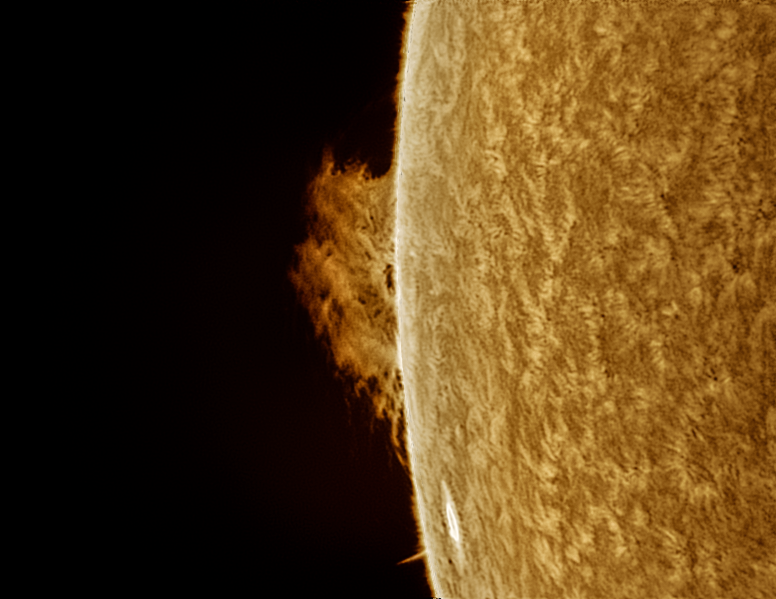

- Blasts from the sun? A filament eruption in the southeast quadrant at around 22 UTC on March 27 produced a beautiful prominence. Initial analysis appoint the plasma hurled into space too south out of Earth direction. Nevertheless, complete model and analysis ongoing to determine of there is a component heading our way at Earth. Other than that no Earth-directed coronal mass ejections (CMEs) were observed in available coronagraph imagery during the past day.
- Solar wind: Solar wind speeds reduced to an average of 690 km/s during the last 24 hours. At the time of this writing (11 UTC) the solar wind speed is 660 km/s. The total interplanetary magnetic field (IMF) is at low levels. The Bz component (north-south orientation) mostly north oriented with a short period southward. A southward Bz is favorable for auroras.
- Geomagnetic activity: Earth’s geomagnetic field a couple of synoptic 3 hour periods yesterday March 27 from 12 to 18 UTC when it reached a G1 (minor) geomagnetic storm (Kp = 5) level. After that the geomagnetic disturbance started to reduce to Kp = 4 levels.

Sun news March 27: A massive coronal hole is bombarding Earth. More auroras tonight?
(11 UTC to 11 UTC)

Earth is currently in the firing line of one of the largest coronal holes we’ve seen in Solar Cycle 25 so far. This area of lower density in the sun’s atmosphere is bombarding our magnetic field with fast solar wind. And this has been combining with slower solar wind to create a co-rotating interaction region – a complex blob of compressed solar wind – that has disturbed Earth’s magnetic field over the past few days. Last night we saw G1 (minor) to G2 (moderate) geomagnetic storming, bringing auroras to northerly latitudes. And we could see more auroras tonight, before the solar wind effects start to wane tomorrow. Clear skies, aurora hunters, and share your beautiful photos with us!
Sun-Earth highlights in the past day
- Flare activity remains at moderate levels after the production of an isolated M flare over the past 24 hours. This time it was an M2.1 flare at 0:37 UTC on March 27 blasted out by active region AR4043 in the northeast. Shortly after the flare an R1 (minor) radio blackout was registered affecting an area over the Pacific Ocean, west of Fiji Island. During the past 24 hours the sun produced 12 flares – one M and 11 C flares – half of them sparked by AR4043.
- There are currently only two active regions on the sun. That’s one of the lowest numbers we’ve seen in a while. The last time we saw no sunspots at all was June 8, 2022. AR4043 retains its beta-gamma magnetic configuration and remains the most productive region. The other region, AR4035, has a simpler beta configuration.
- Blasts from the sun? No Earth-directed coronal mass ejections (CMEs) were hurled from the sun during the past day.
- Solar wind: Solar wind speeds increased to an average of 800 km/s, with a peak of 864 km/s early this morning. At the time of this writing (11 UTC) the solar wind speed is 730 km/s. The total interplanetary magnetic field (IMF) is at moderately disturbed levels. The Bz component (north-south orientation) is fluctuating between north and south, and is southward at this writing. A southward Bz is favorable for auroras.
- Geomagnetic activity: Our geomagnetic field has been disturbed to active levels for most of the past day, starting at 12 UTC on March 26 when it reached a G1 (minor) geomagnetic storm (Kp = 5) level. It peaked at a G2 (moderate, Kp = 6) level at 18 UTC on March 26. A G1 level is ongoing at this writing.
I finally got to see the Northern Lights again! Tonight’s display was in Hancock, MI at the Maasto Hiihto Trails. I’m glad I went out! #NorthernLights #AuroraBorealis #Aurora #KeweenawPeninsula #UpperMichigan #StormHour #Yooper #SpaceWx #DarkSky pic.twitter.com/7Ictm2xSmq
— Isaac (@ID_photo_graphy) March 26, 2025
Sun news March 26: Solar wind impact underway, more auroras tonight?
(11 UTC to 11 UTC)
Auroras lit up northern skies last night, after a powerful co-rotating interaction region – a complex blob of compressed solar wind – arrived as expected. On the coat-tails of this blob was a blast of high-speed solar wind from a giant coronal hole in the sun’s southern hemisphere. The impact has already stirred Earth’s magnetic field to a G1 (minor) disturbance, and could trigger G1–G2 (minor–moderate) geomagnetic storms through March 27, with effects potentially reverberating into March 28. Did you see the auroras last night? Share your beautiful photos with us. And clear skies for tonight and tomorrow, aurora hunters!
Sun-Earth highlights in the past day
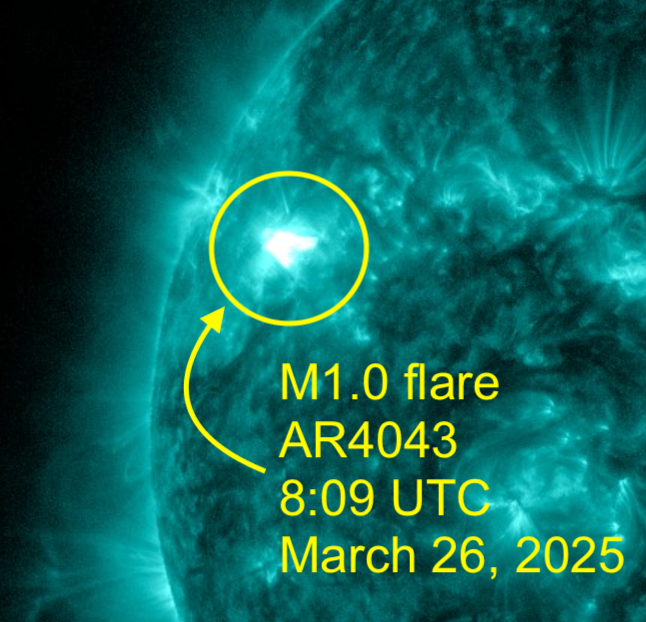
- Flare activity jumped up to moderate with the production of an isolated M flare over the past 24 hours. The event was an M1.0 from active region AR4043 in the northeast quadrant at 8:09 UTC on March 26. The blast caused an R1 (minor) radio blackout that affected an area over the Arabian Sea east of Somalia. The sun produced 18 flares during the period, with eight flares from prolific flare producer AR4036.
- There are currently four active regions on the sun. AR4036 retained its beta-gamma magnetic configuration and remains the most productive region. The rest of the active regions have simpler alpha or beta configurations. Most of them have decayed or remain stable. There is a newcomer in the northeast quadrant, labeled AR4043.
- Blasts from the sun? An Earth-directed coronal mass ejection (CME) hurled from the sun on March 22 arrived over the past day, but did not have much impact. No other Earth-directed CMEs were observed in available coronagraph imagery.
- Solar wind: Solar wind speeds have remained normal, averaging ~350 km/s to ~360 km/s. At the time of this writing it is peaking at 370 km/s. The total interplanetary magnetic field (IMF) briefly jumped to disturbed levels. The Bz component (north-south orientation) is mostly oriented northward.
- Geomagnetic activity: Our geomagnetic field’s activity peaked at a G1 (minor) geomagnetic storm (Kp = 5) at 2:59 UTC on March 26, and was otherwise mainly at around Kp = 4 levels.
Well, that was rather nice! ?? The sky went into outburst at 12.30am, just in time before the clouds rolled in again! What a vibrant pink sky, clearly visible to the naked eye! Oh how I have missed this! ? Views from my window, Sperrins, overlooking Keady mountain. @chunder10 pic.twitter.com/whUPZ8r9Z6
— Rachel Cassidy (@cassidy_rachel) March 26, 2025
Sun news March 25: Beautiful auroras tonight?
(11 UTC to 11 UTC)

Space weather experts are predicting beautiful auroral displays at northerly latitudes tonight! That’s because a giant coronal hole is now facing Earth and sending a stream of fast solar wind our way. This stream is expected to catch up with slower wind ahead of it, forming a co-rotating interaction region (CIR): a powerful structure that can stir up Earth’s magnetic field. This blast of solar wind could trigger geomagnetic activity tonight and into tomorrow. In fact, NOAA has issued a G2 (Moderate) geomagnetic storm alert for March 25. Clear skies and good luck, aurora hunters! And in other news, Mercury passed between Earth and the sun yesterday, with the SOHO spacecraft watching on. Take a look at the imagery below.
Sun-Earth highlights in the past day
- Flare activity remains at low levels with only C flares fired over the past 24 hours. However, flare production has increased, with 21 total C flares in the past day. The largest event was a C3.4 flare at 0:40 UTC on March 25 from active region AR4036 in the northwest. AR4036 produced 13 of the day’s flares.
- There are four active regions on the sun. AR4036 retained its beta-gamma magnetic configuration and is the most productive region we can see now. The remaining active regions show simpler alpha or beta configurations, remaining stable or in decay.
- Blasts from the sun? An Earth-directed coronal mass ejection (CME) hurled from the sun on March 22 arrived over the past day, but did not have much impact. No other Earth-directed CMEs were observed in available coronagraph imagery.
- Solar wind: Solar wind speeds dropped, ranging from ~360 km/s to ~376 km/s. These solar wind conditions reflect a waning coronal hole influence. The total interplanetary magnetic field (IMF) remained low. The Bz component (north-south orientation) fluctuated between north and southward. It is currently southward oriented.
- Geomagnetic activity: Our geomagnetic field’s activity peaked at Kp = 4 during a 3-hour period late on March 24. For the rest of the day the Kp index was between 2 and 3.


Sun news March 24: Enormous coronal hole to stir things up
(11 UTC to 11 UTC)
Geomagnetic activity is expected to heat up over the next few days. That’s because a giant coronal hole will soon be facing Earth and sending its fast solar wind our way. Plus, this stream will catch up with slower wind ahead of it, forming a powerful structure known as a co-rotating interaction region (CIR). This blast of solar wind could really stir up geomagnetic activity on Earth tomorrow and Wednesday.
Sun-Earth highlights in the past day
- Flare activity has dropped to low with only 13 C flares over the past day. The largest event was a C5.2 flare at 7:37 UTC on March 24 from active region AR4035 just north of the solar disk’s center.
- There are eight active regions on the Earth-facing solar disk. AR4036 continues to grow in size and is the only active region showing a beta-gamma magnetic configuration, indicating a potential for stronger flares. The remaining active regions show simpler alpha or beta configurations and remain stable or in decay.
- Blasts from the sun? No Earth-directed coronal mass ejections (CMEs) were detected in the past 24 hours. A faint halo coronal mass ejection from a filament eruption observed on March 21 arrived overnight. A second CME from March 22 may arrive today.
- Solar wind: Solar wind speeds decreased from ~480 km/s to ~400 km/s. The solar wind conditions reflect waning coronal hole influences. The total interplanetary magnetic field (IMF) remained low. The Bz component (north-south orientation) fluctuated between north and southward.
- Geomagnetic activity: Our geomagnetic field’s activity ranged from Kp = 1 to 4. Kp = 4 was reached after the faint CME reached Earth early on March 24. The geomagnetic field reached G1–G2 (minor–moderate) geomagnetic storm levels over the past day, due to the CME and coronal hole high-speed stream (solar wind) effects.


Sun news March 23: Parker Solar Probe’s fearless March 22 perihelion
(11 UTC to 11 UTC)
Today’s top story: Parker Solar Probe has now successfully completed yet another record-setting close flyby of the sun. Its 23rd solar encounter peaked around 23 UTC on March 22, marking its 2nd-closest approach, almost within 3.8 million miles of the sun, and traveling at nearly 426,000 mph. This encounter began on March 18 and continues through March 27, with the next closest approach scheduled for June 19, 2025.
Sun-Earth highlights in the past day
- Flare activity has dropped to low with only C flares over the past day. The largest event was a C5.0 flare at 17:27 UTC on March 22 from active region AR4035 in the north central. Total flare production was 19 C flares.
- There are 11 active regions on the Earth-facing solar disk. AR4036 continues to grow in size and magnetic complexity, and two new sunspot regions have emerged. AR4036 in the northwest is the only active region showing a beta-gamma magnetic configuration, indicating a potential for strong flares. The remaining active regions show simpler alpha or beta configurations and remain stable or in decay. There are three newcomers on the solar disk. They are AR4020 and AR4022 that emerged in the southeast quadrant; AR4041 in the northeast.
- Blasts from the sun? There are no confirmed CMEs heading earthward. A faint, wide-angle coronal mass ejection (CME) from a filament eruption near disk center between 13:00–15:00 UTC on March 22 is still under analysis for potential Earth-directed effects.
- Solar wind: Solar wind speeds ranged from ~400–550 km/s. The solar wind showed signs of waning CME effects and ongoing CH HSS influence. The total interplanetary magnetic field (IMF) strength declined from a peak. The Bz component (north-south orientation) fluctuated between south and north.
- Geomagnetic activity: The geomagnetic field is unsettled at this writing (Kp = 3 at around 11 UTC). The geomagnetic field reached G1–G2 (minor–moderate) geomagnetic storm levels over the past day, due to CME and coronal hole high-speed stream (solar wind) effects.
What’s ahead? Sun-Earth forecast
- Low-to-moderate flare activity is expected over the next 24 hours, with a chance of isolated M-class flares. The chance for M flares is 30% today, and the chance for X flares is 5% today.
- Blasts from the sun? NOAA issued a G3 (strong) geomagnetic storm watch due to a coronal mass ejection (CME), due to arrive on March 23. The blob of solar stuff left the sun on March 21.
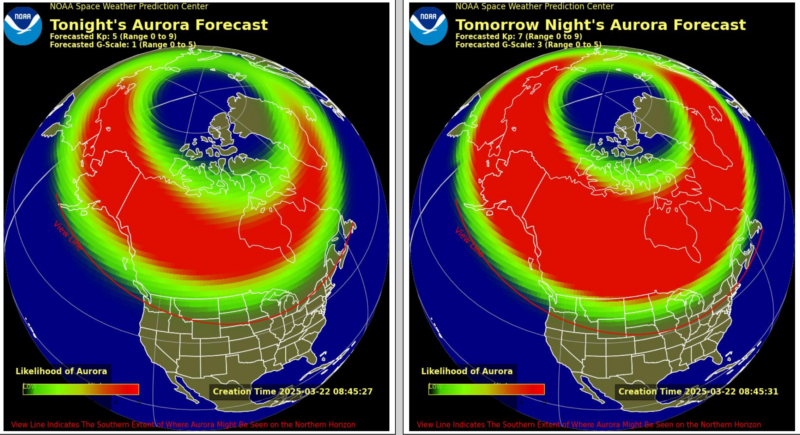
- Geomagnetic activity forecast: The geomagnetic field is expected to reach G1 (minor) to G2 (moderate) levels during today March 22. All this is due to a CME influence combined with fast solar wind from a coronal hole and a resulting CIR. G3 (strong) levels are anticipated for March 23 with the arrival of a CME that left the sun on March 21. Additional solar wind enhancements are likely through March 25, driven by coronal hole effects and a developing corotating interaction region (CIR). Stay tuned!

Sun news March 22: Not a myth! Aurora season is happening now
(11 UTC to 11 UTC)
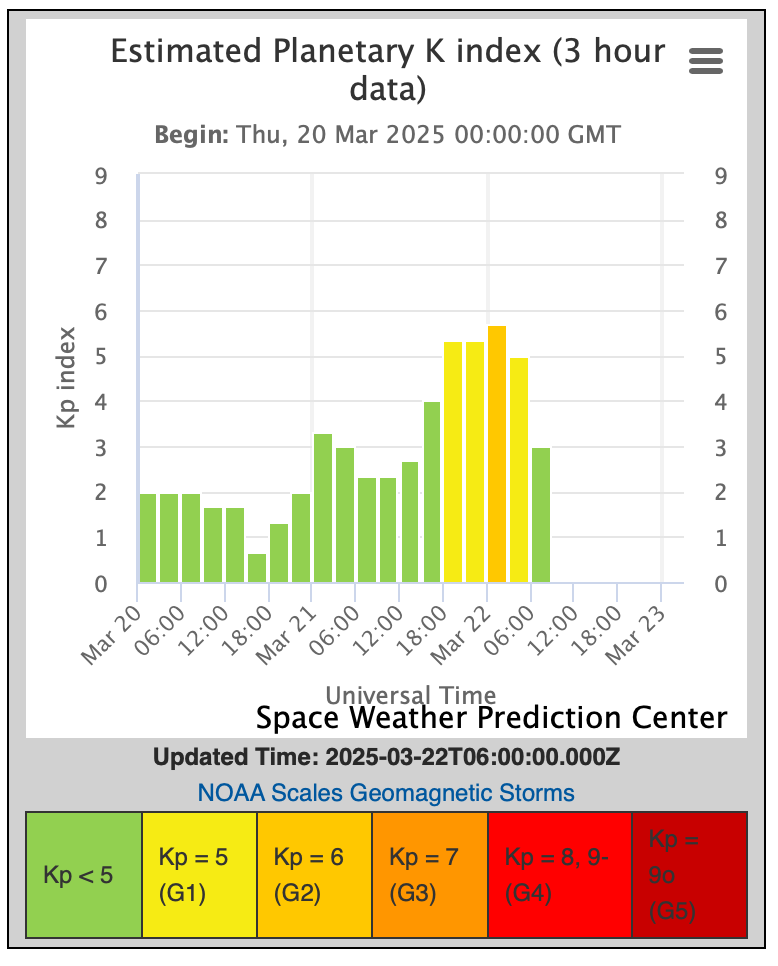
Auroras lit up the skies just after this week’s March equinox. Earth’s magnetic field was disturbed to G1 (minor) and G2 (moderate) storm levels (Kp = 5–6) from late March 21 into early March 22. Displays were seen across Scandinavia, including Kiruna, Tromsø, and Rovaniemi. The activity was driven by a coronal mass ejection (CME) combined with fast solar wind from a coronal hole, forming a corotating interaction region (CIR) that stirred Earth’s magnetic field. As expected, the three coronal holes reported yesterday are sending high-speed streams, contributing to ongoing geomagnetic activity. Another CME from March 21 is on the way, and NOAA has issued a geomagnetic storm watch with a chance for G3 (Strong) storm conditions on March 23. Keep an eye on the skies—more auroras may be on the way! P.S. Yes, it’s true that auroras happen more frequently around the equinoxes. Read about it here.
Sun-Earth highlights in the past day
- Flare activity is back up to moderate with an isolated M flare over the past day. The M1.2 flare blasted out at 15:58 UTC on March 21 from active region AR4028 in the southwest. The flare caused an R1 (minor) radio blackout that affected an area over the Atlantic Ocean. Total flare production was seven flares, the M and six C flares.
- There are 11 active regions on the Earth-facing solar disk. Active region AR4036 in the northwest is now the only active region showing a beta-gamma magnetic configuration, becoming the most interesting sunspot region on the solar disk for now. The remaining active regions show simpler alpha or beta configurations and remain stable or in decay. There are four newcomers today on the solar disk as we see it from Earth. They are AR4036 and AR4037 that emerged in the northwest quadrant; AR4038 in the southeast and AR4039 in the northeast.
- Blasts from the sun? The M1.2 flare by AR4028 is under analysis to determine if there is a component of a coronal mass ejection (CME) coming our way at Earth after the blast.
- Solar wind: Solar wind speeds averaged around 520 km/s with a peak at 580 km/s late on March 21, dropped down to 430 km/s during this writing. The total interplanetary magnetic field (IMF) was strongly disturbed. The Bz component (north-south orientation) remained south oriented late on March 21 early today, March 22. It is back to northward at the time of this writing (11 UTC). Auroral displays may be heightened when Bz is directed southward.
- Geomagnetic activity: The geomagnetic field was active late yesterday through early this morning. It was disturbed up to G1 (minor) to a G2 (moderate) levels (Kp = 5 – 6). This was due to the passage of a CME that left the sun likely on March 17 combined with a corotating interaction region (CIR).
Sun news March 21: A powerful burst! But the sun naps on
(11 UTC to 11 UTC)
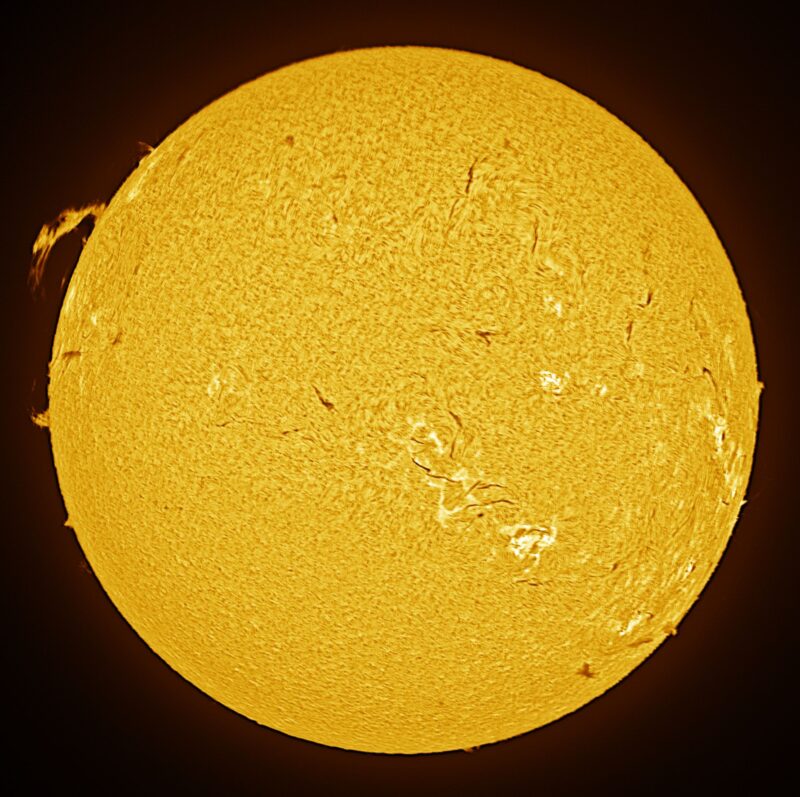

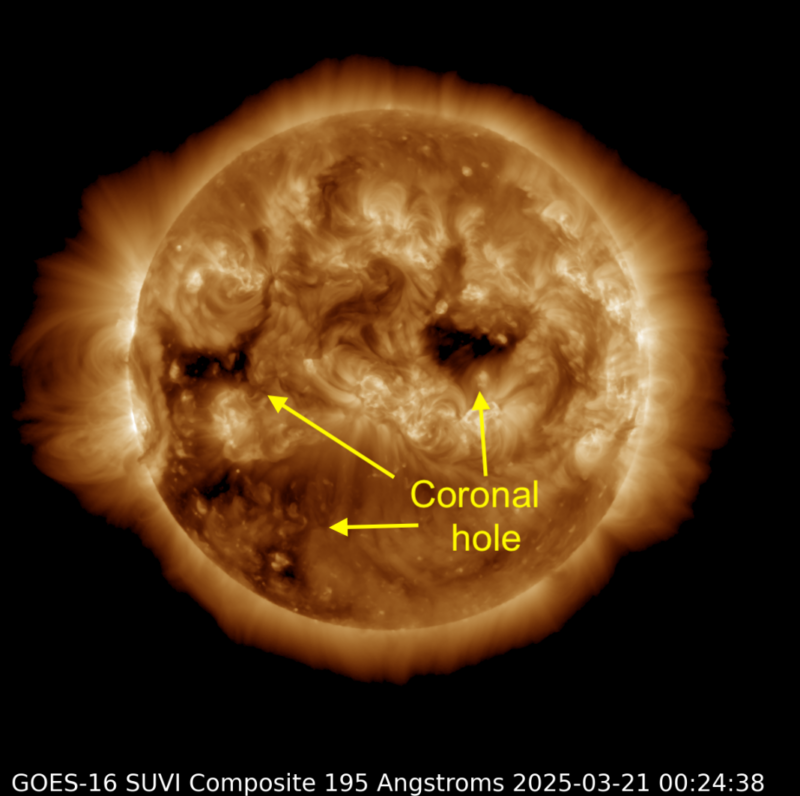
We reached the peak of Solar Cycle 25 late last year. And we can expect solar activity to remain high throughout 2025, if not longer. But over the past day the sun has been napping. Just three C (common) flares flickered to life in the past 24 hours, making it one of the quietest days we’ve seen in awhile. Even Earth’s magnetic field seemed to be relaxing, with only minor geomagnetic stirrings. The biggest excitement came from a filament eruption southeast of the sun’s disk center around 18 UTC. It launched a blob of solar plasma and magnetic fields that might be heading our way. Space weather experts are currently analyzing the trajectory. Meanwhile, three coronal holes scattered across the solar disk are poised to send streams of fast solar wind toward Earth. And as that speedy solar wind catches up with slower-moving wind ahead of it, a corotating interaction region (CIR) could form, potentially giving Earth’s magnetic field a bit of a shakeup in the next couple of days. Stay tuned. This calm might just be the quiet before the solar storm.
Sun-Earth highlights in the past day
- Flare activity dropped down to low, with only C flares over the past day. This was one of the lowest flare production days this year so far, with only three Cs. The largest was a C4.4 flare produced by active region AR4025 in the sun’s northwest quadrant at 17:10 UTC on March 20. The sun produced no flares on March 21 up to the time of this writing (11 UTC).
- There are eight active regions on the Earth-facing solar disk. Active region AR4035, now centered in the sun’s northeast quadrant, developed a gamma complexity; today it shows a beta-gamma magnetic configuration, giving it the most potential for producing big flares of any active region on the Earth-facing solar disk. Will it deliver? Who knows? The remaining active regions show simpler alpha or beta configurations and remain stable or in decay.
- Blasts from the sun? Other than the blast described above (which is still under analysis), no coronal mass ejections (CMEs) Earth-oriented were observed in available coronagraph imagery over the past day.
- Solar wind: Solar wind speeds averaged 400 km/s (894,775 mph) early today then dropped to 380 km/s (about 850,036 mph) this morning. The total interplanetary magnetic field (IMF) wasmmildly disturbed. The Bz component (north-south orientation) was mostly northward and remains so at the time of this writing (11 UTC). Auroral displays may be heightened when Bz is directed southward.
- Geomagnetic activity: The geomagnetic field was quiet to unsettled levels during most of the day (Kp = 2 – 3).

Sun news March 20: Will the equinox bring beautiful auroras?
(11 UTC to 11 UTC)
The March equinox arrived at 9:01 UTC (4:01 CDT) this morning, and auroras are triggered much more easily around the time of an equinox. Could we be treated to some equinox auroras today? A G1 (minor) geomagnetic storm was registered between 18 and 21 UTC last night. And while activity has dropped this morning, fast solar wind and a potential coronal mass ejection (CME) impact could be enough to cause auroras later today. Stay tuned!
Sun-Earth highlights in the past day
- Flare activity jumped back up to a moderate level after an isolated M1.5 flare over the past 24 hours. The blast was produced by active region AR4031 in the northwest at 20:40 UTC on March 19. The flare provoked an R1 (minor) radio blackout that affected an area in the middle of the Pacific Ocean west of Galapagos. The sun produced 10 flares during our observation period: an M plus nine C flares.
- There are currently eight active regions on the Earth-facing solar disk. All of them are showing simple alpha or beta magnetic configurations.
- Blasts from the sun? Specialists have announced that the coronal mass ejection (CME) we saw yesterday at 0:44 UTC is not Earth-bound.
- Solar wind: Solar wind speeds averaged at around 460 km/s (1,030,000 mph) early today and dropped down to 441 km/s (about 1,000,000 mph) at the time of this writing. The total interplanetary magnetic field (IMF) remains mildly disturbed. The Bz component (north-south orientation) was mostly north-oriented and remains so at the time of this writing (11 UTC). Geomagnetic activity is heightened when Bz is directed southward.
- Geomagnetic activity: The geomagnetic field was enhanced to an active level late yesterday, with the anticipated G1 (minor) geomagnetic storm arriving early. It brought auroral conditions at 21:15 UTC last night. The active level (Kp 5) was recorded between 18 and 21 UTC.


Sun news March 19: See 2 beautiful sun blasts at once
(11 UTC to 11 UTC)
At 0:44 UTC this morning, two filaments – long ropes of solar material and magnetic fields – erupted from our star in near-perfect unison. And the eruption you can see toward the sun’s center sent a blob of sun-stuff – a coronal mass ejection or CME – soaring out into space. Analysts are currently determining whether it could be on a course for Earth. It would be well timed if it did, as auroras are triggered much more easily around the time of an equinox. In fact, even a slight increase in the solar wind tomorrow could bring beautiful auroras. Stay tuned!
Sun-Earth highlights in the past day
- Flare activity back to a low level. The sun produced only 10 faint C flares over the past 24 hours. The largest event of the period was a C2.2 flare from an unnumbered active region in the northwest at 12:27 UTC on March 18.
- There are currently 10 active regions on the solar disk as we see it from Earth. All of them show simple alpha or beta magnetic configurations. There is a newcomer in the northeast quadrant now numbered AR4035.
- Blasts from the sun? No coronal mass ejections (CMEs) Earth-bound have been confirmed from yesterday’s M1 and C9.8 flares. But the central filament eruption mentioned above certainly hurled plasma into space. Initial impressions suggest it will pass to the north of Earth, but but we’re waiting for the specialists to complete their modeling and analysis.
- Solar wind: Solar wind speeds averaged at around 460 km/s, peaking at 473 km/s at the time of this writing. The total interplanetary magnetic field (IMF) remains mildly disturbed. The Bz component (north-south orientation) was mostly south-oriented for most of the past day and remains so at the time of this writing (11 UTC). Geomagnetic activity is heightened when Bz is directed southward.
- Geomagnetic activity: The geomagnetic field has been quiet-to-unsettled, with an active level (Kp = 4) reached between 3 and 6 UTC on March 19.

Sun news March 18: Activity rises with big back-to-back blasts
(11 UTC to 11 UTC)
Sun activity has jumped up to moderate after sunspot region AR4033 fired an M1.0 flare at 19:33 UTC last night. Interestingly, just a few minutes earlier, a C9.8 flare – almost an M flare – blasted from a filament in the vicinity of this same sunspot region, giving the impression of an almost-double-M flare. And both flares launched blobs of solar material and magnetic fields (coronal mass ejections, or CMEs) into space. It appears these might be headed for Earth, although modeling is still ongoing. Stay tuned.
Sun-Earth highlights in the past day
- Flare activity jumped up to a moderate level with the production of an M1.0 flare, the largest event of the period. Active region AR4033, in the northeast, released the flare at 19:33 UTC on March 17. The blast caused an R1 (minor) radio blackout that affected an area over the Pacific Ocean west of Galapagos. The sun produced 16 flares: the M1.0 and 15 C flares.
- There are 12 active regions on the Earth-facing solar disk. All of them show simple alpha or beta magnetic configurations. Sunspot regions AR4025 and AR4028 have lost their more complex gamma structures.
- Blasts from the sun? Two coronal mass ejections (CMEs) from the M1 and C9.8 flares were observed by the SOHO spacecraft at 19:36 UTC. Initial analysis suggests an earthly trajectory, but further modeling is in progress.
- Solar wind: Solar wind speeds averaged at around 400 km/s, dropping as low as 330 km/s. The total interplanetary magnetic field (IMF) was mildly disturbed. The Bz component (north-south orientation) was southward for most of the past day, before moving north at the time of this writing (11 UTC). Geomagnetic activity is heightened when Bz is directed southward.
- Geomagnetic activity: The geomagnetic field has been unsettled, with an active level (Kp = 4) reached at 20:59 UTC on March 17.
Sun news March 17: Calm, with an exciting sun-blast possibility
(11 UTC to 11 UTC)

Sun activity has been low overall. But a glancing blow from a coronal mass ejection (CME) – a giant blast of sun-stuff and magnetic fields – could be possible at Earth on March 20. A filament eruption in the sun’s northwest quadrant on March 16 resulted in a slow, faint CME, first observed at 11:24 UTC in imagery from the SOHO spacecraft’s LASCO C2 coronagraph. Modeling suggests a glancing blow to Earth around midday on March 20 cannot be ruled out. Meanwhile, solar wind speeds continue to decrease, but another high-speed stream (CH HSS) is expected to enhance conditions – bringing better conditions for auroral displays – by March 18.
Sun-Earth highlights in the past day
- Flare activity remained at low levels with the production of only C flares. The largest event was a C7.8 flare from active region AR4030 in the southeast at 5:42 UTC on March 17. The sun produced 10 flares.
- There are 12 active regions on the Earth-facing solar disk. Sunspot regions AR4025 and AR4028 have beta-gamma magnetic configurations. The remaining sunspot regions have simpler alpha or beta magnetic structures.
- Blasts from the sun? As mentioned above, a filament eruption in the sun’s northwest quadrant at 08:58 UTC on March 16 might have caused a slow, faint coronal mass ejection (CME). LASCO C2 imagery detected the CME at 11:24 UTC. It might deliver a glancing blow to Earth around midday on March 20.
- Solar wind: Solar wind speeds gradually decreased from ~500 km/s to 410-430 km/s. The total interplanetary magnetic field (IMF) strength remained weak. The Bz component (north-south orientation) fluctuated between the north and southward direction.
- Geomagnetic activity: The geomagnetic field was quiet, with one early unsettled period. Quiet to active (Kp = 2 to 4).
Find archived versions of past days’ sun news here.
Sun news March 16: A timely low, and a quiet Sun Day
(11 UTC to 11 UTC)
Happy Sun Day! The sun is covered with 13 sunspot groups or active regions. Despite this solar activity remains at low levels, with only C flares observed. Geomagnetic activity also remains quiet to unsettled, with isolated active periods possible through March 18. Is this weekend’s quiet a preview of what’s to come for our local star? After all, as NASA and NOAA announced in October 2024, we’re now past the peak of the current sunspot cycle, Cycle 25. Heliophysicist C. Alex Young and EarthSky’s founder Deborah Byrd discussed that announcement in October, in this livestream. Watch here, or in the video player below.
Sun-Earth highlights in the past day
- Flare activity dropped to low levels with the production of only C flares. The largest event was a C4.2 flare from active region AR4019 in the northwest at 8:03 UTC on March 16. The sun produced 11 flares.
- There are 13 active regions on the Earth-facing solar disk. Sunspot regions AR4019 and AR4028 have beta-gamma magnetic configurations. The remaining sunspot regions have simpler alpha or beta magnetic structures.
- Blasts from the sun? No new Earth-directed coronal mass ejections (CMEs) have been observed.
- Solar wind: Solar wind speeds ranged between 500-560 km/s, temporarily peaking near 560 km/s before decreasing to 500-520 km/s. The interplanetary magnetic field strength was weak. The Bz (north-south orientation) magnetic field component fluctuated between the north and south.
- Geomagnetic activity: The geomagnetic field was quiet to active (Kp = 1 to 4).


Sun news for March 15-16, 2025. The Earth-facing side of the sun currently has 13 sunspot or active regions. Yet the sun has been quiet with only C flares all weekend. Will we have a quiet Sun Day today? And is it a preview of what’s to come? Image via SDO. 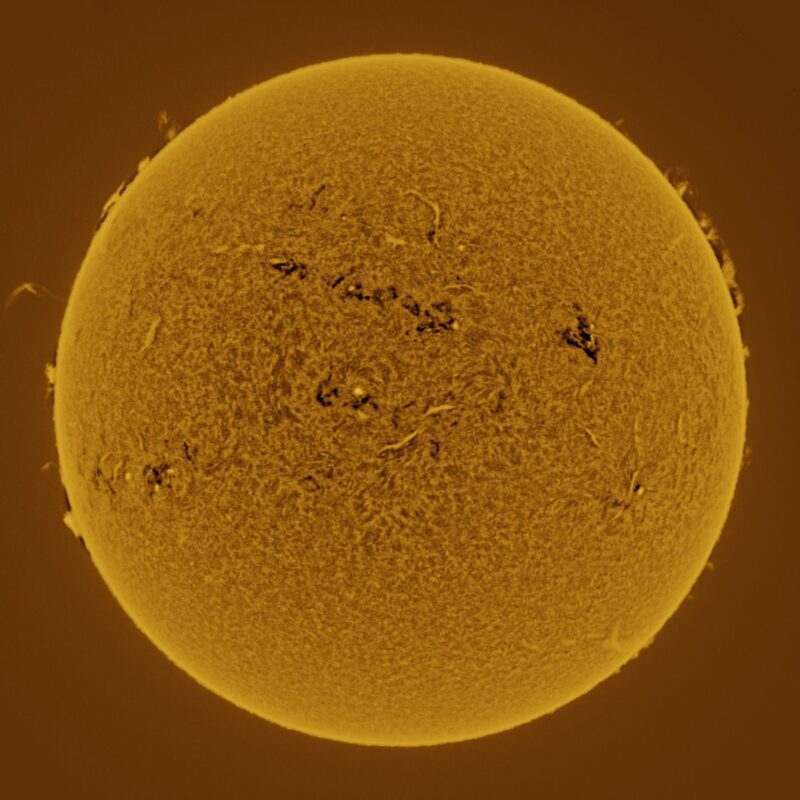
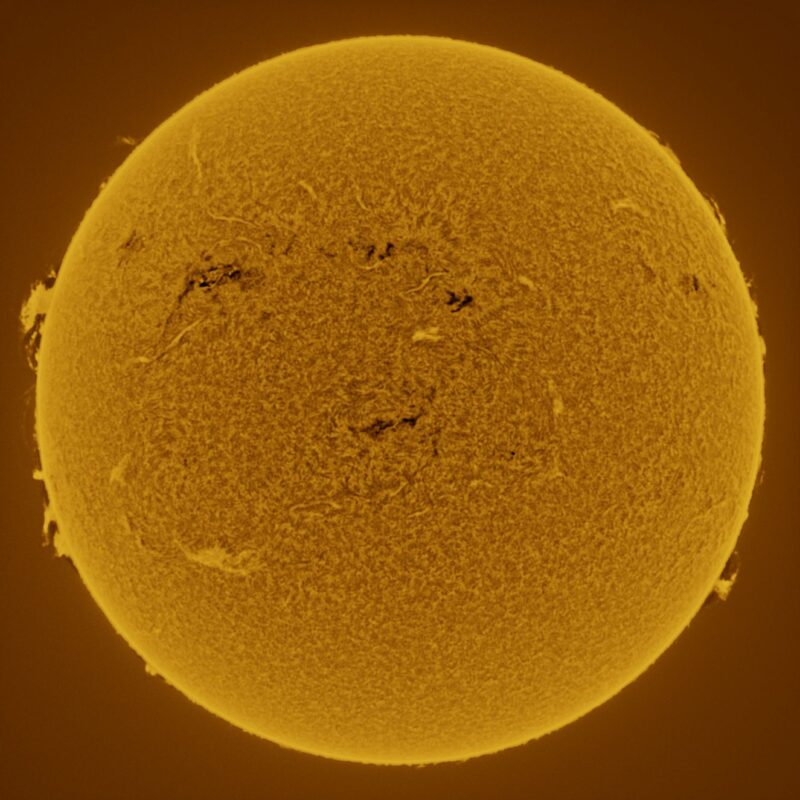
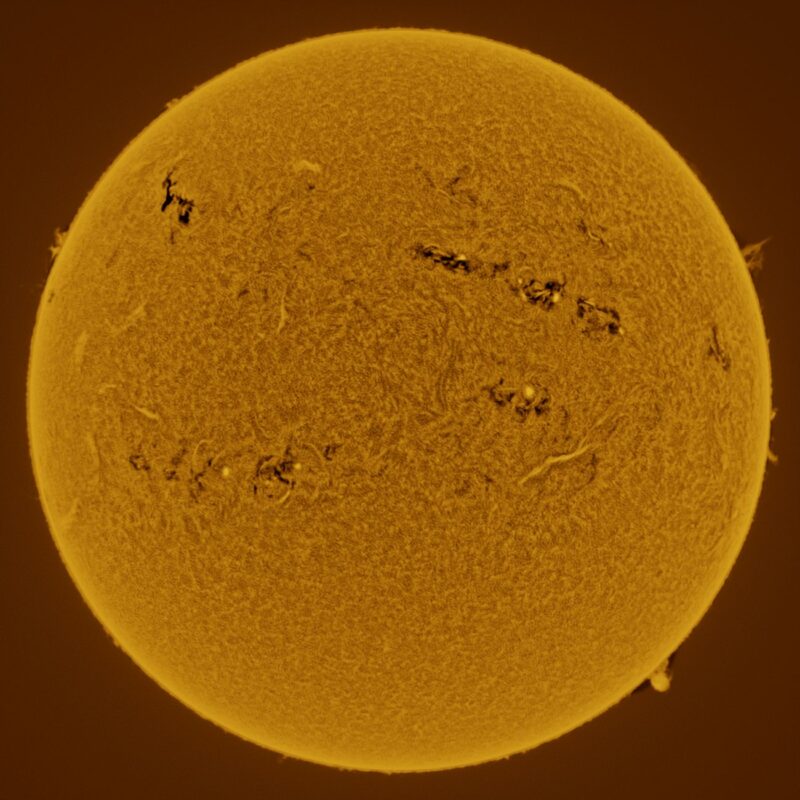
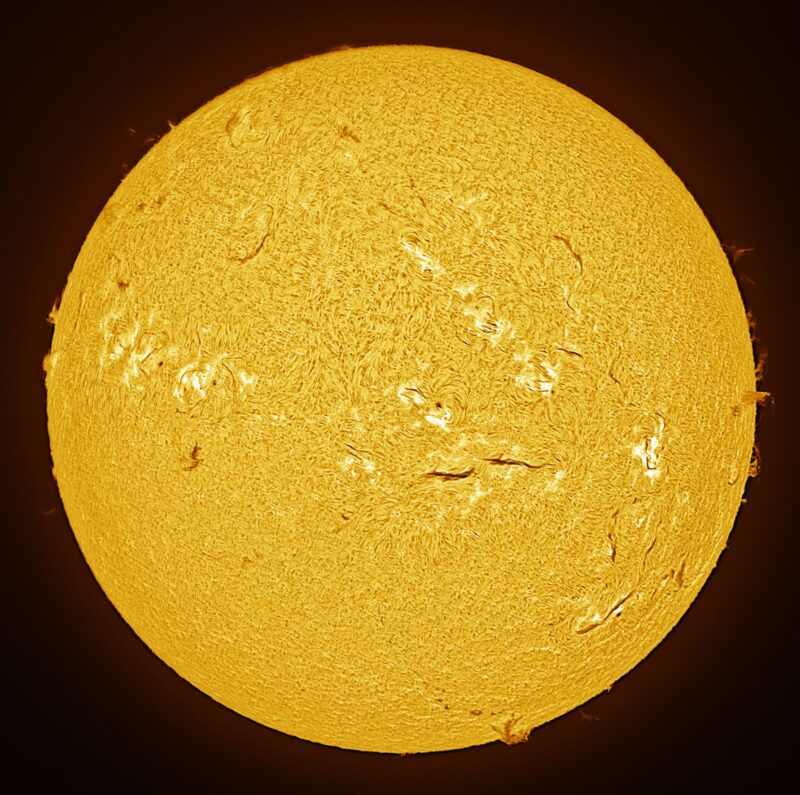
View at EarthSky Community Photos. | Mario Rana in Hampton, Virginia, captured this filtered image on March 15, 2025. Mario wrote: “Hydrogen-alpha image of the sun with some nice prominences and active regions.” Thank you, Mario! Sun news March 15: Watch an enormous prominence blast into space
(11 UTC to 11 UTC)
A gorgeous prominence erupted from the sun earlier today (6 UTC on March 15). Sun-stuff hurtled into space, but this far-side surge wasn’t Earth-directed. Meanwhile, activity occurred on the sun’s northwest limb (edge). This active region might soon rotate into view, bringing action to the Earth-facing side of our star. And there’s already been moderate action over the past day. Plus, a coronal hole high-speed stream (CH HSS) continues to enhance solar wind speeds. So, here on Earth, geomagnetic storm conditions, the conditions we need for auroras, have been holding steady.
Sun-Earth highlights in the past day
- Flare activity jumped to moderate levels with the production of an isolated M flare. The event was an M1.1 flare from active region AR4028 in the southeast at 22:21 UTC on March 14. The flare caused an R1 (minor) radio blackout affecting an area over the Pacific Ocean south of Hawaii. The sun produced 13 flares, the M plus 12 C class flares.
- There are 10 active regions on the Earth-facing solar disk. Sunspot region AR4019 lost its gamma magnetic configuration but kept its beta-delta; indicating that it is still capable of more M flares and even X flares. AR4021 lost its delta showing a simple beta magnetic configurations. AR4028 evolved into a beta-gamma region. The remaining sunspot regions have simpler alpha or beta magnetic structures.
- Blasts from the sun? No new Earth-directed coronal mass ejections (CMEs) have been observed.
- Solar wind: Solar wind speeds averaged slightly above 500 km/s peaking up to 580 km/s. It is at 550 km/s at the time of this writing. The interplanetary magnetic field has an average strength. The Bz (north-south orientation) magnetic field component was south-oriented late yesterday (a southward Bz can fuel auroral activity) then shifted northward. At time of this writing it is back to southward.
- Geomagnetic activity: G2 (moderate) geomagnetic storms occurred yesterday. Unsettled-to-active conditions persisted afterward Kp = 3 to 4. Did you see auroras last night, and did you take photos? Share your beautiful photos with us!

Sun news for March 14-15, 2025. This is called a “prominence.” It’s a great chunk of solar materials and magnetic fields. This one lifted into space earlier today (March 15, 2025). Whoosh! Image via NOAA. 
Solar activity is surging on the sun’s northeastern limb (edge), too. This active area on the sun could soon rotate into view. Image via NOAA. 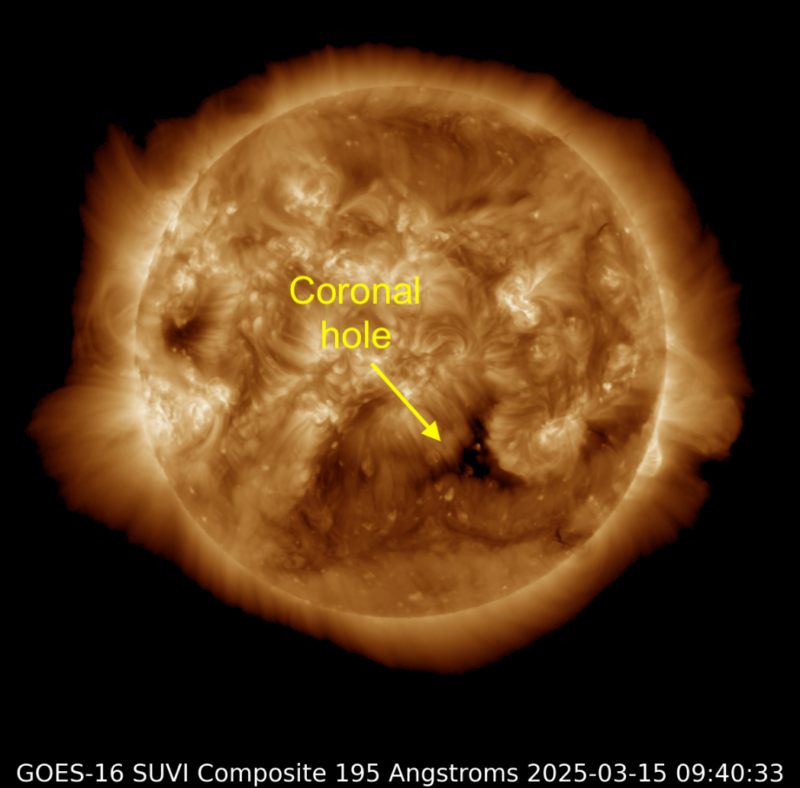
Another coronal hole is rotating into a geoeffective position. This will send high speed solar wind to Earth soon. Image via NOAA Sun news March 14: Yet more beautiful auroras possible!
(11 UTC to 11 UTC)
The anticipated geomagnetic storm arrived and reached a peak of a G2 (moderate) level. And it seems that, for most part of the day yesterday, Earth’s geomagnetic field was enhanced at at least G1 (minor) geomagnetic levels. Specialists expect these conditions to continue during the rest of the day today, extended through tomorrow, March 15. All this mean auroral displays are possible tonight and tomorrow. G1 or Kp5 conditions are expected but an isolated G2 (moderate or Kp6) might occur. Auroral displays might be possible at high latitudes, and as far south as northern states in the U.S., such as New York, Wisconsin and Washington. Read more below.
Sun-Earth highlights in the past day
- Flare activity continues at low levels, with only 16 C flares in the past day. There were no M- or X-class events. The largest event of the period was a C7.9 flare at 19:36 UTC on March 13 from active region AR4019 in the northwest quadrant.
- There are nine active regions on the Earth-facing sun. Sunspot region AR4019 developed a gamma magnetic configuration, while keeping its beta-delta; in other words, it now has the most complex magnetic configuration possible, a beta-gamma-delta. This means it’s capable of more M flares and even X flares. AR4021 retained its beta-delta magnetic configurations, but, in the past day, did not live up to its potential to produce strong flares. Meanwhile, AR4019 increased its flare production.The remaining sunspot regions have simpler alpha or beta magnetic structures. There is a newcomer on the solar disk: AR4028 in the southeast quadrant.
- Blasts from the sun? No new Earth-directed coronal mass ejections (CMEs) have been observed.
- Solar wind: Solar wind speeds averaged 550 km/s with peaks up to 570 km/s due to the arrival of a fast solar wind stream from a coronal hole. The interplanetary magnetic field showed an increase in strength. The Bz (north-south orientation) was primarily south-oriented for most part of the day (a southward Bz can fuel auroral activity).
- Geomagnetic activity: Geomagnetic conditions was active with G1 (minor, or Kp 5) geomagnetic storm levels during most part of the period with a peak at G2 (moderate) geomagnetic storm early on March 14 from 0-3 UTC. All that means that there were conditions for auroral displays in high latitudes. Did you have clear skies? Happened to witness auroras? Share your beautiful photos with us!</li>
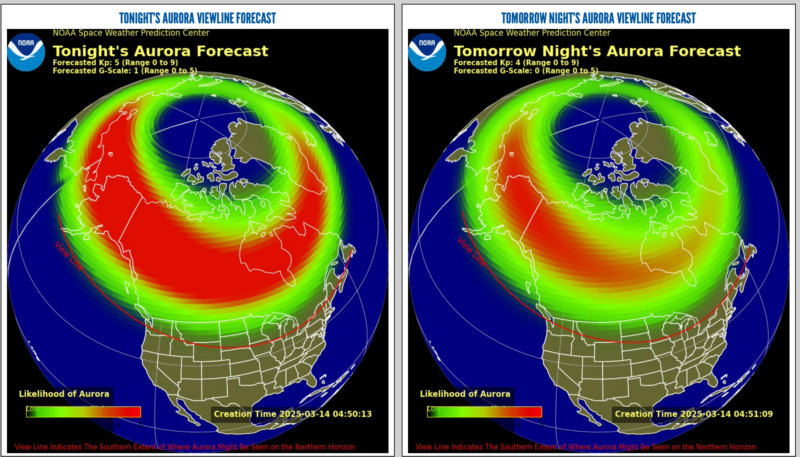
Sun news March 14, 2025. A stream of fast solar wind combined with a corotating interaction region (CIR provoked G1 (minor) and G2 (moderate) geomagnetic storms during the past 24 hours. These conditions might extend through tonight and tomorrow, bringing chances for auroral displays at high latitudes. Image via NOAA. 
March 13, 2025. Fiery activity is observed on the east solar horizon. This activity is from the sun’s far side, but soon will rotate into view. That means we might see more flare action in the coming days. GOES-14 SUVI 304 angstrom. Image via NOAA. Sun news March 13: Solar wind surge! Auroras on the way?
(11 UTC to 11 UTC)
Our star is constantly sending out a stream of charged particles we call the solar wind. But sometimes this stream is more intense than usual. Over the past day, a clump of solar wind (called a corotating interaction region) has been driven toward Earth by another stream of high-speed solar wind, which was released through a coronal hole, or a less dense patch in the sun’s outer atmosphere. This increase in the solar wind – combined with a persistently southward-oriented interplanetary magnetic field – has triggered G1 (minor) geomagnetic storm conditions. And there’s a chance for G2 (moderate) storms through tomorrow. Expect heightened auroral activity, especially at high latitudes!
Sun-Earth highlights in the past day
- Flare activity has dropped to low with only C flares produced in the past day, but flare productivity increased notably. The largest event of the period was a C6.0 flare at 12:17 UTC on March 12 from an as-yet-unnumbered active region that emerged in the southeast. This newcomer was the main flare producer of the period with 18 C flares.
- Total flares: Total flare production increased to 24 C flares, with no M- or X-class events.
- There are nine active regions on the Earth-facing sun. Sunspot regions AR4019 and AR4021 retained their beta-delta magnetic configurations but provided low flare production. The remaining sunspot regions have simpler alpha or beta magnetic structures. There are three newcomers on the solar disk: AR4025 in the northeast quadrant, AR4026 in the southeast and AR4027 in the northwest.
- Blasts from the sun? No new Earth-directed coronal mass ejections (CMEs) have been observed.
- Solar wind: Solar wind speeds surged toward 550 km/s due to the arrival of a fast solar wind stream from a coronal hole. The interplanetary magnetic field showed an increase in strength. The Bz (north-south orientation) was primarily south-oriented for most of the past day (a southward Bz can fuel auroral activity).
- Geomagnetic activity: Geomagnetic conditions reached G1 (minor, or Kp 5) geomagnetic storm levels from 15-18 UTC and 21-24 UTC yesterday.
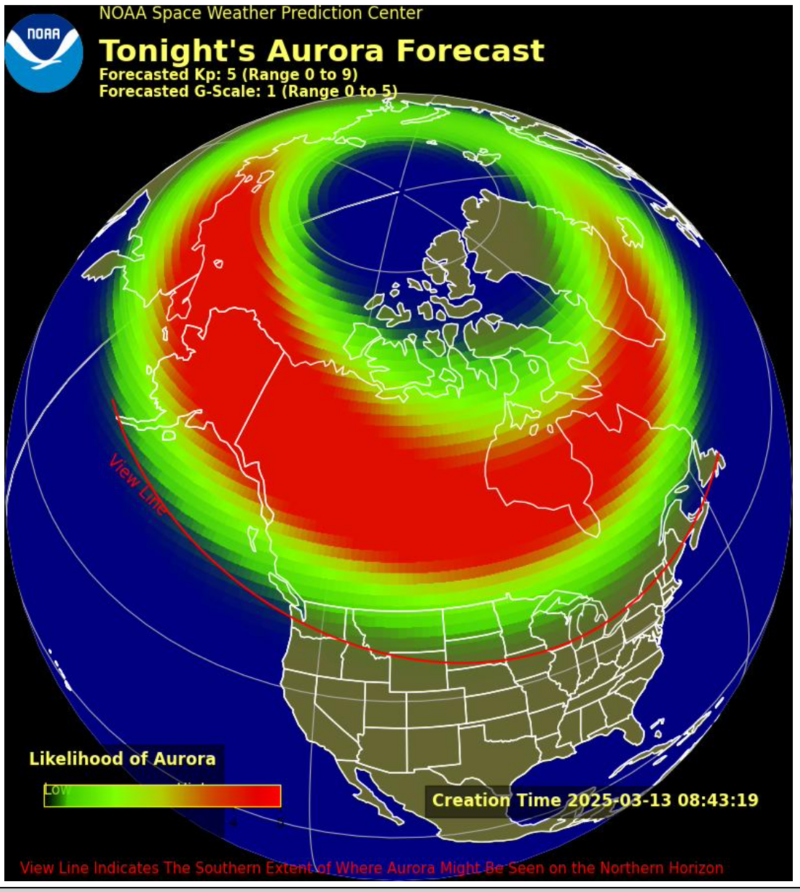
Sun news for March 13, 2025. Fast solar wind from a coronal hole has driven a clump of compressed solar wind into Earth. This has caused G1 (minor) geomagnetic activity over the last 24 hours, with the possibility of more to come. Image via NOAA. 
The Kp index for the last 24 hours shows the extended period of minor geomagnetic activity. At the time of writing, activity remains at the G1 (minor) level. Sun news March 12. Coming soon! New views of the solar wind
(11 UTC to 11 UTC)
Up and away! NASA’s PUNCH (Polarimeter to UNify the Corona and Heliosphere) mission successfully launched from California’s Vandenberg Space Force Base last night. PUNCH will soon offer unprecedented imagery and insights into the solar corona (the sun’s outer atmosphere) and the solar wind (the stream of charged particles constantly flowing from our star). These particles can disturb Earth’s magnetic field, often triggering auroras, so PUNCH should significantly improve our ability to forecast and understand space weather events. Events, for instance, like those expected in the coming days! Starting tomorrow, Earth will encounter a stream of high-speed solar wind from a coronal hole. Active conditions, including G1 (minor) geomagnetic storms, are likely, with a chance of G2 (moderate) storms through March 14.
Sun-Earth highlights in the past day
- Flare activity jumped to moderate levels due to an isolated M1.1 flare. The blast occurred at 13:04 UTC on March 12 from a newcomer active region that emerged in the northwest, AR4024. The event caused an R1 (minor) radio blackout affecting an area over the Atlantic Ocean near the equator.
- Total flares: The sun produced a total of 18 flares over the past 24 hours: one M and 17 C flares.
- There are eight active regions on Earth-facing side of the sun. Sunspot region AR4019 retained its beta-delta magnetic configuration, as did AR4021. The remaining sunspot regions have simpler alpha or beta magnetic structures. There are three newcomers on the solar disk: AR4022 and AR4023 in the northeast quadrant and AR4024 in the northwest quadrant.
- Blasts from the sun? No new Earth-directed coronal mass ejections (CMEs) have been observed.
- Solar wind: The fast solar wind stream from a coronal hole is waning. Wind speeds averaged over 450 km/s with peaks of nearly 530 km/s yesterday, before gradually easing back to around 450 km/s. The interplanetary magnetic field reached moderate levels in strength. The Bz (north-south orientation) was oriented northward, then turned down southward early today (a southward Bz can fuel auroral activity).
- Geomagnetic activity: Geomagnetic activity showed an increase to unsettled levels (Kp = 3) earlier today and remained at that level through most of the period.

March 11, 2025. Sun activity increased to a moderate level due to an isolated M1.1 flare blasted out by newcomer active region AR4024 in the northwest quadrant. The event occurred at 13:04 UTC on March 11 and provoked an R1 (minor) radio blackout over the Atlantic Ocean. AIA 131 angstrom. Image via SDO. 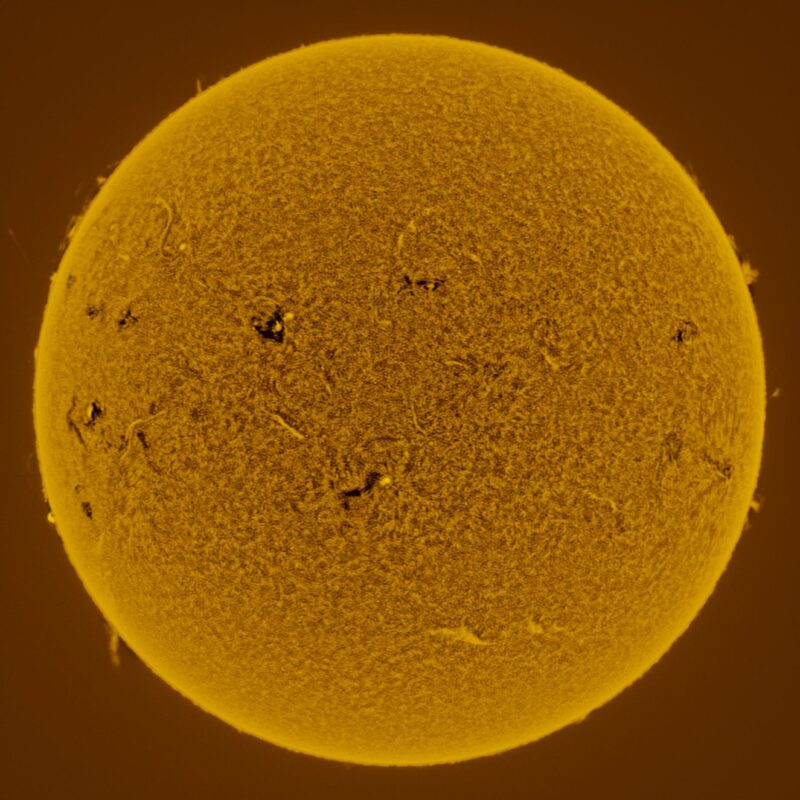
View at EarthSky Community Photos. | Mario Rana in Hampton, Virginia, captured this filtered image on March 11, 2025. Mario wrote: “Hydrogen-alpha image of the sun with a number of active regions and some nice prominences.” Thank you, Mario! Sun news March 11. We’re excited. More epic auroras coming soon?
(11 UTC to 11 UTC)
Earth’s geomagnetic field has settled down after a bout of high-speed solar wind stream from a coronal hole sparked beautiful auroral displays over the weekend. The large coronal hole responsible for this activity has now rotated out of its geoeffective (Earth-affecting) position. But a new coronal hole is now forming in the sun’s southeast quadrant, and it’s expected to move into an Earth-facing position soon. Will this bring another round of auroral action? Stay tuned!
Sun-Earth highlights in the past day
- Flare activity continued at low levels. Only C flares were produced over the past day, with the largest event being a C2.7 flare fired at 5:52 UTC on March 11 from active region AR4021.
- Total flares: The sun produced 5 C flares over the past 24 hours.
- There are five active regions on the Earth-facing side of our star. Active region AR4019 is showing promise with a beta-delta magnetic configuration. The remaining sunspot regions have simpler alpha or beta magnetic structures. There’s a newcomer in the southeast quadrant numbered AR4021.
- Blasts from the sun? No new Earth-directed coronal mass ejections (CMEs) have been observed.
- Solar wind: The fast solar wind stream from a coronal hole is waning. Wind speeds averaged over 500 km/s with peaks of nearly 540 km/s yesterday, before gradually easing back to around 480 km/s. The interplanetary magnetic field remains low in strength. The Bz (north-south orientation) was southward most of the period, with a northward peak at 8 UTC today before falling back to southward at the time of this writing (a southward Bz can fuel auroral activity).
- Geomagnetic activity: Geomagnetic activity dropped to unsettled (Kp = 3) then quiet (Kp = 2) levels earlier today.

Sun news for March 10-11. Geomagnetic activity has calmed, since the solar wind stream from a large coronal hole is subsiding. But another coronal hole is moving into a geoeffective position. This means more high-speed solar wind streams could be heading our way, bringing more geomagnetic activity and auroras. Image via SDO. 
A calm sun observed in the 171 angstroms wavelength by the SDO spacecraft. Images via SDO. 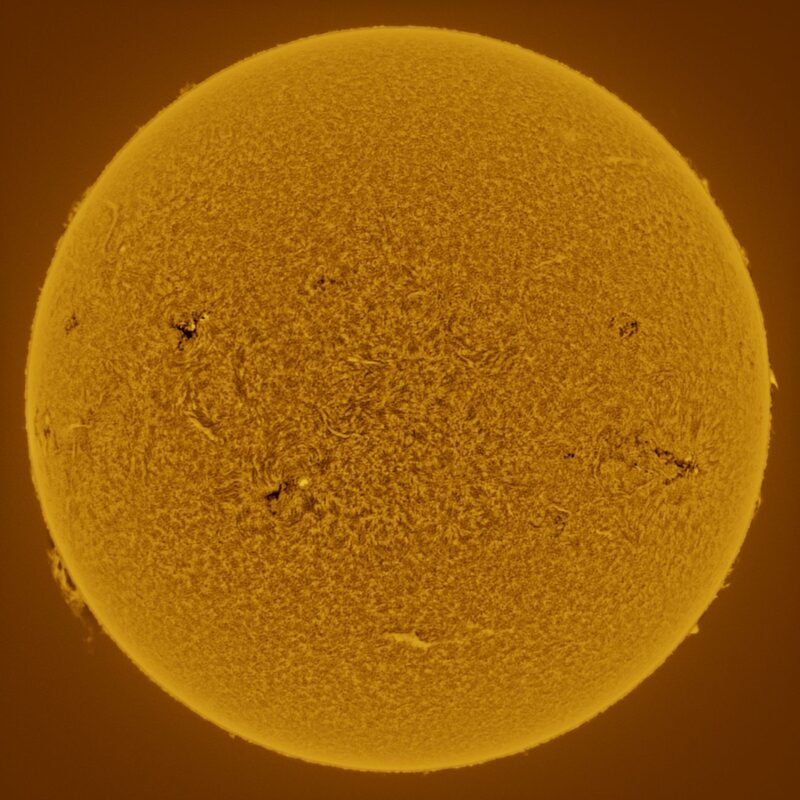
View at EarthSky Community Photos. | Mario Rana in Hampton, Virginia, captured this filtered image on March 10, 2025. Mario wrote: “Hydrogen-alpha image of the sun. The beautiful prominence on the southeast limb is still hanging in there.” Thank you, Mario! Sun news March 10. Auroras yesterday, more on the way
(11 UTC to 11 UTC)
A stream of high-speed solar wind from a coronal hole on our star has been fueling geomagnetic storming over the weekend. Storming peaked at G2 (moderate) levels on March 9, bringing auroras to high latitudes, before gradually settling. Solar winds are expected to gradually weaken now … until another enhancement arrives around March 12-13, which could bring another round of G1 (minor) to G2 (moderate) geomagnetic storms. Stay tuned for potential aurora alerts!
Sun-Earth highlights in the past day
- Flare activity has dropped to low levels with only C flares. The largest event was a C2.6 flare at 18:54 UTC on March 9 from a region still beyond the southeast limb (edge).
- Total flares: The sun produced 5 C flares over the past 24 hours.
- There are four active regions on the Earth-facing solar disk, most of which have shown gradual fading, including a once-prominent region in the southwest. However, some emerging activity has been observed in the northeast, where AR4019 might be kicking into gear. The region developed a beta-gamma-delta region overnight. AR4012 kept its beta-gamma configuration. The remaining active regions have simpler alpha or beta magnetic structures.
- Blasts from the sun? No new Earth-directed coronal mass ejections (CMEs) have been observed.
- Solar wind: The fast solar wind stream from a coronal hole remains in play. Wind speeds increased from ~500 km/s to a peak of nearly 700 km/s yesterday, before gradually easing back to around 600 km/s. The interplanetary magnetic field was initially moderate to strong, but weakened after 10:00 UTC yesterday. The Bz (north/south component) (north-south orientation) was moderately southward early on, fueling geomagnetic activity, before becoming weaker and more variable after 12:00 UTC.
- Geomagnetic activity: The storm reached G2 (moderate) geomagnetic levels between 3:00 and 6:00 UTC on March 9, before gradually settling to active (Kp 4) and unsettled (Kp 3) levels later in the day. Auroras were observed at high latitudes during the storm peak.

Sun news for March 9-10, 2025. An aurora ovation model forecast by the MetOffice UK for March 10-13. Minor to moderate activity could come to Earth on March 13. Image via MetOffice UK. 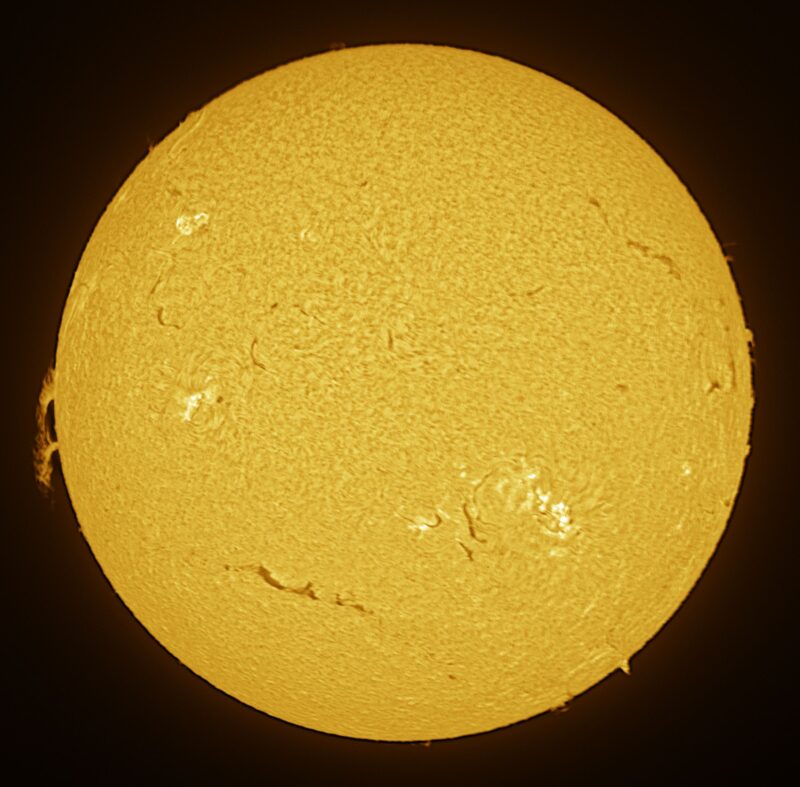
View at EarthSky Community Photos. | Jim Militello in Tucson, Arizona, captured this filtered image of the sun on March 9, 2025. Jim wrote: “Hydrogen-alpha image of the sun showing active regions, filaments, and some nice prominences.” Thank you, Jim! Sun news March 9. Auroras, fueled by solar wind, happening now!
(11 UTC to 11 UTC)
At the time of this writing (11 UTC on March 9), we have G2 (moderate) storm conditions! This means vibrant auroras are dancing across the skies at higher latitudes from Alaska to New Hampshire. If you’re in the right place, look up! The show is on.
Sun-Earth highlights in the past day
- Flare activity dropped to low levels with only C flares. The largest event was a C4 flare at 18:25 UTC on March 8 from a region still beyond the east limb.
- Total flares: The sun produced 11 C flares over the past 24 hours.
- There are six active regions on the Earth-facing solar disk. AR4012 kept its beta-gamma configurations while AR4016 relaxed to a simpler beta region. The remaining active regions have simpler alpha or beta magnetic structures. There is a newcomer today in the northeast quadrant near the limb (edge), AR4020.
- Blasts from the sun? No new Earth-directed coronal mass ejections (CMEs) have been observed.
- Solar wind: Solar wind speeds increased from 400 km/s to peaks of close to 700 km/s due to the arrival of a corotating interaction region (CIR) ahead of a CH HSS. The interplanetary magnetic field (IMF) peaked at 19 nT at 16:06 UTC on March 8. The Bz (north/south component) (north-south orientation) fluctuated between north and south, remaining moderately southward after 15:20 UTC (a key factor in creating auroras), enhancing geomagnetic activity.
- Geomagnetic activity: Our geomagnetic field was quiet to unsettled initially. Four periods of G1 (minor) geomagnetic storm conditions were observed between 20:59 UTC on March 8 and 5:58 UTC on March 9. The field then reached G2 (moderate) storm conditions at 5:59 UTC on March 9 then dropping back to G1 (minor) storming at 9:31 UTC and back up to G2 (moderate) levels at 10:45 UTC where it remains. Te solar wind environment kicked into high gear as a corotating interaction region (CIR) stirred up space weather ahead of an coronal hole high-speed stream (CH HSS). This charged-up solar wind surge sent geomagnetic activity climbing.
Just had a massive substorm one of the best of the season here in Alaska. Our workshop drove two hours to clear skies, and we were rewarded. Seriously one of the best displays I have seen all year. Wow wow wow!
— Vincent Ledvina (@vincentledvina.bsky.social) March 9, 2025 at 5:03 AM
HOLY SMOKES!! What a colourful Aurora show we saw tonight!! G1 solarstorm! Taken at Haunted Lakes, Alberta.#TeamTanner #Aurora @treetanner @TamithaSkov @weathernetwork @spann @chunder10 @scottrockphoto pic.twitter.com/CY8wbHAtYK
— Dar Tanner (@dartanner) March 9, 2025
Aurora spotted looking over Lake Ontario in Wilson NY at 9:00 pm est #Aurora #NYwx pic.twitter.com/MuC81PmAQn
— Will McWeather (@Billy_Ch4os) March 9, 2025
The pillar of fire Crossfield Alberta 20250309T1113Z. This is a 4 minute timelapse! pic.twitter.com/sztjwSZQ0R
— Harlan Thomas (@theauroraguy) March 9, 2025
Amazing northern lights substorms tonight. pic.twitter.com/bqlFXEWZIH
— Zander (@lund_zander) March 9, 2025
Sun news March 8. Sun activity is on the rise again
(11 UTC to 11 UTC)
Today’s top story: The sun is stirring! An M1.6 solar flare erupted from AR4016 on March 7. A new sunspot, AR4019, has emerged, as the biggest sunspot, AR4012, is slowly fading. We also saw two solar eruptions that launched coronal mass ejections (CMEs) into space! One was headed too far south to strike Earth, and the second is still being analyzed. Meanwhile, Earth’s magnetic field is in for some action. A fast solar wind stream has the potential to bring geomagnetic storms (G1-level) on March 9-10, possibly lighting up the skies with auroras! Stay tuned!
Sun-Earth highlights in the past day
- Flare activity increased to moderate levels thanks to an isolated M flare. The largest event was an M1.6 flare at 21 UTC on March 7 from AR4016. The flare produced an R1 (minor) radio blackout that affected an area over the Pacific Ocean west of Galapagos.
- Total flares: The sun produced 13 flares over the past 24 hours, an M plus 12 C flares.
- There are six active regions on the Earth-facing solar disk. AR4012 and AR4016 keep their moderate beta-gamma configurations while the remaining active regions have simpler alpha or beta magnetic structures. There is a newcomer today in the northeast quadrant near the limb (edge), AR4019.
- Blasts from the sun? A filament eruption at 18:30 UTC on March 7 hurled a chunk of solar stuff into space. Modeling and analysis ongoing to determine if any component of this coronal mass ejections (CMEs) is Earth oriented.
- Solar wind: Solar wind speeds ranged from 360-425 km/s, remaining mildly enhanced. The interplanetary magnetic field (IMF) remained weak with the Bz (north/south component) showing no prolonged southward orientation (a key factor in creating auroras). It is north oriented at the time of this writing.
- Geomagnetic activity: Our geomagnetic field was unsettled to active. The active (Kp = 4) threshold was reached at 9:01 UTC.
What’s ahead? Sun-Earth forecast
- Low-to-moderate flare activity is expected over the next 24 hours, with a chance of isolated M-class (moderate) flares. The chance for M flares is 40%. The chance for X flares is 5%.
- Blasts from the sun? No significant Earth-directed CMEs are currently in the forecast.
- Geomagnetic activity forecast: Quiet-to-unsettled conditions are anticipated to continue early March 8. But activity might pick up, reaching active levels late March 8 – early March 9 as a corotating interaction region (CIR) caused by high-speed solar wind stream (HSS) from a coronal hole slamming into slower solar wind, reaches Earth. Periods of active conditions and G1 (minor) geomagnetic storm levels are likely early March 9 extended thru March 10 as fast solar wind persists.

Sun news for March 7-8, 2025. Here’s an M1.6 flare that happened at 21 UTC on March 7. It came from sunspot region AR4016. Images via SDO. 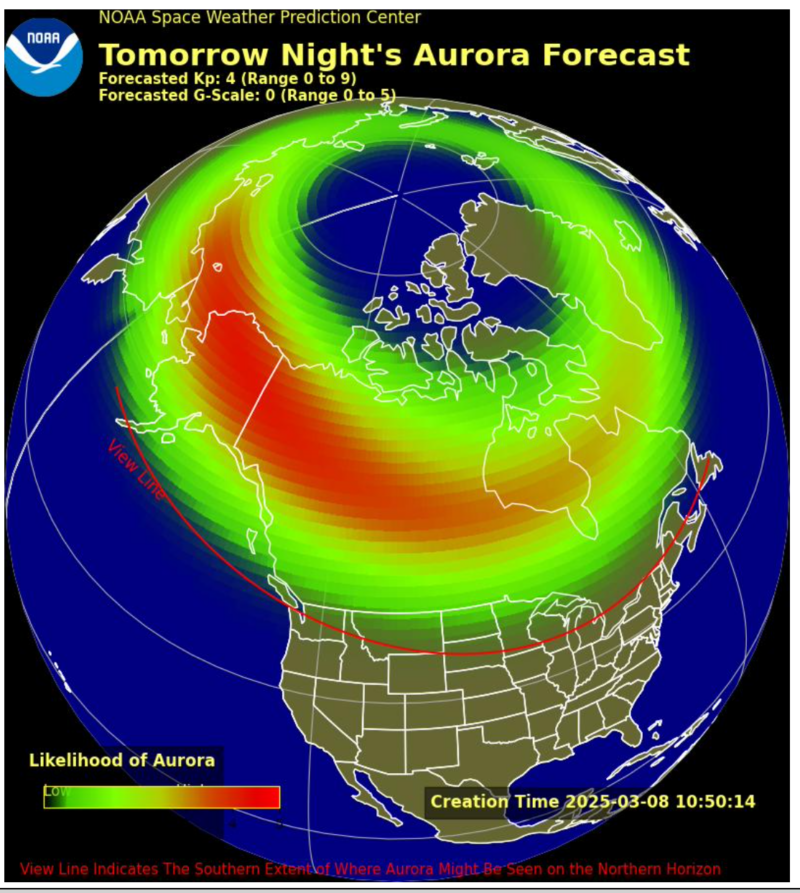
This is the NOAA prediction for today’s auroral oval and aurora location. This is computed using the ovation model. Images via NOAA 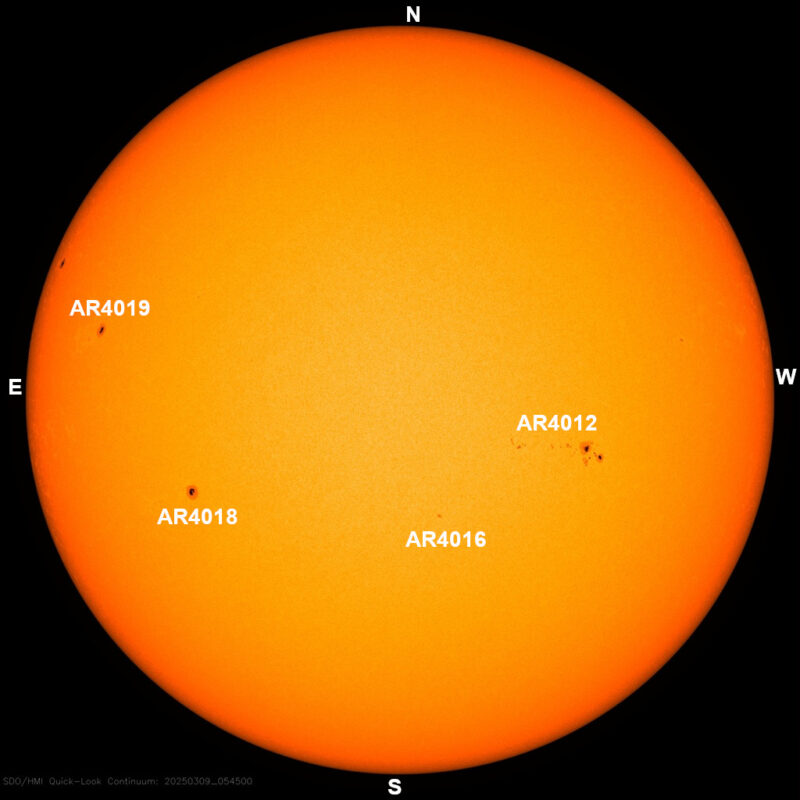
This image shows sun activity – with the most active regions labeled – as of 5 UTC on March 9, 2025. Original image, without labels, via NASA SDO. Courtesy of NASA/SDO and the AIA, EVE, and HMI science teams, with labeling by EarthSky. Today’s sun is posted by Armando Caussade. Why are east and west on the sun reversed? Sun news March 7. A large coronal hole spraying solar wind toward Earth
(11 UTC to 11 UTC)
A high-speed solar wind stream from a massive coronal hole is on the way to Earth, and it’s bringing some excitement with it! On March 8, something called a corotating interaction region (CIR) is expected to hit, stirring up Earth’s magnetic field and increasing geomagnetic activity. What’s a CIR? Imagine a high-speed solar wind stream slamming into slower-moving solar wind. This collision compresses and intensifies the solar wind’s plasma, creating a structure that behaves almost like a coronal mass ejection (CME). When it reaches Earth, it could spark a geomagnetic storm and ignite dazzling auroras in high-latitude skies. Stay tuned!
Sun-Earth highlights in the past day
- Flare activity dropped to low with only C flares. The largest event was a C1.7 at 00:13 UTC on March 7.
- Total flares: Six C flares over the past 24 hours.
- Seven active regions are currently on the Earth-facing solar disk. AR4012 and AR4016 show a moderate beta-gamma configurations. The remaining active regions have simpler alpha or beta magnetic structures.
- Blasts from the sun? No new coronal mass ejections (CMEs) were observed in available coronagraph imagery.
- Solar wind: Solar wind speeds ranged from 435-525 km/s, remaining mildly enhanced. The interplanetary magnetic field (IMF) remained weak with the Bz (north/south component) fluctuating between north and south, without any prolonged southward direction (a key factor in creating auroras).
- Geomagnetic activity: Our geomagnetic field was quiet (Kp = 1) to unsettled (Kp = 3), with no significant disturbances detected.

Sun news for March 6-7, 2025. A large coronal hole is facing Earth such that the coronal hole’s high-speed solar wind stream (HSS) is buffeting Earth. This means the coronal hole is in a geoeffective position. This could disturb the Earth’s magnetic field (geomagnetic) in the next 2 days. Image via SDO. 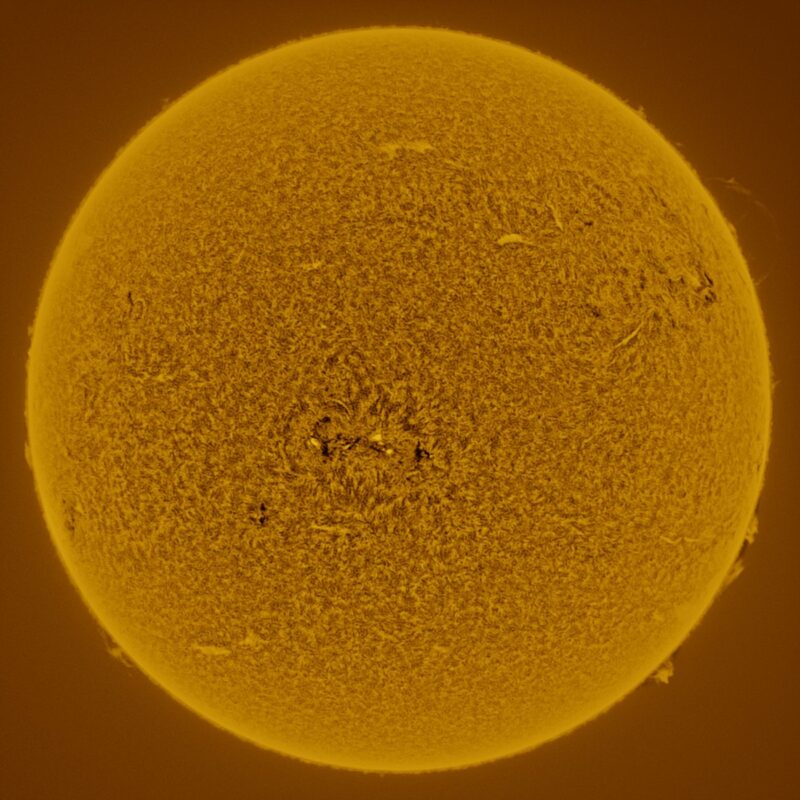
View at EarthSky Community Photos. | Mario Rana in Hampton, Virginia, captured this filtered image on March 6, 2025. Mario wrote: “Hydrogen-alpha image of the sun featuring active region AR4012 and a delicate prominence on the northwest limb.” Thank you, Mario! Sun news March 6. Big solar blast and a beautiful prominence
(11 UTC to 11 UTC)
After several days of low flaring, an M1.8 flare has pushed solar activity up to moderate levels. This flare, produced by sunspot region AR4016, peaked at 11:50 UTC on March 5, triggering an R1 (minor) radio blackout over an area north of Madagascar. AR4016 has developed rapidly, gaining a promising beta-gamma configuration, while AR4012 also continues to grow. These two regions are now the ones to watch for potential flare activity. Meanwhile, a stunning prominence was observed on the west limb, likely produced by active regions that recently rotated out of view. Plus, take a look below to see Saturn enter the field of view of the SOHO spacecraft’s LASCO C3 instrument.
Sun-Earth highlights in the past day
- Flare activity jumped up to moderate after an isolated M flare. The M1.8 flare was fired at 11:50 UTC on March 5 from sunspot region AR4016 in the southeast. It triggered an R1 (minor) radio blackout over an area north of Madagascar.
- Total flares: Eight flares – one M and seven C-class flares – were fired over the past 24 hours.
- Eight active regions are currently on the Earth-facing solar disk. AR4012 and AR4016 show a moderate beta-gamma configuration. The remaining active regions have simpler alpha or beta magnetic structures.
- Blasts from the sun? No new coronal mass ejections (CMEs) were observed in available coronagraph imagery.
- Solar wind: Solar wind speeds remained above 400 km/s (894,775 mph), peaking at 450 km/s (1,07,000 mph) before decreasing to 387 km/s (865,694 mph). The interplanetary magnetic field (a critical factor in creating auroras) had a Bz (north/south component) that was mostly northward, with brief southward deflections (a south Bz contributes to auroras). However, it has now turned northward.
- Geomagnetic activity: Our geomagnetic field remained quiet, with the Kp index between at Kp = 2 and 3 over the past 24 hours. At the moment of this writing, Kp = 2.

Sun news for March 5-6, 2025. An isolated M1.8 flare has pushed solar activity up to moderate. This flare, produced by sunspot region AR4016, peaked at 11:50 UTC on March 5, triggering an R1 (minor) radio blackout over an area north of Madagascar. Image via SDO. 
A stunning prominence was observed on the west limb, likely from active regions that recently rotated out of view. Image via NOAA. 
Saturn came into the field of view of SOHO’s LASCO C3. Image via SOHO. Sun news March 5. A solar blast reached Earth last night
(11 UTC to 11 UTC)
A great burp of sun-stuff (a coronal mass ejection or CME) hit Earth’s magnetic field last night, as anticipated. Geomagnetic disturbance jumped to the Kp = 4 threshold at 21:36 UTC on March 4, and the CME’s influence may extend through the rest of today. Though a geomagnetic storm wasn’t registered last night, forecasters still expect a G1 (minor) or even a G2 (moderate) storm later today, meaning the potential for auroral displays at high latitudes. Did you see any auroras last night? Share your photos with us.
Sun-Earth highlights in the past day
Sun news March 2. Flare and filament action in the southeast
(11 UTC to 11 UTC)
Today’s top story: Overall activity remains low, with a declining trend in C-class flares. The strongest was a C9.6 flare on March 1 from the southeastern limb, possibly tied to a returning active region. A significant filament eruption in the southeastern quadrant produced a coronal mass ejection (CME). Preliminary analysis suggests this CME may deliver a glancing blow to Earth around the end of March 4, pending further observations. Stay tuned to see if the new regions bring more activity.
Sun-Earth highlights in the past day
- Flare activity remained low over the past 24 hours, but, once again, only barely. The largest event was a C9.6 flare, at 23:01 UTC on March 1 from an area in the southeast, unnumbered at the time, possibly from AR4011 or AR4012.
- Total flares: 9 C-class flares over the past 24 hours.
- There are ten active regions on the solar disk as seen from Earth with two new minor regions in the east and a third developing in the northeast, AR4011-13. Most regions remain magnetically simple. NOTE: AR4011-13 emerged after our current sunspot image.
- Blasts from the sun? A filament eruption in the southeastern quadrant at 17:30 UTC on March 1 launched a coronal mass ejection (CME). A CME was observed in LASCO imagery and is being analyzed for a potential Earth-directed component. Preliminary results suggest a glancing blow to Earth’s magnetic field around 21:00 UTC on March 4.
- Solar wind. Solar winds remain strong but are gradually weakening as the coronal hole high-speed stream (CH HSS) wanes. Solar wind speeds declined from ~700 km/s to ~600 km/s over the past 24 hours. The interplanetary magnetic field (a critical factor in creating auroras) continued to decrease and the Bz (north/south) component remained south-directed.
- Geomagnetic activity: Reached active levels (Kp = 4) due to sustained CH HSS influences with a southward IMF.
What’s ahead? Sun-Earth forecast
- Low-to-moderate flare activity is expected for the next 24 hours with a chance for isolated M-class (moderate) flares. The chance for M flares is 25%. The chance for X flares is 1% today. Activity may increase slightly as new sunspot regions rotate into view over the eastern solar horizon.
- Blasts from the sun? Chance of a glancing coronal mass ejection (CME) impact late Tuesday (March 4).
- Geomagnetic activity forecast On March 2-3, unsettled to active geomagnetic conditions are expected. A G1 (minor) geomagnetic storm is possible on March 4 due to a glancing CME.

This image shows sun activity – with the most active regions labeled – as of 0 UTC on March 3, 2025. Original image, without labels, via NASA SDO. Courtesy of NASA/SDO and the AIA, EVE, and HMI science teams, with labeling by EarthSky. Today’s sun is posted by Armando Caussade. Why are east and west on the sun reversed? Sun news March 1. More stunning aurora photos as solar wind calms
(11 UTC to 11 UTC)
Solar wind speeds surged to nearly 800 km/s (1.8 million miles per hour) over the past day. And so strong geomagnetic storms have continued! We saw G1 (minor) storming, with a chance for G1-G2 (minor-moderate) storming later today (March 1) if a glancing coronal mass ejection (CME) impact from February 25 reaches Earth. Stay tuned and get your cameras ready for more auroral shows.
Sun-Earth highlights in the past day
- Flare activity remained low over the past 24 hours, but, once again, only barely. The largest event was a C6.4 flare, at 8:30 UTC on March 1 from AR4010 in the northeast.
- Total flares: 14 C-class flares over the past 24 hours.
- There are seven active regions on the solar disk as seen from Earth.
- Blasts from the sun? A filament eruption in the northeast occurred on February 28, but any associated coronal mass ejection (CME) was obscured by a strong event from just beyond the western limb. Further analysis is needed to determine if any ejecta is Earth-directed.
- Solar wind. Solar wind speeds surged to nearly 800 km/s before settling to ~700 km/s due to continued coronal hole high-speed stream (CH HSS) influence. interplanetary magnetic field (a critical factor in creating auroras) strengthened slightly then calmed. The Bz (north/south) component fluctuated between being north and south-directed, but no prolonged southward periods were observed.
- Geomagnetic activity: G1 (minor) (Kp = 5) geomagnetic storms were observed in the past day. This was due to high-speed solar wind with a southward IMF.
What’s ahead? Sun-Earth forecast
- Low-to-moderate flare activity is expected for the next 24 hours with a chance for isolated M-class (moderate) flares. The chance for M flares is 25%. The chance for X flares is 5% today.
- Blasts from the sun? A possible weak glancing coronal mass ejection (CME) impact from February 25 may occur today (March 1), contributing to geomagnetic disturbances. Additional CME activity is being monitored from a filament eruption on February 28.
- Geomagnetic activity forecast Unsettled to active (Kp = 3-4) on March 1, with a chance of G1-G2 (minor-moderate) storming (Kp = 5-6) if a CME impact occurs. On March 2-3, quiet to unsettled conditions (Kp = 1-3) are expected as coronal hole high-speed stream (CH HSS) influence begins to wane.

Sun news for March 1, 2025. Another amazing aurora photo, captured by sun post co-author Raúl Cortés. He and his family have been driving around northern Norway, and even up into Lapland. He caught this aurora outside a restaurant in northern Norway. Bright and beautiful, despite light pollution! “The best we saw was in Skiboltn just in front of Lyngen Fjord,” he wrote. Image via Raúl Cortés. 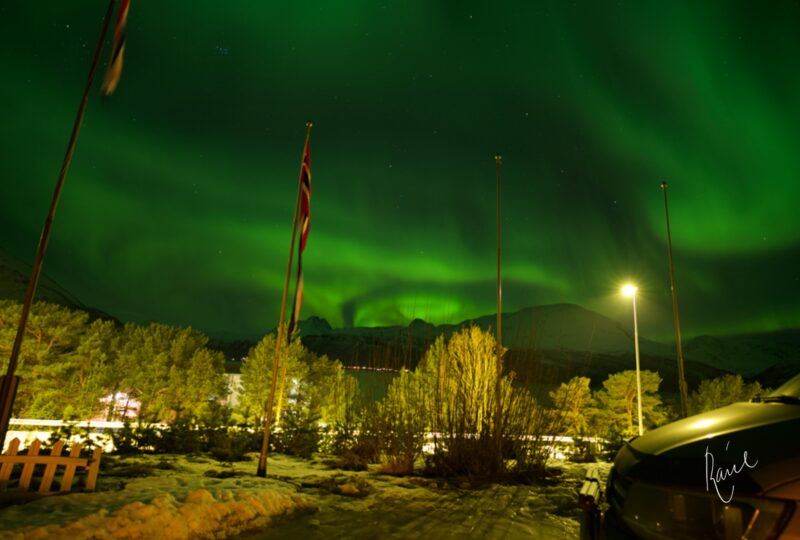
“There was a moment when the whole skyk turned green.” Image via Raúl Cortés. Thank you, Raúl! 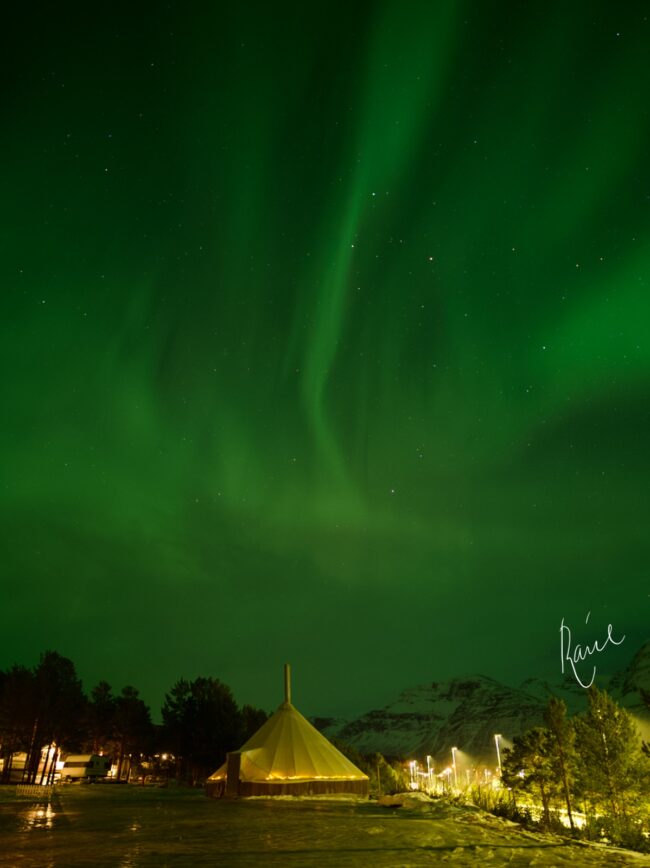
“Auroras dancing above a Sami tent (savvu).” Image via Raúl Cortés. Thank you, Raúl!
Like what you read?
Subscribe and receive daily news delivered to your inbox.
More from
C. Alex Young


Sun news: See a huge solar eruption

Yes, there’s an aurora season, and it’s here
Sun activity archive for September 2026
Sun activity archive for August 2026