Sun news August 31: M flares erupt, sun stuff on the way
(11:00 UTC Aug 30 – 11:00 UTC Aug 31)

After a steady drumbeat of C flares the day before, the sun ramped up with three M-class solar flares during the last 24 hours. The strongest was a long-duration M2.8 at 20:02 UTC on August 30 from AR4204 (north-central disk). It launched a full-halo coronal mass ejection (CME) now under analysis. Early signs suggest it is likely Earth-directed, with an expected arrival window of September 1–2. Complex region AR4197 (now beta–gamma–delta) produced the other two M flares and remains the most flare-productive area. Newcomer AR4207 has rotated onto the northeast limb and may evolve as it moves further into view.
- Flare activity: Activity increased to moderate, with:
- M2.8 — AR4204 (N04E12) — peaked 20:02 UTC on August 30, long-duration and CME-associated.
- M1.3 — AR4197 (S19W08) — peaked 14:09 UTC on August 30.
- M1.2 — AR4197 (S18W06) — peaked 15:59 UTC on August 30.
- Several C flares (strongest C7.2 from AR4196 at 22:23 UTC on August 30).
- Sunspot regions: Eleven numbered regions on the Earth-facing disk.
- AR4197 (S18W10): beta–gamma–delta; multiple M flares and continued complexity.
- AR4204 (N04E12): Likely beta; source of the long-duration M2.8 and associated CME.
- AR4207 (N30E69): New on the northeast limb (alpha for now); reclassification likely as it rotates in.
- AR4191 (N10W55): beta; largely stable.
- Blasts from the Sun? An asymmetric full-halo CME was detected around 20:30 UTC on Aug 30, most likely tied to the M2.8 event. Initial analysis indicates this CME is probably Earth-directed; modeling is in progress.
- Solar wind: Nominal background conditions with speeds ~350–425 km/s (780,000-950,000 mph). Total field (Bt) peaked near 10 nT (nominal); the interplanetary magnetic field (IMF) north–south component (Bz) ranged between about +8 and -6 nT (nominal).
- Earth’s magnetic field: Quiet over the past day (Kp 1–2 ).
What’s ahead? Sun–Earth forecast
- Flare activity forecast: Expect mostly low-to-moderate levels with M-class flares likely and a slight chance of an X-class event through September 2.
- Geomagnetic activity forecast:
- Aug 31–Sep 1: Mostly quiet to unsettled due to a coronal hole high-speed stream (CH HSS).
- Sep 1–2: Potential CME arrival could bring periods of geomagnetic storming (details to be refined once modeling is complete).
- Sep 3: Likely trend back toward quieter conditions after CME passage.
- Radiation forecast: High-energy protons remain slightly elevated but below the S1 threshold; gradual decline expected. Short-lived enhancements remain possible with additional M or X flares.
Sun news August 30: The sun’s flare machine keeps firing
(11 UTC to 11 UTC)
The sun kept up a steady pace of flare activity over the past 24 hours, although without any new M flares. A total of 22 C-class flares lit up the Earth-facing disk, with the strongest reaching C5.9 from AR4197. This region has grown into a complex beta-gamma-delta sunspot group — the type capable of producing stronger M and even X-class flares. Meanwhile, two new sunspot groups, AR4205 and AR4207, have rotated into view on the sun’s northeastern limb. With no Earth-directed CMEs detected and solar wind conditions only mildly variable, the stage is set for calm geomagnetic conditions today.
- Flare activity: Solar activity stayed low, with only C (common) flares. But flare productivity kept up, and the sun produced a total of 22 flares in the past day.
- The strongest flare of the period, a C5.9, peaked at 12:44 UTC on August 29 from AR4197 (S19E09).
- Other notable flares include a C5.0 at 17:15 UTC on August 29 from AR4195, a C4.6 at 2:11 UTC on August 30 from an incoming region in the northeast, and a C4.2 at 5:47 UTC on August 30 from AR4197.
- AR4197 leads the count, producing eight C-class flares in the past day.
- Sunspot regions: The sun shows 11 numbered regions on its Earth-facing disk. Two newcomers on the northeast limb are now numbered AR4205 and AR4207.
- AR4197 (southeast) developed a delta structure and now shows a beta-gamma-delta configuration. It is the largest region in extent and carries the magnetic complexity capable of producing more M flares, with a chance of even X flares.
- AR4191 (northwest, beta) remains the second largest region but holds a simple beta configuration and produces no flares.
- The remaining sunspots stayed generally stable, with a few showing slight decay.
- Blasts from the sun? Observers detected no Earth-directed coronal mass ejections (CMEs) over the past day.
- Solar wind: Solar wind averaged around 370 km/s and reaches 408 km/s at 6:40 UTC on August 30. Total field stays ~4–7 nT (normal range). The IMF north–south component (Bz) points mostly south during the period, then turns northward.
- Earth’s magnetic field: Earth’s field stayed quiet to unsettled (Kp 1–2) over the past 24 hours. It is Kp = 2 at the time of this writing.
Sun news August 29: Sun activity is up with M flares!
(11 UTC to 11 UTC)




After several days of relative quiet, the sun returned to moderate activity over the past day with a surge of flare production. We tracked a total of 25 flares in the past 24 hours, including five M-class events and 20 C-class events. The most active regions were AR4197 in the southeast, which continues to show strong magnetic complexity and growth, and AR4203 at the west limb, which produced the majority of the M-class activity as it rotated out of view. Despite the flare uptick, there were no Earth-directed CMEs, and geomagnetic conditions remained mostly quiet to unsettled.
- Flare activity: Solar activity is back to a moderate, thanks to multiple M flares. The sun produced a total of 25 flares in the past day, five Ms plus 20 C flares.
- Strongest of the period: M1.5 at 20:40 UTC on August 28 from AR4203 (N10W88–W89).
- Other notable flares: M1.1 at 14:16 UTC on August 28 by AR4197 (S18E22), M1.2 at 17:11 UTC on August 28 by AR4203 (N10W88), M1.0 at 19:03 UTC on August 28 from AR4203 (N10W88), M1.1 at 04:16 UTC on August 29 from AR4203 (N10W88).
- AR4203 (N10W89) was the top flare producer with 12 flares—four M-class plus eight C-class—in the past day.
- Sunspot regions: The sun currently shows 10 numbered regions on its Earth-facing disk (with two new regions rotating onto the northeast limb).
- AR4197 (southeast, beta-gamma) remains the largest and most magnetically complex; indications of intermediate spot growth and increased complexity.
- AR4191 (northwest, beta) is the second largest in extent.
- AR4200 (southwest, beta) showed some intermediate spot growth.
- The rest of the sunspots on the solar disk remained generally stable, with a few showing slight decay.
- Blasts from the sun? No Earth-directed coronal mass ejections (CMEs) were detected. An active filament in the northwest lifted off around 4:00 UTC on August 28; available imagery suggests any material was likely reabsorbed or directed away from Earth. Several limb eruptions were observed but were not Earth-directed.
- Solar wind: Solar wind was at background to slightly elevated levels (~370–410 km/s; peak near ~450 km/s at 6:40 UTC on August 28). Total field ~4–7 nT (normal range) with the IMF north–south component (Bz) varying about +- 6 nT (normal range). See Bz primer: what is Bz?
- Earth’s magnetic field: Conditions were quiet to unsettled (typical Kp 1–2) over the past 24 hours. Forecasts call for mainly quiet conditions through August 30, with a chance of unsettled spells around August 31 if a coronal-hole high-speed stream arrives. No geomagnetic storm activity is expected. Kp =1 at the time of this writing.
Sun news August 29, 2025. We had 5 M flares over the past day! The largest was an M1.5 flare from active region AR4203 at 20:40 UTC on August 28. Image via SDO. Sun news August 28: Beautiful filament, new regions keep firing
(11 UTC to 11 UTC)
After two fiery days of multiple M-class flares, the sun eased back to only C-class activity over the past 24 hours. But exciting new regions keep firing, including a strong C9.3 flare from AR4204 in the northeast. Other active regions – including previously dominant AR4197 and AR4199 – continued to produce C flares, while AR4203 became the lead flare producer of the day. Though things have calmed down, forecasters still expect M-class flares could return in the coming days. And it’s not all about flares. We also observed a beautiful filament – a huge rope of solar material and magnetic fields – waving above the solar surface in the northwest this morning. Take a look above.
- Flare activity: Solar activity dropped back to a low level, with multiple C flares.
- A C9.3 at 12:50 UTC August 27 from AR4204 (N04E56) was the strongest flare of the period.
- Other notable flares: C6.6 (AR4195, 00:17 UTC Aug 28), C5.5 (AR4203, 00:33 UTC Aug 28), C5.4 (AR4199, 14:33 UTC Aug 27), C6.6 (AR4203, 3:39 UTC Aug 28), and multiple smaller C flares from AR4197, AR4200, and AR4203.
- AR4203 (N10W81) was the top flare producer with four C flares in the past day.
- Sunspot regions: Thirteen numbered regions currently populate the Earth-facing disk.
- AR4197 (southeast, beta-gamma) showed further development and produced multiple C-class flares.
- AR4199 (northeast, beta) rotated further into view and was responsible for several C-class flares.
- AR4200 (southwest, beta) continued to grow, contributing two C flares.
- AR4203 (northwest, beta) produced the most flares of the past day, including a C6.6.
- AR4204 (northeast, alpha) is a new region, and already produced the strongest flare of the period (C9.3).
- AR4191 (central disk, beta-gamma) is still the largest sunspot group, but remains relatively quiet.
- Blasts from the sun? No Earth-directed CMEs were detected. Material from a filament eruption in the northwest appeared to be reabsorbed into the sun, rather than ejected into space. Several eruptions were seen off the limbs (edges) but were directed away from Earth.
- Solar wind: Solar wind eased to ~350–400 km/s, with a total field of 2–8 nT (normal). The IMF was weak, with one southward Bz deflection reaching -7 nT (normal). A weak coronal hole high-speed stream (CH HSS) may keep conditions slightly disturbed through August 29.
- Earth’s magnetic field: Conditions were quiet-to-unsettled (Kp 1–4) over the past 24 hours. Forecasts call for unsettled spells under coronal hole’s high-speed solar wind influence, then a trend back to quiet by August 30. No geomagnetic storm activity is expected.
What’s ahead? Sun-Earth forecast
- Flare activity forecast: Mostly low-to-moderate activity, with C flares expected to dominate. More M-class flares remain possible (60%), especially from AR4197 or AR4199. A stronger X flare is considered unlikely (10%).
- Geomagnetic activity forecast:
- Aug 28–29: Quiet to unsettled, with isolated active periods possible under weak coronal hole solar wind influence.
- Aug 30: Quiet conditions as solar wind effects wane.
- Radiation forecast: High-energy protons remain slightly elevated, near but mostly below the S1 (minor) threshold. A gradual decline is expected, though enhancements remain possible if new M or X flares erupt.

Sun news for August 27-28, 2025. An impressive filament arced over the northwest of the sun. It appeared it would continue into space, but most of the solar plasma settled back down toward our star. The imagery was captured in 304 angstrom wavelength light. Images via NOAA/GOES. 
Sun news for August 27-28, 2025. A beautiful filament eruption appeared over the northeast limb (edge), which means we call it a prominence. It occurred around 1 UTC August 28, 2025. Images via NOAA/GOES. 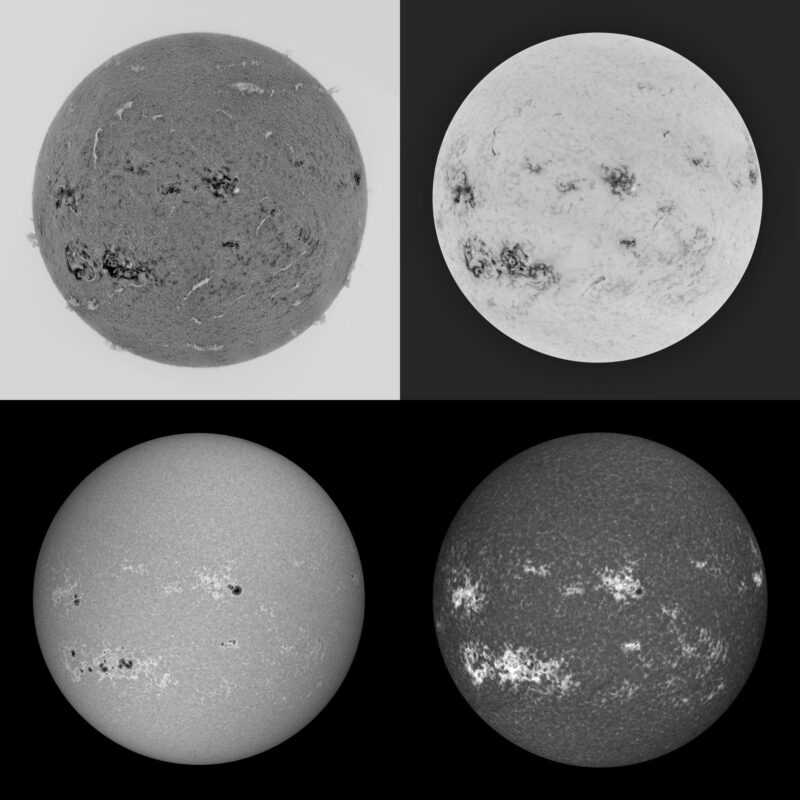
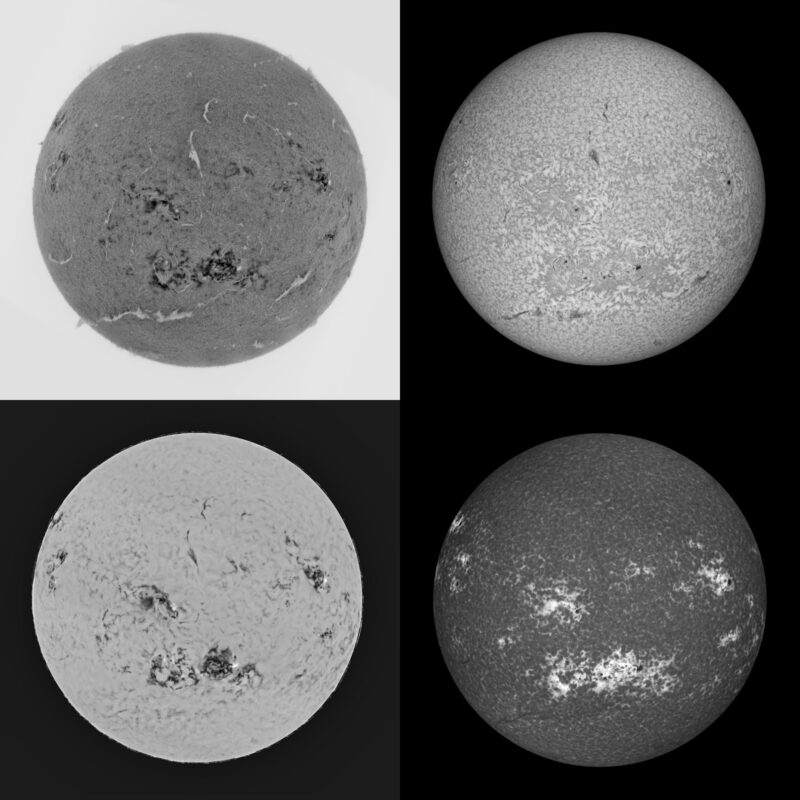
View at EarthSky Community Photos. | Mario Rana in Hampton, Virginia, captured these filtered images on August 27, 2025. Mario wrote: “The sun in various wavelengths: hydrogen-alpha, helium D3, G-Band, and calcium-H.” Thank you, Mario! Sun news August 27: New sunspot regions keep the flares coming
(11 UTC to 11 UTC)
Action is continuing to ramp up on the sun, with new sunspot groups emerging and firing off flares. Newcomer AR4202 delivered its first M-class flare (M1.0) yesterday at 14:07 UTC, while AR4199 – the producer of several M flares in recent days – continues to rotate further into view. Adding to the party is AR4197 in the southeast, which remains the most active sunspot region. Together, these regions are keeping the solar east buzzing with energy, and forecasters say more M flares are likely in the days ahead.
- Flare activity: Solar activity stayed moderate over the past day, with multiple C flares and one M flare:
- M1.0 at 13:39 UTC August 26 from AR4202 (S21E86) – the largest flare of the period.
- Other notable flares: C7.5 (AR4199, 23:57 UTC August 26), C6.9 (AR4199, 12:59 UTC August 26), C5.6 (AR4199, 11:51 UTC August 26), plus several C4+ events from AR4197 and AR4199.
Overall, flare production was centered on AR4197 and AR4199, with AR4202 making a strong debut.
- Sunspot regions: Four new regions (AR4200–4203) were numbered, bringing the visible total to 14.
- AR4197 (southeast, beta-gamma) – rapidly growing and producing frequent flares.
- AR4199 (northeast, beta) – rotating further into view with consistent C-class output and one strong C7.5 late in the period.
- AR4202 (southeast limb) – produced its first M flare (M1.0), signaling potential for more.
- AR4191 (near central meridian, beta-gamma) – still the largest region, showing growth, but relatively quiet during this period.
- Blasts from the sun? A coronal mass ejection (CME) was associated with the earlier M4.5 flare from AR4197, first seen in coronagraph imagery at 5:48 UTC Aug 26, but modeling shows it will miss Earth. Additional eruptions off the eastern limb were also non-Earth-directed.
- Solar wind: Solar wind eased from ~430 km/s to ~350 km/s. The interplanetary magnetic field (IMF) was low, with Bz fluctuating north and southward. A coronal hole high-speed stream (CH HSS) is expected to disturb conditions slightly through August 29.
- Earth’s magnetic field: Conditions were quiet-to-unsettled (Kp 1–3). Forecasts call for unsettled-to-active levels on August 27 under coronal hole high-speed stream influence, before tapering back to quieter conditions through August 29. A G1 (minor) geomagnetic storm is not expected, but minor active periods are possible.



Sun news for August 26, 2025. The sun has kept up moderate activity thanks to an M1.0 flare from newcomer sunspot region AR4202 at 14:07 UTC on August 26. Shortly after the bast, an R1 (minor) radio blackout was observed affecting an area over the Atlantic Ocean west of Africa. AIA 131 angstrom. Image via SDO. Sun news August 26: Action on the rise with 5 M flares!
(5 UTC to 5 UTC)
Action is rising on our star, with an impressive 5 M (moderate) flares blasted over the past day. Four of these came from new sunspot region AR4199, the bright spot you can see rotating into view just north of the equator in the video above. Solar scientists think this region produced the huge blast of solar material that erupted from the far side of the sun last Thursday, so it seems to mean business. The other M flare, a powerful M4.5, came from AR4197 in the southeast, which has showed rapid growth and produced several other flares over the past day. Together, these active regions are setting the stage for more volatile days ahead. Stay tuned.
- Flare activity: Solar activity was moderate over the past day, with 19 flares registered. The review:
- M4.5 at 5:25 UTC August 26 from AR4197 (S20E49, SE limb) – the largest flare of the day.
- M1.2 at 15:18 UTC August 25 from AR4199 (N04E87).
- M1.1 at 15.18 UTC August 25 from AR4199 (N04E87).
- M3.3 at 0:30 UTC August 26 from AR4199 (N04E87).
- M1.3 at 0:45 UTC August 26 AR4199 (N04E87).
- Other notable flares: C8.0 (AR4197, 0:10 UTC August 26), C7.4 at 1:34 UTC on August 26 (AR4197) and multiple C4+ events from AR4197 and AR4199.
Together, these bursts continue to spotlight eastern limb as the emerging hotspot for flare activity.
- Sunspot regions: Nine numbered active regions currently populate the Earth-facing side of the sun. AR4191 kept its (beta-gamma) configuration and remains the largest sunspot group, but did not produce any flares in the period. Newcomer AR4197 now shows a volatile beta-delta configuration and produced eight flares, while AR4199 has a beta configuration and produced 11 flares.
- Blasts from the sun? Despite the fireworks, no Earth-directed coronal mass ejections (CMEs) were detected over the past day.
- Solar wind: Speeds averaged around 425 km/s during the period, and sit at 379 km/s at the time of this writing (11 UTC on August 26). The interplanetary magnetic field (IMF) is at low levels and the Bz is swinging between north and south. A southward Bz is favorable for auroras. A coronal hole high-speed stream (CH HSS) is expected to elevate geomagnetic conditions from August 26 to 27.
- Earth’s magnetic field: Quiet-to-unsettled (Kp 1–3) levels were observed yesterday, and Kp = 2 conditions are in place at the time of this writing. Forecasts call for unsettled-to-active levels today through tomorrow, with a slight chance of G1 (minor) storming.

Sun news for August 25-26, 2025. Action is picking up on the eastern solar disk, with 5 M (moderate) flares from 2 of the newest regions, AR4197 and AR4199. 131 angstrom wavelength images via NASA/SDO. 
Sun news for August 25-26, 2025. Action is picking up on the eastern solar disk. Five M flares came from 2 of the newest regions, AR4197 and AR4199, including the M4.5 from AR4199. The flares were captured by the 171 angstrom wavelength channel of the SDO/ AIA cameras. More to come? Images via NASA/SDO. 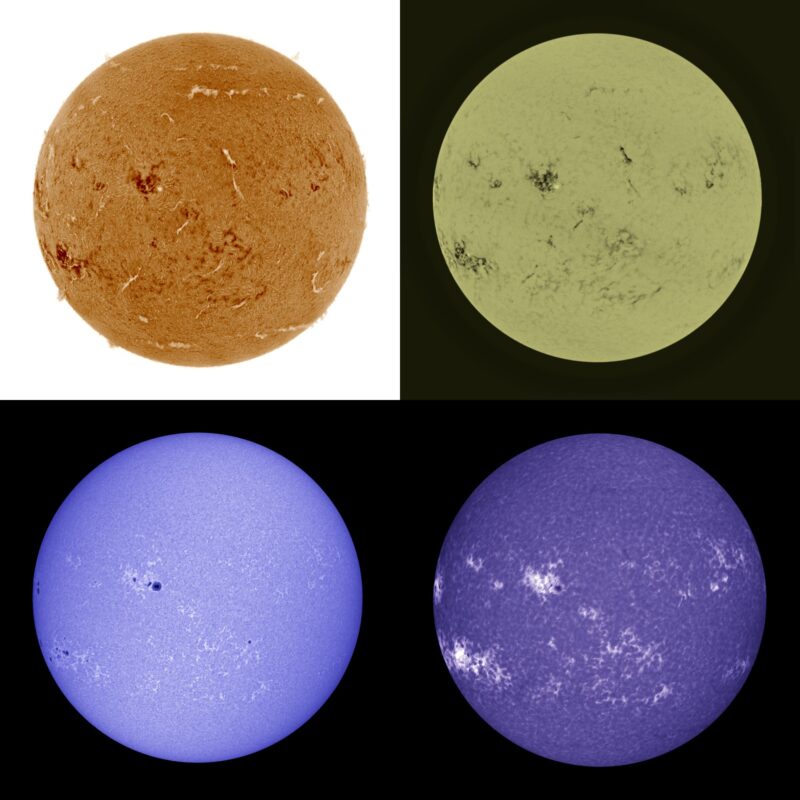
View at EarthSky Community Photos. | Mario Rana in Hampton, Virginia, captured these filtered images on August 25, 2025. Mario wrote: “The sun in various wavelengths: hydrogen-alpha, helium D3, G-Band, and calcium-H.” Thank you, Mario! Sun news August 25: M flares and a radiation storm from the northeast
(11 UTC to 11 UTC)
The sun blasted out an M4.5 (moderate) flare at 5:24 UTC this morning from just over the northeast horizon. With a series of strong C-class events and an additional M1.0 flare also erupting from this spot later in the morning, it seems a new, magnetically active sunspot region is starting to rotate into view from this area. Amid all this flaring, particles released by the sun – especially protons – were accelerated to extremely high velocities, triggering an S1 (minor) radiation storm at Earth.
- Flare activity: Solar activity was moderate, with 17 flares recorded. The highlights:
- M4.5 at 5:24 UTC (N04E89, NE limb) – the largest flare of the day.
- M1.0 at 9:07 UTC from AR4197 (S16E67).
- C9.9 at 8:55 UTC (N04E89, NE limb).
- Other notable flares: C8.7 (AR4197, 23:47 UTC) and multiple C4+ events from AR4191, AR4196, AR4197, and the northeast limb region.
Together, these bursts spotlight the northeast limb as the emerging hotspot for flare activity.
- Sunspot regions: Eight active regions are currently on the Earth-facing side of the sun. AR4191 (beta-gamma) grew larger, producing several C-class flares. Newcomers AR4196 (alpha) and AR4197 (beta) both flared multiple times, with AR4197 contributing the M1.0 and C8.7 events. The moderate M4.5 and C9.9 flares originated from the region just beyond the northeast limb, now rotating into view.
- Blasts from the sun? Despite the fireworks, no Earth-directed coronal mass ejections (CMEs) were detected.
- Solar wind: Speeds eased to ~375–400 km/s, down from ~455 km/s, with the interplanetary magnetic field (IMF) at low levels and the Bz swinging between north and south. A southward Bz is favorable for auroras. A coronal hole high-speed stream (CH HSS) is expected to elevate conditions from August 25 to 26.
- Earth’s magnetic field: Quiet (Kp 1–2) levels were recorded yesterday. Forecasts call for unsettled-to-active levels today through tomorrow, with a slight chance of G1 (minor) storming.
- Radiation storm: A greater-than-10-Mev proton flux climbed late yesterday and exceeded the threshold for an S1 (minor) radiation storm on August 25.

Sun news for August 24-25, 2025. A region just over the northeast horizon is keeping up its action, producing an M4.5 (moderate) flare at 5:24 UTC this morning. Images via NASA/ SDO and JHelioviewer. 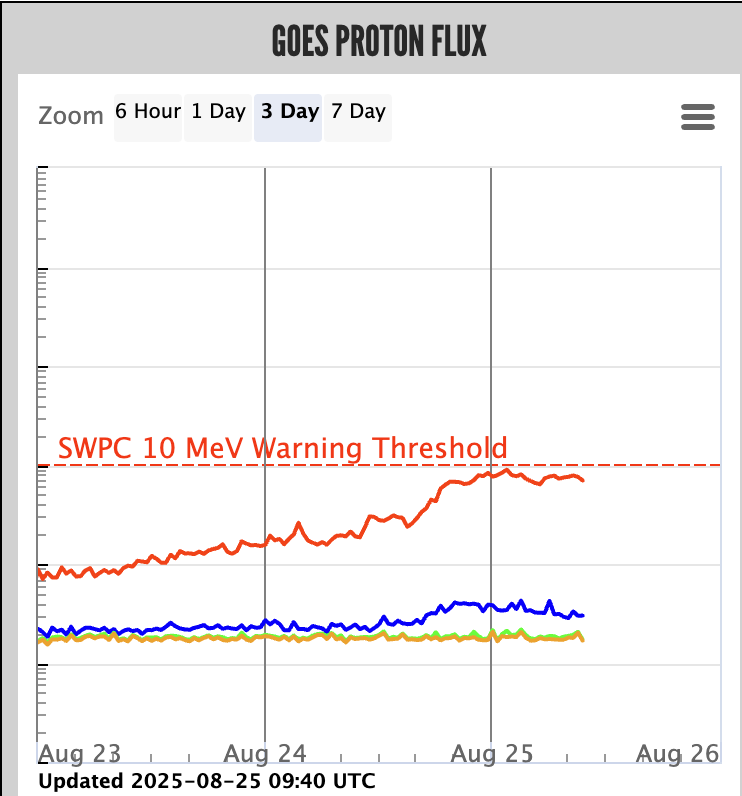
Sun news for August 24-25, 2025. Solar protons from the eastern limb reached the S1 (minor) particle storm threshold around 1:30 UTC on August 25. More indication of activity just over the northeastern limb. Images via NOAA. 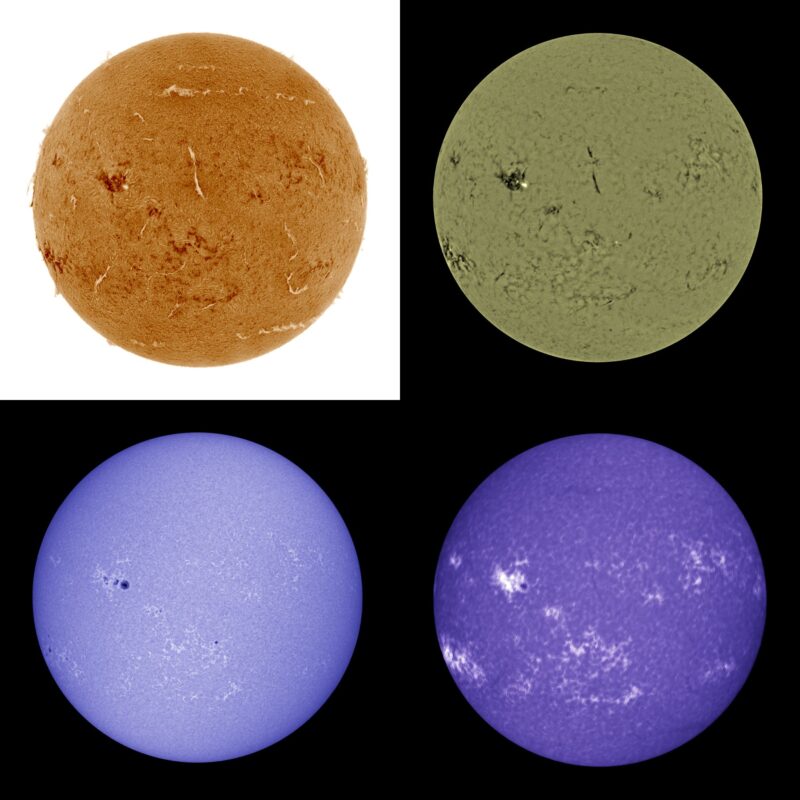
View at EarthSky Community Photos. | Mario Rana in Hampton, Virginia, captured these filtered images on August 24, 2025. Mario wrote: “The sun in various wavelengths: hydrogen-alpha, helium D3, G-Band, and calcium-H.” Thank you, Mario! 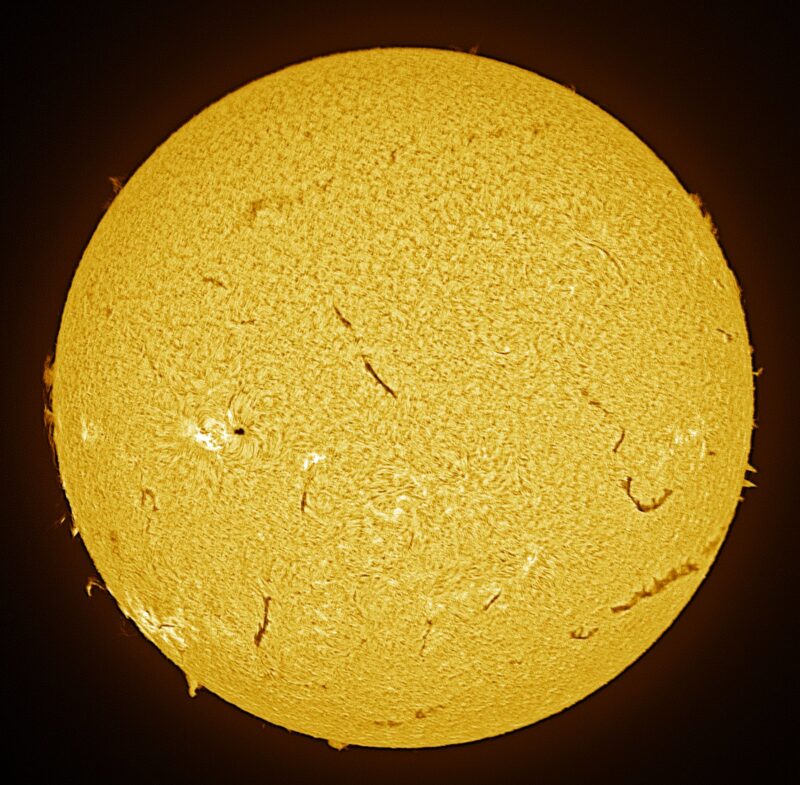
View at EarthSky Community Photos. | Jim Militello in Tucson, Arizona, captured this filtered image of the sun on August 24, 2025. Jim wrote: “Hydrogen-alpha image of the sun showing active region 4191 with a huge sunspot.” Thank you, Jim! Sun news August 24: Another small M flare lights up the sun’s southeast
(11 UTC to 11 UTC)
The sun fired off another M (moderate) flare. This one was an M1.9, from just on or behind the sun’s southeast limb, near an emerging active region. While dramatic, the event produced no Earth-directed CME. Elsewhere on the sun’s disk, an established region, AR4191, popped off a strong C1.9 flare. This region is showing signs of growth in its core spots. Stay tuned for space weather updates.
- Flare activity: Solar activity reached moderate levels, thanks to the M1.9 limb flare at 20:06 UTC on August 23. Another M flare (M1.3) flashed in the sun’s corona just over the northeast limb (edge) near the solar equator. A handful of smaller C-class flares also came from the southeast limb. AR4191 produced the strongest on-disk flare (C9.1) at 19:22 UTC on August 23 and continues to evolve. The sun produced the mentioned M and C flares along with 21 additional C flares for a total of 24 flares.
- Sunspot regions: Six active regions face Earth. AR4191 (beta configuration) is the most developed. New regions AR4193 and AR4194 joined the count on August 23, both small and simple. AR4195 is rotating onto the disk near the southeast limb. Most other groups remain small and stable. By the way, the prominence we discussed yesterday – dancing on the sun’s northwest limb (edge) began to lift off from the sun after yesterday’s update.
- Blasts from the sun? No Earth-directed coronal mass ejections (CMEs) were detected over the past day.
- Solar wind: Solar wind eased from ~545 km/s (1.2 million mph) down to ~425 km/s by late August 23. The interplanetary magnetic field IMF was weak and the Bz component stayed mostly small, flipping between north and south. Expect nominal flow to continue today before a coronal hole high-speed stream (CH HSS) arrives around August 25.
- Earth’s magnetic field: Conditions were mostly quiet to unsettled (Kp 0–3). A coronal hole stream may spark geomagnetic activity on August 25–26.
What’s ahead? Sun-Earth forecast
- Flare activity forecast: Mostly low activity today (August 24). The chance of R1–R2 (minor to moderate) flares (35%) continues through August 26, especially from regions near the southeast limb. The chance for an X-class flare remains very low (5%).
- Geomagnetic activity forecast:

Sun news for August 23-24, 2025. The prominence we mentioned in yesterday’s post lifted off the northwest limb (edge) disconnected from the sun late August 23. Images via SDO, GOES, and JHelioviewer 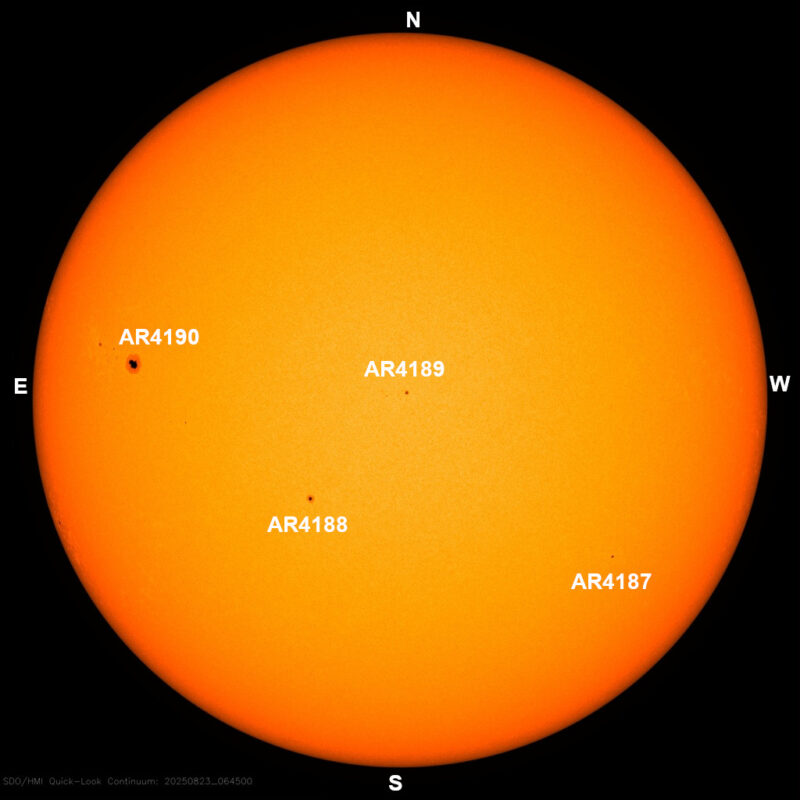
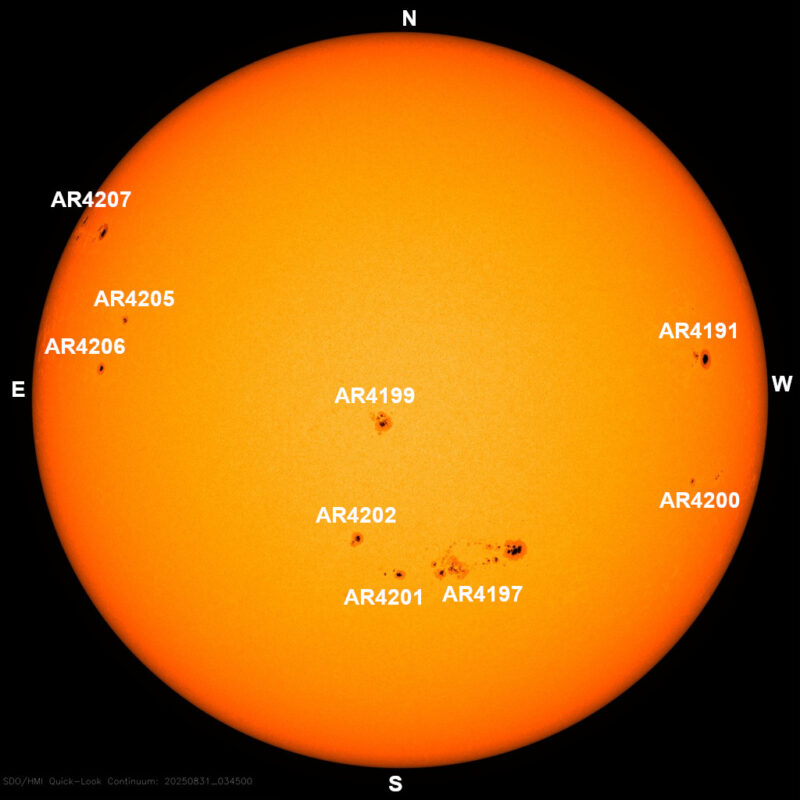
This image shows sun activity – with the most active regions labeled – as of 6 UTC on August 23, 2025. Please note that NASA SDO imaging is down, and as of 3 UTC on August 25 no newer images from the SDO probe were available. Original image, without labels, via NASA SDO. Courtesy of NASA/SDO and the AIA, EVE, and HMI science teams, with labeling by EarthSky. Today’s sun is posted by Armando Caussade. Why are east and west on the sun reversed? Sun news August 23: Surprise M flare heralds an old region’s return
(11 UTC to 11 UTC)
The sun unleashed a long-duration M flare at 18:51 UTC on August 22. It surprised everyone and pushed solar activity to moderate. The blast came from an incoming, still-unnumbered region just over the sun’s southeast horizon. The flare triggered an R1 (minor) radio blackout over the Pacific Ocean southwest of Mexico and produced a Type II radio emission. Evidence suggests this may be the return of an old, magnetically complex region that previously fueled fiery activity on the sun’s far side. We’ll keep watch, as it rotates into view and earns its new sunspot number.
- Flare activity: Sun activity jumped to moderate over the past day, with three flares. The largest was an M1.7 event from the southeast limb at 18:51 UTC, which caused the R1 radio blackout. AR4191 contributed two smaller C-class flares during the same period.
- Sunspot regions: Four active regions currently face Earth. AR4191 remains the largest, while the other visible regions show simple alpha or beta magnetic configurations and appear stable. The incoming southeast limb region might bring more complexity – and more flare potential on the sun’s Earth-facing side – once it rotates fully into view.
- Blasts from the sun? No Earth-directed coronal mass ejections (CMEs) left the sun in the past 24 hours.
- Solar wind: Solar wind slowed from 535 km/s (1,200,000 mph) late on August 21 to 459 km/s (1,030,000 mph) by the end of August 22. The interplanetary magnetic field weakened, with Bz mostly northward but showing some brief southward swings. Forecasters expect waning high-speed stream effects through August 22, with background-like conditions returning by August 23.
- Earth’s magnetic field: Geomagnetic activity stayed quiet to unsettled (Kp 1–3) on August 22. Forecasts call for similar conditions on August 23, with only a small chance of isolated active intervals or G1 (minor) geomagnetic storming if CME remnants graze Earth. Activity should settle further on August 24–25.

Sun news for August 22-23, 2025. Surprise! An M flare flashed off the sun’s eastern limb (edge). This is the first M flare in about a week, and it signals a new sunspot region that will rotate into view soon. Images via NASA/ SDO.

Sun news for August 22-23, 2025. A beautiful solar filament (prominence on the limb) sits over the northern limb (edge). We wonder if it might erupt. Images via NASA/ SDO. 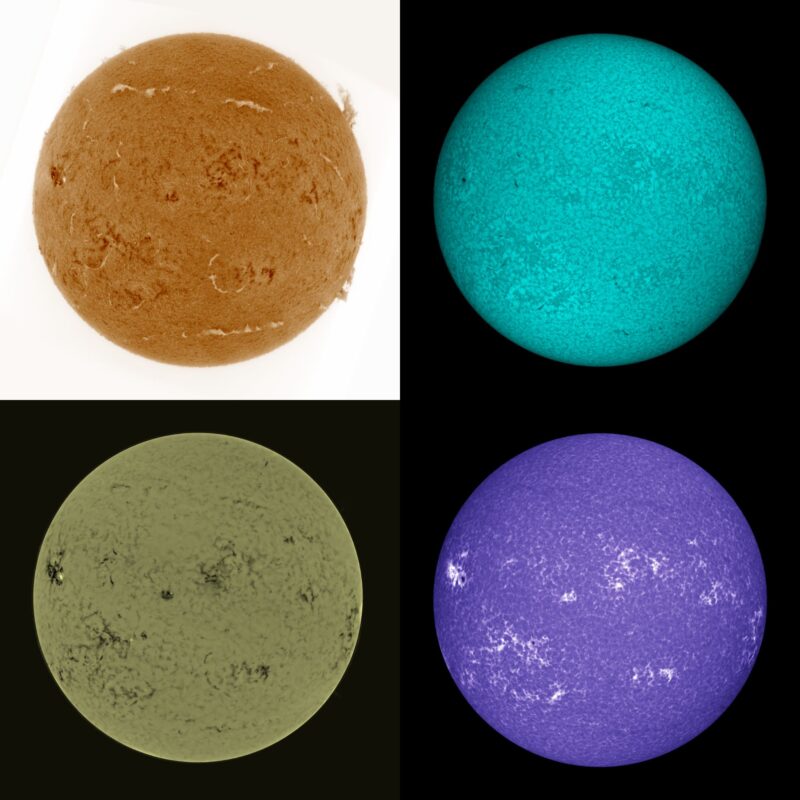
View at EarthSky Community Photos. | Mario Rana in Hampton, Virginia, captured these filtered images on August 22, 2025. Mario wrote: “The sun in various wavelengths: hydrogen-alpha, hydrogen-beta, helium D3, and calcium-H.” Thank you, Mario! Sun news August 22: This sun blast is headed for Mars
(11 UTC to 11 UTC)
At 8:24 UTC on August 21, the sun unleashed a dramatic coronal mass ejection (CME). Earthly coronagraphs recorded this blast of solar materials and magnetic fields as a wide, fast halo event. Halo events often indicate blasts headed Earth’s direction, but this one launched from the far side of the sun and is racing toward Mars. It’s expected to reach the red planet by August 25. Maybe some Mars spacecraft (rovers or orbiters) will record stirrings to the red world’s near-space environment.
- Flare activity: Sun activity remained at low levels, producing only weak C-class flares. The largest was a C2.3 from AR4191 at 15:56 UTC on August 21. This same active region was the lead flare producer of the past day. It produced six out of the seven flares of the day.
- Sunspot regions: Four sunspot regions now face Earth. AR4191 dominates as the largest, while AR4187 and AR4192 remain small and stable. Spots behind AR4191 may reveal more complexity as they rotate into view.
- Blasts from the sun? As mentioned above, a large CME erupted at 08:24 UTC on August 21, but coronagraphs showed it originated on the far side. No Earth-directed CMEs left the sun in the past 24-hours.
- Solar wind: Solar wind from the coronal hole declined during the day. Speeds dropped to 420-470 km/s (940,000-1,050,000 mph), then increased again near 535 km/s (1,200,000 mph) late in the period. The interplanetary magnetic field (IMF) strength weakened, with the Bz component mostly north-oriented with some southward variations to end the period north-oriented. A southward Bz component is more favorable for auroras. Forecasters expect waning high-speed stream effects through August 22, with a return to background-like conditions by August 23.
- Earth’s magnetic field: Geomagnetic activity stayed quiet to unsettled (Kp 1-3) on August 21. Forecasts call for the same on August 22, with a small chance of isolated active intervals or G1 (minor) geomagnetic storming if CME remnants brush Earth. Conditions should quiet down further by August 23–24.

Sun news! This fast blast of sun stuff – aka a coronal mass ejection (CME) – is known as a halo event because it more or less surrounds the sun on all sides. It often indicates a blast headed to Earth. But this one is going in the opposite direction, to Mars. Images via NOAA/GOES. 
Sun news for August 21-22, 2025. The ENLIL computer model of solar wind and coronal mass ejections (CMEs) shows the far-side eruption on the sun is headed toward Mars. Images via NASA. Sun news August 21: Explosive activity in the northeast
(11 UTC to 11 UTC)
Shortly after the huge prominence eruption yesterday morning, a filament erupted in the northeast at around 11:00 UTC. The SOHO spacecraft’s LASCO C2 instrumented detected a burst of solar material – a coronal mass ejection, or CME – soaring out from this eruption at 11:24 UTC. Then at 8:30 UTC this morning, LASCO C2 recorded another huge blast of sunstuff. This eruption likely occurred on the far side of the sun, as we saw no flare that could be associated with this event on the Earth-facing side. Stay tuned to see if this explosive activity continues.
- Flare activity: Only three C class (common) flares were produced by our star over the past 24 hours, placing activity at low. The largest of the three flares was a C3.3 flare at 0:11 UTC on August 20 from AR4191 in the northeast.
- Sunspot regions: The sun has five labeled active regions on its Earth-facing side. All these regions are small and stable with simple alpha or beta configurations. There is a newcomer on the solar disk now numbered AR4191. Its classification can’t be confidently identified as it’s currently too close to the east limb (edge), but we can see that it’s larger than the rest of the sunspots on the solar disk. We will keep observing this region to see what it’s got in store. Meanwhile, a large coronal hole is forming in the solar northeast. We could soon be feeling the effects of its high-speed solar wind.
- Blasts from the sun? At around 11:24 UTC on August 20, SOHO’S LASCO C2 instrument observed a coronal mass ejection (CME) in the northeast. Due to its location on the very edge of the solar limb (edge), it’s not Earth-bound.
- Solar wind: Solar wind speeds dropped from 624 km/s yesterday to 497 km/s at the time of this writing. The interplanetary magnetic field remains at low levels. The Bz component has been mostly north-oriented during the period and remained northward at 10:00 UTC this morning. A southward Bz component is more favorable for auroras.
- Earth’s magnetic field: Conditions were quiet to unsettled (Kp = 1-3) over the past 24 hours, staying at Kp = 1 at the time of this writing.

Sun news for August 20-21, 2025. Shortly after yesterday’s huge blast, the SOHO spacecraft observed another major eruption, this time in the northeast. And then at around 8:00 UTC today, another big chunk of solar material was hurled into space. Images via NASA/SOHO. 
Sun news for August 20-21. 2025. A large coronal hole is forming in the solar northeast. This could be sending some high-speed solar wind our way. Images via NASA/SDO. Sun news August 20: Huge blast this morning!
(11 UTC to 11 UTC)
At 4:30 UTC this morning, a large prominence – a long rope of solar material and magnetic fields – erupted over the solar southeast horizon. And this blast sent a spectacular blast of sun-stuff into space. Since it was fired on or just behind the horizon, this coronal mass ejection (CME) is not on its way to trouble Earth’s magnetic field. But our planet has experienced G1 (minor) geomagnetic storming over the past day, thanks to a stream of high-speed solar wind from a coronal hole. And forecasters expect the storming to continue today, with a slight chance for G2 (moderate) storms if the anticipated glancing blow from a CME fired on Sunday adds to the disturbance. Stay tuned.
- Flare activity: Activity dropped down to low after only C and B-class (common and basic) flares were produced by our star over the past day. During the last 24 hours, the sun produced a total of five flares: three Cs and two B flares. The largest flare was a C2.5 at 2:39 UTC on August 20 from an incoming active region in the northeast. This as-yet-unnumbered active region was the lead (and only) flare producer of the day.
- Sunspot regions: Our star today has three numbered active regions on the side we see from Earth. These regions remain small and stable with simple alpha or beta configurations. There is a newcomer on the Earth-viewed solar disk: AR4189, now located in the northeast.
- Blasts from the sun? SOHO’S LASCO C2 instrument registered the coronal mass ejection from the huge filament eruption this morning. Due to its location on the very edge of the solar horizon, no component is Earth-bound. Other than that, no coronal mass ejections (CMEs) have been observed in available coronagraph imagery.
- Solar wind: Solar wind raised from speeds of 425 km/s yesterday to a peak of 760 km/s at 5:48 UTC on August 20, and sits at 624 km/s at the time of this writing. The interplanetary magnetic field is at low levels. The Bz component has been mostly south-oriented during the period. It moved south at 10:00 UTC this morning. A southward Bz component is more favorable for auroras.
- Earth’s magnetic field: Conditions were quiet to active (Kp = 2-5) over the past 24 hours, with a G1 (minor) geomagnetic storm level recorded at 18 UTC on August 19. Disturbance is sitting at Kp = 3 at the time of this writing.

Sun news for August 19-20, 2025. A beautiful erupting filament was captured by the Solar Dynamics Observatory this morning. And the SOHO spacecraft’s LASCO C2 and C3 coronagraphs captured the spectacular resulting coronal mass ejection (CME). Images via SDO/ NASA and SOHO/ NASA. 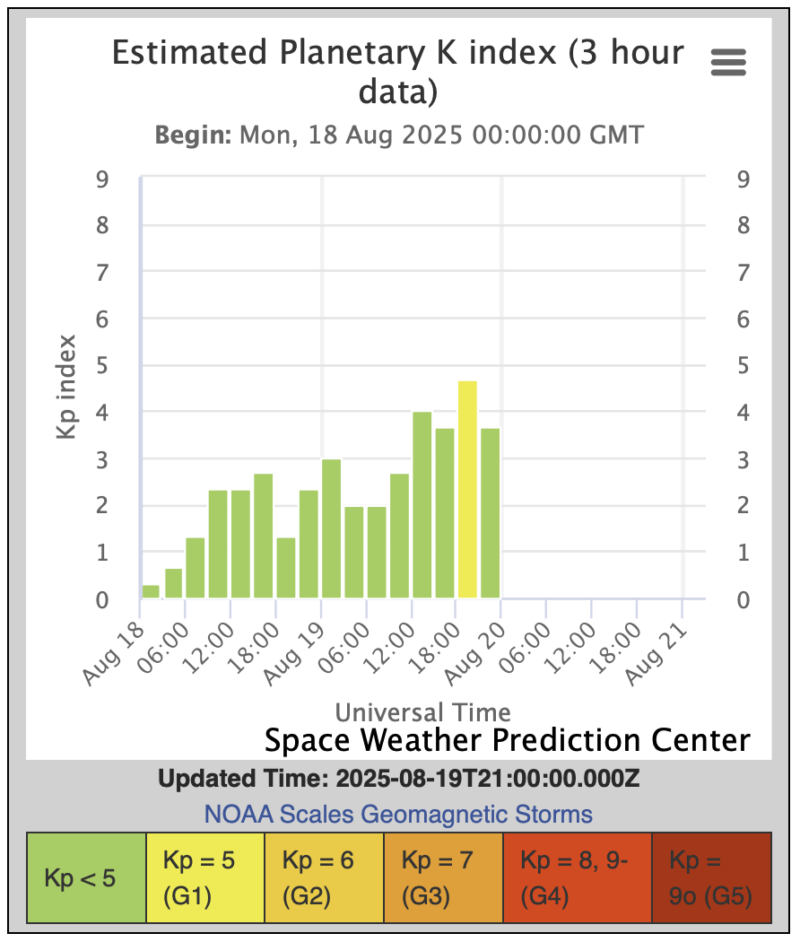
Sun news for August 19-20, 2025. A G1 (minor) geomagnetic storm (Kp = 5) was recorded last night. More storming may be on the way if an incoming CME glances Earth. Images via NOAA. 
View at EarthSky Community Photos. | Mario Rana in Hampton, Virginia, captured these filtered images on August 19, 2025. Mario wrote: “The sun in hydrogen-alpha and hydrogen-beta. Those prominences are amazing!” Thank you, Mario! Sun news August 19: Geomagnetic storms and auroras tonight?
(11 UTC to 11 UTC)
Earth’s magnetic field is calm right now, but conditions are shifting. A powerful knot of solar winds known as a corotating interaction region (CIR) is soon to reach Earth, followed by a stream of high-speed solar wind from a coronal hole. And to top it off, a blob of sun-stuff – a coronal mass ejection (CME) – fired on Sunday could give our magnetic field a glancing blow as early as this evening. These factors could combine to produce G1 (minor) geomagnetic storms tonight. And that means the potential for auroras at high latitudes!
- Flare activity: Activity jumped up to moderate over the past 24 hours thanks to an M-class (moderate) flare. During our observation period the sun produced a total of 10 flares: an M, six Cs (common) and three B (weak) flares. The largest flare was an M1.1 at 4:39 UTC on August 19 from AR4188. The blast caused an R1 (minor) radio blackout that affected an area over the South China Sea.
- Sunspot regions: Four numbered sunspot regions now face Earth. Most remain small and simple. A region near the center of the solar disk shows weak opposite polarity spots, hinting at slight complexity. There are two newcomers on the Earth-viewed solar disk: AR4187 and AR4188, both in the southeast.
- Blasts from the sun? Today’s M flare is still under analysis, but the initial review suggests solar stuff from this flare is not coming to us at Earth. Other than that, no coronal mass ejections (CMEs) have been observed in available coronagraph imagery.
- Solar wind: Solar wind raised from speeds of 320 km/s to peaks of 450 km/s, and sits at 425 km/s at the time of this writing. The interplanetary magnetic field is at moderate levels. The Bz component has been mostly north-oriented during the period, but moved south at 9:30 UTC this morning. A southward Bz component is more favorable for auroras. Conditions should change late today as the CIR and coronal hole high-speed stream arrive, possibly pushing speeds toward 600–700 km/s.
- Earth’s magnetic field: Conditions stayed quiet to unsettled (Kp = 2-3) over the past 24 hours, sitting at Kp = 2 at the time of this writing.
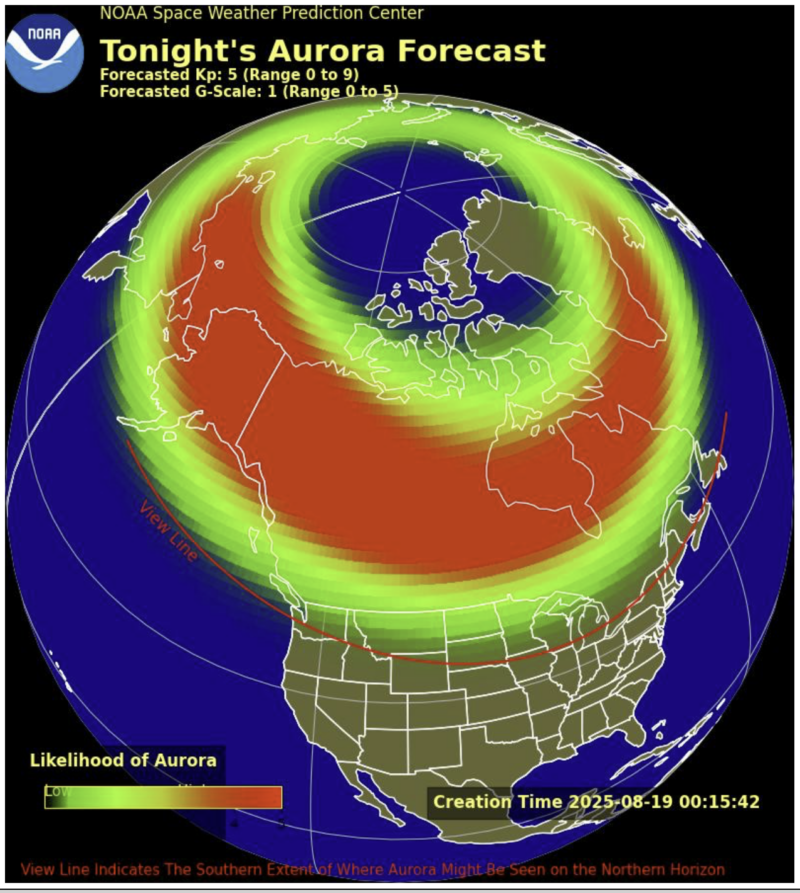
Sun news for August 18-19, 2025. Thanks to a coronal hole’s high-speed solar wind stream, combined with a possible coronal mass ejection (CME) glancing blow, we could see G1 (minor) geomagnetic activity tonight. And that would mean auroras at high latitudes. Stay tuned! Images via NOAA. 
Sun news for August 18-19, 2025. A moderate (M1) solar flare from AR4188 brought activity levels up to moderate. Images via NOAA. 
A beautiful prominence dances over the northeastern solar limb (edge). GOES-19 SUVI 304 angstrom via NOAA. Sun news August 18: Storms brewing as fast solar wind arrives
(11 UTC to 11 UTC)
Earth’s geomagnetic environment is currently quiet, but disturbance is on the way. A complex knot of solar winds known as a co-rotating interaction region (CIR) is expected to reach Earth later today, followed by a stream of high-speed solar wind from a coronal hole. This will likely kick up geomagnetic activity, with G1 (minor) geomagnetic storms likely tomorrow and possibly extending into August 20. Plus, a coronal mass ejection (CME) fired yesterday morning may add to this disturbance if it grazes Earth late tomorrow or early on August 20. Aurora hunters at high latitudes, get ready!
- Flare activity: Activity stayed low over the past 24 hours, with 12 small C-class flares and one B9.0 (moderate) flare. Region AR4180 produced the largest flare, a C3.3, at 19:58 UTC on August 17.
- Sunspot regions: Four numbered sunspot regions now face Earth. Most remain small and simple. A region near the center of the solar disk shows weak opposite polarity spots, hinting at slight complexity. AR4172 continues to depart over the western limb (edge). A new region is rotating in from the southeast limb.
- Blasts from the sun? Coronagraph imagery revealed a coronal mass ejection (CME) at 10:24 UTC yesterday. Analysis suggests the CME may graze Earth late on August 19 or early August 20. Any other CMEs over the past day were fired away from Earth.
- Solar wind: Solar wind stayed calm over the past day, with speeds of 300–350 km/s and weak magnetic fields. The Bz component never turned southward for long. A southward bz component is more favorable for auroras. Conditions should change late August 18 as the CIR and coronal hole high-speed stream arrive, possibly pushing speeds toward 600–700 km/s.
- Earth’s magnetic field: Conditions stayed quiet (Kp = 0–2) over the past 24 hours. Activity should remain low through much of today, then rise to unsettled or active late in the day, with the chance for geomagnetic storms peaking on August 19.

Sun news for August 17-18, 2025. You’re looking at the closest-ever images of the sun. Taken by NASA’s Parker Solar Probe during a close flyby, they show the solar wind and a coronal mass ejection (CME) racing out from the sun’s outer atmosphere, the corona. And a fast stream of solar wind and a coronal mass ejection could reach Earth over the next day. Images via NASA. Sun news August 17: Calm now, but storm chance ahead
(11 UTC to 11 UTC)
Solar activity remained low over the past day, with only faint C-class flares. The most active region, AR4172, is rotating off the sun’s western limb after producing a few minor bursts. A filament eruption in the northeast on August 16 launched a coronal mass ejection (CME), but analysis shows it was directed away from Earth. For now, Earth’s magnetic field is quiet under slow solar wind. But a change is coming: a co-rotating interaction region (CIR) ahead of a recurrent high-speed stream is expected to arrive late on August 18, with a chance for G1 (minor) geomagnetic storms on August 19. Aurora watchers, take note!
- Flare number: Activity was low with only 12 small C-class flares. The largest was a C3.6 event at 4:59 UTC on August 17 from AR4178.
- Sunspot regions: Eight regions are on the Earth-facing side of the sun. AR4172 (beta magnetic configuration) in the northwest remains the most active but is decaying as it departs. AR4178 and AR4174 showed some growth as they reached the western limb (edge), while the rest are small and magnetically simple. A new region is beginning to rotate in from the southeast limb.
- Blasts from the sun? Several CMEs were spotted on coronagraph imagery in the last day, mostly from filament eruptions. None were Earth-directed. One large filament eruption in the northeast around 11:12 UTC on August 16 produced a CME traveling well behind Earth.
- Solar wind: Conditions remained nominal, with speeds between 350–400 km/s and a weak (IMF). No prolonged southward Bz was observed. Solar wind flow is expected to stay calm until late August 18, when a CIR and coronal hole high-speed stream (CH HSS) are forecast to arrive.
- Earth’s magnetic field: Quiet conditions prevailed over the past day (Kp = 1–2). Quiet conditions should continue through most of August 17–18, before geomagnetic activity picks up with the incoming high-speed solar wind.
What’s ahead? Sun-Earth forecast
- Flare activity forecast: Solar flares are expected to remain at low levels, with only a slight chance (20%) for moderate (M-class) events. This chance may rise slightly as new active regions rotate onto the disk from the east.
- Geomagnetic activity forecast:
- Aug 17–18: Mostly quiet to unsettled conditions expected. Activity could begin to rise late August 18 with the approach of a co-rotating interaction region (CIR).
- Aug 19: G1 (minor) geomagnetic storms are likely as Earth enters the fast solar wind from a recurrent coronal hole. Aurora displays may be possible at higher latitudes.
- Aug 20: Unsettled to active conditions expected, with storm chances gradually decreasing.
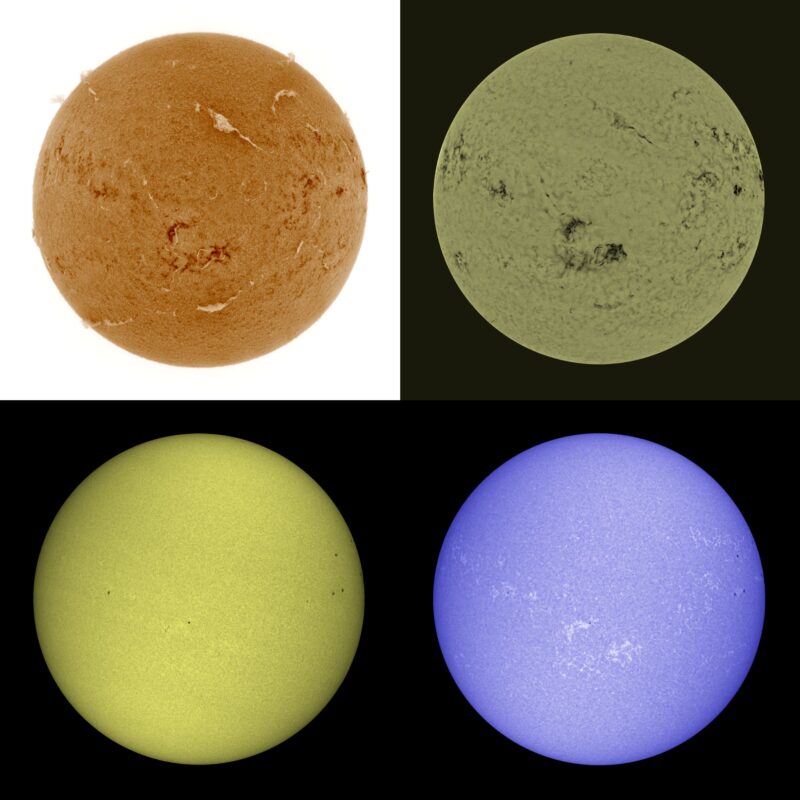
View at EarthSky Community Photos. | Mario Rana in Hampton, Virginia, captured these filtered images on August 16, 2025. Mario wrote: “The sun in various wavelengths: hydrogen-alpha, helium D3, sodium D1, and G-band.” Thank you, Mario! 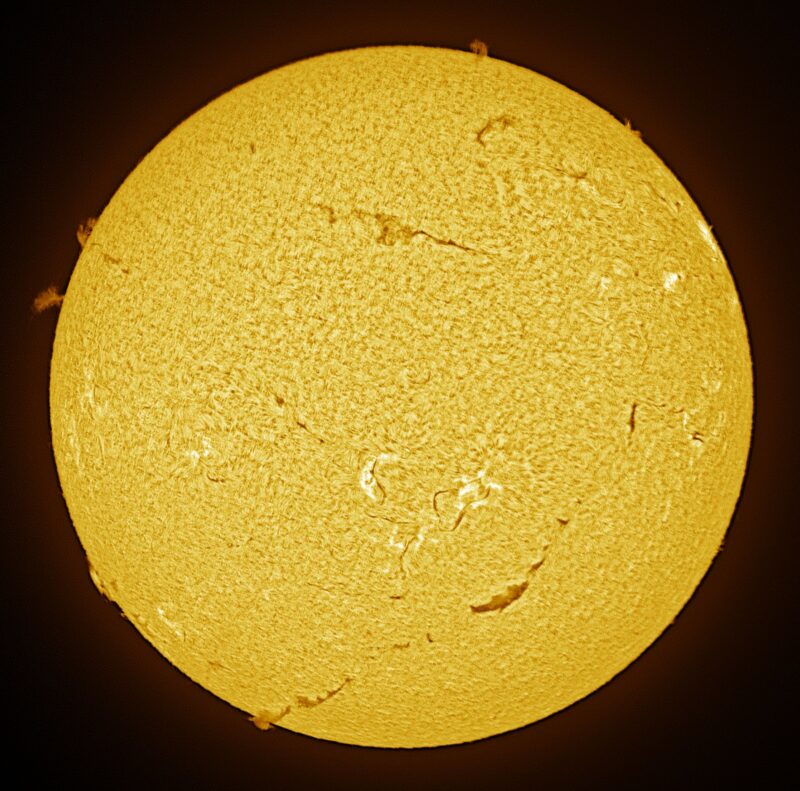
View at EarthSky Community Photos. | Jim Militello in Tucson, Arizona, captured this filtered image of the sun on August 16, 2025. Jim wrote: “Hydrogen-alpha image of the sun showing active regions, prominences, and filaments.” Thank you, Jim! 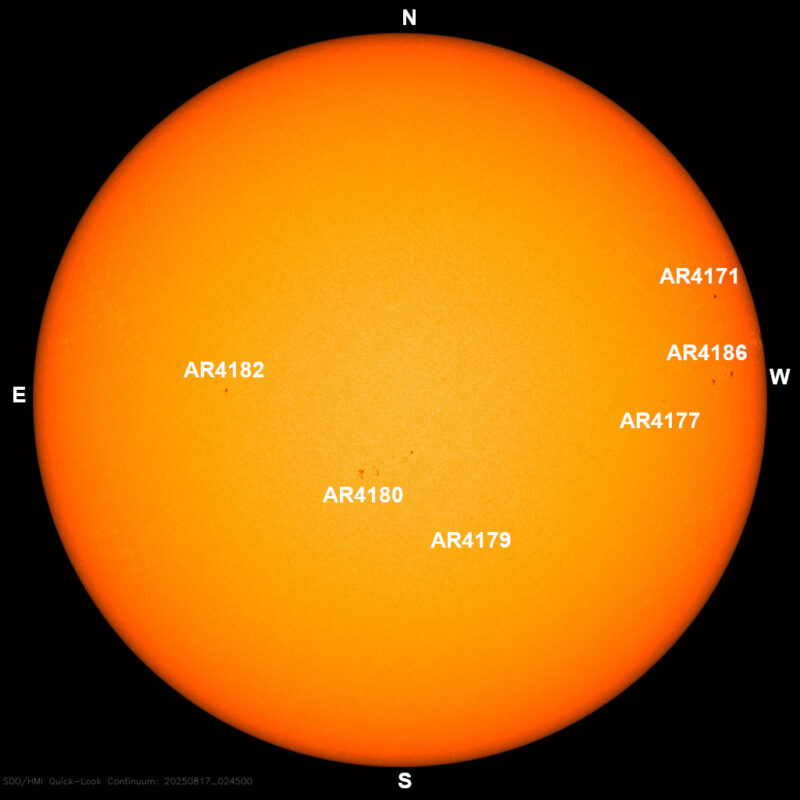
This image shows sun activity – with the most active regions labeled – as of 2 UTC on August 17, 2025. Original image, without labels, via NASA SDO. Courtesy of NASA/SDO and the AIA, EVE, and HMI science teams, with labeling by EarthSky. Today’s sun is posted by Armando Caussade. Why are east and west on the sun reversed? Sun news August 16: Solar Cycle 25 update
(11 UTC to 11 UTC)
NOAA’s Space Weather Prediction Center just released the July 2025 sunspot numbers. They are up slightly from June, which was up a lot following a substantial drop in May. So we are past the peak of Solar Cycle 25. The peak seems to have been a year ago. But the sun is still active! And so officially we’re still at Solar Maximum. It may continue for a year or more. Here are some recent monthly sunspot values:
July 125.6
June 116.3
May 79.2
Overall August 2024 remains as the highest point of Solar Cycle 25 with a monthly value of 216.- Flare number was low over the past day with 8 faint 8 C (common) flares and 7 B (basic) flares: 15 flares in all. The largest was a C7.7 flare produced at 21:22 UTC on August 15 by AR4172 in the northwest. Active region AR4172 was again the lead flare producer with 8 flares, 4 C and 4 B flares.
- Sunspot regions: The sun shows 11 numbered sunspot regions on its Earth-facing side. All show small and magnetically simple alpha or beta magnetic configurations. There is a newcomer on the solar disk: AR4186 in the southwest.
- Blasts from the sun? No Earth-directed coronal mass ejections (CMEs) were observed in available coronagraph imagery over the past day, but the arrival of a co-rotating interaction region (CIR) on August 17, combined with fast solar wind, might provoke some auroras.
- Solar wind: Solar wind dropped from 458 km/s (1,024,000 mph) at the beginning of the period down to 366 km/s (819,000 mph) at the time of this writing (11 UTC on August 16). The interplanetary magnetic field (IMF) is weak, with the Bz mostly south oriented during the period and still southward at the time of this writing (11 UTC on August 16). A southward Bz is more favorable for auroras.
- Earth’s magnetic field: Conditions ranged from quiet to unsettled during the past day (Kp = 1-3). The Kp index has dropped down to Kp = 1 at the time of this writing (11 UTC on August 16).
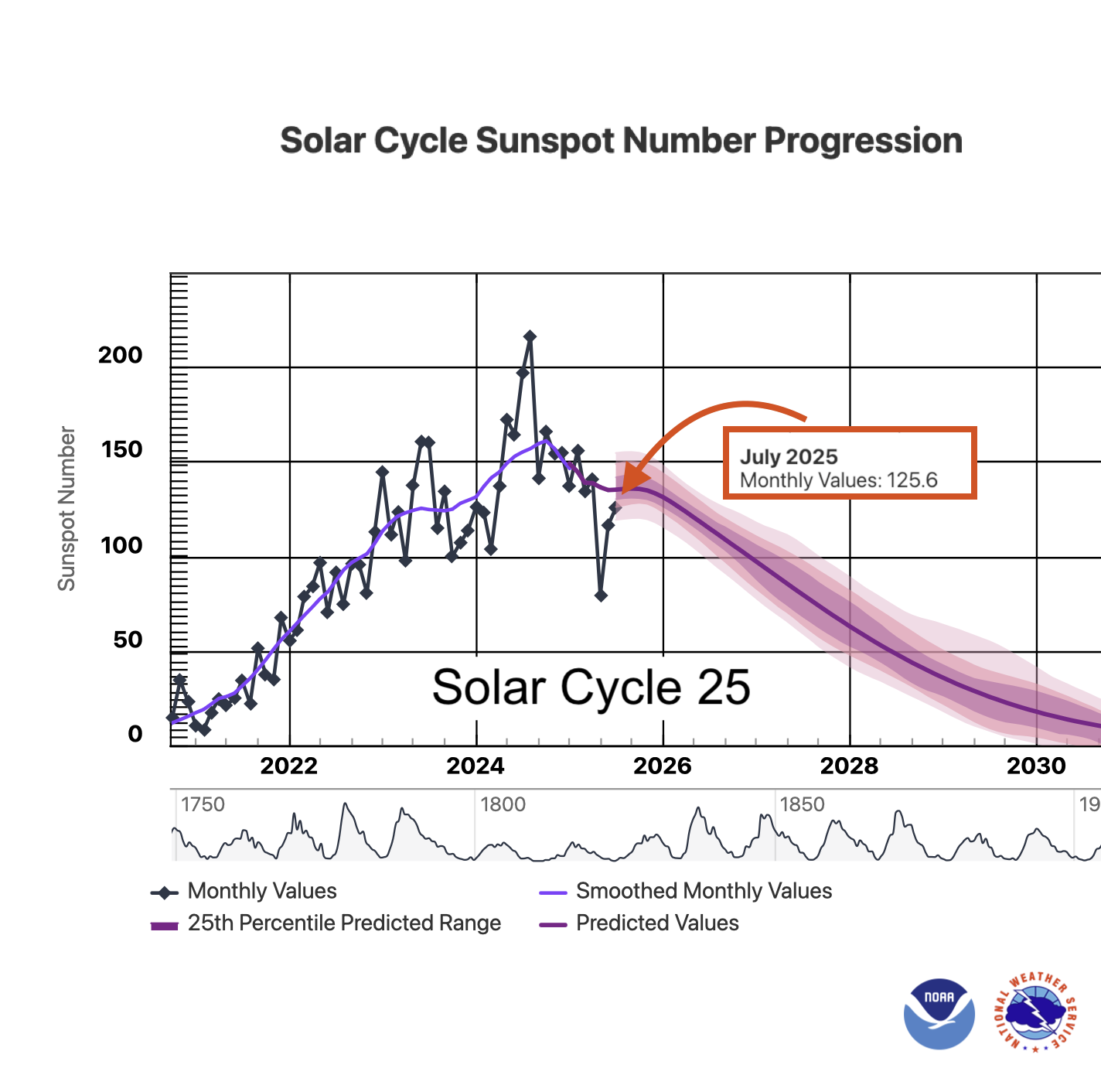
Sun news August 16, 2025. NOAA just released this update on Solar Cycle 25. The monthly value of the sunspot number for July 2025 was 125.6, slightly higher than June. We’re still at solar max, until specialists announce it has ended. Image via NOAA. 
August 16, 2025. The large coronal hole we observed forming in the northeast quadrant has grown in extent to reach the sun’s equator and is now moving into a geoeffective position. The fast solar wind it produces will start reaching us at Earth in the next couple of days. Image via SDO. Sun news August 15: Quiet sun, with a gorgeous arching prominence
(11 UTC to 11 UTC)
Sun activity is low overall, but check out this gorgeous prominence in the sun’s northwest. A prominence is a large, bright feature – made of solar plasma and magnetic fields – extending out from the sun’s limb or edge. These features often appear as loops! Some can extend hundreds of thousands of miles into space (many times Earth’s diameter). This one was partially hurling ejecta into space. Meanwhile, overall, the sun has been quiet over the past day. Details below.
- Flare number: Solar activity continues low, with even fewer and even fainter flares over the last 24 hours. The sun produced 10 flares over the past day, eight C-class (common) and two B-class (basic) flares. The largest event was a C2.0 flare produced at 20:35 UTC on August 14 by AR4178 in the northwest. Active region AR4172 was the lead in flare producer of the period with six C flares.
- Sunspot regions: The sun shows 11 numbered sunspot regions on its Earth-facing side. After showing some growth, AR4178 lost its gamma configuration before going behind the sun’s northwest horizon. It left AR4172 the only sunspot that keeps a beta-gamma configuration, a somewhat promising configuration for flares. AR4172, too, will depart on the west limb (edge) in the next day or two. The rest of the regions are small and magnetically simple. There are two newcomers on the solar disk: AR4184 and AR4185 both in the southwest.
- Blasts from the sun? No Earth-directed coronal mass ejections (CMEs) were observed in available coronagraph imagery over the past day.
- Solar wind: We continue to be buffeted by a large coronal hole’s high-speed solar wind stream, despite it starting to move out of a geoeffective position. Solar wind averaged around 470 km/s during the past day, with a peak at 605 km/s at 6 UTC on August 15. It’s at 458 km/s at the time of this writing (11 UTC on August 15). The interplanetary magnetic field (IMF) stayed weak, with the Bz component moving up and down from north to south oriented during the period. At the time of this writing (11 UTC on August 15), it ended northward. A southward Bz is more favorable for auroras.
- Earth’s magnetic field: Conditions were from quiet to unsettled during the past day (Kp = 2-3). The Kp index has dropped down to Kp = 2 at the time of this writing (11 UTC on August 15).

Sun news for August 15, 2025. It is now the northwest showing fiery activity. Early today (August 15, 2025), we saw this gorgeous arching prominence on the sun’s northwest horizon. GOES-19 SUVI image via NOAA. Sun news August 14: Solar action is in the southwest
(11 UTC to 11 UTC)
As the two most prolific flare producers currently visible to us – AR4172 and AR478 – move closer to the western horizon, solar action has transitioned to the southwest. This region is ablaze with gorgeous jets and prominences from active regions like volatile AR4168, which have rotated out of view but appear to be keeping up their activity over the horizon.
- Flare number: Sun activity remains low with 14 C-class (common) flares produced in the past day. The largest event was a C4.4 flare produced at 19:39 UTC on August 13 by AR4174 in the northwest. Active region AR4178 has taken the lead in flare production with seven C flares, followed by AR4172 with five C flares.
- Sunspot regions: Our star currently shows 10 numbered sunspot regions on the side we see from Earth. AR4178 showed some growth and, along with AR4172, keeps its beta-gamma configuration. The rest of the regions are small and magnetically simple. There are two newcomers on the solar disk: AR4181 in the southwest and AR4182 in the northeast.
- Blasts from the sun? No Earth-directed coronal mass ejections (CMEs) were observed in available coronagraph imagery over the past day.
- Solar wind: We continue to be buffeted by a large coronal hole’s high-speed solar wind stream, despite it starting to move out of a geoeffective position. This kept solar wind at around 500 km/s during the past day, with peaks at 569 km/s late yesterday and early today. Solar wind is at 458 km/s at the time of this writing (11 UTC on August 14). The interplanetary magnetic field (IMF) stayed weak, with the Bz component mostly oriented southward, although it has moved northward at the time of this writing. A southward Bz is more favorable for auroras.
- Earth’s magnetic field: Conditions were mostly unsettled to active during the past day (Kp = 3-4). The Kp index has dropped down to Kp = 2 at the time of this writing (11 UTC on August 14).

Sun news for August 14, 2025. Solar action has transitioned to the southwest, where we’ve been observing beautiful jets and prominences. GOES-19 SUVI 304 angstrom. Image via NOAA. 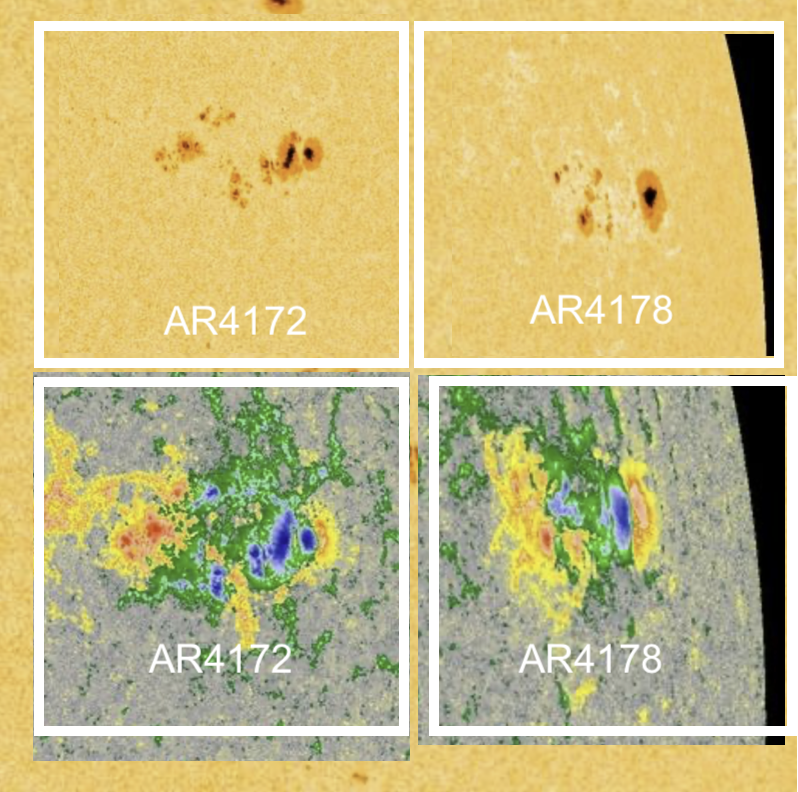
Sun news for August 13, 2025. With prolific sunspot region AR4168 gone, AR4172 and AR4178 seem to be stepping up to the plate. They’re showing promising magnetic complexity. HMI Intensitygram flattened and HMI colorized magnetogram. Image via SDO. Sun news August 13: Two sunspot regions take up the mantle
(11 UTC to 11 UTC)
With prolific sunspot region AR4168 now out of view, you’d think sun activity would be about to enter a lull. But the sun might have other ideas! Sunspot regions AR4178 and AR4172 are showing good potential to pick up where AR4168 left off. They both have promising beta-gamma configurations, and together produced 12 C flares over the past day, one of which was nearly an M flare. Meanwhile, although the large coronal hole that’s been buffeting Earth with solar wind is moving out of a geoeffective position, a new large coronal hole is forming in the northeast! It seems the sun has more action in store for us. Stay tuned.
- Flare number: Sun activity is back to low with 17 C-class (common) flares produced in the last 24 hours. The largest was a C8.4, not far from the M flare threshold. It was produced at 18:43 UTC on August 13 by AR4178 in the northwest. Another powerful C flare – a C7.7 – was blasted by an incoming as-yet-unnumbered region in the northeast at 11:53 UTC on August 12. The lead flare producer of the past day was AR4178 with seven C flares, followed by AR4172 with five C flares.
- Sunspot regions: The sun now has eight active regions on its Earth-viewed side. AR4178 developed a gamma complexity and joined AR4172 with a beta-gamma configuration. The rest of the regions are small and magnetically simple. There is a newcomer on the solar disk: AR4180 in the southeast.
- Blasts from the sun? No Earth-directed coronal mass ejections (CMEs) were observed in available coronagraph imagery over the past day.
- Solar wind: The coronal hole high-speed solar wind stream has started to wane, with speeds dropping down from an average of around 600 km/s during the period down to 519 km/s at the time of this writing (11 UTC on August 13). The interplanetary magnetic field (IMF) stayed weak, with the Bz component also weak, intermittently alternating between southward and northward. It is southward at the time of this writing. A southward Bz is more favorable for auroras.
- Earth’s magnetic field: Conditions were mostly unsettled to active during the past day (Kp = 2-3). A Kp = 3 is in place at the time of this writing (11 UTC on August 13).
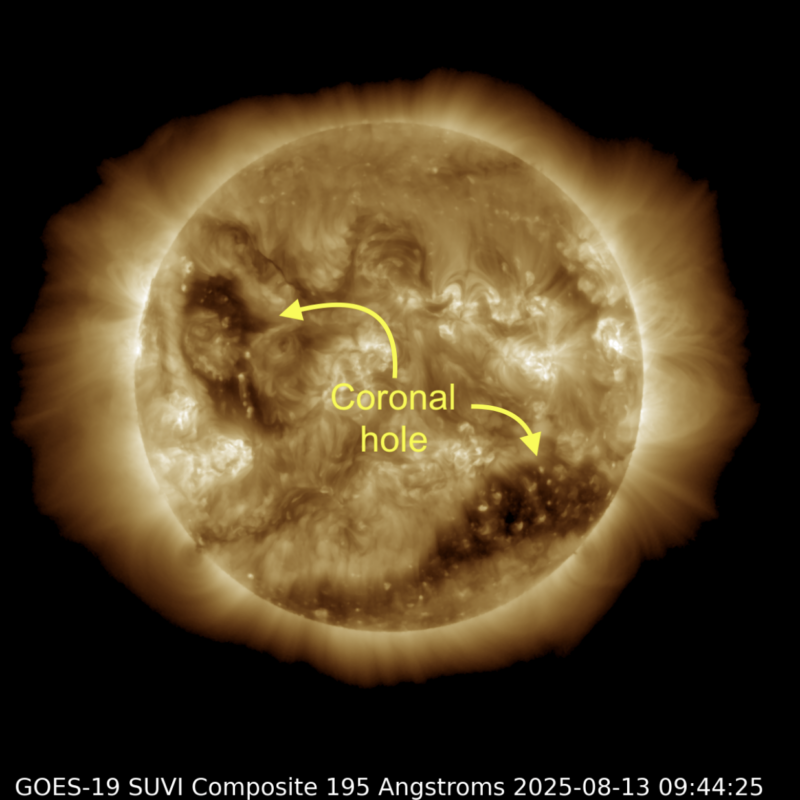
August 13, 2025. A new large coronal hole is forming in the northeast solar quadrant, while the large coronal hole we have been observing moves out of a geoeffective position in the southwest. GOES-19 SUVI 195 angstrom. Image via NOAA. 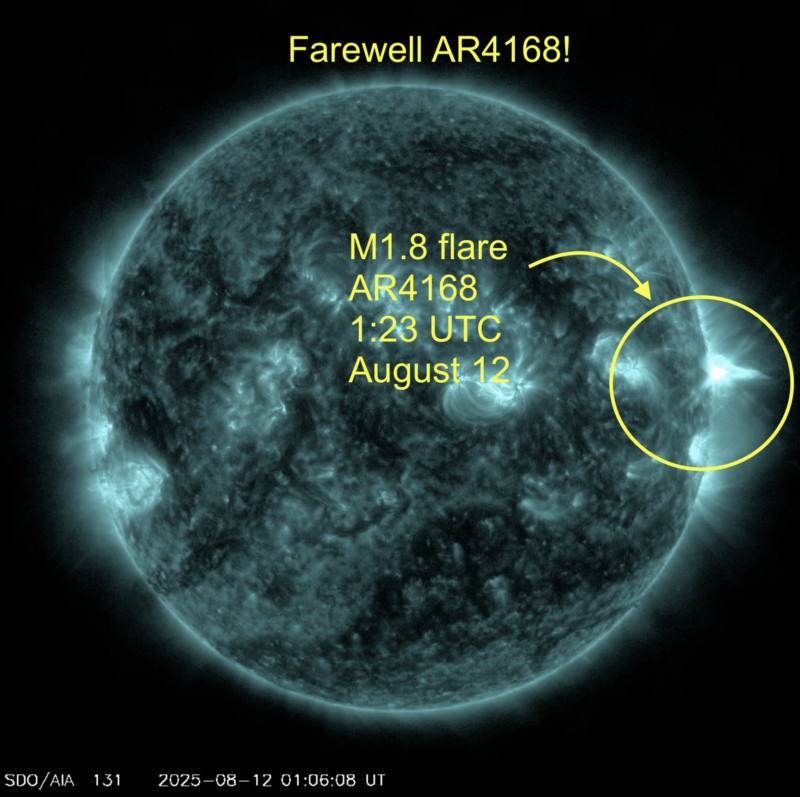
Sun news for August 12, 2025. Farewell AR4168! This prolific active region has rotated onto the far side of our star after more than a week of M (moderate) and C (common) flares. Before saying goodbye, it blasted out this M1.8 flare, the largest of the past day’s flares. AIA 131 angstrom. Image via SDO. Sun news August 12: Farewell prolific sunspot region AR4168!
(11 UTC to 11 UTC)
AR4168, the sunspot region behind much of the elevated solar activity in recent weeks, has now rotated out of view over the sun’s western horizon. It left with a bang, firing off five M (moderate) and 14 Cs (common) flares in the past 24 hours. And we’ve been observing jets and prominences on the western limb (edge) as AR4168 continues its prolific activity out of view. In fact, today’s largest flare – an M1.8 from this region – was likely even larger in reality, as the horizon blocked most of our view of this blast. Farewell AR4168!
- Flare number: AR4168 was by far the most productive region over the past day, stealing the show with five moderate flares plus another 14 C flares. The largest event was an M1.8 at 1:23 UTC on August 12. It provoked an R1 (minor) radio blackout that affected an area over the Philippine Sea. The sun produced a total of 22 flares: five Ms plus 17 Cs.
- Sunspot regions: The sun now has eight active regions on its Earth-viewed side. AR4172 has retained its beta-gamma configuration, while the rest of the regions are small and magnetically simple. There is a newcomer on the solar disk: AR4179, in the southeast.
- Blasts from the sun? No Earth-directed coronal mass ejections (CMEs) were observed in available coronagraph imagery over the past day.
- Solar wind: The coronal hole high-speed solar wind stream remains in force, with speeds averaging around 570 km/s during the period. It’s up to 602 km/s at the time of this writing (11 UTC on August 12). The interplanetary magnetic field (IMF) stayed weak, with the Bz component also weak, intermittently alternating between southward and northward. It is southward at the time of this writing. A southward Bz is more favorable for auroras.
- Earth’s magnetic field: Conditions were mostly unsettled to active during the past day (Kp = 2-4).

August 11, 2025. A huge filament in the southwest quadrant finally exploded, hurling a chunk of solar stuff (a coronal mass ejection, or CME) into space. Due to its southerly location, the plasma that was ejected is not coming Earth’s way. AIA 304 angstrom. Image via SDO. Sun news August 11: New view of a colossal solar blast
(11 UTC to 11 UTC)
The impressive geomagnetic storming we saw through the weekend has come to an end, with only a slight chance for short-lived G1 (minor) storms today. But, as history has shown us, you can’t rule out the sun to suddenly bring more action. Today, we’re looking back at one of the most noteworthy bursts of solar activity ever recorded: the solar storm of July 2012. NASA has released a new visualization of this storm (above), which consisted of 5 bursts of sun-stuff, or coronal mass ejections (CMEs). The largest of these was powerful enough to potentially disrupt power grids and satellite networks, leading scientists classify it in the same bracket as the Carrington Event of 1859, which was the strongest geomagnetic storm ever recorded. Thankfully, this huge 2012 CME didn’t reach Earth. But it did reach our sun-observing satellite STEREO-A, as you can see above. This CME benefitted from the 4 smaller CMEs that came before it, which cleared away the interplanetary material – largely dust, gas and plasma – in its path, letting it travel through space unusually quickly. And the most hair-raising part about this colossal event? Had it occurred just 9 days earlier, the rotation of the sun means that the CME would have headed straight for Earth!
- Flare number: Sunspot region AR4168 continues to dominate flare production with four moderate (M-class) events over the past day, despite showing signs of decay as it nears the sun’s western edge. The largest flare was an M2.3 at 15:07 UTC on August 10. This produced a CME, but analysis indicates it was not Earth-directed.
- Sunspot regions: Eleven regions are visible today. AR4168 remains the most prolific flare producer, though its magnetic details are now harder to assess as it moves off the visible solar disk. Growth has been observed in AR4172 (beta-gamma), AR4178 (beta) and AR4174 (beta) over the last day. A new active region is rotating into view on the southeast limb. The rest of the regions are small and magnetically simple.
- Blasts from the sun? Several coronal mass ejections (CMEs) occurred in the last day, but none appear to be Earth-directed.
- Solar wind: The coronal hole high-speed solar wind stream remains in force, with speeds holding between 550–580 km/s and trending slightly lower. The interplanetary magnetic field (IMF) stayed weak, with the Bz component also weak, occasionally dipping southward. A southward Bz is more favorable for auroras.
- Earth’s magnetic field: Conditions were mostly unsettled to active, with occasional G1 (minor) geomagnetic storm intervals (Kp 5) during the past day.

Sun news for August 10-11, 2025. Late last week, NASA released this new animation of a series of coronal mass ejections (CMEs) that occurred a little over 13 years ago, but which remain firmly in the memory of solar scientists. Between July 12 and August 1, 2012, the sun fired out 5 blasts of sun-stuff, culminating in an enormous Carrington-level event that just missed Earth. Find out more below. Images via NASA/ SVS. 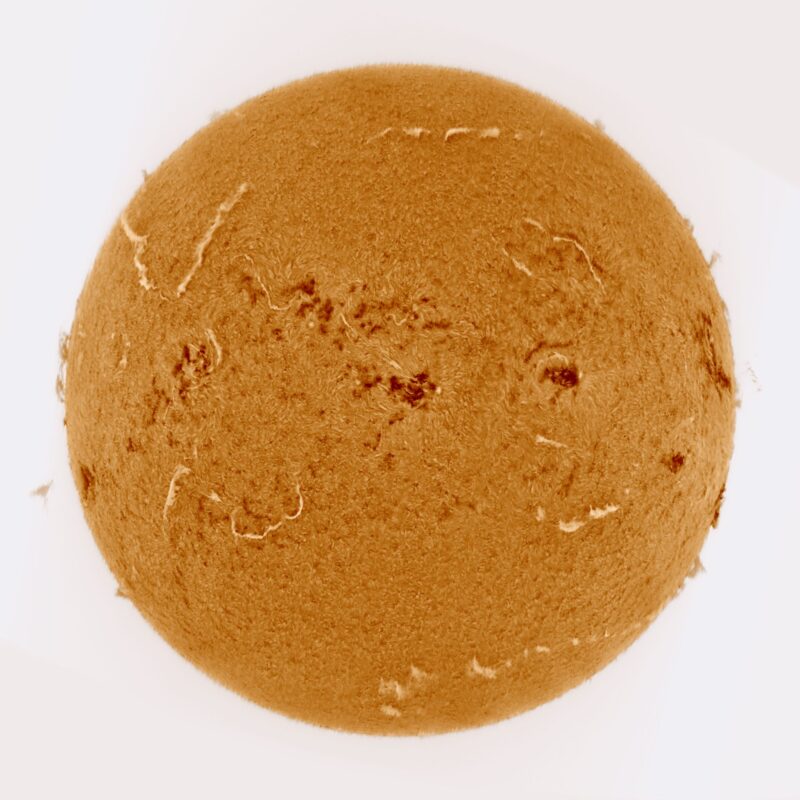
View at EarthSky Community Photos. | Mario Rana in Hampton, Virginia, captured this filtered image on August 10, 2025. Mario wrote: “Hydrogen-alpha image of the sun with some nice filaments and prominences.” Thank you, Mario! Sun news August 10: Storm easing, but auroras still possible
(11 UTC to 11 UTC)
Last night’s geomagnetic storm peaked at G2 (moderate) levels in the late afternoon UTC on August 9, fueled by the one-two punch of a coronal mass ejection (CME) from August 5 and a coronal hole high-speed stream. While conditions have eased, G1 (minor) storms are still possible today as the fast wind continues to buffet Earth’s magnetic field. The big question for aurora chasers: Will the fading storm still light up the skies tonight? There’s a decent chance, especially at higher latitudes, even with lingering moonlight from the August 8–9 full moon. Yes, you can still see auroras with a full moon!
- Flare number: Solar activity stayed at moderate levels thanks to three more M-class M-class bursts from powerhouse region AR4168. This time it was an M1.7 flare at 16:40 UTC on August 9, producing an R1 (minor) radio blackout. The largest event spot also contianed another M1.7 from AR4168 at 3:12 UTC on August 10, 2025. It created an R1 (minor) radio blackout. AR4168, now rotating toward the western limb, is showing signs of decay but remains the most active player. No Earth-directed CMEs were detected in the past day.
- Sunspot regions: Ten regions are visible today, with AR4178 newly numbered. AR4168 (beta-gamma) is still the largest but is losing intermediate spots. AR4172 in the northeast is slowly expanding. The rest are small and magnetically simple.
- Blasts from the sun? Several CMEs were spotted on coronagraph imagery, but none have a significant Earth-directed component.
- Solar wind: Conditions reflect the ongoing influence of a positive polarity high-speed stream. Wind speed rose from ~450 km/s early on August 9 to ~600 km/s by the UTC day’s end. The interplanetary magnetic field (IMF) weakened from 16 nT to ~6 nT, while the Bz component was strongly southward before 15:30 UTC, then trended neutral.
- Earth’s magnetic field: Activity ranged from unsettled to storm levels, with G1 (minor) storms through much of the day and a G2 (moderate) interval from 15:00–18:00 UTC. The forecast calls for active to G1 levels today, with the chance of another brief G2.
What’s ahead? Sun-Earth forecast
- Flare activity forecast: Moderate (M-class) flares remain likely (55%) over the next three days, mainly from AR4168, with a slight chance (10%) for strong (X-class) events. The flare risk should slowly decline as AR4168 rotates out of view.
- Geomagnetic activity forecast:
- Aug 10: Active to G1 (minor) storm levels likely, with a slight chance of a G2 (moderate) interval, due to ongoing high-speed stream influence and possible weak effects from an August 7 CME.
- Aug 11–12: Unsettled to active levels expected, with a slowly decreasing risk of G1 storms as solar wind speeds gradually decline.

Sun news for August 9-10, 2025. Active region, AR4168, has been the focus of attention for the last week. It has produced multiple M flares including two closer to M5 (high) size that produced coronal mass ejections (CME). One on August 5 reached Earth on Friday. This combined with high-speed solar wind from a coronal hole brought geomagnetic activity to Earth starting on Friday at the G1-G2 level. This created aurora at higher latitudes. The impact is waning but more minor aurora could be visible tonight. The sunspot region, AR4168, is fast approaching the western solar limb (edge) and will soon be out of our sight. It could still bring more activity and its location means a higher possibility of solar energetic particles should another punchy event occur. Images via NASA/SDO. 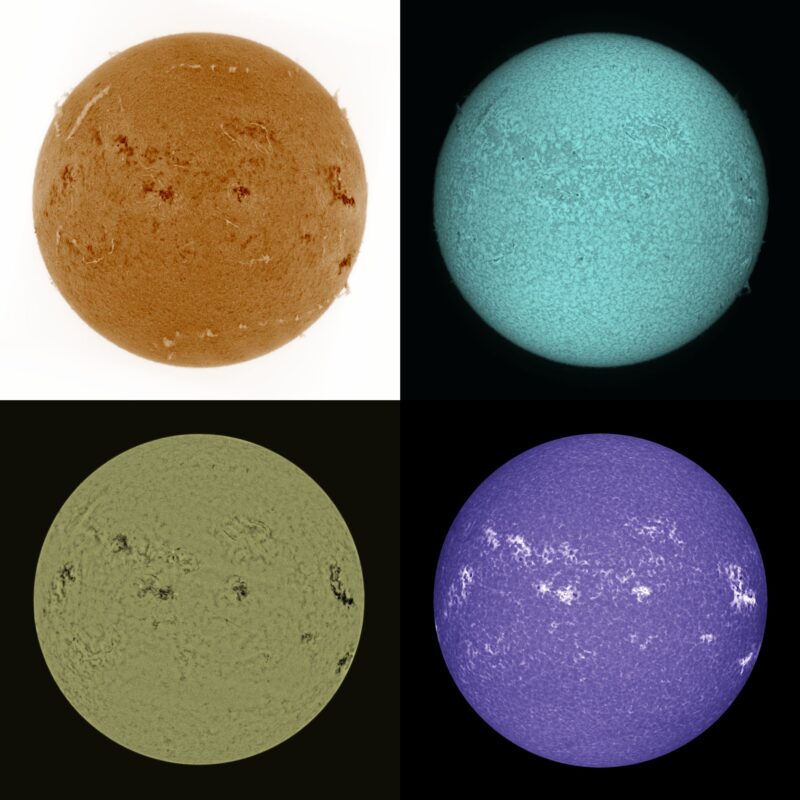
View at EarthSky Community Photos. | Mario Rana in Hampton, Virginia, captured these filtered images on August 9, 2025. Mario wrote: “The sun in various wavelengths: hydrogen-alpha, hydrogen-beta, helium D3, calcium-H.” Thank you, Mario! 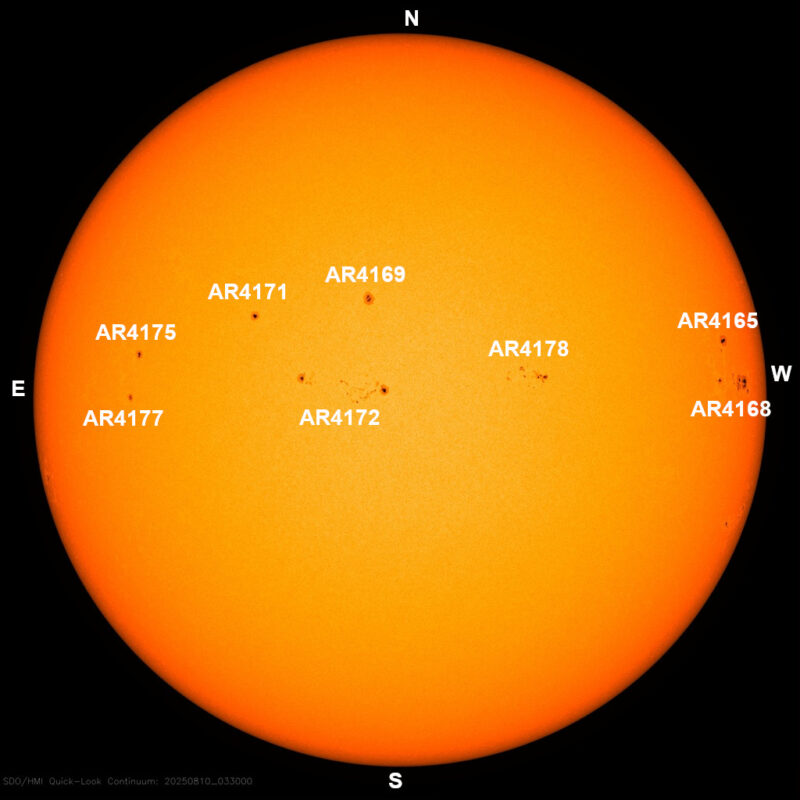
This image shows sun activity – with the most active regions labeled – as of 3 UTC on August 10, 2025. Original image, without labels, via NASA SDO. Courtesy of NASA/SDO and the AIA, EVE, and HMI science teams, with labeling by EarthSky. Today’s sun is posted by Armando Caussade. Why are east and west on the sun reversed? Sun news August 9: Big geomagnetic storm last night. More tonight?
(11 UTC to 11 UTC)
The much-anticipated coronal mass ejection (CME) that left the sun on August 5 finally made its arrival over the past day. It slammed into Earth, teaming up with a coronal hole high-speed stream to shake our magnetic field. The result? A G1 (minor) geomagnetic storm began at 12:00 UTC on August 8 and persisted for nearly the entire day, spanning five three-hour synoptic intervals. As of this writing, a G1 storm is still underway. Will the August 8–9 full moon wash out the auroras? Not necessarily—bright moons can’t fully dim a strong aurora display. Read more: Can you see an aurora borealis when there’s a full moon?
- Flare number: An M1.0 flare from active region AR4168 kept solar activity at moderate levels. This powerhouse region once again stole the show, unleashing a total of 11 flares, the one M and 10 C flares. The M flare happened at 19:10 UTC on August 8. It caused an R1 (minor) radio blackout over the Pacific Ocean west of Mexico. This same region, AR4168, is also the source of the incoming solar material that’s fueling our current G1 storm and boosting the chances for a G2 event this weekend. Auroras!
- There are 11 sunspot regions visible on the Earth-facing solar disk. AR4168 remains the largest and most magnetically complex, sporting a potent beta-gamma-delta configuration. AR4172 in the northeast maintains its beta-gamma complexity. The rest of the regions are either stable or decaying. Three new arrivals – all in the northeast quadrant – joined the lineup today. They’re now labeled AR4175, AR4176, and AR4177.
- Blasts from the sun? Experts did not detect any new coronal mass ejections (CMEs) aimed at Earth during this period.
- Solar wind: The solar wind picked up from 348 km/s to a peak of 554 km/s by 11 UTC on August 8, before easing to 465 km/s at the time of this update. The interplanetary magnetic field (IMF) remained at moderate strength, while the Bz component stayed strongly southward for most of the period, flipping briefly northward around 11 UTC, and ending the day back in the southward orientation.
- Earth’s magnetic field held at storm levels for nearly all of the last day. G1 (minor) storm conditions were logged during five three-hour synoptic intervals. Kp = 5 is ongoing at the time of this report (11 UTC, August 9).
What’s ahead? Sun-Earth forecast
- Flare activity forecast: The chance for M (moderate) flares is 60% today, with a 10% chance for X (strong) flares.
- Geomagnetic activity forecast:
- Aug 9: The geomagnetic field is expected to remain active at G1 (minor) storm levels for the rest of the day, with the combined push from the CME and coronal hole high-speed stream. G2 (moderate) conditions are possible.
- Aug 10: Activity should ease back to quiet to unsettled levels.
- Aug 11: Conditions are likely to stay quiet to unsettled, though residual fast wind effects could linger slightly.
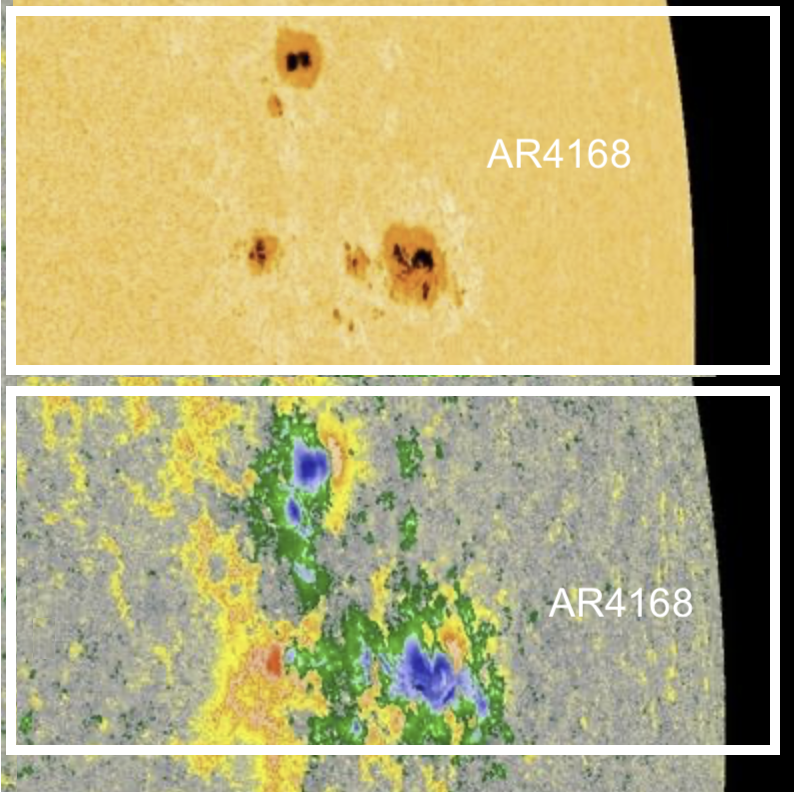
Sun news for August 8-9, 2025. Sunspot region AR4168 fired off a coronal mass ejection (CME) on August 5. That blob of sun stuff reached Earth yesterday, sparking a minor geomagnetic storm that stirred through the past 24-hours. The storming is ongoing and could possibly pick up. And AR4168 is not necessarily done. The region has produced other CMEs. And maybe we’ll see more before it rotates out of view. Images via NASA/SDO. 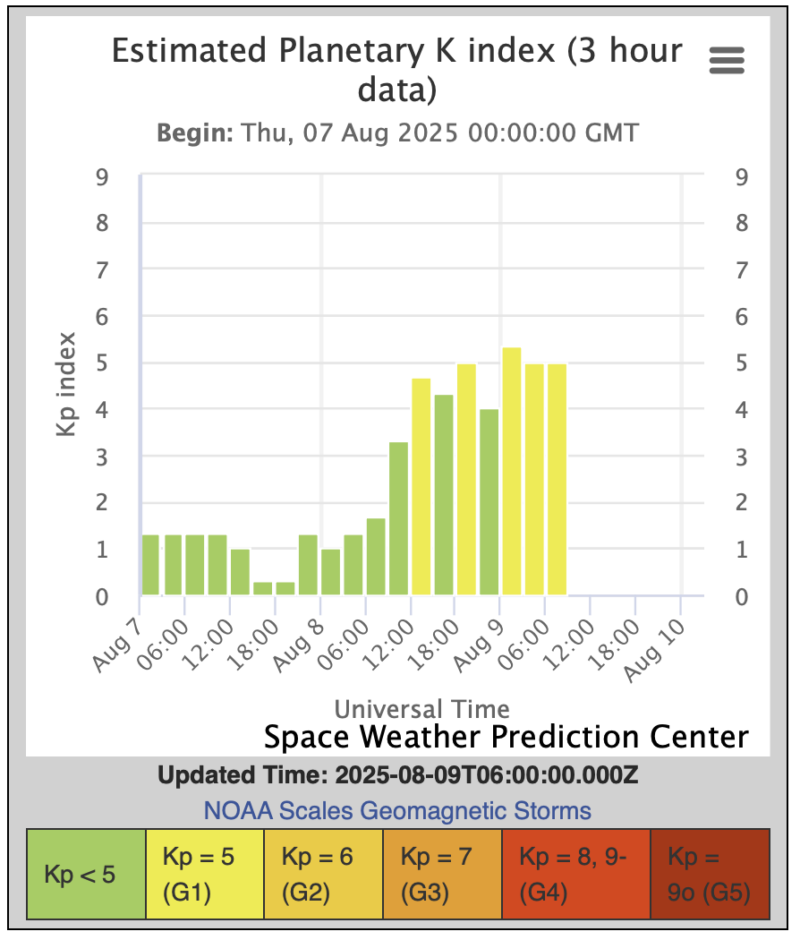
A look at the Kp index over the past 24-hours. Kp 5 is the minor geomagnetic storm (G1) scale. Images via NOAA. 
As AR4168 rotates toward the western limb it continues to fire off lots of flares. They are mostly minor C flares but the M flares continue. Stay tuned for more. Images via SDO 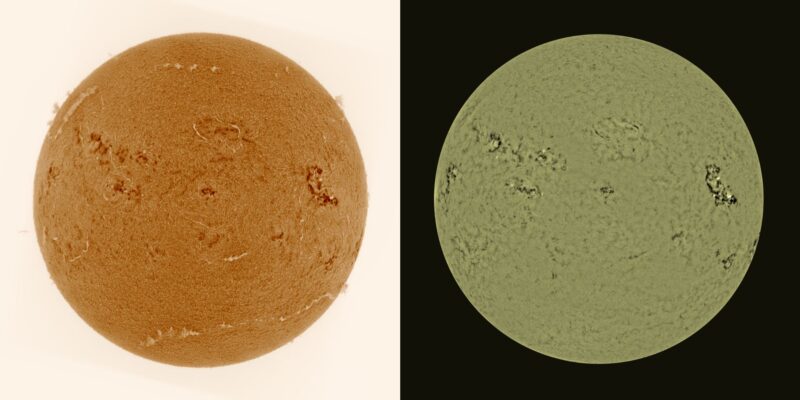
View at EarthSky Community Photos. | Mario Rana in Hampton, Virginia, captured these filtered images on August 8, 2025. Mario wrote: “The sun in hydrogen-alpha and helium D3.” Thank you, Mario! Sun news August 8: An aurora promise for the weekend?
(11 UTC to 11 UTC)
Solar wind speeds remain low for now, but that won’t last — a coronal mass ejection (CME) launch August 5 and a coronal hole high-speed stream (CH HSS) are both on the way. The coming 24–48 hours could get geomagnetically stormy! And that means a good opportunity for auroras. Over the past day, the sun delivered two more M-class flares. They were part of a string of M flares from AR4168. A long-duration M3.9 event fired another blob of sun stuff that is also, perhaps, headed our way. Will the August 8-9 full moon blot out the auroras? Contrary to what you might have heard, it’s possible to see auroras when there’s a bright moon, even a full moon, in the sky. But the auroral display itself must moderate to strong. Read more: Can you see an auroral borealis when there’s a full moon?
- Flare number: Two M flares from the powerhouse AR4168 gave us a solar déjà vu. That’s same region that sent the incoming sun-stuff our way, possibly bringing G1 or G2 geomagnetic storming for this weekend. Over the past day, AR4168 kept solar activity at moderate levels. And overall the sun produced 16 flares: 14 Cs and the two Ms mentioned above. The largest was the M3.9 flare mentioned above. It blasted out from AR4168 at 11:31 UTC on August 7. It triggered an R1 (minor) radio blackout that affected an area over northwest Africa. The second was an M2.8 at 3:53 UTC on August 8, also from AR4168. This time, the corresponding R1 (minor) event was over the Philippine Sea. AR4168 was the lead flare producer of the period, blasting out 12 flares in total — the two Ms plus 10 Cs.
- There are nine sunspot regions currently visible on the solar disk. AR4168 remains the largest in extent and the most magnetically complex, with a potent beta-gamma-delta configuration. Region AR4172 in the northeast is showing rapid flux emergence and now has beta-gamma complexity. Other regions are stable or in decay. A newcomer, just numbered AR4174, has also appeared on the solar disk.
- Blasts from the sun? Modeling and analysis show that the coronal mass ejection (CME) produced during the M3.9 flare event will mostly pass ahead of Earth. A possible glancing blow may occur on August 9 or 10, but chances are low. Meanwhile, the CME from the M4.4 flare is still on track and expected to arrive later on Friday (August 8). It might combine with a co-rotating interaction region (CIR), a complex knot of solar winds. Chances for geomagnetic activity are strong.
- Solar wind: Solar wind conditions were generally calm over the past day, averaging near 350 km/s. At the time of this writing, it remains at 348 km/s. The interplanetary magnetic field (IMF) jumped to moderate levels, and the Bz component was weakly fluctuating north to south, ending the period north-oriented.
- Earth’s magnetic field remained quiet, with Kp = 1–2 conditions over the last 24 hours. Kp = 2 at the time of this writing as of 11 UTC on August 8.

The coronal hole helping to drive the expected geomagnetic activity and aurora has moved into to primetime position. Now we wait to see if it lives up to the expected G2 storm or maybe even a G3. Images via NASA/SDO. Sun news August 7: Sun-stuff on its way to Earth! Auroras incoming?
(11 UTC to 11 UTC)
It’s confirmed: the powerful flare we mentioned yesterday did send out a burst of sun-stuff (a coronal mass ejection, or CME), and it’s on track to reach Earth. It’s expected to arrive around 18:00 UTC tomorrow, triggering up to G3 (strong) geomagnetic storms and likely bringing auroras to high latitudes. Clear skies, everyone!
- Flare number: Two new M-class flares from the powerhouse AR4168 — the same region that sent the incoming sun-stuff our way — kept solar activity at moderate levels today. The sun produced 19 C-class flares and two M-class flares over the past 24 hours. The largest was an M2.2 from AR4168 at 2:32 UTC today, August 7. This region also produced an M1.0 at 17:02 on August 6, as well as the majority of C-class activity. AR4167 and AR4170 also contributed with a few smaller flares.
- There are nine sunspot regions currently visible on the solar disk. AR4168 remains the most magnetically complex, with a potent beta-gamma-delta configuration. Region AR4172 in the northeast is showing rapid flux emergence and now has beta-gamma complexity. Other regions are stable or in decay, with a new region (AR4173) just numbered.
- Blasts from the sun? No new Earth-directed coronal mass ejections (CMEs) were observed during the past 24 hours. However, a CME that blasted out on on August 5 with the M4.4 flare is still on track and expected to arrive tomorrow. It may combine with a co-rotating interaction region (CIR) – a complex knot of solar winds – ahead of a high-speed solar wind stream, boosting chances for geomagnetic activity.
- Solar wind: Solar wind conditions were generally calm over the past day. Speeds ranged from 400–450 km/s, averaging near 420 km/s. The interplanetary magnetic field (IMF) was weak, and the Bz component was weakly variable, oscillating between north and south.
- Earth’s magnetic field remained quiet, with Kp = 1–2 conditions over the last 24 hours. Conditions are expected to stay quiet today, but a strong geomagnetic response is possible tomorrow when solar wind and CME effects arrive.
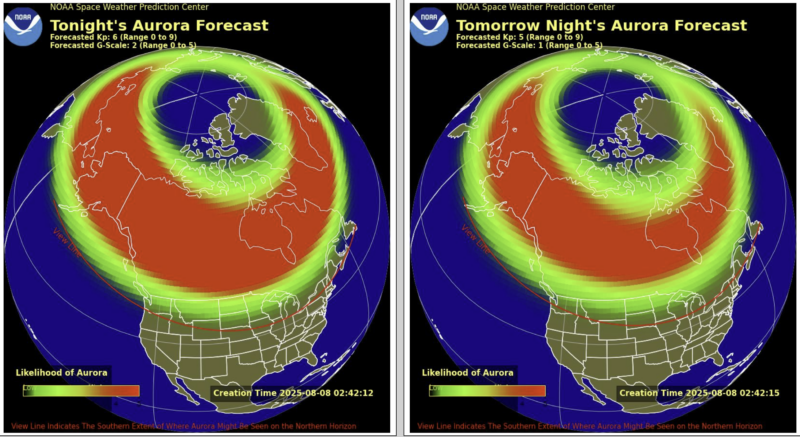
Sun news for August 7-8, 2025. A fast solar wind stream from a coronal hole – combined with a solar CME launched on August 5 – should bring geomagnetic activity and auroras over the weekend. A G2 geomagnetic watch has been issued for Friday night (August 8), and it could even jump to a G3! If so, we might see auroras well into the northern U.S. states and northern Europe. Will it deliver? Time will tell. Images via NOAA 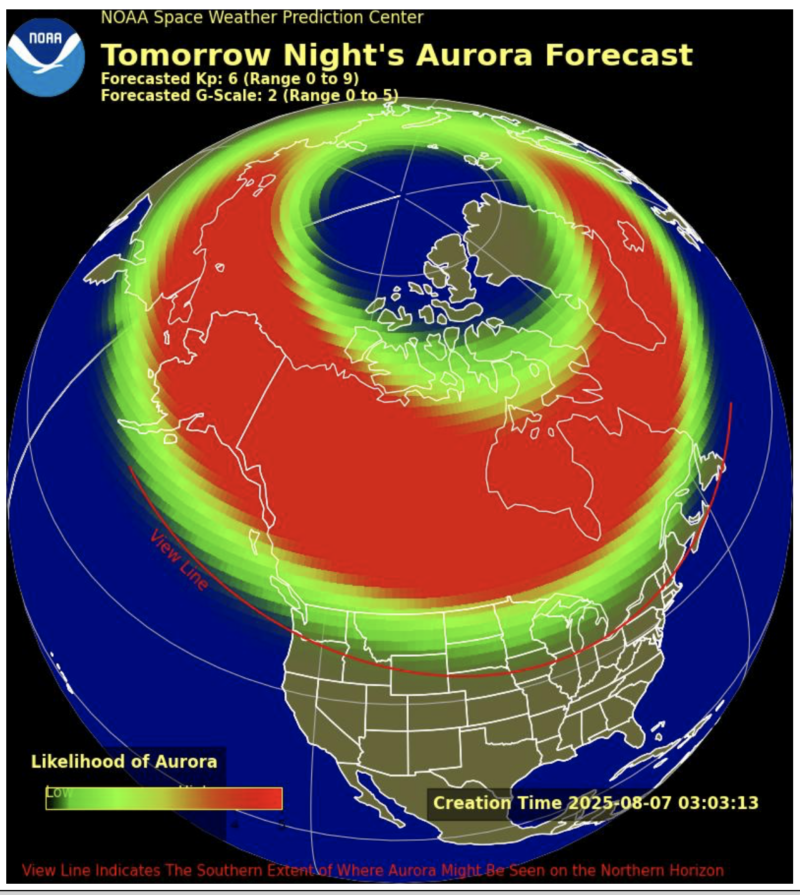
Sun news for August 7-8, 2025. The coronal mass ejection (CME) from yesterday’s M4.4 flare is anticipated to reach Earth around 18:00 UTC tomorrow, August 8. This is expected to trigger G1-G2 (minor-moderate) geomagnetic storms, but G3(strong) storming is possible. And this means likely auroras at high latitudes! Images via NOAA. 
AR4168 continues to produce small M-class flares, keeping activity levels at moderate. The region remains complex, and given its current position it still has potential to send another CME our way. Images via NASA/SDO. 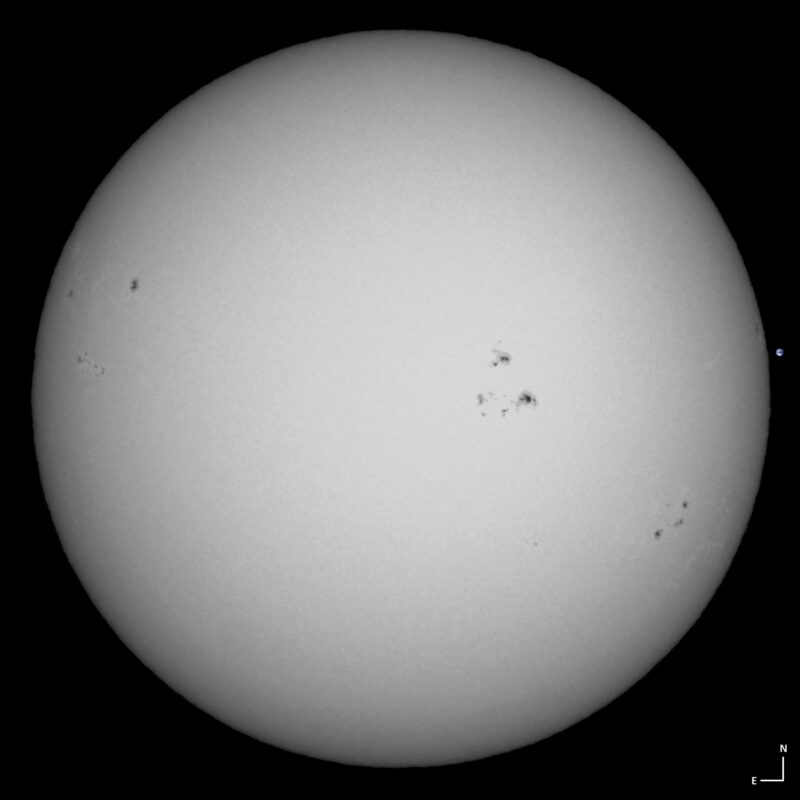
View at EarthSky Community Photos. | Patricio León in Santiago, Chile, captured this filtered image of the sun on August 6, 2025. Patricio wrote: “Active sun. Another M-class flare today, plus two almost-M C flares from very active AR4168. More sunspots entering the east. Stay tuned.” Thank you, Patricio! Sun news August 6: Powerful flare might have sent sun-stuff our way!
(11 UTC to 11 UTC)
We mentioned yesterday that volatile sunspot region AR4168 could soon send a blast of sun-stuff our way … and it seems it’s delivered already! It fired a powerful M4.4 flare at 15:53 UTC yesterday, and all indications suggest this launched out a burst of sun-stuff (a coronal mass ejection, or CME). Since this region is sitting near the center of the solar disk, there’s a good chance this potential CME will be heading toward Earth. If so, we could see up to G3 (strong) geomagnetic storms in a few days. Stay tuned!
- Flare number: Solar activity remained at moderate levels, though it would be classified as high if the M4.4 flare had reached the M5 threshold. On top of the M flare, we observed 24 C-class flares over the past 24 hours. The M4.4 from AR4168 was accompanied by a Type II radio burst, a Tenflare, and plasma dimming, all of which point to a likely coronal mass ejection (CME). The flare also triggered a brief R1 (minor) radio blackout on Earth. AR4168 remains magnetically complex (beta-gamma-delta) and continues to grow. It produced the bulk of the day’s flare activity again. AR4167, although large, remained relatively quiet with just a three C-class flares. AR4167 and AR4170 show beta-gamma complexities.
- There are six sunspot regions currently visible on the Earth-facing disk. AR4168 dominates both in size and complexity with its delta magnetic structure. AR4165 showed trailing spot growth, and a new region in the southwest is rapidly emerging in a circular configuration, suggesting potential for future flares. A new region on the northeastern limb (edge) has also appeared, but remains unclassified for now.
- Blasts from the sun? A coronal mass ejection (CME) was likely produced with the M4.4 flare. Coronagraph images suggest a shock with a small driver, indicating possible Earth-directed components. The CME is still under analysis, with forecasters currently considering a potential arrival late on August 8. No other Earth-directed CMEs were observed during the period.
- The solar wind continued to ease under the declining influence of a coronal hole’s high-speed stream. Speeds averaged near 460 km/s, but dropped to ~400 km/s later in the period. The interplanetary magnetic field (IMF) remained weak, and the Bz component fluctuated weakly between northward and southward.
- Earth’s magnetic field remained mostly quiet to unsettled over the past 24 hours (Kp = 1–3). It is at Kp = 1 at the time of this writing.

Sun news for August 5-6, 2025. Bam! An M4.4 flare has raised activity to just shy of high. The flare came from volatile region AR4168, which is sitting near the center of the solar disk. Though still under analysis, all indications suggest that the eruption fired off a coronal mass ejection (CME) that should be headed our way. Images via NASA/SDO. 
Prominent prominences, simultaneously extending from the east and west solar limbs. Images via NOAA/GOES. Sun news August 5: Flaring on the rise with another M flare
(11 UTC to 11 UTC)
Solar activity continues to surge, with the sun blasting another M flare over the past day. Leading this jump in activity is sunspot region AR4168, which blasted an M1.2 flare in the early hours of this morning as well as an impressive 14 C flares in the past 24 hours. This sunspot group has a volatile delta region, meaning it has good potential to fire more Ms and even X flares. Plus, it’s currently near the center of the solar disk, so any sun-stuff it blasts out should head straight to Earth. Stay tuned!
- Flare number: Solar activity is moderate, with 21 C-class flares and an M-class flare produced during the past 24 hours. The largest event of the period was an M1.2 flare blasted out at 2:12 UTC on August 5 by active region AR4168, now located almost at the center of the solar disk as seen from Earth. Shortly after the M flare, an R1 (minor) radio blackout affected an area over the Philippine Sea. AR4168 was the lead flare producer of the period, with 15 flares: the abovementioned M plus another 14 C flares.
- There are five sunspot regions currently visible on the Earth-facing disk. AR4168 and AR4167 are the most magnetically complex. AR4168 developed a delta region and now shows beta-gamma-delta magnetic complexity, meaning it holds the potential for more M (moderate) and even X (strong) flares. AR4167 now shows a beta-gamma complexity. Meanwhile, the others are stable or in decay. The sunspot region in the northeast we mentioned yesterday has rotated into view and been numbered AR4169.
- Blasts from the sun? No Earth-directed coronal mass ejections (CMEs) were observed in available coronagraph imagery during the period. Today’s M1.2 flare is under modeling and analysis to determine if the CME it produced is heading our way.
- The solar wind speeds averaged around 370 km/s over the period. However, an enhancement arrived around 21:00 UTC on August 4, peaking at 611 km/s, likely from a coronal hole high-speed stream. The solar wind speed is at 360 km/s at the moment of this writing. The interplanetary magnetic field (IMF) is back to a low level, with the Bz component southward for most of the period but slowly moving north at 9 UTC this morning.
- Earth’s magnetic field ranged from quiet to unsettled levels in the past 24 hours (Kp = 1-3). The geomagnetic field is at Kp = 1 at the time of this writing (11 UTC on August 5).
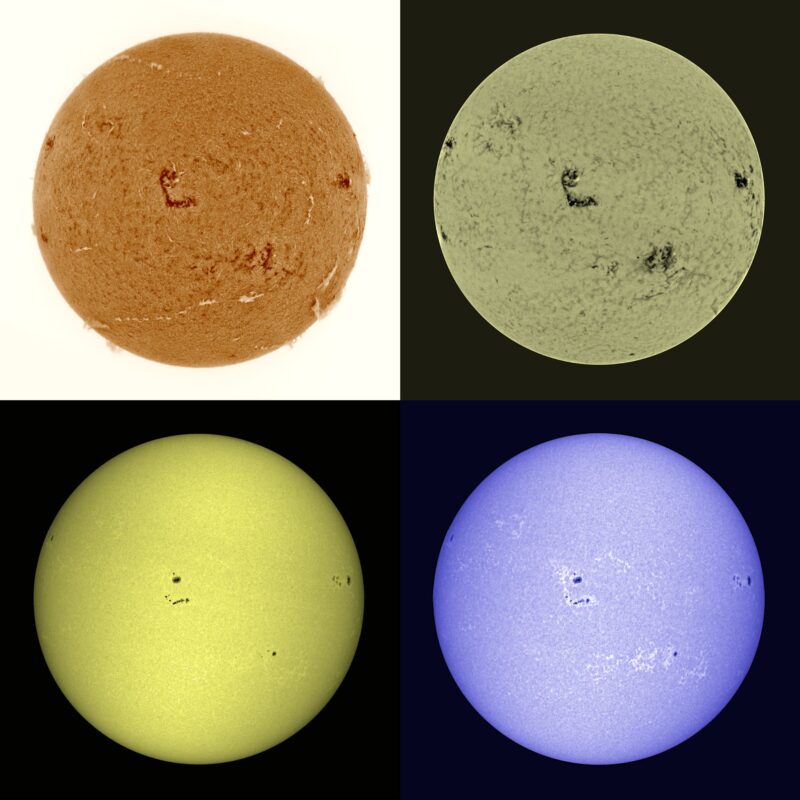
View at EarthSky Community Photos. | Mario Rana in Hampton, Virginia, captured these filtered images on August 4, 2025. Mario wrote: “The sun in various wavelengths: hydrogen-alpha, helium D3, iron 5883.82 Å, and G-band.” Thank you, Mario! Sun news August 4: Action kicks up with M flares and sun-stuff blasts
(11 UTC to 11 UTC)
A trio of M flares, along with 17 C flares, have brought solar activity up to moderate. Plus, two coronal mass ejections (CMEs) are on a course for Earth, with the potential to deliver glancing blows on August 5–6. This might bring G1 (minor) geomagnetic storms and enhanced auroral activity. Watch the skies and stay tuned for updates!
- Flare number Solar activity has risen to moderate levels, with 17 C-class flares and three M-class flares recorded over the past 24 hours. The most energetic event was the M2.9 flare from AR4168, which is showing increasing complexity. In total, three major active regions contributed to the flare activity:
- AR4168 (northeast): produced the M2.9 flare and showed strong growth, currently showing a delta configuration.
- AR4167 (northwest): still large and complex but showing early signs of decay.
- AR4157 (southwest limb): produced a notable C6.8 flare before rotating out of view.
- There are four sunspot regions currently visible on the Earth-facing disk. There is one more about to rotate into view on the northeast limb. AR4168 and AR4167 are the most magnetically complex, while the others are stable or in decay.
- Blasts from the sun? Two coronal mass ejections (CMEs) may have Earth-directed components. They came from the following events:
- A filament eruption near the north-central solar disk around 4:15 UTC on August 3.
- An M2.9 flare from AR4168 around 13:57 UTC on August 3.
No LASCO data from the SOHO spacecraft is currently available due to an outage, making CME prediction difficult. Glancing blows from either CME could arrive late August 5 to early August 6, albeit with low confidence in both timing and impact. No other Earth-directed coronal mass ejections (CMEs) were observed in available coronagraph imagery during the period.
- The solar wind began the observation period near background levels, with speeds around 400 km/s. However, an enhancement arrived around 17:00 UTC on August 3, likely from a coronal hole high-speed stream. Wind speeds peaked at 575 km/s, and the interplanetary magnetic field (IMF) strengthened slightly, with the Bz component dipping southward briefly.
- Earth’s magnetic field ranged from quiet to active in the past 24 hours (Kp = 1-4). This response is consistent with modest southward IMF conditions and elevated wind speeds. The geomagnetic field is unsettled (Kp = 3) at the time of this writing (11 UTC on August 4).

Sun news for August 3-4, 2025. Solar activity increased to moderate thanks in part to an M2.9 flare from AR4168. The region also produced a CME that may glance Earth on August 5-6, bringing a G1 (minor) geomagnetic storm and elevated chances for auroral sightings. Images via NASA/SDO and JHelioviewer. 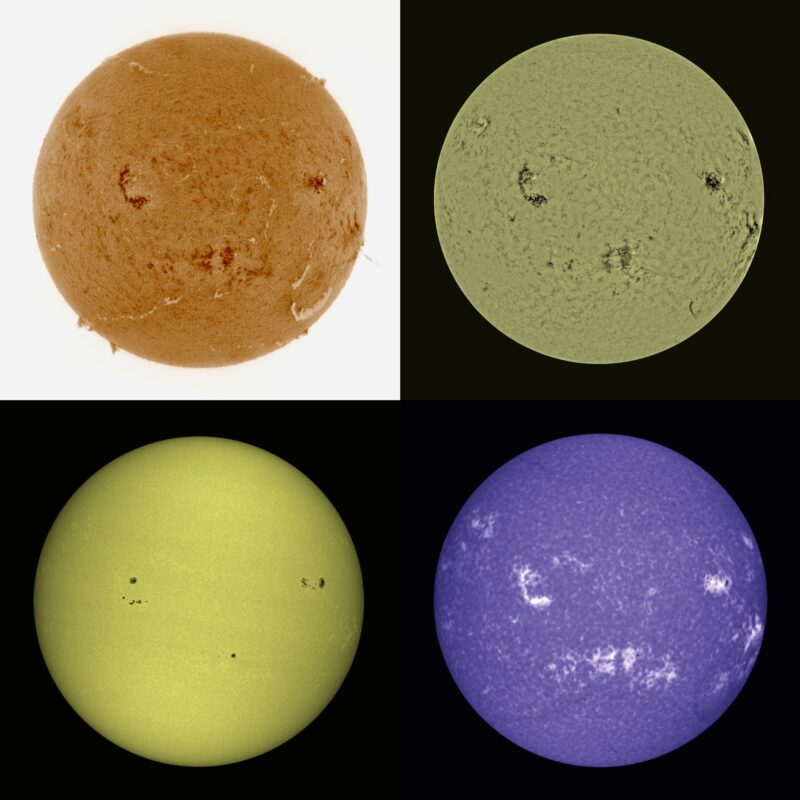
View at EarthSky Community Photos. | Mario Rana in Hampton, Virginia, captured these filtered images on August 3, 2025. Mario wrote: “The sun in various wavelengths: hydrogen-alpha, helium D3, iron 5883.82 Å, and calcium-H. I happened to catch a flare on the southwest limb.” Thank you, Mario! Sun news August 3: C-flares numbers spike up to 28!
(11 UTC to 11 UTC)
Sun activity has been low this week and remains low. But C-flare activity has surged. In the past day, the sun produced 28 C-class flares, a dramatic uptick from previous days. The largest of these was a C4.3 flare from AR4168 at 2:45 UTC on August 3. This region was only recently numbered and is rapidly developing in the sun’s northeast. It might become a key player in the days ahead. Meanwhile, sunspot region AR4167 in the northwest continues to grow and remains the largest and most magnetically complex region on the disk. It produced multiple C flares in the past day, too.
- Flare number jumped significantly over the past 24 hours, while flare strength remained low, as described above. The 28 C-flares of the past day mark the highest flare production in several days, signaling growing solar tension that could lead to stronger flares soon.
- There are seven sunspot regions currently visible on the Earth-facing disk. The most prominent, AR4167 in the northwest, is both the largest and most magnetically complex (beta-gamma configuration), continuing to grow with additional intermediate spots. In the northeast, AR4168 has emerged as a fast-growing and increasingly complex region, now showing strong flare potential. The remaining sunspot regions are smaller, magnetically simple, and either stable or showing signs of decay.
- Blasts from the sun? No Earth-directed coronal mass ejections (CMEs) were observed in available coronagraph imagery during the period.
- Solar wind conditions remained slightly elevated due to lingering influence from a coronal hole high-speed stream (CH HSS). Solar wind speeds varied between 440–555 km/s, while the interplanetary magnetic field (IMF) strength remained average. The Bz component briefly dipped southward, but mostly fluctuated northward and southward. Conditions are gradually trending back toward background levels.
- Earth’s magnetic field was quiet to unsettled in the past day (Kp = 2-3), typical of moderate solar wind interaction. It is at Kp = 1+ at the time of this writing (11 UTC on August 3).
What’s ahead? Sun-Earth forecast
- Flare activity forecast: The chance for M (moderate) flares is 35% today, and the chance for X (strong) flares is 5% today.
- Geomagnetic activity forecast: Geomagnetic conditions should be mostly quiet to unsettled today, August 3, as solar wind influence continues to wane. However, a new coronal hole high-speed stream is anticipated to reach Earth by August 4, bringing a chance for active geomagnetic conditions and a slight chance of a G1 (Minor) geomagnetic storm. Effects may linger into August 5 before diminishing.
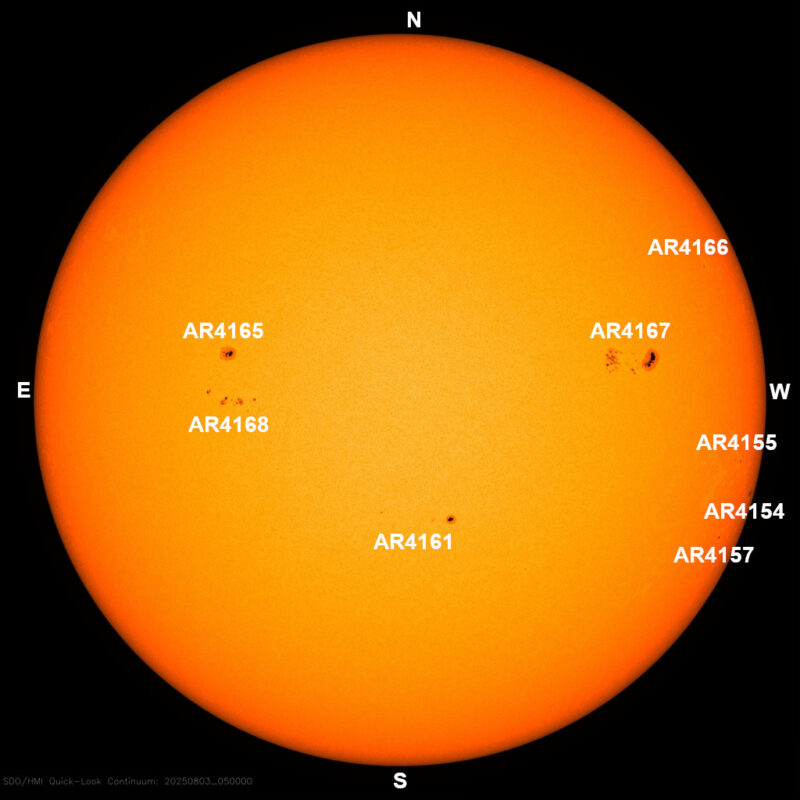
This image shows sun activity – with the most active regions labeled – as of 5 UTC on August 3, 2025. Original image, without labels, via NASA SDO. Courtesy of NASA/SDO and the AIA, EVE, and HMI science teams, with labeling by EarthSky. Today’s sun is posted by Armando Caussade. Why are east and west on the sun reversed? Sun news August 2: More action on the sun’s edges.
(11 UTC to 11 UTC)
While solar flare activity remains quiet, the limbs of the sun are where the real action is happening. Two prominences put on a show: The first appeared as an arched prominence on the eastern horizon around 17:00 UTC on August 1—a region rotating into view soon. The second was a filament eruption near the solar north pole, which lifted off at 07:40 UTC on August 2. Both ejections sent plasma flying into space, but neither is Earth-directed, as they occurred too far east and north, respectively. Still, these limb eruptions are often a sign of incoming active regions, so we’ll be keeping a close watch.
- Flare activity Still at low levels, with only eight C flares recorded over the past 24 hours. Two C3.4 flares were the largest: One from AR4153 at 12:39 UTC and another from AR4155 at 18:17 UTC, both on August 1. AR4153 was again the most active region, producing five C-class flares during the period.
- There are seven sunspot regions currently visible on the Earth-facing disk. The spotlight is on AR4167, which has developed a beta-gamma magnetic complexity, making it slightly more complex and potentially more flare-capable. All other regions remain simple (alpha or beta) and are either stable or in decay, suggesting a calm solar to come.
- Blasts from the sun? A coronal mass ejection (CME) was observed during the C3.4 flare from AR4153, but initial analysis suggests it will miss Earth. No other CMEs were observed in available coronagraph imagery during the past 24 hours.
- Solar wind speeds averaged around 500 km/s (1,118,000 mph) over the past 24 hours, with several peaks of 540 km/s (1,208,000 mph) during all the period. At the time of this writing (11 UTC on August 1) the solar wind speed dropped down to 452 km/s (1,011,000 mph). The interplanetary magnetic field (IMF) strength remained at a low level. The Bz component, which helps determine how much solar wind can enter Earth’s magnetosphere, kept fluctuating. Half of the period it was northward and the other half southward. It moved south at the time of this writing. A southward Bz is favorable for auroras.
- Earth’s magnetic field was mostly unsettled (Kp = 2-3) in the past 24 hours. It is at Kp = 2 at the time of this writing (11 UTC on August 2).

Sun news for August 1-2, 2025. Sun activity is on the edges during the past day. The east horizon granted us with this gorgeous arching prominence. This is action moving into view carried by the sun rotation. GOES-19 SUVI 304 angstrom. Image via NOAA. 
August 2, 2025. A lifting filament erupted in the northwest close to the solar north pole. The event produced a beautiful prominence. Most of the ejecta hurled during the eruption returned back to the sun. GOES-19 SUVI 304 angstrom. Image via NOAA. Sun news August 1: Solar southwest continues hurling plasma
(11 UTC to 11 UTC)
The southwest quadrant of the sun continues to show signs of activity, even as overall flare production remains low. At around 6:00 UTC on August 1, the sun hurled a blob of plasma into space from the vicinity of active region AR4154. Meanwhile, AR4153 remained lively, too, producing several small jets throughout the day. Just another day on our dynamic star. Stay tuned for more.
- Flare activity stayed at low levels over the past 24 hours, with the sun producing 11 faint C flares. The largest event was a C2.4 flare from active region AR4149 in the northwest. It occurred at 3:39 UTC on August 1. AR4153 occupies the place of lead flare producer of the past day, with four C flares.
- There are eight sunspot regions visible on the Earth-facing solar disk. All the labeled active regions have simple alpha or beta magnetic configurations and are either stable or in decay, suggesting a calm day to come. There is a newcomer, now labeled AR4167, in the northwest.
- Blasts from the sun? The filament eruption observed yesterday in the northeast was largely reabsorbed by the sun, with most of the ejected plasma falling back. No coronal mass ejections (CMEs) were observed during the past day.
- Solar wind speeds averaged around 450 km/s (1,007,000 mph) over the past day, with peaks of 540 km/s (1,208,000 mph) at 6 UTC on August 1. At the time of this writing (11 UTC on August 1) the solar wind speed is 462 km/s (1,033,000 mph). The interplanetary magnetic field (IMF) strength remained at a low level. The Bz component, which helps determine how much solar wind can enter Earth’s magnetosphere, kept moving intermittently between north and south. It is northward at the time of this writing. A southward Bz is favorable for auroras.
- Earth’s magnetic field was mostly unsettled (Kp = 2-3) in the past day. It is at Kp = 3 at the time of this writing (11 UTC on August 1).
What’s ahead? Sun-Earth forecast
- Flare activity forecast: The chance for M (moderate) flares is 30% today, and the chance for X (strong) flares is 5% today.
- Geomagnetic activity forecast: Quiet-to-unsettled conditions are anticipated today, August 1, as effects of the solar wind from a coronal hole in the sun’s northern hemisphere starts to wane (the hole moved out of geoeffective position). Conditions should return to quiet on August 2, but August 3 might see unsettled-to-active conditions with a glancing blow by a CME hurled by the sun on July 30.

Sun news for July 31-August 1, 2025. Over the past day, the sun hurled plasma – superheated, ionized gas, a key component of the solar wind – into space, from near sunspot region AR4154. And AR4153 continued to spray out jets of plasma. Images via NASA/SDO 
The NOAA GOES-19 extreme-ultraviolet instrument, SUVI, provided an additional view to all the activity in the sun’s southwest. SUVI provides a similar view to SDO in the 304-angstrom wavelength channel. The detail is not as high, but the field-of-view extends farther way from the solar surface. Images via NOAA/GOES
Like what you read?
Subscribe and receive daily news delivered to your inbox.
More from
C. Alex Young


Sun news: See a huge solar eruption

Yes, there’s an aurora season, and it’s here
Sun activity archive for September 2026
Sun activity archive for August 2026